Department of Petrochemical Engineering
Dr. Babasaheb Ambedkar Technological University,
Lonere - 402103
A
Mini Project Presentation
On
Troubleshooting of Pumps
Presented by,
OM A Zavare (10303320181152713001)
Under the Guidance of
Prof. Harshada Jadhav
CONTENTS
• What is a Pump?
• Literature Review
• Classification of Pumps.
• Types of Pumps.
• Problems and Their Solutions
• Conclusion.
• Reference.
2
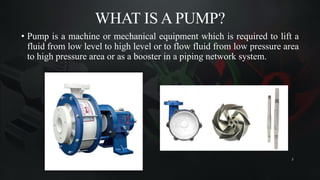
WHAT IS A PUMP?
• Pump is a machine or mechanical equipment which is required to lift a
fluid from low level to high level or to flow fluid from low pressure area
to high pressure area or as a booster in a piping network system.
3
4
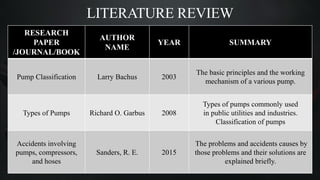
RESEARCH
PAPER
/JOURNAL/BOOK
AUTHOR
NAME
YEAR SUMMARY
Pump Classification Larry Bachus 2003
The basic principles and the working
mechanism of a various pump.
Types of Pumps Richard O. Garbus 2008
Types of pumps commonly used
in public utilities and industries.
Classification of pumps
Accidents involving
pumps, compressors,
and hoses
Sanders, R. E. 2015
The problems and accidents causes by
those problems and their solutions are
explained briefly.
LITERATURE REVIEW
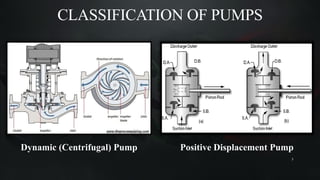
CLASSIFICATION OF PUMPS
5
Dynamic (Centrifugal) Pump Positive Displacement Pump
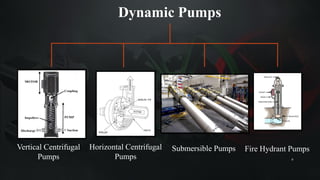
Dynamic Pumps
6
Vertical Centrifugal
Pumps
Horizontal Centrifugal
Pumps
Submersible Pumps Fire Hydrant Pumps
7
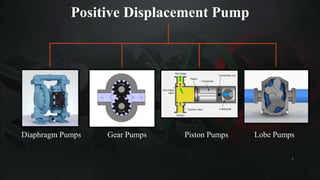
Positive Displacement Pump
Diaphragm Pumps Gear Pumps Piston Pumps Lobe Pumps
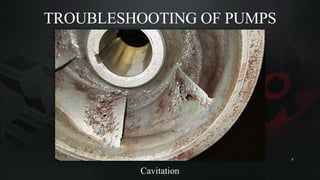
TROUBLESHOOTING OF PUMPS
Cavitation
8
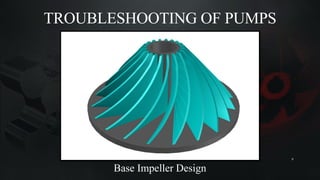
TROUBLESHOOTING OF PUMPS
9
Base Impeller Design
TROUBLESHOOTING OF PUMPS
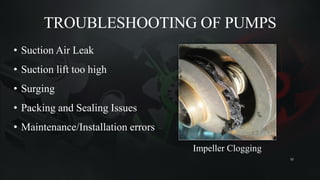
• Suction Air Leak
• Suction lift too high
• Surging
• Packing and Sealing Issues
• Maintenance/Installation errors
10
Impeller Clogging
CONCLUSION
• Centrifugal pumps are best suited for large volume applications or for
smaller volumes.
• Reciprocating Pumps require more frequent maintenance than centrifugal
pumps due to the design of the moving parts.
• A step-by-step procedure, adopted in troubleshooting pump and / or
system helps in easily locating the problem and in finding appropriate
solution.
• Consistent and Systematic maintenance of pipes, pumps and other
equipment is essential.
11
REFERENCE
1. “Pumps” - E.W. McAllister, Pipeline Rules of Thumb Handbook (Sixth Edition), 2005, Pages 417-
474, DOI: 10.1016/B978-075067852-0/50014-9.
2. “Pump classification” - Bachus, Larry & Custodio, Angel. (2003). DOI: 10.1016/B978-185617409-
1/50007-4.
3. “Pump types” - Handbook of Pumps and Pumping, (2006), 1–54 DOI:10.1016/b978-185617476-
3/50003-2
4. “Accidents involving pumps, compressors, and hoses” - Roy E. Sanders, Chemical Process Safety
(Fourth Edition), Butterworth-Heinemann, 2015, Pages 235-267, DOI: 10.1016/B978-0-12-801425-
7.00009-1
12
13

Troubleshooting of pumps

  • 1.
    Department of PetrochemicalEngineering Dr. Babasaheb Ambedkar Technological University, Lonere - 402103 A Mini Project Presentation On Troubleshooting of Pumps Presented by, OM A Zavare (10303320181152713001) Under the Guidance of Prof. Harshada Jadhav
  • 2.
    CONTENTS • What isa Pump? • Literature Review • Classification of Pumps. • Types of Pumps. • Problems and Their Solutions • Conclusion. • Reference. 2
  • 3.
    WHAT IS APUMP? • Pump is a machine or mechanical equipment which is required to lift a fluid from low level to high level or to flow fluid from low pressure area to high pressure area or as a booster in a piping network system. 3
  • 4.
    4 RESEARCH PAPER /JOURNAL/BOOK AUTHOR NAME YEAR SUMMARY Pump ClassificationLarry Bachus 2003 The basic principles and the working mechanism of a various pump. Types of Pumps Richard O. Garbus 2008 Types of pumps commonly used in public utilities and industries. Classification of pumps Accidents involving pumps, compressors, and hoses Sanders, R. E. 2015 The problems and accidents causes by those problems and their solutions are explained briefly. LITERATURE REVIEW
  • 5.
    CLASSIFICATION OF PUMPS 5 Dynamic(Centrifugal) Pump Positive Displacement Pump
  • 6.
    Dynamic Pumps 6 Vertical Centrifugal Pumps HorizontalCentrifugal Pumps Submersible Pumps Fire Hydrant Pumps
  • 7.
    7 Positive Displacement Pump DiaphragmPumps Gear Pumps Piston Pumps Lobe Pumps
  • 8.
  • 9.
  • 10.
    TROUBLESHOOTING OF PUMPS •Suction Air Leak • Suction lift too high • Surging • Packing and Sealing Issues • Maintenance/Installation errors 10 Impeller Clogging
  • 11.
    CONCLUSION • Centrifugal pumpsare best suited for large volume applications or for smaller volumes. • Reciprocating Pumps require more frequent maintenance than centrifugal pumps due to the design of the moving parts. • A step-by-step procedure, adopted in troubleshooting pump and / or system helps in easily locating the problem and in finding appropriate solution. • Consistent and Systematic maintenance of pipes, pumps and other equipment is essential. 11
  • 12.
    REFERENCE 1. “Pumps” -E.W. McAllister, Pipeline Rules of Thumb Handbook (Sixth Edition), 2005, Pages 417- 474, DOI: 10.1016/B978-075067852-0/50014-9. 2. “Pump classification” - Bachus, Larry & Custodio, Angel. (2003). DOI: 10.1016/B978-185617409- 1/50007-4. 3. “Pump types” - Handbook of Pumps and Pumping, (2006), 1–54 DOI:10.1016/b978-185617476- 3/50003-2 4. “Accidents involving pumps, compressors, and hoses” - Roy E. Sanders, Chemical Process Safety (Fourth Edition), Butterworth-Heinemann, 2015, Pages 235-267, DOI: 10.1016/B978-0-12-801425- 7.00009-1 12
  • 13.