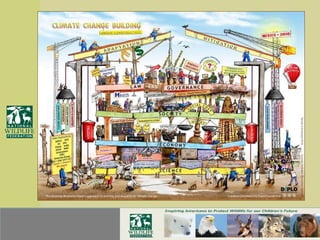
March 11, 2010 Tropical Forests: Post-Copenhagen Policy & Perspective 2009-2010 Greener Campus Series
Speakers Moderator: Erica Anderson– National Wildlife Federation  Program Associate Gustavo A. Silva-Chávez - Environmental Defense Fund,  Climate and Forests Specialist  Kyle Gracey – SustainUS , Chair Alex Page - Attorney at Law Barbara Bramble – National Wildlife Federation,  Sr. Program Advisor, International Affairs
Policy Overview on REDD Gus Silva-Chavez Climate and Forests Specialist International Climate & Air Program
Overview Importance of deforestation to climate policy Importance of developing country participation in climate policy Two main arenas for REDD policy U.S. Legislation United Nations process (REDD: Reducing Emissions from  Deforestation and Degradation)
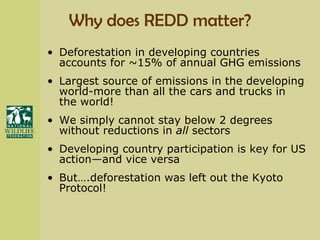
Why does REDD matter? Deforestation in developing countries accounts for ~15% of annual GHG emissions  Largest source of emissions in the developing world-more than all the cars and trucks in the world! We simply cannot stay below 2 degrees without reductions in  all  sectors Developing country participation is key for US action—and vice versa But….deforestation was left out the Kyoto Protocol!
Copenhagen What was supposed to happen? LCA track  (long-term cooperative action) KP  (Kyoto Protocol) What Happened? Copenhagen Accord REDD draft decision
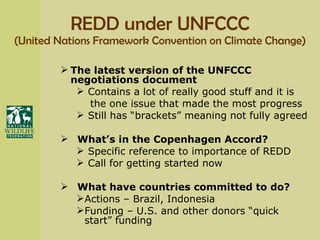
REDD under UNFCCC (United Nations Framework Convention on Climate Change) The latest version of the UNFCCC negotiations document  Contains a lot of really good stuff and it is  the one issue that made the most progress Still has “brackets” meaning not fully agreed What’s in the Copenhagen Accord? Specific reference to importance of REDD  Call for getting started now What have countries committed to do? Actions – Brazil, Indonesia  Funding – U.S. and other donors “quick start” funding
REDD under UNFCCC in 2010 Outstanding Issues Objective Reference levels Scale of REDD Scope Financing Social safeguards
A Youth Perspective on International Forest Protection Kyle Gracey, Chair SustainUS [email_address]
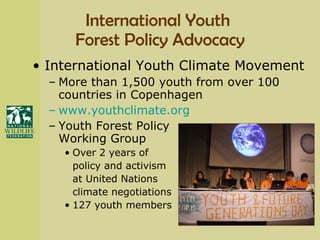
International Youth  Forest Policy Advocacy International Youth Climate Movement More than 1,500 youth from over 100 countries in Copenhagen www.youthclimate.org Youth Forest Policy  Working Group Over 2 years of  policy and activism  at United Nations  climate negotiations 127 youth members
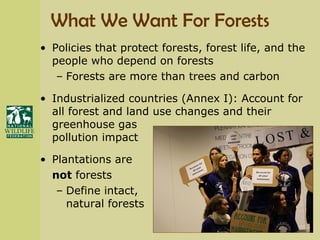
What We Want For Forests Policies that protect forests, forest life, and the people who depend on forests Forests are more than trees and carbon Industrialized countries (Annex I): Account for all forest and land use changes and their greenhouse gas  pollution impact Plantations are  not  forests Define intact, natural forests
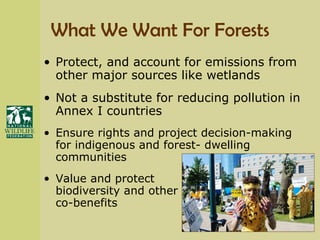
What We Want For Forests Protect, and account for emissions from other major sources like wetlands Not a substitute for reducing pollution in Annex I countries Ensure rights and project decision-making for indigenous and forest- dwelling communities Value and protect  biodiversity and other co-benefits
Get Involved! International Youth Forest Group groups.google.com/group/youthforests SustainUS Policy Group (forests and more!) groups.google.com/group/sustainus-policy
INDIGENOUS PERSPECTIVES  ON REDD/DOMESTIC CLIMATE  CHANGE LEGISLATION March 2010 Prepared by Alexandra C. Page
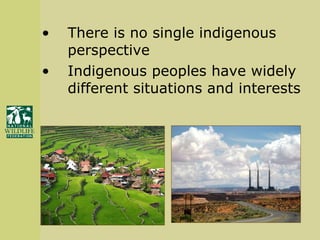
There is no single indigenous perspective Indigenous peoples have widely different situations and interests
One point of agreement among  virtually all indigenous peoples is  the need for strong protections of  indigenous rights and the need for  direct participation of indigenous  peoples in planning and  implementation of REDD activities  on the international, national, and local levels.
Emerging international law  protects indigenous property  rights and the rights of indigenous peoples to participate in decisions  affecting them.
With Canada recently announcing  an intent to take steps to endorse  the UN Declaration on the Rights of  Indigenous Peoples (UNDRIP), the  United States is now one of only two  countries in the world that stands  against the UNDRIP.
The United States does not need to endorse the UNDRIP in order to support strong indigenous rights protections in domestic climate change legislation. The decision rests with the State Department.
Regardless, even strong provisions  on protection of indigenous rights  to property and participation will  not address the significant divides  among indigenous peoples  regarding fundamental REDD  issues.
The Road to Mexico or ? Next steps on the pathway to achieving a fair and binding international climate agreement Barbara Bramble Senior Program Advisor for International Affairs National Wildlife Federation [email_address]
Remember  the goals for REDD from last Year? “ Climate Action Network  (CAN) 450 NGOs Principles for Sustainable REDD (2009)” REDD must be on top of deep cuts in GHGs  by wealthy countries, not a substitute for  shirking responsibility. REDD must be tied to requirements:  Recognize Land and other Rights of  Indigenous Peoples/Local Communities; Full  and effective public participation and transparency.  Prioritize areas with high Biodiversity, prohibit  conversion to industrial plantations/agriculture. National Accounting system vs. Isolated  Projects
 
Status of REDD Negotiations  UNFCCC negotiations document What’s in the Copenhagen Accord? What have countries committed to  do?
Next steps for U.S. climate legislation  - The 3 International Pieces Cap and Trade in House and Senate Kerry, Lieberman and Graham (the  mystery bill) Kerry’s International bill (S. 2835) Appropriations for FY 2011 The best intermediate step
Senator Kerry’s Bill The International Climate Change Investment Act of 2009 (S. 2835) Senate Foreign Relations Committee Combines the policy elements necessary to advance a global climate agreement and provides the foundation to meet America’s commitments under the UNFCCC & Copenhagen Accord: Addresses the global security risks of climate change, and protects  decades of US investments in poverty reduction, development,  and conservation Works with vulnerable countries and populations to build resilience  and adapt to climate change impacts Promotes US economic competitiveness through a clean energy  deployment program Pursues global emissions reductions by protecting forests and  reducing deforestation
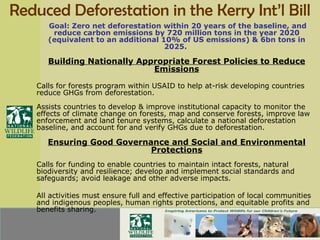
Reduced Deforestation in the Kerry Int’l Bill   Goal: Zero net deforestation within 20 years of the baseline, and reduce carbon emissions by 720 million tons in the year 2020 (equivalent to an additional 10% of US emissions) & 6bn tons in 2025.  Building Nationally Appropriate Forest Policies to Reduce Emissions Calls for forests program within USAID to help at-risk developing countries reduce GHGs from deforestation.  Assists countries to develop & improve institutional capacity to monitor the effects of climate change on forests, map and conserve forests, improve law enforcement and land tenure systems, calculate a national deforestation baseline, and account for and verify GHGs due to deforestation.  Ensuring Good Governance and Social and Environmental Protections Calls for funding to enable countries to maintain intact forests, natural biodiversity and resilience; develop and implement social standards and safeguards; avoid leakage and other adverse impacts.  All activities must ensure full and effective participation of local communities and indigenous peoples, human rights protections, and equitable profits and benefits sharing.
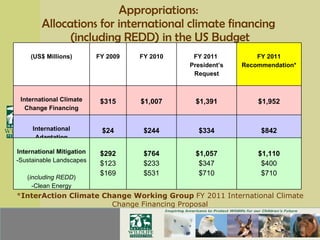
Appropriations:  Allocations for international climate financing  (including REDD) in the US Budget * InterAction Climate Change Working Group  FY 2011 International Climate Change Financing Proposal (US$ Millions) FY 2009 FY 2010 FY 2011  President’s Request FY 2011 Recommendation* International Climate Change Financing $315 $1,007 $1,391 $1,952 International Adaptation $24 $244 $334 $842 International Mitigation -Sustainable Landscapes  ( including REDD ) -Clean Energy $292 $123 $169 $764 $233 $531 $1,057 $347 $710 $1,110 $400 $710
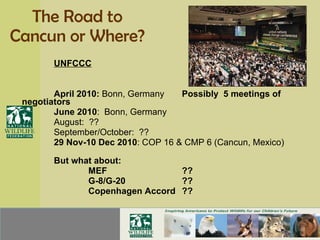
The Road to Cancun or Where? UNFCCC April 2010:  Bonn, Germany Possibly  5 meetings of  negotiators June 2010 :  Bonn, Germany August:  ?? September/October:  ?? 29 Nov-10 Dec 2010 : COP 16 & CMP 6 (Cancun, Mexico) But what about:    MEF  ??   G-8/G-20   ??   Copenhagen Accord  ??
The Road to Cancun or Where? Stay Tuned!!
Erica Anderson Program Associate National Wildlife Federation www.ForestJustice.org Campaign Overview
Forest Justice is: Calling on our elected leaders to recognize the importance of conserving the world’s natural forests when they are shaping domestic climate policies, Advocating for an international climate treaty that includes a fair and equitable REDD, the international policy framework that aims to Reduce Emissions from Deforestation and Degradation, and Working in our communities to support forests by planting trees and using recycled paper and FSC certified wood products. .  Advocating for the protection of forests and the rights of forest dependent communities in our efforts to stop climate change.
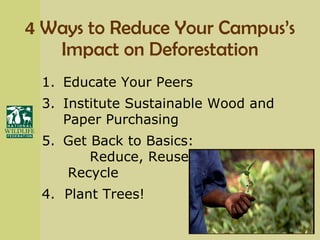
4 Ways to Reduce Your Campus’s Impact on Deforestation Educate Your Peers Institute Sustainable Wood and Paper Purchasing Get Back to Basics:  Reduce, Reuse,    Recycle 4.  Plant Trees!
Forest Justice this Spring Ensure U.S. sticks to $1billion commitment to REDD by advocating for this to stay in 2011 budget Ensure REDD provisions remain in Climate Bill Pressure clothing and shoe retailers to disclose leather sourcing information for “Leather Sourcing Scorecard”
Three Steps to Influence  National Policies 1. Organize Your Peers 2. Engage Your Elected Officials 3. Earn Media
Key Dates Earth Day - April 22, 2010 Arbor Day - April 30, 2010 COP16 in Cancun, Mexico, December 2010
 
Contact Information Erica Anderson– National Wildlife Federation Email: andersone@nwf.org Gustavo A. Silva-Chávez - Environmental Defense Fund , Climate and Forests Specialist  Email:gsilva-chavez@edf.org Kyle Gracey – SustainUS , Chair  Email:  [email_address] Alex Page - Attorney at Law Email: alex.c.page@gmail.com Barbara Bramble – National Wildlife Federation   Email: bramble@nwf.org
Upcoming Webinars:  March 25:  Student Leadership and Careers  –  What opportunities are available in the conservation field and what skills are needed? Register at: www.CampusEcology.org
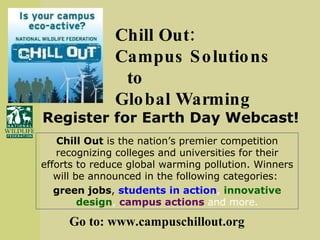
Chill Out:  Campus Solutions to  Global Warming  Chill Out  is the nation’s premier competition recognizing colleges and universities for their efforts to reduce global warming pollution. Winners will be announced in the following categories:  green jobs ,  students in action ,  innovative design ,  campus actions  and more. Go to: www.campuschillout.org Register for Earth Day Webcast!
Promotes climate leadership and sustainability among colleges and universities by providing resources and technical support, creating networking opportunities and  organizing education events.
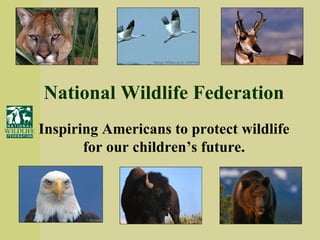
National Wildlife Federation Inspiring Americans to protect wildlife for our children’s future.

Tropical Forests

  • 1.
    March 11, 2010Tropical Forests: Post-Copenhagen Policy & Perspective 2009-2010 Greener Campus Series
  • 2.
    Speakers Moderator: EricaAnderson– National Wildlife Federation Program Associate Gustavo A. Silva-Chávez - Environmental Defense Fund, Climate and Forests Specialist Kyle Gracey – SustainUS , Chair Alex Page - Attorney at Law Barbara Bramble – National Wildlife Federation, Sr. Program Advisor, International Affairs
  • 3.
    Policy Overview onREDD Gus Silva-Chavez Climate and Forests Specialist International Climate & Air Program
  • 4.
    Overview Importance ofdeforestation to climate policy Importance of developing country participation in climate policy Two main arenas for REDD policy U.S. Legislation United Nations process (REDD: Reducing Emissions from Deforestation and Degradation)
  • 5.
    Why does REDDmatter? Deforestation in developing countries accounts for ~15% of annual GHG emissions Largest source of emissions in the developing world-more than all the cars and trucks in the world! We simply cannot stay below 2 degrees without reductions in all sectors Developing country participation is key for US action—and vice versa But….deforestation was left out the Kyoto Protocol!
  • 6.
    Copenhagen What wassupposed to happen? LCA track (long-term cooperative action) KP (Kyoto Protocol) What Happened? Copenhagen Accord REDD draft decision
  • 7.
    REDD under UNFCCC(United Nations Framework Convention on Climate Change) The latest version of the UNFCCC negotiations document Contains a lot of really good stuff and it is the one issue that made the most progress Still has “brackets” meaning not fully agreed What’s in the Copenhagen Accord? Specific reference to importance of REDD Call for getting started now What have countries committed to do? Actions – Brazil, Indonesia Funding – U.S. and other donors “quick start” funding
  • 8.
    REDD under UNFCCCin 2010 Outstanding Issues Objective Reference levels Scale of REDD Scope Financing Social safeguards
  • 9.
    A Youth Perspectiveon International Forest Protection Kyle Gracey, Chair SustainUS [email_address]
  • 10.
    International Youth Forest Policy Advocacy International Youth Climate Movement More than 1,500 youth from over 100 countries in Copenhagen www.youthclimate.org Youth Forest Policy Working Group Over 2 years of policy and activism at United Nations climate negotiations 127 youth members
  • 11.
    What We WantFor Forests Policies that protect forests, forest life, and the people who depend on forests Forests are more than trees and carbon Industrialized countries (Annex I): Account for all forest and land use changes and their greenhouse gas pollution impact Plantations are not forests Define intact, natural forests
  • 12.
    What We WantFor Forests Protect, and account for emissions from other major sources like wetlands Not a substitute for reducing pollution in Annex I countries Ensure rights and project decision-making for indigenous and forest- dwelling communities Value and protect biodiversity and other co-benefits
  • 13.
    Get Involved! InternationalYouth Forest Group groups.google.com/group/youthforests SustainUS Policy Group (forests and more!) groups.google.com/group/sustainus-policy
  • 14.
    INDIGENOUS PERSPECTIVES ON REDD/DOMESTIC CLIMATE CHANGE LEGISLATION March 2010 Prepared by Alexandra C. Page
  • 15.
    There is nosingle indigenous perspective Indigenous peoples have widely different situations and interests
  • 16.
    One point ofagreement among virtually all indigenous peoples is the need for strong protections of indigenous rights and the need for direct participation of indigenous peoples in planning and implementation of REDD activities on the international, national, and local levels.
  • 17.
    Emerging international law protects indigenous property rights and the rights of indigenous peoples to participate in decisions affecting them.
  • 18.
    With Canada recentlyannouncing an intent to take steps to endorse the UN Declaration on the Rights of Indigenous Peoples (UNDRIP), the United States is now one of only two countries in the world that stands against the UNDRIP.
  • 19.
    The United Statesdoes not need to endorse the UNDRIP in order to support strong indigenous rights protections in domestic climate change legislation. The decision rests with the State Department.
  • 20.
    Regardless, even strongprovisions on protection of indigenous rights to property and participation will not address the significant divides among indigenous peoples regarding fundamental REDD issues.
  • 21.
    The Road toMexico or ? Next steps on the pathway to achieving a fair and binding international climate agreement Barbara Bramble Senior Program Advisor for International Affairs National Wildlife Federation [email_address]
  • 22.
    Remember thegoals for REDD from last Year? “ Climate Action Network (CAN) 450 NGOs Principles for Sustainable REDD (2009)” REDD must be on top of deep cuts in GHGs by wealthy countries, not a substitute for shirking responsibility. REDD must be tied to requirements: Recognize Land and other Rights of Indigenous Peoples/Local Communities; Full and effective public participation and transparency. Prioritize areas with high Biodiversity, prohibit conversion to industrial plantations/agriculture. National Accounting system vs. Isolated Projects
  • 23.
  • 24.
    Status of REDDNegotiations UNFCCC negotiations document What’s in the Copenhagen Accord? What have countries committed to do?
  • 25.
    Next steps forU.S. climate legislation - The 3 International Pieces Cap and Trade in House and Senate Kerry, Lieberman and Graham (the mystery bill) Kerry’s International bill (S. 2835) Appropriations for FY 2011 The best intermediate step
  • 26.
    Senator Kerry’s BillThe International Climate Change Investment Act of 2009 (S. 2835) Senate Foreign Relations Committee Combines the policy elements necessary to advance a global climate agreement and provides the foundation to meet America’s commitments under the UNFCCC & Copenhagen Accord: Addresses the global security risks of climate change, and protects decades of US investments in poverty reduction, development, and conservation Works with vulnerable countries and populations to build resilience and adapt to climate change impacts Promotes US economic competitiveness through a clean energy deployment program Pursues global emissions reductions by protecting forests and reducing deforestation
  • 27.
    Reduced Deforestation inthe Kerry Int’l Bill   Goal: Zero net deforestation within 20 years of the baseline, and reduce carbon emissions by 720 million tons in the year 2020 (equivalent to an additional 10% of US emissions) & 6bn tons in 2025. Building Nationally Appropriate Forest Policies to Reduce Emissions Calls for forests program within USAID to help at-risk developing countries reduce GHGs from deforestation. Assists countries to develop & improve institutional capacity to monitor the effects of climate change on forests, map and conserve forests, improve law enforcement and land tenure systems, calculate a national deforestation baseline, and account for and verify GHGs due to deforestation. Ensuring Good Governance and Social and Environmental Protections Calls for funding to enable countries to maintain intact forests, natural biodiversity and resilience; develop and implement social standards and safeguards; avoid leakage and other adverse impacts. All activities must ensure full and effective participation of local communities and indigenous peoples, human rights protections, and equitable profits and benefits sharing.
  • 28.
    Appropriations: Allocationsfor international climate financing (including REDD) in the US Budget * InterAction Climate Change Working Group FY 2011 International Climate Change Financing Proposal (US$ Millions) FY 2009 FY 2010 FY 2011 President’s Request FY 2011 Recommendation* International Climate Change Financing $315 $1,007 $1,391 $1,952 International Adaptation $24 $244 $334 $842 International Mitigation -Sustainable Landscapes ( including REDD ) -Clean Energy $292 $123 $169 $764 $233 $531 $1,057 $347 $710 $1,110 $400 $710
  • 29.
    The Road toCancun or Where? UNFCCC April 2010: Bonn, Germany Possibly 5 meetings of negotiators June 2010 : Bonn, Germany August: ?? September/October: ?? 29 Nov-10 Dec 2010 : COP 16 & CMP 6 (Cancun, Mexico) But what about: MEF ?? G-8/G-20 ?? Copenhagen Accord ??
  • 30.
    The Road toCancun or Where? Stay Tuned!!
  • 31.
    Erica Anderson ProgramAssociate National Wildlife Federation www.ForestJustice.org Campaign Overview
  • 32.
    Forest Justice is:Calling on our elected leaders to recognize the importance of conserving the world’s natural forests when they are shaping domestic climate policies, Advocating for an international climate treaty that includes a fair and equitable REDD, the international policy framework that aims to Reduce Emissions from Deforestation and Degradation, and Working in our communities to support forests by planting trees and using recycled paper and FSC certified wood products. . Advocating for the protection of forests and the rights of forest dependent communities in our efforts to stop climate change.
  • 33.
    4 Ways toReduce Your Campus’s Impact on Deforestation Educate Your Peers Institute Sustainable Wood and Paper Purchasing Get Back to Basics: Reduce, Reuse, Recycle 4. Plant Trees!
  • 34.
    Forest Justice thisSpring Ensure U.S. sticks to $1billion commitment to REDD by advocating for this to stay in 2011 budget Ensure REDD provisions remain in Climate Bill Pressure clothing and shoe retailers to disclose leather sourcing information for “Leather Sourcing Scorecard”
  • 35.
    Three Steps toInfluence National Policies 1. Organize Your Peers 2. Engage Your Elected Officials 3. Earn Media
  • 36.
    Key Dates EarthDay - April 22, 2010 Arbor Day - April 30, 2010 COP16 in Cancun, Mexico, December 2010
  • 37.
  • 38.
    Contact Information EricaAnderson– National Wildlife Federation Email: andersone@nwf.org Gustavo A. Silva-Chávez - Environmental Defense Fund , Climate and Forests Specialist Email:gsilva-chavez@edf.org Kyle Gracey – SustainUS , Chair Email: [email_address] Alex Page - Attorney at Law Email: alex.c.page@gmail.com Barbara Bramble – National Wildlife Federation Email: bramble@nwf.org
  • 39.
    Upcoming Webinars: March 25: Student Leadership and Careers – What opportunities are available in the conservation field and what skills are needed? Register at: www.CampusEcology.org
  • 40.
    Chill Out: Campus Solutions to Global Warming Chill Out is the nation’s premier competition recognizing colleges and universities for their efforts to reduce global warming pollution. Winners will be announced in the following categories: green jobs , students in action , innovative design , campus actions and more. Go to: www.campuschillout.org Register for Earth Day Webcast!
  • 41.
    Promotes climate leadershipand sustainability among colleges and universities by providing resources and technical support, creating networking opportunities and organizing education events.
  • 42.
    National Wildlife FederationInspiring Americans to protect wildlife for our children’s future.