THE UNFCCC POLICY LANDSCAPE 
PRE LIMA 
Stephen Leonard, Senior Policy Analyst – UNFCCC 
Center for International Forestry Research 
20 November 2014
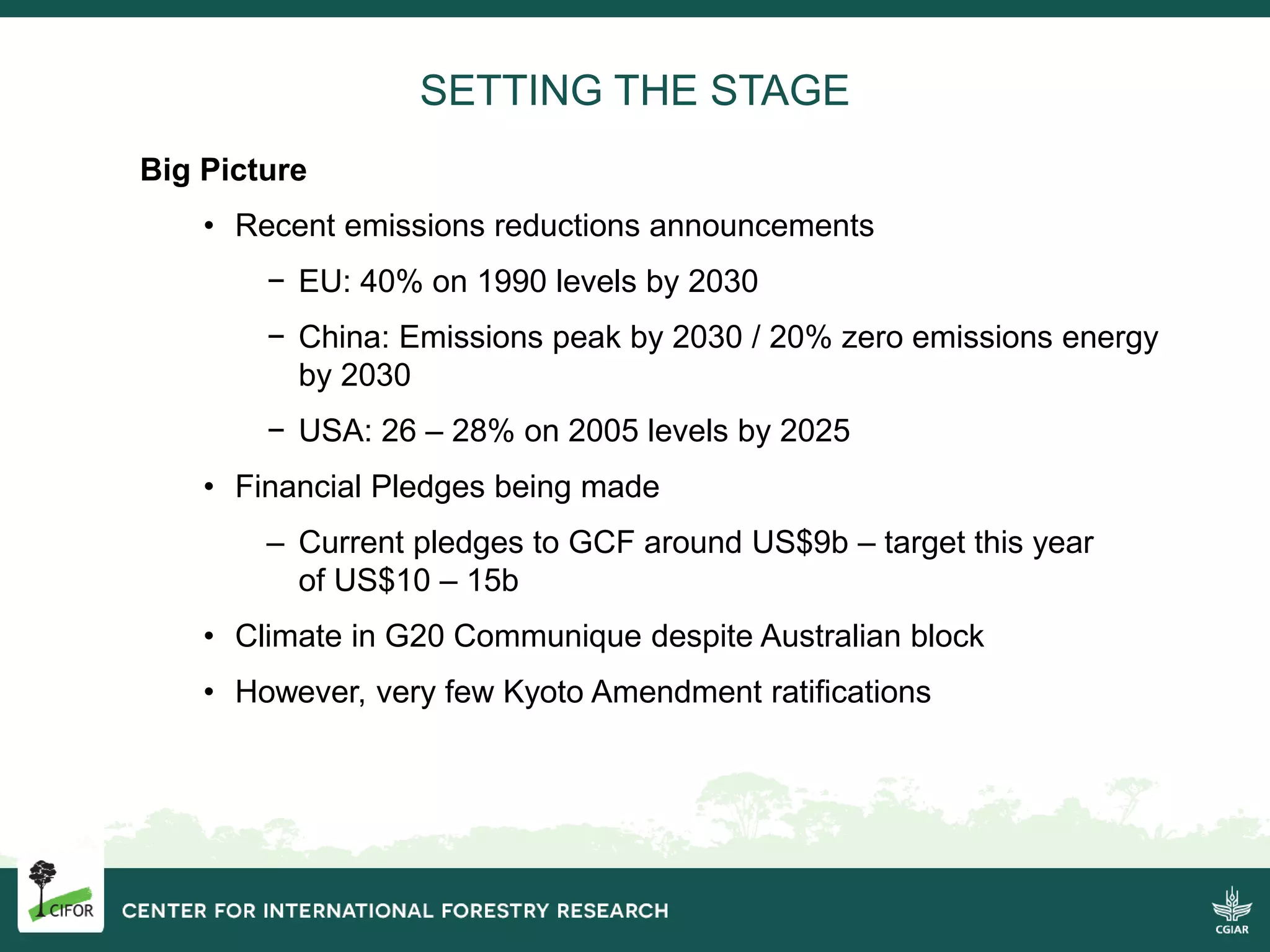
SETTING THE STAGE 
Big Picture 
• Recent emissions reductions announcements 
− EU: 40% on 1990 levels by 2030 
− China: Emissions peak by 2030 / 20% zero emissions energy 
by 2030 
− USA: 26 – 28% on 2005 levels by 2025 
• Financial Pledges being made 
‒ Current pledges to GCF around US$9b – target this year 
of US$10 – 15b 
• Climate in G20 Communique despite Australian block 
• However, very few Kyoto Amendment ratifications
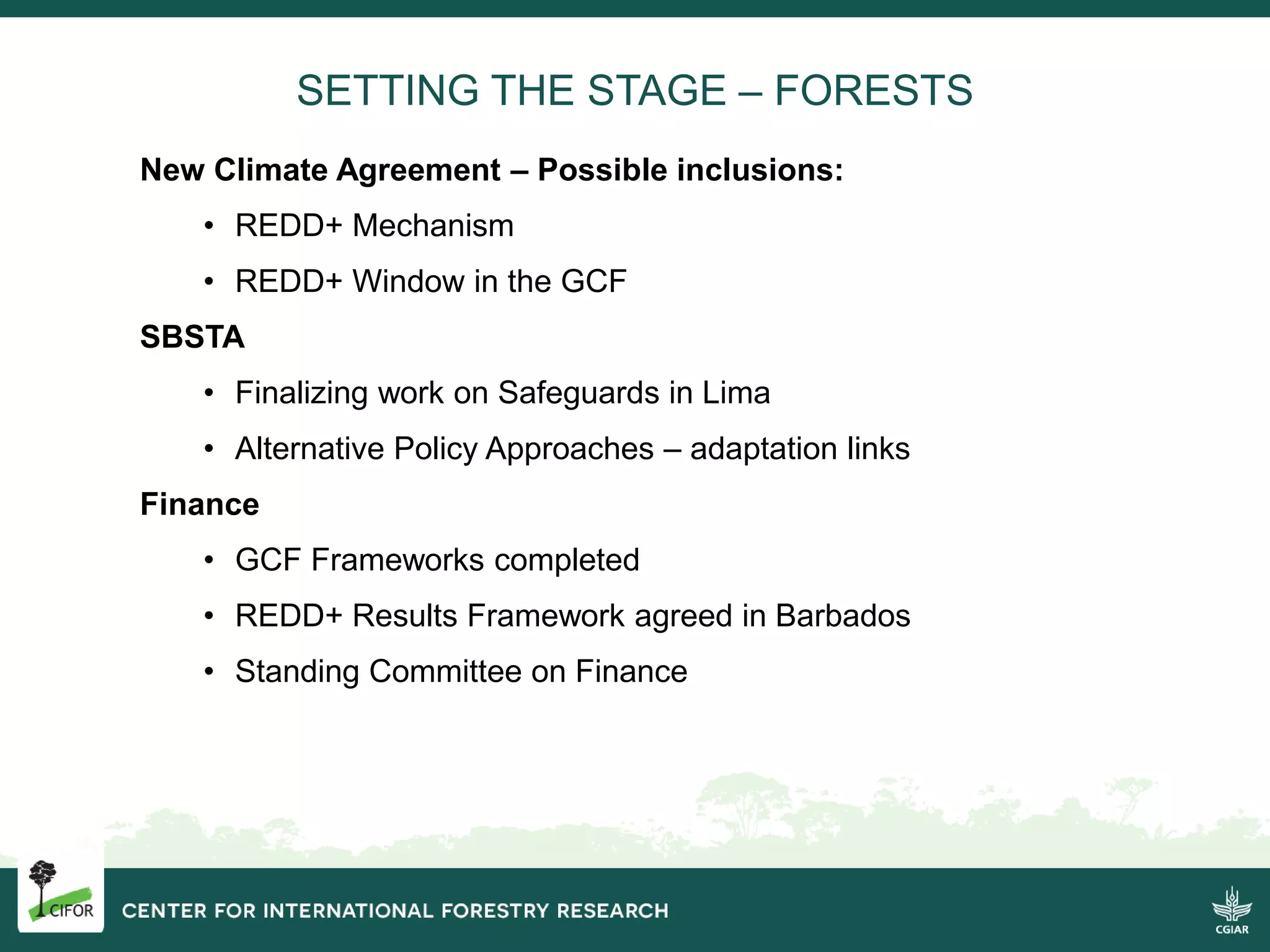
SETTING THE STAGE – FORESTS 
New Climate Agreement – Possible inclusions: 
• REDD+ Mechanism 
• REDD+ Window in the GCF 
SBSTA 
• Finalizing work on Safeguards in Lima 
• Alternative Policy Approaches – adaptation links 
Finance 
• GCF Frameworks completed 
• REDD+ Results Framework agreed in Barbados 
• Standing Committee on Finance
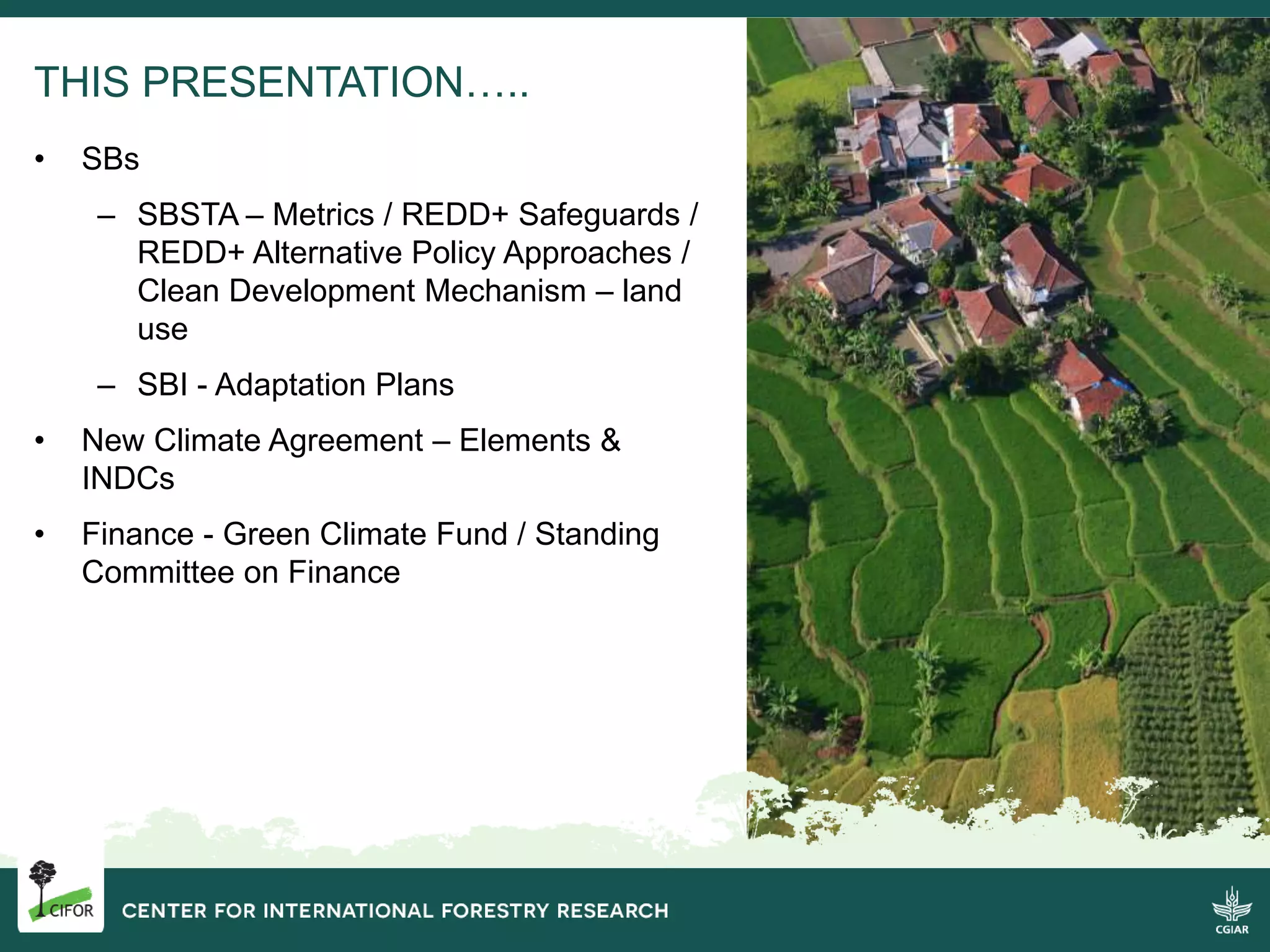
THIS PRESENTATION….. 
• SBs 
– SBSTA – Metrics / REDD+ Safeguards / 
REDD+ Alternative Policy Approaches / 
Clean Development Mechanism – land 
use 
– SBI - Adaptation Plans 
• New Climate Agreement – Elements & 
INDCs 
• Finance - Green Climate Fund / Standing 
Committee on Finance
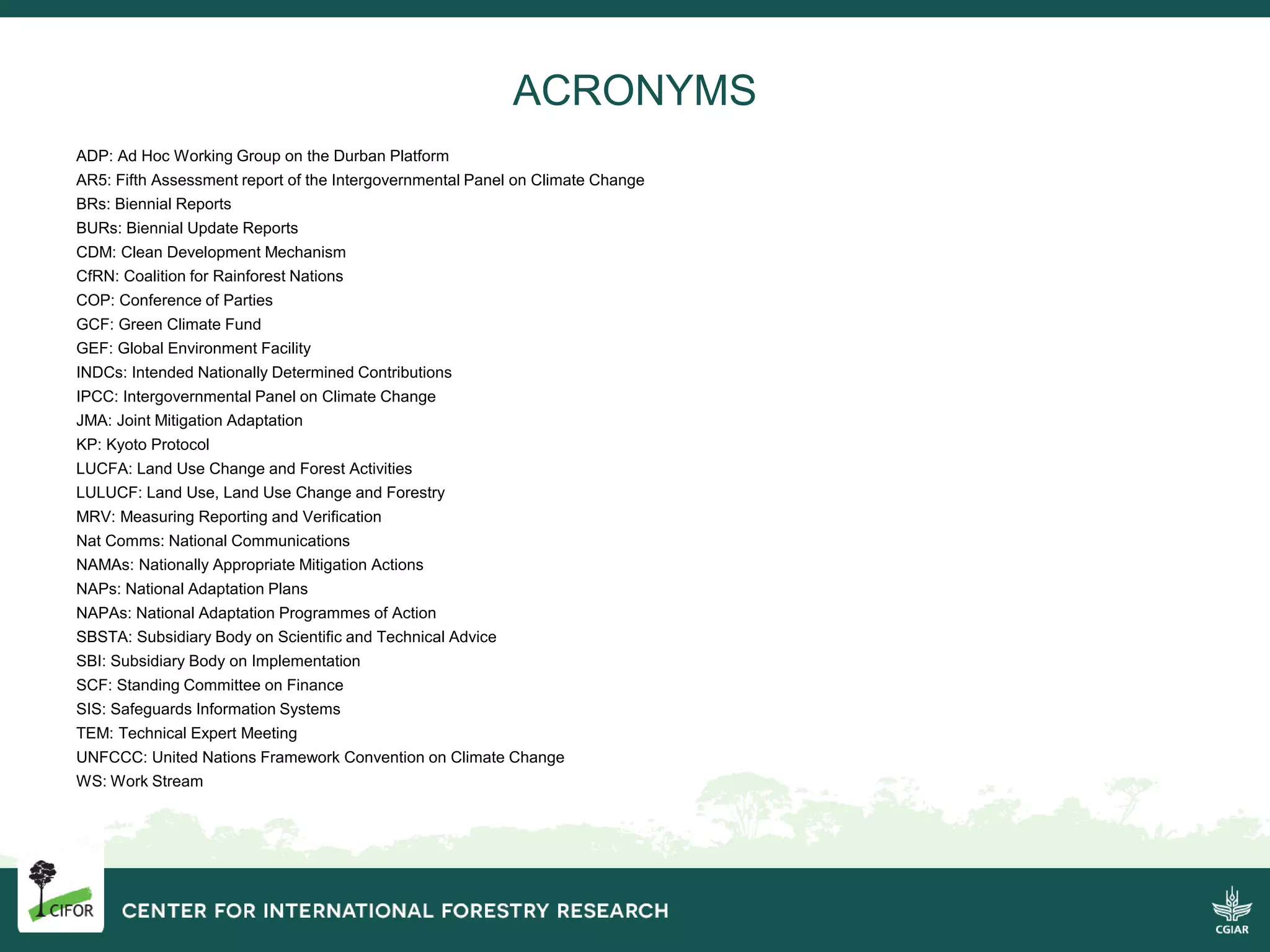
ACRONYMS 
ADP: Ad Hoc Working Group on the Durban Platform 
AR5: Fifth Assessment report of the Intergovernmental Panel on Climate Change 
BRs: Biennial Reports 
BURs: Biennial Update Reports 
CDM: Clean Development Mechanism 
CfRN: Coalition for Rainforest Nations 
COP: Conference of Parties 
GCF: Green Climate Fund 
GEF: Global Environment Facility 
INDCs: Intended Nationally Determined Contributions 
IPCC: Intergovernmental Panel on Climate Change 
JMA: Joint Mitigation Adaptation 
KP: Kyoto Protocol 
LUCFA: Land Use Change and Forest Activities 
LULUCF: Land Use, Land Use Change and Forestry 
MRV: Measuring Reporting and Verification 
Nat Comms: National Communications 
NAMAs: Nationally Appropriate Mitigation Actions 
NAPs: National Adaptation Plans 
NAPAs: National Adaptation Programmes of Action 
SBSTA: Subsidiary Body on Scientific and Technical Advice 
SBI: Subsidiary Body on Implementation 
SCF: Standing Committee on Finance 
SIS: Safeguards Information Systems 
TEM: Technical Expert Meeting 
UNFCCC: United Nations Framework Convention on Climate Change 
WS: Work Stream
SUBSIDIARY BODIES
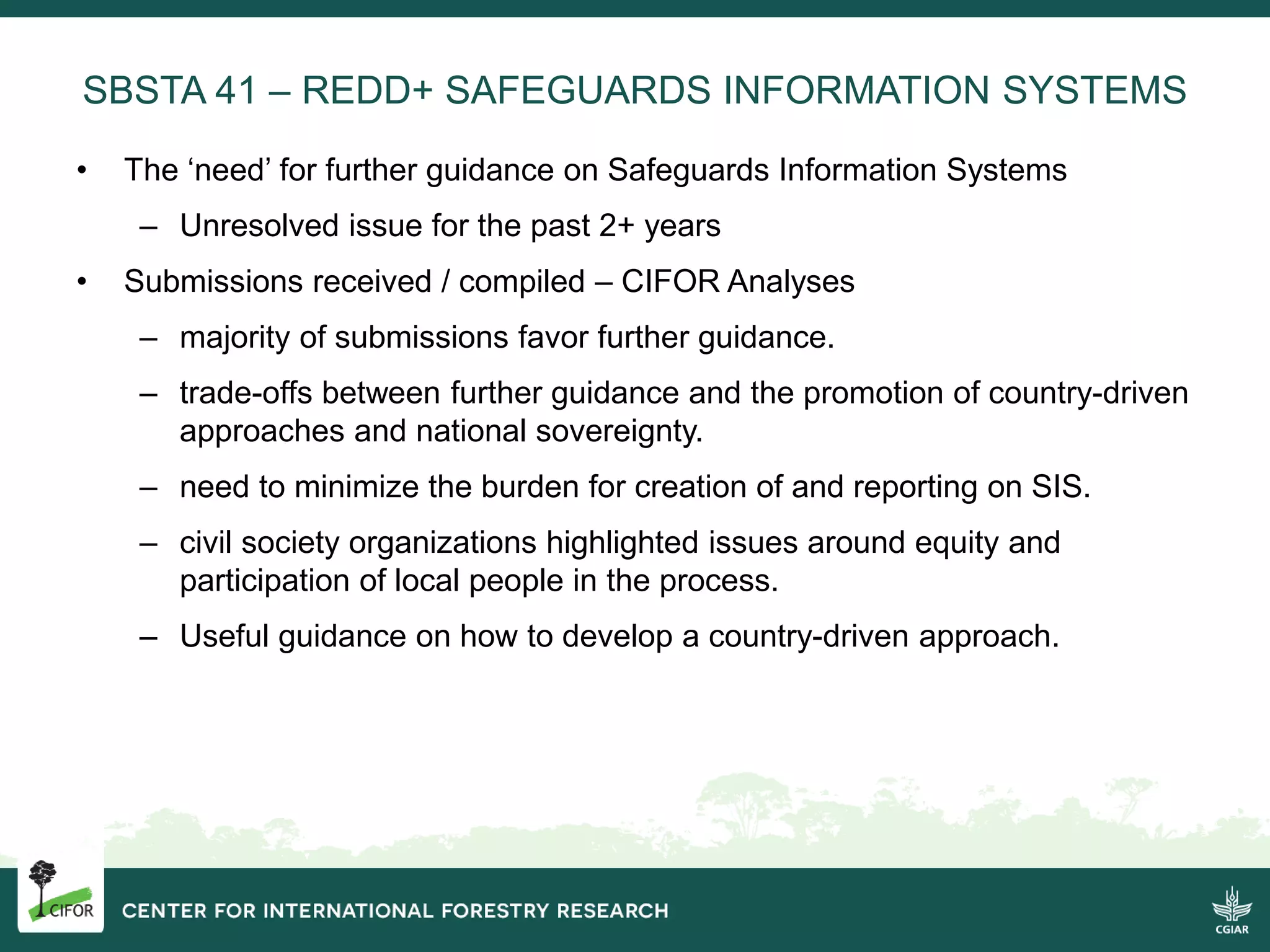
SBSTA 41 – REDD+ SAFEGUARDS INFORMATION SYSTEMS 
• The ‘need’ for further guidance on Safeguards Information Systems 
– Unresolved issue for the past 2+ years 
• Submissions received / compiled – CIFOR Analyses 
– majority of submissions favor further guidance. 
– trade-offs between further guidance and the promotion of country-driven 
approaches and national sovereignty. 
– need to minimize the burden for creation of and reporting on SIS. 
– civil society organizations highlighted issues around equity and 
participation of local people in the process. 
– Useful guidance on how to develop a country-driven approach.
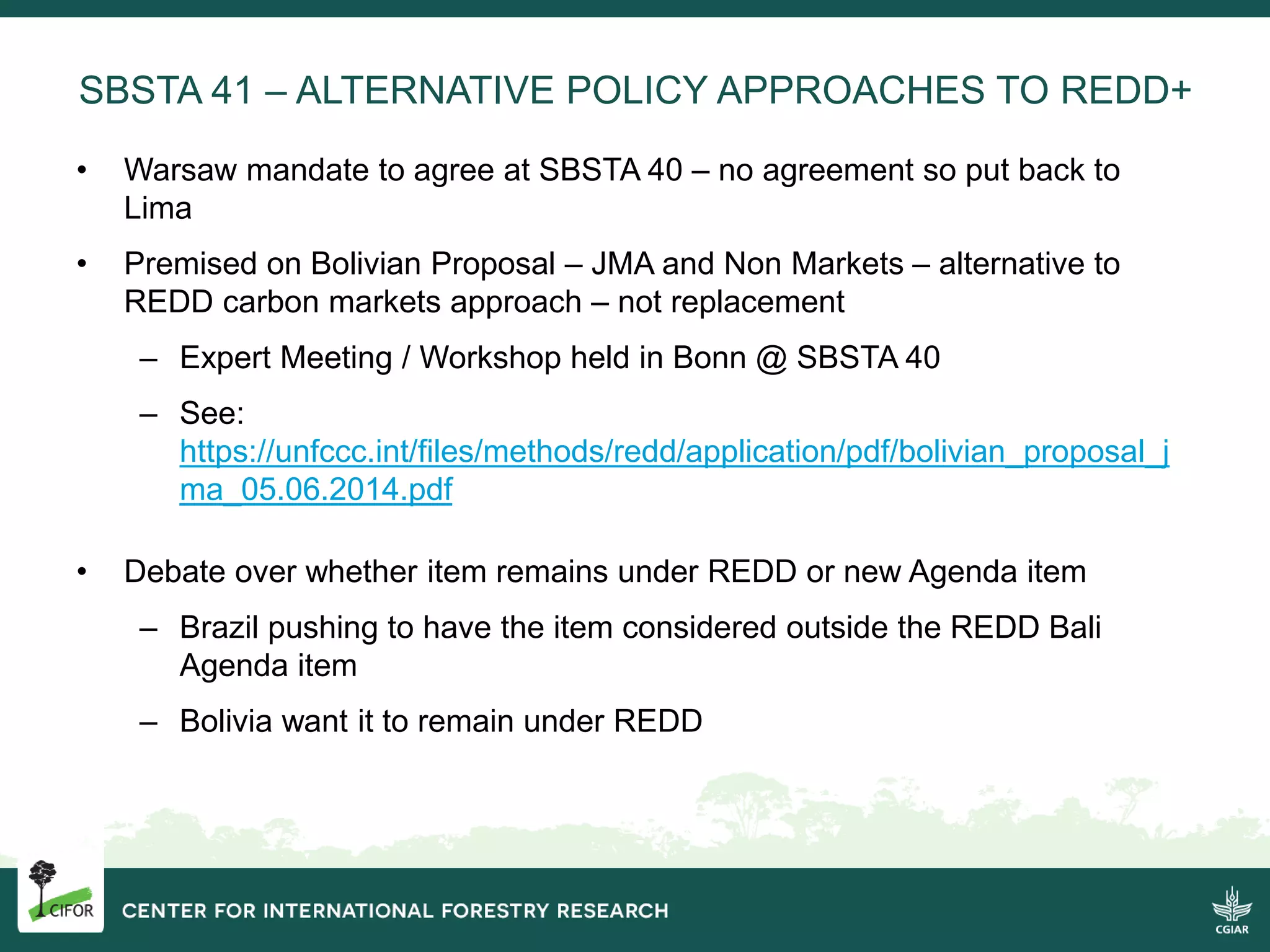
SBSTA 41 – ALTERNATIVE POLICY APPROACHES TO REDD+ 
• Warsaw mandate to agree at SBSTA 40 – no agreement so put back to 
Lima 
• Premised on Bolivian Proposal – JMA and Non Markets – alternative to 
REDD carbon markets approach – not replacement 
– Expert Meeting / Workshop held in Bonn @ SBSTA 40 
– See: 
https://unfccc.int/files/methods/redd/application/pdf/bolivian_proposal_j 
ma_05.06.2014.pdf 
• Debate over whether item remains under REDD or new Agenda item 
– Brazil pushing to have the item considered outside the REDD Bali 
Agenda item 
– Bolivia want it to remain under REDD
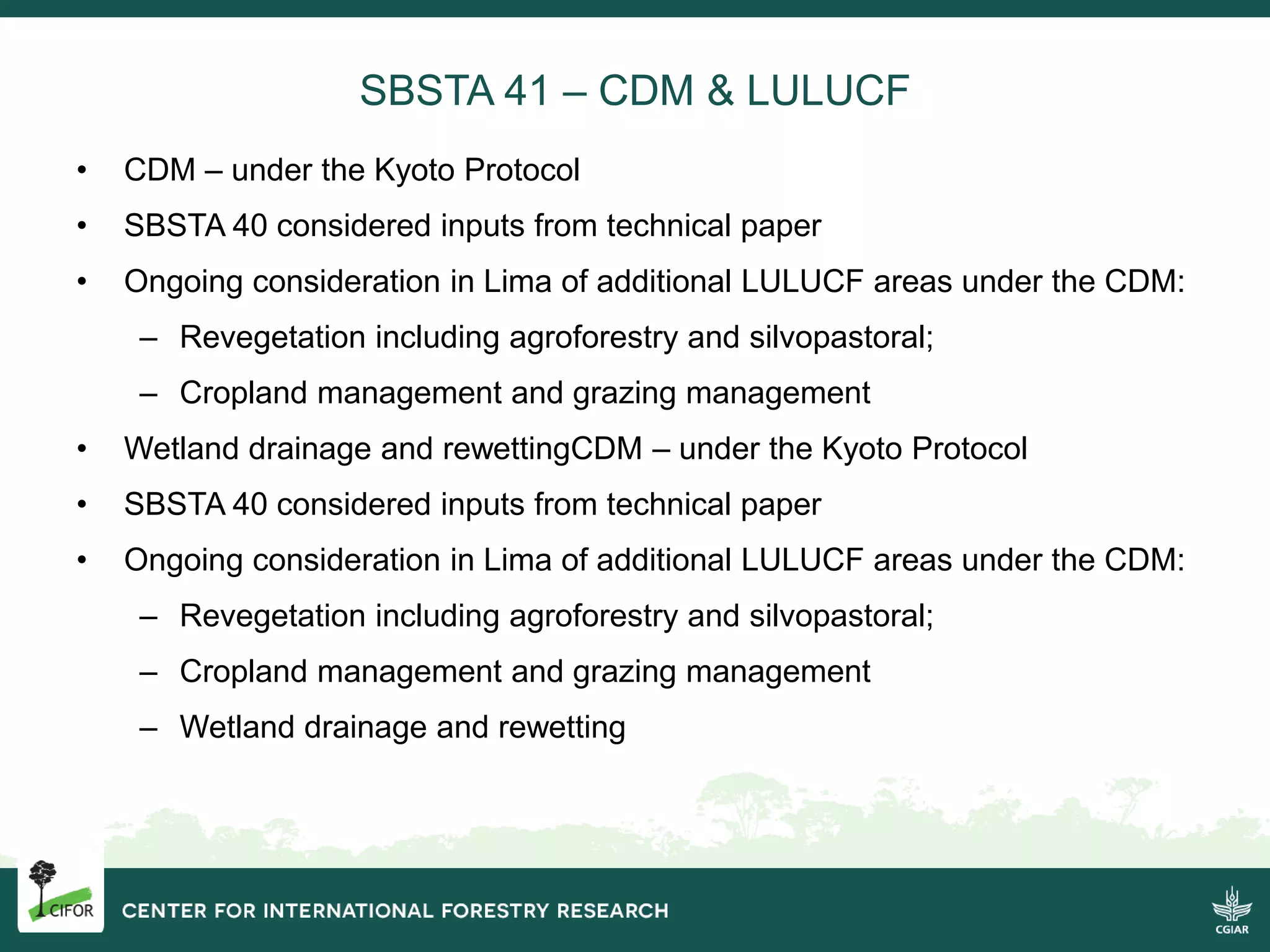
SBSTA 41 – CDM & LULUCF 
• CDM – under the Kyoto Protocol 
• SBSTA 40 considered inputs from technical paper 
• Ongoing consideration in Lima of additional LULUCF areas under the CDM: 
– Revegetation including agroforestry and silvopastoral; 
– Cropland management and grazing management 
• Wetland drainage and rewettingCDM – under the Kyoto Protocol 
• SBSTA 40 considered inputs from technical paper 
• Ongoing consideration in Lima of additional LULUCF areas under the CDM: 
– Revegetation including agroforestry and silvopastoral; 
– Cropland management and grazing management 
– Wetland drainage and rewetting
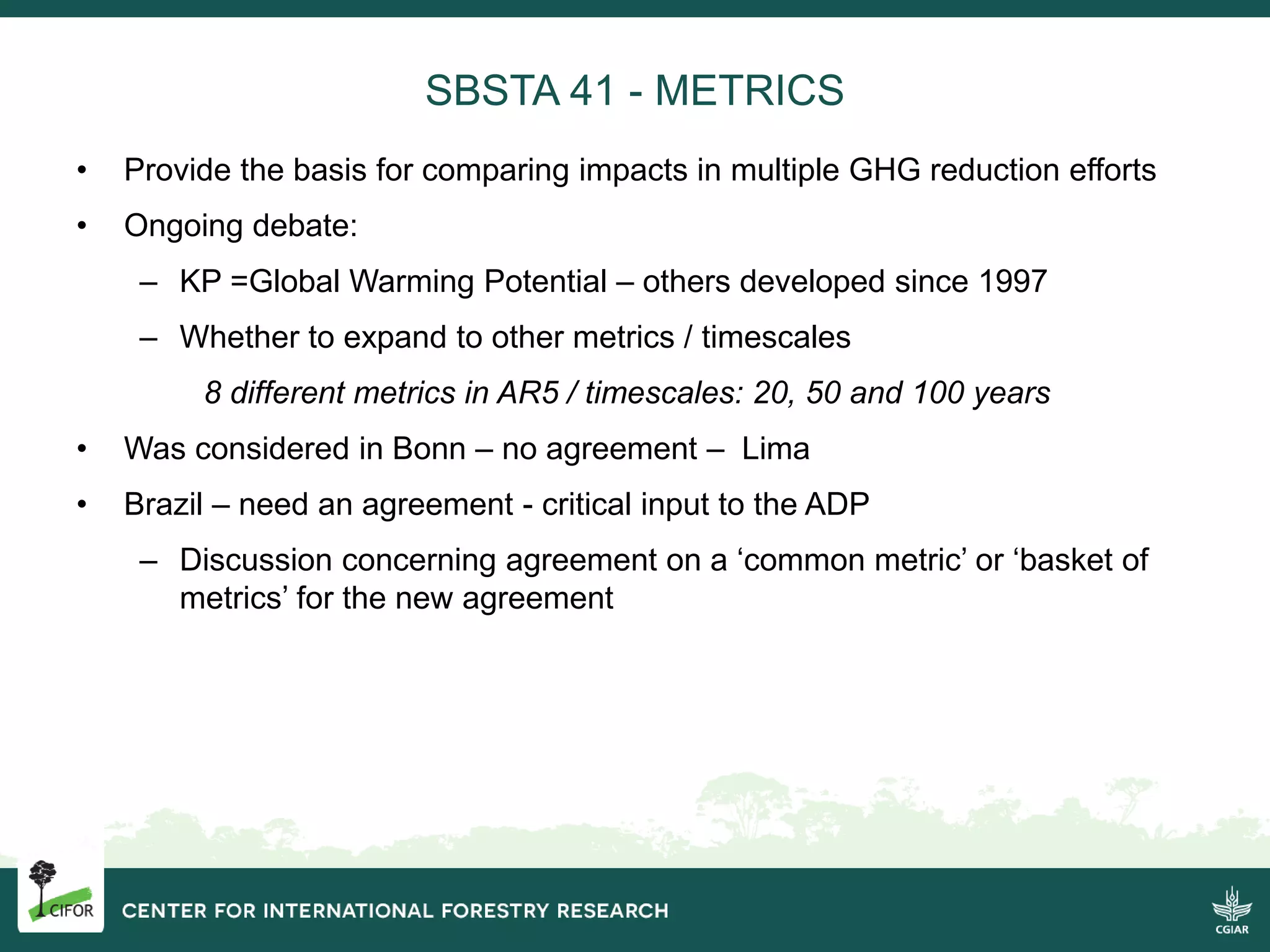
SBSTA 41 - METRICS 
• Provide the basis for comparing impacts in multiple GHG reduction efforts 
• Ongoing debate: 
‒ KP =Global Warming Potential – others developed since 1997 
‒ Whether to expand to other metrics / timescales 
8 different metrics in AR5 / timescales: 20, 50 and 100 years 
• Was considered in Bonn – no agreement – Lima 
• Brazil – need an agreement - critical input to the ADP 
‒ Discussion concerning agreement on a ‘common metric’ or ‘basket of 
metrics’ for the new agreement
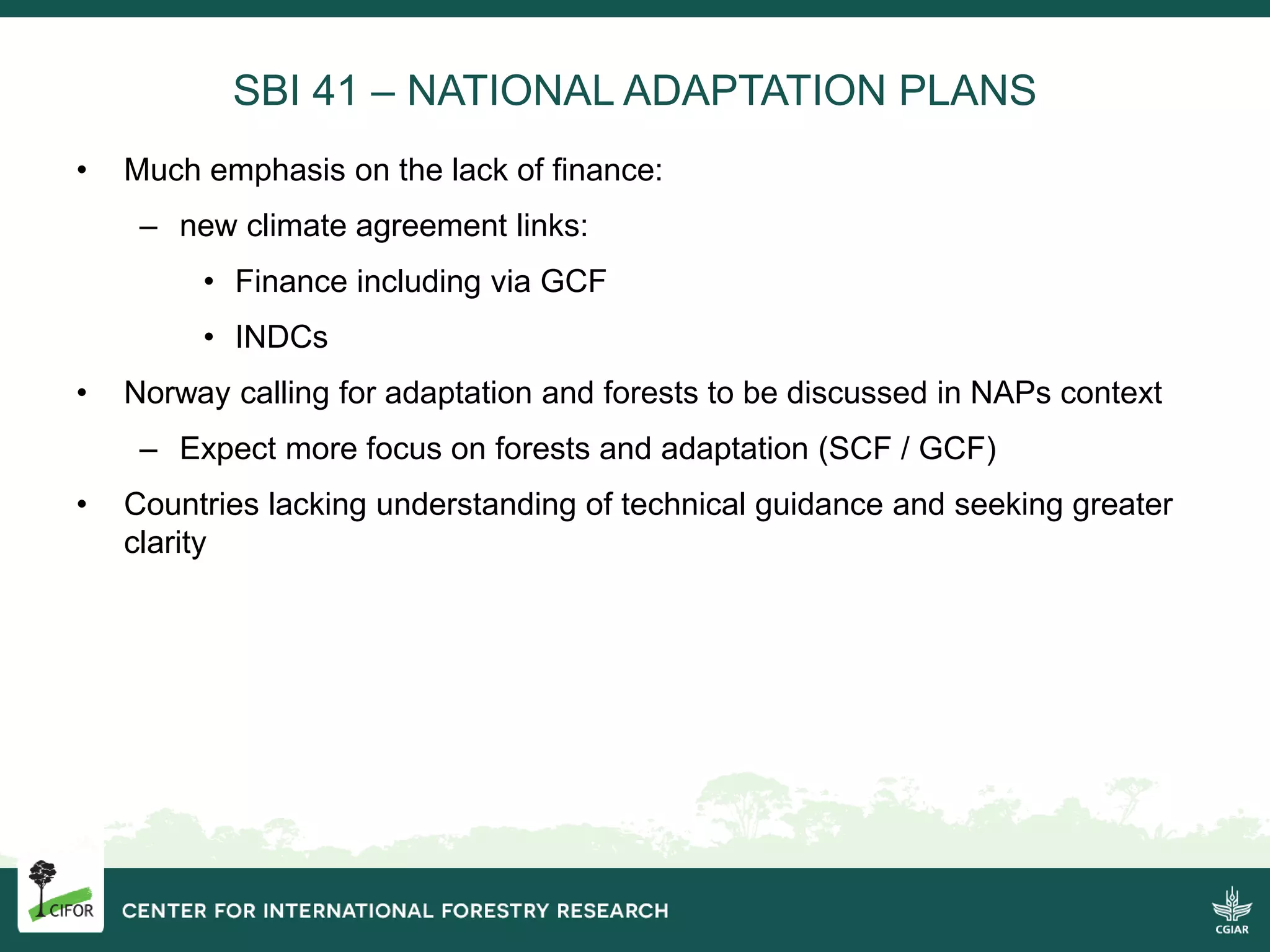
SBI 41 – NATIONAL ADAPTATION PLANS 
• Much emphasis on the lack of finance: 
– new climate agreement links: 
• Finance including via GCF 
• INDCs 
• Norway calling for adaptation and forests to be discussed in NAPs context 
– Expect more focus on forests and adaptation (SCF / GCF) 
• Countries lacking understanding of technical guidance and seeking greater 
clarity
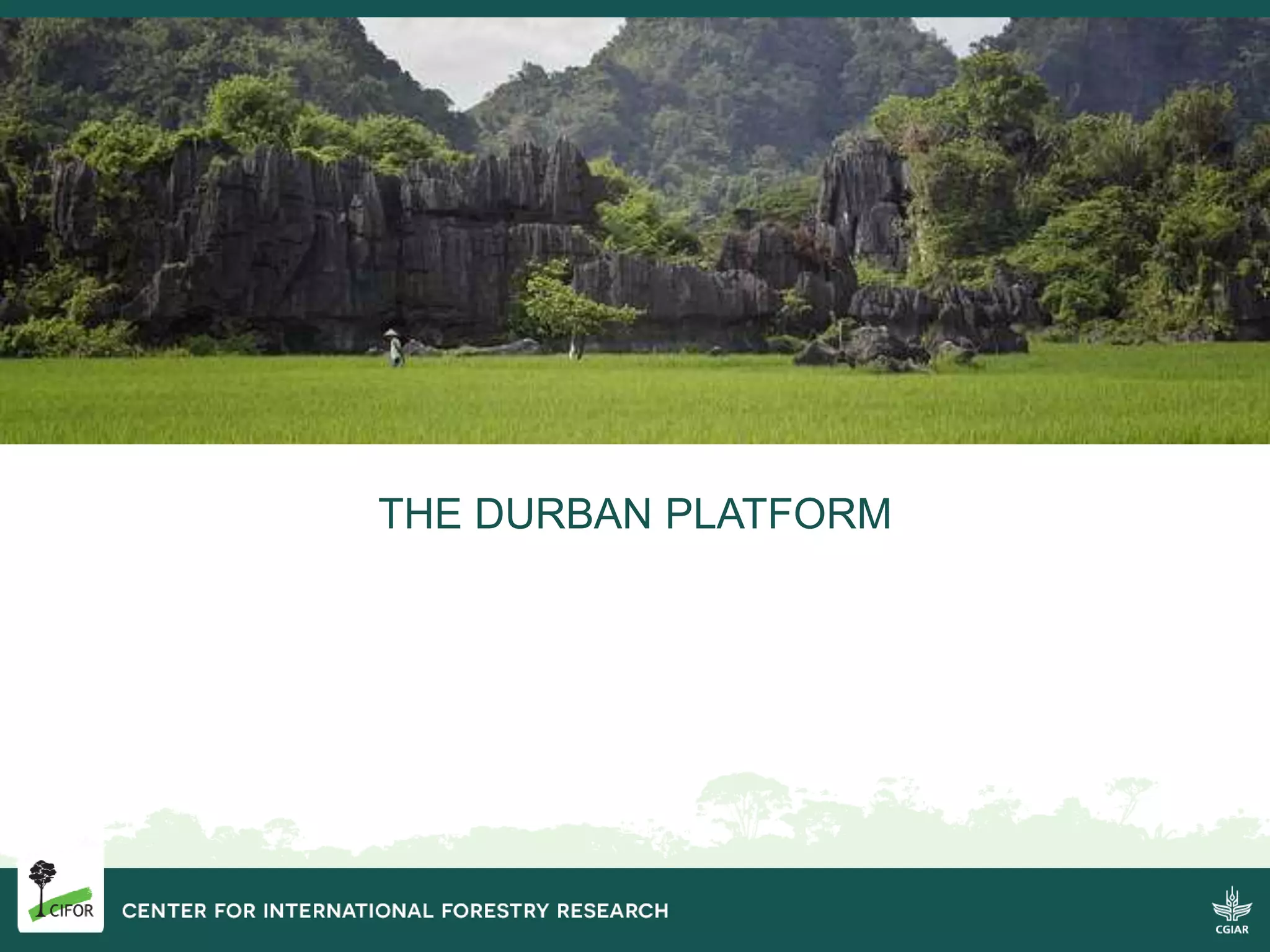
THE DURBAN PLATFORM
THE DURBAN PLATFORM (ADP) 
• Ad Hoc Working Group on the Durban Platform 
• WS 1 - process to develop a protocol, another legal instrument or an agreed 
outcome with legal force applicable to all Parties by 2015 for implementation 
by 2020 
• WS 2 - Pre 2020 - to explore options to close the ambition gap ensuring 
highest possible mitigation efforts by Parties
PRE 2020 MITIGATION 
• TEMs – part of the formal process: 
– Land Use / Non CO2 Emissions (agriculture) 
• Purpose: 
– To enhance pre 2020 mitigation 
– Provide guidance to UNFCCC Institutions (eg: GCF) 
• Projects / programmes to finance 
• Priority areas 
– Likely to be ongoing to up 2020 
• Possible to be broadened to include adaptation
PRE 2020 MITIGATION 
• TEMS: Outputs: 
– Land Use 
• REDD+ remains high on the agenda 
• high mitigation & Adaptation potential from forest and agricultural 
sectors; 
• a scaling up of finance, technology and capacity building is required; 
• sectoral policies are required; 
• participatory multi-stakeholder dialogues should commence at early 
stages; 
See: http://unfccc.int/bodies/awg/items/8171.php
PRE 2020 MITIGATION 
• Non CO2 Emissions – Agriculture 
– up to 80% of emissions from the agriculture sector could be reduced by 
2030. 
• Potential policies and actions identified include 
– soil conservation; 
– soil productivity and erosion control; 
– nitrogen use efficiency; 
– rice management; 
– Research; and 
– landscape approach 
See: http://unfccc.int/bodies/awg/items/8420.php
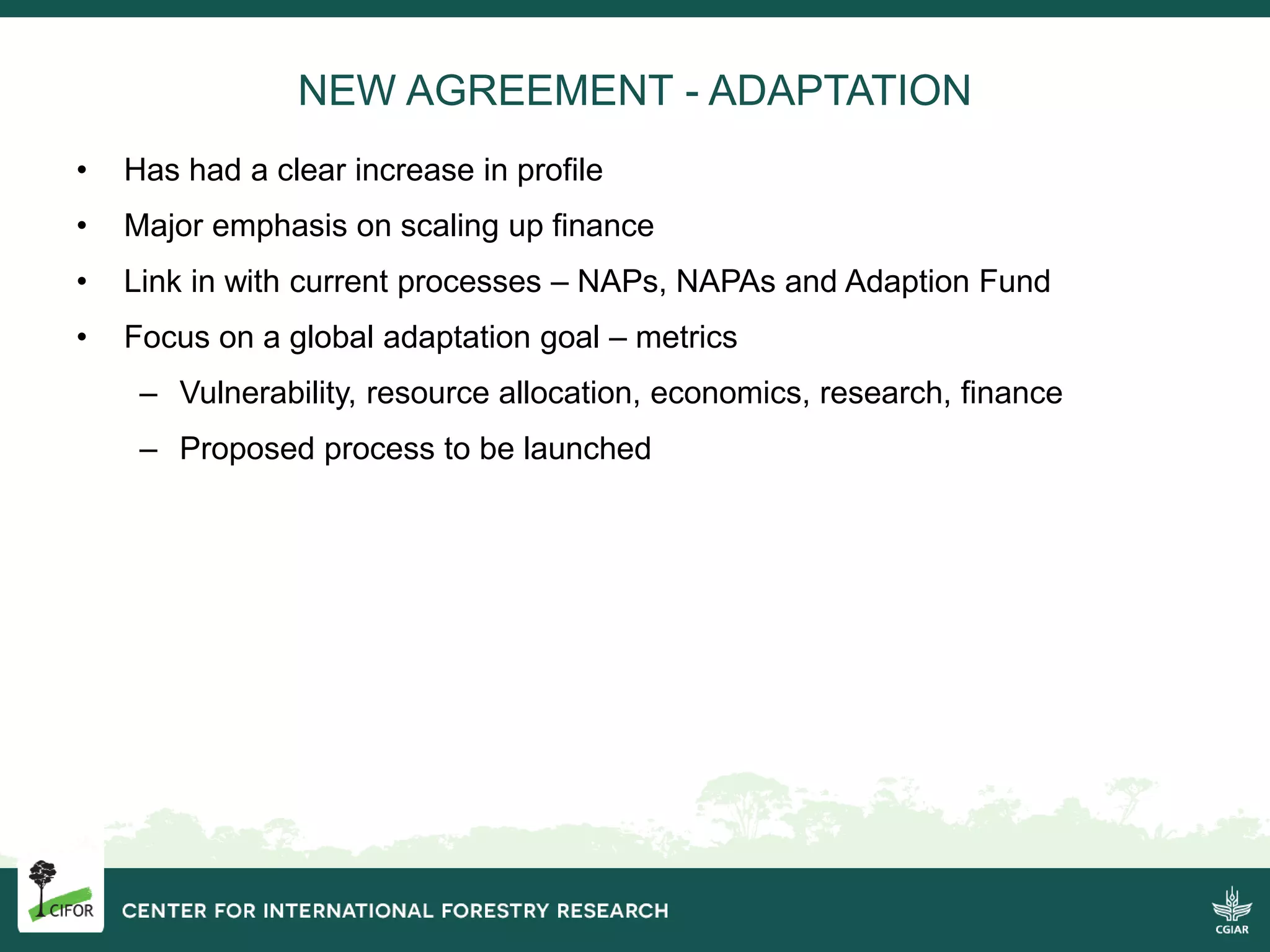
NEW AGREEMENT - ADAPTATION 
• Has had a clear increase in profile 
• Major emphasis on scaling up finance 
• Link in with current processes – NAPs, NAPAs and Adaption Fund 
• Focus on a global adaptation goal – metrics 
– Vulnerability, resource allocation, economics, research, finance 
– Proposed process to be launched
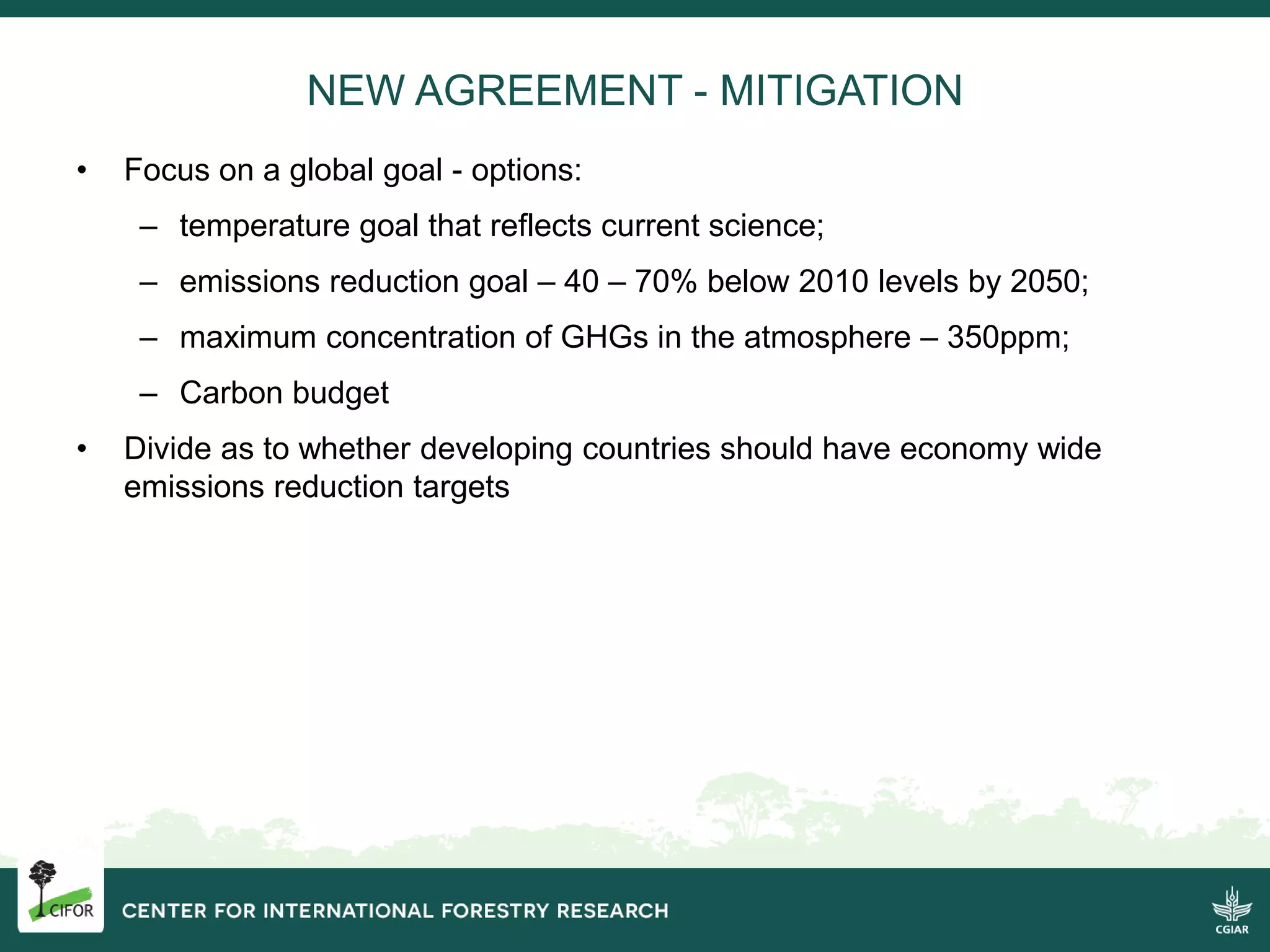
NEW AGREEMENT - MITIGATION 
• Focus on a global goal - options: 
– temperature goal that reflects current science; 
– emissions reduction goal – 40 – 70% below 2010 levels by 2050; 
– maximum concentration of GHGs in the atmosphere – 350ppm; 
– Carbon budget 
• Divide as to whether developing countries should have economy wide 
emissions reduction targets
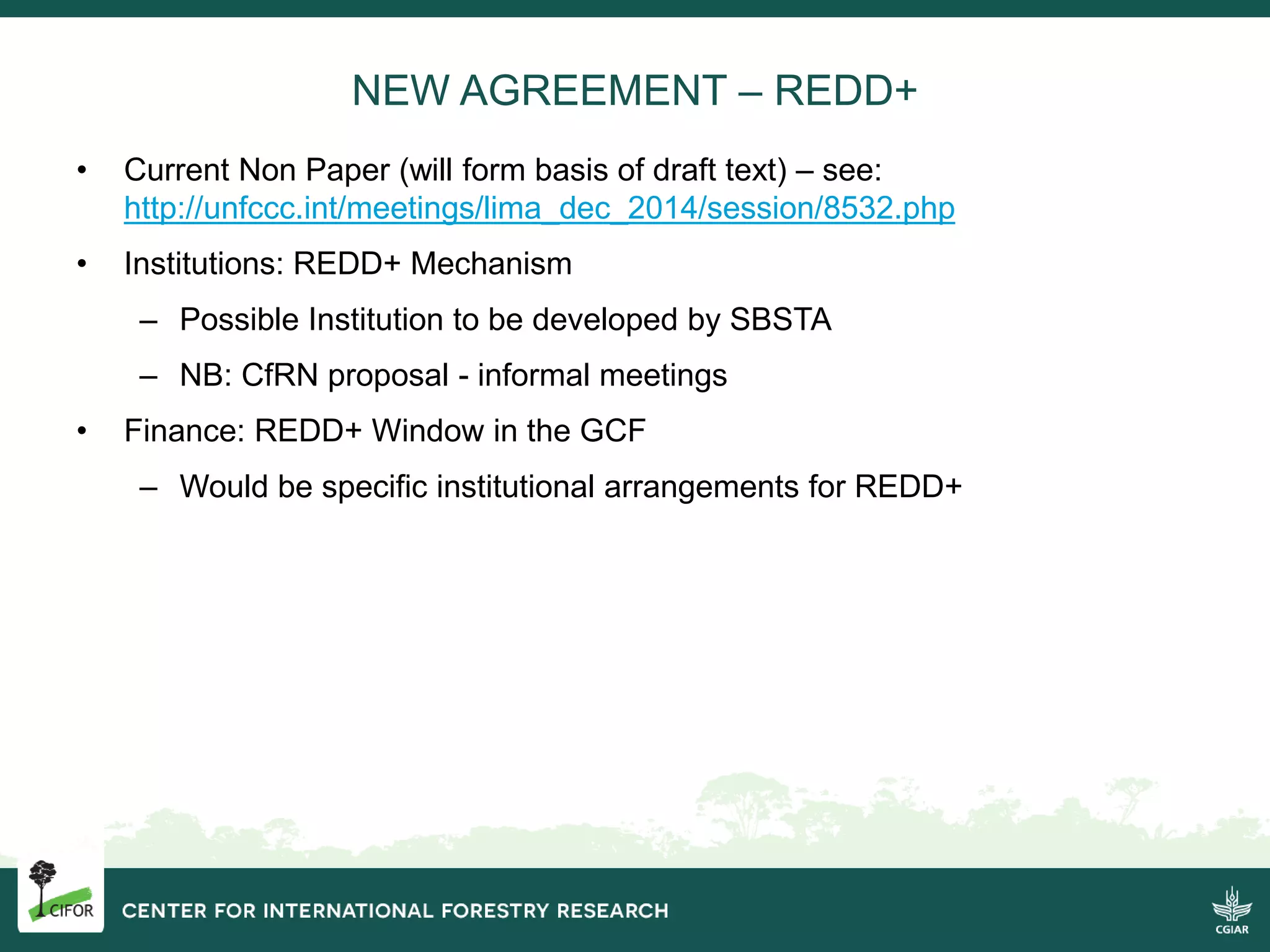
NEW AGREEMENT – REDD+ 
• Current Non Paper (will form basis of draft text) – see: 
http://unfccc.int/meetings/lima_dec_2014/session/8532.php 
• Institutions: REDD+ Mechanism 
– Possible Institution to be developed by SBSTA 
– NB: CfRN proposal - informal meetings 
• Finance: REDD+ Window in the GCF 
– Would be specific institutional arrangements for REDD+
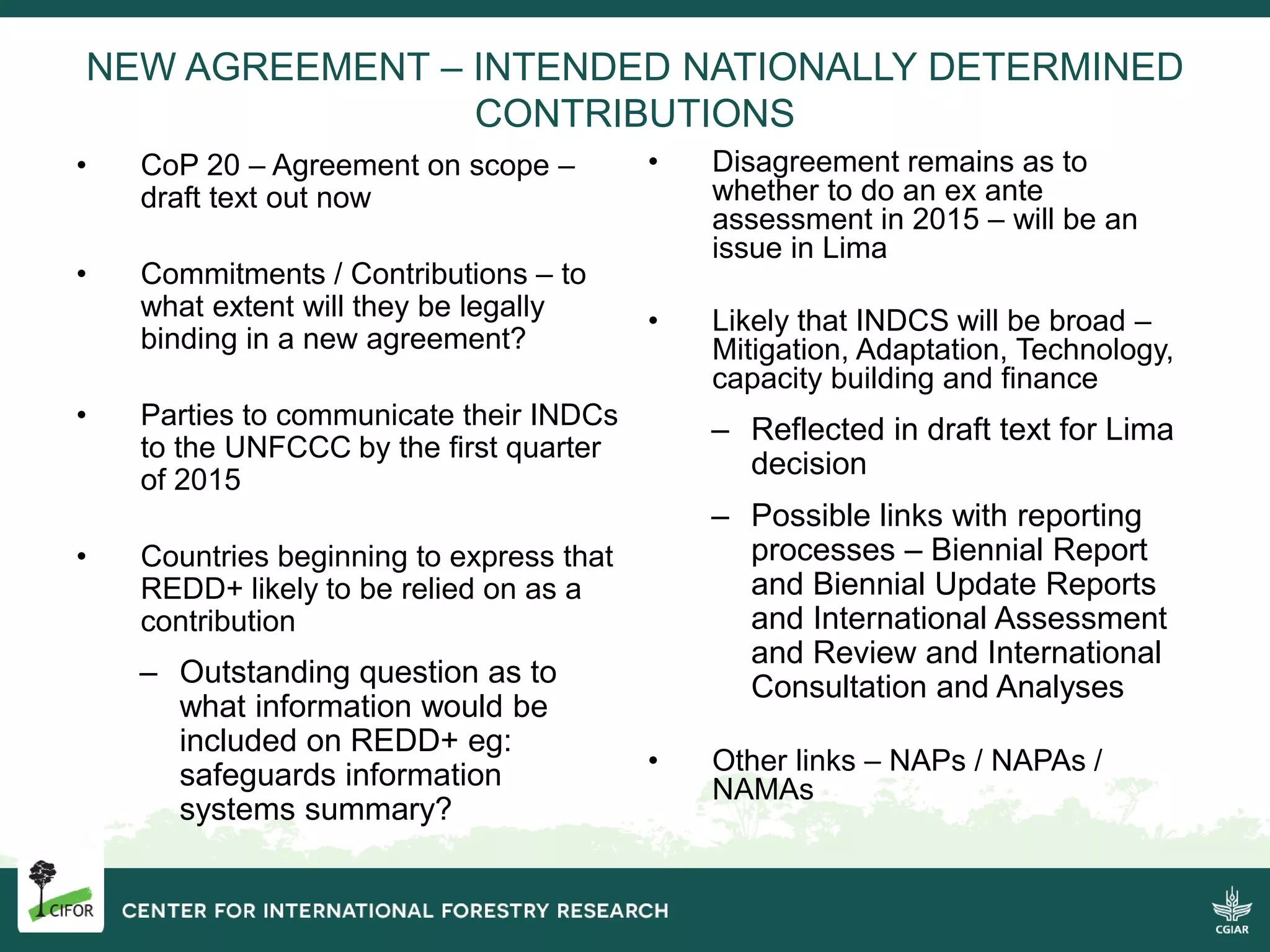
NEW AGREEMENT – INTENDED NATIONALLY DETERMINED 
CONTRIBUTIONS 
• CoP 20 – Agreement on scope – 
draft text out now 
• Commitments / Contributions – to 
what extent will they be legally 
binding in a new agreement? 
• Parties to communicate their INDCs 
to the UNFCCC by the first quarter 
of 2015 
• Countries beginning to express that 
REDD+ likely to be relied on as a 
contribution 
– Outstanding question as to 
what information would be 
included on REDD+ eg: 
safeguards information 
systems summary? 
• Disagreement remains as to 
whether to do an ex ante 
assessment in 2015 – will be an 
issue in Lima 
• Likely that INDCS will be broad – 
Mitigation, Adaptation, Technology, 
capacity building and finance 
– Reflected in draft text for Lima 
decision 
– Possible links with reporting 
processes – Biennial Report 
and Biennial Update Reports 
and International Assessment 
and Review and International 
Consultation and Analyses 
• Other links – NAPs / NAPAs / 
NAMAs
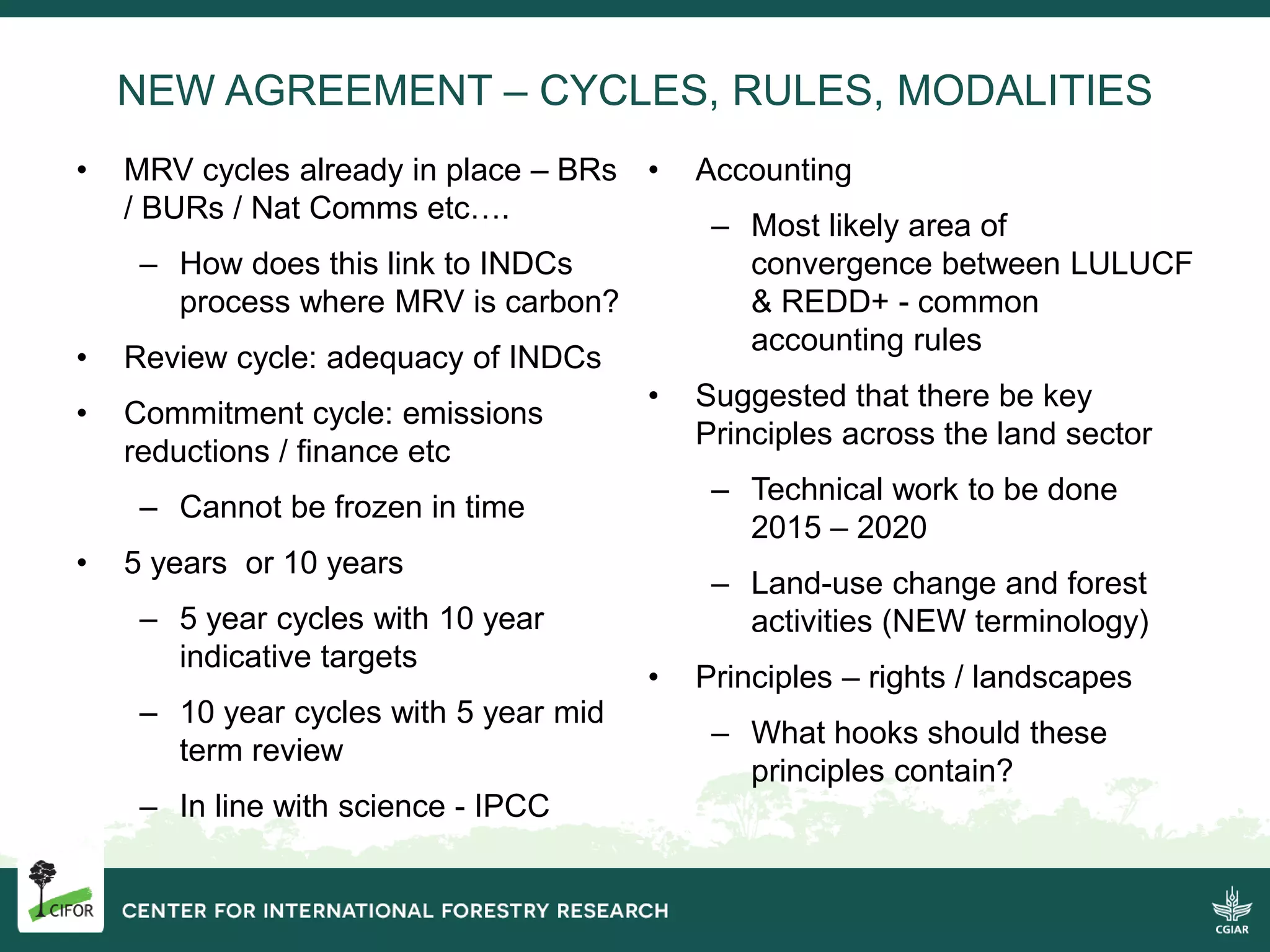
NEW AGREEMENT – CYCLES, RULES, MODALITIES 
• MRV cycles already in place – BRs 
/ BURs / Nat Comms etc…. 
– How does this link to INDCs 
process where MRV is carbon? 
• Review cycle: adequacy of INDCs 
• Commitment cycle: emissions 
reductions / finance etc 
– Cannot be frozen in time 
• 5 years or 10 years 
– 5 year cycles with 10 year 
indicative targets 
– 10 year cycles with 5 year mid 
term review 
– In line with science - IPCC 
• Accounting 
– Most likely area of 
convergence between LULUCF 
& REDD+ - common 
accounting rules 
• Suggested that there be key 
Principles across the land sector 
– Technical work to be done 
2015 – 2020 
– Land-use change and forest 
activities (NEW terminology) 
• Principles – rights / landscapes 
– What hooks should these 
principles contain?
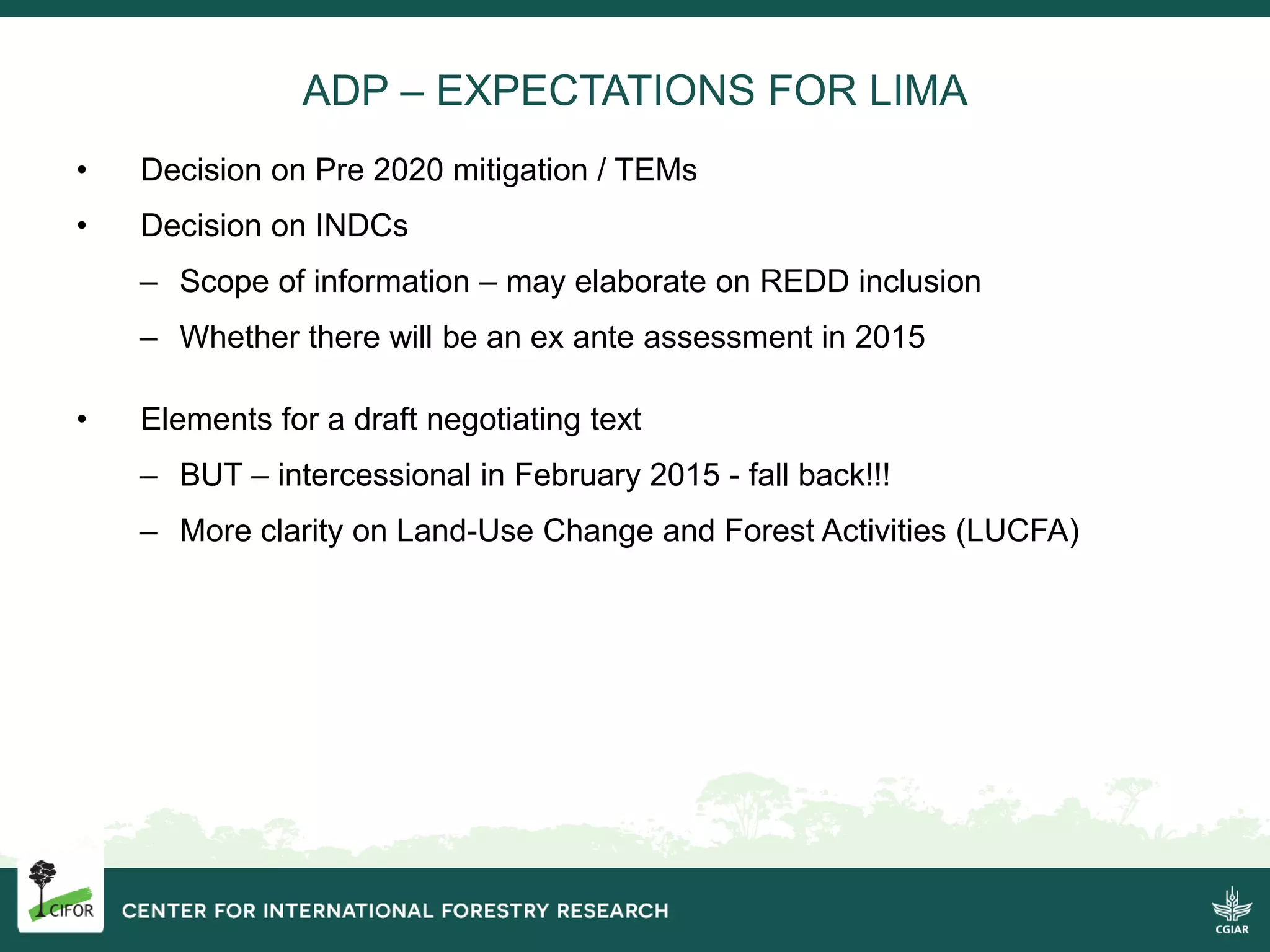
ADP – EXPECTATIONS FOR LIMA 
• Decision on Pre 2020 mitigation / TEMs 
• Decision on INDCs 
– Scope of information – may elaborate on REDD inclusion 
– Whether there will be an ex ante assessment in 2015 
• Elements for a draft negotiating text 
– BUT – intercessional in February 2015 - fall back!!! 
– More clarity on Land-Use Change and Forest Activities (LUCFA)
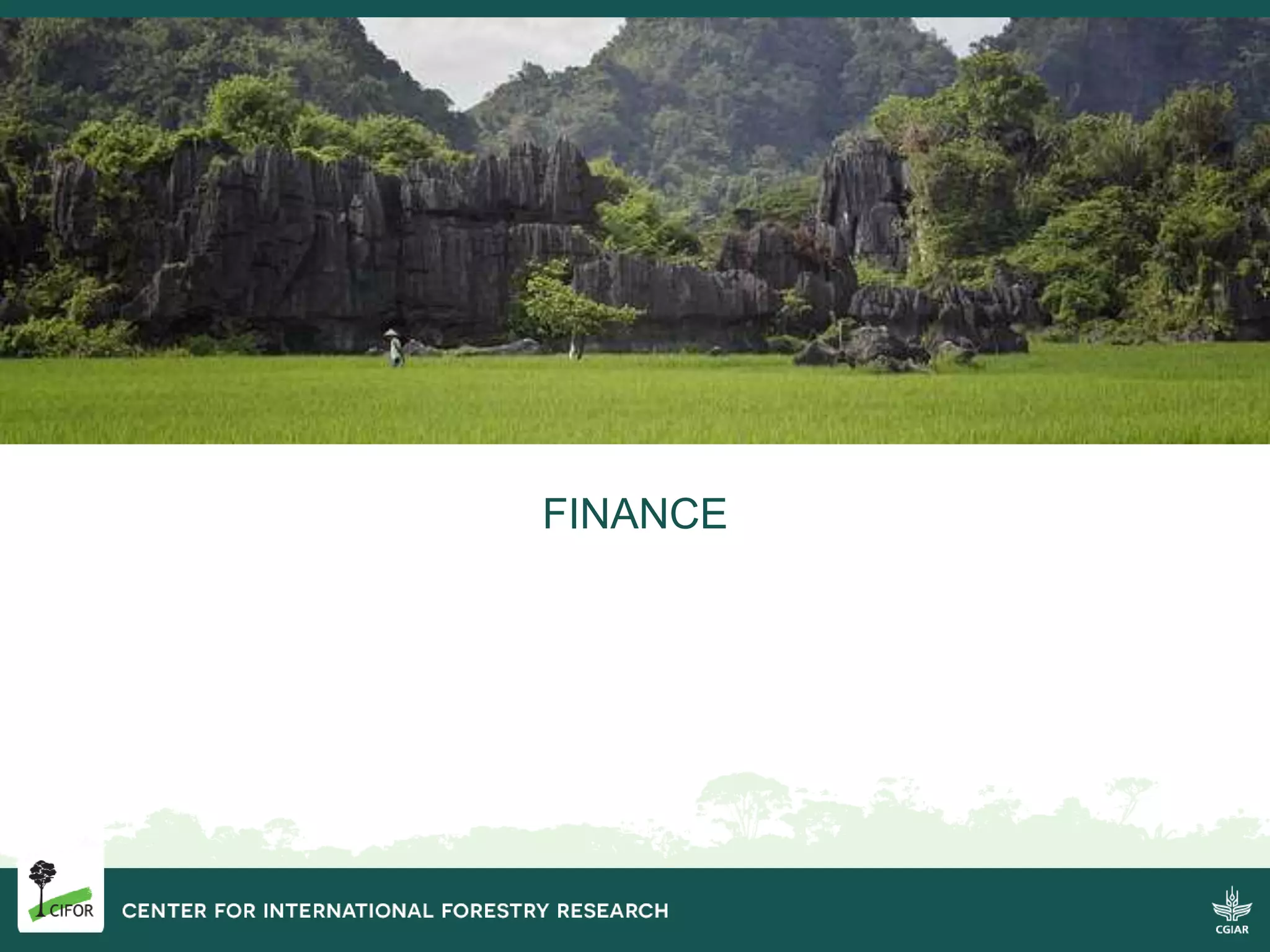
FINANCE
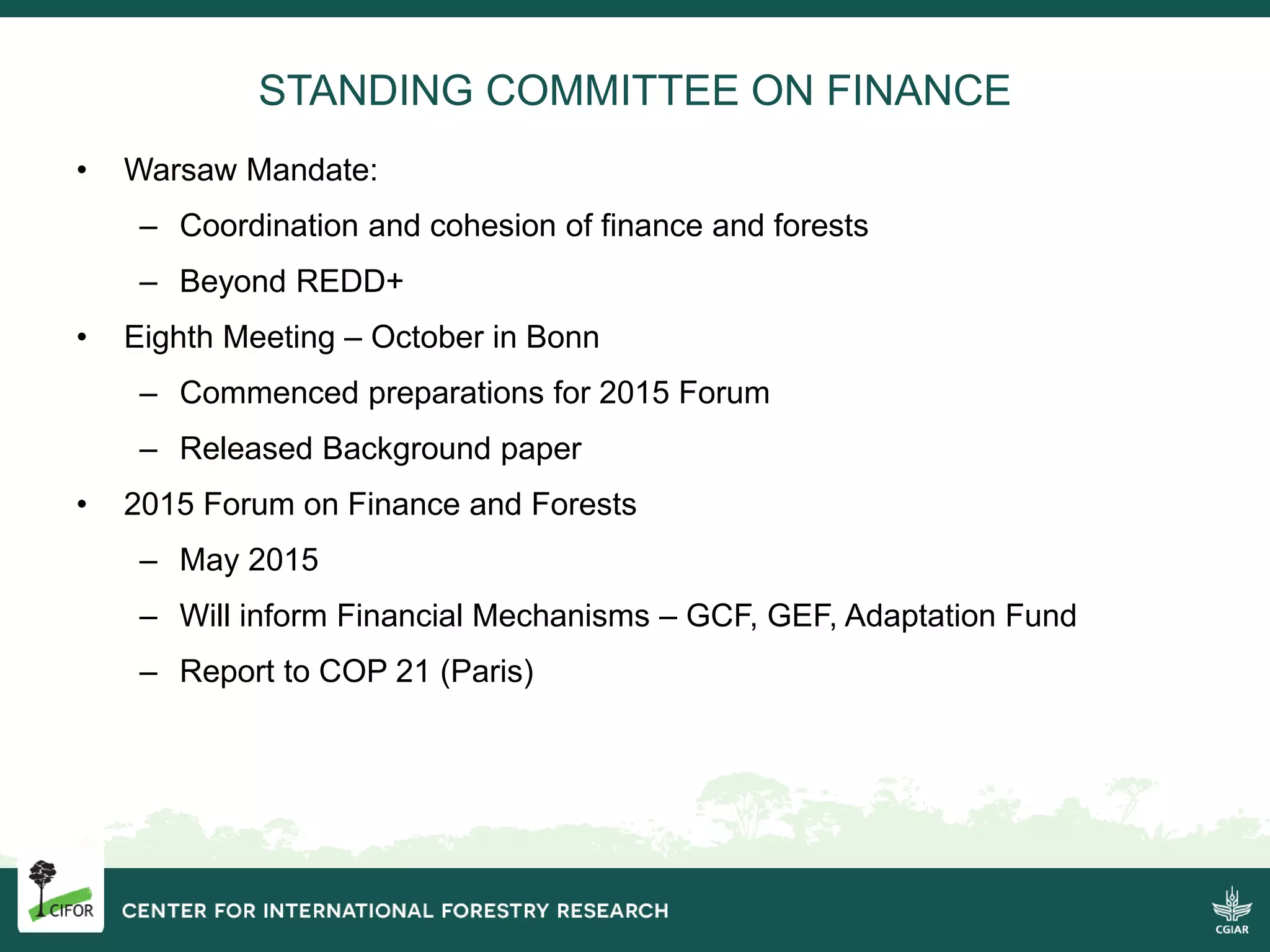
STANDING COMMITTEE ON FINANCE 
• Warsaw Mandate: 
– Coordination and cohesion of finance and forests 
– Beyond REDD+ 
• Eighth Meeting – October in Bonn 
– Commenced preparations for 2015 Forum 
– Released Background paper 
• 2015 Forum on Finance and Forests 
– May 2015 
– Will inform Financial Mechanisms – GCF, GEF, Adaptation Fund 
– Report to COP 21 (Paris)
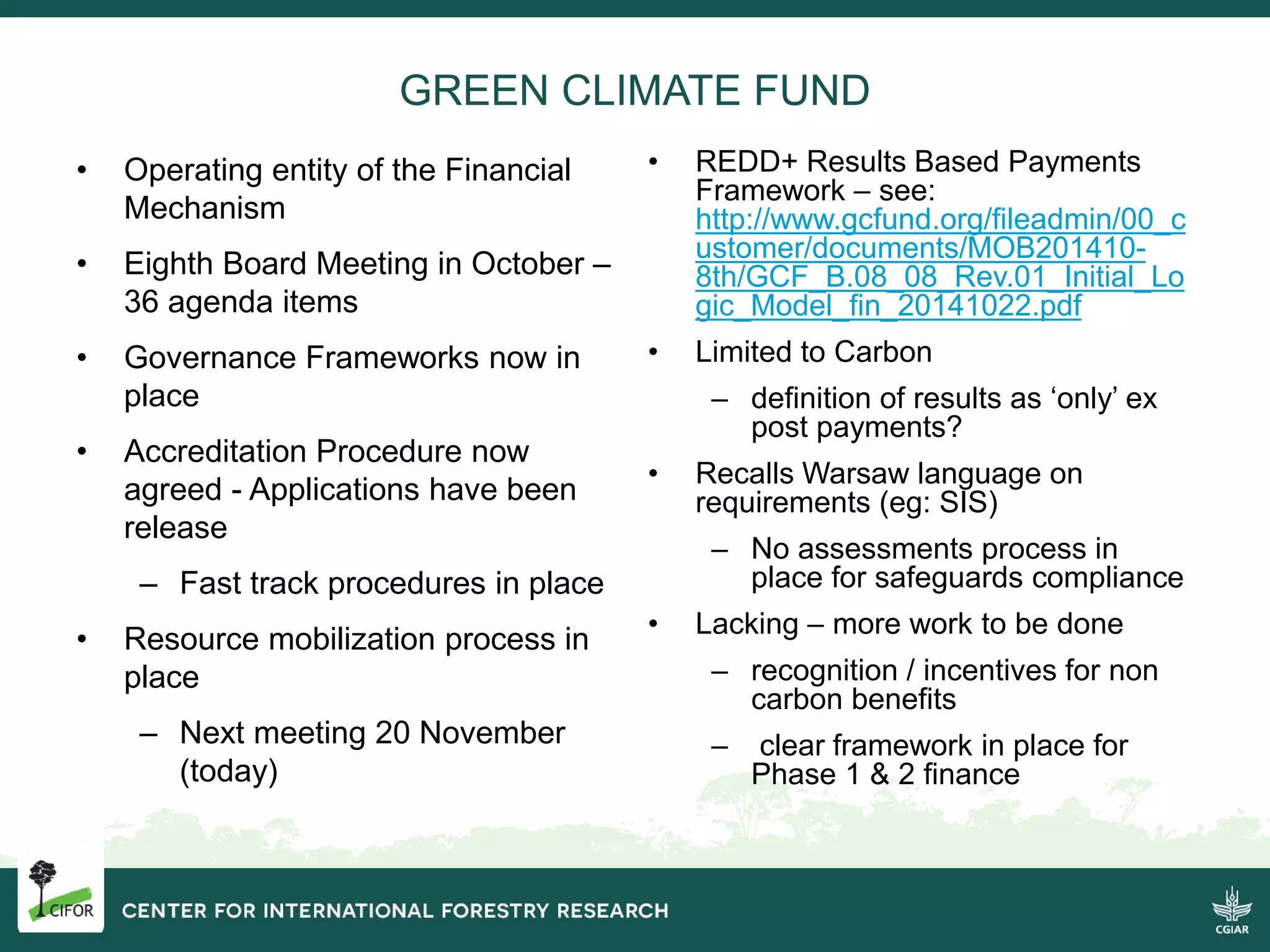
GREEN CLIMATE FUND 
• Operating entity of the Financial 
Mechanism 
• Eighth Board Meeting in October – 
36 agenda items 
• Governance Frameworks now in 
place 
• Accreditation Procedure now 
agreed - Applications have been 
release 
– Fast track procedures in place 
• Resource mobilization process in 
place 
– Next meeting 20 November 
(today) 
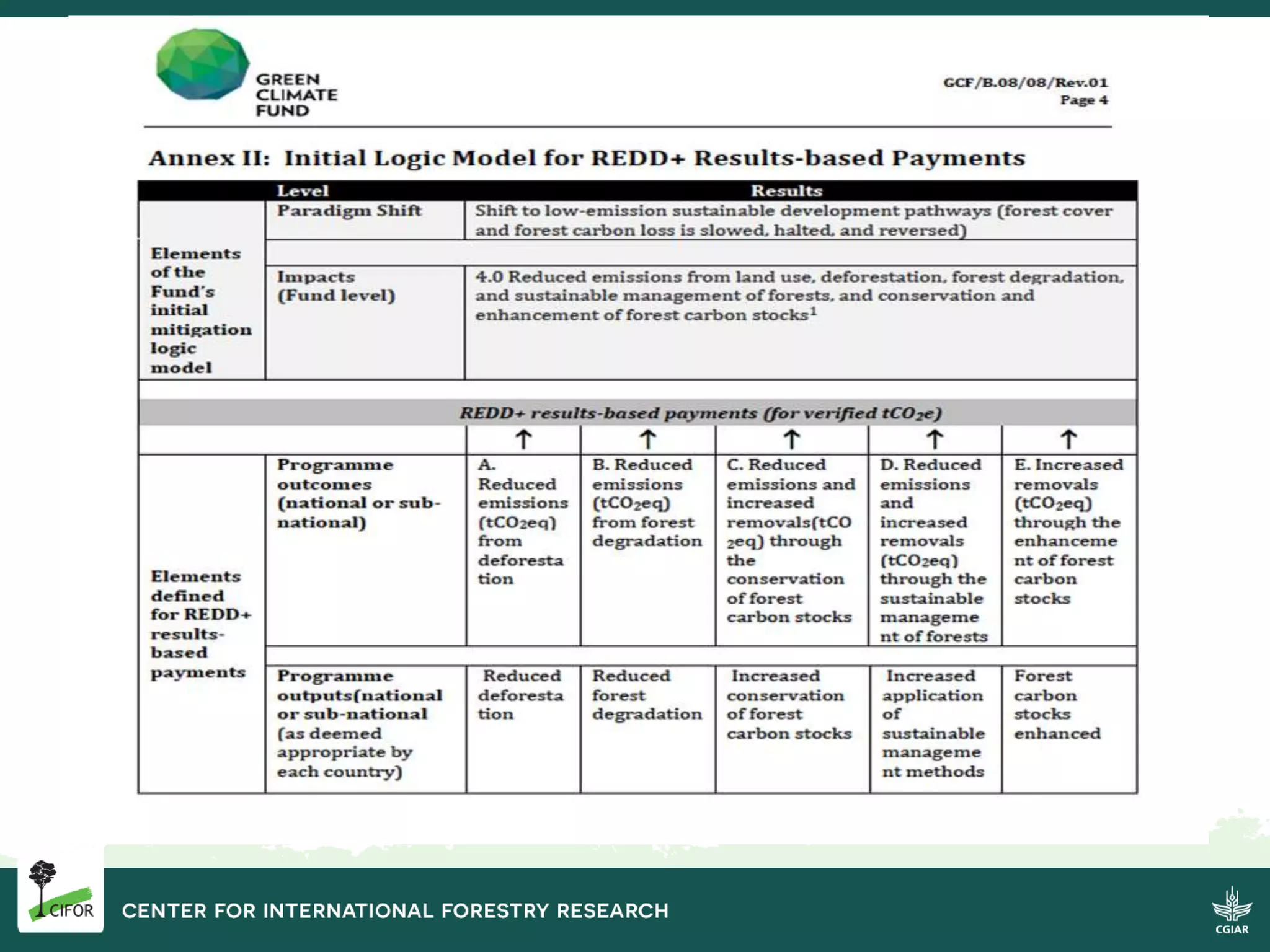
• REDD+ Results Based Payments 
Framework – see: 
http://www.gcfund.org/fileadmin/00_c 
ustomer/documents/MOB201410- 
8th/GCF_B.08_08_Rev.01_Initial_Lo 
gic_Model_fin_20141022.pdf 
• Limited to Carbon 
– definition of results as ‘only’ ex 
post payments? 
• Recalls Warsaw language on 
requirements (eg: SIS) 
– No assessments process in 
place for safeguards compliance 
• Lacking – more work to be done 
– recognition / incentives for non 
carbon benefits 
– clear framework in place for 
Phase 1 & 2 finance
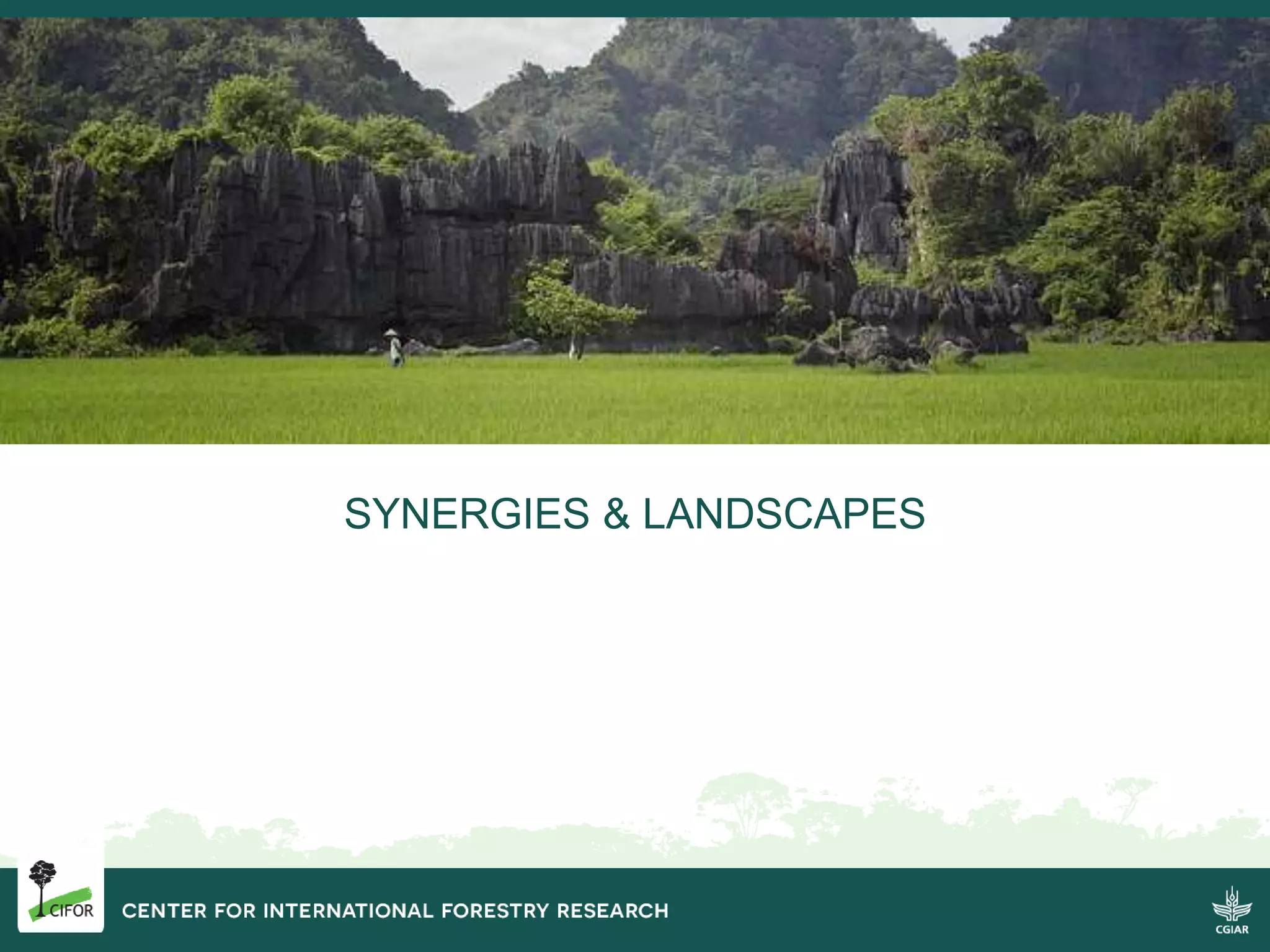
SYNERGIES & LANDSCAPES
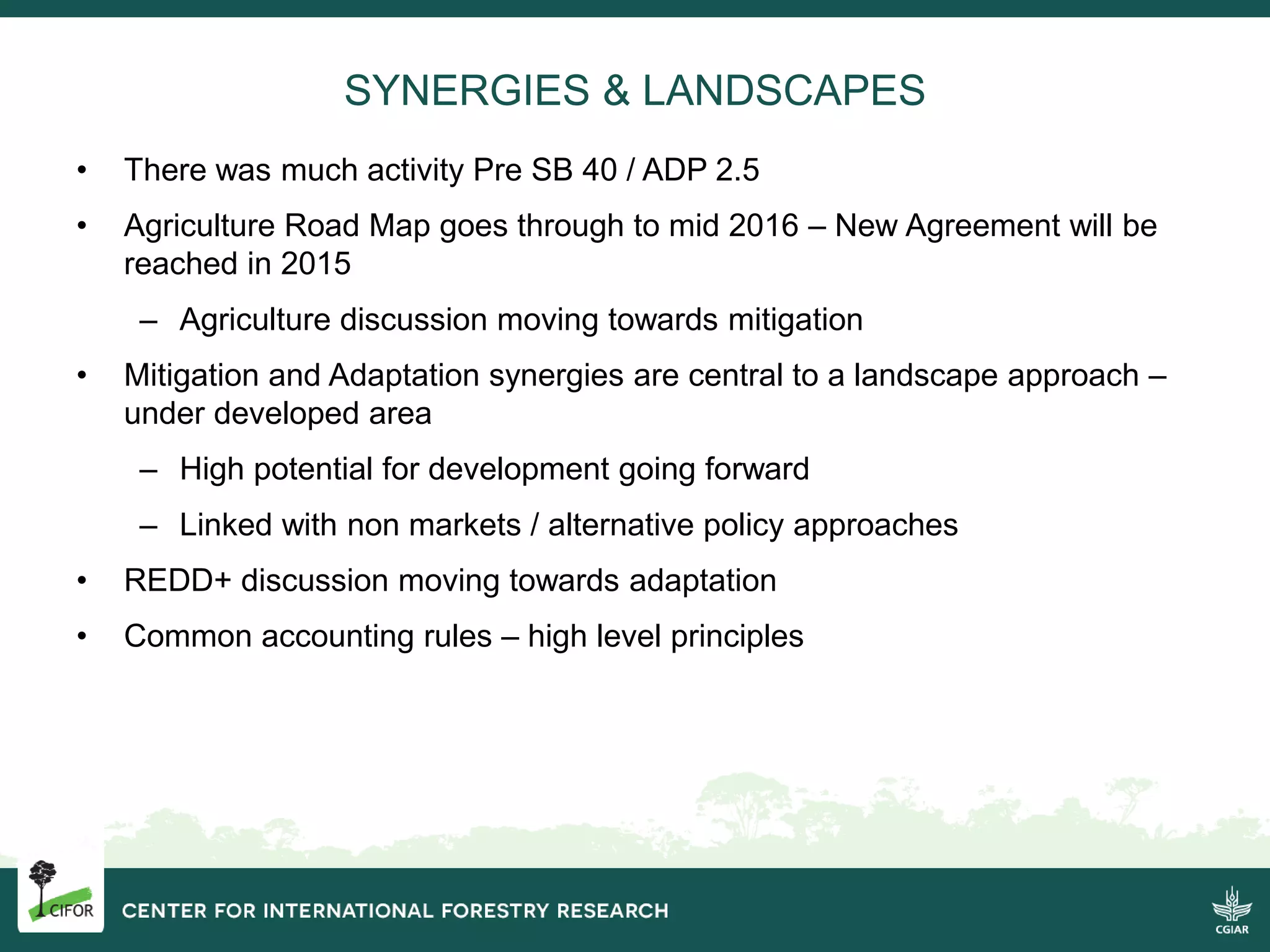
SYNERGIES & LANDSCAPES 
• There was much activity Pre SB 40 / ADP 2.5 
• Agriculture Road Map goes through to mid 2016 – New Agreement will be 
reached in 2015 
– Agriculture discussion moving towards mitigation 
• Mitigation and Adaptation synergies are central to a landscape approach – 
under developed area 
– High potential for development going forward 
– Linked with non markets / alternative policy approaches 
• REDD+ discussion moving towards adaptation 
• Common accounting rules – high level principles
MITIGATION & ADAPTATION SYNERGIES 
• Identified as important for the land sector in AR5 
• ADP - current non paper includes several linkages 
• GCF – Additional Adaptation Results Areas not agreed 
• SCF – Alternative Policy Approaches 
• SBSTA - Alternative Policy Approaches – JMA 
– Some Parties have called for international technical guidance and 
modalities on the issue – Bolivia, Singapore, China, PNG
ACRONYMS 
ADP: Ad Hoc Working Group on the Durban Platform 
AR5: Fifth Assessment report of the Intergovernmental Panel on Climate Change 
BRs: Biennial Reports 
BURs: Biennial Update Reports 
CDM: Clean Development Mechanism 
CfRN: Coalition for Rainforest Nations 
COP: Conference of Parties 
GCF: Green Climate Fund 
GEF: Global Environment Facility 
INDCs: Intended Nationally Determined Contributions 
IPCC: Intergovernmental Panel on Climate Change 
JMA: Joint Mitigation Adaptation 
KP: Kyoto Protocol 
LUCFA: Land Use Change and Forest Activities 
LULUCF: Land Use, Land Use Change and Forestry 
MRV: Measuring Reporting and Verification 
Nat Comms: National Communications 
NAMAs: Nationally Appropriate Mitigation Actions 
NAPs: National Adaptation Plans 
NAPAs: National Adaptation Programmes of Action 
SBSTA: Subsidiary Body on Scientific and Technical Advice 
SBI: Subsidiary Body on Implementation 
SCF: Standing Committee on Finance 
SIS: Safeguards Information Systems 
TEM: Technical Expert Meeting 
UNFCCC: United Nations Framework Convention on Climate Change 
WS: Work Stream
THANK YOU 
cifor.org 
blog.cifor.org 
ForestsTreesAgroforestry.org

The UNFCCC Policy Landscape Pre Lima

  • 1.
    THE UNFCCC POLICYLANDSCAPE PRE LIMA Stephen Leonard, Senior Policy Analyst – UNFCCC Center for International Forestry Research 20 November 2014
  • 2.
    SETTING THE STAGE Big Picture • Recent emissions reductions announcements − EU: 40% on 1990 levels by 2030 − China: Emissions peak by 2030 / 20% zero emissions energy by 2030 − USA: 26 – 28% on 2005 levels by 2025 • Financial Pledges being made ‒ Current pledges to GCF around US$9b – target this year of US$10 – 15b • Climate in G20 Communique despite Australian block • However, very few Kyoto Amendment ratifications
  • 3.
    SETTING THE STAGE– FORESTS New Climate Agreement – Possible inclusions: • REDD+ Mechanism • REDD+ Window in the GCF SBSTA • Finalizing work on Safeguards in Lima • Alternative Policy Approaches – adaptation links Finance • GCF Frameworks completed • REDD+ Results Framework agreed in Barbados • Standing Committee on Finance
  • 4.
    THIS PRESENTATION….. •SBs – SBSTA – Metrics / REDD+ Safeguards / REDD+ Alternative Policy Approaches / Clean Development Mechanism – land use – SBI - Adaptation Plans • New Climate Agreement – Elements & INDCs • Finance - Green Climate Fund / Standing Committee on Finance
  • 5.
    ACRONYMS ADP: AdHoc Working Group on the Durban Platform AR5: Fifth Assessment report of the Intergovernmental Panel on Climate Change BRs: Biennial Reports BURs: Biennial Update Reports CDM: Clean Development Mechanism CfRN: Coalition for Rainforest Nations COP: Conference of Parties GCF: Green Climate Fund GEF: Global Environment Facility INDCs: Intended Nationally Determined Contributions IPCC: Intergovernmental Panel on Climate Change JMA: Joint Mitigation Adaptation KP: Kyoto Protocol LUCFA: Land Use Change and Forest Activities LULUCF: Land Use, Land Use Change and Forestry MRV: Measuring Reporting and Verification Nat Comms: National Communications NAMAs: Nationally Appropriate Mitigation Actions NAPs: National Adaptation Plans NAPAs: National Adaptation Programmes of Action SBSTA: Subsidiary Body on Scientific and Technical Advice SBI: Subsidiary Body on Implementation SCF: Standing Committee on Finance SIS: Safeguards Information Systems TEM: Technical Expert Meeting UNFCCC: United Nations Framework Convention on Climate Change WS: Work Stream
  • 6.
  • 7.
    SBSTA 41 –REDD+ SAFEGUARDS INFORMATION SYSTEMS • The ‘need’ for further guidance on Safeguards Information Systems – Unresolved issue for the past 2+ years • Submissions received / compiled – CIFOR Analyses – majority of submissions favor further guidance. – trade-offs between further guidance and the promotion of country-driven approaches and national sovereignty. – need to minimize the burden for creation of and reporting on SIS. – civil society organizations highlighted issues around equity and participation of local people in the process. – Useful guidance on how to develop a country-driven approach.
  • 8.
    SBSTA 41 –ALTERNATIVE POLICY APPROACHES TO REDD+ • Warsaw mandate to agree at SBSTA 40 – no agreement so put back to Lima • Premised on Bolivian Proposal – JMA and Non Markets – alternative to REDD carbon markets approach – not replacement – Expert Meeting / Workshop held in Bonn @ SBSTA 40 – See: https://unfccc.int/files/methods/redd/application/pdf/bolivian_proposal_j ma_05.06.2014.pdf • Debate over whether item remains under REDD or new Agenda item – Brazil pushing to have the item considered outside the REDD Bali Agenda item – Bolivia want it to remain under REDD
  • 9.
    SBSTA 41 –CDM & LULUCF • CDM – under the Kyoto Protocol • SBSTA 40 considered inputs from technical paper • Ongoing consideration in Lima of additional LULUCF areas under the CDM: – Revegetation including agroforestry and silvopastoral; – Cropland management and grazing management • Wetland drainage and rewettingCDM – under the Kyoto Protocol • SBSTA 40 considered inputs from technical paper • Ongoing consideration in Lima of additional LULUCF areas under the CDM: – Revegetation including agroforestry and silvopastoral; – Cropland management and grazing management – Wetland drainage and rewetting
  • 10.
    SBSTA 41 -METRICS • Provide the basis for comparing impacts in multiple GHG reduction efforts • Ongoing debate: ‒ KP =Global Warming Potential – others developed since 1997 ‒ Whether to expand to other metrics / timescales 8 different metrics in AR5 / timescales: 20, 50 and 100 years • Was considered in Bonn – no agreement – Lima • Brazil – need an agreement - critical input to the ADP ‒ Discussion concerning agreement on a ‘common metric’ or ‘basket of metrics’ for the new agreement
  • 11.
    SBI 41 –NATIONAL ADAPTATION PLANS • Much emphasis on the lack of finance: – new climate agreement links: • Finance including via GCF • INDCs • Norway calling for adaptation and forests to be discussed in NAPs context – Expect more focus on forests and adaptation (SCF / GCF) • Countries lacking understanding of technical guidance and seeking greater clarity
  • 12.
  • 13.
    THE DURBAN PLATFORM(ADP) • Ad Hoc Working Group on the Durban Platform • WS 1 - process to develop a protocol, another legal instrument or an agreed outcome with legal force applicable to all Parties by 2015 for implementation by 2020 • WS 2 - Pre 2020 - to explore options to close the ambition gap ensuring highest possible mitigation efforts by Parties
  • 14.
    PRE 2020 MITIGATION • TEMs – part of the formal process: – Land Use / Non CO2 Emissions (agriculture) • Purpose: – To enhance pre 2020 mitigation – Provide guidance to UNFCCC Institutions (eg: GCF) • Projects / programmes to finance • Priority areas – Likely to be ongoing to up 2020 • Possible to be broadened to include adaptation
  • 15.
    PRE 2020 MITIGATION • TEMS: Outputs: – Land Use • REDD+ remains high on the agenda • high mitigation & Adaptation potential from forest and agricultural sectors; • a scaling up of finance, technology and capacity building is required; • sectoral policies are required; • participatory multi-stakeholder dialogues should commence at early stages; See: http://unfccc.int/bodies/awg/items/8171.php
  • 16.
    PRE 2020 MITIGATION • Non CO2 Emissions – Agriculture – up to 80% of emissions from the agriculture sector could be reduced by 2030. • Potential policies and actions identified include – soil conservation; – soil productivity and erosion control; – nitrogen use efficiency; – rice management; – Research; and – landscape approach See: http://unfccc.int/bodies/awg/items/8420.php
  • 17.
    NEW AGREEMENT -ADAPTATION • Has had a clear increase in profile • Major emphasis on scaling up finance • Link in with current processes – NAPs, NAPAs and Adaption Fund • Focus on a global adaptation goal – metrics – Vulnerability, resource allocation, economics, research, finance – Proposed process to be launched
  • 18.
    NEW AGREEMENT -MITIGATION • Focus on a global goal - options: – temperature goal that reflects current science; – emissions reduction goal – 40 – 70% below 2010 levels by 2050; – maximum concentration of GHGs in the atmosphere – 350ppm; – Carbon budget • Divide as to whether developing countries should have economy wide emissions reduction targets
  • 19.
    NEW AGREEMENT –REDD+ • Current Non Paper (will form basis of draft text) – see: http://unfccc.int/meetings/lima_dec_2014/session/8532.php • Institutions: REDD+ Mechanism – Possible Institution to be developed by SBSTA – NB: CfRN proposal - informal meetings • Finance: REDD+ Window in the GCF – Would be specific institutional arrangements for REDD+
  • 20.
    NEW AGREEMENT –INTENDED NATIONALLY DETERMINED CONTRIBUTIONS • CoP 20 – Agreement on scope – draft text out now • Commitments / Contributions – to what extent will they be legally binding in a new agreement? • Parties to communicate their INDCs to the UNFCCC by the first quarter of 2015 • Countries beginning to express that REDD+ likely to be relied on as a contribution – Outstanding question as to what information would be included on REDD+ eg: safeguards information systems summary? • Disagreement remains as to whether to do an ex ante assessment in 2015 – will be an issue in Lima • Likely that INDCS will be broad – Mitigation, Adaptation, Technology, capacity building and finance – Reflected in draft text for Lima decision – Possible links with reporting processes – Biennial Report and Biennial Update Reports and International Assessment and Review and International Consultation and Analyses • Other links – NAPs / NAPAs / NAMAs
  • 21.
    NEW AGREEMENT –CYCLES, RULES, MODALITIES • MRV cycles already in place – BRs / BURs / Nat Comms etc…. – How does this link to INDCs process where MRV is carbon? • Review cycle: adequacy of INDCs • Commitment cycle: emissions reductions / finance etc – Cannot be frozen in time • 5 years or 10 years – 5 year cycles with 10 year indicative targets – 10 year cycles with 5 year mid term review – In line with science - IPCC • Accounting – Most likely area of convergence between LULUCF & REDD+ - common accounting rules • Suggested that there be key Principles across the land sector – Technical work to be done 2015 – 2020 – Land-use change and forest activities (NEW terminology) • Principles – rights / landscapes – What hooks should these principles contain?
  • 22.
    ADP – EXPECTATIONSFOR LIMA • Decision on Pre 2020 mitigation / TEMs • Decision on INDCs – Scope of information – may elaborate on REDD inclusion – Whether there will be an ex ante assessment in 2015 • Elements for a draft negotiating text – BUT – intercessional in February 2015 - fall back!!! – More clarity on Land-Use Change and Forest Activities (LUCFA)
  • 23.
  • 24.
    STANDING COMMITTEE ONFINANCE • Warsaw Mandate: – Coordination and cohesion of finance and forests – Beyond REDD+ • Eighth Meeting – October in Bonn – Commenced preparations for 2015 Forum – Released Background paper • 2015 Forum on Finance and Forests – May 2015 – Will inform Financial Mechanisms – GCF, GEF, Adaptation Fund – Report to COP 21 (Paris)
  • 25.
    GREEN CLIMATE FUND • Operating entity of the Financial Mechanism • Eighth Board Meeting in October – 36 agenda items • Governance Frameworks now in place • Accreditation Procedure now agreed - Applications have been release – Fast track procedures in place • Resource mobilization process in place – Next meeting 20 November (today) • REDD+ Results Based Payments Framework – see: http://www.gcfund.org/fileadmin/00_c ustomer/documents/MOB201410- 8th/GCF_B.08_08_Rev.01_Initial_Lo gic_Model_fin_20141022.pdf • Limited to Carbon – definition of results as ‘only’ ex post payments? • Recalls Warsaw language on requirements (eg: SIS) – No assessments process in place for safeguards compliance • Lacking – more work to be done – recognition / incentives for non carbon benefits – clear framework in place for Phase 1 & 2 finance
  • 27.
  • 28.
    SYNERGIES & LANDSCAPES • There was much activity Pre SB 40 / ADP 2.5 • Agriculture Road Map goes through to mid 2016 – New Agreement will be reached in 2015 – Agriculture discussion moving towards mitigation • Mitigation and Adaptation synergies are central to a landscape approach – under developed area – High potential for development going forward – Linked with non markets / alternative policy approaches • REDD+ discussion moving towards adaptation • Common accounting rules – high level principles
  • 29.
    MITIGATION & ADAPTATIONSYNERGIES • Identified as important for the land sector in AR5 • ADP - current non paper includes several linkages • GCF – Additional Adaptation Results Areas not agreed • SCF – Alternative Policy Approaches • SBSTA - Alternative Policy Approaches – JMA – Some Parties have called for international technical guidance and modalities on the issue – Bolivia, Singapore, China, PNG
  • 30.
    ACRONYMS ADP: AdHoc Working Group on the Durban Platform AR5: Fifth Assessment report of the Intergovernmental Panel on Climate Change BRs: Biennial Reports BURs: Biennial Update Reports CDM: Clean Development Mechanism CfRN: Coalition for Rainforest Nations COP: Conference of Parties GCF: Green Climate Fund GEF: Global Environment Facility INDCs: Intended Nationally Determined Contributions IPCC: Intergovernmental Panel on Climate Change JMA: Joint Mitigation Adaptation KP: Kyoto Protocol LUCFA: Land Use Change and Forest Activities LULUCF: Land Use, Land Use Change and Forestry MRV: Measuring Reporting and Verification Nat Comms: National Communications NAMAs: Nationally Appropriate Mitigation Actions NAPs: National Adaptation Plans NAPAs: National Adaptation Programmes of Action SBSTA: Subsidiary Body on Scientific and Technical Advice SBI: Subsidiary Body on Implementation SCF: Standing Committee on Finance SIS: Safeguards Information Systems TEM: Technical Expert Meeting UNFCCC: United Nations Framework Convention on Climate Change WS: Work Stream
  • 31.
    THANK YOU cifor.org blog.cifor.org ForestsTreesAgroforestry.org