© 2008 Gaetano Cascini – cascini@etria.net
Università degli Studi di Firenze
Dip. di Meccanica e Tecnologie Industriali
Lab. di Metodi e Tecniche per l’Innovazione
Gaetano Cascini
gaetano.cascini@unifi.it
TRIZ
TRIZ
Innovazione Sistematica
Polo Tecnologico Casarano
Università del Salento
Lecce 27 maggio 2008
2
© 2008 Gaetano Cascini – cascini@etria.net
Program & Goal
Goal:
™ To understand what TRIZ and Systematic Innovation are. Get
awareness of TRIZ tools and techniques. Appreciate strategic and
operational applications of TRIZ
Program:
™ Background
™ Origins
™ Philosophy
™ Key Concepts:
o Laws of Engineering Systems Evolution
o Contradictions
o Ideality and Resources
o Inventive Principles and Inventive Standards
™ Applications & Warnings
3
© 2008 Gaetano Cascini – cascini@etria.net
University of Florence
Lab. of Methods and Tools for Innovation
Research Topics:
™ Data and Text Mining for Patent Analysis
™ Integration of TRIZ in Computer-Aided Design systems
™ TRIZ for Technology Forecasting
Training and coaching for TRIZ introduction in industry:
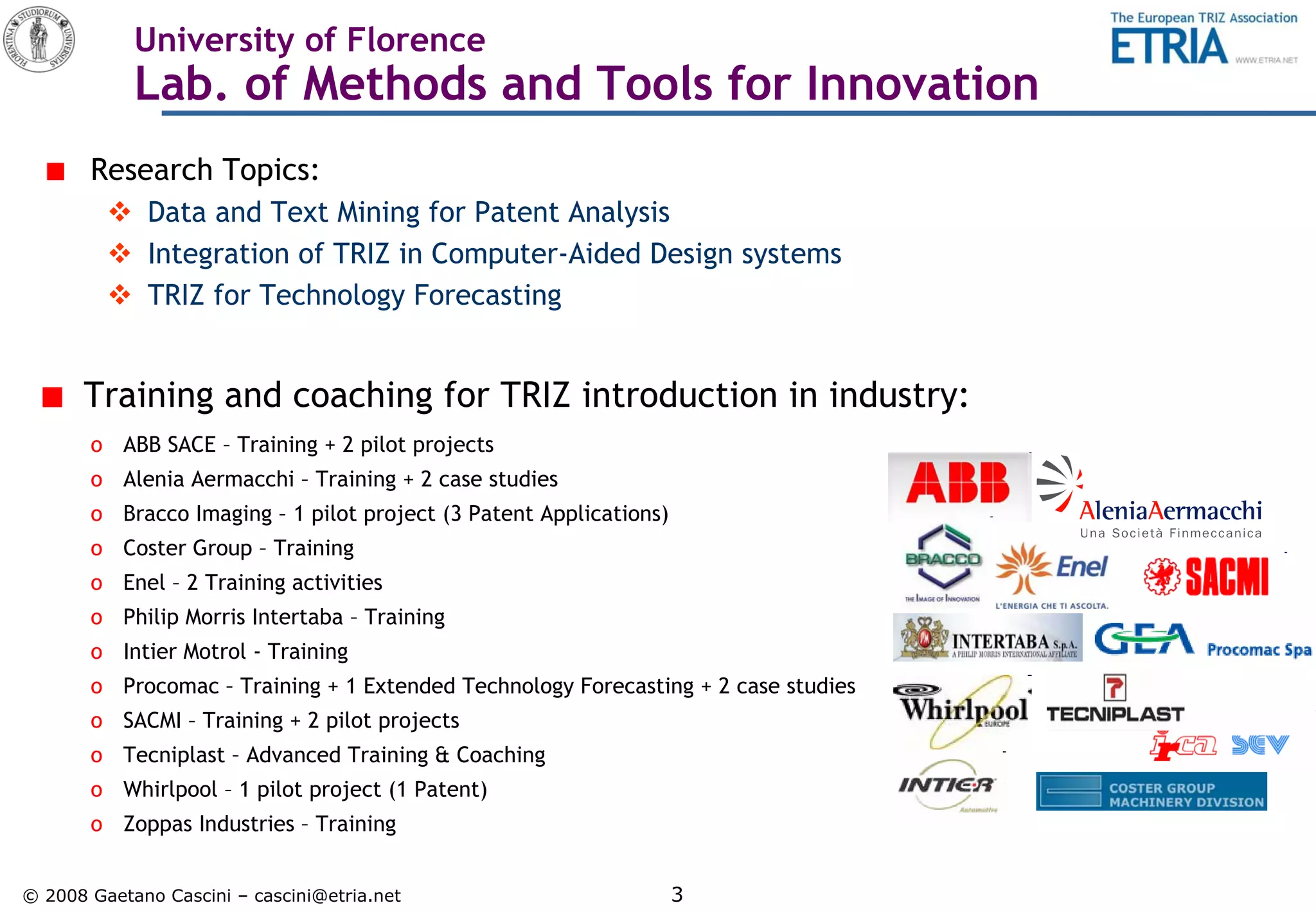
o ABB SACE – Training + 2 pilot projects
o Alenia Aermacchi – Training + 2 case studies
o Bracco Imaging – 1 pilot project (3 Patent Applications)
o Coster Group – Training
o Enel – 2 Training activities
o Philip Morris Intertaba – Training
o Intier Motrol - Training
o Procomac – Training + 1 Extended Technology Forecasting + 2 case studies
o SACMI – Training + 2 pilot projects
o Tecniplast – Advanced Training & Coaching
o Whirlpool – 1 pilot project (1 Patent)
o Zoppas Industries – Training
4
© 2008 Gaetano Cascini – cascini@etria.net
ETRIA – European TRIZ Association
What ETRIA is: WWW.ETRIA.NET
™ ETRIA is a non-profit foundation, registered as a public organization in
Germany.
™ The European TRIZ association intends to function as a connection link
between industrial companies, institutions, educational organizations and
individuals concerned with conceptual questions pertaining to organization
and processing of innovation knowledge.
Main Activities:
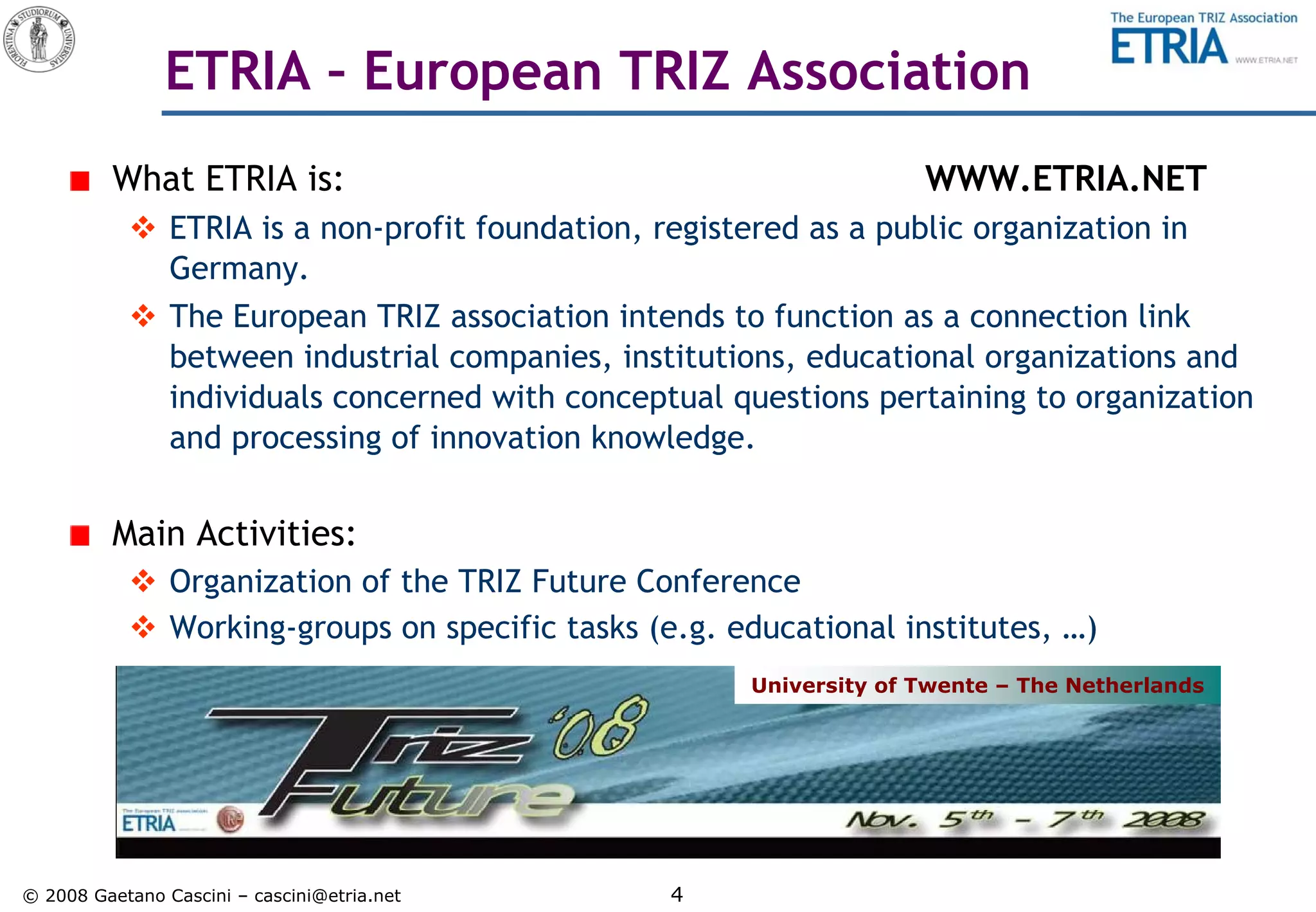
™ Organization of the TRIZ Future Conference
™ Working-groups on specific tasks (e.g. educational institutes, …)
University of Twente – The Netherlands
5
© 2008 Gaetano Cascini – cascini@etria.net
APEIRON – Associazione Italiana TRIZ
Costituire un collegamento fra individui ed organizzazioni
pubbliche e private
™ Diffusione e sviluppo di TRIZ
™ Integrazione con altre metodologie
™ Promuovere la cultura dell’Innovazione Sistematica
WWW.APEIRON-TRIZ.ORG
© 2008 Gaetano Cascini – cascini@etria.net
Università degli Studi di Firenze
Dip. di Meccanica e Tecnologie Industriali
Lab. di Metodi e Tecniche per l’Innovazione
Introduction
7
© 2008 Gaetano Cascini – cascini@etria.net
Il problema della velocità del cambiamento
Forte incremento di velocità vs. capacità di assorbimento del
cambiamento
Necessità di incrementare la distanza dell’orizzonte di visione
Necessità di individuare e migrare in tempo in un nuovo modo di
fare le cose di prima
Necessità di individuare/formare/reperire le conoscenze e gli
skill necessari
Necessità di avere sotto controllo il processo
Necessità di innovare
™ Per rispondere a nuove domande del mercato esplicite o ancora
inespresse
™ Per rispondere con nuove risposte a vecchie domande già note
Source: Umberto Cugini
8
© 2008 Gaetano Cascini – cascini@etria.net
Come affrontiamo oggi il problema innovazione?
Studiamo in modo continuativo e sistematico il mercato, ma
sopratutto la sua dinamica evolutiva in modo da individuare in
anticipo e per primi le future necessità e opportunità?
Attuiamo una ricerca programmata e continua orientata a
individuare nuove soluzioni e/o nuove opportunità?
Facciamo un’ analisi critica continuativa delle nostre soluzioni,
dei nostri processi di sviluppo prodotto, dei nostri metodi e dei
nostri strumenti di progettazione?
Monitoriamo in modo sistematico e continuativo il mercato delle
nuove tecnologie disponobili ed emergenti?
Monitoriamo le dinamiche evolutive dei nostri competitors?
Source: Umberto Cugini
9
© 2008 Gaetano Cascini – cascini@etria.net
Conoscere il proprio presente e futuro prossimo
Di quanto si è ridotto il ciclo di vita dei nostri prodotti?
Di quanto si ridurrà?
Da quanto tempo le soluzioni e le tecnologie utilizzate nei nostri
prodotti sono in essere?
Per quanto tempo potranno ancora essere valide?
Che margini di miglioramento e ottimizzazione abbiamo davanti a noi?
Con quali soluzioni e tecnologie le potremo sostituire?
Abbiamo le conoscenze e le competenze relative all’uso di queste
nuove tecnologie?
Abbiamo idea di quanto dureranno?
Come impatteranno sui nostri processi e sulla nostra organizzazione?
Source: Umberto Cugini
10
© 2008 Gaetano Cascini – cascini@etria.net
Primary school
Problem: How to
distribute 50 cherries
between 3 kids?
Should your kids
solve the problem
by “intuition”
and/or by
“experience”??!!
Problem solving approaches
11
© 2008 Gaetano Cascini – cascini@etria.net
Type of Problem: arithmetic
Model of the problem: 50:3
Tool: division
Model of the solution: 16,67
Solution:
distribute 16 cherries
to each kid
Problem solving approaches
Specific
Problem
General Model
of the Problem
General Model
of the Solution
Specific
Solution
Analysis and
Abstraction
General
Instruments
Solution
Generation
12
© 2008 Gaetano Cascini – cascini@etria.net
High School:
What does it happen by
mixing Sulfuric Acid with
Calcium Hydroxide ?
What would you
suggest?
Let’s try and see?!?
Problem solving approaches
13
© 2008 Gaetano Cascini – cascini@etria.net
Type of problem: chemical
Model of the problem: H2SO4 + Ca(OH)2
Tool: laws of chemistry, oxide-reduction
Model of the solution: CaSO4 + 2 H2O
Solution:
Calcium Sulfate + Water
Problem solving approaches
Specific
Problem
General Model
of the Problem
General Model
of the Solution
Specific
Solution
Analysis and
Abstraction
General
Instruments
Solution
Generation
14
© 2008 Gaetano Cascini – cascini@etria.net
What about innovation?
Why trial & error?
Is it necessary to have a personal talent
to be inventive?
Is it possible to follow a systematic
approach to generate inventive
solutions?
15
© 2008 Gaetano Cascini – cascini@etria.net
From raw ideas to success products
Stages of New Product Development
1 2 3 4 5 6 7
1
10
100
1000
10,000
Number
of
Ideas
3000 Raw Ideas (Unwritten)
300 Ideas Submitted
125 Small Projects
9 Early Stage Development
4 Major Development
1.7 Launches
1 Success
Source: G. Stevens and J. Burley, “3000 Raw Ideas = 1 Commercial
Success!” Research•Technology Management, 40(3): 16-27, May-June,
1997.
“If we knew
what we were
doing, it
wouldn’t be
called research,
would it?” —
Albert Einstein
“If we knew
what we were
doing, it
wouldn’t be
called research,
would it?” —
Albert Einstein
How many of you are
satisfied with the ability
of your organization to
innovate?!?
16
© 2008 Gaetano Cascini – cascini@etria.net
New Ideas,
Invention,
Innovation
Personal
talent
Individual
experience
Tacit knowledge = Intuition
Thomas Alva Edison (1847–1931):
“To invent, you need a good imagination
and a pile of junk”
“I have not failed. I've just found 10,000 ways
that won't work."
Classical Idea Generation
17
© 2008 Gaetano Cascini – cascini@etria.net
Thomas Alva Edison (1847–1931):
“To invent, you need a good imagination and a pile of junk”
“I have not failed. I've just found 10,000 ways that won't work."
Classical Idea Generation
18
© 2008 Gaetano Cascini – cascini@etria.net
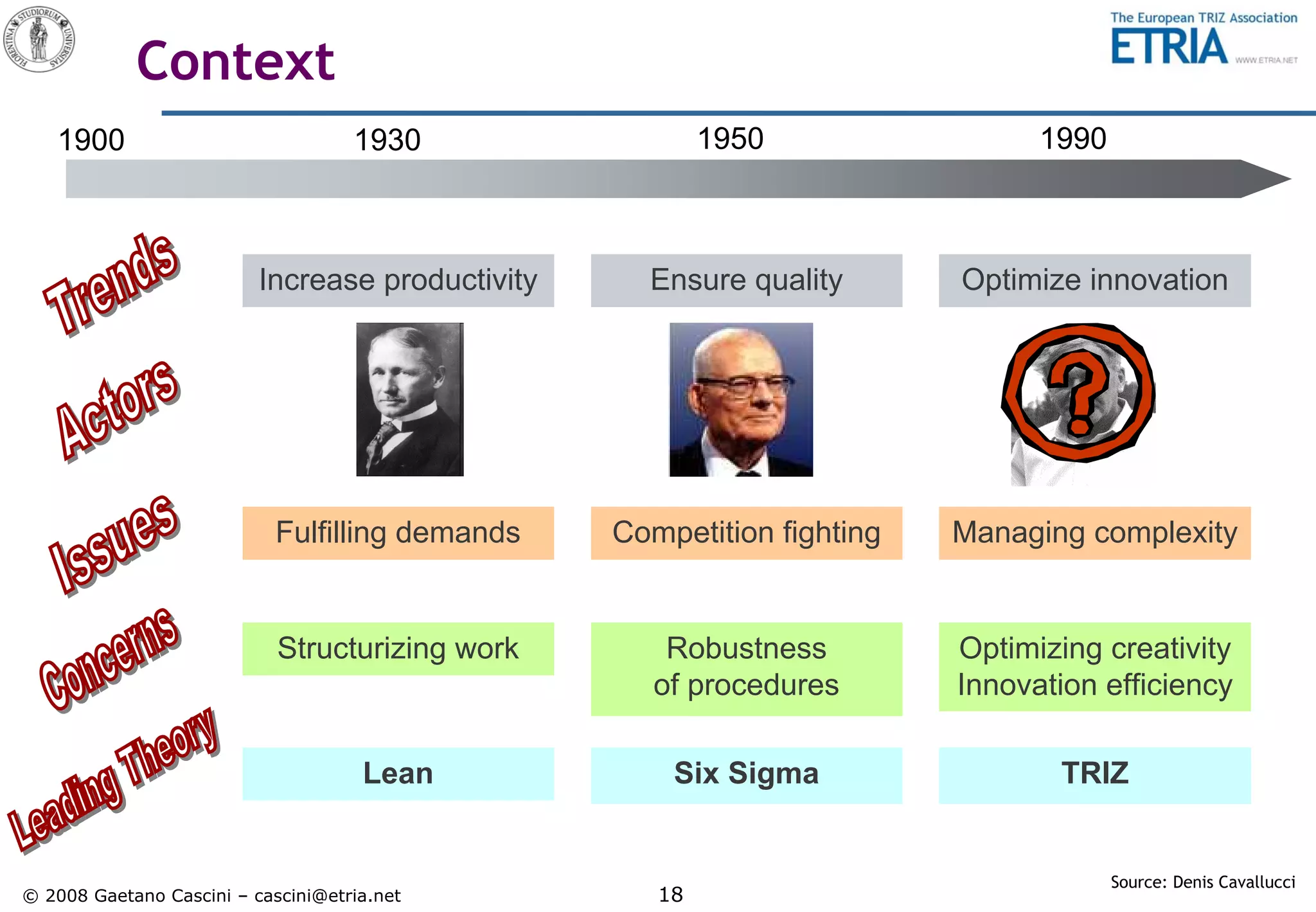
Increase productivity Ensure quality Optimize innovation
Fulfilling demands Competition fighting Managing complexity
Structurizing work Robustness
of procedures
Optimizing creativity
Innovation efficiency
1900 1950 1990
1930
Context
Source: Denis Cavallucci
Lean Six Sigma TRIZ
19
© 2008 Gaetano Cascini – cascini@etria.net
Systematic Innovation: Goal & Obstacles
Source: David Silverstein, Neil DeCarlo, Michael Slocum
Goal: Improve the efficiency of Innovation Processes
™ Reduce or eliminate waste of resources (time, money…) for useless
trials and errors
™ Develop one valuable solution is much better than many ideas to be
validated
™ Manage complexity of modern systems
Obstacles:
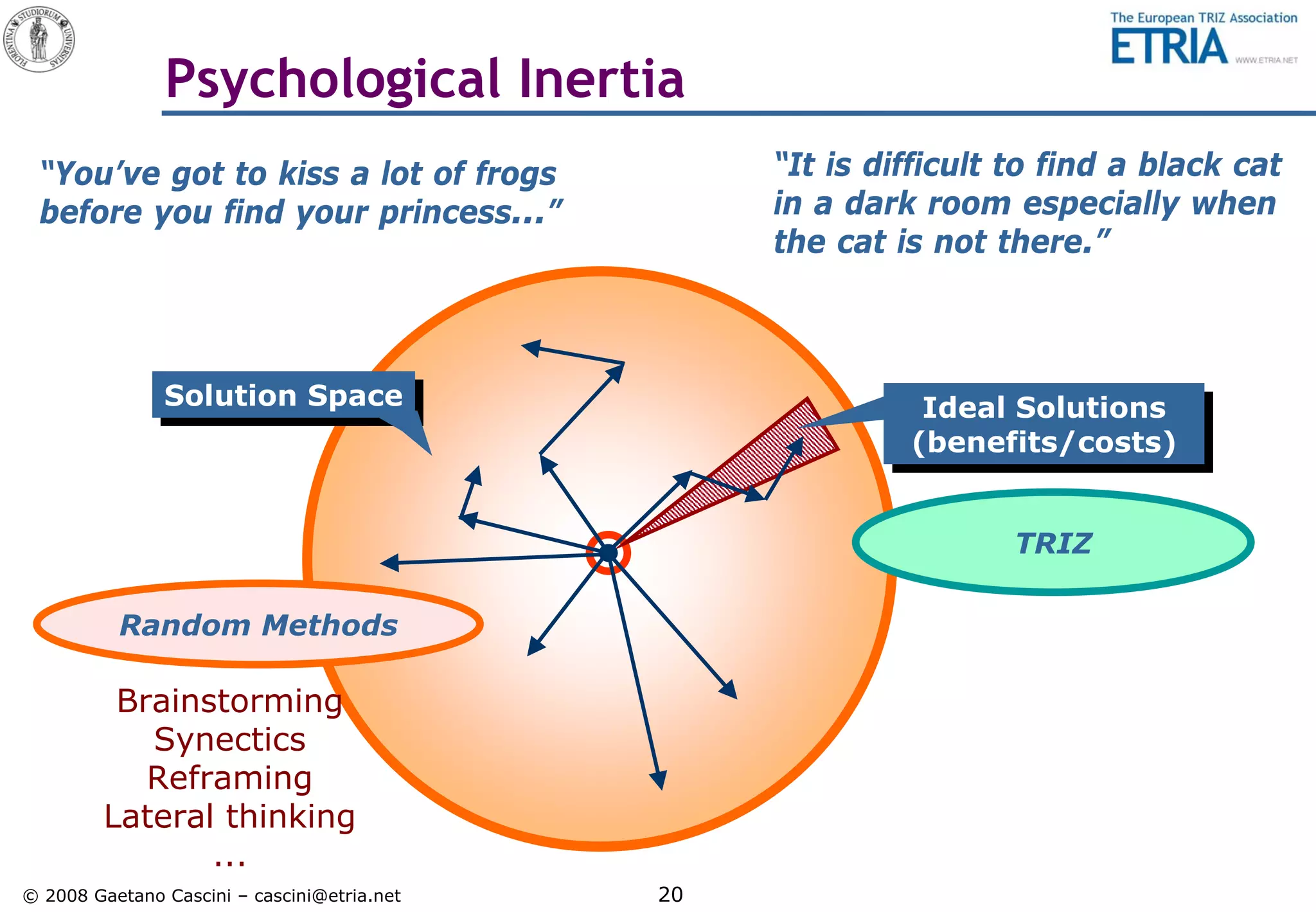
™ Psychological Inertia
™ Trial & Error: lack of a structured approach
™ Design conflicts
20
© 2008 Gaetano Cascini – cascini@etria.net
Psychological Inertia
Ideal Solutions
(benefits/costs)
Ideal Solutions
(benefits/costs)
Solution Space
Solution Space
Random Methods
TRIZ
Brainstorming
Synectics
Reframing
Lateral thinking
...
“You’ve got to kiss a lot of frogs
before you find your princess...”
“It is difficult to find a black cat
in a dark room especially when
the cat is not there.”
21
© 2008 Gaetano Cascini – cascini@etria.net
Design conflicts: e.g. Conventional Active Heatsinks
Conventional Active Heatsink (AHS) devices have reached their functional and
cost limits and can not be improve significantly. These devices have a
number of inherent severe contradictions and the compromises are not
working for modern heat dissipation demands.
Heat sink ratings
Heat sinks are rated by their thermal resistance (Rth) in °C/W. For example 2°C/W
means the heat sink (and therefore the component attached to it) will be 2°C hotter
than the surrounding air for every 1W of heat it is dissipating.
Note that a lower thermal resistance means a better heat sink.
22
© 2008 Gaetano Cascini – cascini@etria.net
Design conflicts: “Long-Short” Heatsink
“Long” heatsink
+ Large surface area (heat dissipation)
- Long distance for ambient air (power consumption)
“Short” heatsink
+ Short distance for ambient air (power consumption)
- Small surface area (heat dissipation)
23
© 2008 Gaetano Cascini – cascini@etria.net
Short Heatsink
Efficiency
Heat dissipation
or compromise
or compromise…
…
Optimal solution
Optimal solution…
…
Long Heatsink
Design conflicts: “Long-Short” Heatsink
24
© 2008 Gaetano Cascini – cascini@etria.net
Short Heatsink
Efficiency
Heat dissipation
Long Heatsink
…
…and suddenly
and suddenly
TRIZ appeared:
TRIZ appeared:
let
let’
’s use
s use
SEGMENTATION
SEGMENTATION
(of the flow)
(of the flow)
Design conflicts: “Long-Short” Heatsink
25
© 2008 Gaetano Cascini – cascini@etria.net
Intel Pentium 4
reference design
0.33 ºC/W
Large surface area
+
short distance for
ambient air
Design conflicts: “Long-Short” Heatsink
ROTYS Dual Cooler
Pentium 4 design
less than 0.22 ºC/W
26
© 2008 Gaetano Cascini – cascini@etria.net
Bielle per motori endotermici
Le bielle per motori da competizione devono sopportare
sollecitazioni affaticanti particolarmente gravose e al tempo stesso
devono avere la massima leggerezza per ridurre le inerzie in gioco
27
© 2008 Gaetano Cascini – cascini@etria.net
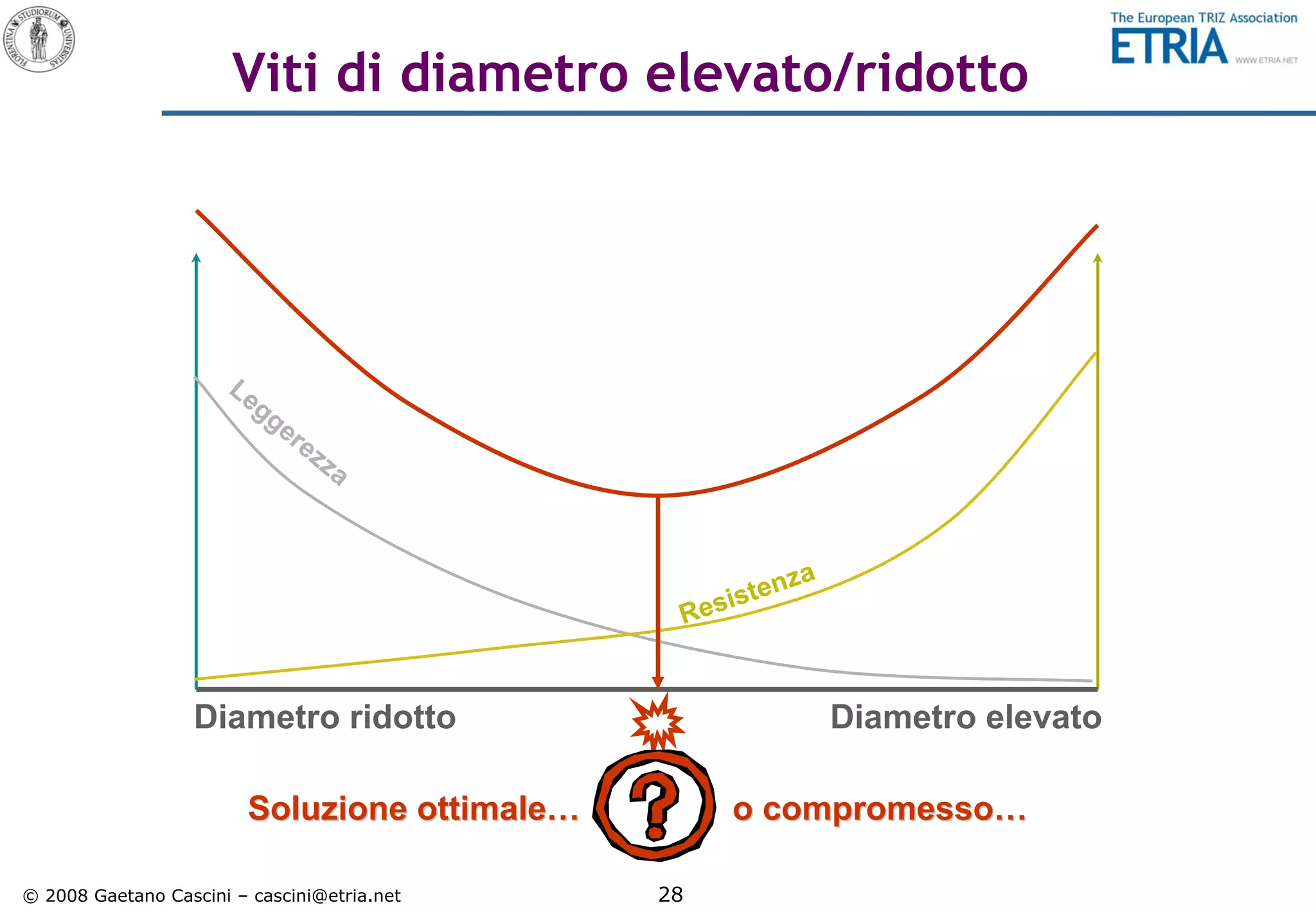
Viti di diametro elevato/ridotto
Diametro elevato
+ maggiore resistenza a fatica
- maggiore peso e inerzia alla rotazione
Diametro ridotto
+ minor peso e inerzia alla rotazione
- minore resistenza a fatica
28
© 2008 Gaetano Cascini – cascini@etria.net
Diametro ridotto
Leggerezza
Resistenza
o
o compromesso
compromesso…
…
Soluzione
Soluzione ottimale
ottimale…
…
Diametro elevato
Viti di diametro elevato/ridotto
29
© 2008 Gaetano Cascini – cascini@etria.net
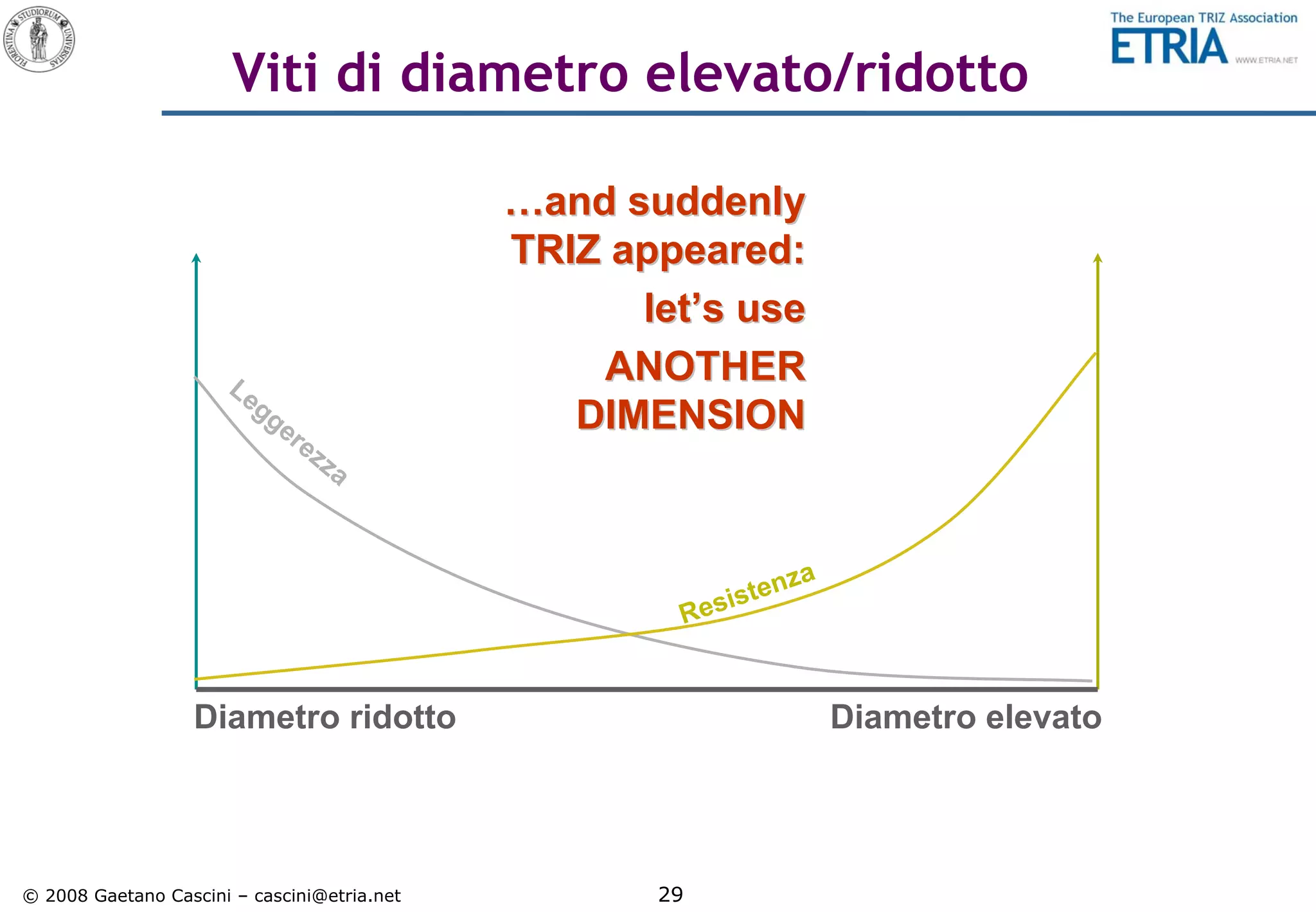
Diametro ridotto
Leggerezza
Resistenza
Diametro elevato
TRIZ appeared:
TRIZ appeared:
let
let’
’s use
s use
ANOTHER
ANOTHER
DIMENSION
DIMENSION
Viti di diametro elevato/ridotto
…
…and suddenly
and suddenly
30
© 2008 Gaetano Cascini – cascini@etria.net
Disegno originale
Nessun problema
di fatica
+
Massa ridotta
(-10%)
Una biella innovativa
Nuova biella SCAM/UNIFI
Cascini G., Frillici F. S., Galimberti
F., Rotini F.: “Biella per motori
endotermici”, patent application
MI2007A000681 presented on April
4, 2007, assignee SCAM srl.
© 2008 Gaetano Cascini – cascini@etria.net
Università degli Studi di Firenze
Dip. di Meccanica e Tecnologie Industriali
Lab. di Metodi e Tecniche per l’Innovazione
TRIZ: Theory of Inventive Problem Solving
32
© 2008 Gaetano Cascini – cascini@etria.net
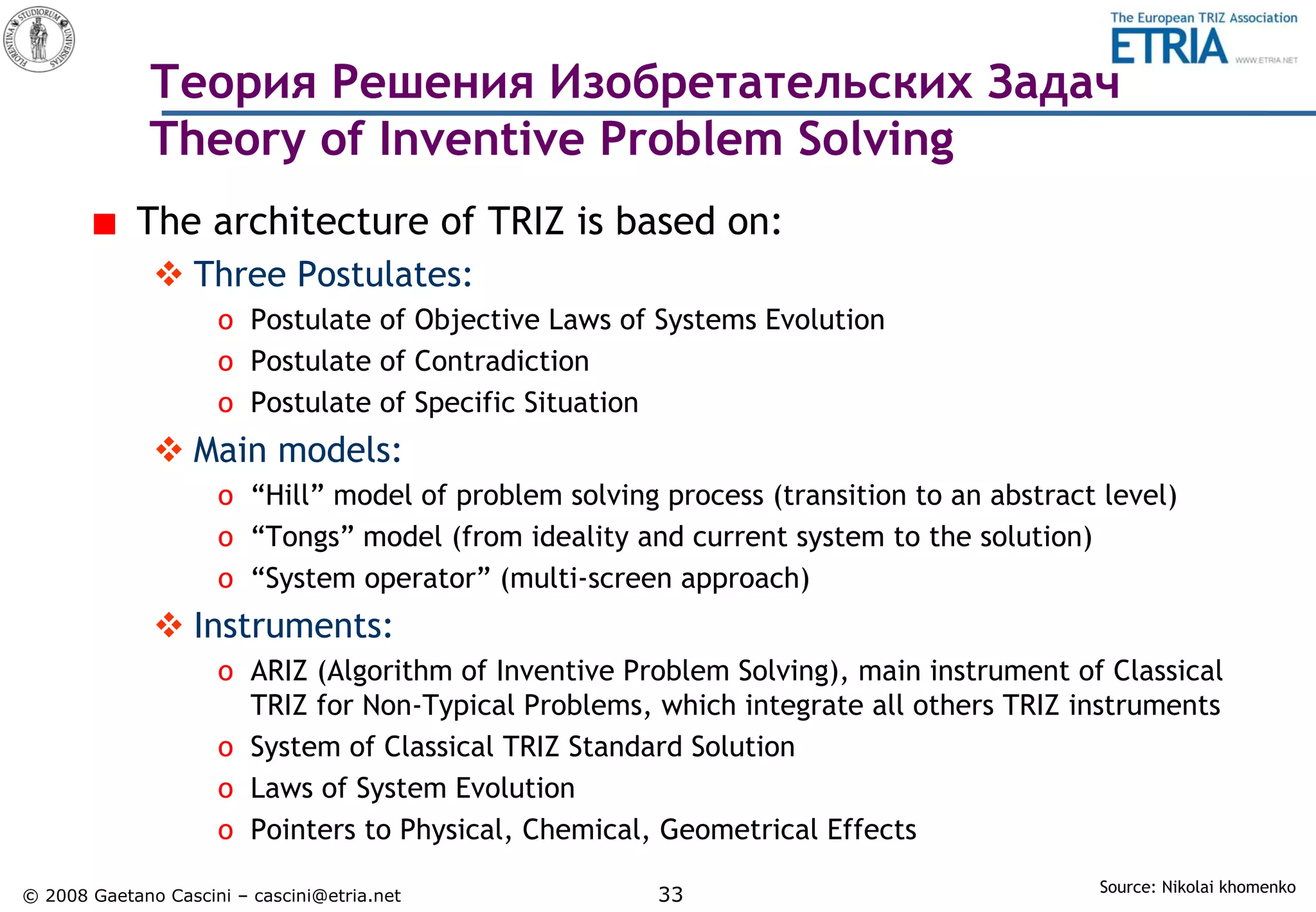
• 99% of inventions use already known solution principle
• Less than 1% are really pioneering inventions
• Breakthrough solutions emerge from resolving contradictions
• Inventors and strong thinkers use patterns
• Creative problem solving patterns are universal
• Creative ideas can be produced in a systematic way
Genrich Altshuller
(1926-1998)
Теория Решения Изобретательских Задач
Theory of Inventive Problem Solving
Analysis of hundreds
of thousands
inventive solutions
33
© 2008 Gaetano Cascini – cascini@etria.net
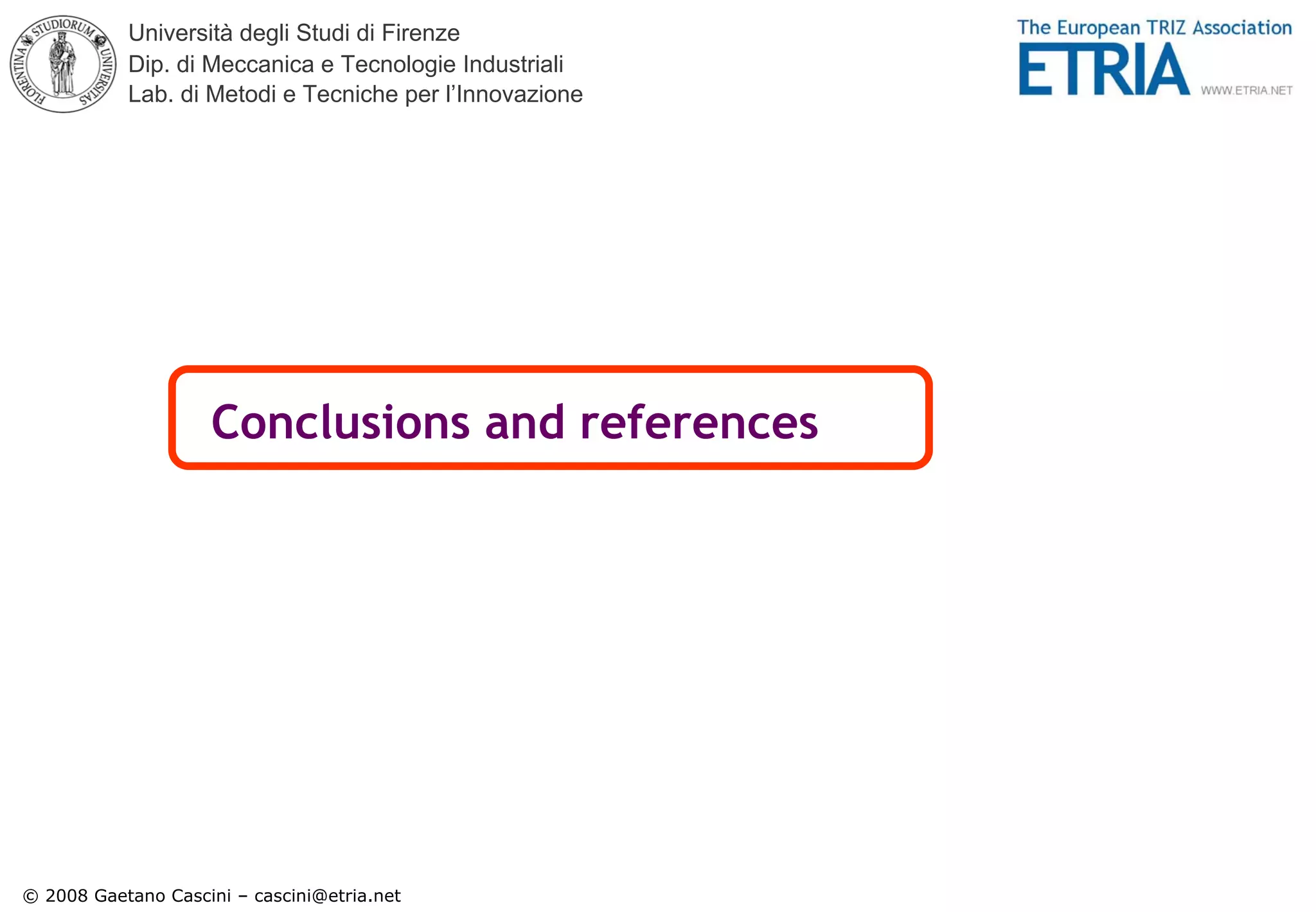
The architecture of TRIZ is based on:
™ Three Postulates:
o Postulate of Objective Laws of Systems Evolution
o Postulate of Contradiction
o Postulate of Specific Situation
™ Main models:
o “Hill” model of problem solving process (transition to an abstract level)
o “Tongs” model (from ideality and current system to the solution)
o “System operator” (multi-screen approach)
™ Instruments:
o ARIZ (Algorithm of Inventive Problem Solving), main instrument of Classical
TRIZ for Non-Typical Problems, which integrate all others TRIZ instruments
o System of Classical TRIZ Standard Solution
o Laws of System Evolution
o Pointers to Physical, Chemical, Geometrical Effects
Теория Решения Изобретательских Задач
Theory of Inventive Problem Solving
Source: Nikolai khomenko
34
© 2008 Gaetano Cascini – cascini@etria.net
Laws of Engineering Systems Evolution
Conclusions for practice:
™ Good solutions are developed in accordance with the objective laws of system evolution
Laws of Technical System Evolution
1 Law of System Completeness
Corollary: Controllability
Trend of elimination of human
involvement from systems
Trend of increasing dynamicity
2 Law of “energy conductivity”
of a system
3 Law of harmonizing the
rhythms of parts of the system
Static
4 Law of increasing ideality
5 Law of uneven development
of the parts of a system
6 Law of transition to a super-
system
Trend Mono-Bi-Poly
Kinematics
7 Law of Transition from macro
to micro level
8 Law of increasing Su-Field
inyteractions
Dynamics
Once upon a time, the
American Professor Samuel
Langley (Theory of
Aviation) was asked why
the first aviators failed
trying to build flying
machines.
He answered: “Perhaps,
because man came up to
the issue from the end and
tried to make flying
machines before he learnt
the laws on which flying is
based on”.
35
© 2008 Gaetano Cascini – cascini@etria.net
Contradictions
System evolution implies the resolution of contradictions, i.e. conflicts
between a system and its environment or between the components of the
system itself
Cause
Cause
Negative Effect
Negative Effect
Contradiction
Positive effect
Conclusions for practice:
™ To solve a problem we should first discover underlying contradictions
™ To achieve maximum benefits, contradictions should be resolved, not compromised
™ Overcoming contradictions is a driving force behind technology evolution. Resolving
contradictions instead of compromising or optimizing, results in breakthrough
solutions
Evaluation Par. 1
Evaluation
Par.
2
System
Requirements
36
© 2008 Gaetano Cascini – cascini@etria.net
Most Desirable
Result
A Barrier (Contradiction)
that prevent from
achievement of the
Most Desirable Result
Conceptual
Solution
“Tongs” model of problem solving process
Evaluation Par. 1
Evaluation
Par.
2
System
Requirements
Initial Situation
(Available
Resources)
Evaluation Par. 1
Evaluation
Par.
2
System
Requirements
T
R
I
Z
37
© 2008 Gaetano Cascini – cascini@etria.net
Specific situation
Each stage of evolution of a system takes place in a specific
environment (context, situation) which influences the
evolution (transformation) of the system and provide specific
resources
Conclusions for practice:
™ Good solutions must (first of all) take into account the resources available in the
specific situation
Material Resources:
- Waste flow
- Cheap materials
- Substance characteristics
- Void
Information Resources:
- Inherent properties
- Mobile information
- Temporary information
- Redundant information
Spatial Resources:
- Empty space, encapsulating
- Other dimensions
- Shape
- Size (1D, 2D, 3D)
Time Resources:
- Parallel working
- Preliminary action/counteraction
- Reworking
- Frequency of action
Energy Resources:
- Energy in the system
- Energy from the supersystem
- Potential energy
- Dissipated energy
38
© 2008 Gaetano Cascini – cascini@etria.net
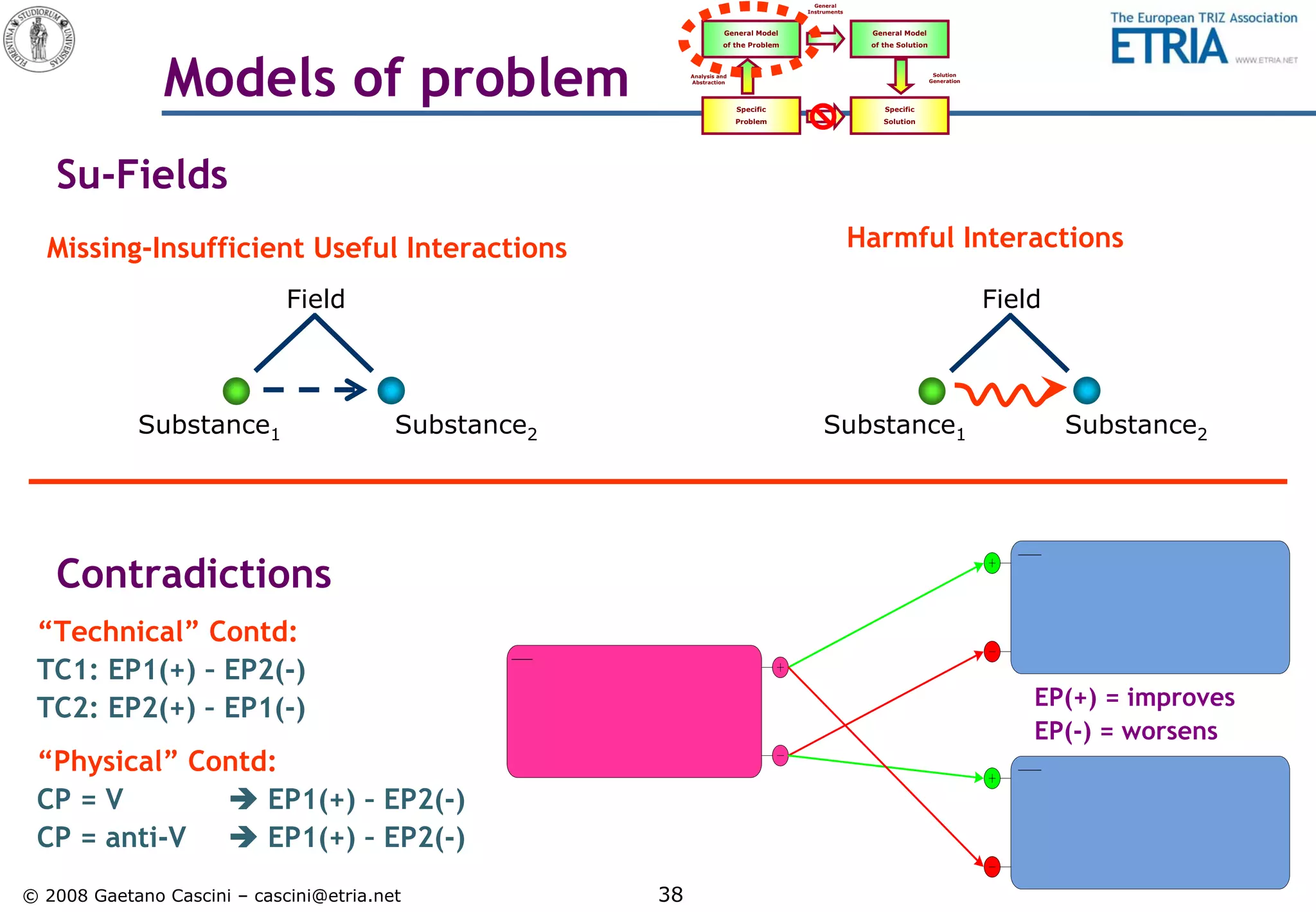
Models of problem
Su-Fields
Missing-Insufficient Useful Interactions
Substance1
Field
Substance2
Harmful Interactions
Substance1
Field
Substance2
Contradictions
“Technical” Contd:
TC1: EP1(+) – EP2(-)
TC2: EP2(+) – EP1(-)
“Physical” Contd:
CP = V Î EP1(+) – EP2(-)
CP = anti-V Î EP1(+) – EP2(-)
EP(+) = improves
EP(-) = worsens
Specific
Problem
General Model
of the Problem
General Model
of the Solution
Specific
Solution
Analysis and
Abstraction
General
Instruments
Solution
Generation
39
© 2008 Gaetano Cascini – cascini@etria.net
Models of problem
Contradictions
“Technical” Contd:
TC1: EP1(+) – EP2(-)
TC2: EP2(+) – EP1(-)
“Physical” Contd:
CP = V Î EP1(+) – EP2(-)
CP = anti-V Î EP1(+) – EP2(-)
EP(+) = improves
EP(-) = worsens
Specific
Problem
General Model
of the Problem
General Model
of the Solution
Specific
Solution
Analysis and
Abstraction
General
Instruments
Solution
Generation
Strong and Light
Table
Fast and Safe
Sailing Boat
© 2008 Gaetano Cascini – cascini@etria.net
Università degli Studi di Firenze
Dip. di Meccanica e Tecnologie Industriali
Lab. di Metodi e Tecniche per l’Innovazione
Conclusions and references
41
© 2008 Gaetano Cascini – cascini@etria.net
TRIZ: A Theory of Solving Inventive Problems (abbreviated in
Russian)
Result of 40 years of research of more than 300 people (and still
evolving)
TRIZ does not replace traditional method for innovation, it adds
value to the existing methods and practices
Since TRIZ has been brought outside of the ex-USSR in 1990th, it
is today recognized by several world-leading organizations such as
Boeing, Lockheed Martin, Procter & Gamble, Samsung, Intel,
Siemens, Mitsubishi as the best practice of innovation
Systematic Innovation further expands TRIZ by adding new tools
and organizing a process of innovation
Теория Решения Изобретательских Задач
Theory of Inventive Problem Solving
42
© 2008 Gaetano Cascini – cascini@etria.net
Some TRIZ Success Cases
Company Story Result
Over 200 TRIZ projects during 2003-
2005
Total economic effect at Samsung
during 2002-2005: Euro 1.5 billion
The most successful commercial
product ever, Crest™ Whitestrips™
was developed with TRIZ
First year of sales: US$ 135 million,
capturing 45% of the world whitening
market.
Total effect at P&G: 300% increase in
the number of patents
Improving atomic oxygen resistance
on coated substrates
Return on Investment in first 12
month: 4070%, payback of the
investment: first 3 days
A new innovative technology for a
refilling tanker on the basis of Boeing
767A
Winning over competition and
increasing sales by US$ 1.5 billion
The use of TRIZ to improve business
process models and making strategic
decisions
Winning an outsourcing contract for
US$ 1 billion
43
© 2008 Gaetano Cascini – cascini@etria.net
Some companies using TRIZ (at least a preliminary experience with)
Avon
BMW
Boeing
Borden
Case
Caterpillar
Clorox
Cummin
Daimler-Chrysler
Datacard
Delphi
Dial
DuPont
Source: David Silverstein,
Neil DeCarlo,
Michael Slocum
Electrolux
Edi Lilly
Ford
Fujitsu
General Motors
Heidelberg
Hitachi
Honeywell
HP
IBM
Intel
ITT
Johnson & Johnson
Kimberly-Clark
Kodak
LG
Lockheed Martin
McDonnel Douglas
Motorola
NASA
NEC Electronics
Pfizer
Pilkington
Procter & Gamble
PSA Peugeot Glacio
Raytheon
Rockwell
Rolls Royce
Samsung
Sanyo
Sara lee
Shell
Siemens
Gillette
Toyota
USPO
Xerox
“Several TRIZ papers were accepted recently to a coming internal conference
(1200 attendees) - ~50 papers were selected out of ~2000 submissions.”
Amir Roggel (Intel) – March 2008
44
© 2008 Gaetano Cascini – cascini@etria.net
Two ways of using Systematic Innovation
45
© 2008 Gaetano Cascini – cascini@etria.net
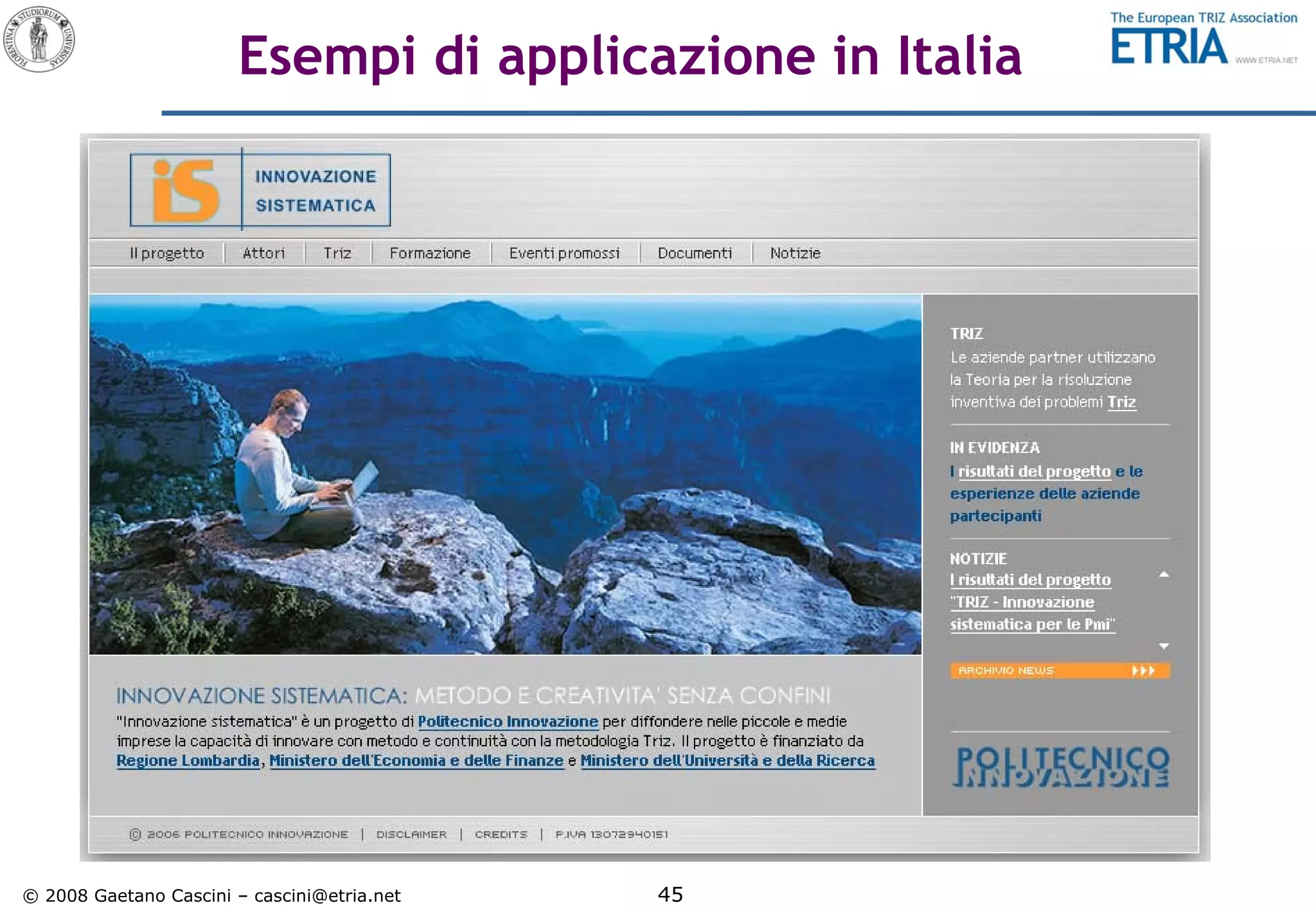
Esempi di applicazione in Italia
46
© 2008 Gaetano Cascini – cascini@etria.net
Esempi di applicazione in Italia
47
© 2008 Gaetano Cascini – cascini@etria.net
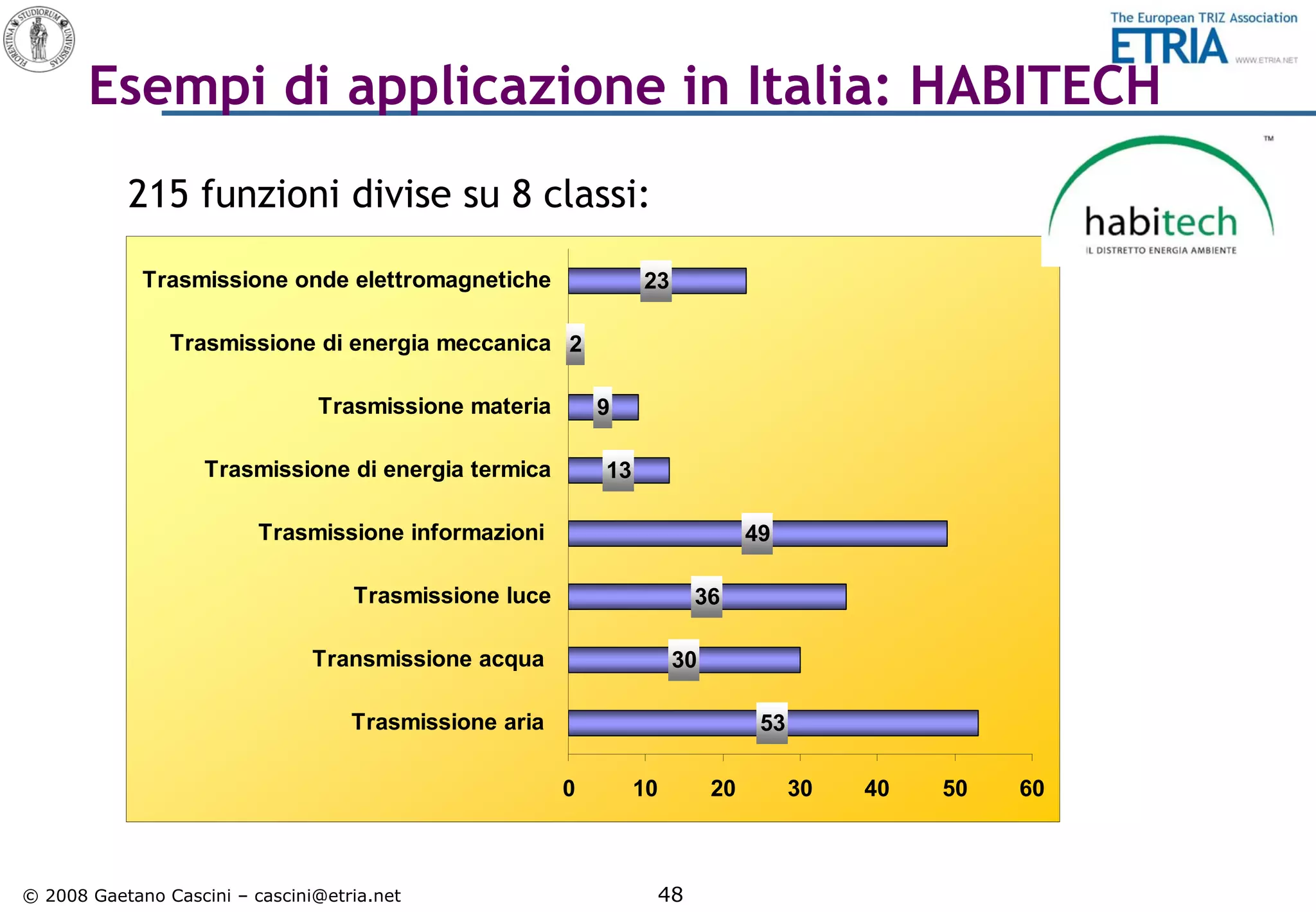
Obiettivo:
Metodo per identificare in maniera sistematica tutte le funzioni associabili al
concetto di “finestra”
Risultati:
215 funzioni identificate
28694 brevetti processati
3580 brevetti selezionati per funzionalità
Esempi di applicazione in Italia: HABITECH
48
© 2008 Gaetano Cascini – cascini@etria.net
Esempi di applicazione in Italia: HABITECH
215 funzioni divise su 8 classi:
53
30
36
49
13
9
2
23
0 10 20 30 40 50 60
Trasmissione aria
Transmissione acqua
Trasmissione luce
Trasmissione informazioni
Trasmissione di energia termica
Trasmissione materia
Trasmissione di energia meccanica
Trasmissione onde elettromagnetiche
49
© 2008 Gaetano Cascini – cascini@etria.net
Esempi di applicazione in Italia: Procomac
Forecasting tecnologico su sistemi di sterilizzazione per
contenitori bevande
ALBERO EVOLUTIVO dei SISTEMI TECNICI
SISTEMA
TECNICO
SISTEMA
TECNICO
IDEALITA'
IDEALITA'
AZIENDE
CONCORRENTI E
BREVETTI
AZIENDE
CONCORRENTI E
BREVETTI
50
© 2008 Gaetano Cascini – cascini@etria.net
Progetto TMC – Regione Toscana
Obiettivo:
™ Analisi dell’evoluzione delle tecnologie rilevanti per il comparto
della meccanica toscana al fine di individuare scenari di innovazione
a breve-medio termine
Attività:
™ Individuazione delle classi brevettuali attinenti ai codici ISTAT più
rappresentativi delle piccole imprese meccaniche toscane
™ Analisi dei brevetti da Europa, Nord America, Est Asiatico
™ Identificazione trend di settore
™ Formulazione degli scenari
51
© 2008 Gaetano Cascini – cascini@etria.net
Progetto TMC – Regione Toscana
Obiettivo:
™ Analisi dell’evoluzione delle tecnologie rilevanti per il comparto
della meccanica toscana al fine di individuare scenari di innovazione
a breve-medio termine
Attività:
™ Individuazione delle classi brevettuali attinenti ai codici ISTAT più
rappresentativi delle piccole imprese meccaniche toscane
™ Analisi dei brevetti da Europa, Nord America, Est Asiatico
™ Identificazione trend di settore
™ Formulazione degli scenari
52
© 2008 Gaetano Cascini – cascini@etria.net
Schede riassuntive per settore
Codice ISTAT
Contiene il codice ISTAT di riferimento per un settore industriale della meccanica e
la sua descrizione
Numero aziende relative al
codice ISTAT
Contiene il numero di aziende registrate da CNA Toscana rispetto alla tipologia
classificata sopra
Classe brevettuale più
attinente
Contiene la classe brevettuale secondo l’International Patent Classification i cui
contenuti sono più affini al settore industriale di riferimento; segue la descrizione
ufficiale della classe brevettuale in inglese e la sua traduzione in italiano
Numerosità della classe
brevettuale
Contiene l’indicatore di maggiore rilievo sull’andamento numerico dei brevetti
relativi alla classe brevettuale sopra indicata. Questo campo introduce i risultati
numerici di dettaglio
Anno 1985 2005 MAX min media
Numero assoluto
Contiene il numero di brevetti relativo all’indicazione della riga sopra
Specifica in quali anni si è raggiunto i valori massimi e minimi
% rispetto all’attività di
brevettazione mondiale
Contiene il valore percentuale dei brevetti rispetto al numero mondiale generale
con le stesse modalità di cui sopra
Specifica in quali anni si è raggiunto i valori massimi e minimi
Distribuzione geografica
degli assegnatari
Descrive ed indica valori numerici sui principali Paesi da cui provengono gli
assegnatari dei brevetti ed i trend rilevanti
Prodotto/processo
Descrive i trend più evidenti rispetto ai brevetti di prodotto (macchine, strumenti,
apparecchi) e di processo (metodologie, processi produttivi)
Analisi delle classi brevettuali
correlate
(backward citations)
Contiene le informazioni principali ricavate dall’analisi dei documenti citati dai
brevetti della classe brevettuale in esame, finalizzata in particolare ad evidenziare i
collegamenti intersettoriali.
Analisi terminologica
(individuazione dei
termini/funzioni chiave)
Contiene i dati salienti emersi dalle analisi sull’individuazione dei termini e delle
funzioni chiave, dalla clusterizzazione, dall’analisi degli aggettivi
Scenario
Riporta nella deduzione lo scenario più caratterizzante del settore in esame. Questo
avviene grazie all’interazione di due statement i quali prendono spunto dai dati
risultanti dall’analisi brevettuale o da altre fonti (qualora sia espressamente
specificato). Con la forza metodologica per ogni statement si esprime la rigorosità
scientifica ed affidabilità con cui tali affermazioni vengono avanzate e le
motivazioni o strumenti grazie alle quali esse vengono addotte.
53
© 2008 Gaetano Cascini – cascini@etria.net
Product Development Costs
Cost of Design
& Development
activities
Product Cycle
Conceptual
Design
Virtual
Prototypes
Physical
Prototypes
Manufacturing
Brain Storming approach:
¾ 1 Day: Conceptual Design Î 100 Ideas
¾ 100 Days: Idea Selection and Validation Î 3 (?) Validated Ideas
Systematic Innovation approach:
¾ 10 Days: Conceptual Design Î 3 Ideas
¾ 3 Days: Idea Selection and Validation Î 1 Implementable Solution
54
© 2008 Gaetano Cascini – cascini@etria.net
Obstacles to Innovation: Innovators Dilemma
55
© 2008 Gaetano Cascini – cascini@etria.net
Web Resources
Web Sites:
http://www.etria.net/ (European TRIZ Association)
http://www.matriz.ru (International TRIZ Association)
http://www.aitriz.org/ (Altshuller Institute for TRIZ)
http://www.triz-journal.com/ (TRIZ journal)
http://www3.sympatico.ca/karasik/ (anti-Triz Journal)
http://www.gnrtr.com
http://www.triz.co.kr/TRIZ/intro.html
http://www.trizminsk.org/
http://www.tetris-project.org/
http://www.thinking-approach.org
http://www.jlproj.org/
http://comcontriz.byethost7.com/letters.htm
Mailing List:
TRIZ Topica (www.topica.com)
56
© 2008 Gaetano Cascini – cascini@etria.net
Gaetano Cascini
gaetano.cascini@unifi.it
cascini@etria.net
www.etria.net
57
© 2008 Gaetano Cascini – cascini@etria.net
Short history of TRIZ Instruments
Source: Dmitry Kucharavy
58
© 2008 Gaetano Cascini – cascini@etria.net
Short history of TRIZ Instruments
Source: Dmitry Kucharavy
59
© 2008 Gaetano Cascini – cascini@etria.net
Short history of TRIZ Instruments
Source: Dmitry Kucharavy
60
© 2008 Gaetano Cascini – cascini@etria.net
Short history of TRIZ Instruments
Source: Dmitry Kucharavy
61
© 2008 Gaetano Cascini – cascini@etria.net
Short history of TRIZ Instruments
ARIZ evolution
1946 1985 Time
1st
wave : Consciousness
2nd
wave : Inventive Principles
3rd wave : Laws of Engineering
Systems Evolution
4th wave : System of
Inventive Standards
• Notion of contradiction
• Levels of inventiveness
• Trial&errors reduction
• Trends of engineering
systems evolution
• 40 principles
• Matrix
• 39 engineering parameters
•8 laws divided in 3 categories
•Ideality
•Resources
•Substances /Field modeling
•76 Inventive Standards
5th
wave : OTSM - ,
complex problem
management
axiomatic
reformulation
formative
stage
deductive
unification
Level of Theoretical
Formalization
Growth of ARIZ
process
Source: Nikolai Khomenko
62
© 2008 Gaetano Cascini – cascini@etria.net
Short history of TRIZ Instruments
Source: Nikolai Khomenko
63
© 2008 Gaetano Cascini – cascini@etria.net
LITERATURE
TRIZ theory (In Russian 1/4):
1. Altshuller G.S., Shapiro R.V. About the Psychology of Innovation and Creativity.- Voprocy Psyhologii (Questions
of Psychology), no 6, 1956. – p. 37-49.
2. Altshuller G.S. Learning to Invent. Tambov: Tambovskoe knijnoe izdatelstvo (Tambo Publushing House, 1961.
3. Altshuller G.S. Bases of the Invetntive Process, Voroneg: Centralno-Chernozemnoe izdatelstvo, 1964.
4. Altshuller G.S. Algorithm for Invention. Moscow: Moscowskii Rabochii Publushing House, 1969 (first edition),
1973 (second edition).
5. Selutskii A.B., Slugin G.I. INSPIRATION BY ORDER. Petrozavodsk: Karelia, 1977.
6. Altshuller G.S. CREATIVITY AS AN EXACT SCIENCE. Moscow: Sovietskoe radio, 1979.
7. Altshuller G.S., Selutskii A.B. WINGS FOR ICARUS. Petrozavodsk: Karelia, 1980.
8. Jukov R.F., Petrov V.M. Modern methods of scientific and technical creativity. - Leningrad: Institute of
improvement of professional skill of the ship-building industry, 1980.
9. Altov G. AND SUDDENLY THE INVENTOR APPEARED. Moscow: Detskaya Literatura, 1989 (1st ed.-1984; 2nd
ed.-1987; 3rd ed.- 1989; 4th ed.- 2000). ISBN 5-08-000598-X
10. Althsuller G.S., Zlotin B.L., Filatov V.I. PROFESSION: TO SEARCH FOR NEW. Kishinev: Karte
Moldaveniaske, 1985.
11. Altshuller G.S. TO FIND AN IDEA: INTRODUCTION TO THE THEORY OF INVENTIVE PROBLEM SOLVING.
Novosibirsk: Nauka, (1st ed.-1986; 2nd ed.-1991; 3rd ed.- 2003). ISBN 5-02-029265-6
12. Petrovich N.T., Tsourikov V.M. A WAY TO INVENTION. Moscow: Evrika, Molodaya Gvardia, 1986.
13. Ivanov G.I. …AND BEGIN TO INVENT. Irkutsk: Vostochno-Sibirskoe izdatelstvo, 1987.
64
© 2008 Gaetano Cascini – cascini@etria.net
LITERATURE
TRIZ theory (In Russian 2/4):
14. DARING FORMULAS OF CREATIVITY. Petrozavodsk: Karelia, 1987.
15. Zlotina E.S., Petrov V.M. Methods of scientific and technical creativity. - Leningrad: The Leningrad House of
scientific and technical propagation, 1987.
16. Zlotin B., Zusman A. A MONTH UNDER THE STARS OF FANTASY: A SCHOOL FOR DEVELOPING
CREATIVE IMAGINATION. Kishinev: Kartya Moldovenyaska Publishing House. 1988.
17. A THREAD IN THE LABYRINTH. Petrozavodsk: Karelia, 1988. ISBN 5-7545-0020-3
18. Althsuller G.S., Zlotin B.L., Zusman A.V., Filatov V.I. SEARCH FOR NEW IDEAS: FROM INSIGHT TO
TECHNOLOGY (THEORY AND PRACTISE OF INVENTIVE PROBLEM SOLVING), Kishinev: Kartya
Moldovenyaska Publishing House, 1989. ISBN 5-362-00147-7
19. RULES OF A GAME WITHOUT RULES. Petrozavodsk: Karelia, 1989. ISBN 5-7545-0108-0
20. Zlotin B., Zusman A. THE INVENTOR CAME TO CLASS. Kishinev: Kartya Moldovenyaska Publishing House.
1989. ISBN 5-372-00498-3
21. Altshuller G., Zlotin B., Zusman A. THEORY AND PRACTICE OF INVENTIVE PROBLEM SOLVING.
(methodical advices) Kishinev 1989.
22. Zlotin B., Zusman A. LAWS OF EVOLUTION AND FORECASTING FOR TECHNICAL SYSTEMS. (methodical
advices) Kishinev 1989.
23. Petrov V.M., Zlotina E.S. The Theory of Inventive Problem Solving - a basis of forecasting of development of
technical systems. - Prag: ChNTO, 1989.
24. HOW TO BECOME A HERETIC. Petrozavodsk: Karelia, 1990. ISBN 5-7545-0217-6
25. Altshuller G., Vertkin I. A. WORKING BOOK ON THE THEORY OF DEVELOPMENT OF CREATIVE PERSON.
Kishinev: STC Progress in association with Kartya Moldovenyaska Publishing House. 1990.
65
© 2008 Gaetano Cascini – cascini@etria.net
LITERATURE
TRIZ theory (In Russian 3/4):
26. Salamatov Y.P. HOW TO BECOME AN INVENTOR: 50 HOURS OF CREATIVITY. Moscow: Prosveschenie,
1990. ISBN 5-09-001061-7
27. CHANCE TO ADVENTURE. Petrozavodsk: Karelia, 1991. ISBN 5-7545-0337-7
28. Zlotin B.L., Zusman A.V. SEARCHING FOR NEW IDEAS IN SCIENCE. In Solving Scientific Problems,
Kishinev: STC Progress in association with Kartya Moldovenyaska,1991.
29. Vikentyev I.L., Kaikov I.K. STAIRS OF IDEAS: TRIZ Basics, Examples and Case Studies.Novosibirsk, 1992.
30. Vikentyev I.L. METHODS OF ADVERTISING. Novosibirsk, 1993.
31. Althsuller G.S., Vertkin I.M. HOW TO BECOME A GENIUS: THE LIFE STRATEGY OF A CREATIVE
PERSON. Minsk: Belarus, 1994. ISBN 985-01-0075-3
32. Ivanov G.I. THE FORMULES OF CREATIVITY OR HOW TO LEARN TO INVENT. Moscow: Prosveschenie.
1994. ISBN 5-09-004135-0
33. Gasanov A.I. and others. BIRTH OF THE INVENTION. Moscow: Interpraks, 1995. 432 p. ISBN 5-85235-226-8
34. Vikentyev I.L. METHODS OF ADVERTISING AND PUBLIC RELATIONS. St. Petersburg:TRIZ-Chance, 1995.
35. Trifonov D.N. COLLECTED TASKS FROM SCIENCE-FICTION LITERATURE. St. Petersburg, TRIZ-Chance,
1995
36. Timokhov V.I. COLLECTION OF CREATIVE PROBLEMS ABOUT BIOLOGY, ECOLOGY AND TRIZ. St.
Petersburg: TRIZ-Chance 1996.
37. Mitrofanov V.V. FROM MANUFACTURING DEFECT TO SCIENTIFIC DISCOVERY. St. Petersburg: TRIZ
Association of St. Petersburg, 1998 ISBN 5-7997-0090-2
66
© 2008 Gaetano Cascini – cascini@etria.net
LITERATURE
TRIZ theory (In Russian 4/4):
38. Faer S.A. "METHODS OF STRATEGY AND TACTICS OF ELECTION CAMPAIGN". St. Petersburg: "Stol'ny
grad", 1998 ISBN 5-89910-003-6
39. Ivanov G.I., Bystritsky A.A. FORMULATING OF CREATIVE PROBLEMS. Chelyabinsk 2000, Library of
magazine "Technologies of creativity"
67
© 2008 Gaetano Cascini – cascini@etria.net
LITERATURE
TRIZ theory (In English 1/3):
40. T.Arciszevsky. " ARIZ-77: an Innovated Design Method" in the Journal of DMG of Californya Polytechnical
State University "Design Method and Theories" 1988, V.2, N2,pp.796-820.
41. G. Altshuller. Creativity as an Exact Science. Translated by Anthony Williams. "Gordon & Breach Science
Publisher", New-York, London, Paris, 1984, 1987.
42. Altshuller, Genrich. And Suddenly the Inventor Appeared: TRIZ, the Theory of Inventive Problem Solving.
Translated by Lev Shulyak. Worchester, Massachusetts: Technical Innovation Center, 1996
43. Kaplan, Stan. Ph.D. An Introduction to TRIZ; The Russian Theory of Inventive Problem Solving. International
Inc. 1996. 44 p.
44. Altshuller, Genrich. 40 Principles: TRIZ Key to Technical Innovation. Translated and edited by Lev Shulyak and
Steven Rodman. Worchester, Massachusetts: Technical Innovation Center, 1997.
45. Viktor R. Fey, Eugene I. Rivin. The Science of Innovation A managerial overview of the TRIZ methodology. The
TRIZ Gorup. 1997
46. Dr. John Terninko, Alla Zusman, Boris Zlotin STEP-BY-STEP TRIZ: Creating Innovative Solution Concepts.
1997
47. TRIZ Research Report: AN APPROACH TO SYSTEMATIC INNOVATION, 1998, ISBN:1879364999
48. Clarke, Dana W. Sr. TRIZ: Through the Eyes of an American TRIZ Specialist; A Study of Ideality,
Contradictions, and Resources. Ideation International Inc. 1997.
49. Terninko, John, Zusman, Alla and Zlotin, Boris. Systematic Innovation: An Introduction to TRIZ (Theory of
Inventing Problem Solving), 1998
50. Altshuller G. The Innovation Algorithm. TRIZ, Systematic Innovation and Technical Creativity. Technical
Innovation Center, Inc. Worcester, MA, 1999.
68
© 2008 Gaetano Cascini – cascini@etria.net
LITERATURE
TRIZ theory (In English 2/3):
51. Salamatov Yuri. TRIZ: The Right Solution at the Right Time: A Guide to Innovative Problem Solving. Insytec,
The Netherlands, 1999. 256 pages.
52. Altshuller G., Zlotin B., Zusman A. and Philatov V. Tools of Classical TRIZ. Ideation International Inc. 1999.
53. Boris Zlotin, Alla Zusman. Directed Evolution: Philosophy, Theory and Practice. Ideation International Inc. 1999.
54. TRIZ in Progress, Transactions of the Ideation Research Group. International Inc. 1999.
55. Kosse, Vladis. Solving Problems with TRIZ; an Exercise Handbook. International Inc.1999.
56. Kaplan, Stan, Zlotin, Boris and Zusman, Alla. New Tools for Failure and Risk Analysis. International Inc. 1999.
57. Zlotin, Boris and Zusman, Alla. Directed Evolution: Philosophy, Theory and Practice. Ideation International Inc.
2001.
58. Rantanen Kalevi, Domb Ellen. Simplified TRIZ: New Problem Solving Applications for Engineers and
Manufacturing Professionals
59. Savransky Semyon D. Engineering of Creativity: Introduction to Triz Methodology of Inventive Problem Solving.
2000.
60. Kalevi Rantanen. SIMPLIFIED TRIZ: New Problem Solving Applications for Engineers. St. Lucie Press, 2002,
280 Seiten, ISBN 1574443232
61. Victor Timokhov. Natural Innovation, Examples of creative problem-solving in Biology, Ecology and TRIZ.
CREAX (ISBN 5-88912-004-2), 2002
62. G. Altshuller; Lev Shulyak; Dana Clarke Sr: "40 Principles Extended Edition: TRIZ Keys to Innovation",
Technical Innovation Center, Inc. (April, 2005)
69
© 2008 Gaetano Cascini – cascini@etria.net
LITERATURE
TRIZ theory (In English 3/3):
63. Darrell Mann: "Hands On: Systematic Innovation", Creax (ISBN: 9077071024), 2002.
64. Michael A. Orloff: "Inventive Thinking Through TRIZ: A Practical Introduction", Springer; 1 edition (March 18,
2003)
65. Don Clausing, Victor Fey: "Effective Innovation: The Development of Winning Technologies", American Society
of Mechanical Engineers (March 1, 2004)
66. Victor Fey, Eugene Rivin: "Innovation on Demand : New Product Development Using TRIZ", Cambridge
University Press (September 30, 2005)
67. David Silverstain, Neil DeCarlo, Michael Slocum: "INsourcing Innovation". Breakthrough Performance Press,
Longmont, CO IBN 0-9769010-0-5
70
© 2008 Gaetano Cascini – cascini@etria.net
LITERATURE
TRIZ theory (In German 1/2):
68. G. Altschuller. Erfinden Wege zur Losung technicherProbleme, in German, VEB - Berlin,1975
69. Altow G. Der Hafen der steinernen Sturme. Berlin: Verlag Das Neue Berlin 1980. 2. Auflage
70. Altschuller G., Seljuzki A. Flugel fur Ikarus: uber die moderne Technik des Erfindens. Gemeinschaftsausgabe
Verlag MIR Moskau, Urania Verlag Leipzig, Jena, Berlin, 1983.
71. Altschuller G.S. Erfinden - Wege zur Losung technischer Probleme. VEB Verlag Technik Berlin, 1984.
Limitierter Nachdruck 1998, 280 Seiten, ISBN 3-00-002700-9
72. Linde H.J., Hill B. Erfolgreich erfinden: widerspruchsorientierte Innovationsstrategie für Entwickler und
Konstrukteure Hoppenstedt Technik Tabellen Verlag, 1993
73. Manfred von Ardenne, Gerhard Musiol u. Siegfried Reball: Effekte der Physik und ihre Anwendungen, Verl.
HARRI DEUTSCH, 1997, 891 Seiten, ISBN 3817111746
74. Terninko, John, B. Zlotin, A. Zusman. TRIZ - der Weg zum konkurrenzlosen Erfolgsprodukt. Landsberg/Lech:
Verlag Moderne Industrie, 1998, 288 Seiten, ISBN 3-478-91920-7
75. Teufelsdorfer H., Conrad A. Kreatives Entwickeln und innovatives Problemlosen mit TRIZ / TIPS. Einfuhrung in
die Methodik und ihre Verknupfung mit QFD. Verlag Publicis MCD,1998, 120 Seiten, ISBN 3-89578-103-7
76. Wirtschaftskammer Osterreich. Schneller entwicklen. Bessere Losungen finden mit TRIZ. Kongressunterlage.
Wien 1999
77. Rolf Herb, Thilo Herb, Veit Kohnhauser. TRIZ - Der systematische Weg zur Innovation. Werkzeuge,
Praxisbeispiele, Schritt-fur-Schritt-Anleitungen. Landsberg/Lech: Verlag Moderne Industrie, 2000, 260 Seiten,
ISBN 3-47891-980-0
71
© 2008 Gaetano Cascini – cascini@etria.net
LITERATURE
TRIZ theory (In German 2/2):
78. Bernd Gimpel, Rolf Herb, Thilo Herb. Ideen finden, Produkte entwickeln mit TRIZ. Taschenbuch, Hanser
Fachbuch, 2000, 180 Seiten, ISBN 3446211594
79. Tilo Pannenbacker. Methodisches Erfinden in Unternehmen. Bedarf, Konzept, Perspektiven fur TRIZ-basierte
Erfolge. Gabler Verlag, 2001, 324 Seiten, ISBN 3409118411
80. Michael A. Orloff. Grundlagen der klassischen TRIZ. Ein praktisches Lehrbuch des erfinderischen Denkens fur
Ingenieure. Springer-Verlag Berlin Heidelberg, 2002, 270 Seiten, ISBN 3540668691
81. Bernd Klein. TRIZ/TIPS - Methodik des erfinderischen Problemlosens. Taschenbuch, Oldenbourg, Mchn, 230
Seiten, 2002, ISBN 3486259520
82. Pavel Livotov, Vladimir Petrov. Innovationstechnologie TRIZ. Produktentwicklung und Problemlosung.
Handbuch. TriSolver Consulting 2002, Hannover, 302 Seiten, ISBN 3-935927-02-9

TRIZ introduction.pdf

  • 1.
    © 2008 GaetanoCascini – cascini@etria.net Università degli Studi di Firenze Dip. di Meccanica e Tecnologie Industriali Lab. di Metodi e Tecniche per l’Innovazione Gaetano Cascini gaetano.cascini@unifi.it TRIZ TRIZ Innovazione Sistematica Innovazione Sistematica Polo Tecnologico Casarano Università del Salento Lecce 27 maggio 2008
  • 2.
    2 © 2008 GaetanoCascini – cascini@etria.net Program & Goal Goal: ™ To understand what TRIZ and Systematic Innovation are. Get awareness of TRIZ tools and techniques. Appreciate strategic and operational applications of TRIZ Program: ™ Background ™ Origins ™ Philosophy ™ Key Concepts: o Laws of Engineering Systems Evolution o Contradictions o Ideality and Resources o Inventive Principles and Inventive Standards ™ Applications & Warnings
  • 3.
    3 © 2008 GaetanoCascini – cascini@etria.net University of Florence Lab. of Methods and Tools for Innovation Research Topics: ™ Data and Text Mining for Patent Analysis ™ Integration of TRIZ in Computer-Aided Design systems ™ TRIZ for Technology Forecasting Training and coaching for TRIZ introduction in industry: o ABB SACE – Training + 2 pilot projects o Alenia Aermacchi – Training + 2 case studies o Bracco Imaging – 1 pilot project (3 Patent Applications) o Coster Group – Training o Enel – 2 Training activities o Philip Morris Intertaba – Training o Intier Motrol - Training o Procomac – Training + 1 Extended Technology Forecasting + 2 case studies o SACMI – Training + 2 pilot projects o Tecniplast – Advanced Training & Coaching o Whirlpool – 1 pilot project (1 Patent) o Zoppas Industries – Training
  • 4.
    4 © 2008 GaetanoCascini – cascini@etria.net ETRIA – European TRIZ Association What ETRIA is: WWW.ETRIA.NET ™ ETRIA is a non-profit foundation, registered as a public organization in Germany. ™ The European TRIZ association intends to function as a connection link between industrial companies, institutions, educational organizations and individuals concerned with conceptual questions pertaining to organization and processing of innovation knowledge. Main Activities: ™ Organization of the TRIZ Future Conference ™ Working-groups on specific tasks (e.g. educational institutes, …) University of Twente – The Netherlands
  • 5.
    5 © 2008 GaetanoCascini – cascini@etria.net APEIRON – Associazione Italiana TRIZ Costituire un collegamento fra individui ed organizzazioni pubbliche e private ™ Diffusione e sviluppo di TRIZ ™ Integrazione con altre metodologie ™ Promuovere la cultura dell’Innovazione Sistematica WWW.APEIRON-TRIZ.ORG
  • 6.
    © 2008 GaetanoCascini – cascini@etria.net Università degli Studi di Firenze Dip. di Meccanica e Tecnologie Industriali Lab. di Metodi e Tecniche per l’Innovazione Introduction
  • 7.
    7 © 2008 GaetanoCascini – cascini@etria.net Il problema della velocità del cambiamento Forte incremento di velocità vs. capacità di assorbimento del cambiamento Necessità di incrementare la distanza dell’orizzonte di visione Necessità di individuare e migrare in tempo in un nuovo modo di fare le cose di prima Necessità di individuare/formare/reperire le conoscenze e gli skill necessari Necessità di avere sotto controllo il processo Necessità di innovare ™ Per rispondere a nuove domande del mercato esplicite o ancora inespresse ™ Per rispondere con nuove risposte a vecchie domande già note Source: Umberto Cugini
  • 8.
    8 © 2008 GaetanoCascini – cascini@etria.net Come affrontiamo oggi il problema innovazione? Studiamo in modo continuativo e sistematico il mercato, ma sopratutto la sua dinamica evolutiva in modo da individuare in anticipo e per primi le future necessità e opportunità? Attuiamo una ricerca programmata e continua orientata a individuare nuove soluzioni e/o nuove opportunità? Facciamo un’ analisi critica continuativa delle nostre soluzioni, dei nostri processi di sviluppo prodotto, dei nostri metodi e dei nostri strumenti di progettazione? Monitoriamo in modo sistematico e continuativo il mercato delle nuove tecnologie disponobili ed emergenti? Monitoriamo le dinamiche evolutive dei nostri competitors? Source: Umberto Cugini
  • 9.
    9 © 2008 GaetanoCascini – cascini@etria.net Conoscere il proprio presente e futuro prossimo Di quanto si è ridotto il ciclo di vita dei nostri prodotti? Di quanto si ridurrà? Da quanto tempo le soluzioni e le tecnologie utilizzate nei nostri prodotti sono in essere? Per quanto tempo potranno ancora essere valide? Che margini di miglioramento e ottimizzazione abbiamo davanti a noi? Con quali soluzioni e tecnologie le potremo sostituire? Abbiamo le conoscenze e le competenze relative all’uso di queste nuove tecnologie? Abbiamo idea di quanto dureranno? Come impatteranno sui nostri processi e sulla nostra organizzazione? Source: Umberto Cugini
  • 10.
    10 © 2008 GaetanoCascini – cascini@etria.net Primary school Problem: How to distribute 50 cherries between 3 kids? Should your kids solve the problem by “intuition” and/or by “experience”??!! Problem solving approaches
  • 11.
    11 © 2008 GaetanoCascini – cascini@etria.net Type of Problem: arithmetic Model of the problem: 50:3 Tool: division Model of the solution: 16,67 Solution: distribute 16 cherries to each kid Problem solving approaches Specific Problem General Model of the Problem General Model of the Solution Specific Solution Analysis and Abstraction General Instruments Solution Generation
  • 12.
    12 © 2008 GaetanoCascini – cascini@etria.net High School: What does it happen by mixing Sulfuric Acid with Calcium Hydroxide ? What would you suggest? Let’s try and see?!? Problem solving approaches
  • 13.
    13 © 2008 GaetanoCascini – cascini@etria.net Type of problem: chemical Model of the problem: H2SO4 + Ca(OH)2 Tool: laws of chemistry, oxide-reduction Model of the solution: CaSO4 + 2 H2O Solution: Calcium Sulfate + Water Problem solving approaches Specific Problem General Model of the Problem General Model of the Solution Specific Solution Analysis and Abstraction General Instruments Solution Generation
  • 14.
    14 © 2008 GaetanoCascini – cascini@etria.net What about innovation? Why trial & error? Is it necessary to have a personal talent to be inventive? Is it possible to follow a systematic approach to generate inventive solutions?
  • 15.
    15 © 2008 GaetanoCascini – cascini@etria.net From raw ideas to success products Stages of New Product Development 1 2 3 4 5 6 7 1 10 100 1000 10,000 Number of Ideas 3000 Raw Ideas (Unwritten) 300 Ideas Submitted 125 Small Projects 9 Early Stage Development 4 Major Development 1.7 Launches 1 Success Source: G. Stevens and J. Burley, “3000 Raw Ideas = 1 Commercial Success!” Research•Technology Management, 40(3): 16-27, May-June, 1997. “If we knew what we were doing, it wouldn’t be called research, would it?” — Albert Einstein “If we knew what we were doing, it wouldn’t be called research, would it?” — Albert Einstein How many of you are satisfied with the ability of your organization to innovate?!?
  • 16.
    16 © 2008 GaetanoCascini – cascini@etria.net New Ideas, Invention, Innovation Personal talent Individual experience Tacit knowledge = Intuition Thomas Alva Edison (1847–1931): “To invent, you need a good imagination and a pile of junk” “I have not failed. I've just found 10,000 ways that won't work." Classical Idea Generation
  • 17.
    17 © 2008 GaetanoCascini – cascini@etria.net Thomas Alva Edison (1847–1931): “To invent, you need a good imagination and a pile of junk” “I have not failed. I've just found 10,000 ways that won't work." Classical Idea Generation
  • 18.
    18 © 2008 GaetanoCascini – cascini@etria.net Increase productivity Ensure quality Optimize innovation Fulfilling demands Competition fighting Managing complexity Structurizing work Robustness of procedures Optimizing creativity Innovation efficiency 1900 1950 1990 1930 Context Source: Denis Cavallucci Lean Six Sigma TRIZ
  • 19.
    19 © 2008 GaetanoCascini – cascini@etria.net Systematic Innovation: Goal & Obstacles Source: David Silverstein, Neil DeCarlo, Michael Slocum Goal: Improve the efficiency of Innovation Processes ™ Reduce or eliminate waste of resources (time, money…) for useless trials and errors ™ Develop one valuable solution is much better than many ideas to be validated ™ Manage complexity of modern systems Obstacles: ™ Psychological Inertia ™ Trial & Error: lack of a structured approach ™ Design conflicts
  • 20.
    20 © 2008 GaetanoCascini – cascini@etria.net Psychological Inertia Ideal Solutions (benefits/costs) Ideal Solutions (benefits/costs) Solution Space Solution Space Random Methods TRIZ Brainstorming Synectics Reframing Lateral thinking ... “You’ve got to kiss a lot of frogs before you find your princess...” “It is difficult to find a black cat in a dark room especially when the cat is not there.”
  • 21.
    21 © 2008 GaetanoCascini – cascini@etria.net Design conflicts: e.g. Conventional Active Heatsinks Conventional Active Heatsink (AHS) devices have reached their functional and cost limits and can not be improve significantly. These devices have a number of inherent severe contradictions and the compromises are not working for modern heat dissipation demands. Heat sink ratings Heat sinks are rated by their thermal resistance (Rth) in °C/W. For example 2°C/W means the heat sink (and therefore the component attached to it) will be 2°C hotter than the surrounding air for every 1W of heat it is dissipating. Note that a lower thermal resistance means a better heat sink.
  • 22.
    22 © 2008 GaetanoCascini – cascini@etria.net Design conflicts: “Long-Short” Heatsink “Long” heatsink + Large surface area (heat dissipation) - Long distance for ambient air (power consumption) “Short” heatsink + Short distance for ambient air (power consumption) - Small surface area (heat dissipation)
  • 23.
    23 © 2008 GaetanoCascini – cascini@etria.net Short Heatsink Efficiency Heat dissipation or compromise or compromise… … Optimal solution Optimal solution… … Long Heatsink Design conflicts: “Long-Short” Heatsink
  • 24.
    24 © 2008 GaetanoCascini – cascini@etria.net Short Heatsink Efficiency Heat dissipation Long Heatsink … …and suddenly and suddenly TRIZ appeared: TRIZ appeared: let let’ ’s use s use SEGMENTATION SEGMENTATION (of the flow) (of the flow) Design conflicts: “Long-Short” Heatsink
  • 25.
    25 © 2008 GaetanoCascini – cascini@etria.net Intel Pentium 4 reference design 0.33 ºC/W Large surface area + short distance for ambient air Design conflicts: “Long-Short” Heatsink ROTYS Dual Cooler Pentium 4 design less than 0.22 ºC/W
  • 26.
    26 © 2008 GaetanoCascini – cascini@etria.net Bielle per motori endotermici Le bielle per motori da competizione devono sopportare sollecitazioni affaticanti particolarmente gravose e al tempo stesso devono avere la massima leggerezza per ridurre le inerzie in gioco
  • 27.
    27 © 2008 GaetanoCascini – cascini@etria.net Viti di diametro elevato/ridotto Diametro elevato + maggiore resistenza a fatica - maggiore peso e inerzia alla rotazione Diametro ridotto + minor peso e inerzia alla rotazione - minore resistenza a fatica
  • 28.
    28 © 2008 GaetanoCascini – cascini@etria.net Diametro ridotto Leggerezza Resistenza o o compromesso compromesso… … Soluzione Soluzione ottimale ottimale… … Diametro elevato Viti di diametro elevato/ridotto
  • 29.
    29 © 2008 GaetanoCascini – cascini@etria.net Diametro ridotto Leggerezza Resistenza Diametro elevato TRIZ appeared: TRIZ appeared: let let’ ’s use s use ANOTHER ANOTHER DIMENSION DIMENSION Viti di diametro elevato/ridotto … …and suddenly and suddenly
  • 30.
    30 © 2008 GaetanoCascini – cascini@etria.net Disegno originale Nessun problema di fatica + Massa ridotta (-10%) Una biella innovativa Nuova biella SCAM/UNIFI Cascini G., Frillici F. S., Galimberti F., Rotini F.: “Biella per motori endotermici”, patent application MI2007A000681 presented on April 4, 2007, assignee SCAM srl.
  • 31.
    © 2008 GaetanoCascini – cascini@etria.net Università degli Studi di Firenze Dip. di Meccanica e Tecnologie Industriali Lab. di Metodi e Tecniche per l’Innovazione TRIZ: Theory of Inventive Problem Solving
  • 32.
    32 © 2008 GaetanoCascini – cascini@etria.net • 99% of inventions use already known solution principle • Less than 1% are really pioneering inventions • Breakthrough solutions emerge from resolving contradictions • Inventors and strong thinkers use patterns • Creative problem solving patterns are universal • Creative ideas can be produced in a systematic way Genrich Altshuller (1926-1998) Теория Решения Изобретательских Задач Theory of Inventive Problem Solving Analysis of hundreds of thousands inventive solutions
  • 33.
    33 © 2008 GaetanoCascini – cascini@etria.net The architecture of TRIZ is based on: ™ Three Postulates: o Postulate of Objective Laws of Systems Evolution o Postulate of Contradiction o Postulate of Specific Situation ™ Main models: o “Hill” model of problem solving process (transition to an abstract level) o “Tongs” model (from ideality and current system to the solution) o “System operator” (multi-screen approach) ™ Instruments: o ARIZ (Algorithm of Inventive Problem Solving), main instrument of Classical TRIZ for Non-Typical Problems, which integrate all others TRIZ instruments o System of Classical TRIZ Standard Solution o Laws of System Evolution o Pointers to Physical, Chemical, Geometrical Effects Теория Решения Изобретательских Задач Theory of Inventive Problem Solving Source: Nikolai khomenko
  • 34.
    34 © 2008 GaetanoCascini – cascini@etria.net Laws of Engineering Systems Evolution Conclusions for practice: ™ Good solutions are developed in accordance with the objective laws of system evolution Laws of Technical System Evolution 1 Law of System Completeness Corollary: Controllability Trend of elimination of human involvement from systems Trend of increasing dynamicity 2 Law of “energy conductivity” of a system 3 Law of harmonizing the rhythms of parts of the system Static 4 Law of increasing ideality 5 Law of uneven development of the parts of a system 6 Law of transition to a super- system Trend Mono-Bi-Poly Kinematics 7 Law of Transition from macro to micro level 8 Law of increasing Su-Field inyteractions Dynamics Once upon a time, the American Professor Samuel Langley (Theory of Aviation) was asked why the first aviators failed trying to build flying machines. He answered: “Perhaps, because man came up to the issue from the end and tried to make flying machines before he learnt the laws on which flying is based on”.
  • 35.
    35 © 2008 GaetanoCascini – cascini@etria.net Contradictions System evolution implies the resolution of contradictions, i.e. conflicts between a system and its environment or between the components of the system itself Cause Cause Negative Effect Negative Effect Contradiction Positive effect Conclusions for practice: ™ To solve a problem we should first discover underlying contradictions ™ To achieve maximum benefits, contradictions should be resolved, not compromised ™ Overcoming contradictions is a driving force behind technology evolution. Resolving contradictions instead of compromising or optimizing, results in breakthrough solutions Evaluation Par. 1 Evaluation Par. 2 System Requirements
  • 36.
    36 © 2008 GaetanoCascini – cascini@etria.net Most Desirable Result A Barrier (Contradiction) that prevent from achievement of the Most Desirable Result Conceptual Solution “Tongs” model of problem solving process Evaluation Par. 1 Evaluation Par. 2 System Requirements Initial Situation (Available Resources) Evaluation Par. 1 Evaluation Par. 2 System Requirements T R I Z
  • 37.
    37 © 2008 GaetanoCascini – cascini@etria.net Specific situation Each stage of evolution of a system takes place in a specific environment (context, situation) which influences the evolution (transformation) of the system and provide specific resources Conclusions for practice: ™ Good solutions must (first of all) take into account the resources available in the specific situation Material Resources: - Waste flow - Cheap materials - Substance characteristics - Void Information Resources: - Inherent properties - Mobile information - Temporary information - Redundant information Spatial Resources: - Empty space, encapsulating - Other dimensions - Shape - Size (1D, 2D, 3D) Time Resources: - Parallel working - Preliminary action/counteraction - Reworking - Frequency of action Energy Resources: - Energy in the system - Energy from the supersystem - Potential energy - Dissipated energy
  • 38.
    38 © 2008 GaetanoCascini – cascini@etria.net Models of problem Su-Fields Missing-Insufficient Useful Interactions Substance1 Field Substance2 Harmful Interactions Substance1 Field Substance2 Contradictions “Technical” Contd: TC1: EP1(+) – EP2(-) TC2: EP2(+) – EP1(-) “Physical” Contd: CP = V Î EP1(+) – EP2(-) CP = anti-V Î EP1(+) – EP2(-) EP(+) = improves EP(-) = worsens Specific Problem General Model of the Problem General Model of the Solution Specific Solution Analysis and Abstraction General Instruments Solution Generation
  • 39.
    39 © 2008 GaetanoCascini – cascini@etria.net Models of problem Contradictions “Technical” Contd: TC1: EP1(+) – EP2(-) TC2: EP2(+) – EP1(-) “Physical” Contd: CP = V Î EP1(+) – EP2(-) CP = anti-V Î EP1(+) – EP2(-) EP(+) = improves EP(-) = worsens Specific Problem General Model of the Problem General Model of the Solution Specific Solution Analysis and Abstraction General Instruments Solution Generation Strong and Light Table Fast and Safe Sailing Boat
  • 40.
    © 2008 GaetanoCascini – cascini@etria.net Università degli Studi di Firenze Dip. di Meccanica e Tecnologie Industriali Lab. di Metodi e Tecniche per l’Innovazione Conclusions and references
  • 41.
    41 © 2008 GaetanoCascini – cascini@etria.net TRIZ: A Theory of Solving Inventive Problems (abbreviated in Russian) Result of 40 years of research of more than 300 people (and still evolving) TRIZ does not replace traditional method for innovation, it adds value to the existing methods and practices Since TRIZ has been brought outside of the ex-USSR in 1990th, it is today recognized by several world-leading organizations such as Boeing, Lockheed Martin, Procter & Gamble, Samsung, Intel, Siemens, Mitsubishi as the best practice of innovation Systematic Innovation further expands TRIZ by adding new tools and organizing a process of innovation Теория Решения Изобретательских Задач Theory of Inventive Problem Solving
  • 42.
    42 © 2008 GaetanoCascini – cascini@etria.net Some TRIZ Success Cases Company Story Result Over 200 TRIZ projects during 2003- 2005 Total economic effect at Samsung during 2002-2005: Euro 1.5 billion The most successful commercial product ever, Crest™ Whitestrips™ was developed with TRIZ First year of sales: US$ 135 million, capturing 45% of the world whitening market. Total effect at P&G: 300% increase in the number of patents Improving atomic oxygen resistance on coated substrates Return on Investment in first 12 month: 4070%, payback of the investment: first 3 days A new innovative technology for a refilling tanker on the basis of Boeing 767A Winning over competition and increasing sales by US$ 1.5 billion The use of TRIZ to improve business process models and making strategic decisions Winning an outsourcing contract for US$ 1 billion
  • 43.
    43 © 2008 GaetanoCascini – cascini@etria.net Some companies using TRIZ (at least a preliminary experience with) Avon BMW Boeing Borden Case Caterpillar Clorox Cummin Daimler-Chrysler Datacard Delphi Dial DuPont Source: David Silverstein, Neil DeCarlo, Michael Slocum Electrolux Edi Lilly Ford Fujitsu General Motors Heidelberg Hitachi Honeywell HP IBM Intel ITT Johnson & Johnson Kimberly-Clark Kodak LG Lockheed Martin McDonnel Douglas Motorola NASA NEC Electronics Pfizer Pilkington Procter & Gamble PSA Peugeot Glacio Raytheon Rockwell Rolls Royce Samsung Sanyo Sara lee Shell Siemens Gillette Toyota USPO Xerox “Several TRIZ papers were accepted recently to a coming internal conference (1200 attendees) - ~50 papers were selected out of ~2000 submissions.” Amir Roggel (Intel) – March 2008
  • 44.
    44 © 2008 GaetanoCascini – cascini@etria.net Two ways of using Systematic Innovation
  • 45.
    45 © 2008 GaetanoCascini – cascini@etria.net Esempi di applicazione in Italia
  • 46.
    46 © 2008 GaetanoCascini – cascini@etria.net Esempi di applicazione in Italia
  • 47.
    47 © 2008 GaetanoCascini – cascini@etria.net Obiettivo: Metodo per identificare in maniera sistematica tutte le funzioni associabili al concetto di “finestra” Risultati: 215 funzioni identificate 28694 brevetti processati 3580 brevetti selezionati per funzionalità Esempi di applicazione in Italia: HABITECH
  • 48.
    48 © 2008 GaetanoCascini – cascini@etria.net Esempi di applicazione in Italia: HABITECH 215 funzioni divise su 8 classi: 53 30 36 49 13 9 2 23 0 10 20 30 40 50 60 Trasmissione aria Transmissione acqua Trasmissione luce Trasmissione informazioni Trasmissione di energia termica Trasmissione materia Trasmissione di energia meccanica Trasmissione onde elettromagnetiche
  • 49.
    49 © 2008 GaetanoCascini – cascini@etria.net Esempi di applicazione in Italia: Procomac Forecasting tecnologico su sistemi di sterilizzazione per contenitori bevande ALBERO EVOLUTIVO dei SISTEMI TECNICI SISTEMA TECNICO SISTEMA TECNICO IDEALITA' IDEALITA' AZIENDE CONCORRENTI E BREVETTI AZIENDE CONCORRENTI E BREVETTI
  • 50.
    50 © 2008 GaetanoCascini – cascini@etria.net Progetto TMC – Regione Toscana Obiettivo: ™ Analisi dell’evoluzione delle tecnologie rilevanti per il comparto della meccanica toscana al fine di individuare scenari di innovazione a breve-medio termine Attività: ™ Individuazione delle classi brevettuali attinenti ai codici ISTAT più rappresentativi delle piccole imprese meccaniche toscane ™ Analisi dei brevetti da Europa, Nord America, Est Asiatico ™ Identificazione trend di settore ™ Formulazione degli scenari
  • 51.
    51 © 2008 GaetanoCascini – cascini@etria.net Progetto TMC – Regione Toscana Obiettivo: ™ Analisi dell’evoluzione delle tecnologie rilevanti per il comparto della meccanica toscana al fine di individuare scenari di innovazione a breve-medio termine Attività: ™ Individuazione delle classi brevettuali attinenti ai codici ISTAT più rappresentativi delle piccole imprese meccaniche toscane ™ Analisi dei brevetti da Europa, Nord America, Est Asiatico ™ Identificazione trend di settore ™ Formulazione degli scenari
  • 52.
    52 © 2008 GaetanoCascini – cascini@etria.net Schede riassuntive per settore Codice ISTAT Contiene il codice ISTAT di riferimento per un settore industriale della meccanica e la sua descrizione Numero aziende relative al codice ISTAT Contiene il numero di aziende registrate da CNA Toscana rispetto alla tipologia classificata sopra Classe brevettuale più attinente Contiene la classe brevettuale secondo l’International Patent Classification i cui contenuti sono più affini al settore industriale di riferimento; segue la descrizione ufficiale della classe brevettuale in inglese e la sua traduzione in italiano Numerosità della classe brevettuale Contiene l’indicatore di maggiore rilievo sull’andamento numerico dei brevetti relativi alla classe brevettuale sopra indicata. Questo campo introduce i risultati numerici di dettaglio Anno 1985 2005 MAX min media Numero assoluto Contiene il numero di brevetti relativo all’indicazione della riga sopra Specifica in quali anni si è raggiunto i valori massimi e minimi % rispetto all’attività di brevettazione mondiale Contiene il valore percentuale dei brevetti rispetto al numero mondiale generale con le stesse modalità di cui sopra Specifica in quali anni si è raggiunto i valori massimi e minimi Distribuzione geografica degli assegnatari Descrive ed indica valori numerici sui principali Paesi da cui provengono gli assegnatari dei brevetti ed i trend rilevanti Prodotto/processo Descrive i trend più evidenti rispetto ai brevetti di prodotto (macchine, strumenti, apparecchi) e di processo (metodologie, processi produttivi) Analisi delle classi brevettuali correlate (backward citations) Contiene le informazioni principali ricavate dall’analisi dei documenti citati dai brevetti della classe brevettuale in esame, finalizzata in particolare ad evidenziare i collegamenti intersettoriali. Analisi terminologica (individuazione dei termini/funzioni chiave) Contiene i dati salienti emersi dalle analisi sull’individuazione dei termini e delle funzioni chiave, dalla clusterizzazione, dall’analisi degli aggettivi Scenario Riporta nella deduzione lo scenario più caratterizzante del settore in esame. Questo avviene grazie all’interazione di due statement i quali prendono spunto dai dati risultanti dall’analisi brevettuale o da altre fonti (qualora sia espressamente specificato). Con la forza metodologica per ogni statement si esprime la rigorosità scientifica ed affidabilità con cui tali affermazioni vengono avanzate e le motivazioni o strumenti grazie alle quali esse vengono addotte.
  • 53.
    53 © 2008 GaetanoCascini – cascini@etria.net Product Development Costs Cost of Design & Development activities Product Cycle Conceptual Design Virtual Prototypes Physical Prototypes Manufacturing Brain Storming approach: ¾ 1 Day: Conceptual Design Î 100 Ideas ¾ 100 Days: Idea Selection and Validation Î 3 (?) Validated Ideas Systematic Innovation approach: ¾ 10 Days: Conceptual Design Î 3 Ideas ¾ 3 Days: Idea Selection and Validation Î 1 Implementable Solution
  • 54.
    54 © 2008 GaetanoCascini – cascini@etria.net Obstacles to Innovation: Innovators Dilemma
  • 55.
    55 © 2008 GaetanoCascini – cascini@etria.net Web Resources Web Sites: http://www.etria.net/ (European TRIZ Association) http://www.matriz.ru (International TRIZ Association) http://www.aitriz.org/ (Altshuller Institute for TRIZ) http://www.triz-journal.com/ (TRIZ journal) http://www3.sympatico.ca/karasik/ (anti-Triz Journal) http://www.gnrtr.com http://www.triz.co.kr/TRIZ/intro.html http://www.trizminsk.org/ http://www.tetris-project.org/ http://www.thinking-approach.org http://www.jlproj.org/ http://comcontriz.byethost7.com/letters.htm Mailing List: TRIZ Topica (www.topica.com)
  • 56.
    56 © 2008 GaetanoCascini – cascini@etria.net Gaetano Cascini gaetano.cascini@unifi.it cascini@etria.net www.etria.net
  • 57.
    57 © 2008 GaetanoCascini – cascini@etria.net Short history of TRIZ Instruments Source: Dmitry Kucharavy
  • 58.
    58 © 2008 GaetanoCascini – cascini@etria.net Short history of TRIZ Instruments Source: Dmitry Kucharavy
  • 59.
    59 © 2008 GaetanoCascini – cascini@etria.net Short history of TRIZ Instruments Source: Dmitry Kucharavy
  • 60.
    60 © 2008 GaetanoCascini – cascini@etria.net Short history of TRIZ Instruments Source: Dmitry Kucharavy
  • 61.
    61 © 2008 GaetanoCascini – cascini@etria.net Short history of TRIZ Instruments ARIZ evolution 1946 1985 Time 1st wave : Consciousness 2nd wave : Inventive Principles 3rd wave : Laws of Engineering Systems Evolution 4th wave : System of Inventive Standards • Notion of contradiction • Levels of inventiveness • Trial&errors reduction • Trends of engineering systems evolution • 40 principles • Matrix • 39 engineering parameters •8 laws divided in 3 categories •Ideality •Resources •Substances /Field modeling •76 Inventive Standards 5th wave : OTSM - , complex problem management axiomatic reformulation formative stage deductive unification Level of Theoretical Formalization Growth of ARIZ process Source: Nikolai Khomenko
  • 62.
    62 © 2008 GaetanoCascini – cascini@etria.net Short history of TRIZ Instruments Source: Nikolai Khomenko
  • 63.
    63 © 2008 GaetanoCascini – cascini@etria.net LITERATURE TRIZ theory (In Russian 1/4): 1. Altshuller G.S., Shapiro R.V. About the Psychology of Innovation and Creativity.- Voprocy Psyhologii (Questions of Psychology), no 6, 1956. – p. 37-49. 2. Altshuller G.S. Learning to Invent. Tambov: Tambovskoe knijnoe izdatelstvo (Tambo Publushing House, 1961. 3. Altshuller G.S. Bases of the Invetntive Process, Voroneg: Centralno-Chernozemnoe izdatelstvo, 1964. 4. Altshuller G.S. Algorithm for Invention. Moscow: Moscowskii Rabochii Publushing House, 1969 (first edition), 1973 (second edition). 5. Selutskii A.B., Slugin G.I. INSPIRATION BY ORDER. Petrozavodsk: Karelia, 1977. 6. Altshuller G.S. CREATIVITY AS AN EXACT SCIENCE. Moscow: Sovietskoe radio, 1979. 7. Altshuller G.S., Selutskii A.B. WINGS FOR ICARUS. Petrozavodsk: Karelia, 1980. 8. Jukov R.F., Petrov V.M. Modern methods of scientific and technical creativity. - Leningrad: Institute of improvement of professional skill of the ship-building industry, 1980. 9. Altov G. AND SUDDENLY THE INVENTOR APPEARED. Moscow: Detskaya Literatura, 1989 (1st ed.-1984; 2nd ed.-1987; 3rd ed.- 1989; 4th ed.- 2000). ISBN 5-08-000598-X 10. Althsuller G.S., Zlotin B.L., Filatov V.I. PROFESSION: TO SEARCH FOR NEW. Kishinev: Karte Moldaveniaske, 1985. 11. Altshuller G.S. TO FIND AN IDEA: INTRODUCTION TO THE THEORY OF INVENTIVE PROBLEM SOLVING. Novosibirsk: Nauka, (1st ed.-1986; 2nd ed.-1991; 3rd ed.- 2003). ISBN 5-02-029265-6 12. Petrovich N.T., Tsourikov V.M. A WAY TO INVENTION. Moscow: Evrika, Molodaya Gvardia, 1986. 13. Ivanov G.I. …AND BEGIN TO INVENT. Irkutsk: Vostochno-Sibirskoe izdatelstvo, 1987.
  • 64.
    64 © 2008 GaetanoCascini – cascini@etria.net LITERATURE TRIZ theory (In Russian 2/4): 14. DARING FORMULAS OF CREATIVITY. Petrozavodsk: Karelia, 1987. 15. Zlotina E.S., Petrov V.M. Methods of scientific and technical creativity. - Leningrad: The Leningrad House of scientific and technical propagation, 1987. 16. Zlotin B., Zusman A. A MONTH UNDER THE STARS OF FANTASY: A SCHOOL FOR DEVELOPING CREATIVE IMAGINATION. Kishinev: Kartya Moldovenyaska Publishing House. 1988. 17. A THREAD IN THE LABYRINTH. Petrozavodsk: Karelia, 1988. ISBN 5-7545-0020-3 18. Althsuller G.S., Zlotin B.L., Zusman A.V., Filatov V.I. SEARCH FOR NEW IDEAS: FROM INSIGHT TO TECHNOLOGY (THEORY AND PRACTISE OF INVENTIVE PROBLEM SOLVING), Kishinev: Kartya Moldovenyaska Publishing House, 1989. ISBN 5-362-00147-7 19. RULES OF A GAME WITHOUT RULES. Petrozavodsk: Karelia, 1989. ISBN 5-7545-0108-0 20. Zlotin B., Zusman A. THE INVENTOR CAME TO CLASS. Kishinev: Kartya Moldovenyaska Publishing House. 1989. ISBN 5-372-00498-3 21. Altshuller G., Zlotin B., Zusman A. THEORY AND PRACTICE OF INVENTIVE PROBLEM SOLVING. (methodical advices) Kishinev 1989. 22. Zlotin B., Zusman A. LAWS OF EVOLUTION AND FORECASTING FOR TECHNICAL SYSTEMS. (methodical advices) Kishinev 1989. 23. Petrov V.M., Zlotina E.S. The Theory of Inventive Problem Solving - a basis of forecasting of development of technical systems. - Prag: ChNTO, 1989. 24. HOW TO BECOME A HERETIC. Petrozavodsk: Karelia, 1990. ISBN 5-7545-0217-6 25. Altshuller G., Vertkin I. A. WORKING BOOK ON THE THEORY OF DEVELOPMENT OF CREATIVE PERSON. Kishinev: STC Progress in association with Kartya Moldovenyaska Publishing House. 1990.
  • 65.
    65 © 2008 GaetanoCascini – cascini@etria.net LITERATURE TRIZ theory (In Russian 3/4): 26. Salamatov Y.P. HOW TO BECOME AN INVENTOR: 50 HOURS OF CREATIVITY. Moscow: Prosveschenie, 1990. ISBN 5-09-001061-7 27. CHANCE TO ADVENTURE. Petrozavodsk: Karelia, 1991. ISBN 5-7545-0337-7 28. Zlotin B.L., Zusman A.V. SEARCHING FOR NEW IDEAS IN SCIENCE. In Solving Scientific Problems, Kishinev: STC Progress in association with Kartya Moldovenyaska,1991. 29. Vikentyev I.L., Kaikov I.K. STAIRS OF IDEAS: TRIZ Basics, Examples and Case Studies.Novosibirsk, 1992. 30. Vikentyev I.L. METHODS OF ADVERTISING. Novosibirsk, 1993. 31. Althsuller G.S., Vertkin I.M. HOW TO BECOME A GENIUS: THE LIFE STRATEGY OF A CREATIVE PERSON. Minsk: Belarus, 1994. ISBN 985-01-0075-3 32. Ivanov G.I. THE FORMULES OF CREATIVITY OR HOW TO LEARN TO INVENT. Moscow: Prosveschenie. 1994. ISBN 5-09-004135-0 33. Gasanov A.I. and others. BIRTH OF THE INVENTION. Moscow: Interpraks, 1995. 432 p. ISBN 5-85235-226-8 34. Vikentyev I.L. METHODS OF ADVERTISING AND PUBLIC RELATIONS. St. Petersburg:TRIZ-Chance, 1995. 35. Trifonov D.N. COLLECTED TASKS FROM SCIENCE-FICTION LITERATURE. St. Petersburg, TRIZ-Chance, 1995 36. Timokhov V.I. COLLECTION OF CREATIVE PROBLEMS ABOUT BIOLOGY, ECOLOGY AND TRIZ. St. Petersburg: TRIZ-Chance 1996. 37. Mitrofanov V.V. FROM MANUFACTURING DEFECT TO SCIENTIFIC DISCOVERY. St. Petersburg: TRIZ Association of St. Petersburg, 1998 ISBN 5-7997-0090-2
  • 66.
    66 © 2008 GaetanoCascini – cascini@etria.net LITERATURE TRIZ theory (In Russian 4/4): 38. Faer S.A. "METHODS OF STRATEGY AND TACTICS OF ELECTION CAMPAIGN". St. Petersburg: "Stol'ny grad", 1998 ISBN 5-89910-003-6 39. Ivanov G.I., Bystritsky A.A. FORMULATING OF CREATIVE PROBLEMS. Chelyabinsk 2000, Library of magazine "Technologies of creativity"
  • 67.
    67 © 2008 GaetanoCascini – cascini@etria.net LITERATURE TRIZ theory (In English 1/3): 40. T.Arciszevsky. " ARIZ-77: an Innovated Design Method" in the Journal of DMG of Californya Polytechnical State University "Design Method and Theories" 1988, V.2, N2,pp.796-820. 41. G. Altshuller. Creativity as an Exact Science. Translated by Anthony Williams. "Gordon & Breach Science Publisher", New-York, London, Paris, 1984, 1987. 42. Altshuller, Genrich. And Suddenly the Inventor Appeared: TRIZ, the Theory of Inventive Problem Solving. Translated by Lev Shulyak. Worchester, Massachusetts: Technical Innovation Center, 1996 43. Kaplan, Stan. Ph.D. An Introduction to TRIZ; The Russian Theory of Inventive Problem Solving. International Inc. 1996. 44 p. 44. Altshuller, Genrich. 40 Principles: TRIZ Key to Technical Innovation. Translated and edited by Lev Shulyak and Steven Rodman. Worchester, Massachusetts: Technical Innovation Center, 1997. 45. Viktor R. Fey, Eugene I. Rivin. The Science of Innovation A managerial overview of the TRIZ methodology. The TRIZ Gorup. 1997 46. Dr. John Terninko, Alla Zusman, Boris Zlotin STEP-BY-STEP TRIZ: Creating Innovative Solution Concepts. 1997 47. TRIZ Research Report: AN APPROACH TO SYSTEMATIC INNOVATION, 1998, ISBN:1879364999 48. Clarke, Dana W. Sr. TRIZ: Through the Eyes of an American TRIZ Specialist; A Study of Ideality, Contradictions, and Resources. Ideation International Inc. 1997. 49. Terninko, John, Zusman, Alla and Zlotin, Boris. Systematic Innovation: An Introduction to TRIZ (Theory of Inventing Problem Solving), 1998 50. Altshuller G. The Innovation Algorithm. TRIZ, Systematic Innovation and Technical Creativity. Technical Innovation Center, Inc. Worcester, MA, 1999.
  • 68.
    68 © 2008 GaetanoCascini – cascini@etria.net LITERATURE TRIZ theory (In English 2/3): 51. Salamatov Yuri. TRIZ: The Right Solution at the Right Time: A Guide to Innovative Problem Solving. Insytec, The Netherlands, 1999. 256 pages. 52. Altshuller G., Zlotin B., Zusman A. and Philatov V. Tools of Classical TRIZ. Ideation International Inc. 1999. 53. Boris Zlotin, Alla Zusman. Directed Evolution: Philosophy, Theory and Practice. Ideation International Inc. 1999. 54. TRIZ in Progress, Transactions of the Ideation Research Group. International Inc. 1999. 55. Kosse, Vladis. Solving Problems with TRIZ; an Exercise Handbook. International Inc.1999. 56. Kaplan, Stan, Zlotin, Boris and Zusman, Alla. New Tools for Failure and Risk Analysis. International Inc. 1999. 57. Zlotin, Boris and Zusman, Alla. Directed Evolution: Philosophy, Theory and Practice. Ideation International Inc. 2001. 58. Rantanen Kalevi, Domb Ellen. Simplified TRIZ: New Problem Solving Applications for Engineers and Manufacturing Professionals 59. Savransky Semyon D. Engineering of Creativity: Introduction to Triz Methodology of Inventive Problem Solving. 2000. 60. Kalevi Rantanen. SIMPLIFIED TRIZ: New Problem Solving Applications for Engineers. St. Lucie Press, 2002, 280 Seiten, ISBN 1574443232 61. Victor Timokhov. Natural Innovation, Examples of creative problem-solving in Biology, Ecology and TRIZ. CREAX (ISBN 5-88912-004-2), 2002 62. G. Altshuller; Lev Shulyak; Dana Clarke Sr: "40 Principles Extended Edition: TRIZ Keys to Innovation", Technical Innovation Center, Inc. (April, 2005)
  • 69.
    69 © 2008 GaetanoCascini – cascini@etria.net LITERATURE TRIZ theory (In English 3/3): 63. Darrell Mann: "Hands On: Systematic Innovation", Creax (ISBN: 9077071024), 2002. 64. Michael A. Orloff: "Inventive Thinking Through TRIZ: A Practical Introduction", Springer; 1 edition (March 18, 2003) 65. Don Clausing, Victor Fey: "Effective Innovation: The Development of Winning Technologies", American Society of Mechanical Engineers (March 1, 2004) 66. Victor Fey, Eugene Rivin: "Innovation on Demand : New Product Development Using TRIZ", Cambridge University Press (September 30, 2005) 67. David Silverstain, Neil DeCarlo, Michael Slocum: "INsourcing Innovation". Breakthrough Performance Press, Longmont, CO IBN 0-9769010-0-5
  • 70.
    70 © 2008 GaetanoCascini – cascini@etria.net LITERATURE TRIZ theory (In German 1/2): 68. G. Altschuller. Erfinden Wege zur Losung technicherProbleme, in German, VEB - Berlin,1975 69. Altow G. Der Hafen der steinernen Sturme. Berlin: Verlag Das Neue Berlin 1980. 2. Auflage 70. Altschuller G., Seljuzki A. Flugel fur Ikarus: uber die moderne Technik des Erfindens. Gemeinschaftsausgabe Verlag MIR Moskau, Urania Verlag Leipzig, Jena, Berlin, 1983. 71. Altschuller G.S. Erfinden - Wege zur Losung technischer Probleme. VEB Verlag Technik Berlin, 1984. Limitierter Nachdruck 1998, 280 Seiten, ISBN 3-00-002700-9 72. Linde H.J., Hill B. Erfolgreich erfinden: widerspruchsorientierte Innovationsstrategie für Entwickler und Konstrukteure Hoppenstedt Technik Tabellen Verlag, 1993 73. Manfred von Ardenne, Gerhard Musiol u. Siegfried Reball: Effekte der Physik und ihre Anwendungen, Verl. HARRI DEUTSCH, 1997, 891 Seiten, ISBN 3817111746 74. Terninko, John, B. Zlotin, A. Zusman. TRIZ - der Weg zum konkurrenzlosen Erfolgsprodukt. Landsberg/Lech: Verlag Moderne Industrie, 1998, 288 Seiten, ISBN 3-478-91920-7 75. Teufelsdorfer H., Conrad A. Kreatives Entwickeln und innovatives Problemlosen mit TRIZ / TIPS. Einfuhrung in die Methodik und ihre Verknupfung mit QFD. Verlag Publicis MCD,1998, 120 Seiten, ISBN 3-89578-103-7 76. Wirtschaftskammer Osterreich. Schneller entwicklen. Bessere Losungen finden mit TRIZ. Kongressunterlage. Wien 1999 77. Rolf Herb, Thilo Herb, Veit Kohnhauser. TRIZ - Der systematische Weg zur Innovation. Werkzeuge, Praxisbeispiele, Schritt-fur-Schritt-Anleitungen. Landsberg/Lech: Verlag Moderne Industrie, 2000, 260 Seiten, ISBN 3-47891-980-0
  • 71.
    71 © 2008 GaetanoCascini – cascini@etria.net LITERATURE TRIZ theory (In German 2/2): 78. Bernd Gimpel, Rolf Herb, Thilo Herb. Ideen finden, Produkte entwickeln mit TRIZ. Taschenbuch, Hanser Fachbuch, 2000, 180 Seiten, ISBN 3446211594 79. Tilo Pannenbacker. Methodisches Erfinden in Unternehmen. Bedarf, Konzept, Perspektiven fur TRIZ-basierte Erfolge. Gabler Verlag, 2001, 324 Seiten, ISBN 3409118411 80. Michael A. Orloff. Grundlagen der klassischen TRIZ. Ein praktisches Lehrbuch des erfinderischen Denkens fur Ingenieure. Springer-Verlag Berlin Heidelberg, 2002, 270 Seiten, ISBN 3540668691 81. Bernd Klein. TRIZ/TIPS - Methodik des erfinderischen Problemlosens. Taschenbuch, Oldenbourg, Mchn, 230 Seiten, 2002, ISBN 3486259520 82. Pavel Livotov, Vladimir Petrov. Innovationstechnologie TRIZ. Produktentwicklung und Problemlosung. Handbuch. TriSolver Consulting 2002, Hannover, 302 Seiten, ISBN 3-935927-02-9