Tree, Matrix and Arrow Diagram
By
DR.A.Nithya
New Seven Q.C. Tools
Tree Diagrams
For Systematically Pursuing the Best Strategies
for Attaining an Objective
 Develops a succession of strategies for
achieving objectives
 Reveals methods to achieve the results.
 Also known as Systematic diagrams or
Dendrograms
Slide 1 0f 5
New Seven Q.C. Tools
Tree Diagrams
Advantages of Tree Diagrams
 Systematic and logical approach is less likely
that items are omitted
 Facilitates agreement among team
 Are extremely convincing with strategies
Slide 2 0f 5
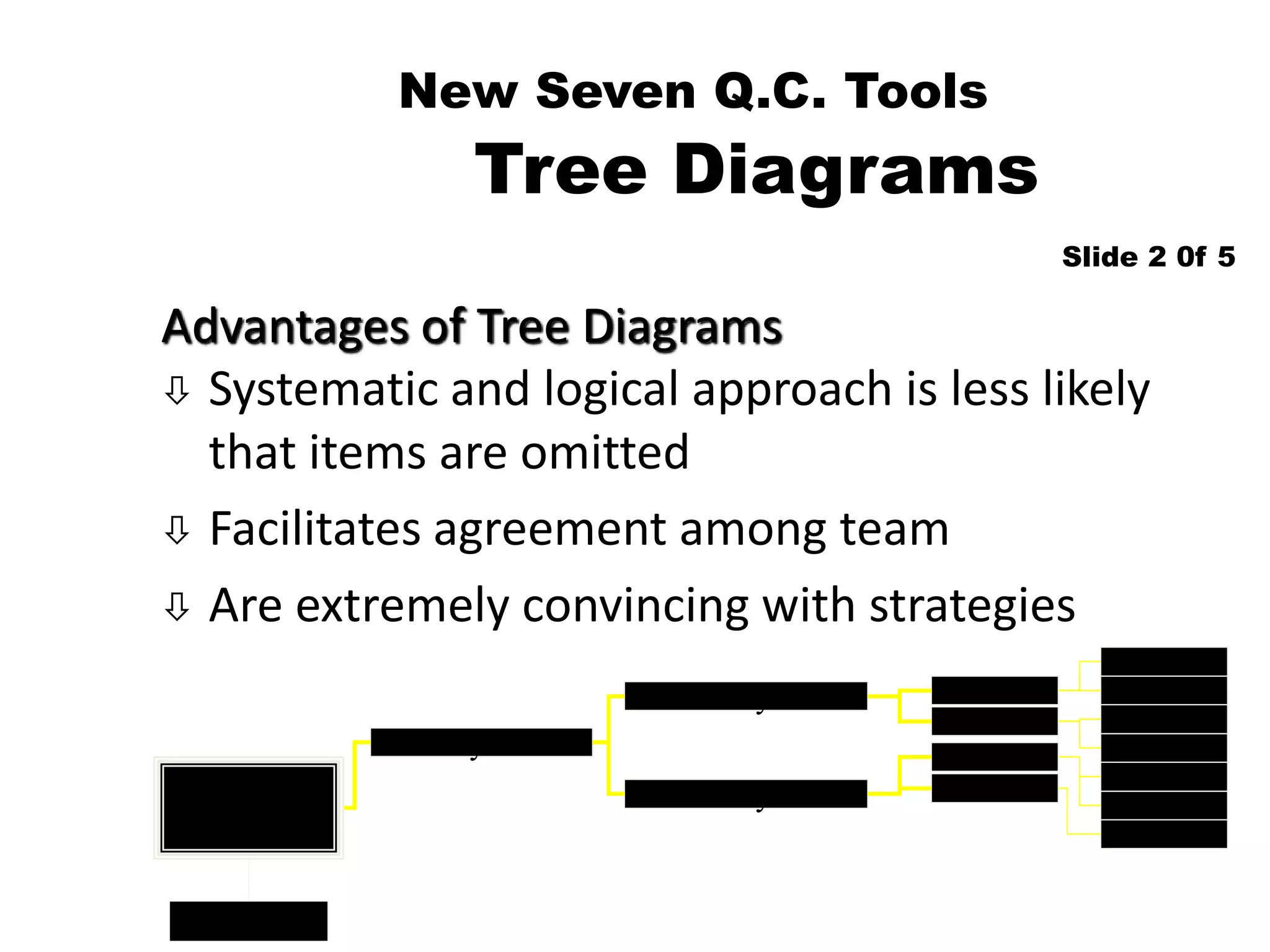
To
Accomplish
Primary means
Constraints
Secondary means
Secondary means
3rd means
3rd means
3rd means
3rd means
4th means
4th means
4th means
4th means
4th means
4th means
4th means
 Discuss means of achieving objective (primary
means, first level strategy)
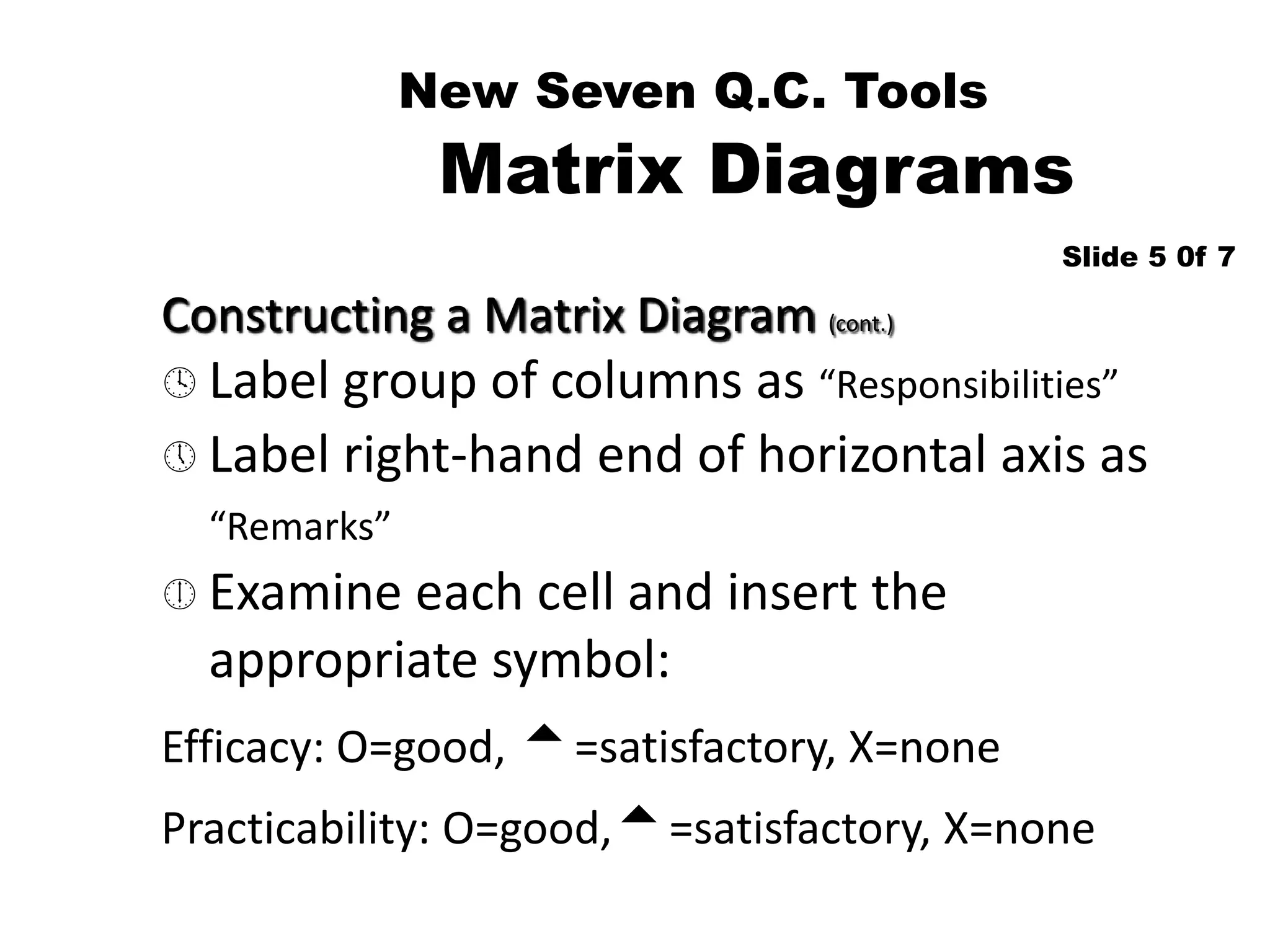
New Seven Q.C. Tools
Tree Diagrams
Constructing a Tree Diagram
Group Method Approach
Slide 3 0f 5
 Write Relations Diagram topic (Objective card)
 Identify constraints on how objective can
be achieved
 Take each primary mean, write ob-jective
for achieving it (secondary means)
New Seven Q.C. Tools
Tree Diagrams
Constructing an Tree Diagram
Group Method Approach (cont.)
Slide 4 0f 5
 Continue to expand to the fourth level
 Review each system of means in both
directions (from objective to means and means to
objective)
 Add more cards if needed
 Connect all levels
Next, complete the diagram
New Seven Q.C. Tools
Matrix Diagrams
For Clarifying Problems by “Thinking
Multidimensionally”
 Consists of a two-dimensional array to
determine location and nature of problem
 Discovers key ideas by relationships
represented by the cells in matrix.
Slide 1 0f 7
New Seven Q.C. Tools
Matrix Diagrams
Advantages of Matrix Diagrams
 Enable data on ideas based on extensive
experience
 Clarifies relationships among different
elements
 Makes overall structure of problem
immediately obvious
 Combined from two to four types of diagrams,
location of problem is clearer.
Slide 2 0f 7
New Seven Q.C. Tools
Matrix Diagrams
Constructing a Matrix Diagram
Slide 4 0f 7
 Write final-level means from Tree diagram
forming vertical axis
 Write in Evaluation categories (efficacy,
practicability, and rank) on horizontal axis.
 Write names along horizontal axis
 Examine final-level means to identify whom
will implement them
New Seven Q.C. Tools
Matrix Diagrams
Constructing a Matrix Diagram (cont.)
Slide 5 0f 7
 Label group of columns as “Responsibilities”
 Label right-hand end of horizontal axis as
“Remarks”
 Examine each cell and insert the
appropriate symbol:
Efficacy: O=good, =satisfactory, X=none
Practicability: O=good,=satisfactory, X=none
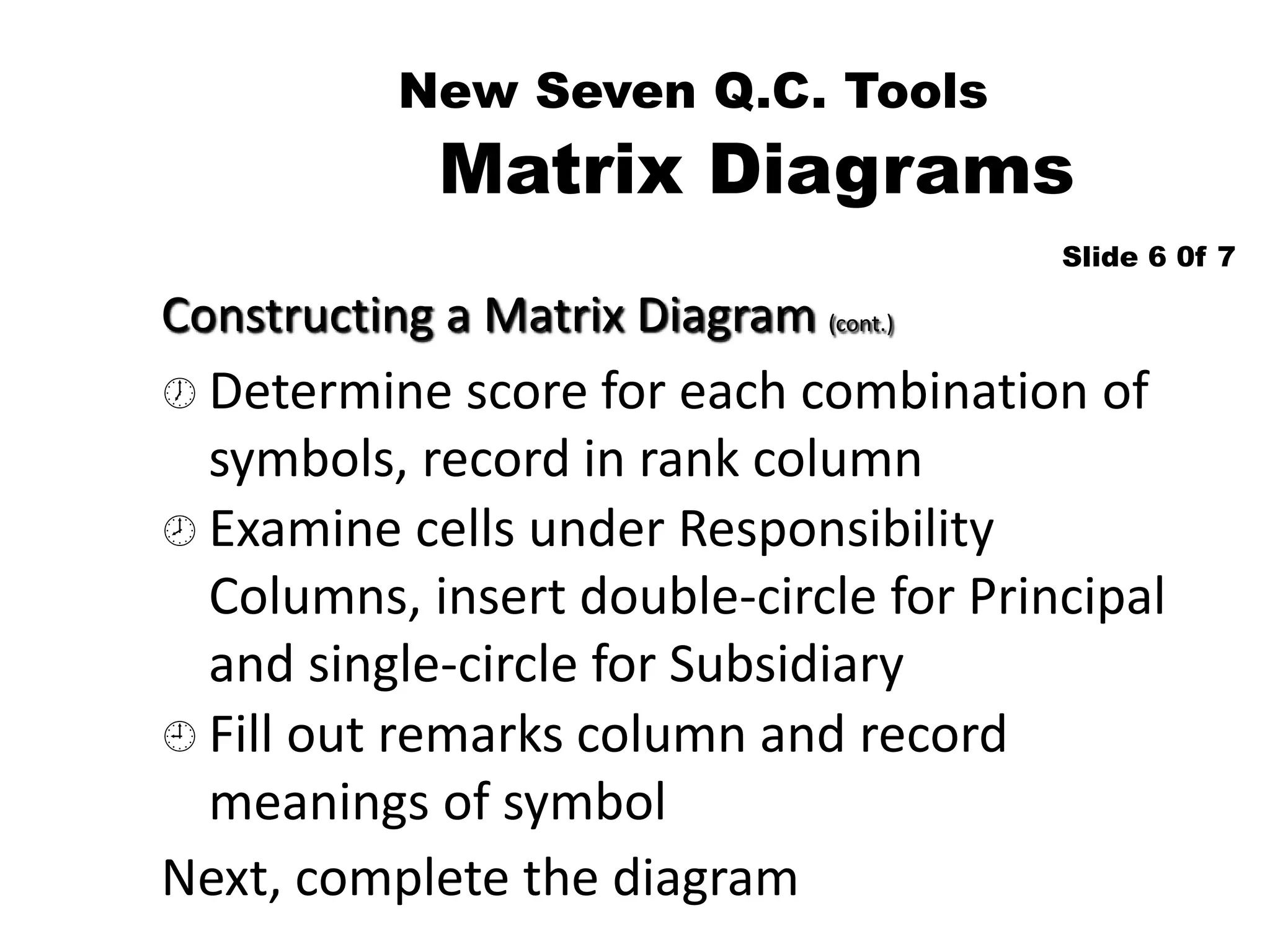
New Seven Q.C. Tools
Matrix Diagrams
Constructing a Matrix Diagram (cont.)
Slide 6 0f 7
 Fill out remarks column and record
meanings of symbol
Next, complete the diagram
 Examine cells under Responsibility
Columns, insert double-circle for Principal
and single-circle for Subsidiary
 Determine score for each combination of
symbols, record in rank column
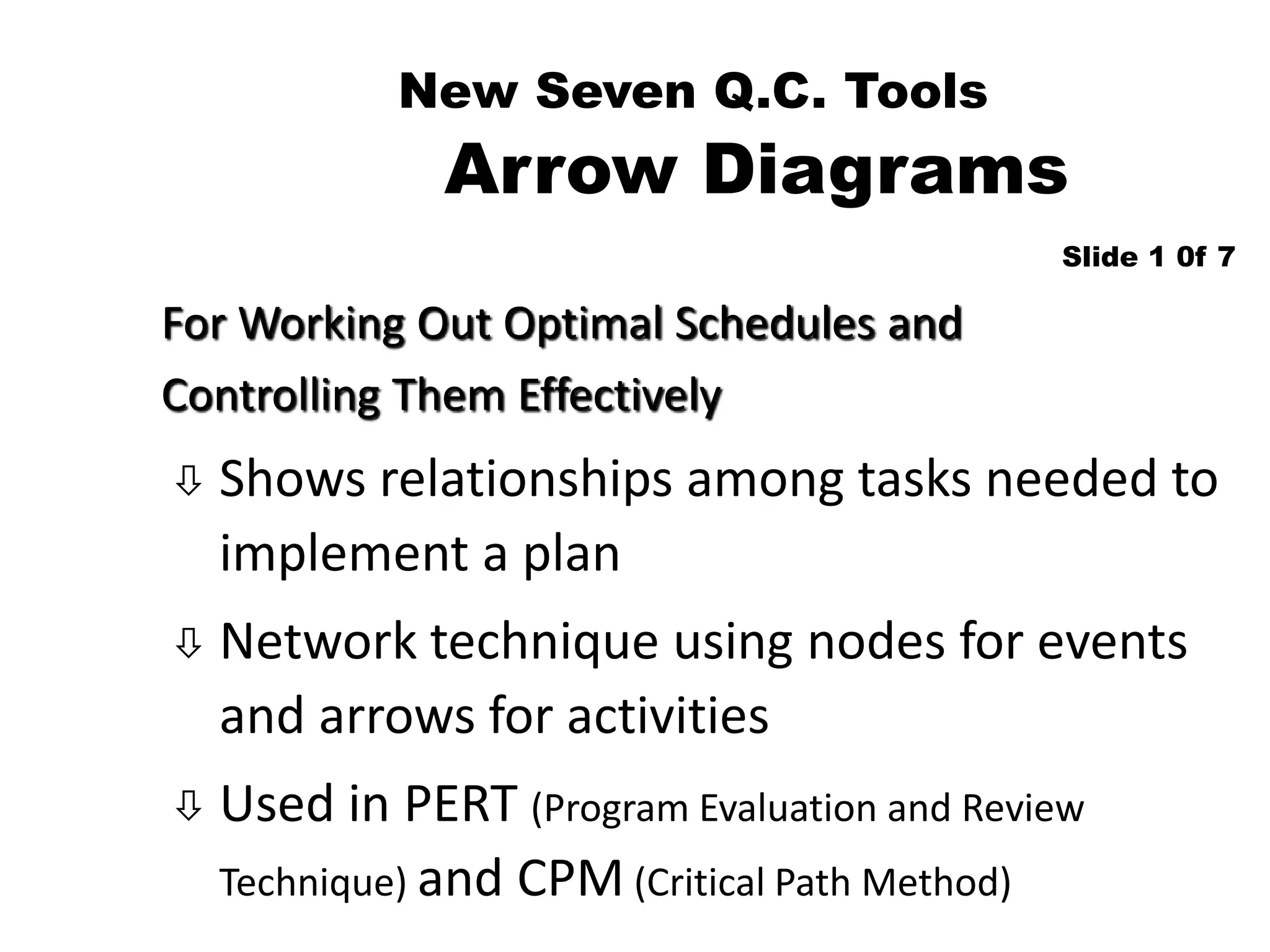
New Seven Q.C. Tools
Arrow Diagrams
For Working Out Optimal Schedules and
Controlling Them Effectively
 Shows relationships among tasks needed to
implement a plan
 Network technique using nodes for events
and arrows for activities
 Used in PERT (Program Evaluation and Review
Technique) and CPM (Critical Path Method)
Slide 1 0f 7
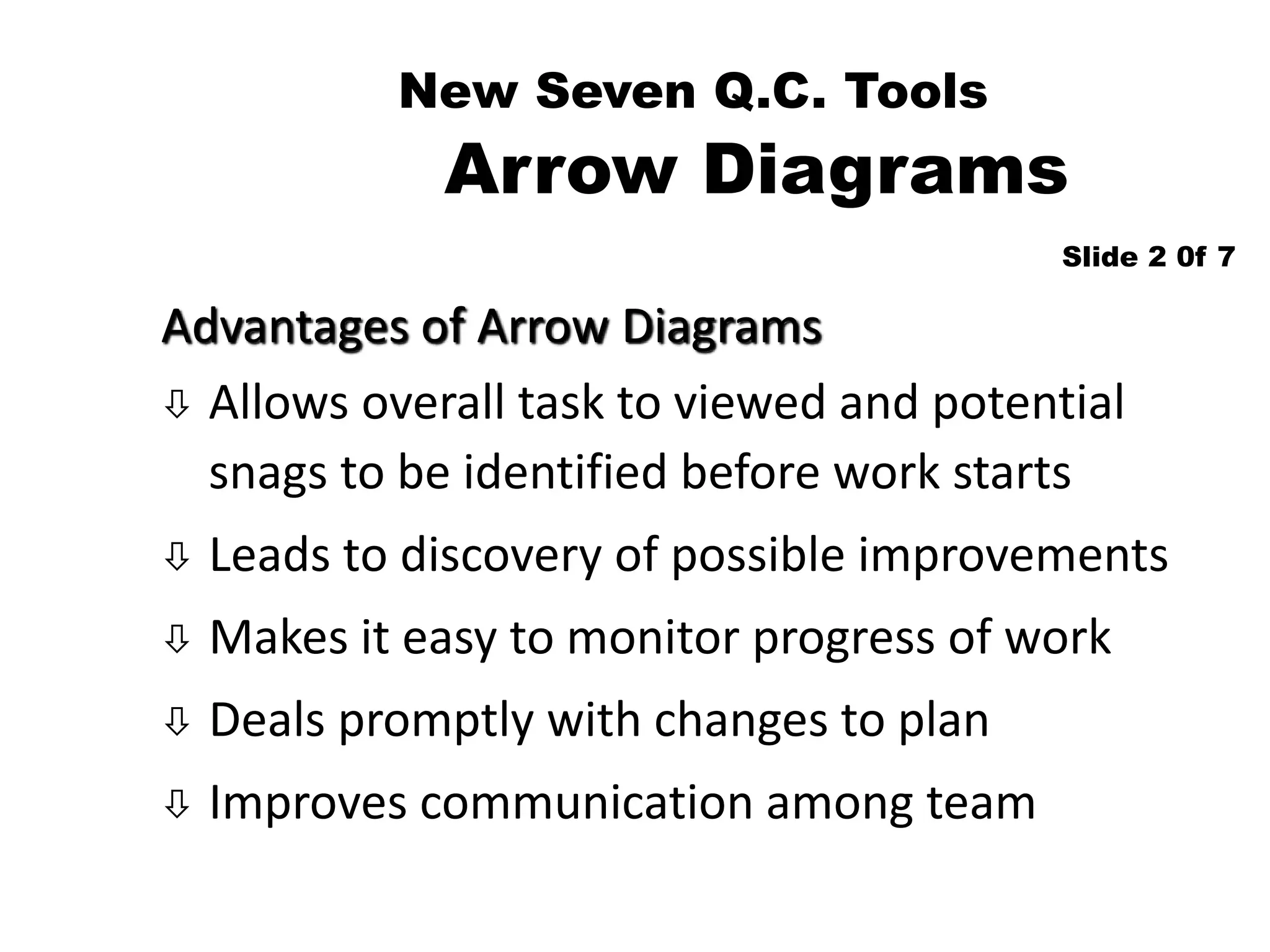
New Seven Q.C. Tools
Arrow Diagrams
Advantages of Arrow Diagrams
 Allows overall task to viewed and potential
snags to be identified before work starts
 Leads to discovery of possible improvements
 Makes it easy to monitor progress of work
 Deals promptly with changes to plan
 Improves communication among team
Slide 2 0f 7
New Seven Q.C. Tools
Arrow Diagrams
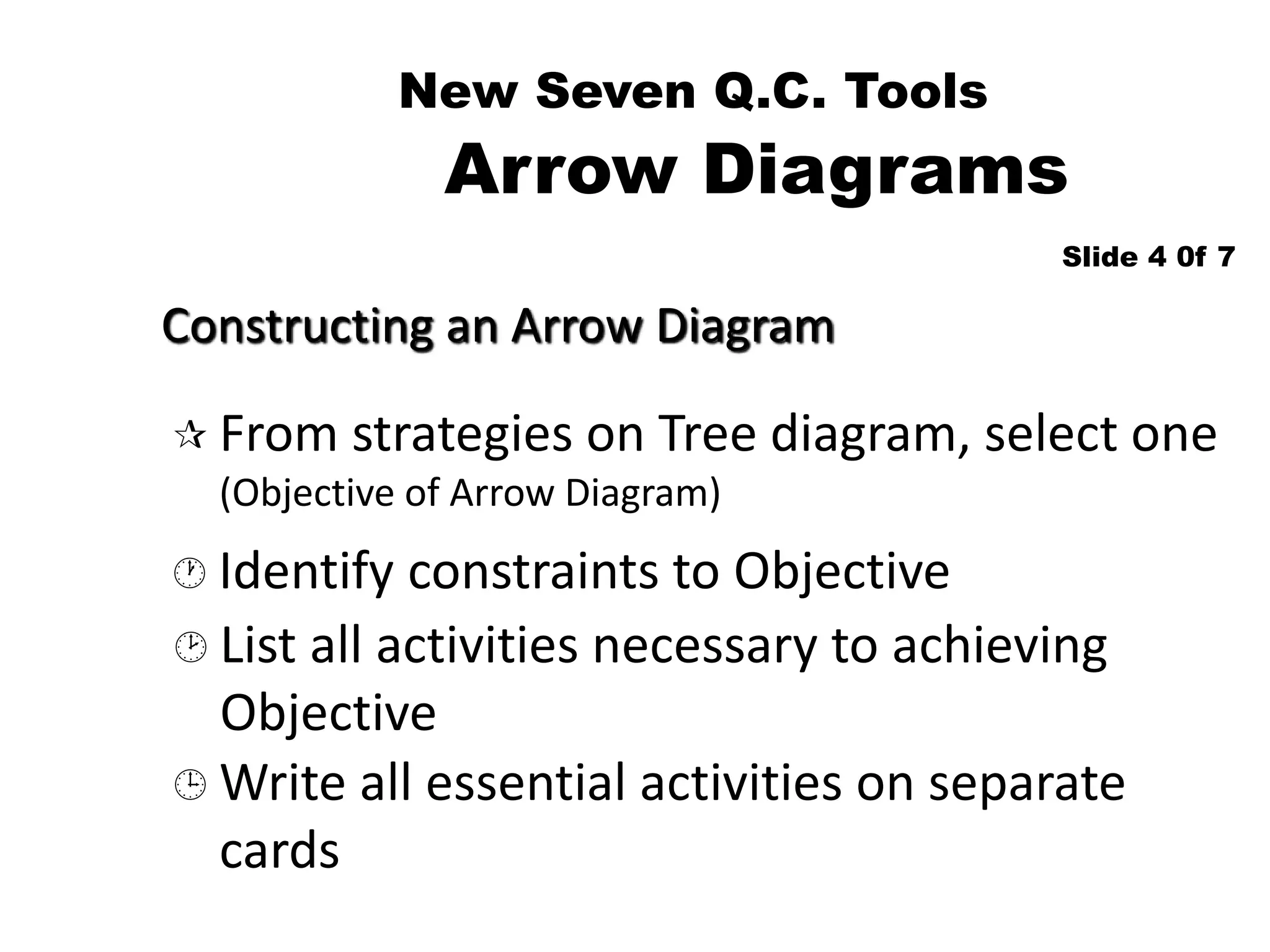
Constructing an Arrow Diagram
Slide 4 0f 7
 From strategies on Tree diagram, select one
(Objective of Arrow Diagram)
 Identify constraints to Objective
 Write all essential activities on separate
cards
 List all activities necessary to achieving
Objective
New Seven Q.C. Tools
Arrow Diagrams
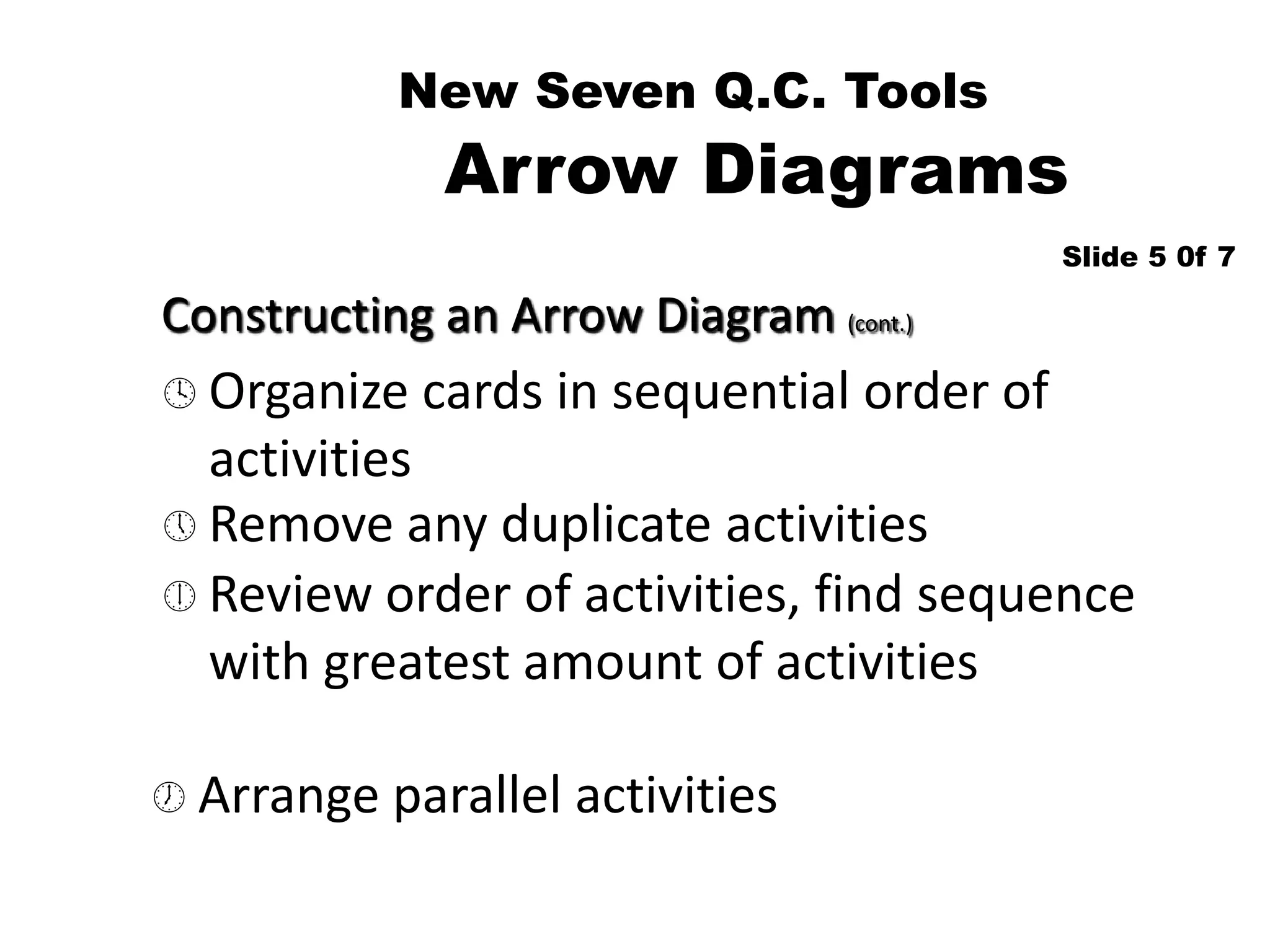
Constructing an Arrow Diagram (cont.)
Slide 5 0f 7
 Organize cards in sequential order of
activities
 Remove any duplicate activities
 Review order of activities, find sequence
with greatest amount of activities
 Arrange parallel activities
New Seven Q.C. Tools
Arrow Diagrams
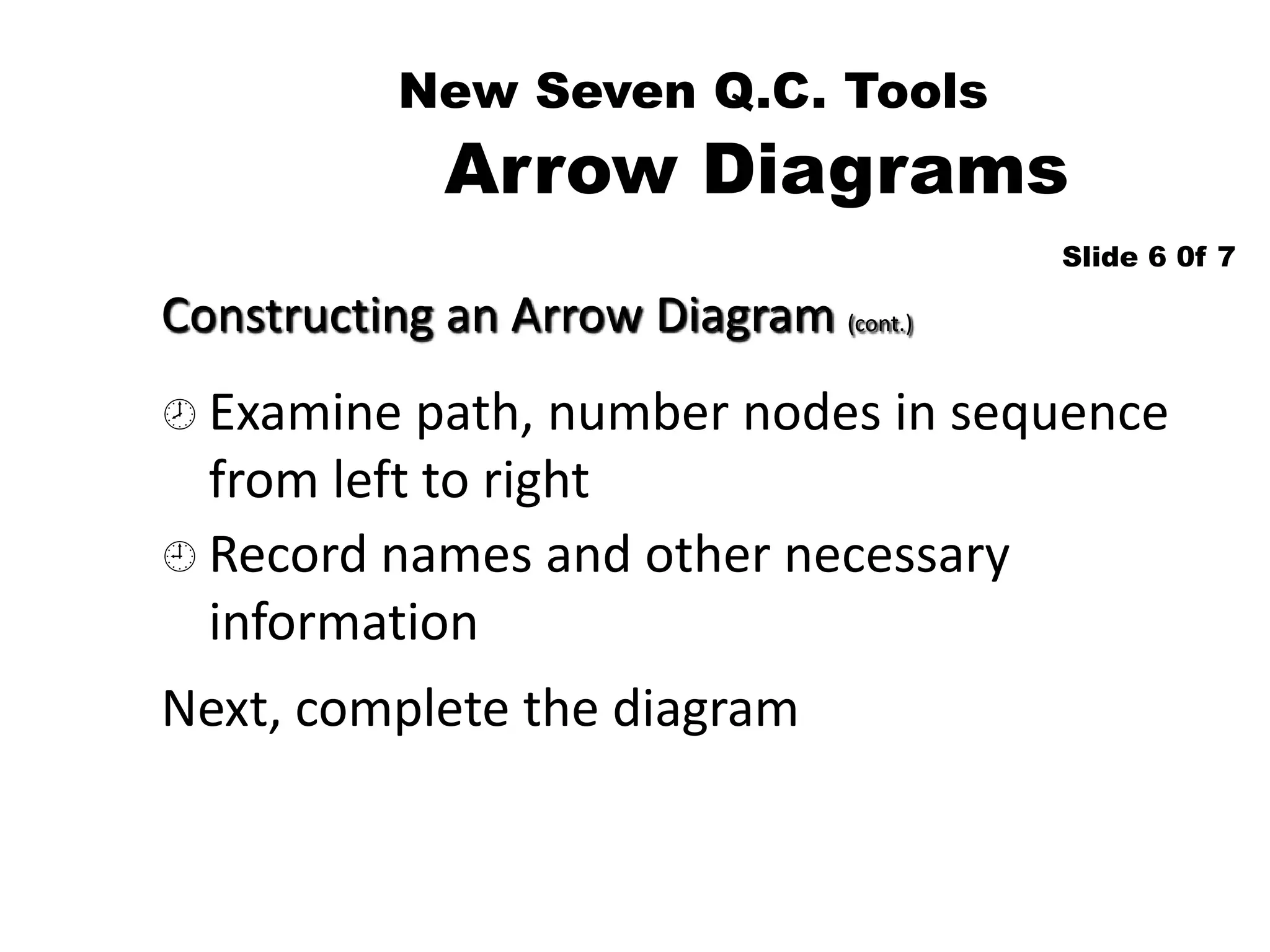
Constructing an Arrow Diagram (cont.)
Slide 6 0f 7
 Record names and other necessary
information
Next, complete the diagram
 Examine path, number nodes in sequence
from left to right

Tree, matrix and arrow diagram

  • 1.
    Tree, Matrix andArrow Diagram By DR.A.Nithya
  • 2.
    New Seven Q.C.Tools Tree Diagrams For Systematically Pursuing the Best Strategies for Attaining an Objective  Develops a succession of strategies for achieving objectives  Reveals methods to achieve the results.  Also known as Systematic diagrams or Dendrograms Slide 1 0f 5
  • 3.
    New Seven Q.C.Tools Tree Diagrams Advantages of Tree Diagrams  Systematic and logical approach is less likely that items are omitted  Facilitates agreement among team  Are extremely convincing with strategies Slide 2 0f 5 To Accomplish Primary means Constraints Secondary means Secondary means 3rd means 3rd means 3rd means 3rd means 4th means 4th means 4th means 4th means 4th means 4th means 4th means
  • 4.
     Discuss meansof achieving objective (primary means, first level strategy) New Seven Q.C. Tools Tree Diagrams Constructing a Tree Diagram Group Method Approach Slide 3 0f 5  Write Relations Diagram topic (Objective card)  Identify constraints on how objective can be achieved  Take each primary mean, write ob-jective for achieving it (secondary means)
  • 5.
    New Seven Q.C.Tools Tree Diagrams Constructing an Tree Diagram Group Method Approach (cont.) Slide 4 0f 5  Continue to expand to the fourth level  Review each system of means in both directions (from objective to means and means to objective)  Add more cards if needed  Connect all levels Next, complete the diagram
  • 6.
    New Seven Q.C.Tools Matrix Diagrams For Clarifying Problems by “Thinking Multidimensionally”  Consists of a two-dimensional array to determine location and nature of problem  Discovers key ideas by relationships represented by the cells in matrix. Slide 1 0f 7
  • 7.
    New Seven Q.C.Tools Matrix Diagrams Advantages of Matrix Diagrams  Enable data on ideas based on extensive experience  Clarifies relationships among different elements  Makes overall structure of problem immediately obvious  Combined from two to four types of diagrams, location of problem is clearer. Slide 2 0f 7
  • 8.
    New Seven Q.C.Tools Matrix Diagrams Constructing a Matrix Diagram Slide 4 0f 7  Write final-level means from Tree diagram forming vertical axis  Write in Evaluation categories (efficacy, practicability, and rank) on horizontal axis.  Write names along horizontal axis  Examine final-level means to identify whom will implement them
  • 9.
    New Seven Q.C.Tools Matrix Diagrams Constructing a Matrix Diagram (cont.) Slide 5 0f 7  Label group of columns as “Responsibilities”  Label right-hand end of horizontal axis as “Remarks”  Examine each cell and insert the appropriate symbol: Efficacy: O=good, =satisfactory, X=none Practicability: O=good,=satisfactory, X=none
  • 10.
    New Seven Q.C.Tools Matrix Diagrams Constructing a Matrix Diagram (cont.) Slide 6 0f 7  Fill out remarks column and record meanings of symbol Next, complete the diagram  Examine cells under Responsibility Columns, insert double-circle for Principal and single-circle for Subsidiary  Determine score for each combination of symbols, record in rank column
  • 11.
    New Seven Q.C.Tools Arrow Diagrams For Working Out Optimal Schedules and Controlling Them Effectively  Shows relationships among tasks needed to implement a plan  Network technique using nodes for events and arrows for activities  Used in PERT (Program Evaluation and Review Technique) and CPM (Critical Path Method) Slide 1 0f 7
  • 12.
    New Seven Q.C.Tools Arrow Diagrams Advantages of Arrow Diagrams  Allows overall task to viewed and potential snags to be identified before work starts  Leads to discovery of possible improvements  Makes it easy to monitor progress of work  Deals promptly with changes to plan  Improves communication among team Slide 2 0f 7
  • 13.
    New Seven Q.C.Tools Arrow Diagrams Constructing an Arrow Diagram Slide 4 0f 7  From strategies on Tree diagram, select one (Objective of Arrow Diagram)  Identify constraints to Objective  Write all essential activities on separate cards  List all activities necessary to achieving Objective
  • 14.
    New Seven Q.C.Tools Arrow Diagrams Constructing an Arrow Diagram (cont.) Slide 5 0f 7  Organize cards in sequential order of activities  Remove any duplicate activities  Review order of activities, find sequence with greatest amount of activities  Arrange parallel activities
  • 15.
    New Seven Q.C.Tools Arrow Diagrams Constructing an Arrow Diagram (cont.) Slide 6 0f 7  Record names and other necessary information Next, complete the diagram  Examine path, number nodes in sequence from left to right