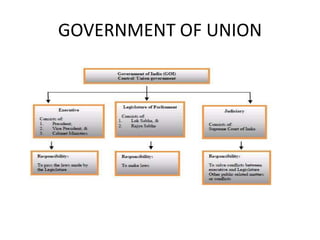
GOVERNMENT OF THE UNION
The executive branch consists of the
president, vice president, and a
Council of Ministers, led by the prime
minister. Within the legislative branch
are the two houses of parliament—the
lower house, or Lok Sabha (House of
the People), and the upper house, or
Rajya Sabha (Council of States).
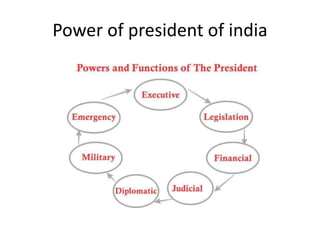
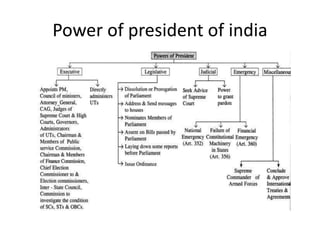
Power of president of india
Powers and Functions of President in
India
• Legislative powers enjoyed by the President of India
• The President has the power to dissolve the Lok Sabha.
• A bill that has been passed by both the houses of the
parliament can become a law only if it receives the
president. (subject to limitations)
• The President of India has the power to nominate 12
members to the Rajya Sabha who have made
extraordinary accomplishments in the fields of science,
art, literature and social service.
• The President has the power to send a bill back to the
parliament unless it is a money bill or constitutional
amendment bill.
Executive power enjoyed by the
President of India
• The executive powers of the country are
vested with the President of India.
• The parliament can grant additional powers to
the President if it deems fit and these powers
can be further delegated by the president to
state governors.
Appointing powers and duties of the
President
• Appointing powers and duties of the President
• The President has the power and responsibility to appoint the Prime Minister of
India.
• The President of India appoints the Chief Justice.
• The President is the appointing authority for the states and also has the power to
dismiss a governor who has violated the constitution in their acts.
• Other than the posts mentioned above, the President has the power to appoint on
a number of posts including, Ambassadors to other countries like, IAS, IPS, IFS,
Attorney General, etcetera.
• Military powers of the President
• The President of India is the commander in chief of all the Indian armed forces.
• The President has the power to declare war or conclude peace with any country
on the advice of a council of ministers headed by the Prime Minister.
• All the treaties with any foreign countries are signed in the name of the President
of India.
Power of president of india
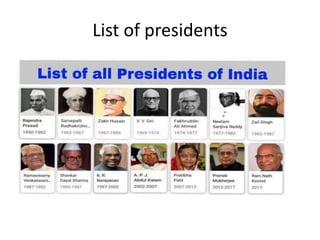
List of presidents
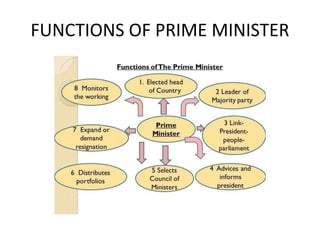
FUNCTIONS OF PRIME MINISTER
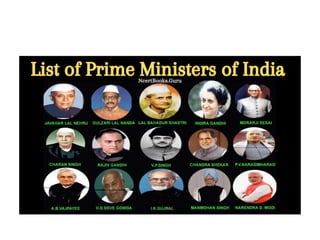
Powers And Functions Of The Prime
Minister
• In the scheme of the parliamentary system of government provided
by the constitution, the President is the nominal executive
authority (de jure executive) and Prime Minister is the real
executive authority (de facto executive).
• In other words, the President is the head of the State while the
Prime Minister is the head of the government.
• The Constitution does not contain any specific procedure for the
selection and appointment of the Prime Minister.
• Article 75 says only that the Prime Minister shall be appointed by
the President.
• The salary and allowances of the Prime Minister are determined
by the Parliament from time to time. He/she gets the salary and
allowances that are payable to a member of Parliament.
Role and power of the prime minister
• Ministry of Personnel, Public Grievances and
Pensions (as Minister of Personnel, Public
Grievances and Pensions)
• Cabinet Secretariat.
• Appointments Committee of the Cabinet.
• Cabinet Committee on Security.
• Cabinet Committee on Economic Affairs.
• Department of Atomic Energy.
Role and power of the prime minister
• He/she is the chairman of the NITI Ayog (which succeeded the
planning commission), National Integration Council, InterState
Council, National Water Resources Council, and some other bodies.
• He plays a significant role in shaping the foreign policy of the
country.
• He is the chief spokesman of the Union government.
• He is the crisis manager-in-chief at the political level during
emergencies.
• As a leader of the nation, he meets various sections of people in
different states and receives memoranda from them regarding their
problems, and so on.
• He is the leader of the party in power and is the political head of
the services.
Emergency Powers of the President
• The constitution of India empowers the
President to proclaim three kinds of
Emergencies: National Emergency (Art. 352);
• Emergency for failure of Constitutional
Machinery in a State (Art. 356);
• Financial Emergency (Art. 360)
Powers and Functions of the Prime
Minister
– He recommends persons who can be appointed as ministers by
the president. The President can appoint only those persons as
ministers who are recommended by the Prime Minister.
– He allocates and reshuffles various portfolios among the
ministers.
– He can ask a minister to resign or advise the President to
dismiss him in case of a difference of opinion.
– He presides over the meeting of the council of ministers and
influences its decisions.
– He guides, directs, controls, and coordinates the activities of all
the ministers.
– He can bring about the collapse of the council of ministers by
resigning from office.
Relationship with the President
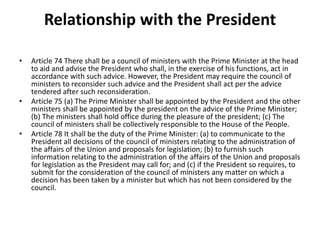
• Article 74 There shall be a council of ministers with the Prime Minister at the head
to aid and advise the President who shall, in the exercise of his functions, act in
accordance with such advice. However, the President may require the council of
ministers to reconsider such advice and the President shall act per the advice
tendered after such reconsideration.
• Article 75 (a) The Prime Minister shall be appointed by the President and the other
ministers shall be appointed by the president on the advice of the Prime Minister;
(b) The ministers shall hold office during the pleasure of the president; (c) The
council of ministers shall be collectively responsible to the House of the People.
• Article 78 It shall be the duty of the Prime Minister: (a) to communicate to the
President all decisions of the council of ministers relating to the administration of
the affairs of the Union and proposals for legislation; (b) to furnish such
information relating to the administration of the affairs of the Union and proposals
for legislation as the President may call for; and (c) if the President so requires, to
submit for the consideration of the council of ministers any matter on which a
decision has been taken by a minister but which has not been considered by the
council.
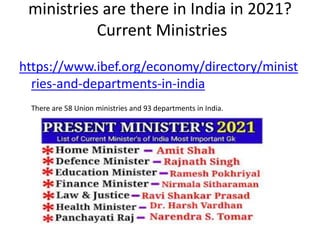
ministries are there in India in 2021?
Current Ministries
https://www.ibef.org/economy/directory/minist
ries-and-departments-in-india
There are 58 Union ministries and 93 departments in India.
GOVERNMENT OF UNION
Legislature of the Union
• Legislature of the Union, which is called
Parliament, consists of the President and two
Houses, known as Council of States (Rajya
Sabha) and House of the People (Lok Sabha).
Each House has to meet within six months of
its previous sitting. A joint sitting of two
Houses can be held in certain cases
The Lok Sabha
• The Lower House or the House of the People is
popularly known as Lok Sabha. Its members are
directly elected by the people. The maximum
number of members to be elected which was
fixed by the Constitution at 500. It was raised to
520 members by the Seventh Constitutional
Amendment (1956) and to 545 members by the
42nd Constitutional Amendment (1976). This
includes not more than 525 members chosen by
direct election from territorial constituencies in
the States and not more 20 members to
represent the Union Territories
STRUCTURE OF LOKSABHA
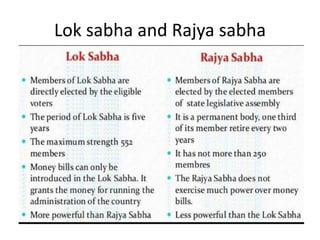
• The maximum strength of the House envisaged by the Constitution
is now 552 .
• The Lok Sabha consists of not more than 530 members elected by
direct election from territorial constituencies in the States,
• not more than 20 members to represent the Union Territories .
• not more than two members to be nominated by the President to
represent the Anglo Indian community.
• The Lok Sabha at present consists of 545 members. Of these, 530
members are directly elected from the States and 13 from Union
Territories, while two are nominated by the President to represent
the Anglo-Indian community. As per Constitution 84th Amendment
Act, the total number of seats as allocated to various States in the
Lok Sabha on the basis of the 1971 census, shall remain unaltered
till the first census to be taken after the year 2026.
• The Lok Sabha is elected for five years, unless dissolved earlier.
Powers of Lok Sabha
• Approval of the ordinances issued by the President
• Change of the boundaries of the states. State, creation of new
states and change in the name of any state.
• Changes in the jurisdiction of the Supreme Court and the High
Courts.
• Changes the qualifications of the members of the Parliament and
State Legislatures.
• Revising the salary and allowances of the members of Parliament,
• The setting up of Joint Public Service Commission for two or more
states.
• Passing of a resolution for abolishing or creating the upper chamber
of a state legislature,
• Approval of a Declaration of Emergency
The Rajya Sabha
• The Rajya Sabha or Council of States consists of not
more than 250 members of which 12 members are
nominated by the President from amongst persons
having 'special knowledge or practical experience in
literature, science, art, and social service.' The
remaining members are elected by the members of the
State Legislative Assemblies in accordance with the
system of proportional representation by means of
single transferable vote. Thus, unlike Lok Sabha, Rajya
Sabha adopts the method of indirect election. For the
purpose of this election, each State is allotted a
number of seats, mainly on the basis of their
population.
POWERS OF RAJYA SABHA
• Safety Valve of India’s Federal Polity
• In addition to the well recognised examples of responsible administration and judicial review, the
Rajya Sabha is an important component of the constitutional checks and balances structure.
• Unlike the president, legislature, and judiciary, the Council of States operates as a safety valve
inside the legislative, reducing federal tensions.
• The founders of the Indian constitution planned to construct a house that would operate as a
revisionary house to check the lower house's hasty legislation, which may be passed under populist
pressures.
• Parliament is not simply a legislative body, but also a deliberative one, allowing members to discuss
important public issues. As a result, the Upper House's job is to be a deliberative body in addition
to balancing the Lok Sabha's "fickleness and enthusiasm."
• Representing the Vulnerable Sections
• In the Lok Sabha, women, religious, ethnic, and linguistic minorities are underrepresented (due to
first past the post-election system).
• As a result, an indirect election to the Rajya Sabha (through propositional representation) would
allow them to participate in the nation's legislative process.
• Special Powers of Rajya Sabha
• The authority to move a subject from the State List to the Union List for a set amount of time
(Article 249).
• Additional All-India Services are being developed (Article 312).
• When the Lok Sabha is dissolved, to declare an emergency under Article 352 for a limited time.
The Speaker
• The position of the Speaker of the Lok Sabha is more or
less similar to the Speaker of the English House of
Commons. The office of the Speaker is symbol of high
dignity and authority. Once elected to the office, the
speaker severs his party affiliation and starts
functioning in an impartial manner. He acts as the
guardian of the rights and privileges of the members.
The Speaker is conferred with a number of powers to
ensure an orderly and efficient conduct of the business
of the House. He conducts the proceedings of the
house, maintains order and decorum in the house and
decides points of order, interprets and applies rules of
the house.
Lok sabha and Rajya sabha
Council of Ministers
• https://www.india.gov.in/my-
government/whos-who/council-ministers

COI - UNIT 2.pptx

  • 1.
    GOVERNMENT OF THEUNION The executive branch consists of the president, vice president, and a Council of Ministers, led by the prime minister. Within the legislative branch are the two houses of parliament—the lower house, or Lok Sabha (House of the People), and the upper house, or Rajya Sabha (Council of States).
  • 2.
  • 3.
    Powers and Functionsof President in India • Legislative powers enjoyed by the President of India • The President has the power to dissolve the Lok Sabha. • A bill that has been passed by both the houses of the parliament can become a law only if it receives the president. (subject to limitations) • The President of India has the power to nominate 12 members to the Rajya Sabha who have made extraordinary accomplishments in the fields of science, art, literature and social service. • The President has the power to send a bill back to the parliament unless it is a money bill or constitutional amendment bill.
  • 4.
    Executive power enjoyedby the President of India • The executive powers of the country are vested with the President of India. • The parliament can grant additional powers to the President if it deems fit and these powers can be further delegated by the president to state governors.
  • 5.
    Appointing powers andduties of the President • Appointing powers and duties of the President • The President has the power and responsibility to appoint the Prime Minister of India. • The President of India appoints the Chief Justice. • The President is the appointing authority for the states and also has the power to dismiss a governor who has violated the constitution in their acts. • Other than the posts mentioned above, the President has the power to appoint on a number of posts including, Ambassadors to other countries like, IAS, IPS, IFS, Attorney General, etcetera. • Military powers of the President • The President of India is the commander in chief of all the Indian armed forces. • The President has the power to declare war or conclude peace with any country on the advice of a council of ministers headed by the Prime Minister. • All the treaties with any foreign countries are signed in the name of the President of India.
  • 6.
  • 7.
  • 8.
  • 9.
    Powers And FunctionsOf The Prime Minister • In the scheme of the parliamentary system of government provided by the constitution, the President is the nominal executive authority (de jure executive) and Prime Minister is the real executive authority (de facto executive). • In other words, the President is the head of the State while the Prime Minister is the head of the government. • The Constitution does not contain any specific procedure for the selection and appointment of the Prime Minister. • Article 75 says only that the Prime Minister shall be appointed by the President. • The salary and allowances of the Prime Minister are determined by the Parliament from time to time. He/she gets the salary and allowances that are payable to a member of Parliament.
  • 10.
    Role and powerof the prime minister • Ministry of Personnel, Public Grievances and Pensions (as Minister of Personnel, Public Grievances and Pensions) • Cabinet Secretariat. • Appointments Committee of the Cabinet. • Cabinet Committee on Security. • Cabinet Committee on Economic Affairs. • Department of Atomic Energy.
  • 11.
    Role and powerof the prime minister • He/she is the chairman of the NITI Ayog (which succeeded the planning commission), National Integration Council, InterState Council, National Water Resources Council, and some other bodies. • He plays a significant role in shaping the foreign policy of the country. • He is the chief spokesman of the Union government. • He is the crisis manager-in-chief at the political level during emergencies. • As a leader of the nation, he meets various sections of people in different states and receives memoranda from them regarding their problems, and so on. • He is the leader of the party in power and is the political head of the services.
  • 12.
    Emergency Powers ofthe President • The constitution of India empowers the President to proclaim three kinds of Emergencies: National Emergency (Art. 352); • Emergency for failure of Constitutional Machinery in a State (Art. 356); • Financial Emergency (Art. 360)
  • 13.
    Powers and Functionsof the Prime Minister – He recommends persons who can be appointed as ministers by the president. The President can appoint only those persons as ministers who are recommended by the Prime Minister. – He allocates and reshuffles various portfolios among the ministers. – He can ask a minister to resign or advise the President to dismiss him in case of a difference of opinion. – He presides over the meeting of the council of ministers and influences its decisions. – He guides, directs, controls, and coordinates the activities of all the ministers. – He can bring about the collapse of the council of ministers by resigning from office.
  • 14.
    Relationship with thePresident • Article 74 There shall be a council of ministers with the Prime Minister at the head to aid and advise the President who shall, in the exercise of his functions, act in accordance with such advice. However, the President may require the council of ministers to reconsider such advice and the President shall act per the advice tendered after such reconsideration. • Article 75 (a) The Prime Minister shall be appointed by the President and the other ministers shall be appointed by the president on the advice of the Prime Minister; (b) The ministers shall hold office during the pleasure of the president; (c) The council of ministers shall be collectively responsible to the House of the People. • Article 78 It shall be the duty of the Prime Minister: (a) to communicate to the President all decisions of the council of ministers relating to the administration of the affairs of the Union and proposals for legislation; (b) to furnish such information relating to the administration of the affairs of the Union and proposals for legislation as the President may call for; and (c) if the President so requires, to submit for the consideration of the council of ministers any matter on which a decision has been taken by a minister but which has not been considered by the council.
  • 16.
    ministries are therein India in 2021? Current Ministries https://www.ibef.org/economy/directory/minist ries-and-departments-in-india There are 58 Union ministries and 93 departments in India.
  • 17.
  • 18.
    Legislature of theUnion • Legislature of the Union, which is called Parliament, consists of the President and two Houses, known as Council of States (Rajya Sabha) and House of the People (Lok Sabha). Each House has to meet within six months of its previous sitting. A joint sitting of two Houses can be held in certain cases
  • 19.
    The Lok Sabha •The Lower House or the House of the People is popularly known as Lok Sabha. Its members are directly elected by the people. The maximum number of members to be elected which was fixed by the Constitution at 500. It was raised to 520 members by the Seventh Constitutional Amendment (1956) and to 545 members by the 42nd Constitutional Amendment (1976). This includes not more than 525 members chosen by direct election from territorial constituencies in the States and not more 20 members to represent the Union Territories
  • 20.
    STRUCTURE OF LOKSABHA •The maximum strength of the House envisaged by the Constitution is now 552 . • The Lok Sabha consists of not more than 530 members elected by direct election from territorial constituencies in the States, • not more than 20 members to represent the Union Territories . • not more than two members to be nominated by the President to represent the Anglo Indian community. • The Lok Sabha at present consists of 545 members. Of these, 530 members are directly elected from the States and 13 from Union Territories, while two are nominated by the President to represent the Anglo-Indian community. As per Constitution 84th Amendment Act, the total number of seats as allocated to various States in the Lok Sabha on the basis of the 1971 census, shall remain unaltered till the first census to be taken after the year 2026. • The Lok Sabha is elected for five years, unless dissolved earlier.
  • 21.
    Powers of LokSabha • Approval of the ordinances issued by the President • Change of the boundaries of the states. State, creation of new states and change in the name of any state. • Changes in the jurisdiction of the Supreme Court and the High Courts. • Changes the qualifications of the members of the Parliament and State Legislatures. • Revising the salary and allowances of the members of Parliament, • The setting up of Joint Public Service Commission for two or more states. • Passing of a resolution for abolishing or creating the upper chamber of a state legislature, • Approval of a Declaration of Emergency
  • 22.
    The Rajya Sabha •The Rajya Sabha or Council of States consists of not more than 250 members of which 12 members are nominated by the President from amongst persons having 'special knowledge or practical experience in literature, science, art, and social service.' The remaining members are elected by the members of the State Legislative Assemblies in accordance with the system of proportional representation by means of single transferable vote. Thus, unlike Lok Sabha, Rajya Sabha adopts the method of indirect election. For the purpose of this election, each State is allotted a number of seats, mainly on the basis of their population.
  • 23.
    POWERS OF RAJYASABHA • Safety Valve of India’s Federal Polity • In addition to the well recognised examples of responsible administration and judicial review, the Rajya Sabha is an important component of the constitutional checks and balances structure. • Unlike the president, legislature, and judiciary, the Council of States operates as a safety valve inside the legislative, reducing federal tensions. • The founders of the Indian constitution planned to construct a house that would operate as a revisionary house to check the lower house's hasty legislation, which may be passed under populist pressures. • Parliament is not simply a legislative body, but also a deliberative one, allowing members to discuss important public issues. As a result, the Upper House's job is to be a deliberative body in addition to balancing the Lok Sabha's "fickleness and enthusiasm." • Representing the Vulnerable Sections • In the Lok Sabha, women, religious, ethnic, and linguistic minorities are underrepresented (due to first past the post-election system). • As a result, an indirect election to the Rajya Sabha (through propositional representation) would allow them to participate in the nation's legislative process. • Special Powers of Rajya Sabha • The authority to move a subject from the State List to the Union List for a set amount of time (Article 249). • Additional All-India Services are being developed (Article 312). • When the Lok Sabha is dissolved, to declare an emergency under Article 352 for a limited time.
  • 24.
    The Speaker • Theposition of the Speaker of the Lok Sabha is more or less similar to the Speaker of the English House of Commons. The office of the Speaker is symbol of high dignity and authority. Once elected to the office, the speaker severs his party affiliation and starts functioning in an impartial manner. He acts as the guardian of the rights and privileges of the members. The Speaker is conferred with a number of powers to ensure an orderly and efficient conduct of the business of the House. He conducts the proceedings of the house, maintains order and decorum in the house and decides points of order, interprets and applies rules of the house.
  • 25.
    Lok sabha andRajya sabha
  • 26.
    Council of Ministers •https://www.india.gov.in/my- government/whos-who/council-ministers