Chapter 10 Product Issues in  Channel Management
Marketing Mix Resources 10 Objective 1: By understanding how the other marketing mix variables interface with the channel variable, and the implications of such, the channel manager could coordinate all strategic components to create the  synergy  needed to meet customers’ needs.
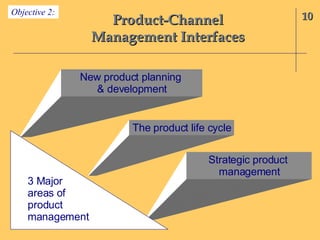
Product-Channel Management Interfaces 10 Objective 2: New product planning  & development The product life cycle Strategic product  management 3 Major areas of product management
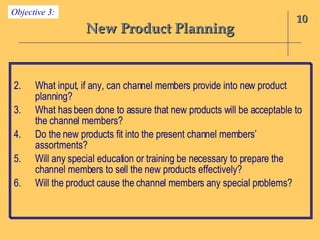
New Product Planning What input, if any, can channel members provide into new product planning? What has been done to assure that new products will be acceptable to the channel members? Do the new products fit into the present channel members’ assortments? Will any special education or training be necessary to prepare the channel members to sell the new products effectively? Will the product cause the channel members any special problems? 10 Objective 3:
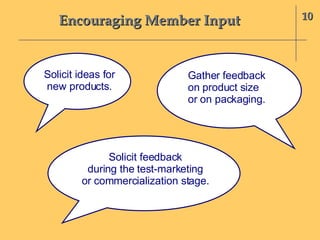
Encouraging Member Input 10 Solicit ideas for new products. Solicit feedback during the test-marketing or commercialization stage. Gather feedback on product size or on packaging.
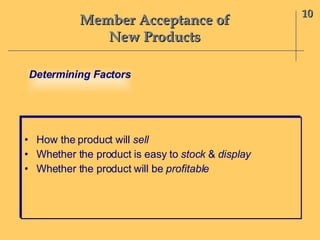
Member Acceptance of New Products How the product will  sell Whether the product is easy to  stock  &  display Whether the product will be  profitable 10 Determining Factors
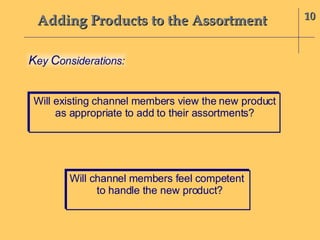
Adding Products to the Assortment 10 Will existing channel members view the new product as appropriate to add to their assortments? K ey  C onsiderations: Will channel members feel competent  to handle the new product?
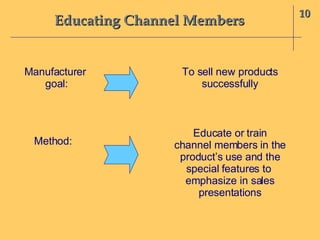
Educating Channel Members 10 Manufacturer  goal: To sell new products successfully Method: Educate or train channel members in the product’s use and the special features to  emphasize in sales presentations
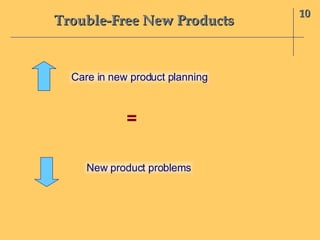
Trouble-Free New Products 10 New product problems Care in new product planning =
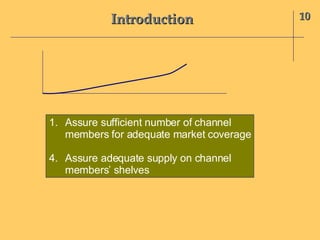
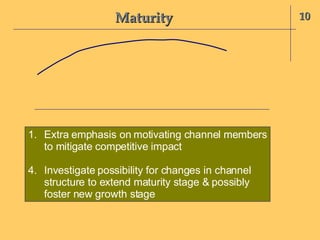
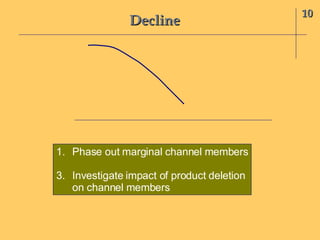
Product Life Cycle 10 Objective 4: Introduction Growth Sales ($) Sales curve Maturity Profit curve Time Decline
Introduction 10 Assure sufficient number of channel members for adequate market coverage Assure adequate supply on channel  members’ shelves
Growth 10 Assure sufficient number of channel member  inventories for adequate market coverage Monitor the effects of competitive products on channel member support
Maturity 10 Extra emphasis on motivating channel members to mitigate competitive impact Investigate possibility for changes in channel structure to extend maturity stage & possibly foster new growth stage
Decline 10 Phase out marginal channel members Investigate impact of product deletion  on channel members
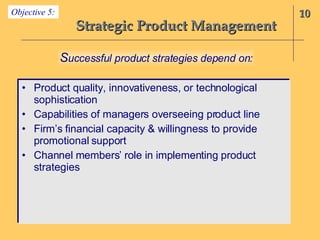
Strategic Product Management Product quality, innovativeness, or technological sophistication Capabilities of managers overseeing product line Firm’s financial capacity & willingness to provide promotional support  Channel members’ role in implementing product strategies 10 S uccessful product strategies depend on: Objective 5:
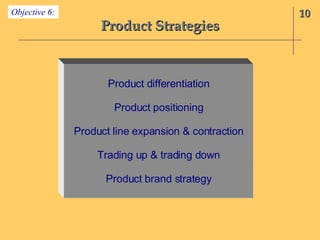
Product Strategies Objective 6: 10 Product differentiation Product positioning Product line expansion & contraction Trading up & trading down Product brand strategy
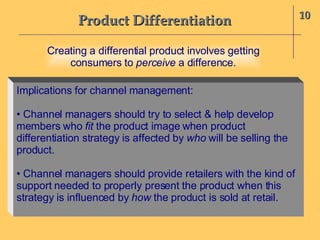
Product Differentiation 10 Implications for channel management: •  Channel managers should try to select & help develop members who  fit  the product image when product differentiation strategy is affected by  who  will be selling the product. •  Channel managers should provide retailers with the kind of support needed to properly present the product when this strategy is influenced by  how  the product is sold at retail. Creating a differential product involves getting consumers to  perceive  a difference.
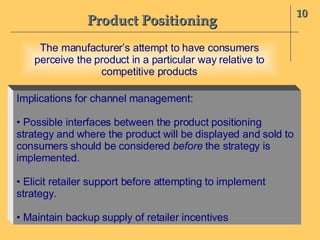
Product Positioning 10 The manufacturer’s attempt to have consumers perceive the product in a particular way relative to competitive products Implications for channel management: •  Possible interfaces between the product positioning strategy and where the product will be displayed and sold to consumers should be considered  before  the strategy is implemented. •  Elicit retailer support before attempting to implement strategy. •  Maintain backup supply of retailer incentives
Product Line Expansion & Contraction 10 Manufacturers often engage in both expansion and contraction simultaneously. Implications for channel management: •  Difficult to balance channel member satisfaction & Support for reshaped product lines •  Channel members are making increasing demands on  Manufacturers to have the right mix of products
Trading Down, Trading Up 10 Adding lower-priced products or product lines, or higher-priced products or product lines, to a product mix Implications for channel management: •  Whether existing channel members provide adequate coverage of high-end or low-end market segments to  which trade-up or trade-down product is aimed •  Whether the channel members have confidence in  the manufacturer’s ability to successfully market the trade-up or trade-down product
Product Brand Strategy 10 When manufacturers sell under both national and private brands, direct competition with channel members may result Implications for channel management: •  Do not sell both national & private brand versions of  products to the same channel members. •  Sell national and private brand versions in different  geographical territories. •  Physically vary products enough to minimize direct competition.
Product Service Strategy 10 Objective 6: It is the role of the marketing channel to provide necessary service along with the product to the final user Manufacturers should provide after-sale service •  by offering it directly at the factory •  through their own network of service centers •  through channel members •  through authorized independent service centers •  by some combination of the above

ch 10

  • 1.
    Chapter 10 ProductIssues in Channel Management
  • 2.
    Marketing Mix Resources10 Objective 1: By understanding how the other marketing mix variables interface with the channel variable, and the implications of such, the channel manager could coordinate all strategic components to create the synergy needed to meet customers’ needs.
  • 3.
    Product-Channel Management Interfaces10 Objective 2: New product planning & development The product life cycle Strategic product management 3 Major areas of product management
  • 4.
    New Product PlanningWhat input, if any, can channel members provide into new product planning? What has been done to assure that new products will be acceptable to the channel members? Do the new products fit into the present channel members’ assortments? Will any special education or training be necessary to prepare the channel members to sell the new products effectively? Will the product cause the channel members any special problems? 10 Objective 3:
  • 5.
    Encouraging Member Input10 Solicit ideas for new products. Solicit feedback during the test-marketing or commercialization stage. Gather feedback on product size or on packaging.
  • 6.
    Member Acceptance ofNew Products How the product will sell Whether the product is easy to stock & display Whether the product will be profitable 10 Determining Factors
  • 7.
    Adding Products tothe Assortment 10 Will existing channel members view the new product as appropriate to add to their assortments? K ey C onsiderations: Will channel members feel competent to handle the new product?
  • 8.
    Educating Channel Members10 Manufacturer goal: To sell new products successfully Method: Educate or train channel members in the product’s use and the special features to emphasize in sales presentations
  • 9.
    Trouble-Free New Products10 New product problems Care in new product planning =
  • 10.
    Product Life Cycle10 Objective 4: Introduction Growth Sales ($) Sales curve Maturity Profit curve Time Decline
  • 11.
    Introduction 10 Assuresufficient number of channel members for adequate market coverage Assure adequate supply on channel members’ shelves
  • 12.
    Growth 10 Assuresufficient number of channel member inventories for adequate market coverage Monitor the effects of competitive products on channel member support
  • 13.
    Maturity 10 Extraemphasis on motivating channel members to mitigate competitive impact Investigate possibility for changes in channel structure to extend maturity stage & possibly foster new growth stage
  • 14.
    Decline 10 Phaseout marginal channel members Investigate impact of product deletion on channel members
  • 15.
    Strategic Product ManagementProduct quality, innovativeness, or technological sophistication Capabilities of managers overseeing product line Firm’s financial capacity & willingness to provide promotional support Channel members’ role in implementing product strategies 10 S uccessful product strategies depend on: Objective 5:
  • 16.
    Product Strategies Objective6: 10 Product differentiation Product positioning Product line expansion & contraction Trading up & trading down Product brand strategy
  • 17.
    Product Differentiation 10Implications for channel management: • Channel managers should try to select & help develop members who fit the product image when product differentiation strategy is affected by who will be selling the product. • Channel managers should provide retailers with the kind of support needed to properly present the product when this strategy is influenced by how the product is sold at retail. Creating a differential product involves getting consumers to perceive a difference.
  • 18.
    Product Positioning 10The manufacturer’s attempt to have consumers perceive the product in a particular way relative to competitive products Implications for channel management: • Possible interfaces between the product positioning strategy and where the product will be displayed and sold to consumers should be considered before the strategy is implemented. • Elicit retailer support before attempting to implement strategy. • Maintain backup supply of retailer incentives
  • 19.
    Product Line Expansion& Contraction 10 Manufacturers often engage in both expansion and contraction simultaneously. Implications for channel management: • Difficult to balance channel member satisfaction & Support for reshaped product lines • Channel members are making increasing demands on Manufacturers to have the right mix of products
  • 20.
    Trading Down, TradingUp 10 Adding lower-priced products or product lines, or higher-priced products or product lines, to a product mix Implications for channel management: • Whether existing channel members provide adequate coverage of high-end or low-end market segments to which trade-up or trade-down product is aimed • Whether the channel members have confidence in the manufacturer’s ability to successfully market the trade-up or trade-down product
  • 21.
    Product Brand Strategy10 When manufacturers sell under both national and private brands, direct competition with channel members may result Implications for channel management: • Do not sell both national & private brand versions of products to the same channel members. • Sell national and private brand versions in different geographical territories. • Physically vary products enough to minimize direct competition.
  • 22.
    Product Service Strategy10 Objective 6: It is the role of the marketing channel to provide necessary service along with the product to the final user Manufacturers should provide after-sale service • by offering it directly at the factory • through their own network of service centers • through channel members • through authorized independent service centers • by some combination of the above