MARKET RESEARCH
ON APPLE INC.
Background1
Apple Inc. is an American multinational
technology company that designs,
manufactures, and develops consumer
electronics.
Apple’s Sales in 2016.
$233000000000
Industry, Environment
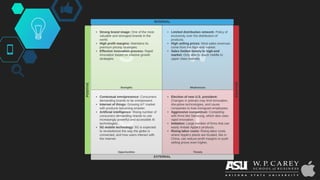
and Company Analysis2
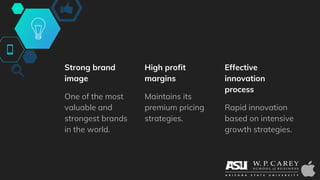
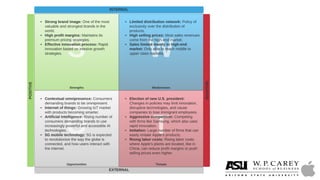
Strong brand
image
One of the most
valuable and
strongest brands
in the world.
High profit
margins
Maintains its
premium pricing
strategies.
Effective
innovation
process
Rapid innovation
based on intensive
growth strategies.
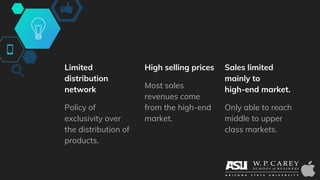
Limited
distribution
network
Policy of
exclusivity over
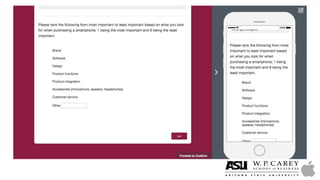
the distribution of
products.
High selling prices
Most sales
revenues come
from the high-end
market.
Sales limited
mainly to
high-end market.
Only able to reach
middle to upper
class markets.
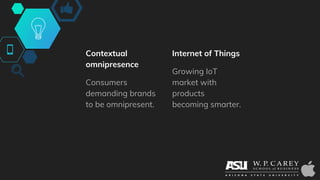
Contextual
omnipresence
Consumers
demanding brands
to be omnipresent.
Internet of Things
Growing IoT
market with
products
becoming smarter.
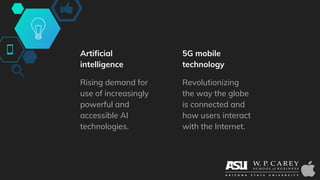
5G mobile
technology
Revolutionizing
the way the globe
is connected and
how users interact
with the Internet.
Artificial
intelligence
Rising demand for
use of increasingly
powerful and
accessible AI
technologies.
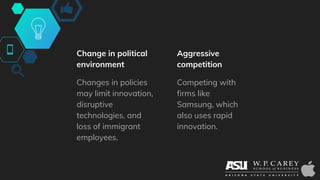
Aggressive
competition
Competing with
firms like
Samsung, which
also uses rapid
innovation.
Change in political
environment
Changes in policies
may limit innovation,
disruptive
technologies, and
loss of immigrant
employees.
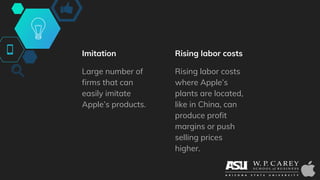
Imitation
Large number of
firms that can
easily imitate
Apple’s products.
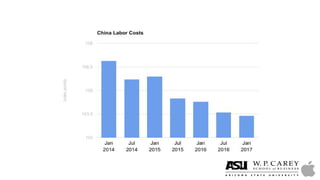
Rising labor costs
Rising labor costs
where Apple’s
plants are located,
like in China, can
produce profit
margins or push
selling prices
higher.
iPhone’s 10th
year
anniversary
2017 marks the
10th
year
anniversary of the
iPhone.
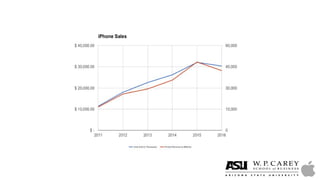
Sales are going
down
For the first time in
15 years, Apple’s
revenue has been
declining.
Market Volume is
growing
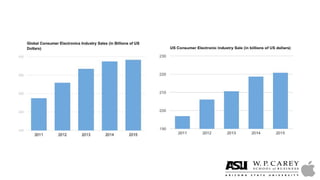
In 2017, the
predicted CE
market volume is
$81.6 billion.
iPhone’s 10th
year
anniversary
2017 marks the
10th
year
anniversary of the
iPhone.
Sales are going
down
For the first time in
15 years, Apple’s
revenue has been
declining.
Market Volume is
growing
In 2017, the
predicted CE
market volume is
$81.6 billion.
Problem Definition3
Managerial Questions
Should Apple
investigate moving
the company
outside of the
United States?
Why have product
sales decreased in
the past year?
Should Apple shift
its focus away
from shrinking
markets, such as
tablets, and focus
more on growing
markets such as
services?
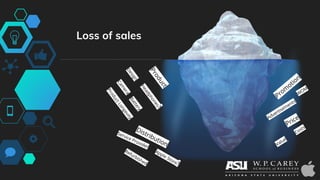
Loss of sales
Prom
otion
Product
Price
Distribution
Design
Headphones?
Cam
era
Battery
ProductLongevity
Refurbished
Apple Store?
Service Provider
Advertisements
WOM
Value
Costs
Research Method4
We aim to discover
How preferences,
attitudes, and
intentions vary
based on
demographics.
Factors affecting
customer
satisfaction.
How many people
have switched to
and from the
iPhone and what
brand they switch
to or from.
How we conducted our research
Self-administered
sample survey.
Both structured
and unstructured
questions.
Designed using
Qualtrics Survey
Software.
Our study design:
Cross-sectional descriptive study
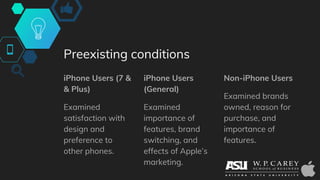
Preexisting conditions
iPhone Users (7 &
& Plus)
Examined
satisfaction with
design and
preference to
other phones.
iPhone Users
(General)
Examined
importance of
features, brand
switching, and
effects of Apple’s
marketing.
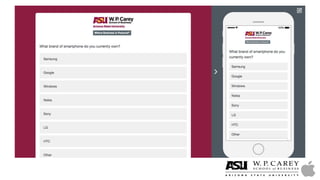
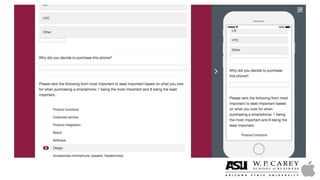
Non-iPhone Users
Examined brands
owned, reason for
purchase, and
importance of
features.
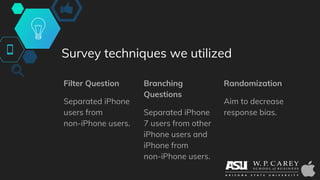
Survey techniques we utilized
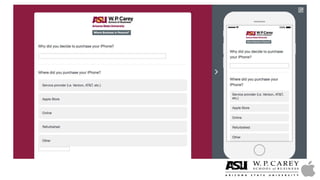
Filter Question
Separated iPhone
users from
non-iPhone users.
Branching
Questions
Separated iPhone
7 users from other
iPhone users and
iPhone from
non-iPhone users.
Randomization
Aim to decrease
response bias.
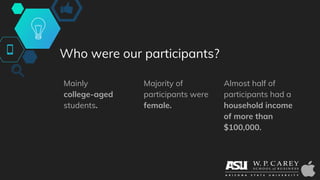
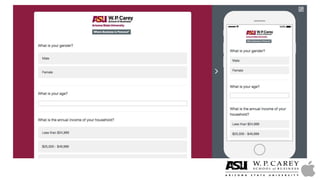
Who were our participants?
Mainly
college-aged
students.
Majority of
participants were
female.
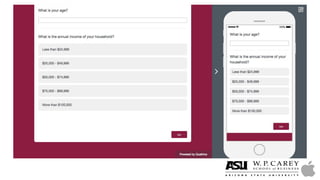
Almost half of
participants had a
household income
of more than
$100,000.
Findings5
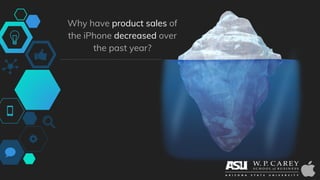
Why have product sales of
the iPhone decreased over
the past year?
We hypothesize that pricing strategy is the
cause of the iPhone’s loss of sales.
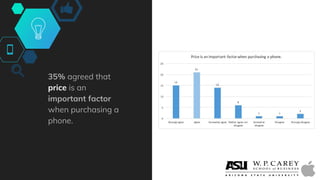
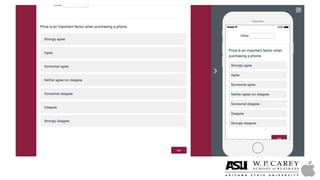
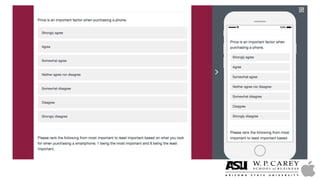
35% agreed that
price is an
important factor
when purchasing a
phone.
We hypothesize that product design is the
cause of the iPhone’s loss of sales.
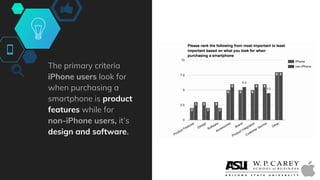
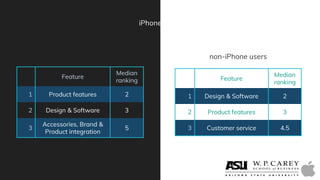
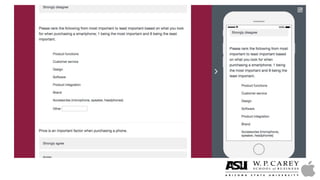
The primary criteria
iPhone users look for
when purchasing a
smartphone is product
features while for
non-iPhone users, it’s
design and software.
Feature
Median
ranking
1 Product features 2
2 Design & Software 3
3
Accessories, Brand &
Product integration
5
Feature
Median
ranking
1 Design & Software 2
2 Product features 3
3 Customer service 4.5
iPhone users
non-iPhone users
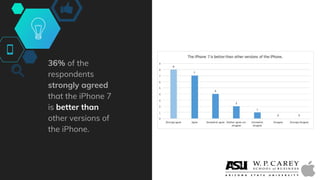
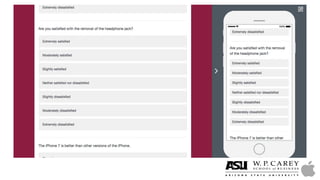
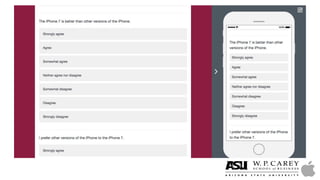
36% of the
respondents
strongly agreed
that the iPhone 7
is better than
other versions of
the iPhone.
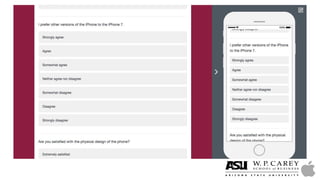
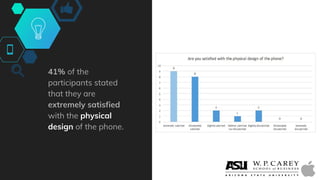
41% of the
participants stated
that they are
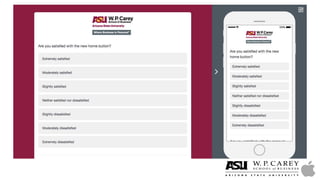
extremely satisfied
with the physical
design of the phone.
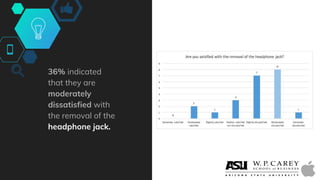
36% indicated
that they are
moderately
dissatisfied with
the removal of the
headphone jack.
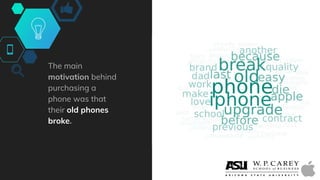
The main
motivation behind
purchasing a
phone was that
their old phones
broke.
We hypothesize that inefficient distribution
and ineffective targeting are the causes of
the iPhone’s loss of sales.
Is gender a significant indicator of
iPhone ownership?
65% of the people who own
an iPhone are female.
However, we found out that gender is not
a significant indicator of iPhone ownership
with a p-value of 0.5.
Is income a significant indicator of
iPhone ownership?
47.5% of the people who own an
iPhone earn more than $100,000 per
year.
However, we found out that income is not
a significant indicator of iPhone ownership
with a p-value of 0.75.
We hypothesize that ineffective promotion
is the cause of the iPhone’s loss of sales.
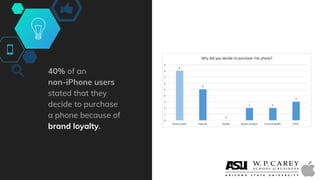
40% of an
non-iPhone users
stated that they
decide to purchase
a phone because of
brand loyalty.
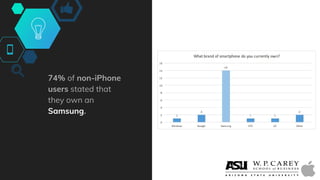
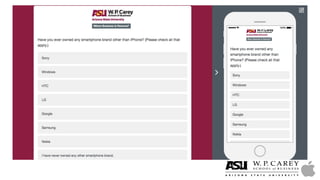
74% of non-iPhone
users stated that
they own an
Samsung.
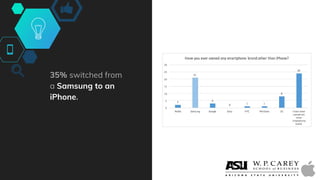
35% switched from
a Samsung to an
iPhone.
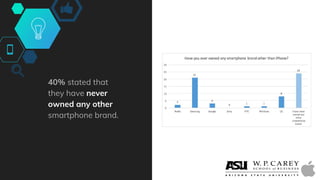
40% stated that
they have never
owned any other
smartphone brand.
Conclusions and
Recommendations6
Apple needs to do something..
Functionality
iOS operating
system versus
Android operating
system.
Price
Product value
must equal the
price, and it is
important in its
marketing mix.
Design
Design blunders
can shake
consumer loyalty.
But...
Targeting
Apple is targeting
the right market.
Promotion
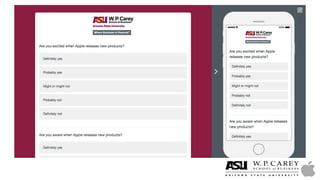
Consumers are
aware and excited
about Apple brand
products.
Scope and Limitation7
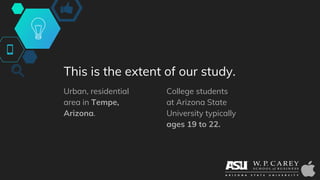
This is the extent of our study.
Urban, residential
area in Tempe,
Arizona.
College students
at Arizona State
University typically
ages 19 to 22.
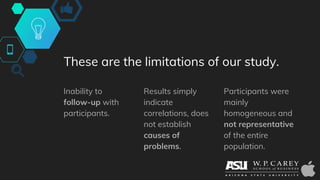
These are the limitations of our study.
Inability to
follow-up with
participants.
Results simply
indicate
correlations, does
not establish
causes of
problems.
Participants were
mainly
homogeneous and
not representative
of the entire
population.
Future Research7
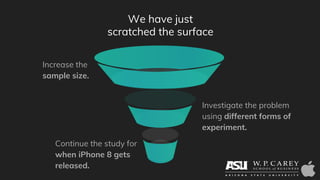
We have just
scratched the surface
Increase the
sample size.
Investigate the problem
using different forms of
experiment.
Continue the study for
when iPhone 8 gets
released.
Thanks!
Any questions?
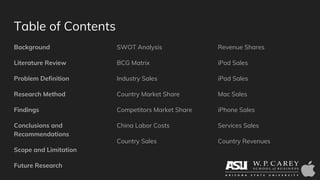
Background
Literature Review
Problem Definition
Research Method
Findings
Conclusions and
Recommendations
Scope and Limitation
Future Research
Table of Contents
SWOT Analysis
BCG Matrix
Industry Sales
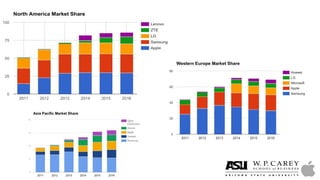
Country Market Share
Competitors Market Share
China Labor Costs
Country Sales
Revenue Shares
iPod Sales
iPad Sales
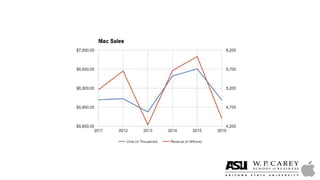
Mac Sales
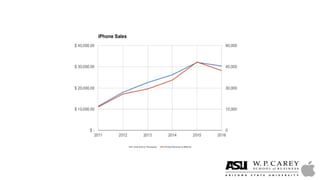
iPhone Sales
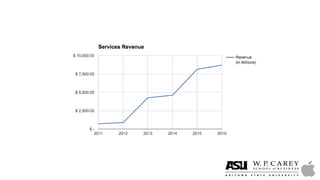
Services Sales
Country Revenues
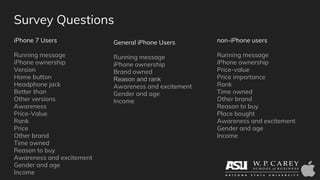
iPhone 7 Users
Running message
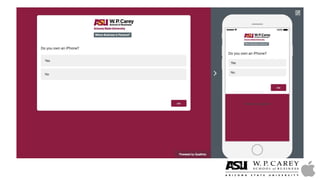
iPhone ownership
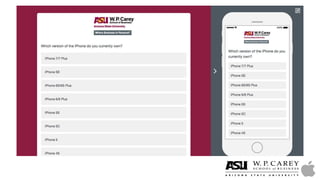
Version
Home button
Headphone jack
Better than
Other versions
Awareness
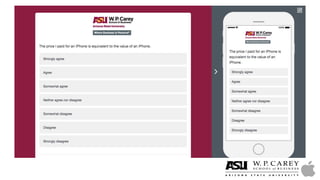
Price-Value
Rank
Price
Other brand
Time owned
Reason to buy
Awareness and excitement
Gender and age
Income
Survey Questions
General iPhone Users
Running message
iPhone ownership
Brand owned
Reason and rank
Awareness and excitement
Gender and age
Income
non-iPhone users
Running message
iPhone ownership
Price-value
Price importance
Rank
Time owned
Other brand
Reason to buy
Place bought
Awareness and excitement
Gender and age
Income
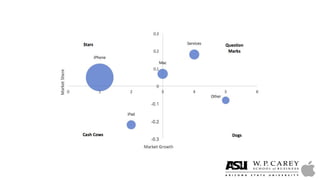
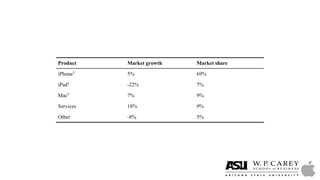
Product Market growth Market share
iPhone3
5% 69%
iPad3
-22% 7%
Mac3
7% 9%
Services 18% 9%
Other -8% 5%
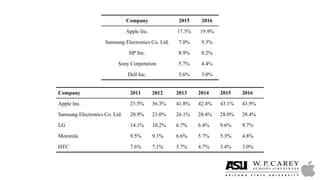
Company 2015 2016
Apple Inc. 17.3% 19.9%
Samsung Electronics Co. Ltd. 7.0% 9.3%
HP Inc. 8.9% 8.2%
Sony Corporation 5.7% 4.4%
Dell Inc. 3.6% 3.0%
Company 2011 2012 2013 2014 2015 2016
Apple Inc. 25.5% 36.3% 41.8% 42.4% 43.1% 43.9%
Samsung Electronics Co. Ltd. 20.9% 21.0% 26.1% 28.4% 28.0% 28.4%
LG 14.1% 10.2% 6.7% 6.4% 9.6% 9.7%
Motorola 9.5% 9.1% 6.6% 5.7% 5.3% 4.8%
HTC 7.6% 7.1% 5.7% 4.7% 3.4% 3.0%
Market Research on Apple

Market Research on Apple

  • 1.
  • 3.
  • 4.
    Apple Inc. isan American multinational technology company that designs, manufactures, and develops consumer electronics.
  • 5.
    Apple’s Sales in2016. $233000000000
  • 6.
  • 8.
    Strong brand image One ofthe most valuable and strongest brands in the world. High profit margins Maintains its premium pricing strategies. Effective innovation process Rapid innovation based on intensive growth strategies.
  • 9.
    Limited distribution network Policy of exclusivity over thedistribution of products. High selling prices Most sales revenues come from the high-end market. Sales limited mainly to high-end market. Only able to reach middle to upper class markets.
  • 10.
    Contextual omnipresence Consumers demanding brands to beomnipresent. Internet of Things Growing IoT market with products becoming smarter.
  • 11.
    5G mobile technology Revolutionizing the waythe globe is connected and how users interact with the Internet. Artificial intelligence Rising demand for use of increasingly powerful and accessible AI technologies.
  • 12.
    Aggressive competition Competing with firms like Samsung,which also uses rapid innovation. Change in political environment Changes in policies may limit innovation, disruptive technologies, and loss of immigrant employees.
  • 13.
    Imitation Large number of firmsthat can easily imitate Apple’s products. Rising labor costs Rising labor costs where Apple’s plants are located, like in China, can produce profit margins or push selling prices higher.
  • 14.
    iPhone’s 10th year anniversary 2017 marksthe 10th year anniversary of the iPhone. Sales are going down For the first time in 15 years, Apple’s revenue has been declining. Market Volume is growing In 2017, the predicted CE market volume is $81.6 billion.
  • 15.
    iPhone’s 10th year anniversary 2017 marksthe 10th year anniversary of the iPhone. Sales are going down For the first time in 15 years, Apple’s revenue has been declining. Market Volume is growing In 2017, the predicted CE market volume is $81.6 billion.
  • 16.
  • 17.
    Managerial Questions Should Apple investigatemoving the company outside of the United States? Why have product sales decreased in the past year? Should Apple shift its focus away from shrinking markets, such as tablets, and focus more on growing markets such as services?
  • 19.
  • 20.
  • 21.
    We aim todiscover How preferences, attitudes, and intentions vary based on demographics. Factors affecting customer satisfaction. How many people have switched to and from the iPhone and what brand they switch to or from.
  • 22.
    How we conductedour research Self-administered sample survey. Both structured and unstructured questions. Designed using Qualtrics Survey Software.
  • 23.
  • 24.
    Preexisting conditions iPhone Users(7 & & Plus) Examined satisfaction with design and preference to other phones. iPhone Users (General) Examined importance of features, brand switching, and effects of Apple’s marketing. Non-iPhone Users Examined brands owned, reason for purchase, and importance of features.
  • 25.
    Survey techniques weutilized Filter Question Separated iPhone users from non-iPhone users. Branching Questions Separated iPhone 7 users from other iPhone users and iPhone from non-iPhone users. Randomization Aim to decrease response bias.
  • 26.
    Who were ourparticipants? Mainly college-aged students. Majority of participants were female. Almost half of participants had a household income of more than $100,000.
  • 27.
  • 28.
    Why have productsales of the iPhone decreased over the past year?
  • 29.
    We hypothesize thatpricing strategy is the cause of the iPhone’s loss of sales.
  • 30.
    35% agreed that priceis an important factor when purchasing a phone.
  • 31.
    We hypothesize thatproduct design is the cause of the iPhone’s loss of sales.
  • 32.
    The primary criteria iPhoneusers look for when purchasing a smartphone is product features while for non-iPhone users, it’s design and software.
  • 33.
    Feature Median ranking 1 Product features2 2 Design & Software 3 3 Accessories, Brand & Product integration 5 Feature Median ranking 1 Design & Software 2 2 Product features 3 3 Customer service 4.5 iPhone users non-iPhone users
  • 34.
    36% of the respondents stronglyagreed that the iPhone 7 is better than other versions of the iPhone.
  • 35.
    41% of the participantsstated that they are extremely satisfied with the physical design of the phone.
  • 36.
    36% indicated that theyare moderately dissatisfied with the removal of the headphone jack.
  • 37.
    The main motivation behind purchasinga phone was that their old phones broke.
  • 38.
    We hypothesize thatinefficient distribution and ineffective targeting are the causes of the iPhone’s loss of sales.
  • 39.
    Is gender asignificant indicator of iPhone ownership? 65% of the people who own an iPhone are female.
  • 40.
    However, we foundout that gender is not a significant indicator of iPhone ownership with a p-value of 0.5.
  • 41.
    Is income asignificant indicator of iPhone ownership? 47.5% of the people who own an iPhone earn more than $100,000 per year.
  • 42.
    However, we foundout that income is not a significant indicator of iPhone ownership with a p-value of 0.75.
  • 43.
    We hypothesize thatineffective promotion is the cause of the iPhone’s loss of sales.
  • 44.
    40% of an non-iPhoneusers stated that they decide to purchase a phone because of brand loyalty.
  • 45.
    74% of non-iPhone usersstated that they own an Samsung.
  • 46.
    35% switched from aSamsung to an iPhone.
  • 47.
    40% stated that theyhave never owned any other smartphone brand.
  • 48.
  • 49.
    Apple needs todo something.. Functionality iOS operating system versus Android operating system. Price Product value must equal the price, and it is important in its marketing mix. Design Design blunders can shake consumer loyalty.
  • 50.
    But... Targeting Apple is targeting theright market. Promotion Consumers are aware and excited about Apple brand products.
  • 51.
  • 52.
    This is theextent of our study. Urban, residential area in Tempe, Arizona. College students at Arizona State University typically ages 19 to 22.
  • 53.
    These are thelimitations of our study. Inability to follow-up with participants. Results simply indicate correlations, does not establish causes of problems. Participants were mainly homogeneous and not representative of the entire population.
  • 54.
  • 55.
    We have just scratchedthe surface Increase the sample size. Investigate the problem using different forms of experiment. Continue the study for when iPhone 8 gets released.
  • 56.
  • 57.
    Background Literature Review Problem Definition ResearchMethod Findings Conclusions and Recommendations Scope and Limitation Future Research Table of Contents SWOT Analysis BCG Matrix Industry Sales Country Market Share Competitors Market Share China Labor Costs Country Sales Revenue Shares iPod Sales iPad Sales Mac Sales iPhone Sales Services Sales Country Revenues
  • 58.
    iPhone 7 Users Runningmessage iPhone ownership Version Home button Headphone jack Better than Other versions Awareness Price-Value Rank Price Other brand Time owned Reason to buy Awareness and excitement Gender and age Income Survey Questions General iPhone Users Running message iPhone ownership Brand owned Reason and rank Awareness and excitement Gender and age Income non-iPhone users Running message iPhone ownership Price-value Price importance Rank Time owned Other brand Reason to buy Place bought Awareness and excitement Gender and age Income
  • 61.
    Product Market growthMarket share iPhone3 5% 69% iPad3 -22% 7% Mac3 7% 9% Services 18% 9% Other -8% 5%
  • 64.
    Company 2015 2016 AppleInc. 17.3% 19.9% Samsung Electronics Co. Ltd. 7.0% 9.3% HP Inc. 8.9% 8.2% Sony Corporation 5.7% 4.4% Dell Inc. 3.6% 3.0% Company 2011 2012 2013 2014 2015 2016 Apple Inc. 25.5% 36.3% 41.8% 42.4% 43.1% 43.9% Samsung Electronics Co. Ltd. 20.9% 21.0% 26.1% 28.4% 28.0% 28.4% LG 14.1% 10.2% 6.7% 6.4% 9.6% 9.7% Motorola 9.5% 9.1% 6.6% 5.7% 5.3% 4.8% HTC 7.6% 7.1% 5.7% 4.7% 3.4% 3.0%