Good Afternoon
Folks
Good Afternoon
Folks!1
Treatment Plan
Dr.Abhishek Gaur
BDS, MDS, (Ph. D)
Department of Periodontist
R. R. Dental College & Hospital
Umrada, Udaipur (RAJ.)
Introduction
• Treatment Plan is a blueprint for case management.
• Treatment is planned after diagnosis & prognosis
established.
• Includes all procedures required for establishment &
maintenance of oral health.
Treatment Plan
is
Based On :
1. Diagnosis
2. Disease severity
3. Desirable therapeutic end
Long Term
Goals
Short Term
Goals
Goals of Treatment Plan
Reconstruction of a healthy dentition that fulfils all
functional and esthetic requirements.
Long term planning involves consideration of prosthetic
reconstruction, which may require implant therapy.
Also the need for orthodontic treatment should be evaluated.
Goals of Treatment PlanGoals of Treatment Plan
Master Plan
for
Treatment Plan
Master Plan
for
Treatment Plan
Master Plan for Treatment Plan
The aim of the treatment plan is total
treatment, i.e., the coordination of
all the short- and long-term goals for
the purpose of creating a well
functioning dentition in a healthy
periodontal environment.
• Need for emergency treatment (pain, acute infections).
• Teeth that will require removal.
• Periodontal pocket therapy techniques (surgical or nonsurgical).
• Endodontic therapy.
• The need for occlusal correction, including orthodontic therapy.
• The use of implant therapy.
• The need for caries removal and the placement of temporary and
final restorations.
• Prosthetic replacements that may be needed and which teeth will
be abutments if a fixed prosthesis is used.
• Decisions regarding esthetic considerations in periodontal therapy.
It Includes all procedures required for
the establishment & maintenance of
oral Health & involves the decisions :
Extracting
or
Preserving
a Tooth ?
Extracting
or
Preserving
a Tooth ?
“Treatment is directed to establishing and maintaining the
health of the periodontium throughout the mouth rather
than attempting spectacular efforts to “tighten loose teeth.”
Carranza’s Clinical Periodontology, 11th Edition
• Therefore attempts to save questionable teeth may jeopardize
adjacent teeth and may lead to the loss of bone needed for
implant therapy.
• Teeth on the borderline of a hopeless prognosis do not
contribute to the overall usefulness of the dentition.
• Such teeth become sources of recurrent problem to the patient.
A tooth should be extracted
under the following
conditions :
1. It is so mobile that function becomes painful.
2. It can cause acute abscesses during therapy.
3. There is no use for it in the overall treatment plan.
A tooth should be extracted
under the following
conditions :
A tooth can be retained under the
following conditions :
1.It maintains posterior stops and may be functional after
implant placement in adjacent areas.
2.When the implant is restored, these teeth can be extracted.
3.In the anterior esthetic zone, a tooth can be retained
during periodontal therapy and removed when treatment is
completed and a permanent restorative procedure can be
performed.
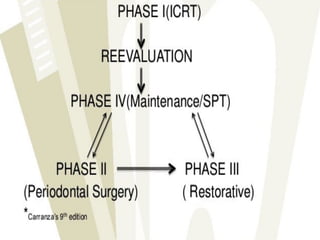
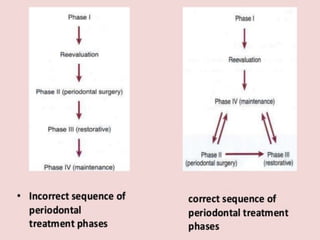
Phases
Of
Periodontal Therapy
Phases
Of
Periodontal Therapy
Patients must understand the purpose of the
maintenance program, and the dentist must
emphasise that preservation of the teeth
depends on maintenance therapy.
• Inadequate plaque control.
• Incomplete sub-gingival plaque removal.
• Bacteria are present in the gingival tissues in
chronic and aggressive periodontitis cases.
• Bacteria transmitted between spouses and other
family members.
• Microscopic nature of the dentogingival unit
healing after periodontal treatment
Rationale for Maintenance Therapy
To prevent the progression and
recurrence of periodontal disease
in patients who have previously
been treated for gingivitis and
periodontitis
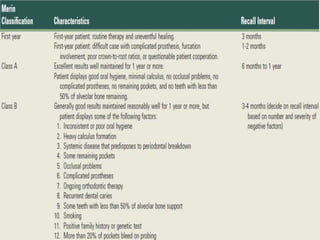
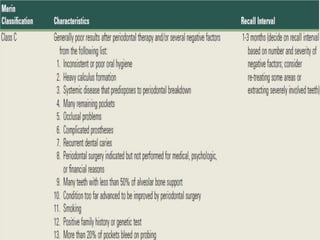
Merin’s Classification
for
Recall Intervals
Treatment Plan
Treatment Plan
Treatment Plan

Treatment Plan

  • 1.
  • 2.
    Treatment Plan Dr.Abhishek Gaur BDS,MDS, (Ph. D) Department of Periodontist R. R. Dental College & Hospital Umrada, Udaipur (RAJ.)
  • 3.
    Introduction • Treatment Planis a blueprint for case management. • Treatment is planned after diagnosis & prognosis established. • Includes all procedures required for establishment & maintenance of oral health.
  • 4.
    Treatment Plan is Based On: 1. Diagnosis 2. Disease severity 3. Desirable therapeutic end
  • 5.
  • 6.
    Reconstruction of ahealthy dentition that fulfils all functional and esthetic requirements. Long term planning involves consideration of prosthetic reconstruction, which may require implant therapy. Also the need for orthodontic treatment should be evaluated. Goals of Treatment PlanGoals of Treatment Plan
  • 7.
  • 8.
    Master Plan forTreatment Plan The aim of the treatment plan is total treatment, i.e., the coordination of all the short- and long-term goals for the purpose of creating a well functioning dentition in a healthy periodontal environment.
  • 9.
    • Need foremergency treatment (pain, acute infections). • Teeth that will require removal. • Periodontal pocket therapy techniques (surgical or nonsurgical). • Endodontic therapy. • The need for occlusal correction, including orthodontic therapy. • The use of implant therapy. • The need for caries removal and the placement of temporary and final restorations. • Prosthetic replacements that may be needed and which teeth will be abutments if a fixed prosthesis is used. • Decisions regarding esthetic considerations in periodontal therapy. It Includes all procedures required for the establishment & maintenance of oral Health & involves the decisions :
  • 10.
  • 12.
    “Treatment is directedto establishing and maintaining the health of the periodontium throughout the mouth rather than attempting spectacular efforts to “tighten loose teeth.” Carranza’s Clinical Periodontology, 11th Edition • Therefore attempts to save questionable teeth may jeopardize adjacent teeth and may lead to the loss of bone needed for implant therapy. • Teeth on the borderline of a hopeless prognosis do not contribute to the overall usefulness of the dentition. • Such teeth become sources of recurrent problem to the patient.
  • 13.
    A tooth shouldbe extracted under the following conditions : 1. It is so mobile that function becomes painful. 2. It can cause acute abscesses during therapy. 3. There is no use for it in the overall treatment plan. A tooth should be extracted under the following conditions :
  • 14.
    A tooth canbe retained under the following conditions : 1.It maintains posterior stops and may be functional after implant placement in adjacent areas. 2.When the implant is restored, these teeth can be extracted. 3.In the anterior esthetic zone, a tooth can be retained during periodontal therapy and removed when treatment is completed and a permanent restorative procedure can be performed.
  • 15.
  • 19.
    Patients must understandthe purpose of the maintenance program, and the dentist must emphasise that preservation of the teeth depends on maintenance therapy.
  • 20.
    • Inadequate plaquecontrol. • Incomplete sub-gingival plaque removal. • Bacteria are present in the gingival tissues in chronic and aggressive periodontitis cases. • Bacteria transmitted between spouses and other family members. • Microscopic nature of the dentogingival unit healing after periodontal treatment Rationale for Maintenance Therapy
  • 21.
    To prevent theprogression and recurrence of periodontal disease in patients who have previously been treated for gingivitis and periodontitis
  • 22.