Trauma Resuscitation in
Emergency Department
DR SURESH NAIDU
Friday, May 18, 2018 1
Trauma Resuscitation in Emergency Department
It was 1.00 a.m. and raining heavily
….it was dull day in ED….
Red zone is empty…
And then ……
Friday, May 18, 2018 2
Trauma Resuscitation in Emergency Department
It was 1.00 a.m. and raining
heavily
….it was dull day in ED….
Red zone is empty…
You are on your Facebook
….surfing emergency medicine
sites
Friday, May 18, 2018 3
Trauma Resuscitation in Emergency Department
Doctor , there is a MVA car vs lorry
near Sungai Dua toll ,
2 victims , one has severe facial injury
and poor conscious level, while another
is alert, but complain of difficulty in
breathing and abdominal pain
ETA 10 MINUTES.
Friday, May 18, 2018 4
Trauma Resuscitation in Emergency Department
Friday, May 18, 2018 5
Trauma Resuscitation in Emergency Department
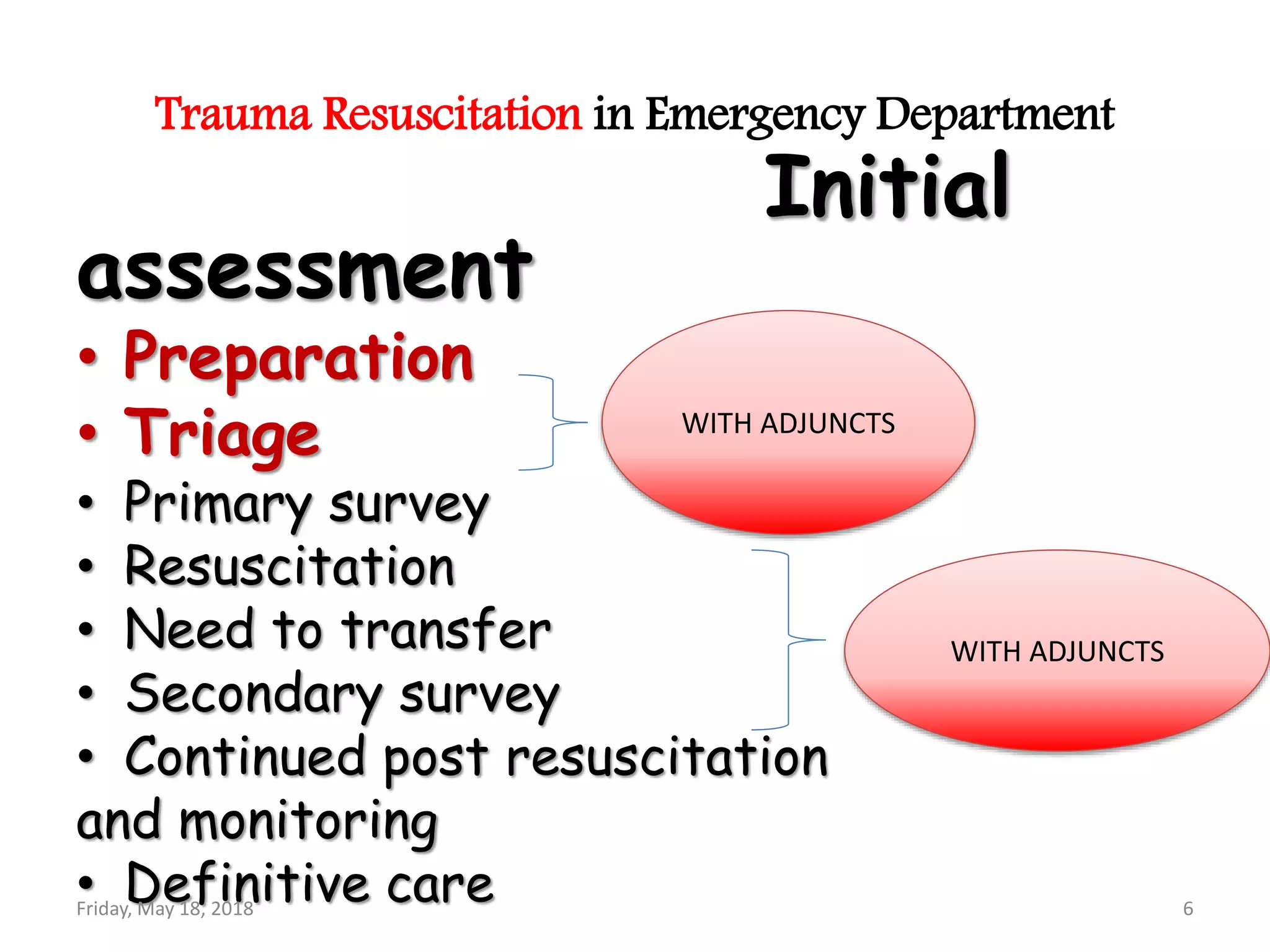
Initial
assessment
• Preparation
• Triage
• Primary survey
• Resuscitation
• Need to transfer
• Secondary survey
• Continued post resuscitation
and monitoring
• Definitive careFriday, May 18, 2018 6
WITH ADJUNCTS
WITH ADJUNCTS
Trauma Resuscitation in Emergency Department
Preparation and triage
People
Place
Equipment
Drugs
Friday, May 18, 2018 7
Trauma Resuscitation in Emergency Department
CASE 1
57 year old with laceration over chin,
bleeding from mouth and nose.
Orophyrangeal airway is in place, and the
paramedics are ambubagging him….with
each bagging blood oozed out of his
deformed nostrils
BP= 170/100
HR= 120/min
SpO=85% on manual bagging
Friday, May 18, 2018 8
Trauma Resuscitation in Emergency Department
CASE 2
30 years old ,restless and agitated
tachypneic,
BP=80/44
HR=140/min
Spo2=80% on HFMO2
Friday, May 18, 2018 9
Trauma Resuscitation in Emergency Department
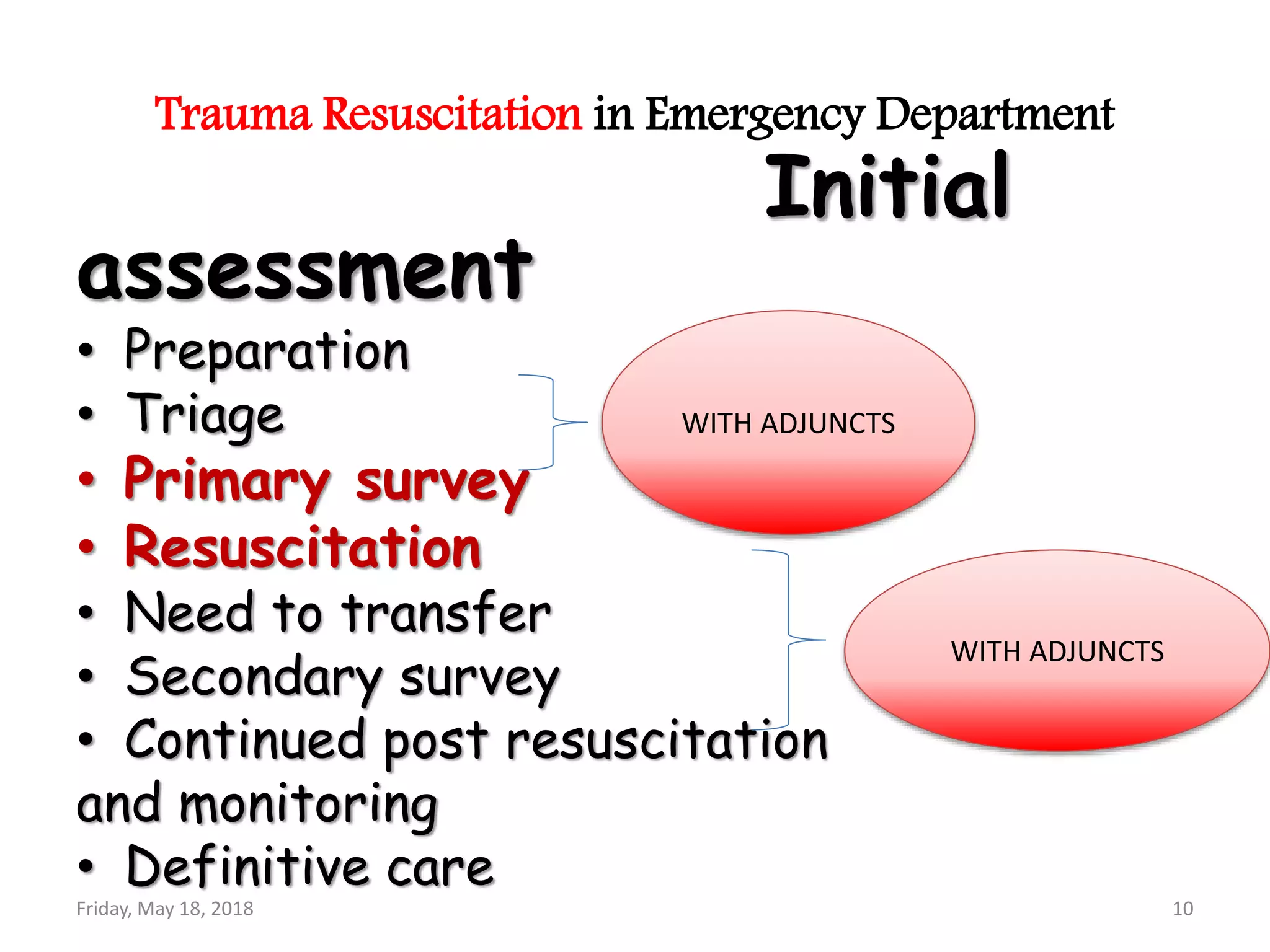
Initial
assessment
• Preparation
• Triage
• Primary survey
• Resuscitation
• Need to transfer
• Secondary survey
• Continued post resuscitation
and monitoring
• Definitive care
Friday, May 18, 2018 10
WITH ADJUNCTS
WITH ADJUNCTS
Trauma Resuscitation in Emergency Department
PRIMARY SURVEY
A-Airway with cervical control
B-Breathing and ventilation
C-Circulation with hemorrhage control
D-Disability: Neurologic status
E-Exposure/Environmental control
Friday, May 18, 2018 11
Trauma Resuscitation in Emergency Department
PRIMARY SURVEY -A
Objective signs of airway compromise
1. Patient agitated, abusive or
obtunded, cyanotic , or maybe even
be pale
2. Abnormal breathing sounds.
3. Location of trachea
4. Use of accessory respiratory muscles
Friday, May 18, 2018 12
Trauma Resuscitation in Emergency Department
PRIMARY SURVEY -B
Objective signs of inadequate
ventilation
1. Look for symmetrical chest rise and
fall
2. Look for signs for difficulty of
breathing
3. Listen for movement of air both side
of chest.
3. Use of pulse oximeter.
Friday, May 18, 2018 13
Trauma Resuscitation in Emergency Department
PRIMARY SURVEY -A and B -AIRWAY and VENTILATION MANAGEMENT
VENTILATION
PROBLEM
NPO2/Facemask
oxygen
Ambubag
Non invasive
ventilation
Needle
thoracocentesis
Finger thoracotomy
Chest tube
AIRWAY
MAINTAINENCE
Chin lift/jaw thrust
Orophyrangeal airway
Nasopharyngeal
airway
Supraglottic airway
Endotracheal tube
Surgical airway
Friday, May 18, 2018 14
Trauma Resuscitation in Emergency Department
PRIMARY SURVEY
A-Airway assessment and maintenance:
Need for Definitive
airway
A –impending airway obstruction
B –Respiratory insufficiency due to a
large pulmonary contusion, flail chest,
or other thoracic injury.
C –multisystem trauma with shock
D –Reduced GCS (especially <8).
Friday, May 18, 2018 15
Trauma Resuscitation in Emergency Department
PRIMARY SURVEY -A and B -AIRWAY and VENTILATION MANAGEMENT
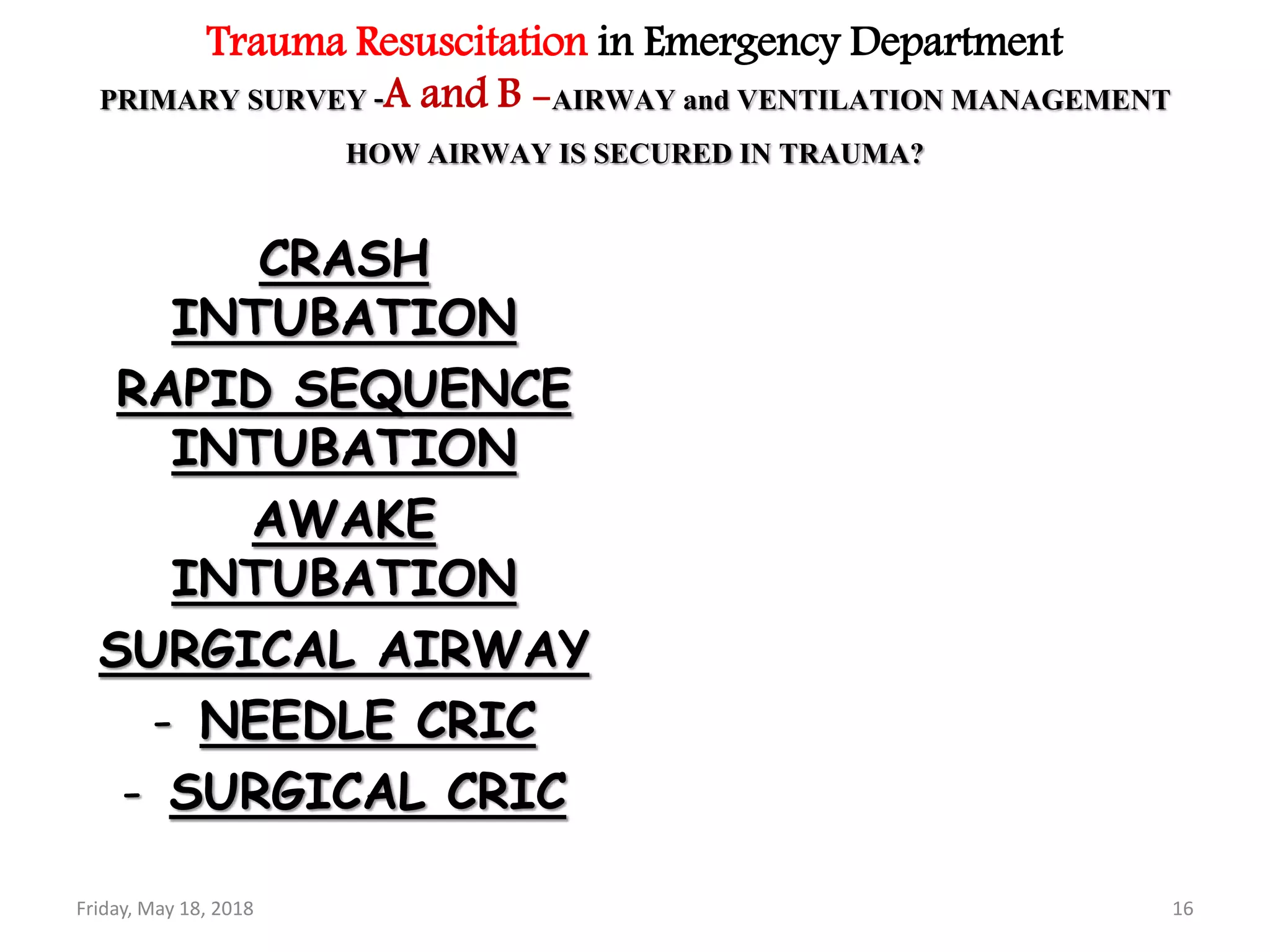
HOW AIRWAY IS SECURED IN TRAUMA?
CRASH
INTUBATION
RAPID SEQUENCE
INTUBATION
AWAKE
INTUBATION
SURGICAL AIRWAY
- NEEDLE CRIC
- SURGICAL CRIC
Friday, May 18, 2018 16
Trauma Resuscitation in Emergency Department
PRIMARY SURVEY -A and B -AIRWAY and VENTILATION MANAGEMENT
PREDICTOR OF DIFFICULT
INTUBATION
LEMON
• LOOK EXTERNALLY
• EVALUATE 3-3-2
RULE
• MALLAPATI
• OBSTRUCTION
• NECK MOBILITY
PREDICTOR OF DIFFICULT
VENTILATION
MOANS
• Mask seal
• Obesity
• Aged
• No teeth
• Stiffness
(resistance to
ventilation)
Friday, May 18, 2018 17
Trauma Resuscitation in Emergency Department
PRIMARY SURVEY -A and B -AIRWAY and VENTILATION MANAGEMENT
Friday, May 18, 2018 18
PREOXYGENATION
ABLE TO PREOXYGENATE DEFINITIVE AIRWAY/SURGICAL AIRWAY
ASSESS AIRWAY ANATOMY DIFFICULT
Call for
assistance
Intubation +/- drugs/cricoid pressure
Consider airway adjuncts
Definitive airway/surgical airway
PREPARATION
Trauma Resuscitation in Emergency Department
PRIMARY SURVEY
ATOM-FC
(thoracic trauma)
• Airway obstruction or disruption
• Tension pneumothorax
• Open pneumothorax
• Massive haemothorax
• Flail chest
• Cardiac tamponade
Friday, May 18, 2018 19
Trauma Resuscitation in Emergency Department
PRIMARY SURVEY
ATOM-FC
(thoracic trauma)
• Airway obstruction or disruption (A)
• Tension pneumothorax (B/C>A)
• Open pneumothorax (B/A>C)
• Massive haemothorax (B/C>A)
• Flail chest (B>A)
• Cardiac tamponade (C>A/B)
Friday, May 18, 2018 20
Trauma Resuscitation in Emergency Department
PRIMARY SURVEY
A-Airway with cervical control
B-Breathing and ventilation
C-Circulation with hemorrhage control
D-Disability: Neurologic status
E-Exposure/Environmental control
Friday, May 18, 2018 21
Trauma Resuscitation in Emergency Department
PRIMARY SURVEY- C- SHOCK
Friday, May 18, 2018 22
HEAMORRAGIC
OBSTRUCTIVECARDIOGENIC
DISTRIBUTIVE
Shock in trauma is
hemorrhagic unless
proven otherwise
Trauma Resuscitation in Emergency Department
PRIMARY SURVEY- C- SHOCK
ASSESSMENT OF SHOCK
Look, Touch and Pulse
Blood Pressure
Spo2
Urine output
Ultrasonography
X ray
Blood investigation
Friday, May 18, 2018 23
Trauma Resuscitation in Emergency Department
PRIMARY SURVEY- C- SHOCK
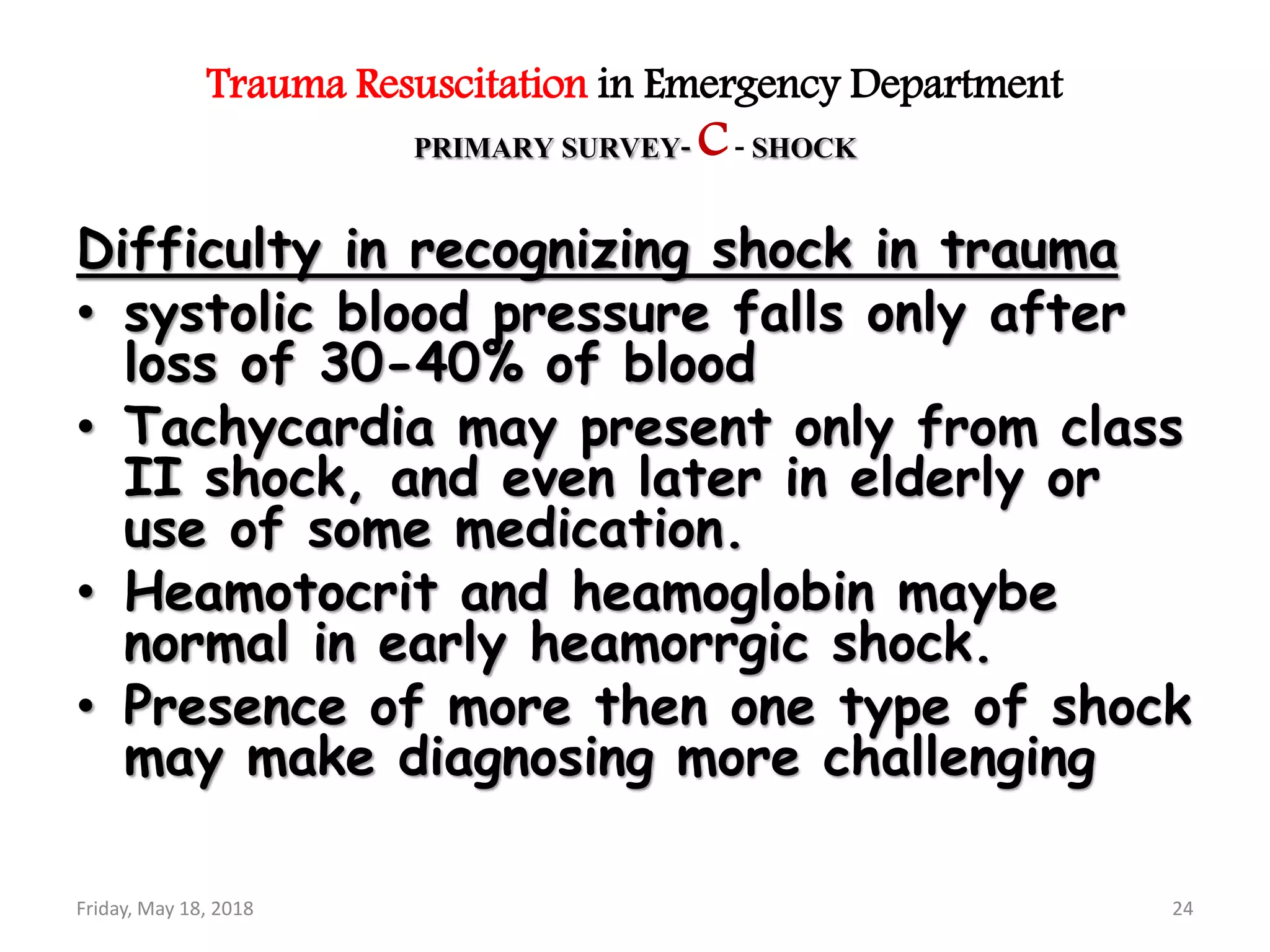
Difficulty in recognizing shock in trauma
• systolic blood pressure falls only after
loss of 30-40% of blood
• Tachycardia may present only from class
II shock, and even later in elderly or
use of some medication.
• Heamotocrit and heamoglobin maybe
normal in early heamorrgic shock.
• Presence of more then one type of shock
may make diagnosing more challenging
Friday, May 18, 2018 24
Trauma Resuscitation in Emergency Department
PRIMARY SURVEY- C- SHOCK
6 regions which may account for major
blood loss:
‘Street': scalp and external sources
(especially small children)
Chest
Abdomen
Long bones (especially femurs)
Pelvis
Retroperitoneum
Friday, May 18, 2018 25
Trauma Resuscitation in Emergency Department
PRIMARY SURVEY- C- SHOCK
ASSESSMENT OF SHOCK
Friday, May 18, 2018 26
Trauma Resuscitation in Emergency Department
PRIMARY SURVEY- C- SHOCK
ASSESSMENT OF SHOCK
Friday, May 18, 2018 27
?
Trauma Resuscitation in Emergency Department
PRIMARY SURVEY- C– SHOCK
Goal of hemorrhagic shock management
• “FIND the bleeding, STOP the
bleeding”
• Rapid and effective restoration of
blood volume
• Maintain functional blood composition
to preserve blood function:—
hemostasis, oxygen carrying capacity,
oncotic pressure and biochemistry
Friday, May 18, 2018 28
Trauma Resuscitation in Emergency Department
PRIMARY SURVEY- C– SHOCK
Approach to hemorrhage control
Friday, May 18, 2018 29
INVASIVE MEASURES
Sutures Tamponade Packing Cautery
Interventional
surgery
DCR
INITIAL MEASURES
Direct pressure& elevation
Adrenaline gauze, hemostatic
dressing
Reduce, Splinting , tourniquet
GET HELP & FIND CAUSE
Trauma Resuscitation in Emergency Department
PRIMARY SURVEY- C– SHOCK
Approach to hemorrhagic shock management-volume
restoration.
Friday, May 18, 2018 30
1-2 L crystalloid run fast…
• dilutional coagulopathy
• impaired oxygen delivery due to
dilutional anaemia
• hypothermia
• worsening metabolic acidosis
• clot dislodgement and haemorrhage
from blood pressure elevation
Trauma Resuscitation in Emergency Department
PRIMARY SURVEY- C– SHOCK
Approach to hemorrhagic shock management-volume
restoration.
Friday, May 18, 2018 31
2 L crystalloid
run fast…
Trauma Resuscitation in Emergency Department
PRIMARY SURVEY- C– SHOCK
Approach to hemorrhagic shock management-volume
restoration.
Friday, May 18, 2018 32
Trauma Resuscitation in Emergency Department
PRIMARY SURVEY- C– SHOCK
Approach to hemorrhagic shock management-volume
restoration.
Friday, May 18, 2018 33
Trauma Resuscitation in Emergency Department
PRIMARY SURVEY- C– SHOCK
Approach to hemorrhagic shock management-volume
restoration.
Friday, May 18, 2018 34
Damage Control Resuscitation
Permissive hypotension( minimal
normotension)
Early Hemostatic resuscitation
Damage control surgery
Trauma Resuscitation in Emergency Department
PRIMARY SURVEY- C– SHOCK
Approach to hemorrhagic shock management-volume
restoration.
Friday, May 18, 2018 35
Damage Control Resuscitation
Permissive hypotension( minimal
normotension)
TARGET MAP > 65mmHg
TARGET MAP > 90mmHg if head injury
Trauma Resuscitation in Emergency Department
PRIMARY SURVEY- C– SHOCK
Approach to hemorrhagic shock management-volume
restoration.
Friday, May 18, 2018 36
Damage Control Resuscitation
Early Hemostatic resuscitation
Minimise crystalloids
Early blood products
Activate massive transfusion protocol if needed
Iv tranexamic acid
Recombinant Factor VIIa
Calcium
Prevent hypothermia
Trauma Resuscitation in Emergency Department
PRIMARY SURVEY- C– SHOCK
Approach to hemorrhagic shock management-volume
restoration.
Friday, May 18, 2018 37
Damage Control Resuscitation
Permissive hypotension( minimal
normotension)
Early Hemostatic resuscitation
Damage control surgery
Trauma Resuscitation in Emergency Department
PRIMARY SURVEY
A-Airway with cervical control
B-Breathing and ventilation
C-Circulation with hemorrhage control
D-Disability: Neurologic status
E-Exposure/Environmental control
Friday, May 18, 2018 38
Trauma Resuscitation in Emergency Department
PRIMARY SURVEY- D –DISABILITY
ASSESMENT
Friday, May 18, 2018 39
• Assess GCS
• Assess pupillary size and responsiveness
• Assess gross motor and sensory function in all
4 limbs
• If you suspect a spinal injury is present a full
neurological assessment is vital at the earliest
opportunity — check for priapism, loss of anal
sphincter tone and the bulbocavernosus
reflex
• Check glucose
Trauma Resuscitation in Emergency Department
PRIMARY SURVEY- D –DISABILITY
MANAGEMENT
Friday, May 18, 2018 40
• Airway maintenance
• Seizure control
• Treat hypoglycemia
• Anxiety or agitation
• Treat raised intracranial pressure
Trauma Resuscitation in Emergency Department
PRIMARY SURVEY- E–EXPOSURE&ENVIROMENT
Friday, May 18, 2018 41
EXPOSE PATIENT BUT MAINTAIN
THERMOSTASIS
If not yet done, consider log-rolling the patient now
Areas where potentially life threating injuries can
be missed are:
• Back of head
• Back
• Buttocks
• Perineum
• Axillae
• Skin folds
Trauma Resuscitation in Emergency Department
Initial
assessment
• Preparation
• Triage
• Primary survey
• Resuscitation
• Need to transfer
• Secondary survey
• Continued post resuscitation
and monitoring
• Definitive care
Friday, May 18, 2018 42
WITH ADJUNCTS
WITH ADJUNCTS
Trauma Resuscitation in Emergency Department
PRIMARY SURVEY-ADJUNCTS
Friday, May 18, 2018 43
ABG, LAB WORK UP
ETCO2
ECG/CARDIAC MONITAR
CXR&PELVIC XRAY
ULTRASOUND (EFAST)
DPL
CBD, NG TUBE
Trauma Resuscitation in Emergency Department
Initial
assessment
• Preparation
• Triage
• Primary survey
• Resuscitation
• Need to transfer
• Secondary survey
• Continued post resuscitation
and monitoring
• Definitive care
Friday, May 18, 2018 44
WITH ADJUNCTS
WITH ADJUNCTS
Trauma Resuscitation in Emergency Department
Initial
assessment
• Preparation
• Triage
• Primary survey
• Resuscitation
• Need to transfer
• Secondary survey
• Continued post resuscitation
and monitoring
• Definitive care
Friday, May 18, 2018 45
WITH ADJUNCTS
WITH ADJUNCTS
Trauma Resuscitation in Emergency Department
SECONDARY SURVEY
Friday, May 18, 2018 46
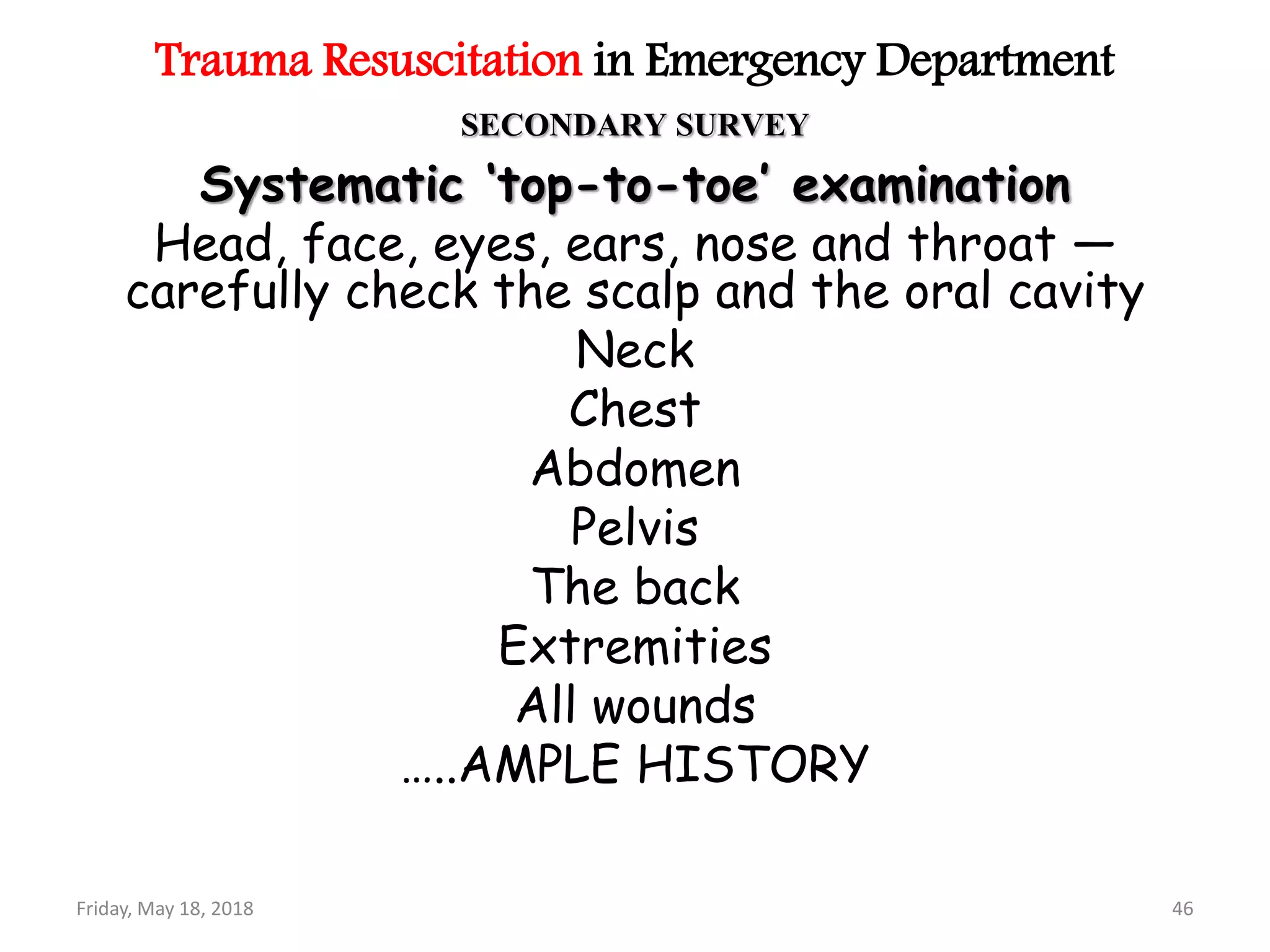
Systematic ‘top-to-toe’ examination
Head, face, eyes, ears, nose and throat —
carefully check the scalp and the oral cavity
Neck
Chest
Abdomen
Pelvis
The back
Extremities
All wounds
…..AMPLE HISTORY
Trauma Resuscitation in Emergency Department
SECONDARY SURVEY
ATOM-FC
(thoracic trauma)
• Aortic injury
• Thorax injuries ( haemothorax,
pneumothorax)
• Oesphageal perforation
• Muscular diaphragmatic injury
• Fistula (bronchopleural) and other
tracheobronchial injury
• Contusion to the heart or lungsFriday, May 18, 2018 47
Trauma Resuscitation in Emergency Department
SECONDARY SURVEY-ADJUNCTS
Friday, May 18, 2018 48
Remaining xray
Ct scan
Angiography
Contrast urography bronchoscophy
Esophagoscophy
Transsophageal ultrasound
Doppler
Trauma Resuscitation in Emergency Department
Initial
assessment
• Preparation
• Triage
• Primary survey
• Resuscitation
• Need to transfer
• Secondary survey
• Continued post resuscitation
and monitoring
• Definitive care
Friday, May 18, 2018 49
WITH ADJUNCTS
WITH ADJUNCTS
Trauma Resuscitation in Emergency Department
CASE 1
57 year old with laceration over chin,
bleeding from mouth and nose.
Orophyrangeal airway is in place, and the
paramedics are ambubagging him….with
each bagging blood oozed out of his
deformed nostrils
BP= 170/100
HR= 120/min
SpO=85% on manual bagging
Friday, May 18, 2018 50
Trauma Resuscitation in Emergency Department
CASE 1
You decided to take over airway, but
used RSI, BUT FAILED despite
attempting with bougie and McCoy. You
called for help , meanwhile placing a
supraglottic device(SPO2 at 80-85%
while bagging)
A senior colleague took over , and
finally managed to secured airway by
surgicalFriday, May 18, 2018 51
Trauma Resuscitation in Emergency Department
CASE 1
Patient was transfered to Seberang
Jaya Hospital for CT scan and you don’t
think patient will be send back to your
hospital
Friday, May 18, 2018 52
Trauma Resuscitation in Emergency Department
CASE 2
30 years old ,restless and agitated
tachypneic,
BP=80/44
HR=140/min
Spo2=80% on HFMO2
Friday, May 18, 2018 53
Trauma Resuscitation in Emergency Department
CASE 2A
You found patient had distended neck
veins, tracheal shift to right, absent
breath sounds on his left side . You
noticed bruise on left side with limited
chest movement. There is crepitation on
palpation.
Friday, May 18, 2018 54
Trauma Resuscitation in Emergency Department
CASE 2A
You diagnosed tension pneumothorax and
performed finger thoracotomy while
waiting chest tube getting prepared.
Meanwhile your colleague secured
airway by means of RSI as there is so
much subcutaneus emphysema upto
neck. Intubation was successful in
single attempt. Chest tube was inserted
soon after….Friday, May 18, 2018 55
Trauma Resuscitation in Emergency Department
CASE 2A
Iv Hartman was in progress , spo2
picked up to 100%, Patient remained
hypotensive and tachycardia. YOU
ordered “emergency o” and performed
E-FAST
You noticed gross free fluid in Morrison
pouch and perisplenic space. Others
areas are normal finding.
Friday, May 18, 2018 56
Trauma Resuscitation in Emergency Department
CASE 2B
You found patient had distended neck
veins, tracheal shift to left, absent
breath sounds on his right side . You
noticed bruise on right side with limited
chest movement.
Friday, May 18, 2018 57
Trauma Resuscitation in Emergency Department
CASE 2B
You diagnosed tension pneumothorax and
performed finger thoracotomy while
waiting chest tube getting prepared. A
gush of blood splattered on your
apron…and it seems unstoppable.
Your colleague secured airway by means of
RSI. Intubation was successful in a single
attempt. Chest tube was inserted within
Seconds.
Friday, May 18, 2018 58
Trauma Resuscitation in Emergency Department
CASE 2A
Iv Hartman was in progress , spo2
picked up to 100%, Patient remained
hypotensive and tachycardia. YOU
ordered “emergency o” and performed
E-FAST
You noticed gross free fluid in Morrison
pouch
Friday, May 18, 2018 59
Trauma Resuscitation in Emergency Department
CASE 2B
Iv Hartman and normal saline was in
progress in each arm, EMERGENCY O
on the way. Chest tube inserted ,
drains about a litre of blood(excluding
on your apron and floor). Spo2 remains
around 80% , BP=60/40mmHg. HR=140
to 150/min
And you performed ultrasound…
Friday, May 18, 2018 60
Trauma Resuscitation in Emergency Department
CASE 2B
And you performed ultrasound…
Ultrasound on right unable to get clear
definite image. Your can’t even
identify spleen. You thought see bowels
all the way up where lung should be.
On left side , there is free fluid in
Morrison pouch.
Friday, May 18, 2018 61
Trauma Resuscitation in Emergency Department
Friday, May 18, 2018 62
?

Trauma resuscitation in Emergency Department

  • 1.
    Trauma Resuscitation in EmergencyDepartment DR SURESH NAIDU Friday, May 18, 2018 1
  • 2.
    Trauma Resuscitation inEmergency Department It was 1.00 a.m. and raining heavily ….it was dull day in ED…. Red zone is empty… And then …… Friday, May 18, 2018 2
  • 3.
    Trauma Resuscitation inEmergency Department It was 1.00 a.m. and raining heavily ….it was dull day in ED…. Red zone is empty… You are on your Facebook ….surfing emergency medicine sites Friday, May 18, 2018 3
  • 4.
    Trauma Resuscitation inEmergency Department Doctor , there is a MVA car vs lorry near Sungai Dua toll , 2 victims , one has severe facial injury and poor conscious level, while another is alert, but complain of difficulty in breathing and abdominal pain ETA 10 MINUTES. Friday, May 18, 2018 4
  • 5.
    Trauma Resuscitation inEmergency Department Friday, May 18, 2018 5
  • 6.
    Trauma Resuscitation inEmergency Department Initial assessment • Preparation • Triage • Primary survey • Resuscitation • Need to transfer • Secondary survey • Continued post resuscitation and monitoring • Definitive careFriday, May 18, 2018 6 WITH ADJUNCTS WITH ADJUNCTS
  • 7.
    Trauma Resuscitation inEmergency Department Preparation and triage People Place Equipment Drugs Friday, May 18, 2018 7
  • 8.
    Trauma Resuscitation inEmergency Department CASE 1 57 year old with laceration over chin, bleeding from mouth and nose. Orophyrangeal airway is in place, and the paramedics are ambubagging him….with each bagging blood oozed out of his deformed nostrils BP= 170/100 HR= 120/min SpO=85% on manual bagging Friday, May 18, 2018 8
  • 9.
    Trauma Resuscitation inEmergency Department CASE 2 30 years old ,restless and agitated tachypneic, BP=80/44 HR=140/min Spo2=80% on HFMO2 Friday, May 18, 2018 9
  • 10.
    Trauma Resuscitation inEmergency Department Initial assessment • Preparation • Triage • Primary survey • Resuscitation • Need to transfer • Secondary survey • Continued post resuscitation and monitoring • Definitive care Friday, May 18, 2018 10 WITH ADJUNCTS WITH ADJUNCTS
  • 11.
    Trauma Resuscitation inEmergency Department PRIMARY SURVEY A-Airway with cervical control B-Breathing and ventilation C-Circulation with hemorrhage control D-Disability: Neurologic status E-Exposure/Environmental control Friday, May 18, 2018 11
  • 12.
    Trauma Resuscitation inEmergency Department PRIMARY SURVEY -A Objective signs of airway compromise 1. Patient agitated, abusive or obtunded, cyanotic , or maybe even be pale 2. Abnormal breathing sounds. 3. Location of trachea 4. Use of accessory respiratory muscles Friday, May 18, 2018 12
  • 13.
    Trauma Resuscitation inEmergency Department PRIMARY SURVEY -B Objective signs of inadequate ventilation 1. Look for symmetrical chest rise and fall 2. Look for signs for difficulty of breathing 3. Listen for movement of air both side of chest. 3. Use of pulse oximeter. Friday, May 18, 2018 13
  • 14.
    Trauma Resuscitation inEmergency Department PRIMARY SURVEY -A and B -AIRWAY and VENTILATION MANAGEMENT VENTILATION PROBLEM NPO2/Facemask oxygen Ambubag Non invasive ventilation Needle thoracocentesis Finger thoracotomy Chest tube AIRWAY MAINTAINENCE Chin lift/jaw thrust Orophyrangeal airway Nasopharyngeal airway Supraglottic airway Endotracheal tube Surgical airway Friday, May 18, 2018 14
  • 15.
    Trauma Resuscitation inEmergency Department PRIMARY SURVEY A-Airway assessment and maintenance: Need for Definitive airway A –impending airway obstruction B –Respiratory insufficiency due to a large pulmonary contusion, flail chest, or other thoracic injury. C –multisystem trauma with shock D –Reduced GCS (especially <8). Friday, May 18, 2018 15
  • 16.
    Trauma Resuscitation inEmergency Department PRIMARY SURVEY -A and B -AIRWAY and VENTILATION MANAGEMENT HOW AIRWAY IS SECURED IN TRAUMA? CRASH INTUBATION RAPID SEQUENCE INTUBATION AWAKE INTUBATION SURGICAL AIRWAY - NEEDLE CRIC - SURGICAL CRIC Friday, May 18, 2018 16
  • 17.
    Trauma Resuscitation inEmergency Department PRIMARY SURVEY -A and B -AIRWAY and VENTILATION MANAGEMENT PREDICTOR OF DIFFICULT INTUBATION LEMON • LOOK EXTERNALLY • EVALUATE 3-3-2 RULE • MALLAPATI • OBSTRUCTION • NECK MOBILITY PREDICTOR OF DIFFICULT VENTILATION MOANS • Mask seal • Obesity • Aged • No teeth • Stiffness (resistance to ventilation) Friday, May 18, 2018 17
  • 18.
    Trauma Resuscitation inEmergency Department PRIMARY SURVEY -A and B -AIRWAY and VENTILATION MANAGEMENT Friday, May 18, 2018 18 PREOXYGENATION ABLE TO PREOXYGENATE DEFINITIVE AIRWAY/SURGICAL AIRWAY ASSESS AIRWAY ANATOMY DIFFICULT Call for assistance Intubation +/- drugs/cricoid pressure Consider airway adjuncts Definitive airway/surgical airway PREPARATION
  • 19.
    Trauma Resuscitation inEmergency Department PRIMARY SURVEY ATOM-FC (thoracic trauma) • Airway obstruction or disruption • Tension pneumothorax • Open pneumothorax • Massive haemothorax • Flail chest • Cardiac tamponade Friday, May 18, 2018 19
  • 20.
    Trauma Resuscitation inEmergency Department PRIMARY SURVEY ATOM-FC (thoracic trauma) • Airway obstruction or disruption (A) • Tension pneumothorax (B/C>A) • Open pneumothorax (B/A>C) • Massive haemothorax (B/C>A) • Flail chest (B>A) • Cardiac tamponade (C>A/B) Friday, May 18, 2018 20
  • 21.
    Trauma Resuscitation inEmergency Department PRIMARY SURVEY A-Airway with cervical control B-Breathing and ventilation C-Circulation with hemorrhage control D-Disability: Neurologic status E-Exposure/Environmental control Friday, May 18, 2018 21
  • 22.
    Trauma Resuscitation inEmergency Department PRIMARY SURVEY- C- SHOCK Friday, May 18, 2018 22 HEAMORRAGIC OBSTRUCTIVECARDIOGENIC DISTRIBUTIVE Shock in trauma is hemorrhagic unless proven otherwise
  • 23.
    Trauma Resuscitation inEmergency Department PRIMARY SURVEY- C- SHOCK ASSESSMENT OF SHOCK Look, Touch and Pulse Blood Pressure Spo2 Urine output Ultrasonography X ray Blood investigation Friday, May 18, 2018 23
  • 24.
    Trauma Resuscitation inEmergency Department PRIMARY SURVEY- C- SHOCK Difficulty in recognizing shock in trauma • systolic blood pressure falls only after loss of 30-40% of blood • Tachycardia may present only from class II shock, and even later in elderly or use of some medication. • Heamotocrit and heamoglobin maybe normal in early heamorrgic shock. • Presence of more then one type of shock may make diagnosing more challenging Friday, May 18, 2018 24
  • 25.
    Trauma Resuscitation inEmergency Department PRIMARY SURVEY- C- SHOCK 6 regions which may account for major blood loss: ‘Street': scalp and external sources (especially small children) Chest Abdomen Long bones (especially femurs) Pelvis Retroperitoneum Friday, May 18, 2018 25
  • 26.
    Trauma Resuscitation inEmergency Department PRIMARY SURVEY- C- SHOCK ASSESSMENT OF SHOCK Friday, May 18, 2018 26
  • 27.
    Trauma Resuscitation inEmergency Department PRIMARY SURVEY- C- SHOCK ASSESSMENT OF SHOCK Friday, May 18, 2018 27 ?
  • 28.
    Trauma Resuscitation inEmergency Department PRIMARY SURVEY- C– SHOCK Goal of hemorrhagic shock management • “FIND the bleeding, STOP the bleeding” • Rapid and effective restoration of blood volume • Maintain functional blood composition to preserve blood function:— hemostasis, oxygen carrying capacity, oncotic pressure and biochemistry Friday, May 18, 2018 28
  • 29.
    Trauma Resuscitation inEmergency Department PRIMARY SURVEY- C– SHOCK Approach to hemorrhage control Friday, May 18, 2018 29 INVASIVE MEASURES Sutures Tamponade Packing Cautery Interventional surgery DCR INITIAL MEASURES Direct pressure& elevation Adrenaline gauze, hemostatic dressing Reduce, Splinting , tourniquet GET HELP & FIND CAUSE
  • 30.
    Trauma Resuscitation inEmergency Department PRIMARY SURVEY- C– SHOCK Approach to hemorrhagic shock management-volume restoration. Friday, May 18, 2018 30 1-2 L crystalloid run fast… • dilutional coagulopathy • impaired oxygen delivery due to dilutional anaemia • hypothermia • worsening metabolic acidosis • clot dislodgement and haemorrhage from blood pressure elevation
  • 31.
    Trauma Resuscitation inEmergency Department PRIMARY SURVEY- C– SHOCK Approach to hemorrhagic shock management-volume restoration. Friday, May 18, 2018 31 2 L crystalloid run fast…
  • 32.
    Trauma Resuscitation inEmergency Department PRIMARY SURVEY- C– SHOCK Approach to hemorrhagic shock management-volume restoration. Friday, May 18, 2018 32
  • 33.
    Trauma Resuscitation inEmergency Department PRIMARY SURVEY- C– SHOCK Approach to hemorrhagic shock management-volume restoration. Friday, May 18, 2018 33
  • 34.
    Trauma Resuscitation inEmergency Department PRIMARY SURVEY- C– SHOCK Approach to hemorrhagic shock management-volume restoration. Friday, May 18, 2018 34 Damage Control Resuscitation Permissive hypotension( minimal normotension) Early Hemostatic resuscitation Damage control surgery
  • 35.
    Trauma Resuscitation inEmergency Department PRIMARY SURVEY- C– SHOCK Approach to hemorrhagic shock management-volume restoration. Friday, May 18, 2018 35 Damage Control Resuscitation Permissive hypotension( minimal normotension) TARGET MAP > 65mmHg TARGET MAP > 90mmHg if head injury
  • 36.
    Trauma Resuscitation inEmergency Department PRIMARY SURVEY- C– SHOCK Approach to hemorrhagic shock management-volume restoration. Friday, May 18, 2018 36 Damage Control Resuscitation Early Hemostatic resuscitation Minimise crystalloids Early blood products Activate massive transfusion protocol if needed Iv tranexamic acid Recombinant Factor VIIa Calcium Prevent hypothermia
  • 37.
    Trauma Resuscitation inEmergency Department PRIMARY SURVEY- C– SHOCK Approach to hemorrhagic shock management-volume restoration. Friday, May 18, 2018 37 Damage Control Resuscitation Permissive hypotension( minimal normotension) Early Hemostatic resuscitation Damage control surgery
  • 38.
    Trauma Resuscitation inEmergency Department PRIMARY SURVEY A-Airway with cervical control B-Breathing and ventilation C-Circulation with hemorrhage control D-Disability: Neurologic status E-Exposure/Environmental control Friday, May 18, 2018 38
  • 39.
    Trauma Resuscitation inEmergency Department PRIMARY SURVEY- D –DISABILITY ASSESMENT Friday, May 18, 2018 39 • Assess GCS • Assess pupillary size and responsiveness • Assess gross motor and sensory function in all 4 limbs • If you suspect a spinal injury is present a full neurological assessment is vital at the earliest opportunity — check for priapism, loss of anal sphincter tone and the bulbocavernosus reflex • Check glucose
  • 40.
    Trauma Resuscitation inEmergency Department PRIMARY SURVEY- D –DISABILITY MANAGEMENT Friday, May 18, 2018 40 • Airway maintenance • Seizure control • Treat hypoglycemia • Anxiety or agitation • Treat raised intracranial pressure
  • 41.
    Trauma Resuscitation inEmergency Department PRIMARY SURVEY- E–EXPOSURE&ENVIROMENT Friday, May 18, 2018 41 EXPOSE PATIENT BUT MAINTAIN THERMOSTASIS If not yet done, consider log-rolling the patient now Areas where potentially life threating injuries can be missed are: • Back of head • Back • Buttocks • Perineum • Axillae • Skin folds
  • 42.
    Trauma Resuscitation inEmergency Department Initial assessment • Preparation • Triage • Primary survey • Resuscitation • Need to transfer • Secondary survey • Continued post resuscitation and monitoring • Definitive care Friday, May 18, 2018 42 WITH ADJUNCTS WITH ADJUNCTS
  • 43.
    Trauma Resuscitation inEmergency Department PRIMARY SURVEY-ADJUNCTS Friday, May 18, 2018 43 ABG, LAB WORK UP ETCO2 ECG/CARDIAC MONITAR CXR&PELVIC XRAY ULTRASOUND (EFAST) DPL CBD, NG TUBE
  • 44.
    Trauma Resuscitation inEmergency Department Initial assessment • Preparation • Triage • Primary survey • Resuscitation • Need to transfer • Secondary survey • Continued post resuscitation and monitoring • Definitive care Friday, May 18, 2018 44 WITH ADJUNCTS WITH ADJUNCTS
  • 45.
    Trauma Resuscitation inEmergency Department Initial assessment • Preparation • Triage • Primary survey • Resuscitation • Need to transfer • Secondary survey • Continued post resuscitation and monitoring • Definitive care Friday, May 18, 2018 45 WITH ADJUNCTS WITH ADJUNCTS
  • 46.
    Trauma Resuscitation inEmergency Department SECONDARY SURVEY Friday, May 18, 2018 46 Systematic ‘top-to-toe’ examination Head, face, eyes, ears, nose and throat — carefully check the scalp and the oral cavity Neck Chest Abdomen Pelvis The back Extremities All wounds …..AMPLE HISTORY
  • 47.
    Trauma Resuscitation inEmergency Department SECONDARY SURVEY ATOM-FC (thoracic trauma) • Aortic injury • Thorax injuries ( haemothorax, pneumothorax) • Oesphageal perforation • Muscular diaphragmatic injury • Fistula (bronchopleural) and other tracheobronchial injury • Contusion to the heart or lungsFriday, May 18, 2018 47
  • 48.
    Trauma Resuscitation inEmergency Department SECONDARY SURVEY-ADJUNCTS Friday, May 18, 2018 48 Remaining xray Ct scan Angiography Contrast urography bronchoscophy Esophagoscophy Transsophageal ultrasound Doppler
  • 49.
    Trauma Resuscitation inEmergency Department Initial assessment • Preparation • Triage • Primary survey • Resuscitation • Need to transfer • Secondary survey • Continued post resuscitation and monitoring • Definitive care Friday, May 18, 2018 49 WITH ADJUNCTS WITH ADJUNCTS
  • 50.
    Trauma Resuscitation inEmergency Department CASE 1 57 year old with laceration over chin, bleeding from mouth and nose. Orophyrangeal airway is in place, and the paramedics are ambubagging him….with each bagging blood oozed out of his deformed nostrils BP= 170/100 HR= 120/min SpO=85% on manual bagging Friday, May 18, 2018 50
  • 51.
    Trauma Resuscitation inEmergency Department CASE 1 You decided to take over airway, but used RSI, BUT FAILED despite attempting with bougie and McCoy. You called for help , meanwhile placing a supraglottic device(SPO2 at 80-85% while bagging) A senior colleague took over , and finally managed to secured airway by surgicalFriday, May 18, 2018 51
  • 52.
    Trauma Resuscitation inEmergency Department CASE 1 Patient was transfered to Seberang Jaya Hospital for CT scan and you don’t think patient will be send back to your hospital Friday, May 18, 2018 52
  • 53.
    Trauma Resuscitation inEmergency Department CASE 2 30 years old ,restless and agitated tachypneic, BP=80/44 HR=140/min Spo2=80% on HFMO2 Friday, May 18, 2018 53
  • 54.
    Trauma Resuscitation inEmergency Department CASE 2A You found patient had distended neck veins, tracheal shift to right, absent breath sounds on his left side . You noticed bruise on left side with limited chest movement. There is crepitation on palpation. Friday, May 18, 2018 54
  • 55.
    Trauma Resuscitation inEmergency Department CASE 2A You diagnosed tension pneumothorax and performed finger thoracotomy while waiting chest tube getting prepared. Meanwhile your colleague secured airway by means of RSI as there is so much subcutaneus emphysema upto neck. Intubation was successful in single attempt. Chest tube was inserted soon after….Friday, May 18, 2018 55
  • 56.
    Trauma Resuscitation inEmergency Department CASE 2A Iv Hartman was in progress , spo2 picked up to 100%, Patient remained hypotensive and tachycardia. YOU ordered “emergency o” and performed E-FAST You noticed gross free fluid in Morrison pouch and perisplenic space. Others areas are normal finding. Friday, May 18, 2018 56
  • 57.
    Trauma Resuscitation inEmergency Department CASE 2B You found patient had distended neck veins, tracheal shift to left, absent breath sounds on his right side . You noticed bruise on right side with limited chest movement. Friday, May 18, 2018 57
  • 58.
    Trauma Resuscitation inEmergency Department CASE 2B You diagnosed tension pneumothorax and performed finger thoracotomy while waiting chest tube getting prepared. A gush of blood splattered on your apron…and it seems unstoppable. Your colleague secured airway by means of RSI. Intubation was successful in a single attempt. Chest tube was inserted within Seconds. Friday, May 18, 2018 58
  • 59.
    Trauma Resuscitation inEmergency Department CASE 2A Iv Hartman was in progress , spo2 picked up to 100%, Patient remained hypotensive and tachycardia. YOU ordered “emergency o” and performed E-FAST You noticed gross free fluid in Morrison pouch Friday, May 18, 2018 59
  • 60.
    Trauma Resuscitation inEmergency Department CASE 2B Iv Hartman and normal saline was in progress in each arm, EMERGENCY O on the way. Chest tube inserted , drains about a litre of blood(excluding on your apron and floor). Spo2 remains around 80% , BP=60/40mmHg. HR=140 to 150/min And you performed ultrasound… Friday, May 18, 2018 60
  • 61.
    Trauma Resuscitation inEmergency Department CASE 2B And you performed ultrasound… Ultrasound on right unable to get clear definite image. Your can’t even identify spleen. You thought see bowels all the way up where lung should be. On left side , there is free fluid in Morrison pouch. Friday, May 18, 2018 61
  • 62.
    Trauma Resuscitation inEmergency Department Friday, May 18, 2018 62 ?