Sreehari M
MBA, Pg.D,
B.Com
Transportation is the movement of
humans, animals and goods from one
location to another.
These materials become productive
only when they are transported from the
point of origin to the point of consumption
• The success and failure of any business activity
is largely depend on the movement of the final
output from point of origin to the point of
consumption at an economy of scale.
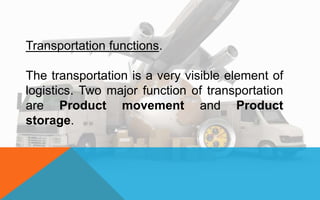
Transportation functions.
The transportation is a very visible element of
logistics. Two major function of transportation
are Product movement and Product
storage.
Product Movement.
• The basic value provided by the transportation is to move inventory to
specific destination, whether In the form of material, components,
work-in-progress or finished goods.
• Transportation also play a key role in reverse logistics.
• When designing the logistics system, managers strive to reduce in-
transit inventory to minimum.
Product storage. ( another aspect of transportation)
• Transport vehicle can also be used for product storage
at shipment origin but they are comparatively
expensive.
• The condition of the goods that are in transit is also a
major responsibility of the transporter.
• Storage function is considered with the matter of fact
that the good must be safe and should be in the shape
of when its was loaded.
Transportation Principles.
Two fundamental economic principles that
impact transportation efficiency are Economy of
the scale and Economy of distance.
These principles are important when
evaluating transportation alternatives.
Economy of the scale :
• Economy of the scale principle in transportation is that the cost per unit of
weight decrease as the size of shipment increase.
Eg: larger capacity transportation vehicle such as rail and water are less
costly per unit of weight than smaller-capacity vehicle like flight and small
truck.
Economy of distance:
• Economy of distance refers to decreased
transportation cost per unit of weight as distance
increase.
• Longer distance allow fixed cost to be spread over
more miles, resulting in lower per mile charges.
Transportation
Participants
Transportation Participants:
Transportation decision are influenced by these parties.
• Shipper and consignee
• Carrier and agent
• Government
• Internet
• Public
Shipper and consignee:
• The shipper and consignee have a common
interest in moving goods from the point of origin to
destination within a given time at the lowest cost.
• The specific pickup and delivery times, predictable
transit time, and zero loss and damage as well as
accurate and timely exchange of information and
invoicing.
Carrier and Agent:
• Broker and freight forwarder are transport agents that
facilitate carrier and customer matching.
• As a service business, carrier want to charge their customer
the highest rate possible while minimizing labour, fuel and
vehicle cost required to complete the movement.
• To achieve this objective the carrier seeks to coordinate
pickup and delivery times to group or consolidate many diff.
shipper’s freight into movements that achieve economy of
the scale and distance.
Government:
Govt. desires a stable and efficient transportation
environment to support economic growth. A stable
and efficient transportation environment requires
that carrier provide essential service at reasonable
cost. Since the direct impact of transportation on
economic success, govt have traditionally been
involved in oversight of carrier practice.
Internet :
• The primary advantage of internet in transportation is the
real time information sharing with the customer and
supplier.
• The recent trend of online shopping is the best example of
the effective transportation/logistics and internet
• Because of internet exploration the operation of logistics
became more easier and information distortion is much
lesser.
• The internet allow both the supplies and customer to
directly interact through web sites.
Public :
• The public is concerned with transportation accessibility, expenses
and effectiveness as well as environmental and safety standard.
• The public unknowingly create demand for transportation by
purchasing goods.
• The effect of air pollution and oil spillage is a significant
transportation related social issue.
• The cost of environment impact and safety is ultimately paid by
consumer.

Transportation and logistics

  • 1.
  • 3.
    Transportation is themovement of humans, animals and goods from one location to another. These materials become productive only when they are transported from the point of origin to the point of consumption
  • 4.
    • The successand failure of any business activity is largely depend on the movement of the final output from point of origin to the point of consumption at an economy of scale.
  • 5.
    Transportation functions. The transportationis a very visible element of logistics. Two major function of transportation are Product movement and Product storage.
  • 6.
    Product Movement. • Thebasic value provided by the transportation is to move inventory to specific destination, whether In the form of material, components, work-in-progress or finished goods. • Transportation also play a key role in reverse logistics. • When designing the logistics system, managers strive to reduce in- transit inventory to minimum.
  • 7.
    Product storage. (another aspect of transportation) • Transport vehicle can also be used for product storage at shipment origin but they are comparatively expensive. • The condition of the goods that are in transit is also a major responsibility of the transporter. • Storage function is considered with the matter of fact that the good must be safe and should be in the shape of when its was loaded.
  • 9.
    Transportation Principles. Two fundamentaleconomic principles that impact transportation efficiency are Economy of the scale and Economy of distance. These principles are important when evaluating transportation alternatives.
  • 10.
    Economy of thescale : • Economy of the scale principle in transportation is that the cost per unit of weight decrease as the size of shipment increase. Eg: larger capacity transportation vehicle such as rail and water are less costly per unit of weight than smaller-capacity vehicle like flight and small truck.
  • 11.
    Economy of distance: •Economy of distance refers to decreased transportation cost per unit of weight as distance increase. • Longer distance allow fixed cost to be spread over more miles, resulting in lower per mile charges.
  • 12.
  • 13.
    Transportation Participants: Transportation decisionare influenced by these parties. • Shipper and consignee • Carrier and agent • Government • Internet • Public
  • 14.
    Shipper and consignee: •The shipper and consignee have a common interest in moving goods from the point of origin to destination within a given time at the lowest cost. • The specific pickup and delivery times, predictable transit time, and zero loss and damage as well as accurate and timely exchange of information and invoicing.
  • 15.
    Carrier and Agent: •Broker and freight forwarder are transport agents that facilitate carrier and customer matching. • As a service business, carrier want to charge their customer the highest rate possible while minimizing labour, fuel and vehicle cost required to complete the movement. • To achieve this objective the carrier seeks to coordinate pickup and delivery times to group or consolidate many diff. shipper’s freight into movements that achieve economy of the scale and distance.
  • 16.
    Government: Govt. desires astable and efficient transportation environment to support economic growth. A stable and efficient transportation environment requires that carrier provide essential service at reasonable cost. Since the direct impact of transportation on economic success, govt have traditionally been involved in oversight of carrier practice.
  • 17.
    Internet : • Theprimary advantage of internet in transportation is the real time information sharing with the customer and supplier. • The recent trend of online shopping is the best example of the effective transportation/logistics and internet • Because of internet exploration the operation of logistics became more easier and information distortion is much lesser. • The internet allow both the supplies and customer to directly interact through web sites.
  • 18.
    Public : • Thepublic is concerned with transportation accessibility, expenses and effectiveness as well as environmental and safety standard. • The public unknowingly create demand for transportation by purchasing goods. • The effect of air pollution and oil spillage is a significant transportation related social issue. • The cost of environment impact and safety is ultimately paid by consumer.