#2   Get More Refcardz! visit refcardz.com


                                              CONTENTS INCLUDE:


                                                                                                 Getting Started with Ajax
                                              n	
                                                   Getting to Know HTTP
                                              n	
                                                   Tips for Using XHR
                                              n	
                                                   Ajax and Architecture
                                              n	
                                                   Ajax Toolkits
                                              n	


                                              n	
                                                   Ajax User Interfaces
                                                   Hot Tips and more...
                                                                                                                                                                                                   By Dave Crane

                                                     GETTING STARTED                                                                                  GETTING TO KNOW HTTP

                                                     The standard way to do Ajax is to use the XMLHttpRequest object,                                 To make use of the XHR to its fullest, we recommend you
                                                     known as XHR by its friends. Use XHR directly, or via one of the                                 become familiar with the workings of the HTTP protocol. Using
                                                     helpful Ajax libraries such as Prototype or jQuery. How do we use                                Ajax, you have much more control over HTTP than with classic
                                                     XHR “by hand”? To start with, we need to get a reference to it:                                  web app development.
                                                          if (window.XMLHttpRequest) {
                                                                                                                                                                        request
                                                              xhr = new XMLHttpRequest();
                                                          } else if (window.ActiveXObject) {
                                                              xhr = new ActiveXObject(“Microsoft.XMLHTTP”);
                                                                                                                                                                                                      headers
                                                          }
                                                    We can then open a connection to a URL:
                                                                                                                                                     browser                       body
                                                     	    xhr.open(
                                                              “GET”,
                                                              “my-dynamic-content.jsp?id=”
                                                                +encodeURI(myId),                                                                                                                                       server
                                                              true
                                                           );

                                                    Specify a callback function to receive the response:                                                                                                      headers
      www.dzone.com


                                                                                                                                                                                          body
                                                     	    xhr.onreadystatechange = function(){
                                                                                                                                                                                                   response
                                                             processReqChange(req);
                                                           }
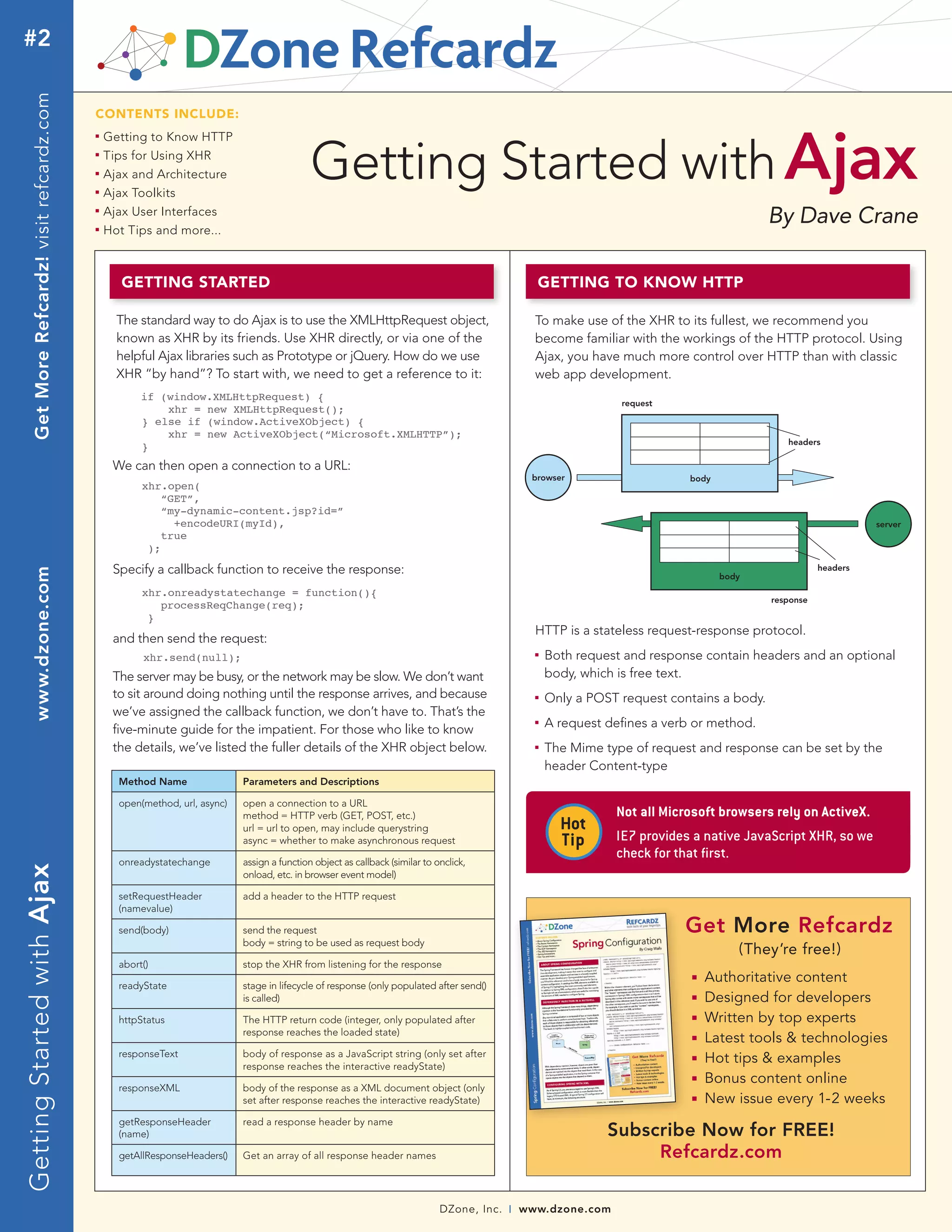
                                                                                                                                                      HTTP is a stateless request-response protocol.
                                                    and then send the request:
                                              	           xhr.send(null);                                                                             n
                                                                                                                                                       	 Both request and response contain headers and an optional 	
                                                    The server may be busy, or the network may be slow. We don’t want                                 	 body, which is free text.
                                                    to sit around doing nothing until the response arrives, and because                               n
                                                                                                                                                          	 Only a POST request contains a body.
                                                    we’ve assigned the callback function, we don’t have to. That’s the
                                                    five-minute guide for the impatient. For those who like to know
                                                                                                                                                      n
                                                                                                                                                          	 A request defines a verb or method.
                                                    the details, we’ve listed the fuller details of the XHR object below.                             n
                                                                                                                                                       	 The Mime type of request and response can be set by the 	
                                                                                                                                                      	 header Content-type
                                                     Method Name                Parameters and Descriptions

                                                     open(method, url, async)   open a connection to a URL
                                                                                method = HTTP verb (GET, POST, etc.)                                                   Not all Microsoft browsers rely on ActiveX.
                                                                                url = url to open, may include querystring                                   Hot
                                                                                async = whether to make asynchronous request                                 Tip       IE7 provides a native JavaScript XHR, so we
                                                                                                                                                                       check for that first.
                                                     onreadystatechange         assign a function object as callback (similar to onclick,
Getting Started with Ajax


                                                                                onload, etc. in browser event model)

                                                     setRequestHeader           add a header to the HTTP request
                                                     (namevalue)

                                                     send(body)                 send the request                                                                                  Get More Refcardz
                                                                                body = string to be used as request body
                                                                                                                                                                                             (They’re free!)
                                                     abort()                    stop the XHR from listening for the response
                                                                                                                                                                                    n 	Authoritative content
                                                     readyState                 stage in lifecycle of response (only populated after send()
                                                                                is called)                                                                                          n 	Designed for developers
                                                                                                                                                                                    n 	Written by top experts
                                                     httpStatus                 The HTTP return code (integer, only populated after
                                                                                response reaches the loaded state)                                                                  n 	Latest tools & technologies

                                                     responseText               body of response as a JavaScript string (only set after                                             n	 Hot tips & examples
                                                                                response reaches the interactive readyState)
                                                                                                                                                                                    n 	Bonus content online
                                                     responseXML                body of the response as a XML document object (only
                                                                                set after response reaches the interactive readyState)                                              n 	New issue every 1-2 weeks


                                                     getResponseHeader          read a response header by name
                                                     (name)                                                                                                          Subscribe Now for FREE!
                                                     getAllResponseHeaders()    Get an array of all response header names                                                 Refcardz.com

                                                                                                                                  DZone, Inc.   |   www.dzone.com
2
                                                                                                                                                        Getting Started with Ajax
         tech facts at your fingertips


    Common HTTP Verbs                                                                                 Handling the Response
    99% of the time, you’ll only need GET and POST. Many other                                        We’ve assigned a callback handler function to our XHR object.
    verbs are used by WebDAV, Subversion over HTTP, and other                                         This function will get called several times as the response comes
    niche applications, but not all web servers will understand them.                                 in. Typically, we only want to parse the response once it has fully
                                                                                                      arrived, i.e. the readyState is complete.
    Verb          Notes

    GET           Strictly speaking, should be used only to fetch data, not to effect                     	 xhr.onreadystatechange=function(){
                  changes on the server. GET requests contain no body. Parameters are                            if (xhr.readyState==4){
                  passed in the querystring of the URL.                                                             if (xhr.status==200){
    POST          Should be used to update data on the server. Parameters/data passed                                 parseResponse(xhr);
                  in the body.                                                                                      }else{
                                                                                                                      //handle the HTTP error...
    HEAD          Will fetch the headers of the response only, not the body. Useful for
                  finding out how large a resource is (read the Content-length header)                              }
                  or how old it is (read the Last-modified header), for example.                                 };
                                                                                                              };
    If you’re using the increasingly popular REST approach to web
    services, the HTTP verb is used to indicate the type of operation                                 XHR ReadyState Values
    being performed. The most commonly used HTTP verbs in REST                                         State   Value           Comments
    map onto the CRUD (create, read, update, delete) approach:
                                                                                                       0       Uninitialized   The request hasn’t yet been sent
    HTTP Verb          CRUD              Notes                                                         1       Loading         The response hasn’t yet arrived
                       operation
                                                                                                       2       Loaded          Response headers can be read
    PUT                Create            Add a new object instance to the domain model.
                                                                                                       3       Interactive     Response body is incomplete, but can be read
    GET                Read              Get an existing domain object from the server.
                                                                                                       4       Complete        Response body is complete
    POST               Update            Modify an existing domain object.

    DELETE             Delete            Remove an existing object from the domain model.             So, what might the parseResponse() method look like? We have
                                                                                                      a lot of freedom in the types of response we send. Let’s look at
Common Mime Types                                                                                     some of the common ones.
Setting the right mime type for your request and response is
good manners—it’s also vital to get the app to behave correctly!                                      Handling a HTML Response
                                                                                                      The server can send pre-assembled HTML content, which we
    Mime Type                     Meaning                 Usage
                                                                                                      just stitch into the web page.
    application/x-www-            Body is an encoded      Sending request from HTML
    form-urlencoded               querystring of          form or Ajax. Required in order             <table class=’item selected’>                function parseResponse(xhr){
                                  key-value pairs         for server to decode parameters             <tr>                                           var div=document
                                                          into $_GET, servlet parameters, or          <td rowspan=’3’ valign=’top’><div                .getElementById(“myDiv”);
                                                          HttpRequest.Form.                           class=’itemIcon’><img                          div.innerHTML=xhr.responseText;
                                                                                                      src=’../images/kmoon.png’></div></td>        }
    text/xml,                     Body is an XML          Can be used anywhere – request              <td class=’itemTitle’>The Moon on a
    application/xml               document                or response. Must set response to           Stick</td>
                                                                                                      </tr>
                                                          one of these in order to use XHR.
                                                                                                      <tr>
                                                          responseXML property.
                                                                                                      <td valign=’top’>What every project
                                                                                                      manager wants - and they want it
    text/plain                    Body is plain
                                                                                                      yesterday!<br/><br/><i>NB: Stick not
                                  unformatted text                                                    included.</i></td>
                                                                                                      </tr>
    text/html, text/xhtml         Body is (X)HTML         Standard web pages sent from
                                                                                                      <tr>
                                  content                 server, or content fragments sent to        <td><div class=’price’>$365.00</div></td>
                                                          Ajax apps.                                  </tr>
                                                                                                      </tr>
    text/javascript               Body is a piece of      Standard .js files, JavaScript              </table>
                                  JavaScript code         fragments sent to Ajax apps.

    image/png, image/             Body is a binary        Images sent by server.
    jpeg, image/gif               image                                                               Handling a JSON Response
                                                                                                      JSON is a simple text-markup that’s extremely easy for JavaScript
                                                                                                      to digest! It doesn’t come so naturally to server-side languages,
     TIPS FOR USING XHR
                                                                                                      but there are JSON libraries for most servers these days—see
                                                                                                      http://www.json.org. Most Ajax libraries now provide support
n
 	 Always set async to true when calling open(). Synchronous Ajax 	
                                                                                                      for JSON.
	 requests block the browser UI, giving the stop-start behaviour 	
	 we were trying to get away from in the first place!                                                 {                                            function parseResponse(xhr){
                                                                                                          imgSrc: “kmoon.png”,                       var jsonObj=eval(
n
 	 XHR can be fussy about order of setting-up. Always set the 	                                           title: “The Moon on a Stick”,               “(“
                                                                                                          description: “What every proj-              +xhr.responseText
	 callback handler before calling send()                                                              ect manager wants - and they want it            +”)”
                                                                                                      yesterday!<br/><br/><i>NB: Stick not           );
n
    	 To send HTML-form like data                                                                     included.</i>”,                                setImgSrc(jsonObj.imgSrc);
	    	       n
                 	 Use encodeURI() to encode all data values                                              price: “365.00”                            setTitle(jsonObj.title);
                                                                                                      }                                            }
	    	
         	 Set the mime-type of the request to application/x-www-	
             n

                                                                                                                                                                                  →
			 form-urlencoded
n
 	 Set the response mime type to application/xml or text/xml if 	
	 you want to use the responseXML property


                                                                                   DZone, Inc.   |   www.dzone.com
3
                                                                                                                                    Getting Started with Ajax
     tech facts at your fingertips


    TIPS FOR USING XHR, continued                                                      AJAX AND ARCHITECTURE

Handling an XML Response                                                           Does Ajax only affect the client-side? Certainly not! Particularly
XML is a more natural fit for most server technologies. XHR sup-                   if your server is responding with data rather than HTML frag-
ports XML by giving us the responseXML property, but parsing                       ments, you’ll want to refactor to some extent.
this using the DOM is hard work.
                                                                                        dumb client               thin client                thick client
<item imgSrc=”kmoon.png”             function parseResponse(xhr){
price=”365.00”>                        var xmlDoc=xhr.responseXML;
                                                                                        browser                  browser                     browser
  <title>The Moon on a                 var item=xmlDoc.getElementsByTagName
Stick</title>                            (‘item’)[0];                                   display                  display                     display
  <description><![CDATA[What           var imgSrc=item.getAttribute
                                                                                                                 presentation                presentation
every project manager wants -            (‘imgSrc’);
and they want it                       var title=item.getElementsByTagName                                                                   business objects
yesterday!<br/><br/><i>NB: Stick         (‘title’)[0]
                                                                                                                                             data transfer
not                                      .firstChild.data;
included.</i>]]></description>         setImgSrc(imgSrc);
  </item>                              setTitle(title);
                                     }                                                  presentation
                                                                                                                 presentation                data transfer
                                                                                        business objects         business objects            business objects
Some browsers also support XPath as a more pleasant way to
parse XML. Sarissa and mozXPath.js both provide cross-browser
XPath support.
                                                                                        persistence              persistence                 persistence

<item imgSrc=”kmoon.png”             function parseResponse(xhr){
price=”365.00”>                        var xmlDoc=xhr.responseXML;                      web server               web server                  web server
  <title>The Moon on a                 var imgSrc=xmlDoc.selectSingleNode
Stick</title>                            (‘/item/@imgSrc’).value;
  <description><![CDATA[What           var title=xmlDoc.selectSingleNode                database server          database server            database server
every project manager wants -            (‘/item/title/text()’).value;
and they want it                       setImgSrc(imgSrc);
yesterday!<br/><br/><i>NB: Stick       setTitle(title);
not                                  }                                             Dumb client and thick client above are extremes. In between,
included.</i>]]></description>
  </item>
                                                                                   there is a thinner (but still intelligent) client, that will suffice in
                                                                                   many cases. No single model is right for all cases. Try out these
                                                                                   rules of thumb:
Handling a Javascript Response
Another approach to Ajax is to generate scripts on the server,                     n
                                                                                    	 To add small Ajax features to an existing app, stick with the thin 	
and send them to the client to be evaluated. Care should be                        	 client approach. Thick client is for complex, line-of-business 	
taken here to define a suitably high-level API on the client                       	 app replacements.
against which the generated script is to run, otherwise tight                      n
                                                                                    	 Your client-side code is visible, and runs on somebody else’s 	
coupling between server and client code can result.                                	 machine. Don’t expose details of your business tier. Keep it 	
setImgSrc(“kmoon.png”);              function parseResponse(xhr){                  	 coarse-grained.
setTitle(                              eval(xhr.responseText);
   “The Moon on a Stick”             }                                             n
                                                                                    	 Some functionality MUST be kept on the server, such as data 	
);
                                                                                   	 validation. Simple, fast validation on the client is an addition, 	
                                                                                   	 not a replacement!
Handling Mixed Responses                                                           n
                                                                                    	 Treat your client-side code well. Use the patterns and practises 	
Some Javascript libraries allow mixing of these dialects of
                                                                                   	 that you would use on the server to keep your code clean and 	
Ajax within a single response. The Prototype Ajax.Updater, for
                                                                                   	 maintainable.
example, can accept a response as HTML, into which <script>
tags are embedded. The script will be extracted and evalu-                         n
                                                                                    	 Most projects have a legacy system behind them. How can you 	
ated, while the rest of the content is embedded into a target                      	 introduce Ajax with minimal disruption? Does it speak XML, or 	
DOM element.                                                                       	 generate HTML from components? Can you re-use that?


    AJAX TOOLKITS                                                                                                               continued on next page...


Toolkits and frameworks will make your life easier in                             Client-side versus Server-side
several ways:                                                                     Some toolkits are JavaScript-only, others include a back-end
	
  	 Providing tried-and-tested solutions to common
       n                                                                          system too. Client-side toolkits will give more flexibility, but may
		 problems                                                                       require more work on the server-side too.
	
  	 Abstracting away cross-browser incompatibilities and
       n
                                                                                  High-level versus Low-level
		 annoyances                                                                     JavaScript is a flexible language, and some toolkits are geared
	
  	 Providing higher level abstractions such as ready-made
       n
                                                                                  towards enhancing the language itself in a variety of ways. Oth-
		 UI widgets and networking stacks                                               ers are more concerned with higher-level issues such as simplify-
However, it’s a jungle out there, with many different types of                    ing XHR, or providing drop-in widgets such as trees, tables and
toolkits on the market. Let’s divide them into broad families.                    drag-and-drop.


                                                                DZone, Inc.   |   www.dzone.com
4
                                                                                                                                                                Getting Started with Ajax
        tech facts at your fingertips


Some popular Ajax Toolkits                                                                           Loading HTML Content into a DOM Node
 Name                                   Client/   High/       Comments                                    Prototype                                 jQuery
                                        Server    Low-level
                                                                                                          new Ajax.Updater(                         $(“#myDomNode”).load(
 Prototype                              Client    Low         Remodels and extends                           $(“myDomNode”),                           “my-dynamic-content.jsp”,
                                                                                                             “my-dynamic-content.jsp”,                 { id: myId }
 (http://prototypejs.org)                                     JavaScript following the Ruby
                                                                                                             { method: “post”,                      );
                                                              scripting language. Many
                                                                                                               params: { id: myId }
                                                              features for arrays, functions,                }
                                                              XHR, DOM and forms.                         );
 Scriptaculous                          Client    High        Special effects, drag and
 (http://script.aculo.us)                                     drop, and widgets built on
                                                                                                     n	
                                                                                                              No need to provide a callback function at all
                                                              top of prototype.
                                                                                                     Working wth JSON Responses
 dojo                                   Client    Low-high    Comprehensive set of
 (http://dojotoolkit.org)                                     libraries covering everything                   Prototype                             jQuery
                                                              from packaging & language
                                                              features through Ajax to UI                     new Ajax.Request(                     $.getJSON(
                                                                                                                 “my-dynamic-content.jsp”,             “my-dynamic-content.jsp?id=”+myId,
                                                              widgets.
                                                                                                                 { method: “post”,                     function(json){
 Yahoo User Interface (YUI)             Client    Low-high    Another comprehensive set                            params: { id: myId },                 alert(json.someProperty);
 (http://developer.yahoo.com/                                 of libraries covering many                           onComplete:                         }
 yui/)                                                        aspects of Ajax development.                    function(response,json){              );
                                                                                                                     alert(json.someProperty);
 Ext                                    Client    High        Widget-based set of user                             }
 (http://extjs.com)                                           interface components with                          }
                                                              Ajax support.                                   );

 sarissa                                Client    Low         Rich library for working               n	
                                                                                                              JSON response returned to our callback already parsed
 (http://sarissa.sf.net)                                      with XML, providing cross-
                                                              browser XPath and XSLT.

 Mochikit                               Client    Low-high    General-purpose Ajax and
                                                                                                              GENERAL JAVASCRIPT PROGRAMMING TIPS
 (http://mochikit.com)                                        DHTML library, inspired by
                                                              Python.                                 JavaScript is a loosely-typed scripting language with support for
 jQuery                                 Client    Low         Small, concise Ajax and                 object-oriented and functional programming styles. Although it
 (http://jquery.com)                                          DOM helper library.                     looks like Java and C-family languages, it’s quite different under
 MooTools                               Client    Low-high    Modular library covering                the hood. Here are a few survival tips to get you through your first
 (http://mootools.net)                                        everything from core                    serious encounter with this language:
                                                              classes to special effects. A
                                                              promising newcomer.                     n
                                                                                                        Objects can be extended at runtime with new properties.


 Ruby on Rails                          Server    Low-high    Primarily a server-side toolkit,        	 Think of Javascript objects as associative arrays.
 (http://www.rubyonrails.org)                                 but has first-rate support
                                                              for Ajax, using Prototype
                                                                                                      n
                                                                                                        Functions are first-class objects, and can be passed as


                                                              and Scriptaculous. Allows               	 arguments into other functions (see the numerous callback
                                                              large parts of the client tier          	 functions earlier).
                                                              to be written on the server,
                                                              in Ruby.                                n
                                                                                                        JavaScript functions support closures. That is, variables that 	


 GWT                                    Client    High        Java framework that allows              	 are in scope when a function is defined can still be referenced 	
 (http://code.google.com/                                     Ajax client tier to be written          	 inside the function, even if it is invoked later.
 webtoolkit)                                                  in Java.

 JSF                                    Server    High        Various JSF vendors have
 (various vendors)                                            Ajax-enabled some of their                      AJAX USER INTERFACES
                                                              components, again allowing
                                                              some Ajax functionality
                                                              without hand-writing                    Before Ajax, the UI was nearly always delivered as declarative
                                                              JavaScript.                             HTML, and the Document Object Model, or DOM, was only used
                                                                                                      in moderation. With Ajax—especially single-page applications—
We haven’t time to show you how to make Ajax calls with all of                                        the DOM can play a much bigger role.
these toolkits, but let’s pick two of the most popular: Prototype
                                                                                                      Working with the DOM is a two-stage process:
and jQuery.
                                                                                                      n	       Finding the elements we want to work with
The Basics : Making an Ajax request                                                                   n	       Modifying their contents or reorganizing them

     Prototype                                    jQuery                                              Finding DOM Elements
     new Ajax.Request(                            $.post(                                             The DOM standard itself gives us a few basic tools to work with.
        “my-dynamic-content.jsp”,                    “my-dynamic-content.jsp”,
        { method: “post”,
                                                                                                      Enterprising JavaScript library developers have built on top of
                                                     { id: myId },
          params: { id: myId },                      function(xhr){                                   these to provide a much richer set of functionality.
          onComplete: function(response){
                                                       parseResponse(xhr);
            parseResponse(response);                                                                      Function                      arguments     returns      notes
                                                     }
          }
        }                                         );
                                                                                                          document.                     string        DOM          find single element on
     );                                                                                                   getElementById()                            Element      page. Id attribute must be
                                                                                                                                                                   unique in page
n	
  No need to create your own XHR object
                                                                                                          document.                     string        collection   find all elements on page
n	
  Use high-level, meaningful callbacks rather than                                                        getElementsByTagName()                      of DOM       of a particular HTML tag
	 onreadystatechange                                                                                      element.
                                                                                                                                                      elements     type e.g. H1, IMG, LI. Use
                                                                                                                                                                   as a method of element
n	
  Sensible defaults provided for all the options you don’t want 	                                         getElementsByTagName()
                                                                                                                                                                   to search a subtree of the
	 to specify yourself                                                                                                                                              document


                                                                                 DZone, Inc.     |   www.dzone.com
5
                                                                                                                                                                    Getting Started with Ajax
       tech facts at your fingertips


Finding DOM Elements, continued                                                                           Modifying the DOM
 Function                              arguments       returns         notes
                                                                                                          Again, the DOM standard gives us a basic set of tools to work with,
                                                                                                          and browser vendors have effectively standardized a few more.
 element.childNodes                    none            collection      find node’s immediate
                                                       of DOM          children
                                                                                                           Function              arguments        returns        notes
                                                       elements
 element.parentNode                    none            DOM             find node’s immediate               document.             string (tag      DOM            create new content slowly and
                                                       Element         parent                              createElement()       name)            Element        painfully!

 element.nextSibling                   none            DOM             allow
 element.previousSibling                               Element         traversal of sibling nodes          document.             string           DOM text
                                                                                                           createTextNode()      (content of      node
The id attribute is often too specific—adding one to each element we                                                             node)

may need to locate becomes tedious, and clutters the markup. Tag                                           element.              n/a              n/a            use the browser’s built-in HTML
names, on the other hand, are not specific enough to be useful in                                          innerHTML                                             parser to shortcut the creation
many cases. The most common solution is to use CSS classes to lo-                                                                                                of new content

cate elements. We can make these as specific or general as we need.                                        element.              DOM              null           add a DOM node as child of
                                                                                                           appendChild()         element                         another node
Finding DOM elements using Prototype                                                                       element.              DOM              null           remove a child DOM node from
                                                                                                           removeChild()         element                         the parent
Function                                arguments        returns        notes
                                                                                                           element.              DOM              null           add a DOM node in relation to
$()                                     string,          DOM            powerful and
                                                                                                           insertBefore()        element                         other siblings, not just at the end
                                        many             element,       concise superset of
                                        strings, or      or array of    getElementById()
                                        elements         elements                                         Modifying the DOM with Prototype
document.                               string (a        array of       version 1.5+                      Prototype favors the use of innerHTML to modify the DOM. It
getElementsByClassName()                CSS class)       DOM            simple analogue to                enhances this with the Insertion namespace, and, more recently,
element.                                                 elements       getElementsByTagName()
getElementsByClassName()                                                                                  an insert method on the DOM element class itself.
$$()                                    string           array of       version 1.5+
                                                                                                           Function               arguments                     notes
                                        (selector        DOM            accepts CSS selector
                                        rule)            elements       rules, and xpath queries
                                                                                                           Insertion.Top          DOM element,                  version 1.5: Object that inserts
element.select()                        string           array of       version 1.6                        Insertion.Bottom       string (HTML content)         HTML content into element
                                        (selector        DOM            analogue to $$(),                  Insertion.Before                                     alongside existing content.
                                        rule)            elements       syntactically neater               Insertion.After
element.up()                            selector         DOM            powerful positional                Element.update()       string (HTML content)         version 1.6: overwrites content in
element.down()                          rules,           Element        navigation methods,                                                                     element
                                        counts                          that can work with
element.next()
                                        (both                           selectors                          Element.insert()       HTML content or hash          version 1.6: Can insert a single
element.previous()                      optional)                                                                                 of content                    piece of content, or multiple
                                                                                                                                                                pieces in one go
Examples
                                                                                                           Element.remove()       none                          all versions: removes the calling
$(“myList”)	                  	selects the element with id=myList                                                                                              element (and its children) from
 .select (“li.new”)     	  	selects all DOM elements of type 	                                                                                                 the page
		 <LI> with CSS class new within
		 subtree beneath myList	                                                                                Prototype provides no support for building DOM elements
$(“widget”)	                  	selects element with id=”widget”                                          programmatically, but the Scriptaculous library adds a DOMBuilder
 .down(“img div.handle”,2) 	  internally returns list of all <IMG> 	                                     object to the mix.
		 tags that are children of a DIV with 	
		 CSS class handle, and returns the                                                                      Modifying the DOM with jQuery
		 second one                                                                                             jQuery is based around selecting sets of DOM elements, and it
                                                                                                          provides methods for manipulating sets of DOM elements in bulk.
Finding DOM elements using jQuery                                                                         (These can be used on sets of one element too!) The methods here
Function        arguments         returns           notes                                                 all operate on a set of DOM nodes returned from a selector.
$()             string            jQuery            although only one method is listed here,
                (selector         object            jQuery is exceptionally powerful in this                Function           arguments            notes
                rule)             wrapping          regard. The selector rules encompass CSS3,              $.html()           string (HTML         simple wrapper around innerHTML, will
                                  array of          xpath (optional) and a range of custom                                     content)             duplicate content for each element in the set
                                  elements          selectors too!
                                                                                                            $.append()         string (HTML         insert content into node(s) alongside existing
Examples                                                                                                    $.prepend()        content)             content
                                                                                                            $.before()
$(“div”)	                                      	select all nodes by tag type                               $.after()
$(“#myList”)	                                  	select by unique id
                                                                                                            $.appendTo()       string               argument is the target element or elements,
$(“ul#myList li.new”)	                         complex CSS selector                                        $.prependTo()      (selector rule)      to which the current node will be moved to. If
                                                                                                            $.insertBefore()   or DOM               multiple targets are present, the nodes being
                                                                                                            $.insertAfter()    element              appended will be copied to each one

                   DOM elements can be assigned to multiple CSS classes.                                    $.remove()         none                 remove all elements in set from the page
       Hot         When finding elements using a selector mechanism, you
       Tip                                                                                                  $.empty()          none                 empty all elements in the set of their content
                   may use the same CSS classes that determine the look of                                  $.wrap()           string (HTML) or     wrap each element in set individually with a
                   your page, or you may assign separate marker classes,                                                       DOM element          copy of the content provided in argument

                   i.e. CSS classes that have no visual effect on the page.                                 $.wrapAll()        string (HTML) or     wrap all elements in the set as a single unit with
                                                                                                                               DOM element          the content provided in argument


                                                                                       DZone, Inc.   |   www.dzone.com
6
                                                                                                                                                                                                 Getting Started with Ajax
            tech facts at your fingertips


                                                                                                                                   FireBug             FF           www.getfirebug.com           Swiss army knife for developers,
          WIDGETS VS. BEHAVIORS                                                                                                                                                                  incorporating DOM & CSS
                                                                                                                                                                                                 inspector, interactive debugger,
                                                                                                                                                                                                 network monitor and profiler.
       Both jQuery and Prototype (and its sister Scriptaculous) tend                                                               Web                 IE           searchmicrosoft.com          Closest thing to Firebug for IE,
       towards a style of UI called Unobtrusive Javascript, in which the                                                           Developers                                                    minus the debugger.
                                                                                                                                   Toolkit
       content of the page is declared as HTML, and subsequently made
                                                                                                                                   Script              IE           searchmicrosoft.com          Free Javascript debugger for
       interactive. Selectors play an important role in this approach, in                                                          Debugger                                                      IE, (also check out Visual Studio
       locating the elements to which to add behavior. There is an alterna-                                                                                                                      express’ debugger).

       tive approach to developing Ajax UIs, much more akin to desktop                                                             Fiddler             IE/any       www.fiddlertool.com          Powerful network monitor with
                                                                                                                                                                                                 programmable interface for
       application development, in which the DOM elements are created                                                                                                                            modifying requests in many
       programmatically by javascript components, which the designer                                                                                                                             ways. Tight integration with IE,
                                                                                                                                                                                                 but can work with any browser.
       then wires together using layouts and containers. Qooxdoo and
                                                                                                                                   LiveHTTP            FF           livehttpheaders.mozdev.org   Network monitor extension for
       Ext2 are both examples of this style of UI development.                                                                     Headers                                                       Firefox.

                                                                                                                                   JSUnit              any          www.jsunit.net               The original unit testing
                                                                                                                                                                                                 framework for Javascript.
          TOOLS OF THE TRADE
                                                                                                                                   Selenium            FF/any       www.openqa.org               Powerful unit testing tool for
                                                                                                                                                                                                 Javascript, featuring interactive
       In an ideal world, choosing the right framework makes develop-                                                                                                                            test recorder IDE (Firefox only)
                                                                                                                                                                                                 and browser automation tool
       ment a breeze, but in practice, you’ll need to go under the hood                                                                                                                          (most browsers).
       from time to time to figure out what’s going on. We recommend                                                               YSlow               FF           developer.yahoo.com/yslow    Comprehensive performance
       the following tools to keep your Ajax development on track.                                                                                                                               analysis for web pages, runs as
                                                                                                                                                                                                 a plugin to Firebug!

                                                                                                                                   Tamper Data         FF           http://addons.mozilla.org/   Use tamperdata to view and
                                                                                                                                                                    en-US/firefox/addon/966      modify HTTP/HTTPS headers
                                                                                                                                                                                                 and post parameters.


 ABOUT THE AUTHOR                                                                                                                                                         RECOMMENDED BOOK
                                   Dave Crane                                                                                                                                             Ajax in Action explains how
                                   Dave Crane has over ten years experience in the IT industry, working with J2EE,                                                                        to distribute the application
                                   PHP, Ajax, and a variety of scripting languages in industries including home                                                                           between the client and the
                                   entertainment, banking, simulation modelling and global supply chains. He                                                                              server (hint: use a “nested MVC”
                                   currently works as Developer/Architect for Historic Futures Ltd., and runs Ajax                                                                        design) while retaining the
                                   training courses in the UK and overseas with Skillsmatter Ltd. He is well-known                                                                        integrity of the system. You will
                                   as the author of Manning’s Ajax in Action, Prototype & Scriptaculous in Action                                                                         learn how to ensure your app is
                                   and Ajax in Practice.                                                                                                                                  flexible and maintainable,
                                                                                                                                                                        and how good, structured design can help avoid
 Publications                                                                                                                                                           problems like browser incompatibilities.
 n	   Ajax in Action
 n	   Prototype & Scriptaculous in Action                                                                                                                                                    BUY NOW
 n	   Ajax in Practice                                                                                                                                                   books.dzone.com/books/ajax-in-action

 Get More FREE Refcardz. Visit refcardz.com now!
 Upcoming Refcardz:                                                Available:
 Core Seam                                                         Essential Ruby                                       JavaServer Faces
 Core CSS: Part III                                                Essential MySQL                                      Core CSS: Part I
                                                                   JUnit and EasyMock                                   Struts2
 Hibernate Search
                                                                   Getting Started with MyEclipse                       Core .NET
                                                                                                                                                                                     FREE
 Equinox                                                           Spring Annotations                                   Very First Steps in Flex
 EMF                                                               Core Java                                            C#
                                                                   Core CSS: Part II                                    Groovy
 XML
                                                                   PHP                                                  NetBeans IDE 6.1 Java Editor
 JSP Expression Language                                           Getting Started with JPA                             RSS and Atom
                                                                                                                                                                                                             Design Patterns
 ALM Best Practices                                                Visit refcardz.com for a complete listing of available Refcardz.                                                                      Published June 2008

                                                                                                                              DZone, Inc.
                                                                                                                                                                                          ISBN-13: 978-1-934238-02-8
                                                                                                                              1251 NW Maynard
                                                                                                                                                                                          ISBN-10: 1-934238-02-3
                                                                                                                              Cary, NC 27513
                                                                                                                                                                                                                         50795
                                                                                                                              888.678.0399
DZone communities deliver over 4 million pages each month to
                                                                                                                              919.678.0300
more than 1.7 million software developers, architects and decision
                                                                                                                              Refcardz Feedback Welcome
makers. DZone offers something for everyone, including news,                                                                  refcardz@dzone.com
                                                                                                                                                                                                                                     $7.95


tutorials, cheatsheets, blogs, feature articles, source code and more.                                                        Sponsorship Opportunities                              9 781934 238028
“DZone is a developer’s dream,” says PC Magazine.                                                                             sales@dzone.com

Copyright © 2008 DZone, Inc. All rights reserved. No part of this publication may be reproduced, stored in a retrieval system, or transmitted, in any form or by means electronic,                                     Version 1.1
mechanical, photocopying, or otherwise, without prior written permission of the publisher.

Ajax cheat sheet

  • 1.
    #2 Get More Refcardz! visit refcardz.com CONTENTS INCLUDE: Getting Started with Ajax n Getting to Know HTTP n Tips for Using XHR n Ajax and Architecture n Ajax Toolkits n n Ajax User Interfaces Hot Tips and more... By Dave Crane GETTING STARTED GETTING TO KNOW HTTP The standard way to do Ajax is to use the XMLHttpRequest object, To make use of the XHR to its fullest, we recommend you known as XHR by its friends. Use XHR directly, or via one of the become familiar with the workings of the HTTP protocol. Using helpful Ajax libraries such as Prototype or jQuery. How do we use Ajax, you have much more control over HTTP than with classic XHR “by hand”? To start with, we need to get a reference to it: web app development. if (window.XMLHttpRequest) { request xhr = new XMLHttpRequest(); } else if (window.ActiveXObject) { xhr = new ActiveXObject(“Microsoft.XMLHTTP”); headers } We can then open a connection to a URL: browser body xhr.open( “GET”, “my-dynamic-content.jsp?id=” +encodeURI(myId), server true ); Specify a callback function to receive the response: headers www.dzone.com body xhr.onreadystatechange = function(){ response processReqChange(req); } HTTP is a stateless request-response protocol. and then send the request: xhr.send(null); n Both request and response contain headers and an optional The server may be busy, or the network may be slow. We don’t want body, which is free text. to sit around doing nothing until the response arrives, and because n Only a POST request contains a body. we’ve assigned the callback function, we don’t have to. That’s the five-minute guide for the impatient. For those who like to know n A request defines a verb or method. the details, we’ve listed the fuller details of the XHR object below. n The Mime type of request and response can be set by the header Content-type Method Name Parameters and Descriptions open(method, url, async) open a connection to a URL method = HTTP verb (GET, POST, etc.) Not all Microsoft browsers rely on ActiveX. url = url to open, may include querystring Hot async = whether to make asynchronous request Tip IE7 provides a native JavaScript XHR, so we check for that first. onreadystatechange assign a function object as callback (similar to onclick, Getting Started with Ajax onload, etc. in browser event model) setRequestHeader add a header to the HTTP request (namevalue) send(body) send the request Get More Refcardz body = string to be used as request body (They’re free!) abort() stop the XHR from listening for the response n Authoritative content readyState stage in lifecycle of response (only populated after send() is called) n Designed for developers n Written by top experts httpStatus The HTTP return code (integer, only populated after response reaches the loaded state) n Latest tools & technologies responseText body of response as a JavaScript string (only set after n Hot tips & examples response reaches the interactive readyState) n Bonus content online responseXML body of the response as a XML document object (only set after response reaches the interactive readyState) n New issue every 1-2 weeks getResponseHeader read a response header by name (name) Subscribe Now for FREE! getAllResponseHeaders() Get an array of all response header names Refcardz.com DZone, Inc. | www.dzone.com
  • 2.
    2 Getting Started with Ajax tech facts at your fingertips Common HTTP Verbs Handling the Response 99% of the time, you’ll only need GET and POST. Many other We’ve assigned a callback handler function to our XHR object. verbs are used by WebDAV, Subversion over HTTP, and other This function will get called several times as the response comes niche applications, but not all web servers will understand them. in. Typically, we only want to parse the response once it has fully arrived, i.e. the readyState is complete. Verb Notes GET Strictly speaking, should be used only to fetch data, not to effect xhr.onreadystatechange=function(){ changes on the server. GET requests contain no body. Parameters are if (xhr.readyState==4){ passed in the querystring of the URL. if (xhr.status==200){ POST Should be used to update data on the server. Parameters/data passed parseResponse(xhr); in the body. }else{ //handle the HTTP error... HEAD Will fetch the headers of the response only, not the body. Useful for finding out how large a resource is (read the Content-length header) } or how old it is (read the Last-modified header), for example. }; }; If you’re using the increasingly popular REST approach to web services, the HTTP verb is used to indicate the type of operation XHR ReadyState Values being performed. The most commonly used HTTP verbs in REST State Value Comments map onto the CRUD (create, read, update, delete) approach: 0 Uninitialized The request hasn’t yet been sent HTTP Verb CRUD Notes 1 Loading The response hasn’t yet arrived operation 2 Loaded Response headers can be read PUT Create Add a new object instance to the domain model. 3 Interactive Response body is incomplete, but can be read GET Read Get an existing domain object from the server. 4 Complete Response body is complete POST Update Modify an existing domain object. DELETE Delete Remove an existing object from the domain model. So, what might the parseResponse() method look like? We have a lot of freedom in the types of response we send. Let’s look at Common Mime Types some of the common ones. Setting the right mime type for your request and response is good manners—it’s also vital to get the app to behave correctly! Handling a HTML Response The server can send pre-assembled HTML content, which we Mime Type Meaning Usage just stitch into the web page. application/x-www- Body is an encoded Sending request from HTML form-urlencoded querystring of form or Ajax. Required in order <table class=’item selected’> function parseResponse(xhr){ key-value pairs for server to decode parameters <tr> var div=document into $_GET, servlet parameters, or <td rowspan=’3’ valign=’top’><div .getElementById(“myDiv”); HttpRequest.Form. class=’itemIcon’><img div.innerHTML=xhr.responseText; src=’../images/kmoon.png’></div></td> } text/xml, Body is an XML Can be used anywhere – request <td class=’itemTitle’>The Moon on a application/xml document or response. Must set response to Stick</td> </tr> one of these in order to use XHR. <tr> responseXML property. <td valign=’top’>What every project manager wants - and they want it text/plain Body is plain yesterday!<br/><br/><i>NB: Stick not unformatted text included.</i></td> </tr> text/html, text/xhtml Body is (X)HTML Standard web pages sent from <tr> content server, or content fragments sent to <td><div class=’price’>$365.00</div></td> Ajax apps. </tr> </tr> text/javascript Body is a piece of Standard .js files, JavaScript </table> JavaScript code fragments sent to Ajax apps. image/png, image/ Body is a binary Images sent by server. jpeg, image/gif image Handling a JSON Response JSON is a simple text-markup that’s extremely easy for JavaScript to digest! It doesn’t come so naturally to server-side languages, TIPS FOR USING XHR but there are JSON libraries for most servers these days—see http://www.json.org. Most Ajax libraries now provide support n Always set async to true when calling open(). Synchronous Ajax for JSON. requests block the browser UI, giving the stop-start behaviour we were trying to get away from in the first place! { function parseResponse(xhr){ imgSrc: “kmoon.png”, var jsonObj=eval( n XHR can be fussy about order of setting-up. Always set the title: “The Moon on a Stick”, “(“ description: “What every proj- +xhr.responseText callback handler before calling send() ect manager wants - and they want it +”)” yesterday!<br/><br/><i>NB: Stick not ); n To send HTML-form like data included.</i>”, setImgSrc(jsonObj.imgSrc); n Use encodeURI() to encode all data values price: “365.00” setTitle(jsonObj.title); } } Set the mime-type of the request to application/x-www- n → form-urlencoded n Set the response mime type to application/xml or text/xml if you want to use the responseXML property DZone, Inc. | www.dzone.com
  • 3.
    3 Getting Started with Ajax tech facts at your fingertips TIPS FOR USING XHR, continued AJAX AND ARCHITECTURE Handling an XML Response Does Ajax only affect the client-side? Certainly not! Particularly XML is a more natural fit for most server technologies. XHR sup- if your server is responding with data rather than HTML frag- ports XML by giving us the responseXML property, but parsing ments, you’ll want to refactor to some extent. this using the DOM is hard work. dumb client thin client thick client <item imgSrc=”kmoon.png” function parseResponse(xhr){ price=”365.00”> var xmlDoc=xhr.responseXML; browser browser browser <title>The Moon on a var item=xmlDoc.getElementsByTagName Stick</title> (‘item’)[0]; display display display <description><![CDATA[What var imgSrc=item.getAttribute presentation presentation every project manager wants - (‘imgSrc’); and they want it var title=item.getElementsByTagName business objects yesterday!<br/><br/><i>NB: Stick (‘title’)[0] data transfer not .firstChild.data; included.</i>]]></description> setImgSrc(imgSrc); </item> setTitle(title); } presentation presentation data transfer business objects business objects business objects Some browsers also support XPath as a more pleasant way to parse XML. Sarissa and mozXPath.js both provide cross-browser XPath support. persistence persistence persistence <item imgSrc=”kmoon.png” function parseResponse(xhr){ price=”365.00”> var xmlDoc=xhr.responseXML; web server web server web server <title>The Moon on a var imgSrc=xmlDoc.selectSingleNode Stick</title> (‘/item/@imgSrc’).value; <description><![CDATA[What var title=xmlDoc.selectSingleNode database server database server database server every project manager wants - (‘/item/title/text()’).value; and they want it setImgSrc(imgSrc); yesterday!<br/><br/><i>NB: Stick setTitle(title); not } Dumb client and thick client above are extremes. In between, included.</i>]]></description> </item> there is a thinner (but still intelligent) client, that will suffice in many cases. No single model is right for all cases. Try out these rules of thumb: Handling a Javascript Response Another approach to Ajax is to generate scripts on the server, n To add small Ajax features to an existing app, stick with the thin and send them to the client to be evaluated. Care should be client approach. Thick client is for complex, line-of-business taken here to define a suitably high-level API on the client app replacements. against which the generated script is to run, otherwise tight n Your client-side code is visible, and runs on somebody else’s coupling between server and client code can result. machine. Don’t expose details of your business tier. Keep it setImgSrc(“kmoon.png”); function parseResponse(xhr){ coarse-grained. setTitle( eval(xhr.responseText); “The Moon on a Stick” } n Some functionality MUST be kept on the server, such as data ); validation. Simple, fast validation on the client is an addition, not a replacement! Handling Mixed Responses n Treat your client-side code well. Use the patterns and practises Some Javascript libraries allow mixing of these dialects of that you would use on the server to keep your code clean and Ajax within a single response. The Prototype Ajax.Updater, for maintainable. example, can accept a response as HTML, into which <script> tags are embedded. The script will be extracted and evalu- n Most projects have a legacy system behind them. How can you ated, while the rest of the content is embedded into a target introduce Ajax with minimal disruption? Does it speak XML, or DOM element. generate HTML from components? Can you re-use that? AJAX TOOLKITS continued on next page... Toolkits and frameworks will make your life easier in Client-side versus Server-side several ways: Some toolkits are JavaScript-only, others include a back-end Providing tried-and-tested solutions to common n system too. Client-side toolkits will give more flexibility, but may problems require more work on the server-side too. Abstracting away cross-browser incompatibilities and n High-level versus Low-level annoyances JavaScript is a flexible language, and some toolkits are geared Providing higher level abstractions such as ready-made n towards enhancing the language itself in a variety of ways. Oth- UI widgets and networking stacks ers are more concerned with higher-level issues such as simplify- However, it’s a jungle out there, with many different types of ing XHR, or providing drop-in widgets such as trees, tables and toolkits on the market. Let’s divide them into broad families. drag-and-drop. DZone, Inc. | www.dzone.com
  • 4.
    4 Getting Started with Ajax tech facts at your fingertips Some popular Ajax Toolkits Loading HTML Content into a DOM Node Name Client/ High/ Comments Prototype jQuery Server Low-level new Ajax.Updater( $(“#myDomNode”).load( Prototype Client Low Remodels and extends $(“myDomNode”), “my-dynamic-content.jsp”, “my-dynamic-content.jsp”, { id: myId } (http://prototypejs.org) JavaScript following the Ruby { method: “post”, ); scripting language. Many params: { id: myId } features for arrays, functions, } XHR, DOM and forms. ); Scriptaculous Client High Special effects, drag and (http://script.aculo.us) drop, and widgets built on n No need to provide a callback function at all top of prototype. Working wth JSON Responses dojo Client Low-high Comprehensive set of (http://dojotoolkit.org) libraries covering everything Prototype jQuery from packaging & language features through Ajax to UI new Ajax.Request( $.getJSON( “my-dynamic-content.jsp”, “my-dynamic-content.jsp?id=”+myId, widgets. { method: “post”, function(json){ Yahoo User Interface (YUI) Client Low-high Another comprehensive set params: { id: myId }, alert(json.someProperty); (http://developer.yahoo.com/ of libraries covering many onComplete: } yui/) aspects of Ajax development. function(response,json){ ); alert(json.someProperty); Ext Client High Widget-based set of user } (http://extjs.com) interface components with } Ajax support. ); sarissa Client Low Rich library for working n JSON response returned to our callback already parsed (http://sarissa.sf.net) with XML, providing cross- browser XPath and XSLT. Mochikit Client Low-high General-purpose Ajax and GENERAL JAVASCRIPT PROGRAMMING TIPS (http://mochikit.com) DHTML library, inspired by Python. JavaScript is a loosely-typed scripting language with support for jQuery Client Low Small, concise Ajax and object-oriented and functional programming styles. Although it (http://jquery.com) DOM helper library. looks like Java and C-family languages, it’s quite different under MooTools Client Low-high Modular library covering the hood. Here are a few survival tips to get you through your first (http://mootools.net) everything from core serious encounter with this language: classes to special effects. A promising newcomer. n Objects can be extended at runtime with new properties. Ruby on Rails Server Low-high Primarily a server-side toolkit, Think of Javascript objects as associative arrays. (http://www.rubyonrails.org) but has first-rate support for Ajax, using Prototype n Functions are first-class objects, and can be passed as and Scriptaculous. Allows arguments into other functions (see the numerous callback large parts of the client tier functions earlier). to be written on the server, in Ruby. n JavaScript functions support closures. That is, variables that GWT Client High Java framework that allows are in scope when a function is defined can still be referenced (http://code.google.com/ Ajax client tier to be written inside the function, even if it is invoked later. webtoolkit) in Java. JSF Server High Various JSF vendors have (various vendors) Ajax-enabled some of their AJAX USER INTERFACES components, again allowing some Ajax functionality without hand-writing Before Ajax, the UI was nearly always delivered as declarative JavaScript. HTML, and the Document Object Model, or DOM, was only used in moderation. With Ajax—especially single-page applications— We haven’t time to show you how to make Ajax calls with all of the DOM can play a much bigger role. these toolkits, but let’s pick two of the most popular: Prototype Working with the DOM is a two-stage process: and jQuery. n Finding the elements we want to work with The Basics : Making an Ajax request n Modifying their contents or reorganizing them Prototype jQuery Finding DOM Elements new Ajax.Request( $.post( The DOM standard itself gives us a few basic tools to work with. “my-dynamic-content.jsp”, “my-dynamic-content.jsp”, { method: “post”, Enterprising JavaScript library developers have built on top of { id: myId }, params: { id: myId }, function(xhr){ these to provide a much richer set of functionality. onComplete: function(response){ parseResponse(xhr); parseResponse(response); Function arguments returns notes } } } ); document. string DOM find single element on ); getElementById() Element page. Id attribute must be unique in page n No need to create your own XHR object document. string collection find all elements on page n Use high-level, meaningful callbacks rather than getElementsByTagName() of DOM of a particular HTML tag onreadystatechange element. elements type e.g. H1, IMG, LI. Use as a method of element n Sensible defaults provided for all the options you don’t want getElementsByTagName() to search a subtree of the to specify yourself document DZone, Inc. | www.dzone.com
  • 5.
    5 Getting Started with Ajax tech facts at your fingertips Finding DOM Elements, continued Modifying the DOM Function arguments returns notes Again, the DOM standard gives us a basic set of tools to work with, and browser vendors have effectively standardized a few more. element.childNodes none collection find node’s immediate of DOM children Function arguments returns notes elements element.parentNode none DOM find node’s immediate document. string (tag DOM create new content slowly and Element parent createElement() name) Element painfully! element.nextSibling none DOM allow element.previousSibling Element traversal of sibling nodes document. string DOM text createTextNode() (content of node The id attribute is often too specific—adding one to each element we node) may need to locate becomes tedious, and clutters the markup. Tag element. n/a n/a use the browser’s built-in HTML names, on the other hand, are not specific enough to be useful in innerHTML parser to shortcut the creation many cases. The most common solution is to use CSS classes to lo- of new content cate elements. We can make these as specific or general as we need. element. DOM null add a DOM node as child of appendChild() element another node Finding DOM elements using Prototype element. DOM null remove a child DOM node from removeChild() element the parent Function arguments returns notes element. DOM null add a DOM node in relation to $() string, DOM powerful and insertBefore() element other siblings, not just at the end many element, concise superset of strings, or or array of getElementById() elements elements Modifying the DOM with Prototype document. string (a array of version 1.5+ Prototype favors the use of innerHTML to modify the DOM. It getElementsByClassName() CSS class) DOM simple analogue to enhances this with the Insertion namespace, and, more recently, element. elements getElementsByTagName() getElementsByClassName() an insert method on the DOM element class itself. $$() string array of version 1.5+ Function arguments notes (selector DOM accepts CSS selector rule) elements rules, and xpath queries Insertion.Top DOM element, version 1.5: Object that inserts element.select() string array of version 1.6 Insertion.Bottom string (HTML content) HTML content into element (selector DOM analogue to $$(), Insertion.Before alongside existing content. rule) elements syntactically neater Insertion.After element.up() selector DOM powerful positional Element.update() string (HTML content) version 1.6: overwrites content in element.down() rules, Element navigation methods, element counts that can work with element.next() (both selectors Element.insert() HTML content or hash version 1.6: Can insert a single element.previous() optional) of content piece of content, or multiple pieces in one go Examples Element.remove() none all versions: removes the calling $(“myList”)  selects the element with id=myList element (and its children) from .select (“li.new”)  selects all DOM elements of type the page <LI> with CSS class new within subtree beneath myList Prototype provides no support for building DOM elements $(“widget”)  selects element with id=”widget” programmatically, but the Scriptaculous library adds a DOMBuilder .down(“img div.handle”,2)  internally returns list of all <IMG> object to the mix. tags that are children of a DIV with CSS class handle, and returns the Modifying the DOM with jQuery second one jQuery is based around selecting sets of DOM elements, and it provides methods for manipulating sets of DOM elements in bulk. Finding DOM elements using jQuery (These can be used on sets of one element too!) The methods here Function arguments returns notes all operate on a set of DOM nodes returned from a selector. $() string jQuery although only one method is listed here, (selector object jQuery is exceptionally powerful in this Function arguments notes rule) wrapping regard. The selector rules encompass CSS3, $.html() string (HTML simple wrapper around innerHTML, will array of xpath (optional) and a range of custom content) duplicate content for each element in the set elements selectors too! $.append() string (HTML insert content into node(s) alongside existing Examples $.prepend() content) content $.before() $(“div”)  select all nodes by tag type $.after() $(“#myList”)  select by unique id $.appendTo() string argument is the target element or elements, $(“ul#myList li.new”)  complex CSS selector $.prependTo() (selector rule) to which the current node will be moved to. If $.insertBefore() or DOM multiple targets are present, the nodes being $.insertAfter() element appended will be copied to each one DOM elements can be assigned to multiple CSS classes. $.remove() none remove all elements in set from the page Hot When finding elements using a selector mechanism, you Tip $.empty() none empty all elements in the set of their content may use the same CSS classes that determine the look of $.wrap() string (HTML) or wrap each element in set individually with a your page, or you may assign separate marker classes, DOM element copy of the content provided in argument i.e. CSS classes that have no visual effect on the page. $.wrapAll() string (HTML) or wrap all elements in the set as a single unit with DOM element the content provided in argument DZone, Inc. | www.dzone.com
  • 6.
    6 Getting Started with Ajax tech facts at your fingertips FireBug FF www.getfirebug.com Swiss army knife for developers, WIDGETS VS. BEHAVIORS incorporating DOM & CSS inspector, interactive debugger, network monitor and profiler. Both jQuery and Prototype (and its sister Scriptaculous) tend Web IE searchmicrosoft.com Closest thing to Firebug for IE, towards a style of UI called Unobtrusive Javascript, in which the Developers minus the debugger. Toolkit content of the page is declared as HTML, and subsequently made Script IE searchmicrosoft.com Free Javascript debugger for interactive. Selectors play an important role in this approach, in Debugger IE, (also check out Visual Studio locating the elements to which to add behavior. There is an alterna- express’ debugger). tive approach to developing Ajax UIs, much more akin to desktop Fiddler IE/any www.fiddlertool.com Powerful network monitor with programmable interface for application development, in which the DOM elements are created modifying requests in many programmatically by javascript components, which the designer ways. Tight integration with IE, but can work with any browser. then wires together using layouts and containers. Qooxdoo and LiveHTTP FF livehttpheaders.mozdev.org Network monitor extension for Ext2 are both examples of this style of UI development. Headers Firefox. JSUnit any www.jsunit.net The original unit testing framework for Javascript. TOOLS OF THE TRADE Selenium FF/any www.openqa.org Powerful unit testing tool for Javascript, featuring interactive In an ideal world, choosing the right framework makes develop- test recorder IDE (Firefox only) and browser automation tool ment a breeze, but in practice, you’ll need to go under the hood (most browsers). from time to time to figure out what’s going on. We recommend YSlow FF developer.yahoo.com/yslow Comprehensive performance the following tools to keep your Ajax development on track. analysis for web pages, runs as a plugin to Firebug! Tamper Data FF http://addons.mozilla.org/ Use tamperdata to view and en-US/firefox/addon/966 modify HTTP/HTTPS headers and post parameters. ABOUT THE AUTHOR RECOMMENDED BOOK Dave Crane Ajax in Action explains how Dave Crane has over ten years experience in the IT industry, working with J2EE, to distribute the application PHP, Ajax, and a variety of scripting languages in industries including home between the client and the entertainment, banking, simulation modelling and global supply chains. He server (hint: use a “nested MVC” currently works as Developer/Architect for Historic Futures Ltd., and runs Ajax design) while retaining the training courses in the UK and overseas with Skillsmatter Ltd. He is well-known integrity of the system. You will as the author of Manning’s Ajax in Action, Prototype & Scriptaculous in Action learn how to ensure your app is and Ajax in Practice. flexible and maintainable, and how good, structured design can help avoid Publications problems like browser incompatibilities. n Ajax in Action n Prototype & Scriptaculous in Action BUY NOW n Ajax in Practice books.dzone.com/books/ajax-in-action Get More FREE Refcardz. Visit refcardz.com now! Upcoming Refcardz: Available: Core Seam Essential Ruby JavaServer Faces Core CSS: Part III Essential MySQL Core CSS: Part I JUnit and EasyMock Struts2 Hibernate Search Getting Started with MyEclipse Core .NET FREE Equinox Spring Annotations Very First Steps in Flex EMF Core Java C# Core CSS: Part II Groovy XML PHP NetBeans IDE 6.1 Java Editor JSP Expression Language Getting Started with JPA RSS and Atom Design Patterns ALM Best Practices Visit refcardz.com for a complete listing of available Refcardz. Published June 2008 DZone, Inc. ISBN-13: 978-1-934238-02-8 1251 NW Maynard ISBN-10: 1-934238-02-3 Cary, NC 27513 50795 888.678.0399 DZone communities deliver over 4 million pages each month to 919.678.0300 more than 1.7 million software developers, architects and decision Refcardz Feedback Welcome makers. DZone offers something for everyone, including news, refcardz@dzone.com $7.95 tutorials, cheatsheets, blogs, feature articles, source code and more. Sponsorship Opportunities 9 781934 238028 “DZone is a developer’s dream,” says PC Magazine. sales@dzone.com Copyright © 2008 DZone, Inc. All rights reserved. No part of this publication may be reproduced, stored in a retrieval system, or transmitted, in any form or by means electronic, Version 1.1 mechanical, photocopying, or otherwise, without prior written permission of the publisher.