TRANSLATION
S Y N T H E S I S O F P R OT E I N F R O M m R N A
PRESENTED BY:
A L I H A S S A N
TRANSLATION
• Translation is the process of protein synthesis.
• The information encoded in the mRNA is translated
into amino acid sequence through the joint activity of
the tRNAs and ribosomes.
STAGES OF TRANSLATION
• INITIATION
• ELONGATION
• TERMINATION
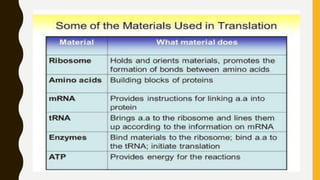
TRANSLATION REQUIRES:
• Ribosomes
• Amino Acids
• Messenger RNA (mRNA)
• Transfer RNA (tRNA)
• Enzymes
(Aminoacyl synthetase, Aminoacyl peptidase)
• ATP
FACTORS FOR TRANSLTION
1. Initiation factor
2. Elongation factor
3. Releasing factor
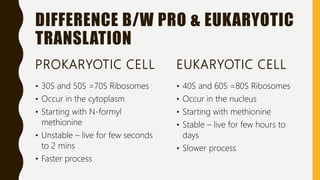
DIFFERENCE B/W PRO & EUKARYOTIC
TRANSLATION
PROKARYOTIC CELL
• 30S and 50S =70S Ribosomes
• Occur in the cytoplasm
• Starting with N-formyl
methionine
• Unstable – live for few seconds
to 2 mins
• Faster process
EUKARYOTIC CELL
• 40S and 60S =80S Ribosomes
• Occur in the nucleus
• Starting with methionine
• Stable – live for few hours to
days
• Slower process
THE END

Translation

  • 1.
    TRANSLATION S Y NT H E S I S O F P R OT E I N F R O M m R N A
  • 2.
    PRESENTED BY: A LI H A S S A N
  • 3.
    TRANSLATION • Translation isthe process of protein synthesis. • The information encoded in the mRNA is translated into amino acid sequence through the joint activity of the tRNAs and ribosomes.
  • 4.
    STAGES OF TRANSLATION •INITIATION • ELONGATION • TERMINATION
  • 5.
    TRANSLATION REQUIRES: • Ribosomes •Amino Acids • Messenger RNA (mRNA) • Transfer RNA (tRNA) • Enzymes (Aminoacyl synthetase, Aminoacyl peptidase) • ATP
  • 7.
    FACTORS FOR TRANSLTION 1.Initiation factor 2. Elongation factor 3. Releasing factor
  • 9.
    DIFFERENCE B/W PRO& EUKARYOTIC TRANSLATION PROKARYOTIC CELL • 30S and 50S =70S Ribosomes • Occur in the cytoplasm • Starting with N-formyl methionine • Unstable – live for few seconds to 2 mins • Faster process EUKARYOTIC CELL • 40S and 60S =80S Ribosomes • Occur in the nucleus • Starting with methionine • Stable – live for few hours to days • Slower process
  • 10.