Transit Oriented Development:
Addressing the Challenges and
Capitalizing on Opportunities
               Mariia Zimmerman,
               Principal
               MZ Strategies, LLC
               Mariia@MZStrategies.com


                     © all rights reserved for MZ Strategies, LLC unless
                     otherwise noted in this presentation.
What is Transit Oriented Development?
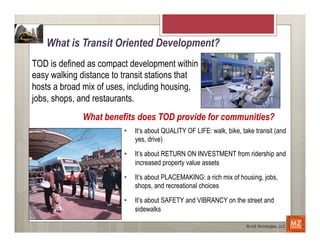
TOD is defined as compact development within
easy walking distance to transit stations that
hosts a broad mix of uses, including housing,
jobs, shops, and restaurants.
              What benefits does TOD provide for communities?
              	
             •    It’s about QUALITY OF LIFE: walk, bike, take transit (and
                      	
          yes, drive)
                             •    It’s about RETURN ON INVESTMENT from ridership and
                                  increased property value assets

                             •    It’s about PLACEMAKING: a rich mix of housing, jobs,
                                  shops, and recreational choices

                             •    It’s about SAFETY and VIBRANCY on the street and
                                  sidewalks

                                                                            © MZ Strategies, LLC
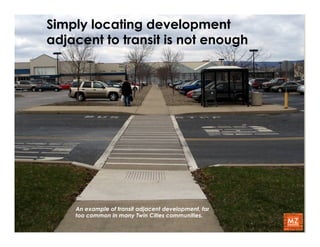
Simply locating development
adjacent to transit is not enough


    An example of transit adjacent development, far
    too common in many Twin Cities communities.
                                                      © MZ Strategies, LLC
What is Development Oriented Transit?
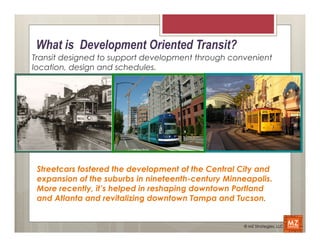
Transit designed to support development through convenient
location, design and schedules.


 Streetcars fostered the development of the Central City and
 expansion of the suburbs in nineteenth-century Minneapolis.
 More recently, it’s helped in reshaping downtown Portland
 and Atlanta and revitalizing downtown Tampa and Tucson.


                                                    © MZ Strategies, LLC
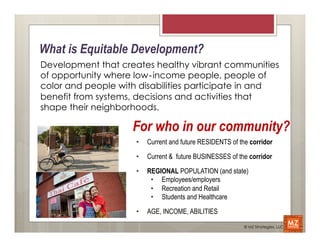
What is Equitable Development?
Development that creates healthy vibrant communities
of opportunity where low‐income people, people of
color and people with disabilities participate in and
benefit from systems, decisions and activities that
shape their neighborhoods.

                    For who in our community?
                     •    Current and future RESIDENTS of the corridor

                     •    Current & future BUSINESSES of the corridor

                     •    REGIONAL POPULATION (and state)
                           •  Employees/employers
                           •  Recreation and Retail
                           •  Students and Healthcare

                     •    AGE, INCOME, ABILITIES
                                                            © MZ Strategies, LLC
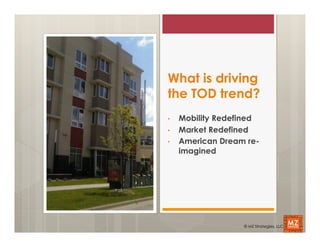
What is driving
the TOD trend?
•    Mobility Redefined
•    Market Redefined
•    American Dream re-
     imagined


                   © MZ Strategies, LLC
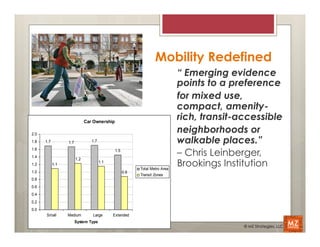
Mobility Redefined
                                                                             “ Emerging evidence
                                                                             points to a preference
                                                                             for mixed use,
                                                                             compact, amenity-
                              Car Ownership
                                                                             rich, transit-accessible
2.0
                                                                             neighborhoods or
1.8   1.7         1.7            1.7                                         walkable places.”
                                                                             – Chris Leinberger,
1.6                                           1.5
1.4

                                                                             Brookings Institution
                        1.2
                                       1.1
1.2         1.1
                                                          Total Metro Area
1.0                                                 0.9
                                                          Transit Zones
0.8
0.6
0.4
0.2
0.0
      Small       Medium         Large       Extended
                        System Type
                                                                                            © MZ Strategies, LLC
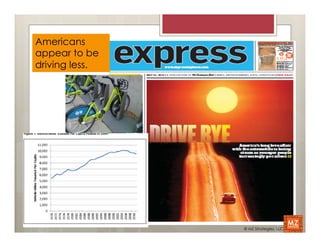
Americans
appear to be
driving less.


                © MZ Strategies, LLC
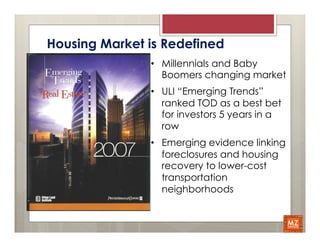
Housing Market is Redefined
               •  Millennials and Baby
                  Boomers changing market
               •  ULI “Emerging Trends”
                  ranked TOD as a best bet
                  for investors 5 years in a
                  row
               •  Emerging evidence linking
                  foreclosures and housing
                  recovery to lower-cost
                  transportation
                  neighborhoods
Development Response to Transit
20,000
18,000
16,000
14,000
12,000
10,000
 8,000
 6,000
 4,000
 2,000
    0
          Evanston, IL:    Portland:     Hudson-Bergen     Minneapolis:        Arlington:        Chicago: UPNW
         METRA 3 miles Streetcar 6 miles  LRT Line 15      Hiawatha 12      Rosslyn-Ballston     Commuter Line
                                             miles             miles         METROrail 3            63 miles
                                                                                 miles


               Number of new Housing Units         Amount of Development- OfficeCommercial (sq ft) x 1,000


                                                         Source: Center for Transit Oriented Development

                                                                                               © MZ Strategies, LLC
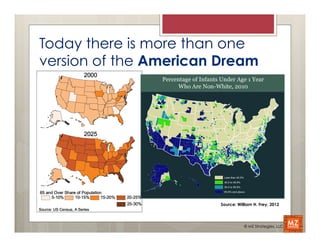
Today there is more than one
version of the American Dream


                        Source: William H. Frey, 2012


                                   © MZ Strategies, LLC
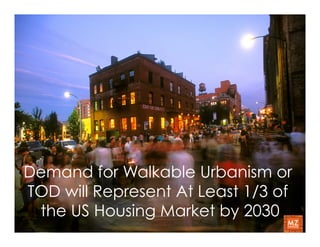
Demand for Walkable Urbanism or
TOD will Represent At Least 1/3 of
 the US Housing Market by 2030
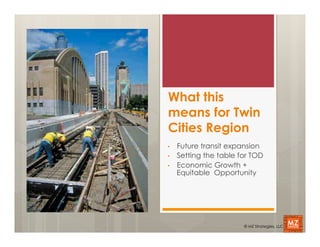
What this
means for Twin
Cities Region
•    Future transit expansion
•    Setting the table for TOD
•    Economic Growth +
     Equitable Opportunity


                        © MZ Strategies, LLC
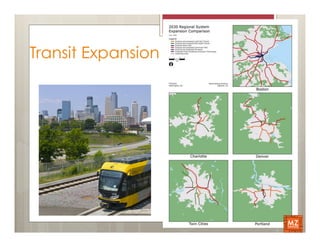
Transit Expansion
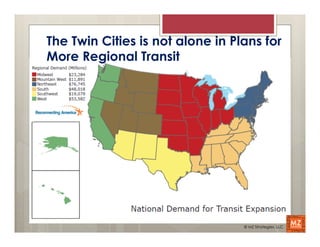
The Twin Cities is not alone in Plans for
More Regional Transit


                                  © MZ Strategies, LLC
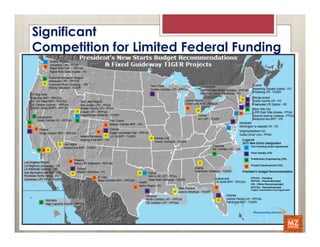
Significant
Competition for Limited Federal Funding
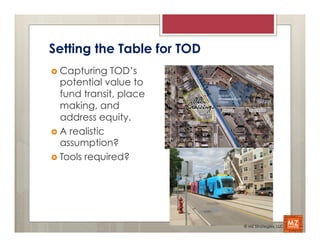
Setting the Table for TOD
›  Capturing   TOD’s
    potential value to
    fund transit, place
    making, and
    address equity.
›  A realistic
    assumption?
›  Tools required?


                            © MZ Strategies, LLC
Challenges and Timing for
Aligning Transit + Development
                            ›  Route   Alignment and
“We were behind the
                                Station Location
curve with Hiawatha,        ›  Station Area
we’re with the curve            Planning
on Central, and we          ›  Land Assemblage
want to be ahead of             (public/private)
                            ›  Infrastructure: transit,
the curve with                  water, housing
Southwest LRT.”             ›  Equitable
~ Commissioner McLoughlin       Development mix of
                                hsg + jobs


                                                  © MZ Strategies, LLC
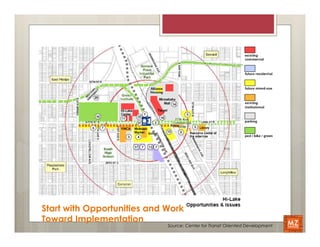
Start with Opportunities and Work
Toward Implementation
                             Source: Center for Transit Oriented Development
TOD “Silverware”
›  StationArea Planning
›  Zoning and Building Codes/Overlays/Form
    Based Codes
›  Density bonuses and time incentives
›  TIF/Special Assessment Districts/District
    Financing
›  Affordable housing trust funds/set-asides
›  Parking strategies/Car + Bike Sharing


                                           © MZ Strategies, LLC
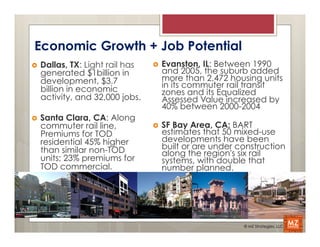
Economic Growth + Job Potential
›    Dallas, TX: Light rail has   ›    Evanston, IL: Between 1990
      generated $1billion in             and 2005, the suburb added
      development, $3.7                  more than 2,472 housing units
      billion in economic                in its commuter rail transit
                                         zones and its Equalized
      activity, and 32,000 jobs.         Assessed Value increased by
                                         40% between 2000-2004
›    Santa Clara, CA: Along
      commuter rail line,          ›    SF Bay Area, CA: BART
      Premiums for TOD                   estimates that 50 mixed-use
      residential 45% higher             developments have been
      than similar non-TOD               built or are under construction
                                         along the region's six rail
      units; 23% premiums for            systems, with double that
      TOD commercial.                    number planned.


                                                             © MZ Strategies, LLC
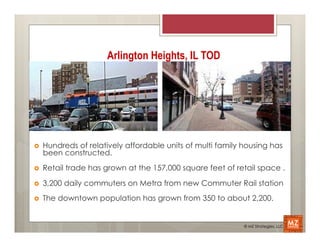
Arlington Heights, IL TOD


›    Hundreds of relatively affordable units of multi family housing has
      been constructed.
›    Retail trade has grown at the 157,000 square feet of retail space .

›    3,200 daily commuters on Metra from new Commuter Rail station
›    The downtown population has grown from 350 to about 2,200.


                                                              © MZ Strategies, LLC
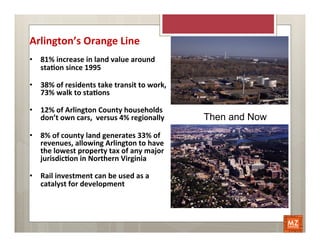
Arlington’s	
  Orange	
  Line	
  
•  81%	
  increase	
  in	
  land	
  value	
  around	
  
   sta7on	
  since	
  1995	


•  38%	
  of	
  residents	
  take	
  transit	
  to	
  work,	
  
   73%	
  walk	
  to	
  sta7ons	
  

•  12%	
  of	
  Arlington	
  County	
  households	
  
   don’t	
  own	
  cars,	
  	
  versus	
  4%	
  regionally	
      Then and Now
•  8%	
  of	
  county	
  land	
  generates	
  33%	
  of	
  
   revenues,	
  allowing	
  Arlington	
  to	
  have	


   the	
  lowest	
  property	
  tax	
  of	
  any	
  major	
  
   jurisdic7on	
  in	
  Northern	
  Virginia	
  

•  Rail	
  investment	
  can	
  be	
  used	
  as	
  a	
  	
  
   catalyst	
  for	
  development	
  
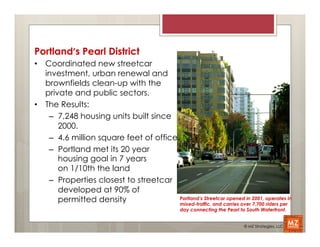
Portland’s Pearl District	
  
•  Coordinated new streetcar
   investment, urban renewal and
   brownfields clean-up with the
   private and public sectors.
•  The Results:
    –  7,248 housing units built since
       2000.
    –  4.6 million square feet of office
    –  Portland met its 20 year
       housing goal in 7 years
       on 1/10th the land
    –  Properties closest to streetcar
       developed at 90% of
       permitted density                 Portland’s Streetcar opened in 2001, operates in
                                         mixed-traffic, and carries over 7,700 riders per
                                                  day connecting the Pearl to South Waterfront.


                                                                             © MZ Strategies, LLC
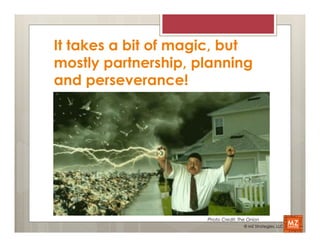
It takes a bit of magic, but
mostly partnership, planning
and perseverance!


                     Photo Credit: The Onion
                                     © MZ Strategies, LLC
31

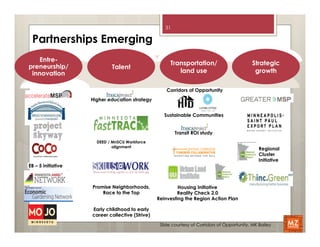
 Partnerships Emerging
    Entre-
                                                      Transportation/                         Strategic
preneurship/                Talent
 innovation                                              land use                              growth

                                                     Corridors of Opportunity
                    Higher education strategy


                                                    Sustainable Communities


                                                         Transit ROI study
                      DEED / MnSCU Workforce
                             alignment
                                                                                                 Regional
                                                                                                 Cluster
                                                                                                 Initiative
EB – 5 initiative


                    Promise Neighborhoods,                Housing Initiative
                        Race to the Top                   Reality Check 2.0
                                                 Reinvesting the Region Action Plan

                    Early childhood to early
                    career collective (Strive)

                                                  Slide courtesy of Corridors of Opportunity, MK Bailey
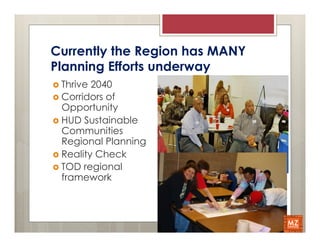
Currently the Region has MANY
Planning Efforts underway
›  Thrive 2040
›  Corridors of
    Opportunity
›  HUD Sustainable
    Communities
    Regional Planning
›  Reality Check
›  TOD regional
    framework
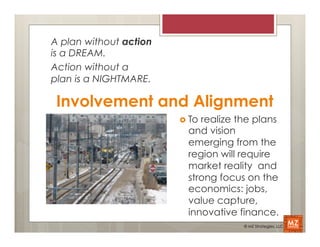
A plan without action
is a DREAM.
Action without a
plan is a NIGHTMARE.

 Involvement and Alignment
                        ›  To
                             realize the plans
                          and vision
                          emerging from the
                          region will require
                          market reality and
                          strong focus on the
                          economics: jobs,
                          value capture,
                          innovative finance.
                                      © MZ Strategies, LLC

Policy Forum Series: Zimmerman - Transit Oriented Development-Addressing the Challenges and Capitalizing on Opportunities

  • 1.
    Transit Oriented Development: Addressingthe Challenges and Capitalizing on Opportunities Mariia Zimmerman, Principal MZ Strategies, LLC Mariia@MZStrategies.com © all rights reserved for MZ Strategies, LLC unless otherwise noted in this presentation.
  • 2.
    What is TransitOriented Development? TOD is defined as compact development within easy walking distance to transit stations that hosts a broad mix of uses, including housing, jobs, shops, and restaurants. What benefits does TOD provide for communities?   •  It’s about QUALITY OF LIFE: walk, bike, take transit (and   yes, drive) •  It’s about RETURN ON INVESTMENT from ridership and increased property value assets •  It’s about PLACEMAKING: a rich mix of housing, jobs, shops, and recreational choices •  It’s about SAFETY and VIBRANCY on the street and sidewalks © MZ Strategies, LLC
  • 3.
    Simply locating development adjacentto transit is not enough An example of transit adjacent development, far too common in many Twin Cities communities. © MZ Strategies, LLC
  • 4.
    What is DevelopmentOriented Transit? Transit designed to support development through convenient location, design and schedules. Streetcars fostered the development of the Central City and expansion of the suburbs in nineteenth-century Minneapolis. More recently, it’s helped in reshaping downtown Portland and Atlanta and revitalizing downtown Tampa and Tucson. © MZ Strategies, LLC
  • 5.
    What is EquitableDevelopment? Development that creates healthy vibrant communities of opportunity where low‐income people, people of color and people with disabilities participate in and benefit from systems, decisions and activities that shape their neighborhoods. For who in our community? •  Current and future RESIDENTS of the corridor •  Current & future BUSINESSES of the corridor •  REGIONAL POPULATION (and state) •  Employees/employers •  Recreation and Retail •  Students and Healthcare •  AGE, INCOME, ABILITIES © MZ Strategies, LLC
  • 7.
    What is driving theTOD trend? •  Mobility Redefined •  Market Redefined •  American Dream re- imagined © MZ Strategies, LLC
  • 8.
    Mobility Redefined “ Emerging evidence points to a preference for mixed use, compact, amenity- Car Ownership rich, transit-accessible 2.0 neighborhoods or 1.8 1.7 1.7 1.7 walkable places.” – Chris Leinberger, 1.6 1.5 1.4 Brookings Institution 1.2 1.1 1.2 1.1 Total Metro Area 1.0 0.9 Transit Zones 0.8 0.6 0.4 0.2 0.0 Small Medium Large Extended System Type © MZ Strategies, LLC
  • 9.
    Americans appear to be drivingless. © MZ Strategies, LLC
  • 10.
    Housing Market isRedefined •  Millennials and Baby Boomers changing market •  ULI “Emerging Trends” ranked TOD as a best bet for investors 5 years in a row •  Emerging evidence linking foreclosures and housing recovery to lower-cost transportation neighborhoods
  • 11.
    Development Response toTransit 20,000 18,000 16,000 14,000 12,000 10,000 8,000 6,000 4,000 2,000 0 Evanston, IL: Portland: Hudson-Bergen Minneapolis: Arlington: Chicago: UPNW METRA 3 miles Streetcar 6 miles LRT Line 15 Hiawatha 12 Rosslyn-Ballston Commuter Line miles miles METROrail 3 63 miles miles Number of new Housing Units Amount of Development- OfficeCommercial (sq ft) x 1,000 Source: Center for Transit Oriented Development © MZ Strategies, LLC
  • 12.
    Today there ismore than one version of the American Dream Source: William H. Frey, 2012 © MZ Strategies, LLC
  • 13.
    Demand for WalkableUrbanism or TOD will Represent At Least 1/3 of the US Housing Market by 2030
  • 14.
    What this means forTwin Cities Region •  Future transit expansion •  Setting the table for TOD •  Economic Growth + Equitable Opportunity © MZ Strategies, LLC
  • 15.
  • 20.
    The Twin Citiesis not alone in Plans for More Regional Transit © MZ Strategies, LLC
  • 21.
  • 22.
    Setting the Tablefor TOD ›  Capturing TOD’s potential value to fund transit, place making, and address equity. ›  A realistic assumption? ›  Tools required? © MZ Strategies, LLC
  • 23.
    Challenges and Timingfor Aligning Transit + Development ›  Route Alignment and “We were behind the Station Location curve with Hiawatha, ›  Station Area we’re with the curve Planning on Central, and we ›  Land Assemblage want to be ahead of (public/private) ›  Infrastructure: transit, the curve with water, housing Southwest LRT.” ›  Equitable ~ Commissioner McLoughlin Development mix of hsg + jobs © MZ Strategies, LLC
  • 24.
    Start with Opportunitiesand Work Toward Implementation Source: Center for Transit Oriented Development
  • 25.
    TOD “Silverware” ›  StationAreaPlanning ›  Zoning and Building Codes/Overlays/Form Based Codes ›  Density bonuses and time incentives ›  TIF/Special Assessment Districts/District Financing ›  Affordable housing trust funds/set-asides ›  Parking strategies/Car + Bike Sharing © MZ Strategies, LLC
  • 26.
    Economic Growth +Job Potential ›  Dallas, TX: Light rail has ›  Evanston, IL: Between 1990 generated $1billion in and 2005, the suburb added development, $3.7 more than 2,472 housing units billion in economic in its commuter rail transit zones and its Equalized activity, and 32,000 jobs. Assessed Value increased by 40% between 2000-2004 ›  Santa Clara, CA: Along commuter rail line, ›  SF Bay Area, CA: BART Premiums for TOD estimates that 50 mixed-use residential 45% higher developments have been than similar non-TOD built or are under construction along the region's six rail units; 23% premiums for systems, with double that TOD commercial. number planned. © MZ Strategies, LLC
  • 27.
    Arlington Heights, ILTOD ›  Hundreds of relatively affordable units of multi family housing has been constructed. ›  Retail trade has grown at the 157,000 square feet of retail space . ›  3,200 daily commuters on Metra from new Commuter Rail station ›  The downtown population has grown from 350 to about 2,200. © MZ Strategies, LLC
  • 28.
    Arlington’s  Orange  Line   •  81%  increase  in  land  value  around   sta7on  since  1995     •  38%  of  residents  take  transit  to  work,   73%  walk  to  sta7ons   •  12%  of  Arlington  County  households   don’t  own  cars,    versus  4%  regionally   Then and Now •  8%  of  county  land  generates  33%  of   revenues,  allowing  Arlington  to  have       the  lowest  property  tax  of  any  major   jurisdic7on  in  Northern  Virginia   •  Rail  investment  can  be  used  as  a     catalyst  for  development  
  • 29.
    Portland’s Pearl District   •  Coordinated new streetcar investment, urban renewal and brownfields clean-up with the private and public sectors. •  The Results: –  7,248 housing units built since 2000. –  4.6 million square feet of office –  Portland met its 20 year housing goal in 7 years on 1/10th the land –  Properties closest to streetcar developed at 90% of permitted density Portland’s Streetcar opened in 2001, operates in mixed-traffic, and carries over 7,700 riders per day connecting the Pearl to South Waterfront. © MZ Strategies, LLC
  • 30.
    It takes abit of magic, but mostly partnership, planning and perseverance! Photo Credit: The Onion © MZ Strategies, LLC
  • 31.
    31 Partnerships Emerging Entre- Transportation/ Strategic preneurship/ Talent innovation land use growth Corridors of Opportunity Higher education strategy Sustainable Communities Transit ROI study DEED / MnSCU Workforce alignment Regional Cluster Initiative EB – 5 initiative Promise Neighborhoods, Housing Initiative Race to the Top Reality Check 2.0 Reinvesting the Region Action Plan Early childhood to early career collective (Strive) Slide courtesy of Corridors of Opportunity, MK Bailey
  • 32.
    Currently the Regionhas MANY Planning Efforts underway ›  Thrive 2040 ›  Corridors of Opportunity ›  HUD Sustainable Communities Regional Planning ›  Reality Check ›  TOD regional framework
  • 33.
    A plan withoutaction is a DREAM. Action without a plan is a NIGHTMARE. Involvement and Alignment ›  To realize the plans and vision emerging from the region will require market reality and strong focus on the economics: jobs, value capture, innovative finance. © MZ Strategies, LLC