IBM Global Business Services                                           Automotive Industry
Executive Report


IBM Institute for Business Value


Transforming retail
Engaging customers through information, influencers and interactions
IBM Institute for Business Value
IBM Global Business Services, through the IBM Institute for Business Value, develops
fact-based strategic insights for senior executives around critical public and private
sector issues. This executive report is based on an in-depth study by the Institute’s
research team. It is part of an ongoing commitment by IBM Global Business Services
to provide analysis and viewpoints that help companies realize business value.
You may contact the authors or send an e-mail to iibv@us.ibm.com for more information.
Additional studies from the IBM Institute for Business Value can be found at
ibm.com/iibv
Introduction


By Kalman Gyimesi and Benjamin Stanley


The automotive retail landscape is in the midst of
revolution. Confronted by consumers who demand highly personalized products and services,
automakers must cast aside traditions more than a century old and pursue innovative new retail
business models. They must embrace the expectations of sophisticated consumers, enable
collaboration across a broader sales ecosystem and facilitate new revenue streams. To navigate
this changing marketplace, automakers can solve the retail puzzle by demonstrating excellence
across four dimensions that can turn today’s discerning customer into tomorrow’s valued
advocate.

The automotive industry’s retail model is at a crossroads.          Other consumer-focused industries have seen their business
Having sold cars essentially the same way for more than a           models upended as a result of the wealth of information and
century – based on a carefully built brand image, on-road           number of choices available to almost everyone today. Auto-
performance, safety features and freedom of ownership – the         makers must follow a similar path to that forged by such
industry must now look to create differentiated offerings that      industries as electronics and telecommunications, where use of
appeal to today’s digitally connected, sophisticated consumer.      multiple technologies to research, compare and purchase
                                                                    products and services has created new opportunities for
Consumers are now turning their attention to their mobility         individualized offerings, new distribution channels and
needs and are expecting their cars to deliver the same capabili-    profitable partnerships.
ties and conveniences as their other smart “devices.” They are
viewing their cars in the same light as their tablets and mobile    Already many industries are changing how they reach out and
devices, which means they are not only looking for quality, safe,   win over these consumers. The retail industry, for example, is
reliable transportation, but are also beginning to view their       customizing in-store shopping experiences, adding digital
vehicles as another extension of their digitally connected lives.   distribution channels and providing a seamless segue from
                                                                    online browsing to brick-and-mortar purchasing.1 Other B2C
                                                                    enterprises, across almost every product category, are capturing
                                                                    information at every touch point to improve the consumer
                                                                    experience with their products and services.
Connectivity and use of multiple technologies is
transforming retail across a broad array of industries.
2    Transforming retail


For the automotive industry, the retail model in place is nearly          Automotive executives are keenly aware of how their customers
the same as when the first Model T rolled off the assembly line           are changing. In a recent IBM Institute for Business Value
more than a century ago. From the beginning of mass manu-                 survey of more than 100 automotive executives, customer
facturing, cars have been targeted to generalized market                  management was cited as the part of the automotive value
segments based on performance, appearance, reliability, safety            chain that will change the most over the next decade.2 Overall,
and price. To capitalize on today’s new generation of                     67 percent of the executives we surveyed recognize that
consumers, however, the industry must become more creative                substantial changes are ahead in automotive retail. These
in how it introduces new products, develops services and                  executives recognize that, with all of the new ways to interact
engages with its customers. Automakers, their partners and                with customers across the commerce cycle, rethinking
suppliers recognize that traditional methods of selling and               customer management will be the most important ingredient
promoting their products must give way to the mandates of the             to developing new retail models.
digital age. In just a few years, the industry has begun moving
from limited, infrequent transactions with customers to a                 One of the key ingredients to developing stronger, ongoing
rapidly developing network of information and interactions                customer relationships is the integration of data from those
that enables automotive companies to know and understand                  activities that generate the most frequent customer interaction
buying preferences and habits in new ways (see Figure 1).                 (see figure 2).


        Historical customer touch points                                  New touch points that enable greater customer understanding

                                                                                        Search optimization
                                                                                   Social networking
                                                                                                                                 Mobility services
                                                                                       E-mail/text
                                                                                                                  In V
                                                                                 Viral marketing              e
                                                                                                         n


                                                                                                                       eh
                                                                                                       Onli


                                                                                         Portals                                      Connected
                                                                                                                          icle


                           Retail                                                                                                     services
                                                                                    Blogs/user
    Purchase                                   Finance                              communities
      History                                  packaging                                                      Retail
                 Warranty            Service
                  history            history

Source: IBM Institute for Business Value.


Figure 1: Automakers are increasingly using online tools, vehicle connectivity and mobility services to connect with customers.
IBM Global Business Services   3


              What will be the most valuable aspects of integrated
              customer information?

                   Vehicle service history          82%                    •	Data is important but is
                Vehicle purchase history            73%                      semi-annual or less frequent
                                                                           •	Touch points with customers are
             Finance/profitability history          61%                      transactional and not interactive
       Mobility service usage patterns              54%
                                                                           •	Data is weekly to daily
Other online/social media interaction               52%
                                                                           •	Touch points with customer are
   Connected vehicle usage patterns                 52%                      frequent
                                                                           •	Enables relationships through
                  Call center interactions          49%
                                                                             ongoing engagement with
              OEM website interactions              44%                      customers, deeper insights to
                                                                             their needs and marketplace
                                                                             patterns
Source: Transforming Retail Survey (n=110), 2011.


Figure 2: Stronger, ongoing partnerships with customers require greater investment in developing and integrating data from the activities that
occur most often.


The extent to which this data is used and shared differentiates          To capitalize on the opportunities presented by today’s
outperforming organizations from others. In the 2011 IBM                 hyper-connected, empowered consumers and the vast amount
Global Chief Marketing Officer Study, outperformers                      of customer information this connectedness provides them,
indicated they apply customer data extensively in every aspect           automakers must solve the retail puzzle by demonstrating
of the customer lifecycle.3 While enhancing customer loyalty             innovation and excellence across four dimensions: Disruptive
and advocacy is the highest priority for automakers, their               Differentiation, Connected Experience, Social Reach and
application of data is lowest across the “usage” and “advocacy”          Channel Transparency (see Figure 3).
customer lifecycle phases.4
4   Transforming retail


                                             What to buy?                                        How to buy?

                             Disruptive Differentiation                                          Social Reach
                                             Accelerate                                          Engage
                                        development of                                           customers through
                                differentiating offerings                                        social innovation


                                Connected Experience                                             Transparent Channels
                                        Capitalize on                                            Enable
                                      opportunities to                                           new channels for product,
                                        ensure loyalty                                           services and revenue

Sources: IBM Institute for Business Value.


Figure 3: Transforming the retail puzzle requires excellence across four dimensions to turn today’s consumers into valued customers.


Disruptive Differentiation
The path to successful retail starts with outstanding products.          Study methodology
Fresh new vehicles, electronics, connectivity and services are
                                                                         Quantitative data for this study was obtained through an
coming to the market at an ever-increasing pace. The potential           online survey of 110 automotive industry executives in 18
exists for the industry to consolidate these trends and create           countries. Of these responses, 38 percent were from OEMs
new offerings that disrupt the status quo through innovation             and 20 percent from dealers, with the rest of the responses
that changes the market and even creates new value or markets.           representing executives across suppliers, captive finance
                                                                         organizations, solution providers and others.
Product development, in fact, trailed only customer manage-
                                                                         Additionally, follow-up interviews were conducted with a
ment in the assessment of executives in our survey of what
                                                                         number of these industry leaders. We also used data from
aspect of the automotive value chain will change most over the
                                                                         the IBM Global Chief Marketing Officer Study, in which 70
next decade. And automotive CEOs interviewed for the IBM
                                                                         senior marketing executives from the automotive industry
2010 Global Chief Executive Officer Study said they expect
                                                                         were interviewed, to corroborate and amplify our findings.5
new or different products and services will be their leading
responses to changing customer expectations over the next five
years.6 Automakers are already acting in this regard. In a
presentation at an automotive conference earlier this year, one
manufacturer indicated it is pushing for 20 new product
introductions over the next 24 months.7                                  “We need a customer-centric mindset. We must commit
                                                                         more time to incorporating the “voice of the customer”
                                                                         into our offerings.”
                                                                         President, Automotive OEM, Japan
IBM Global Business Services   5


While a vibrant vehicle pipeline has been a core competency                           Automakers will also need to think beyond the vehicle and
for automakers for decades, the industry is now recognizing                           offer mobility services that address traffic congestion, provide
that products themselves account for only half the picture in                         integration with other relevant transportation modes and
attracting and retaining new customers. New services that                             decrease the cost of ownership.
appeal to today’s connected consumer are also critical. Nearly
seven of ten automotive CEOs said new or different services                           Capitalizing on personalization
will be the biggest area of customer demand over the next few                         In today’s connected society, where consumers are openly
years.8                                                                               vocal about their individual likes and dislikes, differentiation
                                                                                      usually means personalization.
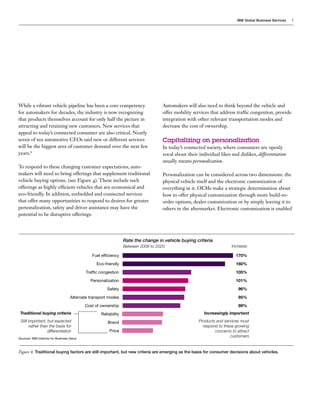
To respond to these changing customer expectations, auto-
makers will need to bring offerings that supplement traditional                       Personalization can be considered across two dimensions: the
vehicle buying options. (see Figure 4). These include such                            physical vehicle itself and the electronic customization of
offerings as highly efficient vehicles that are economical and                        everything in it. OEMs make a strategic determination about
eco-friendly. In addition, embedded and connected services                            how to offer physical customization through more build-to-
that offer many opportunities to respond to desires for greater                       order options, dealer customization or by simply leaving it to
personalization, safety and driver assistance may have the                            others in the aftermarket. Electronic customization is enabled
potential to be disruptive offerings.


                                                                   Rate the change in vehicle buying criteria
                                                                   Between 2008 to 2020                                  Increase

                                                Fuel efficiency                                                             170%

                                                  Eco-friendly                                                              160%

                                             Traffic congestion                                                             105%

                                               Personalization                                                              101%

                                                        Safety                                                               96%

                                    Alternate transport modes                                                                95%

                                             Cost of ownership                                                               89%
 Traditional buying criteria                         Reliability                                           Increasingly important
 Still important, but expected                           Brand                                          Products and services must
        rather than the basis for                                                                         respond to these growing
                   differentiation                        Price                                                 concerns to attract
Sources: IBM Institute for Business Value.
                                                                                                                        customers


Figure 4: Traditional buying factors are still important, but new criteria are emerging as the basis for consumer decisions about vehicles.
6   Transforming retail


by providing customers with the ability to control various           Finding and capitalizing on customer touch points should be a
vehicle features from any location though software and apps.         benefit of enabling new vehicle features, regardless of whether
For example, many manufacturers provide a remote vehicle             they are proprietary or open. Through continuously collecting
start through the key fob; however, on very cold or hot days         data about customers and their vehicle usage, automakers can
this will not help the vehicle be more comfortable unless the        target specific solutions to individual preferences. Ultimately,
climate controls are set properly. A more personalized solution      OEMs can build customer reliance upon a particular method
would offer access to the entire climate system through a smart      of electronic control and create customer “stickiness” to the
phone. Climate and vehicle adjustments could be made                 products and services of their specific brands.
remotely, removing the need to preset the vehicle manually.
                                                                     Componentizing and repackaging the right products and
Electronics can be further personalized by offering various          services into compelling offerings will afford automakers
interfaces, or “skins,” that appeal to different target audiences.   flexibility in both pricing and selling their products to diverse
The virtual interfaces for highly connected young adults might       audiences. Packages can be tailored for differentiation
look very different than interfaces to more selectively              according to individual needs, climate, parking location or,
connected seniors. Reducing electronic components to their           even, the needs of additional passengers. Vehicles can also be
basic building blocks will allow them to be creatively bundled       componentized according to generational needs (see sidebar,
and packaged for various demographic groups.                         “Complex multi-generational families”).

While build-to-order remains within the direct control of            Differentiating for success
automakers, electronic customization is likely to become a           Vehicles have become increasingly difficult to differentiate
battleground between OEMs and third parties – such as                from the similar offerings of competitors. The acceleration of
telecommunications and media and entertainment companies             development of fresh vehicles, products and services that
– that are already far along the personalized electronics            disrupt the current value expectations of customers gives
learning curve.                                                      automakers the opportunity to break away from this paradigm.

To influence that segment of electronics customization beyond        Differentiate the platform
their direct control, OEMs must work with selected partners to       Determine the best opportunities to differentiate product and
implement open-standard vehicle enhancements and conve-              service offerings physically, electronically and virtually. The
niences. They should not waste resources trying to control           extent of physical customization offered through the design of
features that are easily supplied by others, but, instead, focus     the vehicle is a strategic choice. It can be offered either
on enabling and amplifying these capabilities to the best            through online configurators, pushing toward build-to-order
advantage of their product offerings.                                sales models or through dealer-driven personalization.
                                                                     However, electronic personalization will be a necessity to
                                                                     effectively compete in the future. Strategically, automakers
                                                                     must separate the electronic personalization they can control
                                                                     from what can best be left open to external innovation.
IBM Global Business Services   7


Create the building blocks                                         Package to the audience
Every aspect of the vehicle and the interaction with it is being   Automakers have long excelled at packaging physical vehicle
electrified. Automakers should aggressively incorporate            features into bundles. Electronic components can be treated in
electronic components and enable control through remote            similar fashion. However, electronic components provide much
apps. Even previously obscure aspects of personal comfort          greater flexibility into how they are bundled based on indi-
should be fully electrified and available for customization. By    vidual preferences, demographics or geographic locations. This
reducing these features to their core building blocks, they can    provides a new differentiating capability of appeal to all
then be packaged and positioned according to diverse needs         relevant audiences and the ability to sell and price flexibly.
of customers based on their preferences, geography and
vehicle use.


Complex multi-generational families
Could automakers more effectively help extended families           Seniors are the fastest growing demographic on the Internet,
single-source their transportation needs across generations?       but are likely to be more selectively connected in their
                                                                   vehicles. They will want easy and simplified access to
Auto companies have long understood and targeted their
                                                                   navigation, driver assistance and vehicle service. Their
vehicles at specific demographic groups. Young adults often
                                                                   families will be interested in safety, security and location
look for basic entry-level vehicles. Growing families require
                                                                   tracking.
larger, more spacious cars to move their children. Finally,
after the children grow up, active seniors refocus on smaller,     Often the middle generation exerts significant influence in
comfortable vehicles.                                              helping both their children and parents select vehicles and
                                                                   services. Connectivity and electronic personalization can
The right vehicles also have to be coupled with the right
                                                                   help tie the generations together into interconnected,
mobility services. Young people are often more urban and
                                                                   collaborative families. As their families grow, they will want
have less discretionary spending. They need access to
                                                                   electronics that are portable across different vehicles and
public transit. At the same time, growing families may need
                                                                   will be interested in infotainment and information services.
occasional access to different types of cars from their
                                                                   Their mobility service needs would entail occasional access
primary vehicles.
                                                                   to a variety of vehicles for many uses, such as a van or SUV
Young adults are already highly connected and will welcome         for family highway trips, or a small sports car or hybrid for
the ability to select the electronic “skin” to their vehicles.     longer one-or-two-person trips.
They will want to extensively configure electronics. Parents
                                                                   If automakers can reduce electronic capabilities down to
will be concerned about safe driving and usage of social
                                                                   their components, they can then be reassembled into
media in cars for their children, as well as proactive vehicle
                                                                   packages that appeal to various demographic groups and
maintenance alerting. The younger generation may also need
                                                                   managed across interconnected collaborative families. By
to have occasional access to vehicles while traveling or
                                                                   considering how to bundle offerings to whole family units,
away at college.
                                                                   automakers have the potential to develop lifelong customer
                                                                   advocates.
8    Transforming retail


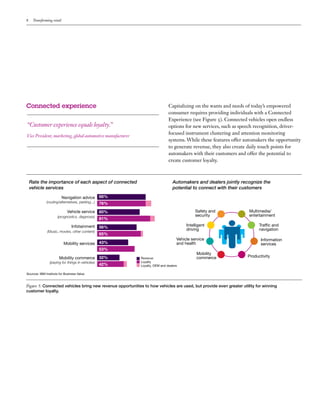
Connected experience                                                          Capitalizing on the wants and needs of today’s empowered
                                                                              consumer requires providing individuals with a Connected
                                                                              Experience (see Figure 5). Connected vehicles open endless
“C                                                  ty.”                      options for new services, such as speech recognition, driver-
                                                                              focused instrument clustering and attention monitoring
Vice President, marketing, global automotive manufacturer
                                                                              systems. While these features offer automakers the opportunity
                                                                              to generate revenue, they also create daily touch points for
                                                                              automakers with their customers and offer the potential to
                                                                              create customer loyalty.


    Rate the importance of each aspect of connected                              Automakers and dealers jointly recognize the
    vehicle services                                                             potential to connect with their customers

                           Navigation advice       68%
              (routing/alternatives, parking...)   76%
                             Vehicle service       60%                                       Safety and             Multimedia/
                      (prognostics, diagnosis)                                               security               entertainment
                                                   81%
                                Infotainment       56%                                  Intelligent                      Traffic and
              (Music, movies, other content)
                                                                                        driving                          navigation
                                                   65%
                                                                                   Vehicle service                        Information
                            Mobility services      43%                             and health                             services
                                                   53%
                                                                                              Mobility
                       Mobility commerce           32%      Revenue                           commerce             Productivity
                (paying for things in vehicles)             Loyalty
                                                   42%      Loyalty, OEM and dealers

Sources: IBM Institute for Business Value.


Figure 5: Connected vehicles bring new revenue opportunities to how vehicles are used, but provide even greater utility for winning
customer loyalty.
IBM Global Business Services   9


The spectrum of connected services
Vast opportunities are available for automakers to serve                                Automakers should focus on enabling and amplifying
drivers and passengers through connected vehicles. With                                 connected services that customers will likely bring into
the rise of smart devices, it’s inevitable that customers will                          vehicles. For example, they can allow easy access to power
bring these devices into their vehicles and want to use them                            sources and recharging from every seat in the vehicle.
to enhance their experience as they are moving about.                                   “Dumb screens” that enhance display and content viewing
Automakers must consider what aspects of telematics and                                 to passengers through their devices can be added. Signal
vehicle connectivity they will be able to differentiate                                 boosters can be embedded in vehicles to detect and
themselves with and what will be ultimately co-opted by                                 increase wireless reception. OEMs must resist trying to
third parties.                                                                          compete for content with smart device providers, which have
                                                                                        greater resources and more sophisticated solutions. Instead,
Additionally, they will have to decide where to concentrate
                                                                                        they should pick the elements of the connected spectrum
limited IT resources to compete across a spectrum of
                                                                                        where they can provide differentiated offerings.
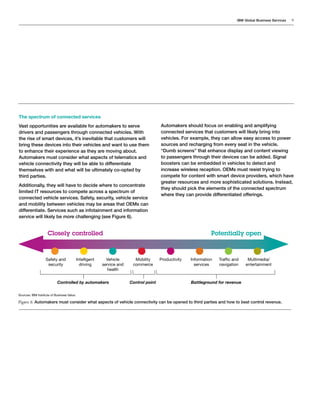
connected vehicle services. Safety, security, vehicle service
and mobility between vehicles may be areas that OEMs can
differentiate. Services such as infotainment and information
service will likely be more challenging (see Figure 6).


                    Closely controlled                                                                           Potentially open


                   Safety and               Intelligent     Vehicle       Mobility      Productivity   Information   Traffic and    Multimedia/
                    security                  driving     service and    commerce                        services    navigation    entertainment
                                                            health


                           Controlled by automakers                     Control point                  Battleground for revenue

Sources: IBM Institute of Business Value.

Figure 6: Automakers must consider what aspects of vehicle connectivity can be opened to third parties and how to best control revenue.
10    Transforming retail


The rapid growth of vehicle and device connectivity provides        Automakers then can provide solutions to seamlessly move a
greater opportunities to link customers to products and             customer’s persona between any of its vehicles to make the
services for long-term relationships. For example, by 2016 in       experience uniform. Vehicle interchangeability allows auto-
the United States, there are expected to be 150 million in-car      makers to sell the appeal of the entire brand and vehicle
Internet users and 30 million Internet radio users. More than       portfolio to all customers rather than just focusing on indi-
210 million connected cars are expected to be sold in mature        vidual models.
markets. Application usage will accelerate 40 fold, with more
than 129 million users of smartphone applications in cars.9         Ultimately, integrating vehicles with other modes of transpor-
                                                                    tation allows automakers to sell mobility as a subscription
These projections are in line with what we learned from the         service across transportation modes. As urbanization continues
2011 IBM Global Chief Marketing Officer Study. In that study,       its multi-decade transformation of population centers, the
64 percent of automotive marketing officers told us that            ability to move between modes easily will be a key component
enhancing customer loyalty and advocacy was their highest           to ensure that cars remain relevant and retain their place in the
priority as they begin enabling digital technologies. That          transportation mix.
jumped even higher to 70 percent when considering CMOs
from just automotive OEMs.10                                        Connectivity also provides the opportunity to delight
                                                                    customers by changing the service equation. Very few customer
All members of the automotive value chain should recognize          experiences with their vehicles are as unpleasant as having
the potential to connect with customers. To accomplish this,        them serviced. The Connected Experience offers an opportu-
gathering and sharing the increasing amount of customer data        nity for remote service of vehicles and less direct maintenance.
available across the value chain is essential if OEMs, dealers
and other partners are to understand and be able to meet the        Capitalizing on connection
changing demands of today’s consumers.                              Automakers should take every opportunity to use vehicle
                                                                    connectivity to link customers to products and services.
Connectivity making a difference
One of the inevitable byproducts of connectivity may be the         Connect for loyalty
interchangeability of vehicles. Enabling a single persona across    Connected vehicles present the best opportunity for auto-
a vehicle portfolio differentiates from feature, function and       makers to interact with their customers every time they use
price comparisons of models with competitors. Customers             their car. They can use this information to developed personal-
could personalize on several parameters, including:                 ized solutions and enhance customer loyalty by making it
                                                                    difficult or inconvenient for them to switch brands. The most
•	   Vehicle settings and adjustments                               valuable connected features are those that help drivers get
•	   Customization of the layout and information presented on the   where they are going most efficiently and keep them informed
     dashboard                                                      about their trip and their vehicle. Ultimately, this gives
•	   Music, media and other content                                 automakers the opportunity to focus on customer trust and
•	   Calendar and business applications                             loyalty. Trust drives advocacy, which, in turn, drives customer
•	   Navigation and routing through varying parameters.             spend.11 Concentrate on loyalty and the revenue will come.
IBM Global Business Services   11


Focus on opportunity                                                Despite this unpreparedness, both OEMs and dealers must
There are many opportunities for connected services from            learn to engage customers and prospects through social media
which third parties can be excluded, such as safety, vehicle        and other channels. Social engagement and conversations are
service, remote control of vehicle parameters and full porta-       increasingly differentiating the most successful automotive
bility of a personalized electronics profile between vehicles.      offerings and reinforcing that consumers still have an ongoing
Invest and protect connected applications that cannot be easily     passion for automobiles and their brands. In fact, OEMs and
replicated by third parties or competitors. Automakers have         dealers are generally aligned in the role social media plays in
limited IT resources, which should be concentrated on               their businesses (see Figure 7). The only real point of discon-
providing exciting solutions in areas others cannot reach.          nection our interviews revealed is that dealers would like to be
                                                                    more aware and engaged in OEM social media initiatives.
Integrate and amplify
Connected vehicles provide numerous opportunities. In areas
such as infotainment, productivity, e-mail or social media
usage, it will be difficult for automakers to compete with other    Rate the benefits of social media/business activity
solution providers. Instead, they should partner with               for automakers
companies adept at these types of services, such as telecommu-        Understanding public perception            85%
nications providers. OEMs should accommodate devices that                     of company and brands              91%
drivers and passengers bring into vehicles and improve their                                                     80%
experience while there. Focus should be on inexpensive                Building brand image and loyalty
                                                                                                                 91%
enablers, such as easy access to power, simple screens for device
                                                                       Building overall corporate image          78%
connection and signal boosters to improve reception.                                      and reputation         86%

                                                                            Understanding new industry           63%
Social Reach                                                                            developments             59%
Social media is booming and is no longer the exclusive domain
of the younger generation. Yet, 62 percent of automotive Chief                      Generating sales leads       53%
Marketing Officers indicated social media is the factor for                                                      64%
which they are least prepared to address.12 Though both                               Communication with         40%
                                                                                        business partners
OEMs and dealers recognize the value of social media in their                                                    55%
businesses, they are still learning how to use it effectively.                                                                     OEMs
                                                                                                                                   Dealers
                                                                    Sources: IBM Institute for Business Value.


                                                                    Figure 7: Dealers and OEMs are aligned in many ways in the role of
“Until recently, we didn’t realize how powerful the                 social media in their businesses.
impact of social media is in our marketing success.”
CMO, European automotive trading company
12   Transforming retail


Consumers are increasingly focused on their mobile devices.          segments, as well as sending these messages to the media
These devices have now grown to 23 percent of their time             individual consumers prefer. Perhaps that’s why 63 percent of
spent on media.13 Yet, mobile still accounts for only 1 percent      automotive CEOs identify creativity as the top leadership
of total advertising spend. Conversely, the time they spend          quality needed in their organizations over the next five years.15
engaged in traditional print media has plummeted to 6 percent,
but organizations still invest nearly a third of their total         Collective Intelligence: Listening to
advertising budget in print.                                         the crowd
                                                                     The traditional automotive sales model has, historically,
Why the disconnect? Part of the reason is that digital adver-        consisted of a close, albeit tumultuous, working relationship
tising is still maturing, and approaches need to be developed        between OEMs and dealers. In today’s world, that relationship
that will reach consumers in a manner they will accept. Unlike       must not only be strengthened, it must be expanded to include
television or print, for example, saturating devices with mobile     partners, customers and others across the extended automotive
advertising is counterproductive. Such an approach only              ecosystem.
alienates the target audience, ensuring that relevant messages
are ignored, or worse, result in a backlash. Even so, automakers     The rapid rise of the social technologies is increasing the
are looking to expand the use of these technologies over the         ability of companies to tap into Collective Intelligence – the
next three to five years. Eighty-eight percent of automotive         distributed knowledge and expertise of individuals located
CMOs plan to increase their use of social media, and 82              inside and outside the formal boundaries of the enterprise.
percent are looking to grow their deployment of mobile               Applying this knowledge can deliver tangible benefits in
applications.14                                                      developing new products and services, sharing best practices,
                                                                     distributing work in new, innovative ways and predicting future
Even the most traditional marketing executives admit that new,       events.16
digital tools will become the primary means for engagement in
coming years. Unlike more traditional media, the consumer is         For the automotive industry in particular, this requires OEMs
in almost complete control of what he or she receives or             to effectively engage the public with tactics that creatively draw
rejects. More than ever, automotive marketing and communi-           attention to their respective brands and vehicles, such as video,
cations professionals will need to be highly creative in selecting   promotions, contests and games. Dealers can provide local
the right messages for the right highly targeted market              context and action to pull in those customers who connect to
                                                                     the OEM. Understanding the customer’s practices with social
                                                                     media gives OEMs, dealers, suppliers and other business
                                                                     partners direction on which initiatives to employ, to whom and
                                                                     through which media.
More than ever, automakers and dealers will need to
make sure they have selected the right messages, targeted
to the right audiences, through the right media.
IBM Global Business Services   13


Finally, engagement by all parties through public listening                                      Influence customers through engagement
provides the opportunity to capture and sort customer data                                       Automotive executives need to engage customers through the
and respond rapidly with relevant content. Listening to the                                      vast reaches of social conversation by synthesizing and driving
public requires sophisticated automated sorting and analytics                                    the discussion. The must become key influencers in the
engines that help automakers and dealers find the most                                           customer decision making process through active participation
meaningful social media opportunities. There have to be                                          in social networks.
effective processes to not only find effective engagement
opportunities with customers, but also to subsequently engage                                    Align your ecosystem
them with speed.                                                                                 Aligning employees, dealerships and other partners as active
                                                                                                 collaborators in social business is essential for effective
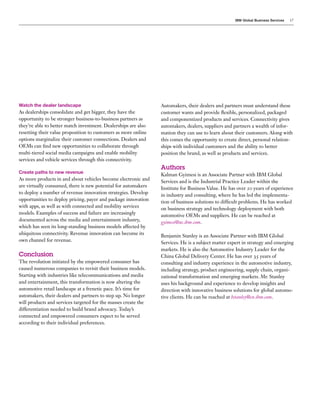
To capitalize on the intelligence to be gleaned from social                                      customer engagement. Everyone matters, so finding new ways
conversation, both OEMs and dealers must be able to                                              to bring innovation and creativity forward is critical to creating
overcome respective organizational obstacles. They must work                                     the disruptive differentiation needed to succeed. By elevating
collectively to gather and assimilate marketplace intelligence                                   collaboration, sharing of ideas and seamless interaction
through social collaboration (see Figure 8.)                                                     through social networks, your people and partners can connect
                                                                                                 to customers to learn what they “really” want.


To capitalize on intelligence to be gleaned from social conversation, both OEMs and dealers must be
able to overcome respective organizational obstacles.


                      OEM                                                      Integrate into workflow                             Dealers
                                                                                  as well as culture


                                                           Address sources                            Commit to take
                                                           of resistance and                           action based
                                                               objections                               on results


      Operational objections: Address sources                           Integrate workflow: Integrate Collective       Commit to act: Act on what is discovered,
      of resistance, including operational                              Intelligence efforts directly into the work    communicating value and outcomes to
      challenges, conflict with existing charters,                      environment, both technologically and          both the organization and the individual
      perceived loss of control and shifting roles                      culturally
      and responsibilities


Source: IBV Collective Intelligence: Capitalizing on the crowd, 2011.


Figure 8: OEMs and dealers must collectively work to gather and assimilate marketplace intelligence through social collaboration.
14   Transforming retail


Listen widely and engage quickly                                   Transparent Channels
Developing sophisticated listening engines and rapid engage-
ment processes will facilitate learning about customers and        Innovating new channels
identifying new opportunities. Listening and engaging in social    While the priority for automakers will remain on selling
conversations provides better insight to sentiments about your     vehicles through dealerships, many new products and services
brand and opportunities to influence those perceptions.            with revenue-growth potential will face intense competition
Employees can serve as brand ambassadors, engaging potential       outside the industry and be sold through multiple channels.
prospects and turning them into revenue-generating
customers. Dealers are a critical component to extending social    More vehicle products and services will be available virtually.
reach as they own the local face-to-face connection with           This opens the door for OEMs to initiate direct consumer
customers.                                                         contact through a variety of digital channels. Just two years
                                                                   ago, less than a third of automotive CEOs indicated they
Move beyond the obvious                                            expected to develop new sales channels.17 Today, many new
Advance social media outreach by exploring emerging,               channels for products and services are already in place and
growing tools and platforms that stretch beyond the “Big           more are coming at a rapid pace. Automakers will have to
Three” of Facebook, Twitter and YouTube. Engaging and              determine which third-party channels best help their growth,
connecting customers to brands through social sites further        which channels they will develop themselves and whether some
enables unique customized experiences with specific products       channels present a challenge to their primary business. (see
and services. Creating these social connections across products,   Figure 9.)
the ecosystem and customer networks also drives new innova-
tions and business models discussions. Simply listening to the     Overall, OEMs will need to develop a multi-channel strategy
customer is not enough. Customers want to engage and have          as growth opportunities emerge from a number of new
input into new products and services. A social business            directions. They will have to develop their own direct channels
connected to social and product networks is highly advanta-        and engage new partners. In the process, they will be chal-
geous in truly knowing and wowing customers.                       lenged by others outside the traditional industry. Media and
                                                                   Entertainment companies and telcommunications companies
                                                                   already have significant advantages with connected services and
                                                                   apps. Independent retailers will challenge for all types of
                                                                   products and services. Conventional banks will compete with
                                                                   captive finance companies for both loans and financing dealer
“Transforming sales channels and providing low-cost
                                                                   floor space.
products are particularly critical in rapidly developing
countries.”
CEO, Japanese OEM
IBM Global Business Services            15


What channels might sell the following automotive products or services by 2020?
Channel/product selected by more than 50 percent of executives                                                            Competitive focus will be virtual
                                                                                                                          OEMs develop new opportunities for sales
                                                                                                                          of connected product offerings
                                                                       Traditional focus is physical
100%                                                                   Dealerships continue to dominate                   Products and services that can be
                                                                       traditional vehicle sales and service              distributed virtually will have competition
                                                                                                                          from many channels


75%


50%
           ICE vehicles            Service,                 Electric   Financial            In-vehicle         Mobility       Vehicle apps
                                   warranty,                vehicles   products             connectivity       services
                                   repair
                                                                                                                           OEM direct
                                                                                                                           Authorized dealership
                                                                                                                           Independent retailer
                                                                                                                           Telecom provider
 Source: IBM Transform Retail Survey/Interviews (n=110), 2011.


Figure 9: New sales channels are developing and competing for products and services that can be sold virtually.


 Dealers remain traditional while seeking                                              everything from comparative research on vehicles, to configu-
                                                                                       ration, financing and price negotiations. Dealers are also
 new opportunities
                                                                                       challenged to keep the customer’s business after the vehicle is
 Dealerships have been consolidating into larger dealer groups
                                                                                       no longer under warranty. Customers traditionally move
 for some time. Since the economic crisis, this trend has been
                                                                                       rapidly away from dealer service to less expensive alternative
 accelerating and, according to half the executives in our most
                                                                                       options.
 recent survey, will continue to do so over the next several years.
 Larger dealership groups will have greater resources and
                                                                                       Where does this leave dealers? Dealerships, like OEMs, will
 investment capability to devote to effective, coordinated digital
                                                                                       have to work to redefine their value proposition to customers.
 marketing strategies, including greater use of social campaigns,
                                                                                       They should be exploring mobility services, where they can
 tablets and mobile devices. While dealerships remain the key
                                                                                       become a hub for moving customers to various types of
 channel for the traditional sale and service of new vehicles,
                                                                                       vehicles and helping to establish more hubs across their local
 third-party buying sites are emerging that help consumers with
                                                                                       area. They can also help customers enable peer-to-peer
16   Transforming retail


transactions for sharing everything from their vehicles, to rides,   These can be summarized into three general categories of
to parking. Dealers might also lead the way in offering vehicle      revenue innovation:
customizations and accessories, as well as providing rapid-
charging services for electric vehicles.                             •	   Pricing innovation, focusing on new ways to charge for your
                                                                          product, in terms of both the amount of money charged and
Furthermore, service can become a competitive advantage for               the point(s) in time when the customer is required to pay.
dealers. For example, connected diagnostics and prognostics,              Examples can include selling components by parts or creative
which are not easily replicated by third parties, can simplify the        bundling.
service effort. As well, innovative dealers have begun using         •	   Payer innovation, focusing on finding customers who are not
service visits as an unsolicited sales channel to move customers          ultimately the consumers of the product or altering who pays
to new vehicles.                                                          for a given good or service. Examples can include advertising-
                                                                          supported offerings or social networking-based communities.
Revenue innovation can be its own                                    •	   Package innovation, focusing on new ways to expand product
channel                                                                   or brand value to different customer behaviors and segments
Customers are increasingly supplementing their vehicle                    or new ways of offering the product to the customer.
experience with virtual products. More automotive customers               Examples can include demographic-based packaging and
will look for connected services and opportunities to integrate           brand extensions.
their smart phones into their vehicles through apps. Also, they
will look more for mobility services that consolidate their          Other industries, such as media and telecommunications, have
transportation costs and help them figure out how best to            been aggressively experimenting with revenue innovation in
move around regardless of mode. Automotive companies can             recent years. Their business models have been upended by
offer mobility services to capture more of the spend that is         such trends as ubiquitous low-cost communications, rapid
currently fragmented across many providers.                          technological innovation, nearly unlimited low-cost bandwidth,
                                                                     real-time data processing power and the expectations for
As automakers offer more of these services, an opportunity will      personalization and control by users. These trends are almost
arise to innovate the management of revenue as a channel in          certain to extend into connected vehicles.
itself. Conventional subscription models are not the only ways
to generate revenue. Several strategies will be needed to            Linking to build customer connections
provide customers with choice and flexibility in virtual             As more products extend into the virtual world and can be
products.                                                            configured in a variety of ways, consumers will expect to
                                                                     discover new products through their Connected Experience,
                                                                     regardless of the device. Automakers must develop online and
                                                                     mobile experiences that link customers to new products and
                                                                     services. Developing the virtual channel increasingly involves
                                                                     OEMs and puts them in a stronger position to build individual
                                                                     customer relationships.
IBM Global Business Services   17


Watch the dealer landscape                                      Automakers, their dealers and partners must understand these
As dealerships consolidate and get bigger, they have the        customer wants and provide flexible, personalized, packaged
opportunity to be stronger business-to-business partners as     and componentized products and services. Connectivity gives
they’re able to better match investment. Dealerships are also   automakers, dealers, suppliers and partners a wealth of infor-
resetting their value proposition to customers as more online   mation they can use to learn about their customers. Along with
options marginalize their customer connections. Dealers and     this comes the opportunity to create direct, personal relation-
OEMs can find new opportunities to collaborate through          ships with individual customers and the ability to better
multi-tiered social media campaigns and enable mobility         position the brand, as well as products and services.
services and vehicle services through this connectivity.
                                                                Authors
Create paths to new revenue
                                                                Kalman Gyimesi is an Associate Partner with IBM Global
As more products in and about vehicles become electronic and    Services and is the Industrial Practice Leader within the
are virtually consumed, there is new potential for automakers   Institute for Business Value. He has over 20 years of experience
to deploy a number of revenue innovation strategies. Develop    in industry and consulting, where he has led the implementa-
opportunities to deploy pricing, payer and package innovation   tion of business solutions to difficult problems. He has worked
with apps, as well as with connected and mobility services      on business strategy and technology deployment with both
models. Examples of success and failure are increasingly        automotive OEMs and suppliers. He can be reached at
documented across the media and entertainment industry,         gyimesi@us.ibm.com.
which has seen its long-standing business models affected by
ubiquitous connectivity. Revenue innovation can become its
                                                                Benjamin Stanley is an Associate Partner with IBM Global
own channel for revenue.
                                                                Services. He is a subject matter expert in strategy and emerging
                                                                markets. He is also the Automotive Industry Leader for the
Conclusion                                                      China Global Delivery Center. He has over 35 years of
The revolution initiated by the empowered consumer has          consulting and industry experience in the automotive industry,
caused numerous companies to revisit their business models.     including strategy, product engineering, supply chain, organi-
Starting with industries like telecommunications and media      zational transformation and emerging markets. Mr. Stanley
and entertainment, this transformation is now altering the      uses his background and experience to develop insights and
automotive retail landscape at a frenetic pace. It’s time for   direction with innovative business solutions for global automo-
automakers, their dealers and partners to step up. No longer    tive clients. He can be reached at bstanley@cn.ibm.com.
will products and services targeted for the masses create the
differentiation needed to build brand advocacy. Today’s
connected and empowered consumers expect to be served
according to their individual preferences.
References

1.	 Schaefer, Melissa. “Winning over the empowered consumer: Why trust       © Copyright IBM Corporation 2012
    matters.” IBM Institute for Business Value. March 2012. http://
    www-935.ibm.com/services/us/gbs/thoughtleadership/ibv-empowered-         IBM Global Services
    consumer.html                                                            Route 100
                                                                             Somers, NY 10589
2.	 Automotive 2020: Transforming Retail Study. IBM Institute for Business   U.S.A.
    Value. 2012.
3.	 “From Stretched to Strengthened: Insights from the Global Chief          Produced in the United States of America
    Marketing Officer Study.” IBM Institute for Business Value. October      May 2012
    2011. http://www-935.ibm.com/services/us/cmo/cmostudy2011/               All Rights Reserved
    cmo-registration.html                                                    IBM, the IBM logo and ibm.com are trademarks or registered trademarks
4.	 “From Stretched to Strengthened: Automotive Insights from the Global     of International Business Machines Corporation in the United States, other
    Chief Marketing Officer Study.” IBM Institute for Business Value.        countries, or both. If these and other IBM trademarked terms are marked
    October 2011.                                                            on their first occurrence in this information with a trademark symbol (® or
                                                                             ™), these symbols indicate U.S. registered or common law trademarks
5.	 “From Stretched to Strengthened: Insights from the Global Chief
                                                                             owned by IBM at the time this information was published. Such trademarks
    Marketing Officer Study.” IBM Institute for Business Value. October
                                                                             may also be registered or common law trademarks in other countries. A
    2011. http://www-935.ibm.com/services/us/cmo/cmostudy2011/
                                                                             current list of IBM trademarks is available on the Web at “Copyright and
    cmo-registration.html
                                                                             trademark information” at ibm.com/legal/copytrade.shtml
6.	 “Capitalizing on Complexity: Insights from the Global Chief Executive
    Officer Study.” IBM Institute for Business Value. May 2010. http://      Other company, product and service names may be trademarks or service
    www-935.ibm.com/services/us/ceo/ceostudy2010/index.html                  marks of others.

7.	 Presentations by automakers at the Automotive News World Congress        References in this publication to IBM products and services do not
                                                                             imply that IBM intends to make them available in all countries in which
8.	 “Capitalizing on Complexity: Insights from the Global Chief Executive
                                                                             IBM operates.
    Officer Study.” IBM Institute for Business Value. May 2010. http://
    www-935.ibm.com/services/us/ceo/ceostudy2010/index.html
9.	 “Connected Car Market Data,” ABI Research; “Internet-connected car                Please Recycle
    infotainment perspectives.” iSuppli.
10.	Schaefer, Melissa. “Winning over the empowered consumer.” IBM
    Institute for Business Value. March 2012.
11.	“From Stretched to Strengthened: Insights from the Global Chief
    Marketing Officer Study.” IBM Institute for Business Value. October
    2011. http://www-935.ibm.com/services/us/cmo/cmostudy2011/
    cmo-registration.html
12.	Ibid.
13.	Drum, Kevin. “Chart of the Day: The Rise of the Machine.” Mother
    Jones. February 21, 2012. http://www.motherjones.com/kevin-
    drum/2012/02/chart-day-rise-machine
14.	“From Stretched to Strengthened: Insights from the Global Chief
    Marketing Officer Study.” IBM Institute for Business Value. October
    2011. http://www-935.ibm.com/services/us/cmo/cmostudy2011/
    cmo-registration.html
15.	“Capitalizing on Complexity: Insights from the Global Chief Executive
    Officer Study.” IBM Institute for Business Value. May 2010. http://
    www-935.ibm.com/services/us/ceo/ceostudy2010/index.html
16.	Lesser,Eric, David Ransom, Rawn Shah and Bob Pulver. “Collective
    Intelligence: Capitalizing on the crowd.” IBM Institute for Business
    Value. January 2012. http://www-935.ibm.com/services/us/gbs/
    thoughtleadership/ibv-collective-intelligence.html
17.	“Capitalizing on Complexity: Insights from the Global Chief Executive
    Officer Study: Automotive Executive Summary.” IBM Institute for
    Business Value. http://public.dhe.ibm.com/common/ssi/ecm/en/
    gbe03313usen/GBE03313USEN.PDF. May 2010.
                                                                                                                                 GBE03493-USEN-00

Transforming Retail

  • 1.
    IBM Global BusinessServices Automotive Industry Executive Report IBM Institute for Business Value Transforming retail Engaging customers through information, influencers and interactions
  • 2.
    IBM Institute forBusiness Value IBM Global Business Services, through the IBM Institute for Business Value, develops fact-based strategic insights for senior executives around critical public and private sector issues. This executive report is based on an in-depth study by the Institute’s research team. It is part of an ongoing commitment by IBM Global Business Services to provide analysis and viewpoints that help companies realize business value. You may contact the authors or send an e-mail to iibv@us.ibm.com for more information. Additional studies from the IBM Institute for Business Value can be found at ibm.com/iibv
  • 3.
    Introduction By Kalman Gyimesiand Benjamin Stanley The automotive retail landscape is in the midst of revolution. Confronted by consumers who demand highly personalized products and services, automakers must cast aside traditions more than a century old and pursue innovative new retail business models. They must embrace the expectations of sophisticated consumers, enable collaboration across a broader sales ecosystem and facilitate new revenue streams. To navigate this changing marketplace, automakers can solve the retail puzzle by demonstrating excellence across four dimensions that can turn today’s discerning customer into tomorrow’s valued advocate. The automotive industry’s retail model is at a crossroads. Other consumer-focused industries have seen their business Having sold cars essentially the same way for more than a models upended as a result of the wealth of information and century – based on a carefully built brand image, on-road number of choices available to almost everyone today. Auto- performance, safety features and freedom of ownership – the makers must follow a similar path to that forged by such industry must now look to create differentiated offerings that industries as electronics and telecommunications, where use of appeal to today’s digitally connected, sophisticated consumer. multiple technologies to research, compare and purchase products and services has created new opportunities for Consumers are now turning their attention to their mobility individualized offerings, new distribution channels and needs and are expecting their cars to deliver the same capabili- profitable partnerships. ties and conveniences as their other smart “devices.” They are viewing their cars in the same light as their tablets and mobile Already many industries are changing how they reach out and devices, which means they are not only looking for quality, safe, win over these consumers. The retail industry, for example, is reliable transportation, but are also beginning to view their customizing in-store shopping experiences, adding digital vehicles as another extension of their digitally connected lives. distribution channels and providing a seamless segue from online browsing to brick-and-mortar purchasing.1 Other B2C enterprises, across almost every product category, are capturing information at every touch point to improve the consumer experience with their products and services. Connectivity and use of multiple technologies is transforming retail across a broad array of industries.
  • 4.
    2 Transforming retail For the automotive industry, the retail model in place is nearly Automotive executives are keenly aware of how their customers the same as when the first Model T rolled off the assembly line are changing. In a recent IBM Institute for Business Value more than a century ago. From the beginning of mass manu- survey of more than 100 automotive executives, customer facturing, cars have been targeted to generalized market management was cited as the part of the automotive value segments based on performance, appearance, reliability, safety chain that will change the most over the next decade.2 Overall, and price. To capitalize on today’s new generation of 67 percent of the executives we surveyed recognize that consumers, however, the industry must become more creative substantial changes are ahead in automotive retail. These in how it introduces new products, develops services and executives recognize that, with all of the new ways to interact engages with its customers. Automakers, their partners and with customers across the commerce cycle, rethinking suppliers recognize that traditional methods of selling and customer management will be the most important ingredient promoting their products must give way to the mandates of the to developing new retail models. digital age. In just a few years, the industry has begun moving from limited, infrequent transactions with customers to a One of the key ingredients to developing stronger, ongoing rapidly developing network of information and interactions customer relationships is the integration of data from those that enables automotive companies to know and understand activities that generate the most frequent customer interaction buying preferences and habits in new ways (see Figure 1). (see figure 2). Historical customer touch points New touch points that enable greater customer understanding Search optimization Social networking Mobility services E-mail/text In V Viral marketing e n eh Onli Portals Connected icle Retail services Blogs/user Purchase Finance communities History packaging Retail Warranty Service history history Source: IBM Institute for Business Value. Figure 1: Automakers are increasingly using online tools, vehicle connectivity and mobility services to connect with customers.
  • 5.
    IBM Global BusinessServices 3 What will be the most valuable aspects of integrated customer information? Vehicle service history 82% • Data is important but is Vehicle purchase history 73% semi-annual or less frequent • Touch points with customers are Finance/profitability history 61% transactional and not interactive Mobility service usage patterns 54% • Data is weekly to daily Other online/social media interaction 52% • Touch points with customer are Connected vehicle usage patterns 52% frequent • Enables relationships through Call center interactions 49% ongoing engagement with OEM website interactions 44% customers, deeper insights to their needs and marketplace patterns Source: Transforming Retail Survey (n=110), 2011. Figure 2: Stronger, ongoing partnerships with customers require greater investment in developing and integrating data from the activities that occur most often. The extent to which this data is used and shared differentiates To capitalize on the opportunities presented by today’s outperforming organizations from others. In the 2011 IBM hyper-connected, empowered consumers and the vast amount Global Chief Marketing Officer Study, outperformers of customer information this connectedness provides them, indicated they apply customer data extensively in every aspect automakers must solve the retail puzzle by demonstrating of the customer lifecycle.3 While enhancing customer loyalty innovation and excellence across four dimensions: Disruptive and advocacy is the highest priority for automakers, their Differentiation, Connected Experience, Social Reach and application of data is lowest across the “usage” and “advocacy” Channel Transparency (see Figure 3). customer lifecycle phases.4
  • 6.
    4 Transforming retail What to buy? How to buy? Disruptive Differentiation Social Reach Accelerate Engage development of customers through differentiating offerings social innovation Connected Experience Transparent Channels Capitalize on Enable opportunities to new channels for product, ensure loyalty services and revenue Sources: IBM Institute for Business Value. Figure 3: Transforming the retail puzzle requires excellence across four dimensions to turn today’s consumers into valued customers. Disruptive Differentiation The path to successful retail starts with outstanding products. Study methodology Fresh new vehicles, electronics, connectivity and services are Quantitative data for this study was obtained through an coming to the market at an ever-increasing pace. The potential online survey of 110 automotive industry executives in 18 exists for the industry to consolidate these trends and create countries. Of these responses, 38 percent were from OEMs new offerings that disrupt the status quo through innovation and 20 percent from dealers, with the rest of the responses that changes the market and even creates new value or markets. representing executives across suppliers, captive finance organizations, solution providers and others. Product development, in fact, trailed only customer manage- Additionally, follow-up interviews were conducted with a ment in the assessment of executives in our survey of what number of these industry leaders. We also used data from aspect of the automotive value chain will change most over the the IBM Global Chief Marketing Officer Study, in which 70 next decade. And automotive CEOs interviewed for the IBM senior marketing executives from the automotive industry 2010 Global Chief Executive Officer Study said they expect were interviewed, to corroborate and amplify our findings.5 new or different products and services will be their leading responses to changing customer expectations over the next five years.6 Automakers are already acting in this regard. In a presentation at an automotive conference earlier this year, one manufacturer indicated it is pushing for 20 new product introductions over the next 24 months.7 “We need a customer-centric mindset. We must commit more time to incorporating the “voice of the customer” into our offerings.” President, Automotive OEM, Japan
  • 7.
    IBM Global BusinessServices 5 While a vibrant vehicle pipeline has been a core competency Automakers will also need to think beyond the vehicle and for automakers for decades, the industry is now recognizing offer mobility services that address traffic congestion, provide that products themselves account for only half the picture in integration with other relevant transportation modes and attracting and retaining new customers. New services that decrease the cost of ownership. appeal to today’s connected consumer are also critical. Nearly seven of ten automotive CEOs said new or different services Capitalizing on personalization will be the biggest area of customer demand over the next few In today’s connected society, where consumers are openly years.8 vocal about their individual likes and dislikes, differentiation usually means personalization. To respond to these changing customer expectations, auto- makers will need to bring offerings that supplement traditional Personalization can be considered across two dimensions: the vehicle buying options. (see Figure 4). These include such physical vehicle itself and the electronic customization of offerings as highly efficient vehicles that are economical and everything in it. OEMs make a strategic determination about eco-friendly. In addition, embedded and connected services how to offer physical customization through more build-to- that offer many opportunities to respond to desires for greater order options, dealer customization or by simply leaving it to personalization, safety and driver assistance may have the others in the aftermarket. Electronic customization is enabled potential to be disruptive offerings. Rate the change in vehicle buying criteria Between 2008 to 2020 Increase Fuel efficiency 170% Eco-friendly 160% Traffic congestion 105% Personalization 101% Safety 96% Alternate transport modes 95% Cost of ownership 89% Traditional buying criteria Reliability Increasingly important Still important, but expected Brand Products and services must rather than the basis for respond to these growing differentiation Price concerns to attract Sources: IBM Institute for Business Value. customers Figure 4: Traditional buying factors are still important, but new criteria are emerging as the basis for consumer decisions about vehicles.
  • 8.
    6 Transforming retail by providing customers with the ability to control various Finding and capitalizing on customer touch points should be a vehicle features from any location though software and apps. benefit of enabling new vehicle features, regardless of whether For example, many manufacturers provide a remote vehicle they are proprietary or open. Through continuously collecting start through the key fob; however, on very cold or hot days data about customers and their vehicle usage, automakers can this will not help the vehicle be more comfortable unless the target specific solutions to individual preferences. Ultimately, climate controls are set properly. A more personalized solution OEMs can build customer reliance upon a particular method would offer access to the entire climate system through a smart of electronic control and create customer “stickiness” to the phone. Climate and vehicle adjustments could be made products and services of their specific brands. remotely, removing the need to preset the vehicle manually. Componentizing and repackaging the right products and Electronics can be further personalized by offering various services into compelling offerings will afford automakers interfaces, or “skins,” that appeal to different target audiences. flexibility in both pricing and selling their products to diverse The virtual interfaces for highly connected young adults might audiences. Packages can be tailored for differentiation look very different than interfaces to more selectively according to individual needs, climate, parking location or, connected seniors. Reducing electronic components to their even, the needs of additional passengers. Vehicles can also be basic building blocks will allow them to be creatively bundled componentized according to generational needs (see sidebar, and packaged for various demographic groups. “Complex multi-generational families”). While build-to-order remains within the direct control of Differentiating for success automakers, electronic customization is likely to become a Vehicles have become increasingly difficult to differentiate battleground between OEMs and third parties – such as from the similar offerings of competitors. The acceleration of telecommunications and media and entertainment companies development of fresh vehicles, products and services that – that are already far along the personalized electronics disrupt the current value expectations of customers gives learning curve. automakers the opportunity to break away from this paradigm. To influence that segment of electronics customization beyond Differentiate the platform their direct control, OEMs must work with selected partners to Determine the best opportunities to differentiate product and implement open-standard vehicle enhancements and conve- service offerings physically, electronically and virtually. The niences. They should not waste resources trying to control extent of physical customization offered through the design of features that are easily supplied by others, but, instead, focus the vehicle is a strategic choice. It can be offered either on enabling and amplifying these capabilities to the best through online configurators, pushing toward build-to-order advantage of their product offerings. sales models or through dealer-driven personalization. However, electronic personalization will be a necessity to effectively compete in the future. Strategically, automakers must separate the electronic personalization they can control from what can best be left open to external innovation.
  • 9.
    IBM Global BusinessServices 7 Create the building blocks Package to the audience Every aspect of the vehicle and the interaction with it is being Automakers have long excelled at packaging physical vehicle electrified. Automakers should aggressively incorporate features into bundles. Electronic components can be treated in electronic components and enable control through remote similar fashion. However, electronic components provide much apps. Even previously obscure aspects of personal comfort greater flexibility into how they are bundled based on indi- should be fully electrified and available for customization. By vidual preferences, demographics or geographic locations. This reducing these features to their core building blocks, they can provides a new differentiating capability of appeal to all then be packaged and positioned according to diverse needs relevant audiences and the ability to sell and price flexibly. of customers based on their preferences, geography and vehicle use. Complex multi-generational families Could automakers more effectively help extended families Seniors are the fastest growing demographic on the Internet, single-source their transportation needs across generations? but are likely to be more selectively connected in their vehicles. They will want easy and simplified access to Auto companies have long understood and targeted their navigation, driver assistance and vehicle service. Their vehicles at specific demographic groups. Young adults often families will be interested in safety, security and location look for basic entry-level vehicles. Growing families require tracking. larger, more spacious cars to move their children. Finally, after the children grow up, active seniors refocus on smaller, Often the middle generation exerts significant influence in comfortable vehicles. helping both their children and parents select vehicles and services. Connectivity and electronic personalization can The right vehicles also have to be coupled with the right help tie the generations together into interconnected, mobility services. Young people are often more urban and collaborative families. As their families grow, they will want have less discretionary spending. They need access to electronics that are portable across different vehicles and public transit. At the same time, growing families may need will be interested in infotainment and information services. occasional access to different types of cars from their Their mobility service needs would entail occasional access primary vehicles. to a variety of vehicles for many uses, such as a van or SUV Young adults are already highly connected and will welcome for family highway trips, or a small sports car or hybrid for the ability to select the electronic “skin” to their vehicles. longer one-or-two-person trips. They will want to extensively configure electronics. Parents If automakers can reduce electronic capabilities down to will be concerned about safe driving and usage of social their components, they can then be reassembled into media in cars for their children, as well as proactive vehicle packages that appeal to various demographic groups and maintenance alerting. The younger generation may also need managed across interconnected collaborative families. By to have occasional access to vehicles while traveling or considering how to bundle offerings to whole family units, away at college. automakers have the potential to develop lifelong customer advocates.
  • 10.
    8 Transforming retail Connected experience Capitalizing on the wants and needs of today’s empowered consumer requires providing individuals with a Connected Experience (see Figure 5). Connected vehicles open endless “C ty.” options for new services, such as speech recognition, driver- focused instrument clustering and attention monitoring Vice President, marketing, global automotive manufacturer systems. While these features offer automakers the opportunity to generate revenue, they also create daily touch points for automakers with their customers and offer the potential to create customer loyalty. Rate the importance of each aspect of connected Automakers and dealers jointly recognize the vehicle services potential to connect with their customers Navigation advice 68% (routing/alternatives, parking...) 76% Vehicle service 60% Safety and Multimedia/ (prognostics, diagnosis) security entertainment 81% Infotainment 56% Intelligent Traffic and (Music, movies, other content) driving navigation 65% Vehicle service Information Mobility services 43% and health services 53% Mobility Mobility commerce 32% Revenue commerce Productivity (paying for things in vehicles) Loyalty 42% Loyalty, OEM and dealers Sources: IBM Institute for Business Value. Figure 5: Connected vehicles bring new revenue opportunities to how vehicles are used, but provide even greater utility for winning customer loyalty.
  • 11.
    IBM Global BusinessServices 9 The spectrum of connected services Vast opportunities are available for automakers to serve Automakers should focus on enabling and amplifying drivers and passengers through connected vehicles. With connected services that customers will likely bring into the rise of smart devices, it’s inevitable that customers will vehicles. For example, they can allow easy access to power bring these devices into their vehicles and want to use them sources and recharging from every seat in the vehicle. to enhance their experience as they are moving about. “Dumb screens” that enhance display and content viewing Automakers must consider what aspects of telematics and to passengers through their devices can be added. Signal vehicle connectivity they will be able to differentiate boosters can be embedded in vehicles to detect and themselves with and what will be ultimately co-opted by increase wireless reception. OEMs must resist trying to third parties. compete for content with smart device providers, which have greater resources and more sophisticated solutions. Instead, Additionally, they will have to decide where to concentrate they should pick the elements of the connected spectrum limited IT resources to compete across a spectrum of where they can provide differentiated offerings. connected vehicle services. Safety, security, vehicle service and mobility between vehicles may be areas that OEMs can differentiate. Services such as infotainment and information service will likely be more challenging (see Figure 6). Closely controlled Potentially open Safety and Intelligent Vehicle Mobility Productivity Information Traffic and Multimedia/ security driving service and commerce services navigation entertainment health Controlled by automakers Control point Battleground for revenue Sources: IBM Institute of Business Value. Figure 6: Automakers must consider what aspects of vehicle connectivity can be opened to third parties and how to best control revenue.
  • 12.
    10 Transforming retail The rapid growth of vehicle and device connectivity provides Automakers then can provide solutions to seamlessly move a greater opportunities to link customers to products and customer’s persona between any of its vehicles to make the services for long-term relationships. For example, by 2016 in experience uniform. Vehicle interchangeability allows auto- the United States, there are expected to be 150 million in-car makers to sell the appeal of the entire brand and vehicle Internet users and 30 million Internet radio users. More than portfolio to all customers rather than just focusing on indi- 210 million connected cars are expected to be sold in mature vidual models. markets. Application usage will accelerate 40 fold, with more than 129 million users of smartphone applications in cars.9 Ultimately, integrating vehicles with other modes of transpor- tation allows automakers to sell mobility as a subscription These projections are in line with what we learned from the service across transportation modes. As urbanization continues 2011 IBM Global Chief Marketing Officer Study. In that study, its multi-decade transformation of population centers, the 64 percent of automotive marketing officers told us that ability to move between modes easily will be a key component enhancing customer loyalty and advocacy was their highest to ensure that cars remain relevant and retain their place in the priority as they begin enabling digital technologies. That transportation mix. jumped even higher to 70 percent when considering CMOs from just automotive OEMs.10 Connectivity also provides the opportunity to delight customers by changing the service equation. Very few customer All members of the automotive value chain should recognize experiences with their vehicles are as unpleasant as having the potential to connect with customers. To accomplish this, them serviced. The Connected Experience offers an opportu- gathering and sharing the increasing amount of customer data nity for remote service of vehicles and less direct maintenance. available across the value chain is essential if OEMs, dealers and other partners are to understand and be able to meet the Capitalizing on connection changing demands of today’s consumers. Automakers should take every opportunity to use vehicle connectivity to link customers to products and services. Connectivity making a difference One of the inevitable byproducts of connectivity may be the Connect for loyalty interchangeability of vehicles. Enabling a single persona across Connected vehicles present the best opportunity for auto- a vehicle portfolio differentiates from feature, function and makers to interact with their customers every time they use price comparisons of models with competitors. Customers their car. They can use this information to developed personal- could personalize on several parameters, including: ized solutions and enhance customer loyalty by making it difficult or inconvenient for them to switch brands. The most • Vehicle settings and adjustments valuable connected features are those that help drivers get • Customization of the layout and information presented on the where they are going most efficiently and keep them informed dashboard about their trip and their vehicle. Ultimately, this gives • Music, media and other content automakers the opportunity to focus on customer trust and • Calendar and business applications loyalty. Trust drives advocacy, which, in turn, drives customer • Navigation and routing through varying parameters. spend.11 Concentrate on loyalty and the revenue will come.
  • 13.
    IBM Global BusinessServices 11 Focus on opportunity Despite this unpreparedness, both OEMs and dealers must There are many opportunities for connected services from learn to engage customers and prospects through social media which third parties can be excluded, such as safety, vehicle and other channels. Social engagement and conversations are service, remote control of vehicle parameters and full porta- increasingly differentiating the most successful automotive bility of a personalized electronics profile between vehicles. offerings and reinforcing that consumers still have an ongoing Invest and protect connected applications that cannot be easily passion for automobiles and their brands. In fact, OEMs and replicated by third parties or competitors. Automakers have dealers are generally aligned in the role social media plays in limited IT resources, which should be concentrated on their businesses (see Figure 7). The only real point of discon- providing exciting solutions in areas others cannot reach. nection our interviews revealed is that dealers would like to be more aware and engaged in OEM social media initiatives. Integrate and amplify Connected vehicles provide numerous opportunities. In areas such as infotainment, productivity, e-mail or social media usage, it will be difficult for automakers to compete with other Rate the benefits of social media/business activity solution providers. Instead, they should partner with for automakers companies adept at these types of services, such as telecommu- Understanding public perception 85% nications providers. OEMs should accommodate devices that of company and brands 91% drivers and passengers bring into vehicles and improve their 80% experience while there. Focus should be on inexpensive Building brand image and loyalty 91% enablers, such as easy access to power, simple screens for device Building overall corporate image 78% connection and signal boosters to improve reception. and reputation 86% Understanding new industry 63% Social Reach developments 59% Social media is booming and is no longer the exclusive domain of the younger generation. Yet, 62 percent of automotive Chief Generating sales leads 53% Marketing Officers indicated social media is the factor for 64% which they are least prepared to address.12 Though both Communication with 40% business partners OEMs and dealers recognize the value of social media in their 55% businesses, they are still learning how to use it effectively. OEMs Dealers Sources: IBM Institute for Business Value. Figure 7: Dealers and OEMs are aligned in many ways in the role of “Until recently, we didn’t realize how powerful the social media in their businesses. impact of social media is in our marketing success.” CMO, European automotive trading company
  • 14.
    12 Transforming retail Consumers are increasingly focused on their mobile devices. segments, as well as sending these messages to the media These devices have now grown to 23 percent of their time individual consumers prefer. Perhaps that’s why 63 percent of spent on media.13 Yet, mobile still accounts for only 1 percent automotive CEOs identify creativity as the top leadership of total advertising spend. Conversely, the time they spend quality needed in their organizations over the next five years.15 engaged in traditional print media has plummeted to 6 percent, but organizations still invest nearly a third of their total Collective Intelligence: Listening to advertising budget in print. the crowd The traditional automotive sales model has, historically, Why the disconnect? Part of the reason is that digital adver- consisted of a close, albeit tumultuous, working relationship tising is still maturing, and approaches need to be developed between OEMs and dealers. In today’s world, that relationship that will reach consumers in a manner they will accept. Unlike must not only be strengthened, it must be expanded to include television or print, for example, saturating devices with mobile partners, customers and others across the extended automotive advertising is counterproductive. Such an approach only ecosystem. alienates the target audience, ensuring that relevant messages are ignored, or worse, result in a backlash. Even so, automakers The rapid rise of the social technologies is increasing the are looking to expand the use of these technologies over the ability of companies to tap into Collective Intelligence – the next three to five years. Eighty-eight percent of automotive distributed knowledge and expertise of individuals located CMOs plan to increase their use of social media, and 82 inside and outside the formal boundaries of the enterprise. percent are looking to grow their deployment of mobile Applying this knowledge can deliver tangible benefits in applications.14 developing new products and services, sharing best practices, distributing work in new, innovative ways and predicting future Even the most traditional marketing executives admit that new, events.16 digital tools will become the primary means for engagement in coming years. Unlike more traditional media, the consumer is For the automotive industry in particular, this requires OEMs in almost complete control of what he or she receives or to effectively engage the public with tactics that creatively draw rejects. More than ever, automotive marketing and communi- attention to their respective brands and vehicles, such as video, cations professionals will need to be highly creative in selecting promotions, contests and games. Dealers can provide local the right messages for the right highly targeted market context and action to pull in those customers who connect to the OEM. Understanding the customer’s practices with social media gives OEMs, dealers, suppliers and other business partners direction on which initiatives to employ, to whom and through which media. More than ever, automakers and dealers will need to make sure they have selected the right messages, targeted to the right audiences, through the right media.
  • 15.
    IBM Global BusinessServices 13 Finally, engagement by all parties through public listening Influence customers through engagement provides the opportunity to capture and sort customer data Automotive executives need to engage customers through the and respond rapidly with relevant content. Listening to the vast reaches of social conversation by synthesizing and driving public requires sophisticated automated sorting and analytics the discussion. The must become key influencers in the engines that help automakers and dealers find the most customer decision making process through active participation meaningful social media opportunities. There have to be in social networks. effective processes to not only find effective engagement opportunities with customers, but also to subsequently engage Align your ecosystem them with speed. Aligning employees, dealerships and other partners as active collaborators in social business is essential for effective To capitalize on the intelligence to be gleaned from social customer engagement. Everyone matters, so finding new ways conversation, both OEMs and dealers must be able to to bring innovation and creativity forward is critical to creating overcome respective organizational obstacles. They must work the disruptive differentiation needed to succeed. By elevating collectively to gather and assimilate marketplace intelligence collaboration, sharing of ideas and seamless interaction through social collaboration (see Figure 8.) through social networks, your people and partners can connect to customers to learn what they “really” want. To capitalize on intelligence to be gleaned from social conversation, both OEMs and dealers must be able to overcome respective organizational obstacles. OEM Integrate into workflow Dealers as well as culture Address sources Commit to take of resistance and action based objections on results Operational objections: Address sources Integrate workflow: Integrate Collective Commit to act: Act on what is discovered, of resistance, including operational Intelligence efforts directly into the work communicating value and outcomes to challenges, conflict with existing charters, environment, both technologically and both the organization and the individual perceived loss of control and shifting roles culturally and responsibilities Source: IBV Collective Intelligence: Capitalizing on the crowd, 2011. Figure 8: OEMs and dealers must collectively work to gather and assimilate marketplace intelligence through social collaboration.
  • 16.
    14 Transforming retail Listen widely and engage quickly Transparent Channels Developing sophisticated listening engines and rapid engage- ment processes will facilitate learning about customers and Innovating new channels identifying new opportunities. Listening and engaging in social While the priority for automakers will remain on selling conversations provides better insight to sentiments about your vehicles through dealerships, many new products and services brand and opportunities to influence those perceptions. with revenue-growth potential will face intense competition Employees can serve as brand ambassadors, engaging potential outside the industry and be sold through multiple channels. prospects and turning them into revenue-generating customers. Dealers are a critical component to extending social More vehicle products and services will be available virtually. reach as they own the local face-to-face connection with This opens the door for OEMs to initiate direct consumer customers. contact through a variety of digital channels. Just two years ago, less than a third of automotive CEOs indicated they Move beyond the obvious expected to develop new sales channels.17 Today, many new Advance social media outreach by exploring emerging, channels for products and services are already in place and growing tools and platforms that stretch beyond the “Big more are coming at a rapid pace. Automakers will have to Three” of Facebook, Twitter and YouTube. Engaging and determine which third-party channels best help their growth, connecting customers to brands through social sites further which channels they will develop themselves and whether some enables unique customized experiences with specific products channels present a challenge to their primary business. (see and services. Creating these social connections across products, Figure 9.) the ecosystem and customer networks also drives new innova- tions and business models discussions. Simply listening to the Overall, OEMs will need to develop a multi-channel strategy customer is not enough. Customers want to engage and have as growth opportunities emerge from a number of new input into new products and services. A social business directions. They will have to develop their own direct channels connected to social and product networks is highly advanta- and engage new partners. In the process, they will be chal- geous in truly knowing and wowing customers. lenged by others outside the traditional industry. Media and Entertainment companies and telcommunications companies already have significant advantages with connected services and apps. Independent retailers will challenge for all types of products and services. Conventional banks will compete with captive finance companies for both loans and financing dealer “Transforming sales channels and providing low-cost floor space. products are particularly critical in rapidly developing countries.” CEO, Japanese OEM
  • 17.
    IBM Global BusinessServices 15 What channels might sell the following automotive products or services by 2020? Channel/product selected by more than 50 percent of executives Competitive focus will be virtual OEMs develop new opportunities for sales of connected product offerings Traditional focus is physical 100% Dealerships continue to dominate Products and services that can be traditional vehicle sales and service distributed virtually will have competition from many channels 75% 50% ICE vehicles Service, Electric Financial In-vehicle Mobility Vehicle apps warranty, vehicles products connectivity services repair OEM direct Authorized dealership Independent retailer Telecom provider Source: IBM Transform Retail Survey/Interviews (n=110), 2011. Figure 9: New sales channels are developing and competing for products and services that can be sold virtually. Dealers remain traditional while seeking everything from comparative research on vehicles, to configu- ration, financing and price negotiations. Dealers are also new opportunities challenged to keep the customer’s business after the vehicle is Dealerships have been consolidating into larger dealer groups no longer under warranty. Customers traditionally move for some time. Since the economic crisis, this trend has been rapidly away from dealer service to less expensive alternative accelerating and, according to half the executives in our most options. recent survey, will continue to do so over the next several years. Larger dealership groups will have greater resources and Where does this leave dealers? Dealerships, like OEMs, will investment capability to devote to effective, coordinated digital have to work to redefine their value proposition to customers. marketing strategies, including greater use of social campaigns, They should be exploring mobility services, where they can tablets and mobile devices. While dealerships remain the key become a hub for moving customers to various types of channel for the traditional sale and service of new vehicles, vehicles and helping to establish more hubs across their local third-party buying sites are emerging that help consumers with area. They can also help customers enable peer-to-peer
  • 18.
    16 Transforming retail transactions for sharing everything from their vehicles, to rides, These can be summarized into three general categories of to parking. Dealers might also lead the way in offering vehicle revenue innovation: customizations and accessories, as well as providing rapid- charging services for electric vehicles. • Pricing innovation, focusing on new ways to charge for your product, in terms of both the amount of money charged and Furthermore, service can become a competitive advantage for the point(s) in time when the customer is required to pay. dealers. For example, connected diagnostics and prognostics, Examples can include selling components by parts or creative which are not easily replicated by third parties, can simplify the bundling. service effort. As well, innovative dealers have begun using • Payer innovation, focusing on finding customers who are not service visits as an unsolicited sales channel to move customers ultimately the consumers of the product or altering who pays to new vehicles. for a given good or service. Examples can include advertising- supported offerings or social networking-based communities. Revenue innovation can be its own • Package innovation, focusing on new ways to expand product channel or brand value to different customer behaviors and segments Customers are increasingly supplementing their vehicle or new ways of offering the product to the customer. experience with virtual products. More automotive customers Examples can include demographic-based packaging and will look for connected services and opportunities to integrate brand extensions. their smart phones into their vehicles through apps. Also, they will look more for mobility services that consolidate their Other industries, such as media and telecommunications, have transportation costs and help them figure out how best to been aggressively experimenting with revenue innovation in move around regardless of mode. Automotive companies can recent years. Their business models have been upended by offer mobility services to capture more of the spend that is such trends as ubiquitous low-cost communications, rapid currently fragmented across many providers. technological innovation, nearly unlimited low-cost bandwidth, real-time data processing power and the expectations for As automakers offer more of these services, an opportunity will personalization and control by users. These trends are almost arise to innovate the management of revenue as a channel in certain to extend into connected vehicles. itself. Conventional subscription models are not the only ways to generate revenue. Several strategies will be needed to Linking to build customer connections provide customers with choice and flexibility in virtual As more products extend into the virtual world and can be products. configured in a variety of ways, consumers will expect to discover new products through their Connected Experience, regardless of the device. Automakers must develop online and mobile experiences that link customers to new products and services. Developing the virtual channel increasingly involves OEMs and puts them in a stronger position to build individual customer relationships.
  • 19.
    IBM Global BusinessServices 17 Watch the dealer landscape Automakers, their dealers and partners must understand these As dealerships consolidate and get bigger, they have the customer wants and provide flexible, personalized, packaged opportunity to be stronger business-to-business partners as and componentized products and services. Connectivity gives they’re able to better match investment. Dealerships are also automakers, dealers, suppliers and partners a wealth of infor- resetting their value proposition to customers as more online mation they can use to learn about their customers. Along with options marginalize their customer connections. Dealers and this comes the opportunity to create direct, personal relation- OEMs can find new opportunities to collaborate through ships with individual customers and the ability to better multi-tiered social media campaigns and enable mobility position the brand, as well as products and services. services and vehicle services through this connectivity. Authors Create paths to new revenue Kalman Gyimesi is an Associate Partner with IBM Global As more products in and about vehicles become electronic and Services and is the Industrial Practice Leader within the are virtually consumed, there is new potential for automakers Institute for Business Value. He has over 20 years of experience to deploy a number of revenue innovation strategies. Develop in industry and consulting, where he has led the implementa- opportunities to deploy pricing, payer and package innovation tion of business solutions to difficult problems. He has worked with apps, as well as with connected and mobility services on business strategy and technology deployment with both models. Examples of success and failure are increasingly automotive OEMs and suppliers. He can be reached at documented across the media and entertainment industry, gyimesi@us.ibm.com. which has seen its long-standing business models affected by ubiquitous connectivity. Revenue innovation can become its Benjamin Stanley is an Associate Partner with IBM Global own channel for revenue. Services. He is a subject matter expert in strategy and emerging markets. He is also the Automotive Industry Leader for the Conclusion China Global Delivery Center. He has over 35 years of The revolution initiated by the empowered consumer has consulting and industry experience in the automotive industry, caused numerous companies to revisit their business models. including strategy, product engineering, supply chain, organi- Starting with industries like telecommunications and media zational transformation and emerging markets. Mr. Stanley and entertainment, this transformation is now altering the uses his background and experience to develop insights and automotive retail landscape at a frenetic pace. It’s time for direction with innovative business solutions for global automo- automakers, their dealers and partners to step up. No longer tive clients. He can be reached at bstanley@cn.ibm.com. will products and services targeted for the masses create the differentiation needed to build brand advocacy. Today’s connected and empowered consumers expect to be served according to their individual preferences.
  • 20.
    References 1. Schaefer, Melissa.“Winning over the empowered consumer: Why trust © Copyright IBM Corporation 2012 matters.” IBM Institute for Business Value. March 2012. http:// www-935.ibm.com/services/us/gbs/thoughtleadership/ibv-empowered- IBM Global Services consumer.html Route 100 Somers, NY 10589 2. Automotive 2020: Transforming Retail Study. IBM Institute for Business U.S.A. Value. 2012. 3. “From Stretched to Strengthened: Insights from the Global Chief Produced in the United States of America Marketing Officer Study.” IBM Institute for Business Value. October May 2012 2011. http://www-935.ibm.com/services/us/cmo/cmostudy2011/ All Rights Reserved cmo-registration.html IBM, the IBM logo and ibm.com are trademarks or registered trademarks 4. “From Stretched to Strengthened: Automotive Insights from the Global of International Business Machines Corporation in the United States, other Chief Marketing Officer Study.” IBM Institute for Business Value. countries, or both. If these and other IBM trademarked terms are marked October 2011. on their first occurrence in this information with a trademark symbol (® or ™), these symbols indicate U.S. registered or common law trademarks 5. “From Stretched to Strengthened: Insights from the Global Chief owned by IBM at the time this information was published. Such trademarks Marketing Officer Study.” IBM Institute for Business Value. October may also be registered or common law trademarks in other countries. A 2011. http://www-935.ibm.com/services/us/cmo/cmostudy2011/ current list of IBM trademarks is available on the Web at “Copyright and cmo-registration.html trademark information” at ibm.com/legal/copytrade.shtml 6. “Capitalizing on Complexity: Insights from the Global Chief Executive Officer Study.” IBM Institute for Business Value. May 2010. http:// Other company, product and service names may be trademarks or service www-935.ibm.com/services/us/ceo/ceostudy2010/index.html marks of others. 7. Presentations by automakers at the Automotive News World Congress References in this publication to IBM products and services do not imply that IBM intends to make them available in all countries in which 8. “Capitalizing on Complexity: Insights from the Global Chief Executive IBM operates. Officer Study.” IBM Institute for Business Value. May 2010. http:// www-935.ibm.com/services/us/ceo/ceostudy2010/index.html 9. “Connected Car Market Data,” ABI Research; “Internet-connected car Please Recycle infotainment perspectives.” iSuppli. 10. Schaefer, Melissa. “Winning over the empowered consumer.” IBM Institute for Business Value. March 2012. 11. “From Stretched to Strengthened: Insights from the Global Chief Marketing Officer Study.” IBM Institute for Business Value. October 2011. http://www-935.ibm.com/services/us/cmo/cmostudy2011/ cmo-registration.html 12. Ibid. 13. Drum, Kevin. “Chart of the Day: The Rise of the Machine.” Mother Jones. February 21, 2012. http://www.motherjones.com/kevin- drum/2012/02/chart-day-rise-machine 14. “From Stretched to Strengthened: Insights from the Global Chief Marketing Officer Study.” IBM Institute for Business Value. October 2011. http://www-935.ibm.com/services/us/cmo/cmostudy2011/ cmo-registration.html 15. “Capitalizing on Complexity: Insights from the Global Chief Executive Officer Study.” IBM Institute for Business Value. May 2010. http:// www-935.ibm.com/services/us/ceo/ceostudy2010/index.html 16. Lesser,Eric, David Ransom, Rawn Shah and Bob Pulver. “Collective Intelligence: Capitalizing on the crowd.” IBM Institute for Business Value. January 2012. http://www-935.ibm.com/services/us/gbs/ thoughtleadership/ibv-collective-intelligence.html 17. “Capitalizing on Complexity: Insights from the Global Chief Executive Officer Study: Automotive Executive Summary.” IBM Institute for Business Value. http://public.dhe.ibm.com/common/ssi/ecm/en/ gbe03313usen/GBE03313USEN.PDF. May 2010. GBE03493-USEN-00