Transformer
BY-ROSHAN PATEL
REGD NO-220301120061
Contents
 Need of transformer
 Introduction
 Principle
 Basis of winding
 Application of Transformers
Need of transformer
 To transform the available voltage to required voltage .
 n most cases, appliances are manufactured to work under some specific
voltages. Transformers are used to adjust the voltages to a proper level.
 transformers are the basic components for the transmission of the
electricity.
 By increasing the voltages the loss of the electricity in the transmission
purpose is minimized.
Introduction
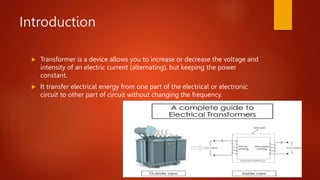
 Transformer is a device allows you to increase or decrease the voltage and
intensity of an electric current (alternating), but keeping the power
constant.
 It transfer electrical energy from one part of the electrical or electronic
circuit to other part of circuit without changing the frequency.
Principle (Electromagnetic Mutual
Induction)
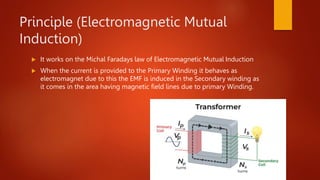
 It works on the Michal Faradays law of Electromagnetic Mutual Induction
 When the current is provided to the Primary Winding it behaves as
electromagnet due to this the EMF is induced in the Secondary winding as
it comes in the area having magnetic field lines due to primary Winding.
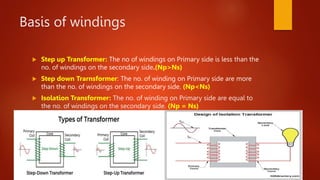
Basis of windings
 Step up Transformer: The no of windings on Primary side is less than the
no. of windings on the secondary side.(Np>Ns)
 Step down Trarnsformer: The no. of winding on Primary side are more
than the no. of windings on the secondary side. (Np<Ns)
 Isolation Transformer: The no. of winding on Primary side are equal to
the no. of windings on the secondary side. (Np = Ns)
Application
 Transmitting electrical energy over long distances through wires.
 Transformers with several secondary's are used in television and radio
receivers where several different voltages are required.
 Used as voltage regulator
Thankyou

Transformer.pptx

  • 1.
  • 2.
    Contents  Need oftransformer  Introduction  Principle  Basis of winding  Application of Transformers
  • 3.
    Need of transformer To transform the available voltage to required voltage .  n most cases, appliances are manufactured to work under some specific voltages. Transformers are used to adjust the voltages to a proper level.  transformers are the basic components for the transmission of the electricity.  By increasing the voltages the loss of the electricity in the transmission purpose is minimized.
  • 4.
    Introduction  Transformer isa device allows you to increase or decrease the voltage and intensity of an electric current (alternating), but keeping the power constant.  It transfer electrical energy from one part of the electrical or electronic circuit to other part of circuit without changing the frequency.
  • 5.
    Principle (Electromagnetic Mutual Induction) It works on the Michal Faradays law of Electromagnetic Mutual Induction  When the current is provided to the Primary Winding it behaves as electromagnet due to this the EMF is induced in the Secondary winding as it comes in the area having magnetic field lines due to primary Winding.
  • 6.
    Basis of windings Step up Transformer: The no of windings on Primary side is less than the no. of windings on the secondary side.(Np>Ns)  Step down Trarnsformer: The no. of winding on Primary side are more than the no. of windings on the secondary side. (Np<Ns)  Isolation Transformer: The no. of winding on Primary side are equal to the no. of windings on the secondary side. (Np = Ns)
  • 7.
    Application  Transmitting electricalenergy over long distances through wires.  Transformers with several secondary's are used in television and radio receivers where several different voltages are required.  Used as voltage regulator
  • 8.