MATHEMATICAL PROBLEM
SOLVING
By
Prof. Sasmita Kumari Nayak
Dept. of CSE
Orders of Growth
Prof. Sasmita Kumari Nayak, CSE
Introduction
• Orders of Growth
• Best-Case, Worst-Case and Average-Case Efficiencies,
• Asymptotic Notations
• Analysis of Recursive Algorithms
• Analysis of Non-Recursive Algorithms
Prof. Sasmita Kumari Nayak, CSE
Orders of Growth
• An order of growth is a set of functions whose
asymptotic growth behavior is considered equivalent.
• consider only the leading term of a formula and ignore
the constant coefficient.
• Example:
– How much faster will algorithm run on computer that
is twice as fast?
– How much longer does it take to solve problem of
double input size?
Prof. Sasmita Kumari Nayak, CSE
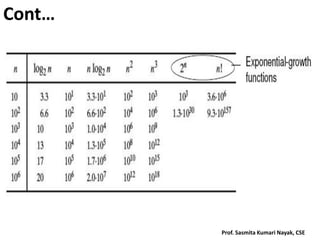
Cont…
Prof. Sasmita Kumari Nayak, CSE
Best-Case, Worst-Case and Average-Case
• Algorithm efficiency depends on the input size n.
– Worst case: Cworst(n) – maximum number of times
the basic operation is executed over inputs of size n
– Best case: Cbest(n) – minimum # times over inputs of
size n
– Average case: Cavg(n) – “average” over inputs of size n
Prof. Sasmita Kumari Nayak, CSE
Cont…
• For some algorithms efficiency depends on type of input.
– Example: Sequential Search
• Problem: Given a list of n elements and a search key K, find an element equal
to K, if any.
• Algorithm: Scan the list and compare its successive elements with K until
either a matching element is found (successful search) or the list is exhausted
(unsuccessful search)
• Given a sequential search problem of an input size of n, what kind of
input would make the running time the longest?
• How many key comparisons?
Prof. Sasmita Kumari Nayak, CSE
Ex: Sequential Search Algorithm
ALGORITHM SequentialSearch(A[0..n-1], K)
//Searches for a given value in a given array by sequential search
//Input: An array A[0..n-1] and a search key K
//Output: Returns the index of the first element of A that matches K or –1
if there are no matching elements
i 0
while i < n and A*i+ ≠ K do
i  i + 1
if i < n //A[I] = K
return i
else
return -1
Worst-Case: Cworst(n) = n
Best-Case: Cbest(n) = 1
Prof. Sasmita Kumari Nayak, CSE
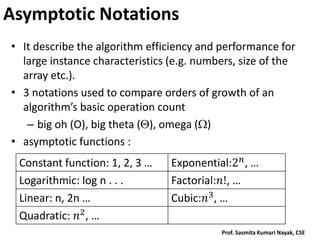
Asymptotic Notations
• It describe the algorithm efficiency and performance for
large instance characteristics (e.g. numbers, size of the
array etc.).
• 3 notations used to compare orders of growth of an
algorithm’s basic operation count
– big oh (O), big theta (), omega ()
• asymptotic functions :
Prof. Sasmita Kumari Nayak, CSE
Constant function: 1, 2, 3 … Exponential:2𝑛
, …
Logarithmic: log n . . . Factorial:𝑛!, …
Linear: n, 2n … Cubic:𝑛3, …
Quadratic: 𝑛2, …
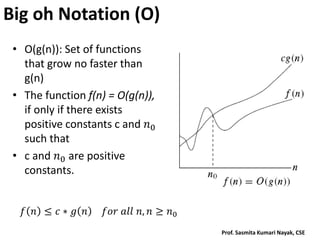
Big oh Notation (O)
• O(g(n)): Set of functions
that grow no faster than
g(n)
• The function f(n) = O(g(n)),
if only if there exists
positive constants c and 𝑛0
such that
• c and 𝑛0 are positive
constants.
Prof. Sasmita Kumari Nayak, CSE
𝑓 𝑛 ≤ 𝑐 ∗ 𝑔 𝑛 𝑓𝑜𝑟 𝑎𝑙𝑙 𝑛, 𝑛 ≥ 𝑛0
Big omega Notation (Ω)
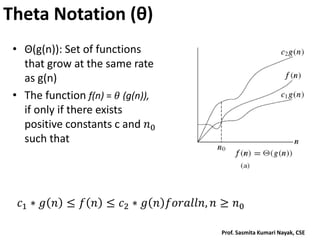
• Ω(g(n)): Set of functions
that grow at least as fast as
g(n)
• The function f(n) = Ω (g(n)),
if only if there exists
positive constants c and 𝑛0
such that
Prof. Sasmita Kumari Nayak, CSE
𝑓 𝑛 ≥ 𝑐 ∗ 𝑔 𝑛 𝑓𝑜𝑟 𝑎𝑙𝑙 𝑛, 𝑛 ≥ 𝑛0
Theta Notation (θ)
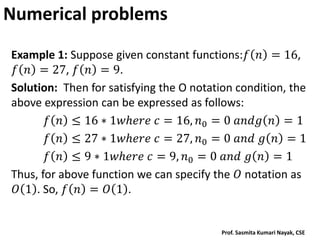
• Θ(g(n)): Set of functions
that grow at the same rate
as g(n)
• The function f(n) = 𝜃 (g(n)),
if only if there exists
positive constants c and 𝑛0
such that
Prof. Sasmita Kumari Nayak, CSE
𝑐1 ∗ 𝑔 𝑛 ≤ 𝑓 𝑛 ≤ 𝑐2 ∗ 𝑔 𝑛 𝑓𝑜𝑟𝑎𝑙𝑙𝑛, 𝑛 ≥ 𝑛0
Numerical problems
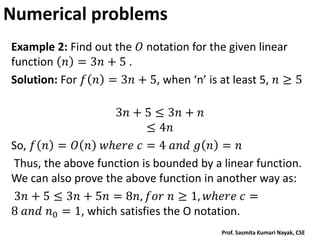
Example 1: Suppose given constant functions:𝑓 𝑛 = 16,
𝑓 𝑛 = 27, 𝑓 𝑛 = 9.
Solution: Then for satisfying the O notation condition, the
above expression can be expressed as follows:
𝑓 𝑛 ≤ 16 ∗ 1𝑤𝑕𝑒𝑟𝑒 𝑐 = 16, 𝑛0 = 0 𝑎𝑛𝑑𝑔 𝑛 = 1
𝑓 𝑛 ≤ 27 ∗ 1𝑤𝑕𝑒𝑟𝑒 𝑐 = 27, 𝑛0 = 0 𝑎𝑛𝑑 𝑔 𝑛 = 1
𝑓 𝑛 ≤ 9 ∗ 1𝑤𝑕𝑒𝑟𝑒 𝑐 = 9, 𝑛0 = 0 𝑎𝑛𝑑 𝑔 𝑛 = 1
Thus, for above function we can specify the 𝑂 notation as
𝑂 1 . So, 𝑓 𝑛 = 𝑂 1 .
Prof. Sasmita Kumari Nayak, CSE
Numerical problems
Example 2: Find out the 𝑂 notation for the given linear
function 𝑛 = 3𝑛 + 5 .
Solution: For 𝑓 𝑛 = 3𝑛 + 5, when ‘n’ is at least 5, 𝑛 ≥ 5
3𝑛 + 5 ≤ 3𝑛 + 𝑛
≤ 4𝑛
So, 𝑓 𝑛 = 𝑂 𝑛 𝑤𝑕𝑒𝑟𝑒 𝑐 = 4 𝑎𝑛𝑑 𝑔 𝑛 = 𝑛
Thus, the above function is bounded by a linear function.
We can also prove the above function in another way as:
3𝑛 + 5 ≤ 3𝑛 + 5𝑛 = 8𝑛, 𝑓𝑜𝑟 𝑛 ≥ 1, 𝑤𝑕𝑒𝑟𝑒 𝑐 =
8 𝑎𝑛𝑑 𝑛0 = 1, which satisfies the O notation.
Prof. Sasmita Kumari Nayak, CSE
Numerical problems
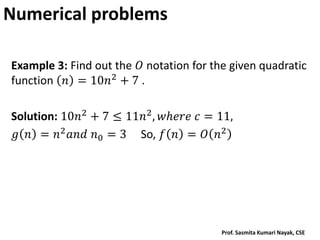
Example 3: Find out the 𝑂 notation for the given quadratic
function 𝑛 = 10𝑛2 + 7 .
Solution: 10𝑛2 + 7 ≤ 11𝑛2, 𝑤𝑕𝑒𝑟𝑒 𝑐 = 11,
𝑔 𝑛 = 𝑛2𝑎𝑛𝑑 𝑛0 = 3 So, 𝑓 𝑛 = 𝑂 𝑛2
Prof. Sasmita Kumari Nayak, CSE
Numerical problems
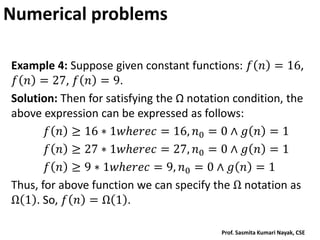
Example 4: Suppose given constant functions: 𝑓 𝑛 = 16,
𝑓 𝑛 = 27, 𝑓 𝑛 = 9.
Solution: Then for satisfying the Ω notation condition, the
above expression can be expressed as follows:
𝑓 𝑛 ≥ 16 ∗ 1𝑤𝑕𝑒𝑟𝑒𝑐 = 16, 𝑛0 = 0 ∧ 𝑔 𝑛 = 1
𝑓 𝑛 ≥ 27 ∗ 1𝑤𝑕𝑒𝑟𝑒𝑐 = 27, 𝑛0 = 0 ∧ 𝑔 𝑛 = 1
𝑓 𝑛 ≥ 9 ∗ 1𝑤𝑕𝑒𝑟𝑒𝑐 = 9, 𝑛0 = 0 ∧ 𝑔 𝑛 = 1
Thus, for above function we can specify the Ω notation as
Ω 1 . So, 𝑓 𝑛 = Ω 1 .
Prof. Sasmita Kumari Nayak, CSE
Numerical problems
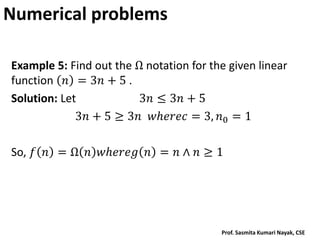
Example 5: Find out the Ω notation for the given linear
function 𝑛 = 3𝑛 + 5 .
Solution: Let 3𝑛 ≤ 3𝑛 + 5
3𝑛 + 5 ≥ 3𝑛 𝑤𝑕𝑒𝑟𝑒𝑐 = 3, 𝑛0 = 1
So, 𝑓 𝑛 = Ω 𝑛 𝑤𝑕𝑒𝑟𝑒𝑔 𝑛 = 𝑛 ∧ 𝑛 ≥ 1
Prof. Sasmita Kumari Nayak, CSE
Numerical problems
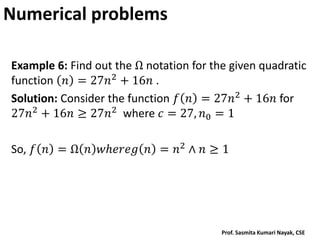
Example 6: Find out the Ω notation for the given quadratic
function 𝑛 = 27𝑛2 + 16𝑛 .
Solution: Consider the function 𝑓 𝑛 = 27𝑛2 + 16𝑛 for
27𝑛2
+ 16𝑛 ≥ 27𝑛2
where 𝑐 = 27, 𝑛0 = 1
So, 𝑓 𝑛 = Ω 𝑛 𝑤𝑕𝑒𝑟𝑒𝑔 𝑛 = 𝑛2
∧ 𝑛 ≥ 1
Prof. Sasmita Kumari Nayak, CSE
Numerical problems
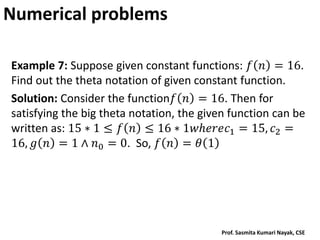
Example 7: Suppose given constant functions: 𝑓 𝑛 = 16.
Find out the theta notation of given constant function.
Solution: Consider the function𝑓 𝑛 = 16. Then for
satisfying the big theta notation, the given function can be
written as: 15 ∗ 1 ≤ 𝑓 𝑛 ≤ 16 ∗ 1𝑤𝑕𝑒𝑟𝑒𝑐1 = 15, 𝑐2 =
16, 𝑔 𝑛 = 1 ∧ 𝑛0 = 0. So, 𝑓 𝑛 = 𝜃 1
Prof. Sasmita Kumari Nayak, CSE
Numerical problems
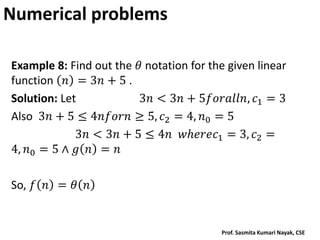
Example 8: Find out the 𝜃 notation for the given linear
function 𝑛 = 3𝑛 + 5 .
Solution: Let 3𝑛 < 3𝑛 + 5𝑓𝑜𝑟𝑎𝑙𝑙𝑛, 𝑐1 = 3
Also 3𝑛 + 5 ≤ 4𝑛𝑓𝑜𝑟𝑛 ≥ 5, 𝑐2 = 4, 𝑛0 = 5
3𝑛 < 3𝑛 + 5 ≤ 4𝑛 𝑤𝑕𝑒𝑟𝑒𝑐1 = 3, 𝑐2 =
4, 𝑛0 = 5 ∧ 𝑔 𝑛 = 𝑛
So, 𝑓 𝑛 = 𝜃 𝑛
Prof. Sasmita Kumari Nayak, CSE
Numerical problems
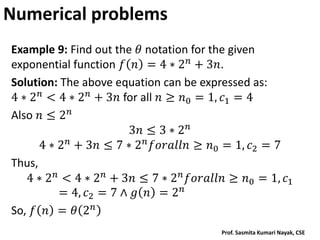
Example 9: Find out the 𝜃 notation for the given
exponential function 𝑓 𝑛 = 4 ∗ 2𝑛 + 3𝑛.
Solution: The above equation can be expressed as:
4 ∗ 2𝑛 < 4 ∗ 2𝑛 + 3𝑛 for all 𝑛 ≥ 𝑛0 = 1, 𝑐1 = 4
Also 𝑛 ≤ 2𝑛
3𝑛 ≤ 3 ∗ 2𝑛
4 ∗ 2𝑛 + 3𝑛 ≤ 7 ∗ 2𝑛𝑓𝑜𝑟𝑎𝑙𝑙𝑛 ≥ 𝑛0 = 1, 𝑐2 = 7
Thus,
4 ∗ 2𝑛 < 4 ∗ 2𝑛 + 3𝑛 ≤ 7 ∗ 2𝑛𝑓𝑜𝑟𝑎𝑙𝑙𝑛 ≥ 𝑛0 = 1, 𝑐1
= 4, 𝑐2 = 7 ∧ 𝑔 𝑛 = 2𝑛
So, 𝑓 𝑛 = 𝜃 2𝑛
Prof. Sasmita Kumari Nayak, CSE
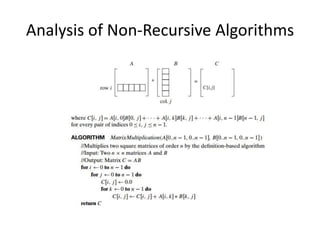
Analysis of Non-Recursive Algorithms
Cont…
Example: Maximum Element
Algorithm MaxElement( A[0...n-1] )
maxval ← A[0]
for i ← 1 to n-1 do
if A[i] > maxval then maxval ← A[i]
return maxval
• What is the problem size? n
• Most frequent operation? Comparison in the for loop
• Depends on worst case or best case? No, has to go through
the entire array
• C(n) = number of comparisons
• C(n) = ∑i=1
n-1 1 = n-1 ε Θ(n)

Module III - 1 - Orders of Growth.p df

  • 1.
    MATHEMATICAL PROBLEM SOLVING By Prof. SasmitaKumari Nayak Dept. of CSE Orders of Growth Prof. Sasmita Kumari Nayak, CSE
  • 2.
    Introduction • Orders ofGrowth • Best-Case, Worst-Case and Average-Case Efficiencies, • Asymptotic Notations • Analysis of Recursive Algorithms • Analysis of Non-Recursive Algorithms Prof. Sasmita Kumari Nayak, CSE
  • 3.
    Orders of Growth •An order of growth is a set of functions whose asymptotic growth behavior is considered equivalent. • consider only the leading term of a formula and ignore the constant coefficient. • Example: – How much faster will algorithm run on computer that is twice as fast? – How much longer does it take to solve problem of double input size? Prof. Sasmita Kumari Nayak, CSE
  • 4.
  • 5.
    Best-Case, Worst-Case andAverage-Case • Algorithm efficiency depends on the input size n. – Worst case: Cworst(n) – maximum number of times the basic operation is executed over inputs of size n – Best case: Cbest(n) – minimum # times over inputs of size n – Average case: Cavg(n) – “average” over inputs of size n Prof. Sasmita Kumari Nayak, CSE
  • 6.
    Cont… • For somealgorithms efficiency depends on type of input. – Example: Sequential Search • Problem: Given a list of n elements and a search key K, find an element equal to K, if any. • Algorithm: Scan the list and compare its successive elements with K until either a matching element is found (successful search) or the list is exhausted (unsuccessful search) • Given a sequential search problem of an input size of n, what kind of input would make the running time the longest? • How many key comparisons? Prof. Sasmita Kumari Nayak, CSE
  • 7.
    Ex: Sequential SearchAlgorithm ALGORITHM SequentialSearch(A[0..n-1], K) //Searches for a given value in a given array by sequential search //Input: An array A[0..n-1] and a search key K //Output: Returns the index of the first element of A that matches K or –1 if there are no matching elements i 0 while i < n and A*i+ ≠ K do i  i + 1 if i < n //A[I] = K return i else return -1 Worst-Case: Cworst(n) = n Best-Case: Cbest(n) = 1 Prof. Sasmita Kumari Nayak, CSE
  • 8.
    Asymptotic Notations • Itdescribe the algorithm efficiency and performance for large instance characteristics (e.g. numbers, size of the array etc.). • 3 notations used to compare orders of growth of an algorithm’s basic operation count – big oh (O), big theta (), omega () • asymptotic functions : Prof. Sasmita Kumari Nayak, CSE Constant function: 1, 2, 3 … Exponential:2𝑛 , … Logarithmic: log n . . . Factorial:𝑛!, … Linear: n, 2n … Cubic:𝑛3, … Quadratic: 𝑛2, …
  • 9.
    Big oh Notation(O) • O(g(n)): Set of functions that grow no faster than g(n) • The function f(n) = O(g(n)), if only if there exists positive constants c and 𝑛0 such that • c and 𝑛0 are positive constants. Prof. Sasmita Kumari Nayak, CSE 𝑓 𝑛 ≤ 𝑐 ∗ 𝑔 𝑛 𝑓𝑜𝑟 𝑎𝑙𝑙 𝑛, 𝑛 ≥ 𝑛0
  • 10.
    Big omega Notation(Ω) • Ω(g(n)): Set of functions that grow at least as fast as g(n) • The function f(n) = Ω (g(n)), if only if there exists positive constants c and 𝑛0 such that Prof. Sasmita Kumari Nayak, CSE 𝑓 𝑛 ≥ 𝑐 ∗ 𝑔 𝑛 𝑓𝑜𝑟 𝑎𝑙𝑙 𝑛, 𝑛 ≥ 𝑛0
  • 11.
    Theta Notation (θ) •Θ(g(n)): Set of functions that grow at the same rate as g(n) • The function f(n) = 𝜃 (g(n)), if only if there exists positive constants c and 𝑛0 such that Prof. Sasmita Kumari Nayak, CSE 𝑐1 ∗ 𝑔 𝑛 ≤ 𝑓 𝑛 ≤ 𝑐2 ∗ 𝑔 𝑛 𝑓𝑜𝑟𝑎𝑙𝑙𝑛, 𝑛 ≥ 𝑛0
  • 12.
    Numerical problems Example 1:Suppose given constant functions:𝑓 𝑛 = 16, 𝑓 𝑛 = 27, 𝑓 𝑛 = 9. Solution: Then for satisfying the O notation condition, the above expression can be expressed as follows: 𝑓 𝑛 ≤ 16 ∗ 1𝑤𝑕𝑒𝑟𝑒 𝑐 = 16, 𝑛0 = 0 𝑎𝑛𝑑𝑔 𝑛 = 1 𝑓 𝑛 ≤ 27 ∗ 1𝑤𝑕𝑒𝑟𝑒 𝑐 = 27, 𝑛0 = 0 𝑎𝑛𝑑 𝑔 𝑛 = 1 𝑓 𝑛 ≤ 9 ∗ 1𝑤𝑕𝑒𝑟𝑒 𝑐 = 9, 𝑛0 = 0 𝑎𝑛𝑑 𝑔 𝑛 = 1 Thus, for above function we can specify the 𝑂 notation as 𝑂 1 . So, 𝑓 𝑛 = 𝑂 1 . Prof. Sasmita Kumari Nayak, CSE
  • 13.
    Numerical problems Example 2:Find out the 𝑂 notation for the given linear function 𝑛 = 3𝑛 + 5 . Solution: For 𝑓 𝑛 = 3𝑛 + 5, when ‘n’ is at least 5, 𝑛 ≥ 5 3𝑛 + 5 ≤ 3𝑛 + 𝑛 ≤ 4𝑛 So, 𝑓 𝑛 = 𝑂 𝑛 𝑤𝑕𝑒𝑟𝑒 𝑐 = 4 𝑎𝑛𝑑 𝑔 𝑛 = 𝑛 Thus, the above function is bounded by a linear function. We can also prove the above function in another way as: 3𝑛 + 5 ≤ 3𝑛 + 5𝑛 = 8𝑛, 𝑓𝑜𝑟 𝑛 ≥ 1, 𝑤𝑕𝑒𝑟𝑒 𝑐 = 8 𝑎𝑛𝑑 𝑛0 = 1, which satisfies the O notation. Prof. Sasmita Kumari Nayak, CSE
  • 14.
    Numerical problems Example 3:Find out the 𝑂 notation for the given quadratic function 𝑛 = 10𝑛2 + 7 . Solution: 10𝑛2 + 7 ≤ 11𝑛2, 𝑤𝑕𝑒𝑟𝑒 𝑐 = 11, 𝑔 𝑛 = 𝑛2𝑎𝑛𝑑 𝑛0 = 3 So, 𝑓 𝑛 = 𝑂 𝑛2 Prof. Sasmita Kumari Nayak, CSE
  • 15.
    Numerical problems Example 4:Suppose given constant functions: 𝑓 𝑛 = 16, 𝑓 𝑛 = 27, 𝑓 𝑛 = 9. Solution: Then for satisfying the Ω notation condition, the above expression can be expressed as follows: 𝑓 𝑛 ≥ 16 ∗ 1𝑤𝑕𝑒𝑟𝑒𝑐 = 16, 𝑛0 = 0 ∧ 𝑔 𝑛 = 1 𝑓 𝑛 ≥ 27 ∗ 1𝑤𝑕𝑒𝑟𝑒𝑐 = 27, 𝑛0 = 0 ∧ 𝑔 𝑛 = 1 𝑓 𝑛 ≥ 9 ∗ 1𝑤𝑕𝑒𝑟𝑒𝑐 = 9, 𝑛0 = 0 ∧ 𝑔 𝑛 = 1 Thus, for above function we can specify the Ω notation as Ω 1 . So, 𝑓 𝑛 = Ω 1 . Prof. Sasmita Kumari Nayak, CSE
  • 16.
    Numerical problems Example 5:Find out the Ω notation for the given linear function 𝑛 = 3𝑛 + 5 . Solution: Let 3𝑛 ≤ 3𝑛 + 5 3𝑛 + 5 ≥ 3𝑛 𝑤𝑕𝑒𝑟𝑒𝑐 = 3, 𝑛0 = 1 So, 𝑓 𝑛 = Ω 𝑛 𝑤𝑕𝑒𝑟𝑒𝑔 𝑛 = 𝑛 ∧ 𝑛 ≥ 1 Prof. Sasmita Kumari Nayak, CSE
  • 17.
    Numerical problems Example 6:Find out the Ω notation for the given quadratic function 𝑛 = 27𝑛2 + 16𝑛 . Solution: Consider the function 𝑓 𝑛 = 27𝑛2 + 16𝑛 for 27𝑛2 + 16𝑛 ≥ 27𝑛2 where 𝑐 = 27, 𝑛0 = 1 So, 𝑓 𝑛 = Ω 𝑛 𝑤𝑕𝑒𝑟𝑒𝑔 𝑛 = 𝑛2 ∧ 𝑛 ≥ 1 Prof. Sasmita Kumari Nayak, CSE
  • 18.
    Numerical problems Example 7:Suppose given constant functions: 𝑓 𝑛 = 16. Find out the theta notation of given constant function. Solution: Consider the function𝑓 𝑛 = 16. Then for satisfying the big theta notation, the given function can be written as: 15 ∗ 1 ≤ 𝑓 𝑛 ≤ 16 ∗ 1𝑤𝑕𝑒𝑟𝑒𝑐1 = 15, 𝑐2 = 16, 𝑔 𝑛 = 1 ∧ 𝑛0 = 0. So, 𝑓 𝑛 = 𝜃 1 Prof. Sasmita Kumari Nayak, CSE
  • 19.
    Numerical problems Example 8:Find out the 𝜃 notation for the given linear function 𝑛 = 3𝑛 + 5 . Solution: Let 3𝑛 < 3𝑛 + 5𝑓𝑜𝑟𝑎𝑙𝑙𝑛, 𝑐1 = 3 Also 3𝑛 + 5 ≤ 4𝑛𝑓𝑜𝑟𝑛 ≥ 5, 𝑐2 = 4, 𝑛0 = 5 3𝑛 < 3𝑛 + 5 ≤ 4𝑛 𝑤𝑕𝑒𝑟𝑒𝑐1 = 3, 𝑐2 = 4, 𝑛0 = 5 ∧ 𝑔 𝑛 = 𝑛 So, 𝑓 𝑛 = 𝜃 𝑛 Prof. Sasmita Kumari Nayak, CSE
  • 20.
    Numerical problems Example 9:Find out the 𝜃 notation for the given exponential function 𝑓 𝑛 = 4 ∗ 2𝑛 + 3𝑛. Solution: The above equation can be expressed as: 4 ∗ 2𝑛 < 4 ∗ 2𝑛 + 3𝑛 for all 𝑛 ≥ 𝑛0 = 1, 𝑐1 = 4 Also 𝑛 ≤ 2𝑛 3𝑛 ≤ 3 ∗ 2𝑛 4 ∗ 2𝑛 + 3𝑛 ≤ 7 ∗ 2𝑛𝑓𝑜𝑟𝑎𝑙𝑙𝑛 ≥ 𝑛0 = 1, 𝑐2 = 7 Thus, 4 ∗ 2𝑛 < 4 ∗ 2𝑛 + 3𝑛 ≤ 7 ∗ 2𝑛𝑓𝑜𝑟𝑎𝑙𝑙𝑛 ≥ 𝑛0 = 1, 𝑐1 = 4, 𝑐2 = 7 ∧ 𝑔 𝑛 = 2𝑛 So, 𝑓 𝑛 = 𝜃 2𝑛 Prof. Sasmita Kumari Nayak, CSE
  • 21.
  • 22.
    Cont… Example: Maximum Element AlgorithmMaxElement( A[0...n-1] ) maxval ← A[0] for i ← 1 to n-1 do if A[i] > maxval then maxval ← A[i] return maxval • What is the problem size? n • Most frequent operation? Comparison in the for loop • Depends on worst case or best case? No, has to go through the entire array • C(n) = number of comparisons • C(n) = ∑i=1 n-1 1 = n-1 ε Θ(n)