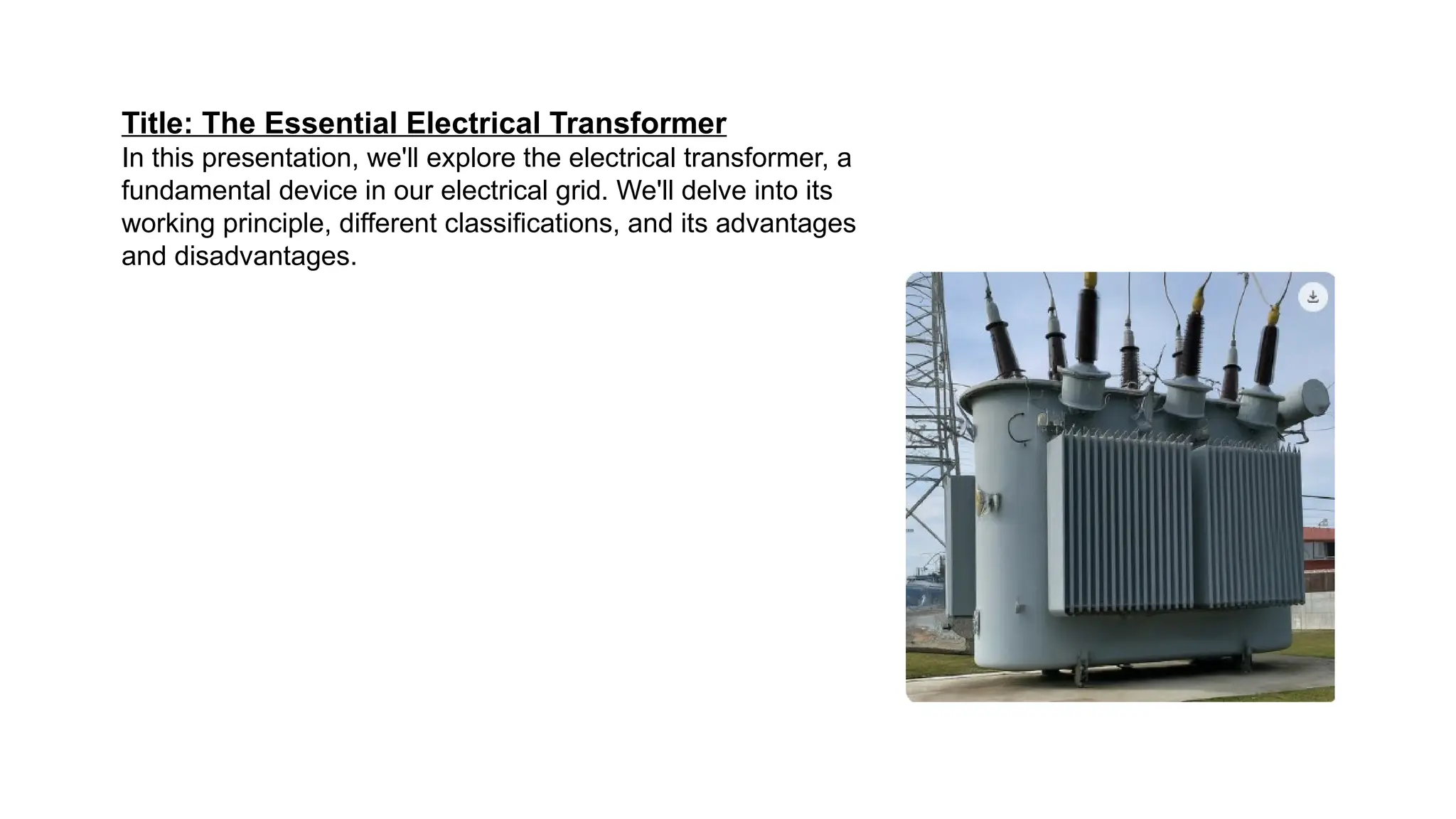
Title: The Essential Electrical Transformer
In this presentation, we'll explore the electrical transformer, a
fundamental device in our electrical grid. We'll delve into its
working principle, different classifications, and its advantages
and disadvantages.
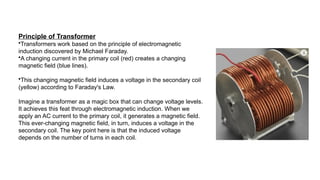
Principle of Transformer
•Transformers work based on the principle of electromagnetic
induction discovered by Michael Faraday.
•A changing current in the primary coil (red) creates a changing
magnetic field (blue lines).
•This changing magnetic field induces a voltage in the secondary coil
(yellow) according to Faraday's Law.
Imagine a transformer as a magic box that can change voltage levels.
It achieves this feat through electromagnetic induction. When we
apply an AC current to the primary coil, it generates a magnetic field.
This ever-changing magnetic field, in turn, induces a voltage in the
secondary coil. The key point here is that the induced voltage
depends on the number of turns in each coil.
Working of a Transformer
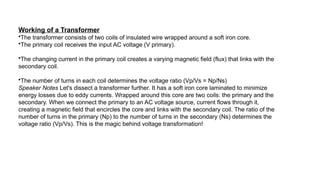
•The transformer consists of two coils of insulated wire wrapped around a soft iron core.
•The primary coil receives the input AC voltage (V primary).
•The changing current in the primary coil creates a varying magnetic field (flux) that links with the
secondary coil.
•The number of turns in each coil determines the voltage ratio (Vp/Vs = Np/Ns)
Speaker Notes Let's dissect a transformer further. It has a soft iron core laminated to minimize
energy losses due to eddy currents. Wrapped around this core are two coils: the primary and the
secondary. When we connect the primary to an AC voltage source, current flows through it,
creating a magnetic field that encircles the core and links with the secondary coil. The ratio of the
number of turns in the primary (Np) to the number of turns in the secondary (Ns) determines the
voltage ratio (Vp/Vs). This is the magic behind voltage transformation!
Classification of Transformers
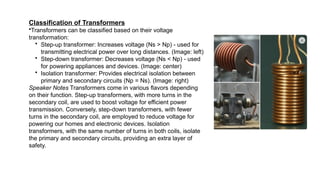
•Transformers can be classified based on their voltage
transformation:
• Step-up transformer: Increases voltage (Ns > Np) - used for
transmitting electrical power over long distances. (Image: left)
• Step-down transformer: Decreases voltage (Ns < Np) - used
for powering appliances and devices. (Image: center)
• Isolation transformer: Provides electrical isolation between
primary and secondary circuits (Np = Ns). (Image: right)
Speaker Notes Transformers come in various flavors depending
on their function. Step-up transformers, with more turns in the
secondary coil, are used to boost voltage for efficient power
transmission. Conversely, step-down transformers, with fewer
turns in the secondary coil, are employed to reduce voltage for
powering our homes and electronic devices. Isolation
transformers, with the same number of turns in both coils, isolate
the primary and secondary circuits, providing an extra layer of
safety.
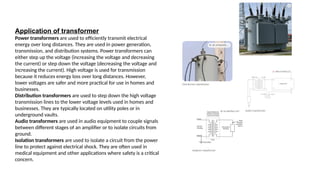
Application of transformer
Power transformers are used to efficiently transmit electrical
energy over long distances. They are used in power generation,
transmission, and distribution systems. Power transformers can
either step up the voltage (increasing the voltage and decreasing
the current) or step down the voltage (decreasing the voltage and
increasing the current). High voltage is used for transmission
because it reduces energy loss over long distances. However,
lower voltages are safer and more practical for use in homes and
businesses.
Distribution transformers are used to step down the high voltage
transmission lines to the lower voltage levels used in homes and
businesses. They are typically located on utility poles or in
underground vaults.
Audio transformers are used in audio equipment to couple signals
between different stages of an amplifier or to isolate circuits from
ground.
Isolation transformers are used to isolate a circuit from the power
line to protect against electrical shock. They are often used in
medical equipment and other applications where safety is a critical
concern.
Advantages of Transformers
•Efficient transmission of electrical power over long distances with minimal energy loss (due to step-up
transformers).
•Provides voltage conversion for powering various appliances and devices with different voltage
requirements (step-down transformers).
•Improves safety by electrically isolating primary and secondary circuits (isolation transformers).
There are five main types of power loss in a transformer:
Copper Loss (I²R Loss): This loss is caused by the resistance of the wires in the transformer's windings. As
current flows through the windings, some energy is dissipated as heat due to this resistance. Larger diameter
wires can be used to reduce copper loss, but this also increases the cost and size of the transformer.
Iron Loss (Core Loss): This loss occurs in the transformer's core, which is made of ferromagnetic material.
There are two main components of iron loss:
Hysteresis Loss: When the magnetic field in the core alternates due to the AC current, the material undergoes
a process called hysteresis. This back-and-forth magnetization involves some energy loss. The specific
properties of the core material affect hysteresis loss.
Eddy Current Loss: The changing magnetic field in the core also induces circulating currents within the core
itself, called eddy currents. These eddy currents dissipate energy as heat. To reduce eddy current loss, the
transformer core is laminated from thin sheets of steel rather than being a solid piece.
Stray Loss: This is a small loss due to leakage flux, which is the magnetic field that doesn't effectively couple
the primary and secondary windings. Stray loss can be minimized by careful transformer design.
Dielectric Loss: This is a loss in the insulating materials used in the transformer, which are not perfect
insulators and will leak a small amount of current. Dielectric loss is usually quite small compared to the other
losses.
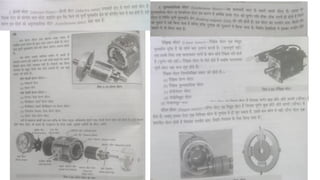
an electric motor work together to transform electrical energy into mechanical energy in the form of rotation. Here's a
breakdown of the essential components and their functions:
Main Parts:
•Stator: This is the stationary outer part of the motor. It typically houses either permanent magnets or electromagnets made of
coils of wire. When energized with electric current, these electromagnets create a strong magnetic field within the stator.
•Rotor: This is the rotating inner part of the motor. The rotor's construction depends on the motor type (DC vs. AC) but
generally consists of a metal shaft with a core made of laminated steel to minimize energy losses. The core may have windings
of wire or permanent magnets on it.
Additional Parts (Depending on Motor Type):
•Commutator (DC Motors): This is a rotating electrical switch in a DC motor. It makes contact with brushes and reverses the
current direction in the rotor windings at the right moment, enabling continuous rotation.
•Brushes (DC Motors): Spring-loaded brushes made of conducting material (like carbon) make contact with the commutator
and transfer electric current to the rotor windings.
•Bearings: These are bearings supporting the rotor shaft, allowing it to spin smoothly with minimal friction.
Function of the Parts:
1.Magnetic Field Generation: The stator's electromagnets or permanent magnets establish a strong magnetic field within the
motor.
2.Current and Force: In DC motors, the commutator and brushes deliver current to the rotor windings. In AC motors, current is
induced in the rotor windings due to the changing magnetic field from the stator. This current flow in the rotor windings
interacts with the stator's magnetic field, creating a force.
3.Rotational Torque: The force produced by the magnetic field interaction acts on the rotor, causing it to experience a turning
force or torque.
4.Continuous Rotation (DC Motors): The commutator ensures that the current in the rotor windings reverses direction at the
appropriate points, maintaining a continuous turning motion.
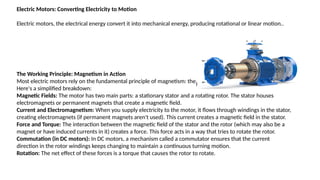
Electric Motors: Converting Electricity to Motion
Electric motors, the electrical energy convert it into mechanical energy, producing rotational or linear motion..
The Working Principle: Magnetism in Action
Most electric motors rely on the fundamental principle of magnetism: the interaction between magnetic fields.
Here's a simplified breakdown:
Magnetic Fields: The motor has two main parts: a stationary stator and a rotating rotor. The stator houses
electromagnets or permanent magnets that create a magnetic field.
Current and Electromagnetism: When you supply electricity to the motor, it flows through windings in the stator,
creating electromagnets (if permanent magnets aren't used). This current creates a magnetic field in the stator.
Force and Torque: The interaction between the magnetic field of the stator and the rotor (which may also be a
magnet or have induced currents in it) creates a force. This force acts in a way that tries to rotate the rotor.
Commutation (in DC motors): In DC motors, a mechanism called a commutator ensures that the current
direction in the rotor windings keeps changing to maintain a continuous turning motion.
Rotation: The net effect of these forces is a torque that causes the rotor to rotate.
Classifying Electric Motors: A World of Variety
1. By Type of Current:
Direct Current (DC) Motors:
Brushed DC Motors: These motors use brushes and a commutator to achieve current commutation
in the rotor, allowing for good speed control. They are commonly found in power tools, electric
vehicles, and applications requiring variable speed control.
Brushless DC Motors (BLDC Motors): BLDC motors utilize electronic controls to manage current
commutation, offering higher efficiency and less maintenance compared to brushed DC motors.
They are becoming increasingly popular due to these advantages.
Alternating Current (AC) Motors:
Synchronous Motors: The rotor's speed is directly tied to the frequency of the AC supply. They are
used in applications requiring constant speed, such as generators, compressors, and clocks.
Induction Motors: These are the most common type of AC motor. The rotor's speed is slightly less
than the AC frequency (due to slip). They are known for their robust design, simplicity, and good
starting torque. There are subcategories within induction motors, including squirrel cage and wound
rotor types.
2. By Application (Special Purpose Motors):
In addition to the basic AC and DC classifications, there are numerous special purpose motors designed for
specific applications:
Stepper Motors: These motors rotate in discrete steps, making them ideal for precise positioning control in
applications like printers, plotters, and robotic arms.
Servo Motors: Similar to stepper motors, servo motors offer precise positioning control but can also achieve
continuous rotation. They are used in applications requiring high precision and feedback control, such as
robotic arms and control surfaces in radio-controlled vehicles.
Linear Motors: Unlike rotary motors, linear motors produce linear motion directly. They are used in
applications like machine tools, high-speed trains, and roller coasters.
Universal Motors: These motors can operate on both AC and DC power. They are commonly found in power
tools and household appliances.
In Our Homes:
•Appliances: From refrigerators and washing machines to mixers, blenders, and hair dryers, electric motors power
the essential functions of our household appliances.
•HVAC Systems: Fans and blowers driven by electric motors circulate air for heating, ventilation, and air
conditioning (HVAC) systems, keeping us comfortable indoors.
•Power Tools: Drills, saws, sanders, and other power tools rely on electric motors to deliver the torque and speed
needed for various DIY and construction tasks.
Industries and Manufacturing:
•Production Lines: Electric motors are the backbone of industrial automation, powering conveyors, machine tools,
robots, and various production equipment.
•Pumps and Fans: They play a crucial role in industrial processes by driving pumps for fluids and slurries, as well as
fans for ventilation and exhaust.
•Heavy Machinery: From cranes lifting massive loads to rolling mills shaping steel, electric motors provide the
power for heavy-duty industrial machinery.
Transportation:
•Electric Vehicles (EVs): The hearts of electric cars, buses, and other EVs are electric motors that propel them
efficiently and quietly.
•Hybrid Vehicles: Electric motors work in conjunction with combustion engines in hybrid vehicles to improve fuel
efficiency and reduce emissions.
•Trains and Subways: Many modern trains and subways utilize electric motors powered by an external electricity
supply for clean and efficient transportation.
Everyday Devices:
•Computer Hard Drives: Electric motors within the hard drive enable the spinning of platters, allowing data storage
and retrieval.
•Disc Drives: Similar to hard drives, motors in disc drives spin the discs for reading and writing data on CDs, DVDs,
and Blu-ray discs.
•Fans and Coolers: Electric motors are the driving force behind cooling fans in computers and electronic devices,
dissipating heat and preventing overheating.
Beyond our Planet:
•Aerospace Applications: Electric motors find use in aircraft control surfaces, landing gear systems, and even in some
experimental electric airplanes.
•Robotics: Electric motors of various sizes power the movement and manipulation capabilities of robots used in
space exploration, manufacturing, and other fields.
Ppt on various electrical equipment .2.1.pptx

Ppt on various electrical equipment .2.1.pptx

  • 1.
    Title: The EssentialElectrical Transformer In this presentation, we'll explore the electrical transformer, a fundamental device in our electrical grid. We'll delve into its working principle, different classifications, and its advantages and disadvantages.
  • 2.
    Principle of Transformer •Transformerswork based on the principle of electromagnetic induction discovered by Michael Faraday. •A changing current in the primary coil (red) creates a changing magnetic field (blue lines). •This changing magnetic field induces a voltage in the secondary coil (yellow) according to Faraday's Law. Imagine a transformer as a magic box that can change voltage levels. It achieves this feat through electromagnetic induction. When we apply an AC current to the primary coil, it generates a magnetic field. This ever-changing magnetic field, in turn, induces a voltage in the secondary coil. The key point here is that the induced voltage depends on the number of turns in each coil.
  • 3.
    Working of aTransformer •The transformer consists of two coils of insulated wire wrapped around a soft iron core. •The primary coil receives the input AC voltage (V primary). •The changing current in the primary coil creates a varying magnetic field (flux) that links with the secondary coil. •The number of turns in each coil determines the voltage ratio (Vp/Vs = Np/Ns) Speaker Notes Let's dissect a transformer further. It has a soft iron core laminated to minimize energy losses due to eddy currents. Wrapped around this core are two coils: the primary and the secondary. When we connect the primary to an AC voltage source, current flows through it, creating a magnetic field that encircles the core and links with the secondary coil. The ratio of the number of turns in the primary (Np) to the number of turns in the secondary (Ns) determines the voltage ratio (Vp/Vs). This is the magic behind voltage transformation!
  • 4.
    Classification of Transformers •Transformerscan be classified based on their voltage transformation: • Step-up transformer: Increases voltage (Ns > Np) - used for transmitting electrical power over long distances. (Image: left) • Step-down transformer: Decreases voltage (Ns < Np) - used for powering appliances and devices. (Image: center) • Isolation transformer: Provides electrical isolation between primary and secondary circuits (Np = Ns). (Image: right) Speaker Notes Transformers come in various flavors depending on their function. Step-up transformers, with more turns in the secondary coil, are used to boost voltage for efficient power transmission. Conversely, step-down transformers, with fewer turns in the secondary coil, are employed to reduce voltage for powering our homes and electronic devices. Isolation transformers, with the same number of turns in both coils, isolate the primary and secondary circuits, providing an extra layer of safety.
  • 5.
    Application of transformer Powertransformers are used to efficiently transmit electrical energy over long distances. They are used in power generation, transmission, and distribution systems. Power transformers can either step up the voltage (increasing the voltage and decreasing the current) or step down the voltage (decreasing the voltage and increasing the current). High voltage is used for transmission because it reduces energy loss over long distances. However, lower voltages are safer and more practical for use in homes and businesses. Distribution transformers are used to step down the high voltage transmission lines to the lower voltage levels used in homes and businesses. They are typically located on utility poles or in underground vaults. Audio transformers are used in audio equipment to couple signals between different stages of an amplifier or to isolate circuits from ground. Isolation transformers are used to isolate a circuit from the power line to protect against electrical shock. They are often used in medical equipment and other applications where safety is a critical concern.
  • 6.
    Advantages of Transformers •Efficienttransmission of electrical power over long distances with minimal energy loss (due to step-up transformers). •Provides voltage conversion for powering various appliances and devices with different voltage requirements (step-down transformers). •Improves safety by electrically isolating primary and secondary circuits (isolation transformers).
  • 7.
    There are fivemain types of power loss in a transformer: Copper Loss (I²R Loss): This loss is caused by the resistance of the wires in the transformer's windings. As current flows through the windings, some energy is dissipated as heat due to this resistance. Larger diameter wires can be used to reduce copper loss, but this also increases the cost and size of the transformer. Iron Loss (Core Loss): This loss occurs in the transformer's core, which is made of ferromagnetic material. There are two main components of iron loss: Hysteresis Loss: When the magnetic field in the core alternates due to the AC current, the material undergoes a process called hysteresis. This back-and-forth magnetization involves some energy loss. The specific properties of the core material affect hysteresis loss. Eddy Current Loss: The changing magnetic field in the core also induces circulating currents within the core itself, called eddy currents. These eddy currents dissipate energy as heat. To reduce eddy current loss, the transformer core is laminated from thin sheets of steel rather than being a solid piece. Stray Loss: This is a small loss due to leakage flux, which is the magnetic field that doesn't effectively couple the primary and secondary windings. Stray loss can be minimized by careful transformer design. Dielectric Loss: This is a loss in the insulating materials used in the transformer, which are not perfect insulators and will leak a small amount of current. Dielectric loss is usually quite small compared to the other losses.
  • 8.
    an electric motorwork together to transform electrical energy into mechanical energy in the form of rotation. Here's a breakdown of the essential components and their functions: Main Parts: •Stator: This is the stationary outer part of the motor. It typically houses either permanent magnets or electromagnets made of coils of wire. When energized with electric current, these electromagnets create a strong magnetic field within the stator. •Rotor: This is the rotating inner part of the motor. The rotor's construction depends on the motor type (DC vs. AC) but generally consists of a metal shaft with a core made of laminated steel to minimize energy losses. The core may have windings of wire or permanent magnets on it. Additional Parts (Depending on Motor Type): •Commutator (DC Motors): This is a rotating electrical switch in a DC motor. It makes contact with brushes and reverses the current direction in the rotor windings at the right moment, enabling continuous rotation. •Brushes (DC Motors): Spring-loaded brushes made of conducting material (like carbon) make contact with the commutator and transfer electric current to the rotor windings. •Bearings: These are bearings supporting the rotor shaft, allowing it to spin smoothly with minimal friction. Function of the Parts: 1.Magnetic Field Generation: The stator's electromagnets or permanent magnets establish a strong magnetic field within the motor. 2.Current and Force: In DC motors, the commutator and brushes deliver current to the rotor windings. In AC motors, current is induced in the rotor windings due to the changing magnetic field from the stator. This current flow in the rotor windings interacts with the stator's magnetic field, creating a force. 3.Rotational Torque: The force produced by the magnetic field interaction acts on the rotor, causing it to experience a turning force or torque. 4.Continuous Rotation (DC Motors): The commutator ensures that the current in the rotor windings reverses direction at the appropriate points, maintaining a continuous turning motion.
  • 9.
    Electric Motors: ConvertingElectricity to Motion Electric motors, the electrical energy convert it into mechanical energy, producing rotational or linear motion.. The Working Principle: Magnetism in Action Most electric motors rely on the fundamental principle of magnetism: the interaction between magnetic fields. Here's a simplified breakdown: Magnetic Fields: The motor has two main parts: a stationary stator and a rotating rotor. The stator houses electromagnets or permanent magnets that create a magnetic field. Current and Electromagnetism: When you supply electricity to the motor, it flows through windings in the stator, creating electromagnets (if permanent magnets aren't used). This current creates a magnetic field in the stator. Force and Torque: The interaction between the magnetic field of the stator and the rotor (which may also be a magnet or have induced currents in it) creates a force. This force acts in a way that tries to rotate the rotor. Commutation (in DC motors): In DC motors, a mechanism called a commutator ensures that the current direction in the rotor windings keeps changing to maintain a continuous turning motion. Rotation: The net effect of these forces is a torque that causes the rotor to rotate.
  • 10.
    Classifying Electric Motors:A World of Variety 1. By Type of Current: Direct Current (DC) Motors: Brushed DC Motors: These motors use brushes and a commutator to achieve current commutation in the rotor, allowing for good speed control. They are commonly found in power tools, electric vehicles, and applications requiring variable speed control. Brushless DC Motors (BLDC Motors): BLDC motors utilize electronic controls to manage current commutation, offering higher efficiency and less maintenance compared to brushed DC motors. They are becoming increasingly popular due to these advantages. Alternating Current (AC) Motors: Synchronous Motors: The rotor's speed is directly tied to the frequency of the AC supply. They are used in applications requiring constant speed, such as generators, compressors, and clocks. Induction Motors: These are the most common type of AC motor. The rotor's speed is slightly less than the AC frequency (due to slip). They are known for their robust design, simplicity, and good starting torque. There are subcategories within induction motors, including squirrel cage and wound rotor types.
  • 11.
    2. By Application(Special Purpose Motors): In addition to the basic AC and DC classifications, there are numerous special purpose motors designed for specific applications: Stepper Motors: These motors rotate in discrete steps, making them ideal for precise positioning control in applications like printers, plotters, and robotic arms. Servo Motors: Similar to stepper motors, servo motors offer precise positioning control but can also achieve continuous rotation. They are used in applications requiring high precision and feedback control, such as robotic arms and control surfaces in radio-controlled vehicles. Linear Motors: Unlike rotary motors, linear motors produce linear motion directly. They are used in applications like machine tools, high-speed trains, and roller coasters. Universal Motors: These motors can operate on both AC and DC power. They are commonly found in power tools and household appliances.
  • 12.
    In Our Homes: •Appliances:From refrigerators and washing machines to mixers, blenders, and hair dryers, electric motors power the essential functions of our household appliances. •HVAC Systems: Fans and blowers driven by electric motors circulate air for heating, ventilation, and air conditioning (HVAC) systems, keeping us comfortable indoors. •Power Tools: Drills, saws, sanders, and other power tools rely on electric motors to deliver the torque and speed needed for various DIY and construction tasks. Industries and Manufacturing: •Production Lines: Electric motors are the backbone of industrial automation, powering conveyors, machine tools, robots, and various production equipment. •Pumps and Fans: They play a crucial role in industrial processes by driving pumps for fluids and slurries, as well as fans for ventilation and exhaust. •Heavy Machinery: From cranes lifting massive loads to rolling mills shaping steel, electric motors provide the power for heavy-duty industrial machinery.
  • 13.
    Transportation: •Electric Vehicles (EVs):The hearts of electric cars, buses, and other EVs are electric motors that propel them efficiently and quietly. •Hybrid Vehicles: Electric motors work in conjunction with combustion engines in hybrid vehicles to improve fuel efficiency and reduce emissions. •Trains and Subways: Many modern trains and subways utilize electric motors powered by an external electricity supply for clean and efficient transportation. Everyday Devices: •Computer Hard Drives: Electric motors within the hard drive enable the spinning of platters, allowing data storage and retrieval. •Disc Drives: Similar to hard drives, motors in disc drives spin the discs for reading and writing data on CDs, DVDs, and Blu-ray discs. •Fans and Coolers: Electric motors are the driving force behind cooling fans in computers and electronic devices, dissipating heat and preventing overheating. Beyond our Planet: •Aerospace Applications: Electric motors find use in aircraft control surfaces, landing gear systems, and even in some experimental electric airplanes. •Robotics: Electric motors of various sizes power the movement and manipulation capabilities of robots used in space exploration, manufacturing, and other fields.