
Transformational Leadership
Brahma Kumaris
www.brahmakumaris.org
Video 2 – Self-Control
Contemporary leadership
 Orientation to results
 Team management
 Constant updating
 Future forecasting
 Personal balance
 Strategic thinking
 Change management
 Intelligences
 The art of communication
 A social approach
 Innovation and creativity
 First, let’s talk about change. We will use a simple
exercise and reflect upon it.
 Let’s create a circle. Everyone gets a sheet of paper. In 2
minutes, you have to draw something you can recognize.
 Now, you pass that sheet to the person at your left.
 Change the drawing you have received, however you want.
 After a time, the facilitator will ask you to pass to the
person at your left.
 Go on with the exercise until you receive your own drawing.
 WHAT HAPPENED TO YOUR DRAWING???
Understanding change
Stage Characteristics Example
Change
(transition)
An expected change for which you have the
tools to face and manage.
A castle of sand, the birth
of a child, a new job.
Crisis An unexpected change for which you don’t
have the tools to face and manage, affecting
your performance, your emotions, values
and future vision.
The destruction of a
castle of sand, the loss of
a job, death of a close
relative.
Chaos An unexpected, undesired and
unmanageable change; any model you have
is useless to face this.
A tsunami, a sudden
bankrupcy of your
company, you learn you
are not part of your
family.
Transformation It is the ultimate change, through which the
final result is totally different.
Glass, change of career, a
new generation.
Stages of change
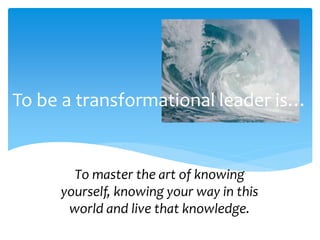
To be a transformational leader is…
To master the art of knowing
yourself, knowing your way in this
world and live that knowledge.
 It is that leader who is able to convince people to do what
they would never do otherwise. That action makes people
to be totally different from before.
 First, that leader will apply this principle to himself/herself.
 How to do it?
1. Start from self-leadership and its 3 elements. Master its
process.
2. Implement those principles into your life, using a certain
methodology (discipline, checking process, coaching, etc.).
3. Reinvest all the results you have got by helping others to
experience the same process as yourself.
To become that leader
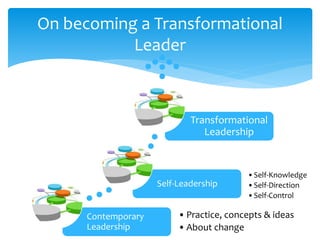
Contemporary
Leadership
• Practice, concepts & ideas
• About change
Self-Leadership
•Self-Knowledge
•Self-Direction
•Self-Control
Transformational
Leadership
On becoming a Transformational
Leader
 A style of leadership where the leader is charged with
identifying the needed change, creating a vision to
guide the change through inspiration, and executing
the change in tandem with committed members of the
group. (Wikipedia)
 It is that leadership which is based on the leader’s
inner work and perception; it comes from within and
generates changes that lead towards transformation
skipping totally or minimizing the effects of crisis and
chaos.
Basic definition
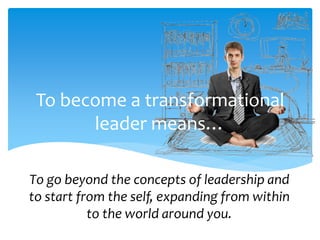
To become a transformational
leader means…
To go beyond the concepts of leadership and
to start from the self, expanding from within
to the world around you.
3 dimensions of a leader’s work
Personal
 Leadership comes
from personal
effort and
resolution.
 This is the most
important
dimension to work
and it will impact
on the other two.
Environmental
 Leaders are
masters of their
own environment.
 A leader influences
deeply everyone
and everything
around them.
Global
* A leader exists for
the world. His
work in a
particular place is
intended to create
a global impact.
* Everything a
leader does
creates an impact
 Spiritual
 A leader will value his or her East as it will point him into
the right direction, the North; balance will come with
West and South.
 Mind
 A leader’s mind creates powerful thoughts and pure
emotions.
 Physical
 Her or his energy will be used in a balanced way.
Personal dimension
 Inner alignment.
 Check your compass, so that all you DO and HAVE is
aligned with your self (BE).
 Connect yourself.
 Everyday, through contemplation, reflection, meditation
or yoga.
 Self-coaching.
 Asking powerful questions and dialoguing with the self
can help in this effort.
Personal dimension – How
 People (in general)
 A leader’s success is connected to his/her power of
creating and sustaining teams, networks and
communities.
 People (close)
 You can recognize a leader by the people close to him or
her; according to his/her quality of leadership, in that
way you know how much leadership that leader has.
 Production
 For a leader, her or his work is a form of expression, not
the end of his/her effort.
Environmental dimension
 Focusing on their potential.
 Think of people as a treasure store and pick the best
they have, their specialty.
 Creating a space.
 For your balance as a leader, you need time and space
for those who are close.
 Coaching, coaching.
 Coaching is important, formal or informal; you need
someone who constantly reminds you of the
importance of your work.
Environmental dimension – How
 Example
 Everything a leader does sets an example for others.
 Values
 For a leader, values is more than a word; it is the path he
or she has to follow to accomplish his/her vision.
 Learning
 A leader never stops learning or re-learning, it is part of
a leader’s life.
Global dimension
 8 powers.
 There is an inner power that can deal with any situation;
be a master of it.
 Check your inventory of values.
 Be honest with yourself and have your own values clear,
learning which ones you have and which ones you need
to develop.
 Be creative in your life.
 Face all challenges with your own speciality, an open
mind and an open heart.
Global dimension – How
What are you taking back?
The best thoughts are the ones I create as they are
part of me and they will guide me with truth,
determination and tenderness.

Transformational leadership iii

  • 1.
  • 2.
    Video 2 –Self-Control
  • 3.
    Contemporary leadership  Orientationto results  Team management  Constant updating  Future forecasting  Personal balance  Strategic thinking  Change management  Intelligences  The art of communication  A social approach  Innovation and creativity
  • 4.
     First, let’stalk about change. We will use a simple exercise and reflect upon it.  Let’s create a circle. Everyone gets a sheet of paper. In 2 minutes, you have to draw something you can recognize.  Now, you pass that sheet to the person at your left.  Change the drawing you have received, however you want.  After a time, the facilitator will ask you to pass to the person at your left.  Go on with the exercise until you receive your own drawing.  WHAT HAPPENED TO YOUR DRAWING??? Understanding change
  • 5.
    Stage Characteristics Example Change (transition) Anexpected change for which you have the tools to face and manage. A castle of sand, the birth of a child, a new job. Crisis An unexpected change for which you don’t have the tools to face and manage, affecting your performance, your emotions, values and future vision. The destruction of a castle of sand, the loss of a job, death of a close relative. Chaos An unexpected, undesired and unmanageable change; any model you have is useless to face this. A tsunami, a sudden bankrupcy of your company, you learn you are not part of your family. Transformation It is the ultimate change, through which the final result is totally different. Glass, change of career, a new generation. Stages of change
  • 6.
    To be atransformational leader is… To master the art of knowing yourself, knowing your way in this world and live that knowledge.
  • 7.
     It isthat leader who is able to convince people to do what they would never do otherwise. That action makes people to be totally different from before.  First, that leader will apply this principle to himself/herself.  How to do it? 1. Start from self-leadership and its 3 elements. Master its process. 2. Implement those principles into your life, using a certain methodology (discipline, checking process, coaching, etc.). 3. Reinvest all the results you have got by helping others to experience the same process as yourself. To become that leader
  • 8.
    Contemporary Leadership • Practice, concepts& ideas • About change Self-Leadership •Self-Knowledge •Self-Direction •Self-Control Transformational Leadership On becoming a Transformational Leader
  • 9.
     A styleof leadership where the leader is charged with identifying the needed change, creating a vision to guide the change through inspiration, and executing the change in tandem with committed members of the group. (Wikipedia)  It is that leadership which is based on the leader’s inner work and perception; it comes from within and generates changes that lead towards transformation skipping totally or minimizing the effects of crisis and chaos. Basic definition
  • 10.
    To become atransformational leader means… To go beyond the concepts of leadership and to start from the self, expanding from within to the world around you.
  • 11.
    3 dimensions ofa leader’s work Personal  Leadership comes from personal effort and resolution.  This is the most important dimension to work and it will impact on the other two. Environmental  Leaders are masters of their own environment.  A leader influences deeply everyone and everything around them. Global * A leader exists for the world. His work in a particular place is intended to create a global impact. * Everything a leader does creates an impact
  • 12.
     Spiritual  Aleader will value his or her East as it will point him into the right direction, the North; balance will come with West and South.  Mind  A leader’s mind creates powerful thoughts and pure emotions.  Physical  Her or his energy will be used in a balanced way. Personal dimension
  • 13.
     Inner alignment. Check your compass, so that all you DO and HAVE is aligned with your self (BE).  Connect yourself.  Everyday, through contemplation, reflection, meditation or yoga.  Self-coaching.  Asking powerful questions and dialoguing with the self can help in this effort. Personal dimension – How
  • 14.
     People (ingeneral)  A leader’s success is connected to his/her power of creating and sustaining teams, networks and communities.  People (close)  You can recognize a leader by the people close to him or her; according to his/her quality of leadership, in that way you know how much leadership that leader has.  Production  For a leader, her or his work is a form of expression, not the end of his/her effort. Environmental dimension
  • 15.
     Focusing ontheir potential.  Think of people as a treasure store and pick the best they have, their specialty.  Creating a space.  For your balance as a leader, you need time and space for those who are close.  Coaching, coaching.  Coaching is important, formal or informal; you need someone who constantly reminds you of the importance of your work. Environmental dimension – How
  • 16.
     Example  Everythinga leader does sets an example for others.  Values  For a leader, values is more than a word; it is the path he or she has to follow to accomplish his/her vision.  Learning  A leader never stops learning or re-learning, it is part of a leader’s life. Global dimension
  • 17.
     8 powers. There is an inner power that can deal with any situation; be a master of it.  Check your inventory of values.  Be honest with yourself and have your own values clear, learning which ones you have and which ones you need to develop.  Be creative in your life.  Face all challenges with your own speciality, an open mind and an open heart. Global dimension – How
  • 18.
    What are youtaking back? The best thoughts are the ones I create as they are part of me and they will guide me with truth, determination and tenderness.