Higher Education Access Tracker
Helping member universities to target,
monitor and evaluate Widening
Participation outreach programmes
Sharon Smith - Director of HEAT
Email: Sharon.smith@heat.ac.uk, Visit: www.heat.ac.uk
Higher Education Access Tracker
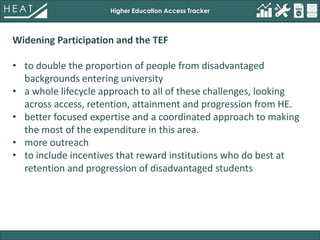
Widening Participation and the TEF
• to double the proportion of people from disadvantaged
backgrounds entering university
• a whole lifecycle approach to all of these challenges, looking
across access, retention, attainment and progression from HE.
• better focused expertise and a coordinated approach to making
the most of the expenditure in this area.
• more outreach
• to include incentives that reward institutions who do best at
retention and progression of disadvantaged students
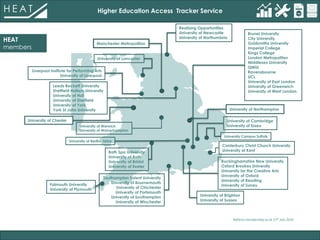
HEAT
members
Higher Education Access Tracker Service
Canterbury Christ Church University
University of Kent
Brunel University
City University
Goldsmiths University
Imperial College
Kings College
London Metropolitan
Middlesex University
QMUL
Ravensbourne
UCL
University of East London
University of Greenwich
University of West London
Buckinghamshire New University
Oxford Brookes University
University for the Creative Arts
University of Oxford
University of Reading
University of SurreyFalmouth University
University of Plymouth
Leeds Beckett University
Sheffield Hallam University
University of Hull
University of Sheffield
University of York
York St John University
Liverpool Institute for Performing Arts
University of Liverpool
Realising Opportunities
University of Newcastle
University of Northumbria
Southampton Solent University
University of Bournemouth
University of Chichester
University of Portsmouth
University of Southampton
University of Winchester
University Campus Suffolk
Bath Spa University
University of Bath
University of Bristol
University of Exeter
University of Brighton
University of Sussex
University of Cambridge
University of EssexUniversity of Warwick
University of Wolverhampton
University of Lancaster
University of Bedfordshire
Reflects membership as at 11th July 2016
University of Chester
University of Northampton
Manchester Metropolitan
Higher Education Access Tracker Service
PAGE 3 OF 12
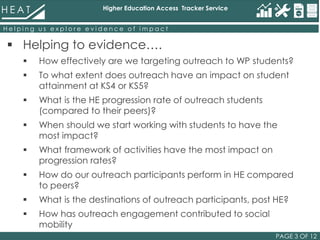
H e l p i n g u s e x p l o r e e v i d e n c e o f i m p a c t
 Helping to evidence….
 How effectively are we targeting outreach to WP students?
 To what extent does outreach have an impact on student
attainment at KS4 or KS5?
 What is the HE progression rate of outreach students
(compared to their peers)?
 When should we start working with students to have the
most impact?
 What framework of activities have the most impact on
progression rates?
 How do our outreach participants perform in HE compared
to peers?
 What is the destinations of outreach participants, post HE?
 How has outreach engagement contributed to social
mobility
Higher Education Access Tracker
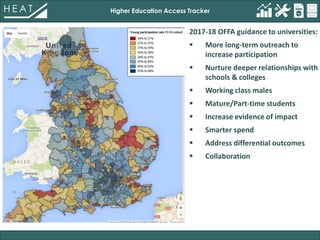
2017-18 OFFA guidance to universities:
 More long-term outreach to
increase participation
 Nurture deeper relationships with
schools & colleges
 Working class males
 Mature/Part-time students
 Increase evidence of impact
 Smarter spend
 Address differential outcomes
 Collaboration
Higher Education Access Tracker
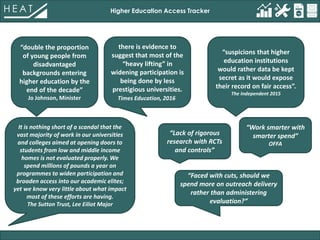
“double the proportion
of young people from
disadvantaged
backgrounds entering
higher education by the
end of the decade”
Jo Johnson, Minister
there is evidence to
suggest that most of the
“heavy lifting” in
widening participation is
being done by less
prestigious universities.
Times Education, 2016
It is nothing short of a scandal that the
vast majority of work in our universities
and colleges aimed at opening doors to
students from low and middle income
homes is not evaluated properly. We
spend millions of pounds a year on
programmes to widen participation and
broaden access into our academic elites;
yet we know very little about what impact
most of these efforts are having.
The Sutton Trust, Lee Eiliot Major
“Lack of rigorous
research with RCTs
and controls”
“Faced with cuts, should we
spend more on outreach delivery
rather than administering
evaluation?”
“suspicions that higher
education institutions
would rather data be kept
secret as it would expose
their record on fair access”.
The Independent 2015
“Work smarter with
smarter spend”
OFFA
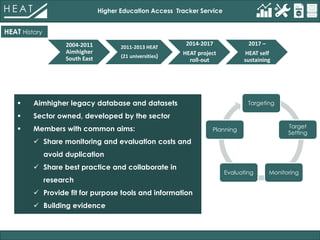
HEAT History
Higher Education Access Tracker Service
2004-2011
Aimhigher
South East
2011-2013 HEAT
(21 universities)
2014-2017
HEAT project
roll-out
2017 –
HEAT self
sustaining
 Aimhigher legacy database and datasets
 Sector owned, developed by the sector
 Members with common aims:
 Share monitoring and evaluation costs and
avoid duplication
 Share best practice and collaborate in
research
 Provide fit for purpose tools and information
 Building evidence
Targeting
Target
Setting
MonitoringEvaluating
Planning
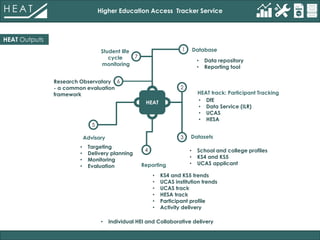
HEAT Outputs
Higher Education Access Tracker Service
• Individual HEI and Collaborative delivery
1
2
3
4
5
6
7
Student life
cycle
monitoring
Database
Advisory
• Data repository
• Reporting tool
• DfE
• Data Service (ILR)
• UCAS
• HESA
• School and college profiles
• KS4 and KS5
• UCAS applicant
• KS4 and KS5 trends
• UCAS institution trends
• UCAS track
• HESA track
• Participant profile
• Activity delivery
• Targeting
• Delivery planning
• Monitoring
• Evaluation Reporting
1
Research Observatory
- a common evaluation
framework
2
3
4
5
6
7
Student life
cycle
monitoring
Database
Datasets
HEAT track: Participant Tracking
Advisory
HEAT
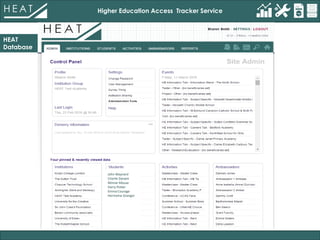
HEAT
Database
Higher Education Access Tracker Service
John Maynard
Charlie Darwin
Minnie Mouse
Harry Potter
Emma Courage
Hermoine Granger
Higher Education Access Tracker Service
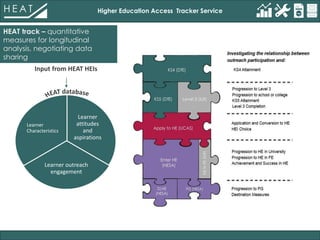
Input from HEAT HEIs
Learner
attitudes
and
aspirations
Learner outreach
engagement
Learner
Characteristics
HEAT track – quantitative
measures for longitudinal
analysis, negotiating data
sharing
Higher Education Access Tracker Service
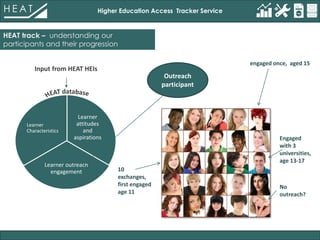
HEAT track – understanding our
participants and their progression
Input from HEAT HEIs
Learner
attitudes
and
aspirations
Learner outreach
engagement
Learner
Characteristics
Outreach
participant
engaged once, aged 15
10
exchanges,
first engaged
age 11
Engaged
with 3
universities,
age 13-17
No
outreach?
Higher Education Access Tracker Service
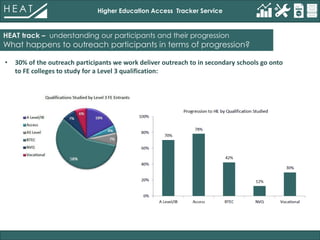
HEAT track – understanding our participants and their progression
What happens to outreach participants in terms of progression?
• 30% of the outreach participants we work deliver outreach to in secondary schools go onto
to FE colleges to study for a Level 3 qualification:
Higher Education Access Tracker Service
Key findings from HEAT track:
HE progression
National Q1-2 YPR
25%32%
HEAT Q1-2 YPR
HEAT participant success rates
Success, attainment & employment
destinations…
Achieved
first degree
84%
Achieved
1st or 2:1
64%
HEAT participants
[2007-2013]
National average
[2010]
Achieved
first degree
82%
Achieved
1st or 2:1
65%
Single HE Talk only
…and the value of intensive WP
Achieved 1st / 2:1 (HEAT)
62%
Achieved 1st /2:1 (national)
60%
Moved up from parent
NSSEC 4-8 to own NSSEC 1-3
77%
Employment Destinations of HEAT cohort after HE (NS-SEC levels)
Looking at Polar v3 Q1/Q2 only…
Comparing HEAT YPR to the
national average
[2011/2012]…
29% into HE
Multiple outreach including
summer school
40% into HE
Multiple outreach including
Campus Visit
34% into HE
Social
Mobility
Higher Education Access Tracker Service
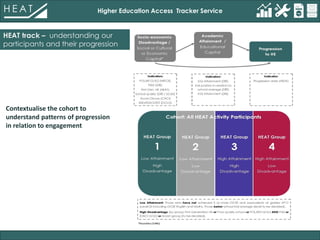
HEAT track – understanding our
participants and their progression
Contextualise the cohort to
understand patterns of progression
in relation to engagement
Higher Education Access Tracker Service
• Membership subscription
• Collaborative practice (with members, HEFCE
and OFFA)
• Democratic decision making, the HEAT vote
• Scaling up but maintaining communication
• Continued development of sustainable
membership service – third sector, differentiated
service, HEAT extra?
The Future of HEAT
Higher Education Access Tracker Service
HEAT advice
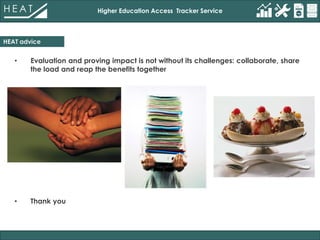
• Evaluation and proving impact is not without its challenges: collaborate, share
the load and reap the benefits together
• Thank you

Sharon Smith

  • 1.
    Higher Education AccessTracker Helping member universities to target, monitor and evaluate Widening Participation outreach programmes Sharon Smith - Director of HEAT Email: Sharon.smith@heat.ac.uk, Visit: www.heat.ac.uk
  • 2.
    Higher Education AccessTracker Widening Participation and the TEF • to double the proportion of people from disadvantaged backgrounds entering university • a whole lifecycle approach to all of these challenges, looking across access, retention, attainment and progression from HE. • better focused expertise and a coordinated approach to making the most of the expenditure in this area. • more outreach • to include incentives that reward institutions who do best at retention and progression of disadvantaged students
  • 3.
    HEAT members Higher Education AccessTracker Service Canterbury Christ Church University University of Kent Brunel University City University Goldsmiths University Imperial College Kings College London Metropolitan Middlesex University QMUL Ravensbourne UCL University of East London University of Greenwich University of West London Buckinghamshire New University Oxford Brookes University University for the Creative Arts University of Oxford University of Reading University of SurreyFalmouth University University of Plymouth Leeds Beckett University Sheffield Hallam University University of Hull University of Sheffield University of York York St John University Liverpool Institute for Performing Arts University of Liverpool Realising Opportunities University of Newcastle University of Northumbria Southampton Solent University University of Bournemouth University of Chichester University of Portsmouth University of Southampton University of Winchester University Campus Suffolk Bath Spa University University of Bath University of Bristol University of Exeter University of Brighton University of Sussex University of Cambridge University of EssexUniversity of Warwick University of Wolverhampton University of Lancaster University of Bedfordshire Reflects membership as at 11th July 2016 University of Chester University of Northampton Manchester Metropolitan
  • 4.
    Higher Education AccessTracker Service PAGE 3 OF 12 H e l p i n g u s e x p l o r e e v i d e n c e o f i m p a c t  Helping to evidence….  How effectively are we targeting outreach to WP students?  To what extent does outreach have an impact on student attainment at KS4 or KS5?  What is the HE progression rate of outreach students (compared to their peers)?  When should we start working with students to have the most impact?  What framework of activities have the most impact on progression rates?  How do our outreach participants perform in HE compared to peers?  What is the destinations of outreach participants, post HE?  How has outreach engagement contributed to social mobility
  • 5.
    Higher Education AccessTracker 2017-18 OFFA guidance to universities:  More long-term outreach to increase participation  Nurture deeper relationships with schools & colleges  Working class males  Mature/Part-time students  Increase evidence of impact  Smarter spend  Address differential outcomes  Collaboration
  • 6.
    Higher Education AccessTracker “double the proportion of young people from disadvantaged backgrounds entering higher education by the end of the decade” Jo Johnson, Minister there is evidence to suggest that most of the “heavy lifting” in widening participation is being done by less prestigious universities. Times Education, 2016 It is nothing short of a scandal that the vast majority of work in our universities and colleges aimed at opening doors to students from low and middle income homes is not evaluated properly. We spend millions of pounds a year on programmes to widen participation and broaden access into our academic elites; yet we know very little about what impact most of these efforts are having. The Sutton Trust, Lee Eiliot Major “Lack of rigorous research with RCTs and controls” “Faced with cuts, should we spend more on outreach delivery rather than administering evaluation?” “suspicions that higher education institutions would rather data be kept secret as it would expose their record on fair access”. The Independent 2015 “Work smarter with smarter spend” OFFA
  • 7.
    HEAT History Higher EducationAccess Tracker Service 2004-2011 Aimhigher South East 2011-2013 HEAT (21 universities) 2014-2017 HEAT project roll-out 2017 – HEAT self sustaining  Aimhigher legacy database and datasets  Sector owned, developed by the sector  Members with common aims:  Share monitoring and evaluation costs and avoid duplication  Share best practice and collaborate in research  Provide fit for purpose tools and information  Building evidence Targeting Target Setting MonitoringEvaluating Planning
  • 8.
    HEAT Outputs Higher EducationAccess Tracker Service • Individual HEI and Collaborative delivery 1 2 3 4 5 6 7 Student life cycle monitoring Database Advisory • Data repository • Reporting tool • DfE • Data Service (ILR) • UCAS • HESA • School and college profiles • KS4 and KS5 • UCAS applicant • KS4 and KS5 trends • UCAS institution trends • UCAS track • HESA track • Participant profile • Activity delivery • Targeting • Delivery planning • Monitoring • Evaluation Reporting 1 Research Observatory - a common evaluation framework 2 3 4 5 6 7 Student life cycle monitoring Database Datasets HEAT track: Participant Tracking Advisory HEAT
  • 9.
    HEAT Database Higher Education AccessTracker Service John Maynard Charlie Darwin Minnie Mouse Harry Potter Emma Courage Hermoine Granger
  • 10.
    Higher Education AccessTracker Service Input from HEAT HEIs Learner attitudes and aspirations Learner outreach engagement Learner Characteristics HEAT track – quantitative measures for longitudinal analysis, negotiating data sharing
  • 11.
    Higher Education AccessTracker Service HEAT track – understanding our participants and their progression Input from HEAT HEIs Learner attitudes and aspirations Learner outreach engagement Learner Characteristics Outreach participant engaged once, aged 15 10 exchanges, first engaged age 11 Engaged with 3 universities, age 13-17 No outreach?
  • 12.
    Higher Education AccessTracker Service HEAT track – understanding our participants and their progression What happens to outreach participants in terms of progression? • 30% of the outreach participants we work deliver outreach to in secondary schools go onto to FE colleges to study for a Level 3 qualification:
  • 13.
    Higher Education AccessTracker Service Key findings from HEAT track: HE progression National Q1-2 YPR 25%32% HEAT Q1-2 YPR HEAT participant success rates Success, attainment & employment destinations… Achieved first degree 84% Achieved 1st or 2:1 64% HEAT participants [2007-2013] National average [2010] Achieved first degree 82% Achieved 1st or 2:1 65% Single HE Talk only …and the value of intensive WP Achieved 1st / 2:1 (HEAT) 62% Achieved 1st /2:1 (national) 60% Moved up from parent NSSEC 4-8 to own NSSEC 1-3 77% Employment Destinations of HEAT cohort after HE (NS-SEC levels) Looking at Polar v3 Q1/Q2 only… Comparing HEAT YPR to the national average [2011/2012]… 29% into HE Multiple outreach including summer school 40% into HE Multiple outreach including Campus Visit 34% into HE Social Mobility
  • 14.
    Higher Education AccessTracker Service HEAT track – understanding our participants and their progression Contextualise the cohort to understand patterns of progression in relation to engagement
  • 15.
    Higher Education AccessTracker Service • Membership subscription • Collaborative practice (with members, HEFCE and OFFA) • Democratic decision making, the HEAT vote • Scaling up but maintaining communication • Continued development of sustainable membership service – third sector, differentiated service, HEAT extra? The Future of HEAT
  • 16.
    Higher Education AccessTracker Service HEAT advice • Evaluation and proving impact is not without its challenges: collaborate, share the load and reap the benefits together • Thank you