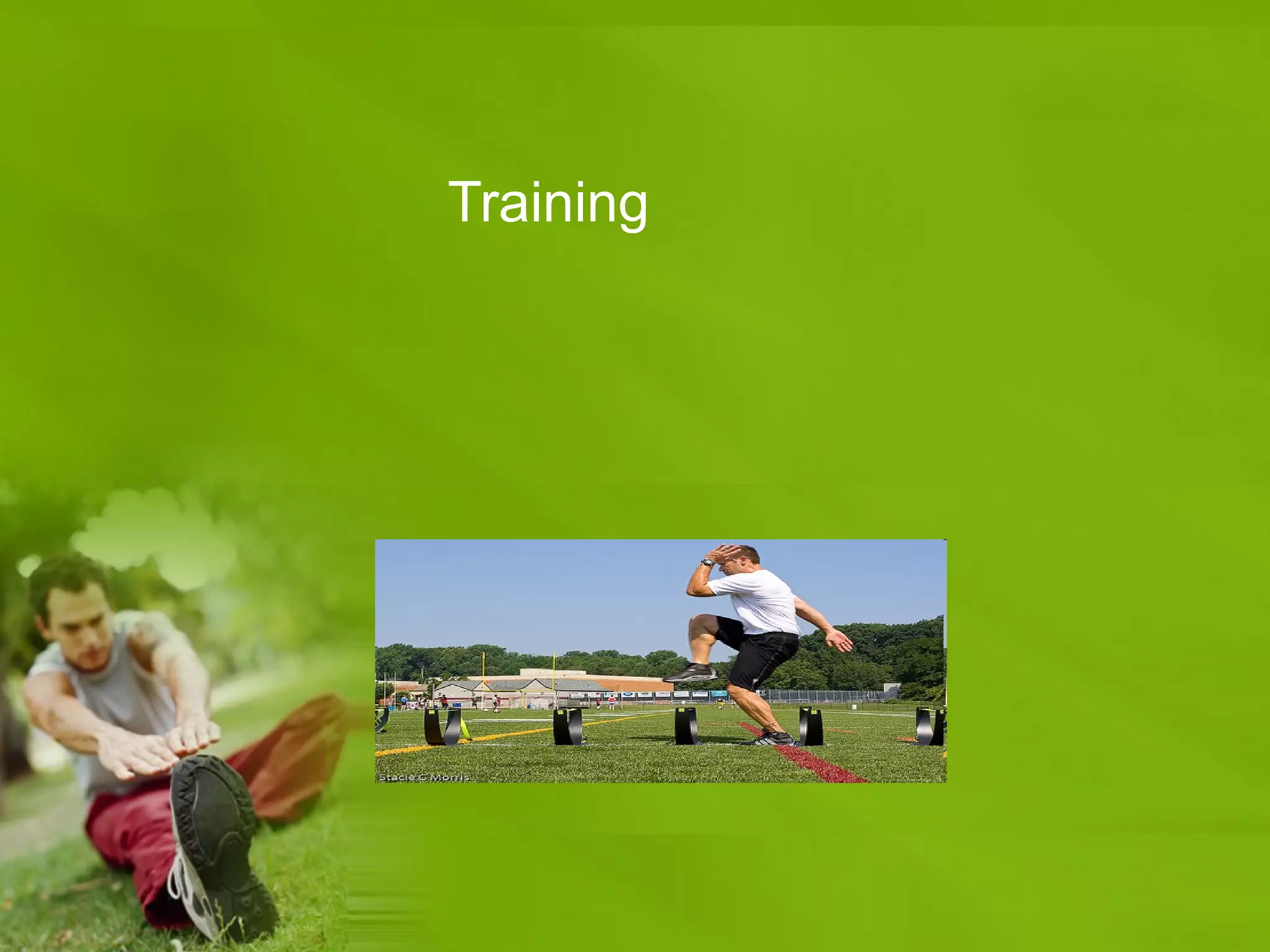
Training
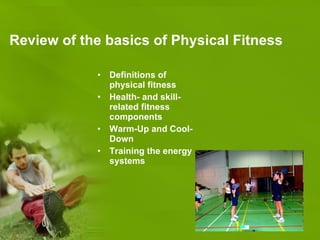
Review of the basics of Physical Fitness Definitions of physical fitness Health- and skill-related fitness components Warm-Up and Cool-Down Training the energy systems
Principles of Fitness Development Training is a programme of exercise designed to help you reach your fitness goals or targets. In order to ensure that a fitness training or exercise programme is safe and effective, it is vital that certain guiding principles are applied. The keys to selecting the right kinds of exercises for developing and maintaining each of the basic components of fitness are found in the principles of specificity, overload, reversibility, progression, diminishing returns, and individual differences.
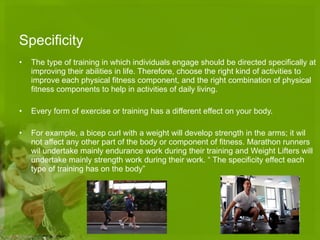
Specificity The type of training in which individuals engage should be directed specifically at improving their abilities in life. Therefore, choose the right kind of activities to improve each physical fitness component, and the right combination of physical fitness components to help in activities of daily living.  Every form of exercise or training has a different effect on your body. For example, a bicep curl with a weight will develop strength in the arms; it wil not affect any other part of the body or component of fitness. Marathon runners wil undertake mainly endurance work during their training and Weight Lifters will undertake mainly strength work during their work. “ The specificity effect each type of training has on the body”
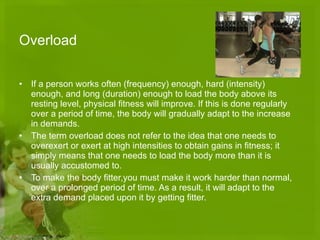
Overload If a person works often (frequency) enough, hard (intensity) enough, and long (duration) enough to load the body above its resting level, physical fitness will improve. If this is done regularly over a period of time, the body will gradually adapt to the increase in demands.  The term overload does not refer to the idea that one needs to overexert or exert at high intensities to obtain gains in fitness; it simply means that one needs to load the body more than it is usually accustomed to. To make the body fitter,you must make it work harder than normal, over a prolonged period of time. As a result, it will adapt to the extra demand placed upon it by getting fitter.
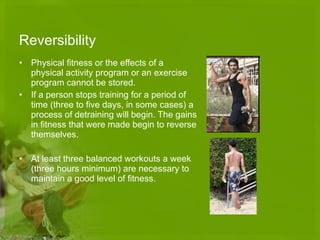
Reversibility Physical fitness or the effects of a physical activity program or an exercise program cannot be stored.  If a person stops training for a period of time (three to five days, in some cases) a process of detraining will begin. The gains in fitness that were made begin to reverse themselves.  At least three balanced workouts a week (three hours minimum) are necessary to maintain a good level of fitness.
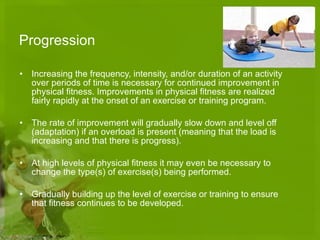
Progression Increasing the frequency, intensity, and/or duration of an activity over periods of time is necessary for continued improvement in physical fitness. Improvements in physical fitness are realized fairly rapidly at the onset of an exercise or training program.  The rate of improvement will gradually slow down and level off (adaptation) if an overload is present (meaning that the load is increasing and that there is progress).  At high levels of physical fitness it may even be necessary to change the type(s) of exercise(s) being performed. Gradually building up the level of exercise or training to ensure that fitness continues to be developed.
Individual differences Every person has a unique physical and psychological makeup that requires a unique training program. Factors that may play a role are current fitness level, gender, age, heredity, susceptibility to injury, rest and recovery needs, and diet.  Two people working out with the same program could experience completely different results.
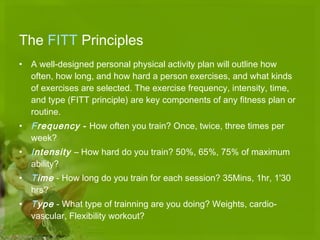
The  FITT  Principles A well-designed personal physical activity plan will outline how often, how long, and how hard a person exercises, and what kinds of exercises are selected. The exercise frequency, intensity, time, and type (FITT principle) are key components of any fitness plan or routine. F requency  -  How often you train? Once, twice, three times per week? I ntensity   – How hard do you train? 50%, 65%, 75% of maximum ability? T ime  - How long do you train for each session? 35Mins, 1hr, 1'30 hrs? T ype  - What type of trainning are you doing? Weights, cardio-vascular, Flexibility workout?
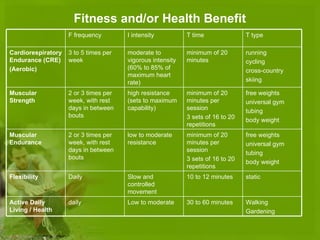
Fitness and/or Health Benefit static 10 to 12 minutes Slow and controlled movement Daily Flexibility Walking Gardening 30 to 60 minutes Low to moderate daily Active Daily Living / Health free weights   universal gym   tubing   body weight minimum of 20 minutes per session   3 sets of 16 to 20 repetitions low to moderate resistance 2 or 3 times per week, with rest days in between bouts Muscular Endurance free weights   universal gym   tubing   body weight minimum of 20 minutes per session   3 sets of 16 to 20 repetitions high resistance (sets to maximum capability) 2 or 3 times per week, with rest days in between bouts Muscular Strength running   cycling   cross-country skiing  minimum of 20 minutes moderate to vigorous intensity (60% to 85% of maximum heart rate) 3 to 5 times per week Cardiorespiratory Endurance (CRE)   (Aerobic) T type T time I intensity F frequency
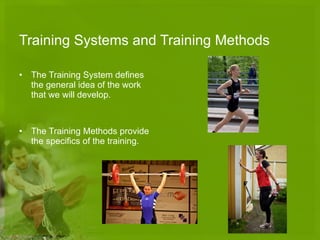
Training Systems and Training Methods The Training System defines the general idea of the work that we will develop.  The Training Methods  provide the specifics of the training.
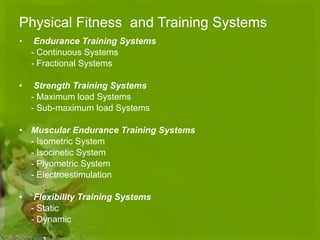
Physical Fitness  and Training Systems Endurance Training Systems - Continuous Systems - Fractional Systems Strength Training Systems - Maximum load Systems - Sub-maximum load Systems Muscular Endurance Training Systems - Isometric System - Isocinetic System - Plyometric System - Electroestimulation Flexibility Training Systems - Static - Dynamic
Web Ppt:http://www.indezine.com/powerpoint/freetemplates/1881.html www:http://iessanblas.edu.gva.es/.../Ed Fisica /.../eso/4eso_%20sist_entren.pps   http://www.bbc.co.uk/schools/gcsebitesize/pe/exercise/1_exercise_principles_rev1.shtml http://www.google.com/ http://www.flickr.com/
Images Image 1:  http://farm4.static.flickr.com/3019/2735353204_ae0f768199.jpg Image 2: http://farm2.static.flickr.com/1066/779315841_baff9387ed.jpg Image 3:  http://farm3.static.flickr.com/2369/1902059483_47f9b9a0bb_m.jpg Image 4:  http://farm5.static.flickr.com/4059/4457694598_f23542a550.jpg Image 5:  http://farm4.static.flickr.com/3577/3645259452_f009838c4f.jpg Image 6: http://farm4.static.flickr.com/3391/3592548721_32b76b21a7.jpg Image 7: http://farm6.static.flickr.com/5017/5471391578_3e580fb7f8.jpg Image 8:  http://t0.gstatic.com/images?q=tbn:ANd9GcR037NPjA7YKJyTTvT7Z01ikB3K-VpDttE6wqFUqjnALOLey1Sb Image 9:  http://farm4.static.flickr.com/3013/2452068666_2756cac273.jpg Image 10:  http://images.cdn.fotopedia.com/agusem-Uuvu8wWJJ-Y-hd.jpg Image 11:  http://farm4.static.flickr.com/3122/3243399019_c86dc03650.jpg Image 12:  http://images.cdn.fotopedia.com/flickr-4882994170-hd.jpg Image 13: http://1.bp.blogspot.com/_ahWXDB_ujRM/TNQrtyUuplI/AAAAAAAAEjc/QEQggNK0HSc/s1600/logos+creative+commons+licencias.jpg
Note: This material was prepared by Victor E. Rodríguez Rodríguez for the Bilingual Section of Physical Education (English) of the IES. A Guía, Vigo. I used images from of  http :// www.flickr.com /  and  http :// www.google.es / imghp?hl=es&tab=wi  sites, and in all the images I have added their reference. In this work, I have also included portions of the text of the different sites, which are reflected in the bibliography at the end of the text . This material was elaborated for exclusively educational purposes and non-commercial uses.  Nota: Este material foi elaborado por Víctor E. Rodríguez Rodríguez para a Sección Bilingüe de Educación Física (inglés) do IES. A Guía de Vigo. Utiliceí imáxenes de lugares web ( http :// www.flickr.com /  e  http :// www.google.es / imghp?hl=es&tab=wi  ) e en todas ellas engadín a súa referencia. Neste traballo, tamén incluín porcións de texto de diferentes páxinas web, reflectidas na bibliografía ao final do texto. Este material foi elaborado con fins exclusivamente didácticos e sen uso comercial.

Training plan

  • 1.
  • 2.
    Review of thebasics of Physical Fitness Definitions of physical fitness Health- and skill-related fitness components Warm-Up and Cool-Down Training the energy systems
  • 3.
    Principles of FitnessDevelopment Training is a programme of exercise designed to help you reach your fitness goals or targets. In order to ensure that a fitness training or exercise programme is safe and effective, it is vital that certain guiding principles are applied. The keys to selecting the right kinds of exercises for developing and maintaining each of the basic components of fitness are found in the principles of specificity, overload, reversibility, progression, diminishing returns, and individual differences.
  • 4.
    Specificity The typeof training in which individuals engage should be directed specifically at improving their abilities in life. Therefore, choose the right kind of activities to improve each physical fitness component, and the right combination of physical fitness components to help in activities of daily living. Every form of exercise or training has a different effect on your body. For example, a bicep curl with a weight will develop strength in the arms; it wil not affect any other part of the body or component of fitness. Marathon runners wil undertake mainly endurance work during their training and Weight Lifters will undertake mainly strength work during their work. “ The specificity effect each type of training has on the body”
  • 5.
    Overload If aperson works often (frequency) enough, hard (intensity) enough, and long (duration) enough to load the body above its resting level, physical fitness will improve. If this is done regularly over a period of time, the body will gradually adapt to the increase in demands. The term overload does not refer to the idea that one needs to overexert or exert at high intensities to obtain gains in fitness; it simply means that one needs to load the body more than it is usually accustomed to. To make the body fitter,you must make it work harder than normal, over a prolonged period of time. As a result, it will adapt to the extra demand placed upon it by getting fitter.
  • 6.
    Reversibility Physical fitnessor the effects of a physical activity program or an exercise program cannot be stored. If a person stops training for a period of time (three to five days, in some cases) a process of detraining will begin. The gains in fitness that were made begin to reverse themselves. At least three balanced workouts a week (three hours minimum) are necessary to maintain a good level of fitness.
  • 7.
    Progression Increasing thefrequency, intensity, and/or duration of an activity over periods of time is necessary for continued improvement in physical fitness. Improvements in physical fitness are realized fairly rapidly at the onset of an exercise or training program. The rate of improvement will gradually slow down and level off (adaptation) if an overload is present (meaning that the load is increasing and that there is progress). At high levels of physical fitness it may even be necessary to change the type(s) of exercise(s) being performed. Gradually building up the level of exercise or training to ensure that fitness continues to be developed.
  • 8.
    Individual differences Everyperson has a unique physical and psychological makeup that requires a unique training program. Factors that may play a role are current fitness level, gender, age, heredity, susceptibility to injury, rest and recovery needs, and diet. Two people working out with the same program could experience completely different results.
  • 9.
    The FITT Principles A well-designed personal physical activity plan will outline how often, how long, and how hard a person exercises, and what kinds of exercises are selected. The exercise frequency, intensity, time, and type (FITT principle) are key components of any fitness plan or routine. F requency - How often you train? Once, twice, three times per week? I ntensity – How hard do you train? 50%, 65%, 75% of maximum ability? T ime - How long do you train for each session? 35Mins, 1hr, 1'30 hrs? T ype - What type of trainning are you doing? Weights, cardio-vascular, Flexibility workout?
  • 10.
    Fitness and/or HealthBenefit static 10 to 12 minutes Slow and controlled movement Daily Flexibility Walking Gardening 30 to 60 minutes Low to moderate daily Active Daily Living / Health free weights universal gym tubing body weight minimum of 20 minutes per session 3 sets of 16 to 20 repetitions low to moderate resistance 2 or 3 times per week, with rest days in between bouts Muscular Endurance free weights universal gym tubing body weight minimum of 20 minutes per session 3 sets of 16 to 20 repetitions high resistance (sets to maximum capability) 2 or 3 times per week, with rest days in between bouts Muscular Strength running cycling cross-country skiing minimum of 20 minutes moderate to vigorous intensity (60% to 85% of maximum heart rate) 3 to 5 times per week Cardiorespiratory Endurance (CRE) (Aerobic) T type T time I intensity F frequency
  • 11.
    Training Systems andTraining Methods The Training System defines the general idea of the work that we will develop. The Training Methods provide the specifics of the training.
  • 12.
    Physical Fitness and Training Systems Endurance Training Systems - Continuous Systems - Fractional Systems Strength Training Systems - Maximum load Systems - Sub-maximum load Systems Muscular Endurance Training Systems - Isometric System - Isocinetic System - Plyometric System - Electroestimulation Flexibility Training Systems - Static - Dynamic
  • 13.
    Web Ppt:http://www.indezine.com/powerpoint/freetemplates/1881.html www:http://iessanblas.edu.gva.es/.../EdFisica /.../eso/4eso_%20sist_entren.pps http://www.bbc.co.uk/schools/gcsebitesize/pe/exercise/1_exercise_principles_rev1.shtml http://www.google.com/ http://www.flickr.com/
  • 14.
    Images Image 1: http://farm4.static.flickr.com/3019/2735353204_ae0f768199.jpg Image 2: http://farm2.static.flickr.com/1066/779315841_baff9387ed.jpg Image 3: http://farm3.static.flickr.com/2369/1902059483_47f9b9a0bb_m.jpg Image 4: http://farm5.static.flickr.com/4059/4457694598_f23542a550.jpg Image 5: http://farm4.static.flickr.com/3577/3645259452_f009838c4f.jpg Image 6: http://farm4.static.flickr.com/3391/3592548721_32b76b21a7.jpg Image 7: http://farm6.static.flickr.com/5017/5471391578_3e580fb7f8.jpg Image 8: http://t0.gstatic.com/images?q=tbn:ANd9GcR037NPjA7YKJyTTvT7Z01ikB3K-VpDttE6wqFUqjnALOLey1Sb Image 9: http://farm4.static.flickr.com/3013/2452068666_2756cac273.jpg Image 10: http://images.cdn.fotopedia.com/agusem-Uuvu8wWJJ-Y-hd.jpg Image 11: http://farm4.static.flickr.com/3122/3243399019_c86dc03650.jpg Image 12: http://images.cdn.fotopedia.com/flickr-4882994170-hd.jpg Image 13: http://1.bp.blogspot.com/_ahWXDB_ujRM/TNQrtyUuplI/AAAAAAAAEjc/QEQggNK0HSc/s1600/logos+creative+commons+licencias.jpg
  • 15.
    Note: This materialwas prepared by Victor E. Rodríguez Rodríguez for the Bilingual Section of Physical Education (English) of the IES. A Guía, Vigo. I used images from of http :// www.flickr.com / and http :// www.google.es / imghp?hl=es&tab=wi sites, and in all the images I have added their reference. In this work, I have also included portions of the text of the different sites, which are reflected in the bibliography at the end of the text . This material was elaborated for exclusively educational purposes and non-commercial uses. Nota: Este material foi elaborado por Víctor E. Rodríguez Rodríguez para a Sección Bilingüe de Educación Física (inglés) do IES. A Guía de Vigo. Utiliceí imáxenes de lugares web ( http :// www.flickr.com / e http :// www.google.es / imghp?hl=es&tab=wi ) e en todas ellas engadín a súa referencia. Neste traballo, tamén incluín porcións de texto de diferentes páxinas web, reflectidas na bibliografía ao final do texto. Este material foi elaborado con fins exclusivamente didácticos e sen uso comercial.