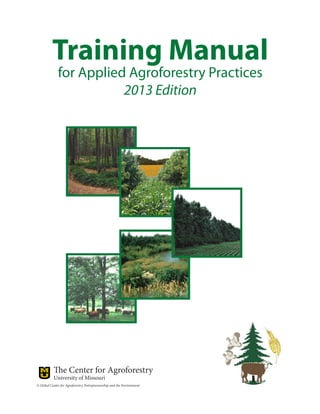
Training Manual
for Applied Agroforestry Practices
2013 Edition
The Center for Agroforestry
University of Missouri
A Global Center for Agroforestry, Entrepreneurship and the Environment
2 Training Manual for Applied Agroforestry Practices – 2013 Edition
Training Manual for Applied Agroforestry Practices – 2013 Edition
Produced by the University of Missouri
Center for Agroforestry
203 ABNR
Columbia, Mo 65211
www.centerforagroforestry.org
email: musnragroforestry@missouri.edu
Funding for this work is via the United States Department of Agriculture North Central SARE with
Agreement Number H003044602 and NCR-SARE Project Number ENC12-129.
Any opinions, findings, conclusions or recommendations expressed in this publication are those of
the author(s) and do not necessarily reflect the view of the USDA.
The Center for Agroforestry
University of Missouri
A Global Center for Agroforestry, Entrepreneurship and the Environment
3	University of Missouri Center for Agroforestry
Acknowledgements
This publication is the result of the collaborative efforts of several individuals and organizations.
The University of Missouri Center for Agroforestry acknowledges the USDA National Agroforestry Center and
the Mid-America Agroforestry Working Group, for contributions to the text of this manual.
Portions of this material are also credited to the “Forest Landowner’s Guide to Evaluating and Choosing
a Natural Resource-Based Enterprise,” published by the Natural Resource, Agriculture, and Engineering
Service (NRAES) Cooperative Extension program, Ithaca, New York. NRAES is an interdisciplinary, issue-
oriented program sponsored by cooperative extension of fourteen member land grant universities and is
housed at Cornell University. For more information, visit www.nraes.org.
View this manual online at: www.centerforagroforestry.org
Printed: July 2013
Michael Gold, Mihaela Cernusca & Michelle Hall, Eds.
4 Training Manual for Applied Agroforestry Practices – 2013 Edition
Training Manual for Applied Agroforestry
Practices: Table of Contents
User’s Guide to the Training Manual
Chapter 1: Defining Agroforestry
Mike Gold & Andy Mason
Chapter 2: Planning for Agroforestry
Mike Gold & Mihaela Cernusca
Chapter 3: Alley Cropping
Dusty Walter, Shibu Jose & Diomy Zamora
Chapter 4: Silvopasture
Dusty Walter
Chapter 5: Riparian & Upland Forest Buffers
Dick Schultz, Tom Isenhart & Leigh Ann Long
Chapter 6: Windbreaks
Bruce Wight & Richard Straight
Chapter 7: Forest Farming
John Munsell, Jeanine Davis &
Jim Chamberlain
Chapter 8: Agroforestry and Wildlife
Rebecca Christoffel
Chapter 9: Marketing Principles
Mihaela Cernusca, Mike Gold & Larry Godsey
Chapter 10: Economic Considerations for
Agroforestry
Larry Godsey
Appendices: 
Section 1:
•	 Economic Budgeting Guide
•	 Funding Incentives for Agroforestry
•	 Tax Incentives for Agroforestry
Section 2:
Trees and Shrubs
Section 3:
Grasses and Forages
Section 4:
The Basics of Selling Timber
Section 5:
Planning for Agroforestry Workbook
Section 6:
Plant Resource Guide
5	University of Missouri Center for Agroforestry
Mike Gold, University of Missouri
Andy Mason, USDA National Agroforestry
Center
Mihaela Cernusca, University of Missouri
Dusty Walter, University of Missouri
Shibu Jose, University of Missouri
Diomy Zamora, University of Minnesota
Dick Schultz, Iowa State University
Tom Isenhart, Iowa State University
Leigh Ann Long, Iowa State University
Bruce Wight, USDA National Resources
Conservation Service (Retired/Consultant)
Richard Straight, USDA National
Agroforestry Center
John Munsell, Virginia Tech
Jeanine Davis, North Carolina State
University
Jim Chamberlain, USDA National
Agroforestry Center
Rebecca Christoffel, Iowa State University
Larry Godsey, Missouri Valley College
Chapter Authors’Affiliations
6 Training Manual for Applied Agroforestry Practices – 2013 Edition
User’s Guide to the Training Manual
Farmers and other landowners drawing
sustenance from the land strive continually
to produce goods through methods that are
economical, conservation-minded and socially
acceptable.
Agroforestry practices are unique and through
their proper application each objective of
economy, conservation of resources and social
acceptance can be met. Agroforestry practices
are designed to fit specific niches within the
farm to meet specific landowner objectives.
When properly designed, agroforestry practic-
es can achieve a balance between diverse, and
often seemingly opposed, objectives.
This manual will help explain each of the
agroforestry practices and their application.
Additionally, the manual is designed to assist in
the decision process so that, when established
or managed, the agroforestry practice is most
effective at achieving the desired objectives.
About this Manual
This training manual is designed to provide
easy-to-use information about agroforestry.
The intended audience includes forest and
agricultural landowners, resource profession-
als and other educators; yet, anyone interested
in establishing or managing trees for mul-
tiple functions on the landscape can use the
agroforestry guidelines to assist in achieving
success.
This updated edition of the training manual
is not intended to function as the comprehen-
sive source of information on agroforestry.
Agroforestry is both an art and a science.
Therefore, do not use this training manual
as your only resource of information on
agroforestry practices. Rather, it is designed to
be used as a tool to assist in the decision-mak-
ing process. There are countless ways for trees
to meet conservation, economic and societal
goals, and we are learning more and more each
day about effective designs that better ensure
agroforestry will meet one or more specific
goals.
How this Manual
is Organized
This manual is divided into specific chapters
explaining agroforestry practices and manage-
ment. Chapter 2 is intended to assist you in
implementing your knowledge of agroforestry
into your operation in a step-by-step process.
The appendices contain information about
the economics and taxation involved with
agroforestry, as well as crop sheets for select-
ing the appropriate trees, shrubs, grasses, forbs
and crops for your agroforestry practice. You
may pull out chapters and appendices and use
them independently as needed.
7	University of Missouri Center for Agroforestry
Let’s Begin
From specific land management practices
designed to conserve limited resources to the
marketing of specialty, non-commodity prod-
ucts, the ideas in this manual can improve the
likelihood of your success. We hope it is both a
useful tool and a source of inspiration for addi-
tional management practices that utilize trees
or shrubs on the farm for multiple benefits.
Land management practices that integrate
trees and shrubs with agriculture can provide
benefits to the farm and the surrounding land-
scape. We hope that the ideas and practices
put forth in this manual inspire and assist in
making decisions related to managing land re-
sources that involve trees and shrubs. It is our
desire to help farm managers and land owners
achieve long-term satisfaction from working
harmoniously with the soil, water, air, forests
and wildlife resources of this Earth.
Gene Garrett, left,
former director
of the Center for
Agroforestry, and
Michael Gold, right,
associate director,
speak about the
opportunities
agroforestry pro-
vides at the First
World Congress of
Agroforestry,
Orlando, Fla.
8 Training Manual for Applied Agroforestry Practices – 2013 Edition
Agroforestry practices help landowners di-
versify products, markets and farm income;
improve soil and water quality; and reduce
erosion, non-point source pollution and
flood damage. The integrated practices of
agroforestry enhance land and aquatic habitats
for fish and wildlife and improve biodiversity
while sustaining land resources for generations
to come.
UMCA is one of the world’s leading cen-
ters contributing to the science underlying
agroforestry. Since 1998, UMCA, established in
1998, has been supported by significant collab-
orative funding from the USDA-ARS. Interdis-
ciplinary research conducted by faculty, re-
search specialists, graduate and undergraduate
students, provides sound science that uncovers
new environmental and economic benefits
from agroforestry practices and solves produc-
tion challenges.
Linked to the Center’s solid science and re-
search programs are several key partnerships
with landowners, natural resource profession-
als, federal and state agencies and non-profit
organizations. Through these critical partner-
ships, UMCA and its partners are producing an
expanding list of positive outcomes for land-
owners, the natural environment and society as
a whole.
UMCA Philosophy:
“A farm can be regarded as a food factory and
the criterion for its success is saleable products.
Or, it can be regarded as a place to live, and the
criterion for its success is harmonious balance
between plants, animals and people; between
the domestic and the wild; and between utility
and beauty.” – Aldo Leopold
About the University of Missouri
Center for Agroforestry (UMCA)
UMCA Mission:
To initiate, coordinate and enhance
agroforestry activities to meet the environ-
mental, social and economic needs of land
management within the state of Missouri,
North America and the temperate zone world-
wide.
To accomplish our mission, UMCA:
•	 Conducts, coordinates and promotes inter-
active research on agroforestry practices
to improve the productive and protective
functions of agricultural and forest lands.
•	 Conducts, coordinates and promotes
interdisciplinary research on the social,
economic and market dimensions of
agroforestry.
•	 Conducts an active outreach program that
increases the awareness and adoption of
agroforestry practices.
•	 Conducts, coordinates and promotes inter-
disciplinary research on the policy dimen-
sions of agroforestry.
•	 Provides opportunities for formal educa-
tion via a series of online courses. Both a
graduate certificate and/or master’s de-
gree in agroforestry are available through
MizzouOnline at the University of Missouri.
•	 Develops and carries out a collaborative
international agroforestry program in the
areas of instruction, research and out-
reach.
9	University of Missouri Center for Agroforestry
Agroforestry Key Criteria
Four key criteria characterize agroforestry
practices. Application of the 4 “I” criteria are
key to determine what is and what is not an
agroforestry practice:
	
Intentional	
Combinations of trees, crops, and/or livestock
are intentionally designed, established, and/or
managed to work together and yield multiple
products and benefits, rather than as individual
elements which may occur together but are
managed separately. Agroforestry is neither
monoculture farming, nor is it a mixture of
monocultures.
Intensive
Agroforestry practices are created and inten-
sively managed to maintain their productive
and protective functions, and often involve
cultural operations such as cultivation, fertil-
ization, irrigation, pruning and thinning.
		
Integrated
Components are structurally and functionally
combined into a single, integrated manage-
ment unit tailored to meet the objectives of the
landowner. Integration may be horizontal or
vertical, above- or below-ground, simultane-
Chapter 1: Defining Agroforestry
Working with UMCA staff and natural resources profes-
sionals helps landowners plan and implement agroforestry
practices.
Agroforestry:
Definition and Practices
What is agroforestry?
Agroforestry is new market opportunities. Sus-
tainable “climate-smart” agriculture. Land stew-
ardship. Habitat for wildlife. Improved air and
water quality. Diversified farm income. Increased
wealth for rural communities.
In simple terms, agroforestry is intensive land-
use management combining trees and/or
shrubs with crops and/or livestock.
Agroforestry practices are designed to fit
specific niches within the farm to meet specific
landowner objectives.
Agroforestry practices help landowners to
diversify products, markets, and farm income;
improve soil and water quality; and reduce
erosion, non-point source pollution and dam-
age due to flooding. The integrated practices
of agroforestry enhance land and aquatic
habitats for fish and wildlife and improve bio-
diversity while sustaining land resources for
generations to come. In a changing climate,
agroforestry practices can be designed and
strategically located to provide greater resil-
iency in agricultural landscapes so landowners
can meet production objectives when faced
with extreme weather (e.g., drought, floods).
Tree-based practices sequester significant
amounts of carbon that can help meet future
potential greenhouse gas reduction goals.
Definition of Temperate Agroforestry (USA):
Intensive land-use management that optimizes
the benefits (physical, biological, ecological,
economic, social) from biophysical interactions
created when trees and/or shrubs are deliber-
ately combined with crops and/or livestock.
10 Training Manual for Applied Agroforestry Practices – 2013 Edition
ous or sequential. Integration of multiple crops
utilizes more of the productive capacity of the
land and helps to balance economic production
with resource conservation.
Interactive 	
Agroforestry actively manipulates and utilizes
the interactions among components to yield
multiple harvestable products, while concur-
rently providing numerous conservation and
ecological benefits.
Specialty mushrooms can be grown on logs in a forest
farming practice for additional income, as explained
by Nicola MacPherson of Ozark Forest Mushrooms at
this field day.
The five recognized agroforestry
practices
•	 Riparian and Upland Forest Buffers
•	 Windbreaks
•	 Alley Cropping
•	 Silvopasture
•	 Forest Farming	 	 		
1. Riparian and Upland Forest Buffers
Riparian forest buffers are strips of perma-
nent vegetation, consisting of trees, shrubs,
and grasses, planted or managed between
agricultural land (usually cropland or pas-
tureland) and water bodies (rivers, streams,
creeks, lakes, wetlands) to reduce runoff and
non-point source pollution. Forest buffers are
usually planted in three distinct zones near an
agricultural stream for stabilizing streambanks,
improving aquatic and terrestrial habitats, and
providing harvestable products. Upland buffers
with cool- or warm-season grass alone or com-
bined with shrubs and/or trees are also used to
reduce nonpoint-source pollution and prevent
gully formation in agricultural watersheds.
		
2. Windbreaks
Windbreak practices (shelterbelts, timberbelts,
hedgerows, and living snowfences) are planted
and managed as part of a crop or livestock
operation to enhance crop production, protect
crops and livestock, manage snow distribution,
and/or control soil erosion.
Field windbreaks are used to protect a vari-
ety of wind-sensitive row crops, forage, tree,
and vine crops to control soil erosion, and to
provide other benefits such as improved insect
pollination of crops and enhanced wildlife
habitat.
Livestock windbreaks help reduce animal
stress and mortality, improve feed and water
consumption, enhance weight gain and calving
success rates, and control odor. Timberbelts
are managed windbreaks designed to increase
the value of the forestry component.
Forest Farming 	 Silvopasture 	 Alley Cropping 	 Riparian Forest Buffers Windbreaks
11	University of Missouri Center for Agroforestry
Characteristics of Agroforestry Practices
Land-use practices deliberately integrated
into the whole farm
Contain complex interactions among compo-
nents suited to particular environments and
human needs
Competition and its management is critical
Has two or more outputs
The “cycle” of an agroforestry practice is always
more than one year
Even the simplest agroforestry practice is more
complex, ecologically (in terms of structure and
function) and economically than monocropping
For the landowner, often judged successful or
not by the bottom line “does it pay?”
3. Alley Cropping
This practice combines trees planted in single
or multiple rows with agricultural or horti-
cultural crops cultivated in the wide alleys
between the tree rows. High-value hardwoods
such as oak, walnut, ash, and pecan are favored
species in alley cropping practices, and can po-
tentially provide high-value lumber or veneer
logs in the long-term.
Crops or forages grown in the alleys, and nuts
from walnut, pecan and chestnut trees, pro-
vide annual income from the land while the
longer-term wood crop matures. Specialty
crops (herbs, fruits, vegetables, nursery stock,
flowers, etc.) can be grown in alleys, utilizing
the microclimate created by trees, to boost
economic production from each acre. 	
4. Silvopasture
This practice combines trees with forage (pas-
ture or hay) and livestock production.
Silvopasture can be established by adding trees
to existing pasture, or by thinning an existing
forest stand and adding (or improving) a forage
component. Trees are managed for high-value
timber or sawlogs, and at the same time they
provide shelter for livestock, reduce heat stress
and improve food and water consumption.
In the winter, the protection of trees reduces
cold stress — therefore, animals do not lose
as much energy keeping warm and are able to
gain more weight.
Forage and livestock provide short-term
income at the same time a crop of high-value
sawlogs is being grown, providing a greater
overall economic return from the land.
5. Forest Farming
In forest farming practices, high-value specialty
crops are cultivated under the protection of a
forest overstory that has been modified and
managed for sustained timber production and
to provide the appropriate microclimate condi-
tions.
Shade-tolerant specialty crops like ginseng,
shiitake mushrooms, and decorative ferns
grown in the understory are sold for medici-
nal/botanical, decorative/handicraft, or food
products. Overstory trees are managed to pro-
duce timber and veneer logs.	
A key concern in developing agroforestry
nomenclature for the U.S. is overlap and confu-
sion with mainstream land use management
Definition and Practices
Is it agroforestry?
Application of the 4 “I”’s
The four key criteria revisited
Application of the 4 “I” criteria are key to deter-
mine what is and what is not an AF practice:
•	 Intentional		
•	 Intensive 		
•	 Integrated 	
•	 Interactive
12 Training Manual for Applied Agroforestry Practices – 2013 Edition
disciplines, e.g., forestry, agriculture, and
livestock production. There is a fundamental
need to develop a definition and criteria that
would effectively distinguish practices that are
agroforestry from those that are not. Applica-
tion of the four criteria defining agroforestry
(intentional, intensive, integrative, and interac-
tive) provide the key to determine what is and
is not an agroforestry practice.
Perspectives on U.S.
agroforestry and landowner
adoption
Although there is currently no national da-
tabase or inventory, landowner adoption
and application of agroforestry practices is
believed to be very low. A significant expan-
sion of agroforestry in the U.S. will require an
increased focus on the four “P”s of adoption:
•	 Peer-to-peer learning
•	 Professionals
•	 Partnerships
•	 Programs
Specifically, it will require more:
Peer-to-peer learning:
•	 Identifying respected landowners/pro-
ducers that have adopted and practice
agroforestry.
•	 Getting them connected with other pro-
ducers who are not currently practicing
agroforestry.
•	 Knowledge of local customs/culture and
employing methods/tools such as:
	 Farmer meets farmer in the “back forty”
	 On-farm demonstration sites, workshops
	 Social media/networks
Professionals:
•	 An increased number of professionals with
agroforestry expertise are essential to pro-
vide the technical, educational, marketing
assistance requested by landowners.
•	 Advancing agroforestry literacy through:
	 o Regional/state agroforestry
	 academies
	 o Agroforestry majors/certificates
	 offered by universities
	 (e.g., online Master’s Degree and 		
	 Graduate Certificate in Agroforestry 		
	 offered by the University of Missouri).
	 o Certification of agroforestry
	 professionals (e.g., joint national
	 “certified agroforester” program 		
	 sponsored by professional forestry/		
natural resource/agricultural
	 societies).
Partnerships:
•	 Bringing people together to increase
awareness and understanding of
agroforestry, landowner objectives, com-
munity, and watershed goals.
•	 Multi-state/regional partnerships may
be most effective. Examples include the
1890 Agroforestry Consortium (1890 AFC),
Chesapeake Bay Agroforestry Team (CBAT),
and the Mid-American Agroforestry Work-
ing Group (MAAWG)
•	 Lasting partnerships need a clear purpose
and tangible project(s) to keep members
engaged. For example, The 1890 AFC brings
together the 20 1890 land-grant universi-
ties and USDA agency partners to advance
agroforestry research, teaching and exten-
sion. CBAT is focusing on implementing the
actions in Section 4 - Agroforestry of the
Chesapeake Bay Forest Restoration Strat-
egy. The MAAWG sponsors networking and
educational activities to advance regional
agroforestry interests. As a tangible proj-
ect, The MAAWG is helping to facilitate the
weeklong Agroforestry Academy.
•	 Establishing agroforestry communities of
practices such as the Forest Farming com-
munity that has been established by a team
led by Virginia Tech with USDA support.
13	University of Missouri Center for Agroforestry
Programs:
•	 USDA and other state/local programs pro-
vide vital resources that make it possible
for professionals to provide the assistance
that supports planning and establishment
of agroforestry practices.
•	 USDA assistance that helps advance
agroforestry adoption and practice applica-
tion includes: the Natural Resource Con-
servation Service’s Environmental Quality
Incentives and Conservation Stewardship
programs; the National Institute of Food
and Agriculture’s Renewable Resources
Extension Act and McIntire-Stennis Coop-
erative Forestry Research programs; and
the U.S. Forest Service’s Forest Stewardship
and Research & Development programs.
•	 The 2012 Census of Agriculture (USDA
National Agricultural Statistics Service) in-
cludes the first-ever agroforestry practice
question. Simply asking the right question
might get a producer/landowner thinking
about adopting agroforestry!
14 Training Manual for Applied Agroforestry Practices – 2013 Edition
Additional Resources
In Print:
•	 Garrett, H.E., (ed.) 2009. North American Agroforestry: An Integrated Science and Practice.
2nd. ed. Madison, WI. American Society of Agronomy, Inc..
•	 Gordon, A.M. and S.M. Newman. 1997. Temperate Agroforestry Systems. CAB International, 269
p.
•	 Jose, S., M.A. Gold and H.E. Garrett. 2012. The Future of Temperate Agroforestry in the United
States. In: Garrity, D.P. and P.K.R. Nair (eds). Agroforestry – The Way Forward. Advances in
Agroforestry Book Series, Springer Science.
•	 Josiah, Scott J. 2000. Discovering Profits in Unlikely Places: Agroforestry Opportunities for Added
Income. University of Minnesota Extension. WW-07407 2000.
•	 Schoeneberger, M.; Bentrup, G. 2012. Branching out: agroforestry as a climate change mitigation
and adaptation tool for agriculture. Journal of Soil and Water Conservation. vol. 67 no. 5. 128A-
136A.
Online:
•	 Association For Temperate Agroforestry: http://www.aftaweb.org/
•	 Beetz, A. 2011. Agroforestry: An Overview. National Sustainable Agriculture Information Service,
National Center for Appropriate Technology (ATTRA) IP155. http://www.agmrc.org/media/cms/
agrofor_A18CE08578D41.pdf
•	 Brant, G. 2011. +H: The Human Considerations in the Adoption of Agroforestry. Agroforestry
Note 43. USDA National Agroforestry Center, Lincoln, NE. http://nac.unl.edu/documents/agro-
forestrynotes/an43g13.pdf
•	 Chesapeake Bay Forest Restoration Strategy, including Section 4 – Agroforestry: http://executi-
veorder.chesapeakebay.net/chesapeakeforestrestorationstrategy.pdf
•	 1890 Agroforestry Consortium: http://www.csrees.usda.gov/nea/nre/in_focus/forests_
if_1890agro.html
•	 eXtension Forest Farming Community of Practice: http://www.extension.org/pages/62959/
forest-farming-community
•	 Green Lands/Blue Waters: http://www.leopold.iastate.edu/green-lands-blue-waters
•	 Center for Integrated Natural Resources and Agricultural Management: http://www.cinram.
umn.edu/
•	 Iowa State University Riparian Management Systems: http://www.buffer.forestry.iastate.edu/
•	 Mid-American Agroforestry Working Group: http://midamericanagroforestry.net/
•	 Midwest Cover Crops Council: http://www.mccc.msu.edu/
•	 The Center for Agroforestry, University of Missouri. http://www.centerforagroforestry.org/
•	 The Center for Subtropical Agroforestry, University of Florida. http://sfrc.ifas.ufl.edu/cstaf/
•	 USDA National Agroforestry Center: http://www.unl.edu/nac/
•	 U.S. Department of Agriculture, 2011. USDA Agroforestry Strategic Framework, FY 2011-2016.
Washington, DC. 35 p. http://www.usda.gov/documents/AFStratFrame_FINAL-lr_6-3-11.pdf.
•	 U.S. Department of Agriculture, Office of Secretary. 2013. USDA policy for agroforestry. De-
partmental Regulation 1073-002. http://www.ocio.usda.gov/document/departmental-regula-
tion-1073-002
•	 World Agroforestry Centre: http://www.worldagroforestry.org/
15	University of Missouri Center for Agroforestry
Notes
16 Training Manual for Applied Agroforestry Practices – 2013 Edition
In this chapter
•	 Developing a Plan for
Agroforestry
•	 Identifying Land Uses, Resources,
Goals and Market Opportunities
Developing a plan may seem tedious at the be-
ginning, but the long term benefits far outweigh
the difficulties of plan creation. By having a
plan, landowners can better envision how to
successfully integrate an Agroforestry Practice
to their farm. And, the planning process will
also help develop a familiarity with the man-
agement that is required in order to reach the
goals, objectives, benefits and economics that
are desired. The best way to ensure success is
by thoughtful and honest planning.
A Plan for Integrating
Agroforestry on the Farm
Why plan? The development of a plan for
integrating agroforestry practices to the farm
system is as important as the actual establish-
ment of the practice itself. Planning -- and the
development of a timeline -- will help maximize
the chances for the success of the agroforestry
practice. Planning will not only assist in under-
standing how the practice and its placement on
the landscape can accomplish specific on farm
goals, but will provide assistance in identifying
market opportunities for products that may be
grown in the practice. Remember: Diagnosis
precedes treatment.
The culmination of the planning process is the
development of a 5-year management and ac-
tivities schedule. This final, yet very important
step, will help line out the inputs needed over
time in order to keep the agroforestry practice
a meaningful and productive component of the
farm system for years to come.
Chapter 2: Introduction to Planning for
Agroforestry
Steps to Developing an
Agroforestry Plan
Personal Assessment
Step 1: Initial Objectives and Priorities
Step 2: Evaluate Personal Resources
Biophysical Site Assessment
Step 3: Identify Current Land Uses
Step 4: Map Area(s) for Agroforestry Development
Step 5: Climate Assessment
Step 6: Soil Assessment
Step 7: Physical Features (Terrain)
Step 8: Timber and Non-Timber Forest Crop
Inventory
Agroforestry Development Ideas
Step 9: Agroforestry Ideas – Brainstorming
Step 10: Listing‘Best Bets’
Evaluating the‘Best Bets’in the
Context of the Industry
Step 11: SWOT Analysis
Step 12: Porter Five Forces Model
Step 13: Revising your‘Best Bets’
Marketing Strategy for‘Best Bets’
Step 14: Select and Describe Target Market(s)
Step 15: Adding Value to Products
Step 16: Getting Products to the Buyer
Step 17: Setting the Price
Step 18: Promoting Your Products
Agroforestry Practice Design and Management
Step 19: Revisit Your Objectives and Priorities
Step 20: Detailed‘Best Bets’Crop Information
Step 21: Designing Your Agroforestry Practices
The Agroforestry Development Plan
Step 22: A Five-Year Management Projection
Step 23: Yearly Activity Schedule
17	University of Missouri Center for Agroforestry
Coupled with the Workbook (See Appendix Sec-
tion 5: Planning for Agroforestry Workbook),
these steps are designed to help guide you
through the various stages of creating a plan for
your agroforestry development area(s), and will
assist you in gathering information on:
•	 Your objectives and priorities
•	 Personal resources (e.g., labor, equipment,
buildings, animals, plants)
•	 Climate, soil conditions and physical features
•	 Current land use
•	 Land available to practice agroforestry
•	 A non-timber plant inventory (for woodland
only)
•	 Market conditions for potential products
Together with chapters three to 10 of this
manual and the tree/shrub/grass/forage infor-
mation provided in the appendices, the steps
provided in this workbook will allow you to
identify what agroforestry products can grow on
your land, which of these products you can sell
profitably, and how to develop basic business
and marketing strategies. The final steps are a
five-year development plan and yearly activity
schedule, outlining the work you plan to do to
establish your agroforestry development(s). The
time you put into researching, preparing and fol-
lowing your plan is an investment in your future
agroforestry success.
The steps presented in the following pages—de-
signed to guide you in creating an agroforestry
plan—are often inter-related, and information
gathered in one step will likely impact informa-
tion gathered in other steps. For this reason, the
creation of your plan will likely require you to
revisit (and expand) each step as you learn more
and develop new ideas.
Note: The succession of steps has been orga-
nized to help you develop your plan logically.
You need not complete each step in the order
they are presented. You may prefer to gather
information in a way that best suits your circum-
stances.
In addition to identifying available resources,
site conditions and marketable plants, filling
in the Workbook forms will help you explore
and articulate your values and attitudes. Every
landowner will have different personal and pro-
duction goals for an agroforestry development,
and your plan for your land will be different
from someone across the country, State, or even
across the road. To accommodate these differ-
ences, this guide is not based on a single set of
goals. Instead, it has been developed to provide
a set of tools that you can use to make informed
decisions in creating a profitable agroforestry
business.
An agroforestry development plan is based on
the capability of your land, your personal goals,
your business goals, and your land steward-
ship objectives. These goals and objectives will
be re-assessed and changed as you obtain new
information during the planning and initiation
of an agroforestry development. Agroforestry
practices are always changing, and understand-
ing and working with change will help you best
achieve your goals.
There are many sources of information and
advice available to assist you with your
agroforestry development. Since agroforestry
practices often involve various fields (e.g., for-
estry, agronomy, animal husbandry, horticulture,
soil science, marketing) you may have to aug-
ment your personal knowledge. Sources listed at
the end of each chapter in the training manual
are designed to guide you.
How to Proceed
You’ll find a pull-out Workbook in Appendix 5.
The Workbook forms can be photocopied as
needed. The information, tools and links you
need to complete the plan are found in chapters
that follow (chapters 3 to 10).
It is recommended that you read through these
steps before you begin to write down informa-
tion in the corresponding chapters of the Work-
book.
18 Training Manual for Applied Agroforestry Practices – 2013 Edition
Note: Depending on the size of your property,
you may have one or more areas on which you
want to develop agroforestry practices. Planning
will be easier if you prepare separate forms for
each separate development area, especially if
potential agroforestry development areas have
different site conditions and current uses.
Step 1: Initial Objectives and
Priorities
Landowners exploring multiple uses for their
property face many preliminary decisions. Not
least, if you have a number of different objec-
tives for an area, some may seem to be in con-
flict. The choices each landowner makes reflect
a set of individual values and attitudes. Your
personal and business goals become the criteria
for assessing the different possibilities for your
land.
Your land management objectives and priori-
ties will be specific to your circumstances and
the area you want to develop for agroforestry.
However, among other possibilities, you may
want to:
•	 Develop a new source of income from unpro-
ductive land (diversification)
•	 Reduce costs of an existing farm or forest
operation
•	 Develop a source of long-term income
•	 Develop a source of short-term income while
awaiting long-term income from timber
•	 Reduce property taxes
•	 Protect or improve environmental conditions
•	 Increase grazing opportunities
Turn to the Planning for Agroforestry Work-
book: Appendix 5 and complete the table of
initial objectives and priorities. Remember that
these initial objectives may change as you learn
more about your land and your agroforestry
business. After you finish this assessment, you
will be able to weigh your objectives against
what you can actually produce on each area of
your land.
Step 2: Evaluate Personal Resources
In addition to your land base, your agroforestry
development will require the input of other per-
sonal resources. An evaluation of the resources
available to you will help determine which
agroforestry options are best suited to your
operation. An evaluation should include:
Management and labor availability – Periods
during which you are not busy (between or after
harvests) and the periods during which labor
and management time will be committed to
other activities.
Equipment and buildings – Buildings and equip-
ment, including machines and hand tools, that
can be used for this development.
Livestock – Your operation may already have
cattle, sheep or other animals.
Plant material – Your own sources of seed, seed-
lings, cuttings and larger trees.
Other materials – Resources such as sawdust or
shavings, manure and straw for mulch.
List these personal resources, as well as any-
thing else that you consider of importance, in
the table provided in the Workbook.
Step 3: Identify Current Land Uses
List the present uses of each area of your land
and the products you harvest, and record them
in your Workbook. These uses could include:
Residential
Recreational
Farming (which crops)
Grazing (type of livestock)
Timber production
Non-timber production
Environmental use
19	University of Missouri Center for Agroforestry
Step 4: Map Area(s) for Agroforestry
Development
An agroforestry development may include all of
your land or only specific areas, such as exist-
ing woodlands, open field, logged-over area or
riparian zone. In either case, identifying objec-
tives and making decisions will be much easier if
you break your land into separate development
areas with similar current uses and site condi-
tions (such as soil, moisture and existing plants).
Steps in the Workbook, including the sketch
map, should be completed for each separate
development area. Pages of the Workbook can
be copied for this purpose.
For each agroforestry development area, you
should:
- Draw a sketch map of the area you are target-
ing for agroforestry development. Using the leg-
end provided in the Workbook, indicate bound-
ary lines, main geographic features, houses,
other buildings and roads.
- Identify and measure the area approximately,
marking these measurements on the sketch.
This will help determine planting requirements
and potential crop production.
There is some overlap between Step 3 and Step
4, since you will indicate these uses on your
sketch map. Step 3 gives an opportunity to pro-
vide information on land use in greater detail,
and by thinking about land uses, you may decide
to modify your sketch map.
Why Assess Your Land?
Assess climate, soil and physical features on
each site on which you intend to develop an
agroforestry practice. These assessments will
allow you to determine:
•	 Which plants you can successfully grow on
each site
•	 Limitations to planting and growing these
plants
•	 The most effective management practices
Assessments can be as detailed as you want, or
as required by the project. The introduction of
long-term or special-needs crops such as black
walnut trees requires a different level of site as-
sessment than the planting of a shallow-rooted
annual crop. Even if you plan to begin small, with
a few tree seedlings on a fence line and a small
planting of medicinal herbs, you should still as-
sess the limitations and potential of your land.
The information provided here, and the accom-
panying form in the Workbook, provides a basic
site assessment. More detailed assessments
require added time, equipment and expertise.
They are only worth doing if it will help with a
critical aspect of your agroforestry development.
For most developments, they are not necessary.
Step 5: Climate Assessment
Climate on your site ultimately determines what
you can grow on your land. Combining this data
with the information provided in Appendices 2
and 3 will establish the range of possibilities for
your agroforestry practice.
Hardiness Zone - The US Department of Agri-
culture Plant Hardiness Zone Map has mapped
plant hardiness zones for the entire country. You
can find the Plant Hardiness Zone Map for dif-
ferent regions of the USA at the USDA National
Arboretum website: http://www.usna.usda.
gov/Hardzone/ushzmap.html
To locate a Plant Hardiness Zone Map specific to
your State go to the following website and click
on your State: http://www.growit.com/bin/US-
DAZoneMaps.exe?MyState=MO
These zones rate the conditions affecting win-
ter survival of plants. The primary factor is the
minimum (coldest) winter temperature, with
some consideration for the number of frost-free
days, summer rainfall, maximum temperatures,
snow cover and wind.
Most information sources, and suppliers of seeds
and plants, list the minimum hardiness zone for
particular plants. Plant breeding programs have
resulted in cultivars or selections of many plants
that differ in hardiness from their parent (check
this carefully to prevent a costly error).
20 Training Manual for Applied Agroforestry Practices – 2013 Edition
In some cases, the hardiness zone mapping is
only an approximate guide for local conditions.
Enter hardiness zone information in the table
provided in the Workbook. Additional informa-
tion you may find, such as frost-free days and
date of soil thaw, should also be included in the
table.
Soil Information Sources
Information about various versions of a
soil survey can be obtained one of three
ways:
•	 By checking the list of published surveys on
the soils web site of the USDA
•	 By contacting the appropriate state office of
the NRCS
•	 By contacting the appropriate local office of
the NRCS
Note: Additional information about Mis-
souri soils can be found at the Missouri
Cooperative Soil Survey web site at
(http://soils.missouri.edu).
Step 6: Soil Assessment
Land Capability Classification - The Land
Capability Classification shows, in a general way,
the suitability of soils for most kinds of agricul-
tural land use or field crops. The soils are
grouped according to their limitations for field
crops, the risk of damage if they are used for
crops, and the way they respond to manage-
ment. There are two principle categories in this
classification system, the Capability Class and
Capability Subclass.
The Land Capability Classification identifies the
potential of local areas for agricultural produc-
tion. County Soil Surveys contain the Land Ca-
pability Classification for all soils in your county.
The County Soil Surveys also provide useful
climate information.
The classes are ranked from I (highest) to VIII
(lowest), but the capability subclasses refer
to soil groups within a class. Classes I - IV are
considered capable of the sustained production
of common field crops. Crop species become
limiting as the land capability declines from
Class I to Class IV. Class V lands are only capable
of producing perennial forage crops or specially
adapted crops. Class VI lands are capable of
providing sustained pasture. Class VII land are
incapable of either arable culture or grazing.
Capability Subclasses include: (e) runoff and
erosion; (w) wetness; and (s) root zone or tillage
problems - shallow, droughty or stony.
List the climatic, capability rating and limiting
factors for your site, as well as any other in-
formation you believe might be useful, in your
Workbook.
Soils are an extremely important feature of
your land base because they are the material in
which the plants of your agroforestry practice
will grow. Soil survey publications represent a
snapshot in time. They contain information that
was current as of the indicated publication date.
The text, tables and soil maps may have been
updated since publication. The most up-to-date
information is available on the NRCS Web Soil
Survey (http://websoilsurvey.nrcs.usda.gov/
app/) or the Soil Data Mart online at (http://
soildatamart.nrcs.usda.gov/).
Read about the soils (formation of soils), look at
a soils map, then examine your soils. One way
to gain an understanding of your soil is to dig
several soil pits at least 18" deep, and examine
your soils for several important features. How-
ever, soils are landform dependent, and samples
taken should represent different landforms and
positions on those landforms. It is recommend-
ed to dig one or two pits per acre, and more if
the area/landform is not uniform. For more de-
tail on soil assessment, see Additional Resources
at the end of this chapter.
21	University of Missouri Center for Agroforestry
Important note: If you are planning to practice
agroforestry on a woodland area, plan to do a
plant inventory. Since this requires setting up
survey plots in a grid system, you probably want
to do your soil assessments at the same time as
your plant inventory.
Soil Texture and Composition
Mineral soils are particles of rock or minerals
produced from rock by weathering and other
geological processes. Soil textures are grouped
into the three particle sizes shown in the table
below. Sands and gravel are the largest particles,
while clay and silt soils contain the smallest
particles. The finer textured soils hold more
water and dry out more slowly. Organic soil
layers or horizons are derived from decaying
vegetation, usually in a thin layer above mineral
soils. Where found in a sizable layer, they tend to
retain both water and nutrients.
In your Workbook list the soil type(s) found in
each of your agroforestry development areas,
and map the locations if there is more than one
type.
Soil Depth
Soil depth determines the rooting capability of
the plants you may wish to grow. In particular,
forest soils can be quite shallow, requiring extra
care in management. You will notice distinct lay-
ers as you dig down and you may come across
restricting layers such as: 1) stones and rock
outcrops that can interfere with digging and cul-
tivation, and can reduce the nutrient and water-
holding capacity of the soil. Rock outcroppings
are areas with very little soil; and 2) hardpan,
a hardened layer below the surface of the soil
that can prevent penetration of water and roots.
Additional soil features that may be problematic
include: fragipans, claypans, abrupt textural
changes and general discontinuity. Deep-rooted
plants such as alfalfa or black walnut will be
severely impacted by hardpan. Neighbors and
previous landowners may know if there is a
hardpan, but you may have to dig several holes
to determine the extent.
Note and record in your Workbook the approxi-
mate percentage of rock fragments in the soil
(stoniness), and depth and type of any restrict-
ing layers. Show their extent on the sketch map.
Soil Moisture
Soil moisture, which is key to the establishment
and growth of plants, is closely linked to soil tex-
ture. The spaces (pores) between soil particles
hold water and air needed by plants for good
growth. Generally, coarser soils are well-drained
and are often dry for longer periods, while soils
with finer textures hold more water and are
likely to remain moist longer. Other factors,
such as ground water level or the presence of an
impermeable layer that restricts drainage, also
determine soil moisture.
As you dig your pit, is the soil dusty and dry?
Does water seep into the bottom of the hole?
Often, the time of year and recent weather will
influence soil moisture.
High Water Table, Standing Water or Flooding
Areas such as wetlands and parts of riparian
zones which remain fully saturated for extended
periods of time are of special concern. These ar-
eas are sensitive to access development and ma-
chine use, and are important for wildlife habitat
and other environmental values. You will need
to identify these areas of your land and plan to
use especially careful management. Access may
be limited for all or part of the year.
In your Workbook and on your sketch map,
it is important to note any: wetland features,
evidence of flooding, areas that experience
overland flows or standing water during spring
runoff, and areas with continual seepage or high
water table.
Both very wet or dry conditions pose challenges
for planting and management. However, some
plants are particularly adapted to one or the oth-
er of these extremes (see Appendices 2 & 3 for
a listing of suitable plants). Note the moisture
conditions of various portions of your proposed
development area on both your sketch map and
in your Workbook.
22 Training Manual for Applied Agroforestry Practices – 2013 Edition
Nutrients
The availability of nutrients in the soil affects
the quantity and quality of products produced.
You can undertake a soil test to determine the
soil pH (acid/alkaline balance), specific nutrient
levels, and recommendations for various crops.
Tissue analysis is also an effective way (pre-
ferred in forest soils) to determine nutritional
status of existing trees and plants. Although
there are soil sampling field kits, soil and tis-
sue samples are usually sent to a laboratory for
analysis and interpretation. In your Workbook
note the status of soil nutrients that you have
determined and attach any lab reports.
Step 7: Physical Features (Terrain)
The physical features outlined in Step 7 are
closely related to – but also different from – the
soil characteristics described in Step 6. For
ease-of-use, physical features are described
separately from soil characteristics. However,
the information you generate through each step
is entered into the same table in the Workbook.
This allows you to easily see the relationships
between physical features and soil characteris-
tics. There are several physical features that can
influence your capability to produce particular
crops on a site.
Aspect refers to the direction toward which
the site slopes (if any). South and southwest-
facing slopes are usually warmer and drier than
those facing north, and naturally support dif-
ferent plant communities. Terrain relief refers
to whether the site is steep, flat, sloped, rolling,
gullied or broken (steep slopes between bench-
es). This will influence access and machine
capability, water management, cold air drainage,
and other microclimate factors. Frost pockets
are one additional feature to consider. Cold
air flows downhill and pools in low areas. The
resulting localized frosts can damage delicate
flowers and shoots that start to grow early in
the spring. Even crop plants correctly chosen for
your hardiness zone can be affected. Assess low
areas on your land for potential frost pockets—
the absence of native berry plants can be a good
indicator. Avoid these areas for frost-sensitive
plants. Sloped or bench land that has good air
drainage is a better choice.
Enter your observations of the physical features
mentioned above in your Workbook and on your
sketch map.
Step 8: Timber and Non-Timber
Forest Crop Inventory
If you want to practice agroforestry in woodland
areas, this chapter will help you inventory the
variety of plants growing on your land—every-
thing from trees to herbs on the forest floor. The
inventory of trees described here is restricted to
their potential production of non-timber prod-
ucts (e.g., medicinals, florals) and their interac-
tions with other plants (e.g., shade, moisture,
nutrients). A non-timber vegetation inventory
can be used to help create a list of ‘best bets’—
plants that can be successfully grown on your
land, and will also help you decide how to man-
age your woodland efficiently and productively
(i.e., managing competition for sun, water and
nutrients). There is literature available else-
where on timber inventory methods (see Addi-
tional Resources).
If you own more than a few acres of land, you
should sample your land base, using inventory
plots to obtain a ‘best approximation’ of the
vegetation. Sampling is an excellent compro-
mise between doing nothing (and having a very
limited picture of your land) and trying to do the
impossible: counting every tree, shrub and herb
on your property.
A. Preparing Your Inventory
An inventory should give you a timely snapshot
of your land; it should not take too long, nor
should it be too difficult. Inventory plots are
the sites where you record information about
vegetation and other features on your land. They
form a pre-determined portion (or percentage)
of the larger area you’re interested in sampling.
Multiplying your plot data by the number of
plots that would fit in the larger area will give an
estimate of what you would find if you actually
measured everything. Size of inventory plots
23	University of Missouri Center for Agroforestry
depends on what you’re trying to survey and
the vegetation cover on the plot. In your forest
vegetation survey, you will actually take two
separate surveys from the same plot center. This
is because you need to collect information about
two very different types of vegetation: Trees;
shrubs and other smaller plants.
Plot cruises can be used to estimate the number
of plants in a forest by species, diameter, height,
form class and grade. All fixed plot cruises have
statistical sampling error which is important
to know and understand before relying on the
data. A plot cruise simply consists of counting
and classifying all trees or plants species in a
series of circular sample plots. Circular plots are
usually 1/10-acre in size (37.2 feet radius). The
plots are evenly spaced throughout the stand
to provide an equal sampling of all forest types
across all topographic changes
B. Doing Your Inventory
Locating your plots in the field. Following a
compass line is a vital skill when conducting
your vegetation inventory. It is beyond the scope
of this training manual to review compass work
in detail but there are a couple of points to re-
member:
- The right compass for the job. Ideally, you
should have a ‘ranger’ type with a mirror in the
lid, gunsight sighting, liquid dampened needle,
and an adjustment for setting declination.
- Staying on track. With a little practice, staying
on your traverse line is not difficult. Hold the
compass level, line up the arrow in the mirror
face, sight on the farthest object you can pick
out through the gunsight (e.g., recognizable tree,
rock, stump), and walk toward it. When you
reach that landmark, sight again and find a new
object to focus on.
Obtain a good guidebook to the plants of your
area. Remember that quality can have a big
impact on the prices you receive for non-timber
forest products. That means you will have to
make judgment calls when doing your inventory.
Information on product specifications—includ-
ing acceptable quality—can be found in Appen-
dices 2 and 3. It is also important to remember
that you should contact buyers before you
harvest, so that you can harvest to the correct
specifications.
Tree Inventory
The tree inventory described here is only in-
tended to determine the non-timber resources
available (e.g., boughs, vines, bark, burls).
Number of trees and species. Record the num-
ber of trees of each species found at the plot.
This will assist in determining what non-timber
products can be obtained, and what plants can
be grown under the canopy.
Tree age. This is optional, but can be useful to
know. An increment borer is easy to use and will
not harm the trees. Record the age of one or two
average trees per plot.
Tree height. This is also optional, and only re-
ally useful for a timber inventory. Details on cal-
culating height can be found in the guide “Con-
ducting a Simple Timber Inventory,” https://
uextension.tennessee.edu/publications/Docu-
ments/PB1780.pdf
Condition of trees. Helpful in determining
whether marketable non-timber products can
be harvested. Also helpful in assessing the pos-
sible function as a windbreak.
Crown closure. The degree of canopy closure
will determine the conditions for raising or en-
hancing shade-loving species in the understory
Non-tree Inventory
Begin your inventory by identifying and listing
all the harvestable non-tree species found in the
plot on your plot sheet. Include plants that pro-
vide good browse if you intend to graze the area.
For each species, record the following:
Total number of plants for each species.
Where possible/feasible, count the number of
individual plants of each species found in the
plot. This will be easier on an open forest floor
24 Training Manual for Applied Agroforestry Practices – 2013 Edition
than it will be on dense sites. You may choose
to record sites like the latter simply as ‘dense
coverage.’ This is one of those instances where
judgment calls come in. Even an approximate
number could be useful in developing a harvest-
ing plan.
Estimate of the percentage cover for each
species. How much of the plot do you think the
species covers? Provide an estimate to the clos-
est 10%.
Proportion of harvestable vs. non-harvest-
able individuals. The aim here is estimate
the amount of harvestable individuals for each
species (none, 20%, 50%). Your decisions will
be based on factors such as size, color, and insect
or other damage. If many of the plants are not
harvestable in their current condition, cultural
practices such as fertilization and pruning may
be available that would improve product quan-
tity and quality.
C. Using Your Inventory
First, make sure all areas inventoried are
marked on your map(s). Next, you need to take
the raw data from your inventory (plot sheets),
compile it, and present it in a useful format. That
means taking the information from your sample
plots and organizing the information so it repre-
sents your entire development area.
Trees and/or Other Resources per acre
Among your survey information, you have
recorded the number of each plant species that
appears in each inventory plot. Now you want to
convert that number into the number of plants
per acre. This is done using the plots per acre
factor. The plot information is then extrapolated
to one acre and then multiplied by the total
acres. For example, if you counted ten individual
witch hazel shrubs in your plot cruise
One plot on 1-acre:
Plot size 1/10-acre
Plot radius (feet) 37.2
Average trillium plants /plot 8
Factor to 1-acre, multiply times 10
Total estimated witch hazel per acre = 80
Once you know the approximate number of
plants of a given species per are you have a fairly
good idea of the plant resources you have on
your land. Record the information in the tables
provided in the Workbook.
Step 9: Agroforestry Development
Ideas – Brainstorming
After reading the chapters 3 through 10 in this
training manual, you will probably come up with
some ideas for agroforestry developments on
your property. Once you have done this, it is time
to engage in some brainstorming. In addition,
check out the appendices 2 (Trees and Shrubs
for Agroforestry) and 3 (Grasses and Forages for
Agroforestry) to develop additional ideas.
Brainstorming is the process of putting ideas
down on paper as they come into your head. List
them all and don’t try to self-censor the ideas.
You can reduce this list to ‘best bets’ later. Input
from family and friends, as well as ideas from
neighboring landowners, can help generate
useful ideas. This is also a point at which expert
advice may expand the list of possibilities. For
additional assistance consult the Additional
Resources that are listed at the end of every
chapter.
For each development area, sort the list by prac-
tice and record this information in your Work-
book. In general, more intensive agroforestry
practices (e.g., forest farming) are suited for
smaller units of land, while the more extensive
practices (e.g., silvopasture) are suited to larger
units of land.
Step 10: Listing‘Best Bets’
The intent of this short but important step is
to create a list of potential crops that can be
grown on your land. This list of ‘best bets’ will
be based on the information you have gathered
so far—including land and personal resources,
site conditions and current land use—combined
with the plant information provided in Appendi-
ces 2 and 3.
25	University of Missouri Center for Agroforestry
Perhaps the easiest way to approach this list is
by first determining what plants can grow under
the climatic, soil and physical conditions that
occur in each of your agroforestry development
areas. Plants you already cultivate on your land,
plants revealed by your non-timber inventory,
and crop ideas you have developed while gather-
ing information, will all form part of this list.
You can add substantially to the list by looking
at Appendices 2 and 3 to see what other plants
can be successfully grown on your site, and what
products can be made from them. You want this
list to be as extensive as possible, so you can
consider the widest possible range of options.
Your list can be refined by considering the
resources at your disposal (e.g., labor, buildings,
equipment) at different times of the year. These
factors will limit the crops and crop combina-
tions you can grow. Finally, you can further
refine your list by revisiting the objectives you
have for your land, such as income diversifica-
tion, reduction of land taxes or environmental
protection.
The list of ‘best bets’ you make in this part of
your Workbook should include all the plants
that can grow on your land, and the products
that can be derived. Make sure you include tim-
ber products that can be made from trees you
would plant as part of an agroforestry develop-
ment. If you have done a timber inventory—in
addition to the non-timber vegetation inventory
list those possible timber products as well.
Along with Chapter 10 of the Training Manual,
the following steps will help you develop a
marketing strategy, or marketing plan. Each step
contains directions needed to complete corre-
sponding sections in your Workbook. You should
note that every part of every step might not ap-
ply to your situation.
Step 11: SWOT Analysis
Having analyzed the current situation of your
farm with respect to objectives and priorities,
personal resources, site assessment and veg-
etation inventory and brainstormed ideas of
agroforestry practices, you can use that infor-
mation to identify Strengths and Weaknesses,
Opportunities and Threats or a SWOT analysis
for the crops you think may produce. This can
be helpful in defining and clarifying the issues
you need to address in the rest of the planning
process.
As detailed in Chapter 9, Marketing Principles,
in identifying strengths and weaknesses, you
will be focusing on factors that are internal to
your business. Opportunities and threats refer
to the external environment of your business.
The plan you will develop will be shaped by
both internal and external factors; it will build
on your strengths and minimizing the impacts
of your weaknesses while in the same time be
responsive to the opportunities and threats your
environment offers.
In the SWOT Analysis worksheet, summarize
the internal strengths and weaknesses and the
external opportunities and threats for your
business as you identify them today. Consider all
aspects: natural, physical and human resources,
marketing, operations, and finances.
Step 12: Porter Five Forces Model
The Five Forces Model (developed by Dr. Michael
Porter of Harvard University) serves as a good
framework for assessing different industries
you would like to get in. The Five Forces Model
identifies coordination and control aspects of
an industry and provides a guideline for under-
standing the resources and relationships needed
to be successful in a market. The model is pre-
sented in more detail in Chapter 9 – Marketing
Principles. Using the information and examples
provided in Chapter 9, use the following ideas to
evaluate the chosen crops in the context of the
industry:
Identify Barriers to Entry
Identify suppliers/Bargaining power of
suppliers
Identifying Buyers/ Bargaining power of buyers
Identify substitutes
26 Training Manual for Applied Agroforestry Practices – 2013 Edition
Identify competitors and their competitive ad-
vantages
Step 13: Revising Your‘Best Bets’
In Step 11 you identified the plants that can
grow on your land, and which you can produce
with the resources you have available.
After a thorough analysis using the SWOT Analy-
sis and Porter Five Forces Model, the list of ‘best
bets’ can be refined to include those plants and
products you think have the best market poten-
tial. When selecting a list of marketable ‘best
bets,’ consider:
•	 How difficult is to enter the market?
•	 Is the required supply available?
•	 Are there buyers nearby?
•	 What is the demand for the crop, relative to
supply?
•	 How does harvesting and selling these crops
fit in with the rest of your production system?
For example, will the crop(s) require big in-
puts of labor during an already busy period?
•	 Is investment of resources (labor and capital)
likely to provide an adequate return?
•	 How does that return compare to other pos-
sible crop/product options?
•	 Where possible, use your vegetation inventory
information to list the approximate volumes
of the crops you have for sale. For crops not
yet planted, you should estimate how much
you’ll be able to sell so you have an idea of
how much to plant.
Step 14: Select and Describe Target
Market(s)
Refer to Chapter 9 – Marketing Principles to
develop the following steps (14 to 18). In these
steps you will be creating a marketing strategy.
Your marketing strategy is about defining your
customer or target market and tailoring your
product, pricing, distribution and promotion
strategies to satisfy that target market.
Your first task in building a customer strategy is
to identify your target market. Target markets
are most commonly characterized as either
individual households or businesses. Begin your
target market research by developing a cus-
tomer profile. Customer profiles can help you
determine if a market segment is large enough
to be profitable. Break your target market up
into segments based on differences in their
geographic location, demographic characteris-
tics, social class, personality, buying behavior or
benefits sought.
Example:
Product: Elderberry jelly
Customer segments:
1. Farmers markets customers
Geographic: Local area
Demographic: Mostly female, mid-age, moderate
to high household income
Psychographic: Support for local agriculture,
health conscious
Needs/Preferences: Prefer locally produced
food, fresh food, convenience
2. Online customers
Geographic: Nation-wide (USA)
Demographic: Younger, moderate to high house-
hold income, high level of education
Psychographic: Price sensitive
Needs/Preferences: Like the comfort of shop-
ping from home
3. Health food stores customers
Geographic: Regional area
Demographic: Older, higher household income,
high level of education
Psychographic: Health conscious, less price
sensitive
Needs/Preferences: Prefer healthy, high quality
products
Step 15: Adding Value to Products
As you think about the products your business
will offer, try to describe them in terms of the
value they will bring to your customers. List all
value added opportunities and identify “pros”
(how it will benefit the needs of each customer
segment) and “cons” (e.g., costs, risks) for each
27	University of Missouri Center for Agroforestry
of them. Identify also unique characteristics that
will differentiate your product from competi-
tors. Define each product to address specific
needs for each market segment.
Step 16: Getting Products to the
Buyer
Now that you have a customer and product in
mind, your next task is to identify how to move
or distribute products from your farm to the
customer’s house or store shelves. Distribution
strategies typically describe Location - Where
will you sell your product?; Distribution – Which
sales channels will your product follow?; and
Transportation – How will your product reach
the buyer?
Step 17: Setting the Price
In general, pricing strategies are based on two
factors: prevailing market prices and your costs.
In the long run, your price has to cover your full
costs—including production, marketing and
promotion—as well as a return for your time
and investment. Try to identify prevailing mar-
ket prices for similar products if they exist; learn
about what customers are willing to pay and
what prices your competitors charge. Also iden-
tify and document all your production, market-
ing and promotion costs. Decide how you want
to price your product for each market segment.
Do you want to undermine the competition by
offering a lower price? Can you set a high price
that reflects your quality image or market de-
mand? Are you simply looking to cover costs? Do
you have power to set a price? How sensitive is
demand to price changes? Take all these aspects
into consideration and try to establish a realistic
price or price range for each product.
Step 18: Promoting Your Products
Promotion is very important to gain product rec-
ognition among customers. Promotional strate-
gies often are built around a “message.” The
message that you deliver about your product
or business is just as important as the product
itself. Equally important is how and when you
deliver that message through the use of adver-
tising tools and media. Consider also the costs of
each promotion method.
Step 19: Re-visit Your Objectives and
Priorities
The first step in developing your agroforestry
plan was to outline your initial objectives and
priorities for your land-based business. Since
then, you have gathered considerable amounts
of information that will likely change at least
some of those original goals. Record your
revised objectives and priorities in the space
provided in the Workbook.
Step 20: Detailed‘Best Bets’Crop
Information
To develop the most functional and profitable
agroforestry practices, you should know as
much as possible about each plant you intend
to grow. You will have gathered much of this
information while filling out your Workbook,
using your land assessment, plant inventory
(where appropriate), market research, Appen-
dices 2 and 3, and possibly your own additional
research.
Important information includes the biological
requirements of each plant, the agroforestry
practices they can be grown in, what other
plants (and animals) they are compatible with,
labor requirements for harvesting, potential
volumes, value-added opportunities, and useful
market information.
The table provided in the Workbook may in-
clude categories of information you do not have.
You can exclude these or take extra time to find
the information. There is also extra space for ad-
ditional information you consider important but
not specifically listed here.
Step 21: Designing Your
Agroforestry Practices
Now is the time to arrange your plants into
agroforestry practices that best meet the man-
agement objectives you outlined in Step 19. The
28 Training Manual for Applied Agroforestry Practices – 2013 Edition
information on each plant crop, and the man-
agement information provided earlier in this
chapter, will allow you to design and manage
agroforestry practices that best meet your objec-
tives. Fill in a table in the Workbook for each
agroforestry practice you intend to develop.
Note: Remember that price and marketability
are not the only criteria for selection of the
plants you will include in your agroforestry
practices. Some plants may be chosen because
they provide valuable ecological functions to
your agroforestry practice, such as trees for
shade and windbreaks, or legumes for nitrogen
fixation.
Building an Agroforestry
Development Plan
The purpose of building an agroforestry devel-
opment plan is to create a schedule of the work
that needs to be done in the years ahead in order
to fully develop your agroforestry area(s). Your
completed Agroforestry Development Workplan
will include specific tasks, timelines, and labor
projections for each agroforestry practice on a
year-by-year basis. You will need a Development
Plan for each agroforestry development area.
The Development Workplan is the final step in
your Workbook, and will form the practical basis
for your agroforestry development. You will no
doubt change and adapt your work projections
in the years ahead, but a good Development Plan
will form a clear starting point and help focus
your management efforts.
The Development Plan includes two distinct
parts:
•	 A five-year plan outlining specific tasks for
each agroforestry practice
•	 A yearly activity plan, broken down into spe-
cific tasks for each month.
Step 22: A Five-Year Management
Projection
Your five-year management projection is a
schedule of the work you plan to undertake in
the next five years to develop your agroforestry
practices. The specific tasks and timelines you
prepare will form the basis for your yearly activ-
ity schedule.
Don’t worry too much about getting absolutely
everything right on the first pass. Your plans
will change over time and you can go back and
adjust your projections accordingly. For now,
you are mainly interested in conceptualizing the
overall operation on paper.
The five-year management projection has four
sections:
•	 Area: size of the area to be managed.
•	 Practice: agroforestry practice and its as-
sociated products.
•	 Year: year that you want the management
activity to take place.
•	 Management Objective: specific objective
you hope to accomplish.
Use the template provided in the Workbook to
create your own five-year management projec-
tion.
Step 23: Yearly Activity Schedule
The yearly activity schedule describes specific
tasks that need to be done, when and by whom.
This is the document you will use to plan your
work schedule on a month-by-month basis. A
good yearly activity schedule will allow you to
identify potential time and business conflicts,
and ensure you avoid overlapping seasonal ac-
tivities that could create shortages of labor and
resources.
A yearly activity schedule—one for each
agroforestry practice—has five sections:
•	 Crop Plant: the plants that you have decided
you can grow and market.
•	 Management Objectives: a record of objec-
tives, transferred from your five-year projec-
tion.
•	 Task and Time of Year: a list of specific tasks
that must be accomplished to achieve each
objective, including timelines associated
with each task.
•	 Materials: estimates of seed, seedlings, fertil-
29	University of Missouri Center for Agroforestry
izer, fencing, animals, feed and other items
necessary for corresponding tasks.
•	 Labor and Equipment: a record of labor and
equipment needs (if any) for each of the
specific tasks.
Like the five-year management projection, your
yearly activity schedule will likely change as you
learn more. Remember to leave yourself plenty
of time to complete all the work. As landowners
well know, most tasks take longer than expected.
The yearly activity schedule will also be helpful
in costing the materials, labor and equipment
that are necessary for the cash flow projection of
your business plan. For details on business plan-
ning, refer to Building a Sustainable Business:
A Guide to Developing a Business Plan for Farms
and Rural Businesses. The information in the
Workbook will provide a good basis for a busi-
ness plan that includes a comprehensive cash
flow projection.
Additional Resources
Handbook for Agroforestry Planning and Design. University of Missouri Center for Agroforestry.
2013. www.centerforagroforestry.org
Conducting a Simple Timber Inventory, The University of Tennessee Institute of Agriculture,
https://uextension.tennessee.edu/publications/Documents/PB1780.pdf
Building a Sustainable Business: A Guide to Developing a Business Plan for Farms and Rural Busi-
nesses. Minnesota Institute for Sustainable Agriculture. 2003.
30 Training Manual for Applied Agroforestry Practices – 2013 Edition
Notes
31	University of Missouri Center for Agroforestry
In this alley crop-
ping example,
soybeans are
planted in the
alleyways be-
tween nut trees
for short-term
income, nuts for
medium-term
income and in
the long-term a
possible timber
harvest.
Alley Cropping
Alley cropping is broadly defined as the plant-
ing of two or more sets of single or multiple
rows of trees or shrubs at wide spacings, creat-
ing alleys within which agricultural, horticul-
tural, or forage crops are cultivated. The trees
or shrubs may include valuable hardwood
species, such as nut trees, or trees desirable for
wood products. Shrubs can provide nuts, fruit
or other products. This approach is some-
times called intercropping and multi-cropping.
Currently most of the emphasis and research
focuses on pecan, chestnut and eastern black
walnut alley cropping applications. However,
there are numerous other potential tree, shrub
and crop combinations.
Role on the Farm
Alley cropping provides the opportunity to
grow wood or other tree products such as nuts
or fruit, while providing an annual income
through the production of companion crops.
Benefits of Alley Cropping
•	 Diversify farm enterprise
•	 Reduce erosion
•	 Improve water quality
•	 Protect crops
•	 Enhance wildlife
•	 Improve aesthetics
Diversifying farm products and supplement-
ing income:
Alley cropping diversifies farm enterprises by
providing short-term cash flow from annual
crops while also providing medium- to long-
term products from the woody components.
Timber and non-timber products may con-
tribute to income generation from the farm. In
addition to the potential for producing nuts,
berries, and fruits, well-managed timber can
provide a long-term investment.
Reducing soil erosion from wind and water:
Soils with a high erodibility index (>8 ) are
highly susceptible to damage and are difficult
to protect when used as crop land. The soil
erodibility index provides a numerical expres-
sion of the potential for a soil to erode consid-
ering the physical and chemical properties of
the soil and the climatic conditions where it is
located. The higher the index, the greater the
investment needed to maintain the sustain-
Chapter 3: Alley Cropping
In this chapter:
•	 Defining Alley Cropping
•	 General Benefits and Limitations
•	 Alley Cropping Functions
•	 Design Considerations
•	 Tree Arrangement
•	 Tree and Shrub Selection
•	 Selection of Companion Crops
•	 Specialty and Biomass Crops
•	 Operation and Maintenance
•	 Economic Incentives for Alley Crop-
ping
•	 Summary
•	 Success Stories
•	 Additional Resources
32 Training Manual for Applied Agroforestry Practices – 2013 Edition
ability of the soil resource base if intensively
cropped.
Alley cropping protects fragile soils through
a network of roots produced by the trees and
supplemental ground-cover resulting from
fallen leaves and the companion crop. Rows of
trees, shrubs, and/or grasses planted on the
contour of a slope will also serve to reduce soil
movement down the slope.
Reducing erosion on sloping cropland:
The interception of rainfall by the tree canopy
and increased infiltration due to tree and her-
baceous roots protects the soil; water quality
is improved due to interception of sediment
by herbaceous cover in tree rows and inter-
ception, sequestration, and decomposition of
agricultural chemicals by tree and herbaceous
root environment. Agricultural chemical (e.g.,
nitrogen) leached beyond the root zone of
the agronomic crops can be absorbed by the
deeper root systems of the tree, hence minimiz-
ing the leaching of chemical into the ground
water resulting in improved water quality.
Microclimate impacts:
Trees and shrubs improve crop production by
slowing wind speed and reducing wind ero-
sion, modifying the crop microclimate with
similar effects to that of windbreaks (see
Chapter 6 on windbreaks). Alley cropping can
reduce crop evapotranspiration by 15-30 per-
cent and increase water content in the tillage
layer by 5-15 percent. Deep tree roots trans-
port soil nutrients to leaves. Leaves contribute
organic matter to soil and release nutrients as
they decompose.	
	
Protecting crops:
Alley cropping reduces damage from insect
pests by reducing crop visibility, diluting pest
hosts due to plant diversity, interfering with
pest movement, and creating habitat more
favorable to beneficial insects.
Enhancing wildlife habitat and aesthetics:
Linear plantings of trees and/or shrubs in an
agricultural landscape increases the habitat
diversity for wildlife, both through increased
amount of edge and/or as a result of the in-
creased diversity (vertical and horizontal) of
vegetation. Increased vertical complexity has
been correlated with increased bird numbers.
These areas can also serve as protective corri-
dors for wildlife movement and provide a food
source.
Limitations to Alley Cropping:
Alley cropping, as with other forms of multi-
cropping, requires more intensive technical
management skill and marketing knowledge.
The following limitations should be considered:
•	 Requires a more intensive management
system including specialized equipment for
the tree management and additional mana-
gerial skills and training to manage multiple
crops on a given site
•	 Removes land from annual crop production
and may not provide a financial return from
the trees for several years
•	 Requires a marketing infrastructure for the
tree products that may not be present in the
local area
•	 Trees may be an obstacle to crop cultivation
if not carefully planned and designed
•	 Trees compete with companion crops for
sun, moisture and nutrients
•	 Companion crops may compete with trees
for moisture and nutrients
•	 Herbicide drift from crops may damage trees
Alley Cropping Functions
There are numerous mechanisms in which al-
ley cropping impacts the landscapes to which it
is applied, including water management, nutri-
ent cycling, soil quality, microclimate modifica-
tion and pest management.
•	 Alley cropping impacts water management
by altering the hydrologic cycle through
increased water infiltration via disruption
of overland flow by the tree/grass strip.
Water cycled through the system is more
thoroughly filtered and any excess is gradu-
ally released.
33	University of Missouri Center for Agroforestry
•	 Nutrient cycling and soil quality are im-
pacted as deeply rooted trees exploit lower
soil horizons and cycle the nutrients to
the surface through litterfall. Additional
nitrogen is added to the nutrient pool if a
nitrogen-fixing tree or shrub is used. Re-
duced soil erosion by wind and water help
maintain soil quality. Additional moisture
is added to the site through interception of
rainfall by the tree canopy.
•	 Microclimates are modified due to reduc-
tions in wind velocity which reduces air
temperatures and evapotranspiration of
intercropped plants and soil.
•	 Pest management can be strengthened
through the structural diversity in the
landscape developed by the intentional as-
sociation of trees and crops. Alley cropping
creates habitat to build up biodiversity and
associated populations of natural enemies
of insects, diseases, or weed pests and can
interrupt pest cycles.
•	 Similar to the function of riparian forest
buffers, alley cropping practices may help
intercept, fix and biodegrade sediments,
nutrients, pesticides, and other biological
pollutants present on the site.
•	 Similar to the establishment of windbreaks,
alley cropping may improve wildlife habitat
by providing food, cover, nesting sites, and
travel lanes for a variety of wildlife species.
•	 Incorporation of trees and shrubs add op-
portunity for additional products which are
derived from the tree/shrub component
(wood, nuts, fruit, foliage) as well as the
option to plant sensitive crops which can be
grown due to the protection from the trees.
Not all of these functions may exist with each
application of alley cropping. The function is
dependent upon the way the plant components
are manipulated in the design process. There is
also a lack of understanding of all the different
interactions that can occur with the different
combinations of tree/shrub/herbaceous (an-
nual and perennial) plants. For a given design,
we do not have enough information to evaluate
all the different pest interactions to definitively
state that beneficial insects will be favored and
the negative pests will be reduced, although
there are examples of this.
Designs Unique to Each Landowner
Each alley cropping practice can be uniquely
designed to reflect landowner needs and site
potential. However, there are physical interac-
tions between the rows of woody species and
the companion crop that should be understood
and reflected in plans for the alley cropping
practice design.
Physical growth traits of individual trees and
how these influence the crop, are based on three
factors:
A. Light Competition
B. Root Competition for Water and Nutrients
C. Allelopathy
A) Light Competition (above ground)
A tree species should be selected that best
accommodates the sunlight requirements of
a specific crop. Some tree species have small
leaves and feathery foliage casting a light shade
and lend themselves well to alley cropping.
When considering a tree species for an alley
cropping practice, small leaves and light shade
is preferable to heavy shade.
In what ways can light competition be re-
duced?
•	 Spacing
When the distance between rows of trees/
shrubs is increased, the years an alleyway may
be cropped with minimal competition from the
trees is also increased.
•	 Row Orientation
An East-West orientation of tree rows will
maximize the sunlight received by an alley
crop, provided the topography permits this
arrangement. Trees may have to be planted on
the contour if erosion is a consideration. Trees
may be planted in other orientations if prevail-
ing winds have a negative influence on crop
yields.
•	 Maximizing available light
Trees with small fine leaves will allow more
34 Training Manual for Applied Agroforestry Practices – 2013 Edition
light through the canopy. These leaves decom-
pose rapidly and allow nutrients to be recycled
into the soil faster. As decomposed materials
contribute organic matter to the soil, the soil
moisture-holding capacity is increased. In-
creased organic matter enhances soil microbe
and earthworm activity. Taken together, this
also improves soil tilth and health.
•	 Understanding crown and foliage
characteristics - phenology
Utilize trees that leaf-out late in the spring and/
or drop leaves early in the fall. If the agronomic
crop component matures in the early spring,
such as winter wheat (Triticum aestivum L.),
or heads out in the late fall, such as milo. A
tree species should be incorporated that best
accommodates the light needs of that specific
crop (e.g., a tree species that breaks dormancy
late for winter wheat or a species that drops its
leaves early for milo - a good example of a tree
that satisfies both needs is black walnut).
•	 Timely Thinning and Pruning
Properly thinning trees within rows can main-
tain semi-open crown conditions. Maintained
through regular thinning, these openings can
help continue the vigorous growth of shade
intolerant companion crops. Pruning basal
branches before they reach 1” in diameter
improves future wood quality and thins the
depth of the canopy permitting more sunlight
to reach companion crops.
B) Root Competition (below ground)
Competition for water and nutrients between
the tree and the intercropped species not only
affects the yields of the companion crop but
also the growth of the trees.
What ways can root competition be reduced?
•	 Understanding rooting zones	
Vertical distribution of root systems varies
among species. Deep-rooted species have
a reduced volume of roots near the surface
(good for minimizing competition with adja-
cent crops). Erosion can be addressed through
ground cover establishment and management.
•	 Which trees have deep roots?
Tree species have different site requirements.
For instance, as a rule, wetland species tend to
be shallow rooted. While a potential species
list has been included in the appendices, it is
always useful to consult your local forester for
assistance in determining species suitable to
your planting site.
•	 What can be done if the trees are more shal-
low rooted?
Through the use of a Ripper, Coulter, or Chisel
Plow, roots can be severed (the addition of sub-
surface knives may also be used to sever more
roots outside the rip).
Trenching trials strongly suggest that even dur-
ing the early years of tree development, compe-
tition for water and/or nutrients is the major
reason for reduced crop yields. By early (begin-
ning with young trees) and repeated (annually
or biennially) ripping lateral roots, the number
of tree roots can be significantly decreased in
the plow zone. The remaining roots will remain
active deeper in the soil profile.
C) Allelopathy (Chemical Interactions)
Traditionally, the term allelopathy denotes
the negative biochemical influence exerted by
one plant on the growth of nearby plants. For
example, pine needles may produce acids that
inhibit growth of plants on the forest floor,
while roots of black walnut trees produce a
compound called juglone, which also inhibits
the growth of other plants.
A broader definition would also include posi-
tive influences. For example, some plants (e.g.,
legumes, European black alder, black locust) fix
nitrogen that can benefit nearby plants.
Chemical interactions can be controlled by
choosing plant combinations that work to-
gether. Juglone, for instance, does not affect all
plants. Conversely, nitrogen-fixing plants are
only useful to neighboring plants that require
extra nitrogen.
35	University of Missouri Center for Agroforestry
Tree arrangement
The tree and/or shrub row(s) are placed at
intervals across the crop field, depending on
the purpose, either on the contour or perhaps
even perpendicular to prevailing troublesome
winds. Several factors are used to determine
the interval between the row(s) of trees or
shrubs including slope length, field width, crop
light requirements and equipment width.
As mentioned earlier, landowner objectives
will determine the products to be harvested
from the alley cropping practice. These objec-
tives also determine the arrangement of trees/
shrubs and crops and the set of management
practices needed to obtain those products. Al-
ley cropping practices are highly diverse and
range from simple to complex. Plantings can
consists of a single tree species or a number of
species. Similarly, single tree rows or multiple
rows may be used.
There are several key factors to consider when
planning and establishing the practice on a
given site:
Layout: Tree Arrangement
• Single or mixed species
• Number of tree rows - single vs. multiple
• Alley width: Between row spacing
• Within row spacing
With a conservation perspective in mind, slope
length relates to the spacing needed to reduce
water erosion. The light requirement for the
crop or forage to be grown in the alleyway
must be considered prior to tree establishment.
Finally, alley width must be set as multiples of
the widest field equipment width.
Single vs. Mixed Species - The row(s) of trees
can have either a single species in the row or
mixed species. A single species is the easiest to
plant but a mixed species planting with simi-
lar growth rates and site requirements may
provide greater economic and environmental
diversity.
Factors to consider when deciding how many
rows to establish and the arrangement of the
trees within the rows may be based on a num-
ber of potential benefits including:
•	 Annual crop being produced and area re-
moved from production by tree/shrub rows
•	 Desired tree/shrub crops and management
needed to enhance production (such as weed
control and pruning)
•	 Erosion concerns that multiple rows and
combinations of trees/shrubs/grasses can
better address
•	 Wildlife habitat created through multiple
rows of combined trees/shrubs/grasses
Single vs. Multiple Row Sets of Trees -The single
row takes up the least amount of space but the
trees will probably require pruning to enhance
the quality of the future wood product. Multi-
ple rows, however, will result in self pruning of
the interior row(s). Conifers are a good choice
as the “trainer” trees in the outside rows since
hardwood species will tend to bend toward the
light in the alleyway thus reducing their wood
value except for chips. Nitrogen-fixing “nurse
trees” can also be used.
36 Training Manual for Applied Agroforestry Practices – 2013 Edition
Advantages to single rows:
•	 Environment maintained
•	 Less tree to tree competition
•	 Reduced competition between components
•	 Wildlife habitat enhanced
•	 Plant-insect relationships increased
•	 Economics improved
Single rows create the proper environment for
nut trees to develop full crowns. Trees in single
rows which are spaced further apart develop
wider, more branched crowns. Conversely, if
high value tree form is important, then closely
spaced trees may encourage self pruning and
straight bole development. In single rows,
trees are open on at least two sides,
and therefore have less competi-
tion between trees within each
row, when compared to multiple
row configurations. Single tree
rows add diversity to a typical row
crop field. Researchers think the
greatest value to wildlife of woody-
herbaceous buffers are the benefits
created through breaking-up the
traditional mono-culture setting
associated with agriculture. Vegeta-
tion change and structural diversity
is an important tool in controlling
agricultural pests. Products com-
ing from the farm are diversified
through the addition of trees and
their products.
Advantages to double rows:
•	 Environment maintained
•	 Reduced competition
•	 Wildlife habitat
•	 Economics
When rows are offset, double rows
of trees maintain similar advantages
to that of single row plantings while
improving the potential to realize
environmental benefits, such as soil
and water protection. Compared
to rectangular grid patterns of tree
planting, double rows allow maxi-
mum utilization of space for com-
panion crops.
Competition for light between trees can be
reduced through offset row configurations.*
Multiple rows of trees planted in offset con-
figurations maintain exposure of a majority of
each trees crown/canopy to sunlight. Double
rows provide the same benefits as a single row
alley crop setting, but allow structure (vertical
and horizontal vegetative layering and density
components) and diversity (variety of spe-
cies planted) to be increased. This creates an
environment for greater utilization of the tree
row by increased numbers of wildlife species.
Finally, products coming from the farm are fur-
Top: Triple row of trees using conifers to train high-value hardwoods. A
single-row tree strip is also shown. Bottom: aerial view of single, double
and triple row configurations for alley cropping at the Horticulture and
Agroforestry Research Center, New Franklin, Mo.
37	University of Missouri Center for Agroforestry
ther diversified. It is also possible that thinned
trees can provide early economic gain (prior to
final crop tree maturation).
[*As mentioned, caution should be observed
since deciduous hardwood trees will exhibit a
tendency to grow towards light. If an environ-
ment of unequal lighting is created (more light
to one side of a trees’ crown), most hardwood
species will grow towards sunlight, and away
from competition. This can cause devaluing of
the tree for wood products due to sweep (stem
curvature). ]
Advantages to multiple rows:
•	 Benefit from competition between tree rows
•	 Wildlife habitat
•	 Plant-Insect relationships
•	 Economics	
Certain trees will benefit from some light
competition. For high value wood, it is desir-
able to grow a single, straight stem. Trees and
/or shrubs planted on either side of a high
value tree species, can be used to train the stem
of that tree. By using ‘trainer’ trees on either
side of the high value tree, natural pruning
and straight stem growth can be encouraged.
Ultimately, this starts the process (may also
require pruning) of producing a straight, clear
(small or no knots) log of higher quality than
might be grown in an open setting. However,
choosing the correct ‘trainer’ species is impor-
tant because you do not want the outside trees
to outgrow your center tree. If they do, they
will provide too much shade.
Wildlife habitat potential increases greatly with
a wider row of trees. Increased numbers of
animals will use this area for travel lanes and
the interior creates protective cover opportuni-
ties for birds and small mammals.
	
Plant-insect benefits are the same for single
and double row configurations, though some
additional advantages may be realized by di-
versifying the species planted.
Economic benefits are similar to double row
configurations. As with double rows, addition-
al trees per acre in multiple row configurations
may also qualify these plantings for cost-share
assistance and create opportunities for me-
dium-term tree crops to be removed for cash
flow (e.g., trees grown for landscaping).
Crown competition between adjacent trees (A) as
compared to the increased growing space available to
individual trees when planting in an offset configuration
(B). Double or triple rows of long-needled hard pines
(e.g., cold tolerant loblolly or pitch x loblolly hybrids) can
be grown either as (A) or (B). A byproduct of a double or
triple planting is the potential for pine straw production
within tree rows.
Tree and shrub arrangement
To enhance the growth of trees in multiple-row
plantings, staggering the trees between adja-
cent rows will permit maximum crown de-
velopment. Staggered spacing provides more
room to grow.
Alley Width: between tree row/set spacing: If
wood production is of primary importance,
closer row spacing is desirable. Wider row
spacing is preferred when nut production is
desired.
38 Training Manual for Applied Agroforestry Practices – 2013 Edition
Equipment Travel Lanes: The use of trees
planted in rows can allow equipment passage
in any number of directions.
The spacing should also be adjusted based
on multiples of the widest farm equipment to
be used in the alley way. Spacing to accom-
modate equipment is particularly important
in nut production when early crown develop-
ment is desirable. Plan alleys such that full, or
multiple, passes of the equipment are utilized.
For example, if using a 13-foot wide disk it
may be desirable to have an alleyway 60 feet
wide. This allows for 4 passes with the disk
(52 feet) and a buffer (to ensure damage is not
done to the base of the tree) of 4 feet adjacent
to each tree row (8 feet; 4 feet on either side
of the cropped alley).
The number of years that light-demanding
crops are to be grown in the alleyways is
another consideration:
•	 60 feet spacing will generally allow crop
production (e.g. corn, soybeans, cereals,
etc.) for 5-10 years
•	 80-120 foot spacing will allow production
for up to 20 years or more
•	 As the shade increases over the life of the
trees, it may be necessary to change the
companion crop being grown in the alley-
way (see plant material section).
Within Tree Row Spacing: The primary objec-
tive for the trees, and the cost of the planting
stock, will help determine the within-row
spacing. If erosion control is desired, a closer
spacing would give better results. If the tree
stock is of unknown origin and quality, a closer
spacing would also be desirable to give more
opportunities to select the best quality trees
during succeeding thinnings. Closer spacing
may also be required if minimum numbers of
trees per acre are required to meet government
cost share requirements. However, if expensive
grafted tree stock is used for nut production, a
wider spacing may be used to reduce cost.
For example, trees that are grown tightly
spaced will have a tendency to grow up, to-
wards the light. This growth trait is highly
desirable when growing trees for quality
wood production. Additionally, as these tightly
spaced trees begin to shade one another, each
of their branches in the shade will begin to die
and eventually fall off. This is called self-prun-
ing, and is again desirable when trying to grow
high quality wood in timber production.
Tree and Shrub Selection:
Desirable Characteristics
There are a number of desirable characteristics
for trees or shrubs that will be grown in an al-
ley cropping system. It is not necessary (prob-
ably not possible) that all the following charac-
teristics be exhibited by one tree species:
•	 Produces a commercially valuable product
or multiple products (i.e., timber, nuts) that
has an acceptable local market.
•	 Relatively fast growing (medium growth
rate on high value trees is acceptable) or
highly valued for production or conservation
benefits
•	 Produces appropriate shade for the compan-
ion crop
•	 Be adapted to a variety of sites and soils
•	 Deep-rooted with minimal roots at the soil
surface to minimize competition with crops
in the alleyway.
•	 Have foliage with minimal acid-generating
potential if companion crops prefer a pH
neutral soil. Conifers acidify soil, combine
well with acid loving crops.
39	University of Missouri Center for Agroforestry
•	 Does not produce growth inhibitory chemi-
cals (allelochemicals) that would prevent
some crops from growing near them (e.g.,
black walnut)
•	 Have a growing season that complements
the companion crop
•	 Produces wildlife benefits
Selecting companion crops
Companion crops are planted in the alleys be-
tween the tree rows. The choice of companion
crop will vary depending on the types of trees
selected and the crop(s) desired by the grower.
There are three major groups of crops which
can be grown in an alley cropping practice: 1)
Row/cereal and forage crops; 2) Fruits and
other specialty crops; and 3) biomass produc-
ing crops.
Initially, the growing environment in the alley
will be favorable to row crops requiring full sun
(corn, soybeans, wheat) or forages. Potential
companion crops include row/cereal crops, for-
ages, fruits and other specialty crops, biomass
producing crops.
As trees grow taller and develop larger crowns,
they will exert greater influence on the growing
environment in the alley with increased shade,
water and nutrient competition and humidity
levels, along with decreased temperatures and
decreased wind movement.
Plant Materials:
Trees for Alley Cropping
Black walnut: Outstanding markets available
for wood. Opportunities exist for the sale of wild
nuts, cultivars provide a higher return. Produces
light shade, has a short foliage period, and is deep
rooted. The juglone allelochemical limits compan-
ion crop choices somewhat.
Pecan: Markets available for both wood and nuts.
Markets exist for nuts from native wild pecans and
for cultivars. Nuts more valuable than the wood.
More shade produced than with walnut but no
allelochemicals.
Oaks: The wood has a high value and the acorns
are good wildlife food. The oaks are relatively slow
growing and produce fairly dense shade.
Chestnuts: Chinese chestnut produce valuable
nuts at an early age, are blight resistant and adapt-
ed to the climate of the eastern U.S. Prices are high
and markets are growing for domestic producers.
Nut or fruit bearing shrubs: The hazelnut, paw-
paw, blueberries, etc. could be used as stand-alone
hedgerows or in combination with other taller tree
species
While availability of sunlight is a primary factor
that determines how well row crops or for-
ages perform in the alley, water and nutrient
competition is even more significant. The tree
canopy density will be partially determined by
the spacing of the trees within a row and the
width between tree rows. This spacing will also
influence below ground competition.
Tree/shrub selection for row crops – Corn,
soybeans, wheat, milo, barley, oats, potatoes,
pumpkins, lettuce, peas, etc. have demon-
strated success in alley cropping. Most of these
crops have high light demands. Using corn in
the first few years speeds tree growth by creat-
ing a greenhouse effect for the tree rows. In an
alleyway 60 feet wide, shade will limit their use
after 5-10 years depending on the tree species.
40 Training Manual for Applied Agroforestry Practices – 2013 Edition
Selection of forage crops – In an alley cropping
practice, forage crops such as fescue, orchard
grass, bluegrass, or alfalfa, are grown for hay
production between rows of planted trees, but
are not grazed. This distinguishes the alley
cropping practice from a silvopasture practice.
Kentucky 31 tall fescue and orchardgrass toler-
ate considerable shade and are very productive
cool-season grasses. Other potential forages
that show shade tolerance include Kentucky
bluegrass, ryegrass, smooth brome, timothy
and white clover. Winter annuals such as
cereal grains, crimson clover, and hairy vetch
must be reseeded every year and only provide
one cutting of hay, but do not compete with the
trees and provide good erosion control.
Bluegrass hay is harvested between rows of pecan
trees in this alley cropping example, Shepherd
Farm, Clifton Hill, Mo.
Cool vs. warm-season forages
It is also necessary to consider whether a cool
or warm season crop and/or forage may be
more appropriate for the site conditions and
objectives. Studies conducted by the University
of Missouri have found that many cool-season
legumes and grasses produce greater biomass
when grown under partial shade as compared
to full sun. Some warm-season grasses showed
similar responses, but most were southern
temperate zone species.
•	 Advantages and Disadvantages of Cool 	
Season Forages
Cool-season perennial species are most
productive in the spring when tempera-
tures are typically cool and moisture plenti-
ful. They grow less or become dormant
during the hot summer months when mois-
ture is often limiting, then increase growth
in the fall.
Cool-season forages can be highly competi-
tive with tree crops for moisture and nutri-
ents, especially in the spring as trees break
dormancy. As young trees are becoming es-
tablished, it is desirable that no vegetation
grow within a 3-foot radius. To maximize
the growth of older trees, vegetation should
be controlled in a diameter approximately
equal to the crown diameter size. However,
this may or may not result in the greatest
economic gain.
Warm-season forages
Warm-season perennial species grow most
during the summer months. Though warm-
season forages have a shorter growing season,
they are still very productive.
Eastern gamagrass, bermuda grass, Switch-
grass, Indiangrass, and big bluestem are
examples of warm-season perennial grasses
identified for use in Missouri. Southern cli-
mates may use bahiagrass or bermudagrass.
•	 Advantages and Disadvantages of Warm-
Season Forages
The root systems associated with warm-
season forages are typically deeper than
cool-season grasses. This makes them an
excellent choice for controlling erosion and
protecting sub-surface water from leached
pesticides and nutrients. These forages will
likely be less competitive in the early spring
when many trees are beginning their an-
nual growth. Warm season “clump” grasses
provide excellent habitat for quail in combi-
nation with woody shrubs.
41	University of Missouri Center for Agroforestry
Warm-season forages grow vigorously
in the hot summer months. Therefore, a
consideration is that this may put them in
competition with trees and other woody
vegetation at a time of the year when water
is quite possibly the most limited resource.
On the other hand, if a tree species puts on
its growth in late spring, in certain instanc-
es a warm-season forage can make a good
companion crop.
The point is that compatibility, even sea-
sonal compatibility, must be considered
when selecting trees, shrubs, grasses, and
crops for an alley cropping practice.
	
Integrating Specialty Crops into an
Alley Cropping Practice
Most often associated with the forest farming
practice, specialty crops also have potential
for integration into alley cropping practices.
Landscaping plants, Christmas trees, small fruit
trees or shrubs and berries can be grown either
temporarily between the permanent in-row
crop trees or in the alleyways. As the alleyways
become more shaded, shade tolerant species
such as redbud, dogwood and spruce could
be grown for landscaping if there is a nearby
market. Plants which can be marketed for their
medicinal, ornamental, or food values (includ-
ing St. John’s Wort, wildflowers for seed, pump-
kins, etc.) also provide unique opportunities for
alley cropping. Species that are light demand-
ing can be established in the alleyways while
those requiring some shade can be planted
within the tree rows as shade develops.
Specialty crops that can be produced in full
sun include:
•	 Horticultural plants, such as tomatoes,
pumpkins and blackberries
•	 Forages, grains and oilseeds
•	 Tree crops, such as nuts
•	 Seed production, such as wildflower or select
grasses
•	 Christmas trees
•	 Shrubs and other landscaping plants
•	 Trees for lumber and wood fiber products
Biomass Crops
Both woody and herbaceous plants for biomass
production could be an option for the alley-
Top: Lettuce intercropped until mid-June followed im-
mediately by a pumpkin intercrop until October. Vineland,
Ontario. Bottom: Grain is alley-cropped in a young pecan
orchard, Georgia, U.S.
42 Training Manual for Applied Agroforestry Practices – 2013 Edition
ways. “Soft” hardwood species such as cotton-
wood, hybrid poplars, willow, sycamore and
silver maple could be grown for pulp, paper or
oriented strand board if markets are available.
Herbaceous biomass crops (e.g. switchgrass)
are another alternative.
Operation and Maintenance
Pest management: Periodic inspection of the
crops and trees is recommended to detect and
identify possible pests. Insects and diseases
can be significant factors in reducing the health
and vigor of both the tree crop and the inter-
crop. The corrective actions should minimize
the impacts on beneficial insects.
Fertilization and nutrient management: A nor-
mal fertility program should be applied for the
intercrop in the alleyway. Generally, fertiliza-
tion of the tree crop is not needed, but fertil-
izing the intercrop may also benefit the trees.
Competition for nutrients can be minimized
by root pruning or by adding more nutrients.
Nutrients can be added in the form of chemi-
cal fertilizer, animal manure or a wide range of
other materials. This may also include the use
of living mulches or green manures.
Canopy management (Pruning): If there is too
much shade under an existing stand of trees,
the canopy can be pruned to allow more light
to reach the understory plants. You may be able
to accomplish this by clear-stem pruning for
improved timber production. This involves the
removal of branches low on the stem of a tree
in order to raise the height at which the canopy
begins. This allows more light to enter the
understory from side angles while also creating
adequate space for operating equipment. Re-
member, removing more than 40% of the trees
foliage will significantly reduce the growth of
the tree. It is best to always have 40-50% of a
tree’s height in crown or foliage.
Alley cropping example: Paulownia and winter wheat in
China. Through careful pruning, the proper shade canopy
can be developed and light levels can be manipulated in an
alley cropping practice. Often, the alley cropping practice
will transition to more shade tolerant crops, or extensive
tree removal by thinning will be needed in order to main-
tain light levels.
Periodic root “training” will improve crop yields:
Based on research into tree and crop interac-
tions it has been shown that even during the
early years of tree development, competition
for water and/or nutrients is the major reason
for reduced crop yields. By early (beginning
with young trees) and repeated (annual, bien-
nial) deep ripping of lateral roots, the number
of tree roots can be significantly decreased in
the plow zone. Row crops will continue to pro-
duce commercial yields even as shade levels
increase.
Weed Control: Weed control for an alley crop-
ping includes both the rows of trees and the
intercrop. For the tree row(s), weeds need to be
minimized usually for the first three to five years
in a band about three feet on each side of the
trees. Weed removal can be done in a number
of different ways, from herbicides and cutting
to cultivation. An additional consideration for
use in controlling weeds adjacent to trees may
include mulch, fabric barriers or living mulches.
Nothing will improve the growth of trees and
shrubs like the control of competing grasses.
43	University of Missouri Center for Agroforestry
Maintenance tasks specific to trees:
•	 Replanting: Replant all trees or shrubs that
have failed for the first 3 years.
•	 Branch Pruning: Pruning of the trees may
be necessary to improve wood quality, the
microenvironment for the companion crop,
allow equipment access, or correct storm
damage.
•	 Root Pruning: Deep ripping of tree roots
(up to 24 inches deep) projecting into the
companion crop area will reduce competi-
tion. Unless down from the outset, do not rip
both sides of the trees the same year. Allow a
2-year interval before ripping the other side.
Deep ripping will need to be repeated on an
annual or biennial interval.
•	 Thinning: The tree rows will normally need
to be thinned to increase light in the alley-
ways and speed production of high value
crop trees.
To achieve the objective of maximum tree
growth rates throughout the timber rotation,
growers must be willing to periodically thin
out trees. Failure to do so dramatically and
adversely impacts future tree growth rates and
rotation length.
Economic Incentives for
Alley Cropping
There are many agencies offering programs
that can be used to establish and maintain
agroforestry practices on private land. One of
the most significant of these agencies is the
USDA Natural Resource Conservation Service
(NRCS), which offers the Environmental Quality
Incentive Program (EQIP) that may be utilized
toward agroforestry practices like alley crop-
ping.
The EQIP program is designated for environ-
mental concerns associated with livestock
production. Landowners engaged in livestock
or agricultural production can apply for 1 to
10-year contracts through a competitive appli-
cation process based on environmental bene-
fits. Eligible lands include cropland, rangeland,
pasture, forestland, and other farm and ranch
lands. Conservation practices are designed
with the help of USDA/NRCS and other agen-
cies to address the locally-identified priority
resource concerns. EQIP contracts provide
cost-share payments up to 50 percent of the es-
tablishment cost for conservation practices and
various incentive payments. For alley cropping
44 Training Manual for Applied Agroforestry Practices – 2013 Edition
practices, EQIP will pay $50 per acre for first
3 years on land planted in trees and the grass
strip adjacent to trees. No more than 50% of
the cropland can be enrolled.
NRCS Standard 311 identifies the guidelines
for establishing an alley cropping practice for
EQIP. For more information, contact your local
USDA/NRCS office.
Additional USDA programs to establish and
maintain an alley cropping practice are offered
through the Forest Service (FS) and the Sus-
tainable Agriculture Research and Education
(SARE) program. See chart below for a listing of
incentives offered by these federal agencies or
consult the UMCA publication “Funding Incen-
tives for Agroforestry in Missouri.”
Funding incentive for Alley Cropping
through EQIP:
$50 payment per acre for first 3 years on
land in trees and grass strip adjacent to
trees. No more than 50% of the cropland
can be enrolled.
Cost Share Opportunities: Alley cropping is the
tree or shrub component of an overall conser-
vation management system for cropland or
hayland. To be an effective conservation man-
agement system, several other conservation
practices need to be considered for inclusion in
the system depending on the objectives to be
achieved.
•	 Conservation Crop Rotation (328)
•	 Crop Residue Management (329, 344)
•	 Contour Farming (330)
•	 Contour Buffer Strips (332)
Contour Orchard & Other Fruit Area (331)
•	 Filter Strip (393)
•	 Forage Harvest Management (511)
•	 Grassed Waterway (412)	
•	 Stripcropping, Contour (585)
•	 Terrace (600)
•	 Pasture and Hayland Planting (512)
•	 Nutrient Management (590)
•	 Pest Management (595)
•	 Wildlife Upland Habitat Management 		
(645)
(Numbers in parentheses are NRCS Conserva-
tion Practice Codes.)
Note: Cost share reimbursement rates vary by
state and by year.
Summary
Alley Cropping needs to be part of an overall
management system including crop rotation,
crop residue management, combinations of
buffer practices, pest management and nutri-
ent management. Alley Cropping can help di-
versify farm enterprises, protect soil, improve
air and water quality, enhance fish and wildlife
habitat, conserve biodiversity, and beautify the
landscape.
Success Story
Paul Smith
20-acre alley cropping practice, Northwest Mis-
souri, near Claremont
“I guess I was a little hesitant at first to plant
trees. I wondered at times what some of my
farmer friends and neighbors would think of
covering good bottomland with trees. My wife
reminded me that her father had spent his
lifetime clearing this off and now we’re plant-
ing it back in trees.
45	University of Missouri Center for Agroforestry
“In 1999 we seeded this field to orchard grass,
and alfalfa. The first cutting that year produced
about 3 tons per acre, and I feel that we ben-
efit from the alley cropping because we have
a short-term benefit of the crops between the
tree rows -- and eventually, my family or some-
one else will benefit from the tree crop.”
Success Story
Dan Shepherd
Shepherd Farms – Bluegrass hay and pecan alley
cropping practice, buffalo ranch and agritourism
business, Clifton Hill, Mo.
Dan Shepherd raises buffalo for processing into
lean, high-quality meats and jerky, in addition
to his pecan and bluegrass hay alley cropping
practice. Shepherd Farms is also a nationwide
leader in production, wholesale and retail dis-
tribution of Eastern Gamagrass seed.
“Alley cropping is ideal for achieving both our
production and conservation benefits,” said
Shepherd. “We earn an annual income off the
ground, while the trees are being established.
We also enjoy an abundance of wildlife in the
habitat created by alley cropping. While the
crops are growing we see deer, turkey and
quail utilizing this ground and the trees.”
Early spring, winter wheat in a young Chi-
nese chestnut orchard, Napton, Mo.
Winter wheat harvest in a young Chinese
chestnut orchard, Napton, Mo.
46 Training Manual for Applied Agroforestry Practices – 2013 Edition
Additional Resources
National Agroforestry Center:
http://nac.unl.edu/alleycropping.htm
The Center for Agroforestry at the University of Missouri:
http://www.centerforagroforestry.org
Alley Cropping: http://www.centerforagroforestry.org/practices/ac.php
Alley Cropping video:
http://www.youtube.com/watch?v=b8Kwb5yInPM
In Print:
Garrett, H.E. (editor) 2009. North American Agroforestry: An Integrated Science and Practice (2nd
Edition). American Society of Agronomy. pp. 133-162. (Chapter 7)
From the United Kingdom:
http://www.agroforestry.co.uk/silvoar.html
Manage Insects on Your Farm. http://www.sare.org/publications/insect.htm
For additional information on the characteristics of individual forage species:
Forages Vol. 1: An Introduction to Grassland Agriculture by Barnes, Miller, & Nelson, 1995, Iowa
State University Press
Southern Forages by Ball, Hoveland, & Lacefield, 1991, Potash and Phosphate Institute Pasture Man-
agement Guide for Northern Missouri by USDA NRCS, Ingalls, John J., 1998. From USDA SARE.
47	University of Missouri Center for Agroforestry
EXERCISE: REVIEW OF ALLEY CROPPING
1. What factors affect the width between your rows?
2. What are some of the advantages and disadvantages to alley cropping?
3. What are advantages and drawbacks of utilizing narrow vs. wide alleyways?
4. Identify two management practices that are critical to maintaining tree growth over
time.
5. Why is root pruning performed on tree/shrub species in alley cropping?
6. Removing what percent or more of the tree’s foliage can have a serious impact on the
growth of the tree?
7. How do you determine how far apart to plant trees in a tree line and how far apart to
plant the tree rows? Is there such a thing as a wrong distance, such as too far apart or too
close together?
48 Training Manual for Applied Agroforestry Practices – 2013 Edition
EXERCISE KEY
1. What factors affect the width between your rows? Landowner goals and objectives, desired
crops, uses for trees, and width of existing crop production equipment all impact between and
within row widths.
2. What are some of the advantages and disadvantages to alley cropping? Advantages:
Short-term cash flow, trees benefit from crop fertilization, sun crops compete with weeds,
reduce runoff, form of windbreaks, and provide increased economic diversity and long-term
payoff. Disadvantages- Tree rows are obstacles for cultivation, provide competition for sunlight,
moisture, and nutrients, and require more intensive management. Herbicide drift from crops
may damage trees. Sun crops will need to be exchanged for more shade tolerant crops over
time.
3. What are advantages and drawbacks of utilizing narrow vs. wide alleyways? Narrow al-
leys with more tree rows permit greater production of trees and shrubs per acre of land putting
an emphasis on the value of the woody crop. Narrower alleys will also become shaded within
just a few years forcing a shift from sun to shade loving crops. Wide alleys permit sun loving
crops to be grown for many years and are often more compatible with farm equipment
4. Identify two management practices that are critical to maintaining tree growth over
time. Ongoing weed control around the base of the trees, using herbicides, mulch, fabric bar-
riers or living mulches is absolutely essential for rapid tree growth and establishment. As the
trees age and grow, thinning out crowded trees within the row will enable the trees to maintain
maximum growth rates over the long haul.
5. Why is root pruning performed on tree/shrub species in alley cropping? Tree roots can be
pruned (severed) or“trained”to reduce competition for water and nutrients.
6. Removing what percent or more of the tree’s foliage can have a serious impact on the
growth of the tree? Removing over 40% of the crown of the tree will reduce its growth.
7. How do you determine how far apart to plant trees in a tree line and how far apart to
plant the tree rows? Is there such a thing as a wrong distance, such as too far apart or too
close together? (See question #1) Depending on the emphasis of nut or wood production,
and what kinds of crops are planned on, the width of the alleys must be adjusted to meet these
plans. Wood production is compatible with narrow rows and multiple rows; nut production
requires single rows and wide spacing between trees.
A“wrong”distance would be any planting configuration that does not meet the landowners
short-, medium- and long-term objectives resulting is lower production from desired crops
or reduced tree growth or poor tree form. Row-to-row distance also must match with existing
equipment.
49	University of Missouri Center for Agroforestry
Notes
50 Training Manual for Applied Agroforestry Practices – 2013 Edition
Cattle graze among Missouri pecan trees in this well-
managed silvopasture practice.
Defining Silvopasture
Silvopastoral practices intentionally integrate
the management of trees, forages, and grazing
livestock for a production benefit. It is impor-
tant to note that allowing livestock to graze
in a natural woodland area without active
livestock/forage grazing management is NOT
considered agroforestry. Silvopasture can be
created using two different approaches:
1. Establish trees into existing pasture.  
The right choice of tree crop (often matched
to soils) allows you to carry on a profitable
livestock operation while creating a long-term
investment in timber and/or forest products.
Young trees allow plenty of light for forage
production. Additionally, as the tree compo-
nent develops, shade and wind protection
will enhance livestock performance. Success
and longevity of the practice hinges on two
primary factors: control of the grass growth
around young trees (necessary for early tree
development) and proper management of tree
densities (necessary for light management and
forage long-term production).
2. Establish forages in the woods.
By establishing select forages in an intensively
manipulated forest environment, the area can
then be jointly managed for grazing and timber
production. In most forests, the key to success-
ful silvopasturing will be forage production.
Levels of forage production will hinge on two
factors: having the light necessary for forage
growth and response, and proper rotational
grazing. Soil fertility should be adjusted to en-
hance forage development, and light adjusted
by reducing tree density and managing tree
spacing. It is important to recognize that long-
term timber value and silvopasture viability
hinges on keeping trees appropriate for the site
and of high quality. Forages should be selected
that match grazing objectives and light avail-
ability.
General Benefits of
Silvopasture
•	 Diversify farm enterprise
•	 Improved growth of high quality trees
•	 Reduced stress and improved animal pro-
ductivity
•	 Improved nutrient cycling
•	 Enhanced wildlife habitat
Chapter 4: Silvopasture
In this chapter:
•	 Defining a Silvopasture
•	 General Benefits and
Limitations	
•	 Components of a Silvopasture: Live-
stock, Trees, Forages
•	 Summary
•	 Success Story
•	 Frequently Asked Questions
•	 Additional Resources
•	 Exercise and Key
•	 UMCA Research
51	University of Missouri Center for Agroforestry
Properly applied on a landscape, the
silvopasture practice can enhance and diversify
farm income opportunities, provide environ-
mental benefits and create wildlife habitat. Cur-
rent research is focused on understanding the
dynamics of the silvopastoral practice (i.e., in-
teractions between trees, forages and livestock).
The expected outcome is that silvopastoral
practices will improve the productivity of the
grazing animal, the quality and diversity of for-
age available to the grazing animal and wildlife,
and effectively interpose timber stand improve-
ment across a wide array of forested land.
General Limitations of
Silvopasture
•	 Producer should already be practicing
some type of rotational grazing
•	 Distance and access to water
•	 Challenges establishing young trees
•	 Challenges introducing forages to existing
woodlands
•	 Maintaining proper light levels
•	 Fencing issues
Converting all of a pasture grazing system to
silvopastures is unlikely on a wide scale. Many
farm managers have a wide variety of exist-
ing resources. Choose pastures where tree
growth could be ideal and mix with compatible
forage(s).
Management Intensive Grazing (MiG) helps to
divide the farm into management units. Use
the silvopastures strategically to compliment
the grazing system. Creating small, fenced pad-
docks and rotating cattle builds in “recovery
periods” for the forage and protects the soil
and the trees. Grazing recovery periods can
only be achieved when well-designed livestock
water supplies and cross fences are used.
Components of
Silvopasture
Silvopasture practices are different from other
types of agroforestry because they require
landowners to manage livestock, as well as
trees and forage plants. This three-way interac-
tion means there are three factors to consider
when designing your agroforestry practice:
livestock, trees, and forages.
The five variables in a silvopastoral practice
that can be subjected to management are live-
stock, livestock grazing practice, tree species,
tree density, and forage species. The majority of
research conducted has evaluated silvopastoral
practices under conifers (mostly pine) with
only limited evaluation of hardwood-based
practices. Most hardwood research has been
conducted with either oak species or nut-
bearing species (e.g., black walnut, pecan). In
certain instances under deciduous tree stands,
forage production has been reported to be
equal or even greater than in open exposure to
sunlight. Fescue and orchardgrass production
has been shown to be greater under a 35-year-
old walnut canopy than in open pastures.
Managed grazing practices, similar to open pas-
tures, should be developed and implemented to
maximize forage production in a silvopastoral
practice. The increased forage production un-
der a canopy would result in increased stocking
rate potential and greater productivity per unit
of land.
A. Livestock
Cattle and sheep are primarily used in silvo-
pastoral practices. Animal performance can
be enhanced via use of silvopastoral practices.
This occurs from reduction of heat stress and
improved forage availability and nutritional
quality. However, there may be instances where
browsing livestock, such as species of goats,
can be used to eliminate undesirable understo-
ry vegetation. In these instances, the livestock
receive forage benefits from the woodland, and
the woodland is enhanced when invasive or
undesirable vegetation is eliminated. Selecting
appropriate livestock will help landowners to
achieve their objectives.
52 Training Manual for Applied Agroforestry Practices – 2013 Edition
The greatest difference between silvopastoral
and “open” management of cattle or sheep is
the contrasting environmental conditions. In
the open, such as a conventional pasture or
range, radiant heat can be much more intense
than in a shaded environment. Shade has been
shown to improve animal performance, with
primary emphasis placed upon heat stress
amelioration. Research with cattle has shown
that compared to unshaded or sparsely shaded
pasture, uniformly distributed shade results in
maximum grazing time.
Heat and cold stress can adversely affect cattle
throughout much of the temperate zone in
North America. Protection from cold can be
important for livestock in northern climates.
Properly positioned trees and shrubs can
provide much needed protection for pastures,
feedlots, and calving areas. Reducing wind
speed lowers animal stress, improves animal
health and increases feeding efficiency of live-
stock.
It takes careful management to ensure live-
stock do not damage young trees. Success will
depend on your understanding of livestock
behavior.
Grazing Considerations
•	 Grazing - early stages:
Protect trees from livestock in early stages of
growth. Electric fencing works well. Once tree
limbs are out of reach of stock, there is less to
worry about.
•	 Grazing - later stages:
Tree growth likely to reduce annual forage pro-
duction annually once a full canopy develops.
Choosing a shade tolerant forage is important.
More aggressive forages are less of a problem.
Fit silvopasture practices into the overall graz-
ing “system”.
Special Water Considerations for
Silvopasture
•	 Consider using portable water tanks
•	 If installing permanent tanks, consider
concrete tanks
•	 Consider using tank covers on permanent
tanks
•	 Consider installing water within 600 feet
travel distance
Animals acquire water through drinking and
from the moisture in the forage they eat. As air
temperature increases water requirements also
increase. This becomes especially critical as air
temperatures exceed 77 degrees F. The need
for available drinking water is compounded
because forages become drier at higher tem-
peratures. At 90 F, a 600 pound growing steer
needs about 13 gallons of water per day. At 60
F, that need falls to eight gallons per day. One
distinct advantage of a silvopasture system
is that shade is distributed throughout the
pasture and greatly reduces high temperature
stress on livestock.
Water requirements vary for the kind, size, age,
and breed of livestock. For example, Bos taurus
breeds of cattle (European types) generally
consume more water than Bos indicus breeds
(such as Brahman-influenced breeds). Dairy
breeds need significantly more water than
beef breeds. The rule-of-thumb used by some
livestock managers is one gallon of water per
day per 100 pounds of body weight per animal.
Water use also varies considerably depending
upon the animal’s health, air temperature, wa-
ter temperature, stage of lactation, and other
environmental factors.
Water Distribution
Daily intake of water increases when travel dis-
tance is less than 600 feet. Water consumption
may be 15 percent higher in small paddocks
with water in every field (less than 600 feet
of travel) than in similar systems with water
available at a single source (where cattle may
travel between 600 and 2,000 feet to water).
When water is located close to the forage re-
source, the herd’s “social structure” is modified
such that animals tend to water more frequent-
ly as individuals. This tends to keep the herd
dispersed throughout the paddock and results
in a greater portion of time spent grazing.
53	University of Missouri Center for Agroforestry
Fencing
Proper pasture
rotation provides
“recovery periods”
for the grazed
forage, minimizes
soil compaction,
and protects trees
in a silvopasture
system. There are
several key com-
ponents in an ef-
fective and easily
managed fencing
system:
•	 An ener-
gized fence
is primarily a
psychological barrier and can only be effec-
tive if the fence carries enough current to
deliver a “deterrent” shock. Alternating cur-
rent (AC) powered units are generally the
best choice for energizing a fence if 220- or
110-volt power is available. For remote ar-
eas, battery powered systems with solar re-
charge may be necessary. In a silvopasture
practice, the potential for malfunction
increases with the risk of falling branches
or trees damaging the system.
•	 To assure effective operation, the energized
fence should have a proper-sized energizer.
Generally one-joule output per mile of
fence is sufficient. Be properly grounded
with a minimum of three feet of ground
rod per joule output. Be protected from
lightning by installing a surge protector at
the power source, a lightning choke at the
fence, and an additional ground rod every
3,000 feet of fence.
•	 High tensile wire is recommended when
using energized fences for border areas and
is also used for cross fencing. The number
of strands depends upon the type of live-
stock being grazed. Generally, a minimum
of four- to six- strands is recommended for
border fencing and one to three strands for
cross fencing cattle. Other types of livestock
often require special considerations such
Of course, it is not always possible to install
the “ideal” water system and many successful
grazers utilize water in pastures larger than
32 acres with travel distances to water greater
than 600 feet. Dedicated travel lanes have been
successful to allow cattle to travel to central
water locations. This approach, however, is
best suited to level terrain and locations with
only slight erosion hazards. To compensate for
less than ideal situations special care must be
taken to monitor grazing impacts on trees and
forages. Adjusting the stocking levels and graz-
ing rotation periods can help protect both the
forage and the trees in a silvopasture practice
with water distribution problems.
Water supply options for silvopasture include
wells, creeks, ponds, springs and even munici-
pal or rural water systems. Ponds can provide a
good reliable source of drinking water for live-
stock and wildlife, as well as providing other
benefits. Consider utilizing portable livestock
tanks that can be removed during tree manage-
ment or harvesting operations.
Browsing
Poorly managed livestock can cause two types
of damage to trees: browsing and trampling.
Livestock preferences are predictable; they will
choose grass before they browse conifer trees.
However, conifers are attractive to livestock
when they are flushing in spring, so that is a
good time to keep animals and trees apart.
In hardwoods/deciduous trees, livestock
browse can be a problem at anytime. When
available, livestock will seek out nutritional
forage. The browsing of terminal shoots by do-
mestic or wild animals will result in deformity
and loss of tree growth. It is therefore desir-
able to have physical protection around hard-
wood seedlings. Wire cages, or a single strand
of high tensile electric wire along both sides
of a seedling (usually 3 feet from seedlings),
or seedling row, have been shown effective at
reducing browse damage.
Fencing, placed approximately
3 feet from tree seedlings, is
effective at reducing browsing
damage from livestock.
54 Training Manual for Applied Agroforestry Practices – 2013 Edition
as distance above the ground of the bot-
tom wire, and distance between wires for
smaller livestock like goats and sheep.
•	 Polywire or polytape can be used for tem-
porary or portable cross fencing to create
smaller paddocks for intensive grazing or
to allocate stockpiled pastures for winter
grazing. This enhances the manager’s abil-
ity to provide optimum, forage recovery
periods.
•	 Fencing, placed approximately 3-feet from
tree seedlings, is effective at reducing
browsing damage from livestock.
Trampling damage
The damage livestock do by stepping on (or
against) a seedling, as well as rubbing off the
bark, is the number one cause of tree seedling
death. Generally, trees are most susceptible
when less than 16 inches tall, and during the
period of rapid growth in early spring. Tram-
pling damage causes deformation and weaken-
ing of the stem, and may also provide an entry
point for pests and disease.
You can also use obstacle planting to create
patterns that will help control livestock move-
ment. When planting trees, it’s important to vi-
sualize where animals could be encouraged to
walk. With that in mind, you can use a tractor
to position small logs or logging debris in rough
lines to guide the livestock and keep them away
from seedlings. Unlike a standard planting grid
pattern, obstacle planting in a row creates a
‘fence’ that steers animals on pasture pathways
between and around tree seedlings.
B. Trees
Typically, reforestation is designed to produce
quality trees for wood production. Conse-
quently, initial planting densities do not often
coincide with producing good livestock forage.
Even where good forage is available, supply
decreases dramatically once the canopy closes
past 50 percent. If trees are planted at 12-foot
intervals, then, depending on site condition,
that may happen after only 5 to 10 years.
However, with the selection of appropriate tree
species and changes in planting design, it is
possible to grow more than 300 trees per acre
while maintaining good forage for a longer pe-
riod. As an example, this can be accomplished
by planting at a 8-foot intervals between trees
with 18 feet between rows.
Conventional planting is done on a grid pattern.
However, by using different configurations,
such as the planting scheme mentioned above,
or by establishing tree clusters across a pad-
dock, the time between required thinnings may
be increased and the area available for forage
growth may be maximized. Much wider spac-
ing between tree rows is feasible and depends
upon the landowner’s objectives. In all but the
most widely spaced initial plantings, such as 40
feet by 40 feet, thinnings will at some point be
necessary in order to maintain light levels suf-
ficient for forage production.
Levels of management for livestock
•	 Optimal: Timing livestock access to the
area to maximize positive interactions
with the forages and minimize negative
interactions with tree seedlings. Frequent
rotation to optimize forage health.
•	 Improved: Moving livestock when
forage supply is starting to decline and
seedling trees have minimal damage.
•	 Poor: “Dumping”livestock on an area
and leaving for extended periods of time,
causing overgrazing of forages and dam-
age o trees obstacle planting in a row
creates a‘fence’that steers animals on
pasture pathways between and around
tree seedlings.
55	University of Missouri Center for Agroforestry
Tree arrangement on the land
The proper design plan of any silvopasture
practice should consider the spacing between
select trees and shrubs, both within a tree/
shrub row and between tree/shrub rows. Tree
arrangement, either during tree establish-
ment in pastures or as a result of thinning
trees within managed forested stands, can vary
greatly among trees in single, double or mul-
tiple rows; individual widely spaced trees; and/
or clustered or grouped trees.
Advantages of single and multiple row
plantings
Single Row
•	 Better crown space for nut production
•	 Maintenance is simplified (such as mow-
ing)
•	 Diversified landscape is created
•	 Farm production is enhanced
Multiple Row
•	 Enhanced erosion control
•	 Better growth of trees for timber
•	 Improved wildlife value
•	 Greater diversification of farm products
An aerial view of the Horticulture and Agroforestry
Research Center shows a silvopasture research area pat-
tern. Double rows of tree plantings are shown on the left;
triple rows are on the right. Multiple rows provide large
volumes of wood without overly sacrificing forage produc-
tion.
Differences exist between the results that can
be expected from each tree arrangement.
Landowner objectives will determine the best
Desirable characteristics of an
agroforestry tree species
•	 Marketable. This includes both the wood
itself and other products such as nuts or
fruit, which would provide another source
of income.
•	 Compatible with the companion crops
or forage you choose. Some trees pro-
duce growth-inhibiting chemicals which
may effect what you can grow.
•	 High quality.
•	 Fast growing or of such a high value
that a species of medium growth rate is
acceptable.
•	 Deep-rooted so the trees do not com-
pete with the crops or forage for mois-
ture.
•	 Have rapidly decomposing foliage.
•	 Be properly matched to the site. Site
tolerant, suited to either a wet or dry site.
•	 The leaves should produce a light,
rather than a heavy shade. This will be
especially important as the trees mature
and the canopy closes. The lighter the
shade that is produced, the longer you
can grow crops or forages.
•	 Capable of producing the products you
desire.
56 Training Manual for Applied Agroforestry Practices – 2013 Edition
arrangement of trees and the forages to be
used, and it must be remembered that
silvopasture management is intensive and
dynamic over time.
There are several key factors to keep in mind
when establishing the practice on a given site
and determining the width of the alley between
rows of trees. Key factors include equipment
size, forage, changes through time and thinning
and pruning.
Factor 1: Equipment Size
A silvopasture design that plans for occasional
forage removal by mechanical means, must
provide space between the trees so that equip-
ment can move freely. The alley between tree
rows should be wide enough to allow clear
passage of the widest piece of equipment and
should be organized so that full passes of the
equipment are utilized. Ultimately, the design
should recognize the branch and crown devel-
opment which will occur over time for a given
tree species and that may be associated with
products desired from those trees. For ex-
ample, when planting trees for nut production,
where large crowns are desirable, wider space
between tree rows should be planned.
Factor 2: Forage
Closer tree spacings may be designed for for-
ages which are more shade tolerant, keeping in
mind equipment requirements. However, most
forages need a minimum of 50 percent light,
so plan to manage tree densities to produce
adequate light for forage growth.
Factor 3: Changes through time
Increased shading occurs as trees mature. As
this happens, a change toward a more shade
tolerant forage will be necessary to maintain
suitable yields. These changes can also be
offset by timely thinning of lower quality trees
and through prunings that reduce branch den-
sity in a tree’s crown.
Factor 4: Thinning and pruning
Timely thinning can be used to maintain semi-
open crown conditions. While used as a tool
to manage the light available for forage pro-
duction, thinning also serves to increase the
resources (light, water, and nutrients) available
to the remaining higher value trees and there-
fore, should enhance their growth rate.
Another dual purpose management practice is
pruning. Proper pruning of the lower branches,
to develop a high-value butt log, can increase
log value and increase the space available for
operation of equipment. At the same time, this
also increases sunlight available to the forage.
Finally, crown management through pruning
may be beneficial if the desired tree product
is nuts. An open crown not only allows more
light to reach interior branch tips (necessary
for flowering and fruiting), but also will allow
increased light to filter through to the forage.
A single row of pine and fencing allows for man-
aged paddock grazing based on forage response to
grazing.
C. Forage
As feed for livestock, forage is a vital compo-
nent of silvopasture practices. Choose forage(s)
that will do well in the level of shade produced
by the tree cover and meet the nutritional
needs of the chosen livestock. Tree size, den-
sity, and pattern all influence understory forage
production. Typically, combined canopy cover-
age must equal or exceed 35 percent before it
significantly impacts forage production. How-
57	University of Missouri Center for Agroforestry
ever, many cool season grasses and legumes
perform well in 50 percent shade. Recognize
that shade produced by the canopy will in-
crease over time as the trees mature.
Establishing pastures in the forest
1. Prepare your site for seeding as soon as
possible after thinning (crop tree) or harvest-
ing (selection cutting or improvement harvest)
from the forest, so native vegetation doesn’t
have a chance to respond to canopy removal
and invade the site.
2. Seed immediately after site preparation
(light fire or disking, and necessary soil amend-
ments like lime or fertilizer) to give domestic
forage the jump on native competitors.
3. Lay out pastures and fencing for rotational
grazing.
4. Install water supply to meet livestock re-
quirements.
Annual rye and timothy grass grow well in shaded envi-
ronments, as shown here under 8-year-old walnut grown
between rows of pine.
Forage growth and interaction
The forage component of a silvopastoral prac-
tice can be either competitive or complimenta-
ry with your trees. Your management decisions
will influence which way the practice develops.
As the select forage begins to develop and fill
an area, it may be beneficial for tree growth to
eliminate the forage that would otherwise grow
directly adjacent to the tree. It is desirable to
use a weed mat, herbicide or some other form
of control to eliminate grass growing within
two to three feet of seedlings for up to five
years. Tree growth will greatly benefit.
Cool season forages have their peak produc-
tion in the spring when temperatures are cool.
Later they are harvested or allowed to become
dormant during the summer. These forages
should be grazed no shorter than three inches
and should be six inches in height at the end of
the growing season.
Within a Row
•	 Federal/State subsidy program requirements
•	 Production vs. conservation benefits
•	 Wood production vs. other tree products
•	 Grafted vs. seedling planted stock
•	 Markets for small-diameter material	
Between a Row
•	 Production vs. conservation objectives
•	 Wood production vs. other tree products
•	 Light requirement of forage
Duration of grazing regime
•	 Width of farm equipment
Special Considerations for tree spacing
58 Training Manual for Applied Agroforestry Practices – 2013 Edition
Cool season plants tend to:
•	 Be competitive for spring soil moisture
•	 Be less competitive for water in the sum-
mer months when moisture may be limit-
ing to tree growth
•	 Many perform reasonably well under par-
tial shade
Warm season grasses should be grazed no
shorter than 8 inches during the growing
season and by the end of the growing season,
the last grazing rotation should leave the for-
age with a height of 10 inches. These grasses
achieve most of their growth in the summer
months.
Warm season plants tend to:
•	 Be less competitive in the early spring
when many trees are beginning their an-
nual growth
•	 Be more competitive for water during the
summer months when trees are putting on
the majority of their diameter growth
•	 Most warm-season grasses native to Mis-
souri do not perform well under partial
shade
Can forage be grown in the shade?
Research at the UMCA has shown that many
cool-season grasses and legumes, when planted
under 50 percent shade, will perform equally
to or better than open grown plants. Better
performance means overall growth will im-
prove (better yields) and often means that
quality will improve, as well as digestibility.
Why?
Tree canopies modify the ground level climate.
The combination of modified climate and
change in light levels, causes many grasses and
legumes to both, increase growth (due to modi-
fied climate and moisture), and have less lignin
in their leaves (improved quality).
Summary
Always use managed grazing principles with
the silvopasture practice. As a part of grazing
considerations, do not forget to supply ad-
equate water for the livestock. As a rule, keep
livestock within 600 feet of water.
As a part of a farms grazing system, the
silvopasture practice can be a nice addition. It
offers many opportunities to enhance livestock
productivity through both the modified cli-
mate it provides and the improved forage it is
capable of producing.
Advantages of a Silvopasture Practice:
•	 Trees improve climate for grazing
•	 Complements ongoing pasture operations
•	 Shade enhances growth of some forages
•	 Livestock address short-term cash-flow
•	 Problems of forestry
•	 Improved nutrient cycling
•	 Nitrogen-fixing forage crops also benefit
trees
Disadvantages of a Silvopasture Practice:
•	 Fencing cost may be increased
•	 Management intensive grazing is required
•	 Equipment operation may be more difficult
Major factors influencing forage
production
•	 Tree species
•	 Tree spacing
•	 Tree age
•	 Forage shade tolerance
•	 Forage selection
If you live where it’s dry...
Forage can compete with trees for scarce
moisture. Seed at lower rates and have live-
stock available to graze before the forage
becomes competitive. By taking these precau-
tions and matching tree and forage selections,
your results should be:
•	 More palatable forage
•	 More efficient grazing
•	 More vegetation removal
59	University of Missouri Center for Agroforestry
Success Story
Jim Wilson
Pecan and walnut silvopasture practice near Ne-
vada, Mo.
“Ever since we’ve been in nut production we’ve
used cattle to control the height of the grass.
We also benefit from the value of the beef that
we sell in the fall, in addition to the nuts that
we harvest.
We chose cattle to run in here because we
fertilize these trees with nitrogen and it causes
the grass to grow. By grazing, it gives us extra
profit from the beef. And it also helps where we
don’t have to mow as much.”
“Another thing that we like about the trees is
that it’s cooler on a hot summer day. It’s at least
ten degrees cooler down here, and the cattle
are just scattered out everywhere grazing.”
2003 SARE Highlights
Good Bedfellows: Cattle, pecan trees in an
environmentally sound mix, Haydon Farm, Oke-
mah, Okla.
Oklahoma ranks second in the nation for native
pecan production and third for its forage-based
beef industry, so it’s no surprise that cattle and
pecans co-exist on about 50,000 acres. They
make good companions. Cattle gain weight
on grass that otherwise would require mow-
ing, return nutrients through manure, and
prune the lower limbs of pecan trees. In return,
orchard shade encourages cattle to graze and
gain weight in hot weather. There’s room for
improvement in that symbiotic relationship,
however, says Oklahoma State University (OSU)
extension horticulturist Dean McCraw, who is
using a SARE grant to refine the system. While
most pecan/beef cattle operations use com-
mercial fertilizer and follow a “typical” orchard
spray program, “research has shown that prof-
its and environmental impacts can be improved
by replacing the purchased nitrogen with
legume pastures and developing a customized
pest management system based on scouting
and weather monitoring,” he said. “We are look-
ing at how all these components interact on
real farms.”
Legume pastures planted in the orchards
increased daily weight gain for the steers,
improved soil health by reducing grazing com-
paction, reduced nitrogen runoff and increased
habitat for beneficial insects. Over the three-
year project, native pecan trees in plots with
legume pastures averaged nearly 700 pounds
of pecans per acre and over 250 pounds of
beef gain per acre without any added nitrogen
fertilizer. The result: a savings of nearly $30 per
acre in fertilizer cost while essentially elimi-
nating fertilizer runoff potential. The benefit
of legumes was most dramatic in flood-prone
plots, where legumes prove tough enough to
withstand excessive water and out-compete
other vegetation.
While the orchard/beef combo proves useful
in eastern Oklahoma, with its 100,000 acres
of native pecan trees, another SARE project is
helping ranchers find the system that best suits
their own resources. Damona Doye, OSU exten-
sion economist, used case studies of cow/calf
operations to identify management strengths
and weaknesses in animal science, forages,
financial management, and herd health. Dur-
ing the course of the multi-state project, more
than 100 ranchers in three states identified
60 Training Manual for Applied Agroforestry Practices – 2013 Edition
potential cost-saving measures of about $3,000
annually each. Doye shared case study find-
ings with other producers during information
exchange forums and offered training to vet-
erinarians and accountants so they can better
assist their farm clients to improve resource
management practices.
Hardwood silvopasture under white oak at the MU Wurdack
Research Center.
61	University of Missouri Center for Agroforestry
Frequently Asked Questions:
Does the silvopasture practice have any long-term effects on soil compaction?
Soil compaction is a valid concern, both from the standpoint of optimizing tree growth, and
from the potentially negative influence compaction can have on forage productivity. Any pas-
ture may have problems from soil compaction. And, while it may be more challenging to see
the effects of compaction on tree growth, it is visible in forage productivity. Therefore, one of
the best ways to gauge whether or not the soil is being overly compacted is by the stand of for-
age being produced. If a forage stand is thin and does not grow back following removal of the
livestock, then soil compaction may be a problem (this assumes that drought or lack of nutrients
is not the factor limiting production). Always strive to not overuse pasture. Sound management,
such as management intensive grazing, is the best method for limiting soil compaction, and
will be evidenced by good forage development. Another way to say this is that if the forage in
a silvopasture practice is maintaining growth and productivity, then compaction is not likely a
problem.
Will rows of trees planted to a pasture develop an open growth form?
There is the potential that trees established in pastures will develop a more open-grown form.
This form, wide crowns and increased branching, while not desirable if trees are grown for
timber, is more desirable for trees grown to produce a nut crop. However, in either case prun-
ing will likely be necessary to enhance productivity and often quality. Nut trees require prun-
ing in order to ensure that light reaches flowers and results in nut development. Timber trees
will likely require pruning for correction to their form and to enhance their quality. If trees are
grown for timber, another option may include planting shrubs/trees adjacent to the timber tree
in order to shade its trunk and encourage upright growth. Trainer trees will help reduce side
branch development and cause the tree to grow up towards better light.
Is the silvopasture practice sustainable?
Sustainability refers to the long-term potential of a practice to continue through multiple
harvests. And, yes the silvopasture practice “trees in the pasture” is sustainable. However, it
becomes sustainable through proper planning and management. Planning should include an
activities schedule that predicts when certain management will need to take place in the life of
the practice. For instance, as newly established trees develop and produce increasing levels of
shade, when will thinnings need to take place to maintain light levels adequate for forage pro-
duction? Is it possible to predict this time? I would say yes, at least within a range. You can do
this by looking at the forest site-index from the soil survey and judging the trees height develop-
ment over time, and of course this will also be dependent on the initial planting density. This
is just one example, but it illustrates the importance of planning and management (really the
thought process of looking out to the future) on creating a reasonably sustainable practice.
Is “pasture in the forest” a proven silvopasture practice?
No. Experimental trials are underway and show promise. However, long-term impacts of cattle
on existing trees in a forest stand, potential for cost-effective regeneration of trees and long-
term maintenance of forage under forest canopies are under investigation. Finally, landowner
willingness to use management-intensive grazing – essential for “pasture in the forest” – is
critical.
62 Training Manual for Applied Agroforestry Practices – 2013 Edition
Additional Resources
Forum/Blog
http://silvopasture.ning.com/
Course
http://www.silvopasture.org/
Video
http://www.youtube.com/watch?v=VJsKmBbtw7Q and http://centerforagroforestry.org/pubs/vid-
eomain.php
Silvopasture
Cornell Univ.: http://www2.dnr.cornell.edu/ext/info/pubs/MapleAgrofor/Silvopasturing3-3-2011.pdf
USDA NRCS: Information Sheet http://www.nrcs.usda.gov/Internet/FSE_DOCUMENTS/nrc-
s144p2_010420.pdf
Garrett, H.E. (editor) 2009. North American Agroforestry: An Integrated Science and Practice (2nd
Edition). American Society of Agronomy. pp. 105-132. (Chapter 6)
Garrett, H.E., M.S. Kerley, K.P. Ladyman, W.D. Ladyman, L.D. Godsey, J.W. VanSambeek and D. K. Brau-
er. 2004. Hardwood silvopasture management in North America. Agroforestry Systems 61: 21-33.
USDA National Agroforestry Center: http://nac.unl.edu/silvopasture.htm
Fike, J. H., Buergler, A. L., Burger, J. A., and Kallenbach, R. L. 2004. Considerations for establishing and
managing silvopastures. Online. Forage and Grazinglands. doi:10.1094/FG-2004-1209-01-RV. http://
www.plantmanagementnetwork.org/pub/fg/review/2004/silvo/
University of Florida: http://edis.ifas.ufl.edu/fr145 and http://edis.ifas.ufl.edu/fr139
Mississippi State Univ.: http://msucares.com/crops/forages/newsletters/09/4.pdf
Grazing Systems
University of Missouri Extension (Grazing and Watering): http://muextension.missouri.edu/ex-
plorepdf/envqual/EQ0379.pdf http://muextension.missouri.edu/explorepdf/envqual/eq0380.pdf
National Sustainable Agriculture Information Service - ATTRA :
Managed Grazing around Riparian Areas: https://attra.ncat.org/attra-pub/summaries/summary.
php?pub=116
https://attra.ncat.org/attra-pub/livestock/pasture.html
https://attra.ncat.org/attra-pub/summaries/summary.php?pub=245
https://attra.ncat.org/attra-pub/summaries/summary.php?pub=249
https://attra.ncat.org/attra-pub/summaries/summary.php?pub=244
63	University of Missouri Center for Agroforestry
EXERCISE: REVIEW OF THE SILVOPASTURE PRACTICE
What considerations need to be taken into account in order to develop a successful
silvopasture practice?
1. Identify the top three landowner objectives related to creating a silvopasture practice
i.
ii.
iii.
2. What are the three interactive components to consider in design of a successful
silvopasture practice?
i.
ii.
iii.
3. What cost-share or incentive programs are available to assist with the silvopasture prac-
tice (don’t forget to include assistance that might be available to establish managed grazing
systems or watering systems)?
i.
ii.
iii.
4. Do you have any major concerns related to integrating the silvopasture practice with the
current farm layout (such as access and movement of the livestock)?
5. Are there any conservation agencies or groups that could assist in designing integrated
habitat that works with your current farming practices?
i.
ii.
iii.
64 Training Manual for Applied Agroforestry Practices – 2013 Edition
6. What are the two primary ways that livestock can damage trees? And, is there a plan in
place to minimize damage should it occur?
	 i.
	ii.
7. What are the four factors that go into planning alley widths for the silvopasture practice?
	 i.
	ii.
	iii.
	iv.
8. What other considerations are needed to reach the landowner objectives identified in
question #1?
EXERCISE: REVIEW OF THE SILVOPASTURE PRACTICE
65	University of Missouri Center for Agroforestry
EXERCISE KEY
1. Identify the top three landowner objectives related to creating a silvopasture practice Increase acre-
age available for grazing, Better production from paddocks, Reduced stress on livestock for increased
productivity
2. What are the three interactive components to consider in design of a successful silvopasture prac-
tice? Forage, Livestock, Trees
3. What cost-share or incentive programs are available to assist with the silvopasture practice (don’t
forget to include assistance that might be available to establish managed grazing systems or watering
systems)? EQIP, SWCD Watering, USDA Rotational Grazing/Fence and Watering Systems
4. Do you have any major concerns related to integrating the silvopasture practice with the current
farm layout (such as access and movement of the livestock)? Limiting access to streams and providing
alternative watering systems. Protection of young, newly established trees.
5. Are there any conservation agencies or groups that could assist in designing integrated habitat that
works with your current farming practices? USDA NRCS, MDC, MU Extension
6. What are the two primary ways that livestock can damage trees? And, is there a plan in place to
minimize damage should it occur? Trampling, Browsing, Use single strand of electric fence spaced 3 feet
from seedlings.
7. What are the four factors that go into planning alley widths for the silvopasture practice? Equipment
size, Forage, Changes through time, Thinning and Pruning
8. What other considerations are needed in order to reach the landowner objectives identified in ques-
tion # 1? Create a good activities schedule that outlines the process of implementing forest thinning, fenc-
ing, forage establishment, creating watering access, etc…
66 Training Manual for Applied Agroforestry Practices – 2013 Edition
Notes
67	University of Missouri Center for Agroforestry
What is a Riparian Forest
Buffer?
Riparian forest buffers are designed combina-
tions of trees, shrubs, grasses, forbs and bio-
engineered structures adjacent to, or within, a
stream channel designed to mitigate the impact
of land use on the stream. The term riparian
applies to what is commonly called the flood-
plain, and designed buffers often occupy only a
portion of that landscape. At the landscape lev-
el, riparian forest buffers link land and aquatic
ecosystems, and perform vital ecosystem
services. By establishing, or managing, trees,
shrubs and grasses in the zone adjacent to
streams, water quality and aquatic ecosystem
health can be sustained or enhanced. However,
to be effective, buffer design and management
strategies must include plants that are adapted
to specific riparian environments (channel con-
dition, flood regime, soils, water table depths,
and upland topography), as well as provide
management guidelines landowners are willing
to follow to keep buffers healthy and effective.
What is an Upland Forest
Buffer?
Upland forest buffers are areas of trees, shrubs,
grasses and forbs planted on the contours of
the upland areas of watersheds, within agri-
cultural fields. They provide many of the same
benefits as riparian forest buffers, but differ in
location and are often narrower in width. They
are not to be confused with the woody por-
tion of an alley cropping system (see Chapter
3) or windbreaks (see Chapter 6) as they are
primarily planted to reduce non-point source
pollution and erosion, and prevent gully forma-
tion. However, depending on the site and land-
owner objectives, upland forest buffers could
provide some of the same benefits as these
other two agroforestry practices.
Chapter 5: Upland & Riparian Forest Buffers
In this Chapter:
•	 Defining Upland and Riparian Forest
Buffers
•	 Planning and Design
•	 Management and Maintenance
•	 Marketing Value-Added Products
from Buffers
•	 Financial Considerations
•	 Success Stories	
•	 Additional Resources
•	 Exercises
Properly applied on a landscape, riparian and
upland forest buffers can enhance and diver-
sify farm income opportunities, improve the
environment and create wildlife habitat. By de-
veloping an understanding of the interactions
between a riparian buffer (trees, shrubs and
grasses), the stream, and the adjacent upland
area, its layout can effectively meet the goals
for which it has been established. A similar un-
derstanding of the interactions of upland buf-
fers with landscape position and annual crops
is necessary to meet the design goals of these
buffers. By understanding the requirements of
each of the components of the buffer, it can be
managed to maintain effectiveness over time,
and also sustain its contributions to the farm as
an integrated agroforestry practice.
68 Training Manual for Applied Agroforestry Practices – 2013 Edition
Advantages of a Riparian Forest Buffer
•	 Reduce sediment, organic material, nutrients
and pesticides in surface runoff and reduce
nutrients and other chemicals in shallow
groundwater flow
•	 Create wildlife habitat and provide wildlife
corridors
•	 Create shade and lower water temperatures
to improve habitat for aquatic organisms
•	 Provide a source of detritus and large woody
debris for aquatic and terrestrial organisms
•	 Provide a harvestable crop of timber, fiber,
forage, fruit or other crops consistent with
other intended purposes
•	 Stabilize eroding stream banks and reduce
scour erosion in the floodplain
•	 Increase carbon storage in plant biomass
and soils
Disadvantages of a Riparian Forest Buffer
•	 Possible intensive management required,
depending on design and harvestable prod-
ucts
•	 Loss of crop ground or pasture
•	 Flooding may damage harvestable products
•	 Challenges with artificial subsurface drain-
age (tile)
Advantages of an Upland Forest Buffer
•	 Stabilize crop field soils by providing a
frictional perennial plant surface that slows
surface runoff and traps sediment and as-
sociated nutrients
•	 Provides a zone of improved soil quality that
allows high infiltration rates of water into
the soil, allowing runoff to be filtered by the
buffer before it reaches the shallow ground-
water
•	 Provides a refuge for beneficial insects that
may help control crop pests
•	 Provides wildlife habitat
•	 Slows wind that can increase evaporation
from drying crop plants
Disadvantages of an Upland Forest Buffer
•	 Loss of crop ground or pasture
•	 May reduce available soil moisture for crops
adjacent to the buffer
•	 Provides shade which may reduce growth of
crops adjacent to the buffer
•	 Provides habitat for wildlife that may feed on
adjacent crops
Riparian Forest Buffer
Zones and Benefits
A riparian forest buffer is typically composed of
three management zones, planted parallel to the
stream:
Zone 1 – A zone closest to the stream bank that
can include a mixture of fast growing native
bottomland trees, shrubs, grasses and forbs
that are designed to grow rapidly to stabilize
stream banks. This vegetation should be able to
tolerate periodic flooding and is not harvested
to provide natural interactions with the stream
channel, including shading of the stream and
providing large woody debris to the channel
following natural mortality or loss resulting
from undercut stream banks.
Zone 2 – A much wider managed zone adja-
cent to Zone 1 consisting of trees, shrubs and
grasses and forbs that can tolerate periodic
flooding and high water tables. Upland trees
and shrubs can be planted in riparian areas
adjacent to deeply incised channels that have
lowered water tables. Their primary water
quality purpose is nutrient uptake and storage
and flood mitigation. Woody stems, especially
of multi-stemmed shrubs, slow floodwater and
trap floating debris within the buffer keeping
it out of the adjacent crop field or pasture. This
zone can be managed for specific wildlife and
additional income from nuts, berries, woody
florals, or biomass products.
Zone 3 – An area adjacent to crop fields or pas-
tures that provides high infiltration, sediment
trapping, nutrient uptake and can help disperse
concentrated runoff. Native grasses and forbs
are normally preferred for their multiple ben-
efits and adaptability, but dense, stiff-stemmed
introduced grasses may also be effective. Grass
and forb seeds can be harvested and sold for
69	University of Missouri Center for Agroforestry
other projects, or grasses may be harvested for
hay or use as biomass.
The three distinct zones of a riparian buffer require indi-
vidual management decisions to optimize their benefits.
For example, in Zone 1, seek plants that help stabilize the
bank and provide long-term support for aquatic habitat.
For Zone 2, decorative woody florals, fruit-bearing shrubs
and fast-growing are an excellent choice for additional
income and to diversify wildlife habitat options. Zone 3 is
well suited for native grasses and forbs.
Zone 3
Zone 2
Zone 1
Riparian Forest Buffers and
Market Opportunities
Infiltration of nutrients, trapping sediment in
surface runoff and debris from floodwaters,
and stabilizing stream banks are the important
water quality process functions of riparian for-
est buffers, but they can also provide a land-
owner with value-added market opportunities
and enhanced wildlife habitat.
Edible berries and decorative woody florals,
such as red osier dogwood and curly willow,
may be planted in Zone 2 of the riparian buffer.
These are valuable components of the floral
and decorating industries. Nut- or fruit-bearing
trees or fast-growing biomass trees planted in
Zone 2 also contribute to income opportuni-
ties from buffers. Wildlife habitat for game and
non-game species is significantly enhanced
with the implementation of a diverse species
riparian forest buffer, and lease hunting may be
another economic opportunity gained through
a riparian buffer system.
Planning and Design for
Upland and Riparian Forest
Buffers
Establishing a buffer for specific goals
When considering riparian or upland forest
buffer design and implementation, it is impor-
tant to understand landowner objectives and
concerns; major functions of the buffer; pres-
ent land-use of the proposed buffer site; soils
and relief; stratigraphy and water table loca-
tion; establishment methods to be used; short
and long-term management methods; govern-
ment programs; and market opportunities for
potential products of the buffers.
The challenge to designing and maintaining a
buffer system is to achieve your desired goals
while also retaining the buffer’s critical en-
vironmental benefits. For example, riparian
buffers established for reducing stream bank
erosion require designs which incorporate
plant materials both on and adjacent to the
eroding bank that have deep and fibrous roots
that better stabilize soil. Buffers created for fil-
tering sediment and associated chemicals and
nutrients from agricultural runoff work best
by slowing surface runoff, and improving soil
quality that supports rapid infiltration, so wa-
ter can move through plant root zones before
it enters the adjacent water body. This can best
be accomplished by establishing stiff stemmed
grasses and forbs. Once in the soil, plant roots
and soil organisms capture, transform and
store non-point source pollutants that would
otherwise end up in aquatic systems.
Considering your desired outcomes for a buffer
is an necessary first step in creating a func-
tional design. Landowners are strongly encour-
aged to work with a natural resource profes-
sional to make a sketch of the buffer on an
aerial photo and identify major problem areas,
such as severe bank erosion, grass waterways
and gullies that exit into existing the peren-
nial riparian plant community, drainage tiles,
etc. Trees, shrubs, grasses and forbs should
70 Training Manual for Applied Agroforestry Practices – 2013 Edition
then be planted in their appropriate zones to
accommodate any unique problem areas. For
example, trees, shrubs and deep-rooted native
grasses and forbs should not be planted di-
rectly above field drainage tile lines. Shallower-
rooted, native or non-native grasses are more
appropriate for these sites. It is important to
also be realistic about the time you have avail-
able for managing plants in buffer systems. In
the case of many large scale row crop and/or
livestock farms, the time required for buffer
maintenance and harvesting of plants may not
be available because these occur at the same
time as intensive farming activities. In these
cases, selecting lower-maintenance plants, or
hiring a natural resource management profes-
sional to oversee the maintenance aspects of
the buffer may be appropriate.
A list of the different plant species, their plant-
ing location and spacing are a critical part of
the design sketch. The most effective riparian
buffer, which can be as wide as 180 ft. (55 m)
has three zones of vegetation, each planted par-
allel to the stream, as indicated in the section
“Riparian Forest Buffer Zones and Benefits.”
Upland buffers, as they are usually only 6-16 ft.
(2-5 m) wide, do not have specific zones.
Many streams are deeply incised and are no
longer in contact with their floodplain. Along
these kinds of channels, upland as well as
riparian tree and shrub species can be planted,
depending on both functional and market ob-
jectives of the landowner.
A totally functional riparian buffer often
requires additional riparian management
practices. Examples of these kinds of prac-
tices include: 1) stream bank stabilizing bio-
engineering techniques, 2) small wetlands or
bio-filters to intercept field drainage tiles, 3)
rewetted buffers where tile lines are intercept-
ed by lateral tiles that run parallel to the buffer
causing their flow to move through the riparian
soil profile to the stream, 4) stream channel
stabilizing boulder weirs, and 5) controlled
flash grazing practices.
Dick Schultz, professor, Department
of Natural Resource Ecology and
Management, Iowa State University,
offers suggestions for preparing to
establish a buffer:
“Before you select the kind of buffer to install
along your stream, think of what you would
like the stream and riparian zone to look
like, and what you would like the site to
accomplish. Once you have identified your
objectives, walk the site with natural resource
professionals and explain your objectives
and desires. They may use the Natural
Resources Conservation Service ‘Stream Visual
Assessment Protocol’ or a similar tool to help
you identify functional problems within the
riparian zone. Once the site problems and
objectives have been identified, select the
buffer type that addresses your specific site’s
needs.
Keep in mind that riparian forest buffers
and grass filter strips may not solve all of
the identified problems along your stream
corridor. They are primarily designed to
reduce surface runoff of sediment and
agricultural chemicals, bank erosion,
subsurface movement of agricultural
chemicals in the shallow groundwater, and
degradation of aquatic or upland habitat.
They are not designed to stop bank erosion
along deep channels with vertical banks
or stabilize the channel bed. They have no
impact on groundwater moving directly
through drainage tile networks, and they
are not usually designed to accommodate
livestock grazing. However, riparian buffers
are but one tool among a number of riparian
management practices.”
Key areas for consideration
Stream Channel – This involves an assess-
ment of the shape and form of the stream
channel, the material found in the stream
71	University of Missouri Center for Agroforestry
bed and the shape and vegetative cover of
the stream banks. Channel lengths that have
been straightened create problems both up-
and downstream of the channelized section.
Straightening the channel increases the slope
of the channel which increases the velocity and
erosive potential of water moving through the
channel. This can lead to increased downcut-
ting of the channel both up- and downstream
of the channelized section. Once downcutting
has reached a resistant bed material and/or
the strength of the bank soil reaches an un-
stable height, the banks will begin to collapse,
widening the channel and encroaching on the
riparian zone. Channels can be stabilized with
practices such as boulder weirs and bioengi-
neering techniques.
Zone 3
Switchgrass
Zone 2
Trees and Shrubs
Adjacent to the Stream (Zones 1 and 2) –
Plants growing on land in direct contact with
the upper edge of the stream bank can both
stabilize bank erosion and serve as a living
filter. This area also functions to slow flood
waters, filter flood debris, and provide both
upland and aquatic wildlife habitat. Selection
of the species to provide these functions will
depend on their ability to withstand the fre-
quency, magnitude and length of the flooding
regime of the site and the depth to the water
table during the growing season.
In Zone 1, deep rooted plant species can serve
to provide bank stability along deeply incised
channels. Longer lived woody roots can pro-
vide reinforcement of the bank soils and shade
and organic matter inputs to the stream chan-
nel. If the channel is incised, fast growing
bottomland trees (such as silver maple, willow,
cottonwood, green ash, and box elder) should
occupy the first two rows adjacent to the chan-
nel to allow rapid stabilization of stream banks.
These two rows of trees should be allowed
to mature and die without removal to pro-
vide continuous shade and organic matter for
the aquatic ecosystem, unless they are along
streams with tile or other drainage roles. If
drainage tile outlets are present, these rows of
trees should be allowed to reach maturity but
should be harvested to reduce the chance of
contributing large woody debris to the channel
thereby restricting drainage.
Where woody plant inputs to the channel are
not desired, shrubs or deep-rooted grasses
and forbs can be planted, although they do not
provide the same strength to vertical banks
because of their more rapid turnover. Where
banks have a slope of 3 to 1 or less steep, these
grasses and forbs can provide very effective
stability.
The next two or three rows of trees or shrubs
(Zone 2) can consist of bottomland or upland
species along deeply incised channels where
the water table during the growing season is an
average of 4 or more feet below the surface.
Where flooding is frequent and flood waters
carry significant debris, several rows of multi-
stemmed shrubs should be planted at the outer
edge of the woody zone (Zone 2) to trap the
debris and keep it from being deposited on the
grass/forb outer zone or the adjacent crop field
or pasture.
Select species adapted to the soil conditions on
the site. Depending on landowner objectives,
trees and shrubs that provide potential market-
able timber or specialty crops can be used. Use
a mix of tree and shrub species either by plant-
ing a different kind in each row or by block
planting. A mixture prevents loss of benefits if
one species fails and provides a more diverse
wildlife habitat.
72 Training Manual for Applied Agroforestry Practices – 2013 Edition
In areas with frequent flooding, trees and
shrubs should also be less densely planted
so a ground cover of grasses and forbs can be
established. Where the trees and/or shrubs
completely shade the soil, surface erosion from
flood waters can be extensive and counter -pro-
ductive to the function of the buffer system.
It is therefore important to maintain a woody
plant spacing that allows enough sunlight to
reach the soil to support a grass/forb cover.
Understanding the Buffer Zone: Function and Management
Comprised of two or three zones, these zones become areas where specific plants and management
are combined to create a forested riparian buffer that is highly effective at improving and maintaining
water quality and aquatic habitat.
ZONE
(Location, species choice)
FUNCTION MANAGEMENT
Zone 1
(Beginning near the edge of the stream)
(fast growing trees/shrub species)
• Shade the stream and moderate water
temperature
• Provide bank stabilization
• Enhance aquatic habitat with organic
matter
• Final filter of material moving through
the buffer
• Reduce velocity of over-the-bank flood
waters
• Unmanaged zone, trees allowed to
mature & fall into stream contribut-
ing important large woody debris
• Large woody debris not allowed in
streams with tile drainage or other
specific drainage functions.
• Along above streams selective har-
vest, with replacement from planting
or coppice resprouting
• Logging equipment excluded
• Grazing is excluded
Zone 2
(Beginning at the edge of Zone 1)
(fast and slower growing trees and shrub
species)
• Provide maximum infiltration
• Uptake of Non-Point Source (NPS) nutri-
ents and chemicals
• Storage of NPS pollutants
• Breakdown NPS pollutants
• Provide forest-grown products
• Enhanced wildlife habitat
• Reduce velocity of over-the-bank flood
waters
• Trap debris moving in flood waters to
keep it out of crop fields
• Active management encouraged
• Marketable products encouraged
from trees and shrubs were feasible
• Harvest should stimulate new
growth
• Avoid soil compacting activities
• Grazing excluded • Wildlife activi-
ties such as bird watching or lease
hunting
Zone 3
(Beginning at the edge of Zone 2)
(grass and forb species)
• Slow surface runoff converting concen-
trated flow to sheet flow
• Slowed runoff drops most sediment/de-
bris at outside edge of zone
• Remaining sediment is filtered from
sheet flow
• High infiltration of water delivering NPS
nutrients & chemicals to soil filter
• Uptake of nutrients and chemicals
• Maintain vigorous vegetative
growth
• Remove biomass – mow and bail so
as not to smother remaining plants.
• Remove biomass – flash grazing
possible with fencing of woody
zones
• Remove biomass – burn on 3-5 year
cycle
• Work accumulated sediments away
from the buffer edge, back into the
field
On non-recreational or non-incised streams, Zones 1 and 2 are often combined, and management becomes more
closely aligned to that of Zone 2 alone. In each of the zones it is important to recognize the role that buffer health
plays in maintaining function. Healthy and actively growing vegetation provides the best capture and utilization of
problem NPS nutrients and chemicals prior to their entering waterways.
73	University of Missouri Center for Agroforestry
This spacing depends on species and is usually
wider than that recommended for planting tim-
ber trees but narrower than widths suggested
for major nut growing plantations.
Outer Edge (Zone 3) – This zone provides the
initial treatment of direct runoff from adjacent
land uses. This runoff is usually in the form of
concentrated flow associated with ephemeral
gullies. Sheet flow or broad shallow flows are
rare in cultivated field settings. As a result the
intercepting plant community must present a
dense and stiff barrier that can slow the con-
centrated flow, causing it to spread and drop its
sediment load before entering the grass/forb
zone and then move into the zone where high
infiltration rates will allow the water to enter
the soil filter.
Mixtures of grasses and forbs can be used ef-
fectively if the zone is wide enough. Width will
depend on the length and slope of the adjacent
crop field. If the grass zone has been established
on previously cultivated riparian soil it will take
at least 5-10 years to redevelop the maximum
infiltration potential of the undisturbed soil.
Where Zone 3 intercepts a grass waterway, a
wider, triangular-shaped area should be devel-
oped to provide an apron for the water to spread
over before entering Zone 3. Native warm- and
cool-season grasses with associated forbs are
best suited for this zone, as they remain upright
under the flow of water and have deeper root
systems than introduced cool-season grasses.
These deep root systems, much of which are re-
placed annually, provide large amounts of organ-
ic matter to the soil. Organic matter improves
soil quality by increasing amounts of large soil
aggregates that create large macropores, which
in turn favor high water infiltration rates and in-
creased microbial activity for non-point source
pollution processing.
Introduced cool-season grasses can be used
but often require a zone that is twice as wide as
that made up of native grasses, and may have
less of an impact on improving soil quality.
The introduced grasses are easier to establish
and can provide more fodder for livestock,
but native grasses and forbs provide a more
diverse habitat for upland game birds, such as
pheasant and quail, and non-game species . As
with the other zones, make sure to select those
species that are adapted to the soil moisture
and flooding regime of the site. It is important
that the grass zone be well managed to main-
tain vigorous growth of the grasses and forbs
(see section on Management and Maintenance
of Forest Buffers). For native grass/forb filters
burning or baling of the biomass on a 3-5 year
rotation is required. For introduced grass
strips mowing and baling or flash grazing can
be used. If grazing is used, the woody zones
(Zones 1 and 2) should be fenced.
It is imperative that the woody plant zone also
have a grass/forb filter zone on the outside
edge of the buffer. Most surface runoff from ad-
jacent crop fields is in the form of concentrated
flow. When that flow is intercepted by a woody
zone that has minimal ground cover, gullies can
easily form through the buffer. This is also true
for grass waterways that are intercepted by
woody zones without a grass/forb filter. Gul-
lies that form in the riparian forest convey sedi-
ment to the stream and move up into the crop
field or the grass waterway. This is commonly
the case for “remnant” forest buffers that land-
owners often believe act as effective buffers. If
no grass filter is possible, then wider spacing
of the trees and shrubs to allow a dense grass-
covered soil is necessary.
Additional Considerations
Width: Widths of Zones 1, 2, and 3 can vary
depending on the physical characteristics of the
site and the functional requirements needed
to improve water quality and aquatic habitat.
USDA Conservation Reserve Program (CRP)
requirements will also dictate allowable widths
of each of the zone. If CRP is not used to es-
tablish a forest buffer, then zone widths can be
adjusted to meet management and functional
objectives.
74 Training Manual for Applied Agroforestry Practices – 2013 Edition
When determining the width of your buffer, it
is a good rule of thumb that “wider is better.” If
surface runoff is the only problem, a grass/forb
filter 30-50 feet wide may be sufficient depend-
ing on the slope and width of the adjacent crop
field. Concentrated flow in the form of ephem-
eral gullies or grass waterways may require
a wider apron at the intersection of the two
features. If bank stability is an issue, especially
if the channel is deeply incised with vertical
banks, a woody tree and/or shrub zone should
be included. Buffer width may vary to address
runoff hotspots as mentioned above or to ad-
just to field widths, especially along meander-
ing channels. Widths of the various zones can
be adjusted depending on the “needs” of the
site. For example, if the crop field is relatively
flat and the channel is deeply incised with
vertical banks, the grass filter width could be
reduced; if the crop field had significant slope
and numerous areas of concentrated flow, the
grass filter would remain at its designed width
and the woody zones would be adjusted.
Figure 1. Riparian forest buffer widths by various sections.
Source: Schultz et al. 2009.
Length: A zone of perennial vegetation
should be included along the entire length
of any stream channel. If a zone of woody or
herbaceous species already exists, a survey
should be conducted to determine the fate
of any concentrated flow entering the zone
including that moving down a grass waterway.
If gullies exist from the edge of the field
through the native plant community, a grass/
forb filter zone should be added or widened.
While buffers along the channel of an
individual property can significantly reduce the
sediment and nutrient load from the adjacent
crop field, buffering only a small percentage of
the entire length of a channel may not result in
measurable improvements in water quality or
aquatic habitat in the larger stream ecosystem.
Ideally streams should be buffered starting
at their source and moving downstream. But
any buffer along any portion of the channel is a
positive contribution either directly in terms of
improving water quality and aquatic habitat or
by providing a role model that often stimulates
other landowners along the stream to follow
suit.
Impacts on wildlife habitat: Buffers can be
designed to meet water quality functions,
provide market options for the landowner and
improve wildlife habitat. If upland birds like
pheasants and/or quail are desired, a wide
zone of native grass/forb filter with or without
woody zones can be developed. If a diversity
of non-game birds in addition to upland game
birds is desired combinations of diverse woody
and native grass/forb zones will provide the
largest diversity. Continuous buffers along a
channel will provide a connective corridor for
wildlife movement.
75	University of Missouri Center for Agroforestry
Figure 2. Selecting the appropriate species for a riparian buf-
fer will help ensure its success and longevity. (Source: Schultz
et al. 2009.)
Planting Tips and Species
Selection
The selection of appropriate tree, shrub, grass
and forb species is essential for the success
of the buffer. When possible, select species of
plants adapted to the site conditions. Often this
is best accomplished by using native plants.
Native plants - with proper management - will
spread through underground rhizomes, bulbs
or other vegetative means and are an excellent
choice for the zones of a riparian forest buffer.
Compared with the roots of most non-native
cool-season grasses, warm-season grasses
and forbs have deep, extensive root systems
that help improve soil quality and processing
of non-point source pollutants. These na-
tive plants can withstand long periods of dry
weather, and do not require watering unless
the buffer is established in an urban setting
and is less than one year old. The main con-
siderations are: 1) selecting species that grow
on potentially moist sites; 2) choosing species
based on the severity of surface runoff from
adjacent crop fields or grazed lands; and 3)
making certain that seed of desired natives is
both available and affordable. Most nursery
information includes a description of sites
suited for different species. These seeds can
be expensive. Most native seed nurseries have
several mixtures that can be appropriate at
varying levels of cost. Specific mixtures are
also provided to meet specific CRP conserva-
tion practice standards.
Many forest nurseries carry one to two-year
old seedlings of most tree and shrub species
for planting in Zones 1 and 2 of the buffer. Use
high quality stock with good root systems.
Quality hardwood seedlings should have a
minimum of four to five large lateral roots.
Trees and shrubs should be planted in early
spring, soak seedling root systems in water for
up to 12 hours before planting and make sure
the planting holes are completely closed so the
roots do not dry out.
Consider as wide a variety of species as pos-
sible to develop diverse wildlife habitat and re-
duce potential diseases and insect infestations
with associated loss of plants. If you plan to sell
products from your buffer, identify markets
prior to purchasing seeds or plants. Non-na-
tives may also have good market value, but take
care to avoid establishing invasive exotics.
To determine the most suitable species for
your design, ask the following:
1. What are the functional needs of the site?
2. What are my objectives?
3. What are the problems?
4. Which species will do well on my site?
5. Which species are available from local nurs-
ery sources?
6. Will harvesting of products from these spe-
cies occur at the same time as other land man-
agement activities (field cultivation, planting,
harvesting, etc.)
76 Training Manual for Applied Agroforestry Practices – 2013 Edition
Species Combinations: Here are species
combination possibilities that could provide the
important riparian buffer functions.
• Replace shrub rows with trees, or tree rows
with shrubs, to increase timber product or
floral product options or provide more diverse
wildlife habitat. In either case, permanent
woody roots are maintained, but use a mixture
of species. Numerous different combinations
of trees and shrubs and grasses and forbs can
be used to more closely mimic the kind of
riparian habitat that might have been native
to an area. For example, where a shrub thicket
of willow and shrubs might have been typi-
cal and the channel is not deeply incised, the
trees can be completely removed from Zones
1 and 2 and a combined shrub zone created.
• Plant the entire buffer area to warm-season
prairie grass. Some bank stabilization may
be needed (i.e., willow or red osier dogwood
planted in the stream bank) to provide long-
term stability. This system is best suited to
riparian areas that are still in contact with the
channel where banks are not high and are
gently sloped.
• Where riparian grazing is desired and adja-
cent crop fields are more than several hundred
feet from the stream, plant a native grass/forb
mixture in a 15- to 20-ft. strip along the stream
and completely fence that area. Fencing keeps
livestock off the banks and can direct livestock
to armored crossings and access to water for
drinking. Ideally these would be minimal with
watering sites provided away from the stream.
• Use direct seeding and broadcast or ran-
domly plant a mixture of tree and shrub seeds
or seedlings in both tree and shrub zones to
naturalize the planting and avoid rows.
(Source: Iowa State University Extension, “Stew-
ards of our Streams” series, www.extension.
iastate.edu/)
Resource professionals at your local NRCS,
state department of conservation or natural
resources, or university extension office can
assist you with species selection.
Planting an Upland or Riparian
Forest Buffer
Woody species planting is best done with
seedlings. Direct seeding can be done in some
situations but the density of the ensuing stand
of trees often is too dense to allow a complete
herbaceous ground cover to develop. Prepar-
ing a site for tree planting depends on the
existing cover of the site. If the buffer is to be
planted into an existing crop field, seed the
area to a mixture of perennial ryegrass and
timothy. Seedlings can be planted directly into
this minimally competitive grass mixture. After
planting, spray a 4 foot wide strip centered
over the trees with a grass killing herbicide.
Mow the grass strips between the tree rows
for the first three to four years. Late season
mowing will reduce winter habitat for rodents
that can girdle seedlings. Distance between
tree rows should be wide enough to support
the mowing equipment that is available and to
allow grass cover to remain throughout the life
of the buffer. If the woody species are going
to be planted into an existing grass or mixed
grass- and forb-covered riparian zone, four foot
wide strips should be sprayed with glyphosate
prior to planting. Once seedlings are planted,
keep this strip grass- and forb-free for the first
3-4 years and mow the strips between the rows
of trees. Spacing of trees should range from
10-15 feet between rows and 8-10 feet within
the rows.
Site preparation for planting Zone 3 grasses
and forbs in a filter strip can take numerous
forms. If the site was previously in pasture,
burning down the existing pasture vegeta-
tion with glyphosate in the fall and again in
the spring, and then using a prairie seed drill
can result in a good stand of plants. If the site
was previously in row crops, light tilling of the
surface to kill early weed species, followed by
surface packing with a cultipacker and then
using a seed drill will provide a good stand.
Annual rye or oats can be mixed in with the na-
tive grasses and forbs if rapid cover is desired,
especially in areas that are prone to flooding.
For woody plant establishment, site prepara-
77	University of Missouri Center for Agroforestry
tion should begin in the fall, followed by spring
planting.
Brad Riphagen is a Field Coordinator for
Trees Forever, a non-profit organization
founded in 1989 dedicated to planting
and caring for trees and forests. He offers
suggestions for planting trees, shrubs and
grasses.
“When seeding grass and forbs, a firm
seedbed is needed to ensure that the small
seeds are in contact with the soil yet remain
close to the surface. You can drill directly
into soybean stubble and into sod that has
been killed with glyphosate. When planting
trees and shrubs into a crop field, it is a
good idea to drill grasses, like timothy or
perennial rye, which won’t out compete the
trees and help to prevent erosion.
Order trees and shrubs early, up to four
months before scheduled planting time
to assure receiving the desired species.
For direct seeding of most trees or shrubs,
collect or purchase seed and plant in the fall.
Direct seeding in the spring is possible if you
can purchase seed from a dealer. Plant tree
and shrub seedlings as early in the spring
as site conditions allow. Grasses and forbs
should also be planted in the spring.”
Management and Maintenance of
Upland and Riparian Forest
Buffers
Managing an Existing Streamside Forest for
a Riparian Buffer System. Buffer function
should be a primary consideration in man-
agement. Therefore, management of existing
buffers should focus on either maintaining
or enhancing buffer function. Although plant
materials may be alive and growing, they may
not be growing vigorously and be in the best of
health. Plants with vigorous growth will have
enhanced uptake and use of nutrients. This
also equals greater storage of materials that
would otherwise travel into the water system.
Management strategies need to look toward
creating stronger plants, resulting in plants
that are more likely to survive environmental
stress, such as seasonal flood events. Natural
life spans of plants should also be considered.
Under proper management woody plants will
grow vigorously until they have matured at
which point their physiological processes will
reach a plateau and begin to decline. When
woody plants have reached this point they no
longer add major stores of agricultural nutri-
ents and chemicals and should be harvested
and replaced with young seedlings or coppice
stems from stumps or roots.
Densities of woody plants in existing stream
side forests are often too great to support
good perennial plant cover on the soil surface.
Therefore one of the most important manage-
ment tasks for maintaining buffer function is to
thin the forest to allow light to reach the forest
floor. If this is not done, gullies will form in the
forest at points where concentrated flow, either
from ephemeral gullies or from grass water-
ways entering the existing forest. These gullies
are sources of sediment in the stream and will
ultimately work their way out of the forest buf-
fer and into the adjacent crop field or pasture.
Management and Maintenance of Planted
Forest Buffers. Function is maintained when
the buffer zones are maximizing their poten-
tial for plant growth. For grasses and forbs,
this may mean mowing or selectively applying
flash or rotational grazing at appropriate times
of the year (such as dry and not wet periods).
This can assist in minimizing the accumula-
tion of dead grass material and enhance overall
grass and forb growth and vigor. However, it
is crucial that access to adjacent woody zones
or the stream or creek be limited. One method
of limiting access is to only have fenced access
available in small, planned areas (Figure 3).
Additionally, grass zones adjacent to crop fields
may occasionally need to have accumulated
soils pulled back into the field. This can be ac-
complished by directionally discing such that
soil is moved away from the grass edge.
78 Training Manual for Applied Agroforestry Practices – 2013 Edition
Figure 3. Riparian management system with livestock access
restricted by fencing. Source: Schultz et al. 2009.
In the shrub zones, management may include
such practices as cutting the shrubs back and
control of invading grasses and weeds. In the
timbered zone, thinning and selective harvest
may be used to keep the remaining trees and
herbaceous ground cover in a state of health
and vigorous growth. Also, your management
plan in the timbered zone should take into ac-
count the need for regeneration and the estab-
lishment of new seedlings. This can either be
natural or artificial, such as when planting new
seedlings. It is important to remember that as
trees age, slower growth rates and death are
natural. One management tool then, is to har-
vest mature trees prior to their death, degrada-
tion, or break­down, when they may otherwise
become debris in the waterway that inhibits
proper flow or release stored nutrients back to
the ecosystem.
Enhancement. From time to time, in spite of
any maintenance that may be completed, it may
also be necessary to enhance or enrich the buf-
fer to maintain the desired functionality. This
may be as simple as planting additions (over-
seeding grass zones or planting trees or shrubs
in openings created by harvest or loss from
flood damage). Remember, the goal is to have a
healthy and vigorously growing buffer, and one
without gaps that would allow water to chan-
nel through.
Maintenance begins at the time of buffer estab-
lishment and may include mulching, mowing,
and herbicide application for weed control
until trees and shrubs are large enough to
compete on their own. A native grass and forb
zone planting requires about 3 years to become
well established. During the first 2-3 years it
is important to mow the grass and forb zone as
high as possible to reduce annual weeds, but
without removing the young grasses and forbs.
You can increase the filtering capacity and po-
tential economic returns by trimming, cutting
back, mowing, or harvesting the shrub, grass
and forb species. By keeping the plants in a
state of vigorous growth, they will actively filter
more soluble nutrients from the water.
Finally, inspect the buffer annually and after
significant storm events to determine the need
to remove excess sediment at the cropland
edge of the buffer that can prevent shallow
runoff from flowing evenly through the buffer,
or to repair concentrated flow cuts through the
buffer.
Replanting and reseeding. Replanting and
reseeding are important maintenance practices
during the first few years following establish-
ment of a riparian buffer and can be done in
the spring or fall. Replace significant losses of
tree and shrub seedlings during the first three
years to ensure the desired plant density of
the mature buffer. If more than three or four
consecutive seedlings have died they should
be replaced. Spot planting can be done quickly
with just a bucket full of water, seedlings and a
shovel. Protecting young trees and shrubs from
deer, rabbits and beaver can be expensive, but
may be necessary in some cases.
79	University of Missouri Center for Agroforestry
Applying a chemical barrier helps seedlings get
off to a good start.
Replanting in the native grass/forb zone may
be a bit more involved, depending on the
density and quality of the grasses and forbs.
If there is poor establishment, a herbicide like
glyphosate can be used, followed by redrilling.
If there is some establishment, but not as dense
as desired, the site can be directly reseeded. If
the areas needing reseeding are large a prai-
rie seed drill can be used, if they are small,
hand-spreading the seed and raking it into the
ground is acceptable.
During the life of a forest buffer, trees will begin
to compete with each other as they do in a
natural forest, and without pruning and thin-
ning they will not maintain an optimal growth
rate. They will also provide such a dense shade
that no living ground cover that completely
covers the soil to reduce erosion from out-of-
bank events will be able to exist. Depending
on spacing, fast-growing trees such as cotton-
woods and poplars will be competing with each
other within 10 years of planting. After 8 to 9
years, every second or third tree may have to
be harvested to increase water availability and
growth space for remaining trees.
Prescribed burning. Fire is a good mainte-
nance tool for native grasses and forb plantings
associated with upland and riparian forest
buffers. To reduce weed competition and
invigorate the grasses and forbs during the
year, prescribed burns are usually performed
early in the spring. During this time, many of
the competing introduced cool-season grasses,
weeds and woody plants begin growing while
the warm-season native prairie plants are still
dormant. Always develop a prescribed burn
plan prior to burning. Assistance for develop-
ing a prescribed burn plan may be available
through your state department of natural
resources or conservation.
While different burning frequencies may be
used, an annual spring burn for the first three
or four years is recommended. Following es-
tablishment of a good stand of desired grasses
and forbs, a burning cycle of once every three
to four years can be used. The burning cycle is
usually defined by the accumulation of dead
plant material on the ground, weed species
invasion and general vigor of the plant com-
munity. Fall burns also can be used to stimu-
late forb growth more than the grass growth.
However, they may be problematic if adjacent
crops are not harvested, and will reduce winter
habitat for wildlife.
Burning the native grass and forb component
of an upland or riparian buffer can be tricky
due to the close proximity of shrubs and trees.
Such a burn requires numerous people, care-
ful planning, attention to fuel sources and
amounts, and attention to wind. Using a small,
slow backfire (a fire that burns into the wind)
helps to keep the fire more controlled while
it is close to neighboring shrubs and trees. A
fire break is often mowed or raked between
the shrubs and/or trees and the native prairie
component. The fire break can be wetted if the
fuel is dry.
A good strategy is to burn when steady wind
(10-15 mph) is blowing away from the woody
zones. This way, a backfire can be started with
a drip torch along a firebreak and allowed to
burn into the prairie grass filter. The fire moves
slowly because it is burning into a prevailing
wind. Once the backfire has burned a strip of
10 - 15 feet in width, a head fire (burning with
the wind) can be lit and allowed to burn rapidly
with the wind. If there is heavy corn stover
left along the crop edge, care must be taken to
keep the fire out of the field. This can be done
80 Training Manual for Applied Agroforestry Practices – 2013 Edition
by raking or wetting the stover or running a
disk along the edge of the grass/forb zone just
before the fire is lit. The crew, equipped with
fire rakes, fire swatters, and backpack spray-
ers, should patrol the burn to keep it contained.
Fires should be kept small and well controlled
(start small to test the wind, moisture condi-
tions, and train your crew). A water tank in
a pickup truck fitted with a small pump and
garden hose can be very useful for wetting
the fire break and corn stover. If you have not
performed a controlled burn before, you should
ask for assistance from a local natural resource
professional who has experience dealing with
controlled burns. Consideration should be
given to the influence of burning on nesting
birds.
Ideally, you should burn in sections; burn only
one side of the creek or break the grass/forb
zone into three or four sections and burn one
each year. Fall burns eliminate winter cover
and late spring burns can destroy nests. How-
ever, fire helps to maintain native plant health.
Most native prairie plants will grow more
vigorously, produce more flowers and produce
more seed after a fire. The active growing
points of most prairie plants are below the soil
surface, and are therefore unaffected as the fire
rapidly passes over. After the fire, these plants
are stimulated by warmth of the blackened
ground and the nutrients that were released
from burned plant material. (End: Iowa State
University Extension contribution)
Other Riparian Practices that May
be Required
Specific Considerations for Stability:
Stream Bank Structures
In some cases, erosion caused by runoff and/or
sloughing of stream banks is too excessive to be
stabilized by a Forested Riparian Buffer alone.
Therefore, to quickly stop erosion, it may be
necessary to use stream bank bioengineering.
This is an expensive and intensive practice and
is only appropriate for specific trouble spots.
Stream bank bioengineering can:
•	 Be used to change the steep angle on
actively eroding banks to a more gradual
slope on which plants may then become
established,
•	 Slow water movement and reduce erosion
by adding frictional material to stream
banks,
•	 Reduce undercutting,
•	 Reduce stream sediment loads,
•	 Improve water quality,
•	 Improve aquatic habitat and wildlife habi-
tat.
The following bioengineering practices and
structures can be used singly, or in combina-
tion, to create a more stable stream channel
and bank.
Figure 4. A combination of live and dead materials
used in the stream bank bioengineering practice.
Source: Schultz et al. 2009.
Rock rip-rap. Rocks anchored to the toe of the
stream bank. This type of stabilization is useful
in areas of severe undercutting. Size of the rock
is directly related to stream size, and the vol-
ume and velocity of water flow. Larger streams
with increased water volume and velocity will
require larger rock. A mixture of rock sizes is
often appropriate to provide a surface with
minimal openings that allow water to move
through turbulently. In no case should large
81	University of Missouri Center for Agroforestry
chunks of concrete be used for this purpose as
they often allow large gaps that water is forced
through at higher velocities and turbulence
that can erode the soil behind the concrete
slabs. In order to avoid undercutting of the an-
chored rock, the rip-rap should extend to stable
material in the channel bottom. In some cases,
it may be necessary to reshape the stream bank
prior to rock placement.
Tree revetments. In smaller streams, (1-3
order) cut trees can be anchored along the toe
of the bank in place of rock rip-rap, with the
butt of the tree facing upstream . Eastern red
cedar is ideal for this purpose, as it can hold
its leaves for more than a year following cut-
ting; however, bundles of branches from other
tree species can be used . The dense branches
provide significant friction that slows water
and drops sediment, creating a stable toebank
on which other plants can become established.
Logs and branches can also be hiding places for
aquatic organisms. Planting willow cuttings
and/or red osier seedlings above the cut trees
or branch bundles can increase the stabilizing
potential of this practice.
Geotextile fabrics. Fabrics of jute, coconut, or
other fibers may be used in conjunction with
any of the living structures. This fiber mat will
hold soil in place while the live plant material
becomes established. The fabric can be held in
place with stakes and/or placed in the trench
with fascines and covered with a shallow layer
of soil.
Live post and stakes. By using dormant plant
material, stream banks can be quickly stabi-
lized. Dormant material (cuttings) of a few
selected tree and shrub species (particularly
willows) will quickly develop root structures
below ground and produce live shoots above.
Stakes of one-half inch diameter and larger
are driven into an eroding bank. The longer
the stake, the better stability that is provided
because the more roots will sprout along the
stem. Lengths may range from 2 to 3 feet for
stakes, and up to 10 feet for posts. Installa-
tion should begin with the larger stakes being
placed at the base, along the water line, and the
smaller stakes planted into the upper stream
bank.
Live fascines. Also known as wattles, these
are bundles of live, dormant branches (whips)
primarily of willow species. The material used
is often the smaller diameter tops associated
with the stakes that were installed as described
above. Individual whips should be at least 4
feet in length. These branches are then over-
lapped, with all butts and buds pointed in the
same direction, to form bundles of up to 8 inch-
es diameter and 10 to 20 feet in length. As with
live stakes, it is desirable to use species which
will quickly root. Place the fascines in shallow
trenches, leaving the upper live buds exposed.
Soil should be tamped into place around the
bundles and a dead stake used to anchor them
in place. By placing fascines along the contour,
small branch dams are formed against soil
movement. This will create a terraced effect on
stream banks. Bundles should be spaced from 3
to 6 feet apart with narrower spacings used on
steeper banks.
In-stream structures. Where channel incision
is still actively occurring and stream banks are
unstable, or where there is a lack of in-stream
habitat, rock structures, such as boulder weirs
can be constructed. These structures are con-
structed of properly sized rock and are no more
than 1.5 to 2 ft high at their center. They are
usually constructed with a slight V in the center
to direct flow down the center of the channel.
They have an upstream rock apron with a 4:1
slope and a down-stream apron with a 20:1
slope. These aprons reduce the turbulence of
the water, while allowing enough to improve
oxygenation of the water. These structures are
usually used in series, allowing the pool of the
downstream weir to back up to the apron of the
upstream weir. This placement reduces channel
bed erosion. Providing pools that are 1.5 to 2
ft deep reduces the critical bank height at low
flow, thus reducing bank erosion. (See Figure 3,
page 8).
82 Training Manual for Applied Agroforestry Practices – 2013 Edition
Field Tile Structures. Artificial subsurface
drainage (field tiles) passes directly through
riparian forest buffers with no treatment of
the water flowing in them. For any treatment
of contaminants in the tile water to occur, the
water in the tile must exit the tile and move
through the living soil filter of the buffer. Two
promising new techniques can achieve sig-
nificant treatment of tile flow: biofilters and
saturated riparian buffers.
Biofilters consist of passing the tile flow
through a large volume of woodchips that have
been buried in pits in the soil. The woodchips
provide a habitat for microorganisms that can
reduce nitrate and other contaminants. These
pits can be developed as part of the grass/
forb filter or can be placed directly upslope of
Zone 3. Pits are usually about 4 feet deep with
an average size of 15 ft by 100 ft. A soil layer
is placed over the buried chips and planted to
grass. Equipment can travel over the pits al-
though planting row crops directly over them is
not recommended. The woodchips will need to
be replaced periodically, perhaps every 10-20
years.
Saturated buffers consist of intercepting a field
tile before it flows below the riparian buffer
and splitting the flow into lateral tiles that run
parallel to the buffer. The water in these lateral
tiles then flows through the living soil filter of
the riparian buffer. In an early test of this sys-
tem at least 60% of the flow from the primary
tile was diverted into the laterals and water
moving through the buffer soil showed over
90% reduction of nitrate-nitrogen.
Considerations for Wildlife
One of the most notable benefits of using native
plant species in a buffer is the creation of effec-
tive wildlife habitat. Native grasses and forbs
provide different heights, densities, shapes of
stems and leaves, different flowering times, and
different flowers and fruits to attract differ-
ent species of wildlife. The key is to plant as
wide a mix of species as possible to achieve the
maximum wildlife benefit. Planting pure na-
tive warm-season grass strips with one or two
species is more effective than just one species
of introduced low-growing cool-season grass,
but planting 5 or 6 species of native grass and
25 forbs provides much more habitat potential.
Similarly, planting mixtures of trees and shrubs
will provide more diverse structural habitat,
but if a landowner is mainly concerned with
upland bird habitat, trees provide perches for
predator raptors that may prey on the prairie
birds. In a recent study of bird use of riparian
forest buffers over 40 species of birds were
found in a three-zone riparian buffer where
only 12 species were found in an area similar
to the pre-buffer condition of the site.
Lease hunting is an opportunity for income from the
wildlife habitat created by your riparian buffer. (MDC photo)
Improved wildlife habitat, for species such as ducks and
quail, are another benefit of riparian buffers.
83	University of Missouri Center for Agroforestry
Jim Wooley is the Field Operations Coordina-
tor for Quail Forever, a non-profit organization
dedicated to the protection and enhancement
of pheasant and other upland wildlife popula-
tion through habitat improvement.
“Quail Forever and Pheasants Forever are
interested in riparian buffers and other buffer
systems because of the habitat that these
types of practices provide for pheasants and
other wildlife, including non-game wildlife.
Beyond that, establishing a buffer offers an
exceptionally good economic benefit for a
landowner. He’s taking ground that in a lot of
cases is productive, but may have some prob-
lems associated with it. In some cases, we’re
looking at cash rentals and incentives that
approach two hundred dollars per acre. That’s
an excellent return on the ground, and the
buffer is providing many benefits, not only to
the landowners, but to society in general.”
Improved wildlife habitat, such as ducks and quail, are
another benefit of riparian buffers.
Market Opportunities with
Upland and Riparian Forest
Buffers
Many products grown in the buffer have
monetary value in addition to their functional
conservation benefits. A trip to a local florist or
craft store will give you an idea of the diverse
uses of plants and plant stems that could be
harvested from an upland or riparian buffer
with the proper species. It may also be helpful
to ask if local stores are interested in purchas-
ing locally and sustainably grown materials.
At that time, inquire how they would like to
receive the material (condition and packaging).
Willow and
dogwood
branches are
bundled for
sale to retail
and whole-
sale florists,
bringing
as much as
50-75 cents
per branch
in some mar-
kets.
Markets for nut crops like black walnut (background) and
pecan (inset) include farmers’markets and retail/specialty
grocers.
Decorative woody florals and craft products.
Decorative woody florals can be planted in
Zone 2 of a riparian forest buffer for additional
income. This category includes any woody
plant species that has a colorful or unusually
shaped stem, bud, flower, fruit or leaf. Common
examples include pussy and curly willows and
red- and yellow-stemmed dogwoods. These
plants, and many others, are regularly used in
the floral industry to add height and breadth,
enhance line and form, and add a splash of
84 Training Manual for Applied Agroforestry Practices – 2013 Edition
color. They retain their bright colors for a long
time, extending an arrangement’s usable life.
Woody florals accent cut-floral arrangements
and enhance consumer perceptions of size and
value, and can make a statement even when
used alone in a vase design. They can be sold to
retail or wholesale florists by the stem or the
bundle at competitive prices.
Learn more about decorative woody florals
through research conducted by the Univer-
sity of Nebraska Extension Forestry Program,
including a list of additional species of woody
plants com­monly used in the floral industry
and retail and wholesale nursery stock sources
online at http:// snrs.unl.edu/forestry/woody_
florals.htm.
Market Opportunities
Examples of‘mar-
ketable’products
Timeframe to reach
market potential
Floral and craft
products
Beginning approximately 2
years after establishment,
and if done correctly (i.e.
plants re-sprout), continu-
ing for many years
Berries and nuts From 2 to 15 years, de-
pending on the crop
Biomass 3 to 20 year rotation, mar-
ket dependent
Timber trees In most cases, 40+ years
Berries and nursery stock. Various species of
edible berries, including elderberries, black-
berries and raspberries, can be grown in the
shrub zone of a riparian buffer for additional
income. Markets for fresh berries can be found
by contacting local farmers’ markets, grocers
and specialty health food stores.
Harvesting nut crops. Planting nut-bearing
species including pecan, hazelnut, and black
walnut in Zone 2 can provide income from nut
harvests. Nut crops are readily sold at farm-
ers’ markets, roadside stands or to retail and
wholesale grocers. The University of Missouri
Center for Agroforestry is conducting extensive
research to identify outstanding cultivars of
chestnut, pecan and black walnut. Information-
al guides and research updates are available at
www.centerforagroforestry.org/profit.
Timber trees. Planting trees in Zone 2 of your
riparian buffer for a future timber harvest
requires a management plan and patience,
but can be very profitable over the long-term.
In Missouri, when the market is right, Silver
Maple brings almost as much as oak species
(price per board feet).
Integrating riparian buffers into your current
land use practices can maintain the integrity of
stream channels, reduce the impact of upland
sources of pollution, generate income and op-
timize performance for environmental protec-
tion and economic production. With thoughtful
consideration to site characteristics, landowner
goals, species selection and environmental and
wildlife benefits, riparian buffers provide an
additional source of sustainable production
with multiple conservation benefits.
Financial Resources
There are many agencies offering programs
that can be used to establish and maintain
agroforestry practices on private land. One of
the most significant of these agencies is the
USDA Farm Service Agency (FSA), through the
various elements of the Conservation Reserve
Program. Each of these programs is designed
to take environmentally sensitive and highly
erodible land out of production by offering a
soil rental payment, a cost-share for the estab-
lishment of various conservation practices and
other financial incentives to landowners who
offer to set aside their land.
The Conservation Reserve Program Continu-
ous Sign-up (CRPCS) program offers direct
benefits to landowners establishing a forested
riparian buffer. CRPCS is a voluntary program
85	University of Missouri Center for Agroforestry
that focuses on funding conservation practices
(CP) protecting environmentally sensitive land,
including wetlands and riparian areas. Land-
owners with eligible land who wish to enroll
that land in the CRPCS may signup at any time
during the year.
Available funding through the Continuous Con-
servation Reserve Program (CCRP) can include:
•	 Annual soil rental rate payments that can be
up to 120 percent of the average soil rental
rate for the area.
•	 Annual maintenance payments of $5 to $10
per acre.
•	 Cost share payments up to 50 percent of the
establishment cost.
Along with these three payments, CCRP also
has two one-time incentive payments available
for certain CP’s, including:
•	 A signing incentive payment (SIP) equal to
$10 per acre per number of contract years.
•	 A practice incentive payment (PIP) equal to
40 percent of the establishment costs.
Several CRPCS practices allow for tree plant-
ing, including:
•	 CP16A Shelterbelts
•	 CP22 Riparian buffers
•	 CP23 Wetland Restoration
Riparian buffers have become a priority for
most USDA agencies. Under the requirements
of the CRPCS’s riparian forest buffer practice
(CP22), landowners must establish at least a
two-zone buffer. The total width of the riparian
forest buffer will vary depending on the size of
the stream and landowner objectives. For first
and second order streams, the buffer must be
at least 50 feet wide and cannot exceed 180
feet. Buffers along third order streams must
be at least 100 feet wide. Riparian forest buf-
fers along the Missouri and Mississippi Rivers
may be increased to 300 feet. Buffers may be
extended beyond 180 feet or 300 feet for the
purpose of improving water quality benefits.
NRCS Standard 391 identifies the guidelines
for establishing a riparian forest buffer for the
CRPCS. For more information, contact your lo-
cal USDA/ FSA office.
Additional USDA programs to establish and
maintain riparian forest buffers are offered
through the Natural Resources Conservation
Service (NRCS); the Forest Service (FS); and the
Sustainable Agriculture Research and Educa-
tion (SARE) program. The United States Fish
and Wildlife Service (USFWS) also offers assis-
tance; see chart below for a listing of incentives
offered by these federal agencies or consult
the UMCA publication “Funding Incentives for
Agroforestry in Missouri.”
Riparian Forest Buffer (CP22)
 10- to 15-year contracts
 Conservation Reserve Program
continuous sign-up
 Eligible for the following CRP financial
incentives
	 - 120 percent SRR
	 - 50 percent regular cost share
	 - SIP
	 - PIP
	 - $7-$10 maintenance
 Width requirements - (1st and 2nd order
streams)
Grass zone:		 25 feet maximum
Minimum buffer width: 	 50 feet
Maximum buffer width:	 180 feet
 Width requirements (3rd order streams)
Grass zone:		 25 feet maximum
Minimum buffer width:	 100 feet
Maximum buffer width:	 180 feet
Brief description of the CRPCS funding and design
characteristics that support the establishment of
riparian forest buffers.
Summary
When incorporated on the farm landscape,
forested upland and riparian buffers can ef-
fectively improve water quality and limit soil
loss. A buffer can be established and become
productive in a relatively short time period.
86 Training Manual for Applied Agroforestry Practices – 2013 Edition
One of the keys to the successful buffer is the
choice of materials and plant species that are
suitable for the selected site. The next step is
to understand the dynamics of the watershed
and stream with respect to adjacent land-use
issues so that the buffer design will adequately
address the problem. Finally, be clear on the
management needed in order to maintain the
effective functioning of the buffer over time.
Working from these three points of reference
will best ensure the success of an upland or
riparian buffer for years to come.
Success Stories
Lon Strum
Story County, Iowa
Lon Strum rotates corn and soybeans on his
1,000-acre operation in Story County, Iowa.
Before installing a riparian buffer, his tractor
would occasionally get stuck on the banks of
Bear Creek. While he no longer produces corn
or soybeans from the buffered land, he no
longer loses his crops during wet years, doesn’t
have to worry about getting his tractor stuck,
and enjoys the benefits of a healthy stream
with a significant amount of habitat.
“When I was on the edges, I was constantly get-
ting stuck as I was working close to the creek. It
was just more hassle then what I wanted. Since
putting in the riparian buffer, I don’t notice any
difference in the yields, but now I just go in
straight rows.
“The buffer has also added to our wildlife habi-
tat. This is the hunting paradise of Story County
right here, especially for pheasant hunting.
People have come from Alaska, Michigan, and
all over Iowa. The demand is very large.”
Ron Risdal
Story County, Iowa
Ron Risdal has experienced similar success
with the riparian buffer he installed back in
1990. Risdal rotates corn, soybeans, and alfalfa
on his farm.
“There’s always something new. We can go
fishing, or we can go out here and kick up a
deer or pheasant or partridge.”
“I don’t think we’ve lost hardly any stream bank
since 1993, but before we were moving fences
almost every year. Yesterday morning when
it was flooding, it stopped at the buffer strip
instead of washing all over the bank. We don’t
have to haul rocks in the gullies like we used to
do years ago.”
87	University of Missouri Center for Agroforestry
Additional Resources
In Print
Schultz, R.C., T.M. Isenhart, J.P Colletti, W.W. Simpkins, R.P. Udawatta, and P.L. Schultz. 2009. Riparian
and Upland Buffer Practices. Chapter 8 In: H.E. Garrett, (Ed.) North American Agroforestry: An inte-
grated Science and Practice, 2nd Ed. American Society of Agronomy, Madison, WI.
University Resources
The University of Missouri Center for Agroforestry -- www.centerforagroforestry.org
Iowa State University Extension (See publications list for“Stewards of our Streams”series on riparian
buffers.) www.extension.iastate.edu/
Healthy Land, Healthy Water: Riparian Management Systems (A resource web site from the
Iowa State Agroecology Issue Team of the Leopold Center for Sustainable Agriculture)
www.buffer.forestry.iastate.edu/
Science-based Trials of Rowcrops Integrated with Prairies (STRIPs) (Research involving upland native
grass buffers at Iowa State University) http://www.nrem.iastate.edu/research/STRIPs/
The University of Nebraska Forestry Extension (Resources about decorative woody florals and other
specialty forest products) http://ncdc.unl.edu/woodyfloral.shtml
State-Based Resources
Missouri Department of Natural Resources (Perform a search for“buffers”to see current bulletins and
information.) www.dnr.mo.gov /
Missouri Department of Conservation (Find the Resource Forester for your county through this online
listing.) mdc.mo.gov
Grow Native! (A native plant marketing and education program of the Missouri Prairie Foundation,
established to increase the demand, use of native plants in the Lower Midwest) www.grownative.org
Federal Resources
USDA Agricultural Research Service (ARS) (Search for“buffers”to find research projects and publica-
tions) www.ars.usda.gov
Natural Resources Conservation Service (Use subject search to view nationwide guides and publica-
tions on riparian buffers.) www.nrcs.usda.gov/
The USDA National Agroforestry Center -- www.unl.edu/nac/
Non-Profit Organizations
Trees Forever (An organization dedicated to natural resources stewardship and addressing the chal-
lenges facing communities and the environment, including water quality.)
www.treesforever.org/
Five Practices of Agroforestry DVD: Produced by the University of Missouri Center for Agroforestry
Includes the basics of establishing a riparian buffer practice.
http://www.youtube.com/watch?v=8HDnyV1ViHw
“Stewards of our Streams: Maintenance of Riparian Buffers.”For more information visit www.exten-
sion.iastate.edu. http://www.extension.iastate.edu/Publications/PM1626C.pdf
88 Training Manual for Applied Agroforestry Practices – 2013 Edition
EXERCISE: REVIEW OF RIPARIAN FOREST BUFFERS
1. Why are warm season grasses viewed as an essential component of a well-designed ripar-
ian forest buffer?
2. Due to the effectiveness of warm season grasses at slowing the movement of water headed
towards streams and waterways, sediments accumulate at the up slope side of the buffer.
Is this a problem in the long run and can it be managed?
3. If I manage my grass/shrub/tree buffer for the first 3 to 5 years and it has become well es-
tablished, can it be left alone to take care of itself from that point?
4. As their name implies, warm season grasses do not begin active growth until late spring.
However, fertilizers and other soil amendments are applied early in the spring.
Also, while crops are being planted and getting established, the soil is relatively unprotected
from rainfall and prone to serious erosion. Given this situation, how effective are warm sea-
son grasses as buffers?
5. How wide should my buffer be?
6. What cost share programs are available to help offset the costs of RFB establishment?
89	University of Missouri Center for Agroforestry
EXERCISE KEY
1. Why are warm season grasses viewed as an essential component of a well-designed riparian
forest buffer? Warm season grasses are typically stiff-stemmed clump grasses. Once established,
warm season grasses roots penetrate deeply into the root zone. These two attributes contribute two
essential functions to the buffer. First, the stiff stems hold up against water movement and forces
water to slow down as it moves through the grasses. Second, coupled with the well-developed deep
root profile and well aerated soil, flowing water will have adequate residence time to percolate into
the soil. Sediments and phosphate fall out of solution, soluble nutrients enter the root zone, while
atrazine can be detoxified by plant roots and microorganisms.
2. Due to the effectiveness of warm season grasses at slowing the movement of water headed
towards streams and waterways, sediments accumulate at the up slope side of the buffer. Is
this a problem in the long run and can it be managed? Yes, this can become a problem if the
warm season grass buffer is not managed. Riparian forest buffers are living filters, and like all filters,
they need to be“cleaned”periodically to function properly. In the case of a RFB, cleaning refers to
periodic maintenance.
3. If I manage my grass/shrub/tree buffer for the first 3 to 5 years and it has become well es-
tablished, can it be left alone to take care of itself from that point? RFBs must be managed on a
continued basis to maximize their buffer function. To maintain active growth and out-compete fes-
cue and other invasive woody species, warm season grasses and forbs must be burned periodically.
Trees must be thinned periodically to maintain active growth rates and not stagnate. Similarly, many
shrubs selected for RFBs must be coppiced (cut back close to the ground) to maintain vigorous root
and shoot growth.
4. As their name implies, warm season grasses do not begin active growth until late spring.
However, fertilizers and other soil amendments are applied early in the spring. Also, while
crops are being planted and getting established, the soil is relatively unprotected from rain-
fall and prone to serious erosion. Given this situation, how effective are warm season grasses
as buffers? For a buffer to be truly effective, warm season grasses are an essential component. The
above stated problem is their biggest weakness. Therefore, warm season grasses need to be used
in combination with both cool season grasses and woody perennials for a RFB to be effective on a
year-round basis. Cool season grasses begin growth early in the spring, and even though they are
relatively shallow rooted and lack stiff stems (so that water will knock them down and flow right over
the top) they are active and a first line of defense against water, soil and nutrient movement early is
the growing season. Combined with shrubs and trees, some of which also become active early in the
growing season (e.g., willow species), RFBs are fully functional.
90 Training Manual for Applied Agroforestry Practices – 2013 Edition
EXERCISE KEY, con’t
5. How wide should my buffer be? The general rule of thumb is that wider is better. However, that
is a very broad generalization. Buffer width depends on many factors including the purpose(s) for
the buffer, the associated cropping pattern and related conservation practices being employed
upslope, the specific soil and slope conditions, and whether or not government cost share programs
are involved which require certain minimum widths. Buffers may be designed for bank stability,
aquatic habitat protection and improvement, sediment control, removal of soluble nutrients from
adjacent crop fields, flood control or wildlife habitat. To stabilize streambanks and protect aquatic
habitat, effective buffers can vary from 30 to 90 feet wide. For sediment and flood control or to im-
prove wildlife habitat, buffers must be wider, ranging from 60 feet to well beyond 150 ft.
6. What cost share programs are available to help offset the costs of RFB establishment?
USDA FSA offers a variety of cost share programs including the Conservation Reserve Program (CRP),
Conservation Reserve Program Continuous Sign-up (CRPCS), and the Conservation Reserve En-
hancement Program (CREP). Each of these programs contains approved practices that support RFB
establishment. Further details on cost share programs are found in the UMCA Publication“Funding
Incentives for Agroforestry in Missouri”(changes to these programs may occur after passage of a
new Farm Bill).
91	University of Missouri Center for Agroforestry
Notes
92 Training Manual for Applied Agroforestry Practices – 2013 Edition
This guide is intended to help you design and
manage the interactive agroforestry practice of
windbreaks. Properly applied on a landscape, a
windbreak can enhance and diversify farm
income opportunities, improve the environ-
ment and create wildlife habitat. By develop-
ing an understanding of the interactions
between the windbreak (trees, shrubs and
grasses) and the adjacent land area, its layout
can be most effective at meeting the goals for
which it is, or has been, established. By under-
standing the needs of each of the windbreak’s
component parts, the windbreak can be man-
aged to best maintain its effectiveness over
time, and also sustain its contributions to the
farm or ranch.
Windbreaks Defined
A windbreak is any barrier (natural or ar-
tificial) that reduces troublesome winds by
creating a wind shadow to the leeward (down-
wind) side. Its major function is to reduce the
velocity of the wind. A windbreak must be 2.5
feet or higher to have a significant effect. The
kinds of materials that can be used for a wind-
break include trees, shrubs, tall perennial or
annual plants (e.g., switchgrass or sunflowers)
Chapter 6: Windbreaks
In this chapter:
•	 Defining a Windbreak
•	 How Windbreaks Function
•	 Windbreak Benefits to Soil, Crops
and Livestock
•	 Windbreak Design
•	 Productive Windbreaks
•	 Site Preparation, Planting and Main-
tenance
Appendix:
•	 Non-Agroforestry Uses of Wind-
breaks:
	 o Windbreaks for Homes
	 o Windbreaks for Livestock Odor 	
	 Reduction
	 o Living Snow Fences
	 o Windbreaks for Wildlife
•	 Success Stories
•	 Economic Incentives
•	 Additional Resources
Agricultural practices benefitting from prop-
erly applied windbreaks include:
•	 Crop production
•	 Soil conservation
•	 Livestock and dairy cattle husbandry
•	 Livestock confinement facilities.
•	 Nut, fruit, and berry crops
Crops that can be produced from actively
managed windbreaks include:
•	 Nuts, fruits, berries
•	 Timber, fencepost, firewood
•	 Christmas trees
•	 Boughs, cones, wreaths
•	 Landscape plants
•	 Shade-tolerant plants such as those
grown in the forest farming practice
•	 Lease hunting opportunities when man-
aged for wildlife benefits
93	University of Missouri Center for Agroforestry
that will attain a sufficient height to create the
desired wind shadow.
The windbreak practice, also commonly re-
ferred to as shelterbelt, uses intensive man-
agement for growing trees, shrubs and/or
grasses adjacent to other agricultural practices,
and consists of one or more rows of closely
spaced trees and/or shrubs planted at right
angles to the prevailing winds. A windbreak
becomes important to the agricultural system
by enhancing production, or conservation, as
it modifies air movement and wind speeds
resulting in microclimatic changes. The terms
windbreak and shelterbelt can be used inter-
changeably.
Seven Windbreak Structural Elements
Determine Effectiveness
•	 Height
•	 Density
•	 Orientation
•	 Length
•	 Width
•	 Continuity/uniformity
•	 Cross-sectional shape
How Windbreaks Function
Windbreak Height. Height (referred to as ‘H’)
is the most important factor determining the
downwind area of protection. The windbreak
‘H’ is the height of the tallest row of trees in the
windbreak. The windbreak will reduce wind
speed for 2 to 5 times the height of the wind-
break (2H to 5H) on the upwind side and up to
30H on the downwind side of the barrier. The
area protected is a direct result of the height
and density.
Windbreak Density. Density is the ratio of the
solid portion of the barrier to the total area of
the barrier. Wind flows through the open por-
tions of a windbreak, thus the more solid the
windbreak, the less wind passes through. By
adjusting windbreak density, different wind
flow patterns and areas of protection are estab-
lished.
Density level is manipulated by choice of plant
materials (e.g., deciduous vs. conifer); and
plant arrangement. By combining low growing
shrubs with medium and tall deciduous trees,
dense plant material is provided at three levels
(low, middle and upper) of the windbreak dur-
ing the growing season. However, during the
winter, the density would decrease due to the
loss of foliage. Consequently, a conifer compo-
nent would be desirable for year-round protec-
tion.
•	 Dense (60-80%) = Maximum wind reduc-
tion but short wind shadow
•	 Moderately Dense (40-60%) = Less wind
reduction but longer wind shadow
•	 Under 40% = Effective for snow distribu-
tion across a field
The term windbreak porosity may also be used
to characterize this structural element. The
percentage of porosity is the amount of open
spaces in the windbreak when viewed perpen-
94 Training Manual for Applied Agroforestry Practices – 2013 Edition
to decline. However, the 25-35% density level
is very effective for even distribution of snow
across a field for moisture management. This
density level is not as good for stopping wind
erosion.
Windbreak Orientation. Windbreaks are
most effective when oriented at right angles to
prevailing or troublesome winds, (Fig. 2, be-
low). The best orientation for each windbreak
depends on the objectives for the windbreak.
A key point to remember is that although the
troublesome wind may occur primarily from
one direction, it rarely blows exclusively from
that direction. As the wind changes direction
and is no longer blowing directly against the
windbreak, the protected area decreases.
Windbreak Length. Although the height of
the windbreak determines the extent of the
protected area downwind, the length of a
windbreak determines the amount of total area
receiving protection. For maximum efficiency,
the uninterrupted length of a windbreak
should exceed the height by at least 10:1 (i.e., a
windbreak 30 feet tall needs to be at least 300
feet long). The ratio reduces the influence of
end-turbulence on the total protected area.
Windbreak Width. The width primarily serves
as a means to manipulate the desired density
of the windbreak. The number of rows, the
distance between trees, and species composi-
dicularly to the windbreak. In other words po-
rosity is the inverse of density, i.e., a 60 percent
dense windbreak would be 40 percent porous.
The degree of density will impact the extent
of the area being protected and the magnitude
of protection as shown in Figure 1. A solid
fence (100% density) provides maximum wind
reduction, but the area of wind reduction is
shorter than with a dense tree windbreak. The
dense windbreak (60-80%) provides a greater
area of protection, and the magnitude of wind
reduction is as good as the solid structural
fence or wall. For the moderately dense wind-
break (40-60%), the magnitude of wind reduc-
tion is somewhat less but the wind shadow is
at its maximum. Once the density drops below
40%, the effectiveness of the windbreak begins
Fig. 1. Wind speed reduction to the lee of windbreaks with
different densities.
Fig. 2. Windbreak Design Options.
95	University of Missouri Center for Agroforestry
Advantages of Windbreaks
•	 Enhance crop yield
•	 Protect soil from wind erosion
•	 Shelter livestock and crops
•	 Capture water runoff and nutrients
•	 Improve irrigation efficiency
•	 Filter and reduce dust
•	 Help control odors
•	 Screen unsightly areas
•	 Provide wildlife travel corridors and habi-
tat
•	 Protect structures (homes, outbuildings,
roads)
•	 Reduce noise
•	 Improve aesthetics
Disadvantages of Windbreaks
•	 Require more intensive management
•	 Need specialized equipment for tree/
shrub management
•	 Remove land from annual crop produc-
tion
•	 Financial returns increase gradually as a
windbreak grows
•	 May harbor harmful crop pests, e.g., in-
sects & weeds
Benefits for the Soil
Windbreaks have been widely recognized as a
key tool to reduce wind erosion. When wind
speed is reduced, the wind erosion process
cannot start. Wind erosion can rob land of
precious topsoil containing nutrients and
organic matter. This loss can lead to reduced
productivity and the need to add more nutri-
ents. Wind erosion potential is the greatest
when fields are very wide and the soil is bare
and smooth. Windbreaks combined with other
wind erosion control measures (e.g., reduced
tillage, herbaceous wind barriers) provide
conservation system that can tolerate wide
weather extremes.
tion are factors controlling windbreak density.
Increasing the number of rows or decreasing
the distance between trees increases density
and provides a more solid barrier to the wind.
A wider windbreak can also increase the value
of the windbreak for wildlife and offers oppor-
tunities to produce products.
Windbreak Continuity. Continuity influences
efficiency. Gaps in a windbreak become funnels
that concentrate wind flow, creating areas on
the downwind side of the gap in which wind
speeds often exceed open field wind velocities.
Gaps will decrease the windbreak’s effective-
ness. Access lanes through a windbreak should
be avoided or minimized.
Windbreak Cross-Sectional Shape. Some
windbreak guides call for a “hip-roof shape” to
assist in “lifting” the wind. However, the cross-
sectional shape of windbreaks with equal den-
sities has minimal influence on wind velocities
within 10H of the leeward side of a barrier. Be-
yond 10H, straight sides provide slightly more
protection than slanted sides because more
wind passes through the trees and extends the
protected area farther to the leeward.
Windbreak Benefits
Windbreaks offer a variety of potential envi-
ronmental and financial benefits to a farm or
ranch enterprise through protection of crops
and livestock. The rural community also ben-
efits from improved air quality through wind
speed reductions and the physical capture of
airborne particulates including dust, smoke,
pesticide droplets and odors. Windbreaks also
provide aesthetic diversity by adding trees in
an agricultural landscape and enhance wildlife
habitats and corridors through the addition of
tree, shrub and herbaceous cover.
96 Training Manual for Applied Agroforestry Practices – 2013 Edition
Benefits for Crops
Windbreaks improve crop production and qual-
ity by modifying the microclimate and reducing
wind erosion. They protect crops from insect
pests by reduced crop visibility, dilution of pest
hosts due to plant diversity, interference with
pest movement, creation of environments less
favorable to pests and more favorable to ben-
eficial insects. They can be designed to manage
snow drifting to maximize use of the moisture
for crops. Windbreaks improve irrigation ef-
ficiency by reducing evaporation losses; and
improve water quality through interception of
sediment and interception, sequestration and
decomposition of agricultural chemicals in the
tree, shrub and herbaceous rhizosphere.
When field windbreaks are suggested to
landowners, they often have a mental image
of crop reduction and/or loss adjacent to the
windbreak and from the space occupied by
the windbreak. What is often not recognized
is the potential for increased crop quality and
quantity on the leeward (downwind) side of
the windbreak. Many years of field research
have shown there is a yield advantage for many
crops when protected
by a windbreak. This
yield increase generally
occurs from 1.5/2H to
10-12H on the leeward
side of the windbreak
(Fig. 3). The amount of
yield increase will vary
from year to year due
to different weather
conditions. There will also be some variation
due to soils and the types of trees used in the
windbreak (i.e., less competitive trees result in
greater gains). The yield advantage is normally
more than enough to offset the decrease in
yield immediately adjacent to the windbreak
and the land occupied by the windbreak. Some
landowners will plant a deep rooted crop such
as alfalfa adjacent to the windbreak in the area
impacted the most from competition and are
able to gain good quality forage.
This field windbreak is designed to provide year-round
protection by incorporating cedar and pine outer rows with
an interior row of deciduous shrubs.
Benefits to Orchards and
Vegetable Crops
In addition to the traditional commodity crops,
windbreaks are also used to protect a variety
Crop Windbreaks: Weighted Average Crop Yield
Increase
Corn 12% Soybeans 13%
Barley 25% Winter Wheat 23%
Hay 20% Spring Wheat 8%
Fig. 3. Windbreak Benefits for
Crops.
97	University of Missouri Center for Agroforestry
of horticultural crops including many fruit
and vegetable crops. Some of the key benefits
of protecting these types of crops include:
improved crop quality from reduced bruis-
ing, better pollination from insects due to less
wind, and early maturing of the crops resulting
in possible marketing advantages. Windbreaks
around orchards are also being examined
for their use in preventing off-site drifting of
pesticides. Many orchards and other farms
are being engulfed by housing developments.
Windbreaks can help buffer potential land-use
conflicts.
Benefits to Livestock
Windbreaks provide valuable protection to
livestock especially for young animals and in
areas with cold northerly winds during winter
and early spring. Reducing the wind impacts
lowers animal stress and improves general
health resulting better livestock production
by increasing feed efficiency and weight gains,
improving survival of newborns and increasing
milk production. Windbreaks can also provide
living screens to separate incompatible uses
(i.e., livestock facilities from suburban resi-
dences).
Windbreak Design
Designing windbreaks requires the planner to
be able to manipulate the different structural
components of a windbreak in order to achieve
the desired effect. Climatic and physical effects
such as wind speed, apparent air temperature,
snow deposition and evapotranspiration are
modified as a result of the structural character-
istics of the windbreak.
Ask Yourself: What needs to be protected?
•	 Crops/orchards
•	 Soil
•	 Livestock and/or Livestock Buildings
1) Determining the Windbreak Purpose
As noted previously, a windbreak can have a
variety of purposes ranging from crop protec-
tion to snow management. The design of the
windbreak is dependent upon the purpose(s)
desired. To determine the purpose(s) requires
understanding the desired objectives of the
landowner and the physical site characteristics.
The first step in design is to interview the
landowner to ascertain his/her objectives or
purposes for the windbreak. A probing ques-
tioning strategy can be effective such as:
Crops
•	 Have you had any wind erosion from your
fields?  If so,
	 o When did it occur?
	 o From which direction(s) does the wind 	
	    cause the most problem(s)?
	 o Are you using other wind erosion
	    control practices, e.g., reduced tillage?
•	 Have you had any crop damage or loss from
the wind or blowing soil?
	 o When did it occur?
	 o From which direction(s) does the wind 	
	    cause the most problem(s)?
	 o What crops are you growing that may 	
	    be wind sensitive?
•	 Are you growing crops that need pollina-
tion?
Livestock
•	 When do your livestock need the most wind
protection?
•	 What livestock pastures, lots or structures
need wind protection?
•	 Do we need to be concerned with summer air
movement in the livestock area?
•	 Which access roads need to be kept clear of
snow?
•	 Is there a drainage issue associated with
rain or snowmelt runoff?
2) Site Evaluation
The next step is to evaluate the site conditions
that may affect windbreak design and applica-
tion. Use a conservation plan map or photo to
identify fields in need of protection, existing
windbreaks, soil problems, utilities, direction of
prevailing erosive winds, property lines, roads
and access lanes. (Fig. 4, next page.)
98 Training Manual for Applied Agroforestry Practices – 2013 Edition
•	 Identify protection needs for the wind-
break, such as fencing to keep out live-
stock.
•	 Observe any existing plant species which
may be alternate hosts for pathogens, e.g.,
cedar-apple rust.
•	 Inventory existing wildlife habitat and
wildlife species in the area so the wind-
break may complement.
3) Design Considerations for Different
Windbreaks
Windbreak Design Tips for Crop Fields
•	 For crop protection/production and/or
uniform snow distribution, windbreak-
to-windbreak intervals should be 15
to 20H. For crops highly susceptible to
damage from wind or small amounts of
wind-blown soil during some portion of
the growing season, a spacing interval of
6-10H provides a high degree of protec-
tion.
•	 For erosion control purposes, the Natural
Resources Conservation Service uses a
rule-of thumb of “no erosion out to 10H
leeward” -- leading to a windbreak-to-
windbreak interval of 10H plus the dis-
tance protected by the agronomic system
(i.e., standing crop, crop residues, cropping
pattern, ridging) being used.
•	 Different design densities and heights
result in different snow drift patterns. For
example, if the landowner wants to spread
snow evenly across a field to improve soil
moisture in a crop field, the windbreak
design density should range from 25 to 35
percent. This would be roughly equivalent
to a single row of deciduous trees without
leaves at a wide spacing (15 to 20 feet). If
soil erosion is a potential problem during
the time the windbreak is at this density
level, additional conservation measures
will be needed.
•	 Identify all areas needing protection based
on the troublesome wind direction(s).
•	 Inventory the soils. Begin a starter list of
species adapted to the soils.
•	 Observe the topography to determine any
drainage concerns either into or away from
the windbreak (especially snowmelt and
feedlot runoff)
•	 Locate property lines, overhead and under­
ground utilities (electric, telephone, gas,
and/ or sewer), and existing trees or
shrubs which may be within or adjacent to
the proposed windbreak.
•	 Identify any access roads or lanes that
could cause breaks in the windbreak.
•	 Locate the windbreak to avoid obstructing
the winter sun, or oncoming traffic near
driveways.
Fig. 4. Area sketch for site evaluation.
99	University of Missouri Center for Agroforestry
General Design Considerations
•	 Avoid creating gaps with access roads cut
through a windbreak. Wind flow increases
through gaps decreasing windbreak ef-
fectiveness. Where needed, design the
opening at an angle to prevailing winds.
Lanes or roads through single-row barriers
should be avoided; where necessary, locate
them 100 to 500 feet from the ends of the
windbreak.
•	 Locate new rows of trees 50 feet from ex-
isting trees.
•	 Stay away from subsurface drain fields and
overhead utilities.
•	 Avoid locating windbreaks within 200 feet
of road intersections to prevent poor driver
visibility.
Selecting Tree and Shrub Species
All species of trees and shrubs do not grow at
the same rate nor do they grow to the same
mature height. Likewise, adapted species
vary in their growth on different soils within
a geographical area. The amount of available
soil moisture during the growing season and
soil aeration are two important factors affect-
ing tree and shrub growth. These factors are
largely determined by soil texture, soil depth
and climate.
Conservation tree and shrub suitability groups
have been developed as a guide for selecting
species best suited to different kinds of soils,
and climate, predicting height growth at 20
•	 Plan for 40-60 % density for crop and
soil protection.
•	 Plan for 25 - 35% density for snow
distribution.
Windbreak Design Tips for Livestock
•	 Greatest wind protection occurs from 2H to
5H leeward of the tallest tree row.
•	 For wind and snow protection, the most
windward row needs to be 100 to 200 feet
from the windward edge of the primary
protection area.
•	 Allow room for snow deposition outside
of feeding area. Care must also be taken to
accommodate the drainage both from the
clean water runoff from the windbreak (i.e.
snowmelt) and drainage from the livestock
feeding area. Effluent from the feeding
area can harm and sometimes kill trees and
shrubs.
•	 Critical temperatures for beef cattle are
determined in part by the condition of
the coat. Below the critical temperature,
livestock must expend more energy to keep
warm.
Livestock Critical Temperatures
Coat Description	Critical Temperature
Summer coat or wet		 59oF
Fall coat				45oF
Winter coat			32oF	
Heavy winter coat		 18oF
Adapted from D.R. Ames, Kansas State University
100 Training Manual for Applied Agroforestry Practices – 2013 Edition
years, and measuring effectiveness. These
guides should be available in the NRCS Field Of-
fice Technical Guide. Information about differ-
ent plants can also be obtained from PLANTS
located on the internet at www.plants.usda.gov.
Windbreak Plant Materials
Select plants adapted to:
- Climate
- Soils
Select to meet objectives:
- Foliage density characteristics
- Height potential
- Wildlife needs
In addition to selecting plants adapted to the
climate and soil, plants need to be selected that
have the greatest potential for meeting land-
owner objectives. The primary objective is to
select plants that will provide the desired level
of wind protection in a reasonable length of
time (within 10 years). This means selecting
species that will give the appropriate level of
density and optimum height for the site. For
example, conifers need to be considered if opti-
mum year-round wind protection is desired. If
wildlife is desired, select appropriate plants for
the desired animals or birds.
Productive Windbreaks
For most of the other agroforestry practices,
e.g., Alley Cropping and Silvopasture, a market-
able product is typically produced from the
woody component. Windbreaks have histori-
cally been a conservation practice providing
benefits to the adjacent area by reducing wind
impacts. The trees and shrubs in a windbreak
have rarely been managed to sell a product. In
the older windbreaks planted in the 1930’s and
1940’s plants were chosen that could provide
fruit for home consumption and trees were
cut for use as fence posts and rough lumber
on the farm. The concept of producing usable
products from windbreaks and other conserva-
tion practices has recently been revived and
promoted in Productive Conservation: Grow-
ing Specialty Forest Products in Agroforestry
Plantings.
For example, nut and fruit producing plants
could be incorporated into a windbreak design
with the intent of harvesting the fruits/nuts as
a product. The harvesting would not impact
the other benefits of the windbreak. Some
commonly harvested fruits include chokecher-
ry, highbush cranberry, sand cherry, currants,
Corneliacherry dogwood, jostaberry, Nanking
cherry, chokeberry, buffaloberry, pawpaw, per-
simmon, and many others. All are harvested
for home consumption, but many are also gath-
ered for commercial use as fresh fruit, jams,
jellies, syrups, juices, concentrates, confections
and wines.
A second possible enterprise could be decora-
tive woody florals. Any woody plant species
that has a colorful or unusually shaped stem,
bud, flower, fruit or even leaf can become a
decorative floral product. Some plant examples
include stems from red and yellow-stemmed
dogwoods; and curly, pussy, flame and basket
willows. Even though the stems of these plants
will be harvested, most of them will re-sprout
from the roots restoring their value as part of
the windbreak.
With any of these concepts, careful advanced
planning is needed. Some unique challenges
include understanding available markets, tim-
ing of harvest, perishability of the product,
available labor, wildlife pressure, year-to-year
production, etc. Once these issues have been
resolved, thought is needed to decide how
to incorporate the plants into the windbreak
design. If the plants that will be harvested are
primarily shrubs, the design can be fairly easy
since shrubs typically are included in the outer
or inner rows which will make access easier.
Growing specialty forest products in wind-
breaks can provide supplemental income while
at the same time improve the environment.
Another advantage is that the windbreak will
receive more management care and could
result in a longer lasting planting. Success will
only occur if the grower is a skilled manager
and an effective marketer.
101	University of Missouri Center for Agroforestry
Windbreak Site Preparation,
Planting and Maintenance
Site Preparation
Site preparation is an important first step to
ensure successful survival of the trees and
shrubs in the windbreak. The goal is to maxi-
mize the amount of moisture at the site and to
minimize the potential for weed competition.
The type of site preparation used depends
on the soil and existing vegetation at the site.
With sandy soils, care must be given to avoid
wind erosion problems. On sloping sites,
precautions must be taken to prevent water
erosion. Site preparation can be accomplished
either mechanically (e.g., tillage equipment in-
cluding chisel plow, disc, rototiller, or scalper),
chemically (pre and/or postemergent herbi-
cides) or a combination of both.
Site preparation
•	 Maximize moisture
•	 Minimize competition
•	 Match the site
•	 Be timely
•	 Care for plants
•	 Plant at correct depth
Planting
Tree planting methods include using either a
tree planting machine or hand planting tools.
For both methods, some key techniques need
to be followed:
•	 Do not plant on hot, windy days.
•	 Prevent roots from drying out.
•	 Do not plant when the temperature is
freezing or below.
•	 Plant seedlings in a vertical position with
root collar 1” below soil surface.
•	 Prepare a trench or hole deep and wide
enough to permit roots to spread out
naturally; avoid “J rooting” - prune roots as
needed to prevent J roots.
•	 Pack soil firmly around roots to eliminate
air pockets.
In arid areas where trees are difficult to grow
shrubs or tall native grasses may be used to
provide crop protection, to control wind ero­
sion, and to capture snow for crop production.
Maintenance
The goal is to maintain the health and vigor of
individual trees and shrubs while maintain-
ing the overall structure of the windbreak as
an effective wind barrier. With proper care, a
windbreak will serve a long life of protection.
Windbreak maintenance
•	 Weed/grass control for the first 3 to 5
years with a optional cover crop between
rows
•	 Use supplemental water to ensure early
survival and development
•	 Replant to fill gaps
•	 Protect from animals and pests
•	 Use corrective thinning and pruning
•	 Do not fertilize (cost prohibitive)
•	 Weed/grass control -Weeds need to be
mini­mized usually for the first three to five
years in a band about three to four feet on
each side of the rows of trees or shrubs.
The area between the rows can be planted
to an annual cover crop (e.g., grain/forage
sorghum, oats, corn, millet, wheat, rye, or
sunflowers) which can help control weeds,
provide wildlife cover, and protect young
tree seedlings from soil or wind abrasion.
•	 Supplemental irrigation -Irrigation (e.g.,
hand, drip, sprinkler, furrow or flood) is
not a substitute for good site preparation
and weed/grass control. Irrigation should
be used when soil moisture conditions are
extremely dry at planting time or during a
prolonged drought after planting.
•	 Replanting -Replant all trees and shrubs
that have failed in order to fill in the gaps
in the windbreak. Replant annually for at
least three years after the initial planting
and continue until a full stand of trees is
attained.
102 Training Manual for Applied Agroforestry Practices – 2013 Edition
•	 Animal Protection -Establish appropriate
fencing to prevent livestock and large mam-
mal damage. Controlling small mammals
can include repellents, traps, special fenc-
ing, and seedling protectors (e.g. photode-
gradable plastic tubing or mesh netting).
Consult with local and state game/wildlife
specialists for control measures for your
area.
•	 Pest control -Periodic inspection of the
crops and trees is recommended to de-
tect and identify pos­sible pests. These
inspections and in some cases the use of
pheromone traps will help determine when
corrective action is warranted.
•	 Pruning -Hail, wind or snow storms often
cause breakage of limbs and sometimes
the main trunk(s) of the trees and shrubs.
Remove broken limbs and tops.
•	 Fertilization -Generally, fertilization of
wind­breaks is not recommended. It is not
practical, economical, or feasible, in most
cases. The only situation where fertilization
may be justified would be a small, high val-
ued windbreak planted on soils that have
obvious soil nutrient deficiencies. Apply
fertilizer according to soil test results.
Summary
Windbreaks protect crops, soil, and livestock
while also improving air and water quality,
broadening biodiversity, and beautifying the
landscape. One of the keys to the successful
windbreak is recognizing what the landowner
wants to accomplish through its application on
the landscape. The next step is to then under-
stand the properties of a successful windbreak.
And finally, choose species to plant in the wind-
break that will enable it to work as expected.
With a little planning upfront, a windbreak
can provide a variety of benefits from improv-
ing crop production to maintaining livestock
health.
Non-Agroforestry Uses of
Windbreaks
1) Windbreaks for Homes
Benefits
Windbreaks reduce energy consumption by
reducing air infiltration into buildings resulting
in less heat loss and by reducing the amount of
snow removal from roads and around build-
ings.
Design Tips
•	 For wind protection only, the tallest row
needs to be 2-5H (H = planned height of the
tallest row) from the primary area needing
protection.
•	 However, for wind and snow protection, the
most windward row needs to be 100 to 200
feet from the windward edge of the prima-
ry protection area. The distance between
the area needing protection and the wind-
ward row varies with the amount of space
needed for snow storage.
•	 Once this critical distance is met, check to
see if the area needing protection is still
in the 2-5H zone, i.e. a house. Areas and
objects more than 10H from the windbreak
will receive reduced wind protection.
•	 To protect structures, the windbreak
should have a density ranging from 60 to
80 percent during the period requiring
maximum protec­tion. To achieve the mini-
mum level of this density range, plant at
least three rows of trees and shrubs with at
least one row being a conifer.
•	 Extend the windbreak a minimum of 100
feet past structures needing protection to
accommodate wind turbulence at the end
of the windbreak and end-drifts of snow.
•	 Locate access roads from 100 to 500 feet
from the ends of the windbreak. If a lane
must cut a windbreak, it should cut through
the windbreak at an angle to prevailing
winds to prevent funneling of wind and
snow drifting.
103	University of Missouri Center for Agroforestry
Two designs for protecting a structure from
snow
•	 Traditional multi-row windbreak: A ba-
sic farmstead windbreak consists of three
to eight rows of both conifers and decidu-
ous trees and shrubs. Conifers or shrubs
should be located on the windward side
with tall deciduous species in the center.
A row of shrubs on the interior or leeward
side completes the design.
•	 Modified twin-row, high density wind-
break: In areas with frequent heavy snows
consider adding a row or two of shrubs
50 feet to the wind­ward side to trip snow
before it reaches the main windbreak. An
auxiliary planting of shrubs on the leeward
side of the windbreak can also add good
emergency cover for wildlife. This can be
supplemented with a food plot between
the main windbreak and the auxiliary
planting.
Go to Windbreaks for Rural Living for more
information http://nac.unl.edu/documents/
more,publications/ec1767.pdf
Windbreak Design -
To Protect Homes and Outbuildings
Windbreaks for protecting structures such as
the farmstead, roads and other buildings:
Position the windbreak as close to perpendic-
ular to the most troublesome wind direction.
“One-leg”windbreaks are sufficient if winds
come from one direction only, but a“two-leg”
or network of windbreak(s) provides greater
protection for variable wind directions.
Plan for 60-80 % density for maximum
protection. Locate windward row 100 - 200
feet from area needing protection. In areas
with variable winds, multiple-leg windbreaks
provide greater protection to the field or
farmstead than single-leg windbreaks.
Community Windbreaks
Planned community windbreaks can provide
extra protection for the entire development
and be an economic gain for the developer and
homeowner from increased property values.
Windbreaks in the rural-urban interface can
also reduce potential conflicts, such as blow-
ing dust, privacy, odors or noise, between land
uses. High quality windbreaks between agricul-
ture and communities can prevent windblown
soil and snow. Sediment in the yard, dust in
homes and pesticide drift can be great aggrava-
tion to both rural and urban homeowners. For
more information see Working Trees for Com-
munities, http://nac.unl.edu/documents/work-
ingtrees/brochures/wtc.pdf
Windbreak designs for snow
104 Training Manual for Applied Agroforestry Practices – 2013 Edition
2) Living Snow Fences
Benefits
Blowing and drifting snow jeopardizes public
safety and emergency services, interrupts busi-
nesses, increases road maintenance costs and
causes wildlife mortality. Living snow fences are
more cost-effective than structural barriers, can
meet many additional objectives, and provide a
wide array of benefits beyond snow control.
Design Tips
•	 To achieve maximum snow accumulation,
the windbreak density should range from
60 to 80 percent.
•	 The most windward row should be a
minimum of 100 feet from the area being
protected to prevent inappropriate snow-
drifts. This distance will vary (100 to 300
feet) depending on the location and sever-
ity of winters.
•	 A trip row of shrubs or dense conifer can
be located 50 to 100 feet windward of the
main windbreak to create a snow trap.
•	 For protecting roads, allow plenty of room
for the leeward drift by locating the wind-
ward row of the windbreak 200 to 300 feet
from the center of the road.
•	 Refer to the above Windbreak Design for
Snow figure for more guidance about snow
behavior adjacent to different windbreak
designs.
•	 Go to Working Trees: Living Snow Fences,
http://nac.unl.edu/documents/working-
trees/brochures/livingsnowfenceforweb.
pdf, and Windbreaks for Snow Manage-
ment, http://nac.unl.edu/documents/
morepublications/ec1770.pdf, for more
information.
3) Windbreaks for Livestock Odor
Reduction
Benefits
Windbreaks (or vegetative environmental buf-
fers - VEBs) placed around livestock produc-
tion facilities can help mitigate the movement
of odors and dust generated by these opera-
tions. Urban expansion has placed many more
people into closer contact with agricultural
operations. Large scale livestock confinement
production has led to increased concentra-
tions of odor emissions travelling across
highly modified landscapes relatively devoid
of natural barriers. Windbreaks alone will
not prevent these odor problems but can help
reduce negative visual perceptions and the
detection of smell by neighbors and surround-
ing communities.
Design Tips
•	 Windbreaks should con-
sist of at least one to three
rows of conifer and decidu-
ous species.
•	 Two to three rows of
trees can provide an ideal 60
percent windbreak density
(or 40 percent porosity) for
odor control.
•	 Shrubs are generally
planted in the outside or
inside rows, followed by co-
nifers with deciduous hard-
woods towards the middle
Integrate windbreaks into an overall landscape design to achieve multiple objectives.
105	University of Missouri Center for Agroforestry
or along the downwind side where they can
grow more efficiently.
•	 Tree varieties and placement for the wind-
break should be managed to maximize odor
interception and dilution of air, and reduce
odor leaving the source.
•	 Where site and facility conditions merit
and allow, place plantings (not necessarily
windbreaks) around the entire perimeter
of the odor source.
•	 Even a site with a windbreak on one side
that is strategically placed and designed
can make a difference.
•	 For more information see Windbreaks: A
“Fresh” Tool to Mitigate Odors from Live-
stock Production Facilities, http://nac.
unl.edu/documents/agroforestrynotes/
an41w04.pdf
4) Windbreaks for Wildlife Benefits
Benefits
With careful design, windbreaks provide nest-
ing habitat for a wide variety of birds (up to 57
species) and other wildlife. Windbreaks can
also produce needed food as well as protec-
tive cover when the wildlife forage in adjacent
areas. Shelter from predation and escape cover
as well as emergency cover from severe weath-
er e.g., blizzards can be provided.
Design Tips
•	 Windbreaks can be given a more natural
look and still provide excellent wildlife
habitat and wind protection.
•	 Connecting Habitats - Where appropriate,
select the windbreak site that connects to a
larger habitat block such as a river corridor,
woodlot, wetland, woody draw, or similar
area.
•	 Herbaceous Cover - Consider planting or
leaving herbaceous vegetation such as a
mixture of grasses and legumes, standing
grain, or crop residues as a border (20 to
50 feet wide) along the edges of the wind-
break. If grasses or legumes are used, they
should be separated from the new tree
planting to avoid competition. This strip
of cover can provide nesting, loafing, and
foraging cover for a number of species.
•	 Winter Cover - Adding a shrub row 50 to
100 feet windward of the main windbreak
as a snow trap results in greater wildlife
protection on the leeward side of the main
windbreak. Use species that will provide
good thermal protection in the winter such
as cedar and spruce.
•	 Food - Select species that may have high
food value for a variety of wildlife. Plant-
ing food plots or fruit-bearing shrubs on
the lee side of windbreaks provides food in
an area protected from wind and possibly
warmed by the sun, points that are particu-
larly important in cold months.
•	 For more information see Windbreaks and
Wildlife, http://nac.unl.edu/documents/
morepublications/ec1771.pdf
Quail find excellent habitat in field windbreaks.
106 Training Manual for Applied Agroforestry Practices – 2013 Edition
Success Stories
Paul Huenfeld, Nebraska Producer Using Wind-
breaks with Organic Farming
“Organic farming and trees were just a natural
fit, like a hand and a glove, as far as I was con-
cerned. We needed buffers around the farm.
We also really value the importance of habitat
for the insects and the predators, and we see
that along the trees where we can plant grass
and legumes is an excellent source of habitat
for the different species of wildlife.”
Claud Launius, Retired cotton producer, Malden
Plain, Mo.
Claud Launius is a retired cotton farmer in the
sandy soil area of “the Bootheel” of Missouri
known as Malden Plain. “We were having a lot
of trouble with blowing sand in the spring of
the year; it was blowing and hurting our cotton
pretty bad--killing some of it.” Then, Natural
Resources Conservation Service (NRCS) Dis-
trict Conservationist Phil Gurley told Launius
about crosswind trap strips, and said he could
get switchgrass seed through the Missouri
Department of Conservation. Launius installed
some on an 80-acre field in 1989. Although
some cotton farmers have used wheat and rye
to slow the wind, switchgrass grows to 6 or
8 feet and Launius says it keeps the wind up
in the air. “In the spring, it’s windy when the
cotton plants are babies, and that’s the worst
time. If they get up to 6 or 8 inches tall they
can defend themselves; but when they’re short,
with just two leaves, wind and sand can just
cut them off. It’s like a baby that gets sick--they
don’t grow like they ought to until they get well
again. That’s cotton, it’s like any plant.” When
Launius retired he rented his land, and his ten-
ant has kept up the wind strips.
Launius added four rows of switchgrass in
strips with 24 rows of cotton. He figures he
might have gone with 36 rows of cotton to 4
rows of switch­grass, “but I’d be afraid to tear
any of it up.” Besides, he’s doing better with
the 68 acres than he did with the original 80
acres. “Our yields have increased a half-bale
per acre or more because the plants aren’t
getting hurt. They just sit there and grow; the
weather doesn’t bother them. We really like it.”
Launius is surprised that others aren’t plant-
ing switchgrass wind traps, but thinks they just
don’t want to give up those 4 rows of cotton
ground. He notes that there are other benefits
beyond protecting the cotton plants and boost-
ing production. “It’s doing really well for quail
and other animals, such as rabbits. By hiding
in the switchgrass, the quail run the hunters
crazy. The grass is really thick and it keeps get-
ting thicker and thicker.” To maintain it, every
other 4-row strip is burned every other year;
that makes the switchgrass “stool out” more,
and then it has millions of seeds on it –”and
that’s what quail and wildlife like.”
107	University of Missouri Center for Agroforestry
Economic Incentives
There are several agencies offering programs
that can be used to establish and maintain
windbreak practices on private land. The
USDA Farm Service Agency (FSA) offers three
programs that may be used for windbreaks
and shelterbelts: the Conservation Reserve
Program (CRP), the Continuous Conservation
Reserve Program (CCRP), and the Conservation
Reserve Enhancement Program (CREP). Each
of these programs is designed to take environ-
mentally sensitive and highly erodible land out
of production by offering a soil rental payment,
a cost-share for the establishment of various
conservation practices and other financial
incentives to landowners who offer to set aside
their land.
Of these three programs, the CCRP program of-
fers direct benefits to landowners establishing
a windbreak/shelterbelt. CCRP is a voluntary
program that focuses on funding conservation
practices (CP) protecting environmentally sen-
sitive land. Landowners with eligible land who
wish to enroll that land in the CCRP may sign-
up at any time during the year. NRCS Standard
380 identifies the guidelines for establishing a
windbreak for the CCRP. For more information,
contact your local USDA/FSA office.
The USDA/NRCS has four main programs that
offer funds for tree planting and agroforestry.
They are the Environmental Quality Incentives
Program (EQIP), the Wildlife Habitat Incentive
Program (WHIP), and the Conservation Stew-
ardship Program (CSP). In conjunction with the
funding programs noted, the USDA/NRCS also
provides technical assistance to landowners
who are interested in conservation planning
and application.
The USDA National Institute of Food and
Agriculture supports the Sustainable Agricul-
ture Research and Education (SARE) program.
Of the three funding types available through
SARE, only one, the producer grant, is aimed
at the landowner. Landowners who submit ac-
cepted proposals can receive up to $15,000 to
establish and maintain the sustainable practice
that they propose.
See chart at right for a listing of incentives
offered by these federal agencies or consult
the UMCA publication “Funding Incentives for
Agroforestry in Missouri.”
108 Training Manual for Applied Agroforestry Practices – 2013 Edition
Key to Programs:
CS = Cost Share
(ranges from 50%
to 90%, based on
a predetermined
expected cost struc-
ture)
PP = Practice pay-
ment derived for
each particular
practice.
LE = Land Easement
(Rental payments
based on an aver-
age rental rate per
land use type; ease-
ments are typically
5, 10, 15, 30 years or
permanent)
M = Annual main-
tenance payments
(range from $5 - $10
per acre)
IP = Additional
incentive payments
(payments could
include sign-up
bonuses, additional
cost-share, and/or
increased land ease-
ment rates)
G = Grants
Federal
Agency and
Programs
Offered
Programs
Available
for Wind-
breaks
USDA/FSA
Continuous
Conservation
Reserve Pro-
gram (CCRP)
CS,LE,IP,M
USDA/NRCS
Environmen-
tal Quality
Incentives
Program
(EQIP)
PP
Conservation
Stewardship
Program
(CSP)
CS,LE
Wildlife
Habitat Incen-
tive Program
(WHIP)
PP
USDA/NIFA
SARE Produc-
er Grants
G
109	University of Missouri Center for Agroforestry
Additional Resources
Windbreak Resources – USDA National Agroforestry Center
http://nac.unl.edu/windbreaks.htm This page has many windbreak references, but suggests starting with
the 11 publications listed under the Windbreak Series heading starting with How Windbreaks Work. The
Agroforestry Notes also provide some specialized information.
NRCS Windbreak Information
National Windbreak/Shelterbelt Establishment Practice Standard
NRCS State Windbreak/Shelterbelt Establishment Practice Standards and Specifications:
1. Electronic Field Office Technical Guide: http://efotg.sc.egov.usda.gov/efotg_locator.aspx
2. Locate your state on the map then your county
3. Choose Section 4 of FOTG, then Conservation Practice Folder and scroll to Windbreak
Illinois
Illinois Windbreak Manual – Illinois Department of Conservation, Extension and NRCS: http://web.extension.
illinois.edu/forestry/iwm_complete.pdf
Essential Elements for Windbreak Design – University of Illinois Extension: web.extension.illinois.edu/cfiv/
homeowners/081208.html
Iowa
Planning Farmstead Windbreaks - Iowa State Extension
www.extension.iastate.edu/Publications/PM1716.pdf
Farmstead Windbreaks: Establishment, Care and Maintenance - Iowa State Extension
www.extension.iastate.edu/Publications/PM1717.pdf
Minnesota
Field Windbreaks – Minnesota Department of Agriculture Conservation Funding Guide
www.mda.state.mn.us/protecting/conservation/practices/fieldwindbreak.aspx
Windbreaks and Living Snow Fences – University of Minnesota Extension: www.myminnesotawoods.umn.
edu/2009/01/windbreaks-and-living-snow-fences/
Selecting Trees and Shrubs in Windbreaks - University of Minnesota Extension:
www.extension.umn.edu/agroforestry/components/selecting-trees-and-shrubs-in-windbreaks.pdf
Missouri
Planning Tree Windbreaks in Missouri – University of Missouri Extension extension.missouri.edu/explorepdf/
agguides/forestry/g05900.pdf
Windbreaks: Agroforestry Practice – University of Missouri Center for Agroforestry: http://www.
centerforagroforestry.org/practices/wb.php
Using Windbreaks to Reduce Odors Associated with Livestock Production Facilities – USDA NRCS-MO – IS-
MO380: www.nrcs.usda.gov/Internet/FSE_DOCUMENTS/nrcs144p2_010805.pdf
Nebraska
Windbreak Design – University of Nebraska Extension NEBGuide G1304: http://nfs.unl.edu/documents/wind-
breakdesign.pdf
110 Training Manual for Applied Agroforestry Practices – 2013 Edition
Additional Resources, con’t
Wisconsin
Windbreaks: Trees as Technology for Protecting Wisconsin’s Topsoil – University of Wisconsin: www.cias.wisc.
edu/crops-and-livestock/windbreaks-trees-as-technology-for-protecting-wisconsins-topsoil/
Windbreaks That Work – Wisconsin Department of Natural Resources: dnr.wi.gov/topic/forestmanagement/
documents/pub/FR-070.pdf
Tree and Shrub Species for Windbreaks – USDA NRCS-Wisconsin: ftp://ftp-fc.sc.egov.usda.gov/WI/technotes/
forestry-tn4.pdf
In Print:
Brandle, J.R., L. Hodges, J. Tyndall, and R.A. Sudmeyer. 2009. IN: North American Agroforestry: An Integrated
Science and Practice (H.E. Garrett, Editor). 2nd Edition. Agronomy Society of America, Madison, WI. Pp. 75-105
Brandle, J.R., L. Hodges, and B. Wight. 2000. IN: North American Agroforestry: An Integrated Science and Prac-
tice (H.E. Garrett, W.J. Rietveld and R.F. Fisher, ed’s.). Agronomy Society of America, Madison, WI. pp. 79-118.
Brandle, J.R., D.L. Hintz and J.W. Sturrock. 1988. Windbreak Technology. IN: Agriculture, Ecosystems and Envi-
ronment, 22/23. Elsevier Science Publishers. Amsterdam, The Netherlands. 598 pp
111	University of Missouri Center for Agroforestry
EXERCISE: REVIEW OF WINDBREAKS
1. What are the advantages of windbreaks for:
•	 Cattle
•	 Soil
•	 Crops
2. How far from the windbreak will crops benefit with increased yields?
3. Compare and contrast the uses for single-row and multiple-row windbreaks.
4. When considering whether to use single or multiple row windbreaks, what factors
should be considered?
5. When deciding between deciduous and coniferous species, what factors will also be
used when writing out the management plan?
6. Putting in a windbreak will cause a farmer to take acres out of production. How can you
persuade a farmer that putting a windbreak in will be beneficial in the long run?
7. What financial assistance programs are being funded through state or federal programs
to help landowners with the cost of putting windbreaks up on their property?
8. A number of features must be analyzed prior to the placement of a windbreak. List four
of these features.
For further thought:
Like any other aspect of agroforestry, windbreaks can provide advantages and disadvan-
tages to the landowner. How do you work with the landowner to see past the disadvan-
tages and not focus on the negative?
112 Training Manual for Applied Agroforestry Practices – 2013 Edition
EXERCISE KEY
1. What are the advantages of windbreaks for cattle, soil and crops?
Properly designed windbreaks have been shown to increase crop yield for a wide variety of
crops. Decreases in wind speed protect downwind crops, decreasing evapotranspiration and
increasing water use efficiency. Decreasing wind speed enhanced soil stability and is the primary
basis for the installation of windbreaks dating back to the Dust Bowl of the 1930’s. During the
winter, cattle use energy to keep warm, increasing their feed requirement. Windbreaks moder-
ate winter temperature extremes, reducing cold stress. Windbreaks also improve calving success
rates.
2. How far from the windbreak will crops benefit with increased yields?
The rule of thumb is that crop yields are improved out to 10-15H.
3. Compare and contrast the uses for single-row and multiple-row windbreaks.
Single-row deciduous windbreaks are designed to improve snow distribution across a crop field
to improve moisture for early season crop growth. They are also used surrounding orchards to
still the air and improve pollination and/or speed up crop maturation. They may also be used as
a visual screen along roads. Other windbreak applications depend on multiple-rows of decidu-
ous and coniferous trees and shrubs, combined and configured for specific purposes (i.e., crop
production, animal protection, snow fences).
4. When considering whether to use single or multiple row windbreaks, what factors
should be considered?
The purpose of the windbreak dictates the design.
5. When deciding between deciduous and coniferous species, what factors will also be
used when writing out the management plan?
Both conifers and deciduous trees bring different attributes to the function of the windbreak.
Deciduous trees are more porous to wind movement, and are less effective in slowing wind
speeds. Conversely, deciduous windbreaks reduce wind velocity further downwind. Conifers
provide much more wind blockage, critical to protect cattle from wind and snow and roads and
buildings from snow buildup.
6. Putting in a windbreak will cause a farmer to take acres out of production. How can you
persuade a farmer that putting a windbreak in will be beneficial in the long run?
A realistic assessment of the farmers’goals and objectives, coupled with a similar assessment of
the entire farm and cropping system, will lead to the diagnosis that may include establishment
of windbreaks. Evidence of windblown soil erosion and associated crop damage, need for cattle
protection or protection of buildings and roads, may all lead to this diagnosis. Once the diagno-
sis includes windbreaks, the next step is to explore cost share programs that may help to offset
establishment costs. Visits to other landowners that have functioning windbreaks, will be very
effective in addressing farmer concerns.
113	University of Missouri Center for Agroforestry
EXERCISE KEY, con’t
7. What cost share programs are being funded through state or federal programs to help
landowners with the cost of putting windbreaks up on their property?
EQIP and CCRP both provide cost share for windbreak installation. (see“Funding Incentives for
Agroforestry in Missouri”for a thorough discussion of available cost share programs).
8. A number of features must be analyzed prior to the placement of a windbreak. List four
of these features.
Height, density, orientation, length, width, uniformity, cross sectional shape.
114 Training Manual for Applied Agroforestry Practices – 2013 Edition
Notes
115	University of Missouri Center for Agroforestry
Trees are planted with ginseng and other profitable medici-
nal plants in this illustration. Shiitake mushrooms grow on
logs nearby, demonstrating another product that can be
farmed in a forest.
What is Forest Farming?
Forest farming is the intentional and sustain-
able cultivation of marketable non-timber
forest products (NTFPs) in woodlands with
suitable shade and site conditions. This
agroforestry practice diversifies forest manage-
ment and enhances associated income oppor-
tunities. It also improves forest composition
and structure and long-term health, quality,
and economic value. Forest farmers actively
monitor and manage interactions between
trees and understory crops with long-term
forest health and productivity in mind. Both
timber and non-timber crops can be managed
on the same forested land, or non-timber crops
can be grown in forests where timber harvest-
ing is not possible or desired. Forest farming
operations range from very small (< ½ acre) to
very large (> 50 acres).
Advantages
•	 Enhance forest health
•	 Improve forest composition
•	 Diversify income opportunities
•	 Profit from the rising popularity of forest
farmed products
•	 Range of operation sizes possible
Challenges
•	 Informal or immature markets
•	 Variable yield
•	 Limited information available on how to
produce crops
•	 Volatile markets for some products
•	 Some crops attractive to poachers
What are Non-Timber
Forest Products (NTFPs)?
Forest Farming is defined as the intentional
and intensive management of forested lands to
produce site-appropriate NTFPs. Forest farm-
ers may intentionally manage shade levels in
a forest and among understory plants to favor
cultivation or enhanced growth of NTFPs with
viable markets. NTFPs include a broad range
of goods harvested from woodlands. Herbal
plants such as ginseng and goldenseal, spe-
cialty mushrooms like shiitake and reishi, and
wild foods such as fiddlehead ferns and miner’s
lettuce that grow in a forest are termed NTFPs.
Chapter 7: Forest Farming
In this chapter:
•	 Forest Farming Defined
•	 Non-Timber Forest Products
•	 Types of Non-Timber Forest Prod-
ucts
•	 Forest Farming Methods
•	 Designing a Forest Farming Opera-
tion
•	 Forest Management Considerations
•	 Summary
•	 Success Stories
•	 Additional Resources
116 Training Manual for Applied Agroforestry Practices – 2013 Edition
Unlike other agroforestry practices such as
alley cropping or windbreaks, where trees are
introduced into an agricultural system, forest
farming intentionally integrates agricultural
techniques into existing or newly established
forests to farm NTFPs. While some forest farm-
ers grow NTFPs for personal consumption,
many cultivate and harvest with revenue op-
portunities in mind.
The total monetary value of NTFPs is difficult
to estimate due to the informal nature of many
markets. Nevertheless, several product- and
region-specific estimates suggest that the value
of the industry is substantial. For example, in
2011 consumer sales of herbs and botanicals
in the U.S. reached $5.28 billion. Raw materi-
als to supply that industry were valued at $500
million (Nutrition Business Journal, 2012).
Ginseng exports were valued at $51.9 million in
2007; $13.6 million for cultivated ginseng and
$38.3 million for wild ginseng (Mitchell and
Chang, 2009). McLain and Jones (2005) esti-
mate that the aggregate annual value of NTFP
harvests in North America likely runs in the
tens of billions of dollars.
Types of NTFPs
Forest farmed NTFPs are generally divided
into 4 categories:
•	 Medicinal
•	 Edible
•	 Floral
•	 Decorative and Craft
Medicinal NTFPs. People have collected me-
dicinal plants in forests for as long as they have
walked in them. Medicinal substances are used
in nutraceutical, herbal health, cosmetic, and
other products and derived from a variety of
sources. This includes wood (e.g., aromatic oils
from cedar), bark (e.g., smooth sumac, slippery
elm), buds (e.g., cottonwood), leaves (e.g., cat-
nip, ginseng, ginkgo), roots (e.g., black cohosh,
goldenseal), fruit and flowers (e.g., Echinacea,
partridge­berry, skullcap, St. John’s Wort), and
pollen (e.g., ash, maples, pines). Knowledge
about medicinal NTFPs often is informal, but
formal information regarding cultivation is
increasing.
Edible NTFPs. There are a surprising num-
ber of forest-grown edible products. They
include fiddlehead ferns, mushrooms, nuts,
honey, maple syrup, and the fruit, leaves and/
or roots of many herbaceous plants. Demand
for these products is consistent and in some
cases increasing. Many types of nuts are farmed
throughout Midwestern forests, including
black walnuts, pecans, hickory nuts and but-
ternuts. Forest farmed food such as shiitake
mushrooms and ramps have been highlighted
in gourmet magazines and cooking shows. Wild
greens are particularly popular right now and
include watercress, miner’s lettuce, branch
lettuce, dandelion, bean salad, and poke sal-
let. Wild populations of these plants are usu-
ally abundant and only need to be tended not
planted. Numerous types of berry species are
cultivated and can be used in products ranging
from fresh fruit to jams, jellies, syrups, juices
and wines.
Floral/Decorative NTFPs. Forest farmers
can cultivate various decorative plant spe-
cies to be used individually or in decorative
arrangements. Galax is valued for its attrac-
tive and durable leaves. Holly is valued for its
evergreen leaves (in some species) and bright
red berries, and witch hazel, redbud, quince,
mountain laurel, and rhododendron for their
forced flowers. Pine cones, as well as other
seed capsules and pods are used in a variety of
craft, potpourri, and seasonal products. These
products have consistent markets, command
substantial prices, and are sold to floral shops
and large retailers or wholesalers. Many plants
are valued for landscaping and straw harvested
in pine forests is used frequently as landscap-
ing mulch.
Specialty Woods NTFPs. A number of spe-
cies produce specialty woods and materials for
use by local artisans in hand crafted products
and art. For example, “diamond willow”, which
117	University of Missouri Center for Agroforestry
is actually a diseased willow with cankered
stems, often are carved and polished by crafts-
men to create beautiful walking sticks and
other items. Smooth sumac, hickory, and aspen
saplings are also converted to walking sticks
and mass marketed. Burls are carved and
turned into bowls. These value-added “art ob-
jects” often sell for up to $100 or more.
Forest Farming Methods
Management requirements differ based on the
NTFPs being farmed. For example, medicinal
herb production often involves cultivating the
forest floor and possible canopy management
to create appropriate growing conditions.
Small diameter hardwoods that are removed
for timber stand improvement, for instance,
may be used as logs for mushroom production.
In general, forest farming methods range from
minimal to intensive, which varies depend-
ing on the products being produced but often
relates to tradeoffs between time and money.
There are three recognized methods of forest
farming: woods grown (sometimes referred
to as forest gardening), wild-simulated and
Forest Farming Method Management Intensity
Woods Grown Woods grown, also known as forest gardening, is most intensive. In
addition to potential thinning of the forest overstory, it often involves
clearing undesirable vegetation in the understory and other practices
that are more closely related to agronomy (e.g., tillage, fertilization,
weeding, and control of disease, insects, and wildlife). Due to costs
associated with input levels, forest gardening can be costly and time
consuming but can render large NTFP yield.
Wild-Simulated Wild-simulated is the cultivation of NTFPs in natural growing environ-
ments. A natural growing environment can deliver products similar in
appearance and quality to plants naturally growing in the wild. Rather
than administer intensive agronomic practices, wild simulated for-
est farmers use minimally invasive techniques to expose the soil, and
plant seeds or plants. Fertilizers and pesticides are rarely used. Despite
potential decreases in total yields, wild simulated products often have
higher priced markets when compared to those that are more inten-
sively cultivated.
Managed Wild Population Managed wild populations involves working with plants or fungus
that already exist. The forest canopy may be modified to favor growth
of desirable NTFPs. Understory plants that are competing with the de-
sired species may be removed. Annual harvests might not be possible.
Inputs are very low and yields vary depending on the species and how
often it is harvested.
Wild-Harvest or
Wild-Craft
Wild-harvesting is the harvesting of NTFPs growing naturally in the
forest. It is not generally considered forest farming because active
management is not involved. There are no inputs and no risks. There
are sustainable wild-harvest methods that can be followed to ensure
future harvests.
Each forest farming method has advantages as well as potential drawbacks in terms of time and money, which also varies
by crop. For example, woods grown ginseng may result in a greater yield when compared to wild-simulated but per weight
value may be lower. Successful forest farmers have a good sense of available markets and NTFP prices and match method
and product to maximize revenue.
118 Training Manual for Applied Agroforestry Practices – 2013 Edition
managed wild populations. Woods grown is
the most intensive and involves comprehensive
site preparation and follow-up management.
Start-up costs often are high, but the inputs
can significantly increase yield. Wild-simulated
is less intensive in terms of site preparation
and may involve some canopy management
and clearing of the forest floor, but once the
plants or seeds are planted, little else is done
management wise. Compared to woods grown,
wild simulated typically renders less volume,
but because the inputs are less, the risks are
reduced and the returns may be similar. In the
case of ginseng, the slower growth and more
wild appearance of the roots often command
price premiums, resulting in higher returns.
Managing wild populations involves tending
an existing population of a plant or fungi. It
may involve canopy management, removal of
competing understory plants, and thinning of
plants to provide for better growing conditions.
This method requires few inputs, comes with
less risk, and usually does not provide high
returns, but may be very desirable for prod-
ucts that have unpredictable markets. Lastly,
although not a farming method, a landowner
might choose to simply wild-harvest (or wild-
craft) marketable NTFPs from their forest. If
sustainable wild-harvesting methods are used,
products should be available for harvest in
future years.
Designing a Forest Farming
Operation
It is recommended to start small when estab-
lishing a forest farming operation. A successful
forest farmer stated that it takes multiple years
to master NTFP cultivation. The first few years
are typically filled with a mix of successes and
failures in terms of growing and marketing. The
next few years are a time to leverage lessons
learned to refine production, increase efficien-
cy, and build on developed markets.
Starting small allows a forest farmer to gain ex-
perience and suffer some setbacks without los-
ing large amounts of money. Small areas can be
used to test different crops, sites and manage-
ment practices. Initial operations usually focus
on two or three crops, but can include more if
markets and labor are not a limiting factor.
Forest farming depends in large part on site
conditions that are present and those required
by the desired NTFPs. It is necessary to match
and maintain appropriate sites to particular
NTFPs. For example, if you want to produce flo-
ral greens that have a rich, dark green color, op-
timum conditions may include less shade than
what is required for ginseng cultivation. Over
time, changes occur in a mature or a developing
forest that may necessitate thinning, planting
of additional trees, or providing artificial shade
to maintain useful site conditions. Also, each
forest farming operation should contribute to
overall forest health and productivity.
In forest farming, shade levels can be ad-
justed by one of two methods:
If there is not enough shade for the under-
story, additional planting of trees may be
necessary. Shade structures made of wood
lath, boughs, or polypropylene shade cloth
may be necessary to protect the plants until
trees mature and natural shade becomes
sufficient. If shade levels are too dense, thin-
ning and/or pruning of trees may help create
increase the light levels.
Ginseng grows well in this mix of alley cropping and forest
farming. Walnut trees provide necessary shade.
119	University of Missouri Center for Agroforestry
Forest Management
Considerations
A well-managed forest offers diverse financial
opportunities. Managing the understory for
NTFPs in addition to other activities such as
timber harvesting and habitat improvement
can increase revenue and benefit forest health
and plant conservation. Success depends on
realistic objectives in accordance with time,
labor, and site conditions and amendments.
Managing site-appropriate species with growth
and value potential will help maximize revenue
opportunities. While timber harvests are com-
mon sources of revenue for woodland owners,
it is often several years between cuttings. For-
est farming of marketable NTFPs can provide
owners with intermediate income opportuni-
ties while timber and other salable products
mature.
Timber Stand Improvement (TSI) is an inter-
mediate practice that removes trees to improve
species composition, stand structure, wildlife
values, regeneration, and forest health. Crop
tree management is one method for manag-
ing woodlands according to site conditions.
In this technique, the best performing and
most marketable trees are identified and their
growth favored by thinning other trees to
retain a suitable residual density. Both methods
can provide woody material for use in NTFP
production. For example, logs from thinning
may be repurposed as mushroom substrate
or used for terracing in hillside forest farms.
Management of the forest overstory trees will
impact forest farming possibilities regardless
of the NTFP crop. In each case, the level of light
reaching the forest floor will be altered, the
implications of which should be considered by
forest farmers. To obtain additional details of
forest management options, print or request a
copy of the document “Forest Management for
Landowners” from the Missouri Department
of Conservation online at mdc.mo.gov/forest/
private/ forest_manag.pdf. (See additional
resources at the end of this chapter). To gather
information on managing timber, contact
forestry organizations listed under Additional
Resources at the end of this chapter. Also see
appendix section four, “The Basics of Selling
Timber.”
Summary
Forest farming is one of five temperate
agroforestry practices. Unlike practices that in-
corporate trees into agricultural systems (e.g.,
alley cropping and silvopasture), forest farming
integrates cultivation into existing or newly
established forests. Benefits include providing
intermediate and periodic income from crops
while timber matures or where timber harvest-
ing is not possible or desirable. Forest farming
practices help diversify forest management and
provide important and useful products. Man-
agement should focus on site conditions and
tradeoffs between time and money in terms of
method intensity. It also may be necessary to
manage shade levels by thinning, pruning, and/
or adding trees.
Before beginning an enterprise, forest farm-
ers should:
1) Identify and investigate existing or develop-
ing NTFP markets;
2) Select NTFPs of interest from the list of
those with viable markets;
3) Obtain site requirements, production, and
processing information for selected NTFPs;
Forest farming of log grown shiitake mushrooms, Ozark
Forest Mushrooms, Timber, Mo.
120 Training Manual for Applied Agroforestry Practices – 2013 Edition
4) Decide on a production method and opera-
tional investments; and
5) Thoroughly investigate technical resources
and engage technical experts.
Sources of expertise on growing and producing
NTFPs can be obtained online from Coopera-
tive Extension’s Forest Farming Community of
Practice (http://www.extension.org/forest_
farming) and in County Extension offices, State
Land Grant Universities, the Natural Resources
Conservation Service, the USDA Forest Service,
State Forestry and Conservation Agencies, and
Internet sources (see Additional Resources
section).
Markets for forest farmed products vary, but
often are direct to consumer and via local
stores, cooperatives, or farmers markets. How-
ever, in some cases, larger-scale markets are
available. For example, shiitake, matsutake,
morel, and chanterelle mushrooms, as well as
truffles, may be sold in small volumes at farm-
ers’ markets or to gourmet restaurants, or in
larger volumes to distributors for resale in re-
gional markets. Markets for decorative prod-
ucts like grape vine wreaths often are in urban
areas and may be very seasonal. Decorative
products may be sold through cooperatives
or to local buyers. Non-local buyers may also
be reached through the Internet. However, by
Examples of Forest Farming Products with Markets
Medicinal NTFPs: Ginseng, goldenseal, black cohosh, bloodroot, mayapple, wild ginger, Oregon-
grape, false unicorn (fairywand), ginkgo, skullcap, slippery elm, wild yam, Bethroot, Culver’s root
(black root), blue cohosh, boneset, lady’s slipper, passionflower, partridge berry, hawthorne, pink-
root, (indian pink), spikenard, stargrass (devil’s bit), stoneroot, Virginia snakeroot, yellow indigo, and
yellow root.
Floral/Decorative NTFPs: Grape vines for wreaths; burls for carving; , bark, pine needles, wood
splints, kudzu, various stems, and bark for baskets; , fall colored leaves and Spanish moss for decora-
tions; cuttings from conifers for wreaths, roping, and garlands; salal, pussywillows, ferns, beargrass,
and galax for floral greens for use in arrangements; and pine straw for landscaping mulch.
Edible NTFPs: Mushrooms including shiitake, oyster, reishi, morels, maitake, native truffles, and
lion’s mane; nuts including pecans, black walnuts; fruits and berries including gooseberries and
blackberries, crab apples, elderberries, paw paws, and blueberries; vegetables including fiddle
heads, ramps, bean salad (rosy twisted stalk), bear grass spiderwort, branch lettuce, burdock, dan-
delion, dock, miner’s lettuce, nettles, poke sallet, sweet salad (Solomon’s seal), upland cress (creasy
greens), and watercress; syrups including sugar maple and birch; and honey.
Woodland Wildflower NTFPs: Spring ephemerals to be sold as potted plants including celandine
poppy, wild geranium, bluebells, Jack-in-the Pulpit, mayapple, and trillium.
Specialty Woods NTFPs: Fine woods for making musical instruments and decorative bowls and
plates including curly maple, black walnut, Appalachian red spruce, and eastern red cedar.
Biomass Plants: Willow and poplar grown as short rotation crops; and waste products from timber
including sawdust, wood chips, bark, stumps, and branches.
Timber By-products: High quality sawlogs, low quality trees, firewood, and woody residues for
energy production.
121	University of Missouri Center for Agroforestry
marketing directly to consumers a grower is
more likely to retain a greater share of profits
than when a middleman is involved.
A market analysis and business plan can help
a beginning forest farmer chart out required
inputs and is an essential starting point. This
training manual offers a thorough framework
for analyzing specialty crop markets and
planning successful farming enterprises (see
Chapter 9). Carrying out comprehensive and
careful planning during and after startup will
help minimize problems and increase chances
for long term forest farming success.
Success Stories
Ozark Forest Mushrooms, Timber, Mo.
One of the Midwest’s most significant
demonstrations of a successful forest
farming practice is Ozark Forest Mushrooms
near Timber, MO. Dan Hellmuth and Nicola
MacPherson established the specialty
mushroom operation in 1990 on what was
then a timber operation, and together with
a small staff, coordinate every step of the
value-added process, from the inoculated
logs to packaged, consumer-friendly, organic
mushroom products.
Top: High
value me-
dicinal herb
markets have
been increas-
ing in recent
years.
Bottom:
Pineneedles
harvested
into bales
and sold for
landscaping
mulch.
UMCA Forest Farming Research: 
Specialty and Gourmet
Mushroom Production
Log grown shiitake and other specialty gour-
met mushrooms have substantial markets.
From gourmet chefs to general household
consumers, the awareness and popularity of
these edible NTFPs has grown significantly
over the past 2 decades.
The University of Missouri Center for
Agroforestry (UMCA) leads one of the nation’s
most comprehensive research programs for
shiitake and other gourmet mushrooms in an
effort to help develop mushrooms as a profit-
able agroforestry crop in the Midwest.
Results indicate that shiitake is a premium,
high-dollar mushroom that grows well in
Missouri. Research is also being conducted to
develop forest farming techniques for morel,
truffle and other gourmet mushrooms. Nu-
merous specialty mushroom workshops are
hosted nationwide and often bring together
researchers, niche-product experts, and
landowners to advance specialty mushroom
production and markets.
122 Training Manual for Applied Agroforestry Practices – 2013 Edition
Nicola MacPherson, right, talks to field day participants
about year-round, sustainable shiitake mushroom
production, used to extend mushroom production through
the winter months.
A key to their success was developing an
agroforestry practice that works within
the natural setting of the land. Under the
guidelines of the Stewardship Incentive
Program, administered by the Missouri
Department of Conservation (MDC), the couple
harvests a renewable supply of oak logs for
mushroom production while simultaneously
maintaining their forested acres in a healthy
ecological state. Consequently, what began
with only 100 oak logs in production has
grown to include 18,000 shiitake logs in
production. Only five acres of the couple’s
2,500 forested acres are utilized for the
mushroom business.
A greenhouse with a wood furnace for
burning spent/culled shiitake logs is used for
mushroom cultivation during the cold season
and sustainable usage of wood resources.
Ozark Forest Mushrooms gives particular
emphasis to targeted marketing of their
value-added boxed mixes and products. “The
biggest marketing challenge for a rural area is
that most of the mushrooms are a fairly high
value specialty food, and the largest market
is in some of the state’s bigger cities,” said
Hellmuth. “We are marketing products to St.
Louis and need to deliver them to the city on a
weekly basis.”
“It’s hard work that doesn’t stop,” MacPherson
said, “but when I walk into a restaurant and
see my mushrooms on the menu, or walk into
a supermarket and see our products on the
shelf, that gives me huge pleasure and makes
all the work worthwhile.”
123	University of Missouri Center for Agroforestry
Additional Resources
Internet Sources: Understory Crops
• eXtension Forest Farming Community - http://www.extension.org/forest_farming
• NC State University Cooperative Extension: (numerous publications)   http://ncherb.org
• Non-Timber Forests Products - http://www.sfp.forprod.vt.edu/
• National Agroforestry Center (many resources on numerous Forest Farming Products) - http://nac.
unl.edu/index.htm
• UM Center for Agroforestry: (publications on a variety of products and practices) - http://www.
centerforagroforestry.org/pubs/index.asp#pubs
• Missouri Alternatives Center: (topics alphabetically organized) - http://agebb.missouri.edu/mac/
links/index.htm
• Association for Temperate Agroforestry: (many topics) - http://www.aftaweb.org/ATTRA
• National Sustainable Agriculture Information Service: (numerous publications) -   https://attra.ncat.
org/horticultural.html#Agroforestry
Forestry Consultation
UMCA DVD
Visit www.centerforagroforestry.org or the University of Missouri Extension web page at http://ex-
tension.missouri.edu/explore/agguides/agroforestry/index.htm to purchase.
Forest Farming video - http://www.youtube.com/watch?v=ssFQXgGbwTE
In Print
Chamberlain, J.L., D. Mitchell, T. Brigham, T. Hobby, L. Zabek, and J. Davis. 2009. Forest Farming Prac-
tices. IN: North American Agroforestry: An Integrated Science and Practice. 2nd Edition. (H.E. Garrett,
editor). Agronomy Society of America, Madison, WI. pp. 219-255.
Persons, W.S. and J.M. Davis. 2007. Growing and marketing ginseng, goldenseal, and other wood-
124 Training Manual for Applied Agroforestry Practices – 2013 Edition
EXERCISE: REVIEW OF FOREST FARMING
1. Identify the top three landowner objectives related to forest farming.
	 i.	_______________________________________________________
	 ii.	_______________________________________________________
	 iii.	_______________________________________________________
2. What are the four general categories of Non-Timber Forest Products?
	 i.	_______________________________________________________
	 ii.	_______________________________________________________
	 iii.	_______________________________________________________
	 iv.	_______________________________________________________
3. What are the four methods of integrating forest farming with wooded environments?
Which are the highest input and cost and which are the lowest?
	 i.	_______________________________________________________
	 ii.	_______________________________________________________
	 iii.	_______________________________________________________
	 iv.	_______________________________________________________
4. Identify three products to be produced from the managed land.
	
	 i.	_______________________________________________________
	 ii.	_______________________________________________________
	 iii.	_______________________________________________________
5. Identify how the landowner can reach their objectives while producing the desired
crops.
125	University of Missouri Center for Agroforestry
EXERCISE KEY
1. Identify the top three landowner objectives related to forest farming.
i. Alternative income from forested land
ii. Improved forest health
iii. Improved timber value
2. What are the four general categories of Non-Timber Forest Products?
i. Medicinal
ii. Edible
iii. Floral
iv. Decoratives and Crafts
3. What are the four methods of integrating forest farming with wooded environments?
Which are the highest input and cost and which are the lowest?
i. Woods grown – highest input and costs
ii. Wild- Simulated
iii. Managed wild
iv. Wild-harvested – lowest input and costs
4. Identify three products to be produced from the managed land.
i. High quality timber
ii. Shiitake Mushrooms
iii. Ginseng
5. Identify how the landowner can reach their objectives while producing the desired
crops.
First identify certain wooded areas that may be more appropriate than others for growing the
desired crop. Choose a northerly aspect and well drained site for ginseng production. There can
be a bit more flexibility on the mushroom site (but, place it where access is good). And, are there
sites that are best for just producing timber (soils, aspect, slope position)? Select crop trees to
create appropriate shade levels. Thin. Plant ginseng by planned method. Inoculate mushroom
logs in an identified area.
126 Training Manual for Applied Agroforestry Practices – 2013 Edition
Notes
127	University of Missouri Center for Agroforestry
Chapter 8: Agroforestry and Wildlife
Wildlife benefits in your
agroforestry operation
Regardless of what a landowner does on their
land, including nothing, there are both posi-
tive and negative effects on wildlife. Many of
our current agricultural practices, particularly
those associated with larger farms and the
associated increase in size of equipment, has
drastically reduced the quality and quantity
of available wildlife habitat. Agroforestry
practices offer an opportunity to both provide
benefits to wildlife as well as quality timber
production. Many landowners view wildlife as
an important by-product of their land manage-
ment activities, particularly wood production.
Agroforestry practices which include a diver-
sity of plantings, produce structural and spatial
diversity. It is this species and structural diver-
sity that is beneficial to wildlife.
The sorts of benefits that landowners receive
from wildlife are at least fourfold, including
1) aesthetics, 2) ecological, 3) economic, and
4) recreational. Migratory birds, such as wood
ducks and yellow warblers provide ample
pleasure to the observer. Bees and flies are
important pollinators in agroforestry systems,
while foxes and weasels are important preda-
tors on seed-eating mice and others. Land-
owners can benefit from agricultural tourism,
including birders, bicyclists and families that
are interested in visiting a farm to teach their
children about food, or by providing lease
hunting opportunities. Wildlife provide 1) end-
less opportunities for the amateur naturalist to
learn about the interconnections among plants,
animals, and their surroundings, 2) a plethora
of photographic opportunities, and 3) endless
entertainment at feeding stations.
In this chapter:
•	 Wildlife benefits in your agroforestry
operation
•	 What do I need to consider?
•	 What lives here and nearby now?
•	 Setting goals and objectives
•	 Agroforestry practices as habitat
•	 Economic opportunities presented
by wildlife
•	 Resources for more information
Summary of benefits
Aesthetic – Wildlife provide music to our ears
and beauty to our eyes
Social – Wildlife help in providing a sense
of place and attract families, photographers,
birdwatchers, hunters and anglers
Ecological – Wildlife, such as amphibians,
indicate high-quality habitat that provides
clean water and unpolluted soil. Some wild-
life species provide soil aeration services, such
as moles, while other wildlife species disperse
seeds, such as birds and mammals.
Economic - Wildlife can provide you with an
economic return when you open your land to
others for birdwatching, hunting, guiding or
agritourism. Indirectly, pollinators provide bil-
lions of dollars worth of pollinating services,
while bats provide billions of dollars in insect
“pest”control.
128 Training Manual for Applied Agroforestry Practices – 2013 Edition
What do I need to
consider about wildlife
and agroforestry?
For wildlife to be present, their basic needs
must be met, including food, water, shelter and
space. A shortage of any of these elements will
severely limit the numbers of a given wildlife
species that are able to be supported on a given
property. In addition, many wildlife species
have complex needs that include 1) the need
for multiple habitats during their life cycle, 2)
the need for different food items based on their
age, 3) the difference in behaviors of the spe-
cies between the breeding and non-breeding
seasons, and 4) an annual migration of many
birds, as well as some mammals and insects
each year to warmer climes, where someone
else is managing wildlife.
Types and amounts of wildlife that will benefit
from agroforestry practices are dependent on
the size of the agroforestry area, surrounding
land uses, types of plantings, configurations of
plantings, age of plantings, and the juxtaposi-
tion of different habitat types. Some wildlife
species are known as area-sensitive, needing
large, contiguous areas of habitat in which to
live. Other wildlife species thrive where there
is a lot of edge habitat, the area where two
habitat types intersect. Some wildlife species
are specialists, animals that are reliant on just
one or two food sources, for example. Others
are generalists, animals that can either feed
on a large variety of foods, live in a variety of
different habitat types, or both. These charac-
teristics of wildlife will in part, determine the
feasibility of managing for them as part of your
agroforestry operation.
Geographic scale, or size, of both agroforestry
areas and surrounding land use is an impor-
tant factor in wildlife habitat management. The
scale of agroforestry practices, typically 4-8
ha, is small enough that managing for many
wildlife species is impractical. This includes
larger-bodied animals and area-sensitive spe-
cies. If your agroforestry practice is embedded
in a larger matrix of suitable habitat, it may be
possible to benefit many other wildlife spe-
cies. However, there are many wildlife species,
particularly smaller bodies animals that can be
managed on smaller areas.
Agroforestry practices embedded in some
habitats can lead to negative impacts on cur-
rent wildlife populations. The linear and
fragmented makeup of many riparian forest
sites can lead to a decrease in the different
types of small mammals inhabiting an area, as
well as birds, reptiles and amphibians. In some
cases, the increase in habitat and reproductive
success for songbirds can be negated because
of an increase in nest predation. Importantly,
landscape context matters when managing
for wildlife. The wildlife benefit derived from
agroforestry is directly related to the surround-
ing habitat matrix.
Fragmentation, or the isolation of habitats,
poses another issue for wildlife. Whenever
possible, it is preferable to restore larger frag-
ments or more connected fragments of habitat
than to restore many small and isolated frag-
ments. One important example of this has to do
with cowbirds, a bird that lays its eggs in other
birds’ nests. Many songbirds are naïve to this
sort of “parasitic” behavior and will work to
raise the larger and louder cowbird chick(s) at
the expense of raising their own offspring. The
rates at which cowbirds parasitize the nests of
forest songbirds typically decline with distance
from forest edges. Fragmentation limits dis-
persal in amphibians and thereby decreases
129	University of Missouri Center for Agroforestry
their opportunities to colonize wetlands. For
wildlife to thrive, it is important to maintain or
recreate, habitat connectivity, within a larger
geographic area. Agroforestry practices can
be used to reduce the negative consequences
of fragmentation by lessening habitat isola-
tion through the use of plantings that are well
thought out and well-connected with other
habitats.
A final consideration pertaining to habitat
fragmentation and isolation is source and
sink population dynamics. When installing
agroforestry practices on the land, it may prove
to be very inviting to wildlife species, and in
fact, be heavily used by wildlife. However, when
such practices are isolated from other suitable
patches of habitat, they can serve to increase
predator use of the area and thus lead to an
overall reduction in the prey species. This is
because as the prey species disappears from
the site, it becomes open and inviting for others
of its kind to recolonize, thereby increasing
predator use of the area, and leading to another
reduction or disappearance of the prey species
from the area. This can be compounded when
the site is irregularly shaped, which increases
the amount of “edge” habitat which makes the
prey species more vulnerable to predators.
In addition to the limits inherent in the wildlife
species themselves and the land and land use
of an area, wildlife benefits that can result from
your agroforestry operation are also contin-
gent upon your own goals and objectives for
your property and the investment that you can
and will make to integrate wildlife benefits
with your timber production and agricultural
production. To maximize benefits to wildlife,
a landowner can slightly modify plantings and
select plants that meet the needs of wildlife
species with little impact to the production
of wood products or field management. With
careful selection of trees and shrubs, you can
develop a new wildlife product and diversify
your returns. However, it goes without say-
ing that compromise is inherent when you are
balancing wood production, crop income and
wildlife production. A strictly economic cost-
benefit analysis is unlikely to result in favoring
wildlife production. However, it’s the previ-
ously mentioned benefits of wildlife that help
to balance the scales. In some instances, dis-
cussed later in this chapter, it is also possible to
reap some economic return on an investment
in production of wildlife habitat.
What lives here and
nearby now?
The first step in constructing a wildlife man-
agement plan for your agroforestry area(s) is to
conduct an inventory of what wildlife species
are currently using or living on your land. It is
advised that you conduct an inventory prior to
goal and objective setting, because your goals
and objectives, should consider the wildlife
that is currently on the property. Your inter-
est and the amount of time and energy that
you have available to invest, will determine
the completeness of your inventory and the
frequency with which you go out to observe
wildlife. A good first step to take in conducting
your inventory is to download an aerial map of
your property or create your own map of your
property on which structures, crops, standing
timber, and water features are delineated. This
will be the foundation for your efforts to moni-
tor wildlife. Spending time in the field to iden-
tify trees, shrubs and important understory
plants will add detail to your map and provide
information regarding current food, water and
cover resources available to wildlife.
130 Training Manual for Applied Agroforestry Practices – 2013 Edition
Standard methods are available to inventory
mammals, birds, amphibians and reptiles on
your property. Some insect groups, such as
butterflies and moths, are more easily observed
and identified than others. Some wildlife spe-
cies are active when people normally are, dur-
ing the day, and are thus more easily observed
than species that are night-active. Some spe-
cies are year round residents, such as nuthatch-
es and cardinals, while others are only in the
area for part of the year such as yellow-rumped
warblers and kingbirds. To be able to document
the greatest percentage of wildlife that are
currently using your property, it is necessary
to get out in different seasons and at various
times during the day. Citizen science programs
and trainings in your area can provide you with
the skills, checklists and sometimes even the
equipment you need to inventory wildlife on
your property. These events will also provide
you with opportunities to meet with like-mind-
ed individuals and the instructors running the
trainings, and perhaps garner some assistance
in your inventory work.
Once you know what plants and wildlife
already frequent your property, as well as the
time and money you have and are willing to
invest in a wildlife management plan, you’re
ready to define your goals and objectives.
Setting Goals and
Objectives
You are more likely to meet with success in
increasing wildlife on your property if you
have clearly identified goals, and both short
and long-term wildlife objectives. Your goals
and objectives will guide you in your manage-
ment activities and subsequent monitoring of
wildlife populations on your land. If you do not
clearly define what your goals and objectives
are from the start, you may find that you divert
time and financial resources with little return
on your investment. The identified end goal of
your wildlife management i.e. to harvest deer,
will influence the sorts of agroforestry prac-
tices that you use to meet your goal.
In defining goals and objectives for wild-
life, it’s important to remember that as your
agroforestry areas age and the structure and
plant composition of these areas change, so too
will the wildlife change. As your forests ma-
ture, those wildlife species that are dependent
on young, or early successional forest habitat,
will decline while species that are dependent
on mature forests will appear and increase in
number. For example, in very young stands,
we can expect species such as quail and field
sparrow to thrive, while in more developed
stands, it is more likely that birds such as
brown thrashers and northern cardinals with
benefit. When the stand reaches maturity (30-
60 years), species that are dependent on mast
will increase, such as white-tailed deer, white-
footed mice and tree squirrels. The point is to
recognize that wildlife species and benefits will
change as your plantings mature. Realizing this
from the beginning can lead to setting realistic
goals and can reduce later disappointment.
Your wildlife objectives will guide you in your
choice of trees to plant, distance between
plants, cover crops and even the configura-
tion of your fields. Some options may be more
economically viable than others, while some
options may give rise to more wildlife view-
ing opportunities. Another point regarding
the setting of wildlife goals and objectives is to
consider some of the potential downsides of
managing for wildlife.
Wildlife can and may cause considerable dam-
age in agroforestry fields. Eastern cottontail
131	University of Missouri Center for Agroforestry
rabbits and white-tailed deer routinely feed on
tree and crop plantings, as well as ornamental
plants and even weeds. While rabbit damage
is easily identified by the clean 45° cut made,
white-tailed deer damage can be identified by
the ragged ends they leave behind. During the
summer, rabbit and deer damage to woody veg-
etation is minimal because of the abundance
of green, leafy vegetation available, but they
can do considerable damage to seedlings and
saplings during the fall and winter. In addition
to feeding on woody stems, male deer will rub
their antlers on seedlings and saplings, some-
times knocking stems completely out of the
ground; in other cases, leading to misshapen
boles and decreased value of the wood.
Rabbits can cause considerable damage in
agroforestry. Dugger et al. (2003) found that
damage to oaks planted in plots with natural
vegetation was greater than in plots that had
been planted to redtop grass (85% of the
bareroot seedlings clipped and 31% of the
bareroot seedlings clipped, respectively)
– Millspaugh et al. 2009
There are many methods available to reduce
rabbit and deer herbivory in agroforestry plots.
These range from fencing, which can be 100%
effective but can also be quite costly, to protect-
ing individual stems using plastic mesh tubes
or shelter tubes (but note that shelter tubes
affect the microclimate within them which is
warmer and more humid during the day). Fall
mowing may be effective in reducing rabbit
herbivory because of the elimination of winter
cover. Keep in mind that even a relatively small
patch (< 10m2
) may contain rabbits.
Agroforestry practices as
habitat
Managing for a diversity of habitat types will
also tend to promote a diversity of wildlife.
Agroforestry practices such as alley crop-
ping, windbreaks, forested riparian buffers,
silvopasture, and forest farming will provide
you with opportunities to manage for a diver-
sity of habitats that may benefit wildlife. Trees
and shrubs can enhance wildlife habitat as well
as provide additional products on the farm.
Alley Cropping
Alley cropping systems are designed to grow an
annual crop between rows of high value trees,
like oak, pecan or walnut, until the trees are
harvested or the alley crops are shaded out.
Alley cropping diversifies plant structure for
wildlife habitat. Such structure is important for
birds, and the matrix of trees and crops provide
travel corridors for mammals and reptiles. You
can optimize benefits to wildlife by carefully
choosing the agricultural crop to be planted
and its configuration. Once the trees have ma-
tured to the degree that they are shading out
the crop, that habitat becomes important for
amphibians, which must travel from one activ-
ity area to another but that must stay moist.
Cover Crops
A native cover crop mixture that includes na-
tive warm season grasses will benefit wildlife.
Previous research in such habitat has garnered
observations of greater bird abundance, spe-
cies richness, and reproductive success.
Riparian Forest Buffers
Riparian buffers consist of streamside
plantings of a mixture of grasses, shrubs, forbs
and saplings, which are attractive to wildlife.
While these buffers can serve as travel cor-
ridors for wildlife, they are not necessarily a
good place for birds to reproduce, unless other
high quality habitat exists nearby. These buffer
strips can also be valuable as habitat and travel
corridors for amphibians, but need to be about
100 m wide to protect stream amphibians. The
tree canopy of buffers reduces water tempera-
ture, while roots and fallen leaves provide
food and hiding places for wildlife. A potential
downfall of streamside buffers for wildlife is
that they can lead to reduced nest success in
some birds, particularly grassland birds. These
areas are most used by generalist birds.
132 Training Manual for Applied Agroforestry Practices – 2013 Edition
Windbreaks
Windbreaks, plantings of trees perpendicular
to prevailing winds, can protect soil, crops, live-
stock, buildings and wildlife from harsh winds
when properly designed and located. The
microclimate that windbreaks create enables
native insects to pollinate crops more efficient-
ly. Size of the windbreak is often considered
most important to bird diversity. However, it’s
important to note that birds that most benefit
from windbreaks are forest-edge and general-
ist species. Windbreaks have been reported to
have negative effects on grassland birds due to
higher predation and cowbird parasitism rates.
Some mammals, such as white-tailed deer and
cottontail rabbits benefit from windbreaks
because of the mix of food and cover available.
Windbreaks are most beneficial to wildlife
when they are large and provide a diversity of
structure, including both deciduous and conif-
erous trees, shrubs and a diversity of under-
story grasses and forbs.
Forest Farming
High value specialty crops like ginseng and
goldenseal can be cultivated under the pro-
tection of a forest canopy. This provides a
harvestable product for the landowner which
provides incentive to keep the land in forest
habitat. The diversity created with forest farm-
ing attracts a variety of wildlife species.
Silvopasture
Silvopastures combine trees, forage and
livestock in an intensively managed system.
Silvopastures are typically less diverse than a
natural forest understory, but incorporating
clumps of native grasses and forbs can pro-
vide quality habitat for wild turkey and other
animals.
Restoration of Bottomland Forests
Bottomland forests can be incredibly beneficial
to wildlife because of the availability of mast
from oaks and nut-producing trees, fruit from
soft mass trees and the variety of structure
provided by trees and shrubs. Bottomland
forests are important for birds in every stage of
development from grassland to mature forest.
Recently a number of federal programs have
aimed to restore some of the millions of hect-
ares of bottomland forest that were converted
to agricultural use in the 19th and 20th centu-
ries. Although trees can be difficult to estab-
lish, newer techniques, which includes the use
of larger seedlings with well-developed root
systems, can increase the likelihood of planting
success. Once established, oak species provide
mast for waterfowl and deer and are favored
foraging areas for spring-migrating and breed-
ing warblers. Faster-growing tree species can
also benefit wildlife by providing needed struc-
ture to forest songbirds. During the early years
of an oak planting, this habitat will be used by a
number of grassland species. By planting oaks
in combination with fast-growing tree species
that promote quick stand development, you
can more quickly benefit and attract forest
songbirds. The downside to this approach is
that the taller trees provide perches for cow-
birds, which leads to increased rates of cow-
bird parasitism on forest songbirds. However,
the rates of cowbird parasitism are not only
varied at the local level, but are also sensitive to
regional and landscape effects such as regional
forest cover.
Special Applications
Many agroforestry practices have been adapted
to help people and communities deal with
133	University of Missouri Center for Agroforestry
problems, such as wastewater and stormwater
treatment, with fast growing willows and cot-
tonwood trees. These trees provide wildlife
habitat and may be a future energy source.
Elements of Wildlife Habitat
and its Management
Provided by Agroforestry
Practices
Disturbance
Historically, fire, floods, wind, ice and wildlife
browsing disturbed the land which in turn
helped control invasive species and promote
native plant growth. Today, vegetation can be
managed by mowing, disking, thinning, pre-
scribed burning and grazing. The extent and
timing of disturbances helps create diversity
and structure. Timing can also minimize im-
pact to wildlife, such as mowing after nesting is
complete.
Vertical and Horizontal Structure
Different layers of vegetation allow an assort-
ment of wildlife to utilize the same area. Each
tier creates a niche in the habitat area. Five or
more layers are optimal and include the can-
opy, understory, shrub layer, herbaceous layer
and the floor.
Connectivity
Many species of wildlife need a minimum
amount of a particular habitat type; if it gets to
be too small they won’t use it. Vegetation can
be used to connect several small isolated areas
within a landscape, thus making it more viable
and increasing the usable space for wildlife.
Economic Opportunities
Presented by Wildlife
Agri-tourism and hunting leases are just two of
the ways in which you can diversity your farm
income with wildlife. Agritourism in its broad-
est sense involves any agriculturally-based
operation or activity that brings visitors to a
farm or ranch. In the United States, it includes
such activities as picking your own fruit, shop-
ping at farmstands, horseback riding, honey or
wine tasting, birdwatching or learning about
cheesemaking. The Whiterock Conservancy,
in Coon Rapids, Iowa, provides an example of
a working farm enterprise that has also em-
braced agritourism in its mission. Its three-
part mission includes: 1) Protect & Preserve
the Natural Resources of the Middle Raccoon
River Watershed, 2) Demonstrate Sustainable
Multipurpose Land Management, and 3) Pro-
mote Low-impact Outdoor Recreation & Pro-
vide Environmental Education. Their approach
to tourism is structured around stewardship
which emphasizes the diverse landscape man-
aged with diverse methods and used by diverse
audiences. Their tourism focus is on education
particular as it pertains to conservation and to
manage visitor impacts to the property.
A hunting lease is an agreement between a
landowner and a hunter or group of hunters,
where the right to trespass and hunt is granted
for a particular time and fee. Hunting leases
are most popular in areas where little public
land is available to hunt and access to private
lands is at a premium. Before you delve into
the world of hunting leases, it’s important to
consider what is reasonable to expect. The type
and quantity of game animals depends upon
not only your land, but that of the surround-
ing area. As your trees move through differ-
ent phases of the growth cycle (i.e. seedling,
sapling, mature tree), the type and extent of
habitat available to game animals will change.
The most profitable pay-to-hunt operations
usually require the greatest investment in labor
and management by the landowner.
Some general considerations when contem-
plating lease hunting include the following. To
be effective and profitable, you need to have
willing participants partake of the opportu-
nity. It is therefore, suggested, that providing
such opportunities near expanding urban and
suburban areas will be advantageous. Another
134 Training Manual for Applied Agroforestry Practices – 2013 Edition
consideration is the “quality” of the hunting ex-
perience provided to clients. This includes cost
of the lease, distance from the clients’ homes,
the abundance and variety of game animals,
hunter safety, camping or lodging facilities and
others.
Finally, you’ll need to consider what sorts of
leasing opportunities will be available through-
out your timber rotation. Early on, it may be
that mourning doves provide an opportunity,
but once the stand has matured, opportunities
for turkey and white-tailed deer hunting will
be available which will require less intensive
management on your part.
Types of hunting leases are variable. In the
past, many landowners provided non-fee ac-
cess with an informal verbal permission agreed
to by a handshake. This may still be useful for
managing nuisance populations, particularly if
you don’t want to invest the time or energy or
simply are not interested in fee hunting. How-
ever, agreements are becoming rare. They are
most often still found in rural or rural-small
town areas where hunters are more aware of
farm-related issues and concerns. Another non-
monetary hunting lease is an exchange of ser-
vices, whereby a landowner allows hunting in
exchange for a service such as the monitoring
of land for trespassers or helping with farming
operations. These arrangements can be either
formal or informal.
There are four general categories of fee
hunting:
1) daily lease;
2) short-term or season lease;
3) annual or multi-year lease; and
4) broker or outfitter lease.
A daily lease is often used when there is a rela-
tively short hunting season and when a number
of hunters can be accommodated on a small
parcel of land. Most commonly, game species
include pen-reared birds or mourning doves.
This sort of lease is intensive for a landowner
to manage, requiring a greater intensity of
interactions with hunters and more intensive
wildlife habitat management to assure that
game animals are available on the opening day
of the season.
Short-term or season leases necessitate much
less labor on the part of the landowner. This
sort of lease works best for species such as tur-
key or white-tailed deer. Some considerations
for short-term leases include the use of equip-
ment, such as blinds. You need to be sure that
hunters do not use any kind of screw-in type of
tree stand or climbing steps, which may dam-
age the eventual value of the trees that you’re
growing.
In an annual or multi-year lease, a landowner
enters into an agreement with a hunt club or
a group of friends willing to share the cost of
having long-term access to a hunting spot. An
advantage to this sort of arrangement is that be
the establishment of a long-term relationship
with the land, the hunters may start to develop
a sense of stewardship for the property and
may ask to help conduct or participate in wild-
life habitat management activities.
A broker or outfitter lease involves a middle
man that rents all of the hunting rights from
a landowner and then subleases to individual
hunters by species or season. This alleviates a
lot of the work by a landowner, who then only
has to interact with one individual on all hunt-
ing related issues.
Regardless of the flavor of hunting arrange-
ment that you enter into, one of the most
important concerns for most landowners has
to do with liability. Most landowners fear being
sued or held liable for injuries sustained by
hunters or others while on the land. The degree
of landowner liability differs by the status of
the visitor or use, with trespassers being af-
forded the least protection and invited visitors,
the most. A qualified lawyer and an insurance
agent should be consulted before you enter
into any hunting lease agreement or purchase
liability insurance.
135	University of Missouri Center for Agroforestry
Resources for More
Information
Cost share programs for wildlife exist on the
federal, state and local levels. There are two
federal agencies, both under jurisdiction by
the United States Department of Agriculture
(USDA) that provide the majority of support for
conservation practices. In recent history, most
of the support for conservation practices has
been associated with federal farm programs.
However, cost share programs that have not
typically allowed for production of harvestable
products can be used to develop and maintain
habitat components in conjunction with farm-
ing practices.
The Farm Service Agency (FSA) administers the
Conservation Reserve Program (CRP). The CRP
includes many conservation practices, includ-
ing windbreaks (Conservation Practice (CP) 5)
and riparian buffers (CP22). The FSA also have
several other programs that can be used to
create or maintain wildlife habitat, including:
Conservation Reserve Enhancement Program
(CREP) and the Grassland Reserve Program.
(http://www.fsa.usda.gov)
The Natural Resources Conservation Service
(NRCS) often provides the technical support
needed to design a CRP conservation practice.
NRCS is also responsible for supporting and
administering the following: the Conserva-
tion Security Program (CSP), Wildlife Habitat
Incentive Program (WHIP), Wetlands Reserve
program (WRP); and Environmental Quality
Incentives Program(EQIP) (http://www.nrcs.
usda.gov).
Private programs that provide support for
wildlife habitat management activities on the
national level include: Pheasants Forever (PF)
(http://www.pheasantsforever.org/); National
Wild Turkey Federal (NWTF) (www.nwtf.org/);
Quail Forever (QF) (www.quailforever.org/)‎;
and Ducks Unlimited (DU) (www.ducks.org). In
each case, the main thrust of the organization
is to develop, maintain, and manage habitat for
the wildlife species of interest. These groups
are instrumental in putting private landown-
ers in touch with professionals who will as-
sist in designing habitat that is appropriate
for the landowners’ needs and desires. These
private groups often have seed mixes available
at reduced costs and equipment to rent for the
development of local wildlife habitats.
136 Training Manual for Applied Agroforestry Practices – 2013 Edition
Additional Resources
Agritourism and Lease Hunting
Agricultural Marketing Resource Center
http://www.agmrc.org/commodities__products/agritourism/agritourism-businesses/
University of Missouri Extension: http://muextension.missouri.edu/explorepdf/agguides/wildlife/G09420.pdf
Whiterock Conservancy
http://www.whiterockconservancy.org/
Wildlife Habitat Management
A Bird’s Eye View: A Guide to Managing and Protecting Your Land for Neotropical Migratory Birds in the Upper
Mississippi River Blufflands
http://dnr.wi.gov/topic/wildlifehabitat/documents/wcbmp.pdf
A Landowner’s Guide to Woodland Wildlife Management
http://woodlandinfo.org/sites/woodlandinfo.org/files/pdf/UWEX/G3578.pdf
Agroforestry and Wildlife Management Go Together on Small Farms
http://www.ars.usda.gov/is/ar/archive/dec04/farm1204.pdf
Basics of Managing Wildlife on Agricultural Lands (IN)
http://www.extension.purdue.edu/extmedia/FNR/FNR-193-W.pdf
Best Management Practices for Woodcock and Associated Bird Species
http://dnr.wi.gov/topic/wildlifehabitat/documents/wcbmp.pdf
General Management for Wildlife (MO)
http://mdc.mo.gov/documents/landown/wild/wmml_2000.pdf
Habitat Management Guidelines for Amphibians and Reptiles of the Midwestern United States
http://www.mwparc.org/products/habitat/
Wildlife Management for Missouri Landowners
http://mdc.mo.gov/sites/default/files/resources/2010/05/5354_3245.pdf
Xerces Society (for information about providing habitat for pollinators)
http://www.xerces.org/pollinator-conservation/
References
Anonymous. 2008. Silvopasture: an agroforestry practice. USDA, National Agroforestry Center.
Anonymous. 2005. Working trees for wildlife. USDA, National Agroforestry Center.
Millspaugh, J.J., J.H. Schulz, T.W. Mong, D. Burhans, W.D. Walter, R. Bredesen, R.D. Pritchert, and D. C. Dey. 2009.
Agroforestry wildlife Benefits, Chapter 11. In: Garrett, H.E. (Ed). North American Agroforestry: An Integrated
Science and Practice. 2nd Edition. Agronomy Society of America, Madison, Wis.
Robinson, J. 2005. Silvopasture and eastern wild turkey. USDA National Agroforestry Center, AF Note, #28.
137	University of Missouri Center for Agroforestry
Notes
138 Training Manual for Applied Agroforestry Practices – 2013 Edition
Marketing agroforestry
products
Unlike other types of conservation prac-
tices where land is taken out of production,
agroforestry is “productive conservation.”
Agroforestry practices enable landowners to
generate income from the production of a wide
range of conventional and specialty products
while simultaneously protecting and conserv-
ing soil, water and other natural resources.
Products produced through agroforestry prac-
tices, including specialty or non-timber for-
est products, are produced from trees, within
forests, or in myriad combinations with trees
or shrubs, crops and/or animals. Many of these
products have proven economic value but have
been ignored by, or are unknown to, agricul-
tural and forest landowners. In North America
such products include: edibles (e.g., mush-
rooms, chestnuts, heartnuts, pecans, hickories,
hazelnuts, persimmon, pawpaw, Asian pears,
cornelian cherry, Kiwi fruit, aronia, elderberry,
mayhaw, goji berry, other berries); herbal me-
dicinals (e.g., ginseng, goldenseal, witch hazel,
elderberry); specialty wood products (e.g.,
diamond willow canes, redcedar closet liners,
walnut gunstock blanks); floral and greenery
products (e.g., curly and pussy willow), ferns,
salal; fiber and mulch (e.g., cedar pet bedding,
pine straw); and recreation (e.g., agritourism,
fee hunting).
The“black box”of agroforestry
enterprises, the need for market
research
Agroforestry enterprises often produce niche
products for markets about which little is
known. All that may be known about a prod-
uct’s market is that it is produced and eventu-
ally purchased and consumed. What happens
to the product along the value chain between
producer and consumer and why the consumer
is buying the product is unknown, and it is
commonly referred to as the “black box”. From
a producer’s perspective, the list of unan-
swered questions is long. How do I get into
the market? What are my costs and potential
returns? Where can I buy what I need for my
business and for what price? Is the supply
readily available? Who are my customers? How
many times does the product change hands
before it reaches the final consumer? Who are
my competitors, what are they doing? How is
this market changing? What strategy should
I use in order to be successful in this market?
These and many other questions complicate
the decision to produce and market niche prod-
ucts. Unlike commodity markets with readily
available market information, the challenge
for farms and small businesses that engage in
agroforestry enterprises to overcome is the
lack of information about niche specialty prod-
uct markets. In order to successfully exploit
niche product markets, agroforestry entrepre-
neurs must perform some market research to
open the “black box” and overcome information
asymmetry inherent in these niche markets.
Chapter 9: Marketing Principles
In this chapter:
•	 Marketing agroforestry products
•	 The“black box”of agroforestry
enterprises
•	 Data collection
•	 Analyze of current situation (SWOT
Analysis)
•	 Industry assessment ( Porter Five
Forces Model)
•	 Researching and selecting target
markets
•	 Developing product, price,
distribution and promotion
strategies
•	 Real world examples
139	University of Missouri Center for Agroforestry
Data collection
The first step in any market research process
is data collection. It starts with investigating
publicly available data (secondary information
sources) and continues with information gath-
ered specifically for the market(s) of interest
(primary information sources).
Secondary information sources:
•	 Published reports and studies.
•	 Online information sources, such as web-
sites, newsgroups, and electronic bulletin
boards.
•	 Trade magazines and journals, newspapers,
books and literature from competitors.
•	 Business directories.
Primary information sources:
•	 Personal interviews with consumers, pro-
ducers, and other persons involved in the
value chain.
•	 Observations (visiting farmer’s markets,
retail outlets, production facilities, as well
as attending farmer field days, trade shows,
and marketing conferences).
•	 Online, mail or phone surveys.
•	 Focus groups.
This list is not complete but should give you
an idea of some potential sources for market
information that will help with analyzing the
business environment and the industry for
whatever product you may be interested in
selling.
Analyze your current situation –
SWOT analysis
Strengths, weaknesses, opportunities, threats
(SWOT) analysis includes an examination of
both internal factors (strengths and weak-
nesses) and external factors (opportunities
and threats) that can have an influence on the
success of your enterprise.
First, look inside the farm business and identify
its strengths and weaknesses. What strengths
does the farm/business have that helps you
accomplish your goals and makes you competi-
tive? (e.g., the ability to provide quality prod-
ucts, consistent year-round supply, excellent
customer service, competitive price, produc-
tion or marketing skills, good location, reliable
workforce, previous experience in the industry,
strong financial position). Weaknesses are
areas where the farm/business can be vulner-
able to competitors. What can create problems
in your business? What do your competitors do
better that you? (e.g., lack of experience in the
industry, insufficient finances, limited access
to distribution channels, seasonal product,
insufficient workforce). Identified weaknesses
(e.g., lack of consistent supply because of the
seasonality of the product) can be transformed
into strengths (e.g., building indoor facilities
to extend production time). In general, a farm
must find ways to minimize the impact of its
weaknesses on its business operations.
The second part of the SWOT analysis requires
you to look outside your business at issues
that you cannot control but can manage and
identify opportunities or threats and find ways
to influence their impact on your business. Is
there anything in the marketing environment
related to suppliers, intermediaries, customers,
competitors, and public-at-large that can help
(opportunity) or affect (threat) your business’s
ability to produce and sell products? Are there
any trends favorable (opportunities) or disad-
vantageous (threats) for your business?
Examples of opportunities include a farmers
market just developing in your area; a grower
coop just taking shape close to you; buying
property near a large population area that
would allow you to direct market your product;
increasing interest in locally produced prod-
ucts; increased interest in new, more sustain-
able agricultural practices; development of new
varieties or cultivars.
Examples of threats include changes in federal
and state regulations, increased competition
from imports, inflation, shortage in raw ma-
terials, extreme climate events, fluctuations of
140 Training Manual for Applied Agroforestry Practices – 2013 Edition
markets, seasonal purchasing trends, and high
levels of competition.
The process of identifying any strengths, weak-
nesses, opportunities or threats should help
you identify areas where your strengths and
opportunities align with a high probability of
success as well as combinations of weaknesses
and threats that need to be avoided or at least
provide for methods to minimize their effects
on the farm business. The SWOT analysis helps
provide direction and serves as a basis for de-
veloping a business plan. It should be repeated
at least once a year to review achievements,
measure production efficiencies, and evaluate
alternatives.
Industry assessment – Porter’s
Five Forces Model
An approach proven successful in shedding
light on the “black box” is the model developed
by Dr. Michael Porter of Harvard University
(Porter, 1980) that describes the forces driving
industry competition, known as the Porter’s
Five Forces Model (PFFM) (Fig. 1). Porter’s
strategic forces help evaluate the ease of
market entry and exit, buyer and seller power,
power of substitute products and competitive
rivalry and provide a general view of the indus-
try. With respect to agroforestry, the method is
especially useful for farm businesses that plan
to enter new markets.
The forces and the questions they help
answer:
Potential entrants (barriers to entry)
How difficult is it to enter the market and what
resources are needed?  
Barriers to entry are advantages that existing
firms have relative to new entrants like high
start-up costs, proprietary knowledge and
learning curve, and cost advantages for existing
firms.
Fig. 1. Porter’s Five Forces Model
141	University of Missouri Center for Agroforestry
For example, if you want to produce mush-
rooms, large white button mushrooms firms
definitely have advantages of scale and cost
advantages associated with equity in facilities.
Even if you have the necessary information,
materials and equipment available, it’s tough
to break into the white button mushroom
industry because of the large capital required
to achieve a competitive scale. When supply is
limited (like in the case of the elderberry indus-
try), larger, existing firms have better access to
the limited supply, leaving new entrants with
the need of paying higher prices and/or limit-
ing production. For all agroforestry specialty
crops, information about production and mar-
keting is lacking. In a few areas, universities,
experienced growers and processors lower this
barrier by providing the necessary informa-
tion to get started. Attention should be given
to researching laws and regulations which can
facilitate or hinder entry into the industry. As a
new firm (entrant), you would like to have easy
access to the new industry, but once there, you
would like to have some barriers to protect you
from new entrants. It is important to know and
understand these barriers for an easy entry
and for creating protection in the future.
Bargaining power of suppliers
Who can provide the needed supply? Who has
more control in the supply chain? Can you
choose from a variety of suppliers thus getting
competitive prices for the supply you need? If
prices get too high can you use another input? If
not, can you produce it yourself?
Suppliers are the individuals and businesses
that provide the raw materials to be trans-
formed into goods. Lack of available supply
may increase the cost of production (e.g., lim-
ited sources of ginseng seed, import of elder-
berry concentrate from Europe) or delay the
production start (e.g., need to propagate own
elderberry plants or produce and graft own
trees).
Bargaining power of buyers
Who is going to buy my product(s)? Would it
be better to deliver directly to consumers or to
use intermediaries? Who are the intermediar-
ies? How much control does the buyer exert?
Who are the final customers and what are their
needs? Are you competing against a respected
brand name that creates a higher value for its
products?  
Buyers are the people/organizations who cre-
ate demand in an industry. When the buyers
exert power in an industry, they may impose
specific requirements on the quantity and
quality of products they buy. These may im-
pose additional costs to sell the products. For
small niche specialty products produced in
agroforestry settings, there is a challenge to
provide large enough quantities to enter distri-
bution channels. Another challenge on the buy-
ers’ side is handling perishable products. For
example, due to the newness of the industry,
there is little knowledge among buyers on how
to handle chestnuts. Due to high moisture con-
tent, chestnuts need to be kept refrigerated to
minimize water loss and decay. Communication
and information provided to retailers will en-
sure that chestnuts will be handled and stored
properly and consumers will have a positive
experience with the chestnuts they purchase.
Substitutes (substitute products)
Are my products in any way unique or can they
be easily substituted by other products with a
similar function? If buyers decide your products
are too expensive, will they buy another product?
It is very important to distinguish your prod-
ucts and to communicate their unique proper-
ties otherwise they will be easily substituted
by lower price substitutes. For example, you
need to distinguish native pecans from Geor-
gia or Texas pecans if you want to sell them
at a premium. Also, you need to communi-
cate and educate the consumer of the various
health benefits of elderberry if you want them
to choose elderberry juice and not another
cheaper or better known juice on the shelf.
Industry competitors (rivalry among exist-
ing firms)
Who are the competitors and what are their
competitive advantages? What can I do better
142 Training Manual for Applied Agroforestry Practices – 2013 Edition
than them? Are you competing against a respect-
ed brand name that creates a higher value for its
products?
Rivalry can take many forms, such as price
discounting, new product introductions, adver-
tising campaigns, and service improvements.
Characteristic for new and small markets like
the ones for niche specialty crops, the level
of competition is low and existing businesses
cooperate to grow together the industry. How-
ever, to protect your place in the market, you
need to start to differentiate from the others
and create competitive advantages like quality,
customer service and convenience.
Researching and selecting
target markets
Customers differ in their values, needs, wants,
believes and incentives to purchase. Product
oriented businesses, who find a product they
can produce and try to sell it without first
looking at customers’ needs, risk developing a
product that won’t sell. Instead, most success-
ful businesses are customer oriented—they
design marketing strategies around the needs
of their customers.
The process of identifying customers’ pref-
erences and dividing the larger market into
groups is called segmentation. Markets can be
segmented in a variety of ways. The most com-
mon ways of segmentation are by demographic
characteristics (e.g., age, sex, race, religion,
education, income, household size), geographic
location (e.g., counties, states, regions) and psy-
chographic characteristics (e.g., lifestyle char-
acteristics, behavioral patterns, beliefs, values
and attitudes).
Creating a customer profile for each segment
will help describe who are the customers,
what they value, how much are they willing
to buy and determine which segment can be
the most profitable to target. By identify-
ing and targeting only specific market seg-
ments you can develop more effective product,
price, distribution and promotion strategies.
Developing product, price,
distribution and promotion
strategies tailored for each
target market selected
A marketing strategy is a plan regarding what
products to develop, how the products will
get to the customers, for what price and how
the product benefits will be communicated to
customers.
Product strategy
What product will you offer to satisfy the
needs of your target customers?
The most common marketing strategy for farm-
ers producing agroforestry products is product
differentiation to appeal to a focused group of
consumers (the target market). Farmers have
the opportunity to implement many creative
marketing ideas to differentiate their products
and services in response to the needs of their
Left: Terry
Durham, pro-
ducer and seller
of elderberry juice
(Hartsburg, Mo.)
Bottom: A variety
of elderberry value
added products
offered by Wyl-
dewood Cellars
(Wichita, Kan.)
143	University of Missouri Center for Agroforestry
customers. Differentiation equates to adding
value to the products. Adding value will al-
low you to obtain a better price for the same
amount of raw material. For small landowners,
adding value to agricultural and non-timber
crops can make an enormous difference to the
bottom line.
Ideas for Adding Value
Value can be added through processing, pack-
aging and customer service. A few of the more
common methods of adding value to your
agroforestry products are described below.
•	 Many edibles you could produce in an
agroforestry practice also have a market
in a value added form. Fresh products
are usually perishable and only available
for short periods. Processing extends the
period during which products can be made
available, and allows processors to in-
crease potential returns. Examples include:
processed fruit products (jams, jellies, fruit
leathers, sauces, chutneys, vinegars); fro-
zen products (berries are the most obvious
candidates, though mushrooms are some-
times frozen); and dried products (mush-
rooms, berries).
•	 Value-added decorative and craft prod-
ucts can provide immediate returns. The
amount of skill required to produce these
products varies. Some products (e.g.,
wreaths) are fairly easy to produce, while
others (e.g., baskets and furniture) may
require more time to develop proper skills.
•	 Herbal products offer a number of opportu-
nities for adding value. Medicinal herbs are
a good option for marketing at a local level
but you must adhere to regulations that
govern the sale of these products. Getting
into the business of selling ‘drugs’ to the
mass market should not be taken lightly.
Herbal teas sold under food regulations
may offer a much easier approach.
Is it Worth it? The ‘Cons’ of Adding Value
Adding value is not always the best option.
Ask yourself some hard questions before you
embark on the value-added route:
•	 Are financial and human resources/ex-
pertise available to develop value-added
processing?
•	 If not, what will it take to acquire them
(e.g., loans, training)?
•	 Do you have the long-term supply of re-
sources to support a value-added strategy?
•	 What are the markets for potential value-
added products?
•	 Can you meet the requirements of the mar-
ketplace?
•	 How easy will it be to break into those
markets?
•	 How long will it take to recoup the costs of
any processing equipment involved?
•	 Can you handle the risks sometimes in-
volved in adding value? For example, are
you better off taking less for your product
but letting a middleman absorb the risk?
As with any business, you have to do the
research, consider your resources and crunch
the numbers to see if it’s worthwhile. Usually,
adding value is smart marketing.
Top: Curly
willow can be a
profitable crop
when sold to
local florists
(Nebraska
Woody Florals
Cooperative).
Left: Chestnuts
sold at the Mis-
souri Chestnut
Roast Festival
144 Training Manual for Applied Agroforestry Practices – 2013 Edition
Distribution strategy:
Getting products to buyers
There are three aspects to getting your prod-
ucts to buyers:
A. Distribution: The sales channel(s) your
product will follow.
B. Location: Where you sell your product.
C. Transportation: How your product will
reach the buyer.
A. Distribution: Sales Channels. Your prod-
uct may be able to take a number of different
routes—or sales channels—to the end user.
Which sales channel(s) you end up using will
depend on a number of factors, such as:
•	 Existence of a ‘dominant’ distribution sys-
tem for your product
•	 Demand for your product from various
levels in the marketing chain
•	 Time you have available and your market-
ing abilities.
Using these criteria, among others, you can
choose one of the two basic marketing chan-
nels that most products follow:
Direct marketing is the process of selling a
product or service directly to the consumer. Di-
rect marketing is the alternative most suited to
agroforestry product producers. Selling direct
provides the grower the opportunity to capture
a larger share of the consumers’ spending and
the opportunity to educate the consumer about
the farm and its production methods (e.g.,
about the advantages to buy organic or locally
grown products). Direct marketing is growing
in popularity because consumers now demand
safer and high quality products. Buyers place a
value on coming face-to-face with the producer
and their production location (farm, farmers
market, on-farm retail store) and obtaining
more information about the products pro-
duced.
Intermediary distribution provides other mar-
ket outlets and include wholesalers, brokers,
cooperatives and retailers. One of the chal-
lenges in the wholesale marketplace is the need
to provide a constant, dependable supply of
large quantities of quality goods. Wholesalers
may only accept a few weeks’ worth of product
at any one time, forcing the producer to incur
storage and multiple delivery costs. Another
challenge is to maintain premium product
integrity along the value chain (i.e., maintain
freshness or maintain organic integrity at each
stage of the product’s journey to the market).
In general, the closer the producer is to the
consumer, the greater the return as well as
the workload. Your choice of sales channels
may significantly impact your bottom line.
You may be tempted to eliminate one or more
middlemen in the chain. Remember that if
you’re being paid outright by a broker/buyer/
wholesaler, that person is also accepting the
risk of selling your product to the next level
in the sales chain. Before you take over that
role yourself, make sure that you are willing to
accept the additional risk. Also, some products
and markets may allow you to invite bids from
different buyers and possibly obtain a bet-
ter price. Knowing how your product is being
distributed could, over time, help you establish
‘alternative marketing strategies’ to improve
your returns. You may find opportunities to
sell your products at a higher level and to cut
out some of the middlemen. You may also
discover potential channels that will provide
other business opportunities.
B. Location. When selling directly to consum-
ers, there is a range of choices as to where
you will offer your product. Possible sites for
marketing agroforestry products include:
•	 Your property (everything from timber to
berry jam), if not too remote
•	 Roadside stands (your driveway, highway
rest areas, park-and-ride locations)
•	 Farmers markets (in urban areas these can
be especially lucrative)
•	 Craft markets
•	 Co-operative marketing with other firms
(e.g., renting seasonal space at a plant
nursery, Christmas tree lot, supermarket,
bed and breakfast).
145	University of Missouri Center for Agroforestry
Many businesses take orders over the phone,
by fax, email, or regular mail, and deliver the
product (themselves or using a delivery ser-
vice) directly to customers. For some products,
particularly specialty foods and crafts, the
Internet can provide easier access to a wider
market than traditional mail-order techniques.
All ‘mail-order’ type direct marketing systems
require a product that is easily handled and ac-
cess to reliable transportation for it.
C. Transportation Options. If you are pursu-
ing a sales channel where your customers are
not coming to you, it is necessary to consider
how your product will get to them. Impor-
tant factors to consider include: cost to ship
to distant markets via various transportation
modes, inclusion (or not) of transportation
costs in the selling price (i.e., whether you or
the buyer pays the freight costs), the reliability
and timeliness of various modes of transporta-
tion (especially for perishable goods). Nego-
tiating favorable freight terms may be critical
to the viability of your business, so do not
simply accept the first quote you receive from
a shipper. For air cargoes, some freight brokers
may be able to offer much better rates than
the airlines. Greater volumes may permit price
breaks, so partnering with another businesses
in assembling loads can be beneficial. Another
way to reduce freight costs is to find trucking
firms which are seeking ‘back-haul’ loads (i.e.,
freight for trucks from regional or provincial
distribution centers that would otherwise be
returning empty). It is important to compile a
list of prospective transport options and their
respective costs. In some cases it is simply not
profitable to ship a specific product into a par-
ticular market.
Pricing Strategy: For how much can we
sell our products?
Product pricing can be challenging since
pricing for niche products produced through
agroforestry practices is not regulated as in
commodity markets. Producers who sell com-
modities are normally price takers, sellers
that have no market control and must “take”
or accept the going market price. For differ-
entiated niche products, one or more pricing
strategies can be considered, depending on the
target market and product strategy. The basic
functions of pricing are to cover costs, make
a profit, and encourage customers to buy. You
can either price to the market or price to your
costs. (See http://extension.missouri.edu/p/
G648 - Break-even Pricing, Revenue and Units;
http://extension.missouri.edu/p/G649 - Se-
lecting an Appropriate Pricing Strategy).
Pricing to the Market. When you’re just start-
ing out, pricing to the market is often the sim-
plest approach. Pricing to the market involves
finding out what others are charging for the
same products, and then using that information
to establish a similar price range. Buyers are
also pricing to the market when they tell you
what they’re willing to pay for your products.
Pricing information on agricultural products
can be obtained from a number of sources. If
you plan to sell directly to the public, various
Right: Paw-
paw samples
and sales at
the Farmers
Market. Below:
Chestnuts sold
in a local natural
products store
146 Training Manual for Applied Agroforestry Practices – 2013 Edition
retail market outlets will provide you with
information on the going rate for your product.
Buyers will also provide pricing information,
but keep in mind that these prices are usu-
ally negotiable. The Internet may be another
source of pricing information, depending on
the market you are seeking to access. Pricing
information for agroforestry specialty crops
and products can be difficult to obtain, but your
best bet is talking to other producers and the
buyers you’ve identified. The Internet also has
limited pricing information for some products,
especially for ‘finished’ or value-added prod-
ucts such as crafts, wreaths, berry jam and the
like (these may also be obtained from cata-
logues from various companies).
Pricing to Your Costs. Pricing to your costs
ensures that what you charge covers all your
expenses – not necessarily the case when pric-
ing to the market. Businesses sometimes start
out by pricing to the market, and then shift to
pricing according to costs once these become
clearly identified. If you find that similar prod-
ucts are available for a much lower price than
you could charge, you’ll have to either adjust
your profit margin or differentiate your prod-
uct so that consumers feel it is worth the higher
price. The timing of sales has a strong influ-
ence over the price which can be obtained, and
the obvious objective is to sell when prices are
highest (i.e., demand is high relative to supply).
Non-perishable products allow greater flex-
ibility in this choice, as do products processed
to allow out-of-season sales. You may also wish
to explore different management practices that
will enable you to harvest early or late in the
season when other supplies may be limited.
What goes into the cost equation?
Production costs, materials, fixed overhead,
time/labor and profit. A simple formula for set-
ting the price per unit is:
Price per unit = Total costs of production per
unit + Desired profit per unit
Price setter or price taker?
Sometimes you will be able to set prices for
your product, other times you won’t. A num-
ber of factors will influence whether you are a
price-setter or a price-taker:
•	 The scale of the market; Prices for interna-
tionally traded commodities (e.g., lumber,
wheat) tend to be set far from the place
of production. This is also true for many
agricultural commodities and agroforestry
products (e.g., mushrooms, some floral
greens, medicinal herbs) that are traded in
international or other extended markets.
•	 Product differentiation; If your product is
unique (the opposite of a commodity) you
are more likely able to influence the price
you receive. ‘Niche’ market and value-add-
ed products usually have superior opportu-
nities for cost-driven pricing.
•	 Your reputation within the industry;
Sometimes experienced, dependable sup-
pliers are able to get a higher price for their
products (a ‘premium’) because buyers
know they will reliably supply a high qual-
ity product.
•	 Your negotiating skills; If you have good
negotiating skills, your ability to influence
the prices you receive for a product will
increase greatly.
In the end, the single most important influence
on your pricing decisions will be your cus-
tomer’s ability and willingness to pay the price
you are asking. However, keep in mind that you
can also influence prices by promoting your
products.
Communication (Promotion) Strategy:
How and what will be communicated to
buyers and consumers?
Promotion is essential to gain product recogni-
tion among customers. The promotion strategy
should identify the message, the way of deliv-
ery, and costs.
147	University of Missouri Center for Agroforestry
Message: What do I want to communicate
about my product? Consumers are often
unfamiliar with niche agroforestry products,
therefore the more information provided about
the products benefits, the more likely people
are to try the product. Communicating “fresh-
ness” and “local” or “small scale production
methods” can be an important part of a promo-
tion strategy.
Tools and delivery: How am I going to com-
municate this message? Local producers can
advertise in newspapers, magazines, flyers
and catalogs, radio, TV, billboards, within
health food stores, and online. Publicity is
more convenient than advertising because
it uses non-paid media coverage of the firm
and its products. Methods used to generate
publicity include participation in festivals and
fairs, collaboration with charities, sponsoring
community events, and news releases. News
releases to the media are a low cost method to
get promotion. Offering free samples is a com-
monly used practice that helps establish local
markets. Organizing workshops, giving talks,
farm tours, attending farmers markets, collabo-
rating with local Community Supported Agri-
culture (CSA) groups and word of mouth are
ways to raise awareness, inform and educate
consumers, and build trust and understanding.
For products with health benefits not so known
to consumers, fact sheets distributed at farm-
ers markets and educational on farm displays
are very useful.
Costs: How much will all of these cost? If paid
advertising media are used, partnering with
other farms can reduce individual advertising
costs. Brands are created to identify a busi-
nesses’ product and distinguish it from the
competition. While expensive, many niche
producers concentrate promotional efforts on
image advertising, i.e., promoting the concepts
of “heart healthy”, “locally grown” or “green”
products.
Real World Example
Ben’s Black Walnuts: Marketing the
Eastern Black Walnut
Ben’s Black Walnuts, a small eastern black wal-
nut nutmeat producer located in Iowa, provides
an excellent example of strategies for success
in the eastern black walnut nutmeat market.
Bill and Geri Hanson, owners of Ben’s Black
Walnuts, successfully linked their unique abili-
ties with an untapped market niche to provide
quality black walnut nutmeat.
Eastern black walnut (Juglans nigra L.) markets
are often categorized with other nut markets,
such as pecan or English walnut. However, east-
ern black walnuts are unique for many reasons.
They are native, locally grown nuts with a
robust and rich flavor. Black walnuts are low in
saturated fats, have no cholesterol and are high
in polyunsaturated and monosaturated fats
(the “good” fats) which can lower “bad” cho-
lesterol levels (LDL) without damaging “good”
cholesterol (HDL).
Historically there has been only one major
processor of black walnut meat, Hammon’s
Products Company. Hammon’s is located in
southwest Missouri, but has contract buyers
and hullers located in numerous locations
throughout the Midwest. The going market
price for black walnuts delivered to these con-
tract buyers and hullers ranges from $0.10 to
$0.13 per pound. Supply is collected 99% from
the wild; there are no large producers using im-
proved cultivated varieties. Producers who are
growing improved cultivars have the option of
selling directly to Hammon’s for a higher price;
however, those improved cultivars must be de-
livered to the processing plant in Stockton, Mo.
The market demand for eastern black walnut
nutmeats is small compared to the demand for
pecans or other popular nutmeats. Black wal-
nut nutmeats are used in ice cream, baking, and
candies. However, due to the strong flavor asso-
ciated with the wild crop, the demand for black
walnut nutmeats as a stand-alone “snack” is
148 Training Manual for Applied Agroforestry Practices – 2013 Edition
small. Currently, the black walnut market is not
structured in a way that allows for segregation
of improved cultivars. Hammon’s processing
requires large quantities of nuts to meet their
current demand in the ice cream and nutmeat
markets. Due to the fact that there are very few
plantations of improved cultivars and it may
take up to 15 years for a plantation of improved
cultivars to reach full production, Hammon’s
has to rely on the wild nut crop.
The Hanson’s strategies were to grow their
own improved black walnut cultivars; process
those nuts on the farm; and sell them directly
to retail stores within a close radius of the farm.
They started planting black walnut trees in
1984 on 10 acres. Since then they have expand-
ed to nearly 18 acres of grafted black walnut
trees. Instead of looking to the existing market
for nuts which was controlled by Hammon’s
Products Company, the Hanson’s began devel-
oping the machinery and equipment needed
to process nutmeats. By modifying equipment
designed for other uses, such as a huller/
washer that was designed for English walnut,
the Hanson’s developed a completely vertically
integrated production system. Through direct
marketing to local grocery stores and other
retail outlets, nearly 2000 pounds of nutmeats
are sold annually, grossing nearly $12,000. By
controlling the process from the tree to the
store, they were able to maintain a higher qual-
ity product, create a niche market for quality
black walnut nutmeats and capture a larger
profit for themselves.
Ben’s Black Walnuts are successful because of
several reasons. First, the Hanson’s control the
supply and quality of the nut crop by owning
their own grafted trees. Yield and quality from
their black walnut plantation is predictable.
The Hanson’s continually work to improve the
cultivars that they grow in order to extend the
harvest season and improve cracking and nut-
meat qualities.
Second, direct marketing to local retail outlets
has helped link a person with a product (a
face with a place). In other words, Ben’s Black
Walnuts are not just a product that comes from
some distant processor; it is a product that
comes from Bill and Geri Hanson. The Hanson’s
have developed a trust relationship with the
retailer and consumer through their personal
involvement with those market participants.
Finally, the scale of the operation is designed
for the labor and inputs available. The Hanson’s
operation is designed to handle no more than
10,000 pounds of nuts per year. They currently
have enough trees planted to reach this capac-
ity. Labor, the constraining factor in the produc-
tion system, is provided by Bill and Geri.
While the eastern black walnut market is still
faced with a single large buyer, low commodity
prices, and wild nuts of variable quality, Ben’s
Black Walnuts has carved out a niche. Focusing
on quality, adding a personal marketing touch,
vertical integration and capturing the full value
chain, the Hanson’s have recognized market
forces and developed successful strategies.
Real World Example
Oak Leaf Wood and Supplies:“Your Trash
is My Cash”
Paul and Kathy Easley have a “stump to store”
niche market wood manufacturing business in
central Illinois. At its outset 18 years ago, the
Easleys’ hardwood business cut exactly what
the customer wanted, including fence boards,
bridge decking and hog farrowing crates.
At the same time, the Easleys began their
own primary market research to study the
competition by touring numerous hardwood
facilities in adjoining states. The entrepreneurs
also studied everything these facilities weren’t
doing, learning they weren’t involved in niche
markets, such as the production of bowl, gun
stock, pen or flute blanks. After making these
market discoveries and focusing on these
market opportunities, the Easleys moved their
business in a new direction from its original
markets.
149	University of Missouri Center for Agroforestry
Paul’s experience with wood enabled him to
recognize that highly figured wood products
can be sawn from less than perfect logs. Today,
he and Kathy saw up the lumber, then run the
trees through their sawmill kiln and surfacing
operation. They also have their own hardwood
retail store (established 1990) in downtown
Moweaqua, Ill.
The Easleys maintain a competitive advantage
in several ways. First, they have a very low
raw material (supply) cost. Tree services bring
wood to the business instead of paying landfill
dumping fees. Nearly 80% of his product con-
sists of wood that would otherwise have been
deposited into landfills, with the remaining
20% coming from their own farm.
Second, their knowledge and ability to turn
“junk wood” into high value blanks helps
maintain an edge on the competition. Crotch
material, from logs often left behind in the
woods after timber harvest, contains feathered
(figured) grain. By proper slicing, Paul puts the
feathered grain into the wood blanks and in-
creases their value as much as 10 fold. He also
adds value by using everything – for example,
the pen blank is a byproduct that normally
gets burned or thrown away as edging waste.
Blanks are put back through the edger to create
their shape (¾ of an inch square, and 6 inches
long), then put through a chop saw table 6 at a
time. Pen blanks alone add up to $10,000 per
year.
Oak Leaf Wood and Supplies combines vision
and experience with patience, taking the time to
cut the wood to maximize its value. The busi-
ness puts the needs of the customers, crafters
and other high-end users at the center of activ-
ity. Recognizing that there are many different
facets to woodworking and many market niches
to be filled, the Easleys do not actually make
any finished products in the retail business.
The products they manufacture and sell include
cabinet grade stock, carving stock and ballpoint
pen blanks. The retail business handles approxi-
mately one hundred species of wood.
Paul attributes part of the business success to
his involvement in a variety of related activi-
ties. He is also a sawmill distributor, finding it
easy to sell sawmills because people can see
for themselves how they benefit his success-
ful entrepreneurship efforts. Because demand
for Oak Leaf Wood and Supplies products grew
faster than the Easleys’ ability to supply their
customers, Paul networks with 25 sawmills
in a 50-mile radius of his facility, buying the
product that his sawmill customers make and
selling it in his retail outlet.
Using a band sawmill, Paul processes wood others might
consider trash into value-added products on his farm.
The Easleys’ market area includes the entire
United States and seven foreign countries.
They attribute this to tremendous high-quality,
free publicity, and making a product that
people wanted.
“Publicity is free, while advertising costs a lot
of money,” said Paul. “Good publicity is easy to
do. If you are doing things that are unique and
different than everybody else, if you’re having
a good time at what you do, tell people about
it, and there will be magazines writing articles
about you and your business.”
The Easleys’ business has been featured in
close to one hundred magazines. Paul does not
have a web site, nor does he want one. “We are
so busy doing what we do that there is no room
to do anything else.
150 Training Manual for Applied Agroforestry Practices – 2013 Edition
“Keep it small, keep it simple, and don’t buy
any more equipment than it takes to get the job
done,” suggests Easley. “Then go to work, do
the job with a smile on your face and be enthu-
siastic about your product. If you’re willing to
do that, and talk with your customer, you can
succeed. We’re living proof.”
151	University of Missouri Center for Agroforestry
MARKETING EXAMPLES FOR FORESTRY, AGROFORESTRY AND
NATURAL RESOURCES
Credit: the “Forest Landowner’s Guide to Evaluating and Choosing a Natural Resource-Based Enterprise,” published by the Natural
Resource, Agriculture, and Engineering Service (NRAES-151) Cooperative Extension program, based at Cornell University, Ithaca, New York.
152 Training Manual for Applied Agroforestry Practices – 2013 Edition
MARKETING EXAMPLES FOR FORESTRY, AGROFORESTRY AND
NATURAL RESOURCES (con’t)
153	University of Missouri Center for Agroforestry
MARKETING EXAMPLES FOR FORESTRY, AGROFORESTRY AND
NATURAL RESOURCES (con’t)
154 Training Manual for Applied Agroforestry Practices – 2013 Edition
Additional Resources
Online Marketing Resources:
•	 http://ohioline.osu.edu/ae-fact/0008.html - Direct Marketing as a Value-Added Opportunity for Agricul-
ture, Ohio State University Fact Sheet
•	 http://www.sfp.forprod.vt.edu – Non-Timber Forest Products, The Center for Forest Products Marketing
and Management, Virginia Polytechnic Institute and State University, and The Southern Research Station,
USDA Forest Service, Blacksburg, Virginia
•	 http://www.ibiblio.org/pfaf/database/commonM.html - Plants For A Future Database, Plants for a Future,
Blagdon Cross Plant Research and Demonstration Gardens, Ashwater, Beaworthy, Devon, EX21 5DF, Eng-
land
•	 http://www.ces.ncsu.edu/chatham/ag/SustAg/marketing.html - Growing Small Farms, North Carolina
Cooperative Extension.
•	 http://www.sare.org/Learning-Center/Books/Building-a-Sustainable-Business - Building a Sustainable
Business. A Guide to Developing a Business Plan for Farms and Rural Businesses. Developed by the Min-
nesota Institute for Sustainable Agriculture.
•	 https://attra.ncat.org/publication.html - National Sustainable Agriculture Information Service Publication
List
•	 http://www.centerforagroforestry.org/profit/ - University of Missouri Center for Agroforestry resources
•	 http://nac.unl.edu/documents/morepublications/sfp1.pdf - Scott Josiah, University of Nebraska, Lincoln,
Marketing Specialty Forest Products
•	 http://nac.unl.edu/documents/morepublications/sfp2.pdf - Scott Josiah, University of Nebraska, Lincoln,
Productive Conservation: Growing Specialty Forest Products in Agroforestry Plantings
•	 http://www.agmrc.org/business_development/strategy_and_analysis/ - Agricultural Marketing Resource
Center. Resources for Business Strategy and Analysis.
•	 http://extension.missouri.edu/p/G648 - Break-even Pricing, Revenue and Units.
•	 http://extension.missouri.edu/p/G649 - Selecting an Appropriate Pricing Strategy.
Publications
•	 Gold, M.A., M.M. Cernusca and L.D. Godsey. 2009. Agroforestry product markets and marketing. Chapter
11. In: Garrett, H.E. (ed). North American Agroforestry: An Integrated Science and Practice. 2nd Edition.
Agronomy Society of America, Madison, WI.
•	 Cernusca M.M., M.A. Gold and L.D. Godsey 2012. Using the Porter model to analyze the U.S. elderberry
industry. Agroforestry Systems 86(3):365-377.
•	 Gold, M.A., M.M. Cernusca and L.D. Godsey. 2008. A competitive market analysis of the U.S. shiitake mush-
room marketplace. HortTechnology 18(3): 489-499.
•	 Gold, M.A., M.M. Cernusca and L.D. Godsey. 2006. Competitive Market Analysis: Chestnut Producers. Hort-
Technology, 16(2):360-369.
•	 Gold, M.A., L.D. Godsey and M.M. Cernusca. 2005. Competitive market analysis of Eastern red cedar. For-
est Products Journal 55(12):58-65.
Literature Cited
Porter, M.E. 1980. Competitive Strategy: Techniques for Analyzing Industries and Competitors. New York: The
Free Press. 396 pp.
155	University of Missouri Center for Agroforestry
EXERCISE: REVIEW OF MARKETING
1. According to Michael Porter, there are five forces that influence how an industry is struc-
tured. What are they?
2. What are the main marketing strategies that you need to develop for each target mar-
ket?
156 Training Manual for Applied Agroforestry Practices – 2013 Edition
EXERCISE KEY
1. According to Michael Porter, there are five forces that influence how an industry or a
business is structured. What are they?
The five forces defined by Michael Porter are:
1) Barriers to entry,
2) Bargaining power of suppliers,
3) Bargaining power of buyers,
4) Threat of substitute products, and
5) Rivalry among existing firms.
2. What are the main marketing strategies that you need to develop for each target mar-
ket?
The main marketing strategies are:
Product – The right products to satisfy the needs of your target customers
Price – For what price can we sell our products?
Distribution – How are we getting the products in the hands of our customers?
Promotion – How are we letting people know what we have for sale?
157	University of Missouri Center for Agroforestry
Notes
158 Training Manual for Applied Agroforestry Practices – 2013 Edition
Agroforestry Economics
Overview
This chapter is a brief overview of the re-
sources and information found in the detailed
Agroforestry in Action guides produced by the
Center for Agroforestry. These guides are in-
cluded in the Appendix of this Training Manual:
•	 Economic Budgeting for Agroforestry
Practices
•	 Tax Considerations for the Establishment of
Agroforestry Practices
•	 Funding Incentives for Agroforestry in
Missouri
Agroforestry should not be thought of as a set
of practices that take land out of production.
Instead, agroforestry is a set of practices that
responsibly weaves together production and
stewardship. There are many economic bene-
fits to incorporating agroforestry practices into
agricultural landscapes. The five practices of
agroforestry provide opportunities for gener-
ating income from a wide array of alternative
products, ranging from edible nut and berry
crops to diverse woody floral crops. Addition-
ally, agroforestry practices provide valuable
environmental services for landowners, such as
soil and stream protection, wildlife habitat, and
aesthetics at a low cost.
Monitoring the economic costs and benefits
from an agroforestry practice is essential for
analyzing its economic success or failure.
Economic budgeting provides a method for
systematically tracking costs and revenues that
are incurred on any productive enterprise.
For most agroforestry practices, there are nu-
merous incentive programs available that can
help offset establishment costs. Federal income
tax laws can also provide incentives in the form
of increased deductions from taxable income
and lower tax rates on certain types of income.
This chapter will briefly discuss agroforestry
from an economic perspective.
Budgeting, funding incentives, and tax incen-
tives are three of the most important economic
considerations when analyzing an agroforestry
practice. Even if the goals of the landowner do
not include managing the agroforestry practice
for income, the landowner should be aware
of ways to minimize the costs associated with
establishing and maintaining that practice.
Economic Budgeting
Economic budgeting is a decision making tool
used to:
1) report,
2) monitor,
3) analyze, and
4) forecast the financial performance of an
economic enterprise.
Budgets can be highly detailed standardized
forms or roughly delineated estimates on the
back of an envelope. The quality of the econom-
ic analysis and thus the quality of the decisions
made based on the analysis depend on the time
and effort put into the budget.
Chapter 10: Economic Considerations
In this chapter:
•	 Agroforestry Budgeting
•	 Agroforestry Costs
•	 Revenues
•	 Funding Incentives for Agroforestry
•	 Summary
•	 Additional Resources
159	University of Missouri Center for Agroforestry
There are several methods for budgeting, de-
pending on the type of analysis being conduct-
ed. For agroforestry economic analysis, two
main types of budgets are used: enterprise
budgets and cash flow budgets.
•	 Enterprise budget: This is a detailed list
of all cost and revenues for a single enter-
prise, such as corn or livestock, typically for
a single planning period.
•	 Cash flow budget: This is a detailed sched-
ule of the amount and timing of costs and
revenues. Cash flow budgets can identify
possible risks, predict cash needs over
a period of time, and provide a basis for
comparison with other alternatives. A cash
flow budget can combine several enterprise
budgets to identify areas where losses from
one enterprise can be offset by revenues
from another enterprise.
Costs
Costs can be grouped into two categories: fixed
and variable. Within these two categories,
costs are separated even further into cash and
non-cash costs. Cash costs are those costs that
require out-of-pocket cash payments. Non-cash
costs are often called economic costs or op-
portunity costs. Understanding each of these
categories of costs will help organize data into
economic information.
•	 Fixed costs:
Fixed costs are typically those costs that are at-
tributed to resource ownership. In other words,
fixed costs occur regardless of any productive
activity being attempted. Fixed cash costs are
out-of-pocket expenses that are not dependent
on production level or commodity. Examples
of fixed cash costs include property taxes and
insurance. Fixed non-cash costs are account-
ing costs that do not require a cash outlay.
Although these costs are incurred regardless
of production, they are influenced by produc-
tion activities. For example, depreciation is a
non-cash fixed cost that accrues regardless of
whether the capital is used for production or
not. A tractor will depreciate in value even if it
is parked in a barn and never used. The amount
and type of capital that depreciates will depend
on the production activities. A crop enterprise
may have depreciation from specialized equip-
ment such as a combine and a planter, but a
livestock enterprise will not have this type of
depreciation.
•	 Variable costs:
Variable costs are those costs attributed to the
productive use of resources. Variable cash costs
include all input costs, such as seed, chemicals,
fuel, hired labor, and maintenance. Variable
cash costs for agroforestry practices can be
broken down even farther into four main cost
areas: establishment, maintenance, harvesting,
and marketing. One of the most common mis-
takes that many landowners make is failing to
account for their own personal time. Although
many landowners enjoy the time they spend
working with trees and nature in general, there
is still an economic cost to the time that is
spent establishing, managing, harvesting, and
marketing products from agroforestry prac-
tices. Remember to count personal time spent
as a variable cost.
Revenues
Typical revenues from conventional forestry
can come from things such as nuts, timber, and
seedlings. In agriculture, revenues are typi-
cally based on monocultured crops or livestock
enterprises. However, by combining agriculture
and forestry, more revenue opportunities can
be realized from the same natural resource
base. Revenues in agroforestry are limited only
by the creative resources of the decision maker.
Many agroforestry practices require significant
investment during establishment years, fol-
lowed by a period of several years before the
trees start to generate a return on that invest-
ment. This may be a strong disincentive to the
adoption of these practices, even if long-run
estimates indicate that the practice will be
more profitable. Because of this characteristic
of agroforestry, landowners should be encour-
160 Training Manual for Applied Agroforestry Practices – 2013 Edition
aged to seek out additional incentives for
agroforestry.
Incentives for Agroforestry
Agroforestry incentives can come from many
different sources. The fact that the practice
improves the environmental quality of a
landowner’s property may be all the incentive
needed to convince that landowner to adopt
that practice. However, for some landowners to
adopt requires a significant financial incentive.
Programs designed to minimize or offset the
initial establishment cost burden are the most
common type of funding incentive available to
landowners interested in agroforestry.
Funding incentives can come from at least
three major sources:
1) Federal,
2) State, and
3) private conservation programs.
Federal conservation programs are those
initiated by major legislation, such as the Farm
Bill. Examples of federally funded agroforestry
incentives would include programs such as:
•	 Conservation Reserve Program (CRP)
•	 Environmental Quality Incentive Program
(EQIP)
•	 Wetland Reserve Program (WRP)
•	 Wildlife Habitat Incentive Program (WHIP)
•	 Conservation Security Program (CSP)
•	 Sustainable Agriculture Research and Edu-
cation Program (SARE)
•	 Partners for Fish and Wildlife (PFW)
These programs offer cost share payments,
land easement payments, and other incentive
payments to landowners who adopt environ-
mentally responsible land-use practices. One
downside to many of these programs is the fact
that the landowner often foregoes design flex-
ibility and alternative product market income
for the guaranteed program payments.
State funding programs are very similar to
the federal programs. In 1990, the State of
Missouri passed an innovative program called
the Missouri Agroforestry Program which was
part of the Missouri Economic Diversification
and Afforestation Act. Although this program
has had limited funding, the concept is unique
in the fact that it encourages landowners to
seek income opportunities from alternative
products grown or harvested from land that is
managed primarily for conservation benefits.
The Missouri Department of Conservation
was given the responsibility of overseeing this
program along with a cost share program that
promotes conservation practices. Other sourc-
es of funding in Missouri include the Missouri
Department of Agriculture and the Missouri
Department of Natural Resources.
Private funding sources with application for
agroforestry often center on organizations
that promote game animals or forestry. Pri-
vate sources include groups such as Pheasants
Forever, Ducks Unlimited, Quail Unlimited, and
the National Wild Turkey Federation. These
organizations offer cost-share programs and
land easement payments to landowners who
manage their land in a way that improves the
habitat of the game animal they represent.
Tax Incentives
Another incentive for agroforestry adoption
may be the income tax benefits that a landown-
er could receive.
There are three basic ways to substantially
reduce your tax burden:
1) increased deductions,
2) reduced tax rate, and
3) tax credits.
The current Internal Revenue Code (IRC) offers
at least four areas where a landowner can re-
duce their potential tax burden by establishing
an agroforestry practice.
161	University of Missouri Center for Agroforestry
The IRC offers tax benefits for
1) reforestation,
2) conservation,
3) business investment, and
4) capital gains.
•	 Section 194 of the IRC describes the refor-
estation deduction and amortizable basis
deduction. This deduction allows a land-
owner to deduct the first $10,000 of refor-
estation expenses from taxable income and
then amortize and deduct the remaining
expense over an 84-month period.
•	 Section 175 describes the conservation de-
duction that allows a landowner to deduct
certain conservation expenses up to 25% of
the gross income earned from the farm-
ing business. These conservation expenses
must be incurred in accordance with a plan
approved by the United States Department
of Agriculture (USDA) Natural Resources
Conservation Service (NRCS), or a similar
agency.
•	 Section 126 details how to exclude cost-
share payments received from approved
federal or state conservation programs
from taxable income.
•	 Section 179 allows a landowner who is
managing the agroforestry practice as an
active business to deduct a large amount
of expenses incurred for personal property
used more than 50% in the business.
Summary
Agroforestry is a set of land-use practices that
interlaces production and stewardship. From an
economic standpoint, agroforestry can increase
production diversity by integrating a wide
range of commodity and alternative products. In
order to monitor and analyze the economic pa-
rameters of an agroforestry practice, landown-
ers may need to adopt some form of economic
budgeting. Because of the impact of long estab-
lishment periods and long periods where no
economic returns are generated, a combination
of enterprise budgeting and cash flow budget-
ing is recommended in order to fully capture
the short- and long-term revenue potentials.
Some agroforestry practices may have substan-
tial cost during an establishment period and
not generate revenue to offset those costs until
several years later. Because of this, landown-
ers may wish to seek funding incentives to help
ease the establishment cost burden. Federal,
state and private conservation programs offer
land easements and cost-share payments for
establishing agroforestry practices or related
land use practices.
In addition to these programs, the IRC offers
some substantial tax benefits for those who
invest in reforestation, conservation, or some
form of business that relies on the management
of the natural resource base.
162 Training Manual for Applied Agroforestry Practices – 2013 Edition
Additional Resources
Economic Budgeting Websites:
•	 http://www.pubs.ext.vt.edu/category/agricultural-financial-mgmt.html
•	 http://extension.missouri.edu/main/DisplayCategory.aspx?C=77
•	 http://www.agrifoodbc.ca/communities
Funding Incentive Websites:
•	 http://www.fsa.usda.gov – USDA Farm Service Agency homepage.
•	 http://www.nrcs.usda.gov – USDA Natural Resource Conservation Service homepage.
•	 http://www.sare.org – Sustainable Agriculture Research and Education (SARE) homepage.
•	 http://www.attra.org/attra-pub/summaries/betterrural.html – Building Better Rural Places, A
publication of the U.S. Department of Agriculture agencies working together for sustainable ru-
ral development in collaboration with The Michael Fields Agricultural Institute and The National
Center for Appropriate Technology (NCAT).
•	 http://www.na.fs.fed.us/pubs/misc/flg - Forest Landowners Guide to Internet Resources: States
of the Northeast, US Forest Service Northeastern Area and the Northeastern Area Association of
State Foresters.
Tax Incentive Websites:
•	 http://www.timbertax.org – National Timber Tax Website
•	 http://www.irs.gov – Internal Revenue Service Website
163	University of Missouri Center for Agroforestry
EXERCISE: REVIEW OF ECONOMIC INCENTIVES
Variable cash costs can be grouped into four categories, what are they?
1.
2.
3.
4.
Two types of budgets are recommended for the economic analysis of agroforestry practices,
what are they?
1.
2.
What are the four sections of the Internal Revenue Code (IRC) that can affect agroforestry
adopters?
1.
2.
3.
4.
What is the difference between a variable cost and a fixed cost?
164 Training Manual for Applied Agroforestry Practices – 2013 Edition
EXERCISE KEY
Variable cash costs can be grouped into four categories, what are they?
1. Establishment
2. Maintenance
3. Harvesting
4. Marketing
Two types of budgets are recommended for the economic analysis of agroforestry practices,
what are they?
1. Enterprise budget
2. Cash flow budget
What are the four sections of the Internal Revenue Code (IRC) that can affect agroforestry
adopters?
1. Section 194- Reforestation deduction and amortizable basis deduction
2. Section 175-Conservation deduction
3. Section 126-Cost-share exclusion
4. Section 179-Business investment deduction
What is the difference between a variable cost and a fixed cost?
A fixed cost is a cost that is associated with the ownership of resources. Fixed costs must be paid regard-
less of what activity is conducted on the property. Variable costs are costs associated with the productive
use of resources. Variable costs are the costs that are used when comparing the economics of competing
resource-use options.
165	University of Missouri Center for Agroforestry
Notes
166 Training Manual for Applied Agroforestry Practices – 2013 Edition
In this chapter:
•	 Identifying the Proper Trees and/
or Shrubs
•	 Design and Management
•	 Tree and Shrub Recommenda-
tions
•	 Selection Table
The Center for Agroforestry is conducting research
on Chinese chestnuts as a tree for profitable
agroforestry plantings.
Agroforestry combines trees, shrubs, forages,
grasses, livestock and crops in innovative, flex-
ible combinations tailored to the landowner’s
needs. However, it is the trees and shrubs that
are the foundation of any of the agroforestry
practices. They occupy land for many years,
taking longer to produce marketable crops
than other agricultural crops and, thus, require
careful thought before planting and long-term
care. Yet, through deliberate integration with
farm practices, long lasting production and
conservation benefits can occur simultane-
ously.
What Makes a Tree
Appropriate for
Agroforestry?
The answer is not always the same for any
given situation, and will likely vary according to
each landowner’s specific interest. That said,
many trees and shrubs can be planted in con-
figurations and/or densities that will enable
them to meet several objectives.
The following pages may be used as a general
reference and guide for the selection of appro-
priate trees and/or shrubs.
Identifying the proper trees and shrubs
When selecting a tree species, begin by
matching the species with the site. The se-
lected species should be capable of providing
the products and services desired by the land-
owner. Depending on the practice selected,
other considerations might include:
•	 Suited to the soil and site conditions	
•	 Species compatibility trees should be com-
patible with the companion crop
•	 High value
•	 Fast growing or of such high value that a
slower growth rate is acceptable
•	 Deep-rooted so the trees do not compete
with companion crops for moisture
•	 Drought-tolerant or capable of growing on
a wet site
•	 Produce a light rather than a heavy shade.
•	 What species already exist on the site?
•	 Marketability - What products (nuts, wood,
etc.) do you want to market? Do markets
exist?
Appendix Section 2:  
Trees and Shrubs for Agroforestry
167	University of Missouri Center for Agroforestry
Tree and Shrub
Recommendations
Following is a table of tree and shrub species
suitable for agroforestry practices in Missouri.
Included in the table are recommended re-
gions, agroforestry application, potential mar-
kets, typical site (upland or bottomland), soil
moisture requirements, growth rate, height,
light preference, and additional notes for each
species. Trees and shrubs are listed in alpha-
betical order by common name.
This list is not exhaustive, but rather a starting
point. All species listed for a given region may
not be suited to all sites in that region. Species
not generally recommended for a given region
may have application on individual sites. For
more specific information on trees and shrubs
for a particular site, contact the area Missouri
Department of Conservation Forester or Pri-
vate Lands Specialist.
Mark Coggeshall, UMCA Tree Improvement Specialist, works
to produce control pollinated seeds from eastern black wal-
nut trees he is growing on a trellis system.
In addition to the table, a series of crop sheets
have been developed that contain a short de-
scription of each species, its habitat, manage-
ment and harvesting considerations, methods
of propagation and economic uses.
168 Training Manual for Applied Agroforestry Practices – 2013 Edition
Design and Management of Trees and Shrubs for Agroforestry
Planting design and management of an agroforestry practice depends on existing site conditions
and the goals of the landowner (you may also refer to the section on each specific practice for more
information on design considerations). Trees can be planted in single or multiple rows, on contours
or in groups. Consider the products you wish to produce, any conservation or wildlife benefits de-
sired, on-farm equipment and the needs of companion crops when planning the planting design.
As trees require some maintenance, management requirements may influence the planting design.
Some important management considerations are:
Weed control 	 - most important in a young trees life
Fertilization 	 - depends on species selected and production objectives
Pruning 	 - a must for timber production and recommended for nut production
Thinning	 - timely thinnings are critical to maintaining tree growth
Grafting	 - recommended for nut production, yet limit the number of trees requiring 		
		 grafting in any given year.
•	 Weed control can reduce competition for moisture, nutrients and, in some cases, for light. Op-
tions for weed control include the use of herbicides, mulches (including living mulches such as
many clovers, and fabric mulches) and cultivation. To gain the best growth from newly estab-
lished trees, weed control should be maintained for a minimum of 3 years, and often for as
many as 5 years.
•	 Timely fertilization may be necessary for high-yielding fruit and nut production. In fruit and nut
production, having certain nutrients available to the tree at the appropriate time of year is often
essential for flower and nut set. For timber production, the cost of fertilization is usually not
recovered over the time it takes for a timber tree to reach maturity.
•	 Pruning allows room for equipment to pass below the branches and can be used to promote
the production of desired products such as timber. Pruning is also a useful tool in management
of fruit and nut trees. Through proper pruning, the shape of the crown and its density can be
managed to facilitate and improve a trees productivity.
•	 Timely thinnings promote good tree growth by reducing competition for water, light and nutri-
ents. As trees mature they grow to occupy more of the space where they are being managed.
As crowns of adjacent trees begin to touch or overlap, this is also a general indicator that their
root systems are overlapping. When trees touch or overlap, competition for light, moisture and
nutrients between adjacent trees may become a factor limiting tree growth. At this point, thin-
ning can be beneficial.
•	 Grafting primarily applies to fruit and nut production. By grafting scion wood to a tree you are
assured that the fruit or nut produced has the potential to exhibit the exact same characteristics
as the adult tree from which the scion came. However, this does not always occur, since mois-
ture, nutrients and management also play a significant role in fruit and nut development. Yet,
it is the best way to ensure success. Spread planting over several years to limit the number of
trees that will require grafting in a single year.
169	University of Missouri Center for Agroforestry
170 Training Manual for Applied Agroforestry Practices – 2013 Edition
171	University of Missouri Center for Agroforestry
172 Training Manual for Applied Agroforestry Practices – 2013 Edition
173	University of Missouri Center for Agroforestry
174 Training Manual for Applied Agroforestry Practices – 2013 Edition
Additional Resources
Online:
•	 USDA NRCS Plant Database – http://www.plants.usda.gov/
•	 Plant Resource Guide: Materials and Management – http://www.centerforagroforestry.org/
pubs/training/appendix6.pdf
•	 University of Connecticut Plant Database of Trees, Shrubs and Vines – http://www.hort.uconn.
edu/plants/a/a.html
•	 Grow Native – http://www.grownative.org/
•	 Native Plant Information – http://www.grownative.org/index.cfm?fuseaction=plants.main
•	 Silvics of North American Trees – http://www.na.fs.fed.us/spfo/pubs/silvics_manual/table_of_
contents.htm
•	 MDC Private Lands Division – http://www.mdc.mo.gov/landown
•	 Missouri Flora Database – http://www.missouriplants.com/
•	 Arkansas Home and Garden Plant Database – http://www.arhomeandgarden.org/planto-
ftheweek/archivesa_d.htm
•	 Grasses of Iowa – http://www.eeob.iastate.edu/research/iowagrasses/speciescn-nat.html
•	 Kansas Wildflowers and Grasses – http://www.lib.ksu.edu/wildflower/
•	 USDA Forest Service Plant Database – http://www.fs.fed.us/database/feis/plants/
•	 The Right Tree Handbook - Minnesota Power – http://www.mnpower.com/treebook/
175	University of Missouri Center for Agroforestry
Notes
176 Training Manual for Applied Agroforestry Practices – 2013 Edition
In this chapter:
•	 Identifying the Proper Grasses
and Forages for Agroforestry
•	 Design and Management
Shade Trials: Learning about the shade tolerance of plant
species is important to the Center for Agroforestry. Here
mulches and forage crops are tested to identify their
potential for planting under trees.
Agroforestry combines trees, shrubs, forages,
grasses, livestock and crops in innovative, flex-
ible combinations tailored to the landowner’s
needs. Through their integration with farm
practices, production and conservation benefits
can occur simultaneously. However, because
the same resources are often used by all the
plants in a given area, competition can pose
some challenges to productivity.
What Makes a Forage/Grass
Appropriate?
The answer will likely vary according to each
landowner’s specific interest and goals. That
said, many trees and shrubs can be planted in
configurations or densities that will also en-
hance the production of select forages and/or
grasses. In fact, the University of Missouri Cen-
ter for Agroforestry has researched and identi-
fied many cool season grasses and legumes that
produce better or the same under 50% shade
as compared to full sun.
The following pages may be used as a general
reference and guide for the selection of an ap-
propriate forage/grass for your agroforestry
practice.
As a component of a farm system, the prop-
erly designed and implemented agroforestry
practice will help:
•	 Increase crop production
•	 Diversify products and farm income
•	 Improve soil quality and reduce erosion
•	 Improve water quality and reduce damage
due to flooding
•	 Enhance wildlife habitat and improve bio-
diversity
•	 Reduce pest management inputs.
Design and Management
Planting design and management of an
agroforestry practice depends on existing site
conditions and the goals of the landowner. (You
may also refer to the section on each spe-
cific practice for more information on design
considerations) Many forages/grasses will do
quite well under partially shaded conditions.
The following table outlines some of the for-
ages/grasses that the University of Missouri
Center for Agroforestry has identified for use in
partially shaded environments, and what can
be expected from their productivity in shaded
environments. In all cases, consider the prod-
ucts you wish to produce, any conservation or
wildlife benefits desired, on-farm equipment
and the needs of companion crops when plan-
ning the planting design.
Appendix Section 3: 
Grasses and Forages for Agroforestry
177	University of Missouri Center for Agroforestry
When you decide on the appropriate forage/
grass for your agroforestry practice, you should
then seek out specific information on how to
manage or establish that specific forage/grass
species. Some considerations that will have a
significant influence on the success of the for-
age/grass of choice include:
•	 Soil pH
•	 Time of seeding
•	 The use of companion or nurse crops
•	 Seeding method (broadcast vs.
drilling)
•	 The use of herbicides to control
undesirable/competing species
•	 Seeding rates
•	 The need for Inoculation
•	 Seed bed preparation
•	 Soil fertility
Each of the above mentioned establishment
and management considerations can have a
significant impact on both growth and pro-
ductivity of a forage/grass stand. For more on
establishing forages and seeding of a variety of
forages common to Missouri, please reference:
Forage and Grass
Recommendations for
Agroforestry
Following is a table of forage and grass species
suitable for agroforestry practices in Missouri.
Included in the table are recommendations
on practice applicability, potential uses and
general site recommendations. Forages and
grasses are listed in alphabetical order by com-
mon name. Consult with your regional agron-
omy specialist, or check with your University
Extension personnel, to identify specifics on
the appropriateness of a forage or grass to your
region.
The following list is not exhaustive, but rather
a starting point. All species listed may not be
suited to all sites or regions within the State.
Identifying the proper forages
and grasses
When selecting a forage/grass species, con-
sider compatibility with the site. The selected
species should be capable of providing
the products and services desired by the
landowner. Depending on the agroforestry
practice selected, other forage/grass consider-
ations may include:
•	 Level of shade tolerance
•	 Season of production (example, warm vs.
cool season grasses)
•	 Productivity capacity for a given site. For
example: is it drought-tolerant, or capable of
growing on a wet site that is known to flood
periodically?
•	 Compatibility with end use (example: is the
forage for livestock, or is the grass intended
for erosion control and other conservation
needs?)
•	 What species already exist on the site and
can a natural forage/grass stand be en-
hanced?
178 Training Manual for Applied Agroforestry Practices – 2013 Edition
179	University of Missouri Center for Agroforestry
180 Training Manual for Applied Agroforestry Practices – 2013 Edition
181	University of Missouri Center for Agroforestry
182 Training Manual for Applied Agroforestry Practices – 2013 Edition
183	University of Missouri Center for Agroforestry
Additional Resources
Online:
•	 For a number of publications on specific forages and grasses, visit: 
http://muextension.missouri.edu/explore/agguides/crops/#Forages
•	 Plant Resource Guide: Materials and Management – http://www.centerforagroforestry.org/
pubs/training/appendix6.pdf
•	 Establishing Forages – http://muextension.missouri.edu/explore/agguides/crops/g04650.htm
•	 Seeding Rates, Dates and Depths for Common Missouri Forages – http://muextension.missouri.
edu/explore/agguides/crops/g04652.htm
•	 USDA NRCS Plant Database – http://www.plants.usda.gov/
•	 University of Connecticut Plant Database of Trees, Shrubs and Vines – http://www.hort.uconn.
edu/plants/a/a.html
•	 Grow Native – http://www.grownative.org/
•	 Native Plant Information – http://www.grownative.org/index.cfm?fuseaction=plants.main
•	 Silvics of North American Trees – http://www.na.fs.fed.us/spfo/pubs/silvics_manual/table_of_
contents.htm
•	 MDC Private Lands Division – http://www.mdc.mo.gov/landown
•	 Missouri Flora Database – http://www.missouriplants.com/
•	 Arkansas Home and Garden Plant Database – http://www.arhomeandgarden.org/planto-
ftheweek/archivesa_d.htm
•	 Grasses of Iowa – http://www.eeob.iastate.edu/research/iowagrasses/speciescn-nat.html
•	 Kansas Wildflowers and Grasses – http://www.lib.ksu.edu/wildflower/
•	 USDA Forest Service Plant Database – http://www.fs.fed.us/database/feis/plants/
•	 The Right Tree Handbook - Minnesota Power – http://www.mnpower.com/treebook/
184 Training Manual for Applied Agroforestry Practices – 2013 Edition
Notes
185	University of Missouri Center for Agroforestry
Selling timber can be a rewarding experience
for some forest land owners while a traumatic
experience for others. Landowners who do a
thorough job of planning and marketing are
usually satisfied with a timber harvest; those
who did not prepare for a timber sale are likely
to be dissatisfied. Many people receive a frac-
tion of their timber’s true value because they
do not know what they have or do not know
how to sell it. This article presents guidelines
to assist individuals in selling timber from their
woodlands.
Define Your Objectives
A wise man once said, “Without a road map,
you will probably never get to your destina-
tion.” A successful timber harvest begins with
identifying your objectives. This can best be
done with a written Forest Management Plan
that identifies your objectives, steps to achiev-
ing them, and times when they will be con-
ducted.
The plan should also identify the type of har-
vest to be conducted and steps to be taken for
reforestation after the harvest.
You need to tell the log buyer exactly what you
expect from the timber sale. This is best done
through provisions written into a timber sale
contract. For example, if one of your objectives
is maintaining water quality, a provision in the
contract should state that Best Management
Practices (BMPs) will be followed during road
building, stream crossing, and harvesting. For
a list of voluntary BMPs, contact a Missouri
Department of Conservation (MDC) forester.
Why Sell Timber
Other than simply for financial gain, timber
harvesting is a tool for accomplishing objec-
tives that you may have identified in your forest
Appendix Section 4: 
The Basics of Selling Timber
management plan. Such objectives may include:
•	 Improving the overall health and vigor of the
forest
•	 Promoting seedling regeneration
•	 Creating wildlife habitat
•	 Reducing the density of the forest (if over-
crowded)
•	 Establishing planting areas
•	 Creating vistas and trails
•	 Developing certain types of recreational
activities
•	 Salvaging damaged trees
Steps in Selling Timber
When selling timber these steps should be fol-
lowed:
1. Know what you have to sell
2. Determine what your timber is worth
3. Determine what method you will use to 	 	
     sell your timber
4. Determine a method of payment
5. Advertise your sale
6. Develop a written contract with the buyer
7. Supervise and inspect the harvest
8. Practice good forestry
Know What You Have to Sell
Before advertising a timber sale, you first need
to determine what you have to sell. This in-
volves selecting the trees to be harvested and
determining what volumes and products are
present in those trees. Make sure the trees are,
in fact, on your property. Settle any boundary
disputes with your neighbors before you sell
any timber. Clearly mark the trees to be har-
vested so the logger can easily see them. Mark
each tree with a spot of paint about chest high
(bright blue or orange works best) on the same
side of the tree so they are visible from a main
trail or road. A second spot of paint should
186 Training Manual for Applied Agroforestry Practices – 2013 Edition
be placed at the ground line. This paint spot
will remain after logging to serve as a check
to make certain that only marked trees were
harvested.
After selecting the trees to be harvested,
estimate the wood volume or the number of
products that will be cut by species. Timber
volumes are estimated by measuring individual
trees. For more details read the University
Extension guide “How to Measure Trees and
Logs,” which is available from a MDC forester or
the county Extension Service agent.
Some common products that may be produced
from trees include sawlogs, stave bolts (to
make barrels), veneer logs, firewood, pulpwood
(to make paper), posts and poles. These prod-
ucts are determined by the species, size and
quality of your timber and can vary greatly in
price. There may not be a market for all these
products within any given area. Local mills will
determine the specifications for each product
they purchase. For current market conditions,
Timber Price Reports are available from a MDC
forester.
Determine What Your Timber is
Worth
The price paid for standing trees before they
are harvested (called stumpage) has no set
value.
Your timber is worth whatever you and the
buyer agree to. Many factors influence the price
of standing trees. These include:
•	 Tree species. Wood from some species is
more valuable than wood from other spe-
cies.
•	 Tree size. Large trees will have more vol-
ume and clear wood than smaller trees.
•	 Tree quality. Trees with fewer defects (e.g.,
branch scars, decay, imbedded wire) have
higher quality, more valuable wood.
•	 Volume of sale. Large volume sales will
bring a higher per unit price than small
volume sales.
•	 Distance to the mill. The closer a woodlot
is to the mill, the lower the hauling costs.
•	 Site accessibility. The ease with which the
forest land can be reached affects costs.
•	 Logging difficulty. Steepness of terrain and
soil moisture conditions affect the equip-
ment that can be used and speed of har-
vesting.
•	 Market conditions. Poor markets mean
lower timber prices. Buyers often pay more
for logs when their inventories are low to
ensure continued mill operation.
•	 Your restrictions on harvesting and skid-
ding techniques. Restrictions set forth in
your timber sale contract, such as seeding
skid trails after harvest, will increase log-
ging costs.
Different buyers may offer substantially differ-
ent prices for the same timber, depending on
their own particular costs and markets. The
only way to actually determine what your tim-
ber is worth is to offer it for sale on the open
market and contact as many potential buyers
as possible.
Determine a Selling Method
Selecting the appropriate selling method for
marketing your timber is the key to having
a successful timber sale. The two methods
commonly used in Missouri are sealed bid and
negotiation.
The sealed bid sale is recommended most of-
ten for private woodland owners. This process
informs potential buyers about the timber sale.
These buyers are allowed a length of time (usu-
ally 4 to 6 weeks) to inspect the sale and sub-
mit bids. Each bidder is allowed to make only
one bid and late bids are always rejected. Bids
are then opened at a specified time and place,
and the successful buyer is selected. If no bids
meet your minimum requirements, you have
the right to refuse all bids. No further price
negotiations should take place after a buyer
has been selected and unsuccessful bidders
notified that the timber was sold. A blank Bid
Solicitation is available from a MDC forester.
187	University of Missouri Center for Agroforestry
A negotiated sale involves face-to-face nego-
tiations between the seller and a single buyer.
This procedure often results in a price well
below what the timber is worth because the
buyer has no competition and the seller is often
uninformed about the timber’s value. For that
reason, do not be too anxious to accept the first
offer for your timber. A negotiated sale, how-
ever, may be the best method if:
•	 You have a small amount of timber or poor
quality timber to sell.
•	 Markets for the species and products for sale
are so poor that few buyers would be inter-
ested.
•	 You want to work with a particular buyer
that you know and trust.
•	 You are marketing certain specialty prod-
ucts.
Method of Payment
There are two methods of payment available to
woodland owners who sell timber.
In a lump sum sale you receive a single pay-
ment for the trees to be sold before the harvest
begins. Splitting payments for each cutting area
may be necessary for large sales. Payment is
based on the amount of timber volume esti-
mated and not the actual volume harvested.
Lump sum sales, therefore, depend heavily on
the accuracy of your estimate of the volume
and quality of timber for sale.
An advantage of a lump sum sale is simplic-
ity. The landowner is relieved of the burden of
keeping track of the volume of timber being
harvested and income is provided before har-
vesting begins. A disadvantage is that the seller
receives bids that are based on an estimate of
the volume to be harvested, which may be dif-
ferent from the amount actually harvested.
In a yield sale the landowner is paid a certain
amount for each unit of product cut. This re-
quires that someone (usually at the mill) scale
the volume of products after harvest. An ad-
vantage of a yield sale is that the landowner is
being paid for the timber that is actually being
harvested. The disadvantage is that problems
can arise in obtaining an accurate tally since
tracking the logs is difficult once they leave
your property.
Advertising Your Sale
There are several steps to follow in preparing a
timber sale notice. You must have accurate, reli-
able information and you need to send it to as
many prospective bidders as possible. An up-
to-date Log Buyers List is available from a MDC
forester. A timber sale notice should include the
basic information that will later become part of
the timber sale contract including:
•	 Your name, address and telephone number.
•	 Location of the timber for sale. Include a
map, legal description and directions.
•	 Description of the trees or logs to be sold.
Include volume by species, number of trees,
diameter classes and sawlog grades if ap-
propriate. Describe how the trees and sale
boundaries will be marked.
•	 Type of bid you are expecting: lump sum or
yield sale.
•	 Times when potential buyers can visit and
inspect the timber.
•	 Date, time and place written bids will be
opened. Include how the successful bidder
will be selected and notified.
•	 Whether or not a down payment is required
to bind the offer when the contract is signed.
An amount of 5 to 10 percent of the bid price
is normally required.
•	 Any limitations or special ownership con-
siderations on the sale. Such considerations
include harvesting deadline, restrictions
on access, conditions when loggers cannot
operate (such as wet conditions), streamside
management zones or buffers, etc.
•	 Requirements for a performance bond. A
performance deposit is an amount of money
above the sale price (usually 10 percent of
sale price) posted by the buyer when the
contract is signed and held in escrow by the
seller. The bond’s purpose is to ensure that
188 Training Manual for Applied Agroforestry Practices – 2013 Edition
the buyer abides by the terms set forth in the
contract. The performance deposit should be
refunded immediately after the sale is com-
pleted and contract requirements are met.
•	 Statement whether the logger must carry
insurance and liability. Insurance will avoid
possible legal complications if a logger is
injured on your property and liability insur-
ance will cover any damage to your property
or adjoining lands caused by the logger.
•	 Statement indicating your right to reject any
or all bids.
Timber Sale Contract
The purpose of a timber sale contract is to pro-
tect the interests of buyer and seller and must
be signed by both parties. You should meet
with the logger or buyer to discuss the items to
be included in the contract; this will reduce the
possibility of misunderstandings.
The written contract does not need to be a
complex document, but it should reflect what
you and the logger have agreed to with respect
to the sale. Timber buyers will frequently pro-
vide their own standard contract. Such con-
tracts may not adequately represent your inter-
est as a seller. A blank Timber Sale Contract is
available from a MDC forester. You may want to
have a lawyer draft or review your contract. It
is critical that you include the provisions that
you feel are important regarding the harvest on
your property.
Supervise the Timber Harvest
One of the most important things you can do
during the harvest is to inspect it periodically.
Before harvesting begins, review the timber
sale contract with the logger and point out
sale boundaries. If possible, walk the site to be
harvested with the logger. This will accomplish
two objectives; 1) it will give you an oppor-
tunity to get to know the logger, and 2) it will
give you a chance to explain your objectives of
harvesting timber. A logger that is familiar with
you personally and aware of your objectives
will likely do a better job on the site.
Once timber harvesting begins, visit the area
frequently. When you visit the site make sure
that logging meets the terms of the contract.
Questions that arise should be discussed with
the logger. Unless you discover a flagrant viola-
tion of the contract, a simple suggestion to the
logger in charge of the operation will usually
solve the problem. After the harvest is com-
pleted and all provisions of the contract have
been fulfilled, write a letter releasing the buyer
from the contract and return the performance
deposit.
Practice Good Forestry
Improper logging practices can have adverse
effects on water quality, wildlife and forest
regeneration. To ensure that you are satisfied
with the end result of the timber harvest, it
is important that good forestry practices are
applied during and after the logging operation.
Following BMPs and having a reforestation
plan are two important considerations for har-
vesting timber on your property.
Sources of Forestry Advice
Landowners who have little experience in for-
estry should contact a professional forester to
assist in managing their woodlands. There are
private and public foresters available to help
you with your management plan.
Private Sources. A consultant is a professional
forester whose services are available on a
contract or fee basis, with the fee paid by the
client. Consultants can perform a variety of
work including forest inventories, timber sales
and land appraisal. Consultants may also serve
as the main contractor in carrying out a Forest
Management Plan on your land. A list of con-
sulting foresters is available from the Missouri
Department of Conservation.
Public Sources. The Missouri Department of
Conservation can help private landowners
become good stewards of their forest land
by providing technical forestry assistance. A
forester can provide a variety of services to
189	University of Missouri Center for Agroforestry
help you meet your land management goals.
These services are free-of-charge and will be
as in-depth as you need, depending on your
commitment to the long-term management of
your forest lands. A forester can answer your
questions over the telephone or may provide
on- site assistance. A brochure entitled “Forest
Management Assistance for Missouri Land-
owners” is available from a MDC forester and
describes the services offered.
Contact: State Forester or a local forester at:
Missouri Department of Conservation
P.O. Box 180
Jefferson City, MO 65102-0180
190 Training Manual for Applied Agroforestry Practices – 2013 Edition
Notes
191	University of Missouri Center for Agroforestry
Appendix A: Sample Solicitation of Bid for Timber
You are invited to bid on timber located as follows: in the NW 1/4, Section 23, Township 25 North,
Range 14 West, Timber County, Missouri. The timber is located five miles south of Oak Grove on Route
AB.
For additional information or for directions on how to see the timber, contact: Forrest Farmer, Oak
Grove, Missouri; telephone 573/555-1234.
DESCRIPTION:
Approximately 160 acres of mixed oak timber. The trees to be cut are marked with a fresh orange
paint spot at breast height and on the stump. About 1,600 trees are marked. Bids are to be made on a
lump sum basis.
BID INSTRUCTIONS:
After the bid is completed, return it to:
Forrest Farmer, Route 1
Oak Grove, MO 61234
On or before -- Time: 1:00 P.M. Date:
Mark “TIMBER BID” on the envelope.
The owner reserves the right to reject any or all bids.
BIDDER: TELEPHONE:
ADDRESS: SIGNATURE:
AMOUNT OF BID:
192 Training Manual for Applied Agroforestry Practices – 2013 Edition
Appendix B: Sample Timber Sale Contract
Joe Logger of Big Cedar, Missouri, herein after called the Purchaser, agrees to purchase from Forrest
Farmer of Oak Grove, Missouri, herein after called the Seller, the designated timber specified below:
WITNESSETH:
ARTICLE I. The Seller hereby agrees to sell to the Purchaser, subject to the terms listed below, all of the
timber specified below, on a certain tract owned by the Seller, located in NW 1/4, Section 23, Town-
ship 25 North, Range 14 West, County of Timber, State of Missouri, located on 160 acres, more or less.
ARTICLE II. The Purchaser agrees:
1. To cut only those trees marked with a fresh orange paint spot. Trees marked with an “X” may be cut
if desired.
2. Trees other than those specified above may be cut only for access on areas used for roads and land-
ings.
3. To pay the Seller a lump price of $12,000.00 when the contract is signed to pay for the trees desig-
nated for cutting.
4. To pay three times the stumpage value per tree, a penalty rate, for each tree that is cut which is not
designated for cutting.
5. To keep fields, fences, roads, and streams free from tree tops and other logging debris at all times.
He also agrees to remove all oil and gasoline cans and other debris accumulated during cutting.
6. And understands that the Seller is not responsible or liable in any manner for injury or damage
resulting from the cutting and removing of these trees.
7. That this contract cannot be transferred to another party without the written permission of the
Seller.
ARTICLE III. The Purchaser further agrees to cut and remove said timber in strict accordance with the
following conditions:
1. To waive all claims to the above described trees unless they are cut and removed on or before De-
cember 31, 1999.
2. To do all in his power to prevent and suppress forest fires on or threatening the sale area.
3. To protect from unnecessary injury young growth and other trees not designated for cutting.
4. To repair damage caused by logging to fences, bridges, roads, trails, or other improvements dam-
aged beyond ordinary wear and tear.
5. To allow the owner to cut and remove any portion of a tree left on the ground by the Purchaser
after he has removed his products.
193	University of Missouri Center for Agroforestry
Sample Timber Sale Contract (cont.)
ARTICLE IV. The Seller agrees to the following conditions:
1. To guarantee title to the forest products covered by this agreement and to defend it against all
claims at his expense.
2. To grant or secure necessary entry and right-of-way to the Purchaser and his employees on and
across the area covered by this agreement, and also other privileges usually extended to purchasers.
ARTICLE V. It is mutually understood and agreed by and between the parties hereto as follows:
1. All timber included in this agreement shall remain the property of the Seller, and shall not be re-
moved until paid for in full.
2. In case of a dispute over the terms of this contract, we agree to accept the decision of an arbitration
board of three selected persons as final. Each of the contracting parties will select one person and the
third will be the State Forester or his chosen representative.
Signed in duplicate this ______ day of _______________, 20___.
____________________________ _____________________________
(Witness) (Purchaser)
____________________________ _____________________________
(Witness) (Seller)
____________________________ _____________________________
(Witness) (Seller)
ACKNOWLEDGMENT
STATE OF _________________
COUNTY OF_________________
On this ______ day of ________________________, 20 _____ before me personally appeared
______________________________ to be known to be the person(s) described in and who executed
the foregoing instrument and acknowledged that ______ executed same as ________ free act and
deed.
In Testimony Whereof, I have hereunto set my hand and affixed my official seal, at my office in
______________________, the day and year first above written.
My Commission as Notary
Public Expires _______________.
________________________
NOTARY PUBLIC [an error occurred while processing this directive]
194 Training Manual for Applied Agroforestry Practices – 2013 Edition
Appendix Section 5: Planning for
Agroforestry Workbook
Personal Assessment
Step 1: Initial Objectives and Priorities
Step 2: Evaluate Personal Resources
Biophysical Site Assessment
Step 3: Identify Current Land Uses
Step 4: Map Area(s) for Agroforestry Development
Step 5: Climate Assessment
Step 6: Soil Assessment
Step 7: Physical Features (Terrain)
Step 8: Timber and Non-Timber Forest Crop Inventory
Agroforestry Development Ideas
Step 9: Agroforestry Ideas – Brainstorming
Step 10: Listing‘Best Bets’
Evaluate the‘Best Bets’in the Context of the Industry
Step 11: SWOT Analysis
Step 12: Porter Five Forces Model
Step 13: Revising Your‘Best Bets’
Marketing Strategy for‘Best Bets’
Step 14: Select and Describe Target Market(s)
Step 15: Adding Value to Products
Step 16: Getting Products to the Buyer
Step 17: Setting the Price
Step 18: Promoting Your Products
Agroforestry Practice Design and Management
Step 19: Revisit Your Objectives and Priorities
Step 20: Detailed‘Best Bets’Crop Information
Step 21: Designing Your Agroforestry Practices
The Agroforestry Development Plan
Step 22: A Five-Year Management Projection
Step 23: Yearly Activity Schedule
195	University of Missouri Center for Agroforestry
Personal Assessment
Step 1: Initial Objectives and Priorities
Rank (X) the following management objectives according to your land-use priorities (low, medium,
high). Remember these objectives are a starting point, and you can (and probably will) modify them
later. If possible, numerically rank the top five objectives for your agroforestry project (1=highest to
5=lowest priority).
Objective Low Medium High Top 5
A new source of
income from
unproductive land
Reduce costs of
current farm or
forest operations
Develop new source
of long-term income
(i.e., timber)
Increase short-term
income while
awaiting long-term
timber income
Tax advantages
Increase grazing
opportunities
Increase wildlife
opportunities
Undertake
environmental
improvements
Access to govern-
mental programs
and cost-share
Other
196 Training Manual for Applied Agroforestry Practices – 2013 Edition
Personal Assessment
Step 2: Evaluate Personal Resources
What resources – in addition to your land base – do you have that could be to put into your
agroforestry development? The section below allows you to list and evaluate the resources of all
the family members who will be involved and that you think will have an impact on your ability to
develop this agroforestry area.
Resource Landowner use and potential of resource
1. Management time – When will the new
activity not be in conflict with existing
activities?
2. Labor – Times of year when labor is
most available.
3. Equipment and facilities – For animals,
storage, value-added processing, time of
year available.
4. Specialized farm equipment – Identify
special farm equipment, such as tractors,
ATVs, spray equipment, etc.
5. Irrigation – Water source available.
6. Plant material – Your own sources of
seed, seedlings, cuttings and larger trees,
or will you need to purchase them?
7. Livestock – Cattle, sheep or other ani-
mals. What are their needs, and when are
those greatest (i.e. calving)?
8. Materials – Sawdust or shavings, ma-
nure and straw, or pine straw, for mulch,
etc.
9. Other
197	University of Missouri Center for Agroforestry
Exercise: Can I meet my labor and man-
agement needs?
Total hours
for year
Jan-Mar Apr-June July-Sept Oct-Dec
Suggested hours,
full-time worker
(~ 40 hours/week)
2,000 500 500 500 500
My estimate,
cost of wages,
full-time worker
($7.25/hr. min.
wage – in 2013)
Distribution of hours
(for one year or for production period)
Labor and management hours available
Principal
Manager
Team Member 1
Team Member 2
Team Member 3
Hired Labor
Total Hours
Available
Direct labor and management hours needed by enterprise
Enterprise 1
Enterprise 2
Enterprise 3
Total labor hours
needed
Total labor hours
available (from
above)
Additional labor
hours required
(total hours needed
minus total hours
available)
Excess labor
hours available
(total hours avail-
able minus total
hours needed)
198 Training Manual for Applied Agroforestry Practices – 2013 Edition
Biophysical Site Assessment
Step 3: Identify Current Land Uses
List present uses of each part of your land and the products you harvest. Possibilities include: resi-
dential, recreation, farming (which crop), grazing (type of livestock), timber production, non-timber
production, wildlife areas and green belts.
Land Use Product/Resources Available
1. Residential
2. Recreation
3. Farming (list crops)
4. Grazing Livestock
(type)
5. Timber Production
6. Non-Timber
Production
7. Wildlife Areas
8. Green Belts
9. Other
199	University of Missouri Center for Agroforestry
Exercise: Inventory your land and natural
resources
Agricultural land resources: Cropland and pasture
Who can help? Your local extension agent or NRCS (Natural Resource Conservation Ser-
vice) office can look at your property, indicate whether your present farm-management
plan is sound, and recommend other options that could enhance your operation. Cost share
programs or the sale of your agricultural development rights are other options that may be
of value to you.
Number of acres of tillable land __________
Number of acres of pasture __________
Number of acres left idle __________
Number of acres you farm __________
Number of acres rented __________
Current crop(s)
Number of head of livestock __________
Total annual rental income from land rented to others who grow crops __________
Total annual rental income from land rented to others who raise livestock __________
Fertility of land, agricultural crops: Excellent Good Poor
Fertility of land, forests: Excellent Good Poor
Total annual income from pasture and livestock ______
How much of the annual pasture and livestock income is from land rented to others? ______
Rented from others? ______
Total annual income from cropland ______
How much of the annual cropland income is from land rented to others? ______
Rented from others? ______
200 Training Manual for Applied Agroforestry Practices – 2013 Edition
Exercise: Inventory your land and natural
resources, con’t
Natural resources
Forest. Who can help? You may want to contact a state forester to assist you with the in-
ventory and evaluation of your forest resources. He or she can advise you on the procedure
for developing a forest stewardship plan. In some states, a state forester can help you pre-
pare a forest stewardship plan. In all states, they can provide names of private consultant
foresters to assist with a timber sale or assess the potential of your forest under different
management options.
Total number of acres of forest ______
Three most common tree species (oak, poplar, pine, hickory, etc.) ______________________________
_________________________________________________________________________________________________________
Do you have a written forest management plan? ______
If yes, what year was it prepared? ______
Have your property taxes been reduced because you are enrolled in a land-use-tax assess-
ment program for forestry? ______
What nontimber forest products, if any, are present on the property? (Include edible and
medicinal plants, decorative or floral products, specialty wood products, and native wild
plants.)
Have you or has a past owner sold timber to a commercial timber harvester?
_________________________________________________________________________________________________________
_________________________________________________________________________________________________________
If yes, when? ______ How many acres? ______
(Developing a forest stewardship plan will provide the information to answer the last two
questions.)
201	University of Missouri Center for Agroforestry
Exercise: Inventory your land and natural
resources, con’t
How many acres of forest could a commercial operator potentially harvest during the next
five years?______
Within the next five years, what is the estimated income from a commercial timber
harvest(s) that is compatible with your forest stewardship objectives?
_________________________________________________________________________________________________________
_________________________________________________________________________________________________________
Wildlife
Who can help? State wildlife biologists have limited time but may be able to visit and
discuss options. Leasing the hunting rights is an option that could generate income to pay
taxes or more. Investigate educational materials on hunting options and discuss them with
your extension wildlife specialist. Also contact the U.S. Fish and Wildlife Service.
Are deer causing significant crop or forest damage?
_________________________________________________________________________________________________________
_________________________________________________________________________________________________________
Are other wildlife species causing crop damage? _________
If yes, what species?
_________________________________________________________________________________________________________
_________________________________________________________________________________________________________
Do you have large numbers of geese on your property? _____________________________
Do you have quail or pheasant on your property? _____________________________
Do you have wild turkeys on your property? _____________________________
What other type of wildlife have you seen on the property?
_________________________________________________________________________________________________________
_________________________________________________________________________________________________________
202 Training Manual for Applied Agroforestry Practices – 2013 Edition
Exercise: Inventory your land and natural
resources, con’t
What type of habitat improvements could be made to attract the wildlife you are interested
in introducing to the property (timber harvesting, food plots, tree planting, etc.)?
_________________________________________________________________________________________________________
_________________________________________________________________________________________________________
Do you or other family members hunt on the property?
_________________________________________________________________________________________________________
_________________________________________________________________________________________________________
Do neighbors or other local residents now hunt on the property, with or without permis-
sion? _________________________________________
Do existing hunters pay you for the right to hunt on the property? _________
If yes, how much are you paid a year? _________
List any unique wildlife habitats or species on your property (e.g., forest ponds, wetlands,
old forests, caves).
_________________________________________________________________________________________________________
_________________________________________________________________________________________________________
_________________________________________________________________________________________________________
Aesthetic or intangible resources
List locations on your property that have aesthetic appeal and could be developed for
recreational enterprises, such as vacation cabin or hunting camp. Unique locations include
rivers, streams, scenic overlooks, rock cliffs and wetlands.
_________________________________________________________________________________________________________
_________________________________________________________________________________________________________
_________________________________________________________________________________________________________
203	University of Missouri Center for Agroforestry
Exercise: Inventory your land and natural
resources, con’t
Water resources
If you have more than one pond, or spring, assess each.
Who can help? For assistance with evaluating your water resources, you may want to con-
tact your local cooperative extension office. An extension agent should be able to direct you
to a water-quality specialist in your area.
Ponds. Pond size (in acres) __________
Maximum pond depth (in feet) __________
Maximum summer water temperature at 2 feet __________
pH __________
Alkalinity (in parts per million) __________
What type of fish live in the pond? ___________________________________
Do livestock have full access to the pond? __________
Does livestock waste drain into the pond? __________
Streams/Rivers. Stream width ___________
Stream depth ___________
Does the stream run all year? _________________________________________
What type of fish live there? __________________________________________
Do livestock use the stream or does livestock waste run into the stream? __________
Is the stream bordered by forest of at least 25 feet in width along each side? __________
Springs. Number of springs on the property __________________
Rate of flow of largest spring (gallons per hour) __________________
204 Training Manual for Applied Agroforestry Practices – 2013 Edition
Exercise: Inventory your physical and
personal resources, con’t
Buildings, houses, barns and other structures
List size, age, condition and the cost to convert or upgrade structures for use in the enter-
prise.
House
_________________________________________________________________________________________________________
_________________________________________________________________________________________________________
Barn 1
_________________________________________________________________________________________________________
_________________________________________________________________________________________________________
Barn 2
_________________________________________________________________________________________________________
_________________________________________________________________________________________________________
Other
_________________________________________________________________________________________________________
_________________________________________________________________________________________________________
List rental cost and location of any available public or private structures or facilities that
you can use for your enterprise (e.g., kitchen, storage facility, or processing facility).
_________________________________________________________________________________________________________
_________________________________________________________________________________________________________
_________________________________________________________________________________________________________
Machinery and equipment
For each piece of equipment (tractor, chainsaw, wagon, rototiller, backhoe, bulldozer, etc.),
list make, horsepower, age, condition, attachments, or other relevant information.
1. ______________________________________________________________________________________________________
2. ______________________________________________________________________________________________________
3. ______________________________________________________________________________________________________
4. ______________________________________________________________________________________________________
5. ______________________________________________________________________________________________________
205	University of Missouri Center for Agroforestry
Exercise: Inventory your physical and
personal resources, con’t
Use of byproducts of farm/forest operation
Is animal manure produced from the farm operation? ________
Can it be used onsite? ________
List other byproducts, if any, from farm operations
_________________________________________________________________________________________________________
_________________________________________________________________________________________________________
Can they be used onsite? ________
How and where?
_________________________________________________________________________________________________________
_________________________________________________________________________________________________________
Are limbs and other wood from a recent timber harvest currently available for use? ________
What is the type and quantity of this material (e.g., cords of firewood that it would produce
and number and species of vines)?
_________________________________________________________________________________________________________
_________________________________________________________________________________________________________
Labor and management resources
Time for management and labor involved in an enterprise must come from the team mem-
bers or from outside sources. The opposite chart will help team members determine how
much time they have available during each quarter of the year for management and labor
activities. The time available can be on weekends or weekdays. Completing the chart will
help you look at your time realistically and determine whether the enterprises you are in-
vestigating are compatible with the time you have available.
206 Training Manual for Applied Agroforestry Practices – 2013 Edition
Exercise: Inventory your physical and
personal resources, con’t
Resource
person
Total hours
avail/year
Jan-Mar
Weekday/
Weekend
Apr-June
Weekday/
Weekend
July-Sept
Weekday/
Weekend
Oct-Dec
Weekday/
Weekend
Management/
labor
Labor
Potential labor
sources
outside team
Hours by season and time of the week
207	University of Missouri Center for Agroforestry
Financial resources
How much startup money can you raise by using personal or family resources? ________
Where will the startup money come from (e.g. personal savings, family member, farm
credit, bank, cooperative)?
_________________________________________________________________________________________________________
_________________________________________________________________________________________________________
Do you plan to borrow money from a bank for the enterprise?
_________________________________________________________________________________________________________
Is there a grant program that could provide some startup money? _____________________________
_________________________________________________________________________________________________________
Exercise: Inventory your physical and
personal resources, con’t
208 Training Manual for Applied Agroforestry Practices – 2013 Edition
Special skills that are commonly overlooked
If you or any of your team members have any of the following skills or experience, fill in the names.
Also, add the names of relevant agencies or organizations with which you or your team members
may have connections (such as cooperative extension, university agricultural experiment stations,
the U.S. Department of Agriculture, state department of agriculture, and state forestry agencies).
Exercise: Inventory your physical and
personal resources, con’t
Relevant experience Name of person Short description of
skill/experience
Marketing skills
Computer skills
Production skills
Sales ability
Special skills, such as
innovative thinking
Other
(list skill)
209	University of Missouri Center for Agroforestry
Biophysical Site Assessment
Step 4: Map Area(s) for Agroforestry Development
Using the legend, draw a sketch map of your agroforestry development area in the space below.
This map will be used to mark the locations of areas that have various advantages and limitations.
Note key reference points, such as roads, boundaries and buildings, and include:
Existing land uses – such as crop fields, pastures, stands of trees
Be sure to label with a scale and orientation arrow
Physical features – like steep slopes, rock outcrops, streams and ponds
road
property boundary
fence
brush
woodland area
watercourse
windbreak
building
access road
grass/abandoned field
hydroline
railway
quarry
shallow & rocky
steep slope
bridge
marsh
debris pile
orchard
plantation
Scale:
swamp
Orientation
Scale
210 Training Manual for Applied Agroforestry Practices – 2013 Edition
Biophysical Site Assessment
Step 5: Climate Assessment
Simply stated, the site assessment provides an overall measure of a land area’s ability to support,
or grow, a desired plant. Therefore, as a part of this assessment, the biological areas that will be
considered include the climate, the soils and the land’s physical features, sometimes called the
topography or terrain.
Development Area
Hardiness Zone: Include frost-free
days, first and last frosts (see heat zone
map on the next page).
Indicator Plants
Other Useful Climate
Information:
- Mean annual rainfall
- Mean annual snowfall
- Average temperatures
- Open ground: Average date of spring
thaw and fall freeze
211	University of Missouri Center for Agroforestry
Biophysical Site Assessment
Step 5: Climate Assessment, con’t
Zone Fahrenheit Celsius Example Cities
4a -30 to -25 F -31.7 to -34.4 C Minneapolis/St. Paul, Minn.;
Lewiston, Mont.
4b -25 to -20 F -28.9 to -31.6 C Northwood, Iowa; Nebraska
5a -20 to -15 F -26.2 to -28.8 C Des Moines, Iowa; Illinois
5b -15 to -10 F -23.4 to -26.1 C Columbia, Mo.; Mansfield,
Pa.
6a -10 to -5 F -20.6 to -23.3 C St. Louis, Mo.; Lebanon, Pa.
6b -5 to 0 F -17.8 to -20.5 C McMinnville, Tenn.;
Branson, Mo.
7a 0 to 5 F -15.0 to -17.7 C Oklahoma City, Okla.; South
Boston, Va.
7b 5 to 10 F -12.3 to -14.9 C Little Rock, Ark.; Griffin, Ga.
USDA Hardiness Zones and Average Annual Minimum
Temperature Range
212 Training Manual for Applied Agroforestry Practices – 2013 Edition
Biophysical Site Assessment
Step 5: Climate Assessment, con’t
AHS Plant Heat-Zone Map
The 12 zones of the map indicate the average number of days each year that a given region experi-
ences “heat days” – temperatures over 86 degrees (30 degrees Celsius). That is the point at which
plants begin suffering physiological damage from heat. The zones ranges from Zone 1 (less that one
heat day) to Zone 12 (more than 210 heat days).
Avg. No. Days
Annually Temp. is over 86 degrees F
ZONE 1: -1
ZONE 2: 1-7
ZONE 3: 7-14
ZONE 4: 14-30
ZONE 5: 30-45
ZONE 6: 45-60
ZONE 7: 60-90
ZONE 8: 90-120
ZONE 9: 120-150
ZONE 10: 150-180
ZONE 11: 180-210
ZONE 12: 210+
213	University of Missouri Center for Agroforestry
Biophysical Site Assessment
Step 6: Soil Assessment
This area is for notes about the soil(s) present on specific areas of the sketch map. You should
include information that is directly useful to your agroforestry development. Photocopy the table
below if you are assessing more than one development area.
Development Area Soil Type(s) if Known
1. Soil texture and composi-
tion: Sand and gravel, loam,
silt and clay, organic layer
(depth).
2. Soil depth: Include rock
outcroppings and hardpan
(depth of soil cover), rocki-
ness.
3. Soil moisture: Particular
note of wet areas and flood-
ing (with time of year).
4. Soil nutrients: pH, salinity,
fertility (attach soil reports).
5. Aspect: Especially south
vs. north facing.
6. Terrain relief: Slope,
steepness, gullies.
7. Soil stability: Presence of
high risk indicators such as
sheet, rill or gully erosion.
8. Frost pockets.
9. Roots, stumps and other
debris in or on soil.
214 Training Manual for Applied Agroforestry Practices – 2013 Edition
Biophysical Site Assessment
Step 7: Physical Features (Terrain)
There are a number of physical features, or topography characteristics, that can influence the capa-
bility of your land to produce particular crops on a site. Because physical features are often closely
related to soil characteristics, the information you obtain for each of your agroforestry development
areas should be entered into the same table as the information from Step 6: Soil Assessment.
In combination, the terrain relief and aspect create a lay of the land that often will enhance the
opportunities for a successful agroforestry practice. By listing unique land features you will be
better able to place practices and plant species to the landscape to best ensure their survival and
growth. For example, slope is very important in relation to the moisture available for plant growth.
In general, north-facing slopes will have better moisture than south-facing slopes that are typically
drier.
215	University of Missouri Center for Agroforestry
Tree Inventory
Tree species Percentage of
each
Age
(opt’l)
Height
(opt’l)
Crown
closure
(%age)
Density
(trees/ha)
Timber Inventory Summary
Development area:
Area (ac):
Plot #s:
Plot Area (ft2
):
Plots/ac:
Biophysical Site Assessment
Step 8: Timber and Non-Timber Forest Crop Inventory
In addition to telling you what products you might have for sale, the number and quality of plants
revealed by your vegetation inventory will provide additional information on site conditions. Photo-
copy and fill in for each development area.
216 Training Manual for Applied Agroforestry Practices – 2013 Edition
Non-Timber Inventory Summary
Development area:
Area (ac):
Plot #s:
Plot Area (ft2
):
Plots/ac:
Biophysical Site Assessment
Step 8: Timber and Non-Timber Forest Crop Inventory
In addition to telling you what products you might have for sale, the number and quality of plants
revealed by your vegetation inventory will provide additional information on site conditions. Photo-
copy and fill in for each development area.
Non-Timber Inventory
Harvestable
species
Total # of
plants (ea. spe-
cies)
Cover (%)
(ea. species)
Harvestable
vs. non (%)
Size of plants Info on plants
outside plots
217	University of Missouri Center for Agroforestry
Agroforestry Development Ideas
Step 9: Agroforestry Ideas – Brainstorming
List your agroforestry ideas separately for each development area. An additional category
(Associated Practices) is provided for systems that are not real agroforestry systems, such as
hybrid poplar plantations.
Development Area Agroforestry Ideas
1. Forest Farming
2. Alley Cropping
3. Silvopasture
4. Riparian Forest
Buffers
5. Windbreaks
6. Associated Practices
(e.g., Poplar plantations)
7. Wildlife Areas (e.g.,
increase quail habitat,
lease hunting)
8. Other ideas for
integrating forest
practices on the farm
218 Training Manual for Applied Agroforestry Practices – 2013 Edition
Exercise: Assessing my resources, goals
and possible enterprises
1. Describe the long- and short-term goals that you and your team hope to achieve by starting
this new enterprise.
(a) Long-term goals
1.
2.
(b) Short-term goals
1.
2.
2. List the family members or team members who want to be actively involved. Describe each
person’s responsibilities.
3. Specify how much time each week you and your teammates will have available to spend on
your new enterprise.
4. How much money can each team member provide now to initiate the enterprise?
219	University of Missouri Center for Agroforestry
Exercise: Assessing my resources, goals
and possible enterprises, con’t
(Read and fill in number 5 only if you currently run a natural resources-based enterprise; otherwise, go
to number 6).
5. Check the responses that best characterize your business goals during the next 3 to 5 years
for your current enterprise. Answer any follow-up questions.
 Maintain at about the same level as in the past
________________________________________________________________________________________________________________________
________________________________________________________________________________________________________________________
 Expand. How?
________________________________________________________________________________________________________________________
 Get out altogether. Why?
________________________________________________________________________________________________________________________
 Other:
________________________________________________________________________________________________________________________
6. The following information will help you determine your financial goals for any current or
new enterprise. List the yearly income (you and your family or teammates) expect from the
sources listed below:
Current farm/forest enterprises
________________________________________________________________________________________________________________________
New enterprise (once it is established)
________________________________________________________________________________________________________________________
Non-natural-resource employment (current job)
________________________________________________________________________________________________________________________
Other
________________________________________________________________________________________________________________________
TOTAL
________________________________________________________________________________________________________________________
220 Training Manual for Applied Agroforestry Practices – 2013 Edition
Agroforestry Development Ideas
Step 10: Listing‘Best Bets’
The list you make in this step should include all the plants that can grow on your land, and the
products that can be derived from them. This list represents a summary of the information you have
gathered so far. Photocopy the table below if you are assessing more than one development area.
It is also very useful to consider which Government (State and Federal) Programs are available to
provide funding incentives for a broad range of agroforestry activities, from practice establishment
through value-added and product marketing.
Development Area Available Government Incentive Programs:
‘Best Bet’Plants Potential Products Volumes (indicate when available)
221	University of Missouri Center for Agroforestry
Exercise: What will it take to produce my
product or service?
You will probably have to make some capital purchases, such as buying buildings, equipment or
land and making major improvements, to start your new business. List the capital purchases and
their costs.
________________________________________________________________________________________________________________________
________________________________________________________________________________________________________________________
________________________________________________________________________________________________________________________
________________________________________________________________________________________________________________________
What will be your major production tasks, such as planting, harvesting, building, advertising, sales
and maintenance? Describe the tasks according to the month they should occur. Also indicate which
months you expect to receive income.
Month Task
January
February
March
April
May
June
July
August
September
October
November
December
222 Training Manual for Applied Agroforestry Practices – 2013 Edition
Exercise: Relative merits of various
enterprise ideas
Criteria
Total
*Rated on a scale of 1 to 10, with 1 being least compatible and 10 being most compatible
Example EXERCISE for Smiths: Relative merits of various enterprise ideas
Criteria Shiitake Grape-
vine
wreaths
Hunting
lease
Ginseng Aqua-
culture
Compatible with
residency status
10 10 7 10 10
Preferred by family 9 6 7 9 3
Meets financial
goals
9 9 5 10 9
Uses underused
physical resources
4 9 8 6 8
Uses management/
labor resources
8 6 5 3 6
Potential market
exists
10 5 9 10 6
Uses farm, forest
byproducts
9 9 3 7 5
Family financial
resources avail.
10 8 10 4 8
TOTAL 69 62 54 59 55
Enterprise ideas*
*Rated on a scale of 1 to 10, with 1 being least compatible and 10 being most compatible
Enterprise ideas*
223	University of Missouri Center for Agroforestry
Evaluate the‘Best Bets’in the
Context of the Industry
Step 11: SWOT Analysis
Start the evaluation with an assessment of internal factors (strengths and weaknesses) and external
factors (opportunities and threats). (Refer to the Training Manual, Chapter 9 – Marketing Principles
for this exercise)
Internal Factors External Factors
Strengths Opportunities
Weaknesses Threats
224 Training Manual for Applied Agroforestry Practices – 2013 Edition
Evaluate the‘Best Bets’in the
Context of the Industry
Step 12: Porter Five Forces Model
Identify potential barriers to entry, information about suppliers and buyers, competition and sub-
stitute products, and summarize the information in the following worksheet. (Refer to the Training
Manual, Chapter 9 – Marketing Principles for this exercise)
Potential entrants (Barriers to entry)
Suppliers – Bargaining power of suppliers
Buyers – Bargaining power of buyers
225	University of Missouri Center for Agroforestry
Evaluate the‘Best Bets’in the
Context of the Industry
Step 12: Porter Five Forces Model, con’t
Substitutes
Competitors
226 Training Manual for Applied Agroforestry Practices – 2013 Edition
Exercise: Identify barriers to entry
Development Area Available Government Incentive Programs:
Crop/Product Critical Resources Needed
227	University of Missouri Center for Agroforestry
Exercise: Identify suppliers and supply
availability
Crop/Product Supply Needed Supplier Information about
supply (quality,
availability)
Development	 	 Available Government Incentive Programs:
Area
228 Training Manual for Applied Agroforestry Practices – 2013 Edition
Exercise: Identify buyers and their needs
Development Area Available Government Incentive Programs:
Crop/Product Buyer (and reasons) Buyer needs
229	University of Missouri Center for Agroforestry
Crop/Product Unique
characteristics of
product
Substitute product Unique
characteristics of sub-
stitute product
Development	 	 Available Government Incentive Programs:
Area
Exercise: Identify substitute products
230 Training Manual for Applied Agroforestry Practices – 2013 Edition
Exercise: Researching the competition
Development Area Available Government Incentive Programs:
Crop/Product Competitor Competitor Info
231	University of Missouri Center for Agroforestry
Evaluate the‘Best Bets’
in the Context of the Industry
Step 13: Revising Your‘Best Bets’
List your revised ‘best bets’ in the table below, based on what you know about the marketing poten-
tial of the plants listed. This list will form the basis for your in-depth market research. Photocopy
the table if you are assessing more than one development area.
Development Area Available Government Incentive Programs:
‘Best Bet’Plants Marketable Products Volumes (indicate when avail-
able)
232 Training Manual for Applied Agroforestry Practices – 2013 Edition
Marketing Strategy for‘Best Bets’
Step 14: Select and Describe Target Market(s)
Complete this worksheet for each major product you plan to produce. Develop a profile of the
customer(s) you intend to target by market segment. (Refer to the Training Manual, Chapter 9 –
Marketing Principles for this exercise)
Development Area Available Government Incentive Programs:
Product
Customer
Segment
1. 2. 3.
Geographic
Demographic
Psychographic
Needs/
Preferences
233	University of Missouri Center for Agroforestry
Development Area Available Government Incentive Programs:
Plant/Product Value-Added
Opportunity
‘Pros’ ‘Cons’
Marketing Strategy for‘Best Bets’
Step 15: Adding Value to Products
List the ‘pros’ and ‘cons’ of each value-added activity you are considering. Photocopy the table be-
low if you are assessing more than one development area.
234 Training Manual for Applied Agroforestry Practices – 2013 Edition
Development Area Available Government Incentive Programs:
Product Location Distribution Transportation
Marketing Strategy for‘Best Bets’
Step 16: Getting Products to the Buyer
Use the table below to outline how you will get each of your products to buyers. The three main fac-
tors to consider are:
1. Location: Where will you sell your product?
2. Distribution: Which sales channels will your product follow?
3. Transportation: How will your product reach the buyer?
Photocopy the table below if you are assessing more than one development area.
235	University of Missouri Center for Agroforestry
Development Area Available Government Incentive Programs:
Product Price Range Product Price Range
Marketing Strategy for‘Best Bets’
Step 17: Setting the Price
For each product on your ‘best bets’ list, establish a realistic price or price range. Photocopy the
table below if you are assessing more than one development area.
236 Training Manual for Applied Agroforestry Practices – 2013 Edition
Marketing Strategy for‘Best Bets’
Step 18: Promoting Your Products
Complete this worksheet for each major product you plan to produce. Choose a promotion approach
for each customer segment. (Refer to Chapter 9 – Marketing Principles for this exercise)
Development Area Available Government Incentive Programs:
Product
Customer
Segment
1. 2. 3.
Message
Tools
Frequency
Cost
237	University of Missouri Center for Agroforestry
Top Five Land Management Goals:
1.
2.
3.
4.
5.
Agroforestry Practice Design and
Management
Step 19: Revisit Your Objectives and Priorities
List your top five land management goals (see original objectives listed in Step 1):
238 Training Manual for Applied Agroforestry Practices – 2013 Edition
Crop Plant:
Agroforestry practice
(best produced in)
Where produced
(in development area)
Shade (requirement or tolerance)
Soil and water
(requirement or tolerance)
Particular plant needs
(to produce needed
quantity and quality)
Labor required to grow and harvest
(amount and time of year)
Resource use fit (time, labor and other
resources with other activities)
Compatible crop plants (can be grown
with or should not be grown with)
Agroforestry Practice Design and
Management
Step 20: Detailed‘Best Bets’Crop Information
Use the table to summarize everything you know about each plant you plan to grow in one
agroforestry development area. You can photocopy the table below so that you have one for each
crop plant.
239	University of Missouri Center for Agroforestry
Crop Plant:
Compatible livestock
(animal and useful
interaction)
Harvest requirements (e.g., by
hand, machine, cut tops, dig)
Post-harvest
requirements (e.g.,
storage, drying)
Packaging and shipping re-
quirements
Cost to grow and harvest
Product(s) on market
Current market price
Profit potential
Agroforestry Practice Design and
Management
Step 20: Detailed‘Best Bets’Crop Information (con’t)
240 Training Manual for Applied Agroforestry Practices – 2013 Edition
Agroforestry Practice Design and
Management
Step 20: Detailed‘Best Bets’Crop Information (con’t)
Crop Plant:
Volume (potential
production)
Grade standards in
market
Product influences and trends
Value-added
opportunities
Other
241	University of Missouri Center for Agroforestry
Agroforestry Practice Design and
Management
Step 21: Designing Your Agroforestry Practice
Depending on the size of your operation, you may be able to put your entire development area on
one table, or you may need several. Photocopy as required. You will want to create a separate table
for each development area.
Development Area Available Government Incentive Programs:
Crop Plant(s) Agroforestry Practice Management
Required (to grow marketable
quality)
242 Training Manual for Applied Agroforestry Practices – 2013 Edition
The Agroforestry Development Plan
Step 22: A Five-Year Management Projection
Using the information compiled in your Workplan, complete the following table. Depending on the
size of your operation, you may wish to complete one table for each proposed system. Photocopy
this table as required.
Development Area Available Government Incentive Programs:
Size of Area Practice and Associated
Crop
Year Management Objectives
243	University of Missouri Center for Agroforestry
Agroforestry
Practice
Government Incentive Program Special Requirements:
Time of Year Management
Objective
Specific Tasks Materials Labor and Equip-
ment
The Agroforestry Development Plan
Step 23: Yearly Activity Schedule
This table will represent the work you plan to do in the coming year to develop your agroforestry
practice. You should fill in a table for each agroforestry practice. Photocopy as necessary. Be pre-
pared to revise this schedule as necessary.
244 Training Manual for Applied Agroforestry Practices – 2013 Edition
Notes
245	University of Missouri Center for Agroforestry
Appendix Section 6: 
Plant Resource Guide: Materials and
Management
Please see http://www.centerforagroforestry.org/pubs/training/appendix6.pdf for the full plant
resource guide. For your convenience, the Table of Contents follows.
Alfalfa (Medicago sativa L.)
American Basswood (Tilia americana L.)
American Hazelnut (Corylus americana)
Bald Cypress (Taxodium distichum)
Big Bluestem (Andropogon gerardii)
Bittersweet (Celastrus scandens)
Black Locust (Robina pseudoacacia)
Black Walnut (Juglans nigra)
Blackgum (Nyssa sylvatica)
Blackhaw (Viburnum prunifolium)
Bloodtwig Dogwood (Cornus sanguineum)
Bluebells (Mertensia virginica)
Buffaloberry (Shepherdia canadensis)
Butternut (Juglans cinerea)
Canola (Brassica napus)
Catnip (Nepeta cataria)
Chinquapin Oak (Quercus muehlenbergii Engelm.)
Chokecherry (Prunus virginiana)
Dill (Anethum graveolens)
Dogbane (Apocynum cannabinum)
Eastern Cottonwood (Populus deltoides)
Eastern Gamagrass (Tripsacum dactyloides)
Common Elderberry (Sambucus nigra ssp. canaden-
sis (L.))
Faba Bean (Vicia faba)
Gray Dogwood (Cornus racemosa Lam)
Green Ash (Fraxinus pennsylvanica)
Illinois Bundleflower (Desmanthus illinoensis)
Indiangrass (Sorghastrum nutans)
Kentucky bluegrass (Poa pratensis)
Kentucky Coffeetree (Gymnocladus dioicus)
Lespedeza
COMMON (KUMMEROWIA STRIATA)
KOREAN (KUMMEROWIA STIPULACEA)
Loblolly pine (Pinus taeda)
Ninebark (Physocarpus opulifolius)
Northern Red Oak (Quercus rubra)
Osage-Orange (Maclura pomifera)
Passion-flower (Passiflora incarnata)
Paulownia (Paulownia tomentosa)
Paw paw (Asimina triloba)
Peppermint (Mentha piperita L.)
Common Persimmon (Diospyros virginiana)
Plains Coreopsis (Calliopsis) (Coreopsis tinctoria
Nutt.)
Red Clover (Trifolium pratense L.)
Red Maple (Acer rubrum)
Redtop (Agrostis alba)
River birch (Betula nigra)
Sassafras (Sassafras albidum)
Scarlet Curls Willow (Salix matsudana 'Scarcuzam'
or 'Scarlet Curls')
Scarlet Oak (Quercus coccinea)
Serviceberry (Amelanchier arborea)
Shellbark Hickory (Carya laciniosa)
Skullcap (Scutellaria lateriflora)
Smooth Sumac (Rhus glabra)
St. John’s Wort (Hypericum perforatum)
Sugar Maple (Acer saccharum Marshall)
Swamp White Oak (Quercus bicolor)
White Oak (Quercus alba)
Wild Plum/American Plum (Prunus americana)
Witch-Hazel (Hamamelis virginiana)

Training manual 2013 edition

  • 1.
    Training Manual for AppliedAgroforestry Practices 2013 Edition The Center for Agroforestry University of Missouri A Global Center for Agroforestry, Entrepreneurship and the Environment
  • 2.
    2 Training Manualfor Applied Agroforestry Practices – 2013 Edition Training Manual for Applied Agroforestry Practices – 2013 Edition Produced by the University of Missouri Center for Agroforestry 203 ABNR Columbia, Mo 65211 www.centerforagroforestry.org email: musnragroforestry@missouri.edu Funding for this work is via the United States Department of Agriculture North Central SARE with Agreement Number H003044602 and NCR-SARE Project Number ENC12-129. Any opinions, findings, conclusions or recommendations expressed in this publication are those of the author(s) and do not necessarily reflect the view of the USDA. The Center for Agroforestry University of Missouri A Global Center for Agroforestry, Entrepreneurship and the Environment
  • 3.
    3 University of MissouriCenter for Agroforestry Acknowledgements This publication is the result of the collaborative efforts of several individuals and organizations. The University of Missouri Center for Agroforestry acknowledges the USDA National Agroforestry Center and the Mid-America Agroforestry Working Group, for contributions to the text of this manual. Portions of this material are also credited to the “Forest Landowner’s Guide to Evaluating and Choosing a Natural Resource-Based Enterprise,” published by the Natural Resource, Agriculture, and Engineering Service (NRAES) Cooperative Extension program, Ithaca, New York. NRAES is an interdisciplinary, issue- oriented program sponsored by cooperative extension of fourteen member land grant universities and is housed at Cornell University. For more information, visit www.nraes.org. View this manual online at: www.centerforagroforestry.org Printed: July 2013 Michael Gold, Mihaela Cernusca & Michelle Hall, Eds.
  • 4.
    4 Training Manualfor Applied Agroforestry Practices – 2013 Edition Training Manual for Applied Agroforestry Practices: Table of Contents User’s Guide to the Training Manual Chapter 1: Defining Agroforestry Mike Gold & Andy Mason Chapter 2: Planning for Agroforestry Mike Gold & Mihaela Cernusca Chapter 3: Alley Cropping Dusty Walter, Shibu Jose & Diomy Zamora Chapter 4: Silvopasture Dusty Walter Chapter 5: Riparian & Upland Forest Buffers Dick Schultz, Tom Isenhart & Leigh Ann Long Chapter 6: Windbreaks Bruce Wight & Richard Straight Chapter 7: Forest Farming John Munsell, Jeanine Davis & Jim Chamberlain Chapter 8: Agroforestry and Wildlife Rebecca Christoffel Chapter 9: Marketing Principles Mihaela Cernusca, Mike Gold & Larry Godsey Chapter 10: Economic Considerations for Agroforestry Larry Godsey Appendices:  Section 1: • Economic Budgeting Guide • Funding Incentives for Agroforestry • Tax Incentives for Agroforestry Section 2: Trees and Shrubs Section 3: Grasses and Forages Section 4: The Basics of Selling Timber Section 5: Planning for Agroforestry Workbook Section 6: Plant Resource Guide
  • 5.
    5 University of MissouriCenter for Agroforestry Mike Gold, University of Missouri Andy Mason, USDA National Agroforestry Center Mihaela Cernusca, University of Missouri Dusty Walter, University of Missouri Shibu Jose, University of Missouri Diomy Zamora, University of Minnesota Dick Schultz, Iowa State University Tom Isenhart, Iowa State University Leigh Ann Long, Iowa State University Bruce Wight, USDA National Resources Conservation Service (Retired/Consultant) Richard Straight, USDA National Agroforestry Center John Munsell, Virginia Tech Jeanine Davis, North Carolina State University Jim Chamberlain, USDA National Agroforestry Center Rebecca Christoffel, Iowa State University Larry Godsey, Missouri Valley College Chapter Authors’Affiliations
  • 6.
    6 Training Manualfor Applied Agroforestry Practices – 2013 Edition User’s Guide to the Training Manual Farmers and other landowners drawing sustenance from the land strive continually to produce goods through methods that are economical, conservation-minded and socially acceptable. Agroforestry practices are unique and through their proper application each objective of economy, conservation of resources and social acceptance can be met. Agroforestry practices are designed to fit specific niches within the farm to meet specific landowner objectives. When properly designed, agroforestry practic- es can achieve a balance between diverse, and often seemingly opposed, objectives. This manual will help explain each of the agroforestry practices and their application. Additionally, the manual is designed to assist in the decision process so that, when established or managed, the agroforestry practice is most effective at achieving the desired objectives. About this Manual This training manual is designed to provide easy-to-use information about agroforestry. The intended audience includes forest and agricultural landowners, resource profession- als and other educators; yet, anyone interested in establishing or managing trees for mul- tiple functions on the landscape can use the agroforestry guidelines to assist in achieving success. This updated edition of the training manual is not intended to function as the comprehen- sive source of information on agroforestry. Agroforestry is both an art and a science. Therefore, do not use this training manual as your only resource of information on agroforestry practices. Rather, it is designed to be used as a tool to assist in the decision-mak- ing process. There are countless ways for trees to meet conservation, economic and societal goals, and we are learning more and more each day about effective designs that better ensure agroforestry will meet one or more specific goals. How this Manual is Organized This manual is divided into specific chapters explaining agroforestry practices and manage- ment. Chapter 2 is intended to assist you in implementing your knowledge of agroforestry into your operation in a step-by-step process. The appendices contain information about the economics and taxation involved with agroforestry, as well as crop sheets for select- ing the appropriate trees, shrubs, grasses, forbs and crops for your agroforestry practice. You may pull out chapters and appendices and use them independently as needed.
  • 7.
    7 University of MissouriCenter for Agroforestry Let’s Begin From specific land management practices designed to conserve limited resources to the marketing of specialty, non-commodity prod- ucts, the ideas in this manual can improve the likelihood of your success. We hope it is both a useful tool and a source of inspiration for addi- tional management practices that utilize trees or shrubs on the farm for multiple benefits. Land management practices that integrate trees and shrubs with agriculture can provide benefits to the farm and the surrounding land- scape. We hope that the ideas and practices put forth in this manual inspire and assist in making decisions related to managing land re- sources that involve trees and shrubs. It is our desire to help farm managers and land owners achieve long-term satisfaction from working harmoniously with the soil, water, air, forests and wildlife resources of this Earth. Gene Garrett, left, former director of the Center for Agroforestry, and Michael Gold, right, associate director, speak about the opportunities agroforestry pro- vides at the First World Congress of Agroforestry, Orlando, Fla.
  • 8.
    8 Training Manualfor Applied Agroforestry Practices – 2013 Edition Agroforestry practices help landowners di- versify products, markets and farm income; improve soil and water quality; and reduce erosion, non-point source pollution and flood damage. The integrated practices of agroforestry enhance land and aquatic habitats for fish and wildlife and improve biodiversity while sustaining land resources for generations to come. UMCA is one of the world’s leading cen- ters contributing to the science underlying agroforestry. Since 1998, UMCA, established in 1998, has been supported by significant collab- orative funding from the USDA-ARS. Interdis- ciplinary research conducted by faculty, re- search specialists, graduate and undergraduate students, provides sound science that uncovers new environmental and economic benefits from agroforestry practices and solves produc- tion challenges. Linked to the Center’s solid science and re- search programs are several key partnerships with landowners, natural resource profession- als, federal and state agencies and non-profit organizations. Through these critical partner- ships, UMCA and its partners are producing an expanding list of positive outcomes for land- owners, the natural environment and society as a whole. UMCA Philosophy: “A farm can be regarded as a food factory and the criterion for its success is saleable products. Or, it can be regarded as a place to live, and the criterion for its success is harmonious balance between plants, animals and people; between the domestic and the wild; and between utility and beauty.” – Aldo Leopold About the University of Missouri Center for Agroforestry (UMCA) UMCA Mission: To initiate, coordinate and enhance agroforestry activities to meet the environ- mental, social and economic needs of land management within the state of Missouri, North America and the temperate zone world- wide. To accomplish our mission, UMCA: • Conducts, coordinates and promotes inter- active research on agroforestry practices to improve the productive and protective functions of agricultural and forest lands. • Conducts, coordinates and promotes interdisciplinary research on the social, economic and market dimensions of agroforestry. • Conducts an active outreach program that increases the awareness and adoption of agroforestry practices. • Conducts, coordinates and promotes inter- disciplinary research on the policy dimen- sions of agroforestry. • Provides opportunities for formal educa- tion via a series of online courses. Both a graduate certificate and/or master’s de- gree in agroforestry are available through MizzouOnline at the University of Missouri. • Develops and carries out a collaborative international agroforestry program in the areas of instruction, research and out- reach.
  • 9.
    9 University of MissouriCenter for Agroforestry Agroforestry Key Criteria Four key criteria characterize agroforestry practices. Application of the 4 “I” criteria are key to determine what is and what is not an agroforestry practice: Intentional Combinations of trees, crops, and/or livestock are intentionally designed, established, and/or managed to work together and yield multiple products and benefits, rather than as individual elements which may occur together but are managed separately. Agroforestry is neither monoculture farming, nor is it a mixture of monocultures. Intensive Agroforestry practices are created and inten- sively managed to maintain their productive and protective functions, and often involve cultural operations such as cultivation, fertil- ization, irrigation, pruning and thinning. Integrated Components are structurally and functionally combined into a single, integrated manage- ment unit tailored to meet the objectives of the landowner. Integration may be horizontal or vertical, above- or below-ground, simultane- Chapter 1: Defining Agroforestry Working with UMCA staff and natural resources profes- sionals helps landowners plan and implement agroforestry practices. Agroforestry: Definition and Practices What is agroforestry? Agroforestry is new market opportunities. Sus- tainable “climate-smart” agriculture. Land stew- ardship. Habitat for wildlife. Improved air and water quality. Diversified farm income. Increased wealth for rural communities. In simple terms, agroforestry is intensive land- use management combining trees and/or shrubs with crops and/or livestock. Agroforestry practices are designed to fit specific niches within the farm to meet specific landowner objectives. Agroforestry practices help landowners to diversify products, markets, and farm income; improve soil and water quality; and reduce erosion, non-point source pollution and dam- age due to flooding. The integrated practices of agroforestry enhance land and aquatic habitats for fish and wildlife and improve bio- diversity while sustaining land resources for generations to come. In a changing climate, agroforestry practices can be designed and strategically located to provide greater resil- iency in agricultural landscapes so landowners can meet production objectives when faced with extreme weather (e.g., drought, floods). Tree-based practices sequester significant amounts of carbon that can help meet future potential greenhouse gas reduction goals. Definition of Temperate Agroforestry (USA): Intensive land-use management that optimizes the benefits (physical, biological, ecological, economic, social) from biophysical interactions created when trees and/or shrubs are deliber- ately combined with crops and/or livestock.
  • 10.
    10 Training Manualfor Applied Agroforestry Practices – 2013 Edition ous or sequential. Integration of multiple crops utilizes more of the productive capacity of the land and helps to balance economic production with resource conservation. Interactive Agroforestry actively manipulates and utilizes the interactions among components to yield multiple harvestable products, while concur- rently providing numerous conservation and ecological benefits. Specialty mushrooms can be grown on logs in a forest farming practice for additional income, as explained by Nicola MacPherson of Ozark Forest Mushrooms at this field day. The five recognized agroforestry practices • Riparian and Upland Forest Buffers • Windbreaks • Alley Cropping • Silvopasture • Forest Farming 1. Riparian and Upland Forest Buffers Riparian forest buffers are strips of perma- nent vegetation, consisting of trees, shrubs, and grasses, planted or managed between agricultural land (usually cropland or pas- tureland) and water bodies (rivers, streams, creeks, lakes, wetlands) to reduce runoff and non-point source pollution. Forest buffers are usually planted in three distinct zones near an agricultural stream for stabilizing streambanks, improving aquatic and terrestrial habitats, and providing harvestable products. Upland buffers with cool- or warm-season grass alone or com- bined with shrubs and/or trees are also used to reduce nonpoint-source pollution and prevent gully formation in agricultural watersheds. 2. Windbreaks Windbreak practices (shelterbelts, timberbelts, hedgerows, and living snowfences) are planted and managed as part of a crop or livestock operation to enhance crop production, protect crops and livestock, manage snow distribution, and/or control soil erosion. Field windbreaks are used to protect a vari- ety of wind-sensitive row crops, forage, tree, and vine crops to control soil erosion, and to provide other benefits such as improved insect pollination of crops and enhanced wildlife habitat. Livestock windbreaks help reduce animal stress and mortality, improve feed and water consumption, enhance weight gain and calving success rates, and control odor. Timberbelts are managed windbreaks designed to increase the value of the forestry component. Forest Farming Silvopasture Alley Cropping Riparian Forest Buffers Windbreaks
  • 11.
    11 University of MissouriCenter for Agroforestry Characteristics of Agroforestry Practices Land-use practices deliberately integrated into the whole farm Contain complex interactions among compo- nents suited to particular environments and human needs Competition and its management is critical Has two or more outputs The “cycle” of an agroforestry practice is always more than one year Even the simplest agroforestry practice is more complex, ecologically (in terms of structure and function) and economically than monocropping For the landowner, often judged successful or not by the bottom line “does it pay?” 3. Alley Cropping This practice combines trees planted in single or multiple rows with agricultural or horti- cultural crops cultivated in the wide alleys between the tree rows. High-value hardwoods such as oak, walnut, ash, and pecan are favored species in alley cropping practices, and can po- tentially provide high-value lumber or veneer logs in the long-term. Crops or forages grown in the alleys, and nuts from walnut, pecan and chestnut trees, pro- vide annual income from the land while the longer-term wood crop matures. Specialty crops (herbs, fruits, vegetables, nursery stock, flowers, etc.) can be grown in alleys, utilizing the microclimate created by trees, to boost economic production from each acre. 4. Silvopasture This practice combines trees with forage (pas- ture or hay) and livestock production. Silvopasture can be established by adding trees to existing pasture, or by thinning an existing forest stand and adding (or improving) a forage component. Trees are managed for high-value timber or sawlogs, and at the same time they provide shelter for livestock, reduce heat stress and improve food and water consumption. In the winter, the protection of trees reduces cold stress — therefore, animals do not lose as much energy keeping warm and are able to gain more weight. Forage and livestock provide short-term income at the same time a crop of high-value sawlogs is being grown, providing a greater overall economic return from the land. 5. Forest Farming In forest farming practices, high-value specialty crops are cultivated under the protection of a forest overstory that has been modified and managed for sustained timber production and to provide the appropriate microclimate condi- tions. Shade-tolerant specialty crops like ginseng, shiitake mushrooms, and decorative ferns grown in the understory are sold for medici- nal/botanical, decorative/handicraft, or food products. Overstory trees are managed to pro- duce timber and veneer logs. A key concern in developing agroforestry nomenclature for the U.S. is overlap and confu- sion with mainstream land use management Definition and Practices Is it agroforestry? Application of the 4 “I”’s The four key criteria revisited Application of the 4 “I” criteria are key to deter- mine what is and what is not an AF practice: • Intentional • Intensive • Integrated • Interactive
  • 12.
    12 Training Manualfor Applied Agroforestry Practices – 2013 Edition disciplines, e.g., forestry, agriculture, and livestock production. There is a fundamental need to develop a definition and criteria that would effectively distinguish practices that are agroforestry from those that are not. Applica- tion of the four criteria defining agroforestry (intentional, intensive, integrative, and interac- tive) provide the key to determine what is and is not an agroforestry practice. Perspectives on U.S. agroforestry and landowner adoption Although there is currently no national da- tabase or inventory, landowner adoption and application of agroforestry practices is believed to be very low. A significant expan- sion of agroforestry in the U.S. will require an increased focus on the four “P”s of adoption: • Peer-to-peer learning • Professionals • Partnerships • Programs Specifically, it will require more: Peer-to-peer learning: • Identifying respected landowners/pro- ducers that have adopted and practice agroforestry. • Getting them connected with other pro- ducers who are not currently practicing agroforestry. • Knowledge of local customs/culture and employing methods/tools such as: Farmer meets farmer in the “back forty” On-farm demonstration sites, workshops Social media/networks Professionals: • An increased number of professionals with agroforestry expertise are essential to pro- vide the technical, educational, marketing assistance requested by landowners. • Advancing agroforestry literacy through: o Regional/state agroforestry academies o Agroforestry majors/certificates offered by universities (e.g., online Master’s Degree and Graduate Certificate in Agroforestry offered by the University of Missouri). o Certification of agroforestry professionals (e.g., joint national “certified agroforester” program sponsored by professional forestry/ natural resource/agricultural societies). Partnerships: • Bringing people together to increase awareness and understanding of agroforestry, landowner objectives, com- munity, and watershed goals. • Multi-state/regional partnerships may be most effective. Examples include the 1890 Agroforestry Consortium (1890 AFC), Chesapeake Bay Agroforestry Team (CBAT), and the Mid-American Agroforestry Work- ing Group (MAAWG) • Lasting partnerships need a clear purpose and tangible project(s) to keep members engaged. For example, The 1890 AFC brings together the 20 1890 land-grant universi- ties and USDA agency partners to advance agroforestry research, teaching and exten- sion. CBAT is focusing on implementing the actions in Section 4 - Agroforestry of the Chesapeake Bay Forest Restoration Strat- egy. The MAAWG sponsors networking and educational activities to advance regional agroforestry interests. As a tangible proj- ect, The MAAWG is helping to facilitate the weeklong Agroforestry Academy. • Establishing agroforestry communities of practices such as the Forest Farming com- munity that has been established by a team led by Virginia Tech with USDA support.
  • 13.
    13 University of MissouriCenter for Agroforestry Programs: • USDA and other state/local programs pro- vide vital resources that make it possible for professionals to provide the assistance that supports planning and establishment of agroforestry practices. • USDA assistance that helps advance agroforestry adoption and practice applica- tion includes: the Natural Resource Con- servation Service’s Environmental Quality Incentives and Conservation Stewardship programs; the National Institute of Food and Agriculture’s Renewable Resources Extension Act and McIntire-Stennis Coop- erative Forestry Research programs; and the U.S. Forest Service’s Forest Stewardship and Research & Development programs. • The 2012 Census of Agriculture (USDA National Agricultural Statistics Service) in- cludes the first-ever agroforestry practice question. Simply asking the right question might get a producer/landowner thinking about adopting agroforestry!
  • 14.
    14 Training Manualfor Applied Agroforestry Practices – 2013 Edition Additional Resources In Print: • Garrett, H.E., (ed.) 2009. North American Agroforestry: An Integrated Science and Practice. 2nd. ed. Madison, WI. American Society of Agronomy, Inc.. • Gordon, A.M. and S.M. Newman. 1997. Temperate Agroforestry Systems. CAB International, 269 p. • Jose, S., M.A. Gold and H.E. Garrett. 2012. The Future of Temperate Agroforestry in the United States. In: Garrity, D.P. and P.K.R. Nair (eds). Agroforestry – The Way Forward. Advances in Agroforestry Book Series, Springer Science. • Josiah, Scott J. 2000. Discovering Profits in Unlikely Places: Agroforestry Opportunities for Added Income. University of Minnesota Extension. WW-07407 2000. • Schoeneberger, M.; Bentrup, G. 2012. Branching out: agroforestry as a climate change mitigation and adaptation tool for agriculture. Journal of Soil and Water Conservation. vol. 67 no. 5. 128A- 136A. Online: • Association For Temperate Agroforestry: http://www.aftaweb.org/ • Beetz, A. 2011. Agroforestry: An Overview. National Sustainable Agriculture Information Service, National Center for Appropriate Technology (ATTRA) IP155. http://www.agmrc.org/media/cms/ agrofor_A18CE08578D41.pdf • Brant, G. 2011. +H: The Human Considerations in the Adoption of Agroforestry. Agroforestry Note 43. USDA National Agroforestry Center, Lincoln, NE. http://nac.unl.edu/documents/agro- forestrynotes/an43g13.pdf • Chesapeake Bay Forest Restoration Strategy, including Section 4 – Agroforestry: http://executi- veorder.chesapeakebay.net/chesapeakeforestrestorationstrategy.pdf • 1890 Agroforestry Consortium: http://www.csrees.usda.gov/nea/nre/in_focus/forests_ if_1890agro.html • eXtension Forest Farming Community of Practice: http://www.extension.org/pages/62959/ forest-farming-community • Green Lands/Blue Waters: http://www.leopold.iastate.edu/green-lands-blue-waters • Center for Integrated Natural Resources and Agricultural Management: http://www.cinram. umn.edu/ • Iowa State University Riparian Management Systems: http://www.buffer.forestry.iastate.edu/ • Mid-American Agroforestry Working Group: http://midamericanagroforestry.net/ • Midwest Cover Crops Council: http://www.mccc.msu.edu/ • The Center for Agroforestry, University of Missouri. http://www.centerforagroforestry.org/ • The Center for Subtropical Agroforestry, University of Florida. http://sfrc.ifas.ufl.edu/cstaf/ • USDA National Agroforestry Center: http://www.unl.edu/nac/ • U.S. Department of Agriculture, 2011. USDA Agroforestry Strategic Framework, FY 2011-2016. Washington, DC. 35 p. http://www.usda.gov/documents/AFStratFrame_FINAL-lr_6-3-11.pdf. • U.S. Department of Agriculture, Office of Secretary. 2013. USDA policy for agroforestry. De- partmental Regulation 1073-002. http://www.ocio.usda.gov/document/departmental-regula- tion-1073-002 • World Agroforestry Centre: http://www.worldagroforestry.org/
  • 15.
    15 University of MissouriCenter for Agroforestry Notes
  • 16.
    16 Training Manualfor Applied Agroforestry Practices – 2013 Edition In this chapter • Developing a Plan for Agroforestry • Identifying Land Uses, Resources, Goals and Market Opportunities Developing a plan may seem tedious at the be- ginning, but the long term benefits far outweigh the difficulties of plan creation. By having a plan, landowners can better envision how to successfully integrate an Agroforestry Practice to their farm. And, the planning process will also help develop a familiarity with the man- agement that is required in order to reach the goals, objectives, benefits and economics that are desired. The best way to ensure success is by thoughtful and honest planning. A Plan for Integrating Agroforestry on the Farm Why plan? The development of a plan for integrating agroforestry practices to the farm system is as important as the actual establish- ment of the practice itself. Planning -- and the development of a timeline -- will help maximize the chances for the success of the agroforestry practice. Planning will not only assist in under- standing how the practice and its placement on the landscape can accomplish specific on farm goals, but will provide assistance in identifying market opportunities for products that may be grown in the practice. Remember: Diagnosis precedes treatment. The culmination of the planning process is the development of a 5-year management and ac- tivities schedule. This final, yet very important step, will help line out the inputs needed over time in order to keep the agroforestry practice a meaningful and productive component of the farm system for years to come. Chapter 2: Introduction to Planning for Agroforestry Steps to Developing an Agroforestry Plan Personal Assessment Step 1: Initial Objectives and Priorities Step 2: Evaluate Personal Resources Biophysical Site Assessment Step 3: Identify Current Land Uses Step 4: Map Area(s) for Agroforestry Development Step 5: Climate Assessment Step 6: Soil Assessment Step 7: Physical Features (Terrain) Step 8: Timber and Non-Timber Forest Crop Inventory Agroforestry Development Ideas Step 9: Agroforestry Ideas – Brainstorming Step 10: Listing‘Best Bets’ Evaluating the‘Best Bets’in the Context of the Industry Step 11: SWOT Analysis Step 12: Porter Five Forces Model Step 13: Revising your‘Best Bets’ Marketing Strategy for‘Best Bets’ Step 14: Select and Describe Target Market(s) Step 15: Adding Value to Products Step 16: Getting Products to the Buyer Step 17: Setting the Price Step 18: Promoting Your Products Agroforestry Practice Design and Management Step 19: Revisit Your Objectives and Priorities Step 20: Detailed‘Best Bets’Crop Information Step 21: Designing Your Agroforestry Practices The Agroforestry Development Plan Step 22: A Five-Year Management Projection Step 23: Yearly Activity Schedule
  • 17.
    17 University of MissouriCenter for Agroforestry Coupled with the Workbook (See Appendix Sec- tion 5: Planning for Agroforestry Workbook), these steps are designed to help guide you through the various stages of creating a plan for your agroforestry development area(s), and will assist you in gathering information on: • Your objectives and priorities • Personal resources (e.g., labor, equipment, buildings, animals, plants) • Climate, soil conditions and physical features • Current land use • Land available to practice agroforestry • A non-timber plant inventory (for woodland only) • Market conditions for potential products Together with chapters three to 10 of this manual and the tree/shrub/grass/forage infor- mation provided in the appendices, the steps provided in this workbook will allow you to identify what agroforestry products can grow on your land, which of these products you can sell profitably, and how to develop basic business and marketing strategies. The final steps are a five-year development plan and yearly activity schedule, outlining the work you plan to do to establish your agroforestry development(s). The time you put into researching, preparing and fol- lowing your plan is an investment in your future agroforestry success. The steps presented in the following pages—de- signed to guide you in creating an agroforestry plan—are often inter-related, and information gathered in one step will likely impact informa- tion gathered in other steps. For this reason, the creation of your plan will likely require you to revisit (and expand) each step as you learn more and develop new ideas. Note: The succession of steps has been orga- nized to help you develop your plan logically. You need not complete each step in the order they are presented. You may prefer to gather information in a way that best suits your circum- stances. In addition to identifying available resources, site conditions and marketable plants, filling in the Workbook forms will help you explore and articulate your values and attitudes. Every landowner will have different personal and pro- duction goals for an agroforestry development, and your plan for your land will be different from someone across the country, State, or even across the road. To accommodate these differ- ences, this guide is not based on a single set of goals. Instead, it has been developed to provide a set of tools that you can use to make informed decisions in creating a profitable agroforestry business. An agroforestry development plan is based on the capability of your land, your personal goals, your business goals, and your land steward- ship objectives. These goals and objectives will be re-assessed and changed as you obtain new information during the planning and initiation of an agroforestry development. Agroforestry practices are always changing, and understand- ing and working with change will help you best achieve your goals. There are many sources of information and advice available to assist you with your agroforestry development. Since agroforestry practices often involve various fields (e.g., for- estry, agronomy, animal husbandry, horticulture, soil science, marketing) you may have to aug- ment your personal knowledge. Sources listed at the end of each chapter in the training manual are designed to guide you. How to Proceed You’ll find a pull-out Workbook in Appendix 5. The Workbook forms can be photocopied as needed. The information, tools and links you need to complete the plan are found in chapters that follow (chapters 3 to 10). It is recommended that you read through these steps before you begin to write down informa- tion in the corresponding chapters of the Work- book.
  • 18.
    18 Training Manualfor Applied Agroforestry Practices – 2013 Edition Note: Depending on the size of your property, you may have one or more areas on which you want to develop agroforestry practices. Planning will be easier if you prepare separate forms for each separate development area, especially if potential agroforestry development areas have different site conditions and current uses. Step 1: Initial Objectives and Priorities Landowners exploring multiple uses for their property face many preliminary decisions. Not least, if you have a number of different objec- tives for an area, some may seem to be in con- flict. The choices each landowner makes reflect a set of individual values and attitudes. Your personal and business goals become the criteria for assessing the different possibilities for your land. Your land management objectives and priori- ties will be specific to your circumstances and the area you want to develop for agroforestry. However, among other possibilities, you may want to: • Develop a new source of income from unpro- ductive land (diversification) • Reduce costs of an existing farm or forest operation • Develop a source of long-term income • Develop a source of short-term income while awaiting long-term income from timber • Reduce property taxes • Protect or improve environmental conditions • Increase grazing opportunities Turn to the Planning for Agroforestry Work- book: Appendix 5 and complete the table of initial objectives and priorities. Remember that these initial objectives may change as you learn more about your land and your agroforestry business. After you finish this assessment, you will be able to weigh your objectives against what you can actually produce on each area of your land. Step 2: Evaluate Personal Resources In addition to your land base, your agroforestry development will require the input of other per- sonal resources. An evaluation of the resources available to you will help determine which agroforestry options are best suited to your operation. An evaluation should include: Management and labor availability – Periods during which you are not busy (between or after harvests) and the periods during which labor and management time will be committed to other activities. Equipment and buildings – Buildings and equip- ment, including machines and hand tools, that can be used for this development. Livestock – Your operation may already have cattle, sheep or other animals. Plant material – Your own sources of seed, seed- lings, cuttings and larger trees. Other materials – Resources such as sawdust or shavings, manure and straw for mulch. List these personal resources, as well as any- thing else that you consider of importance, in the table provided in the Workbook. Step 3: Identify Current Land Uses List the present uses of each area of your land and the products you harvest, and record them in your Workbook. These uses could include: Residential Recreational Farming (which crops) Grazing (type of livestock) Timber production Non-timber production Environmental use
  • 19.
    19 University of MissouriCenter for Agroforestry Step 4: Map Area(s) for Agroforestry Development An agroforestry development may include all of your land or only specific areas, such as exist- ing woodlands, open field, logged-over area or riparian zone. In either case, identifying objec- tives and making decisions will be much easier if you break your land into separate development areas with similar current uses and site condi- tions (such as soil, moisture and existing plants). Steps in the Workbook, including the sketch map, should be completed for each separate development area. Pages of the Workbook can be copied for this purpose. For each agroforestry development area, you should: - Draw a sketch map of the area you are target- ing for agroforestry development. Using the leg- end provided in the Workbook, indicate bound- ary lines, main geographic features, houses, other buildings and roads. - Identify and measure the area approximately, marking these measurements on the sketch. This will help determine planting requirements and potential crop production. There is some overlap between Step 3 and Step 4, since you will indicate these uses on your sketch map. Step 3 gives an opportunity to pro- vide information on land use in greater detail, and by thinking about land uses, you may decide to modify your sketch map. Why Assess Your Land? Assess climate, soil and physical features on each site on which you intend to develop an agroforestry practice. These assessments will allow you to determine: • Which plants you can successfully grow on each site • Limitations to planting and growing these plants • The most effective management practices Assessments can be as detailed as you want, or as required by the project. The introduction of long-term or special-needs crops such as black walnut trees requires a different level of site as- sessment than the planting of a shallow-rooted annual crop. Even if you plan to begin small, with a few tree seedlings on a fence line and a small planting of medicinal herbs, you should still as- sess the limitations and potential of your land. The information provided here, and the accom- panying form in the Workbook, provides a basic site assessment. More detailed assessments require added time, equipment and expertise. They are only worth doing if it will help with a critical aspect of your agroforestry development. For most developments, they are not necessary. Step 5: Climate Assessment Climate on your site ultimately determines what you can grow on your land. Combining this data with the information provided in Appendices 2 and 3 will establish the range of possibilities for your agroforestry practice. Hardiness Zone - The US Department of Agri- culture Plant Hardiness Zone Map has mapped plant hardiness zones for the entire country. You can find the Plant Hardiness Zone Map for dif- ferent regions of the USA at the USDA National Arboretum website: http://www.usna.usda. gov/Hardzone/ushzmap.html To locate a Plant Hardiness Zone Map specific to your State go to the following website and click on your State: http://www.growit.com/bin/US- DAZoneMaps.exe?MyState=MO These zones rate the conditions affecting win- ter survival of plants. The primary factor is the minimum (coldest) winter temperature, with some consideration for the number of frost-free days, summer rainfall, maximum temperatures, snow cover and wind. Most information sources, and suppliers of seeds and plants, list the minimum hardiness zone for particular plants. Plant breeding programs have resulted in cultivars or selections of many plants that differ in hardiness from their parent (check this carefully to prevent a costly error).
  • 20.
    20 Training Manualfor Applied Agroforestry Practices – 2013 Edition In some cases, the hardiness zone mapping is only an approximate guide for local conditions. Enter hardiness zone information in the table provided in the Workbook. Additional informa- tion you may find, such as frost-free days and date of soil thaw, should also be included in the table. Soil Information Sources Information about various versions of a soil survey can be obtained one of three ways: • By checking the list of published surveys on the soils web site of the USDA • By contacting the appropriate state office of the NRCS • By contacting the appropriate local office of the NRCS Note: Additional information about Mis- souri soils can be found at the Missouri Cooperative Soil Survey web site at (http://soils.missouri.edu). Step 6: Soil Assessment Land Capability Classification - The Land Capability Classification shows, in a general way, the suitability of soils for most kinds of agricul- tural land use or field crops. The soils are grouped according to their limitations for field crops, the risk of damage if they are used for crops, and the way they respond to manage- ment. There are two principle categories in this classification system, the Capability Class and Capability Subclass. The Land Capability Classification identifies the potential of local areas for agricultural produc- tion. County Soil Surveys contain the Land Ca- pability Classification for all soils in your county. The County Soil Surveys also provide useful climate information. The classes are ranked from I (highest) to VIII (lowest), but the capability subclasses refer to soil groups within a class. Classes I - IV are considered capable of the sustained production of common field crops. Crop species become limiting as the land capability declines from Class I to Class IV. Class V lands are only capable of producing perennial forage crops or specially adapted crops. Class VI lands are capable of providing sustained pasture. Class VII land are incapable of either arable culture or grazing. Capability Subclasses include: (e) runoff and erosion; (w) wetness; and (s) root zone or tillage problems - shallow, droughty or stony. List the climatic, capability rating and limiting factors for your site, as well as any other in- formation you believe might be useful, in your Workbook. Soils are an extremely important feature of your land base because they are the material in which the plants of your agroforestry practice will grow. Soil survey publications represent a snapshot in time. They contain information that was current as of the indicated publication date. The text, tables and soil maps may have been updated since publication. The most up-to-date information is available on the NRCS Web Soil Survey (http://websoilsurvey.nrcs.usda.gov/ app/) or the Soil Data Mart online at (http:// soildatamart.nrcs.usda.gov/). Read about the soils (formation of soils), look at a soils map, then examine your soils. One way to gain an understanding of your soil is to dig several soil pits at least 18" deep, and examine your soils for several important features. How- ever, soils are landform dependent, and samples taken should represent different landforms and positions on those landforms. It is recommend- ed to dig one or two pits per acre, and more if the area/landform is not uniform. For more de- tail on soil assessment, see Additional Resources at the end of this chapter.
  • 21.
    21 University of MissouriCenter for Agroforestry Important note: If you are planning to practice agroforestry on a woodland area, plan to do a plant inventory. Since this requires setting up survey plots in a grid system, you probably want to do your soil assessments at the same time as your plant inventory. Soil Texture and Composition Mineral soils are particles of rock or minerals produced from rock by weathering and other geological processes. Soil textures are grouped into the three particle sizes shown in the table below. Sands and gravel are the largest particles, while clay and silt soils contain the smallest particles. The finer textured soils hold more water and dry out more slowly. Organic soil layers or horizons are derived from decaying vegetation, usually in a thin layer above mineral soils. Where found in a sizable layer, they tend to retain both water and nutrients. In your Workbook list the soil type(s) found in each of your agroforestry development areas, and map the locations if there is more than one type. Soil Depth Soil depth determines the rooting capability of the plants you may wish to grow. In particular, forest soils can be quite shallow, requiring extra care in management. You will notice distinct lay- ers as you dig down and you may come across restricting layers such as: 1) stones and rock outcrops that can interfere with digging and cul- tivation, and can reduce the nutrient and water- holding capacity of the soil. Rock outcroppings are areas with very little soil; and 2) hardpan, a hardened layer below the surface of the soil that can prevent penetration of water and roots. Additional soil features that may be problematic include: fragipans, claypans, abrupt textural changes and general discontinuity. Deep-rooted plants such as alfalfa or black walnut will be severely impacted by hardpan. Neighbors and previous landowners may know if there is a hardpan, but you may have to dig several holes to determine the extent. Note and record in your Workbook the approxi- mate percentage of rock fragments in the soil (stoniness), and depth and type of any restrict- ing layers. Show their extent on the sketch map. Soil Moisture Soil moisture, which is key to the establishment and growth of plants, is closely linked to soil tex- ture. The spaces (pores) between soil particles hold water and air needed by plants for good growth. Generally, coarser soils are well-drained and are often dry for longer periods, while soils with finer textures hold more water and are likely to remain moist longer. Other factors, such as ground water level or the presence of an impermeable layer that restricts drainage, also determine soil moisture. As you dig your pit, is the soil dusty and dry? Does water seep into the bottom of the hole? Often, the time of year and recent weather will influence soil moisture. High Water Table, Standing Water or Flooding Areas such as wetlands and parts of riparian zones which remain fully saturated for extended periods of time are of special concern. These ar- eas are sensitive to access development and ma- chine use, and are important for wildlife habitat and other environmental values. You will need to identify these areas of your land and plan to use especially careful management. Access may be limited for all or part of the year. In your Workbook and on your sketch map, it is important to note any: wetland features, evidence of flooding, areas that experience overland flows or standing water during spring runoff, and areas with continual seepage or high water table. Both very wet or dry conditions pose challenges for planting and management. However, some plants are particularly adapted to one or the oth- er of these extremes (see Appendices 2 & 3 for a listing of suitable plants). Note the moisture conditions of various portions of your proposed development area on both your sketch map and in your Workbook.
  • 22.
    22 Training Manualfor Applied Agroforestry Practices – 2013 Edition Nutrients The availability of nutrients in the soil affects the quantity and quality of products produced. You can undertake a soil test to determine the soil pH (acid/alkaline balance), specific nutrient levels, and recommendations for various crops. Tissue analysis is also an effective way (pre- ferred in forest soils) to determine nutritional status of existing trees and plants. Although there are soil sampling field kits, soil and tis- sue samples are usually sent to a laboratory for analysis and interpretation. In your Workbook note the status of soil nutrients that you have determined and attach any lab reports. Step 7: Physical Features (Terrain) The physical features outlined in Step 7 are closely related to – but also different from – the soil characteristics described in Step 6. For ease-of-use, physical features are described separately from soil characteristics. However, the information you generate through each step is entered into the same table in the Workbook. This allows you to easily see the relationships between physical features and soil characteris- tics. There are several physical features that can influence your capability to produce particular crops on a site. Aspect refers to the direction toward which the site slopes (if any). South and southwest- facing slopes are usually warmer and drier than those facing north, and naturally support dif- ferent plant communities. Terrain relief refers to whether the site is steep, flat, sloped, rolling, gullied or broken (steep slopes between bench- es). This will influence access and machine capability, water management, cold air drainage, and other microclimate factors. Frost pockets are one additional feature to consider. Cold air flows downhill and pools in low areas. The resulting localized frosts can damage delicate flowers and shoots that start to grow early in the spring. Even crop plants correctly chosen for your hardiness zone can be affected. Assess low areas on your land for potential frost pockets— the absence of native berry plants can be a good indicator. Avoid these areas for frost-sensitive plants. Sloped or bench land that has good air drainage is a better choice. Enter your observations of the physical features mentioned above in your Workbook and on your sketch map. Step 8: Timber and Non-Timber Forest Crop Inventory If you want to practice agroforestry in woodland areas, this chapter will help you inventory the variety of plants growing on your land—every- thing from trees to herbs on the forest floor. The inventory of trees described here is restricted to their potential production of non-timber prod- ucts (e.g., medicinals, florals) and their interac- tions with other plants (e.g., shade, moisture, nutrients). A non-timber vegetation inventory can be used to help create a list of ‘best bets’— plants that can be successfully grown on your land, and will also help you decide how to man- age your woodland efficiently and productively (i.e., managing competition for sun, water and nutrients). There is literature available else- where on timber inventory methods (see Addi- tional Resources). If you own more than a few acres of land, you should sample your land base, using inventory plots to obtain a ‘best approximation’ of the vegetation. Sampling is an excellent compro- mise between doing nothing (and having a very limited picture of your land) and trying to do the impossible: counting every tree, shrub and herb on your property. A. Preparing Your Inventory An inventory should give you a timely snapshot of your land; it should not take too long, nor should it be too difficult. Inventory plots are the sites where you record information about vegetation and other features on your land. They form a pre-determined portion (or percentage) of the larger area you’re interested in sampling. Multiplying your plot data by the number of plots that would fit in the larger area will give an estimate of what you would find if you actually measured everything. Size of inventory plots
  • 23.
    23 University of MissouriCenter for Agroforestry depends on what you’re trying to survey and the vegetation cover on the plot. In your forest vegetation survey, you will actually take two separate surveys from the same plot center. This is because you need to collect information about two very different types of vegetation: Trees; shrubs and other smaller plants. Plot cruises can be used to estimate the number of plants in a forest by species, diameter, height, form class and grade. All fixed plot cruises have statistical sampling error which is important to know and understand before relying on the data. A plot cruise simply consists of counting and classifying all trees or plants species in a series of circular sample plots. Circular plots are usually 1/10-acre in size (37.2 feet radius). The plots are evenly spaced throughout the stand to provide an equal sampling of all forest types across all topographic changes B. Doing Your Inventory Locating your plots in the field. Following a compass line is a vital skill when conducting your vegetation inventory. It is beyond the scope of this training manual to review compass work in detail but there are a couple of points to re- member: - The right compass for the job. Ideally, you should have a ‘ranger’ type with a mirror in the lid, gunsight sighting, liquid dampened needle, and an adjustment for setting declination. - Staying on track. With a little practice, staying on your traverse line is not difficult. Hold the compass level, line up the arrow in the mirror face, sight on the farthest object you can pick out through the gunsight (e.g., recognizable tree, rock, stump), and walk toward it. When you reach that landmark, sight again and find a new object to focus on. Obtain a good guidebook to the plants of your area. Remember that quality can have a big impact on the prices you receive for non-timber forest products. That means you will have to make judgment calls when doing your inventory. Information on product specifications—includ- ing acceptable quality—can be found in Appen- dices 2 and 3. It is also important to remember that you should contact buyers before you harvest, so that you can harvest to the correct specifications. Tree Inventory The tree inventory described here is only in- tended to determine the non-timber resources available (e.g., boughs, vines, bark, burls). Number of trees and species. Record the num- ber of trees of each species found at the plot. This will assist in determining what non-timber products can be obtained, and what plants can be grown under the canopy. Tree age. This is optional, but can be useful to know. An increment borer is easy to use and will not harm the trees. Record the age of one or two average trees per plot. Tree height. This is also optional, and only re- ally useful for a timber inventory. Details on cal- culating height can be found in the guide “Con- ducting a Simple Timber Inventory,” https:// uextension.tennessee.edu/publications/Docu- ments/PB1780.pdf Condition of trees. Helpful in determining whether marketable non-timber products can be harvested. Also helpful in assessing the pos- sible function as a windbreak. Crown closure. The degree of canopy closure will determine the conditions for raising or en- hancing shade-loving species in the understory Non-tree Inventory Begin your inventory by identifying and listing all the harvestable non-tree species found in the plot on your plot sheet. Include plants that pro- vide good browse if you intend to graze the area. For each species, record the following: Total number of plants for each species. Where possible/feasible, count the number of individual plants of each species found in the plot. This will be easier on an open forest floor
  • 24.
    24 Training Manualfor Applied Agroforestry Practices – 2013 Edition than it will be on dense sites. You may choose to record sites like the latter simply as ‘dense coverage.’ This is one of those instances where judgment calls come in. Even an approximate number could be useful in developing a harvest- ing plan. Estimate of the percentage cover for each species. How much of the plot do you think the species covers? Provide an estimate to the clos- est 10%. Proportion of harvestable vs. non-harvest- able individuals. The aim here is estimate the amount of harvestable individuals for each species (none, 20%, 50%). Your decisions will be based on factors such as size, color, and insect or other damage. If many of the plants are not harvestable in their current condition, cultural practices such as fertilization and pruning may be available that would improve product quan- tity and quality. C. Using Your Inventory First, make sure all areas inventoried are marked on your map(s). Next, you need to take the raw data from your inventory (plot sheets), compile it, and present it in a useful format. That means taking the information from your sample plots and organizing the information so it repre- sents your entire development area. Trees and/or Other Resources per acre Among your survey information, you have recorded the number of each plant species that appears in each inventory plot. Now you want to convert that number into the number of plants per acre. This is done using the plots per acre factor. The plot information is then extrapolated to one acre and then multiplied by the total acres. For example, if you counted ten individual witch hazel shrubs in your plot cruise One plot on 1-acre: Plot size 1/10-acre Plot radius (feet) 37.2 Average trillium plants /plot 8 Factor to 1-acre, multiply times 10 Total estimated witch hazel per acre = 80 Once you know the approximate number of plants of a given species per are you have a fairly good idea of the plant resources you have on your land. Record the information in the tables provided in the Workbook. Step 9: Agroforestry Development Ideas – Brainstorming After reading the chapters 3 through 10 in this training manual, you will probably come up with some ideas for agroforestry developments on your property. Once you have done this, it is time to engage in some brainstorming. In addition, check out the appendices 2 (Trees and Shrubs for Agroforestry) and 3 (Grasses and Forages for Agroforestry) to develop additional ideas. Brainstorming is the process of putting ideas down on paper as they come into your head. List them all and don’t try to self-censor the ideas. You can reduce this list to ‘best bets’ later. Input from family and friends, as well as ideas from neighboring landowners, can help generate useful ideas. This is also a point at which expert advice may expand the list of possibilities. For additional assistance consult the Additional Resources that are listed at the end of every chapter. For each development area, sort the list by prac- tice and record this information in your Work- book. In general, more intensive agroforestry practices (e.g., forest farming) are suited for smaller units of land, while the more extensive practices (e.g., silvopasture) are suited to larger units of land. Step 10: Listing‘Best Bets’ The intent of this short but important step is to create a list of potential crops that can be grown on your land. This list of ‘best bets’ will be based on the information you have gathered so far—including land and personal resources, site conditions and current land use—combined with the plant information provided in Appendi- ces 2 and 3.
  • 25.
    25 University of MissouriCenter for Agroforestry Perhaps the easiest way to approach this list is by first determining what plants can grow under the climatic, soil and physical conditions that occur in each of your agroforestry development areas. Plants you already cultivate on your land, plants revealed by your non-timber inventory, and crop ideas you have developed while gather- ing information, will all form part of this list. You can add substantially to the list by looking at Appendices 2 and 3 to see what other plants can be successfully grown on your site, and what products can be made from them. You want this list to be as extensive as possible, so you can consider the widest possible range of options. Your list can be refined by considering the resources at your disposal (e.g., labor, buildings, equipment) at different times of the year. These factors will limit the crops and crop combina- tions you can grow. Finally, you can further refine your list by revisiting the objectives you have for your land, such as income diversifica- tion, reduction of land taxes or environmental protection. The list of ‘best bets’ you make in this part of your Workbook should include all the plants that can grow on your land, and the products that can be derived. Make sure you include tim- ber products that can be made from trees you would plant as part of an agroforestry develop- ment. If you have done a timber inventory—in addition to the non-timber vegetation inventory list those possible timber products as well. Along with Chapter 10 of the Training Manual, the following steps will help you develop a marketing strategy, or marketing plan. Each step contains directions needed to complete corre- sponding sections in your Workbook. You should note that every part of every step might not ap- ply to your situation. Step 11: SWOT Analysis Having analyzed the current situation of your farm with respect to objectives and priorities, personal resources, site assessment and veg- etation inventory and brainstormed ideas of agroforestry practices, you can use that infor- mation to identify Strengths and Weaknesses, Opportunities and Threats or a SWOT analysis for the crops you think may produce. This can be helpful in defining and clarifying the issues you need to address in the rest of the planning process. As detailed in Chapter 9, Marketing Principles, in identifying strengths and weaknesses, you will be focusing on factors that are internal to your business. Opportunities and threats refer to the external environment of your business. The plan you will develop will be shaped by both internal and external factors; it will build on your strengths and minimizing the impacts of your weaknesses while in the same time be responsive to the opportunities and threats your environment offers. In the SWOT Analysis worksheet, summarize the internal strengths and weaknesses and the external opportunities and threats for your business as you identify them today. Consider all aspects: natural, physical and human resources, marketing, operations, and finances. Step 12: Porter Five Forces Model The Five Forces Model (developed by Dr. Michael Porter of Harvard University) serves as a good framework for assessing different industries you would like to get in. The Five Forces Model identifies coordination and control aspects of an industry and provides a guideline for under- standing the resources and relationships needed to be successful in a market. The model is pre- sented in more detail in Chapter 9 – Marketing Principles. Using the information and examples provided in Chapter 9, use the following ideas to evaluate the chosen crops in the context of the industry: Identify Barriers to Entry Identify suppliers/Bargaining power of suppliers Identifying Buyers/ Bargaining power of buyers Identify substitutes
  • 26.
    26 Training Manualfor Applied Agroforestry Practices – 2013 Edition Identify competitors and their competitive ad- vantages Step 13: Revising Your‘Best Bets’ In Step 11 you identified the plants that can grow on your land, and which you can produce with the resources you have available. After a thorough analysis using the SWOT Analy- sis and Porter Five Forces Model, the list of ‘best bets’ can be refined to include those plants and products you think have the best market poten- tial. When selecting a list of marketable ‘best bets,’ consider: • How difficult is to enter the market? • Is the required supply available? • Are there buyers nearby? • What is the demand for the crop, relative to supply? • How does harvesting and selling these crops fit in with the rest of your production system? For example, will the crop(s) require big in- puts of labor during an already busy period? • Is investment of resources (labor and capital) likely to provide an adequate return? • How does that return compare to other pos- sible crop/product options? • Where possible, use your vegetation inventory information to list the approximate volumes of the crops you have for sale. For crops not yet planted, you should estimate how much you’ll be able to sell so you have an idea of how much to plant. Step 14: Select and Describe Target Market(s) Refer to Chapter 9 – Marketing Principles to develop the following steps (14 to 18). In these steps you will be creating a marketing strategy. Your marketing strategy is about defining your customer or target market and tailoring your product, pricing, distribution and promotion strategies to satisfy that target market. Your first task in building a customer strategy is to identify your target market. Target markets are most commonly characterized as either individual households or businesses. Begin your target market research by developing a cus- tomer profile. Customer profiles can help you determine if a market segment is large enough to be profitable. Break your target market up into segments based on differences in their geographic location, demographic characteris- tics, social class, personality, buying behavior or benefits sought. Example: Product: Elderberry jelly Customer segments: 1. Farmers markets customers Geographic: Local area Demographic: Mostly female, mid-age, moderate to high household income Psychographic: Support for local agriculture, health conscious Needs/Preferences: Prefer locally produced food, fresh food, convenience 2. Online customers Geographic: Nation-wide (USA) Demographic: Younger, moderate to high house- hold income, high level of education Psychographic: Price sensitive Needs/Preferences: Like the comfort of shop- ping from home 3. Health food stores customers Geographic: Regional area Demographic: Older, higher household income, high level of education Psychographic: Health conscious, less price sensitive Needs/Preferences: Prefer healthy, high quality products Step 15: Adding Value to Products As you think about the products your business will offer, try to describe them in terms of the value they will bring to your customers. List all value added opportunities and identify “pros” (how it will benefit the needs of each customer segment) and “cons” (e.g., costs, risks) for each
  • 27.
    27 University of MissouriCenter for Agroforestry of them. Identify also unique characteristics that will differentiate your product from competi- tors. Define each product to address specific needs for each market segment. Step 16: Getting Products to the Buyer Now that you have a customer and product in mind, your next task is to identify how to move or distribute products from your farm to the customer’s house or store shelves. Distribution strategies typically describe Location - Where will you sell your product?; Distribution – Which sales channels will your product follow?; and Transportation – How will your product reach the buyer? Step 17: Setting the Price In general, pricing strategies are based on two factors: prevailing market prices and your costs. In the long run, your price has to cover your full costs—including production, marketing and promotion—as well as a return for your time and investment. Try to identify prevailing mar- ket prices for similar products if they exist; learn about what customers are willing to pay and what prices your competitors charge. Also iden- tify and document all your production, market- ing and promotion costs. Decide how you want to price your product for each market segment. Do you want to undermine the competition by offering a lower price? Can you set a high price that reflects your quality image or market de- mand? Are you simply looking to cover costs? Do you have power to set a price? How sensitive is demand to price changes? Take all these aspects into consideration and try to establish a realistic price or price range for each product. Step 18: Promoting Your Products Promotion is very important to gain product rec- ognition among customers. Promotional strate- gies often are built around a “message.” The message that you deliver about your product or business is just as important as the product itself. Equally important is how and when you deliver that message through the use of adver- tising tools and media. Consider also the costs of each promotion method. Step 19: Re-visit Your Objectives and Priorities The first step in developing your agroforestry plan was to outline your initial objectives and priorities for your land-based business. Since then, you have gathered considerable amounts of information that will likely change at least some of those original goals. Record your revised objectives and priorities in the space provided in the Workbook. Step 20: Detailed‘Best Bets’Crop Information To develop the most functional and profitable agroforestry practices, you should know as much as possible about each plant you intend to grow. You will have gathered much of this information while filling out your Workbook, using your land assessment, plant inventory (where appropriate), market research, Appen- dices 2 and 3, and possibly your own additional research. Important information includes the biological requirements of each plant, the agroforestry practices they can be grown in, what other plants (and animals) they are compatible with, labor requirements for harvesting, potential volumes, value-added opportunities, and useful market information. The table provided in the Workbook may in- clude categories of information you do not have. You can exclude these or take extra time to find the information. There is also extra space for ad- ditional information you consider important but not specifically listed here. Step 21: Designing Your Agroforestry Practices Now is the time to arrange your plants into agroforestry practices that best meet the man- agement objectives you outlined in Step 19. The
  • 28.
    28 Training Manualfor Applied Agroforestry Practices – 2013 Edition information on each plant crop, and the man- agement information provided earlier in this chapter, will allow you to design and manage agroforestry practices that best meet your objec- tives. Fill in a table in the Workbook for each agroforestry practice you intend to develop. Note: Remember that price and marketability are not the only criteria for selection of the plants you will include in your agroforestry practices. Some plants may be chosen because they provide valuable ecological functions to your agroforestry practice, such as trees for shade and windbreaks, or legumes for nitrogen fixation. Building an Agroforestry Development Plan The purpose of building an agroforestry devel- opment plan is to create a schedule of the work that needs to be done in the years ahead in order to fully develop your agroforestry area(s). Your completed Agroforestry Development Workplan will include specific tasks, timelines, and labor projections for each agroforestry practice on a year-by-year basis. You will need a Development Plan for each agroforestry development area. The Development Workplan is the final step in your Workbook, and will form the practical basis for your agroforestry development. You will no doubt change and adapt your work projections in the years ahead, but a good Development Plan will form a clear starting point and help focus your management efforts. The Development Plan includes two distinct parts: • A five-year plan outlining specific tasks for each agroforestry practice • A yearly activity plan, broken down into spe- cific tasks for each month. Step 22: A Five-Year Management Projection Your five-year management projection is a schedule of the work you plan to undertake in the next five years to develop your agroforestry practices. The specific tasks and timelines you prepare will form the basis for your yearly activ- ity schedule. Don’t worry too much about getting absolutely everything right on the first pass. Your plans will change over time and you can go back and adjust your projections accordingly. For now, you are mainly interested in conceptualizing the overall operation on paper. The five-year management projection has four sections: • Area: size of the area to be managed. • Practice: agroforestry practice and its as- sociated products. • Year: year that you want the management activity to take place. • Management Objective: specific objective you hope to accomplish. Use the template provided in the Workbook to create your own five-year management projec- tion. Step 23: Yearly Activity Schedule The yearly activity schedule describes specific tasks that need to be done, when and by whom. This is the document you will use to plan your work schedule on a month-by-month basis. A good yearly activity schedule will allow you to identify potential time and business conflicts, and ensure you avoid overlapping seasonal ac- tivities that could create shortages of labor and resources. A yearly activity schedule—one for each agroforestry practice—has five sections: • Crop Plant: the plants that you have decided you can grow and market. • Management Objectives: a record of objec- tives, transferred from your five-year projec- tion. • Task and Time of Year: a list of specific tasks that must be accomplished to achieve each objective, including timelines associated with each task. • Materials: estimates of seed, seedlings, fertil-
  • 29.
    29 University of MissouriCenter for Agroforestry izer, fencing, animals, feed and other items necessary for corresponding tasks. • Labor and Equipment: a record of labor and equipment needs (if any) for each of the specific tasks. Like the five-year management projection, your yearly activity schedule will likely change as you learn more. Remember to leave yourself plenty of time to complete all the work. As landowners well know, most tasks take longer than expected. The yearly activity schedule will also be helpful in costing the materials, labor and equipment that are necessary for the cash flow projection of your business plan. For details on business plan- ning, refer to Building a Sustainable Business: A Guide to Developing a Business Plan for Farms and Rural Businesses. The information in the Workbook will provide a good basis for a busi- ness plan that includes a comprehensive cash flow projection. Additional Resources Handbook for Agroforestry Planning and Design. University of Missouri Center for Agroforestry. 2013. www.centerforagroforestry.org Conducting a Simple Timber Inventory, The University of Tennessee Institute of Agriculture, https://uextension.tennessee.edu/publications/Documents/PB1780.pdf Building a Sustainable Business: A Guide to Developing a Business Plan for Farms and Rural Busi- nesses. Minnesota Institute for Sustainable Agriculture. 2003.
  • 30.
    30 Training Manualfor Applied Agroforestry Practices – 2013 Edition Notes
  • 31.
    31 University of MissouriCenter for Agroforestry In this alley crop- ping example, soybeans are planted in the alleyways be- tween nut trees for short-term income, nuts for medium-term income and in the long-term a possible timber harvest. Alley Cropping Alley cropping is broadly defined as the plant- ing of two or more sets of single or multiple rows of trees or shrubs at wide spacings, creat- ing alleys within which agricultural, horticul- tural, or forage crops are cultivated. The trees or shrubs may include valuable hardwood species, such as nut trees, or trees desirable for wood products. Shrubs can provide nuts, fruit or other products. This approach is some- times called intercropping and multi-cropping. Currently most of the emphasis and research focuses on pecan, chestnut and eastern black walnut alley cropping applications. However, there are numerous other potential tree, shrub and crop combinations. Role on the Farm Alley cropping provides the opportunity to grow wood or other tree products such as nuts or fruit, while providing an annual income through the production of companion crops. Benefits of Alley Cropping • Diversify farm enterprise • Reduce erosion • Improve water quality • Protect crops • Enhance wildlife • Improve aesthetics Diversifying farm products and supplement- ing income: Alley cropping diversifies farm enterprises by providing short-term cash flow from annual crops while also providing medium- to long- term products from the woody components. Timber and non-timber products may con- tribute to income generation from the farm. In addition to the potential for producing nuts, berries, and fruits, well-managed timber can provide a long-term investment. Reducing soil erosion from wind and water: Soils with a high erodibility index (>8 ) are highly susceptible to damage and are difficult to protect when used as crop land. The soil erodibility index provides a numerical expres- sion of the potential for a soil to erode consid- ering the physical and chemical properties of the soil and the climatic conditions where it is located. The higher the index, the greater the investment needed to maintain the sustain- Chapter 3: Alley Cropping In this chapter: • Defining Alley Cropping • General Benefits and Limitations • Alley Cropping Functions • Design Considerations • Tree Arrangement • Tree and Shrub Selection • Selection of Companion Crops • Specialty and Biomass Crops • Operation and Maintenance • Economic Incentives for Alley Crop- ping • Summary • Success Stories • Additional Resources
  • 32.
    32 Training Manualfor Applied Agroforestry Practices – 2013 Edition ability of the soil resource base if intensively cropped. Alley cropping protects fragile soils through a network of roots produced by the trees and supplemental ground-cover resulting from fallen leaves and the companion crop. Rows of trees, shrubs, and/or grasses planted on the contour of a slope will also serve to reduce soil movement down the slope. Reducing erosion on sloping cropland: The interception of rainfall by the tree canopy and increased infiltration due to tree and her- baceous roots protects the soil; water quality is improved due to interception of sediment by herbaceous cover in tree rows and inter- ception, sequestration, and decomposition of agricultural chemicals by tree and herbaceous root environment. Agricultural chemical (e.g., nitrogen) leached beyond the root zone of the agronomic crops can be absorbed by the deeper root systems of the tree, hence minimiz- ing the leaching of chemical into the ground water resulting in improved water quality. Microclimate impacts: Trees and shrubs improve crop production by slowing wind speed and reducing wind ero- sion, modifying the crop microclimate with similar effects to that of windbreaks (see Chapter 6 on windbreaks). Alley cropping can reduce crop evapotranspiration by 15-30 per- cent and increase water content in the tillage layer by 5-15 percent. Deep tree roots trans- port soil nutrients to leaves. Leaves contribute organic matter to soil and release nutrients as they decompose. Protecting crops: Alley cropping reduces damage from insect pests by reducing crop visibility, diluting pest hosts due to plant diversity, interfering with pest movement, and creating habitat more favorable to beneficial insects. Enhancing wildlife habitat and aesthetics: Linear plantings of trees and/or shrubs in an agricultural landscape increases the habitat diversity for wildlife, both through increased amount of edge and/or as a result of the in- creased diversity (vertical and horizontal) of vegetation. Increased vertical complexity has been correlated with increased bird numbers. These areas can also serve as protective corri- dors for wildlife movement and provide a food source. Limitations to Alley Cropping: Alley cropping, as with other forms of multi- cropping, requires more intensive technical management skill and marketing knowledge. The following limitations should be considered: • Requires a more intensive management system including specialized equipment for the tree management and additional mana- gerial skills and training to manage multiple crops on a given site • Removes land from annual crop production and may not provide a financial return from the trees for several years • Requires a marketing infrastructure for the tree products that may not be present in the local area • Trees may be an obstacle to crop cultivation if not carefully planned and designed • Trees compete with companion crops for sun, moisture and nutrients • Companion crops may compete with trees for moisture and nutrients • Herbicide drift from crops may damage trees Alley Cropping Functions There are numerous mechanisms in which al- ley cropping impacts the landscapes to which it is applied, including water management, nutri- ent cycling, soil quality, microclimate modifica- tion and pest management. • Alley cropping impacts water management by altering the hydrologic cycle through increased water infiltration via disruption of overland flow by the tree/grass strip. Water cycled through the system is more thoroughly filtered and any excess is gradu- ally released.
  • 33.
    33 University of MissouriCenter for Agroforestry • Nutrient cycling and soil quality are im- pacted as deeply rooted trees exploit lower soil horizons and cycle the nutrients to the surface through litterfall. Additional nitrogen is added to the nutrient pool if a nitrogen-fixing tree or shrub is used. Re- duced soil erosion by wind and water help maintain soil quality. Additional moisture is added to the site through interception of rainfall by the tree canopy. • Microclimates are modified due to reduc- tions in wind velocity which reduces air temperatures and evapotranspiration of intercropped plants and soil. • Pest management can be strengthened through the structural diversity in the landscape developed by the intentional as- sociation of trees and crops. Alley cropping creates habitat to build up biodiversity and associated populations of natural enemies of insects, diseases, or weed pests and can interrupt pest cycles. • Similar to the function of riparian forest buffers, alley cropping practices may help intercept, fix and biodegrade sediments, nutrients, pesticides, and other biological pollutants present on the site. • Similar to the establishment of windbreaks, alley cropping may improve wildlife habitat by providing food, cover, nesting sites, and travel lanes for a variety of wildlife species. • Incorporation of trees and shrubs add op- portunity for additional products which are derived from the tree/shrub component (wood, nuts, fruit, foliage) as well as the option to plant sensitive crops which can be grown due to the protection from the trees. Not all of these functions may exist with each application of alley cropping. The function is dependent upon the way the plant components are manipulated in the design process. There is also a lack of understanding of all the different interactions that can occur with the different combinations of tree/shrub/herbaceous (an- nual and perennial) plants. For a given design, we do not have enough information to evaluate all the different pest interactions to definitively state that beneficial insects will be favored and the negative pests will be reduced, although there are examples of this. Designs Unique to Each Landowner Each alley cropping practice can be uniquely designed to reflect landowner needs and site potential. However, there are physical interac- tions between the rows of woody species and the companion crop that should be understood and reflected in plans for the alley cropping practice design. Physical growth traits of individual trees and how these influence the crop, are based on three factors: A. Light Competition B. Root Competition for Water and Nutrients C. Allelopathy A) Light Competition (above ground) A tree species should be selected that best accommodates the sunlight requirements of a specific crop. Some tree species have small leaves and feathery foliage casting a light shade and lend themselves well to alley cropping. When considering a tree species for an alley cropping practice, small leaves and light shade is preferable to heavy shade. In what ways can light competition be re- duced? • Spacing When the distance between rows of trees/ shrubs is increased, the years an alleyway may be cropped with minimal competition from the trees is also increased. • Row Orientation An East-West orientation of tree rows will maximize the sunlight received by an alley crop, provided the topography permits this arrangement. Trees may have to be planted on the contour if erosion is a consideration. Trees may be planted in other orientations if prevail- ing winds have a negative influence on crop yields. • Maximizing available light Trees with small fine leaves will allow more
  • 34.
    34 Training Manualfor Applied Agroforestry Practices – 2013 Edition light through the canopy. These leaves decom- pose rapidly and allow nutrients to be recycled into the soil faster. As decomposed materials contribute organic matter to the soil, the soil moisture-holding capacity is increased. In- creased organic matter enhances soil microbe and earthworm activity. Taken together, this also improves soil tilth and health. • Understanding crown and foliage characteristics - phenology Utilize trees that leaf-out late in the spring and/ or drop leaves early in the fall. If the agronomic crop component matures in the early spring, such as winter wheat (Triticum aestivum L.), or heads out in the late fall, such as milo. A tree species should be incorporated that best accommodates the light needs of that specific crop (e.g., a tree species that breaks dormancy late for winter wheat or a species that drops its leaves early for milo - a good example of a tree that satisfies both needs is black walnut). • Timely Thinning and Pruning Properly thinning trees within rows can main- tain semi-open crown conditions. Maintained through regular thinning, these openings can help continue the vigorous growth of shade intolerant companion crops. Pruning basal branches before they reach 1” in diameter improves future wood quality and thins the depth of the canopy permitting more sunlight to reach companion crops. B) Root Competition (below ground) Competition for water and nutrients between the tree and the intercropped species not only affects the yields of the companion crop but also the growth of the trees. What ways can root competition be reduced? • Understanding rooting zones Vertical distribution of root systems varies among species. Deep-rooted species have a reduced volume of roots near the surface (good for minimizing competition with adja- cent crops). Erosion can be addressed through ground cover establishment and management. • Which trees have deep roots? Tree species have different site requirements. For instance, as a rule, wetland species tend to be shallow rooted. While a potential species list has been included in the appendices, it is always useful to consult your local forester for assistance in determining species suitable to your planting site. • What can be done if the trees are more shal- low rooted? Through the use of a Ripper, Coulter, or Chisel Plow, roots can be severed (the addition of sub- surface knives may also be used to sever more roots outside the rip). Trenching trials strongly suggest that even dur- ing the early years of tree development, compe- tition for water and/or nutrients is the major reason for reduced crop yields. By early (begin- ning with young trees) and repeated (annually or biennially) ripping lateral roots, the number of tree roots can be significantly decreased in the plow zone. The remaining roots will remain active deeper in the soil profile. C) Allelopathy (Chemical Interactions) Traditionally, the term allelopathy denotes the negative biochemical influence exerted by one plant on the growth of nearby plants. For example, pine needles may produce acids that inhibit growth of plants on the forest floor, while roots of black walnut trees produce a compound called juglone, which also inhibits the growth of other plants. A broader definition would also include posi- tive influences. For example, some plants (e.g., legumes, European black alder, black locust) fix nitrogen that can benefit nearby plants. Chemical interactions can be controlled by choosing plant combinations that work to- gether. Juglone, for instance, does not affect all plants. Conversely, nitrogen-fixing plants are only useful to neighboring plants that require extra nitrogen.
  • 35.
    35 University of MissouriCenter for Agroforestry Tree arrangement The tree and/or shrub row(s) are placed at intervals across the crop field, depending on the purpose, either on the contour or perhaps even perpendicular to prevailing troublesome winds. Several factors are used to determine the interval between the row(s) of trees or shrubs including slope length, field width, crop light requirements and equipment width. As mentioned earlier, landowner objectives will determine the products to be harvested from the alley cropping practice. These objec- tives also determine the arrangement of trees/ shrubs and crops and the set of management practices needed to obtain those products. Al- ley cropping practices are highly diverse and range from simple to complex. Plantings can consists of a single tree species or a number of species. Similarly, single tree rows or multiple rows may be used. There are several key factors to consider when planning and establishing the practice on a given site: Layout: Tree Arrangement • Single or mixed species • Number of tree rows - single vs. multiple • Alley width: Between row spacing • Within row spacing With a conservation perspective in mind, slope length relates to the spacing needed to reduce water erosion. The light requirement for the crop or forage to be grown in the alleyway must be considered prior to tree establishment. Finally, alley width must be set as multiples of the widest field equipment width. Single vs. Mixed Species - The row(s) of trees can have either a single species in the row or mixed species. A single species is the easiest to plant but a mixed species planting with simi- lar growth rates and site requirements may provide greater economic and environmental diversity. Factors to consider when deciding how many rows to establish and the arrangement of the trees within the rows may be based on a num- ber of potential benefits including: • Annual crop being produced and area re- moved from production by tree/shrub rows • Desired tree/shrub crops and management needed to enhance production (such as weed control and pruning) • Erosion concerns that multiple rows and combinations of trees/shrubs/grasses can better address • Wildlife habitat created through multiple rows of combined trees/shrubs/grasses Single vs. Multiple Row Sets of Trees -The single row takes up the least amount of space but the trees will probably require pruning to enhance the quality of the future wood product. Multi- ple rows, however, will result in self pruning of the interior row(s). Conifers are a good choice as the “trainer” trees in the outside rows since hardwood species will tend to bend toward the light in the alleyway thus reducing their wood value except for chips. Nitrogen-fixing “nurse trees” can also be used.
  • 36.
    36 Training Manualfor Applied Agroforestry Practices – 2013 Edition Advantages to single rows: • Environment maintained • Less tree to tree competition • Reduced competition between components • Wildlife habitat enhanced • Plant-insect relationships increased • Economics improved Single rows create the proper environment for nut trees to develop full crowns. Trees in single rows which are spaced further apart develop wider, more branched crowns. Conversely, if high value tree form is important, then closely spaced trees may encourage self pruning and straight bole development. In single rows, trees are open on at least two sides, and therefore have less competi- tion between trees within each row, when compared to multiple row configurations. Single tree rows add diversity to a typical row crop field. Researchers think the greatest value to wildlife of woody- herbaceous buffers are the benefits created through breaking-up the traditional mono-culture setting associated with agriculture. Vegeta- tion change and structural diversity is an important tool in controlling agricultural pests. Products com- ing from the farm are diversified through the addition of trees and their products. Advantages to double rows: • Environment maintained • Reduced competition • Wildlife habitat • Economics When rows are offset, double rows of trees maintain similar advantages to that of single row plantings while improving the potential to realize environmental benefits, such as soil and water protection. Compared to rectangular grid patterns of tree planting, double rows allow maxi- mum utilization of space for com- panion crops. Competition for light between trees can be reduced through offset row configurations.* Multiple rows of trees planted in offset con- figurations maintain exposure of a majority of each trees crown/canopy to sunlight. Double rows provide the same benefits as a single row alley crop setting, but allow structure (vertical and horizontal vegetative layering and density components) and diversity (variety of spe- cies planted) to be increased. This creates an environment for greater utilization of the tree row by increased numbers of wildlife species. Finally, products coming from the farm are fur- Top: Triple row of trees using conifers to train high-value hardwoods. A single-row tree strip is also shown. Bottom: aerial view of single, double and triple row configurations for alley cropping at the Horticulture and Agroforestry Research Center, New Franklin, Mo.
  • 37.
    37 University of MissouriCenter for Agroforestry ther diversified. It is also possible that thinned trees can provide early economic gain (prior to final crop tree maturation). [*As mentioned, caution should be observed since deciduous hardwood trees will exhibit a tendency to grow towards light. If an environ- ment of unequal lighting is created (more light to one side of a trees’ crown), most hardwood species will grow towards sunlight, and away from competition. This can cause devaluing of the tree for wood products due to sweep (stem curvature). ] Advantages to multiple rows: • Benefit from competition between tree rows • Wildlife habitat • Plant-Insect relationships • Economics Certain trees will benefit from some light competition. For high value wood, it is desir- able to grow a single, straight stem. Trees and /or shrubs planted on either side of a high value tree species, can be used to train the stem of that tree. By using ‘trainer’ trees on either side of the high value tree, natural pruning and straight stem growth can be encouraged. Ultimately, this starts the process (may also require pruning) of producing a straight, clear (small or no knots) log of higher quality than might be grown in an open setting. However, choosing the correct ‘trainer’ species is impor- tant because you do not want the outside trees to outgrow your center tree. If they do, they will provide too much shade. Wildlife habitat potential increases greatly with a wider row of trees. Increased numbers of animals will use this area for travel lanes and the interior creates protective cover opportuni- ties for birds and small mammals. Plant-insect benefits are the same for single and double row configurations, though some additional advantages may be realized by di- versifying the species planted. Economic benefits are similar to double row configurations. As with double rows, addition- al trees per acre in multiple row configurations may also qualify these plantings for cost-share assistance and create opportunities for me- dium-term tree crops to be removed for cash flow (e.g., trees grown for landscaping). Crown competition between adjacent trees (A) as compared to the increased growing space available to individual trees when planting in an offset configuration (B). Double or triple rows of long-needled hard pines (e.g., cold tolerant loblolly or pitch x loblolly hybrids) can be grown either as (A) or (B). A byproduct of a double or triple planting is the potential for pine straw production within tree rows. Tree and shrub arrangement To enhance the growth of trees in multiple-row plantings, staggering the trees between adja- cent rows will permit maximum crown de- velopment. Staggered spacing provides more room to grow. Alley Width: between tree row/set spacing: If wood production is of primary importance, closer row spacing is desirable. Wider row spacing is preferred when nut production is desired.
  • 38.
    38 Training Manualfor Applied Agroforestry Practices – 2013 Edition Equipment Travel Lanes: The use of trees planted in rows can allow equipment passage in any number of directions. The spacing should also be adjusted based on multiples of the widest farm equipment to be used in the alley way. Spacing to accom- modate equipment is particularly important in nut production when early crown develop- ment is desirable. Plan alleys such that full, or multiple, passes of the equipment are utilized. For example, if using a 13-foot wide disk it may be desirable to have an alleyway 60 feet wide. This allows for 4 passes with the disk (52 feet) and a buffer (to ensure damage is not done to the base of the tree) of 4 feet adjacent to each tree row (8 feet; 4 feet on either side of the cropped alley). The number of years that light-demanding crops are to be grown in the alleyways is another consideration: • 60 feet spacing will generally allow crop production (e.g. corn, soybeans, cereals, etc.) for 5-10 years • 80-120 foot spacing will allow production for up to 20 years or more • As the shade increases over the life of the trees, it may be necessary to change the companion crop being grown in the alley- way (see plant material section). Within Tree Row Spacing: The primary objec- tive for the trees, and the cost of the planting stock, will help determine the within-row spacing. If erosion control is desired, a closer spacing would give better results. If the tree stock is of unknown origin and quality, a closer spacing would also be desirable to give more opportunities to select the best quality trees during succeeding thinnings. Closer spacing may also be required if minimum numbers of trees per acre are required to meet government cost share requirements. However, if expensive grafted tree stock is used for nut production, a wider spacing may be used to reduce cost. For example, trees that are grown tightly spaced will have a tendency to grow up, to- wards the light. This growth trait is highly desirable when growing trees for quality wood production. Additionally, as these tightly spaced trees begin to shade one another, each of their branches in the shade will begin to die and eventually fall off. This is called self-prun- ing, and is again desirable when trying to grow high quality wood in timber production. Tree and Shrub Selection: Desirable Characteristics There are a number of desirable characteristics for trees or shrubs that will be grown in an al- ley cropping system. It is not necessary (prob- ably not possible) that all the following charac- teristics be exhibited by one tree species: • Produces a commercially valuable product or multiple products (i.e., timber, nuts) that has an acceptable local market. • Relatively fast growing (medium growth rate on high value trees is acceptable) or highly valued for production or conservation benefits • Produces appropriate shade for the compan- ion crop • Be adapted to a variety of sites and soils • Deep-rooted with minimal roots at the soil surface to minimize competition with crops in the alleyway. • Have foliage with minimal acid-generating potential if companion crops prefer a pH neutral soil. Conifers acidify soil, combine well with acid loving crops.
  • 39.
    39 University of MissouriCenter for Agroforestry • Does not produce growth inhibitory chemi- cals (allelochemicals) that would prevent some crops from growing near them (e.g., black walnut) • Have a growing season that complements the companion crop • Produces wildlife benefits Selecting companion crops Companion crops are planted in the alleys be- tween the tree rows. The choice of companion crop will vary depending on the types of trees selected and the crop(s) desired by the grower. There are three major groups of crops which can be grown in an alley cropping practice: 1) Row/cereal and forage crops; 2) Fruits and other specialty crops; and 3) biomass produc- ing crops. Initially, the growing environment in the alley will be favorable to row crops requiring full sun (corn, soybeans, wheat) or forages. Potential companion crops include row/cereal crops, for- ages, fruits and other specialty crops, biomass producing crops. As trees grow taller and develop larger crowns, they will exert greater influence on the growing environment in the alley with increased shade, water and nutrient competition and humidity levels, along with decreased temperatures and decreased wind movement. Plant Materials: Trees for Alley Cropping Black walnut: Outstanding markets available for wood. Opportunities exist for the sale of wild nuts, cultivars provide a higher return. Produces light shade, has a short foliage period, and is deep rooted. The juglone allelochemical limits compan- ion crop choices somewhat. Pecan: Markets available for both wood and nuts. Markets exist for nuts from native wild pecans and for cultivars. Nuts more valuable than the wood. More shade produced than with walnut but no allelochemicals. Oaks: The wood has a high value and the acorns are good wildlife food. The oaks are relatively slow growing and produce fairly dense shade. Chestnuts: Chinese chestnut produce valuable nuts at an early age, are blight resistant and adapt- ed to the climate of the eastern U.S. Prices are high and markets are growing for domestic producers. Nut or fruit bearing shrubs: The hazelnut, paw- paw, blueberries, etc. could be used as stand-alone hedgerows or in combination with other taller tree species While availability of sunlight is a primary factor that determines how well row crops or for- ages perform in the alley, water and nutrient competition is even more significant. The tree canopy density will be partially determined by the spacing of the trees within a row and the width between tree rows. This spacing will also influence below ground competition. Tree/shrub selection for row crops – Corn, soybeans, wheat, milo, barley, oats, potatoes, pumpkins, lettuce, peas, etc. have demon- strated success in alley cropping. Most of these crops have high light demands. Using corn in the first few years speeds tree growth by creat- ing a greenhouse effect for the tree rows. In an alleyway 60 feet wide, shade will limit their use after 5-10 years depending on the tree species.
  • 40.
    40 Training Manualfor Applied Agroforestry Practices – 2013 Edition Selection of forage crops – In an alley cropping practice, forage crops such as fescue, orchard grass, bluegrass, or alfalfa, are grown for hay production between rows of planted trees, but are not grazed. This distinguishes the alley cropping practice from a silvopasture practice. Kentucky 31 tall fescue and orchardgrass toler- ate considerable shade and are very productive cool-season grasses. Other potential forages that show shade tolerance include Kentucky bluegrass, ryegrass, smooth brome, timothy and white clover. Winter annuals such as cereal grains, crimson clover, and hairy vetch must be reseeded every year and only provide one cutting of hay, but do not compete with the trees and provide good erosion control. Bluegrass hay is harvested between rows of pecan trees in this alley cropping example, Shepherd Farm, Clifton Hill, Mo. Cool vs. warm-season forages It is also necessary to consider whether a cool or warm season crop and/or forage may be more appropriate for the site conditions and objectives. Studies conducted by the University of Missouri have found that many cool-season legumes and grasses produce greater biomass when grown under partial shade as compared to full sun. Some warm-season grasses showed similar responses, but most were southern temperate zone species. • Advantages and Disadvantages of Cool Season Forages Cool-season perennial species are most productive in the spring when tempera- tures are typically cool and moisture plenti- ful. They grow less or become dormant during the hot summer months when mois- ture is often limiting, then increase growth in the fall. Cool-season forages can be highly competi- tive with tree crops for moisture and nutri- ents, especially in the spring as trees break dormancy. As young trees are becoming es- tablished, it is desirable that no vegetation grow within a 3-foot radius. To maximize the growth of older trees, vegetation should be controlled in a diameter approximately equal to the crown diameter size. However, this may or may not result in the greatest economic gain. Warm-season forages Warm-season perennial species grow most during the summer months. Though warm- season forages have a shorter growing season, they are still very productive. Eastern gamagrass, bermuda grass, Switch- grass, Indiangrass, and big bluestem are examples of warm-season perennial grasses identified for use in Missouri. Southern cli- mates may use bahiagrass or bermudagrass. • Advantages and Disadvantages of Warm- Season Forages The root systems associated with warm- season forages are typically deeper than cool-season grasses. This makes them an excellent choice for controlling erosion and protecting sub-surface water from leached pesticides and nutrients. These forages will likely be less competitive in the early spring when many trees are beginning their an- nual growth. Warm season “clump” grasses provide excellent habitat for quail in combi- nation with woody shrubs.
  • 41.
    41 University of MissouriCenter for Agroforestry Warm-season forages grow vigorously in the hot summer months. Therefore, a consideration is that this may put them in competition with trees and other woody vegetation at a time of the year when water is quite possibly the most limited resource. On the other hand, if a tree species puts on its growth in late spring, in certain instanc- es a warm-season forage can make a good companion crop. The point is that compatibility, even sea- sonal compatibility, must be considered when selecting trees, shrubs, grasses, and crops for an alley cropping practice. Integrating Specialty Crops into an Alley Cropping Practice Most often associated with the forest farming practice, specialty crops also have potential for integration into alley cropping practices. Landscaping plants, Christmas trees, small fruit trees or shrubs and berries can be grown either temporarily between the permanent in-row crop trees or in the alleyways. As the alleyways become more shaded, shade tolerant species such as redbud, dogwood and spruce could be grown for landscaping if there is a nearby market. Plants which can be marketed for their medicinal, ornamental, or food values (includ- ing St. John’s Wort, wildflowers for seed, pump- kins, etc.) also provide unique opportunities for alley cropping. Species that are light demand- ing can be established in the alleyways while those requiring some shade can be planted within the tree rows as shade develops. Specialty crops that can be produced in full sun include: • Horticultural plants, such as tomatoes, pumpkins and blackberries • Forages, grains and oilseeds • Tree crops, such as nuts • Seed production, such as wildflower or select grasses • Christmas trees • Shrubs and other landscaping plants • Trees for lumber and wood fiber products Biomass Crops Both woody and herbaceous plants for biomass production could be an option for the alley- Top: Lettuce intercropped until mid-June followed im- mediately by a pumpkin intercrop until October. Vineland, Ontario. Bottom: Grain is alley-cropped in a young pecan orchard, Georgia, U.S.
  • 42.
    42 Training Manualfor Applied Agroforestry Practices – 2013 Edition ways. “Soft” hardwood species such as cotton- wood, hybrid poplars, willow, sycamore and silver maple could be grown for pulp, paper or oriented strand board if markets are available. Herbaceous biomass crops (e.g. switchgrass) are another alternative. Operation and Maintenance Pest management: Periodic inspection of the crops and trees is recommended to detect and identify possible pests. Insects and diseases can be significant factors in reducing the health and vigor of both the tree crop and the inter- crop. The corrective actions should minimize the impacts on beneficial insects. Fertilization and nutrient management: A nor- mal fertility program should be applied for the intercrop in the alleyway. Generally, fertiliza- tion of the tree crop is not needed, but fertil- izing the intercrop may also benefit the trees. Competition for nutrients can be minimized by root pruning or by adding more nutrients. Nutrients can be added in the form of chemi- cal fertilizer, animal manure or a wide range of other materials. This may also include the use of living mulches or green manures. Canopy management (Pruning): If there is too much shade under an existing stand of trees, the canopy can be pruned to allow more light to reach the understory plants. You may be able to accomplish this by clear-stem pruning for improved timber production. This involves the removal of branches low on the stem of a tree in order to raise the height at which the canopy begins. This allows more light to enter the understory from side angles while also creating adequate space for operating equipment. Re- member, removing more than 40% of the trees foliage will significantly reduce the growth of the tree. It is best to always have 40-50% of a tree’s height in crown or foliage. Alley cropping example: Paulownia and winter wheat in China. Through careful pruning, the proper shade canopy can be developed and light levels can be manipulated in an alley cropping practice. Often, the alley cropping practice will transition to more shade tolerant crops, or extensive tree removal by thinning will be needed in order to main- tain light levels. Periodic root “training” will improve crop yields: Based on research into tree and crop interac- tions it has been shown that even during the early years of tree development, competition for water and/or nutrients is the major reason for reduced crop yields. By early (beginning with young trees) and repeated (annual, bien- nial) deep ripping of lateral roots, the number of tree roots can be significantly decreased in the plow zone. Row crops will continue to pro- duce commercial yields even as shade levels increase. Weed Control: Weed control for an alley crop- ping includes both the rows of trees and the intercrop. For the tree row(s), weeds need to be minimized usually for the first three to five years in a band about three feet on each side of the trees. Weed removal can be done in a number of different ways, from herbicides and cutting to cultivation. An additional consideration for use in controlling weeds adjacent to trees may include mulch, fabric barriers or living mulches. Nothing will improve the growth of trees and shrubs like the control of competing grasses.
  • 43.
    43 University of MissouriCenter for Agroforestry Maintenance tasks specific to trees: • Replanting: Replant all trees or shrubs that have failed for the first 3 years. • Branch Pruning: Pruning of the trees may be necessary to improve wood quality, the microenvironment for the companion crop, allow equipment access, or correct storm damage. • Root Pruning: Deep ripping of tree roots (up to 24 inches deep) projecting into the companion crop area will reduce competi- tion. Unless down from the outset, do not rip both sides of the trees the same year. Allow a 2-year interval before ripping the other side. Deep ripping will need to be repeated on an annual or biennial interval. • Thinning: The tree rows will normally need to be thinned to increase light in the alley- ways and speed production of high value crop trees. To achieve the objective of maximum tree growth rates throughout the timber rotation, growers must be willing to periodically thin out trees. Failure to do so dramatically and adversely impacts future tree growth rates and rotation length. Economic Incentives for Alley Cropping There are many agencies offering programs that can be used to establish and maintain agroforestry practices on private land. One of the most significant of these agencies is the USDA Natural Resource Conservation Service (NRCS), which offers the Environmental Quality Incentive Program (EQIP) that may be utilized toward agroforestry practices like alley crop- ping. The EQIP program is designated for environ- mental concerns associated with livestock production. Landowners engaged in livestock or agricultural production can apply for 1 to 10-year contracts through a competitive appli- cation process based on environmental bene- fits. Eligible lands include cropland, rangeland, pasture, forestland, and other farm and ranch lands. Conservation practices are designed with the help of USDA/NRCS and other agen- cies to address the locally-identified priority resource concerns. EQIP contracts provide cost-share payments up to 50 percent of the es- tablishment cost for conservation practices and various incentive payments. For alley cropping
  • 44.
    44 Training Manualfor Applied Agroforestry Practices – 2013 Edition practices, EQIP will pay $50 per acre for first 3 years on land planted in trees and the grass strip adjacent to trees. No more than 50% of the cropland can be enrolled. NRCS Standard 311 identifies the guidelines for establishing an alley cropping practice for EQIP. For more information, contact your local USDA/NRCS office. Additional USDA programs to establish and maintain an alley cropping practice are offered through the Forest Service (FS) and the Sus- tainable Agriculture Research and Education (SARE) program. See chart below for a listing of incentives offered by these federal agencies or consult the UMCA publication “Funding Incen- tives for Agroforestry in Missouri.” Funding incentive for Alley Cropping through EQIP: $50 payment per acre for first 3 years on land in trees and grass strip adjacent to trees. No more than 50% of the cropland can be enrolled. Cost Share Opportunities: Alley cropping is the tree or shrub component of an overall conser- vation management system for cropland or hayland. To be an effective conservation man- agement system, several other conservation practices need to be considered for inclusion in the system depending on the objectives to be achieved. • Conservation Crop Rotation (328) • Crop Residue Management (329, 344) • Contour Farming (330) • Contour Buffer Strips (332) Contour Orchard & Other Fruit Area (331) • Filter Strip (393) • Forage Harvest Management (511) • Grassed Waterway (412) • Stripcropping, Contour (585) • Terrace (600) • Pasture and Hayland Planting (512) • Nutrient Management (590) • Pest Management (595) • Wildlife Upland Habitat Management (645) (Numbers in parentheses are NRCS Conserva- tion Practice Codes.) Note: Cost share reimbursement rates vary by state and by year. Summary Alley Cropping needs to be part of an overall management system including crop rotation, crop residue management, combinations of buffer practices, pest management and nutri- ent management. Alley Cropping can help di- versify farm enterprises, protect soil, improve air and water quality, enhance fish and wildlife habitat, conserve biodiversity, and beautify the landscape. Success Story Paul Smith 20-acre alley cropping practice, Northwest Mis- souri, near Claremont “I guess I was a little hesitant at first to plant trees. I wondered at times what some of my farmer friends and neighbors would think of covering good bottomland with trees. My wife reminded me that her father had spent his lifetime clearing this off and now we’re plant- ing it back in trees.
  • 45.
    45 University of MissouriCenter for Agroforestry “In 1999 we seeded this field to orchard grass, and alfalfa. The first cutting that year produced about 3 tons per acre, and I feel that we ben- efit from the alley cropping because we have a short-term benefit of the crops between the tree rows -- and eventually, my family or some- one else will benefit from the tree crop.” Success Story Dan Shepherd Shepherd Farms – Bluegrass hay and pecan alley cropping practice, buffalo ranch and agritourism business, Clifton Hill, Mo. Dan Shepherd raises buffalo for processing into lean, high-quality meats and jerky, in addition to his pecan and bluegrass hay alley cropping practice. Shepherd Farms is also a nationwide leader in production, wholesale and retail dis- tribution of Eastern Gamagrass seed. “Alley cropping is ideal for achieving both our production and conservation benefits,” said Shepherd. “We earn an annual income off the ground, while the trees are being established. We also enjoy an abundance of wildlife in the habitat created by alley cropping. While the crops are growing we see deer, turkey and quail utilizing this ground and the trees.” Early spring, winter wheat in a young Chi- nese chestnut orchard, Napton, Mo. Winter wheat harvest in a young Chinese chestnut orchard, Napton, Mo.
  • 46.
    46 Training Manualfor Applied Agroforestry Practices – 2013 Edition Additional Resources National Agroforestry Center: http://nac.unl.edu/alleycropping.htm The Center for Agroforestry at the University of Missouri: http://www.centerforagroforestry.org Alley Cropping: http://www.centerforagroforestry.org/practices/ac.php Alley Cropping video: http://www.youtube.com/watch?v=b8Kwb5yInPM In Print: Garrett, H.E. (editor) 2009. North American Agroforestry: An Integrated Science and Practice (2nd Edition). American Society of Agronomy. pp. 133-162. (Chapter 7) From the United Kingdom: http://www.agroforestry.co.uk/silvoar.html Manage Insects on Your Farm. http://www.sare.org/publications/insect.htm For additional information on the characteristics of individual forage species: Forages Vol. 1: An Introduction to Grassland Agriculture by Barnes, Miller, & Nelson, 1995, Iowa State University Press Southern Forages by Ball, Hoveland, & Lacefield, 1991, Potash and Phosphate Institute Pasture Man- agement Guide for Northern Missouri by USDA NRCS, Ingalls, John J., 1998. From USDA SARE.
  • 47.
    47 University of MissouriCenter for Agroforestry EXERCISE: REVIEW OF ALLEY CROPPING 1. What factors affect the width between your rows? 2. What are some of the advantages and disadvantages to alley cropping? 3. What are advantages and drawbacks of utilizing narrow vs. wide alleyways? 4. Identify two management practices that are critical to maintaining tree growth over time. 5. Why is root pruning performed on tree/shrub species in alley cropping? 6. Removing what percent or more of the tree’s foliage can have a serious impact on the growth of the tree? 7. How do you determine how far apart to plant trees in a tree line and how far apart to plant the tree rows? Is there such a thing as a wrong distance, such as too far apart or too close together?
  • 48.
    48 Training Manualfor Applied Agroforestry Practices – 2013 Edition EXERCISE KEY 1. What factors affect the width between your rows? Landowner goals and objectives, desired crops, uses for trees, and width of existing crop production equipment all impact between and within row widths. 2. What are some of the advantages and disadvantages to alley cropping? Advantages: Short-term cash flow, trees benefit from crop fertilization, sun crops compete with weeds, reduce runoff, form of windbreaks, and provide increased economic diversity and long-term payoff. Disadvantages- Tree rows are obstacles for cultivation, provide competition for sunlight, moisture, and nutrients, and require more intensive management. Herbicide drift from crops may damage trees. Sun crops will need to be exchanged for more shade tolerant crops over time. 3. What are advantages and drawbacks of utilizing narrow vs. wide alleyways? Narrow al- leys with more tree rows permit greater production of trees and shrubs per acre of land putting an emphasis on the value of the woody crop. Narrower alleys will also become shaded within just a few years forcing a shift from sun to shade loving crops. Wide alleys permit sun loving crops to be grown for many years and are often more compatible with farm equipment 4. Identify two management practices that are critical to maintaining tree growth over time. Ongoing weed control around the base of the trees, using herbicides, mulch, fabric bar- riers or living mulches is absolutely essential for rapid tree growth and establishment. As the trees age and grow, thinning out crowded trees within the row will enable the trees to maintain maximum growth rates over the long haul. 5. Why is root pruning performed on tree/shrub species in alley cropping? Tree roots can be pruned (severed) or“trained”to reduce competition for water and nutrients. 6. Removing what percent or more of the tree’s foliage can have a serious impact on the growth of the tree? Removing over 40% of the crown of the tree will reduce its growth. 7. How do you determine how far apart to plant trees in a tree line and how far apart to plant the tree rows? Is there such a thing as a wrong distance, such as too far apart or too close together? (See question #1) Depending on the emphasis of nut or wood production, and what kinds of crops are planned on, the width of the alleys must be adjusted to meet these plans. Wood production is compatible with narrow rows and multiple rows; nut production requires single rows and wide spacing between trees. A“wrong”distance would be any planting configuration that does not meet the landowners short-, medium- and long-term objectives resulting is lower production from desired crops or reduced tree growth or poor tree form. Row-to-row distance also must match with existing equipment.
  • 49.
    49 University of MissouriCenter for Agroforestry Notes
  • 50.
    50 Training Manualfor Applied Agroforestry Practices – 2013 Edition Cattle graze among Missouri pecan trees in this well- managed silvopasture practice. Defining Silvopasture Silvopastoral practices intentionally integrate the management of trees, forages, and grazing livestock for a production benefit. It is impor- tant to note that allowing livestock to graze in a natural woodland area without active livestock/forage grazing management is NOT considered agroforestry. Silvopasture can be created using two different approaches: 1. Establish trees into existing pasture. The right choice of tree crop (often matched to soils) allows you to carry on a profitable livestock operation while creating a long-term investment in timber and/or forest products. Young trees allow plenty of light for forage production. Additionally, as the tree compo- nent develops, shade and wind protection will enhance livestock performance. Success and longevity of the practice hinges on two primary factors: control of the grass growth around young trees (necessary for early tree development) and proper management of tree densities (necessary for light management and forage long-term production). 2. Establish forages in the woods. By establishing select forages in an intensively manipulated forest environment, the area can then be jointly managed for grazing and timber production. In most forests, the key to success- ful silvopasturing will be forage production. Levels of forage production will hinge on two factors: having the light necessary for forage growth and response, and proper rotational grazing. Soil fertility should be adjusted to en- hance forage development, and light adjusted by reducing tree density and managing tree spacing. It is important to recognize that long- term timber value and silvopasture viability hinges on keeping trees appropriate for the site and of high quality. Forages should be selected that match grazing objectives and light avail- ability. General Benefits of Silvopasture • Diversify farm enterprise • Improved growth of high quality trees • Reduced stress and improved animal pro- ductivity • Improved nutrient cycling • Enhanced wildlife habitat Chapter 4: Silvopasture In this chapter: • Defining a Silvopasture • General Benefits and Limitations • Components of a Silvopasture: Live- stock, Trees, Forages • Summary • Success Story • Frequently Asked Questions • Additional Resources • Exercise and Key • UMCA Research
  • 51.
    51 University of MissouriCenter for Agroforestry Properly applied on a landscape, the silvopasture practice can enhance and diversify farm income opportunities, provide environ- mental benefits and create wildlife habitat. Cur- rent research is focused on understanding the dynamics of the silvopastoral practice (i.e., in- teractions between trees, forages and livestock). The expected outcome is that silvopastoral practices will improve the productivity of the grazing animal, the quality and diversity of for- age available to the grazing animal and wildlife, and effectively interpose timber stand improve- ment across a wide array of forested land. General Limitations of Silvopasture • Producer should already be practicing some type of rotational grazing • Distance and access to water • Challenges establishing young trees • Challenges introducing forages to existing woodlands • Maintaining proper light levels • Fencing issues Converting all of a pasture grazing system to silvopastures is unlikely on a wide scale. Many farm managers have a wide variety of exist- ing resources. Choose pastures where tree growth could be ideal and mix with compatible forage(s). Management Intensive Grazing (MiG) helps to divide the farm into management units. Use the silvopastures strategically to compliment the grazing system. Creating small, fenced pad- docks and rotating cattle builds in “recovery periods” for the forage and protects the soil and the trees. Grazing recovery periods can only be achieved when well-designed livestock water supplies and cross fences are used. Components of Silvopasture Silvopasture practices are different from other types of agroforestry because they require landowners to manage livestock, as well as trees and forage plants. This three-way interac- tion means there are three factors to consider when designing your agroforestry practice: livestock, trees, and forages. The five variables in a silvopastoral practice that can be subjected to management are live- stock, livestock grazing practice, tree species, tree density, and forage species. The majority of research conducted has evaluated silvopastoral practices under conifers (mostly pine) with only limited evaluation of hardwood-based practices. Most hardwood research has been conducted with either oak species or nut- bearing species (e.g., black walnut, pecan). In certain instances under deciduous tree stands, forage production has been reported to be equal or even greater than in open exposure to sunlight. Fescue and orchardgrass production has been shown to be greater under a 35-year- old walnut canopy than in open pastures. Managed grazing practices, similar to open pas- tures, should be developed and implemented to maximize forage production in a silvopastoral practice. The increased forage production un- der a canopy would result in increased stocking rate potential and greater productivity per unit of land. A. Livestock Cattle and sheep are primarily used in silvo- pastoral practices. Animal performance can be enhanced via use of silvopastoral practices. This occurs from reduction of heat stress and improved forage availability and nutritional quality. However, there may be instances where browsing livestock, such as species of goats, can be used to eliminate undesirable understo- ry vegetation. In these instances, the livestock receive forage benefits from the woodland, and the woodland is enhanced when invasive or undesirable vegetation is eliminated. Selecting appropriate livestock will help landowners to achieve their objectives.
  • 52.
    52 Training Manualfor Applied Agroforestry Practices – 2013 Edition The greatest difference between silvopastoral and “open” management of cattle or sheep is the contrasting environmental conditions. In the open, such as a conventional pasture or range, radiant heat can be much more intense than in a shaded environment. Shade has been shown to improve animal performance, with primary emphasis placed upon heat stress amelioration. Research with cattle has shown that compared to unshaded or sparsely shaded pasture, uniformly distributed shade results in maximum grazing time. Heat and cold stress can adversely affect cattle throughout much of the temperate zone in North America. Protection from cold can be important for livestock in northern climates. Properly positioned trees and shrubs can provide much needed protection for pastures, feedlots, and calving areas. Reducing wind speed lowers animal stress, improves animal health and increases feeding efficiency of live- stock. It takes careful management to ensure live- stock do not damage young trees. Success will depend on your understanding of livestock behavior. Grazing Considerations • Grazing - early stages: Protect trees from livestock in early stages of growth. Electric fencing works well. Once tree limbs are out of reach of stock, there is less to worry about. • Grazing - later stages: Tree growth likely to reduce annual forage pro- duction annually once a full canopy develops. Choosing a shade tolerant forage is important. More aggressive forages are less of a problem. Fit silvopasture practices into the overall graz- ing “system”. Special Water Considerations for Silvopasture • Consider using portable water tanks • If installing permanent tanks, consider concrete tanks • Consider using tank covers on permanent tanks • Consider installing water within 600 feet travel distance Animals acquire water through drinking and from the moisture in the forage they eat. As air temperature increases water requirements also increase. This becomes especially critical as air temperatures exceed 77 degrees F. The need for available drinking water is compounded because forages become drier at higher tem- peratures. At 90 F, a 600 pound growing steer needs about 13 gallons of water per day. At 60 F, that need falls to eight gallons per day. One distinct advantage of a silvopasture system is that shade is distributed throughout the pasture and greatly reduces high temperature stress on livestock. Water requirements vary for the kind, size, age, and breed of livestock. For example, Bos taurus breeds of cattle (European types) generally consume more water than Bos indicus breeds (such as Brahman-influenced breeds). Dairy breeds need significantly more water than beef breeds. The rule-of-thumb used by some livestock managers is one gallon of water per day per 100 pounds of body weight per animal. Water use also varies considerably depending upon the animal’s health, air temperature, wa- ter temperature, stage of lactation, and other environmental factors. Water Distribution Daily intake of water increases when travel dis- tance is less than 600 feet. Water consumption may be 15 percent higher in small paddocks with water in every field (less than 600 feet of travel) than in similar systems with water available at a single source (where cattle may travel between 600 and 2,000 feet to water). When water is located close to the forage re- source, the herd’s “social structure” is modified such that animals tend to water more frequent- ly as individuals. This tends to keep the herd dispersed throughout the paddock and results in a greater portion of time spent grazing.
  • 53.
    53 University of MissouriCenter for Agroforestry Fencing Proper pasture rotation provides “recovery periods” for the grazed forage, minimizes soil compaction, and protects trees in a silvopasture system. There are several key com- ponents in an ef- fective and easily managed fencing system: • An ener- gized fence is primarily a psychological barrier and can only be effec- tive if the fence carries enough current to deliver a “deterrent” shock. Alternating cur- rent (AC) powered units are generally the best choice for energizing a fence if 220- or 110-volt power is available. For remote ar- eas, battery powered systems with solar re- charge may be necessary. In a silvopasture practice, the potential for malfunction increases with the risk of falling branches or trees damaging the system. • To assure effective operation, the energized fence should have a proper-sized energizer. Generally one-joule output per mile of fence is sufficient. Be properly grounded with a minimum of three feet of ground rod per joule output. Be protected from lightning by installing a surge protector at the power source, a lightning choke at the fence, and an additional ground rod every 3,000 feet of fence. • High tensile wire is recommended when using energized fences for border areas and is also used for cross fencing. The number of strands depends upon the type of live- stock being grazed. Generally, a minimum of four- to six- strands is recommended for border fencing and one to three strands for cross fencing cattle. Other types of livestock often require special considerations such Of course, it is not always possible to install the “ideal” water system and many successful grazers utilize water in pastures larger than 32 acres with travel distances to water greater than 600 feet. Dedicated travel lanes have been successful to allow cattle to travel to central water locations. This approach, however, is best suited to level terrain and locations with only slight erosion hazards. To compensate for less than ideal situations special care must be taken to monitor grazing impacts on trees and forages. Adjusting the stocking levels and graz- ing rotation periods can help protect both the forage and the trees in a silvopasture practice with water distribution problems. Water supply options for silvopasture include wells, creeks, ponds, springs and even munici- pal or rural water systems. Ponds can provide a good reliable source of drinking water for live- stock and wildlife, as well as providing other benefits. Consider utilizing portable livestock tanks that can be removed during tree manage- ment or harvesting operations. Browsing Poorly managed livestock can cause two types of damage to trees: browsing and trampling. Livestock preferences are predictable; they will choose grass before they browse conifer trees. However, conifers are attractive to livestock when they are flushing in spring, so that is a good time to keep animals and trees apart. In hardwoods/deciduous trees, livestock browse can be a problem at anytime. When available, livestock will seek out nutritional forage. The browsing of terminal shoots by do- mestic or wild animals will result in deformity and loss of tree growth. It is therefore desir- able to have physical protection around hard- wood seedlings. Wire cages, or a single strand of high tensile electric wire along both sides of a seedling (usually 3 feet from seedlings), or seedling row, have been shown effective at reducing browse damage. Fencing, placed approximately 3 feet from tree seedlings, is effective at reducing browsing damage from livestock.
  • 54.
    54 Training Manualfor Applied Agroforestry Practices – 2013 Edition as distance above the ground of the bot- tom wire, and distance between wires for smaller livestock like goats and sheep. • Polywire or polytape can be used for tem- porary or portable cross fencing to create smaller paddocks for intensive grazing or to allocate stockpiled pastures for winter grazing. This enhances the manager’s abil- ity to provide optimum, forage recovery periods. • Fencing, placed approximately 3-feet from tree seedlings, is effective at reducing browsing damage from livestock. Trampling damage The damage livestock do by stepping on (or against) a seedling, as well as rubbing off the bark, is the number one cause of tree seedling death. Generally, trees are most susceptible when less than 16 inches tall, and during the period of rapid growth in early spring. Tram- pling damage causes deformation and weaken- ing of the stem, and may also provide an entry point for pests and disease. You can also use obstacle planting to create patterns that will help control livestock move- ment. When planting trees, it’s important to vi- sualize where animals could be encouraged to walk. With that in mind, you can use a tractor to position small logs or logging debris in rough lines to guide the livestock and keep them away from seedlings. Unlike a standard planting grid pattern, obstacle planting in a row creates a ‘fence’ that steers animals on pasture pathways between and around tree seedlings. B. Trees Typically, reforestation is designed to produce quality trees for wood production. Conse- quently, initial planting densities do not often coincide with producing good livestock forage. Even where good forage is available, supply decreases dramatically once the canopy closes past 50 percent. If trees are planted at 12-foot intervals, then, depending on site condition, that may happen after only 5 to 10 years. However, with the selection of appropriate tree species and changes in planting design, it is possible to grow more than 300 trees per acre while maintaining good forage for a longer pe- riod. As an example, this can be accomplished by planting at a 8-foot intervals between trees with 18 feet between rows. Conventional planting is done on a grid pattern. However, by using different configurations, such as the planting scheme mentioned above, or by establishing tree clusters across a pad- dock, the time between required thinnings may be increased and the area available for forage growth may be maximized. Much wider spac- ing between tree rows is feasible and depends upon the landowner’s objectives. In all but the most widely spaced initial plantings, such as 40 feet by 40 feet, thinnings will at some point be necessary in order to maintain light levels suf- ficient for forage production. Levels of management for livestock • Optimal: Timing livestock access to the area to maximize positive interactions with the forages and minimize negative interactions with tree seedlings. Frequent rotation to optimize forage health. • Improved: Moving livestock when forage supply is starting to decline and seedling trees have minimal damage. • Poor: “Dumping”livestock on an area and leaving for extended periods of time, causing overgrazing of forages and dam- age o trees obstacle planting in a row creates a‘fence’that steers animals on pasture pathways between and around tree seedlings.
  • 55.
    55 University of MissouriCenter for Agroforestry Tree arrangement on the land The proper design plan of any silvopasture practice should consider the spacing between select trees and shrubs, both within a tree/ shrub row and between tree/shrub rows. Tree arrangement, either during tree establish- ment in pastures or as a result of thinning trees within managed forested stands, can vary greatly among trees in single, double or mul- tiple rows; individual widely spaced trees; and/ or clustered or grouped trees. Advantages of single and multiple row plantings Single Row • Better crown space for nut production • Maintenance is simplified (such as mow- ing) • Diversified landscape is created • Farm production is enhanced Multiple Row • Enhanced erosion control • Better growth of trees for timber • Improved wildlife value • Greater diversification of farm products An aerial view of the Horticulture and Agroforestry Research Center shows a silvopasture research area pat- tern. Double rows of tree plantings are shown on the left; triple rows are on the right. Multiple rows provide large volumes of wood without overly sacrificing forage produc- tion. Differences exist between the results that can be expected from each tree arrangement. Landowner objectives will determine the best Desirable characteristics of an agroforestry tree species • Marketable. This includes both the wood itself and other products such as nuts or fruit, which would provide another source of income. • Compatible with the companion crops or forage you choose. Some trees pro- duce growth-inhibiting chemicals which may effect what you can grow. • High quality. • Fast growing or of such a high value that a species of medium growth rate is acceptable. • Deep-rooted so the trees do not com- pete with the crops or forage for mois- ture. • Have rapidly decomposing foliage. • Be properly matched to the site. Site tolerant, suited to either a wet or dry site. • The leaves should produce a light, rather than a heavy shade. This will be especially important as the trees mature and the canopy closes. The lighter the shade that is produced, the longer you can grow crops or forages. • Capable of producing the products you desire.
  • 56.
    56 Training Manualfor Applied Agroforestry Practices – 2013 Edition arrangement of trees and the forages to be used, and it must be remembered that silvopasture management is intensive and dynamic over time. There are several key factors to keep in mind when establishing the practice on a given site and determining the width of the alley between rows of trees. Key factors include equipment size, forage, changes through time and thinning and pruning. Factor 1: Equipment Size A silvopasture design that plans for occasional forage removal by mechanical means, must provide space between the trees so that equip- ment can move freely. The alley between tree rows should be wide enough to allow clear passage of the widest piece of equipment and should be organized so that full passes of the equipment are utilized. Ultimately, the design should recognize the branch and crown devel- opment which will occur over time for a given tree species and that may be associated with products desired from those trees. For ex- ample, when planting trees for nut production, where large crowns are desirable, wider space between tree rows should be planned. Factor 2: Forage Closer tree spacings may be designed for for- ages which are more shade tolerant, keeping in mind equipment requirements. However, most forages need a minimum of 50 percent light, so plan to manage tree densities to produce adequate light for forage growth. Factor 3: Changes through time Increased shading occurs as trees mature. As this happens, a change toward a more shade tolerant forage will be necessary to maintain suitable yields. These changes can also be offset by timely thinning of lower quality trees and through prunings that reduce branch den- sity in a tree’s crown. Factor 4: Thinning and pruning Timely thinning can be used to maintain semi- open crown conditions. While used as a tool to manage the light available for forage pro- duction, thinning also serves to increase the resources (light, water, and nutrients) available to the remaining higher value trees and there- fore, should enhance their growth rate. Another dual purpose management practice is pruning. Proper pruning of the lower branches, to develop a high-value butt log, can increase log value and increase the space available for operation of equipment. At the same time, this also increases sunlight available to the forage. Finally, crown management through pruning may be beneficial if the desired tree product is nuts. An open crown not only allows more light to reach interior branch tips (necessary for flowering and fruiting), but also will allow increased light to filter through to the forage. A single row of pine and fencing allows for man- aged paddock grazing based on forage response to grazing. C. Forage As feed for livestock, forage is a vital compo- nent of silvopasture practices. Choose forage(s) that will do well in the level of shade produced by the tree cover and meet the nutritional needs of the chosen livestock. Tree size, den- sity, and pattern all influence understory forage production. Typically, combined canopy cover- age must equal or exceed 35 percent before it significantly impacts forage production. How-
  • 57.
    57 University of MissouriCenter for Agroforestry ever, many cool season grasses and legumes perform well in 50 percent shade. Recognize that shade produced by the canopy will in- crease over time as the trees mature. Establishing pastures in the forest 1. Prepare your site for seeding as soon as possible after thinning (crop tree) or harvest- ing (selection cutting or improvement harvest) from the forest, so native vegetation doesn’t have a chance to respond to canopy removal and invade the site. 2. Seed immediately after site preparation (light fire or disking, and necessary soil amend- ments like lime or fertilizer) to give domestic forage the jump on native competitors. 3. Lay out pastures and fencing for rotational grazing. 4. Install water supply to meet livestock re- quirements. Annual rye and timothy grass grow well in shaded envi- ronments, as shown here under 8-year-old walnut grown between rows of pine. Forage growth and interaction The forage component of a silvopastoral prac- tice can be either competitive or complimenta- ry with your trees. Your management decisions will influence which way the practice develops. As the select forage begins to develop and fill an area, it may be beneficial for tree growth to eliminate the forage that would otherwise grow directly adjacent to the tree. It is desirable to use a weed mat, herbicide or some other form of control to eliminate grass growing within two to three feet of seedlings for up to five years. Tree growth will greatly benefit. Cool season forages have their peak produc- tion in the spring when temperatures are cool. Later they are harvested or allowed to become dormant during the summer. These forages should be grazed no shorter than three inches and should be six inches in height at the end of the growing season. Within a Row • Federal/State subsidy program requirements • Production vs. conservation benefits • Wood production vs. other tree products • Grafted vs. seedling planted stock • Markets for small-diameter material Between a Row • Production vs. conservation objectives • Wood production vs. other tree products • Light requirement of forage Duration of grazing regime • Width of farm equipment Special Considerations for tree spacing
  • 58.
    58 Training Manualfor Applied Agroforestry Practices – 2013 Edition Cool season plants tend to: • Be competitive for spring soil moisture • Be less competitive for water in the sum- mer months when moisture may be limit- ing to tree growth • Many perform reasonably well under par- tial shade Warm season grasses should be grazed no shorter than 8 inches during the growing season and by the end of the growing season, the last grazing rotation should leave the for- age with a height of 10 inches. These grasses achieve most of their growth in the summer months. Warm season plants tend to: • Be less competitive in the early spring when many trees are beginning their an- nual growth • Be more competitive for water during the summer months when trees are putting on the majority of their diameter growth • Most warm-season grasses native to Mis- souri do not perform well under partial shade Can forage be grown in the shade? Research at the UMCA has shown that many cool-season grasses and legumes, when planted under 50 percent shade, will perform equally to or better than open grown plants. Better performance means overall growth will im- prove (better yields) and often means that quality will improve, as well as digestibility. Why? Tree canopies modify the ground level climate. The combination of modified climate and change in light levels, causes many grasses and legumes to both, increase growth (due to modi- fied climate and moisture), and have less lignin in their leaves (improved quality). Summary Always use managed grazing principles with the silvopasture practice. As a part of grazing considerations, do not forget to supply ad- equate water for the livestock. As a rule, keep livestock within 600 feet of water. As a part of a farms grazing system, the silvopasture practice can be a nice addition. It offers many opportunities to enhance livestock productivity through both the modified cli- mate it provides and the improved forage it is capable of producing. Advantages of a Silvopasture Practice: • Trees improve climate for grazing • Complements ongoing pasture operations • Shade enhances growth of some forages • Livestock address short-term cash-flow • Problems of forestry • Improved nutrient cycling • Nitrogen-fixing forage crops also benefit trees Disadvantages of a Silvopasture Practice: • Fencing cost may be increased • Management intensive grazing is required • Equipment operation may be more difficult Major factors influencing forage production • Tree species • Tree spacing • Tree age • Forage shade tolerance • Forage selection If you live where it’s dry... Forage can compete with trees for scarce moisture. Seed at lower rates and have live- stock available to graze before the forage becomes competitive. By taking these precau- tions and matching tree and forage selections, your results should be: • More palatable forage • More efficient grazing • More vegetation removal
  • 59.
    59 University of MissouriCenter for Agroforestry Success Story Jim Wilson Pecan and walnut silvopasture practice near Ne- vada, Mo. “Ever since we’ve been in nut production we’ve used cattle to control the height of the grass. We also benefit from the value of the beef that we sell in the fall, in addition to the nuts that we harvest. We chose cattle to run in here because we fertilize these trees with nitrogen and it causes the grass to grow. By grazing, it gives us extra profit from the beef. And it also helps where we don’t have to mow as much.” “Another thing that we like about the trees is that it’s cooler on a hot summer day. It’s at least ten degrees cooler down here, and the cattle are just scattered out everywhere grazing.” 2003 SARE Highlights Good Bedfellows: Cattle, pecan trees in an environmentally sound mix, Haydon Farm, Oke- mah, Okla. Oklahoma ranks second in the nation for native pecan production and third for its forage-based beef industry, so it’s no surprise that cattle and pecans co-exist on about 50,000 acres. They make good companions. Cattle gain weight on grass that otherwise would require mow- ing, return nutrients through manure, and prune the lower limbs of pecan trees. In return, orchard shade encourages cattle to graze and gain weight in hot weather. There’s room for improvement in that symbiotic relationship, however, says Oklahoma State University (OSU) extension horticulturist Dean McCraw, who is using a SARE grant to refine the system. While most pecan/beef cattle operations use com- mercial fertilizer and follow a “typical” orchard spray program, “research has shown that prof- its and environmental impacts can be improved by replacing the purchased nitrogen with legume pastures and developing a customized pest management system based on scouting and weather monitoring,” he said. “We are look- ing at how all these components interact on real farms.” Legume pastures planted in the orchards increased daily weight gain for the steers, improved soil health by reducing grazing com- paction, reduced nitrogen runoff and increased habitat for beneficial insects. Over the three- year project, native pecan trees in plots with legume pastures averaged nearly 700 pounds of pecans per acre and over 250 pounds of beef gain per acre without any added nitrogen fertilizer. The result: a savings of nearly $30 per acre in fertilizer cost while essentially elimi- nating fertilizer runoff potential. The benefit of legumes was most dramatic in flood-prone plots, where legumes prove tough enough to withstand excessive water and out-compete other vegetation. While the orchard/beef combo proves useful in eastern Oklahoma, with its 100,000 acres of native pecan trees, another SARE project is helping ranchers find the system that best suits their own resources. Damona Doye, OSU exten- sion economist, used case studies of cow/calf operations to identify management strengths and weaknesses in animal science, forages, financial management, and herd health. Dur- ing the course of the multi-state project, more than 100 ranchers in three states identified
  • 60.
    60 Training Manualfor Applied Agroforestry Practices – 2013 Edition potential cost-saving measures of about $3,000 annually each. Doye shared case study find- ings with other producers during information exchange forums and offered training to vet- erinarians and accountants so they can better assist their farm clients to improve resource management practices. Hardwood silvopasture under white oak at the MU Wurdack Research Center.
  • 61.
    61 University of MissouriCenter for Agroforestry Frequently Asked Questions: Does the silvopasture practice have any long-term effects on soil compaction? Soil compaction is a valid concern, both from the standpoint of optimizing tree growth, and from the potentially negative influence compaction can have on forage productivity. Any pas- ture may have problems from soil compaction. And, while it may be more challenging to see the effects of compaction on tree growth, it is visible in forage productivity. Therefore, one of the best ways to gauge whether or not the soil is being overly compacted is by the stand of for- age being produced. If a forage stand is thin and does not grow back following removal of the livestock, then soil compaction may be a problem (this assumes that drought or lack of nutrients is not the factor limiting production). Always strive to not overuse pasture. Sound management, such as management intensive grazing, is the best method for limiting soil compaction, and will be evidenced by good forage development. Another way to say this is that if the forage in a silvopasture practice is maintaining growth and productivity, then compaction is not likely a problem. Will rows of trees planted to a pasture develop an open growth form? There is the potential that trees established in pastures will develop a more open-grown form. This form, wide crowns and increased branching, while not desirable if trees are grown for timber, is more desirable for trees grown to produce a nut crop. However, in either case prun- ing will likely be necessary to enhance productivity and often quality. Nut trees require prun- ing in order to ensure that light reaches flowers and results in nut development. Timber trees will likely require pruning for correction to their form and to enhance their quality. If trees are grown for timber, another option may include planting shrubs/trees adjacent to the timber tree in order to shade its trunk and encourage upright growth. Trainer trees will help reduce side branch development and cause the tree to grow up towards better light. Is the silvopasture practice sustainable? Sustainability refers to the long-term potential of a practice to continue through multiple harvests. And, yes the silvopasture practice “trees in the pasture” is sustainable. However, it becomes sustainable through proper planning and management. Planning should include an activities schedule that predicts when certain management will need to take place in the life of the practice. For instance, as newly established trees develop and produce increasing levels of shade, when will thinnings need to take place to maintain light levels adequate for forage pro- duction? Is it possible to predict this time? I would say yes, at least within a range. You can do this by looking at the forest site-index from the soil survey and judging the trees height develop- ment over time, and of course this will also be dependent on the initial planting density. This is just one example, but it illustrates the importance of planning and management (really the thought process of looking out to the future) on creating a reasonably sustainable practice. Is “pasture in the forest” a proven silvopasture practice? No. Experimental trials are underway and show promise. However, long-term impacts of cattle on existing trees in a forest stand, potential for cost-effective regeneration of trees and long- term maintenance of forage under forest canopies are under investigation. Finally, landowner willingness to use management-intensive grazing – essential for “pasture in the forest” – is critical.
  • 62.
    62 Training Manualfor Applied Agroforestry Practices – 2013 Edition Additional Resources Forum/Blog http://silvopasture.ning.com/ Course http://www.silvopasture.org/ Video http://www.youtube.com/watch?v=VJsKmBbtw7Q and http://centerforagroforestry.org/pubs/vid- eomain.php Silvopasture Cornell Univ.: http://www2.dnr.cornell.edu/ext/info/pubs/MapleAgrofor/Silvopasturing3-3-2011.pdf USDA NRCS: Information Sheet http://www.nrcs.usda.gov/Internet/FSE_DOCUMENTS/nrc- s144p2_010420.pdf Garrett, H.E. (editor) 2009. North American Agroforestry: An Integrated Science and Practice (2nd Edition). American Society of Agronomy. pp. 105-132. (Chapter 6) Garrett, H.E., M.S. Kerley, K.P. Ladyman, W.D. Ladyman, L.D. Godsey, J.W. VanSambeek and D. K. Brau- er. 2004. Hardwood silvopasture management in North America. Agroforestry Systems 61: 21-33. USDA National Agroforestry Center: http://nac.unl.edu/silvopasture.htm Fike, J. H., Buergler, A. L., Burger, J. A., and Kallenbach, R. L. 2004. Considerations for establishing and managing silvopastures. Online. Forage and Grazinglands. doi:10.1094/FG-2004-1209-01-RV. http:// www.plantmanagementnetwork.org/pub/fg/review/2004/silvo/ University of Florida: http://edis.ifas.ufl.edu/fr145 and http://edis.ifas.ufl.edu/fr139 Mississippi State Univ.: http://msucares.com/crops/forages/newsletters/09/4.pdf Grazing Systems University of Missouri Extension (Grazing and Watering): http://muextension.missouri.edu/ex- plorepdf/envqual/EQ0379.pdf http://muextension.missouri.edu/explorepdf/envqual/eq0380.pdf National Sustainable Agriculture Information Service - ATTRA : Managed Grazing around Riparian Areas: https://attra.ncat.org/attra-pub/summaries/summary. php?pub=116 https://attra.ncat.org/attra-pub/livestock/pasture.html https://attra.ncat.org/attra-pub/summaries/summary.php?pub=245 https://attra.ncat.org/attra-pub/summaries/summary.php?pub=249 https://attra.ncat.org/attra-pub/summaries/summary.php?pub=244
  • 63.
    63 University of MissouriCenter for Agroforestry EXERCISE: REVIEW OF THE SILVOPASTURE PRACTICE What considerations need to be taken into account in order to develop a successful silvopasture practice? 1. Identify the top three landowner objectives related to creating a silvopasture practice i. ii. iii. 2. What are the three interactive components to consider in design of a successful silvopasture practice? i. ii. iii. 3. What cost-share or incentive programs are available to assist with the silvopasture prac- tice (don’t forget to include assistance that might be available to establish managed grazing systems or watering systems)? i. ii. iii. 4. Do you have any major concerns related to integrating the silvopasture practice with the current farm layout (such as access and movement of the livestock)? 5. Are there any conservation agencies or groups that could assist in designing integrated habitat that works with your current farming practices? i. ii. iii.
  • 64.
    64 Training Manualfor Applied Agroforestry Practices – 2013 Edition 6. What are the two primary ways that livestock can damage trees? And, is there a plan in place to minimize damage should it occur? i. ii. 7. What are the four factors that go into planning alley widths for the silvopasture practice? i. ii. iii. iv. 8. What other considerations are needed to reach the landowner objectives identified in question #1? EXERCISE: REVIEW OF THE SILVOPASTURE PRACTICE
  • 65.
    65 University of MissouriCenter for Agroforestry EXERCISE KEY 1. Identify the top three landowner objectives related to creating a silvopasture practice Increase acre- age available for grazing, Better production from paddocks, Reduced stress on livestock for increased productivity 2. What are the three interactive components to consider in design of a successful silvopasture prac- tice? Forage, Livestock, Trees 3. What cost-share or incentive programs are available to assist with the silvopasture practice (don’t forget to include assistance that might be available to establish managed grazing systems or watering systems)? EQIP, SWCD Watering, USDA Rotational Grazing/Fence and Watering Systems 4. Do you have any major concerns related to integrating the silvopasture practice with the current farm layout (such as access and movement of the livestock)? Limiting access to streams and providing alternative watering systems. Protection of young, newly established trees. 5. Are there any conservation agencies or groups that could assist in designing integrated habitat that works with your current farming practices? USDA NRCS, MDC, MU Extension 6. What are the two primary ways that livestock can damage trees? And, is there a plan in place to minimize damage should it occur? Trampling, Browsing, Use single strand of electric fence spaced 3 feet from seedlings. 7. What are the four factors that go into planning alley widths for the silvopasture practice? Equipment size, Forage, Changes through time, Thinning and Pruning 8. What other considerations are needed in order to reach the landowner objectives identified in ques- tion # 1? Create a good activities schedule that outlines the process of implementing forest thinning, fenc- ing, forage establishment, creating watering access, etc…
  • 66.
    66 Training Manualfor Applied Agroforestry Practices – 2013 Edition Notes
  • 67.
    67 University of MissouriCenter for Agroforestry What is a Riparian Forest Buffer? Riparian forest buffers are designed combina- tions of trees, shrubs, grasses, forbs and bio- engineered structures adjacent to, or within, a stream channel designed to mitigate the impact of land use on the stream. The term riparian applies to what is commonly called the flood- plain, and designed buffers often occupy only a portion of that landscape. At the landscape lev- el, riparian forest buffers link land and aquatic ecosystems, and perform vital ecosystem services. By establishing, or managing, trees, shrubs and grasses in the zone adjacent to streams, water quality and aquatic ecosystem health can be sustained or enhanced. However, to be effective, buffer design and management strategies must include plants that are adapted to specific riparian environments (channel con- dition, flood regime, soils, water table depths, and upland topography), as well as provide management guidelines landowners are willing to follow to keep buffers healthy and effective. What is an Upland Forest Buffer? Upland forest buffers are areas of trees, shrubs, grasses and forbs planted on the contours of the upland areas of watersheds, within agri- cultural fields. They provide many of the same benefits as riparian forest buffers, but differ in location and are often narrower in width. They are not to be confused with the woody por- tion of an alley cropping system (see Chapter 3) or windbreaks (see Chapter 6) as they are primarily planted to reduce non-point source pollution and erosion, and prevent gully forma- tion. However, depending on the site and land- owner objectives, upland forest buffers could provide some of the same benefits as these other two agroforestry practices. Chapter 5: Upland & Riparian Forest Buffers In this Chapter: • Defining Upland and Riparian Forest Buffers • Planning and Design • Management and Maintenance • Marketing Value-Added Products from Buffers • Financial Considerations • Success Stories • Additional Resources • Exercises Properly applied on a landscape, riparian and upland forest buffers can enhance and diver- sify farm income opportunities, improve the environment and create wildlife habitat. By de- veloping an understanding of the interactions between a riparian buffer (trees, shrubs and grasses), the stream, and the adjacent upland area, its layout can effectively meet the goals for which it has been established. A similar un- derstanding of the interactions of upland buf- fers with landscape position and annual crops is necessary to meet the design goals of these buffers. By understanding the requirements of each of the components of the buffer, it can be managed to maintain effectiveness over time, and also sustain its contributions to the farm as an integrated agroforestry practice.
  • 68.
    68 Training Manualfor Applied Agroforestry Practices – 2013 Edition Advantages of a Riparian Forest Buffer • Reduce sediment, organic material, nutrients and pesticides in surface runoff and reduce nutrients and other chemicals in shallow groundwater flow • Create wildlife habitat and provide wildlife corridors • Create shade and lower water temperatures to improve habitat for aquatic organisms • Provide a source of detritus and large woody debris for aquatic and terrestrial organisms • Provide a harvestable crop of timber, fiber, forage, fruit or other crops consistent with other intended purposes • Stabilize eroding stream banks and reduce scour erosion in the floodplain • Increase carbon storage in plant biomass and soils Disadvantages of a Riparian Forest Buffer • Possible intensive management required, depending on design and harvestable prod- ucts • Loss of crop ground or pasture • Flooding may damage harvestable products • Challenges with artificial subsurface drain- age (tile) Advantages of an Upland Forest Buffer • Stabilize crop field soils by providing a frictional perennial plant surface that slows surface runoff and traps sediment and as- sociated nutrients • Provides a zone of improved soil quality that allows high infiltration rates of water into the soil, allowing runoff to be filtered by the buffer before it reaches the shallow ground- water • Provides a refuge for beneficial insects that may help control crop pests • Provides wildlife habitat • Slows wind that can increase evaporation from drying crop plants Disadvantages of an Upland Forest Buffer • Loss of crop ground or pasture • May reduce available soil moisture for crops adjacent to the buffer • Provides shade which may reduce growth of crops adjacent to the buffer • Provides habitat for wildlife that may feed on adjacent crops Riparian Forest Buffer Zones and Benefits A riparian forest buffer is typically composed of three management zones, planted parallel to the stream: Zone 1 – A zone closest to the stream bank that can include a mixture of fast growing native bottomland trees, shrubs, grasses and forbs that are designed to grow rapidly to stabilize stream banks. This vegetation should be able to tolerate periodic flooding and is not harvested to provide natural interactions with the stream channel, including shading of the stream and providing large woody debris to the channel following natural mortality or loss resulting from undercut stream banks. Zone 2 – A much wider managed zone adja- cent to Zone 1 consisting of trees, shrubs and grasses and forbs that can tolerate periodic flooding and high water tables. Upland trees and shrubs can be planted in riparian areas adjacent to deeply incised channels that have lowered water tables. Their primary water quality purpose is nutrient uptake and storage and flood mitigation. Woody stems, especially of multi-stemmed shrubs, slow floodwater and trap floating debris within the buffer keeping it out of the adjacent crop field or pasture. This zone can be managed for specific wildlife and additional income from nuts, berries, woody florals, or biomass products. Zone 3 – An area adjacent to crop fields or pas- tures that provides high infiltration, sediment trapping, nutrient uptake and can help disperse concentrated runoff. Native grasses and forbs are normally preferred for their multiple ben- efits and adaptability, but dense, stiff-stemmed introduced grasses may also be effective. Grass and forb seeds can be harvested and sold for
  • 69.
    69 University of MissouriCenter for Agroforestry other projects, or grasses may be harvested for hay or use as biomass. The three distinct zones of a riparian buffer require indi- vidual management decisions to optimize their benefits. For example, in Zone 1, seek plants that help stabilize the bank and provide long-term support for aquatic habitat. For Zone 2, decorative woody florals, fruit-bearing shrubs and fast-growing are an excellent choice for additional income and to diversify wildlife habitat options. Zone 3 is well suited for native grasses and forbs. Zone 3 Zone 2 Zone 1 Riparian Forest Buffers and Market Opportunities Infiltration of nutrients, trapping sediment in surface runoff and debris from floodwaters, and stabilizing stream banks are the important water quality process functions of riparian for- est buffers, but they can also provide a land- owner with value-added market opportunities and enhanced wildlife habitat. Edible berries and decorative woody florals, such as red osier dogwood and curly willow, may be planted in Zone 2 of the riparian buffer. These are valuable components of the floral and decorating industries. Nut- or fruit-bearing trees or fast-growing biomass trees planted in Zone 2 also contribute to income opportuni- ties from buffers. Wildlife habitat for game and non-game species is significantly enhanced with the implementation of a diverse species riparian forest buffer, and lease hunting may be another economic opportunity gained through a riparian buffer system. Planning and Design for Upland and Riparian Forest Buffers Establishing a buffer for specific goals When considering riparian or upland forest buffer design and implementation, it is impor- tant to understand landowner objectives and concerns; major functions of the buffer; pres- ent land-use of the proposed buffer site; soils and relief; stratigraphy and water table loca- tion; establishment methods to be used; short and long-term management methods; govern- ment programs; and market opportunities for potential products of the buffers. The challenge to designing and maintaining a buffer system is to achieve your desired goals while also retaining the buffer’s critical en- vironmental benefits. For example, riparian buffers established for reducing stream bank erosion require designs which incorporate plant materials both on and adjacent to the eroding bank that have deep and fibrous roots that better stabilize soil. Buffers created for fil- tering sediment and associated chemicals and nutrients from agricultural runoff work best by slowing surface runoff, and improving soil quality that supports rapid infiltration, so wa- ter can move through plant root zones before it enters the adjacent water body. This can best be accomplished by establishing stiff stemmed grasses and forbs. Once in the soil, plant roots and soil organisms capture, transform and store non-point source pollutants that would otherwise end up in aquatic systems. Considering your desired outcomes for a buffer is an necessary first step in creating a func- tional design. Landowners are strongly encour- aged to work with a natural resource profes- sional to make a sketch of the buffer on an aerial photo and identify major problem areas, such as severe bank erosion, grass waterways and gullies that exit into existing the peren- nial riparian plant community, drainage tiles, etc. Trees, shrubs, grasses and forbs should
  • 70.
    70 Training Manualfor Applied Agroforestry Practices – 2013 Edition then be planted in their appropriate zones to accommodate any unique problem areas. For example, trees, shrubs and deep-rooted native grasses and forbs should not be planted di- rectly above field drainage tile lines. Shallower- rooted, native or non-native grasses are more appropriate for these sites. It is important to also be realistic about the time you have avail- able for managing plants in buffer systems. In the case of many large scale row crop and/or livestock farms, the time required for buffer maintenance and harvesting of plants may not be available because these occur at the same time as intensive farming activities. In these cases, selecting lower-maintenance plants, or hiring a natural resource management profes- sional to oversee the maintenance aspects of the buffer may be appropriate. A list of the different plant species, their plant- ing location and spacing are a critical part of the design sketch. The most effective riparian buffer, which can be as wide as 180 ft. (55 m) has three zones of vegetation, each planted par- allel to the stream, as indicated in the section “Riparian Forest Buffer Zones and Benefits.” Upland buffers, as they are usually only 6-16 ft. (2-5 m) wide, do not have specific zones. Many streams are deeply incised and are no longer in contact with their floodplain. Along these kinds of channels, upland as well as riparian tree and shrub species can be planted, depending on both functional and market ob- jectives of the landowner. A totally functional riparian buffer often requires additional riparian management practices. Examples of these kinds of prac- tices include: 1) stream bank stabilizing bio- engineering techniques, 2) small wetlands or bio-filters to intercept field drainage tiles, 3) rewetted buffers where tile lines are intercept- ed by lateral tiles that run parallel to the buffer causing their flow to move through the riparian soil profile to the stream, 4) stream channel stabilizing boulder weirs, and 5) controlled flash grazing practices. Dick Schultz, professor, Department of Natural Resource Ecology and Management, Iowa State University, offers suggestions for preparing to establish a buffer: “Before you select the kind of buffer to install along your stream, think of what you would like the stream and riparian zone to look like, and what you would like the site to accomplish. Once you have identified your objectives, walk the site with natural resource professionals and explain your objectives and desires. They may use the Natural Resources Conservation Service ‘Stream Visual Assessment Protocol’ or a similar tool to help you identify functional problems within the riparian zone. Once the site problems and objectives have been identified, select the buffer type that addresses your specific site’s needs. Keep in mind that riparian forest buffers and grass filter strips may not solve all of the identified problems along your stream corridor. They are primarily designed to reduce surface runoff of sediment and agricultural chemicals, bank erosion, subsurface movement of agricultural chemicals in the shallow groundwater, and degradation of aquatic or upland habitat. They are not designed to stop bank erosion along deep channels with vertical banks or stabilize the channel bed. They have no impact on groundwater moving directly through drainage tile networks, and they are not usually designed to accommodate livestock grazing. However, riparian buffers are but one tool among a number of riparian management practices.” Key areas for consideration Stream Channel – This involves an assess- ment of the shape and form of the stream channel, the material found in the stream
  • 71.
    71 University of MissouriCenter for Agroforestry bed and the shape and vegetative cover of the stream banks. Channel lengths that have been straightened create problems both up- and downstream of the channelized section. Straightening the channel increases the slope of the channel which increases the velocity and erosive potential of water moving through the channel. This can lead to increased downcut- ting of the channel both up- and downstream of the channelized section. Once downcutting has reached a resistant bed material and/or the strength of the bank soil reaches an un- stable height, the banks will begin to collapse, widening the channel and encroaching on the riparian zone. Channels can be stabilized with practices such as boulder weirs and bioengi- neering techniques. Zone 3 Switchgrass Zone 2 Trees and Shrubs Adjacent to the Stream (Zones 1 and 2) – Plants growing on land in direct contact with the upper edge of the stream bank can both stabilize bank erosion and serve as a living filter. This area also functions to slow flood waters, filter flood debris, and provide both upland and aquatic wildlife habitat. Selection of the species to provide these functions will depend on their ability to withstand the fre- quency, magnitude and length of the flooding regime of the site and the depth to the water table during the growing season. In Zone 1, deep rooted plant species can serve to provide bank stability along deeply incised channels. Longer lived woody roots can pro- vide reinforcement of the bank soils and shade and organic matter inputs to the stream chan- nel. If the channel is incised, fast growing bottomland trees (such as silver maple, willow, cottonwood, green ash, and box elder) should occupy the first two rows adjacent to the chan- nel to allow rapid stabilization of stream banks. These two rows of trees should be allowed to mature and die without removal to pro- vide continuous shade and organic matter for the aquatic ecosystem, unless they are along streams with tile or other drainage roles. If drainage tile outlets are present, these rows of trees should be allowed to reach maturity but should be harvested to reduce the chance of contributing large woody debris to the channel thereby restricting drainage. Where woody plant inputs to the channel are not desired, shrubs or deep-rooted grasses and forbs can be planted, although they do not provide the same strength to vertical banks because of their more rapid turnover. Where banks have a slope of 3 to 1 or less steep, these grasses and forbs can provide very effective stability. The next two or three rows of trees or shrubs (Zone 2) can consist of bottomland or upland species along deeply incised channels where the water table during the growing season is an average of 4 or more feet below the surface. Where flooding is frequent and flood waters carry significant debris, several rows of multi- stemmed shrubs should be planted at the outer edge of the woody zone (Zone 2) to trap the debris and keep it from being deposited on the grass/forb outer zone or the adjacent crop field or pasture. Select species adapted to the soil conditions on the site. Depending on landowner objectives, trees and shrubs that provide potential market- able timber or specialty crops can be used. Use a mix of tree and shrub species either by plant- ing a different kind in each row or by block planting. A mixture prevents loss of benefits if one species fails and provides a more diverse wildlife habitat.
  • 72.
    72 Training Manualfor Applied Agroforestry Practices – 2013 Edition In areas with frequent flooding, trees and shrubs should also be less densely planted so a ground cover of grasses and forbs can be established. Where the trees and/or shrubs completely shade the soil, surface erosion from flood waters can be extensive and counter -pro- ductive to the function of the buffer system. It is therefore important to maintain a woody plant spacing that allows enough sunlight to reach the soil to support a grass/forb cover. Understanding the Buffer Zone: Function and Management Comprised of two or three zones, these zones become areas where specific plants and management are combined to create a forested riparian buffer that is highly effective at improving and maintaining water quality and aquatic habitat. ZONE (Location, species choice) FUNCTION MANAGEMENT Zone 1 (Beginning near the edge of the stream) (fast growing trees/shrub species) • Shade the stream and moderate water temperature • Provide bank stabilization • Enhance aquatic habitat with organic matter • Final filter of material moving through the buffer • Reduce velocity of over-the-bank flood waters • Unmanaged zone, trees allowed to mature & fall into stream contribut- ing important large woody debris • Large woody debris not allowed in streams with tile drainage or other specific drainage functions. • Along above streams selective har- vest, with replacement from planting or coppice resprouting • Logging equipment excluded • Grazing is excluded Zone 2 (Beginning at the edge of Zone 1) (fast and slower growing trees and shrub species) • Provide maximum infiltration • Uptake of Non-Point Source (NPS) nutri- ents and chemicals • Storage of NPS pollutants • Breakdown NPS pollutants • Provide forest-grown products • Enhanced wildlife habitat • Reduce velocity of over-the-bank flood waters • Trap debris moving in flood waters to keep it out of crop fields • Active management encouraged • Marketable products encouraged from trees and shrubs were feasible • Harvest should stimulate new growth • Avoid soil compacting activities • Grazing excluded • Wildlife activi- ties such as bird watching or lease hunting Zone 3 (Beginning at the edge of Zone 2) (grass and forb species) • Slow surface runoff converting concen- trated flow to sheet flow • Slowed runoff drops most sediment/de- bris at outside edge of zone • Remaining sediment is filtered from sheet flow • High infiltration of water delivering NPS nutrients & chemicals to soil filter • Uptake of nutrients and chemicals • Maintain vigorous vegetative growth • Remove biomass – mow and bail so as not to smother remaining plants. • Remove biomass – flash grazing possible with fencing of woody zones • Remove biomass – burn on 3-5 year cycle • Work accumulated sediments away from the buffer edge, back into the field On non-recreational or non-incised streams, Zones 1 and 2 are often combined, and management becomes more closely aligned to that of Zone 2 alone. In each of the zones it is important to recognize the role that buffer health plays in maintaining function. Healthy and actively growing vegetation provides the best capture and utilization of problem NPS nutrients and chemicals prior to their entering waterways.
  • 73.
    73 University of MissouriCenter for Agroforestry This spacing depends on species and is usually wider than that recommended for planting tim- ber trees but narrower than widths suggested for major nut growing plantations. Outer Edge (Zone 3) – This zone provides the initial treatment of direct runoff from adjacent land uses. This runoff is usually in the form of concentrated flow associated with ephemeral gullies. Sheet flow or broad shallow flows are rare in cultivated field settings. As a result the intercepting plant community must present a dense and stiff barrier that can slow the con- centrated flow, causing it to spread and drop its sediment load before entering the grass/forb zone and then move into the zone where high infiltration rates will allow the water to enter the soil filter. Mixtures of grasses and forbs can be used ef- fectively if the zone is wide enough. Width will depend on the length and slope of the adjacent crop field. If the grass zone has been established on previously cultivated riparian soil it will take at least 5-10 years to redevelop the maximum infiltration potential of the undisturbed soil. Where Zone 3 intercepts a grass waterway, a wider, triangular-shaped area should be devel- oped to provide an apron for the water to spread over before entering Zone 3. Native warm- and cool-season grasses with associated forbs are best suited for this zone, as they remain upright under the flow of water and have deeper root systems than introduced cool-season grasses. These deep root systems, much of which are re- placed annually, provide large amounts of organ- ic matter to the soil. Organic matter improves soil quality by increasing amounts of large soil aggregates that create large macropores, which in turn favor high water infiltration rates and in- creased microbial activity for non-point source pollution processing. Introduced cool-season grasses can be used but often require a zone that is twice as wide as that made up of native grasses, and may have less of an impact on improving soil quality. The introduced grasses are easier to establish and can provide more fodder for livestock, but native grasses and forbs provide a more diverse habitat for upland game birds, such as pheasant and quail, and non-game species . As with the other zones, make sure to select those species that are adapted to the soil moisture and flooding regime of the site. It is important that the grass zone be well managed to main- tain vigorous growth of the grasses and forbs (see section on Management and Maintenance of Forest Buffers). For native grass/forb filters burning or baling of the biomass on a 3-5 year rotation is required. For introduced grass strips mowing and baling or flash grazing can be used. If grazing is used, the woody zones (Zones 1 and 2) should be fenced. It is imperative that the woody plant zone also have a grass/forb filter zone on the outside edge of the buffer. Most surface runoff from ad- jacent crop fields is in the form of concentrated flow. When that flow is intercepted by a woody zone that has minimal ground cover, gullies can easily form through the buffer. This is also true for grass waterways that are intercepted by woody zones without a grass/forb filter. Gul- lies that form in the riparian forest convey sedi- ment to the stream and move up into the crop field or the grass waterway. This is commonly the case for “remnant” forest buffers that land- owners often believe act as effective buffers. If no grass filter is possible, then wider spacing of the trees and shrubs to allow a dense grass- covered soil is necessary. Additional Considerations Width: Widths of Zones 1, 2, and 3 can vary depending on the physical characteristics of the site and the functional requirements needed to improve water quality and aquatic habitat. USDA Conservation Reserve Program (CRP) requirements will also dictate allowable widths of each of the zone. If CRP is not used to es- tablish a forest buffer, then zone widths can be adjusted to meet management and functional objectives.
  • 74.
    74 Training Manualfor Applied Agroforestry Practices – 2013 Edition When determining the width of your buffer, it is a good rule of thumb that “wider is better.” If surface runoff is the only problem, a grass/forb filter 30-50 feet wide may be sufficient depend- ing on the slope and width of the adjacent crop field. Concentrated flow in the form of ephem- eral gullies or grass waterways may require a wider apron at the intersection of the two features. If bank stability is an issue, especially if the channel is deeply incised with vertical banks, a woody tree and/or shrub zone should be included. Buffer width may vary to address runoff hotspots as mentioned above or to ad- just to field widths, especially along meander- ing channels. Widths of the various zones can be adjusted depending on the “needs” of the site. For example, if the crop field is relatively flat and the channel is deeply incised with vertical banks, the grass filter width could be reduced; if the crop field had significant slope and numerous areas of concentrated flow, the grass filter would remain at its designed width and the woody zones would be adjusted. Figure 1. Riparian forest buffer widths by various sections. Source: Schultz et al. 2009. Length: A zone of perennial vegetation should be included along the entire length of any stream channel. If a zone of woody or herbaceous species already exists, a survey should be conducted to determine the fate of any concentrated flow entering the zone including that moving down a grass waterway. If gullies exist from the edge of the field through the native plant community, a grass/ forb filter zone should be added or widened. While buffers along the channel of an individual property can significantly reduce the sediment and nutrient load from the adjacent crop field, buffering only a small percentage of the entire length of a channel may not result in measurable improvements in water quality or aquatic habitat in the larger stream ecosystem. Ideally streams should be buffered starting at their source and moving downstream. But any buffer along any portion of the channel is a positive contribution either directly in terms of improving water quality and aquatic habitat or by providing a role model that often stimulates other landowners along the stream to follow suit. Impacts on wildlife habitat: Buffers can be designed to meet water quality functions, provide market options for the landowner and improve wildlife habitat. If upland birds like pheasants and/or quail are desired, a wide zone of native grass/forb filter with or without woody zones can be developed. If a diversity of non-game birds in addition to upland game birds is desired combinations of diverse woody and native grass/forb zones will provide the largest diversity. Continuous buffers along a channel will provide a connective corridor for wildlife movement.
  • 75.
    75 University of MissouriCenter for Agroforestry Figure 2. Selecting the appropriate species for a riparian buf- fer will help ensure its success and longevity. (Source: Schultz et al. 2009.) Planting Tips and Species Selection The selection of appropriate tree, shrub, grass and forb species is essential for the success of the buffer. When possible, select species of plants adapted to the site conditions. Often this is best accomplished by using native plants. Native plants - with proper management - will spread through underground rhizomes, bulbs or other vegetative means and are an excellent choice for the zones of a riparian forest buffer. Compared with the roots of most non-native cool-season grasses, warm-season grasses and forbs have deep, extensive root systems that help improve soil quality and processing of non-point source pollutants. These na- tive plants can withstand long periods of dry weather, and do not require watering unless the buffer is established in an urban setting and is less than one year old. The main con- siderations are: 1) selecting species that grow on potentially moist sites; 2) choosing species based on the severity of surface runoff from adjacent crop fields or grazed lands; and 3) making certain that seed of desired natives is both available and affordable. Most nursery information includes a description of sites suited for different species. These seeds can be expensive. Most native seed nurseries have several mixtures that can be appropriate at varying levels of cost. Specific mixtures are also provided to meet specific CRP conserva- tion practice standards. Many forest nurseries carry one to two-year old seedlings of most tree and shrub species for planting in Zones 1 and 2 of the buffer. Use high quality stock with good root systems. Quality hardwood seedlings should have a minimum of four to five large lateral roots. Trees and shrubs should be planted in early spring, soak seedling root systems in water for up to 12 hours before planting and make sure the planting holes are completely closed so the roots do not dry out. Consider as wide a variety of species as pos- sible to develop diverse wildlife habitat and re- duce potential diseases and insect infestations with associated loss of plants. If you plan to sell products from your buffer, identify markets prior to purchasing seeds or plants. Non-na- tives may also have good market value, but take care to avoid establishing invasive exotics. To determine the most suitable species for your design, ask the following: 1. What are the functional needs of the site? 2. What are my objectives? 3. What are the problems? 4. Which species will do well on my site? 5. Which species are available from local nurs- ery sources? 6. Will harvesting of products from these spe- cies occur at the same time as other land man- agement activities (field cultivation, planting, harvesting, etc.)
  • 76.
    76 Training Manualfor Applied Agroforestry Practices – 2013 Edition Species Combinations: Here are species combination possibilities that could provide the important riparian buffer functions. • Replace shrub rows with trees, or tree rows with shrubs, to increase timber product or floral product options or provide more diverse wildlife habitat. In either case, permanent woody roots are maintained, but use a mixture of species. Numerous different combinations of trees and shrubs and grasses and forbs can be used to more closely mimic the kind of riparian habitat that might have been native to an area. For example, where a shrub thicket of willow and shrubs might have been typi- cal and the channel is not deeply incised, the trees can be completely removed from Zones 1 and 2 and a combined shrub zone created. • Plant the entire buffer area to warm-season prairie grass. Some bank stabilization may be needed (i.e., willow or red osier dogwood planted in the stream bank) to provide long- term stability. This system is best suited to riparian areas that are still in contact with the channel where banks are not high and are gently sloped. • Where riparian grazing is desired and adja- cent crop fields are more than several hundred feet from the stream, plant a native grass/forb mixture in a 15- to 20-ft. strip along the stream and completely fence that area. Fencing keeps livestock off the banks and can direct livestock to armored crossings and access to water for drinking. Ideally these would be minimal with watering sites provided away from the stream. • Use direct seeding and broadcast or ran- domly plant a mixture of tree and shrub seeds or seedlings in both tree and shrub zones to naturalize the planting and avoid rows. (Source: Iowa State University Extension, “Stew- ards of our Streams” series, www.extension. iastate.edu/) Resource professionals at your local NRCS, state department of conservation or natural resources, or university extension office can assist you with species selection. Planting an Upland or Riparian Forest Buffer Woody species planting is best done with seedlings. Direct seeding can be done in some situations but the density of the ensuing stand of trees often is too dense to allow a complete herbaceous ground cover to develop. Prepar- ing a site for tree planting depends on the existing cover of the site. If the buffer is to be planted into an existing crop field, seed the area to a mixture of perennial ryegrass and timothy. Seedlings can be planted directly into this minimally competitive grass mixture. After planting, spray a 4 foot wide strip centered over the trees with a grass killing herbicide. Mow the grass strips between the tree rows for the first three to four years. Late season mowing will reduce winter habitat for rodents that can girdle seedlings. Distance between tree rows should be wide enough to support the mowing equipment that is available and to allow grass cover to remain throughout the life of the buffer. If the woody species are going to be planted into an existing grass or mixed grass- and forb-covered riparian zone, four foot wide strips should be sprayed with glyphosate prior to planting. Once seedlings are planted, keep this strip grass- and forb-free for the first 3-4 years and mow the strips between the rows of trees. Spacing of trees should range from 10-15 feet between rows and 8-10 feet within the rows. Site preparation for planting Zone 3 grasses and forbs in a filter strip can take numerous forms. If the site was previously in pasture, burning down the existing pasture vegeta- tion with glyphosate in the fall and again in the spring, and then using a prairie seed drill can result in a good stand of plants. If the site was previously in row crops, light tilling of the surface to kill early weed species, followed by surface packing with a cultipacker and then using a seed drill will provide a good stand. Annual rye or oats can be mixed in with the na- tive grasses and forbs if rapid cover is desired, especially in areas that are prone to flooding. For woody plant establishment, site prepara-
  • 77.
    77 University of MissouriCenter for Agroforestry tion should begin in the fall, followed by spring planting. Brad Riphagen is a Field Coordinator for Trees Forever, a non-profit organization founded in 1989 dedicated to planting and caring for trees and forests. He offers suggestions for planting trees, shrubs and grasses. “When seeding grass and forbs, a firm seedbed is needed to ensure that the small seeds are in contact with the soil yet remain close to the surface. You can drill directly into soybean stubble and into sod that has been killed with glyphosate. When planting trees and shrubs into a crop field, it is a good idea to drill grasses, like timothy or perennial rye, which won’t out compete the trees and help to prevent erosion. Order trees and shrubs early, up to four months before scheduled planting time to assure receiving the desired species. For direct seeding of most trees or shrubs, collect or purchase seed and plant in the fall. Direct seeding in the spring is possible if you can purchase seed from a dealer. Plant tree and shrub seedlings as early in the spring as site conditions allow. Grasses and forbs should also be planted in the spring.” Management and Maintenance of Upland and Riparian Forest Buffers Managing an Existing Streamside Forest for a Riparian Buffer System. Buffer function should be a primary consideration in man- agement. Therefore, management of existing buffers should focus on either maintaining or enhancing buffer function. Although plant materials may be alive and growing, they may not be growing vigorously and be in the best of health. Plants with vigorous growth will have enhanced uptake and use of nutrients. This also equals greater storage of materials that would otherwise travel into the water system. Management strategies need to look toward creating stronger plants, resulting in plants that are more likely to survive environmental stress, such as seasonal flood events. Natural life spans of plants should also be considered. Under proper management woody plants will grow vigorously until they have matured at which point their physiological processes will reach a plateau and begin to decline. When woody plants have reached this point they no longer add major stores of agricultural nutri- ents and chemicals and should be harvested and replaced with young seedlings or coppice stems from stumps or roots. Densities of woody plants in existing stream side forests are often too great to support good perennial plant cover on the soil surface. Therefore one of the most important manage- ment tasks for maintaining buffer function is to thin the forest to allow light to reach the forest floor. If this is not done, gullies will form in the forest at points where concentrated flow, either from ephemeral gullies or from grass water- ways entering the existing forest. These gullies are sources of sediment in the stream and will ultimately work their way out of the forest buf- fer and into the adjacent crop field or pasture. Management and Maintenance of Planted Forest Buffers. Function is maintained when the buffer zones are maximizing their poten- tial for plant growth. For grasses and forbs, this may mean mowing or selectively applying flash or rotational grazing at appropriate times of the year (such as dry and not wet periods). This can assist in minimizing the accumula- tion of dead grass material and enhance overall grass and forb growth and vigor. However, it is crucial that access to adjacent woody zones or the stream or creek be limited. One method of limiting access is to only have fenced access available in small, planned areas (Figure 3). Additionally, grass zones adjacent to crop fields may occasionally need to have accumulated soils pulled back into the field. This can be ac- complished by directionally discing such that soil is moved away from the grass edge.
  • 78.
    78 Training Manualfor Applied Agroforestry Practices – 2013 Edition Figure 3. Riparian management system with livestock access restricted by fencing. Source: Schultz et al. 2009. In the shrub zones, management may include such practices as cutting the shrubs back and control of invading grasses and weeds. In the timbered zone, thinning and selective harvest may be used to keep the remaining trees and herbaceous ground cover in a state of health and vigorous growth. Also, your management plan in the timbered zone should take into ac- count the need for regeneration and the estab- lishment of new seedlings. This can either be natural or artificial, such as when planting new seedlings. It is important to remember that as trees age, slower growth rates and death are natural. One management tool then, is to har- vest mature trees prior to their death, degrada- tion, or break­down, when they may otherwise become debris in the waterway that inhibits proper flow or release stored nutrients back to the ecosystem. Enhancement. From time to time, in spite of any maintenance that may be completed, it may also be necessary to enhance or enrich the buf- fer to maintain the desired functionality. This may be as simple as planting additions (over- seeding grass zones or planting trees or shrubs in openings created by harvest or loss from flood damage). Remember, the goal is to have a healthy and vigorously growing buffer, and one without gaps that would allow water to chan- nel through. Maintenance begins at the time of buffer estab- lishment and may include mulching, mowing, and herbicide application for weed control until trees and shrubs are large enough to compete on their own. A native grass and forb zone planting requires about 3 years to become well established. During the first 2-3 years it is important to mow the grass and forb zone as high as possible to reduce annual weeds, but without removing the young grasses and forbs. You can increase the filtering capacity and po- tential economic returns by trimming, cutting back, mowing, or harvesting the shrub, grass and forb species. By keeping the plants in a state of vigorous growth, they will actively filter more soluble nutrients from the water. Finally, inspect the buffer annually and after significant storm events to determine the need to remove excess sediment at the cropland edge of the buffer that can prevent shallow runoff from flowing evenly through the buffer, or to repair concentrated flow cuts through the buffer. Replanting and reseeding. Replanting and reseeding are important maintenance practices during the first few years following establish- ment of a riparian buffer and can be done in the spring or fall. Replace significant losses of tree and shrub seedlings during the first three years to ensure the desired plant density of the mature buffer. If more than three or four consecutive seedlings have died they should be replaced. Spot planting can be done quickly with just a bucket full of water, seedlings and a shovel. Protecting young trees and shrubs from deer, rabbits and beaver can be expensive, but may be necessary in some cases.
  • 79.
    79 University of MissouriCenter for Agroforestry Applying a chemical barrier helps seedlings get off to a good start. Replanting in the native grass/forb zone may be a bit more involved, depending on the density and quality of the grasses and forbs. If there is poor establishment, a herbicide like glyphosate can be used, followed by redrilling. If there is some establishment, but not as dense as desired, the site can be directly reseeded. If the areas needing reseeding are large a prai- rie seed drill can be used, if they are small, hand-spreading the seed and raking it into the ground is acceptable. During the life of a forest buffer, trees will begin to compete with each other as they do in a natural forest, and without pruning and thin- ning they will not maintain an optimal growth rate. They will also provide such a dense shade that no living ground cover that completely covers the soil to reduce erosion from out-of- bank events will be able to exist. Depending on spacing, fast-growing trees such as cotton- woods and poplars will be competing with each other within 10 years of planting. After 8 to 9 years, every second or third tree may have to be harvested to increase water availability and growth space for remaining trees. Prescribed burning. Fire is a good mainte- nance tool for native grasses and forb plantings associated with upland and riparian forest buffers. To reduce weed competition and invigorate the grasses and forbs during the year, prescribed burns are usually performed early in the spring. During this time, many of the competing introduced cool-season grasses, weeds and woody plants begin growing while the warm-season native prairie plants are still dormant. Always develop a prescribed burn plan prior to burning. Assistance for develop- ing a prescribed burn plan may be available through your state department of natural resources or conservation. While different burning frequencies may be used, an annual spring burn for the first three or four years is recommended. Following es- tablishment of a good stand of desired grasses and forbs, a burning cycle of once every three to four years can be used. The burning cycle is usually defined by the accumulation of dead plant material on the ground, weed species invasion and general vigor of the plant com- munity. Fall burns also can be used to stimu- late forb growth more than the grass growth. However, they may be problematic if adjacent crops are not harvested, and will reduce winter habitat for wildlife. Burning the native grass and forb component of an upland or riparian buffer can be tricky due to the close proximity of shrubs and trees. Such a burn requires numerous people, care- ful planning, attention to fuel sources and amounts, and attention to wind. Using a small, slow backfire (a fire that burns into the wind) helps to keep the fire more controlled while it is close to neighboring shrubs and trees. A fire break is often mowed or raked between the shrubs and/or trees and the native prairie component. The fire break can be wetted if the fuel is dry. A good strategy is to burn when steady wind (10-15 mph) is blowing away from the woody zones. This way, a backfire can be started with a drip torch along a firebreak and allowed to burn into the prairie grass filter. The fire moves slowly because it is burning into a prevailing wind. Once the backfire has burned a strip of 10 - 15 feet in width, a head fire (burning with the wind) can be lit and allowed to burn rapidly with the wind. If there is heavy corn stover left along the crop edge, care must be taken to keep the fire out of the field. This can be done
  • 80.
    80 Training Manualfor Applied Agroforestry Practices – 2013 Edition by raking or wetting the stover or running a disk along the edge of the grass/forb zone just before the fire is lit. The crew, equipped with fire rakes, fire swatters, and backpack spray- ers, should patrol the burn to keep it contained. Fires should be kept small and well controlled (start small to test the wind, moisture condi- tions, and train your crew). A water tank in a pickup truck fitted with a small pump and garden hose can be very useful for wetting the fire break and corn stover. If you have not performed a controlled burn before, you should ask for assistance from a local natural resource professional who has experience dealing with controlled burns. Consideration should be given to the influence of burning on nesting birds. Ideally, you should burn in sections; burn only one side of the creek or break the grass/forb zone into three or four sections and burn one each year. Fall burns eliminate winter cover and late spring burns can destroy nests. How- ever, fire helps to maintain native plant health. Most native prairie plants will grow more vigorously, produce more flowers and produce more seed after a fire. The active growing points of most prairie plants are below the soil surface, and are therefore unaffected as the fire rapidly passes over. After the fire, these plants are stimulated by warmth of the blackened ground and the nutrients that were released from burned plant material. (End: Iowa State University Extension contribution) Other Riparian Practices that May be Required Specific Considerations for Stability: Stream Bank Structures In some cases, erosion caused by runoff and/or sloughing of stream banks is too excessive to be stabilized by a Forested Riparian Buffer alone. Therefore, to quickly stop erosion, it may be necessary to use stream bank bioengineering. This is an expensive and intensive practice and is only appropriate for specific trouble spots. Stream bank bioengineering can: • Be used to change the steep angle on actively eroding banks to a more gradual slope on which plants may then become established, • Slow water movement and reduce erosion by adding frictional material to stream banks, • Reduce undercutting, • Reduce stream sediment loads, • Improve water quality, • Improve aquatic habitat and wildlife habi- tat. The following bioengineering practices and structures can be used singly, or in combina- tion, to create a more stable stream channel and bank. Figure 4. A combination of live and dead materials used in the stream bank bioengineering practice. Source: Schultz et al. 2009. Rock rip-rap. Rocks anchored to the toe of the stream bank. This type of stabilization is useful in areas of severe undercutting. Size of the rock is directly related to stream size, and the vol- ume and velocity of water flow. Larger streams with increased water volume and velocity will require larger rock. A mixture of rock sizes is often appropriate to provide a surface with minimal openings that allow water to move through turbulently. In no case should large
  • 81.
    81 University of MissouriCenter for Agroforestry chunks of concrete be used for this purpose as they often allow large gaps that water is forced through at higher velocities and turbulence that can erode the soil behind the concrete slabs. In order to avoid undercutting of the an- chored rock, the rip-rap should extend to stable material in the channel bottom. In some cases, it may be necessary to reshape the stream bank prior to rock placement. Tree revetments. In smaller streams, (1-3 order) cut trees can be anchored along the toe of the bank in place of rock rip-rap, with the butt of the tree facing upstream . Eastern red cedar is ideal for this purpose, as it can hold its leaves for more than a year following cut- ting; however, bundles of branches from other tree species can be used . The dense branches provide significant friction that slows water and drops sediment, creating a stable toebank on which other plants can become established. Logs and branches can also be hiding places for aquatic organisms. Planting willow cuttings and/or red osier seedlings above the cut trees or branch bundles can increase the stabilizing potential of this practice. Geotextile fabrics. Fabrics of jute, coconut, or other fibers may be used in conjunction with any of the living structures. This fiber mat will hold soil in place while the live plant material becomes established. The fabric can be held in place with stakes and/or placed in the trench with fascines and covered with a shallow layer of soil. Live post and stakes. By using dormant plant material, stream banks can be quickly stabi- lized. Dormant material (cuttings) of a few selected tree and shrub species (particularly willows) will quickly develop root structures below ground and produce live shoots above. Stakes of one-half inch diameter and larger are driven into an eroding bank. The longer the stake, the better stability that is provided because the more roots will sprout along the stem. Lengths may range from 2 to 3 feet for stakes, and up to 10 feet for posts. Installa- tion should begin with the larger stakes being placed at the base, along the water line, and the smaller stakes planted into the upper stream bank. Live fascines. Also known as wattles, these are bundles of live, dormant branches (whips) primarily of willow species. The material used is often the smaller diameter tops associated with the stakes that were installed as described above. Individual whips should be at least 4 feet in length. These branches are then over- lapped, with all butts and buds pointed in the same direction, to form bundles of up to 8 inch- es diameter and 10 to 20 feet in length. As with live stakes, it is desirable to use species which will quickly root. Place the fascines in shallow trenches, leaving the upper live buds exposed. Soil should be tamped into place around the bundles and a dead stake used to anchor them in place. By placing fascines along the contour, small branch dams are formed against soil movement. This will create a terraced effect on stream banks. Bundles should be spaced from 3 to 6 feet apart with narrower spacings used on steeper banks. In-stream structures. Where channel incision is still actively occurring and stream banks are unstable, or where there is a lack of in-stream habitat, rock structures, such as boulder weirs can be constructed. These structures are con- structed of properly sized rock and are no more than 1.5 to 2 ft high at their center. They are usually constructed with a slight V in the center to direct flow down the center of the channel. They have an upstream rock apron with a 4:1 slope and a down-stream apron with a 20:1 slope. These aprons reduce the turbulence of the water, while allowing enough to improve oxygenation of the water. These structures are usually used in series, allowing the pool of the downstream weir to back up to the apron of the upstream weir. This placement reduces channel bed erosion. Providing pools that are 1.5 to 2 ft deep reduces the critical bank height at low flow, thus reducing bank erosion. (See Figure 3, page 8).
  • 82.
    82 Training Manualfor Applied Agroforestry Practices – 2013 Edition Field Tile Structures. Artificial subsurface drainage (field tiles) passes directly through riparian forest buffers with no treatment of the water flowing in them. For any treatment of contaminants in the tile water to occur, the water in the tile must exit the tile and move through the living soil filter of the buffer. Two promising new techniques can achieve sig- nificant treatment of tile flow: biofilters and saturated riparian buffers. Biofilters consist of passing the tile flow through a large volume of woodchips that have been buried in pits in the soil. The woodchips provide a habitat for microorganisms that can reduce nitrate and other contaminants. These pits can be developed as part of the grass/ forb filter or can be placed directly upslope of Zone 3. Pits are usually about 4 feet deep with an average size of 15 ft by 100 ft. A soil layer is placed over the buried chips and planted to grass. Equipment can travel over the pits al- though planting row crops directly over them is not recommended. The woodchips will need to be replaced periodically, perhaps every 10-20 years. Saturated buffers consist of intercepting a field tile before it flows below the riparian buffer and splitting the flow into lateral tiles that run parallel to the buffer. The water in these lateral tiles then flows through the living soil filter of the riparian buffer. In an early test of this sys- tem at least 60% of the flow from the primary tile was diverted into the laterals and water moving through the buffer soil showed over 90% reduction of nitrate-nitrogen. Considerations for Wildlife One of the most notable benefits of using native plant species in a buffer is the creation of effec- tive wildlife habitat. Native grasses and forbs provide different heights, densities, shapes of stems and leaves, different flowering times, and different flowers and fruits to attract differ- ent species of wildlife. The key is to plant as wide a mix of species as possible to achieve the maximum wildlife benefit. Planting pure na- tive warm-season grass strips with one or two species is more effective than just one species of introduced low-growing cool-season grass, but planting 5 or 6 species of native grass and 25 forbs provides much more habitat potential. Similarly, planting mixtures of trees and shrubs will provide more diverse structural habitat, but if a landowner is mainly concerned with upland bird habitat, trees provide perches for predator raptors that may prey on the prairie birds. In a recent study of bird use of riparian forest buffers over 40 species of birds were found in a three-zone riparian buffer where only 12 species were found in an area similar to the pre-buffer condition of the site. Lease hunting is an opportunity for income from the wildlife habitat created by your riparian buffer. (MDC photo) Improved wildlife habitat, for species such as ducks and quail, are another benefit of riparian buffers.
  • 83.
    83 University of MissouriCenter for Agroforestry Jim Wooley is the Field Operations Coordina- tor for Quail Forever, a non-profit organization dedicated to the protection and enhancement of pheasant and other upland wildlife popula- tion through habitat improvement. “Quail Forever and Pheasants Forever are interested in riparian buffers and other buffer systems because of the habitat that these types of practices provide for pheasants and other wildlife, including non-game wildlife. Beyond that, establishing a buffer offers an exceptionally good economic benefit for a landowner. He’s taking ground that in a lot of cases is productive, but may have some prob- lems associated with it. In some cases, we’re looking at cash rentals and incentives that approach two hundred dollars per acre. That’s an excellent return on the ground, and the buffer is providing many benefits, not only to the landowners, but to society in general.” Improved wildlife habitat, such as ducks and quail, are another benefit of riparian buffers. Market Opportunities with Upland and Riparian Forest Buffers Many products grown in the buffer have monetary value in addition to their functional conservation benefits. A trip to a local florist or craft store will give you an idea of the diverse uses of plants and plant stems that could be harvested from an upland or riparian buffer with the proper species. It may also be helpful to ask if local stores are interested in purchas- ing locally and sustainably grown materials. At that time, inquire how they would like to receive the material (condition and packaging). Willow and dogwood branches are bundled for sale to retail and whole- sale florists, bringing as much as 50-75 cents per branch in some mar- kets. Markets for nut crops like black walnut (background) and pecan (inset) include farmers’markets and retail/specialty grocers. Decorative woody florals and craft products. Decorative woody florals can be planted in Zone 2 of a riparian forest buffer for additional income. This category includes any woody plant species that has a colorful or unusually shaped stem, bud, flower, fruit or leaf. Common examples include pussy and curly willows and red- and yellow-stemmed dogwoods. These plants, and many others, are regularly used in the floral industry to add height and breadth, enhance line and form, and add a splash of
  • 84.
    84 Training Manualfor Applied Agroforestry Practices – 2013 Edition color. They retain their bright colors for a long time, extending an arrangement’s usable life. Woody florals accent cut-floral arrangements and enhance consumer perceptions of size and value, and can make a statement even when used alone in a vase design. They can be sold to retail or wholesale florists by the stem or the bundle at competitive prices. Learn more about decorative woody florals through research conducted by the Univer- sity of Nebraska Extension Forestry Program, including a list of additional species of woody plants com­monly used in the floral industry and retail and wholesale nursery stock sources online at http:// snrs.unl.edu/forestry/woody_ florals.htm. Market Opportunities Examples of‘mar- ketable’products Timeframe to reach market potential Floral and craft products Beginning approximately 2 years after establishment, and if done correctly (i.e. plants re-sprout), continu- ing for many years Berries and nuts From 2 to 15 years, de- pending on the crop Biomass 3 to 20 year rotation, mar- ket dependent Timber trees In most cases, 40+ years Berries and nursery stock. Various species of edible berries, including elderberries, black- berries and raspberries, can be grown in the shrub zone of a riparian buffer for additional income. Markets for fresh berries can be found by contacting local farmers’ markets, grocers and specialty health food stores. Harvesting nut crops. Planting nut-bearing species including pecan, hazelnut, and black walnut in Zone 2 can provide income from nut harvests. Nut crops are readily sold at farm- ers’ markets, roadside stands or to retail and wholesale grocers. The University of Missouri Center for Agroforestry is conducting extensive research to identify outstanding cultivars of chestnut, pecan and black walnut. Information- al guides and research updates are available at www.centerforagroforestry.org/profit. Timber trees. Planting trees in Zone 2 of your riparian buffer for a future timber harvest requires a management plan and patience, but can be very profitable over the long-term. In Missouri, when the market is right, Silver Maple brings almost as much as oak species (price per board feet). Integrating riparian buffers into your current land use practices can maintain the integrity of stream channels, reduce the impact of upland sources of pollution, generate income and op- timize performance for environmental protec- tion and economic production. With thoughtful consideration to site characteristics, landowner goals, species selection and environmental and wildlife benefits, riparian buffers provide an additional source of sustainable production with multiple conservation benefits. Financial Resources There are many agencies offering programs that can be used to establish and maintain agroforestry practices on private land. One of the most significant of these agencies is the USDA Farm Service Agency (FSA), through the various elements of the Conservation Reserve Program. Each of these programs is designed to take environmentally sensitive and highly erodible land out of production by offering a soil rental payment, a cost-share for the estab- lishment of various conservation practices and other financial incentives to landowners who offer to set aside their land. The Conservation Reserve Program Continu- ous Sign-up (CRPCS) program offers direct benefits to landowners establishing a forested riparian buffer. CRPCS is a voluntary program
  • 85.
    85 University of MissouriCenter for Agroforestry that focuses on funding conservation practices (CP) protecting environmentally sensitive land, including wetlands and riparian areas. Land- owners with eligible land who wish to enroll that land in the CRPCS may signup at any time during the year. Available funding through the Continuous Con- servation Reserve Program (CCRP) can include: • Annual soil rental rate payments that can be up to 120 percent of the average soil rental rate for the area. • Annual maintenance payments of $5 to $10 per acre. • Cost share payments up to 50 percent of the establishment cost. Along with these three payments, CCRP also has two one-time incentive payments available for certain CP’s, including: • A signing incentive payment (SIP) equal to $10 per acre per number of contract years. • A practice incentive payment (PIP) equal to 40 percent of the establishment costs. Several CRPCS practices allow for tree plant- ing, including: • CP16A Shelterbelts • CP22 Riparian buffers • CP23 Wetland Restoration Riparian buffers have become a priority for most USDA agencies. Under the requirements of the CRPCS’s riparian forest buffer practice (CP22), landowners must establish at least a two-zone buffer. The total width of the riparian forest buffer will vary depending on the size of the stream and landowner objectives. For first and second order streams, the buffer must be at least 50 feet wide and cannot exceed 180 feet. Buffers along third order streams must be at least 100 feet wide. Riparian forest buf- fers along the Missouri and Mississippi Rivers may be increased to 300 feet. Buffers may be extended beyond 180 feet or 300 feet for the purpose of improving water quality benefits. NRCS Standard 391 identifies the guidelines for establishing a riparian forest buffer for the CRPCS. For more information, contact your lo- cal USDA/ FSA office. Additional USDA programs to establish and maintain riparian forest buffers are offered through the Natural Resources Conservation Service (NRCS); the Forest Service (FS); and the Sustainable Agriculture Research and Educa- tion (SARE) program. The United States Fish and Wildlife Service (USFWS) also offers assis- tance; see chart below for a listing of incentives offered by these federal agencies or consult the UMCA publication “Funding Incentives for Agroforestry in Missouri.” Riparian Forest Buffer (CP22)  10- to 15-year contracts  Conservation Reserve Program continuous sign-up  Eligible for the following CRP financial incentives - 120 percent SRR - 50 percent regular cost share - SIP - PIP - $7-$10 maintenance  Width requirements - (1st and 2nd order streams) Grass zone: 25 feet maximum Minimum buffer width: 50 feet Maximum buffer width: 180 feet  Width requirements (3rd order streams) Grass zone: 25 feet maximum Minimum buffer width: 100 feet Maximum buffer width: 180 feet Brief description of the CRPCS funding and design characteristics that support the establishment of riparian forest buffers. Summary When incorporated on the farm landscape, forested upland and riparian buffers can ef- fectively improve water quality and limit soil loss. A buffer can be established and become productive in a relatively short time period.
  • 86.
    86 Training Manualfor Applied Agroforestry Practices – 2013 Edition One of the keys to the successful buffer is the choice of materials and plant species that are suitable for the selected site. The next step is to understand the dynamics of the watershed and stream with respect to adjacent land-use issues so that the buffer design will adequately address the problem. Finally, be clear on the management needed in order to maintain the effective functioning of the buffer over time. Working from these three points of reference will best ensure the success of an upland or riparian buffer for years to come. Success Stories Lon Strum Story County, Iowa Lon Strum rotates corn and soybeans on his 1,000-acre operation in Story County, Iowa. Before installing a riparian buffer, his tractor would occasionally get stuck on the banks of Bear Creek. While he no longer produces corn or soybeans from the buffered land, he no longer loses his crops during wet years, doesn’t have to worry about getting his tractor stuck, and enjoys the benefits of a healthy stream with a significant amount of habitat. “When I was on the edges, I was constantly get- ting stuck as I was working close to the creek. It was just more hassle then what I wanted. Since putting in the riparian buffer, I don’t notice any difference in the yields, but now I just go in straight rows. “The buffer has also added to our wildlife habi- tat. This is the hunting paradise of Story County right here, especially for pheasant hunting. People have come from Alaska, Michigan, and all over Iowa. The demand is very large.” Ron Risdal Story County, Iowa Ron Risdal has experienced similar success with the riparian buffer he installed back in 1990. Risdal rotates corn, soybeans, and alfalfa on his farm. “There’s always something new. We can go fishing, or we can go out here and kick up a deer or pheasant or partridge.” “I don’t think we’ve lost hardly any stream bank since 1993, but before we were moving fences almost every year. Yesterday morning when it was flooding, it stopped at the buffer strip instead of washing all over the bank. We don’t have to haul rocks in the gullies like we used to do years ago.”
  • 87.
    87 University of MissouriCenter for Agroforestry Additional Resources In Print Schultz, R.C., T.M. Isenhart, J.P Colletti, W.W. Simpkins, R.P. Udawatta, and P.L. Schultz. 2009. Riparian and Upland Buffer Practices. Chapter 8 In: H.E. Garrett, (Ed.) North American Agroforestry: An inte- grated Science and Practice, 2nd Ed. American Society of Agronomy, Madison, WI. University Resources The University of Missouri Center for Agroforestry -- www.centerforagroforestry.org Iowa State University Extension (See publications list for“Stewards of our Streams”series on riparian buffers.) www.extension.iastate.edu/ Healthy Land, Healthy Water: Riparian Management Systems (A resource web site from the Iowa State Agroecology Issue Team of the Leopold Center for Sustainable Agriculture) www.buffer.forestry.iastate.edu/ Science-based Trials of Rowcrops Integrated with Prairies (STRIPs) (Research involving upland native grass buffers at Iowa State University) http://www.nrem.iastate.edu/research/STRIPs/ The University of Nebraska Forestry Extension (Resources about decorative woody florals and other specialty forest products) http://ncdc.unl.edu/woodyfloral.shtml State-Based Resources Missouri Department of Natural Resources (Perform a search for“buffers”to see current bulletins and information.) www.dnr.mo.gov / Missouri Department of Conservation (Find the Resource Forester for your county through this online listing.) mdc.mo.gov Grow Native! (A native plant marketing and education program of the Missouri Prairie Foundation, established to increase the demand, use of native plants in the Lower Midwest) www.grownative.org Federal Resources USDA Agricultural Research Service (ARS) (Search for“buffers”to find research projects and publica- tions) www.ars.usda.gov Natural Resources Conservation Service (Use subject search to view nationwide guides and publica- tions on riparian buffers.) www.nrcs.usda.gov/ The USDA National Agroforestry Center -- www.unl.edu/nac/ Non-Profit Organizations Trees Forever (An organization dedicated to natural resources stewardship and addressing the chal- lenges facing communities and the environment, including water quality.) www.treesforever.org/ Five Practices of Agroforestry DVD: Produced by the University of Missouri Center for Agroforestry Includes the basics of establishing a riparian buffer practice. http://www.youtube.com/watch?v=8HDnyV1ViHw “Stewards of our Streams: Maintenance of Riparian Buffers.”For more information visit www.exten- sion.iastate.edu. http://www.extension.iastate.edu/Publications/PM1626C.pdf
  • 88.
    88 Training Manualfor Applied Agroforestry Practices – 2013 Edition EXERCISE: REVIEW OF RIPARIAN FOREST BUFFERS 1. Why are warm season grasses viewed as an essential component of a well-designed ripar- ian forest buffer? 2. Due to the effectiveness of warm season grasses at slowing the movement of water headed towards streams and waterways, sediments accumulate at the up slope side of the buffer. Is this a problem in the long run and can it be managed? 3. If I manage my grass/shrub/tree buffer for the first 3 to 5 years and it has become well es- tablished, can it be left alone to take care of itself from that point? 4. As their name implies, warm season grasses do not begin active growth until late spring. However, fertilizers and other soil amendments are applied early in the spring. Also, while crops are being planted and getting established, the soil is relatively unprotected from rainfall and prone to serious erosion. Given this situation, how effective are warm sea- son grasses as buffers? 5. How wide should my buffer be? 6. What cost share programs are available to help offset the costs of RFB establishment?
  • 89.
    89 University of MissouriCenter for Agroforestry EXERCISE KEY 1. Why are warm season grasses viewed as an essential component of a well-designed riparian forest buffer? Warm season grasses are typically stiff-stemmed clump grasses. Once established, warm season grasses roots penetrate deeply into the root zone. These two attributes contribute two essential functions to the buffer. First, the stiff stems hold up against water movement and forces water to slow down as it moves through the grasses. Second, coupled with the well-developed deep root profile and well aerated soil, flowing water will have adequate residence time to percolate into the soil. Sediments and phosphate fall out of solution, soluble nutrients enter the root zone, while atrazine can be detoxified by plant roots and microorganisms. 2. Due to the effectiveness of warm season grasses at slowing the movement of water headed towards streams and waterways, sediments accumulate at the up slope side of the buffer. Is this a problem in the long run and can it be managed? Yes, this can become a problem if the warm season grass buffer is not managed. Riparian forest buffers are living filters, and like all filters, they need to be“cleaned”periodically to function properly. In the case of a RFB, cleaning refers to periodic maintenance. 3. If I manage my grass/shrub/tree buffer for the first 3 to 5 years and it has become well es- tablished, can it be left alone to take care of itself from that point? RFBs must be managed on a continued basis to maximize their buffer function. To maintain active growth and out-compete fes- cue and other invasive woody species, warm season grasses and forbs must be burned periodically. Trees must be thinned periodically to maintain active growth rates and not stagnate. Similarly, many shrubs selected for RFBs must be coppiced (cut back close to the ground) to maintain vigorous root and shoot growth. 4. As their name implies, warm season grasses do not begin active growth until late spring. However, fertilizers and other soil amendments are applied early in the spring. Also, while crops are being planted and getting established, the soil is relatively unprotected from rain- fall and prone to serious erosion. Given this situation, how effective are warm season grasses as buffers? For a buffer to be truly effective, warm season grasses are an essential component. The above stated problem is their biggest weakness. Therefore, warm season grasses need to be used in combination with both cool season grasses and woody perennials for a RFB to be effective on a year-round basis. Cool season grasses begin growth early in the spring, and even though they are relatively shallow rooted and lack stiff stems (so that water will knock them down and flow right over the top) they are active and a first line of defense against water, soil and nutrient movement early is the growing season. Combined with shrubs and trees, some of which also become active early in the growing season (e.g., willow species), RFBs are fully functional.
  • 90.
    90 Training Manualfor Applied Agroforestry Practices – 2013 Edition EXERCISE KEY, con’t 5. How wide should my buffer be? The general rule of thumb is that wider is better. However, that is a very broad generalization. Buffer width depends on many factors including the purpose(s) for the buffer, the associated cropping pattern and related conservation practices being employed upslope, the specific soil and slope conditions, and whether or not government cost share programs are involved which require certain minimum widths. Buffers may be designed for bank stability, aquatic habitat protection and improvement, sediment control, removal of soluble nutrients from adjacent crop fields, flood control or wildlife habitat. To stabilize streambanks and protect aquatic habitat, effective buffers can vary from 30 to 90 feet wide. For sediment and flood control or to im- prove wildlife habitat, buffers must be wider, ranging from 60 feet to well beyond 150 ft. 6. What cost share programs are available to help offset the costs of RFB establishment? USDA FSA offers a variety of cost share programs including the Conservation Reserve Program (CRP), Conservation Reserve Program Continuous Sign-up (CRPCS), and the Conservation Reserve En- hancement Program (CREP). Each of these programs contains approved practices that support RFB establishment. Further details on cost share programs are found in the UMCA Publication“Funding Incentives for Agroforestry in Missouri”(changes to these programs may occur after passage of a new Farm Bill).
  • 91.
    91 University of MissouriCenter for Agroforestry Notes
  • 92.
    92 Training Manualfor Applied Agroforestry Practices – 2013 Edition This guide is intended to help you design and manage the interactive agroforestry practice of windbreaks. Properly applied on a landscape, a windbreak can enhance and diversify farm income opportunities, improve the environ- ment and create wildlife habitat. By develop- ing an understanding of the interactions between the windbreak (trees, shrubs and grasses) and the adjacent land area, its layout can be most effective at meeting the goals for which it is, or has been, established. By under- standing the needs of each of the windbreak’s component parts, the windbreak can be man- aged to best maintain its effectiveness over time, and also sustain its contributions to the farm or ranch. Windbreaks Defined A windbreak is any barrier (natural or ar- tificial) that reduces troublesome winds by creating a wind shadow to the leeward (down- wind) side. Its major function is to reduce the velocity of the wind. A windbreak must be 2.5 feet or higher to have a significant effect. The kinds of materials that can be used for a wind- break include trees, shrubs, tall perennial or annual plants (e.g., switchgrass or sunflowers) Chapter 6: Windbreaks In this chapter: • Defining a Windbreak • How Windbreaks Function • Windbreak Benefits to Soil, Crops and Livestock • Windbreak Design • Productive Windbreaks • Site Preparation, Planting and Main- tenance Appendix: • Non-Agroforestry Uses of Wind- breaks: o Windbreaks for Homes o Windbreaks for Livestock Odor Reduction o Living Snow Fences o Windbreaks for Wildlife • Success Stories • Economic Incentives • Additional Resources Agricultural practices benefitting from prop- erly applied windbreaks include: • Crop production • Soil conservation • Livestock and dairy cattle husbandry • Livestock confinement facilities. • Nut, fruit, and berry crops Crops that can be produced from actively managed windbreaks include: • Nuts, fruits, berries • Timber, fencepost, firewood • Christmas trees • Boughs, cones, wreaths • Landscape plants • Shade-tolerant plants such as those grown in the forest farming practice • Lease hunting opportunities when man- aged for wildlife benefits
  • 93.
    93 University of MissouriCenter for Agroforestry that will attain a sufficient height to create the desired wind shadow. The windbreak practice, also commonly re- ferred to as shelterbelt, uses intensive man- agement for growing trees, shrubs and/or grasses adjacent to other agricultural practices, and consists of one or more rows of closely spaced trees and/or shrubs planted at right angles to the prevailing winds. A windbreak becomes important to the agricultural system by enhancing production, or conservation, as it modifies air movement and wind speeds resulting in microclimatic changes. The terms windbreak and shelterbelt can be used inter- changeably. Seven Windbreak Structural Elements Determine Effectiveness • Height • Density • Orientation • Length • Width • Continuity/uniformity • Cross-sectional shape How Windbreaks Function Windbreak Height. Height (referred to as ‘H’) is the most important factor determining the downwind area of protection. The windbreak ‘H’ is the height of the tallest row of trees in the windbreak. The windbreak will reduce wind speed for 2 to 5 times the height of the wind- break (2H to 5H) on the upwind side and up to 30H on the downwind side of the barrier. The area protected is a direct result of the height and density. Windbreak Density. Density is the ratio of the solid portion of the barrier to the total area of the barrier. Wind flows through the open por- tions of a windbreak, thus the more solid the windbreak, the less wind passes through. By adjusting windbreak density, different wind flow patterns and areas of protection are estab- lished. Density level is manipulated by choice of plant materials (e.g., deciduous vs. conifer); and plant arrangement. By combining low growing shrubs with medium and tall deciduous trees, dense plant material is provided at three levels (low, middle and upper) of the windbreak dur- ing the growing season. However, during the winter, the density would decrease due to the loss of foliage. Consequently, a conifer compo- nent would be desirable for year-round protec- tion. • Dense (60-80%) = Maximum wind reduc- tion but short wind shadow • Moderately Dense (40-60%) = Less wind reduction but longer wind shadow • Under 40% = Effective for snow distribu- tion across a field The term windbreak porosity may also be used to characterize this structural element. The percentage of porosity is the amount of open spaces in the windbreak when viewed perpen-
  • 94.
    94 Training Manualfor Applied Agroforestry Practices – 2013 Edition to decline. However, the 25-35% density level is very effective for even distribution of snow across a field for moisture management. This density level is not as good for stopping wind erosion. Windbreak Orientation. Windbreaks are most effective when oriented at right angles to prevailing or troublesome winds, (Fig. 2, be- low). The best orientation for each windbreak depends on the objectives for the windbreak. A key point to remember is that although the troublesome wind may occur primarily from one direction, it rarely blows exclusively from that direction. As the wind changes direction and is no longer blowing directly against the windbreak, the protected area decreases. Windbreak Length. Although the height of the windbreak determines the extent of the protected area downwind, the length of a windbreak determines the amount of total area receiving protection. For maximum efficiency, the uninterrupted length of a windbreak should exceed the height by at least 10:1 (i.e., a windbreak 30 feet tall needs to be at least 300 feet long). The ratio reduces the influence of end-turbulence on the total protected area. Windbreak Width. The width primarily serves as a means to manipulate the desired density of the windbreak. The number of rows, the distance between trees, and species composi- dicularly to the windbreak. In other words po- rosity is the inverse of density, i.e., a 60 percent dense windbreak would be 40 percent porous. The degree of density will impact the extent of the area being protected and the magnitude of protection as shown in Figure 1. A solid fence (100% density) provides maximum wind reduction, but the area of wind reduction is shorter than with a dense tree windbreak. The dense windbreak (60-80%) provides a greater area of protection, and the magnitude of wind reduction is as good as the solid structural fence or wall. For the moderately dense wind- break (40-60%), the magnitude of wind reduc- tion is somewhat less but the wind shadow is at its maximum. Once the density drops below 40%, the effectiveness of the windbreak begins Fig. 1. Wind speed reduction to the lee of windbreaks with different densities. Fig. 2. Windbreak Design Options.
  • 95.
    95 University of MissouriCenter for Agroforestry Advantages of Windbreaks • Enhance crop yield • Protect soil from wind erosion • Shelter livestock and crops • Capture water runoff and nutrients • Improve irrigation efficiency • Filter and reduce dust • Help control odors • Screen unsightly areas • Provide wildlife travel corridors and habi- tat • Protect structures (homes, outbuildings, roads) • Reduce noise • Improve aesthetics Disadvantages of Windbreaks • Require more intensive management • Need specialized equipment for tree/ shrub management • Remove land from annual crop produc- tion • Financial returns increase gradually as a windbreak grows • May harbor harmful crop pests, e.g., in- sects & weeds Benefits for the Soil Windbreaks have been widely recognized as a key tool to reduce wind erosion. When wind speed is reduced, the wind erosion process cannot start. Wind erosion can rob land of precious topsoil containing nutrients and organic matter. This loss can lead to reduced productivity and the need to add more nutri- ents. Wind erosion potential is the greatest when fields are very wide and the soil is bare and smooth. Windbreaks combined with other wind erosion control measures (e.g., reduced tillage, herbaceous wind barriers) provide conservation system that can tolerate wide weather extremes. tion are factors controlling windbreak density. Increasing the number of rows or decreasing the distance between trees increases density and provides a more solid barrier to the wind. A wider windbreak can also increase the value of the windbreak for wildlife and offers oppor- tunities to produce products. Windbreak Continuity. Continuity influences efficiency. Gaps in a windbreak become funnels that concentrate wind flow, creating areas on the downwind side of the gap in which wind speeds often exceed open field wind velocities. Gaps will decrease the windbreak’s effective- ness. Access lanes through a windbreak should be avoided or minimized. Windbreak Cross-Sectional Shape. Some windbreak guides call for a “hip-roof shape” to assist in “lifting” the wind. However, the cross- sectional shape of windbreaks with equal den- sities has minimal influence on wind velocities within 10H of the leeward side of a barrier. Be- yond 10H, straight sides provide slightly more protection than slanted sides because more wind passes through the trees and extends the protected area farther to the leeward. Windbreak Benefits Windbreaks offer a variety of potential envi- ronmental and financial benefits to a farm or ranch enterprise through protection of crops and livestock. The rural community also ben- efits from improved air quality through wind speed reductions and the physical capture of airborne particulates including dust, smoke, pesticide droplets and odors. Windbreaks also provide aesthetic diversity by adding trees in an agricultural landscape and enhance wildlife habitats and corridors through the addition of tree, shrub and herbaceous cover.
  • 96.
    96 Training Manualfor Applied Agroforestry Practices – 2013 Edition Benefits for Crops Windbreaks improve crop production and qual- ity by modifying the microclimate and reducing wind erosion. They protect crops from insect pests by reduced crop visibility, dilution of pest hosts due to plant diversity, interference with pest movement, creation of environments less favorable to pests and more favorable to ben- eficial insects. They can be designed to manage snow drifting to maximize use of the moisture for crops. Windbreaks improve irrigation ef- ficiency by reducing evaporation losses; and improve water quality through interception of sediment and interception, sequestration and decomposition of agricultural chemicals in the tree, shrub and herbaceous rhizosphere. When field windbreaks are suggested to landowners, they often have a mental image of crop reduction and/or loss adjacent to the windbreak and from the space occupied by the windbreak. What is often not recognized is the potential for increased crop quality and quantity on the leeward (downwind) side of the windbreak. Many years of field research have shown there is a yield advantage for many crops when protected by a windbreak. This yield increase generally occurs from 1.5/2H to 10-12H on the leeward side of the windbreak (Fig. 3). The amount of yield increase will vary from year to year due to different weather conditions. There will also be some variation due to soils and the types of trees used in the windbreak (i.e., less competitive trees result in greater gains). The yield advantage is normally more than enough to offset the decrease in yield immediately adjacent to the windbreak and the land occupied by the windbreak. Some landowners will plant a deep rooted crop such as alfalfa adjacent to the windbreak in the area impacted the most from competition and are able to gain good quality forage. This field windbreak is designed to provide year-round protection by incorporating cedar and pine outer rows with an interior row of deciduous shrubs. Benefits to Orchards and Vegetable Crops In addition to the traditional commodity crops, windbreaks are also used to protect a variety Crop Windbreaks: Weighted Average Crop Yield Increase Corn 12% Soybeans 13% Barley 25% Winter Wheat 23% Hay 20% Spring Wheat 8% Fig. 3. Windbreak Benefits for Crops.
  • 97.
    97 University of MissouriCenter for Agroforestry of horticultural crops including many fruit and vegetable crops. Some of the key benefits of protecting these types of crops include: improved crop quality from reduced bruis- ing, better pollination from insects due to less wind, and early maturing of the crops resulting in possible marketing advantages. Windbreaks around orchards are also being examined for their use in preventing off-site drifting of pesticides. Many orchards and other farms are being engulfed by housing developments. Windbreaks can help buffer potential land-use conflicts. Benefits to Livestock Windbreaks provide valuable protection to livestock especially for young animals and in areas with cold northerly winds during winter and early spring. Reducing the wind impacts lowers animal stress and improves general health resulting better livestock production by increasing feed efficiency and weight gains, improving survival of newborns and increasing milk production. Windbreaks can also provide living screens to separate incompatible uses (i.e., livestock facilities from suburban resi- dences). Windbreak Design Designing windbreaks requires the planner to be able to manipulate the different structural components of a windbreak in order to achieve the desired effect. Climatic and physical effects such as wind speed, apparent air temperature, snow deposition and evapotranspiration are modified as a result of the structural character- istics of the windbreak. Ask Yourself: What needs to be protected? • Crops/orchards • Soil • Livestock and/or Livestock Buildings 1) Determining the Windbreak Purpose As noted previously, a windbreak can have a variety of purposes ranging from crop protec- tion to snow management. The design of the windbreak is dependent upon the purpose(s) desired. To determine the purpose(s) requires understanding the desired objectives of the landowner and the physical site characteristics. The first step in design is to interview the landowner to ascertain his/her objectives or purposes for the windbreak. A probing ques- tioning strategy can be effective such as: Crops • Have you had any wind erosion from your fields? If so, o When did it occur? o From which direction(s) does the wind cause the most problem(s)? o Are you using other wind erosion control practices, e.g., reduced tillage? • Have you had any crop damage or loss from the wind or blowing soil? o When did it occur? o From which direction(s) does the wind cause the most problem(s)? o What crops are you growing that may be wind sensitive? • Are you growing crops that need pollina- tion? Livestock • When do your livestock need the most wind protection? • What livestock pastures, lots or structures need wind protection? • Do we need to be concerned with summer air movement in the livestock area? • Which access roads need to be kept clear of snow? • Is there a drainage issue associated with rain or snowmelt runoff? 2) Site Evaluation The next step is to evaluate the site conditions that may affect windbreak design and applica- tion. Use a conservation plan map or photo to identify fields in need of protection, existing windbreaks, soil problems, utilities, direction of prevailing erosive winds, property lines, roads and access lanes. (Fig. 4, next page.)
  • 98.
    98 Training Manualfor Applied Agroforestry Practices – 2013 Edition • Identify protection needs for the wind- break, such as fencing to keep out live- stock. • Observe any existing plant species which may be alternate hosts for pathogens, e.g., cedar-apple rust. • Inventory existing wildlife habitat and wildlife species in the area so the wind- break may complement. 3) Design Considerations for Different Windbreaks Windbreak Design Tips for Crop Fields • For crop protection/production and/or uniform snow distribution, windbreak- to-windbreak intervals should be 15 to 20H. For crops highly susceptible to damage from wind or small amounts of wind-blown soil during some portion of the growing season, a spacing interval of 6-10H provides a high degree of protec- tion. • For erosion control purposes, the Natural Resources Conservation Service uses a rule-of thumb of “no erosion out to 10H leeward” -- leading to a windbreak-to- windbreak interval of 10H plus the dis- tance protected by the agronomic system (i.e., standing crop, crop residues, cropping pattern, ridging) being used. • Different design densities and heights result in different snow drift patterns. For example, if the landowner wants to spread snow evenly across a field to improve soil moisture in a crop field, the windbreak design density should range from 25 to 35 percent. This would be roughly equivalent to a single row of deciduous trees without leaves at a wide spacing (15 to 20 feet). If soil erosion is a potential problem during the time the windbreak is at this density level, additional conservation measures will be needed. • Identify all areas needing protection based on the troublesome wind direction(s). • Inventory the soils. Begin a starter list of species adapted to the soils. • Observe the topography to determine any drainage concerns either into or away from the windbreak (especially snowmelt and feedlot runoff) • Locate property lines, overhead and under­ ground utilities (electric, telephone, gas, and/ or sewer), and existing trees or shrubs which may be within or adjacent to the proposed windbreak. • Identify any access roads or lanes that could cause breaks in the windbreak. • Locate the windbreak to avoid obstructing the winter sun, or oncoming traffic near driveways. Fig. 4. Area sketch for site evaluation.
  • 99.
    99 University of MissouriCenter for Agroforestry General Design Considerations • Avoid creating gaps with access roads cut through a windbreak. Wind flow increases through gaps decreasing windbreak ef- fectiveness. Where needed, design the opening at an angle to prevailing winds. Lanes or roads through single-row barriers should be avoided; where necessary, locate them 100 to 500 feet from the ends of the windbreak. • Locate new rows of trees 50 feet from ex- isting trees. • Stay away from subsurface drain fields and overhead utilities. • Avoid locating windbreaks within 200 feet of road intersections to prevent poor driver visibility. Selecting Tree and Shrub Species All species of trees and shrubs do not grow at the same rate nor do they grow to the same mature height. Likewise, adapted species vary in their growth on different soils within a geographical area. The amount of available soil moisture during the growing season and soil aeration are two important factors affect- ing tree and shrub growth. These factors are largely determined by soil texture, soil depth and climate. Conservation tree and shrub suitability groups have been developed as a guide for selecting species best suited to different kinds of soils, and climate, predicting height growth at 20 • Plan for 40-60 % density for crop and soil protection. • Plan for 25 - 35% density for snow distribution. Windbreak Design Tips for Livestock • Greatest wind protection occurs from 2H to 5H leeward of the tallest tree row. • For wind and snow protection, the most windward row needs to be 100 to 200 feet from the windward edge of the primary protection area. • Allow room for snow deposition outside of feeding area. Care must also be taken to accommodate the drainage both from the clean water runoff from the windbreak (i.e. snowmelt) and drainage from the livestock feeding area. Effluent from the feeding area can harm and sometimes kill trees and shrubs. • Critical temperatures for beef cattle are determined in part by the condition of the coat. Below the critical temperature, livestock must expend more energy to keep warm. Livestock Critical Temperatures Coat Description Critical Temperature Summer coat or wet 59oF Fall coat 45oF Winter coat 32oF Heavy winter coat 18oF Adapted from D.R. Ames, Kansas State University
  • 100.
    100 Training Manualfor Applied Agroforestry Practices – 2013 Edition years, and measuring effectiveness. These guides should be available in the NRCS Field Of- fice Technical Guide. Information about differ- ent plants can also be obtained from PLANTS located on the internet at www.plants.usda.gov. Windbreak Plant Materials Select plants adapted to: - Climate - Soils Select to meet objectives: - Foliage density characteristics - Height potential - Wildlife needs In addition to selecting plants adapted to the climate and soil, plants need to be selected that have the greatest potential for meeting land- owner objectives. The primary objective is to select plants that will provide the desired level of wind protection in a reasonable length of time (within 10 years). This means selecting species that will give the appropriate level of density and optimum height for the site. For example, conifers need to be considered if opti- mum year-round wind protection is desired. If wildlife is desired, select appropriate plants for the desired animals or birds. Productive Windbreaks For most of the other agroforestry practices, e.g., Alley Cropping and Silvopasture, a market- able product is typically produced from the woody component. Windbreaks have histori- cally been a conservation practice providing benefits to the adjacent area by reducing wind impacts. The trees and shrubs in a windbreak have rarely been managed to sell a product. In the older windbreaks planted in the 1930’s and 1940’s plants were chosen that could provide fruit for home consumption and trees were cut for use as fence posts and rough lumber on the farm. The concept of producing usable products from windbreaks and other conserva- tion practices has recently been revived and promoted in Productive Conservation: Grow- ing Specialty Forest Products in Agroforestry Plantings. For example, nut and fruit producing plants could be incorporated into a windbreak design with the intent of harvesting the fruits/nuts as a product. The harvesting would not impact the other benefits of the windbreak. Some commonly harvested fruits include chokecher- ry, highbush cranberry, sand cherry, currants, Corneliacherry dogwood, jostaberry, Nanking cherry, chokeberry, buffaloberry, pawpaw, per- simmon, and many others. All are harvested for home consumption, but many are also gath- ered for commercial use as fresh fruit, jams, jellies, syrups, juices, concentrates, confections and wines. A second possible enterprise could be decora- tive woody florals. Any woody plant species that has a colorful or unusually shaped stem, bud, flower, fruit or even leaf can become a decorative floral product. Some plant examples include stems from red and yellow-stemmed dogwoods; and curly, pussy, flame and basket willows. Even though the stems of these plants will be harvested, most of them will re-sprout from the roots restoring their value as part of the windbreak. With any of these concepts, careful advanced planning is needed. Some unique challenges include understanding available markets, tim- ing of harvest, perishability of the product, available labor, wildlife pressure, year-to-year production, etc. Once these issues have been resolved, thought is needed to decide how to incorporate the plants into the windbreak design. If the plants that will be harvested are primarily shrubs, the design can be fairly easy since shrubs typically are included in the outer or inner rows which will make access easier. Growing specialty forest products in wind- breaks can provide supplemental income while at the same time improve the environment. Another advantage is that the windbreak will receive more management care and could result in a longer lasting planting. Success will only occur if the grower is a skilled manager and an effective marketer.
  • 101.
    101 University of MissouriCenter for Agroforestry Windbreak Site Preparation, Planting and Maintenance Site Preparation Site preparation is an important first step to ensure successful survival of the trees and shrubs in the windbreak. The goal is to maxi- mize the amount of moisture at the site and to minimize the potential for weed competition. The type of site preparation used depends on the soil and existing vegetation at the site. With sandy soils, care must be given to avoid wind erosion problems. On sloping sites, precautions must be taken to prevent water erosion. Site preparation can be accomplished either mechanically (e.g., tillage equipment in- cluding chisel plow, disc, rototiller, or scalper), chemically (pre and/or postemergent herbi- cides) or a combination of both. Site preparation • Maximize moisture • Minimize competition • Match the site • Be timely • Care for plants • Plant at correct depth Planting Tree planting methods include using either a tree planting machine or hand planting tools. For both methods, some key techniques need to be followed: • Do not plant on hot, windy days. • Prevent roots from drying out. • Do not plant when the temperature is freezing or below. • Plant seedlings in a vertical position with root collar 1” below soil surface. • Prepare a trench or hole deep and wide enough to permit roots to spread out naturally; avoid “J rooting” - prune roots as needed to prevent J roots. • Pack soil firmly around roots to eliminate air pockets. In arid areas where trees are difficult to grow shrubs or tall native grasses may be used to provide crop protection, to control wind ero­ sion, and to capture snow for crop production. Maintenance The goal is to maintain the health and vigor of individual trees and shrubs while maintain- ing the overall structure of the windbreak as an effective wind barrier. With proper care, a windbreak will serve a long life of protection. Windbreak maintenance • Weed/grass control for the first 3 to 5 years with a optional cover crop between rows • Use supplemental water to ensure early survival and development • Replant to fill gaps • Protect from animals and pests • Use corrective thinning and pruning • Do not fertilize (cost prohibitive) • Weed/grass control -Weeds need to be mini­mized usually for the first three to five years in a band about three to four feet on each side of the rows of trees or shrubs. The area between the rows can be planted to an annual cover crop (e.g., grain/forage sorghum, oats, corn, millet, wheat, rye, or sunflowers) which can help control weeds, provide wildlife cover, and protect young tree seedlings from soil or wind abrasion. • Supplemental irrigation -Irrigation (e.g., hand, drip, sprinkler, furrow or flood) is not a substitute for good site preparation and weed/grass control. Irrigation should be used when soil moisture conditions are extremely dry at planting time or during a prolonged drought after planting. • Replanting -Replant all trees and shrubs that have failed in order to fill in the gaps in the windbreak. Replant annually for at least three years after the initial planting and continue until a full stand of trees is attained.
  • 102.
    102 Training Manualfor Applied Agroforestry Practices – 2013 Edition • Animal Protection -Establish appropriate fencing to prevent livestock and large mam- mal damage. Controlling small mammals can include repellents, traps, special fenc- ing, and seedling protectors (e.g. photode- gradable plastic tubing or mesh netting). Consult with local and state game/wildlife specialists for control measures for your area. • Pest control -Periodic inspection of the crops and trees is recommended to de- tect and identify pos­sible pests. These inspections and in some cases the use of pheromone traps will help determine when corrective action is warranted. • Pruning -Hail, wind or snow storms often cause breakage of limbs and sometimes the main trunk(s) of the trees and shrubs. Remove broken limbs and tops. • Fertilization -Generally, fertilization of wind­breaks is not recommended. It is not practical, economical, or feasible, in most cases. The only situation where fertilization may be justified would be a small, high val- ued windbreak planted on soils that have obvious soil nutrient deficiencies. Apply fertilizer according to soil test results. Summary Windbreaks protect crops, soil, and livestock while also improving air and water quality, broadening biodiversity, and beautifying the landscape. One of the keys to the successful windbreak is recognizing what the landowner wants to accomplish through its application on the landscape. The next step is to then under- stand the properties of a successful windbreak. And finally, choose species to plant in the wind- break that will enable it to work as expected. With a little planning upfront, a windbreak can provide a variety of benefits from improv- ing crop production to maintaining livestock health. Non-Agroforestry Uses of Windbreaks 1) Windbreaks for Homes Benefits Windbreaks reduce energy consumption by reducing air infiltration into buildings resulting in less heat loss and by reducing the amount of snow removal from roads and around build- ings. Design Tips • For wind protection only, the tallest row needs to be 2-5H (H = planned height of the tallest row) from the primary area needing protection. • However, for wind and snow protection, the most windward row needs to be 100 to 200 feet from the windward edge of the prima- ry protection area. The distance between the area needing protection and the wind- ward row varies with the amount of space needed for snow storage. • Once this critical distance is met, check to see if the area needing protection is still in the 2-5H zone, i.e. a house. Areas and objects more than 10H from the windbreak will receive reduced wind protection. • To protect structures, the windbreak should have a density ranging from 60 to 80 percent during the period requiring maximum protec­tion. To achieve the mini- mum level of this density range, plant at least three rows of trees and shrubs with at least one row being a conifer. • Extend the windbreak a minimum of 100 feet past structures needing protection to accommodate wind turbulence at the end of the windbreak and end-drifts of snow. • Locate access roads from 100 to 500 feet from the ends of the windbreak. If a lane must cut a windbreak, it should cut through the windbreak at an angle to prevailing winds to prevent funneling of wind and snow drifting.
  • 103.
    103 University of MissouriCenter for Agroforestry Two designs for protecting a structure from snow • Traditional multi-row windbreak: A ba- sic farmstead windbreak consists of three to eight rows of both conifers and decidu- ous trees and shrubs. Conifers or shrubs should be located on the windward side with tall deciduous species in the center. A row of shrubs on the interior or leeward side completes the design. • Modified twin-row, high density wind- break: In areas with frequent heavy snows consider adding a row or two of shrubs 50 feet to the wind­ward side to trip snow before it reaches the main windbreak. An auxiliary planting of shrubs on the leeward side of the windbreak can also add good emergency cover for wildlife. This can be supplemented with a food plot between the main windbreak and the auxiliary planting. Go to Windbreaks for Rural Living for more information http://nac.unl.edu/documents/ more,publications/ec1767.pdf Windbreak Design - To Protect Homes and Outbuildings Windbreaks for protecting structures such as the farmstead, roads and other buildings: Position the windbreak as close to perpendic- ular to the most troublesome wind direction. “One-leg”windbreaks are sufficient if winds come from one direction only, but a“two-leg” or network of windbreak(s) provides greater protection for variable wind directions. Plan for 60-80 % density for maximum protection. Locate windward row 100 - 200 feet from area needing protection. In areas with variable winds, multiple-leg windbreaks provide greater protection to the field or farmstead than single-leg windbreaks. Community Windbreaks Planned community windbreaks can provide extra protection for the entire development and be an economic gain for the developer and homeowner from increased property values. Windbreaks in the rural-urban interface can also reduce potential conflicts, such as blow- ing dust, privacy, odors or noise, between land uses. High quality windbreaks between agricul- ture and communities can prevent windblown soil and snow. Sediment in the yard, dust in homes and pesticide drift can be great aggrava- tion to both rural and urban homeowners. For more information see Working Trees for Com- munities, http://nac.unl.edu/documents/work- ingtrees/brochures/wtc.pdf Windbreak designs for snow
  • 104.
    104 Training Manualfor Applied Agroforestry Practices – 2013 Edition 2) Living Snow Fences Benefits Blowing and drifting snow jeopardizes public safety and emergency services, interrupts busi- nesses, increases road maintenance costs and causes wildlife mortality. Living snow fences are more cost-effective than structural barriers, can meet many additional objectives, and provide a wide array of benefits beyond snow control. Design Tips • To achieve maximum snow accumulation, the windbreak density should range from 60 to 80 percent. • The most windward row should be a minimum of 100 feet from the area being protected to prevent inappropriate snow- drifts. This distance will vary (100 to 300 feet) depending on the location and sever- ity of winters. • A trip row of shrubs or dense conifer can be located 50 to 100 feet windward of the main windbreak to create a snow trap. • For protecting roads, allow plenty of room for the leeward drift by locating the wind- ward row of the windbreak 200 to 300 feet from the center of the road. • Refer to the above Windbreak Design for Snow figure for more guidance about snow behavior adjacent to different windbreak designs. • Go to Working Trees: Living Snow Fences, http://nac.unl.edu/documents/working- trees/brochures/livingsnowfenceforweb. pdf, and Windbreaks for Snow Manage- ment, http://nac.unl.edu/documents/ morepublications/ec1770.pdf, for more information. 3) Windbreaks for Livestock Odor Reduction Benefits Windbreaks (or vegetative environmental buf- fers - VEBs) placed around livestock produc- tion facilities can help mitigate the movement of odors and dust generated by these opera- tions. Urban expansion has placed many more people into closer contact with agricultural operations. Large scale livestock confinement production has led to increased concentra- tions of odor emissions travelling across highly modified landscapes relatively devoid of natural barriers. Windbreaks alone will not prevent these odor problems but can help reduce negative visual perceptions and the detection of smell by neighbors and surround- ing communities. Design Tips • Windbreaks should con- sist of at least one to three rows of conifer and decidu- ous species. • Two to three rows of trees can provide an ideal 60 percent windbreak density (or 40 percent porosity) for odor control. • Shrubs are generally planted in the outside or inside rows, followed by co- nifers with deciduous hard- woods towards the middle Integrate windbreaks into an overall landscape design to achieve multiple objectives.
  • 105.
    105 University of MissouriCenter for Agroforestry or along the downwind side where they can grow more efficiently. • Tree varieties and placement for the wind- break should be managed to maximize odor interception and dilution of air, and reduce odor leaving the source. • Where site and facility conditions merit and allow, place plantings (not necessarily windbreaks) around the entire perimeter of the odor source. • Even a site with a windbreak on one side that is strategically placed and designed can make a difference. • For more information see Windbreaks: A “Fresh” Tool to Mitigate Odors from Live- stock Production Facilities, http://nac. unl.edu/documents/agroforestrynotes/ an41w04.pdf 4) Windbreaks for Wildlife Benefits Benefits With careful design, windbreaks provide nest- ing habitat for a wide variety of birds (up to 57 species) and other wildlife. Windbreaks can also produce needed food as well as protec- tive cover when the wildlife forage in adjacent areas. Shelter from predation and escape cover as well as emergency cover from severe weath- er e.g., blizzards can be provided. Design Tips • Windbreaks can be given a more natural look and still provide excellent wildlife habitat and wind protection. • Connecting Habitats - Where appropriate, select the windbreak site that connects to a larger habitat block such as a river corridor, woodlot, wetland, woody draw, or similar area. • Herbaceous Cover - Consider planting or leaving herbaceous vegetation such as a mixture of grasses and legumes, standing grain, or crop residues as a border (20 to 50 feet wide) along the edges of the wind- break. If grasses or legumes are used, they should be separated from the new tree planting to avoid competition. This strip of cover can provide nesting, loafing, and foraging cover for a number of species. • Winter Cover - Adding a shrub row 50 to 100 feet windward of the main windbreak as a snow trap results in greater wildlife protection on the leeward side of the main windbreak. Use species that will provide good thermal protection in the winter such as cedar and spruce. • Food - Select species that may have high food value for a variety of wildlife. Plant- ing food plots or fruit-bearing shrubs on the lee side of windbreaks provides food in an area protected from wind and possibly warmed by the sun, points that are particu- larly important in cold months. • For more information see Windbreaks and Wildlife, http://nac.unl.edu/documents/ morepublications/ec1771.pdf Quail find excellent habitat in field windbreaks.
  • 106.
    106 Training Manualfor Applied Agroforestry Practices – 2013 Edition Success Stories Paul Huenfeld, Nebraska Producer Using Wind- breaks with Organic Farming “Organic farming and trees were just a natural fit, like a hand and a glove, as far as I was con- cerned. We needed buffers around the farm. We also really value the importance of habitat for the insects and the predators, and we see that along the trees where we can plant grass and legumes is an excellent source of habitat for the different species of wildlife.” Claud Launius, Retired cotton producer, Malden Plain, Mo. Claud Launius is a retired cotton farmer in the sandy soil area of “the Bootheel” of Missouri known as Malden Plain. “We were having a lot of trouble with blowing sand in the spring of the year; it was blowing and hurting our cotton pretty bad--killing some of it.” Then, Natural Resources Conservation Service (NRCS) Dis- trict Conservationist Phil Gurley told Launius about crosswind trap strips, and said he could get switchgrass seed through the Missouri Department of Conservation. Launius installed some on an 80-acre field in 1989. Although some cotton farmers have used wheat and rye to slow the wind, switchgrass grows to 6 or 8 feet and Launius says it keeps the wind up in the air. “In the spring, it’s windy when the cotton plants are babies, and that’s the worst time. If they get up to 6 or 8 inches tall they can defend themselves; but when they’re short, with just two leaves, wind and sand can just cut them off. It’s like a baby that gets sick--they don’t grow like they ought to until they get well again. That’s cotton, it’s like any plant.” When Launius retired he rented his land, and his ten- ant has kept up the wind strips. Launius added four rows of switchgrass in strips with 24 rows of cotton. He figures he might have gone with 36 rows of cotton to 4 rows of switch­grass, “but I’d be afraid to tear any of it up.” Besides, he’s doing better with the 68 acres than he did with the original 80 acres. “Our yields have increased a half-bale per acre or more because the plants aren’t getting hurt. They just sit there and grow; the weather doesn’t bother them. We really like it.” Launius is surprised that others aren’t plant- ing switchgrass wind traps, but thinks they just don’t want to give up those 4 rows of cotton ground. He notes that there are other benefits beyond protecting the cotton plants and boost- ing production. “It’s doing really well for quail and other animals, such as rabbits. By hiding in the switchgrass, the quail run the hunters crazy. The grass is really thick and it keeps get- ting thicker and thicker.” To maintain it, every other 4-row strip is burned every other year; that makes the switchgrass “stool out” more, and then it has millions of seeds on it –”and that’s what quail and wildlife like.”
  • 107.
    107 University of MissouriCenter for Agroforestry Economic Incentives There are several agencies offering programs that can be used to establish and maintain windbreak practices on private land. The USDA Farm Service Agency (FSA) offers three programs that may be used for windbreaks and shelterbelts: the Conservation Reserve Program (CRP), the Continuous Conservation Reserve Program (CCRP), and the Conservation Reserve Enhancement Program (CREP). Each of these programs is designed to take environ- mentally sensitive and highly erodible land out of production by offering a soil rental payment, a cost-share for the establishment of various conservation practices and other financial incentives to landowners who offer to set aside their land. Of these three programs, the CCRP program of- fers direct benefits to landowners establishing a windbreak/shelterbelt. CCRP is a voluntary program that focuses on funding conservation practices (CP) protecting environmentally sen- sitive land. Landowners with eligible land who wish to enroll that land in the CCRP may sign- up at any time during the year. NRCS Standard 380 identifies the guidelines for establishing a windbreak for the CCRP. For more information, contact your local USDA/FSA office. The USDA/NRCS has four main programs that offer funds for tree planting and agroforestry. They are the Environmental Quality Incentives Program (EQIP), the Wildlife Habitat Incentive Program (WHIP), and the Conservation Stew- ardship Program (CSP). In conjunction with the funding programs noted, the USDA/NRCS also provides technical assistance to landowners who are interested in conservation planning and application. The USDA National Institute of Food and Agriculture supports the Sustainable Agricul- ture Research and Education (SARE) program. Of the three funding types available through SARE, only one, the producer grant, is aimed at the landowner. Landowners who submit ac- cepted proposals can receive up to $15,000 to establish and maintain the sustainable practice that they propose. See chart at right for a listing of incentives offered by these federal agencies or consult the UMCA publication “Funding Incentives for Agroforestry in Missouri.”
  • 108.
    108 Training Manualfor Applied Agroforestry Practices – 2013 Edition Key to Programs: CS = Cost Share (ranges from 50% to 90%, based on a predetermined expected cost struc- ture) PP = Practice pay- ment derived for each particular practice. LE = Land Easement (Rental payments based on an aver- age rental rate per land use type; ease- ments are typically 5, 10, 15, 30 years or permanent) M = Annual main- tenance payments (range from $5 - $10 per acre) IP = Additional incentive payments (payments could include sign-up bonuses, additional cost-share, and/or increased land ease- ment rates) G = Grants Federal Agency and Programs Offered Programs Available for Wind- breaks USDA/FSA Continuous Conservation Reserve Pro- gram (CCRP) CS,LE,IP,M USDA/NRCS Environmen- tal Quality Incentives Program (EQIP) PP Conservation Stewardship Program (CSP) CS,LE Wildlife Habitat Incen- tive Program (WHIP) PP USDA/NIFA SARE Produc- er Grants G
  • 109.
    109 University of MissouriCenter for Agroforestry Additional Resources Windbreak Resources – USDA National Agroforestry Center http://nac.unl.edu/windbreaks.htm This page has many windbreak references, but suggests starting with the 11 publications listed under the Windbreak Series heading starting with How Windbreaks Work. The Agroforestry Notes also provide some specialized information. NRCS Windbreak Information National Windbreak/Shelterbelt Establishment Practice Standard NRCS State Windbreak/Shelterbelt Establishment Practice Standards and Specifications: 1. Electronic Field Office Technical Guide: http://efotg.sc.egov.usda.gov/efotg_locator.aspx 2. Locate your state on the map then your county 3. Choose Section 4 of FOTG, then Conservation Practice Folder and scroll to Windbreak Illinois Illinois Windbreak Manual – Illinois Department of Conservation, Extension and NRCS: http://web.extension. illinois.edu/forestry/iwm_complete.pdf Essential Elements for Windbreak Design – University of Illinois Extension: web.extension.illinois.edu/cfiv/ homeowners/081208.html Iowa Planning Farmstead Windbreaks - Iowa State Extension www.extension.iastate.edu/Publications/PM1716.pdf Farmstead Windbreaks: Establishment, Care and Maintenance - Iowa State Extension www.extension.iastate.edu/Publications/PM1717.pdf Minnesota Field Windbreaks – Minnesota Department of Agriculture Conservation Funding Guide www.mda.state.mn.us/protecting/conservation/practices/fieldwindbreak.aspx Windbreaks and Living Snow Fences – University of Minnesota Extension: www.myminnesotawoods.umn. edu/2009/01/windbreaks-and-living-snow-fences/ Selecting Trees and Shrubs in Windbreaks - University of Minnesota Extension: www.extension.umn.edu/agroforestry/components/selecting-trees-and-shrubs-in-windbreaks.pdf Missouri Planning Tree Windbreaks in Missouri – University of Missouri Extension extension.missouri.edu/explorepdf/ agguides/forestry/g05900.pdf Windbreaks: Agroforestry Practice – University of Missouri Center for Agroforestry: http://www. centerforagroforestry.org/practices/wb.php Using Windbreaks to Reduce Odors Associated with Livestock Production Facilities – USDA NRCS-MO – IS- MO380: www.nrcs.usda.gov/Internet/FSE_DOCUMENTS/nrcs144p2_010805.pdf Nebraska Windbreak Design – University of Nebraska Extension NEBGuide G1304: http://nfs.unl.edu/documents/wind- breakdesign.pdf
  • 110.
    110 Training Manualfor Applied Agroforestry Practices – 2013 Edition Additional Resources, con’t Wisconsin Windbreaks: Trees as Technology for Protecting Wisconsin’s Topsoil – University of Wisconsin: www.cias.wisc. edu/crops-and-livestock/windbreaks-trees-as-technology-for-protecting-wisconsins-topsoil/ Windbreaks That Work – Wisconsin Department of Natural Resources: dnr.wi.gov/topic/forestmanagement/ documents/pub/FR-070.pdf Tree and Shrub Species for Windbreaks – USDA NRCS-Wisconsin: ftp://ftp-fc.sc.egov.usda.gov/WI/technotes/ forestry-tn4.pdf In Print: Brandle, J.R., L. Hodges, J. Tyndall, and R.A. Sudmeyer. 2009. IN: North American Agroforestry: An Integrated Science and Practice (H.E. Garrett, Editor). 2nd Edition. Agronomy Society of America, Madison, WI. Pp. 75-105 Brandle, J.R., L. Hodges, and B. Wight. 2000. IN: North American Agroforestry: An Integrated Science and Prac- tice (H.E. Garrett, W.J. Rietveld and R.F. Fisher, ed’s.). Agronomy Society of America, Madison, WI. pp. 79-118. Brandle, J.R., D.L. Hintz and J.W. Sturrock. 1988. Windbreak Technology. IN: Agriculture, Ecosystems and Envi- ronment, 22/23. Elsevier Science Publishers. Amsterdam, The Netherlands. 598 pp
  • 111.
    111 University of MissouriCenter for Agroforestry EXERCISE: REVIEW OF WINDBREAKS 1. What are the advantages of windbreaks for: • Cattle • Soil • Crops 2. How far from the windbreak will crops benefit with increased yields? 3. Compare and contrast the uses for single-row and multiple-row windbreaks. 4. When considering whether to use single or multiple row windbreaks, what factors should be considered? 5. When deciding between deciduous and coniferous species, what factors will also be used when writing out the management plan? 6. Putting in a windbreak will cause a farmer to take acres out of production. How can you persuade a farmer that putting a windbreak in will be beneficial in the long run? 7. What financial assistance programs are being funded through state or federal programs to help landowners with the cost of putting windbreaks up on their property? 8. A number of features must be analyzed prior to the placement of a windbreak. List four of these features. For further thought: Like any other aspect of agroforestry, windbreaks can provide advantages and disadvan- tages to the landowner. How do you work with the landowner to see past the disadvan- tages and not focus on the negative?
  • 112.
    112 Training Manualfor Applied Agroforestry Practices – 2013 Edition EXERCISE KEY 1. What are the advantages of windbreaks for cattle, soil and crops? Properly designed windbreaks have been shown to increase crop yield for a wide variety of crops. Decreases in wind speed protect downwind crops, decreasing evapotranspiration and increasing water use efficiency. Decreasing wind speed enhanced soil stability and is the primary basis for the installation of windbreaks dating back to the Dust Bowl of the 1930’s. During the winter, cattle use energy to keep warm, increasing their feed requirement. Windbreaks moder- ate winter temperature extremes, reducing cold stress. Windbreaks also improve calving success rates. 2. How far from the windbreak will crops benefit with increased yields? The rule of thumb is that crop yields are improved out to 10-15H. 3. Compare and contrast the uses for single-row and multiple-row windbreaks. Single-row deciduous windbreaks are designed to improve snow distribution across a crop field to improve moisture for early season crop growth. They are also used surrounding orchards to still the air and improve pollination and/or speed up crop maturation. They may also be used as a visual screen along roads. Other windbreak applications depend on multiple-rows of decidu- ous and coniferous trees and shrubs, combined and configured for specific purposes (i.e., crop production, animal protection, snow fences). 4. When considering whether to use single or multiple row windbreaks, what factors should be considered? The purpose of the windbreak dictates the design. 5. When deciding between deciduous and coniferous species, what factors will also be used when writing out the management plan? Both conifers and deciduous trees bring different attributes to the function of the windbreak. Deciduous trees are more porous to wind movement, and are less effective in slowing wind speeds. Conversely, deciduous windbreaks reduce wind velocity further downwind. Conifers provide much more wind blockage, critical to protect cattle from wind and snow and roads and buildings from snow buildup. 6. Putting in a windbreak will cause a farmer to take acres out of production. How can you persuade a farmer that putting a windbreak in will be beneficial in the long run? A realistic assessment of the farmers’goals and objectives, coupled with a similar assessment of the entire farm and cropping system, will lead to the diagnosis that may include establishment of windbreaks. Evidence of windblown soil erosion and associated crop damage, need for cattle protection or protection of buildings and roads, may all lead to this diagnosis. Once the diagno- sis includes windbreaks, the next step is to explore cost share programs that may help to offset establishment costs. Visits to other landowners that have functioning windbreaks, will be very effective in addressing farmer concerns.
  • 113.
    113 University of MissouriCenter for Agroforestry EXERCISE KEY, con’t 7. What cost share programs are being funded through state or federal programs to help landowners with the cost of putting windbreaks up on their property? EQIP and CCRP both provide cost share for windbreak installation. (see“Funding Incentives for Agroforestry in Missouri”for a thorough discussion of available cost share programs). 8. A number of features must be analyzed prior to the placement of a windbreak. List four of these features. Height, density, orientation, length, width, uniformity, cross sectional shape.
  • 114.
    114 Training Manualfor Applied Agroforestry Practices – 2013 Edition Notes
  • 115.
    115 University of MissouriCenter for Agroforestry Trees are planted with ginseng and other profitable medici- nal plants in this illustration. Shiitake mushrooms grow on logs nearby, demonstrating another product that can be farmed in a forest. What is Forest Farming? Forest farming is the intentional and sustain- able cultivation of marketable non-timber forest products (NTFPs) in woodlands with suitable shade and site conditions. This agroforestry practice diversifies forest manage- ment and enhances associated income oppor- tunities. It also improves forest composition and structure and long-term health, quality, and economic value. Forest farmers actively monitor and manage interactions between trees and understory crops with long-term forest health and productivity in mind. Both timber and non-timber crops can be managed on the same forested land, or non-timber crops can be grown in forests where timber harvest- ing is not possible or desired. Forest farming operations range from very small (< ½ acre) to very large (> 50 acres). Advantages • Enhance forest health • Improve forest composition • Diversify income opportunities • Profit from the rising popularity of forest farmed products • Range of operation sizes possible Challenges • Informal or immature markets • Variable yield • Limited information available on how to produce crops • Volatile markets for some products • Some crops attractive to poachers What are Non-Timber Forest Products (NTFPs)? Forest Farming is defined as the intentional and intensive management of forested lands to produce site-appropriate NTFPs. Forest farm- ers may intentionally manage shade levels in a forest and among understory plants to favor cultivation or enhanced growth of NTFPs with viable markets. NTFPs include a broad range of goods harvested from woodlands. Herbal plants such as ginseng and goldenseal, spe- cialty mushrooms like shiitake and reishi, and wild foods such as fiddlehead ferns and miner’s lettuce that grow in a forest are termed NTFPs. Chapter 7: Forest Farming In this chapter: • Forest Farming Defined • Non-Timber Forest Products • Types of Non-Timber Forest Prod- ucts • Forest Farming Methods • Designing a Forest Farming Opera- tion • Forest Management Considerations • Summary • Success Stories • Additional Resources
  • 116.
    116 Training Manualfor Applied Agroforestry Practices – 2013 Edition Unlike other agroforestry practices such as alley cropping or windbreaks, where trees are introduced into an agricultural system, forest farming intentionally integrates agricultural techniques into existing or newly established forests to farm NTFPs. While some forest farm- ers grow NTFPs for personal consumption, many cultivate and harvest with revenue op- portunities in mind. The total monetary value of NTFPs is difficult to estimate due to the informal nature of many markets. Nevertheless, several product- and region-specific estimates suggest that the value of the industry is substantial. For example, in 2011 consumer sales of herbs and botanicals in the U.S. reached $5.28 billion. Raw materi- als to supply that industry were valued at $500 million (Nutrition Business Journal, 2012). Ginseng exports were valued at $51.9 million in 2007; $13.6 million for cultivated ginseng and $38.3 million for wild ginseng (Mitchell and Chang, 2009). McLain and Jones (2005) esti- mate that the aggregate annual value of NTFP harvests in North America likely runs in the tens of billions of dollars. Types of NTFPs Forest farmed NTFPs are generally divided into 4 categories: • Medicinal • Edible • Floral • Decorative and Craft Medicinal NTFPs. People have collected me- dicinal plants in forests for as long as they have walked in them. Medicinal substances are used in nutraceutical, herbal health, cosmetic, and other products and derived from a variety of sources. This includes wood (e.g., aromatic oils from cedar), bark (e.g., smooth sumac, slippery elm), buds (e.g., cottonwood), leaves (e.g., cat- nip, ginseng, ginkgo), roots (e.g., black cohosh, goldenseal), fruit and flowers (e.g., Echinacea, partridge­berry, skullcap, St. John’s Wort), and pollen (e.g., ash, maples, pines). Knowledge about medicinal NTFPs often is informal, but formal information regarding cultivation is increasing. Edible NTFPs. There are a surprising num- ber of forest-grown edible products. They include fiddlehead ferns, mushrooms, nuts, honey, maple syrup, and the fruit, leaves and/ or roots of many herbaceous plants. Demand for these products is consistent and in some cases increasing. Many types of nuts are farmed throughout Midwestern forests, including black walnuts, pecans, hickory nuts and but- ternuts. Forest farmed food such as shiitake mushrooms and ramps have been highlighted in gourmet magazines and cooking shows. Wild greens are particularly popular right now and include watercress, miner’s lettuce, branch lettuce, dandelion, bean salad, and poke sal- let. Wild populations of these plants are usu- ally abundant and only need to be tended not planted. Numerous types of berry species are cultivated and can be used in products ranging from fresh fruit to jams, jellies, syrups, juices and wines. Floral/Decorative NTFPs. Forest farmers can cultivate various decorative plant spe- cies to be used individually or in decorative arrangements. Galax is valued for its attrac- tive and durable leaves. Holly is valued for its evergreen leaves (in some species) and bright red berries, and witch hazel, redbud, quince, mountain laurel, and rhododendron for their forced flowers. Pine cones, as well as other seed capsules and pods are used in a variety of craft, potpourri, and seasonal products. These products have consistent markets, command substantial prices, and are sold to floral shops and large retailers or wholesalers. Many plants are valued for landscaping and straw harvested in pine forests is used frequently as landscap- ing mulch. Specialty Woods NTFPs. A number of spe- cies produce specialty woods and materials for use by local artisans in hand crafted products and art. For example, “diamond willow”, which
  • 117.
    117 University of MissouriCenter for Agroforestry is actually a diseased willow with cankered stems, often are carved and polished by crafts- men to create beautiful walking sticks and other items. Smooth sumac, hickory, and aspen saplings are also converted to walking sticks and mass marketed. Burls are carved and turned into bowls. These value-added “art ob- jects” often sell for up to $100 or more. Forest Farming Methods Management requirements differ based on the NTFPs being farmed. For example, medicinal herb production often involves cultivating the forest floor and possible canopy management to create appropriate growing conditions. Small diameter hardwoods that are removed for timber stand improvement, for instance, may be used as logs for mushroom production. In general, forest farming methods range from minimal to intensive, which varies depend- ing on the products being produced but often relates to tradeoffs between time and money. There are three recognized methods of forest farming: woods grown (sometimes referred to as forest gardening), wild-simulated and Forest Farming Method Management Intensity Woods Grown Woods grown, also known as forest gardening, is most intensive. In addition to potential thinning of the forest overstory, it often involves clearing undesirable vegetation in the understory and other practices that are more closely related to agronomy (e.g., tillage, fertilization, weeding, and control of disease, insects, and wildlife). Due to costs associated with input levels, forest gardening can be costly and time consuming but can render large NTFP yield. Wild-Simulated Wild-simulated is the cultivation of NTFPs in natural growing environ- ments. A natural growing environment can deliver products similar in appearance and quality to plants naturally growing in the wild. Rather than administer intensive agronomic practices, wild simulated for- est farmers use minimally invasive techniques to expose the soil, and plant seeds or plants. Fertilizers and pesticides are rarely used. Despite potential decreases in total yields, wild simulated products often have higher priced markets when compared to those that are more inten- sively cultivated. Managed Wild Population Managed wild populations involves working with plants or fungus that already exist. The forest canopy may be modified to favor growth of desirable NTFPs. Understory plants that are competing with the de- sired species may be removed. Annual harvests might not be possible. Inputs are very low and yields vary depending on the species and how often it is harvested. Wild-Harvest or Wild-Craft Wild-harvesting is the harvesting of NTFPs growing naturally in the forest. It is not generally considered forest farming because active management is not involved. There are no inputs and no risks. There are sustainable wild-harvest methods that can be followed to ensure future harvests. Each forest farming method has advantages as well as potential drawbacks in terms of time and money, which also varies by crop. For example, woods grown ginseng may result in a greater yield when compared to wild-simulated but per weight value may be lower. Successful forest farmers have a good sense of available markets and NTFP prices and match method and product to maximize revenue.
  • 118.
    118 Training Manualfor Applied Agroforestry Practices – 2013 Edition managed wild populations. Woods grown is the most intensive and involves comprehensive site preparation and follow-up management. Start-up costs often are high, but the inputs can significantly increase yield. Wild-simulated is less intensive in terms of site preparation and may involve some canopy management and clearing of the forest floor, but once the plants or seeds are planted, little else is done management wise. Compared to woods grown, wild simulated typically renders less volume, but because the inputs are less, the risks are reduced and the returns may be similar. In the case of ginseng, the slower growth and more wild appearance of the roots often command price premiums, resulting in higher returns. Managing wild populations involves tending an existing population of a plant or fungi. It may involve canopy management, removal of competing understory plants, and thinning of plants to provide for better growing conditions. This method requires few inputs, comes with less risk, and usually does not provide high returns, but may be very desirable for prod- ucts that have unpredictable markets. Lastly, although not a farming method, a landowner might choose to simply wild-harvest (or wild- craft) marketable NTFPs from their forest. If sustainable wild-harvesting methods are used, products should be available for harvest in future years. Designing a Forest Farming Operation It is recommended to start small when estab- lishing a forest farming operation. A successful forest farmer stated that it takes multiple years to master NTFP cultivation. The first few years are typically filled with a mix of successes and failures in terms of growing and marketing. The next few years are a time to leverage lessons learned to refine production, increase efficien- cy, and build on developed markets. Starting small allows a forest farmer to gain ex- perience and suffer some setbacks without los- ing large amounts of money. Small areas can be used to test different crops, sites and manage- ment practices. Initial operations usually focus on two or three crops, but can include more if markets and labor are not a limiting factor. Forest farming depends in large part on site conditions that are present and those required by the desired NTFPs. It is necessary to match and maintain appropriate sites to particular NTFPs. For example, if you want to produce flo- ral greens that have a rich, dark green color, op- timum conditions may include less shade than what is required for ginseng cultivation. Over time, changes occur in a mature or a developing forest that may necessitate thinning, planting of additional trees, or providing artificial shade to maintain useful site conditions. Also, each forest farming operation should contribute to overall forest health and productivity. In forest farming, shade levels can be ad- justed by one of two methods: If there is not enough shade for the under- story, additional planting of trees may be necessary. Shade structures made of wood lath, boughs, or polypropylene shade cloth may be necessary to protect the plants until trees mature and natural shade becomes sufficient. If shade levels are too dense, thin- ning and/or pruning of trees may help create increase the light levels. Ginseng grows well in this mix of alley cropping and forest farming. Walnut trees provide necessary shade.
  • 119.
    119 University of MissouriCenter for Agroforestry Forest Management Considerations A well-managed forest offers diverse financial opportunities. Managing the understory for NTFPs in addition to other activities such as timber harvesting and habitat improvement can increase revenue and benefit forest health and plant conservation. Success depends on realistic objectives in accordance with time, labor, and site conditions and amendments. Managing site-appropriate species with growth and value potential will help maximize revenue opportunities. While timber harvests are com- mon sources of revenue for woodland owners, it is often several years between cuttings. For- est farming of marketable NTFPs can provide owners with intermediate income opportuni- ties while timber and other salable products mature. Timber Stand Improvement (TSI) is an inter- mediate practice that removes trees to improve species composition, stand structure, wildlife values, regeneration, and forest health. Crop tree management is one method for manag- ing woodlands according to site conditions. In this technique, the best performing and most marketable trees are identified and their growth favored by thinning other trees to retain a suitable residual density. Both methods can provide woody material for use in NTFP production. For example, logs from thinning may be repurposed as mushroom substrate or used for terracing in hillside forest farms. Management of the forest overstory trees will impact forest farming possibilities regardless of the NTFP crop. In each case, the level of light reaching the forest floor will be altered, the implications of which should be considered by forest farmers. To obtain additional details of forest management options, print or request a copy of the document “Forest Management for Landowners” from the Missouri Department of Conservation online at mdc.mo.gov/forest/ private/ forest_manag.pdf. (See additional resources at the end of this chapter). To gather information on managing timber, contact forestry organizations listed under Additional Resources at the end of this chapter. Also see appendix section four, “The Basics of Selling Timber.” Summary Forest farming is one of five temperate agroforestry practices. Unlike practices that in- corporate trees into agricultural systems (e.g., alley cropping and silvopasture), forest farming integrates cultivation into existing or newly established forests. Benefits include providing intermediate and periodic income from crops while timber matures or where timber harvest- ing is not possible or desirable. Forest farming practices help diversify forest management and provide important and useful products. Man- agement should focus on site conditions and tradeoffs between time and money in terms of method intensity. It also may be necessary to manage shade levels by thinning, pruning, and/ or adding trees. Before beginning an enterprise, forest farm- ers should: 1) Identify and investigate existing or develop- ing NTFP markets; 2) Select NTFPs of interest from the list of those with viable markets; 3) Obtain site requirements, production, and processing information for selected NTFPs; Forest farming of log grown shiitake mushrooms, Ozark Forest Mushrooms, Timber, Mo.
  • 120.
    120 Training Manualfor Applied Agroforestry Practices – 2013 Edition 4) Decide on a production method and opera- tional investments; and 5) Thoroughly investigate technical resources and engage technical experts. Sources of expertise on growing and producing NTFPs can be obtained online from Coopera- tive Extension’s Forest Farming Community of Practice (http://www.extension.org/forest_ farming) and in County Extension offices, State Land Grant Universities, the Natural Resources Conservation Service, the USDA Forest Service, State Forestry and Conservation Agencies, and Internet sources (see Additional Resources section). Markets for forest farmed products vary, but often are direct to consumer and via local stores, cooperatives, or farmers markets. How- ever, in some cases, larger-scale markets are available. For example, shiitake, matsutake, morel, and chanterelle mushrooms, as well as truffles, may be sold in small volumes at farm- ers’ markets or to gourmet restaurants, or in larger volumes to distributors for resale in re- gional markets. Markets for decorative prod- ucts like grape vine wreaths often are in urban areas and may be very seasonal. Decorative products may be sold through cooperatives or to local buyers. Non-local buyers may also be reached through the Internet. However, by Examples of Forest Farming Products with Markets Medicinal NTFPs: Ginseng, goldenseal, black cohosh, bloodroot, mayapple, wild ginger, Oregon- grape, false unicorn (fairywand), ginkgo, skullcap, slippery elm, wild yam, Bethroot, Culver’s root (black root), blue cohosh, boneset, lady’s slipper, passionflower, partridge berry, hawthorne, pink- root, (indian pink), spikenard, stargrass (devil’s bit), stoneroot, Virginia snakeroot, yellow indigo, and yellow root. Floral/Decorative NTFPs: Grape vines for wreaths; burls for carving; , bark, pine needles, wood splints, kudzu, various stems, and bark for baskets; , fall colored leaves and Spanish moss for decora- tions; cuttings from conifers for wreaths, roping, and garlands; salal, pussywillows, ferns, beargrass, and galax for floral greens for use in arrangements; and pine straw for landscaping mulch. Edible NTFPs: Mushrooms including shiitake, oyster, reishi, morels, maitake, native truffles, and lion’s mane; nuts including pecans, black walnuts; fruits and berries including gooseberries and blackberries, crab apples, elderberries, paw paws, and blueberries; vegetables including fiddle heads, ramps, bean salad (rosy twisted stalk), bear grass spiderwort, branch lettuce, burdock, dan- delion, dock, miner’s lettuce, nettles, poke sallet, sweet salad (Solomon’s seal), upland cress (creasy greens), and watercress; syrups including sugar maple and birch; and honey. Woodland Wildflower NTFPs: Spring ephemerals to be sold as potted plants including celandine poppy, wild geranium, bluebells, Jack-in-the Pulpit, mayapple, and trillium. Specialty Woods NTFPs: Fine woods for making musical instruments and decorative bowls and plates including curly maple, black walnut, Appalachian red spruce, and eastern red cedar. Biomass Plants: Willow and poplar grown as short rotation crops; and waste products from timber including sawdust, wood chips, bark, stumps, and branches. Timber By-products: High quality sawlogs, low quality trees, firewood, and woody residues for energy production.
  • 121.
    121 University of MissouriCenter for Agroforestry marketing directly to consumers a grower is more likely to retain a greater share of profits than when a middleman is involved. A market analysis and business plan can help a beginning forest farmer chart out required inputs and is an essential starting point. This training manual offers a thorough framework for analyzing specialty crop markets and planning successful farming enterprises (see Chapter 9). Carrying out comprehensive and careful planning during and after startup will help minimize problems and increase chances for long term forest farming success. Success Stories Ozark Forest Mushrooms, Timber, Mo. One of the Midwest’s most significant demonstrations of a successful forest farming practice is Ozark Forest Mushrooms near Timber, MO. Dan Hellmuth and Nicola MacPherson established the specialty mushroom operation in 1990 on what was then a timber operation, and together with a small staff, coordinate every step of the value-added process, from the inoculated logs to packaged, consumer-friendly, organic mushroom products. Top: High value me- dicinal herb markets have been increas- ing in recent years. Bottom: Pineneedles harvested into bales and sold for landscaping mulch. UMCA Forest Farming Research:  Specialty and Gourmet Mushroom Production Log grown shiitake and other specialty gour- met mushrooms have substantial markets. From gourmet chefs to general household consumers, the awareness and popularity of these edible NTFPs has grown significantly over the past 2 decades. The University of Missouri Center for Agroforestry (UMCA) leads one of the nation’s most comprehensive research programs for shiitake and other gourmet mushrooms in an effort to help develop mushrooms as a profit- able agroforestry crop in the Midwest. Results indicate that shiitake is a premium, high-dollar mushroom that grows well in Missouri. Research is also being conducted to develop forest farming techniques for morel, truffle and other gourmet mushrooms. Nu- merous specialty mushroom workshops are hosted nationwide and often bring together researchers, niche-product experts, and landowners to advance specialty mushroom production and markets.
  • 122.
    122 Training Manualfor Applied Agroforestry Practices – 2013 Edition Nicola MacPherson, right, talks to field day participants about year-round, sustainable shiitake mushroom production, used to extend mushroom production through the winter months. A key to their success was developing an agroforestry practice that works within the natural setting of the land. Under the guidelines of the Stewardship Incentive Program, administered by the Missouri Department of Conservation (MDC), the couple harvests a renewable supply of oak logs for mushroom production while simultaneously maintaining their forested acres in a healthy ecological state. Consequently, what began with only 100 oak logs in production has grown to include 18,000 shiitake logs in production. Only five acres of the couple’s 2,500 forested acres are utilized for the mushroom business. A greenhouse with a wood furnace for burning spent/culled shiitake logs is used for mushroom cultivation during the cold season and sustainable usage of wood resources. Ozark Forest Mushrooms gives particular emphasis to targeted marketing of their value-added boxed mixes and products. “The biggest marketing challenge for a rural area is that most of the mushrooms are a fairly high value specialty food, and the largest market is in some of the state’s bigger cities,” said Hellmuth. “We are marketing products to St. Louis and need to deliver them to the city on a weekly basis.” “It’s hard work that doesn’t stop,” MacPherson said, “but when I walk into a restaurant and see my mushrooms on the menu, or walk into a supermarket and see our products on the shelf, that gives me huge pleasure and makes all the work worthwhile.”
  • 123.
    123 University of MissouriCenter for Agroforestry Additional Resources Internet Sources: Understory Crops • eXtension Forest Farming Community - http://www.extension.org/forest_farming • NC State University Cooperative Extension: (numerous publications) http://ncherb.org • Non-Timber Forests Products - http://www.sfp.forprod.vt.edu/ • National Agroforestry Center (many resources on numerous Forest Farming Products) - http://nac. unl.edu/index.htm • UM Center for Agroforestry: (publications on a variety of products and practices) - http://www. centerforagroforestry.org/pubs/index.asp#pubs • Missouri Alternatives Center: (topics alphabetically organized) - http://agebb.missouri.edu/mac/ links/index.htm • Association for Temperate Agroforestry: (many topics) - http://www.aftaweb.org/ATTRA • National Sustainable Agriculture Information Service: (numerous publications) - https://attra.ncat. org/horticultural.html#Agroforestry Forestry Consultation UMCA DVD Visit www.centerforagroforestry.org or the University of Missouri Extension web page at http://ex- tension.missouri.edu/explore/agguides/agroforestry/index.htm to purchase. Forest Farming video - http://www.youtube.com/watch?v=ssFQXgGbwTE In Print Chamberlain, J.L., D. Mitchell, T. Brigham, T. Hobby, L. Zabek, and J. Davis. 2009. Forest Farming Prac- tices. IN: North American Agroforestry: An Integrated Science and Practice. 2nd Edition. (H.E. Garrett, editor). Agronomy Society of America, Madison, WI. pp. 219-255. Persons, W.S. and J.M. Davis. 2007. Growing and marketing ginseng, goldenseal, and other wood-
  • 124.
    124 Training Manualfor Applied Agroforestry Practices – 2013 Edition EXERCISE: REVIEW OF FOREST FARMING 1. Identify the top three landowner objectives related to forest farming. i. _______________________________________________________ ii. _______________________________________________________ iii. _______________________________________________________ 2. What are the four general categories of Non-Timber Forest Products? i. _______________________________________________________ ii. _______________________________________________________ iii. _______________________________________________________ iv. _______________________________________________________ 3. What are the four methods of integrating forest farming with wooded environments? Which are the highest input and cost and which are the lowest? i. _______________________________________________________ ii. _______________________________________________________ iii. _______________________________________________________ iv. _______________________________________________________ 4. Identify three products to be produced from the managed land. i. _______________________________________________________ ii. _______________________________________________________ iii. _______________________________________________________ 5. Identify how the landowner can reach their objectives while producing the desired crops.
  • 125.
    125 University of MissouriCenter for Agroforestry EXERCISE KEY 1. Identify the top three landowner objectives related to forest farming. i. Alternative income from forested land ii. Improved forest health iii. Improved timber value 2. What are the four general categories of Non-Timber Forest Products? i. Medicinal ii. Edible iii. Floral iv. Decoratives and Crafts 3. What are the four methods of integrating forest farming with wooded environments? Which are the highest input and cost and which are the lowest? i. Woods grown – highest input and costs ii. Wild- Simulated iii. Managed wild iv. Wild-harvested – lowest input and costs 4. Identify three products to be produced from the managed land. i. High quality timber ii. Shiitake Mushrooms iii. Ginseng 5. Identify how the landowner can reach their objectives while producing the desired crops. First identify certain wooded areas that may be more appropriate than others for growing the desired crop. Choose a northerly aspect and well drained site for ginseng production. There can be a bit more flexibility on the mushroom site (but, place it where access is good). And, are there sites that are best for just producing timber (soils, aspect, slope position)? Select crop trees to create appropriate shade levels. Thin. Plant ginseng by planned method. Inoculate mushroom logs in an identified area.
  • 126.
    126 Training Manualfor Applied Agroforestry Practices – 2013 Edition Notes
  • 127.
    127 University of MissouriCenter for Agroforestry Chapter 8: Agroforestry and Wildlife Wildlife benefits in your agroforestry operation Regardless of what a landowner does on their land, including nothing, there are both posi- tive and negative effects on wildlife. Many of our current agricultural practices, particularly those associated with larger farms and the associated increase in size of equipment, has drastically reduced the quality and quantity of available wildlife habitat. Agroforestry practices offer an opportunity to both provide benefits to wildlife as well as quality timber production. Many landowners view wildlife as an important by-product of their land manage- ment activities, particularly wood production. Agroforestry practices which include a diver- sity of plantings, produce structural and spatial diversity. It is this species and structural diver- sity that is beneficial to wildlife. The sorts of benefits that landowners receive from wildlife are at least fourfold, including 1) aesthetics, 2) ecological, 3) economic, and 4) recreational. Migratory birds, such as wood ducks and yellow warblers provide ample pleasure to the observer. Bees and flies are important pollinators in agroforestry systems, while foxes and weasels are important preda- tors on seed-eating mice and others. Land- owners can benefit from agricultural tourism, including birders, bicyclists and families that are interested in visiting a farm to teach their children about food, or by providing lease hunting opportunities. Wildlife provide 1) end- less opportunities for the amateur naturalist to learn about the interconnections among plants, animals, and their surroundings, 2) a plethora of photographic opportunities, and 3) endless entertainment at feeding stations. In this chapter: • Wildlife benefits in your agroforestry operation • What do I need to consider? • What lives here and nearby now? • Setting goals and objectives • Agroforestry practices as habitat • Economic opportunities presented by wildlife • Resources for more information Summary of benefits Aesthetic – Wildlife provide music to our ears and beauty to our eyes Social – Wildlife help in providing a sense of place and attract families, photographers, birdwatchers, hunters and anglers Ecological – Wildlife, such as amphibians, indicate high-quality habitat that provides clean water and unpolluted soil. Some wild- life species provide soil aeration services, such as moles, while other wildlife species disperse seeds, such as birds and mammals. Economic - Wildlife can provide you with an economic return when you open your land to others for birdwatching, hunting, guiding or agritourism. Indirectly, pollinators provide bil- lions of dollars worth of pollinating services, while bats provide billions of dollars in insect “pest”control.
  • 128.
    128 Training Manualfor Applied Agroforestry Practices – 2013 Edition What do I need to consider about wildlife and agroforestry? For wildlife to be present, their basic needs must be met, including food, water, shelter and space. A shortage of any of these elements will severely limit the numbers of a given wildlife species that are able to be supported on a given property. In addition, many wildlife species have complex needs that include 1) the need for multiple habitats during their life cycle, 2) the need for different food items based on their age, 3) the difference in behaviors of the spe- cies between the breeding and non-breeding seasons, and 4) an annual migration of many birds, as well as some mammals and insects each year to warmer climes, where someone else is managing wildlife. Types and amounts of wildlife that will benefit from agroforestry practices are dependent on the size of the agroforestry area, surrounding land uses, types of plantings, configurations of plantings, age of plantings, and the juxtaposi- tion of different habitat types. Some wildlife species are known as area-sensitive, needing large, contiguous areas of habitat in which to live. Other wildlife species thrive where there is a lot of edge habitat, the area where two habitat types intersect. Some wildlife species are specialists, animals that are reliant on just one or two food sources, for example. Others are generalists, animals that can either feed on a large variety of foods, live in a variety of different habitat types, or both. These charac- teristics of wildlife will in part, determine the feasibility of managing for them as part of your agroforestry operation. Geographic scale, or size, of both agroforestry areas and surrounding land use is an impor- tant factor in wildlife habitat management. The scale of agroforestry practices, typically 4-8 ha, is small enough that managing for many wildlife species is impractical. This includes larger-bodied animals and area-sensitive spe- cies. If your agroforestry practice is embedded in a larger matrix of suitable habitat, it may be possible to benefit many other wildlife spe- cies. However, there are many wildlife species, particularly smaller bodies animals that can be managed on smaller areas. Agroforestry practices embedded in some habitats can lead to negative impacts on cur- rent wildlife populations. The linear and fragmented makeup of many riparian forest sites can lead to a decrease in the different types of small mammals inhabiting an area, as well as birds, reptiles and amphibians. In some cases, the increase in habitat and reproductive success for songbirds can be negated because of an increase in nest predation. Importantly, landscape context matters when managing for wildlife. The wildlife benefit derived from agroforestry is directly related to the surround- ing habitat matrix. Fragmentation, or the isolation of habitats, poses another issue for wildlife. Whenever possible, it is preferable to restore larger frag- ments or more connected fragments of habitat than to restore many small and isolated frag- ments. One important example of this has to do with cowbirds, a bird that lays its eggs in other birds’ nests. Many songbirds are naïve to this sort of “parasitic” behavior and will work to raise the larger and louder cowbird chick(s) at the expense of raising their own offspring. The rates at which cowbirds parasitize the nests of forest songbirds typically decline with distance from forest edges. Fragmentation limits dis- persal in amphibians and thereby decreases
  • 129.
    129 University of MissouriCenter for Agroforestry their opportunities to colonize wetlands. For wildlife to thrive, it is important to maintain or recreate, habitat connectivity, within a larger geographic area. Agroforestry practices can be used to reduce the negative consequences of fragmentation by lessening habitat isola- tion through the use of plantings that are well thought out and well-connected with other habitats. A final consideration pertaining to habitat fragmentation and isolation is source and sink population dynamics. When installing agroforestry practices on the land, it may prove to be very inviting to wildlife species, and in fact, be heavily used by wildlife. However, when such practices are isolated from other suitable patches of habitat, they can serve to increase predator use of the area and thus lead to an overall reduction in the prey species. This is because as the prey species disappears from the site, it becomes open and inviting for others of its kind to recolonize, thereby increasing predator use of the area, and leading to another reduction or disappearance of the prey species from the area. This can be compounded when the site is irregularly shaped, which increases the amount of “edge” habitat which makes the prey species more vulnerable to predators. In addition to the limits inherent in the wildlife species themselves and the land and land use of an area, wildlife benefits that can result from your agroforestry operation are also contin- gent upon your own goals and objectives for your property and the investment that you can and will make to integrate wildlife benefits with your timber production and agricultural production. To maximize benefits to wildlife, a landowner can slightly modify plantings and select plants that meet the needs of wildlife species with little impact to the production of wood products or field management. With careful selection of trees and shrubs, you can develop a new wildlife product and diversify your returns. However, it goes without say- ing that compromise is inherent when you are balancing wood production, crop income and wildlife production. A strictly economic cost- benefit analysis is unlikely to result in favoring wildlife production. However, it’s the previ- ously mentioned benefits of wildlife that help to balance the scales. In some instances, dis- cussed later in this chapter, it is also possible to reap some economic return on an investment in production of wildlife habitat. What lives here and nearby now? The first step in constructing a wildlife man- agement plan for your agroforestry area(s) is to conduct an inventory of what wildlife species are currently using or living on your land. It is advised that you conduct an inventory prior to goal and objective setting, because your goals and objectives, should consider the wildlife that is currently on the property. Your inter- est and the amount of time and energy that you have available to invest, will determine the completeness of your inventory and the frequency with which you go out to observe wildlife. A good first step to take in conducting your inventory is to download an aerial map of your property or create your own map of your property on which structures, crops, standing timber, and water features are delineated. This will be the foundation for your efforts to moni- tor wildlife. Spending time in the field to iden- tify trees, shrubs and important understory plants will add detail to your map and provide information regarding current food, water and cover resources available to wildlife.
  • 130.
    130 Training Manualfor Applied Agroforestry Practices – 2013 Edition Standard methods are available to inventory mammals, birds, amphibians and reptiles on your property. Some insect groups, such as butterflies and moths, are more easily observed and identified than others. Some wildlife spe- cies are active when people normally are, dur- ing the day, and are thus more easily observed than species that are night-active. Some spe- cies are year round residents, such as nuthatch- es and cardinals, while others are only in the area for part of the year such as yellow-rumped warblers and kingbirds. To be able to document the greatest percentage of wildlife that are currently using your property, it is necessary to get out in different seasons and at various times during the day. Citizen science programs and trainings in your area can provide you with the skills, checklists and sometimes even the equipment you need to inventory wildlife on your property. These events will also provide you with opportunities to meet with like-mind- ed individuals and the instructors running the trainings, and perhaps garner some assistance in your inventory work. Once you know what plants and wildlife already frequent your property, as well as the time and money you have and are willing to invest in a wildlife management plan, you’re ready to define your goals and objectives. Setting Goals and Objectives You are more likely to meet with success in increasing wildlife on your property if you have clearly identified goals, and both short and long-term wildlife objectives. Your goals and objectives will guide you in your manage- ment activities and subsequent monitoring of wildlife populations on your land. If you do not clearly define what your goals and objectives are from the start, you may find that you divert time and financial resources with little return on your investment. The identified end goal of your wildlife management i.e. to harvest deer, will influence the sorts of agroforestry prac- tices that you use to meet your goal. In defining goals and objectives for wild- life, it’s important to remember that as your agroforestry areas age and the structure and plant composition of these areas change, so too will the wildlife change. As your forests ma- ture, those wildlife species that are dependent on young, or early successional forest habitat, will decline while species that are dependent on mature forests will appear and increase in number. For example, in very young stands, we can expect species such as quail and field sparrow to thrive, while in more developed stands, it is more likely that birds such as brown thrashers and northern cardinals with benefit. When the stand reaches maturity (30- 60 years), species that are dependent on mast will increase, such as white-tailed deer, white- footed mice and tree squirrels. The point is to recognize that wildlife species and benefits will change as your plantings mature. Realizing this from the beginning can lead to setting realistic goals and can reduce later disappointment. Your wildlife objectives will guide you in your choice of trees to plant, distance between plants, cover crops and even the configura- tion of your fields. Some options may be more economically viable than others, while some options may give rise to more wildlife view- ing opportunities. Another point regarding the setting of wildlife goals and objectives is to consider some of the potential downsides of managing for wildlife. Wildlife can and may cause considerable dam- age in agroforestry fields. Eastern cottontail
  • 131.
    131 University of MissouriCenter for Agroforestry rabbits and white-tailed deer routinely feed on tree and crop plantings, as well as ornamental plants and even weeds. While rabbit damage is easily identified by the clean 45° cut made, white-tailed deer damage can be identified by the ragged ends they leave behind. During the summer, rabbit and deer damage to woody veg- etation is minimal because of the abundance of green, leafy vegetation available, but they can do considerable damage to seedlings and saplings during the fall and winter. In addition to feeding on woody stems, male deer will rub their antlers on seedlings and saplings, some- times knocking stems completely out of the ground; in other cases, leading to misshapen boles and decreased value of the wood. Rabbits can cause considerable damage in agroforestry. Dugger et al. (2003) found that damage to oaks planted in plots with natural vegetation was greater than in plots that had been planted to redtop grass (85% of the bareroot seedlings clipped and 31% of the bareroot seedlings clipped, respectively) – Millspaugh et al. 2009 There are many methods available to reduce rabbit and deer herbivory in agroforestry plots. These range from fencing, which can be 100% effective but can also be quite costly, to protect- ing individual stems using plastic mesh tubes or shelter tubes (but note that shelter tubes affect the microclimate within them which is warmer and more humid during the day). Fall mowing may be effective in reducing rabbit herbivory because of the elimination of winter cover. Keep in mind that even a relatively small patch (< 10m2 ) may contain rabbits. Agroforestry practices as habitat Managing for a diversity of habitat types will also tend to promote a diversity of wildlife. Agroforestry practices such as alley crop- ping, windbreaks, forested riparian buffers, silvopasture, and forest farming will provide you with opportunities to manage for a diver- sity of habitats that may benefit wildlife. Trees and shrubs can enhance wildlife habitat as well as provide additional products on the farm. Alley Cropping Alley cropping systems are designed to grow an annual crop between rows of high value trees, like oak, pecan or walnut, until the trees are harvested or the alley crops are shaded out. Alley cropping diversifies plant structure for wildlife habitat. Such structure is important for birds, and the matrix of trees and crops provide travel corridors for mammals and reptiles. You can optimize benefits to wildlife by carefully choosing the agricultural crop to be planted and its configuration. Once the trees have ma- tured to the degree that they are shading out the crop, that habitat becomes important for amphibians, which must travel from one activ- ity area to another but that must stay moist. Cover Crops A native cover crop mixture that includes na- tive warm season grasses will benefit wildlife. Previous research in such habitat has garnered observations of greater bird abundance, spe- cies richness, and reproductive success. Riparian Forest Buffers Riparian buffers consist of streamside plantings of a mixture of grasses, shrubs, forbs and saplings, which are attractive to wildlife. While these buffers can serve as travel cor- ridors for wildlife, they are not necessarily a good place for birds to reproduce, unless other high quality habitat exists nearby. These buffer strips can also be valuable as habitat and travel corridors for amphibians, but need to be about 100 m wide to protect stream amphibians. The tree canopy of buffers reduces water tempera- ture, while roots and fallen leaves provide food and hiding places for wildlife. A potential downfall of streamside buffers for wildlife is that they can lead to reduced nest success in some birds, particularly grassland birds. These areas are most used by generalist birds.
  • 132.
    132 Training Manualfor Applied Agroforestry Practices – 2013 Edition Windbreaks Windbreaks, plantings of trees perpendicular to prevailing winds, can protect soil, crops, live- stock, buildings and wildlife from harsh winds when properly designed and located. The microclimate that windbreaks create enables native insects to pollinate crops more efficient- ly. Size of the windbreak is often considered most important to bird diversity. However, it’s important to note that birds that most benefit from windbreaks are forest-edge and general- ist species. Windbreaks have been reported to have negative effects on grassland birds due to higher predation and cowbird parasitism rates. Some mammals, such as white-tailed deer and cottontail rabbits benefit from windbreaks because of the mix of food and cover available. Windbreaks are most beneficial to wildlife when they are large and provide a diversity of structure, including both deciduous and conif- erous trees, shrubs and a diversity of under- story grasses and forbs. Forest Farming High value specialty crops like ginseng and goldenseal can be cultivated under the pro- tection of a forest canopy. This provides a harvestable product for the landowner which provides incentive to keep the land in forest habitat. The diversity created with forest farm- ing attracts a variety of wildlife species. Silvopasture Silvopastures combine trees, forage and livestock in an intensively managed system. Silvopastures are typically less diverse than a natural forest understory, but incorporating clumps of native grasses and forbs can pro- vide quality habitat for wild turkey and other animals. Restoration of Bottomland Forests Bottomland forests can be incredibly beneficial to wildlife because of the availability of mast from oaks and nut-producing trees, fruit from soft mass trees and the variety of structure provided by trees and shrubs. Bottomland forests are important for birds in every stage of development from grassland to mature forest. Recently a number of federal programs have aimed to restore some of the millions of hect- ares of bottomland forest that were converted to agricultural use in the 19th and 20th centu- ries. Although trees can be difficult to estab- lish, newer techniques, which includes the use of larger seedlings with well-developed root systems, can increase the likelihood of planting success. Once established, oak species provide mast for waterfowl and deer and are favored foraging areas for spring-migrating and breed- ing warblers. Faster-growing tree species can also benefit wildlife by providing needed struc- ture to forest songbirds. During the early years of an oak planting, this habitat will be used by a number of grassland species. By planting oaks in combination with fast-growing tree species that promote quick stand development, you can more quickly benefit and attract forest songbirds. The downside to this approach is that the taller trees provide perches for cow- birds, which leads to increased rates of cow- bird parasitism on forest songbirds. However, the rates of cowbird parasitism are not only varied at the local level, but are also sensitive to regional and landscape effects such as regional forest cover. Special Applications Many agroforestry practices have been adapted to help people and communities deal with
  • 133.
    133 University of MissouriCenter for Agroforestry problems, such as wastewater and stormwater treatment, with fast growing willows and cot- tonwood trees. These trees provide wildlife habitat and may be a future energy source. Elements of Wildlife Habitat and its Management Provided by Agroforestry Practices Disturbance Historically, fire, floods, wind, ice and wildlife browsing disturbed the land which in turn helped control invasive species and promote native plant growth. Today, vegetation can be managed by mowing, disking, thinning, pre- scribed burning and grazing. The extent and timing of disturbances helps create diversity and structure. Timing can also minimize im- pact to wildlife, such as mowing after nesting is complete. Vertical and Horizontal Structure Different layers of vegetation allow an assort- ment of wildlife to utilize the same area. Each tier creates a niche in the habitat area. Five or more layers are optimal and include the can- opy, understory, shrub layer, herbaceous layer and the floor. Connectivity Many species of wildlife need a minimum amount of a particular habitat type; if it gets to be too small they won’t use it. Vegetation can be used to connect several small isolated areas within a landscape, thus making it more viable and increasing the usable space for wildlife. Economic Opportunities Presented by Wildlife Agri-tourism and hunting leases are just two of the ways in which you can diversity your farm income with wildlife. Agritourism in its broad- est sense involves any agriculturally-based operation or activity that brings visitors to a farm or ranch. In the United States, it includes such activities as picking your own fruit, shop- ping at farmstands, horseback riding, honey or wine tasting, birdwatching or learning about cheesemaking. The Whiterock Conservancy, in Coon Rapids, Iowa, provides an example of a working farm enterprise that has also em- braced agritourism in its mission. Its three- part mission includes: 1) Protect & Preserve the Natural Resources of the Middle Raccoon River Watershed, 2) Demonstrate Sustainable Multipurpose Land Management, and 3) Pro- mote Low-impact Outdoor Recreation & Pro- vide Environmental Education. Their approach to tourism is structured around stewardship which emphasizes the diverse landscape man- aged with diverse methods and used by diverse audiences. Their tourism focus is on education particular as it pertains to conservation and to manage visitor impacts to the property. A hunting lease is an agreement between a landowner and a hunter or group of hunters, where the right to trespass and hunt is granted for a particular time and fee. Hunting leases are most popular in areas where little public land is available to hunt and access to private lands is at a premium. Before you delve into the world of hunting leases, it’s important to consider what is reasonable to expect. The type and quantity of game animals depends upon not only your land, but that of the surround- ing area. As your trees move through differ- ent phases of the growth cycle (i.e. seedling, sapling, mature tree), the type and extent of habitat available to game animals will change. The most profitable pay-to-hunt operations usually require the greatest investment in labor and management by the landowner. Some general considerations when contem- plating lease hunting include the following. To be effective and profitable, you need to have willing participants partake of the opportu- nity. It is therefore, suggested, that providing such opportunities near expanding urban and suburban areas will be advantageous. Another
  • 134.
    134 Training Manualfor Applied Agroforestry Practices – 2013 Edition consideration is the “quality” of the hunting ex- perience provided to clients. This includes cost of the lease, distance from the clients’ homes, the abundance and variety of game animals, hunter safety, camping or lodging facilities and others. Finally, you’ll need to consider what sorts of leasing opportunities will be available through- out your timber rotation. Early on, it may be that mourning doves provide an opportunity, but once the stand has matured, opportunities for turkey and white-tailed deer hunting will be available which will require less intensive management on your part. Types of hunting leases are variable. In the past, many landowners provided non-fee ac- cess with an informal verbal permission agreed to by a handshake. This may still be useful for managing nuisance populations, particularly if you don’t want to invest the time or energy or simply are not interested in fee hunting. How- ever, agreements are becoming rare. They are most often still found in rural or rural-small town areas where hunters are more aware of farm-related issues and concerns. Another non- monetary hunting lease is an exchange of ser- vices, whereby a landowner allows hunting in exchange for a service such as the monitoring of land for trespassers or helping with farming operations. These arrangements can be either formal or informal. There are four general categories of fee hunting: 1) daily lease; 2) short-term or season lease; 3) annual or multi-year lease; and 4) broker or outfitter lease. A daily lease is often used when there is a rela- tively short hunting season and when a number of hunters can be accommodated on a small parcel of land. Most commonly, game species include pen-reared birds or mourning doves. This sort of lease is intensive for a landowner to manage, requiring a greater intensity of interactions with hunters and more intensive wildlife habitat management to assure that game animals are available on the opening day of the season. Short-term or season leases necessitate much less labor on the part of the landowner. This sort of lease works best for species such as tur- key or white-tailed deer. Some considerations for short-term leases include the use of equip- ment, such as blinds. You need to be sure that hunters do not use any kind of screw-in type of tree stand or climbing steps, which may dam- age the eventual value of the trees that you’re growing. In an annual or multi-year lease, a landowner enters into an agreement with a hunt club or a group of friends willing to share the cost of having long-term access to a hunting spot. An advantage to this sort of arrangement is that be the establishment of a long-term relationship with the land, the hunters may start to develop a sense of stewardship for the property and may ask to help conduct or participate in wild- life habitat management activities. A broker or outfitter lease involves a middle man that rents all of the hunting rights from a landowner and then subleases to individual hunters by species or season. This alleviates a lot of the work by a landowner, who then only has to interact with one individual on all hunt- ing related issues. Regardless of the flavor of hunting arrange- ment that you enter into, one of the most important concerns for most landowners has to do with liability. Most landowners fear being sued or held liable for injuries sustained by hunters or others while on the land. The degree of landowner liability differs by the status of the visitor or use, with trespassers being af- forded the least protection and invited visitors, the most. A qualified lawyer and an insurance agent should be consulted before you enter into any hunting lease agreement or purchase liability insurance.
  • 135.
    135 University of MissouriCenter for Agroforestry Resources for More Information Cost share programs for wildlife exist on the federal, state and local levels. There are two federal agencies, both under jurisdiction by the United States Department of Agriculture (USDA) that provide the majority of support for conservation practices. In recent history, most of the support for conservation practices has been associated with federal farm programs. However, cost share programs that have not typically allowed for production of harvestable products can be used to develop and maintain habitat components in conjunction with farm- ing practices. The Farm Service Agency (FSA) administers the Conservation Reserve Program (CRP). The CRP includes many conservation practices, includ- ing windbreaks (Conservation Practice (CP) 5) and riparian buffers (CP22). The FSA also have several other programs that can be used to create or maintain wildlife habitat, including: Conservation Reserve Enhancement Program (CREP) and the Grassland Reserve Program. (http://www.fsa.usda.gov) The Natural Resources Conservation Service (NRCS) often provides the technical support needed to design a CRP conservation practice. NRCS is also responsible for supporting and administering the following: the Conserva- tion Security Program (CSP), Wildlife Habitat Incentive Program (WHIP), Wetlands Reserve program (WRP); and Environmental Quality Incentives Program(EQIP) (http://www.nrcs. usda.gov). Private programs that provide support for wildlife habitat management activities on the national level include: Pheasants Forever (PF) (http://www.pheasantsforever.org/); National Wild Turkey Federal (NWTF) (www.nwtf.org/); Quail Forever (QF) (www.quailforever.org/)‎; and Ducks Unlimited (DU) (www.ducks.org). In each case, the main thrust of the organization is to develop, maintain, and manage habitat for the wildlife species of interest. These groups are instrumental in putting private landown- ers in touch with professionals who will as- sist in designing habitat that is appropriate for the landowners’ needs and desires. These private groups often have seed mixes available at reduced costs and equipment to rent for the development of local wildlife habitats.
  • 136.
    136 Training Manualfor Applied Agroforestry Practices – 2013 Edition Additional Resources Agritourism and Lease Hunting Agricultural Marketing Resource Center http://www.agmrc.org/commodities__products/agritourism/agritourism-businesses/ University of Missouri Extension: http://muextension.missouri.edu/explorepdf/agguides/wildlife/G09420.pdf Whiterock Conservancy http://www.whiterockconservancy.org/ Wildlife Habitat Management A Bird’s Eye View: A Guide to Managing and Protecting Your Land for Neotropical Migratory Birds in the Upper Mississippi River Blufflands http://dnr.wi.gov/topic/wildlifehabitat/documents/wcbmp.pdf A Landowner’s Guide to Woodland Wildlife Management http://woodlandinfo.org/sites/woodlandinfo.org/files/pdf/UWEX/G3578.pdf Agroforestry and Wildlife Management Go Together on Small Farms http://www.ars.usda.gov/is/ar/archive/dec04/farm1204.pdf Basics of Managing Wildlife on Agricultural Lands (IN) http://www.extension.purdue.edu/extmedia/FNR/FNR-193-W.pdf Best Management Practices for Woodcock and Associated Bird Species http://dnr.wi.gov/topic/wildlifehabitat/documents/wcbmp.pdf General Management for Wildlife (MO) http://mdc.mo.gov/documents/landown/wild/wmml_2000.pdf Habitat Management Guidelines for Amphibians and Reptiles of the Midwestern United States http://www.mwparc.org/products/habitat/ Wildlife Management for Missouri Landowners http://mdc.mo.gov/sites/default/files/resources/2010/05/5354_3245.pdf Xerces Society (for information about providing habitat for pollinators) http://www.xerces.org/pollinator-conservation/ References Anonymous. 2008. Silvopasture: an agroforestry practice. USDA, National Agroforestry Center. Anonymous. 2005. Working trees for wildlife. USDA, National Agroforestry Center. Millspaugh, J.J., J.H. Schulz, T.W. Mong, D. Burhans, W.D. Walter, R. Bredesen, R.D. Pritchert, and D. C. Dey. 2009. Agroforestry wildlife Benefits, Chapter 11. In: Garrett, H.E. (Ed). North American Agroforestry: An Integrated Science and Practice. 2nd Edition. Agronomy Society of America, Madison, Wis. Robinson, J. 2005. Silvopasture and eastern wild turkey. USDA National Agroforestry Center, AF Note, #28.
  • 137.
    137 University of MissouriCenter for Agroforestry Notes
  • 138.
    138 Training Manualfor Applied Agroforestry Practices – 2013 Edition Marketing agroforestry products Unlike other types of conservation prac- tices where land is taken out of production, agroforestry is “productive conservation.” Agroforestry practices enable landowners to generate income from the production of a wide range of conventional and specialty products while simultaneously protecting and conserv- ing soil, water and other natural resources. Products produced through agroforestry prac- tices, including specialty or non-timber for- est products, are produced from trees, within forests, or in myriad combinations with trees or shrubs, crops and/or animals. Many of these products have proven economic value but have been ignored by, or are unknown to, agricul- tural and forest landowners. In North America such products include: edibles (e.g., mush- rooms, chestnuts, heartnuts, pecans, hickories, hazelnuts, persimmon, pawpaw, Asian pears, cornelian cherry, Kiwi fruit, aronia, elderberry, mayhaw, goji berry, other berries); herbal me- dicinals (e.g., ginseng, goldenseal, witch hazel, elderberry); specialty wood products (e.g., diamond willow canes, redcedar closet liners, walnut gunstock blanks); floral and greenery products (e.g., curly and pussy willow), ferns, salal; fiber and mulch (e.g., cedar pet bedding, pine straw); and recreation (e.g., agritourism, fee hunting). The“black box”of agroforestry enterprises, the need for market research Agroforestry enterprises often produce niche products for markets about which little is known. All that may be known about a prod- uct’s market is that it is produced and eventu- ally purchased and consumed. What happens to the product along the value chain between producer and consumer and why the consumer is buying the product is unknown, and it is commonly referred to as the “black box”. From a producer’s perspective, the list of unan- swered questions is long. How do I get into the market? What are my costs and potential returns? Where can I buy what I need for my business and for what price? Is the supply readily available? Who are my customers? How many times does the product change hands before it reaches the final consumer? Who are my competitors, what are they doing? How is this market changing? What strategy should I use in order to be successful in this market? These and many other questions complicate the decision to produce and market niche prod- ucts. Unlike commodity markets with readily available market information, the challenge for farms and small businesses that engage in agroforestry enterprises to overcome is the lack of information about niche specialty prod- uct markets. In order to successfully exploit niche product markets, agroforestry entrepre- neurs must perform some market research to open the “black box” and overcome information asymmetry inherent in these niche markets. Chapter 9: Marketing Principles In this chapter: • Marketing agroforestry products • The“black box”of agroforestry enterprises • Data collection • Analyze of current situation (SWOT Analysis) • Industry assessment ( Porter Five Forces Model) • Researching and selecting target markets • Developing product, price, distribution and promotion strategies • Real world examples
  • 139.
    139 University of MissouriCenter for Agroforestry Data collection The first step in any market research process is data collection. It starts with investigating publicly available data (secondary information sources) and continues with information gath- ered specifically for the market(s) of interest (primary information sources). Secondary information sources: • Published reports and studies. • Online information sources, such as web- sites, newsgroups, and electronic bulletin boards. • Trade magazines and journals, newspapers, books and literature from competitors. • Business directories. Primary information sources: • Personal interviews with consumers, pro- ducers, and other persons involved in the value chain. • Observations (visiting farmer’s markets, retail outlets, production facilities, as well as attending farmer field days, trade shows, and marketing conferences). • Online, mail or phone surveys. • Focus groups. This list is not complete but should give you an idea of some potential sources for market information that will help with analyzing the business environment and the industry for whatever product you may be interested in selling. Analyze your current situation – SWOT analysis Strengths, weaknesses, opportunities, threats (SWOT) analysis includes an examination of both internal factors (strengths and weak- nesses) and external factors (opportunities and threats) that can have an influence on the success of your enterprise. First, look inside the farm business and identify its strengths and weaknesses. What strengths does the farm/business have that helps you accomplish your goals and makes you competi- tive? (e.g., the ability to provide quality prod- ucts, consistent year-round supply, excellent customer service, competitive price, produc- tion or marketing skills, good location, reliable workforce, previous experience in the industry, strong financial position). Weaknesses are areas where the farm/business can be vulner- able to competitors. What can create problems in your business? What do your competitors do better that you? (e.g., lack of experience in the industry, insufficient finances, limited access to distribution channels, seasonal product, insufficient workforce). Identified weaknesses (e.g., lack of consistent supply because of the seasonality of the product) can be transformed into strengths (e.g., building indoor facilities to extend production time). In general, a farm must find ways to minimize the impact of its weaknesses on its business operations. The second part of the SWOT analysis requires you to look outside your business at issues that you cannot control but can manage and identify opportunities or threats and find ways to influence their impact on your business. Is there anything in the marketing environment related to suppliers, intermediaries, customers, competitors, and public-at-large that can help (opportunity) or affect (threat) your business’s ability to produce and sell products? Are there any trends favorable (opportunities) or disad- vantageous (threats) for your business? Examples of opportunities include a farmers market just developing in your area; a grower coop just taking shape close to you; buying property near a large population area that would allow you to direct market your product; increasing interest in locally produced prod- ucts; increased interest in new, more sustain- able agricultural practices; development of new varieties or cultivars. Examples of threats include changes in federal and state regulations, increased competition from imports, inflation, shortage in raw ma- terials, extreme climate events, fluctuations of
  • 140.
    140 Training Manualfor Applied Agroforestry Practices – 2013 Edition markets, seasonal purchasing trends, and high levels of competition. The process of identifying any strengths, weak- nesses, opportunities or threats should help you identify areas where your strengths and opportunities align with a high probability of success as well as combinations of weaknesses and threats that need to be avoided or at least provide for methods to minimize their effects on the farm business. The SWOT analysis helps provide direction and serves as a basis for de- veloping a business plan. It should be repeated at least once a year to review achievements, measure production efficiencies, and evaluate alternatives. Industry assessment – Porter’s Five Forces Model An approach proven successful in shedding light on the “black box” is the model developed by Dr. Michael Porter of Harvard University (Porter, 1980) that describes the forces driving industry competition, known as the Porter’s Five Forces Model (PFFM) (Fig. 1). Porter’s strategic forces help evaluate the ease of market entry and exit, buyer and seller power, power of substitute products and competitive rivalry and provide a general view of the indus- try. With respect to agroforestry, the method is especially useful for farm businesses that plan to enter new markets. The forces and the questions they help answer: Potential entrants (barriers to entry) How difficult is it to enter the market and what resources are needed? Barriers to entry are advantages that existing firms have relative to new entrants like high start-up costs, proprietary knowledge and learning curve, and cost advantages for existing firms. Fig. 1. Porter’s Five Forces Model
  • 141.
    141 University of MissouriCenter for Agroforestry For example, if you want to produce mush- rooms, large white button mushrooms firms definitely have advantages of scale and cost advantages associated with equity in facilities. Even if you have the necessary information, materials and equipment available, it’s tough to break into the white button mushroom industry because of the large capital required to achieve a competitive scale. When supply is limited (like in the case of the elderberry indus- try), larger, existing firms have better access to the limited supply, leaving new entrants with the need of paying higher prices and/or limit- ing production. For all agroforestry specialty crops, information about production and mar- keting is lacking. In a few areas, universities, experienced growers and processors lower this barrier by providing the necessary informa- tion to get started. Attention should be given to researching laws and regulations which can facilitate or hinder entry into the industry. As a new firm (entrant), you would like to have easy access to the new industry, but once there, you would like to have some barriers to protect you from new entrants. It is important to know and understand these barriers for an easy entry and for creating protection in the future. Bargaining power of suppliers Who can provide the needed supply? Who has more control in the supply chain? Can you choose from a variety of suppliers thus getting competitive prices for the supply you need? If prices get too high can you use another input? If not, can you produce it yourself? Suppliers are the individuals and businesses that provide the raw materials to be trans- formed into goods. Lack of available supply may increase the cost of production (e.g., lim- ited sources of ginseng seed, import of elder- berry concentrate from Europe) or delay the production start (e.g., need to propagate own elderberry plants or produce and graft own trees). Bargaining power of buyers Who is going to buy my product(s)? Would it be better to deliver directly to consumers or to use intermediaries? Who are the intermediar- ies? How much control does the buyer exert? Who are the final customers and what are their needs? Are you competing against a respected brand name that creates a higher value for its products? Buyers are the people/organizations who cre- ate demand in an industry. When the buyers exert power in an industry, they may impose specific requirements on the quantity and quality of products they buy. These may im- pose additional costs to sell the products. For small niche specialty products produced in agroforestry settings, there is a challenge to provide large enough quantities to enter distri- bution channels. Another challenge on the buy- ers’ side is handling perishable products. For example, due to the newness of the industry, there is little knowledge among buyers on how to handle chestnuts. Due to high moisture con- tent, chestnuts need to be kept refrigerated to minimize water loss and decay. Communication and information provided to retailers will en- sure that chestnuts will be handled and stored properly and consumers will have a positive experience with the chestnuts they purchase. Substitutes (substitute products) Are my products in any way unique or can they be easily substituted by other products with a similar function? If buyers decide your products are too expensive, will they buy another product? It is very important to distinguish your prod- ucts and to communicate their unique proper- ties otherwise they will be easily substituted by lower price substitutes. For example, you need to distinguish native pecans from Geor- gia or Texas pecans if you want to sell them at a premium. Also, you need to communi- cate and educate the consumer of the various health benefits of elderberry if you want them to choose elderberry juice and not another cheaper or better known juice on the shelf. Industry competitors (rivalry among exist- ing firms) Who are the competitors and what are their competitive advantages? What can I do better
  • 142.
    142 Training Manualfor Applied Agroforestry Practices – 2013 Edition than them? Are you competing against a respect- ed brand name that creates a higher value for its products? Rivalry can take many forms, such as price discounting, new product introductions, adver- tising campaigns, and service improvements. Characteristic for new and small markets like the ones for niche specialty crops, the level of competition is low and existing businesses cooperate to grow together the industry. How- ever, to protect your place in the market, you need to start to differentiate from the others and create competitive advantages like quality, customer service and convenience. Researching and selecting target markets Customers differ in their values, needs, wants, believes and incentives to purchase. Product oriented businesses, who find a product they can produce and try to sell it without first looking at customers’ needs, risk developing a product that won’t sell. Instead, most success- ful businesses are customer oriented—they design marketing strategies around the needs of their customers. The process of identifying customers’ pref- erences and dividing the larger market into groups is called segmentation. Markets can be segmented in a variety of ways. The most com- mon ways of segmentation are by demographic characteristics (e.g., age, sex, race, religion, education, income, household size), geographic location (e.g., counties, states, regions) and psy- chographic characteristics (e.g., lifestyle char- acteristics, behavioral patterns, beliefs, values and attitudes). Creating a customer profile for each segment will help describe who are the customers, what they value, how much are they willing to buy and determine which segment can be the most profitable to target. By identify- ing and targeting only specific market seg- ments you can develop more effective product, price, distribution and promotion strategies. Developing product, price, distribution and promotion strategies tailored for each target market selected A marketing strategy is a plan regarding what products to develop, how the products will get to the customers, for what price and how the product benefits will be communicated to customers. Product strategy What product will you offer to satisfy the needs of your target customers? The most common marketing strategy for farm- ers producing agroforestry products is product differentiation to appeal to a focused group of consumers (the target market). Farmers have the opportunity to implement many creative marketing ideas to differentiate their products and services in response to the needs of their Left: Terry Durham, pro- ducer and seller of elderberry juice (Hartsburg, Mo.) Bottom: A variety of elderberry value added products offered by Wyl- dewood Cellars (Wichita, Kan.)
  • 143.
    143 University of MissouriCenter for Agroforestry customers. Differentiation equates to adding value to the products. Adding value will al- low you to obtain a better price for the same amount of raw material. For small landowners, adding value to agricultural and non-timber crops can make an enormous difference to the bottom line. Ideas for Adding Value Value can be added through processing, pack- aging and customer service. A few of the more common methods of adding value to your agroforestry products are described below. • Many edibles you could produce in an agroforestry practice also have a market in a value added form. Fresh products are usually perishable and only available for short periods. Processing extends the period during which products can be made available, and allows processors to in- crease potential returns. Examples include: processed fruit products (jams, jellies, fruit leathers, sauces, chutneys, vinegars); fro- zen products (berries are the most obvious candidates, though mushrooms are some- times frozen); and dried products (mush- rooms, berries). • Value-added decorative and craft prod- ucts can provide immediate returns. The amount of skill required to produce these products varies. Some products (e.g., wreaths) are fairly easy to produce, while others (e.g., baskets and furniture) may require more time to develop proper skills. • Herbal products offer a number of opportu- nities for adding value. Medicinal herbs are a good option for marketing at a local level but you must adhere to regulations that govern the sale of these products. Getting into the business of selling ‘drugs’ to the mass market should not be taken lightly. Herbal teas sold under food regulations may offer a much easier approach. Is it Worth it? The ‘Cons’ of Adding Value Adding value is not always the best option. Ask yourself some hard questions before you embark on the value-added route: • Are financial and human resources/ex- pertise available to develop value-added processing? • If not, what will it take to acquire them (e.g., loans, training)? • Do you have the long-term supply of re- sources to support a value-added strategy? • What are the markets for potential value- added products? • Can you meet the requirements of the mar- ketplace? • How easy will it be to break into those markets? • How long will it take to recoup the costs of any processing equipment involved? • Can you handle the risks sometimes in- volved in adding value? For example, are you better off taking less for your product but letting a middleman absorb the risk? As with any business, you have to do the research, consider your resources and crunch the numbers to see if it’s worthwhile. Usually, adding value is smart marketing. Top: Curly willow can be a profitable crop when sold to local florists (Nebraska Woody Florals Cooperative). Left: Chestnuts sold at the Mis- souri Chestnut Roast Festival
  • 144.
    144 Training Manualfor Applied Agroforestry Practices – 2013 Edition Distribution strategy: Getting products to buyers There are three aspects to getting your prod- ucts to buyers: A. Distribution: The sales channel(s) your product will follow. B. Location: Where you sell your product. C. Transportation: How your product will reach the buyer. A. Distribution: Sales Channels. Your prod- uct may be able to take a number of different routes—or sales channels—to the end user. Which sales channel(s) you end up using will depend on a number of factors, such as: • Existence of a ‘dominant’ distribution sys- tem for your product • Demand for your product from various levels in the marketing chain • Time you have available and your market- ing abilities. Using these criteria, among others, you can choose one of the two basic marketing chan- nels that most products follow: Direct marketing is the process of selling a product or service directly to the consumer. Di- rect marketing is the alternative most suited to agroforestry product producers. Selling direct provides the grower the opportunity to capture a larger share of the consumers’ spending and the opportunity to educate the consumer about the farm and its production methods (e.g., about the advantages to buy organic or locally grown products). Direct marketing is growing in popularity because consumers now demand safer and high quality products. Buyers place a value on coming face-to-face with the producer and their production location (farm, farmers market, on-farm retail store) and obtaining more information about the products pro- duced. Intermediary distribution provides other mar- ket outlets and include wholesalers, brokers, cooperatives and retailers. One of the chal- lenges in the wholesale marketplace is the need to provide a constant, dependable supply of large quantities of quality goods. Wholesalers may only accept a few weeks’ worth of product at any one time, forcing the producer to incur storage and multiple delivery costs. Another challenge is to maintain premium product integrity along the value chain (i.e., maintain freshness or maintain organic integrity at each stage of the product’s journey to the market). In general, the closer the producer is to the consumer, the greater the return as well as the workload. Your choice of sales channels may significantly impact your bottom line. You may be tempted to eliminate one or more middlemen in the chain. Remember that if you’re being paid outright by a broker/buyer/ wholesaler, that person is also accepting the risk of selling your product to the next level in the sales chain. Before you take over that role yourself, make sure that you are willing to accept the additional risk. Also, some products and markets may allow you to invite bids from different buyers and possibly obtain a bet- ter price. Knowing how your product is being distributed could, over time, help you establish ‘alternative marketing strategies’ to improve your returns. You may find opportunities to sell your products at a higher level and to cut out some of the middlemen. You may also discover potential channels that will provide other business opportunities. B. Location. When selling directly to consum- ers, there is a range of choices as to where you will offer your product. Possible sites for marketing agroforestry products include: • Your property (everything from timber to berry jam), if not too remote • Roadside stands (your driveway, highway rest areas, park-and-ride locations) • Farmers markets (in urban areas these can be especially lucrative) • Craft markets • Co-operative marketing with other firms (e.g., renting seasonal space at a plant nursery, Christmas tree lot, supermarket, bed and breakfast).
  • 145.
    145 University of MissouriCenter for Agroforestry Many businesses take orders over the phone, by fax, email, or regular mail, and deliver the product (themselves or using a delivery ser- vice) directly to customers. For some products, particularly specialty foods and crafts, the Internet can provide easier access to a wider market than traditional mail-order techniques. All ‘mail-order’ type direct marketing systems require a product that is easily handled and ac- cess to reliable transportation for it. C. Transportation Options. If you are pursu- ing a sales channel where your customers are not coming to you, it is necessary to consider how your product will get to them. Impor- tant factors to consider include: cost to ship to distant markets via various transportation modes, inclusion (or not) of transportation costs in the selling price (i.e., whether you or the buyer pays the freight costs), the reliability and timeliness of various modes of transporta- tion (especially for perishable goods). Nego- tiating favorable freight terms may be critical to the viability of your business, so do not simply accept the first quote you receive from a shipper. For air cargoes, some freight brokers may be able to offer much better rates than the airlines. Greater volumes may permit price breaks, so partnering with another businesses in assembling loads can be beneficial. Another way to reduce freight costs is to find trucking firms which are seeking ‘back-haul’ loads (i.e., freight for trucks from regional or provincial distribution centers that would otherwise be returning empty). It is important to compile a list of prospective transport options and their respective costs. In some cases it is simply not profitable to ship a specific product into a par- ticular market. Pricing Strategy: For how much can we sell our products? Product pricing can be challenging since pricing for niche products produced through agroforestry practices is not regulated as in commodity markets. Producers who sell com- modities are normally price takers, sellers that have no market control and must “take” or accept the going market price. For differ- entiated niche products, one or more pricing strategies can be considered, depending on the target market and product strategy. The basic functions of pricing are to cover costs, make a profit, and encourage customers to buy. You can either price to the market or price to your costs. (See http://extension.missouri.edu/p/ G648 - Break-even Pricing, Revenue and Units; http://extension.missouri.edu/p/G649 - Se- lecting an Appropriate Pricing Strategy). Pricing to the Market. When you’re just start- ing out, pricing to the market is often the sim- plest approach. Pricing to the market involves finding out what others are charging for the same products, and then using that information to establish a similar price range. Buyers are also pricing to the market when they tell you what they’re willing to pay for your products. Pricing information on agricultural products can be obtained from a number of sources. If you plan to sell directly to the public, various Right: Paw- paw samples and sales at the Farmers Market. Below: Chestnuts sold in a local natural products store
  • 146.
    146 Training Manualfor Applied Agroforestry Practices – 2013 Edition retail market outlets will provide you with information on the going rate for your product. Buyers will also provide pricing information, but keep in mind that these prices are usu- ally negotiable. The Internet may be another source of pricing information, depending on the market you are seeking to access. Pricing information for agroforestry specialty crops and products can be difficult to obtain, but your best bet is talking to other producers and the buyers you’ve identified. The Internet also has limited pricing information for some products, especially for ‘finished’ or value-added prod- ucts such as crafts, wreaths, berry jam and the like (these may also be obtained from cata- logues from various companies). Pricing to Your Costs. Pricing to your costs ensures that what you charge covers all your expenses – not necessarily the case when pric- ing to the market. Businesses sometimes start out by pricing to the market, and then shift to pricing according to costs once these become clearly identified. If you find that similar prod- ucts are available for a much lower price than you could charge, you’ll have to either adjust your profit margin or differentiate your prod- uct so that consumers feel it is worth the higher price. The timing of sales has a strong influ- ence over the price which can be obtained, and the obvious objective is to sell when prices are highest (i.e., demand is high relative to supply). Non-perishable products allow greater flex- ibility in this choice, as do products processed to allow out-of-season sales. You may also wish to explore different management practices that will enable you to harvest early or late in the season when other supplies may be limited. What goes into the cost equation? Production costs, materials, fixed overhead, time/labor and profit. A simple formula for set- ting the price per unit is: Price per unit = Total costs of production per unit + Desired profit per unit Price setter or price taker? Sometimes you will be able to set prices for your product, other times you won’t. A num- ber of factors will influence whether you are a price-setter or a price-taker: • The scale of the market; Prices for interna- tionally traded commodities (e.g., lumber, wheat) tend to be set far from the place of production. This is also true for many agricultural commodities and agroforestry products (e.g., mushrooms, some floral greens, medicinal herbs) that are traded in international or other extended markets. • Product differentiation; If your product is unique (the opposite of a commodity) you are more likely able to influence the price you receive. ‘Niche’ market and value-add- ed products usually have superior opportu- nities for cost-driven pricing. • Your reputation within the industry; Sometimes experienced, dependable sup- pliers are able to get a higher price for their products (a ‘premium’) because buyers know they will reliably supply a high qual- ity product. • Your negotiating skills; If you have good negotiating skills, your ability to influence the prices you receive for a product will increase greatly. In the end, the single most important influence on your pricing decisions will be your cus- tomer’s ability and willingness to pay the price you are asking. However, keep in mind that you can also influence prices by promoting your products. Communication (Promotion) Strategy: How and what will be communicated to buyers and consumers? Promotion is essential to gain product recogni- tion among customers. The promotion strategy should identify the message, the way of deliv- ery, and costs.
  • 147.
    147 University of MissouriCenter for Agroforestry Message: What do I want to communicate about my product? Consumers are often unfamiliar with niche agroforestry products, therefore the more information provided about the products benefits, the more likely people are to try the product. Communicating “fresh- ness” and “local” or “small scale production methods” can be an important part of a promo- tion strategy. Tools and delivery: How am I going to com- municate this message? Local producers can advertise in newspapers, magazines, flyers and catalogs, radio, TV, billboards, within health food stores, and online. Publicity is more convenient than advertising because it uses non-paid media coverage of the firm and its products. Methods used to generate publicity include participation in festivals and fairs, collaboration with charities, sponsoring community events, and news releases. News releases to the media are a low cost method to get promotion. Offering free samples is a com- monly used practice that helps establish local markets. Organizing workshops, giving talks, farm tours, attending farmers markets, collabo- rating with local Community Supported Agri- culture (CSA) groups and word of mouth are ways to raise awareness, inform and educate consumers, and build trust and understanding. For products with health benefits not so known to consumers, fact sheets distributed at farm- ers markets and educational on farm displays are very useful. Costs: How much will all of these cost? If paid advertising media are used, partnering with other farms can reduce individual advertising costs. Brands are created to identify a busi- nesses’ product and distinguish it from the competition. While expensive, many niche producers concentrate promotional efforts on image advertising, i.e., promoting the concepts of “heart healthy”, “locally grown” or “green” products. Real World Example Ben’s Black Walnuts: Marketing the Eastern Black Walnut Ben’s Black Walnuts, a small eastern black wal- nut nutmeat producer located in Iowa, provides an excellent example of strategies for success in the eastern black walnut nutmeat market. Bill and Geri Hanson, owners of Ben’s Black Walnuts, successfully linked their unique abili- ties with an untapped market niche to provide quality black walnut nutmeat. Eastern black walnut (Juglans nigra L.) markets are often categorized with other nut markets, such as pecan or English walnut. However, east- ern black walnuts are unique for many reasons. They are native, locally grown nuts with a robust and rich flavor. Black walnuts are low in saturated fats, have no cholesterol and are high in polyunsaturated and monosaturated fats (the “good” fats) which can lower “bad” cho- lesterol levels (LDL) without damaging “good” cholesterol (HDL). Historically there has been only one major processor of black walnut meat, Hammon’s Products Company. Hammon’s is located in southwest Missouri, but has contract buyers and hullers located in numerous locations throughout the Midwest. The going market price for black walnuts delivered to these con- tract buyers and hullers ranges from $0.10 to $0.13 per pound. Supply is collected 99% from the wild; there are no large producers using im- proved cultivated varieties. Producers who are growing improved cultivars have the option of selling directly to Hammon’s for a higher price; however, those improved cultivars must be de- livered to the processing plant in Stockton, Mo. The market demand for eastern black walnut nutmeats is small compared to the demand for pecans or other popular nutmeats. Black wal- nut nutmeats are used in ice cream, baking, and candies. However, due to the strong flavor asso- ciated with the wild crop, the demand for black walnut nutmeats as a stand-alone “snack” is
  • 148.
    148 Training Manualfor Applied Agroforestry Practices – 2013 Edition small. Currently, the black walnut market is not structured in a way that allows for segregation of improved cultivars. Hammon’s processing requires large quantities of nuts to meet their current demand in the ice cream and nutmeat markets. Due to the fact that there are very few plantations of improved cultivars and it may take up to 15 years for a plantation of improved cultivars to reach full production, Hammon’s has to rely on the wild nut crop. The Hanson’s strategies were to grow their own improved black walnut cultivars; process those nuts on the farm; and sell them directly to retail stores within a close radius of the farm. They started planting black walnut trees in 1984 on 10 acres. Since then they have expand- ed to nearly 18 acres of grafted black walnut trees. Instead of looking to the existing market for nuts which was controlled by Hammon’s Products Company, the Hanson’s began devel- oping the machinery and equipment needed to process nutmeats. By modifying equipment designed for other uses, such as a huller/ washer that was designed for English walnut, the Hanson’s developed a completely vertically integrated production system. Through direct marketing to local grocery stores and other retail outlets, nearly 2000 pounds of nutmeats are sold annually, grossing nearly $12,000. By controlling the process from the tree to the store, they were able to maintain a higher qual- ity product, create a niche market for quality black walnut nutmeats and capture a larger profit for themselves. Ben’s Black Walnuts are successful because of several reasons. First, the Hanson’s control the supply and quality of the nut crop by owning their own grafted trees. Yield and quality from their black walnut plantation is predictable. The Hanson’s continually work to improve the cultivars that they grow in order to extend the harvest season and improve cracking and nut- meat qualities. Second, direct marketing to local retail outlets has helped link a person with a product (a face with a place). In other words, Ben’s Black Walnuts are not just a product that comes from some distant processor; it is a product that comes from Bill and Geri Hanson. The Hanson’s have developed a trust relationship with the retailer and consumer through their personal involvement with those market participants. Finally, the scale of the operation is designed for the labor and inputs available. The Hanson’s operation is designed to handle no more than 10,000 pounds of nuts per year. They currently have enough trees planted to reach this capac- ity. Labor, the constraining factor in the produc- tion system, is provided by Bill and Geri. While the eastern black walnut market is still faced with a single large buyer, low commodity prices, and wild nuts of variable quality, Ben’s Black Walnuts has carved out a niche. Focusing on quality, adding a personal marketing touch, vertical integration and capturing the full value chain, the Hanson’s have recognized market forces and developed successful strategies. Real World Example Oak Leaf Wood and Supplies:“Your Trash is My Cash” Paul and Kathy Easley have a “stump to store” niche market wood manufacturing business in central Illinois. At its outset 18 years ago, the Easleys’ hardwood business cut exactly what the customer wanted, including fence boards, bridge decking and hog farrowing crates. At the same time, the Easleys began their own primary market research to study the competition by touring numerous hardwood facilities in adjoining states. The entrepreneurs also studied everything these facilities weren’t doing, learning they weren’t involved in niche markets, such as the production of bowl, gun stock, pen or flute blanks. After making these market discoveries and focusing on these market opportunities, the Easleys moved their business in a new direction from its original markets.
  • 149.
    149 University of MissouriCenter for Agroforestry Paul’s experience with wood enabled him to recognize that highly figured wood products can be sawn from less than perfect logs. Today, he and Kathy saw up the lumber, then run the trees through their sawmill kiln and surfacing operation. They also have their own hardwood retail store (established 1990) in downtown Moweaqua, Ill. The Easleys maintain a competitive advantage in several ways. First, they have a very low raw material (supply) cost. Tree services bring wood to the business instead of paying landfill dumping fees. Nearly 80% of his product con- sists of wood that would otherwise have been deposited into landfills, with the remaining 20% coming from their own farm. Second, their knowledge and ability to turn “junk wood” into high value blanks helps maintain an edge on the competition. Crotch material, from logs often left behind in the woods after timber harvest, contains feathered (figured) grain. By proper slicing, Paul puts the feathered grain into the wood blanks and in- creases their value as much as 10 fold. He also adds value by using everything – for example, the pen blank is a byproduct that normally gets burned or thrown away as edging waste. Blanks are put back through the edger to create their shape (¾ of an inch square, and 6 inches long), then put through a chop saw table 6 at a time. Pen blanks alone add up to $10,000 per year. Oak Leaf Wood and Supplies combines vision and experience with patience, taking the time to cut the wood to maximize its value. The busi- ness puts the needs of the customers, crafters and other high-end users at the center of activ- ity. Recognizing that there are many different facets to woodworking and many market niches to be filled, the Easleys do not actually make any finished products in the retail business. The products they manufacture and sell include cabinet grade stock, carving stock and ballpoint pen blanks. The retail business handles approxi- mately one hundred species of wood. Paul attributes part of the business success to his involvement in a variety of related activi- ties. He is also a sawmill distributor, finding it easy to sell sawmills because people can see for themselves how they benefit his success- ful entrepreneurship efforts. Because demand for Oak Leaf Wood and Supplies products grew faster than the Easleys’ ability to supply their customers, Paul networks with 25 sawmills in a 50-mile radius of his facility, buying the product that his sawmill customers make and selling it in his retail outlet. Using a band sawmill, Paul processes wood others might consider trash into value-added products on his farm. The Easleys’ market area includes the entire United States and seven foreign countries. They attribute this to tremendous high-quality, free publicity, and making a product that people wanted. “Publicity is free, while advertising costs a lot of money,” said Paul. “Good publicity is easy to do. If you are doing things that are unique and different than everybody else, if you’re having a good time at what you do, tell people about it, and there will be magazines writing articles about you and your business.” The Easleys’ business has been featured in close to one hundred magazines. Paul does not have a web site, nor does he want one. “We are so busy doing what we do that there is no room to do anything else.
  • 150.
    150 Training Manualfor Applied Agroforestry Practices – 2013 Edition “Keep it small, keep it simple, and don’t buy any more equipment than it takes to get the job done,” suggests Easley. “Then go to work, do the job with a smile on your face and be enthu- siastic about your product. If you’re willing to do that, and talk with your customer, you can succeed. We’re living proof.”
  • 151.
    151 University of MissouriCenter for Agroforestry MARKETING EXAMPLES FOR FORESTRY, AGROFORESTRY AND NATURAL RESOURCES Credit: the “Forest Landowner’s Guide to Evaluating and Choosing a Natural Resource-Based Enterprise,” published by the Natural Resource, Agriculture, and Engineering Service (NRAES-151) Cooperative Extension program, based at Cornell University, Ithaca, New York.
  • 152.
    152 Training Manualfor Applied Agroforestry Practices – 2013 Edition MARKETING EXAMPLES FOR FORESTRY, AGROFORESTRY AND NATURAL RESOURCES (con’t)
  • 153.
    153 University of MissouriCenter for Agroforestry MARKETING EXAMPLES FOR FORESTRY, AGROFORESTRY AND NATURAL RESOURCES (con’t)
  • 154.
    154 Training Manualfor Applied Agroforestry Practices – 2013 Edition Additional Resources Online Marketing Resources: • http://ohioline.osu.edu/ae-fact/0008.html - Direct Marketing as a Value-Added Opportunity for Agricul- ture, Ohio State University Fact Sheet • http://www.sfp.forprod.vt.edu – Non-Timber Forest Products, The Center for Forest Products Marketing and Management, Virginia Polytechnic Institute and State University, and The Southern Research Station, USDA Forest Service, Blacksburg, Virginia • http://www.ibiblio.org/pfaf/database/commonM.html - Plants For A Future Database, Plants for a Future, Blagdon Cross Plant Research and Demonstration Gardens, Ashwater, Beaworthy, Devon, EX21 5DF, Eng- land • http://www.ces.ncsu.edu/chatham/ag/SustAg/marketing.html - Growing Small Farms, North Carolina Cooperative Extension. • http://www.sare.org/Learning-Center/Books/Building-a-Sustainable-Business - Building a Sustainable Business. A Guide to Developing a Business Plan for Farms and Rural Businesses. Developed by the Min- nesota Institute for Sustainable Agriculture. • https://attra.ncat.org/publication.html - National Sustainable Agriculture Information Service Publication List • http://www.centerforagroforestry.org/profit/ - University of Missouri Center for Agroforestry resources • http://nac.unl.edu/documents/morepublications/sfp1.pdf - Scott Josiah, University of Nebraska, Lincoln, Marketing Specialty Forest Products • http://nac.unl.edu/documents/morepublications/sfp2.pdf - Scott Josiah, University of Nebraska, Lincoln, Productive Conservation: Growing Specialty Forest Products in Agroforestry Plantings • http://www.agmrc.org/business_development/strategy_and_analysis/ - Agricultural Marketing Resource Center. Resources for Business Strategy and Analysis. • http://extension.missouri.edu/p/G648 - Break-even Pricing, Revenue and Units. • http://extension.missouri.edu/p/G649 - Selecting an Appropriate Pricing Strategy. Publications • Gold, M.A., M.M. Cernusca and L.D. Godsey. 2009. Agroforestry product markets and marketing. Chapter 11. In: Garrett, H.E. (ed). North American Agroforestry: An Integrated Science and Practice. 2nd Edition. Agronomy Society of America, Madison, WI. • Cernusca M.M., M.A. Gold and L.D. Godsey 2012. Using the Porter model to analyze the U.S. elderberry industry. Agroforestry Systems 86(3):365-377. • Gold, M.A., M.M. Cernusca and L.D. Godsey. 2008. A competitive market analysis of the U.S. shiitake mush- room marketplace. HortTechnology 18(3): 489-499. • Gold, M.A., M.M. Cernusca and L.D. Godsey. 2006. Competitive Market Analysis: Chestnut Producers. Hort- Technology, 16(2):360-369. • Gold, M.A., L.D. Godsey and M.M. Cernusca. 2005. Competitive market analysis of Eastern red cedar. For- est Products Journal 55(12):58-65. Literature Cited Porter, M.E. 1980. Competitive Strategy: Techniques for Analyzing Industries and Competitors. New York: The Free Press. 396 pp.
  • 155.
    155 University of MissouriCenter for Agroforestry EXERCISE: REVIEW OF MARKETING 1. According to Michael Porter, there are five forces that influence how an industry is struc- tured. What are they? 2. What are the main marketing strategies that you need to develop for each target mar- ket?
  • 156.
    156 Training Manualfor Applied Agroforestry Practices – 2013 Edition EXERCISE KEY 1. According to Michael Porter, there are five forces that influence how an industry or a business is structured. What are they? The five forces defined by Michael Porter are: 1) Barriers to entry, 2) Bargaining power of suppliers, 3) Bargaining power of buyers, 4) Threat of substitute products, and 5) Rivalry among existing firms. 2. What are the main marketing strategies that you need to develop for each target mar- ket? The main marketing strategies are: Product – The right products to satisfy the needs of your target customers Price – For what price can we sell our products? Distribution – How are we getting the products in the hands of our customers? Promotion – How are we letting people know what we have for sale?
  • 157.
    157 University of MissouriCenter for Agroforestry Notes
  • 158.
    158 Training Manualfor Applied Agroforestry Practices – 2013 Edition Agroforestry Economics Overview This chapter is a brief overview of the re- sources and information found in the detailed Agroforestry in Action guides produced by the Center for Agroforestry. These guides are in- cluded in the Appendix of this Training Manual: • Economic Budgeting for Agroforestry Practices • Tax Considerations for the Establishment of Agroforestry Practices • Funding Incentives for Agroforestry in Missouri Agroforestry should not be thought of as a set of practices that take land out of production. Instead, agroforestry is a set of practices that responsibly weaves together production and stewardship. There are many economic bene- fits to incorporating agroforestry practices into agricultural landscapes. The five practices of agroforestry provide opportunities for gener- ating income from a wide array of alternative products, ranging from edible nut and berry crops to diverse woody floral crops. Addition- ally, agroforestry practices provide valuable environmental services for landowners, such as soil and stream protection, wildlife habitat, and aesthetics at a low cost. Monitoring the economic costs and benefits from an agroforestry practice is essential for analyzing its economic success or failure. Economic budgeting provides a method for systematically tracking costs and revenues that are incurred on any productive enterprise. For most agroforestry practices, there are nu- merous incentive programs available that can help offset establishment costs. Federal income tax laws can also provide incentives in the form of increased deductions from taxable income and lower tax rates on certain types of income. This chapter will briefly discuss agroforestry from an economic perspective. Budgeting, funding incentives, and tax incen- tives are three of the most important economic considerations when analyzing an agroforestry practice. Even if the goals of the landowner do not include managing the agroforestry practice for income, the landowner should be aware of ways to minimize the costs associated with establishing and maintaining that practice. Economic Budgeting Economic budgeting is a decision making tool used to: 1) report, 2) monitor, 3) analyze, and 4) forecast the financial performance of an economic enterprise. Budgets can be highly detailed standardized forms or roughly delineated estimates on the back of an envelope. The quality of the econom- ic analysis and thus the quality of the decisions made based on the analysis depend on the time and effort put into the budget. Chapter 10: Economic Considerations In this chapter: • Agroforestry Budgeting • Agroforestry Costs • Revenues • Funding Incentives for Agroforestry • Summary • Additional Resources
  • 159.
    159 University of MissouriCenter for Agroforestry There are several methods for budgeting, de- pending on the type of analysis being conduct- ed. For agroforestry economic analysis, two main types of budgets are used: enterprise budgets and cash flow budgets. • Enterprise budget: This is a detailed list of all cost and revenues for a single enter- prise, such as corn or livestock, typically for a single planning period. • Cash flow budget: This is a detailed sched- ule of the amount and timing of costs and revenues. Cash flow budgets can identify possible risks, predict cash needs over a period of time, and provide a basis for comparison with other alternatives. A cash flow budget can combine several enterprise budgets to identify areas where losses from one enterprise can be offset by revenues from another enterprise. Costs Costs can be grouped into two categories: fixed and variable. Within these two categories, costs are separated even further into cash and non-cash costs. Cash costs are those costs that require out-of-pocket cash payments. Non-cash costs are often called economic costs or op- portunity costs. Understanding each of these categories of costs will help organize data into economic information. • Fixed costs: Fixed costs are typically those costs that are at- tributed to resource ownership. In other words, fixed costs occur regardless of any productive activity being attempted. Fixed cash costs are out-of-pocket expenses that are not dependent on production level or commodity. Examples of fixed cash costs include property taxes and insurance. Fixed non-cash costs are account- ing costs that do not require a cash outlay. Although these costs are incurred regardless of production, they are influenced by produc- tion activities. For example, depreciation is a non-cash fixed cost that accrues regardless of whether the capital is used for production or not. A tractor will depreciate in value even if it is parked in a barn and never used. The amount and type of capital that depreciates will depend on the production activities. A crop enterprise may have depreciation from specialized equip- ment such as a combine and a planter, but a livestock enterprise will not have this type of depreciation. • Variable costs: Variable costs are those costs attributed to the productive use of resources. Variable cash costs include all input costs, such as seed, chemicals, fuel, hired labor, and maintenance. Variable cash costs for agroforestry practices can be broken down even farther into four main cost areas: establishment, maintenance, harvesting, and marketing. One of the most common mis- takes that many landowners make is failing to account for their own personal time. Although many landowners enjoy the time they spend working with trees and nature in general, there is still an economic cost to the time that is spent establishing, managing, harvesting, and marketing products from agroforestry prac- tices. Remember to count personal time spent as a variable cost. Revenues Typical revenues from conventional forestry can come from things such as nuts, timber, and seedlings. In agriculture, revenues are typi- cally based on monocultured crops or livestock enterprises. However, by combining agriculture and forestry, more revenue opportunities can be realized from the same natural resource base. Revenues in agroforestry are limited only by the creative resources of the decision maker. Many agroforestry practices require significant investment during establishment years, fol- lowed by a period of several years before the trees start to generate a return on that invest- ment. This may be a strong disincentive to the adoption of these practices, even if long-run estimates indicate that the practice will be more profitable. Because of this characteristic of agroforestry, landowners should be encour-
  • 160.
    160 Training Manualfor Applied Agroforestry Practices – 2013 Edition aged to seek out additional incentives for agroforestry. Incentives for Agroforestry Agroforestry incentives can come from many different sources. The fact that the practice improves the environmental quality of a landowner’s property may be all the incentive needed to convince that landowner to adopt that practice. However, for some landowners to adopt requires a significant financial incentive. Programs designed to minimize or offset the initial establishment cost burden are the most common type of funding incentive available to landowners interested in agroforestry. Funding incentives can come from at least three major sources: 1) Federal, 2) State, and 3) private conservation programs. Federal conservation programs are those initiated by major legislation, such as the Farm Bill. Examples of federally funded agroforestry incentives would include programs such as: • Conservation Reserve Program (CRP) • Environmental Quality Incentive Program (EQIP) • Wetland Reserve Program (WRP) • Wildlife Habitat Incentive Program (WHIP) • Conservation Security Program (CSP) • Sustainable Agriculture Research and Edu- cation Program (SARE) • Partners for Fish and Wildlife (PFW) These programs offer cost share payments, land easement payments, and other incentive payments to landowners who adopt environ- mentally responsible land-use practices. One downside to many of these programs is the fact that the landowner often foregoes design flex- ibility and alternative product market income for the guaranteed program payments. State funding programs are very similar to the federal programs. In 1990, the State of Missouri passed an innovative program called the Missouri Agroforestry Program which was part of the Missouri Economic Diversification and Afforestation Act. Although this program has had limited funding, the concept is unique in the fact that it encourages landowners to seek income opportunities from alternative products grown or harvested from land that is managed primarily for conservation benefits. The Missouri Department of Conservation was given the responsibility of overseeing this program along with a cost share program that promotes conservation practices. Other sourc- es of funding in Missouri include the Missouri Department of Agriculture and the Missouri Department of Natural Resources. Private funding sources with application for agroforestry often center on organizations that promote game animals or forestry. Pri- vate sources include groups such as Pheasants Forever, Ducks Unlimited, Quail Unlimited, and the National Wild Turkey Federation. These organizations offer cost-share programs and land easement payments to landowners who manage their land in a way that improves the habitat of the game animal they represent. Tax Incentives Another incentive for agroforestry adoption may be the income tax benefits that a landown- er could receive. There are three basic ways to substantially reduce your tax burden: 1) increased deductions, 2) reduced tax rate, and 3) tax credits. The current Internal Revenue Code (IRC) offers at least four areas where a landowner can re- duce their potential tax burden by establishing an agroforestry practice.
  • 161.
    161 University of MissouriCenter for Agroforestry The IRC offers tax benefits for 1) reforestation, 2) conservation, 3) business investment, and 4) capital gains. • Section 194 of the IRC describes the refor- estation deduction and amortizable basis deduction. This deduction allows a land- owner to deduct the first $10,000 of refor- estation expenses from taxable income and then amortize and deduct the remaining expense over an 84-month period. • Section 175 describes the conservation de- duction that allows a landowner to deduct certain conservation expenses up to 25% of the gross income earned from the farm- ing business. These conservation expenses must be incurred in accordance with a plan approved by the United States Department of Agriculture (USDA) Natural Resources Conservation Service (NRCS), or a similar agency. • Section 126 details how to exclude cost- share payments received from approved federal or state conservation programs from taxable income. • Section 179 allows a landowner who is managing the agroforestry practice as an active business to deduct a large amount of expenses incurred for personal property used more than 50% in the business. Summary Agroforestry is a set of land-use practices that interlaces production and stewardship. From an economic standpoint, agroforestry can increase production diversity by integrating a wide range of commodity and alternative products. In order to monitor and analyze the economic pa- rameters of an agroforestry practice, landown- ers may need to adopt some form of economic budgeting. Because of the impact of long estab- lishment periods and long periods where no economic returns are generated, a combination of enterprise budgeting and cash flow budget- ing is recommended in order to fully capture the short- and long-term revenue potentials. Some agroforestry practices may have substan- tial cost during an establishment period and not generate revenue to offset those costs until several years later. Because of this, landown- ers may wish to seek funding incentives to help ease the establishment cost burden. Federal, state and private conservation programs offer land easements and cost-share payments for establishing agroforestry practices or related land use practices. In addition to these programs, the IRC offers some substantial tax benefits for those who invest in reforestation, conservation, or some form of business that relies on the management of the natural resource base.
  • 162.
    162 Training Manualfor Applied Agroforestry Practices – 2013 Edition Additional Resources Economic Budgeting Websites: • http://www.pubs.ext.vt.edu/category/agricultural-financial-mgmt.html • http://extension.missouri.edu/main/DisplayCategory.aspx?C=77 • http://www.agrifoodbc.ca/communities Funding Incentive Websites: • http://www.fsa.usda.gov – USDA Farm Service Agency homepage. • http://www.nrcs.usda.gov – USDA Natural Resource Conservation Service homepage. • http://www.sare.org – Sustainable Agriculture Research and Education (SARE) homepage. • http://www.attra.org/attra-pub/summaries/betterrural.html – Building Better Rural Places, A publication of the U.S. Department of Agriculture agencies working together for sustainable ru- ral development in collaboration with The Michael Fields Agricultural Institute and The National Center for Appropriate Technology (NCAT). • http://www.na.fs.fed.us/pubs/misc/flg - Forest Landowners Guide to Internet Resources: States of the Northeast, US Forest Service Northeastern Area and the Northeastern Area Association of State Foresters. Tax Incentive Websites: • http://www.timbertax.org – National Timber Tax Website • http://www.irs.gov – Internal Revenue Service Website
  • 163.
    163 University of MissouriCenter for Agroforestry EXERCISE: REVIEW OF ECONOMIC INCENTIVES Variable cash costs can be grouped into four categories, what are they? 1. 2. 3. 4. Two types of budgets are recommended for the economic analysis of agroforestry practices, what are they? 1. 2. What are the four sections of the Internal Revenue Code (IRC) that can affect agroforestry adopters? 1. 2. 3. 4. What is the difference between a variable cost and a fixed cost?
  • 164.
    164 Training Manualfor Applied Agroforestry Practices – 2013 Edition EXERCISE KEY Variable cash costs can be grouped into four categories, what are they? 1. Establishment 2. Maintenance 3. Harvesting 4. Marketing Two types of budgets are recommended for the economic analysis of agroforestry practices, what are they? 1. Enterprise budget 2. Cash flow budget What are the four sections of the Internal Revenue Code (IRC) that can affect agroforestry adopters? 1. Section 194- Reforestation deduction and amortizable basis deduction 2. Section 175-Conservation deduction 3. Section 126-Cost-share exclusion 4. Section 179-Business investment deduction What is the difference between a variable cost and a fixed cost? A fixed cost is a cost that is associated with the ownership of resources. Fixed costs must be paid regard- less of what activity is conducted on the property. Variable costs are costs associated with the productive use of resources. Variable costs are the costs that are used when comparing the economics of competing resource-use options.
  • 165.
    165 University of MissouriCenter for Agroforestry Notes
  • 166.
    166 Training Manualfor Applied Agroforestry Practices – 2013 Edition In this chapter: • Identifying the Proper Trees and/ or Shrubs • Design and Management • Tree and Shrub Recommenda- tions • Selection Table The Center for Agroforestry is conducting research on Chinese chestnuts as a tree for profitable agroforestry plantings. Agroforestry combines trees, shrubs, forages, grasses, livestock and crops in innovative, flex- ible combinations tailored to the landowner’s needs. However, it is the trees and shrubs that are the foundation of any of the agroforestry practices. They occupy land for many years, taking longer to produce marketable crops than other agricultural crops and, thus, require careful thought before planting and long-term care. Yet, through deliberate integration with farm practices, long lasting production and conservation benefits can occur simultane- ously. What Makes a Tree Appropriate for Agroforestry? The answer is not always the same for any given situation, and will likely vary according to each landowner’s specific interest. That said, many trees and shrubs can be planted in con- figurations and/or densities that will enable them to meet several objectives. The following pages may be used as a general reference and guide for the selection of appro- priate trees and/or shrubs. Identifying the proper trees and shrubs When selecting a tree species, begin by matching the species with the site. The se- lected species should be capable of providing the products and services desired by the land- owner. Depending on the practice selected, other considerations might include: • Suited to the soil and site conditions • Species compatibility trees should be com- patible with the companion crop • High value • Fast growing or of such high value that a slower growth rate is acceptable • Deep-rooted so the trees do not compete with companion crops for moisture • Drought-tolerant or capable of growing on a wet site • Produce a light rather than a heavy shade. • What species already exist on the site? • Marketability - What products (nuts, wood, etc.) do you want to market? Do markets exist? Appendix Section 2:   Trees and Shrubs for Agroforestry
  • 167.
    167 University of MissouriCenter for Agroforestry Tree and Shrub Recommendations Following is a table of tree and shrub species suitable for agroforestry practices in Missouri. Included in the table are recommended re- gions, agroforestry application, potential mar- kets, typical site (upland or bottomland), soil moisture requirements, growth rate, height, light preference, and additional notes for each species. Trees and shrubs are listed in alpha- betical order by common name. This list is not exhaustive, but rather a starting point. All species listed for a given region may not be suited to all sites in that region. Species not generally recommended for a given region may have application on individual sites. For more specific information on trees and shrubs for a particular site, contact the area Missouri Department of Conservation Forester or Pri- vate Lands Specialist. Mark Coggeshall, UMCA Tree Improvement Specialist, works to produce control pollinated seeds from eastern black wal- nut trees he is growing on a trellis system. In addition to the table, a series of crop sheets have been developed that contain a short de- scription of each species, its habitat, manage- ment and harvesting considerations, methods of propagation and economic uses.
  • 168.
    168 Training Manualfor Applied Agroforestry Practices – 2013 Edition Design and Management of Trees and Shrubs for Agroforestry Planting design and management of an agroforestry practice depends on existing site conditions and the goals of the landowner (you may also refer to the section on each specific practice for more information on design considerations). Trees can be planted in single or multiple rows, on contours or in groups. Consider the products you wish to produce, any conservation or wildlife benefits de- sired, on-farm equipment and the needs of companion crops when planning the planting design. As trees require some maintenance, management requirements may influence the planting design. Some important management considerations are: Weed control - most important in a young trees life Fertilization - depends on species selected and production objectives Pruning - a must for timber production and recommended for nut production Thinning - timely thinnings are critical to maintaining tree growth Grafting - recommended for nut production, yet limit the number of trees requiring grafting in any given year. • Weed control can reduce competition for moisture, nutrients and, in some cases, for light. Op- tions for weed control include the use of herbicides, mulches (including living mulches such as many clovers, and fabric mulches) and cultivation. To gain the best growth from newly estab- lished trees, weed control should be maintained for a minimum of 3 years, and often for as many as 5 years. • Timely fertilization may be necessary for high-yielding fruit and nut production. In fruit and nut production, having certain nutrients available to the tree at the appropriate time of year is often essential for flower and nut set. For timber production, the cost of fertilization is usually not recovered over the time it takes for a timber tree to reach maturity. • Pruning allows room for equipment to pass below the branches and can be used to promote the production of desired products such as timber. Pruning is also a useful tool in management of fruit and nut trees. Through proper pruning, the shape of the crown and its density can be managed to facilitate and improve a trees productivity. • Timely thinnings promote good tree growth by reducing competition for water, light and nutri- ents. As trees mature they grow to occupy more of the space where they are being managed. As crowns of adjacent trees begin to touch or overlap, this is also a general indicator that their root systems are overlapping. When trees touch or overlap, competition for light, moisture and nutrients between adjacent trees may become a factor limiting tree growth. At this point, thin- ning can be beneficial. • Grafting primarily applies to fruit and nut production. By grafting scion wood to a tree you are assured that the fruit or nut produced has the potential to exhibit the exact same characteristics as the adult tree from which the scion came. However, this does not always occur, since mois- ture, nutrients and management also play a significant role in fruit and nut development. Yet, it is the best way to ensure success. Spread planting over several years to limit the number of trees that will require grafting in a single year.
  • 169.
    169 University of MissouriCenter for Agroforestry
  • 170.
    170 Training Manualfor Applied Agroforestry Practices – 2013 Edition
  • 171.
    171 University of MissouriCenter for Agroforestry
  • 172.
    172 Training Manualfor Applied Agroforestry Practices – 2013 Edition
  • 173.
    173 University of MissouriCenter for Agroforestry
  • 174.
    174 Training Manualfor Applied Agroforestry Practices – 2013 Edition Additional Resources Online: • USDA NRCS Plant Database – http://www.plants.usda.gov/ • Plant Resource Guide: Materials and Management – http://www.centerforagroforestry.org/ pubs/training/appendix6.pdf • University of Connecticut Plant Database of Trees, Shrubs and Vines – http://www.hort.uconn. edu/plants/a/a.html • Grow Native – http://www.grownative.org/ • Native Plant Information – http://www.grownative.org/index.cfm?fuseaction=plants.main • Silvics of North American Trees – http://www.na.fs.fed.us/spfo/pubs/silvics_manual/table_of_ contents.htm • MDC Private Lands Division – http://www.mdc.mo.gov/landown • Missouri Flora Database – http://www.missouriplants.com/ • Arkansas Home and Garden Plant Database – http://www.arhomeandgarden.org/planto- ftheweek/archivesa_d.htm • Grasses of Iowa – http://www.eeob.iastate.edu/research/iowagrasses/speciescn-nat.html • Kansas Wildflowers and Grasses – http://www.lib.ksu.edu/wildflower/ • USDA Forest Service Plant Database – http://www.fs.fed.us/database/feis/plants/ • The Right Tree Handbook - Minnesota Power – http://www.mnpower.com/treebook/
  • 175.
    175 University of MissouriCenter for Agroforestry Notes
  • 176.
    176 Training Manualfor Applied Agroforestry Practices – 2013 Edition In this chapter: • Identifying the Proper Grasses and Forages for Agroforestry • Design and Management Shade Trials: Learning about the shade tolerance of plant species is important to the Center for Agroforestry. Here mulches and forage crops are tested to identify their potential for planting under trees. Agroforestry combines trees, shrubs, forages, grasses, livestock and crops in innovative, flex- ible combinations tailored to the landowner’s needs. Through their integration with farm practices, production and conservation benefits can occur simultaneously. However, because the same resources are often used by all the plants in a given area, competition can pose some challenges to productivity. What Makes a Forage/Grass Appropriate? The answer will likely vary according to each landowner’s specific interest and goals. That said, many trees and shrubs can be planted in configurations or densities that will also en- hance the production of select forages and/or grasses. In fact, the University of Missouri Cen- ter for Agroforestry has researched and identi- fied many cool season grasses and legumes that produce better or the same under 50% shade as compared to full sun. The following pages may be used as a general reference and guide for the selection of an ap- propriate forage/grass for your agroforestry practice. As a component of a farm system, the prop- erly designed and implemented agroforestry practice will help: • Increase crop production • Diversify products and farm income • Improve soil quality and reduce erosion • Improve water quality and reduce damage due to flooding • Enhance wildlife habitat and improve bio- diversity • Reduce pest management inputs. Design and Management Planting design and management of an agroforestry practice depends on existing site conditions and the goals of the landowner. (You may also refer to the section on each spe- cific practice for more information on design considerations) Many forages/grasses will do quite well under partially shaded conditions. The following table outlines some of the for- ages/grasses that the University of Missouri Center for Agroforestry has identified for use in partially shaded environments, and what can be expected from their productivity in shaded environments. In all cases, consider the prod- ucts you wish to produce, any conservation or wildlife benefits desired, on-farm equipment and the needs of companion crops when plan- ning the planting design. Appendix Section 3:  Grasses and Forages for Agroforestry
  • 177.
    177 University of MissouriCenter for Agroforestry When you decide on the appropriate forage/ grass for your agroforestry practice, you should then seek out specific information on how to manage or establish that specific forage/grass species. Some considerations that will have a significant influence on the success of the for- age/grass of choice include: • Soil pH • Time of seeding • The use of companion or nurse crops • Seeding method (broadcast vs. drilling) • The use of herbicides to control undesirable/competing species • Seeding rates • The need for Inoculation • Seed bed preparation • Soil fertility Each of the above mentioned establishment and management considerations can have a significant impact on both growth and pro- ductivity of a forage/grass stand. For more on establishing forages and seeding of a variety of forages common to Missouri, please reference: Forage and Grass Recommendations for Agroforestry Following is a table of forage and grass species suitable for agroforestry practices in Missouri. Included in the table are recommendations on practice applicability, potential uses and general site recommendations. Forages and grasses are listed in alphabetical order by com- mon name. Consult with your regional agron- omy specialist, or check with your University Extension personnel, to identify specifics on the appropriateness of a forage or grass to your region. The following list is not exhaustive, but rather a starting point. All species listed may not be suited to all sites or regions within the State. Identifying the proper forages and grasses When selecting a forage/grass species, con- sider compatibility with the site. The selected species should be capable of providing the products and services desired by the landowner. Depending on the agroforestry practice selected, other forage/grass consider- ations may include: • Level of shade tolerance • Season of production (example, warm vs. cool season grasses) • Productivity capacity for a given site. For example: is it drought-tolerant, or capable of growing on a wet site that is known to flood periodically? • Compatibility with end use (example: is the forage for livestock, or is the grass intended for erosion control and other conservation needs?) • What species already exist on the site and can a natural forage/grass stand be en- hanced?
  • 178.
    178 Training Manualfor Applied Agroforestry Practices – 2013 Edition
  • 179.
    179 University of MissouriCenter for Agroforestry
  • 180.
    180 Training Manualfor Applied Agroforestry Practices – 2013 Edition
  • 181.
    181 University of MissouriCenter for Agroforestry
  • 182.
    182 Training Manualfor Applied Agroforestry Practices – 2013 Edition
  • 183.
    183 University of MissouriCenter for Agroforestry Additional Resources Online: • For a number of publications on specific forages and grasses, visit:  http://muextension.missouri.edu/explore/agguides/crops/#Forages • Plant Resource Guide: Materials and Management – http://www.centerforagroforestry.org/ pubs/training/appendix6.pdf • Establishing Forages – http://muextension.missouri.edu/explore/agguides/crops/g04650.htm • Seeding Rates, Dates and Depths for Common Missouri Forages – http://muextension.missouri. edu/explore/agguides/crops/g04652.htm • USDA NRCS Plant Database – http://www.plants.usda.gov/ • University of Connecticut Plant Database of Trees, Shrubs and Vines – http://www.hort.uconn. edu/plants/a/a.html • Grow Native – http://www.grownative.org/ • Native Plant Information – http://www.grownative.org/index.cfm?fuseaction=plants.main • Silvics of North American Trees – http://www.na.fs.fed.us/spfo/pubs/silvics_manual/table_of_ contents.htm • MDC Private Lands Division – http://www.mdc.mo.gov/landown • Missouri Flora Database – http://www.missouriplants.com/ • Arkansas Home and Garden Plant Database – http://www.arhomeandgarden.org/planto- ftheweek/archivesa_d.htm • Grasses of Iowa – http://www.eeob.iastate.edu/research/iowagrasses/speciescn-nat.html • Kansas Wildflowers and Grasses – http://www.lib.ksu.edu/wildflower/ • USDA Forest Service Plant Database – http://www.fs.fed.us/database/feis/plants/ • The Right Tree Handbook - Minnesota Power – http://www.mnpower.com/treebook/
  • 184.
    184 Training Manualfor Applied Agroforestry Practices – 2013 Edition Notes
  • 185.
    185 University of MissouriCenter for Agroforestry Selling timber can be a rewarding experience for some forest land owners while a traumatic experience for others. Landowners who do a thorough job of planning and marketing are usually satisfied with a timber harvest; those who did not prepare for a timber sale are likely to be dissatisfied. Many people receive a frac- tion of their timber’s true value because they do not know what they have or do not know how to sell it. This article presents guidelines to assist individuals in selling timber from their woodlands. Define Your Objectives A wise man once said, “Without a road map, you will probably never get to your destina- tion.” A successful timber harvest begins with identifying your objectives. This can best be done with a written Forest Management Plan that identifies your objectives, steps to achiev- ing them, and times when they will be con- ducted. The plan should also identify the type of har- vest to be conducted and steps to be taken for reforestation after the harvest. You need to tell the log buyer exactly what you expect from the timber sale. This is best done through provisions written into a timber sale contract. For example, if one of your objectives is maintaining water quality, a provision in the contract should state that Best Management Practices (BMPs) will be followed during road building, stream crossing, and harvesting. For a list of voluntary BMPs, contact a Missouri Department of Conservation (MDC) forester. Why Sell Timber Other than simply for financial gain, timber harvesting is a tool for accomplishing objec- tives that you may have identified in your forest Appendix Section 4:  The Basics of Selling Timber management plan. Such objectives may include: • Improving the overall health and vigor of the forest • Promoting seedling regeneration • Creating wildlife habitat • Reducing the density of the forest (if over- crowded) • Establishing planting areas • Creating vistas and trails • Developing certain types of recreational activities • Salvaging damaged trees Steps in Selling Timber When selling timber these steps should be fol- lowed: 1. Know what you have to sell 2. Determine what your timber is worth 3. Determine what method you will use to sell your timber 4. Determine a method of payment 5. Advertise your sale 6. Develop a written contract with the buyer 7. Supervise and inspect the harvest 8. Practice good forestry Know What You Have to Sell Before advertising a timber sale, you first need to determine what you have to sell. This in- volves selecting the trees to be harvested and determining what volumes and products are present in those trees. Make sure the trees are, in fact, on your property. Settle any boundary disputes with your neighbors before you sell any timber. Clearly mark the trees to be har- vested so the logger can easily see them. Mark each tree with a spot of paint about chest high (bright blue or orange works best) on the same side of the tree so they are visible from a main trail or road. A second spot of paint should
  • 186.
    186 Training Manualfor Applied Agroforestry Practices – 2013 Edition be placed at the ground line. This paint spot will remain after logging to serve as a check to make certain that only marked trees were harvested. After selecting the trees to be harvested, estimate the wood volume or the number of products that will be cut by species. Timber volumes are estimated by measuring individual trees. For more details read the University Extension guide “How to Measure Trees and Logs,” which is available from a MDC forester or the county Extension Service agent. Some common products that may be produced from trees include sawlogs, stave bolts (to make barrels), veneer logs, firewood, pulpwood (to make paper), posts and poles. These prod- ucts are determined by the species, size and quality of your timber and can vary greatly in price. There may not be a market for all these products within any given area. Local mills will determine the specifications for each product they purchase. For current market conditions, Timber Price Reports are available from a MDC forester. Determine What Your Timber is Worth The price paid for standing trees before they are harvested (called stumpage) has no set value. Your timber is worth whatever you and the buyer agree to. Many factors influence the price of standing trees. These include: • Tree species. Wood from some species is more valuable than wood from other spe- cies. • Tree size. Large trees will have more vol- ume and clear wood than smaller trees. • Tree quality. Trees with fewer defects (e.g., branch scars, decay, imbedded wire) have higher quality, more valuable wood. • Volume of sale. Large volume sales will bring a higher per unit price than small volume sales. • Distance to the mill. The closer a woodlot is to the mill, the lower the hauling costs. • Site accessibility. The ease with which the forest land can be reached affects costs. • Logging difficulty. Steepness of terrain and soil moisture conditions affect the equip- ment that can be used and speed of har- vesting. • Market conditions. Poor markets mean lower timber prices. Buyers often pay more for logs when their inventories are low to ensure continued mill operation. • Your restrictions on harvesting and skid- ding techniques. Restrictions set forth in your timber sale contract, such as seeding skid trails after harvest, will increase log- ging costs. Different buyers may offer substantially differ- ent prices for the same timber, depending on their own particular costs and markets. The only way to actually determine what your tim- ber is worth is to offer it for sale on the open market and contact as many potential buyers as possible. Determine a Selling Method Selecting the appropriate selling method for marketing your timber is the key to having a successful timber sale. The two methods commonly used in Missouri are sealed bid and negotiation. The sealed bid sale is recommended most of- ten for private woodland owners. This process informs potential buyers about the timber sale. These buyers are allowed a length of time (usu- ally 4 to 6 weeks) to inspect the sale and sub- mit bids. Each bidder is allowed to make only one bid and late bids are always rejected. Bids are then opened at a specified time and place, and the successful buyer is selected. If no bids meet your minimum requirements, you have the right to refuse all bids. No further price negotiations should take place after a buyer has been selected and unsuccessful bidders notified that the timber was sold. A blank Bid Solicitation is available from a MDC forester.
  • 187.
    187 University of MissouriCenter for Agroforestry A negotiated sale involves face-to-face nego- tiations between the seller and a single buyer. This procedure often results in a price well below what the timber is worth because the buyer has no competition and the seller is often uninformed about the timber’s value. For that reason, do not be too anxious to accept the first offer for your timber. A negotiated sale, how- ever, may be the best method if: • You have a small amount of timber or poor quality timber to sell. • Markets for the species and products for sale are so poor that few buyers would be inter- ested. • You want to work with a particular buyer that you know and trust. • You are marketing certain specialty prod- ucts. Method of Payment There are two methods of payment available to woodland owners who sell timber. In a lump sum sale you receive a single pay- ment for the trees to be sold before the harvest begins. Splitting payments for each cutting area may be necessary for large sales. Payment is based on the amount of timber volume esti- mated and not the actual volume harvested. Lump sum sales, therefore, depend heavily on the accuracy of your estimate of the volume and quality of timber for sale. An advantage of a lump sum sale is simplic- ity. The landowner is relieved of the burden of keeping track of the volume of timber being harvested and income is provided before har- vesting begins. A disadvantage is that the seller receives bids that are based on an estimate of the volume to be harvested, which may be dif- ferent from the amount actually harvested. In a yield sale the landowner is paid a certain amount for each unit of product cut. This re- quires that someone (usually at the mill) scale the volume of products after harvest. An ad- vantage of a yield sale is that the landowner is being paid for the timber that is actually being harvested. The disadvantage is that problems can arise in obtaining an accurate tally since tracking the logs is difficult once they leave your property. Advertising Your Sale There are several steps to follow in preparing a timber sale notice. You must have accurate, reli- able information and you need to send it to as many prospective bidders as possible. An up- to-date Log Buyers List is available from a MDC forester. A timber sale notice should include the basic information that will later become part of the timber sale contract including: • Your name, address and telephone number. • Location of the timber for sale. Include a map, legal description and directions. • Description of the trees or logs to be sold. Include volume by species, number of trees, diameter classes and sawlog grades if ap- propriate. Describe how the trees and sale boundaries will be marked. • Type of bid you are expecting: lump sum or yield sale. • Times when potential buyers can visit and inspect the timber. • Date, time and place written bids will be opened. Include how the successful bidder will be selected and notified. • Whether or not a down payment is required to bind the offer when the contract is signed. An amount of 5 to 10 percent of the bid price is normally required. • Any limitations or special ownership con- siderations on the sale. Such considerations include harvesting deadline, restrictions on access, conditions when loggers cannot operate (such as wet conditions), streamside management zones or buffers, etc. • Requirements for a performance bond. A performance deposit is an amount of money above the sale price (usually 10 percent of sale price) posted by the buyer when the contract is signed and held in escrow by the seller. The bond’s purpose is to ensure that
  • 188.
    188 Training Manualfor Applied Agroforestry Practices – 2013 Edition the buyer abides by the terms set forth in the contract. The performance deposit should be refunded immediately after the sale is com- pleted and contract requirements are met. • Statement whether the logger must carry insurance and liability. Insurance will avoid possible legal complications if a logger is injured on your property and liability insur- ance will cover any damage to your property or adjoining lands caused by the logger. • Statement indicating your right to reject any or all bids. Timber Sale Contract The purpose of a timber sale contract is to pro- tect the interests of buyer and seller and must be signed by both parties. You should meet with the logger or buyer to discuss the items to be included in the contract; this will reduce the possibility of misunderstandings. The written contract does not need to be a complex document, but it should reflect what you and the logger have agreed to with respect to the sale. Timber buyers will frequently pro- vide their own standard contract. Such con- tracts may not adequately represent your inter- est as a seller. A blank Timber Sale Contract is available from a MDC forester. You may want to have a lawyer draft or review your contract. It is critical that you include the provisions that you feel are important regarding the harvest on your property. Supervise the Timber Harvest One of the most important things you can do during the harvest is to inspect it periodically. Before harvesting begins, review the timber sale contract with the logger and point out sale boundaries. If possible, walk the site to be harvested with the logger. This will accomplish two objectives; 1) it will give you an oppor- tunity to get to know the logger, and 2) it will give you a chance to explain your objectives of harvesting timber. A logger that is familiar with you personally and aware of your objectives will likely do a better job on the site. Once timber harvesting begins, visit the area frequently. When you visit the site make sure that logging meets the terms of the contract. Questions that arise should be discussed with the logger. Unless you discover a flagrant viola- tion of the contract, a simple suggestion to the logger in charge of the operation will usually solve the problem. After the harvest is com- pleted and all provisions of the contract have been fulfilled, write a letter releasing the buyer from the contract and return the performance deposit. Practice Good Forestry Improper logging practices can have adverse effects on water quality, wildlife and forest regeneration. To ensure that you are satisfied with the end result of the timber harvest, it is important that good forestry practices are applied during and after the logging operation. Following BMPs and having a reforestation plan are two important considerations for har- vesting timber on your property. Sources of Forestry Advice Landowners who have little experience in for- estry should contact a professional forester to assist in managing their woodlands. There are private and public foresters available to help you with your management plan. Private Sources. A consultant is a professional forester whose services are available on a contract or fee basis, with the fee paid by the client. Consultants can perform a variety of work including forest inventories, timber sales and land appraisal. Consultants may also serve as the main contractor in carrying out a Forest Management Plan on your land. A list of con- sulting foresters is available from the Missouri Department of Conservation. Public Sources. The Missouri Department of Conservation can help private landowners become good stewards of their forest land by providing technical forestry assistance. A forester can provide a variety of services to
  • 189.
    189 University of MissouriCenter for Agroforestry help you meet your land management goals. These services are free-of-charge and will be as in-depth as you need, depending on your commitment to the long-term management of your forest lands. A forester can answer your questions over the telephone or may provide on- site assistance. A brochure entitled “Forest Management Assistance for Missouri Land- owners” is available from a MDC forester and describes the services offered. Contact: State Forester or a local forester at: Missouri Department of Conservation P.O. Box 180 Jefferson City, MO 65102-0180
  • 190.
    190 Training Manualfor Applied Agroforestry Practices – 2013 Edition Notes
  • 191.
    191 University of MissouriCenter for Agroforestry Appendix A: Sample Solicitation of Bid for Timber You are invited to bid on timber located as follows: in the NW 1/4, Section 23, Township 25 North, Range 14 West, Timber County, Missouri. The timber is located five miles south of Oak Grove on Route AB. For additional information or for directions on how to see the timber, contact: Forrest Farmer, Oak Grove, Missouri; telephone 573/555-1234. DESCRIPTION: Approximately 160 acres of mixed oak timber. The trees to be cut are marked with a fresh orange paint spot at breast height and on the stump. About 1,600 trees are marked. Bids are to be made on a lump sum basis. BID INSTRUCTIONS: After the bid is completed, return it to: Forrest Farmer, Route 1 Oak Grove, MO 61234 On or before -- Time: 1:00 P.M. Date: Mark “TIMBER BID” on the envelope. The owner reserves the right to reject any or all bids. BIDDER: TELEPHONE: ADDRESS: SIGNATURE: AMOUNT OF BID:
  • 192.
    192 Training Manualfor Applied Agroforestry Practices – 2013 Edition Appendix B: Sample Timber Sale Contract Joe Logger of Big Cedar, Missouri, herein after called the Purchaser, agrees to purchase from Forrest Farmer of Oak Grove, Missouri, herein after called the Seller, the designated timber specified below: WITNESSETH: ARTICLE I. The Seller hereby agrees to sell to the Purchaser, subject to the terms listed below, all of the timber specified below, on a certain tract owned by the Seller, located in NW 1/4, Section 23, Town- ship 25 North, Range 14 West, County of Timber, State of Missouri, located on 160 acres, more or less. ARTICLE II. The Purchaser agrees: 1. To cut only those trees marked with a fresh orange paint spot. Trees marked with an “X” may be cut if desired. 2. Trees other than those specified above may be cut only for access on areas used for roads and land- ings. 3. To pay the Seller a lump price of $12,000.00 when the contract is signed to pay for the trees desig- nated for cutting. 4. To pay three times the stumpage value per tree, a penalty rate, for each tree that is cut which is not designated for cutting. 5. To keep fields, fences, roads, and streams free from tree tops and other logging debris at all times. He also agrees to remove all oil and gasoline cans and other debris accumulated during cutting. 6. And understands that the Seller is not responsible or liable in any manner for injury or damage resulting from the cutting and removing of these trees. 7. That this contract cannot be transferred to another party without the written permission of the Seller. ARTICLE III. The Purchaser further agrees to cut and remove said timber in strict accordance with the following conditions: 1. To waive all claims to the above described trees unless they are cut and removed on or before De- cember 31, 1999. 2. To do all in his power to prevent and suppress forest fires on or threatening the sale area. 3. To protect from unnecessary injury young growth and other trees not designated for cutting. 4. To repair damage caused by logging to fences, bridges, roads, trails, or other improvements dam- aged beyond ordinary wear and tear. 5. To allow the owner to cut and remove any portion of a tree left on the ground by the Purchaser after he has removed his products.
  • 193.
    193 University of MissouriCenter for Agroforestry Sample Timber Sale Contract (cont.) ARTICLE IV. The Seller agrees to the following conditions: 1. To guarantee title to the forest products covered by this agreement and to defend it against all claims at his expense. 2. To grant or secure necessary entry and right-of-way to the Purchaser and his employees on and across the area covered by this agreement, and also other privileges usually extended to purchasers. ARTICLE V. It is mutually understood and agreed by and between the parties hereto as follows: 1. All timber included in this agreement shall remain the property of the Seller, and shall not be re- moved until paid for in full. 2. In case of a dispute over the terms of this contract, we agree to accept the decision of an arbitration board of three selected persons as final. Each of the contracting parties will select one person and the third will be the State Forester or his chosen representative. Signed in duplicate this ______ day of _______________, 20___. ____________________________ _____________________________ (Witness) (Purchaser) ____________________________ _____________________________ (Witness) (Seller) ____________________________ _____________________________ (Witness) (Seller) ACKNOWLEDGMENT STATE OF _________________ COUNTY OF_________________ On this ______ day of ________________________, 20 _____ before me personally appeared ______________________________ to be known to be the person(s) described in and who executed the foregoing instrument and acknowledged that ______ executed same as ________ free act and deed. In Testimony Whereof, I have hereunto set my hand and affixed my official seal, at my office in ______________________, the day and year first above written. My Commission as Notary Public Expires _______________. ________________________ NOTARY PUBLIC [an error occurred while processing this directive]
  • 194.
    194 Training Manualfor Applied Agroforestry Practices – 2013 Edition Appendix Section 5: Planning for Agroforestry Workbook Personal Assessment Step 1: Initial Objectives and Priorities Step 2: Evaluate Personal Resources Biophysical Site Assessment Step 3: Identify Current Land Uses Step 4: Map Area(s) for Agroforestry Development Step 5: Climate Assessment Step 6: Soil Assessment Step 7: Physical Features (Terrain) Step 8: Timber and Non-Timber Forest Crop Inventory Agroforestry Development Ideas Step 9: Agroforestry Ideas – Brainstorming Step 10: Listing‘Best Bets’ Evaluate the‘Best Bets’in the Context of the Industry Step 11: SWOT Analysis Step 12: Porter Five Forces Model Step 13: Revising Your‘Best Bets’ Marketing Strategy for‘Best Bets’ Step 14: Select and Describe Target Market(s) Step 15: Adding Value to Products Step 16: Getting Products to the Buyer Step 17: Setting the Price Step 18: Promoting Your Products Agroforestry Practice Design and Management Step 19: Revisit Your Objectives and Priorities Step 20: Detailed‘Best Bets’Crop Information Step 21: Designing Your Agroforestry Practices The Agroforestry Development Plan Step 22: A Five-Year Management Projection Step 23: Yearly Activity Schedule
  • 195.
    195 University of MissouriCenter for Agroforestry Personal Assessment Step 1: Initial Objectives and Priorities Rank (X) the following management objectives according to your land-use priorities (low, medium, high). Remember these objectives are a starting point, and you can (and probably will) modify them later. If possible, numerically rank the top five objectives for your agroforestry project (1=highest to 5=lowest priority). Objective Low Medium High Top 5 A new source of income from unproductive land Reduce costs of current farm or forest operations Develop new source of long-term income (i.e., timber) Increase short-term income while awaiting long-term timber income Tax advantages Increase grazing opportunities Increase wildlife opportunities Undertake environmental improvements Access to govern- mental programs and cost-share Other
  • 196.
    196 Training Manualfor Applied Agroforestry Practices – 2013 Edition Personal Assessment Step 2: Evaluate Personal Resources What resources – in addition to your land base – do you have that could be to put into your agroforestry development? The section below allows you to list and evaluate the resources of all the family members who will be involved and that you think will have an impact on your ability to develop this agroforestry area. Resource Landowner use and potential of resource 1. Management time – When will the new activity not be in conflict with existing activities? 2. Labor – Times of year when labor is most available. 3. Equipment and facilities – For animals, storage, value-added processing, time of year available. 4. Specialized farm equipment – Identify special farm equipment, such as tractors, ATVs, spray equipment, etc. 5. Irrigation – Water source available. 6. Plant material – Your own sources of seed, seedlings, cuttings and larger trees, or will you need to purchase them? 7. Livestock – Cattle, sheep or other ani- mals. What are their needs, and when are those greatest (i.e. calving)? 8. Materials – Sawdust or shavings, ma- nure and straw, or pine straw, for mulch, etc. 9. Other
  • 197.
    197 University of MissouriCenter for Agroforestry Exercise: Can I meet my labor and man- agement needs? Total hours for year Jan-Mar Apr-June July-Sept Oct-Dec Suggested hours, full-time worker (~ 40 hours/week) 2,000 500 500 500 500 My estimate, cost of wages, full-time worker ($7.25/hr. min. wage – in 2013) Distribution of hours (for one year or for production period) Labor and management hours available Principal Manager Team Member 1 Team Member 2 Team Member 3 Hired Labor Total Hours Available Direct labor and management hours needed by enterprise Enterprise 1 Enterprise 2 Enterprise 3 Total labor hours needed Total labor hours available (from above) Additional labor hours required (total hours needed minus total hours available) Excess labor hours available (total hours avail- able minus total hours needed)
  • 198.
    198 Training Manualfor Applied Agroforestry Practices – 2013 Edition Biophysical Site Assessment Step 3: Identify Current Land Uses List present uses of each part of your land and the products you harvest. Possibilities include: resi- dential, recreation, farming (which crop), grazing (type of livestock), timber production, non-timber production, wildlife areas and green belts. Land Use Product/Resources Available 1. Residential 2. Recreation 3. Farming (list crops) 4. Grazing Livestock (type) 5. Timber Production 6. Non-Timber Production 7. Wildlife Areas 8. Green Belts 9. Other
  • 199.
    199 University of MissouriCenter for Agroforestry Exercise: Inventory your land and natural resources Agricultural land resources: Cropland and pasture Who can help? Your local extension agent or NRCS (Natural Resource Conservation Ser- vice) office can look at your property, indicate whether your present farm-management plan is sound, and recommend other options that could enhance your operation. Cost share programs or the sale of your agricultural development rights are other options that may be of value to you. Number of acres of tillable land __________ Number of acres of pasture __________ Number of acres left idle __________ Number of acres you farm __________ Number of acres rented __________ Current crop(s) Number of head of livestock __________ Total annual rental income from land rented to others who grow crops __________ Total annual rental income from land rented to others who raise livestock __________ Fertility of land, agricultural crops: Excellent Good Poor Fertility of land, forests: Excellent Good Poor Total annual income from pasture and livestock ______ How much of the annual pasture and livestock income is from land rented to others? ______ Rented from others? ______ Total annual income from cropland ______ How much of the annual cropland income is from land rented to others? ______ Rented from others? ______
  • 200.
    200 Training Manualfor Applied Agroforestry Practices – 2013 Edition Exercise: Inventory your land and natural resources, con’t Natural resources Forest. Who can help? You may want to contact a state forester to assist you with the in- ventory and evaluation of your forest resources. He or she can advise you on the procedure for developing a forest stewardship plan. In some states, a state forester can help you pre- pare a forest stewardship plan. In all states, they can provide names of private consultant foresters to assist with a timber sale or assess the potential of your forest under different management options. Total number of acres of forest ______ Three most common tree species (oak, poplar, pine, hickory, etc.) ______________________________ _________________________________________________________________________________________________________ Do you have a written forest management plan? ______ If yes, what year was it prepared? ______ Have your property taxes been reduced because you are enrolled in a land-use-tax assess- ment program for forestry? ______ What nontimber forest products, if any, are present on the property? (Include edible and medicinal plants, decorative or floral products, specialty wood products, and native wild plants.) Have you or has a past owner sold timber to a commercial timber harvester? _________________________________________________________________________________________________________ _________________________________________________________________________________________________________ If yes, when? ______ How many acres? ______ (Developing a forest stewardship plan will provide the information to answer the last two questions.)
  • 201.
    201 University of MissouriCenter for Agroforestry Exercise: Inventory your land and natural resources, con’t How many acres of forest could a commercial operator potentially harvest during the next five years?______ Within the next five years, what is the estimated income from a commercial timber harvest(s) that is compatible with your forest stewardship objectives? _________________________________________________________________________________________________________ _________________________________________________________________________________________________________ Wildlife Who can help? State wildlife biologists have limited time but may be able to visit and discuss options. Leasing the hunting rights is an option that could generate income to pay taxes or more. Investigate educational materials on hunting options and discuss them with your extension wildlife specialist. Also contact the U.S. Fish and Wildlife Service. Are deer causing significant crop or forest damage? _________________________________________________________________________________________________________ _________________________________________________________________________________________________________ Are other wildlife species causing crop damage? _________ If yes, what species? _________________________________________________________________________________________________________ _________________________________________________________________________________________________________ Do you have large numbers of geese on your property? _____________________________ Do you have quail or pheasant on your property? _____________________________ Do you have wild turkeys on your property? _____________________________ What other type of wildlife have you seen on the property? _________________________________________________________________________________________________________ _________________________________________________________________________________________________________
  • 202.
    202 Training Manualfor Applied Agroforestry Practices – 2013 Edition Exercise: Inventory your land and natural resources, con’t What type of habitat improvements could be made to attract the wildlife you are interested in introducing to the property (timber harvesting, food plots, tree planting, etc.)? _________________________________________________________________________________________________________ _________________________________________________________________________________________________________ Do you or other family members hunt on the property? _________________________________________________________________________________________________________ _________________________________________________________________________________________________________ Do neighbors or other local residents now hunt on the property, with or without permis- sion? _________________________________________ Do existing hunters pay you for the right to hunt on the property? _________ If yes, how much are you paid a year? _________ List any unique wildlife habitats or species on your property (e.g., forest ponds, wetlands, old forests, caves). _________________________________________________________________________________________________________ _________________________________________________________________________________________________________ _________________________________________________________________________________________________________ Aesthetic or intangible resources List locations on your property that have aesthetic appeal and could be developed for recreational enterprises, such as vacation cabin or hunting camp. Unique locations include rivers, streams, scenic overlooks, rock cliffs and wetlands. _________________________________________________________________________________________________________ _________________________________________________________________________________________________________ _________________________________________________________________________________________________________
  • 203.
    203 University of MissouriCenter for Agroforestry Exercise: Inventory your land and natural resources, con’t Water resources If you have more than one pond, or spring, assess each. Who can help? For assistance with evaluating your water resources, you may want to con- tact your local cooperative extension office. An extension agent should be able to direct you to a water-quality specialist in your area. Ponds. Pond size (in acres) __________ Maximum pond depth (in feet) __________ Maximum summer water temperature at 2 feet __________ pH __________ Alkalinity (in parts per million) __________ What type of fish live in the pond? ___________________________________ Do livestock have full access to the pond? __________ Does livestock waste drain into the pond? __________ Streams/Rivers. Stream width ___________ Stream depth ___________ Does the stream run all year? _________________________________________ What type of fish live there? __________________________________________ Do livestock use the stream or does livestock waste run into the stream? __________ Is the stream bordered by forest of at least 25 feet in width along each side? __________ Springs. Number of springs on the property __________________ Rate of flow of largest spring (gallons per hour) __________________
  • 204.
    204 Training Manualfor Applied Agroforestry Practices – 2013 Edition Exercise: Inventory your physical and personal resources, con’t Buildings, houses, barns and other structures List size, age, condition and the cost to convert or upgrade structures for use in the enter- prise. House _________________________________________________________________________________________________________ _________________________________________________________________________________________________________ Barn 1 _________________________________________________________________________________________________________ _________________________________________________________________________________________________________ Barn 2 _________________________________________________________________________________________________________ _________________________________________________________________________________________________________ Other _________________________________________________________________________________________________________ _________________________________________________________________________________________________________ List rental cost and location of any available public or private structures or facilities that you can use for your enterprise (e.g., kitchen, storage facility, or processing facility). _________________________________________________________________________________________________________ _________________________________________________________________________________________________________ _________________________________________________________________________________________________________ Machinery and equipment For each piece of equipment (tractor, chainsaw, wagon, rototiller, backhoe, bulldozer, etc.), list make, horsepower, age, condition, attachments, or other relevant information. 1. ______________________________________________________________________________________________________ 2. ______________________________________________________________________________________________________ 3. ______________________________________________________________________________________________________ 4. ______________________________________________________________________________________________________ 5. ______________________________________________________________________________________________________
  • 205.
    205 University of MissouriCenter for Agroforestry Exercise: Inventory your physical and personal resources, con’t Use of byproducts of farm/forest operation Is animal manure produced from the farm operation? ________ Can it be used onsite? ________ List other byproducts, if any, from farm operations _________________________________________________________________________________________________________ _________________________________________________________________________________________________________ Can they be used onsite? ________ How and where? _________________________________________________________________________________________________________ _________________________________________________________________________________________________________ Are limbs and other wood from a recent timber harvest currently available for use? ________ What is the type and quantity of this material (e.g., cords of firewood that it would produce and number and species of vines)? _________________________________________________________________________________________________________ _________________________________________________________________________________________________________ Labor and management resources Time for management and labor involved in an enterprise must come from the team mem- bers or from outside sources. The opposite chart will help team members determine how much time they have available during each quarter of the year for management and labor activities. The time available can be on weekends or weekdays. Completing the chart will help you look at your time realistically and determine whether the enterprises you are in- vestigating are compatible with the time you have available.
  • 206.
    206 Training Manualfor Applied Agroforestry Practices – 2013 Edition Exercise: Inventory your physical and personal resources, con’t Resource person Total hours avail/year Jan-Mar Weekday/ Weekend Apr-June Weekday/ Weekend July-Sept Weekday/ Weekend Oct-Dec Weekday/ Weekend Management/ labor Labor Potential labor sources outside team Hours by season and time of the week
  • 207.
    207 University of MissouriCenter for Agroforestry Financial resources How much startup money can you raise by using personal or family resources? ________ Where will the startup money come from (e.g. personal savings, family member, farm credit, bank, cooperative)? _________________________________________________________________________________________________________ _________________________________________________________________________________________________________ Do you plan to borrow money from a bank for the enterprise? _________________________________________________________________________________________________________ Is there a grant program that could provide some startup money? _____________________________ _________________________________________________________________________________________________________ Exercise: Inventory your physical and personal resources, con’t
  • 208.
    208 Training Manualfor Applied Agroforestry Practices – 2013 Edition Special skills that are commonly overlooked If you or any of your team members have any of the following skills or experience, fill in the names. Also, add the names of relevant agencies or organizations with which you or your team members may have connections (such as cooperative extension, university agricultural experiment stations, the U.S. Department of Agriculture, state department of agriculture, and state forestry agencies). Exercise: Inventory your physical and personal resources, con’t Relevant experience Name of person Short description of skill/experience Marketing skills Computer skills Production skills Sales ability Special skills, such as innovative thinking Other (list skill)
  • 209.
    209 University of MissouriCenter for Agroforestry Biophysical Site Assessment Step 4: Map Area(s) for Agroforestry Development Using the legend, draw a sketch map of your agroforestry development area in the space below. This map will be used to mark the locations of areas that have various advantages and limitations. Note key reference points, such as roads, boundaries and buildings, and include: Existing land uses – such as crop fields, pastures, stands of trees Be sure to label with a scale and orientation arrow Physical features – like steep slopes, rock outcrops, streams and ponds road property boundary fence brush woodland area watercourse windbreak building access road grass/abandoned field hydroline railway quarry shallow & rocky steep slope bridge marsh debris pile orchard plantation Scale: swamp Orientation Scale
  • 210.
    210 Training Manualfor Applied Agroforestry Practices – 2013 Edition Biophysical Site Assessment Step 5: Climate Assessment Simply stated, the site assessment provides an overall measure of a land area’s ability to support, or grow, a desired plant. Therefore, as a part of this assessment, the biological areas that will be considered include the climate, the soils and the land’s physical features, sometimes called the topography or terrain. Development Area Hardiness Zone: Include frost-free days, first and last frosts (see heat zone map on the next page). Indicator Plants Other Useful Climate Information: - Mean annual rainfall - Mean annual snowfall - Average temperatures - Open ground: Average date of spring thaw and fall freeze
  • 211.
    211 University of MissouriCenter for Agroforestry Biophysical Site Assessment Step 5: Climate Assessment, con’t Zone Fahrenheit Celsius Example Cities 4a -30 to -25 F -31.7 to -34.4 C Minneapolis/St. Paul, Minn.; Lewiston, Mont. 4b -25 to -20 F -28.9 to -31.6 C Northwood, Iowa; Nebraska 5a -20 to -15 F -26.2 to -28.8 C Des Moines, Iowa; Illinois 5b -15 to -10 F -23.4 to -26.1 C Columbia, Mo.; Mansfield, Pa. 6a -10 to -5 F -20.6 to -23.3 C St. Louis, Mo.; Lebanon, Pa. 6b -5 to 0 F -17.8 to -20.5 C McMinnville, Tenn.; Branson, Mo. 7a 0 to 5 F -15.0 to -17.7 C Oklahoma City, Okla.; South Boston, Va. 7b 5 to 10 F -12.3 to -14.9 C Little Rock, Ark.; Griffin, Ga. USDA Hardiness Zones and Average Annual Minimum Temperature Range
  • 212.
    212 Training Manualfor Applied Agroforestry Practices – 2013 Edition Biophysical Site Assessment Step 5: Climate Assessment, con’t AHS Plant Heat-Zone Map The 12 zones of the map indicate the average number of days each year that a given region experi- ences “heat days” – temperatures over 86 degrees (30 degrees Celsius). That is the point at which plants begin suffering physiological damage from heat. The zones ranges from Zone 1 (less that one heat day) to Zone 12 (more than 210 heat days). Avg. No. Days Annually Temp. is over 86 degrees F ZONE 1: -1 ZONE 2: 1-7 ZONE 3: 7-14 ZONE 4: 14-30 ZONE 5: 30-45 ZONE 6: 45-60 ZONE 7: 60-90 ZONE 8: 90-120 ZONE 9: 120-150 ZONE 10: 150-180 ZONE 11: 180-210 ZONE 12: 210+
  • 213.
    213 University of MissouriCenter for Agroforestry Biophysical Site Assessment Step 6: Soil Assessment This area is for notes about the soil(s) present on specific areas of the sketch map. You should include information that is directly useful to your agroforestry development. Photocopy the table below if you are assessing more than one development area. Development Area Soil Type(s) if Known 1. Soil texture and composi- tion: Sand and gravel, loam, silt and clay, organic layer (depth). 2. Soil depth: Include rock outcroppings and hardpan (depth of soil cover), rocki- ness. 3. Soil moisture: Particular note of wet areas and flood- ing (with time of year). 4. Soil nutrients: pH, salinity, fertility (attach soil reports). 5. Aspect: Especially south vs. north facing. 6. Terrain relief: Slope, steepness, gullies. 7. Soil stability: Presence of high risk indicators such as sheet, rill or gully erosion. 8. Frost pockets. 9. Roots, stumps and other debris in or on soil.
  • 214.
    214 Training Manualfor Applied Agroforestry Practices – 2013 Edition Biophysical Site Assessment Step 7: Physical Features (Terrain) There are a number of physical features, or topography characteristics, that can influence the capa- bility of your land to produce particular crops on a site. Because physical features are often closely related to soil characteristics, the information you obtain for each of your agroforestry development areas should be entered into the same table as the information from Step 6: Soil Assessment. In combination, the terrain relief and aspect create a lay of the land that often will enhance the opportunities for a successful agroforestry practice. By listing unique land features you will be better able to place practices and plant species to the landscape to best ensure their survival and growth. For example, slope is very important in relation to the moisture available for plant growth. In general, north-facing slopes will have better moisture than south-facing slopes that are typically drier.
  • 215.
    215 University of MissouriCenter for Agroforestry Tree Inventory Tree species Percentage of each Age (opt’l) Height (opt’l) Crown closure (%age) Density (trees/ha) Timber Inventory Summary Development area: Area (ac): Plot #s: Plot Area (ft2 ): Plots/ac: Biophysical Site Assessment Step 8: Timber and Non-Timber Forest Crop Inventory In addition to telling you what products you might have for sale, the number and quality of plants revealed by your vegetation inventory will provide additional information on site conditions. Photo- copy and fill in for each development area.
  • 216.
    216 Training Manualfor Applied Agroforestry Practices – 2013 Edition Non-Timber Inventory Summary Development area: Area (ac): Plot #s: Plot Area (ft2 ): Plots/ac: Biophysical Site Assessment Step 8: Timber and Non-Timber Forest Crop Inventory In addition to telling you what products you might have for sale, the number and quality of plants revealed by your vegetation inventory will provide additional information on site conditions. Photo- copy and fill in for each development area. Non-Timber Inventory Harvestable species Total # of plants (ea. spe- cies) Cover (%) (ea. species) Harvestable vs. non (%) Size of plants Info on plants outside plots
  • 217.
    217 University of MissouriCenter for Agroforestry Agroforestry Development Ideas Step 9: Agroforestry Ideas – Brainstorming List your agroforestry ideas separately for each development area. An additional category (Associated Practices) is provided for systems that are not real agroforestry systems, such as hybrid poplar plantations. Development Area Agroforestry Ideas 1. Forest Farming 2. Alley Cropping 3. Silvopasture 4. Riparian Forest Buffers 5. Windbreaks 6. Associated Practices (e.g., Poplar plantations) 7. Wildlife Areas (e.g., increase quail habitat, lease hunting) 8. Other ideas for integrating forest practices on the farm
  • 218.
    218 Training Manualfor Applied Agroforestry Practices – 2013 Edition Exercise: Assessing my resources, goals and possible enterprises 1. Describe the long- and short-term goals that you and your team hope to achieve by starting this new enterprise. (a) Long-term goals 1. 2. (b) Short-term goals 1. 2. 2. List the family members or team members who want to be actively involved. Describe each person’s responsibilities. 3. Specify how much time each week you and your teammates will have available to spend on your new enterprise. 4. How much money can each team member provide now to initiate the enterprise?
  • 219.
    219 University of MissouriCenter for Agroforestry Exercise: Assessing my resources, goals and possible enterprises, con’t (Read and fill in number 5 only if you currently run a natural resources-based enterprise; otherwise, go to number 6). 5. Check the responses that best characterize your business goals during the next 3 to 5 years for your current enterprise. Answer any follow-up questions.  Maintain at about the same level as in the past ________________________________________________________________________________________________________________________ ________________________________________________________________________________________________________________________  Expand. How? ________________________________________________________________________________________________________________________  Get out altogether. Why? ________________________________________________________________________________________________________________________  Other: ________________________________________________________________________________________________________________________ 6. The following information will help you determine your financial goals for any current or new enterprise. List the yearly income (you and your family or teammates) expect from the sources listed below: Current farm/forest enterprises ________________________________________________________________________________________________________________________ New enterprise (once it is established) ________________________________________________________________________________________________________________________ Non-natural-resource employment (current job) ________________________________________________________________________________________________________________________ Other ________________________________________________________________________________________________________________________ TOTAL ________________________________________________________________________________________________________________________
  • 220.
    220 Training Manualfor Applied Agroforestry Practices – 2013 Edition Agroforestry Development Ideas Step 10: Listing‘Best Bets’ The list you make in this step should include all the plants that can grow on your land, and the products that can be derived from them. This list represents a summary of the information you have gathered so far. Photocopy the table below if you are assessing more than one development area. It is also very useful to consider which Government (State and Federal) Programs are available to provide funding incentives for a broad range of agroforestry activities, from practice establishment through value-added and product marketing. Development Area Available Government Incentive Programs: ‘Best Bet’Plants Potential Products Volumes (indicate when available)
  • 221.
    221 University of MissouriCenter for Agroforestry Exercise: What will it take to produce my product or service? You will probably have to make some capital purchases, such as buying buildings, equipment or land and making major improvements, to start your new business. List the capital purchases and their costs. ________________________________________________________________________________________________________________________ ________________________________________________________________________________________________________________________ ________________________________________________________________________________________________________________________ ________________________________________________________________________________________________________________________ What will be your major production tasks, such as planting, harvesting, building, advertising, sales and maintenance? Describe the tasks according to the month they should occur. Also indicate which months you expect to receive income. Month Task January February March April May June July August September October November December
  • 222.
    222 Training Manualfor Applied Agroforestry Practices – 2013 Edition Exercise: Relative merits of various enterprise ideas Criteria Total *Rated on a scale of 1 to 10, with 1 being least compatible and 10 being most compatible Example EXERCISE for Smiths: Relative merits of various enterprise ideas Criteria Shiitake Grape- vine wreaths Hunting lease Ginseng Aqua- culture Compatible with residency status 10 10 7 10 10 Preferred by family 9 6 7 9 3 Meets financial goals 9 9 5 10 9 Uses underused physical resources 4 9 8 6 8 Uses management/ labor resources 8 6 5 3 6 Potential market exists 10 5 9 10 6 Uses farm, forest byproducts 9 9 3 7 5 Family financial resources avail. 10 8 10 4 8 TOTAL 69 62 54 59 55 Enterprise ideas* *Rated on a scale of 1 to 10, with 1 being least compatible and 10 being most compatible Enterprise ideas*
  • 223.
    223 University of MissouriCenter for Agroforestry Evaluate the‘Best Bets’in the Context of the Industry Step 11: SWOT Analysis Start the evaluation with an assessment of internal factors (strengths and weaknesses) and external factors (opportunities and threats). (Refer to the Training Manual, Chapter 9 – Marketing Principles for this exercise) Internal Factors External Factors Strengths Opportunities Weaknesses Threats
  • 224.
    224 Training Manualfor Applied Agroforestry Practices – 2013 Edition Evaluate the‘Best Bets’in the Context of the Industry Step 12: Porter Five Forces Model Identify potential barriers to entry, information about suppliers and buyers, competition and sub- stitute products, and summarize the information in the following worksheet. (Refer to the Training Manual, Chapter 9 – Marketing Principles for this exercise) Potential entrants (Barriers to entry) Suppliers – Bargaining power of suppliers Buyers – Bargaining power of buyers
  • 225.
    225 University of MissouriCenter for Agroforestry Evaluate the‘Best Bets’in the Context of the Industry Step 12: Porter Five Forces Model, con’t Substitutes Competitors
  • 226.
    226 Training Manualfor Applied Agroforestry Practices – 2013 Edition Exercise: Identify barriers to entry Development Area Available Government Incentive Programs: Crop/Product Critical Resources Needed
  • 227.
    227 University of MissouriCenter for Agroforestry Exercise: Identify suppliers and supply availability Crop/Product Supply Needed Supplier Information about supply (quality, availability) Development Available Government Incentive Programs: Area
  • 228.
    228 Training Manualfor Applied Agroforestry Practices – 2013 Edition Exercise: Identify buyers and their needs Development Area Available Government Incentive Programs: Crop/Product Buyer (and reasons) Buyer needs
  • 229.
    229 University of MissouriCenter for Agroforestry Crop/Product Unique characteristics of product Substitute product Unique characteristics of sub- stitute product Development Available Government Incentive Programs: Area Exercise: Identify substitute products
  • 230.
    230 Training Manualfor Applied Agroforestry Practices – 2013 Edition Exercise: Researching the competition Development Area Available Government Incentive Programs: Crop/Product Competitor Competitor Info
  • 231.
    231 University of MissouriCenter for Agroforestry Evaluate the‘Best Bets’ in the Context of the Industry Step 13: Revising Your‘Best Bets’ List your revised ‘best bets’ in the table below, based on what you know about the marketing poten- tial of the plants listed. This list will form the basis for your in-depth market research. Photocopy the table if you are assessing more than one development area. Development Area Available Government Incentive Programs: ‘Best Bet’Plants Marketable Products Volumes (indicate when avail- able)
  • 232.
    232 Training Manualfor Applied Agroforestry Practices – 2013 Edition Marketing Strategy for‘Best Bets’ Step 14: Select and Describe Target Market(s) Complete this worksheet for each major product you plan to produce. Develop a profile of the customer(s) you intend to target by market segment. (Refer to the Training Manual, Chapter 9 – Marketing Principles for this exercise) Development Area Available Government Incentive Programs: Product Customer Segment 1. 2. 3. Geographic Demographic Psychographic Needs/ Preferences
  • 233.
    233 University of MissouriCenter for Agroforestry Development Area Available Government Incentive Programs: Plant/Product Value-Added Opportunity ‘Pros’ ‘Cons’ Marketing Strategy for‘Best Bets’ Step 15: Adding Value to Products List the ‘pros’ and ‘cons’ of each value-added activity you are considering. Photocopy the table be- low if you are assessing more than one development area.
  • 234.
    234 Training Manualfor Applied Agroforestry Practices – 2013 Edition Development Area Available Government Incentive Programs: Product Location Distribution Transportation Marketing Strategy for‘Best Bets’ Step 16: Getting Products to the Buyer Use the table below to outline how you will get each of your products to buyers. The three main fac- tors to consider are: 1. Location: Where will you sell your product? 2. Distribution: Which sales channels will your product follow? 3. Transportation: How will your product reach the buyer? Photocopy the table below if you are assessing more than one development area.
  • 235.
    235 University of MissouriCenter for Agroforestry Development Area Available Government Incentive Programs: Product Price Range Product Price Range Marketing Strategy for‘Best Bets’ Step 17: Setting the Price For each product on your ‘best bets’ list, establish a realistic price or price range. Photocopy the table below if you are assessing more than one development area.
  • 236.
    236 Training Manualfor Applied Agroforestry Practices – 2013 Edition Marketing Strategy for‘Best Bets’ Step 18: Promoting Your Products Complete this worksheet for each major product you plan to produce. Choose a promotion approach for each customer segment. (Refer to Chapter 9 – Marketing Principles for this exercise) Development Area Available Government Incentive Programs: Product Customer Segment 1. 2. 3. Message Tools Frequency Cost
  • 237.
    237 University of MissouriCenter for Agroforestry Top Five Land Management Goals: 1. 2. 3. 4. 5. Agroforestry Practice Design and Management Step 19: Revisit Your Objectives and Priorities List your top five land management goals (see original objectives listed in Step 1):
  • 238.
    238 Training Manualfor Applied Agroforestry Practices – 2013 Edition Crop Plant: Agroforestry practice (best produced in) Where produced (in development area) Shade (requirement or tolerance) Soil and water (requirement or tolerance) Particular plant needs (to produce needed quantity and quality) Labor required to grow and harvest (amount and time of year) Resource use fit (time, labor and other resources with other activities) Compatible crop plants (can be grown with or should not be grown with) Agroforestry Practice Design and Management Step 20: Detailed‘Best Bets’Crop Information Use the table to summarize everything you know about each plant you plan to grow in one agroforestry development area. You can photocopy the table below so that you have one for each crop plant.
  • 239.
    239 University of MissouriCenter for Agroforestry Crop Plant: Compatible livestock (animal and useful interaction) Harvest requirements (e.g., by hand, machine, cut tops, dig) Post-harvest requirements (e.g., storage, drying) Packaging and shipping re- quirements Cost to grow and harvest Product(s) on market Current market price Profit potential Agroforestry Practice Design and Management Step 20: Detailed‘Best Bets’Crop Information (con’t)
  • 240.
    240 Training Manualfor Applied Agroforestry Practices – 2013 Edition Agroforestry Practice Design and Management Step 20: Detailed‘Best Bets’Crop Information (con’t) Crop Plant: Volume (potential production) Grade standards in market Product influences and trends Value-added opportunities Other
  • 241.
    241 University of MissouriCenter for Agroforestry Agroforestry Practice Design and Management Step 21: Designing Your Agroforestry Practice Depending on the size of your operation, you may be able to put your entire development area on one table, or you may need several. Photocopy as required. You will want to create a separate table for each development area. Development Area Available Government Incentive Programs: Crop Plant(s) Agroforestry Practice Management Required (to grow marketable quality)
  • 242.
    242 Training Manualfor Applied Agroforestry Practices – 2013 Edition The Agroforestry Development Plan Step 22: A Five-Year Management Projection Using the information compiled in your Workplan, complete the following table. Depending on the size of your operation, you may wish to complete one table for each proposed system. Photocopy this table as required. Development Area Available Government Incentive Programs: Size of Area Practice and Associated Crop Year Management Objectives
  • 243.
    243 University of MissouriCenter for Agroforestry Agroforestry Practice Government Incentive Program Special Requirements: Time of Year Management Objective Specific Tasks Materials Labor and Equip- ment The Agroforestry Development Plan Step 23: Yearly Activity Schedule This table will represent the work you plan to do in the coming year to develop your agroforestry practice. You should fill in a table for each agroforestry practice. Photocopy as necessary. Be pre- pared to revise this schedule as necessary.
  • 244.
    244 Training Manualfor Applied Agroforestry Practices – 2013 Edition Notes
  • 245.
    245 University of MissouriCenter for Agroforestry Appendix Section 6:  Plant Resource Guide: Materials and Management Please see http://www.centerforagroforestry.org/pubs/training/appendix6.pdf for the full plant resource guide. For your convenience, the Table of Contents follows. Alfalfa (Medicago sativa L.) American Basswood (Tilia americana L.) American Hazelnut (Corylus americana) Bald Cypress (Taxodium distichum) Big Bluestem (Andropogon gerardii) Bittersweet (Celastrus scandens) Black Locust (Robina pseudoacacia) Black Walnut (Juglans nigra) Blackgum (Nyssa sylvatica) Blackhaw (Viburnum prunifolium) Bloodtwig Dogwood (Cornus sanguineum) Bluebells (Mertensia virginica) Buffaloberry (Shepherdia canadensis) Butternut (Juglans cinerea) Canola (Brassica napus) Catnip (Nepeta cataria) Chinquapin Oak (Quercus muehlenbergii Engelm.) Chokecherry (Prunus virginiana) Dill (Anethum graveolens) Dogbane (Apocynum cannabinum) Eastern Cottonwood (Populus deltoides) Eastern Gamagrass (Tripsacum dactyloides) Common Elderberry (Sambucus nigra ssp. canaden- sis (L.)) Faba Bean (Vicia faba) Gray Dogwood (Cornus racemosa Lam) Green Ash (Fraxinus pennsylvanica) Illinois Bundleflower (Desmanthus illinoensis) Indiangrass (Sorghastrum nutans) Kentucky bluegrass (Poa pratensis) Kentucky Coffeetree (Gymnocladus dioicus) Lespedeza COMMON (KUMMEROWIA STRIATA) KOREAN (KUMMEROWIA STIPULACEA) Loblolly pine (Pinus taeda) Ninebark (Physocarpus opulifolius) Northern Red Oak (Quercus rubra) Osage-Orange (Maclura pomifera) Passion-flower (Passiflora incarnata) Paulownia (Paulownia tomentosa) Paw paw (Asimina triloba) Peppermint (Mentha piperita L.) Common Persimmon (Diospyros virginiana) Plains Coreopsis (Calliopsis) (Coreopsis tinctoria Nutt.) Red Clover (Trifolium pratense L.) Red Maple (Acer rubrum) Redtop (Agrostis alba) River birch (Betula nigra) Sassafras (Sassafras albidum) Scarlet Curls Willow (Salix matsudana 'Scarcuzam' or 'Scarlet Curls') Scarlet Oak (Quercus coccinea) Serviceberry (Amelanchier arborea) Shellbark Hickory (Carya laciniosa) Skullcap (Scutellaria lateriflora) Smooth Sumac (Rhus glabra) St. John’s Wort (Hypericum perforatum) Sugar Maple (Acer saccharum Marshall) Swamp White Oak (Quercus bicolor) White Oak (Quercus alba) Wild Plum/American Plum (Prunus americana) Witch-Hazel (Hamamelis virginiana)