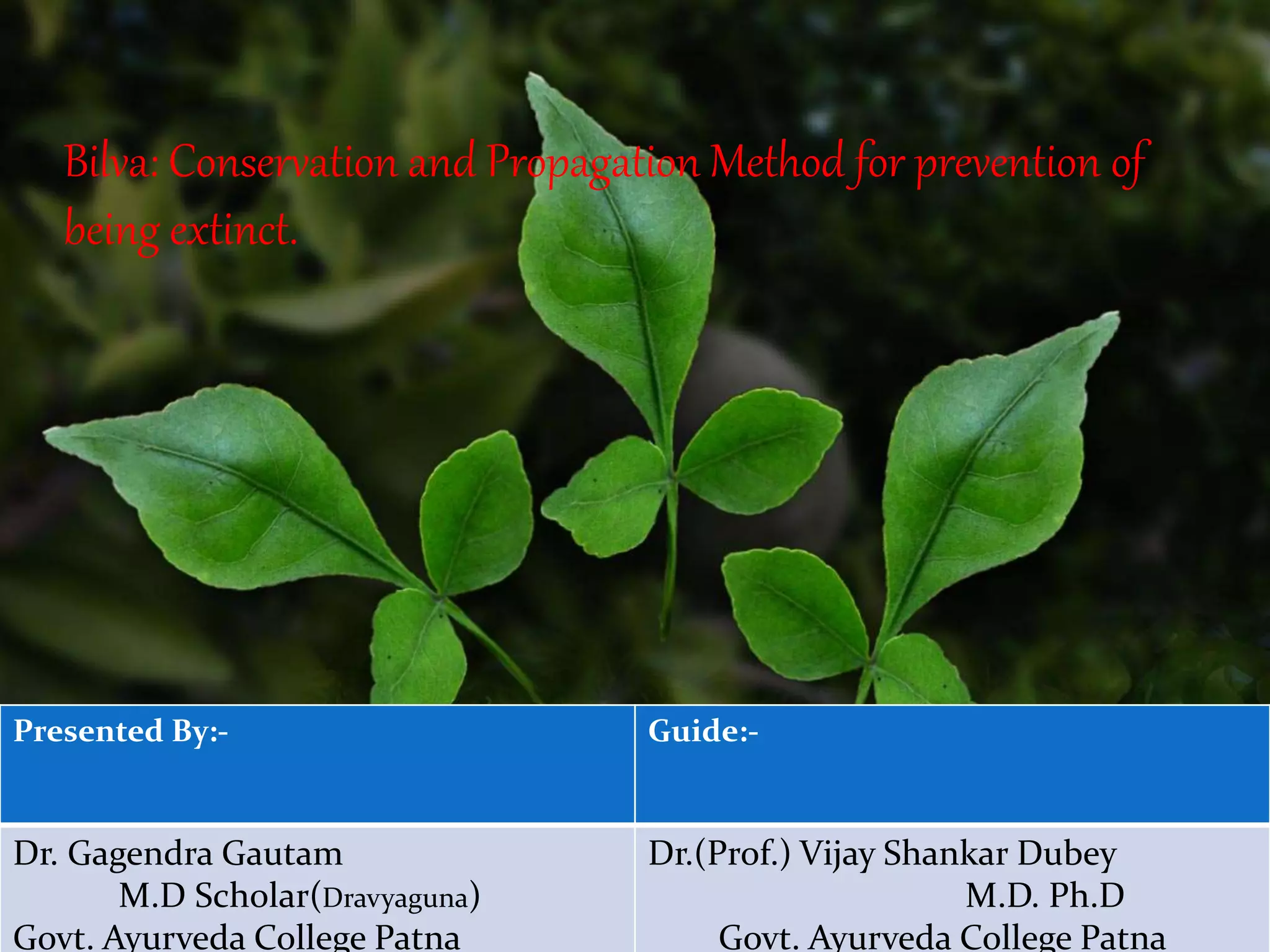
Bilva: Conservation and Propagation Method for prevention of
being extinct.
21 May 2018 1
Presented By:- Guide:-
Dr. Gagendra Gautam
M.D Scholar(Dravyaguna)
Govt. Ayurveda College Patna
Dr.(Prof.) Vijay Shankar Dubey
M.D. Ph.D
Govt. Ayurveda College Patna
Introduction
 It is amazing for us when it comes to our knowledge that
the plant which is integral part of our religious and
cultural life, in addition to its medicinal properties.
 Bilva (Aegle marmelos ) has been in danger of sliding
down towards extinction[Tandon and Thayil (1995)].
 Endangered Status:The foundation for revitalization of local
health traditions (FRLHT), Banglore, India listed bael
(A.marmelos) as rare, endangered and
threatened (RET) species, specifically
endangered species.
Why is Bilva on the verge of extinction?
1.Bilva is a medium size tree which conventionally propagates
through seed. Conventional method of its propagation are
season dependent, slow and labour intensive.
2.Seed have short viability and low vigor due to which seed
germination index is low.
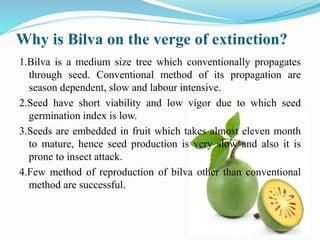
3.Seeds are embedded in fruit which takes almost eleven month
to mature, hence seed production is very slow and also it is
prone to insect attack.
4.Few method of reproduction of bilva other than conventional
method are successful.
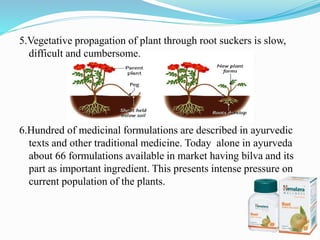
5.Vegetative propagation of plant through root suckers is slow,
difficult and cumbersome.
6.Hundred of medicinal formulations are described in ayurvedic
texts and other traditional medicine. Today alone in ayurveda
about 66 formulations available in market having bilva and its
part as important ingredient. This presents intense pressure on
current population of the plants.
7.People are generally not properly aware of the medicinal
value and present condition of plant population in the country,
so they are indifferent towards the conservation of plants.
8.Indiscriminate exploitation of natural resources causes habitat
loss, which resulted in the disappearance of bilva in wild
source and the species became vulnerable.
Conservation & Propagation methods
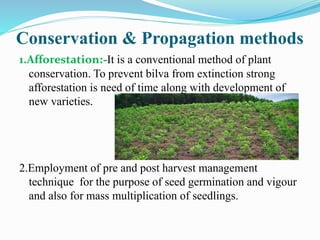
1.Afforestation:-It is a conventional method of plant
conservation. To prevent bilva from extinction strong
afforestation is need of time along with development of
new varieties.
2.Employment of pre and post harvest management
technique for the purpose of seed germination and vigour
and also for mass multiplication of seedlings.
3. Production of viable seed:- For this purpose fruit colour
is employed. The fruits are divided in three colour group:-
a. Greenish
b. Greenish-yellow
c. Yellow
Seeds are obtained from these fruits and grown in nursery and later
on transferred to field. The result was as follows:-
Colour of Fruits Germination
& Vigour
a. greenish 40-45%
b. greenish-yellow 50-55%
c. yellow 70-75%
Thus post harvesting of fruits are critical for the germination and
vigour of seed.
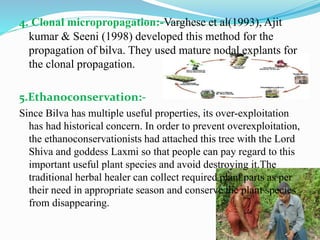
4. Clonal micropropagation:-Varghese et al(1993), Ajit
kumar & Seeni (1998) developed this method for the
propagation of bilva. They used mature nodal explants for
the clonal propagation.
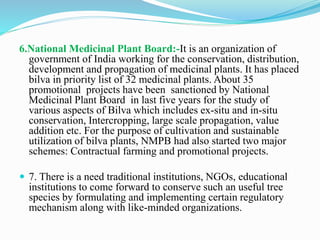
5.Ethanoconservation:-
Since Bilva has multiple useful properties, its over-exploitation
has had historical concern. In order to prevent overexploitation,
the ethanoconservationists had attached this tree with the Lord
Shiva and goddess Laxmi so that people can pay regard to this
important useful plant species and avoid destroying it.The
traditional herbal healer can collect required plant parts as per
their need in appropriate season and conserve the plant species
from disappearing.
6.National Medicinal Plant Board:-It is an organization of
government of India working for the conservation, distribution,
development and propagation of medicinal plants. It has placed
bilva in priority list of 32 medicinal plants. About 35
promotional projects have been sanctioned by National
Medicinal Plant Board in last five years for the study of
various aspects of Bilva which includes ex-situ and in-situ
conservation, Intercropping, large scale propagation, value
addition etc. For the purpose of cultivation and sustainable
utilization of bilva plants, NMPB had also started two major
schemes: Contractual farming and promotional projects.
 7. There is a need traditional institutions, NGOs, educational
institutions to come forward to conserve such an useful tree
species by formulating and implementing certain regulatory
mechanism along with like-minded organizations.
Conclusion
Bilva is an indigenous plant species which are described in vedic literature.
Almost all the ayurvedic text has description of medicinal properties of Bilva.
It is only plant whose apkva phala (Unripe fruit) are used in medicine.Tri-
foliate leaves of the plant represents three gods Bramha,Vishnu And
Mahesh.
It is also indicator of three mahaguna Satva, Raja, And Tama. These three guna
are driving force of human life. This trifoliate leaves also denotes the human
health i.e. physical, mental and spiritual well-being. Bilva is attached to
people culturally. They used bael patra for the worship of lord Shiva and
Laxmi.
There are hundred of traditional formulations in which bilva is used as an
ingredient. Its medicinal properties causes its overexploitation. In the
consequence today bilva is on the verge of extinction.
For the conservation and promotion of this plant species a lot of methods such
as afforestation, tissue culture, ethanoconservation etc. are employed. Apart
from this National Medicinal Plant Board, CCRAS, ICMAR and many
other organizations are conducting projects for the very purpose of this plant
species.
References
 http://lifesciencesleaflets.ning.com/ . Physiol. Mol. Biol. Plants,
14(4)–October, 2008
 Aegle marmelos:A Review on its Medicinal PropertiesPushpendra K.
Patel*1, Jyoti Sahu 1, Lokesh Sahu , Narendra K.1 Prajapati, B.K. Dubey
 Research journal of botany
 http://www.academicjournals.org/JMPR
 Indian journal of traditional knowledge
 Yadav, K., Singh, N. - In vitro propagation and biochemical analysis of
field established wood apple (Aegle marmelos L.)
 https://www.researchgate.net/publication/284679150
 Bael (Aegle marmelos) Extraordinary Species of India: A Review Neeraj,
Vinita Bisht and Vishal Johar*
https://doi.org/10.20546/ijcmas.2017.603.213
 www.google.scholar.com
 biologydiscussion.com
21 May 2018 12

Bilva conservation and propagation

  • 1.
    Bilva: Conservation andPropagation Method for prevention of being extinct. 21 May 2018 1 Presented By:- Guide:- Dr. Gagendra Gautam M.D Scholar(Dravyaguna) Govt. Ayurveda College Patna Dr.(Prof.) Vijay Shankar Dubey M.D. Ph.D Govt. Ayurveda College Patna
  • 2.
    Introduction  It isamazing for us when it comes to our knowledge that the plant which is integral part of our religious and cultural life, in addition to its medicinal properties.  Bilva (Aegle marmelos ) has been in danger of sliding down towards extinction[Tandon and Thayil (1995)].  Endangered Status:The foundation for revitalization of local health traditions (FRLHT), Banglore, India listed bael (A.marmelos) as rare, endangered and threatened (RET) species, specifically endangered species.
  • 3.
    Why is Bilvaon the verge of extinction? 1.Bilva is a medium size tree which conventionally propagates through seed. Conventional method of its propagation are season dependent, slow and labour intensive. 2.Seed have short viability and low vigor due to which seed germination index is low. 3.Seeds are embedded in fruit which takes almost eleven month to mature, hence seed production is very slow and also it is prone to insect attack. 4.Few method of reproduction of bilva other than conventional method are successful.
  • 4.
    5.Vegetative propagation ofplant through root suckers is slow, difficult and cumbersome. 6.Hundred of medicinal formulations are described in ayurvedic texts and other traditional medicine. Today alone in ayurveda about 66 formulations available in market having bilva and its part as important ingredient. This presents intense pressure on current population of the plants.
  • 5.
    7.People are generallynot properly aware of the medicinal value and present condition of plant population in the country, so they are indifferent towards the conservation of plants. 8.Indiscriminate exploitation of natural resources causes habitat loss, which resulted in the disappearance of bilva in wild source and the species became vulnerable.
  • 6.
    Conservation & Propagationmethods 1.Afforestation:-It is a conventional method of plant conservation. To prevent bilva from extinction strong afforestation is need of time along with development of new varieties. 2.Employment of pre and post harvest management technique for the purpose of seed germination and vigour and also for mass multiplication of seedlings.
  • 7.
    3. Production ofviable seed:- For this purpose fruit colour is employed. The fruits are divided in three colour group:- a. Greenish b. Greenish-yellow c. Yellow Seeds are obtained from these fruits and grown in nursery and later on transferred to field. The result was as follows:- Colour of Fruits Germination & Vigour a. greenish 40-45% b. greenish-yellow 50-55% c. yellow 70-75% Thus post harvesting of fruits are critical for the germination and vigour of seed.
  • 8.
    4. Clonal micropropagation:-Vargheseet al(1993), Ajit kumar & Seeni (1998) developed this method for the propagation of bilva. They used mature nodal explants for the clonal propagation. 5.Ethanoconservation:- Since Bilva has multiple useful properties, its over-exploitation has had historical concern. In order to prevent overexploitation, the ethanoconservationists had attached this tree with the Lord Shiva and goddess Laxmi so that people can pay regard to this important useful plant species and avoid destroying it.The traditional herbal healer can collect required plant parts as per their need in appropriate season and conserve the plant species from disappearing.
  • 9.
    6.National Medicinal PlantBoard:-It is an organization of government of India working for the conservation, distribution, development and propagation of medicinal plants. It has placed bilva in priority list of 32 medicinal plants. About 35 promotional projects have been sanctioned by National Medicinal Plant Board in last five years for the study of various aspects of Bilva which includes ex-situ and in-situ conservation, Intercropping, large scale propagation, value addition etc. For the purpose of cultivation and sustainable utilization of bilva plants, NMPB had also started two major schemes: Contractual farming and promotional projects.  7. There is a need traditional institutions, NGOs, educational institutions to come forward to conserve such an useful tree species by formulating and implementing certain regulatory mechanism along with like-minded organizations.
  • 10.
    Conclusion Bilva is anindigenous plant species which are described in vedic literature. Almost all the ayurvedic text has description of medicinal properties of Bilva. It is only plant whose apkva phala (Unripe fruit) are used in medicine.Tri- foliate leaves of the plant represents three gods Bramha,Vishnu And Mahesh. It is also indicator of three mahaguna Satva, Raja, And Tama. These three guna are driving force of human life. This trifoliate leaves also denotes the human health i.e. physical, mental and spiritual well-being. Bilva is attached to people culturally. They used bael patra for the worship of lord Shiva and Laxmi. There are hundred of traditional formulations in which bilva is used as an ingredient. Its medicinal properties causes its overexploitation. In the consequence today bilva is on the verge of extinction. For the conservation and promotion of this plant species a lot of methods such as afforestation, tissue culture, ethanoconservation etc. are employed. Apart from this National Medicinal Plant Board, CCRAS, ICMAR and many other organizations are conducting projects for the very purpose of this plant species.
  • 11.
    References  http://lifesciencesleaflets.ning.com/ .Physiol. Mol. Biol. Plants, 14(4)–October, 2008  Aegle marmelos:A Review on its Medicinal PropertiesPushpendra K. Patel*1, Jyoti Sahu 1, Lokesh Sahu , Narendra K.1 Prajapati, B.K. Dubey  Research journal of botany  http://www.academicjournals.org/JMPR  Indian journal of traditional knowledge  Yadav, K., Singh, N. - In vitro propagation and biochemical analysis of field established wood apple (Aegle marmelos L.)  https://www.researchgate.net/publication/284679150  Bael (Aegle marmelos) Extraordinary Species of India: A Review Neeraj, Vinita Bisht and Vishal Johar* https://doi.org/10.20546/ijcmas.2017.603.213  www.google.scholar.com  biologydiscussion.com
  • 12.