Training Effectiveness & Methodology
ANUBHA WALIA
Trainer .Facilitator.OD Consultant
anubhawalia.wordpress.com
2
• Learning Objectives


By the end of 15mins, you would get info on :
> 4 levels of Evaluation.
> Calculate benefit/cost ratio.
> Calculate return on investment (ROI).
> Use of training Methods
Model of Evaluation
• Level 1: Reaction Level 2: Learning
• Level 3: Behavior Level 4: Results
7
Level 1: Reaction

Measures Trainees Perception, emotions and reactions
How did participants react to the program?
> Smile sheets. OR PAGE
Concept (Poor, Average,Good, Excellent)
!
> Informal & Formal comments
> ( Verbal / POST-IT / FLIP CHART / White board )
!
> Focus group sessions with participants.
(Doing BUZZ / Syndicate / Brainstorming Method)
Level 2: Learning
• To what extent knowledge and
skills improve and change
attitudes as a result of the
training?
> Pre & post-tests – Based on
JD having KSAO
> On-the-job assessment - 90º,
180º, 360º
> Supervisor reports –
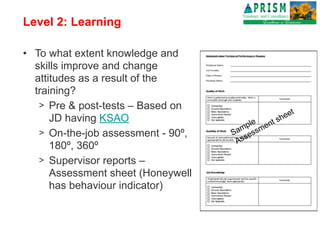
Assessment sheet (Honeywell
has behaviour indicator)
Sample
Assessment sheet
KASO
• Knowledge – “A body of
information applied directly to
the performance of a function”
• Skill – “A present, observable
competence to perform a
learned psychomotor act.”
• A b i l i t y – “ A p r e s e n t
competence to perform an
observable behavior or a
behavior which results in an
observable product.”.
• Other – Other characteristics
that are relevant to the
performance of the job that are
not KSAs (e.g., competencies,
certifications or licenses that
are reqd
Level 3: Behavior
• Behavior: Do learners use their newly acquired skills
and knowledge on the job?
!
> On-the-job observation – Covert & Overt
> Observation method
> Survey
> Self-evaluation
> Performance Benchmark ( based on Quality Circle)
> Supervisor and peer evaluation – on KSAO
11
Level 4: Results 

Often Triggers Reactive aspect
• Results: What organizational
benefits resulted from the training?
> Difficult and costly to collect.
> Impossible to isolate the
results of training.
> M e a s u r i n g r e t u r n o n
investment.
12
Cost Effectiveness & ROI Analysis
Compares the monetary costs of training to the financial
benefits accrued from training.Calculation of actual cost
saving based on change in Result
Calculating Revenue produced by Training
!
> Increased Sales = ____ Addl Sales / employee x Revenue /per sales x No.of employee
> Reduced Error = Average cost / error x No.of error avoided per employee x No.of employee
> Employee Retention = Average cost of new employee x no.of employee retained
!
Total Rev produced by Training *=
Revenue After – Revenue without Training
Calculating Return =
*Revenue prod by Training – Cost of Training = ROI
13
Suggestion / Inputs
Strategic Planning
Implementation
Assessment
Design
!
Development &
Implementation
Evaluation
InbasketDemonstration
Buzz /
GD
Case Study
Role Play
TrainingMethodology
Videos
Films
Blue Tac
Post-its
Exhibition Audio
Round
Robin
Games /
Activities
FISH
BOWL
Stories Role Play
3S - Stop
Sustain Start
Book Anubha’s Session

Training Effectiveness

  • 1.
    Training Effectiveness &Methodology ANUBHA WALIA Trainer .Facilitator.OD Consultant anubhawalia.wordpress.com
  • 2.
    2 • Learning Objectives 
 Bythe end of 15mins, you would get info on : > 4 levels of Evaluation. > Calculate benefit/cost ratio. > Calculate return on investment (ROI). > Use of training Methods
  • 3.
    Model of Evaluation •Level 1: Reaction Level 2: Learning • Level 3: Behavior Level 4: Results 7
  • 4.
    Level 1: Reaction
 MeasuresTrainees Perception, emotions and reactions How did participants react to the program? > Smile sheets. OR PAGE Concept (Poor, Average,Good, Excellent) ! > Informal & Formal comments > ( Verbal / POST-IT / FLIP CHART / White board ) ! > Focus group sessions with participants. (Doing BUZZ / Syndicate / Brainstorming Method)
  • 5.
    Level 2: Learning •To what extent knowledge and skills improve and change attitudes as a result of the training? > Pre & post-tests – Based on JD having KSAO > On-the-job assessment - 90º, 180º, 360º > Supervisor reports – Assessment sheet (Honeywell has behaviour indicator) Sample Assessment sheet
  • 6.
    KASO • Knowledge –“A body of information applied directly to the performance of a function” • Skill – “A present, observable competence to perform a learned psychomotor act.” • A b i l i t y – “ A p r e s e n t competence to perform an observable behavior or a behavior which results in an observable product.”. • Other – Other characteristics that are relevant to the performance of the job that are not KSAs (e.g., competencies, certifications or licenses that are reqd
  • 7.
    Level 3: Behavior •Behavior: Do learners use their newly acquired skills and knowledge on the job? ! > On-the-job observation – Covert & Overt > Observation method > Survey > Self-evaluation > Performance Benchmark ( based on Quality Circle) > Supervisor and peer evaluation – on KSAO 11
  • 8.
    Level 4: Results
 Often Triggers Reactive aspect • Results: What organizational benefits resulted from the training? > Difficult and costly to collect. > Impossible to isolate the results of training. > M e a s u r i n g r e t u r n o n investment. 12
  • 9.
    Cost Effectiveness &ROI Analysis Compares the monetary costs of training to the financial benefits accrued from training.Calculation of actual cost saving based on change in Result Calculating Revenue produced by Training ! > Increased Sales = ____ Addl Sales / employee x Revenue /per sales x No.of employee > Reduced Error = Average cost / error x No.of error avoided per employee x No.of employee > Employee Retention = Average cost of new employee x no.of employee retained ! Total Rev produced by Training *= Revenue After – Revenue without Training Calculating Return = *Revenue prod by Training – Cost of Training = ROI 13
  • 10.
    Suggestion / Inputs StrategicPlanning Implementation Assessment Design ! Development & Implementation Evaluation
  • 11.
    InbasketDemonstration Buzz / GD Case Study RolePlay TrainingMethodology Videos Films Blue Tac Post-its Exhibition Audio Round Robin Games / Activities FISH BOWL Stories Role Play 3S - Stop Sustain Start
  • 12.