



TRAINING AND
DEVELOPMENT OF
SUPERVISORS –
ASSIGNMENT 3
AAKASH SINGH
ANSHU SINGH
ALAKA SATHYAN
ZANDRA
SUPERVISOR SKILL TRAINING -
INTRODUCTION
1. The SST‟s main objective is to equip indirect and direct supervisors
with knowledge, supervising skills and a positive attitude to handle
their daily tasks in garment factories.
2. Direct supervisors oversee a line of workers directly, whereas
indirect supervisors oversee several direct supervisors and do not
directly manage workers.
3. Supervisors are a crucial element of a factory's internal
management system.
4. If poorly trained, they are the source of many problems, ranging
from labor standard to productivity and quality issues.
INTRODUCTION
Improving supervisor-worker relations is a crucial challenge for the
industry. To address these problems, the following measures are
taken –
1. Enforce high work standards
2. Coach and give feedback
3. Enforce discipline fairly
4. Communicate effectively
5. Solve work problems as they arise
6. Respect and uphold workers‟ rights
TRAINING PERIOD
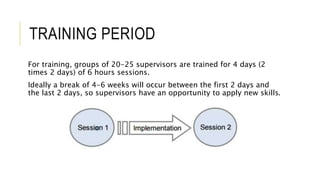
For training, groups of 20-25 supervisors are trained for 4 days (2
times 2 days) of 6 hours sessions.
Ideally a break of 4-6 weeks will occur between the first 2 days and
the last 2 days, so supervisors have an opportunity to apply new skills.
TRAINING – METHODOLOGY (FIRST
PHASE)
1. Analyze and synthesize former researches relevant to identification
of need.
2. Literature review about occupational competency.
3. Design the evaluation and assessment form for functional analysis.
SECOND PHASE
1. Present the designed model to the 5 experts in the field of
instructional design for review and evaluate the suitability.
2. The model was modified according to the experts’ suggestions.
3. After modification, presenting the model in the form of diagram
with report.
4. Analyze the results of evaluation of the model by mean(x) and
standard deviation (S.D.) consisting of 6 criteria for evaluation.
THIRD PHASE
This phase was to implementing the training course. The training
course is then used to train target group to assess their training
achievement.
FOURTH PHASE
1. This phase is to evaluate the training course.
2. Evaluating a program for its effectiveness determines how well the
learners mastered the learning outcomes of the training course.
3. The most important measure of program effectiveness is how well
the knowledge, attitude, and skill delivered in the program were
transferred into jobs and employment opportunities.
4. Data are collected at the end of training to assess their learning
achievement by means of percentage.
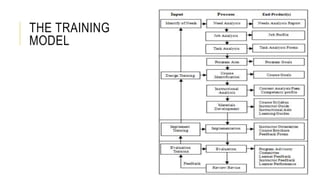
THE TRAINING
MODEL
AREAS OF TRAINING PROGRAMS
1. Discipline in the Floor:
Discipline in floor is very important to create good work culture in
the company.
To ensure effective, safe, accurate and timely stock management to
include space allocation, stock transfer and dealing with non-
confirming product.
Operators may not be aware how to behave in the factory floor.
Supervisor is responsible to train such things to their operators and
helpers.
For example, operators should keep floor clean, keeps accessories
on defined place, and should not talk unnecessarily with other
operators during working hours.
AREAS OF TRAINING PROGRAMS
2. Style Analysis:
It is essential task for a supervisor to collect sample of the style that
is going to be loaded in sewing line and analyze the trims and
accessories used. Supervisor should completely understand what to
be done.
In case any confusion s/he should contact to merchandiser and get
clarification. Quality requirement can be discussed with quality team
or merchandiser.
Though this things are discussed and clarified in PP meeting, some
times everything may not be covered in that meeting. Check what all
trims he/she needs to bring from store prior to line start.
AREAS OF TRAINING PROGRAMS
3. Operator Training:
Though companies set up training center for operator training or
hire only experienced operators, supervisors need to train unskilled
operators on the job.
While a trainee operator is allocated for an operation and the trainee
operator is not confident how to do that job or hesitating to follow an
operation method, supervisor's responsibility is to guide and instruct
them correct method of doing the task.
CHECKLIST
Quality Check list For checklist
CHECKLIST
Employee checklist
sample-supervisor-checklist.pdf

Training and development of supervisors – assignment 3

  • 1.
    TRAINING AND DEVELOPMENT OF SUPERVISORS– ASSIGNMENT 3 AAKASH SINGH ANSHU SINGH ALAKA SATHYAN ZANDRA
  • 2.
    SUPERVISOR SKILL TRAINING- INTRODUCTION 1. The SST‟s main objective is to equip indirect and direct supervisors with knowledge, supervising skills and a positive attitude to handle their daily tasks in garment factories. 2. Direct supervisors oversee a line of workers directly, whereas indirect supervisors oversee several direct supervisors and do not directly manage workers. 3. Supervisors are a crucial element of a factory's internal management system. 4. If poorly trained, they are the source of many problems, ranging from labor standard to productivity and quality issues.
  • 3.
    INTRODUCTION Improving supervisor-worker relationsis a crucial challenge for the industry. To address these problems, the following measures are taken – 1. Enforce high work standards 2. Coach and give feedback 3. Enforce discipline fairly 4. Communicate effectively 5. Solve work problems as they arise 6. Respect and uphold workers‟ rights
  • 4.
    TRAINING PERIOD For training,groups of 20-25 supervisors are trained for 4 days (2 times 2 days) of 6 hours sessions. Ideally a break of 4-6 weeks will occur between the first 2 days and the last 2 days, so supervisors have an opportunity to apply new skills.
  • 5.
    TRAINING – METHODOLOGY(FIRST PHASE) 1. Analyze and synthesize former researches relevant to identification of need. 2. Literature review about occupational competency. 3. Design the evaluation and assessment form for functional analysis.
  • 6.
    SECOND PHASE 1. Presentthe designed model to the 5 experts in the field of instructional design for review and evaluate the suitability. 2. The model was modified according to the experts’ suggestions. 3. After modification, presenting the model in the form of diagram with report. 4. Analyze the results of evaluation of the model by mean(x) and standard deviation (S.D.) consisting of 6 criteria for evaluation.
  • 7.
    THIRD PHASE This phasewas to implementing the training course. The training course is then used to train target group to assess their training achievement.
  • 8.
    FOURTH PHASE 1. Thisphase is to evaluate the training course. 2. Evaluating a program for its effectiveness determines how well the learners mastered the learning outcomes of the training course. 3. The most important measure of program effectiveness is how well the knowledge, attitude, and skill delivered in the program were transferred into jobs and employment opportunities. 4. Data are collected at the end of training to assess their learning achievement by means of percentage.
  • 9.
  • 10.
    AREAS OF TRAININGPROGRAMS 1. Discipline in the Floor: Discipline in floor is very important to create good work culture in the company. To ensure effective, safe, accurate and timely stock management to include space allocation, stock transfer and dealing with non- confirming product. Operators may not be aware how to behave in the factory floor. Supervisor is responsible to train such things to their operators and helpers. For example, operators should keep floor clean, keeps accessories on defined place, and should not talk unnecessarily with other operators during working hours.
  • 11.
    AREAS OF TRAININGPROGRAMS 2. Style Analysis: It is essential task for a supervisor to collect sample of the style that is going to be loaded in sewing line and analyze the trims and accessories used. Supervisor should completely understand what to be done. In case any confusion s/he should contact to merchandiser and get clarification. Quality requirement can be discussed with quality team or merchandiser. Though this things are discussed and clarified in PP meeting, some times everything may not be covered in that meeting. Check what all trims he/she needs to bring from store prior to line start.
  • 12.
    AREAS OF TRAININGPROGRAMS 3. Operator Training: Though companies set up training center for operator training or hire only experienced operators, supervisors need to train unskilled operators on the job. While a trainee operator is allocated for an operation and the trainee operator is not confident how to do that job or hesitating to follow an operation method, supervisor's responsibility is to guide and instruct them correct method of doing the task.
  • 13.
  • 14.