



Muhammad Irfan Akbar (M-15823)
Mustaqeem Haider Ali (B-18497)
Saqib Dogar (B-18602)
Group Members:
Topic:
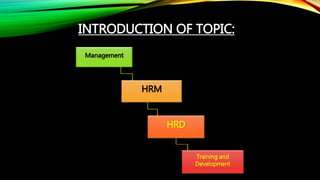
INTRODUCTION OF TOPIC:
Management
HRM
HRD
Training and
Development
TRAINING AND DEVELOPMENT:
“Training and development is a function of human resource management
concerned with organizational activity aimed at bettering the performance of
performance of individuals and groups in organizational settings.”
TRAINING AND DEVELOPMENT:
• Training:
• “Improving the knowledge, skills and attitudes of employees for short-term, particular to specific job or
particular to specific job or task.”
• Like, Employee Orientation, Skill and Technical Training, Coaching, Counselling.
• Development:
• “Preparing for future responsibilities, while increasing the capacity to perform at a current job.”
current job.”
• “It is about the change of whole person not just the academic or vocational pieces of knowledge or
of knowledge or skills needed for work.”
• Like, Management Training, Supervisor Development.
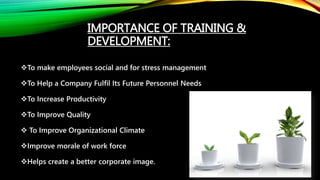
IMPORTANCE OF TRAINING &
DEVELOPMENT:
To make employees social and for stress management
To Help a Company Fulfil Its Future Personnel Needs
To Increase Productivity
To Improve Quality
 To Improve Organizational Climate
Improve morale of work force
Helps create a better corporate image.
IMPORTANCE OF TRAINING &
DEVELOPMENT:
Aids in organizational development.
Improves labor-management relations and creates an appropriate climate for growth,
communication.
To make employees creative and innovative.
Aids in encouraging and achieving self-development and self-confidence.
Increases job satisfaction and recognition.
Develops a sense of growth in learning.
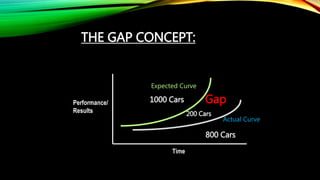
THE GAP CONCEPT:
Performance/
Results
Time
Expected Curve
Actual Curve
Gap1000 Cars
200 Cars
800 Cars
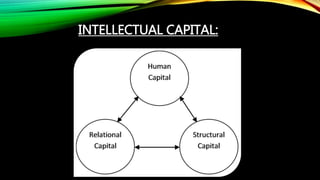
INTELLECTUAL CAPITAL:
CHALLENGES FOR HRD:
• Competing in global economy
• Eliminating the skills gap
• Need for lifelong learning
• Workforce diversity
ROLE OF PSYCHOLOGY IN T&D:
• Contributing to training has long been one of the main concerns of occupational
psychology.
• training involves learning and that learning is a central issue in psychology.
• Training is one of the core skills of occupational psychology.
• It suggests different techniques and methods to resolve the problems regarding
training and development.
• It tells how training relates to other interventions aimed at improving job
performance.
• That is why psychologists are hired to train the management trainees.
FIVE PRINCIPLES OF LEARNING:
• Participation: involve trainees, learn by doing
• Repetition: repeat ideas & concepts to help people learn
• Relevance: learn better when material is meaningful and related
• Transference: to real world using simulations
• Feedback: ask for it and adjust training methods to audience.
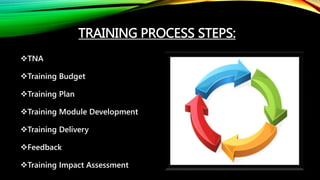
TRAINING PROCESS STEPS:
TNA
Training Budget
Training Plan
Training Module Development
Training Delivery
Feedback
Training Impact Assessment
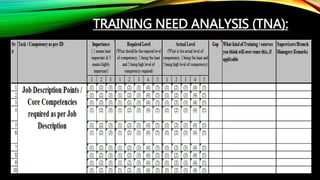
TRAINING NEED ANALYSIS (TNA):
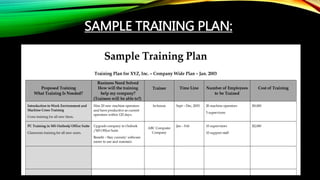
SAMPLE TRAINING PLAN:
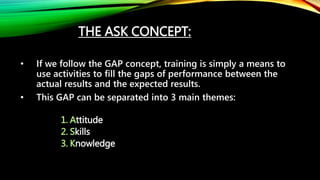
THE ASK CONCEPT:
• If we follow the GAP concept, training is simply a means to
use activities to fill the gaps of performance between the
actual results and the expected results.
• This GAP can be separated into 3 main themes:
1. Attitude
2. Skills
3. Knowledge
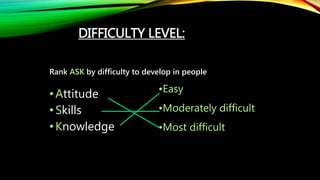
DIFFICULTY LEVEL:
Rank ASK by difficulty to develop in people
•Attitude
•Skills
•Knowledge
•Easy
•Moderately difficult
•Most difficult
JOB ANALYSIS:
Job design
Job Rotation
Job Simplification
Job Enlargement
Job Enrichment
PERFORMANCE MANAGEMENT:
• It is also known as "Talent Management”
• Performance appraisal is a formal structured system of measuring and
evaluating an employee’s job related behavior and outcomes to discover
how and why the employee is presently performing on the job and how
the employee can perform more effectively in the future so that the
employee, organization and society all benefit.
• Employee Scorecard:
• It is part of performance management.
• This technique is used to know about the current performance of employees.
SUCCESSION PLANNING:
• It is part of performance management.
• It is the process where by an organization ensures that employees are
recruited and developed to fill each key role for organization.
• Through your succession planning process, you recruit superior
employees, educate their knowledge, skills and abilities and prepare
them advancement and promotion into ever more challenging role.
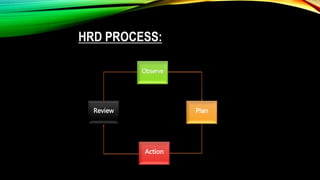
HRD PROCESS:
Observe
Review
Action
Plan
TYPES OF TRAINING:
Skills Training
Retraining
Cross-Functional Training
Team Training
Creativity Training
Literacy Training
 Diversity Training
Customer Service Training
THE THREE DIMENSIONS OF HRD:
• Cognitive Capacities
• Capabilities
• Desired Behaviors
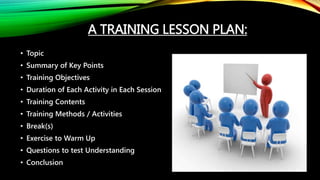
A TRAINING LESSON PLAN:
• Topic
• Summary of Key Points
• Training Objectives
• Duration of Each Activity in Each Session
• Training Contents
• Training Methods / Activities
• Break(s)
• Exercise to Warm Up
• Questions to test Understanding
• Conclusion
EXAMPLES OF INVESTMENT IN TRAINING:
• The budget of Mets Serla Corporation for training and development of employees
was 10 million US dollars in1995-1996.
• Etisalat the world’s biggest telecommunication company is investing huge amounts
in training and development, they have established their own training academy.
• Fatima Fertilizers have 50,000 hours training to its employees in 2011.
• Atlas Honda Pakistan have spent 2.66 billion for training activities in 2009.
• Bolan Casting have invested 2 million Rs. on employees training in 2011.
CONCLUSION:
• As we know that environment is changing so rapidly. Profit margins are
decreasing. Organizations are also facing intense competition due to
globalization. Organizations can overcome these challenges only through
trained and developed workforce.
• So, we should invest maximum on training and development and consider
the cost of training and development as an investment. Because it will
return much more in future beyond your expectations.
Training and Development (HRD)... Psychology...

Training and Development (HRD)... Psychology...

  • 3.
    Muhammad Irfan Akbar(M-15823) Mustaqeem Haider Ali (B-18497) Saqib Dogar (B-18602) Group Members:
  • 4.
  • 5.
  • 6.
    TRAINING AND DEVELOPMENT: “Trainingand development is a function of human resource management concerned with organizational activity aimed at bettering the performance of performance of individuals and groups in organizational settings.”
  • 7.
    TRAINING AND DEVELOPMENT: •Training: • “Improving the knowledge, skills and attitudes of employees for short-term, particular to specific job or particular to specific job or task.” • Like, Employee Orientation, Skill and Technical Training, Coaching, Counselling. • Development: • “Preparing for future responsibilities, while increasing the capacity to perform at a current job.” current job.” • “It is about the change of whole person not just the academic or vocational pieces of knowledge or of knowledge or skills needed for work.” • Like, Management Training, Supervisor Development.
  • 8.
    IMPORTANCE OF TRAINING& DEVELOPMENT: To make employees social and for stress management To Help a Company Fulfil Its Future Personnel Needs To Increase Productivity To Improve Quality  To Improve Organizational Climate Improve morale of work force Helps create a better corporate image.
  • 9.
    IMPORTANCE OF TRAINING& DEVELOPMENT: Aids in organizational development. Improves labor-management relations and creates an appropriate climate for growth, communication. To make employees creative and innovative. Aids in encouraging and achieving self-development and self-confidence. Increases job satisfaction and recognition. Develops a sense of growth in learning.
  • 10.
    THE GAP CONCEPT: Performance/ Results Time ExpectedCurve Actual Curve Gap1000 Cars 200 Cars 800 Cars
  • 11.
  • 12.
    CHALLENGES FOR HRD: •Competing in global economy • Eliminating the skills gap • Need for lifelong learning • Workforce diversity
  • 13.
    ROLE OF PSYCHOLOGYIN T&D: • Contributing to training has long been one of the main concerns of occupational psychology. • training involves learning and that learning is a central issue in psychology. • Training is one of the core skills of occupational psychology. • It suggests different techniques and methods to resolve the problems regarding training and development. • It tells how training relates to other interventions aimed at improving job performance. • That is why psychologists are hired to train the management trainees.
  • 14.
    FIVE PRINCIPLES OFLEARNING: • Participation: involve trainees, learn by doing • Repetition: repeat ideas & concepts to help people learn • Relevance: learn better when material is meaningful and related • Transference: to real world using simulations • Feedback: ask for it and adjust training methods to audience.
  • 15.
    TRAINING PROCESS STEPS: TNA TrainingBudget Training Plan Training Module Development Training Delivery Feedback Training Impact Assessment
  • 16.
  • 17.
  • 20.
    THE ASK CONCEPT: •If we follow the GAP concept, training is simply a means to use activities to fill the gaps of performance between the actual results and the expected results. • This GAP can be separated into 3 main themes: 1. Attitude 2. Skills 3. Knowledge
  • 21.
    DIFFICULTY LEVEL: Rank ASKby difficulty to develop in people •Attitude •Skills •Knowledge •Easy •Moderately difficult •Most difficult
  • 22.
    JOB ANALYSIS: Job design JobRotation Job Simplification Job Enlargement Job Enrichment
  • 23.
    PERFORMANCE MANAGEMENT: • Itis also known as "Talent Management” • Performance appraisal is a formal structured system of measuring and evaluating an employee’s job related behavior and outcomes to discover how and why the employee is presently performing on the job and how the employee can perform more effectively in the future so that the employee, organization and society all benefit. • Employee Scorecard: • It is part of performance management. • This technique is used to know about the current performance of employees.
  • 24.
    SUCCESSION PLANNING: • Itis part of performance management. • It is the process where by an organization ensures that employees are recruited and developed to fill each key role for organization. • Through your succession planning process, you recruit superior employees, educate their knowledge, skills and abilities and prepare them advancement and promotion into ever more challenging role.
  • 25.
  • 26.
    TYPES OF TRAINING: SkillsTraining Retraining Cross-Functional Training Team Training Creativity Training Literacy Training  Diversity Training Customer Service Training
  • 27.
    THE THREE DIMENSIONSOF HRD: • Cognitive Capacities • Capabilities • Desired Behaviors
  • 28.
    A TRAINING LESSONPLAN: • Topic • Summary of Key Points • Training Objectives • Duration of Each Activity in Each Session • Training Contents • Training Methods / Activities • Break(s) • Exercise to Warm Up • Questions to test Understanding • Conclusion
  • 29.
    EXAMPLES OF INVESTMENTIN TRAINING: • The budget of Mets Serla Corporation for training and development of employees was 10 million US dollars in1995-1996. • Etisalat the world’s biggest telecommunication company is investing huge amounts in training and development, they have established their own training academy. • Fatima Fertilizers have 50,000 hours training to its employees in 2011. • Atlas Honda Pakistan have spent 2.66 billion for training activities in 2009. • Bolan Casting have invested 2 million Rs. on employees training in 2011.
  • 30.
    CONCLUSION: • As weknow that environment is changing so rapidly. Profit margins are decreasing. Organizations are also facing intense competition due to globalization. Organizations can overcome these challenges only through trained and developed workforce. • So, we should invest maximum on training and development and consider the cost of training and development as an investment. Because it will return much more in future beyond your expectations.