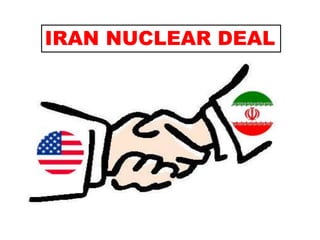
IRAN NUCLEAR DEAL
1. Brief introduction
2. Location of Iran
3. The background of deal
4. Key points
5. Removal of sanctions
6. Economic impact
7. International reactions
8. Impact on Indian economy
9. Conclusion
10.References
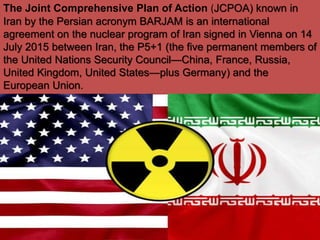
The Joint Comprehensive Plan of Action (JCPOA) known in
Iran by the Persian acronym BARJAM is an international
agreement on the nuclear program of Iran signed in Vienna on 14
July 2015 between Iran, the P5+1 (the five permanent members of
the United Nations Security Council—China, France, Russia,
United Kingdom, United States—plus Germany) and the
European Union.
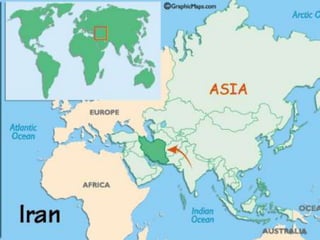
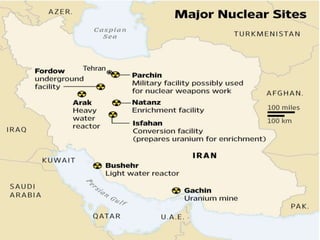
Where is IRAN
located?
The
BACKGROUND
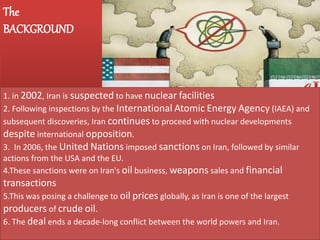
1. in 2002, Iran is suspected to have nuclear facilities
2. Following inspections by the International Atomic Energy Agency (IAEA) and
subsequent discoveries, Iran continues to proceed with nuclear developments
despite international opposition.
3. In 2006, the United Nations imposed sanctions on Iran, followed by similar
actions from the USA and the EU.
4.These sanctions were on Iran's oil business, weapons sales and financial
transactions
5.This was posing a challenge to oil prices globally, as Iran is one of the largest
producers of crude oil.
6. The deal ends a decade-long conflict between the world powers and Iran.
K
e
y
p
o
i
n
t
s
1. Increase the time it would take Iran to acquire
enough material for 1 bomb from 2-3 months to at
least one year.
2. Reduce Iran’s stockpiles of enriched uranium.
3. Reduce no. of Iran’s installed centrifuges by two-
thirds.
4. Prevent Iran from producing weapons- grade
plutonium
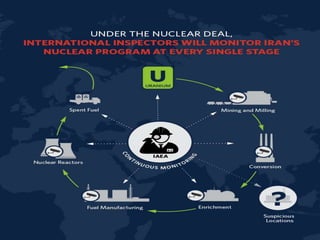
5. Track Iran’s nuclear activity with robust transparency
and inspections
6. Iran will implement the “Additional
Protocol” safeguards agreement.
7. Iran’s heavy water plant at Arak will be redesigned
and rebuilt
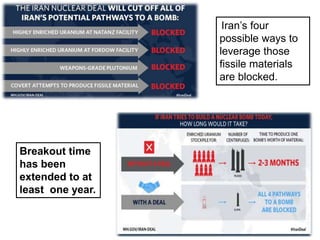
Iran’s four
possible ways to
leverage those
fissile materials
are blocked.
Breakout time
has been
extended to at
least one year.
But how
it can be
achieved??
?
sanctions
• EU sanctions against a number of Iranian companies, individuals and
institutions (such as the Revolutionary Guards) will be lifted.
• The U.S. will "cease" application of its nuclear-
related secondary sanctions.
• No new UN or EU nuclear-related sanctions or restrictive measures will
be imposed.
• If Iran violates the agreement, any of the P5+1 can invoke a "snap back"
provision, under which the sanctions "snap back" into place.
• Sanctions on Iran’s banking and financial systems will go away. It will
enable the immediate release of around $100 billion currently lying
frozen in Iranian bank accounts overseas.
• The oil embargo preventing the import of oil from Iran will be removed.
Economic
impact
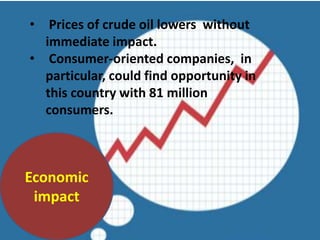
• Prices of crude oil lowers without
immediate impact.
• Consumer-oriented companies, in
particular, could find opportunity in
this country with 81 million
consumers.
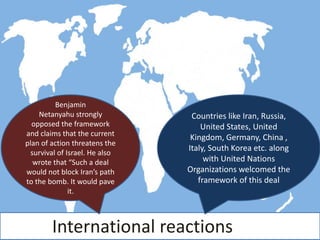
International reactions
Countries like Iran, Russia,
United States, United
Kingdom, Germany, China ,
Italy, South Korea etc. along
with United Nations
Organizations welcomed the
framework of this deal
Benjamin
Netanyahu strongly
opposed the framework
and claims that the current
plan of action threatens the
survival of Israel. He also
wrote that “Such a deal
would not block Iran’s path
to the bomb. It would pave
it.
• It will benefit oil marketing companies such as HPCL, Indian Oil and
BPCL. These stocks gained 2-3.5 per cent higher
• has negative impact for upstream companies, which weighed on
shares in Cairn India and ONGC and Indian refiners.
• benefit domestic pharmaceutical, IT and commodity firms
• Easing of sanctions in Iran will help Aban's working capital situation
• Indian companies will have to compete for consumer products
ranging from clothing to cars.
• "neutral" for Reliance Industries, which operates the world's largest
refinery in Jamnagar.
Impact of
Iran nuclear deal
on Indian economy
The Pros and Cons of such a landmark deal are
debatable. Most views, claims, and allegations are
often politically tuned. For now, the majority across the
globe appears to be positive about the Iran nuclear
deal
Because it will make the world a safer place and benefit
crude oil prices and in turn gas prices globally
1. http://www.investopedia.com/articles/investing/072715/dummies-guide-iran-nuclear-
deal.asp
2. https://en.wikipedia.org/wiki/Joint_Comprehensive_Plan_of_Action#Impact
3. http://www.economist.com/blogs/economist-explains/2015/04/economist-explains-3
4. http://www.economist.com/blogs/graphicdetail/2015/07/daily-chart-iran-graphics
5. http://profit.ndtv.com/news/economy/article-iran-nuclear-deal-what-it-means-for-india-
781303
6. http://www.forbes.com/sites/greatspeculations/2015/06/19/how-would-the-iran-nuclear-
deal-impact-oil-prices/
7. https://www.whitehouse.gov/sites/default/files/docs/jcpoa_what_you_need_to_know.pdf
8. http://www.hindustantimes.com/india/iran-s-nuclear-deal-how-it-affects-india/story-
OgeUy2MISxN3YHzlmJJmIM.html
9. http://www.telegraph.co.uk/news/worldnews/middleeast/iran/11739214/A-summary-of-
the-Iran-nuclear-deal.html

Iran nuclear deal

  • 1.
  • 2.
    1. Brief introduction 2.Location of Iran 3. The background of deal 4. Key points 5. Removal of sanctions 6. Economic impact 7. International reactions 8. Impact on Indian economy 9. Conclusion 10.References
  • 3.
    The Joint ComprehensivePlan of Action (JCPOA) known in Iran by the Persian acronym BARJAM is an international agreement on the nuclear program of Iran signed in Vienna on 14 July 2015 between Iran, the P5+1 (the five permanent members of the United Nations Security Council—China, France, Russia, United Kingdom, United States—plus Germany) and the European Union.
  • 4.
  • 5.
    The BACKGROUND 1. in 2002,Iran is suspected to have nuclear facilities 2. Following inspections by the International Atomic Energy Agency (IAEA) and subsequent discoveries, Iran continues to proceed with nuclear developments despite international opposition. 3. In 2006, the United Nations imposed sanctions on Iran, followed by similar actions from the USA and the EU. 4.These sanctions were on Iran's oil business, weapons sales and financial transactions 5.This was posing a challenge to oil prices globally, as Iran is one of the largest producers of crude oil. 6. The deal ends a decade-long conflict between the world powers and Iran.
  • 6.
    K e y p o i n t s 1. Increase thetime it would take Iran to acquire enough material for 1 bomb from 2-3 months to at least one year. 2. Reduce Iran’s stockpiles of enriched uranium. 3. Reduce no. of Iran’s installed centrifuges by two- thirds. 4. Prevent Iran from producing weapons- grade plutonium 5. Track Iran’s nuclear activity with robust transparency and inspections 6. Iran will implement the “Additional Protocol” safeguards agreement. 7. Iran’s heavy water plant at Arak will be redesigned and rebuilt
  • 8.
    Iran’s four possible waysto leverage those fissile materials are blocked. Breakout time has been extended to at least one year.
  • 9.
    But how it canbe achieved?? ?
  • 11.
    sanctions • EU sanctionsagainst a number of Iranian companies, individuals and institutions (such as the Revolutionary Guards) will be lifted. • The U.S. will "cease" application of its nuclear- related secondary sanctions. • No new UN or EU nuclear-related sanctions or restrictive measures will be imposed. • If Iran violates the agreement, any of the P5+1 can invoke a "snap back" provision, under which the sanctions "snap back" into place. • Sanctions on Iran’s banking and financial systems will go away. It will enable the immediate release of around $100 billion currently lying frozen in Iranian bank accounts overseas. • The oil embargo preventing the import of oil from Iran will be removed.
  • 12.
    Economic impact • Prices ofcrude oil lowers without immediate impact. • Consumer-oriented companies, in particular, could find opportunity in this country with 81 million consumers.
  • 13.
    International reactions Countries likeIran, Russia, United States, United Kingdom, Germany, China , Italy, South Korea etc. along with United Nations Organizations welcomed the framework of this deal Benjamin Netanyahu strongly opposed the framework and claims that the current plan of action threatens the survival of Israel. He also wrote that “Such a deal would not block Iran’s path to the bomb. It would pave it.
  • 14.
    • It willbenefit oil marketing companies such as HPCL, Indian Oil and BPCL. These stocks gained 2-3.5 per cent higher • has negative impact for upstream companies, which weighed on shares in Cairn India and ONGC and Indian refiners. • benefit domestic pharmaceutical, IT and commodity firms • Easing of sanctions in Iran will help Aban's working capital situation • Indian companies will have to compete for consumer products ranging from clothing to cars. • "neutral" for Reliance Industries, which operates the world's largest refinery in Jamnagar. Impact of Iran nuclear deal on Indian economy
  • 15.
    The Pros andCons of such a landmark deal are debatable. Most views, claims, and allegations are often politically tuned. For now, the majority across the globe appears to be positive about the Iran nuclear deal Because it will make the world a safer place and benefit crude oil prices and in turn gas prices globally
  • 16.
    1. http://www.investopedia.com/articles/investing/072715/dummies-guide-iran-nuclear- deal.asp 2. https://en.wikipedia.org/wiki/Joint_Comprehensive_Plan_of_Action#Impact 3.http://www.economist.com/blogs/economist-explains/2015/04/economist-explains-3 4. http://www.economist.com/blogs/graphicdetail/2015/07/daily-chart-iran-graphics 5. http://profit.ndtv.com/news/economy/article-iran-nuclear-deal-what-it-means-for-india- 781303 6. http://www.forbes.com/sites/greatspeculations/2015/06/19/how-would-the-iran-nuclear- deal-impact-oil-prices/ 7. https://www.whitehouse.gov/sites/default/files/docs/jcpoa_what_you_need_to_know.pdf 8. http://www.hindustantimes.com/india/iran-s-nuclear-deal-how-it-affects-india/story- OgeUy2MISxN3YHzlmJJmIM.html 9. http://www.telegraph.co.uk/news/worldnews/middleeast/iran/11739214/A-summary-of- the-Iran-nuclear-deal.html