Total Quality Management
Quality –Indian Context
 Liberalization took place in 1990’s
Statistics
 Among 59 countries which were ranked by world
competitiveness report 1999,India occupied a low 52nd
place
in overall competitiveness and 37th
place in innovative
capacity
Quality and Competitiveness
Why does India lag behind most other industrial nations?
 Antiquated production system/apparatus with a high
rejection rate
 Motorola , is reported to have attained 99.99997%
defect-free manufacturing on the production line.
 In India many plants are struggling to attain a rejection
rate level of under 5 %
Why Quality practices?
Why are the corporates in the world adopting equality
practices so vigorously?
 Changing demands of global customers
For example India is 2nd
largest and 4th
largest in Garment and
shoe exports
But International Marketers over the past have been insisting
on Indian suppliers for slashing the delivery lines from 3
months to 2 weeks.
Quality revolution
• In these days of mass customisation(ie capacity to
manufacture unique products in batches without
compromising on costs, speeds or product standards)
• Indian corporates are increasingly finding it difficult to
compete with foreign manufacturers who can re-engineer
their manufacturing process to produce what customers
wants.
“Total quality is no longer choice ,it is a foregone
conclusion”
Result:
Corporates in India have undertaken restructuring exercises
 Downsizing
 Lean manufacturing
 Delayering
 Adherence to core competencies
Road map for quality journey
 Every business organization needs to prepare a road map for the journey
toward quality, the journey that is continuous and never ending.
 Quality needs to be integrated into business strategies with larger
involvement of employees to exploit its full benefits
 Quality practices shift the focus from inspection to prevention of
errors/faults/defects which in turn eliminate the need for expensive testing
of products as they roll of the assembly line
 Defects free products means no or very few customer complaints which
has the affect of reducing the cost of repair and compensation and
enhancing the profitability
Role of government
 Studies indicate that in most countries –Japan,U.S,Germany
etc ,the role of the government has been critical factor in
catalyzing the quality movement
Quality Scene in India
 CII
FICCI
NPC
Bureau of Indian Standards
Indian Statistical Institute(ISI)
Concepts of quality
Definitions by various Quality Gurus
 Quality is the fitness for use (Dr.Juran)
 Quality is a predictable degree of uniformity and dependability
at low cost and suited to the market(Deming)
 Quality is conformance to requirements (Crosby)
 Quality is the minimum loss imparted by a product to society
from the time the product is shipped(Taguchi)
Universally accepted definition of quality
Definition of quality provided by ISO
 Quality is the totality of characteristics of an entity that satisfies
the stated and implied needs of the customer.
Stated needs: are the needs which the customer specifies for the
procurement of goods or services .They are the purchase
indent for an organization and the physical parameters or the
tangible description of the product or service.
Implied needs : are the associated functions that the product is
supposed to perform irrespective of whether they are stated or
not.
Product
 The term ‘Product’ means in terms of quality
measurement, is result of activities or processes and
includes service,hardware,processed materials, software
or combination thereof.
 It can be tangible eg: Assemblies, processed materials
 Intangible: Knowledge or concepts or a combination
thereof
Dimensions of quality
 Performance
 Features
 Reliability
 Conformity
 Durability
 Serviceability
 Aesthetics
 Perceived quality
For a Manufactured Product
Dimensions of quality
• For Service
 Time
Timeliness
Completeness
Consistency
Accessibility and convenience
Accuracy
Responsiveness
Total Quality Management: An Overview
Definition provided by ISO
“ Total quality management is the management approach of an
organisation,centered on quality,based on the participation of all its
members and aiming a long-term success through customer
satisfaction and benefits to all members of the organization and to
society
Total quality forum of U.S.A defines TQM as
“TQM is a people focused management system that aims at continual
increase in customer satisfaction at continually lower cost.TQM is a
total system approach and an integral part of high-level strategy. it
works horizontally across functions and departments, involving all
employees top to bottom and exceeds backwards and forwards to
include the supply chain and the customer chain”
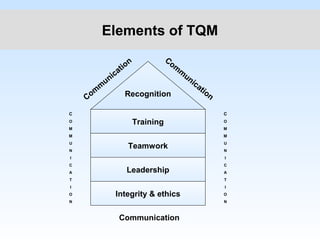
Elements of TQM
Recognition
Training
Teamwork
Leadership
Integrity & ethics
C
O
M
M
U
N
I
C
A
T
I
O
N
C
O
M
M
U
N
I
C
A
T
I
O
N
Communication
Com
m
unication Com
m
unication
Historical evolution of quality
Until the 1960s
Prior to the 20th
century Quality is an art
Demand overcome potential
production
An era of workmanship
F.Taylor(1900s) The scientific approach to
management/standardization/i
nspection and supervision
Shewart(1930s)  Use of statistical principles
Late (1930s) Quality standards and
approaches are introduced in
France and Japan
Historical evolution of quality
1942-1946  Great efforts were initiated
during world war II due to
procurement problems
Deming, Dodge and Juran
played vital roles in the field of
quality
Concept of Acceptance
sampling was devised
Founding of Japan standard
Association
Founding of ASQC
1950 Visits by Deming to Japan
Historical evolution of quality
1951-1957  Quality assurance is
increasingly being accepted
TQC in Japan(Feigenbaum
and Juran)
Founding of European
organization for control of
quality(France,Germany,Italy,H
olland,England)
After 1960s
1961  The martin co in U.S.A
introduces the Zero-defects
approach.
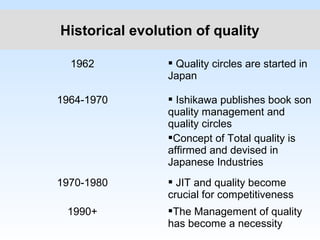
Historical evolution of quality
1962  Quality circles are started in
Japan
1964-1970  Ishikawa publishes book son
quality management and
quality circles
Concept of Total quality is
affirmed and devised in
Japanese Industries
1970-1980  JIT and quality become
crucial for competitiveness
1990+ The Management of quality
has become a necessity
Tqm intro

Tqm intro

  • 1.
  • 2.
    Quality –Indian Context Liberalization took place in 1990’s Statistics  Among 59 countries which were ranked by world competitiveness report 1999,India occupied a low 52nd place in overall competitiveness and 37th place in innovative capacity
  • 3.
    Quality and Competitiveness Whydoes India lag behind most other industrial nations?  Antiquated production system/apparatus with a high rejection rate  Motorola , is reported to have attained 99.99997% defect-free manufacturing on the production line.  In India many plants are struggling to attain a rejection rate level of under 5 %
  • 4.
    Why Quality practices? Whyare the corporates in the world adopting equality practices so vigorously?  Changing demands of global customers For example India is 2nd largest and 4th largest in Garment and shoe exports But International Marketers over the past have been insisting on Indian suppliers for slashing the delivery lines from 3 months to 2 weeks.
  • 5.
    Quality revolution • Inthese days of mass customisation(ie capacity to manufacture unique products in batches without compromising on costs, speeds or product standards) • Indian corporates are increasingly finding it difficult to compete with foreign manufacturers who can re-engineer their manufacturing process to produce what customers wants.
  • 6.
    “Total quality isno longer choice ,it is a foregone conclusion” Result: Corporates in India have undertaken restructuring exercises  Downsizing  Lean manufacturing  Delayering  Adherence to core competencies
  • 7.
    Road map forquality journey  Every business organization needs to prepare a road map for the journey toward quality, the journey that is continuous and never ending.  Quality needs to be integrated into business strategies with larger involvement of employees to exploit its full benefits  Quality practices shift the focus from inspection to prevention of errors/faults/defects which in turn eliminate the need for expensive testing of products as they roll of the assembly line  Defects free products means no or very few customer complaints which has the affect of reducing the cost of repair and compensation and enhancing the profitability
  • 8.
    Role of government Studies indicate that in most countries –Japan,U.S,Germany etc ,the role of the government has been critical factor in catalyzing the quality movement Quality Scene in India  CII FICCI NPC Bureau of Indian Standards Indian Statistical Institute(ISI)
  • 9.
    Concepts of quality Definitionsby various Quality Gurus  Quality is the fitness for use (Dr.Juran)  Quality is a predictable degree of uniformity and dependability at low cost and suited to the market(Deming)  Quality is conformance to requirements (Crosby)  Quality is the minimum loss imparted by a product to society from the time the product is shipped(Taguchi)
  • 10.
    Universally accepted definitionof quality Definition of quality provided by ISO  Quality is the totality of characteristics of an entity that satisfies the stated and implied needs of the customer. Stated needs: are the needs which the customer specifies for the procurement of goods or services .They are the purchase indent for an organization and the physical parameters or the tangible description of the product or service. Implied needs : are the associated functions that the product is supposed to perform irrespective of whether they are stated or not.
  • 11.
    Product  The term‘Product’ means in terms of quality measurement, is result of activities or processes and includes service,hardware,processed materials, software or combination thereof.  It can be tangible eg: Assemblies, processed materials  Intangible: Knowledge or concepts or a combination thereof
  • 12.
    Dimensions of quality Performance  Features  Reliability  Conformity  Durability  Serviceability  Aesthetics  Perceived quality For a Manufactured Product
  • 13.
    Dimensions of quality •For Service  Time Timeliness Completeness Consistency Accessibility and convenience Accuracy Responsiveness
  • 14.
    Total Quality Management:An Overview Definition provided by ISO “ Total quality management is the management approach of an organisation,centered on quality,based on the participation of all its members and aiming a long-term success through customer satisfaction and benefits to all members of the organization and to society Total quality forum of U.S.A defines TQM as “TQM is a people focused management system that aims at continual increase in customer satisfaction at continually lower cost.TQM is a total system approach and an integral part of high-level strategy. it works horizontally across functions and departments, involving all employees top to bottom and exceeds backwards and forwards to include the supply chain and the customer chain”
  • 15.
    Elements of TQM Recognition Training Teamwork Leadership Integrity& ethics C O M M U N I C A T I O N C O M M U N I C A T I O N Communication Com m unication Com m unication
  • 16.
    Historical evolution ofquality Until the 1960s Prior to the 20th century Quality is an art Demand overcome potential production An era of workmanship F.Taylor(1900s) The scientific approach to management/standardization/i nspection and supervision Shewart(1930s)  Use of statistical principles Late (1930s) Quality standards and approaches are introduced in France and Japan
  • 17.
    Historical evolution ofquality 1942-1946  Great efforts were initiated during world war II due to procurement problems Deming, Dodge and Juran played vital roles in the field of quality Concept of Acceptance sampling was devised Founding of Japan standard Association Founding of ASQC 1950 Visits by Deming to Japan
  • 18.
    Historical evolution ofquality 1951-1957  Quality assurance is increasingly being accepted TQC in Japan(Feigenbaum and Juran) Founding of European organization for control of quality(France,Germany,Italy,H olland,England) After 1960s 1961  The martin co in U.S.A introduces the Zero-defects approach.
  • 19.
    Historical evolution ofquality 1962  Quality circles are started in Japan 1964-1970  Ishikawa publishes book son quality management and quality circles Concept of Total quality is affirmed and devised in Japanese Industries 1970-1980  JIT and quality become crucial for competitiveness 1990+ The Management of quality has become a necessity