
Quality Management in Motorola
Submitted to:-
Dr. V. K. Gupta
Submitted By:-
Avik Guin (49)
Samriddhi Bannerjee (54)
Sayak Dutta (57)
Suman Dutta (60)
Sreya Ghosh (59)
Satyajit Chatterjee (55)
Motorola Solutions is a global company with a history of
quality and innovation at its core. Highlights of company
footprint include:
• Primary R&D in 6 countries
• Primary Manufacturing in 3 countries
• Employees in 65 countries
• Sales in over 100 countries
• 1,700 Direct sales representatives
• 20,000 Channel partners
One of many companies that apply the principle of TQM
in their organizational culture.
• Motorola, originator of six sigma
• Company is doing it by improving the quality of their
products by improving their productivity and overall
performance.
• Policy-Higher quality in lower cost.
• Fundamental objective-customer satisfaction
QUALITY CONCEPT:-
Quality concept demonstrated through a three-
pronged approach by the Motorola Company:
• Quality of Forethought (Pre-Production)
• Quality of Workmanship (Production)
• Quality of Objective Self-Appraisal (Post-
Production)
CERTIFICATION:-
•ISO 9001 certification
•First company -Malcolm Balridge National
quality award(1988)
•First companies to win the Federal Government's
top quality prize
•Baldrige National Quality Program 2002
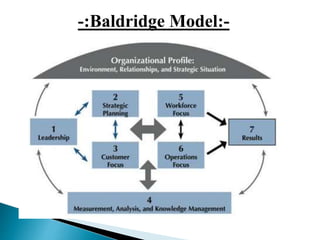
-:Baldridge Model:-
MOTOROLA’S QUALITY
COMMITMENT:-
1. Customer Advocacy: Capturing Your Voice
to Drive Improvement Efforts
• Customer feedback is essential to providing you
with the products, services and solutions depend
on for your mission-critical applications.
• Collected - sales channels, annual customer
surveys, transactional surveys, partner
conferences, call center activity.
• Customer advocacy programs has a direct impact
on our continual improvement efforts.
2. Quantity Management System: Processes that ensure
meet commitments
Our Quality Management approach supports the
commitments make Quality Policy and ensures the
processes in place to support our commitments
3. History of Quality: Our Legacy of Continuous
Improvement
• Motorola developed the Six Sigma quality improvement
process in 1986 which became a global standard across
many industries by providing a common language for
measuring quality.
• Today, Motorola Solutions applies a
Lean Six Sigma methodology in our continuous
improvement efforts.
WHY CUSTOMERS TRUST??
This commitment to quality is supported through our Quality
Management System (QMS) which outlines the policies,
procedures, and processes Motorola have in place to
dynamically improve our business performance.
• Quality Management System is based on the ISO 9000
• Global certification to ISO 9001 is important and supports
the promise of trusted quality and commitment to focus on
what is important
SIX SIGMAAT MOTOROLA:-
Motorola saved $17 Billion from 1986 to 2004, reflecting
hundreds of individual successes in all Motorola business
areas including:
• Sales and Marketing
• Product design
• Manufacturing
• Customer service
• Transactional processes
• Supply chain management
QUALITY POLICY:-
• Motorola Solutions is committed to quality.
• Strive to earn customers trust by consistently
providing dependable products and services
on time delivery, and reliable support for all your
mission and business critical applications.
• Foster a culture of innovation and continual evolvement
to meet customers highest expectations.
• Their reputation and quality heritage represent their
continued commitment to earn people’s trust as a
complete solution provider.
Motorola’s Six steps toward
Excellence
They include:-
• Identify the type of product or service you
provide
• Identify your customers and their requirements
• Determine your needs and suppliers
• Define the process for approaching and doing
work
• Eliminate defect sources and optimize processes
• Continuously improve the Sigma level.
The vision of Performance Excellence is realized
through seven key areas:-
Leadership: A commitment to quality at the top of the organization
is crucial to their success.
Strategic Planning: Quality is a key factor in developing Motorola's
business strategy.
Customer and Market Focus: Their customers and the quality they
demand are at the heart of any strategic plan Motorola develops.
Fact-Based Decisions: Motorola's decision-making processes are
driven by facts that are derived through obtaining and analyzing the
correct information.
Human Resources: Attracting and retaining good
employees and creating a work environment that emphasizes
commitment to customers is vital to maintaining high levels
of quality.
Process Management: Through Six Sigma, they maintain
their focus on continuous improvement of all of their
internal processes.
Business Results: Delivering results benefits Motorola,
their customers and their shareholders.
FURTHER STEPS TOWARDS
MOTOROLA’S QUALITY CONTROL:-
1. Top down commitment and involvement
2. Measurement systems to track progress
3. Tough goal setting
4. Provide the required education
5. Spread the success stories
6. Never lose sight of the customer's priorities
7. Never be satisfied
TQM in Motorola

TQM in Motorola

  • 1.
    Quality Management inMotorola Submitted to:- Dr. V. K. Gupta Submitted By:- Avik Guin (49) Samriddhi Bannerjee (54) Sayak Dutta (57) Suman Dutta (60) Sreya Ghosh (59) Satyajit Chatterjee (55)
  • 2.
    Motorola Solutions isa global company with a history of quality and innovation at its core. Highlights of company footprint include: • Primary R&D in 6 countries • Primary Manufacturing in 3 countries • Employees in 65 countries • Sales in over 100 countries • 1,700 Direct sales representatives • 20,000 Channel partners
  • 3.
    One of manycompanies that apply the principle of TQM in their organizational culture. • Motorola, originator of six sigma • Company is doing it by improving the quality of their products by improving their productivity and overall performance. • Policy-Higher quality in lower cost. • Fundamental objective-customer satisfaction
  • 4.
    QUALITY CONCEPT:- Quality conceptdemonstrated through a three- pronged approach by the Motorola Company: • Quality of Forethought (Pre-Production) • Quality of Workmanship (Production) • Quality of Objective Self-Appraisal (Post- Production)
  • 5.
    CERTIFICATION:- •ISO 9001 certification •Firstcompany -Malcolm Balridge National quality award(1988) •First companies to win the Federal Government's top quality prize •Baldrige National Quality Program 2002
  • 6.
  • 7.
    MOTOROLA’S QUALITY COMMITMENT:- 1. CustomerAdvocacy: Capturing Your Voice to Drive Improvement Efforts • Customer feedback is essential to providing you with the products, services and solutions depend on for your mission-critical applications. • Collected - sales channels, annual customer surveys, transactional surveys, partner conferences, call center activity. • Customer advocacy programs has a direct impact on our continual improvement efforts.
  • 8.
    2. Quantity ManagementSystem: Processes that ensure meet commitments Our Quality Management approach supports the commitments make Quality Policy and ensures the processes in place to support our commitments 3. History of Quality: Our Legacy of Continuous Improvement • Motorola developed the Six Sigma quality improvement process in 1986 which became a global standard across many industries by providing a common language for measuring quality. • Today, Motorola Solutions applies a Lean Six Sigma methodology in our continuous improvement efforts.
  • 9.
    WHY CUSTOMERS TRUST?? Thiscommitment to quality is supported through our Quality Management System (QMS) which outlines the policies, procedures, and processes Motorola have in place to dynamically improve our business performance. • Quality Management System is based on the ISO 9000 • Global certification to ISO 9001 is important and supports the promise of trusted quality and commitment to focus on what is important
  • 10.
    SIX SIGMAAT MOTOROLA:- Motorolasaved $17 Billion from 1986 to 2004, reflecting hundreds of individual successes in all Motorola business areas including: • Sales and Marketing • Product design • Manufacturing • Customer service • Transactional processes • Supply chain management
  • 11.
    QUALITY POLICY:- • MotorolaSolutions is committed to quality. • Strive to earn customers trust by consistently providing dependable products and services on time delivery, and reliable support for all your mission and business critical applications. • Foster a culture of innovation and continual evolvement to meet customers highest expectations. • Their reputation and quality heritage represent their continued commitment to earn people’s trust as a complete solution provider.
  • 12.
    Motorola’s Six stepstoward Excellence They include:- • Identify the type of product or service you provide • Identify your customers and their requirements • Determine your needs and suppliers • Define the process for approaching and doing work • Eliminate defect sources and optimize processes • Continuously improve the Sigma level.
  • 13.
    The vision ofPerformance Excellence is realized through seven key areas:- Leadership: A commitment to quality at the top of the organization is crucial to their success. Strategic Planning: Quality is a key factor in developing Motorola's business strategy. Customer and Market Focus: Their customers and the quality they demand are at the heart of any strategic plan Motorola develops. Fact-Based Decisions: Motorola's decision-making processes are driven by facts that are derived through obtaining and analyzing the correct information.
  • 14.
    Human Resources: Attractingand retaining good employees and creating a work environment that emphasizes commitment to customers is vital to maintaining high levels of quality. Process Management: Through Six Sigma, they maintain their focus on continuous improvement of all of their internal processes. Business Results: Delivering results benefits Motorola, their customers and their shareholders.
  • 15.
    FURTHER STEPS TOWARDS MOTOROLA’SQUALITY CONTROL:- 1. Top down commitment and involvement 2. Measurement systems to track progress 3. Tough goal setting 4. Provide the required education 5. Spread the success stories 6. Never lose sight of the customer's priorities 7. Never be satisfied