Chapter 5

Human Resource Practices


                           1
Human Resource Development And
         Management
The Human Resource Focus Category examines how an
organization motivates and enables employees to develop
and utilize their full potential in alignment with the
organization’s overall objectives and action plans. Also
examined are the organization’s efforts to build and
maintain a work environment and an employee support
climate conducive to performance excellence and to
personal and organizational growth.
    1 Work Systems
    2 Employee Education, Training, and Development
    3 Employee Well-Being and Satisfaction
           a. Work Environment
           b. Employee Support and Satisfaction
                                                  2
Involvement
A Central Idea Of Human Resource Utilization
  • Employee Involvement - any activity by which
    employees participate in work-related decisions
    and improvement activities, with the objectives
    of tapping the creative energies of all employees
    and improving their motivation


                                       3
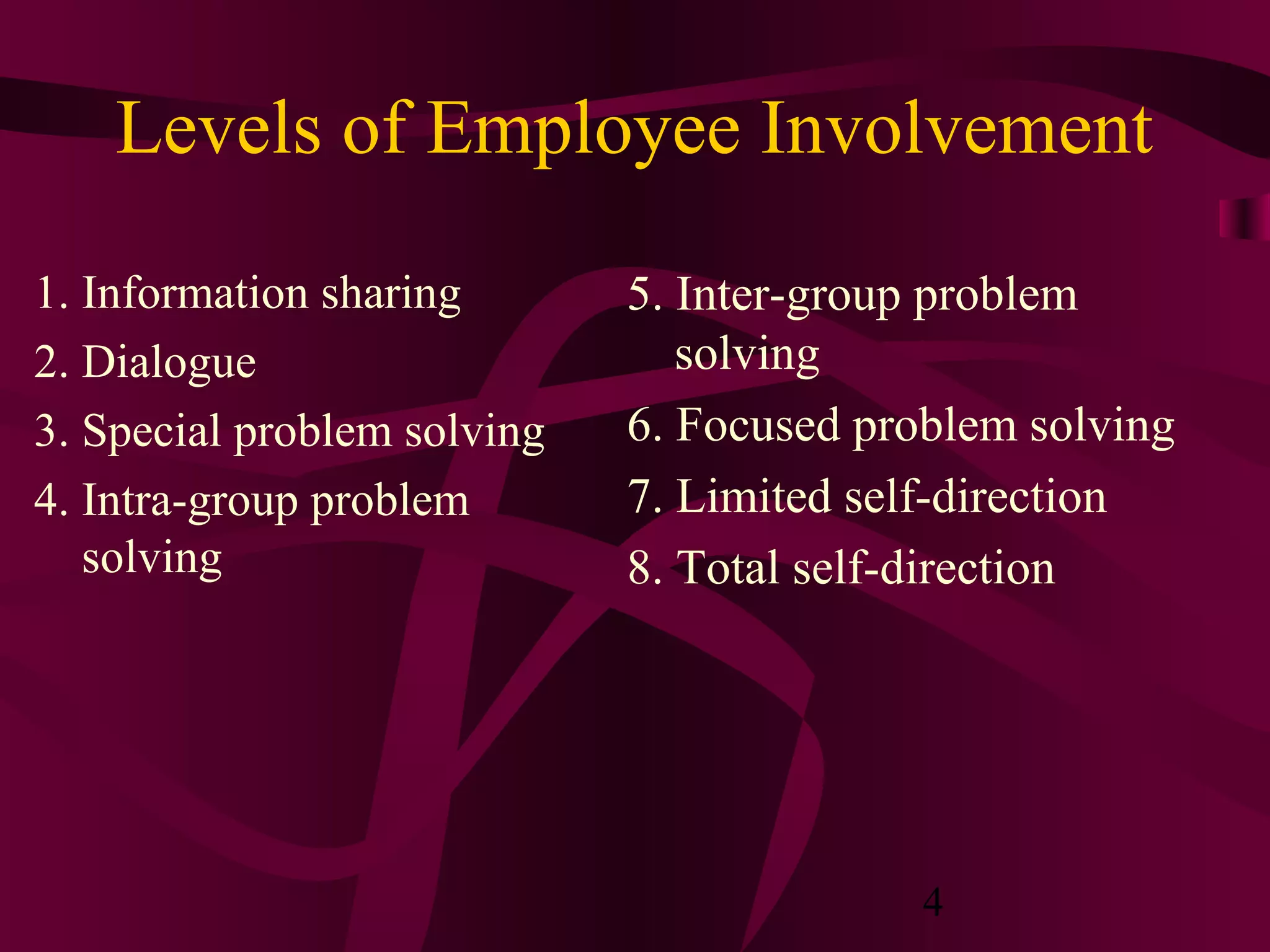
Levels of Employee Involvement

1. Information sharing       5. Inter-group problem
2. Dialogue                     solving
3. Special problem solving   6. Focused problem solving
4. Intra-group problem       7. Limited self-direction
   solving                   8. Total self-direction


                                           4
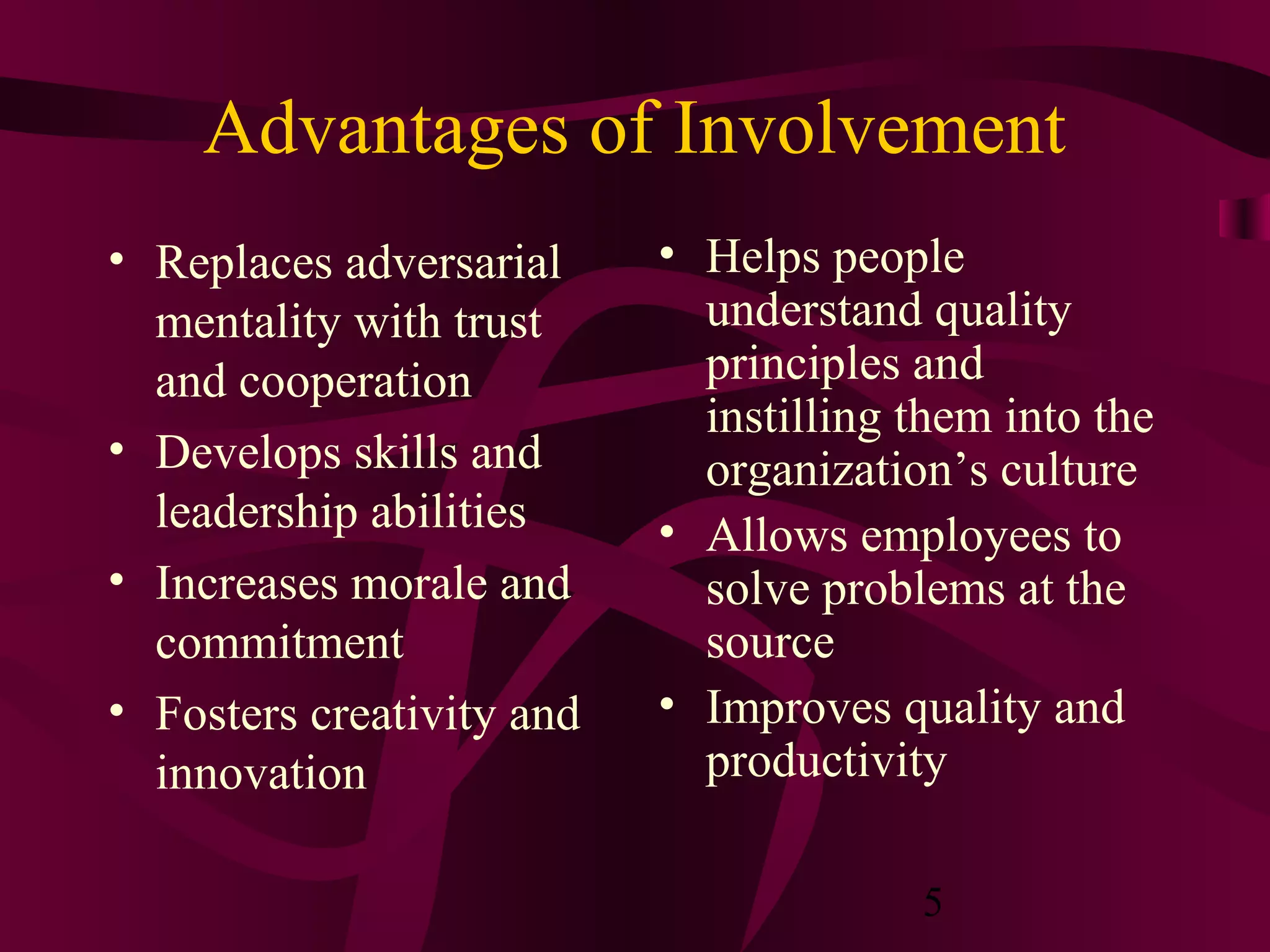
Advantages of Involvement
• Replaces adversarial     • Helps people
  mentality with trust       understand quality
  and cooperation            principles and
                             instilling them into the
• Develops skills and        organization’s culture
  leadership abilities     • Allows employees to
• Increases morale and       solve problems at the
  commitment                 source
• Fosters creativity and   • Improves quality and
  innovation                 productivity

                                        5
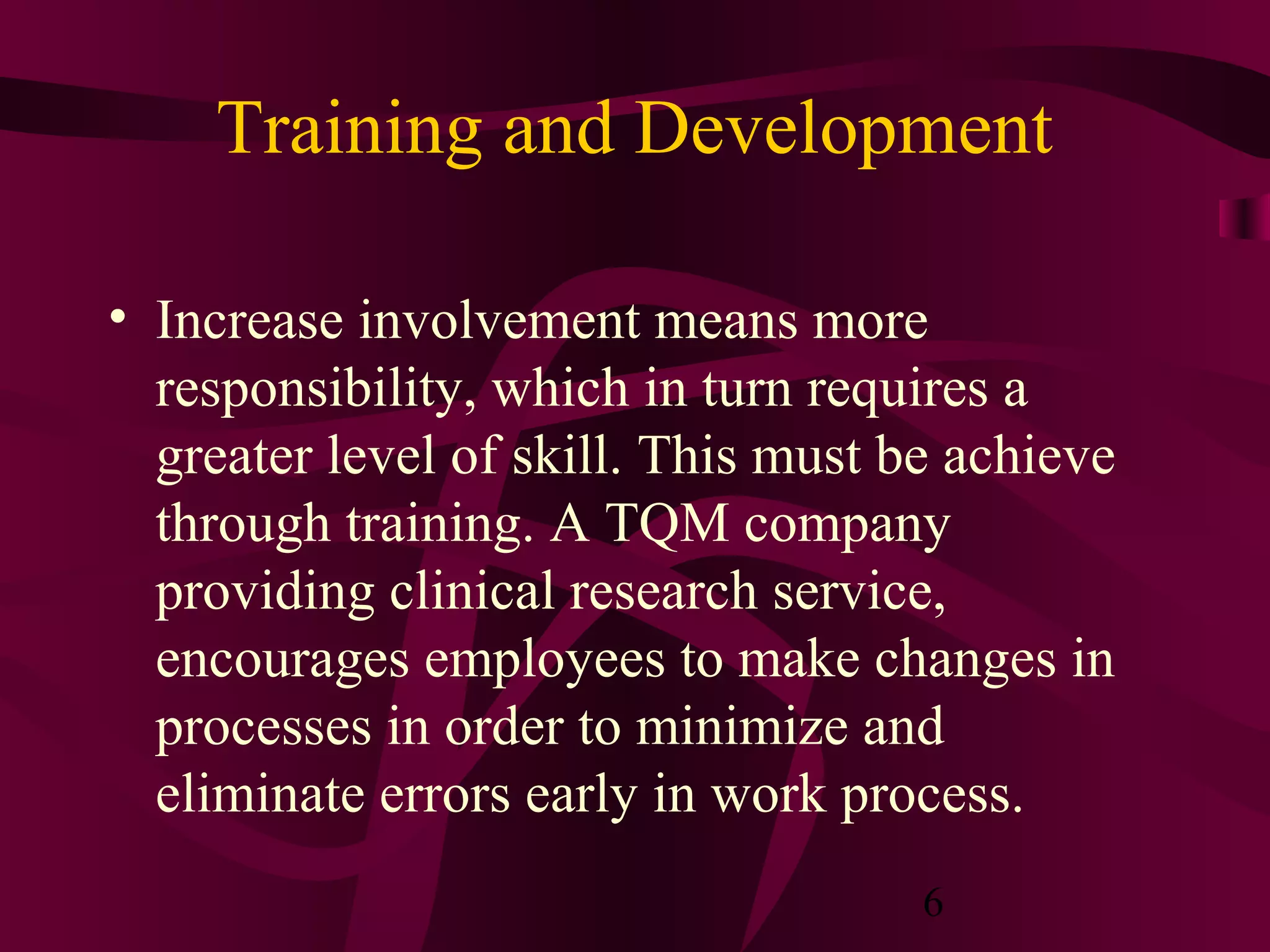
Training and Development

• Increase involvement means more
  responsibility, which in turn requires a
  greater level of skill. This must be achieve
  through training. A TQM company
  providing clinical research service,
  encourages employees to make changes in
  processes in order to minimize and
  eliminate errors early in work process.
                                     6
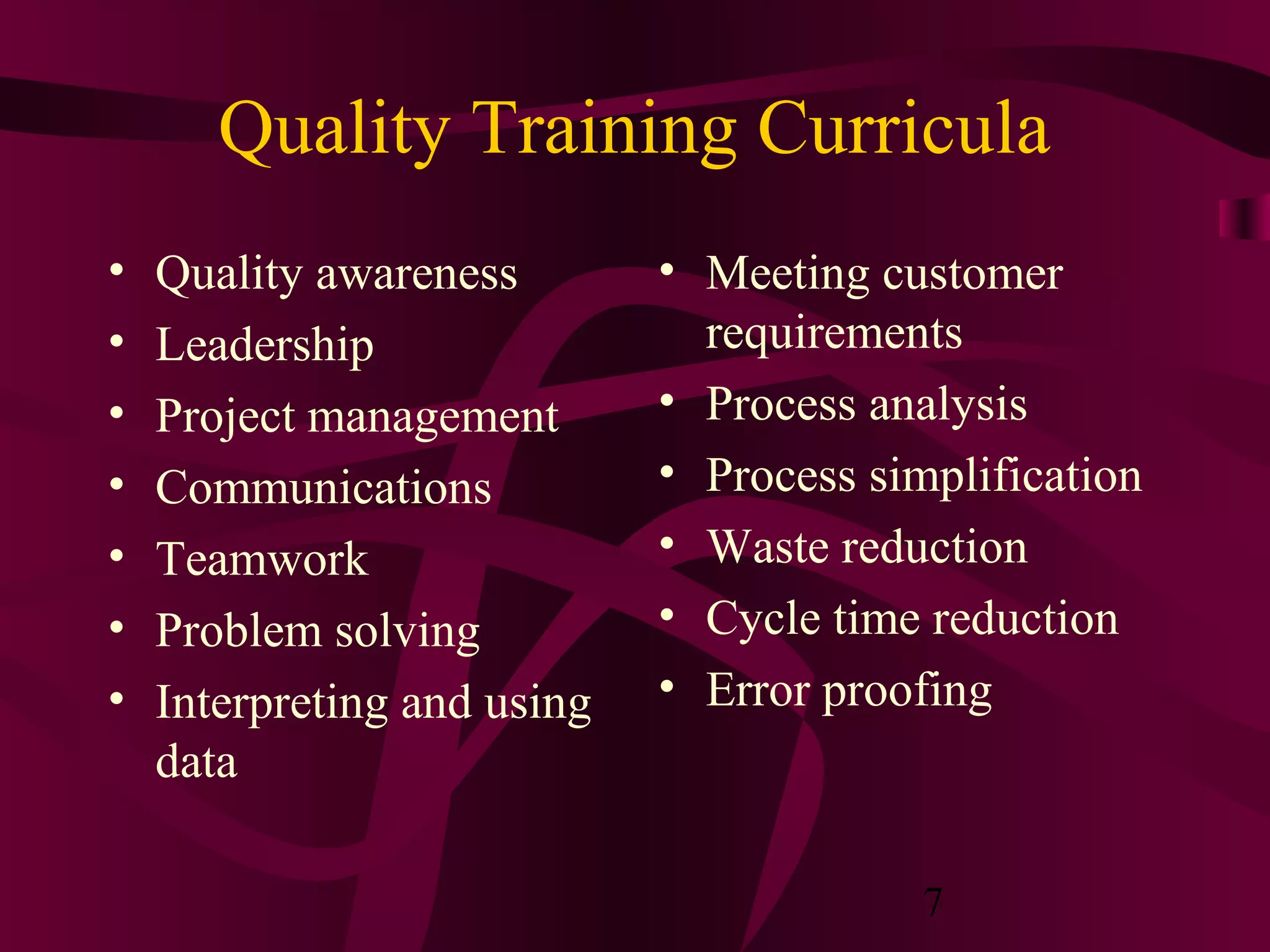
Quality Training Curricula
•   Quality awareness        • Meeting customer
•   Leadership                 requirements
•   Project management       • Process analysis
•   Communications           • Process simplification
•   Teamwork                 • Waste reduction
•   Problem solving          • Cycle time reduction
•   Interpreting and using   • Error proofing
    data

                                          7
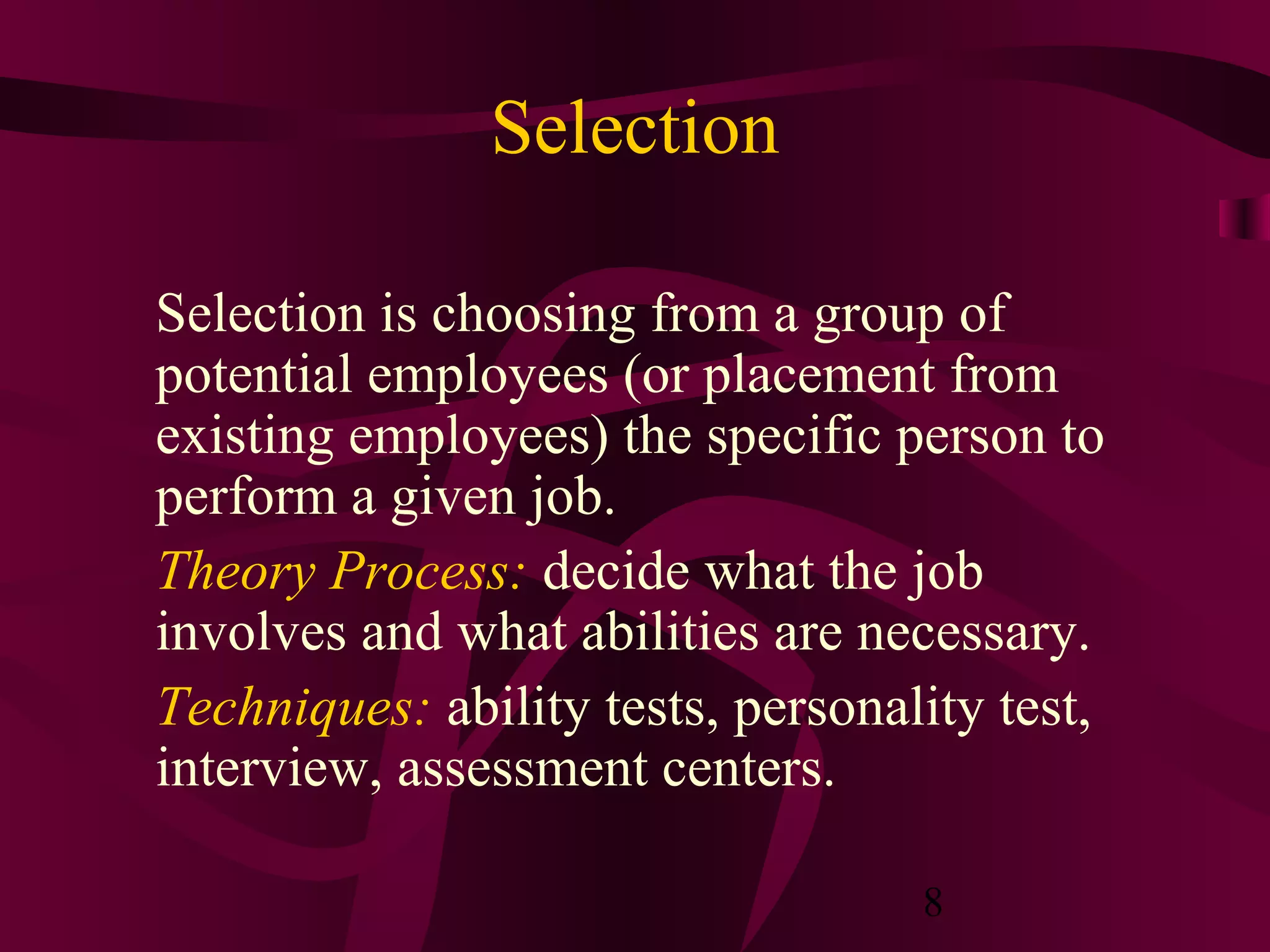
Selection

Selection is choosing from a group of
potential employees (or placement from
existing employees) the specific person to
perform a given job.
Theory Process: decide what the job
involves and what abilities are necessary.
Techniques: ability tests, personality test,
interview, assessment centers.

                                   8
Selection Process in TQM
             Environment
• Determined Job requirement by job analysis
• Identify skill and abilities required
• Compared qualification to job requirement
• Evaluate attitude, values, personality type,
  analytical ability
• Problem-solving ability.
• Pareto analysis
• Performance in quantitative work demand
                                          9
Performance Appraisal
• How you are measured is how you perform!
• Conventional appraisal systems
  – Focus on short-term results and individual
    behavior; fail to deal with uncontrollable
    factors
• New approaches
  – Focus on company goals such as quality and
    behaviors like teamwork
  – 360-degree feedback; mastery descriptions
                                       10
Measuring Employee
  Satisfaction and Effectiveness
• Satisfaction
  – Quality of worklife, teamwork, communications,
    training, leadership, compensation, benefits,
    internal suppliers and customers
• Effectiveness
  – Team and individual behaviors; cost, quality, and
    productivity improvements; employee turnover;
    suggestions; training effectiveness

                                       11
Compensation Systems
• Compensation
  – Merit versus capability/performance
    based plans
  – Gain sharing
• Recognition
  – Monetary or non-monetary
  – Formal or informal
  – Individual or group

                                  12
Individual Or Team Compensation

• Give both individual and team awards
• Involve everyone
• Tie rewards to quality
• Allow peers and customers to nominate and
  recognize superior performance
• Publicize extensively
• Make recognition fun

                                   13
Total Quality Oriented Human
      Resource Management
• Quality work the first time
• Focus on the customer
• Strategic holistic approach to
  improvement
• Continuous improvement as a way of life
• Mutual respect and teamwork

                               14
Many Reason Have Offered As the Cause
 of Poor Performance in Organizations

• System failure            • Lack of necessary
• Misunderstanding of         knowledge or skill
  job expectations          • Lack of appropriate
• Lack of awareness           consequences for
  about performance           performance
• Lake of time, tools, or   • Bad fit for job
  resources to succeed      • Worst compensation
                              system

                                        15

Tqm ch 05

  • 1.
  • 2.
    Human Resource DevelopmentAnd Management The Human Resource Focus Category examines how an organization motivates and enables employees to develop and utilize their full potential in alignment with the organization’s overall objectives and action plans. Also examined are the organization’s efforts to build and maintain a work environment and an employee support climate conducive to performance excellence and to personal and organizational growth. 1 Work Systems 2 Employee Education, Training, and Development 3 Employee Well-Being and Satisfaction a. Work Environment b. Employee Support and Satisfaction 2
  • 3.
    Involvement A Central IdeaOf Human Resource Utilization • Employee Involvement - any activity by which employees participate in work-related decisions and improvement activities, with the objectives of tapping the creative energies of all employees and improving their motivation 3
  • 4.
    Levels of EmployeeInvolvement 1. Information sharing 5. Inter-group problem 2. Dialogue solving 3. Special problem solving 6. Focused problem solving 4. Intra-group problem 7. Limited self-direction solving 8. Total self-direction 4
  • 5.
    Advantages of Involvement •Replaces adversarial • Helps people mentality with trust understand quality and cooperation principles and instilling them into the • Develops skills and organization’s culture leadership abilities • Allows employees to • Increases morale and solve problems at the commitment source • Fosters creativity and • Improves quality and innovation productivity 5
  • 6.
    Training and Development •Increase involvement means more responsibility, which in turn requires a greater level of skill. This must be achieve through training. A TQM company providing clinical research service, encourages employees to make changes in processes in order to minimize and eliminate errors early in work process. 6
  • 7.
    Quality Training Curricula • Quality awareness • Meeting customer • Leadership requirements • Project management • Process analysis • Communications • Process simplification • Teamwork • Waste reduction • Problem solving • Cycle time reduction • Interpreting and using • Error proofing data 7
  • 8.
    Selection Selection is choosingfrom a group of potential employees (or placement from existing employees) the specific person to perform a given job. Theory Process: decide what the job involves and what abilities are necessary. Techniques: ability tests, personality test, interview, assessment centers. 8
  • 9.
    Selection Process inTQM Environment • Determined Job requirement by job analysis • Identify skill and abilities required • Compared qualification to job requirement • Evaluate attitude, values, personality type, analytical ability • Problem-solving ability. • Pareto analysis • Performance in quantitative work demand 9
  • 10.
    Performance Appraisal • Howyou are measured is how you perform! • Conventional appraisal systems – Focus on short-term results and individual behavior; fail to deal with uncontrollable factors • New approaches – Focus on company goals such as quality and behaviors like teamwork – 360-degree feedback; mastery descriptions 10
  • 11.
    Measuring Employee Satisfaction and Effectiveness • Satisfaction – Quality of worklife, teamwork, communications, training, leadership, compensation, benefits, internal suppliers and customers • Effectiveness – Team and individual behaviors; cost, quality, and productivity improvements; employee turnover; suggestions; training effectiveness 11
  • 12.
    Compensation Systems • Compensation – Merit versus capability/performance based plans – Gain sharing • Recognition – Monetary or non-monetary – Formal or informal – Individual or group 12
  • 13.
    Individual Or TeamCompensation • Give both individual and team awards • Involve everyone • Tie rewards to quality • Allow peers and customers to nominate and recognize superior performance • Publicize extensively • Make recognition fun 13
  • 14.
    Total Quality OrientedHuman Resource Management • Quality work the first time • Focus on the customer • Strategic holistic approach to improvement • Continuous improvement as a way of life • Mutual respect and teamwork 14
  • 15.
    Many Reason HaveOffered As the Cause of Poor Performance in Organizations • System failure • Lack of necessary • Misunderstanding of knowledge or skill job expectations • Lack of appropriate • Lack of awareness consequences for about performance performance • Lake of time, tools, or • Bad fit for job resources to succeed • Worst compensation system 15