Introduction
Quality management andpeople
management are intertwined aspects of
organizational success.
People management focuses on the overall
well-being, development, and engagement of
employees, while quality management aims
to consistently deliver products or services
that meet or exceed customer expectations.
Effectively managing people can lead to
improvements in quality, while quality
initiatives can enhance employee
engagement and productivity. .
3.
Introduction
Total Quality Management(TQM), a process
of continuous improvement and innovation
led by top management, is fundamentally
based on the concept that all people
4.
Introduction
At all levels,People should be
Committed
Motivated
Rewarded upon the basis and
equipped to perform
The task of meeting or exceeding
customer expectations.
5.
RelevancePeople
Management in
Quality
Management
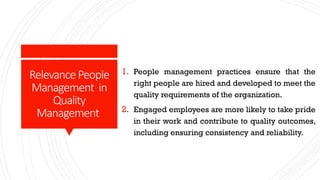
1. Peoplemanagement practices ensure that the
right people are hired and developed to meet the
quality requirements of the organization.
2. Engaged employees are more likely to take pride
in their work and contribute to quality outcomes,
including ensuring consistency and reliability.
6.
RelevancePeople
Management in
Quality
Management
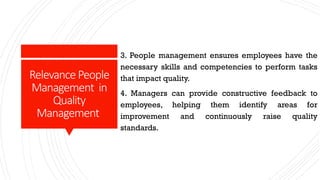
3. Peoplemanagement ensures employees have the
necessary skills and competencies to perform tasks
that impact quality.
4. Managers can provide constructive feedback to
employees, helping them identify areas for
improvement and continuously raise quality
standards.
7.
Relevanceof
Quality
Managementon
People
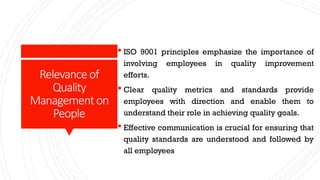
ISO 9001principles emphasize the importance of
involving employees in quality improvement
efforts.
Clear quality metrics and standards provide
employees with direction and enable them to
understand their role in achieving quality goals.
Effective communication is crucial for ensuring that
quality standards are understood and followed by
all employees
8.
TQM vs.
Reward &
Recognition
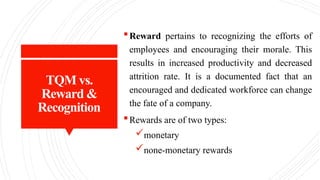
Rewardpertains to recognizing the efforts of
employees and encouraging their morale. This
results in increased productivity and decreased
attrition rate. It is a documented fact that an
encouraged and dedicated workforce can change
the fate of a company.
Rewards are of two types:
monetary
none-monetary rewards
9.
TQM vs
Recognition
Recognitionrefers to the act of acknowledging an
individual or team’s behavior, performance, effort and
accomplishment that support the organizational goals
and values. Recognition encourages employees to
repeat good performances.
Recognition is a form of non-monetary reward. Thus, it
has nothing to do with money.
Types of employee recognition
Top-down
Peer-to-peer
Customer-to-employee
10.
TQM vs
Recognition
TQM demandsreward and recognition
based on the following behaviours
a. Process improvement;
b. Teamwork and collaboration;
c. Problem prevention;
d. Customer satisfaction; and
e. The role of manager as coach or facilitator
11.
OtherStrategiesto
increasePeople
Participationin
QualityManagement
1.People Involvement: Engagingemployees in decision-
making and providing opportunities for growth fosters a sense
of ownership and commitment.
2. Employee Engagement: Creating a positive and
supportive work environment where employees feel valued
and motivated leads to increased productivity and satisfaction.
3. Continuous Learning: Providing opportunities for
employees to develop their skills and knowledge helps them
stay current and contribute effectively.
4. Communication and Collaboration: Open and honest
communication, along with collaboration across teams,
enhances teamwork and problem-solving.
12.
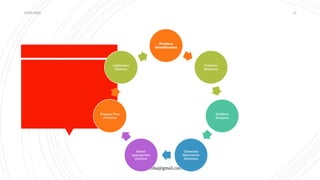
QualityCircles
A Quality Circleis a participation
management technique to manage and
improve the quality of the entire
organization.
Quality circles are a formal,
institutionalized mechanism for productive
and participative problem-solving
interaction among employees
QCs are concerned with encouraging the
employees to participate in continuous
improvement and guide them through.
13.
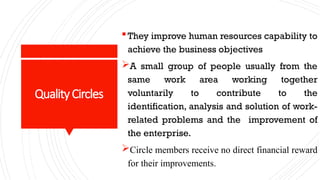
QualityCircles
They improve humanresources capability to
achieve the business objectives
A small group of people usually from the
same work area working together
voluntarily to contribute to the
identification, analysis and solution of work-
related problems and the improvement of
the enterprise.
Circle members receive no direct financial reward
for their improvements.
14.
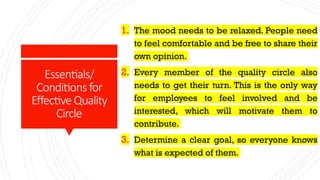
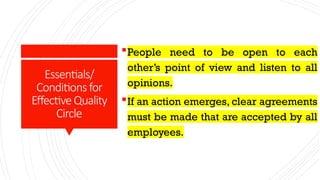
Essentials/
Conditionsfor
EffectiveQuality
Circle
1. The moodneeds to be relaxed. People need
to feel comfortable and be free to share their
own opinion.
2. Every member of the quality circle also
needs to get their turn. This is the only way
for employees to feel involved and be
interested, which will motivate them to
contribute.
3. Determine a clear goal, so everyone knows
what is expected of them.
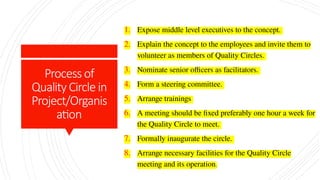
Process of
Quality Circlein
Project/Organis
ation
1.Expose middle level executives to the concept.
2. Explain the concept to the employees and invite them to
volunteer as members of Quality Circles.
3. Nominate senior officers as facilitators.
4. Form a steering committee.
5. Arrange trainings
6. A meeting should be fixed preferably one hour a week for
the Quality Circle to meet.
7. Formally inaugurate the circle.
8. Arrange necessary facilities for the Quality Circle
meeting and its operation.