+
Academic discussion 3
Introducing TPCK
Matthew j. Koehler and Punya Mishra
A presentation by Karen Inwood and Tara Manning.
+
Introduction
This presentation explores the
work of Koehler, M. & Mishra, P.
(2008). Introducing TPCK. In
AACTE Committee on Innovation
& Technology (Ed), Handbook of
technological pedagogical content
knowledge for educators (pp. 3-
29). New York: Routledge.
+ As educators of 21st century learners we have access
to new tools, but the challenge is to find the clever
uses.
 http://youtu.be/8wrFfsxonTE
 But some things are not replaceable. This may be a ‘funny’ take
on technology but these are just tools, they are still not
changing the integration of technology they are just making
accessing the information somewhat easier – which is a
modern convenience that we like to have in the classroom. This
contributes to the wicked problem which we will explore
through this presentation.
+
Article key points
 TPCK is a framework for the teacher to aid in technology
integration and to make this process beneficial for the teacher and
learner.
 TPCK, an understanding that emerges from an interaction of
content, pedagogy and technology knowledge which is vital for
effective teaching with technology.
 The teacher is valued and a key component to curriculum design.
Teachers are in control of the change.
 Teaching is an ill-structured complex domain, so it is a “wicked
problem”; incomplete, contradictory with ongoing changing
requirements and therefore we need frameworks to assist in
curriculum design.
+
Essential concepts leading to TPCK
 We argue that the complexity of developing and applying TPCK
suggests that a greater emphasis should be placed on the idea
of teachers as “Curriculum designers (p. 3).
 Teachers practice in a highly complex dynamic environment
that asks them to integrate knowledge of subject thinking and
learning, knowledge of the subject matter, and increasingly
knowledge of technology (p. 4).
 Thus, creative uses of technology require us to go beyond this
“functional fixedness” so that we can innovatively repurpose
existing tools toward pedagogical ends (p. 6).
+
Teaching with technology as a “wicked
problem” (Rittel & Webber, 1973)
 The wicked problems of technology integration require us to
develop new ways of confronting this complexity. We argue that
at the heart of good teaching with technology there are three
core components: content, pedagogy, and technology and the
relationships between them (p. 12).
 The TPCK framework builds on Shulman’s (1987, 1986)
descriptions of pedagogical content knowledge to describe how
teachers’ understanding of technologies and pedagogical
content knowledge interacts with one another to produce
effective teaching with technology (p. 12).
+
The role of Technology in Teaching
 The instability of digital technologies is manifest in two ways.
First, the knowledge required to learn to use digital technology is
never fixed. Technology changes quickly, causing hardware and
software applications to become out-dated every few years (p. 8).
 SEP – is often the attitude teachers can take to technology – it is
Someone else’s Problem – this has developed partly in the
environment that we work and the attitude that “teachers and
instructor’s, who are in charge of technology and technologists
who are in charge of the technology (p. 9).
 It is not easy for the teacher to navigate between the 2 worlds.
 Just remember there is NO perfect solution to the problem of
integrating technology into the curriculum (p. 10).
+
Technology Knowledge (TK)
 FITness therefore requires a deeper, more essential
understanding and mastery of information technology for
information processing, communication, and problem-solving
than does the traditional definition of computer literacy (p.15).
+
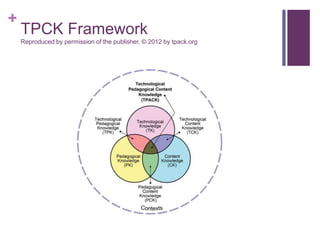
TPCK Framework
Reproduced by permission of the publisher, © 2012 by tpack.org
+
TPCK framework
 3 primary forms of knowledge: Content, pedagogy and
technology.
 These 3 forms are not seen in isolation but are in the TPCK
framework, with a second order of knowledge that lies at the
intersections between them.
 The centre is a third order of knowledge- TPCK
 Thus- 4 more knowledge bases are applicable to teaching
technology in different contexts.
 7 forms of knowledge and context- - - - circle.
+
TPCK
 TPCK is an emergent form of knowledge that goes beyond all
three components (p. 17).
 INTERACTION – is the KEY word
 TPCK requires an understanding of the representation of
concepts using technology- Pedagogical techniques that uses
technology in ways to teach knowledge.
 However, the act of seeing technology, pedagogy and content
as three knowledge bases is not straightforward (p. 18).
+
An overview for the Visual Learner
 https://www.youtube.com/watch?v=I2sD3K3daq8
+
Dynamic teaching using TPCK as a
framework
 At times we do need to find the perfect technology for our
students in our content area that has a pedagogy and planning
for it’s use within given social context for student and teacher to
develop knowledge construction.
 The TPCK framework offers insight, we hope, into how the
myriad complexities and tensions of teaching and learning can
be bought together to mutually develop teachers’ and students
knowledge (p. 24).
+
Summary
 TPCK is a framework for teachers to become designers and
create learning programs that integrate Content, Pedagogy and
Technology for 21st Century learners.
 The TPCK framework offers insight, we hope, into how the
myriad of complexities and tensions of teaching and learning
can be brought together to mutually develop teachers’ and
students’ knowledge (p. 24).
+
Discussion questions
 Where is TPCK reflected in our school-wide pedagogy (SOAR) Can you make
suggestions as to how we can improve the integration of technology in our
school-wide pedagogy?
 What is the role of collaboration within the whole school? Who [ICT experts,
leadership, teachers, professional development presenters]need to collaborate
in terms of the TPCK framework to be successful.
 Think of a time that you have used technology in the classroom and give a brief
explanation as to why and how this was incorporating the TPCK model.
 Is there a place for teaching technology separately? The authors suggest we
need the intersection of the 3 areas of knowledge but is this making the role of
the teacher too complex and should we teach technology skills separately?

TPCK Karen and Tara

  • 1.
    + Academic discussion 3 IntroducingTPCK Matthew j. Koehler and Punya Mishra A presentation by Karen Inwood and Tara Manning.
  • 2.
    + Introduction This presentation exploresthe work of Koehler, M. & Mishra, P. (2008). Introducing TPCK. In AACTE Committee on Innovation & Technology (Ed), Handbook of technological pedagogical content knowledge for educators (pp. 3- 29). New York: Routledge.
  • 3.
    + As educatorsof 21st century learners we have access to new tools, but the challenge is to find the clever uses.  http://youtu.be/8wrFfsxonTE  But some things are not replaceable. This may be a ‘funny’ take on technology but these are just tools, they are still not changing the integration of technology they are just making accessing the information somewhat easier – which is a modern convenience that we like to have in the classroom. This contributes to the wicked problem which we will explore through this presentation.
  • 4.
    + Article key points TPCK is a framework for the teacher to aid in technology integration and to make this process beneficial for the teacher and learner.  TPCK, an understanding that emerges from an interaction of content, pedagogy and technology knowledge which is vital for effective teaching with technology.  The teacher is valued and a key component to curriculum design. Teachers are in control of the change.  Teaching is an ill-structured complex domain, so it is a “wicked problem”; incomplete, contradictory with ongoing changing requirements and therefore we need frameworks to assist in curriculum design.
  • 5.
    + Essential concepts leadingto TPCK  We argue that the complexity of developing and applying TPCK suggests that a greater emphasis should be placed on the idea of teachers as “Curriculum designers (p. 3).  Teachers practice in a highly complex dynamic environment that asks them to integrate knowledge of subject thinking and learning, knowledge of the subject matter, and increasingly knowledge of technology (p. 4).  Thus, creative uses of technology require us to go beyond this “functional fixedness” so that we can innovatively repurpose existing tools toward pedagogical ends (p. 6).
  • 6.
    + Teaching with technologyas a “wicked problem” (Rittel & Webber, 1973)  The wicked problems of technology integration require us to develop new ways of confronting this complexity. We argue that at the heart of good teaching with technology there are three core components: content, pedagogy, and technology and the relationships between them (p. 12).  The TPCK framework builds on Shulman’s (1987, 1986) descriptions of pedagogical content knowledge to describe how teachers’ understanding of technologies and pedagogical content knowledge interacts with one another to produce effective teaching with technology (p. 12).
  • 7.
    + The role ofTechnology in Teaching  The instability of digital technologies is manifest in two ways. First, the knowledge required to learn to use digital technology is never fixed. Technology changes quickly, causing hardware and software applications to become out-dated every few years (p. 8).  SEP – is often the attitude teachers can take to technology – it is Someone else’s Problem – this has developed partly in the environment that we work and the attitude that “teachers and instructor’s, who are in charge of technology and technologists who are in charge of the technology (p. 9).  It is not easy for the teacher to navigate between the 2 worlds.  Just remember there is NO perfect solution to the problem of integrating technology into the curriculum (p. 10).
  • 8.
    + Technology Knowledge (TK) FITness therefore requires a deeper, more essential understanding and mastery of information technology for information processing, communication, and problem-solving than does the traditional definition of computer literacy (p.15).
  • 9.
    + TPCK Framework Reproduced bypermission of the publisher, © 2012 by tpack.org
  • 10.
    + TPCK framework  3primary forms of knowledge: Content, pedagogy and technology.  These 3 forms are not seen in isolation but are in the TPCK framework, with a second order of knowledge that lies at the intersections between them.  The centre is a third order of knowledge- TPCK  Thus- 4 more knowledge bases are applicable to teaching technology in different contexts.  7 forms of knowledge and context- - - - circle.
  • 11.
    + TPCK  TPCK isan emergent form of knowledge that goes beyond all three components (p. 17).  INTERACTION – is the KEY word  TPCK requires an understanding of the representation of concepts using technology- Pedagogical techniques that uses technology in ways to teach knowledge.  However, the act of seeing technology, pedagogy and content as three knowledge bases is not straightforward (p. 18).
  • 12.
    + An overview forthe Visual Learner  https://www.youtube.com/watch?v=I2sD3K3daq8
  • 13.
    + Dynamic teaching usingTPCK as a framework  At times we do need to find the perfect technology for our students in our content area that has a pedagogy and planning for it’s use within given social context for student and teacher to develop knowledge construction.  The TPCK framework offers insight, we hope, into how the myriad complexities and tensions of teaching and learning can be bought together to mutually develop teachers’ and students knowledge (p. 24).
  • 14.
    + Summary  TPCK isa framework for teachers to become designers and create learning programs that integrate Content, Pedagogy and Technology for 21st Century learners.  The TPCK framework offers insight, we hope, into how the myriad of complexities and tensions of teaching and learning can be brought together to mutually develop teachers’ and students’ knowledge (p. 24).
  • 15.
    + Discussion questions  Whereis TPCK reflected in our school-wide pedagogy (SOAR) Can you make suggestions as to how we can improve the integration of technology in our school-wide pedagogy?  What is the role of collaboration within the whole school? Who [ICT experts, leadership, teachers, professional development presenters]need to collaborate in terms of the TPCK framework to be successful.  Think of a time that you have used technology in the classroom and give a brief explanation as to why and how this was incorporating the TPCK model.  Is there a place for teaching technology separately? The authors suggest we need the intersection of the 3 areas of knowledge but is this making the role of the teacher too complex and should we teach technology skills separately?

Editor's Notes

  • #3 KAREN ----- Meeting Notes (10/08/14 13:20) ----- Assumed knowledge
  • #4 TARA
  • #5 KAREN
  • #6 TARA
  • #7 KAREN ----- Meeting Notes (10/08/14 14:02) ----- Tech is seen as a problem sloving goal but intergrating tech is complex and ill-structured with multiple factors and and no real rules. Now we need to grapple with tech, how to teach it, best practice, know a range of tools and how to apply these to produce successful teaching with tech. A wicked problem! ----- Meeting Notes (10/08/14 14:12) ----- Wicked problems occur in a social setting; different goals, objectives, beliefs. ----- Meeting Notes (10/08/14 14:15) ----- TPCK may assist us in terms of teaching with technology.
  • #8 TARA
  • #9 KAREN-Technology is the new circle- we know content and pedagogy and this is the one we grapple with and need to be `fitter’ with.
  • #10 TARA/KAREN
  • #11 KAREN
  • #12 TARA
  • #13 TPCK Framework in 2 minutes Start at 27 sec’s
  • #14 TARA- When we get to the SECOND POINT STOP and we give examples of our own teaching as to the successful interaction of the tools – for Tara imovie and Time Toast and Karen google docs site and short article [Brecht’s Epic Theatre conventions] on Office 365- students read and add a point- discussed next lesson- shared understanding and knowledge construction through use of technology. KAREN second point
  • #15 KAREN- first point TARA- second
  • #16 KAREN- Chocolates TARA- Google doc’s