LEGO Group – Building Strategy
ISS 509E Marketing Management – 05.11.13
Fatih Coban, Yusuf Oktay, Vanessa Schuller,
Jasper Schwenzow
Structure
1. Lego – The Company
2. SWOT Analysis
3. Strategy Analysis
4. Recommendations
5. Lego – Now
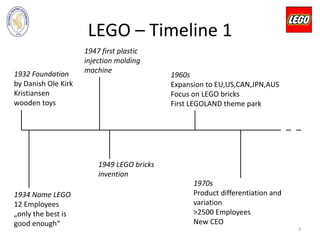
LEGO – Timeline 1
1932 Foundation
by Danish Ole Kirk
Kristiansen
wooden toys
1934 Name LEGO
12 Employees
„only the best is
good enough“
1947 first plastic
injection molding
machine
1949 LEGO bricks
invention
1960s
Expansion to EU,US,CAN,JPN,AUS
Focus on LEGO bricks
First LEGOLAND theme park
1970s
Product differentiation and
variation
>2500 Employees
New CEO
3
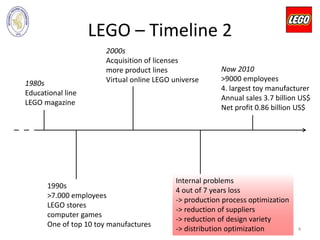
LEGO – Timeline 2
1980s
Educational line
LEGO magazine
1990s
>7.000 employees
LEGO stores
computer games
One of top 10 toy manufactures
2000s
Acquisition of licenses
more product lines
Virtual online LEGO universe
Now 2010
>9000 employees
4. largest toy manufacturer
Annual sales 3.7 billion US$
Net profit 0.86 billion US$
Internal problems
4 out of 7 years loss
-> production process optimization
-> reduction of suppliers
-> reduction of design variety
-> distribution optimization 4
SWOT – Internal
Complex structure
Patents lose value
Compatible competition's building sets
Reduced product design possibilities
Broad differentiation & new computer games
Strong brand image & media presence worldwide
Several branches & touching points
Improved company‘s structure
Products fun & valuable
High quality products
Improving key figures
5
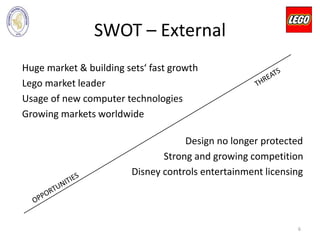
SWOT – External
Huge market & building sets‘ fast growth
Lego market leader
Usage of new computer technologies
Growing markets worldwide
Design no longer protected
Strong and growing competition
Disney controls entertainment licensing
6
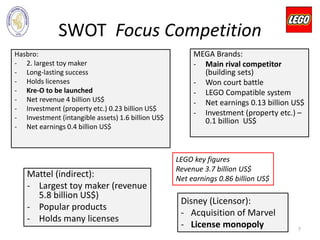
SWOT Focus Competition
Hasbro:
- 2. largest toy maker
- Long-lasting success
- Holds licenses
- Kre-O to be launched
- Net revenue 4 billion US$
- Investment (property etc.) 0.23 billion US$
- Investment (intangible assets) 1.6 billion US$
- Net earnings 0.4 billion US$
MEGA Brands:
- Main rival competitor
(building sets)
- Won court battle
- LEGO Compatible system
- Net earnings 0.13 billion US$
- Investment (property etc.) –
0.1 billion US$
Mattel (indirect):
- Largest toy maker (revenue
5.8 billion US$)
- Popular products
- Holds many licenses
Disney (Licensor):
- Acquisition of Marvel
- License monopoly
LEGO key figures
Revenue 3.7 billion US$
Net earnings 0.86 billion US$
7
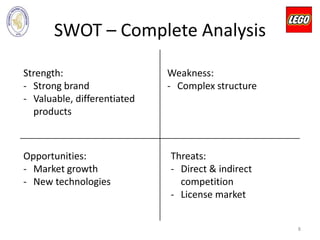
SWOT – Complete Analysis
Strength:
- Strong brand
- Valuable, differentiated
products
Weakness:
- Complex structure
Threats:
- Direct & indirect
competition
- License market
Opportunities:
- Market growth
- New technologies
8
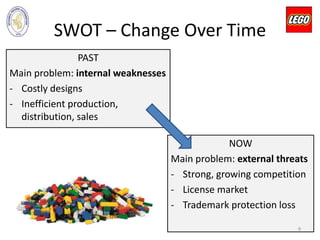
SWOT – Change Over Time
NOW
Main problem: external threats
- Strong, growing competition
- License market
- Trademark protection loss
PAST
Main problem: internal weaknesses
- Costly designs
- Inefficient production,
distribution, sales
9
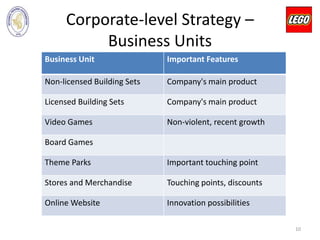
Corporate-level Strategy –
Business Units
Business Unit Important Features
Non-licensed Building Sets Company's main product
Licensed Building Sets Company's main product
Video Games Non-violent, recent growth
Board Games
Theme Parks Important touching point
Stores and Merchandise Touching points, discounts
Online Website Innovation possibilities
10
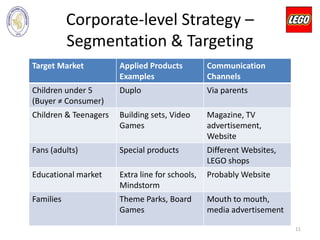
Corporate-level Strategy –
Segmentation & Targeting
Target Market Applied Products
Examples
Communication
Channels
Children under 5
(Buyer ≠ Consumer)
Duplo Via parents
Children & Teenagers Building sets, Video
Games
Magazine, TV
advertisement,
Website
Fans (adults) Special products Different Websites,
LEGO shops
Educational market Extra line for schools,
Mindstorm
Probably Website
Families Theme Parks, Board
Games
Mouth to mouth,
media advertisement
11
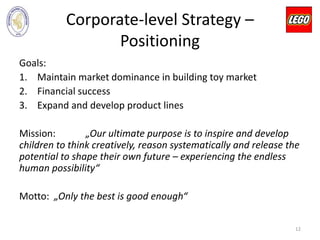
Corporate-level Strategy –
Positioning
Goals:
1. Maintain market dominance in building toy market
2. Financial success
3. Expand and develop product lines
Mission: „Our ultimate purpose is to inspire and develop
children to think creatively, reason systematically and release the
potential to shape their own future – experiencing the endless
human possibility“
Motto: „Only the best is good enough“
12
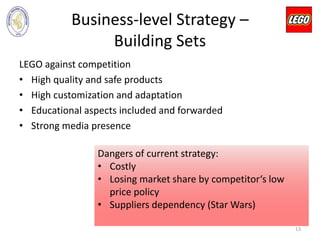
Business-level Strategy –
Building Sets
LEGO against competition
• High quality and safe products
• High customization and adaptation
• Educational aspects included and forwarded
• Strong media presence
Dangers of current strategy:
• Costly
• Losing market share by competitor‘s low
price policy
• Suppliers dependency (Star Wars)
13
Recommendations 1
Problem: License monopoly
Idea: LEGO Toy producer  LEGO Entertainment producer
Strategic implementation:
• Developing own stories
• Promotion via movies, magazines, internet
 finding partners (e.g. Google)
• Adaptation of Merchandising
14
Recommendations 2
Problem: Competitor‘s building sets are compatible
Idea: Enhancing community / network effect
Strategic implementation:
• Stronger dependency between business units
 discounts in Theme Parks
 codes in building sets for website offers
 segmentation of communities
 further supporting community events
15
Recommendations 3
Further recommendations to maintain LEGO‘s
leading status
• Acquisitions of smaller toy producers
• Keep prices steady, just careful discounts on
special occasions
• Enhance position in developing markets (Asia)
 if needed adapt products
16
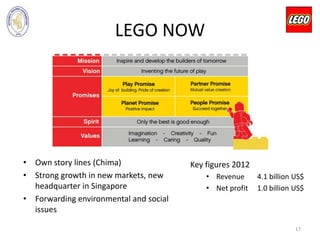
LEGO NOW
• Own story lines (Chima)
• Strong growth in new markets, new
headquarter in Singapore
• Forwarding environmental and social
issues
Key figures 2012
• Revenue 4.1 billion US$
• Net profit 1.0 billion US$
17
Thank You For Your Attention!
18
Sources
• Case Data
• Internet sources
• http://www.shareholder.com/visitors/DynamicDoc/document.cfm?Do
cumentID=2935&CompanyID=HAS&zid=4d6301e3 (28.10.13)
• http://www.megabrands.com/sites/all/files/media/pdf/corpo/en/repo
rts/Financial_Statements_2010-2009.pdf (28.10.13)
• http://aboutus.lego.com/de-de/lego-group/annual-report (28.10.13)
• http://aboutus.lego.com/de-de/sustainability/our-approach (28.10.13)
19

Lego Case Study - The Great Turnaround

  • 1.
    LEGO Group –Building Strategy ISS 509E Marketing Management – 05.11.13 Fatih Coban, Yusuf Oktay, Vanessa Schuller, Jasper Schwenzow
  • 2.
    Structure 1. Lego –The Company 2. SWOT Analysis 3. Strategy Analysis 4. Recommendations 5. Lego – Now
  • 3.
    LEGO – Timeline1 1932 Foundation by Danish Ole Kirk Kristiansen wooden toys 1934 Name LEGO 12 Employees „only the best is good enough“ 1947 first plastic injection molding machine 1949 LEGO bricks invention 1960s Expansion to EU,US,CAN,JPN,AUS Focus on LEGO bricks First LEGOLAND theme park 1970s Product differentiation and variation >2500 Employees New CEO 3
  • 4.
    LEGO – Timeline2 1980s Educational line LEGO magazine 1990s >7.000 employees LEGO stores computer games One of top 10 toy manufactures 2000s Acquisition of licenses more product lines Virtual online LEGO universe Now 2010 >9000 employees 4. largest toy manufacturer Annual sales 3.7 billion US$ Net profit 0.86 billion US$ Internal problems 4 out of 7 years loss -> production process optimization -> reduction of suppliers -> reduction of design variety -> distribution optimization 4
  • 5.
    SWOT – Internal Complexstructure Patents lose value Compatible competition's building sets Reduced product design possibilities Broad differentiation & new computer games Strong brand image & media presence worldwide Several branches & touching points Improved company‘s structure Products fun & valuable High quality products Improving key figures 5
  • 6.
    SWOT – External Hugemarket & building sets‘ fast growth Lego market leader Usage of new computer technologies Growing markets worldwide Design no longer protected Strong and growing competition Disney controls entertainment licensing 6
  • 7.
    SWOT Focus Competition Hasbro: -2. largest toy maker - Long-lasting success - Holds licenses - Kre-O to be launched - Net revenue 4 billion US$ - Investment (property etc.) 0.23 billion US$ - Investment (intangible assets) 1.6 billion US$ - Net earnings 0.4 billion US$ MEGA Brands: - Main rival competitor (building sets) - Won court battle - LEGO Compatible system - Net earnings 0.13 billion US$ - Investment (property etc.) – 0.1 billion US$ Mattel (indirect): - Largest toy maker (revenue 5.8 billion US$) - Popular products - Holds many licenses Disney (Licensor): - Acquisition of Marvel - License monopoly LEGO key figures Revenue 3.7 billion US$ Net earnings 0.86 billion US$ 7
  • 8.
    SWOT – CompleteAnalysis Strength: - Strong brand - Valuable, differentiated products Weakness: - Complex structure Threats: - Direct & indirect competition - License market Opportunities: - Market growth - New technologies 8
  • 9.
    SWOT – ChangeOver Time NOW Main problem: external threats - Strong, growing competition - License market - Trademark protection loss PAST Main problem: internal weaknesses - Costly designs - Inefficient production, distribution, sales 9
  • 10.
    Corporate-level Strategy – BusinessUnits Business Unit Important Features Non-licensed Building Sets Company's main product Licensed Building Sets Company's main product Video Games Non-violent, recent growth Board Games Theme Parks Important touching point Stores and Merchandise Touching points, discounts Online Website Innovation possibilities 10
  • 11.
    Corporate-level Strategy – Segmentation& Targeting Target Market Applied Products Examples Communication Channels Children under 5 (Buyer ≠ Consumer) Duplo Via parents Children & Teenagers Building sets, Video Games Magazine, TV advertisement, Website Fans (adults) Special products Different Websites, LEGO shops Educational market Extra line for schools, Mindstorm Probably Website Families Theme Parks, Board Games Mouth to mouth, media advertisement 11
  • 12.
    Corporate-level Strategy – Positioning Goals: 1.Maintain market dominance in building toy market 2. Financial success 3. Expand and develop product lines Mission: „Our ultimate purpose is to inspire and develop children to think creatively, reason systematically and release the potential to shape their own future – experiencing the endless human possibility“ Motto: „Only the best is good enough“ 12
  • 13.
    Business-level Strategy – BuildingSets LEGO against competition • High quality and safe products • High customization and adaptation • Educational aspects included and forwarded • Strong media presence Dangers of current strategy: • Costly • Losing market share by competitor‘s low price policy • Suppliers dependency (Star Wars) 13
  • 14.
    Recommendations 1 Problem: Licensemonopoly Idea: LEGO Toy producer  LEGO Entertainment producer Strategic implementation: • Developing own stories • Promotion via movies, magazines, internet  finding partners (e.g. Google) • Adaptation of Merchandising 14
  • 15.
    Recommendations 2 Problem: Competitor‘sbuilding sets are compatible Idea: Enhancing community / network effect Strategic implementation: • Stronger dependency between business units  discounts in Theme Parks  codes in building sets for website offers  segmentation of communities  further supporting community events 15
  • 16.
    Recommendations 3 Further recommendationsto maintain LEGO‘s leading status • Acquisitions of smaller toy producers • Keep prices steady, just careful discounts on special occasions • Enhance position in developing markets (Asia)  if needed adapt products 16
  • 17.
    LEGO NOW • Ownstory lines (Chima) • Strong growth in new markets, new headquarter in Singapore • Forwarding environmental and social issues Key figures 2012 • Revenue 4.1 billion US$ • Net profit 1.0 billion US$ 17
  • 18.
    Thank You ForYour Attention! 18
  • 19.
    Sources • Case Data •Internet sources • http://www.shareholder.com/visitors/DynamicDoc/document.cfm?Do cumentID=2935&CompanyID=HAS&zid=4d6301e3 (28.10.13) • http://www.megabrands.com/sites/all/files/media/pdf/corpo/en/repo rts/Financial_Statements_2010-2009.pdf (28.10.13) • http://aboutus.lego.com/de-de/lego-group/annual-report (28.10.13) • http://aboutus.lego.com/de-de/sustainability/our-approach (28.10.13) 19