Valuation of the Super Project


Group Members:
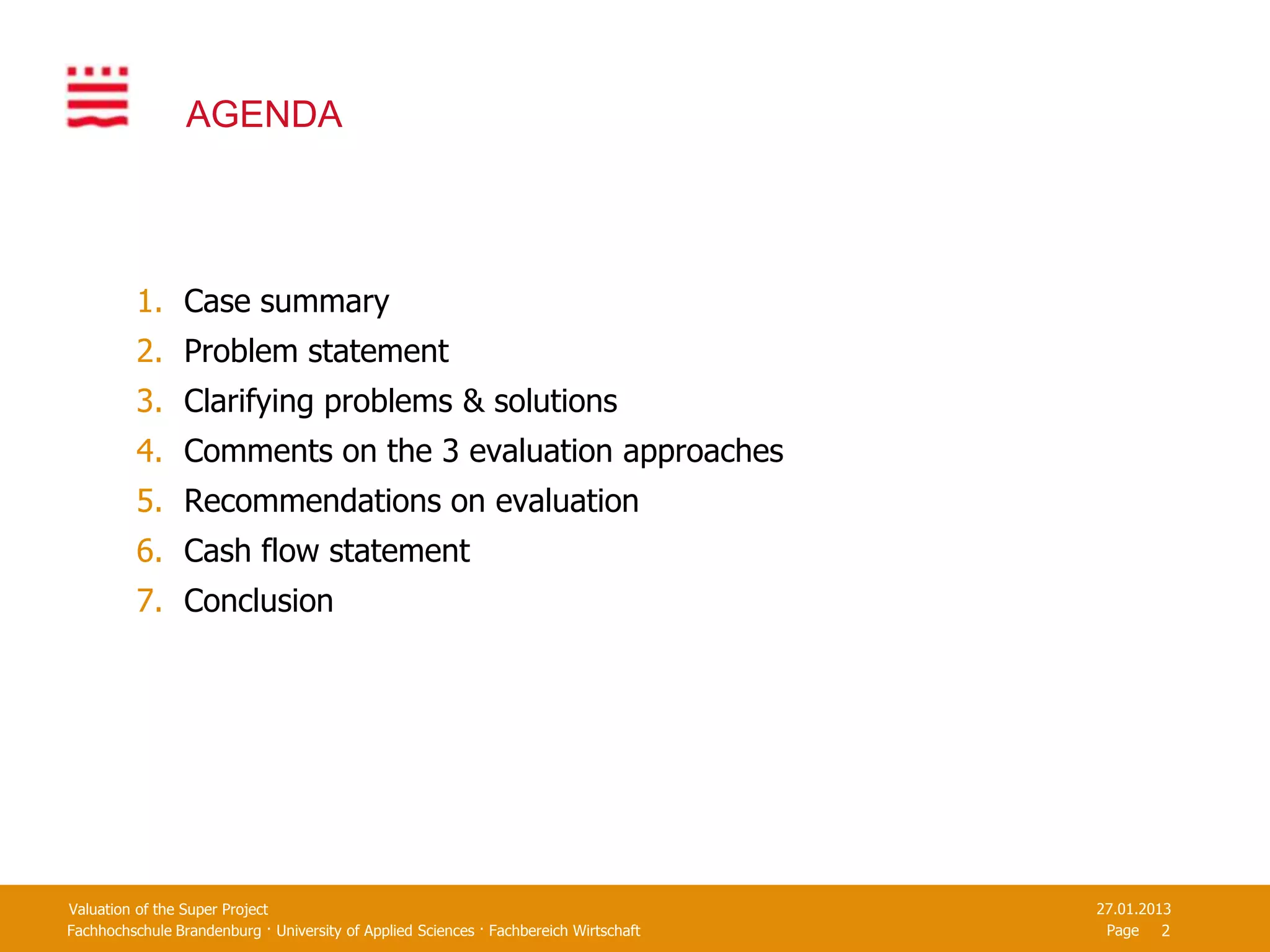
XXX XXXXX
XXX XXXXX
Gordon Schwabe
XXX XXXXX                                27.01.2013
AGENDA


          1. Case summary
          2. Problem statement
          3. Clarifying problems & solutions
          4. Comments on the 3 evaluation approaches
          5. Recommendations on evaluation
          6. Cash flow statement
          7. Conclusion


Valuation of the Super Project                                                         27.01.2013
Fachhochschule Brandenburg · University of Applied Sciences · Fachbereich Wirtschaft    Page 2
Case Summary


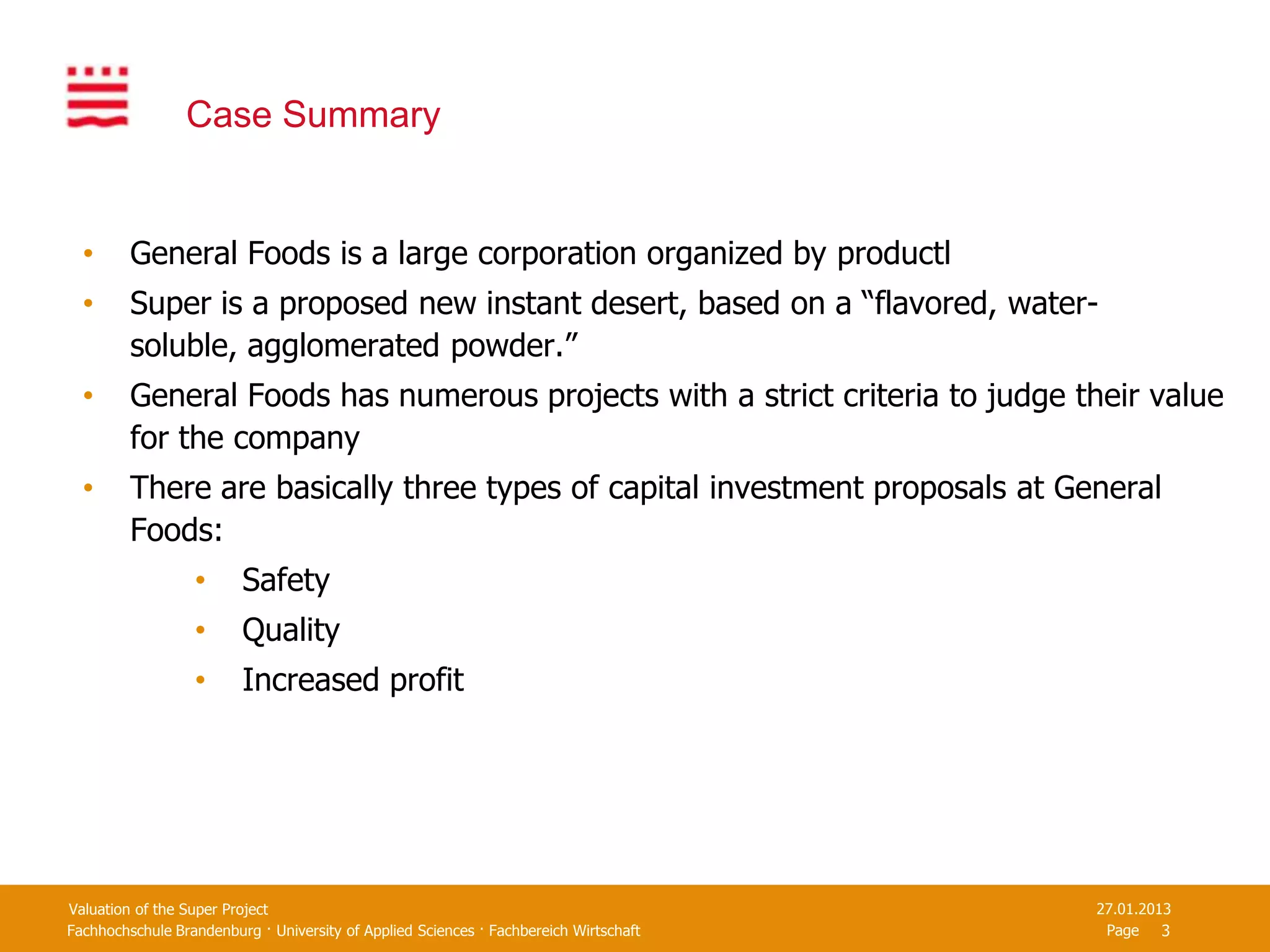
  •      General Foods is a large corporation organized by productl
  •      Super is a proposed new instant desert, based on a “flavored, water-
         soluble, agglomerated powder.”
  •      General Foods has numerous projects with a strict criteria to judge their value
         for the company
  •      There are basically three types of capital investment proposals at General
         Foods:
                  •      Safety
                  •      Quality
                  •      Increased profit


Valuation of the Super Project                                                         27.01.2013
Fachhochschule Brandenburg · University of Applied Sciences · Fachbereich Wirtschaft    Page 3
Problem Statement


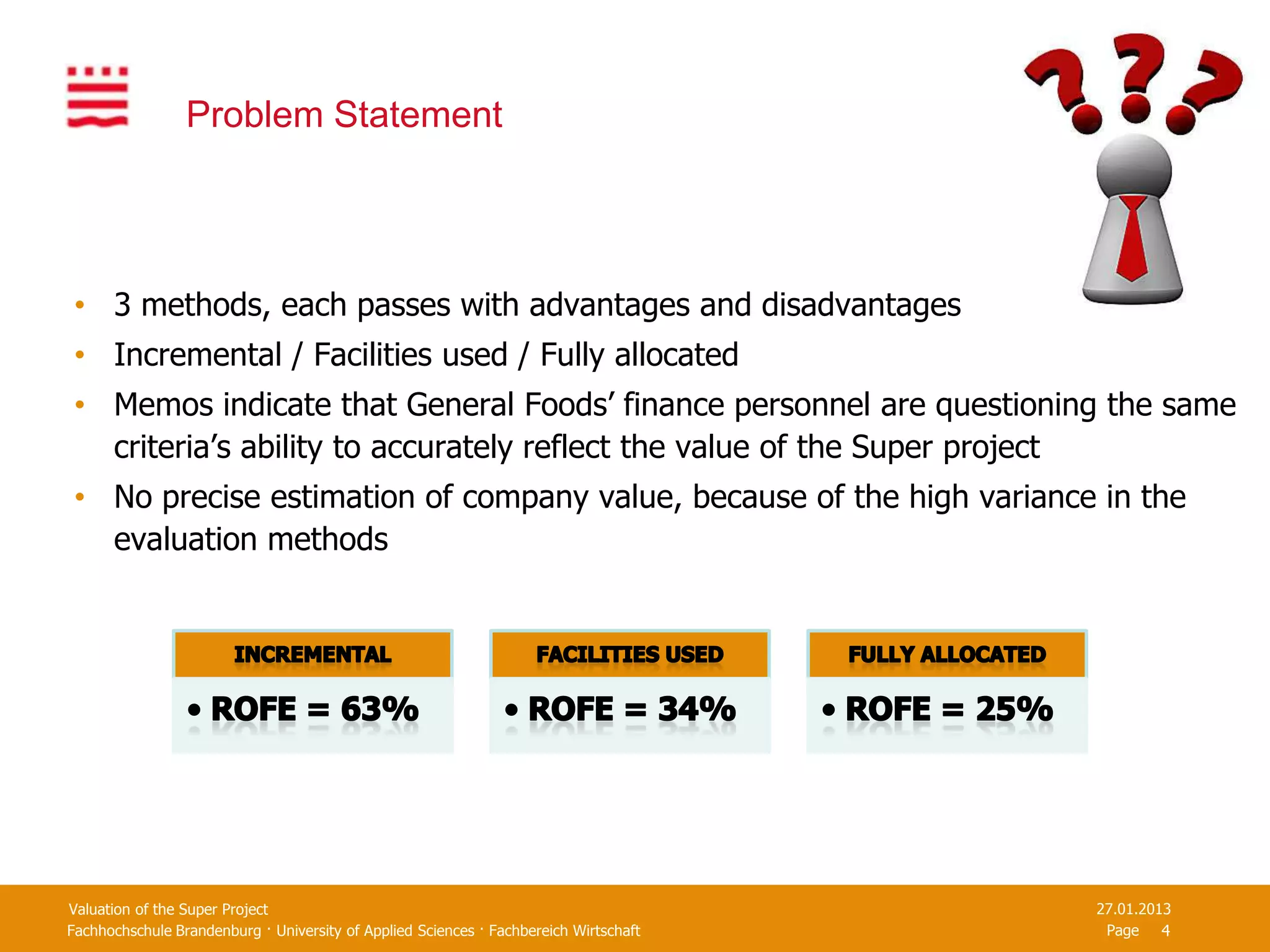
 • 3 methods, each passes with advantages and disadvantages
 • Incremental / Facilities used / Fully allocated
 • Memos indicate that General Foods’ finance personnel are questioning the same
   criteria’s ability to accurately reflect the value of the Super project
 • No precise estimation of company value, because of the high variance in the
   evaluation methods


Valuation of the Super Project                                                         27.01.2013
Fachhochschule Brandenburg · University of Applied Sciences · Fachbereich Wirtschaft    Page 4
Problem Statement – What is ROFE?
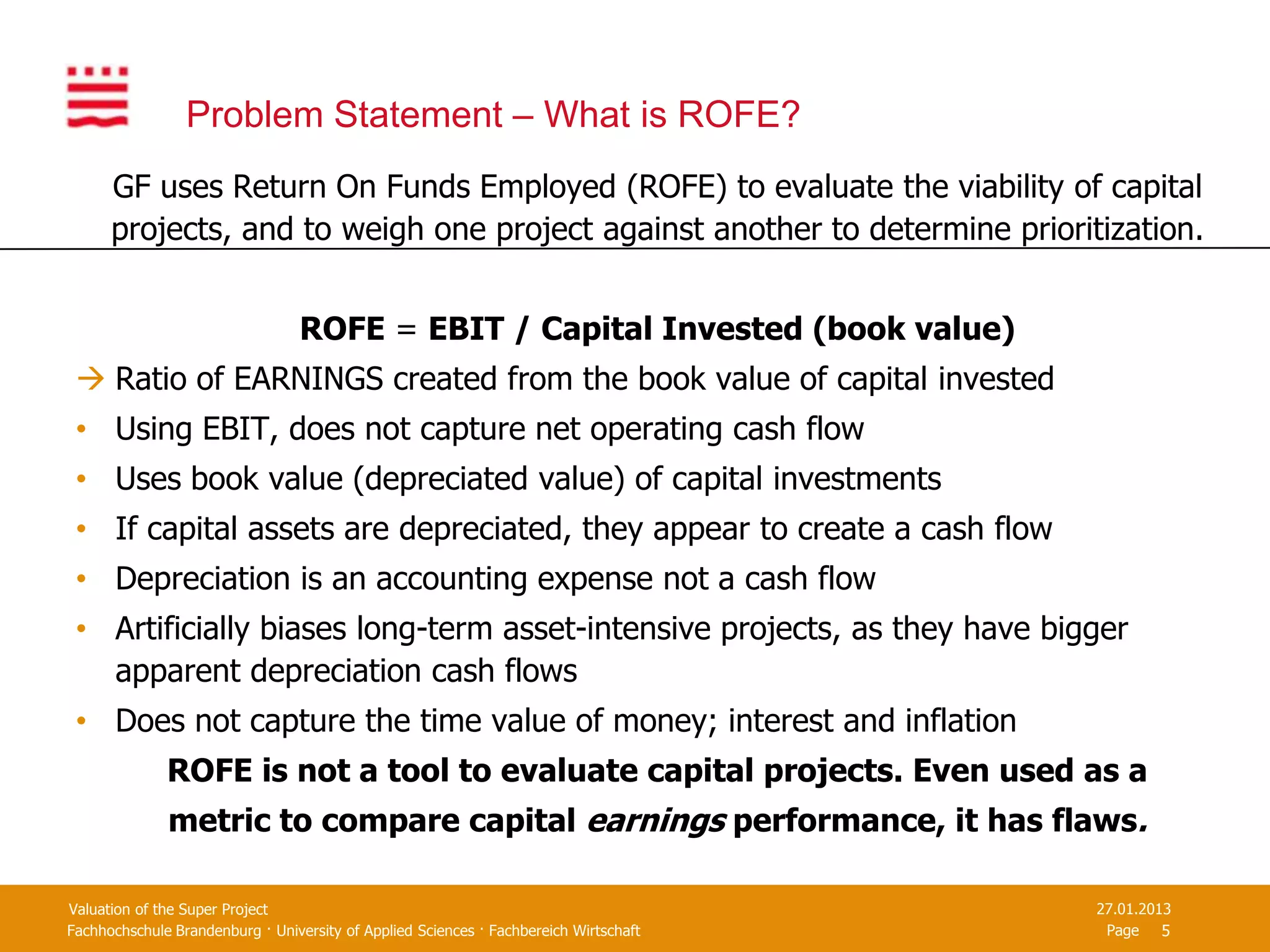
      GF uses Return On Funds Employed (ROFE) to evaluate the viability of capital
      projects, and to weigh one project against another to determine prioritization.


                                  ROFE = EBIT / Capital Invested (book value)
  Ratio of EARNINGS created from the book value of capital invested
 • Using EBIT, does not capture net operating cash flow
 • Uses book value (depreciated value) of capital investments
 • If capital assets are depreciated, they appear to create a cash flow
 • Depreciation is an accounting expense not a cash flow
 • Artificially biases long-term asset-intensive projects, as they have bigger
   apparent depreciation cash flows
 • Does not capture the time value of money; interest and inflation
              ROFE is not a tool to evaluate capital projects. Even used as a
              metric to compare capital earnings performance, it has flaws.

Valuation of the Super Project                                                         27.01.2013
Fachhochschule Brandenburg · University of Applied Sciences · Fachbereich Wirtschaft    Page 5
Problem Statement - How we should deal with…


 • Test-market expenses
 • Erosion of Jell-O contribution margin
 • Allocation of charges for the use of excess agglomerator capacity
 • Overhead expenses


Valuation of the Super Project                                                         27.01.2013
Fachhochschule Brandenburg · University of Applied Sciences · Fachbereich Wirtschaft    Page 6
Test-market expenses


 • Should only be taken into account if they can be attributed to the particular
   project
 • In the Super case these expenses had been made before the Super project had
   started


  Will not be taken into account in the FCF


Valuation of the Super Project                                                         27.01.2013
Fachhochschule Brandenburg · University of Applied Sciences · Fachbereich Wirtschaft    Page 7
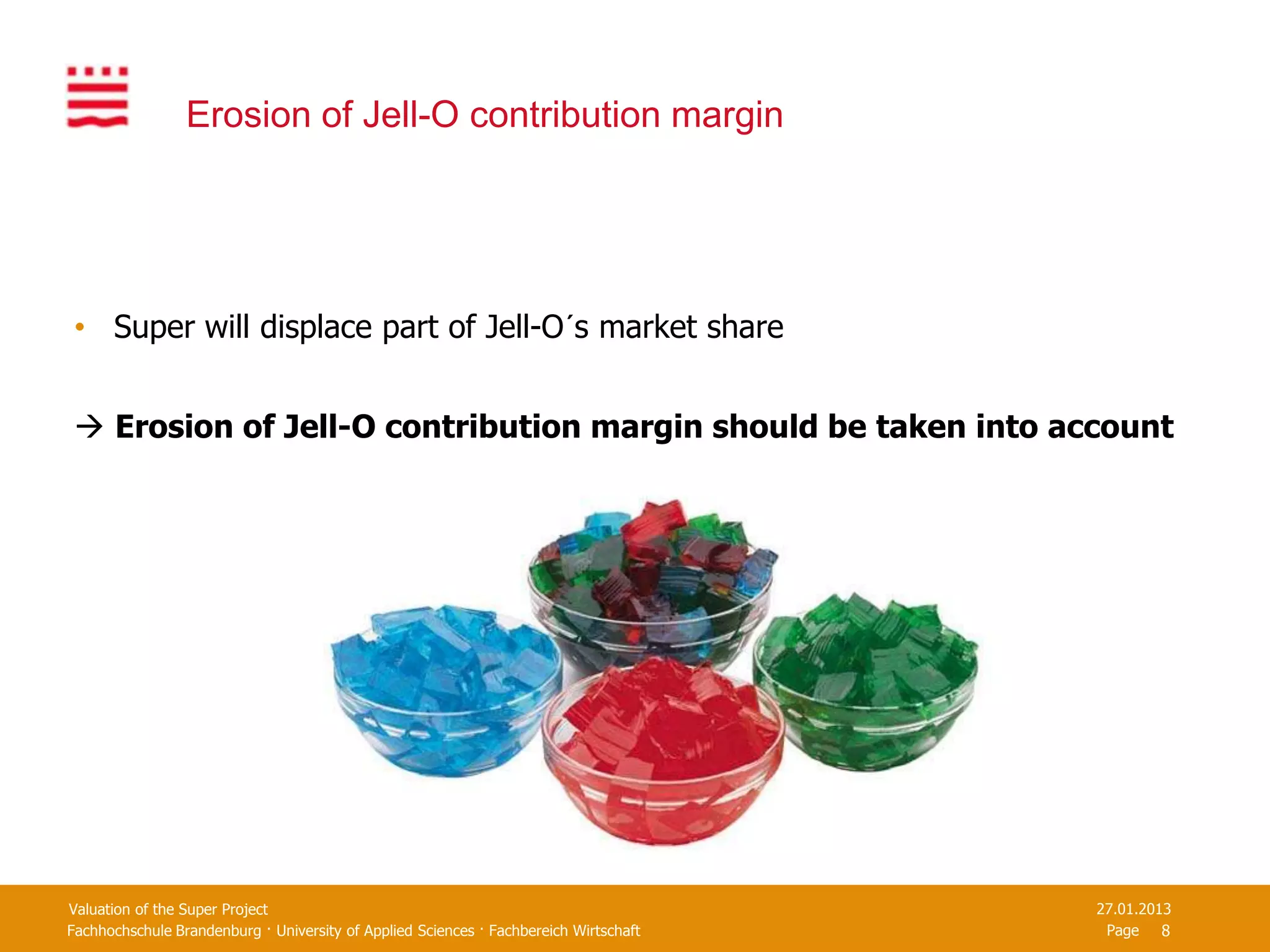
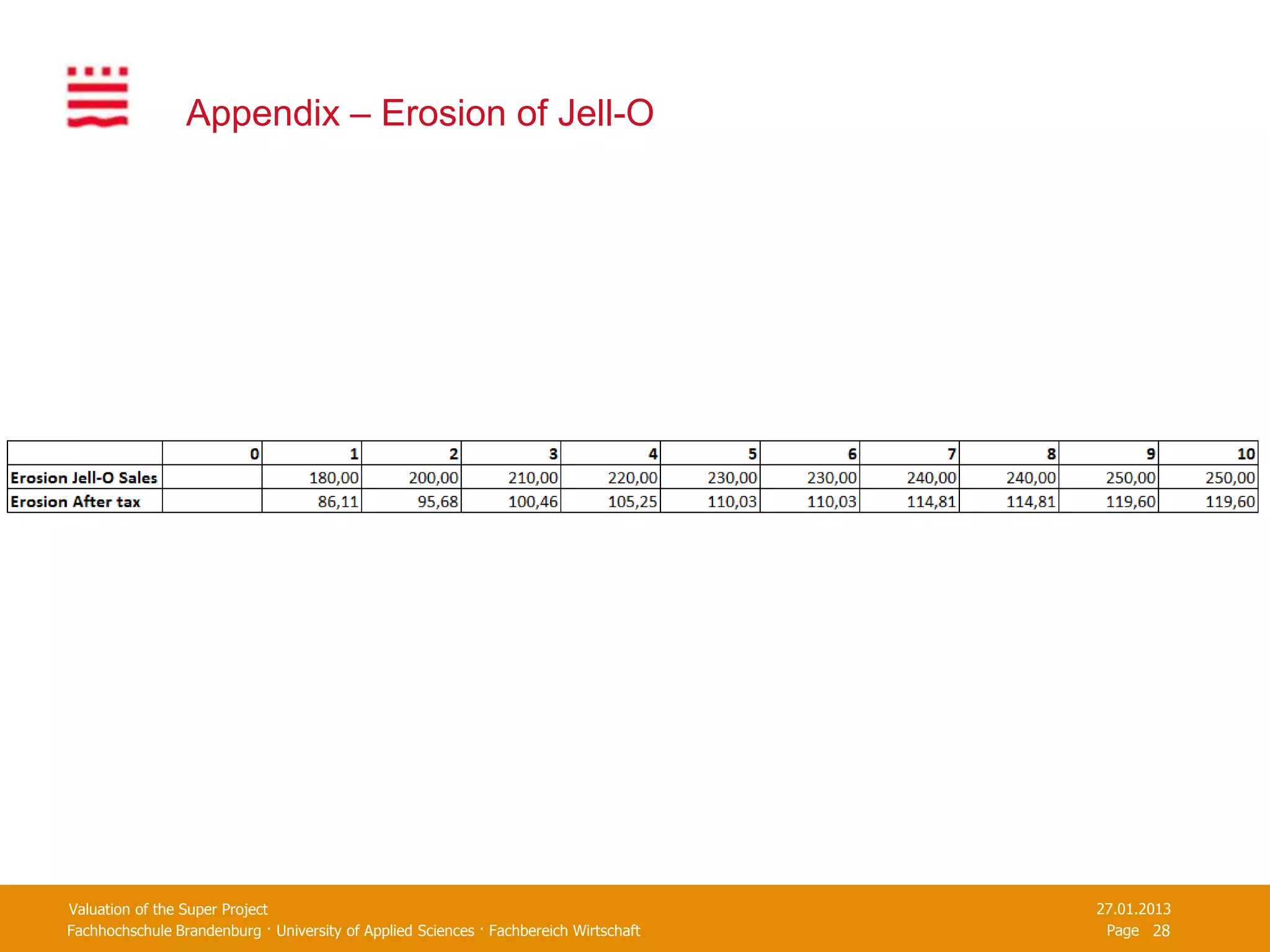
Erosion of Jell-O contribution margin


 • Super will displace part of Jell-O´s market share


  Erosion of Jell-O contribution margin should be taken into account


Valuation of the Super Project                                                         27.01.2013
Fachhochschule Brandenburg · University of Applied Sciences · Fachbereich Wirtschaft    Page 8
Allocation of charges for the use of excess agglomerator capacity


 • Not counted in the FCF of the Super Project
 • Charges represent opportunity costs for the Jell-O devision or future projects


  Take costs into account on a corporate level


Valuation of the Super Project                                                         27.01.2013
Fachhochschule Brandenburg · University of Applied Sciences · Fachbereich Wirtschaft    Page 9
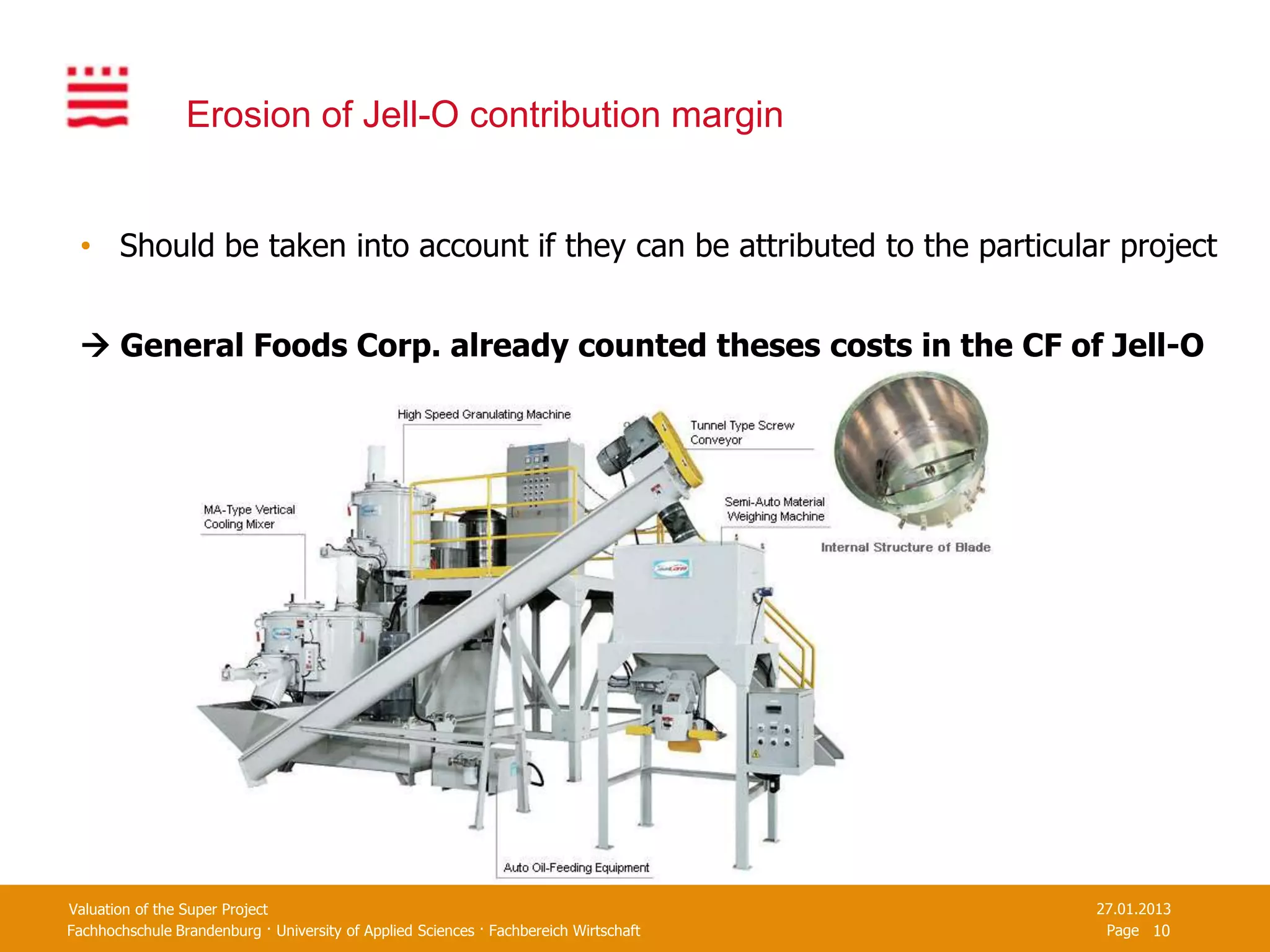
Erosion of Jell-O contribution margin


 • Should be taken into account if they can be attributed to the particular project


  General Foods Corp. already counted theses costs in the CF of Jell-O


Valuation of the Super Project                                                         27.01.2013
Fachhochschule Brandenburg · University of Applied Sciences · Fachbereich Wirtschaft    Page 10
Overhead Expenses


 • Should be taken into account if these expenses can be attributed to Super
 • Overhead expenses for the Super Project are not clearly defined


  Overhead expenses will be taken into account in the FCF


Valuation of the Super Project                                                         27.01.2013
Fachhochschule Brandenburg · University of Applied Sciences · Fachbereich Wirtschaft    Page 11
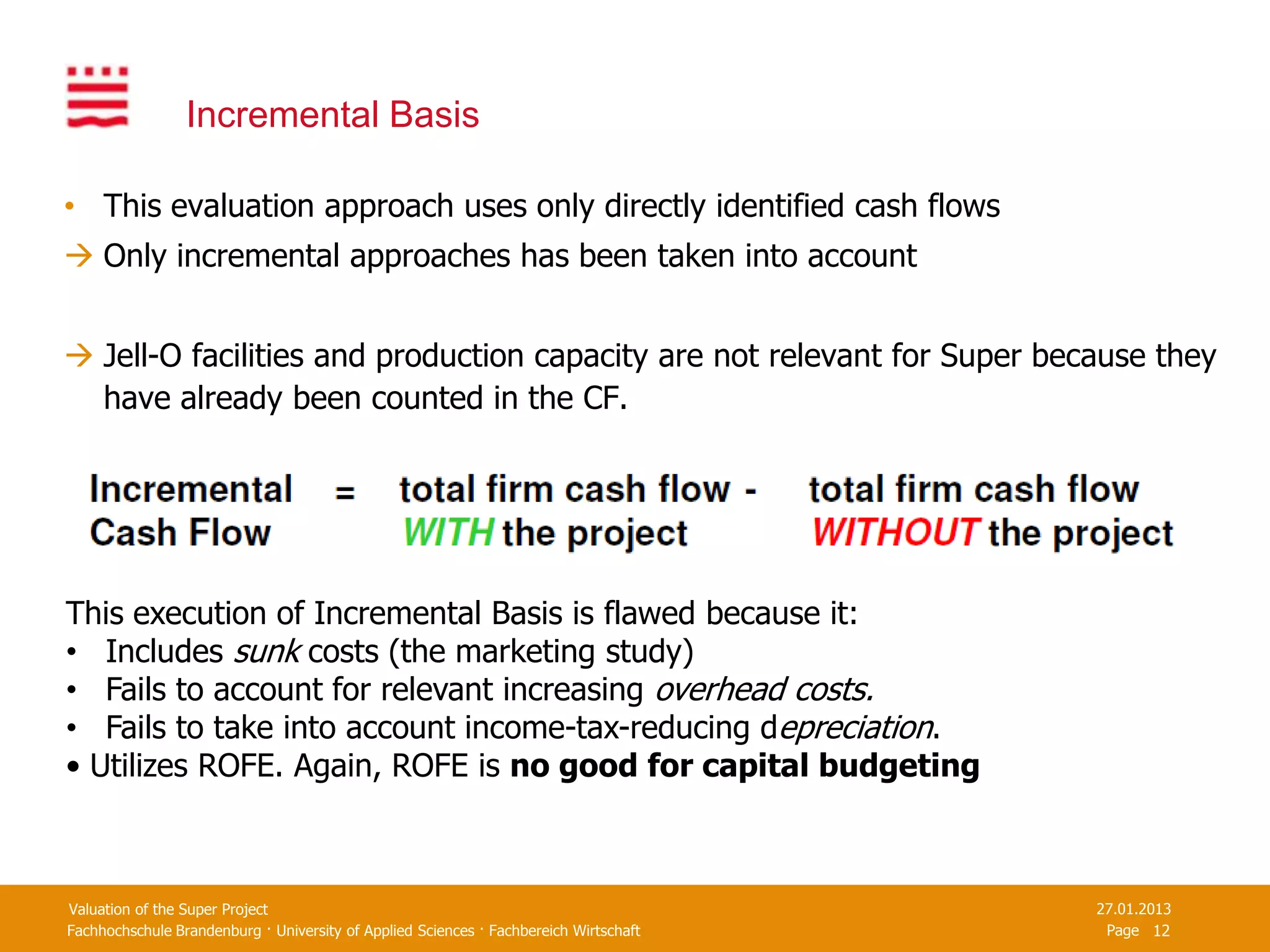
Incremental Basis

• This evaluation approach uses only directly identified cash flows
 Only incremental approaches has been taken into account


 Jell-O facilities and production capacity are not relevant for Super because they
  have already been counted in the CF.


This execution of Incremental Basis is flawed because it:
• Includes sunk costs (the marketing study)
• Fails to account for relevant increasing overhead costs.
• Fails to take into account income-tax-reducing depreciation.
• Utilizes ROFE. Again, ROFE is no good for capital budgeting


Valuation of the Super Project                                                         27.01.2013
Fachhochschule Brandenburg · University of Applied Sciences · Fachbereich Wirtschaft    Page 12
Facilities-Used Basis

• Super will use 1/2 of Jell-O’s agglomerator
• Super will use 2/3 of Jell-O’s building
• Super “pro-rata” share is $453 K
• Charges Super with the facility overhead ($28k p/y).
 This approach
• In the capital budgeting process only incremental cash flows are taken into
  account.
• Only shifts costs ($453K in facilities) to Super, which is an accounting
  maneuver and does not effect the cashflow
• It’s a “net zero” method, it just moves costs
 Useful for accounting, not for capital budgeting


Valuation of the Super Project                                                         27.01.2013
Fachhochschule Brandenburg · University of Applied Sciences · Fachbereich Wirtschaft    Page 13
Fully Allocated Basis


                                   Facilities-Used Basis + overhead expenses


• Overhead expenses:
                • Selling, general and administrative costs


 This approach
• Gives the most inclusive analysis of existing cash flow
• Adds overhead costs correctly


Valuation of the Super Project                                                         27.01.2013
Fachhochschule Brandenburg · University of Applied Sciences · Fachbereich Wirtschaft    Page 14
Evaluation of the Super Project


   GF can do this by:
   1. Taking into account incremental cash flows
   2. Modifying their income statement to deduct depreciation before calculating tax
   3. Ignore sunk costs (marketing test, Jell-O facilities, etc.)
   4. Remove depreciation from capital assets for purposes of evaluation
   5. Accept overhead from growth/doubling powdered dessert line


Valuation of the Super Project                                                         27.01.2013
Fachhochschule Brandenburg · University of Applied Sciences · Fachbereich Wirtschaft    Page 15
Recommendations evaluation of the Super Project


• $200k for high speed filling/packaging equipment, finish packing room
• $360k market test – irrelevant
• Opportunity cost for Jell-O’s facilities and equipment
               • Not relevant – same opportunity for any project using this building
               • From corporate POV, hard to sell to move in some business to utilize
                 temporarily excess Jell-O facilities, low feasibility
• Capital depreciation – non-cash expense – irrelevant
• Capital depreciation expense tax deduction – relevant to operating cash flow
• Shift $453k pro-rata share of Jell-O facilities and agglomerator – Incremental
  test – irrelevant


Valuation of the Super Project                                                         27.01.2013
Fachhochschule Brandenburg · University of Applied Sciences · Fachbereich Wirtschaft    Page 16
Recommendations Evaluation of the Super Project


• $28k avg. yearly depreciation of Jell-O facilities – Incremental test – irrelevant
• $19k business expansion capital for distribution system – Incremental test –
  relevant
• Expansion capital depreciation expense tax deduction – relevant to operating
  cash flow
• $90k additional yearly overhead expense for business expansion – Incremental
  test – relevant


Valuation of the Super Project                                                         27.01.2013
Fachhochschule Brandenburg · University of Applied Sciences · Fachbereich Wirtschaft    Page 17
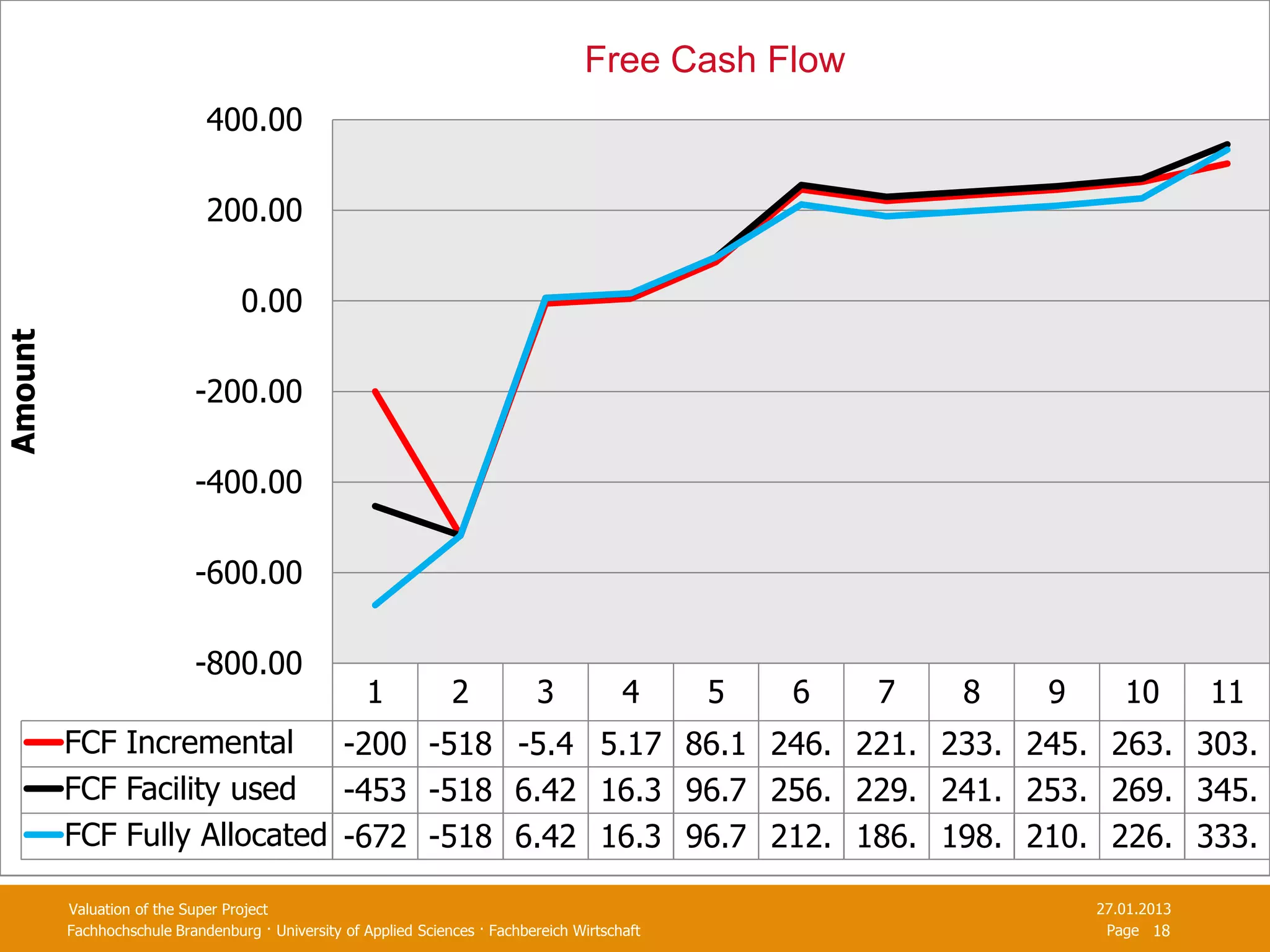
Free Cash Flow
                             400.00

                             200.00

                                  0.00
Amount


                           -200.00

                           -400.00

                           -600.00

                           -800.00
                                                    1            2           3            4     5   6   7   8   9      10        11
         FCF Incremental     -200 -518 -5.4 5.17 86.1 246. 221. 233. 245. 263. 303.
         FCF Facility used -453 -518 6.42 16.3 96.7 256. 229. 241. 253. 269. 345.
         FCF Fully Allocated -672 -518 6.42 16.3 96.7 212. 186. 198. 210. 226. 333.

         Valuation of the Super Project                                                                             27.01.2013
         Fachhochschule Brandenburg · University of Applied Sciences · Fachbereich Wirtschaft                        Page 18
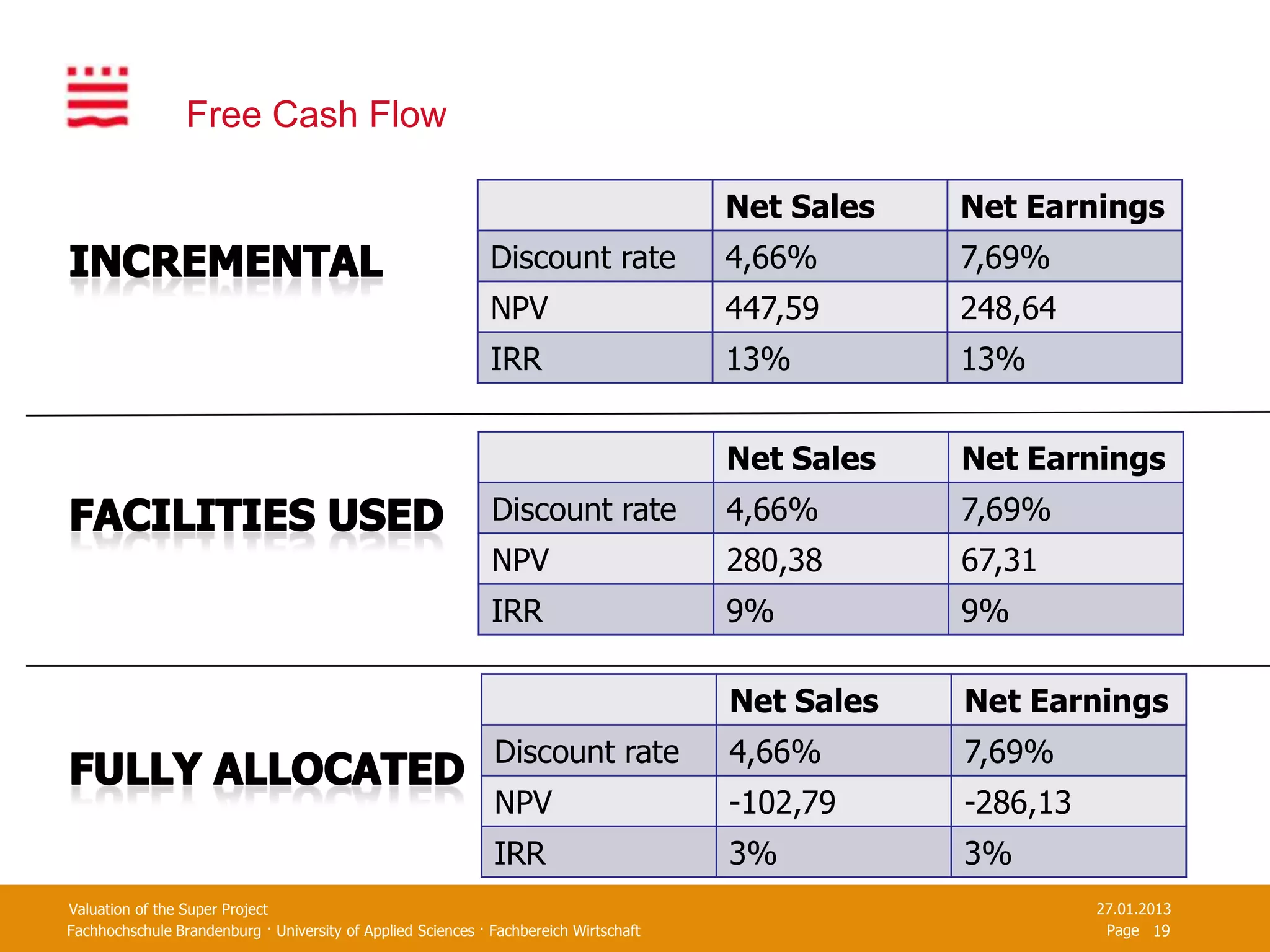
Free Cash Flow

                                                                                       Net Sales   Net Earnings
                                                              Discount rate            4,66%       7,69%
                                                              NPV                      447,59      248,64
                                                              IRR                      13%         13%


                                                                                       Net Sales   Net Earnings
                                                              Discount rate            4,66%       7,69%
                                                              NPV                      280,38      67,31
                                                              IRR                      9%          9%

                                                                                       Net Sales   Net Earnings
                                                              Discount rate            4,66%       7,69%
                                                              NPV                      -102,79     -286,13
                                                              IRR                      3%          3%
Valuation of the Super Project                                                                               27.01.2013
Fachhochschule Brandenburg · University of Applied Sciences · Fachbereich Wirtschaft                          Page 19
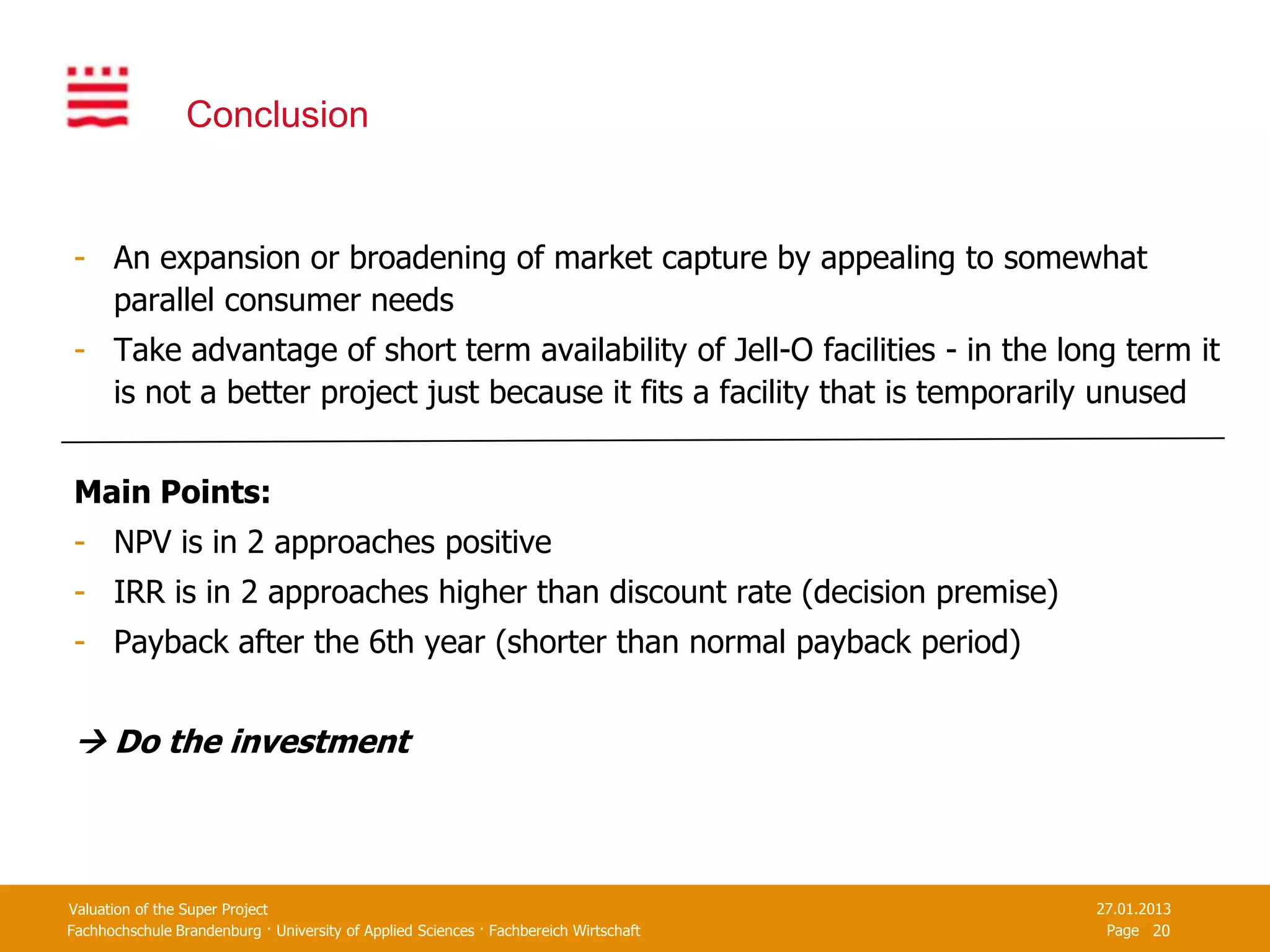
Conclusion


- An expansion or broadening of market capture by appealing to somewhat
  parallel consumer needs
- Take advantage of short term availability of Jell-O facilities - in the long term it
  is not a better project just because it fits a facility that is temporarily unused


Main Points:
- NPV is in 2 approaches positive
- IRR is in 2 approaches higher than discount rate (decision premise)
- Payback after the 6th year (shorter than normal payback period)


 Do the investment


Valuation of the Super Project                                                         27.01.2013
Fachhochschule Brandenburg · University of Applied Sciences · Fachbereich Wirtschaft    Page 20
Fachbereich Wirtschaft


Thank you for your attention
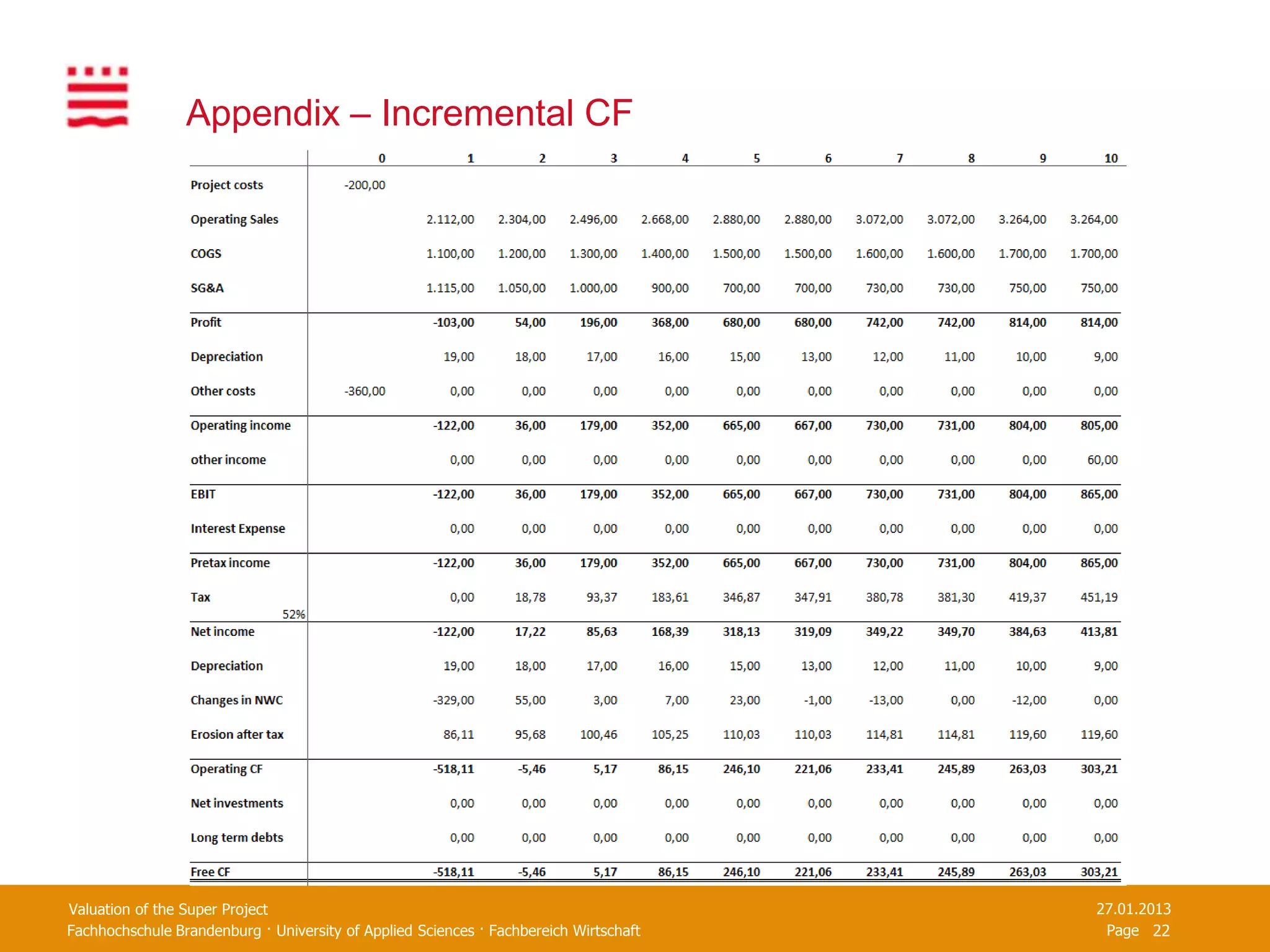
Appendix – Incremental CF


Valuation of the Super Project                                                         27.01.2013
Fachhochschule Brandenburg · University of Applied Sciences · Fachbereich Wirtschaft    Page 22
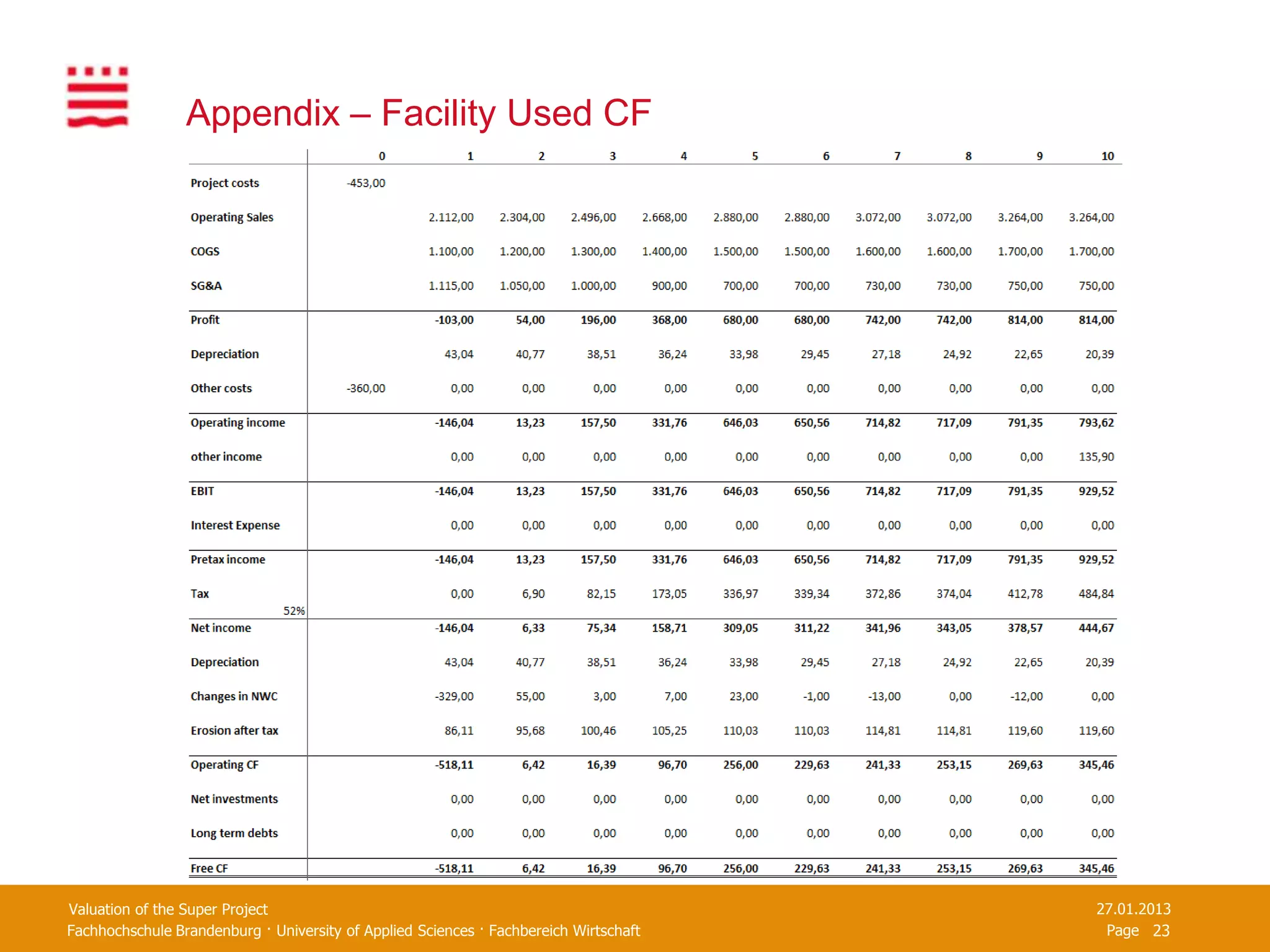
Appendix – Facility Used CF


Valuation of the Super Project                                                         27.01.2013
Fachhochschule Brandenburg · University of Applied Sciences · Fachbereich Wirtschaft    Page 23
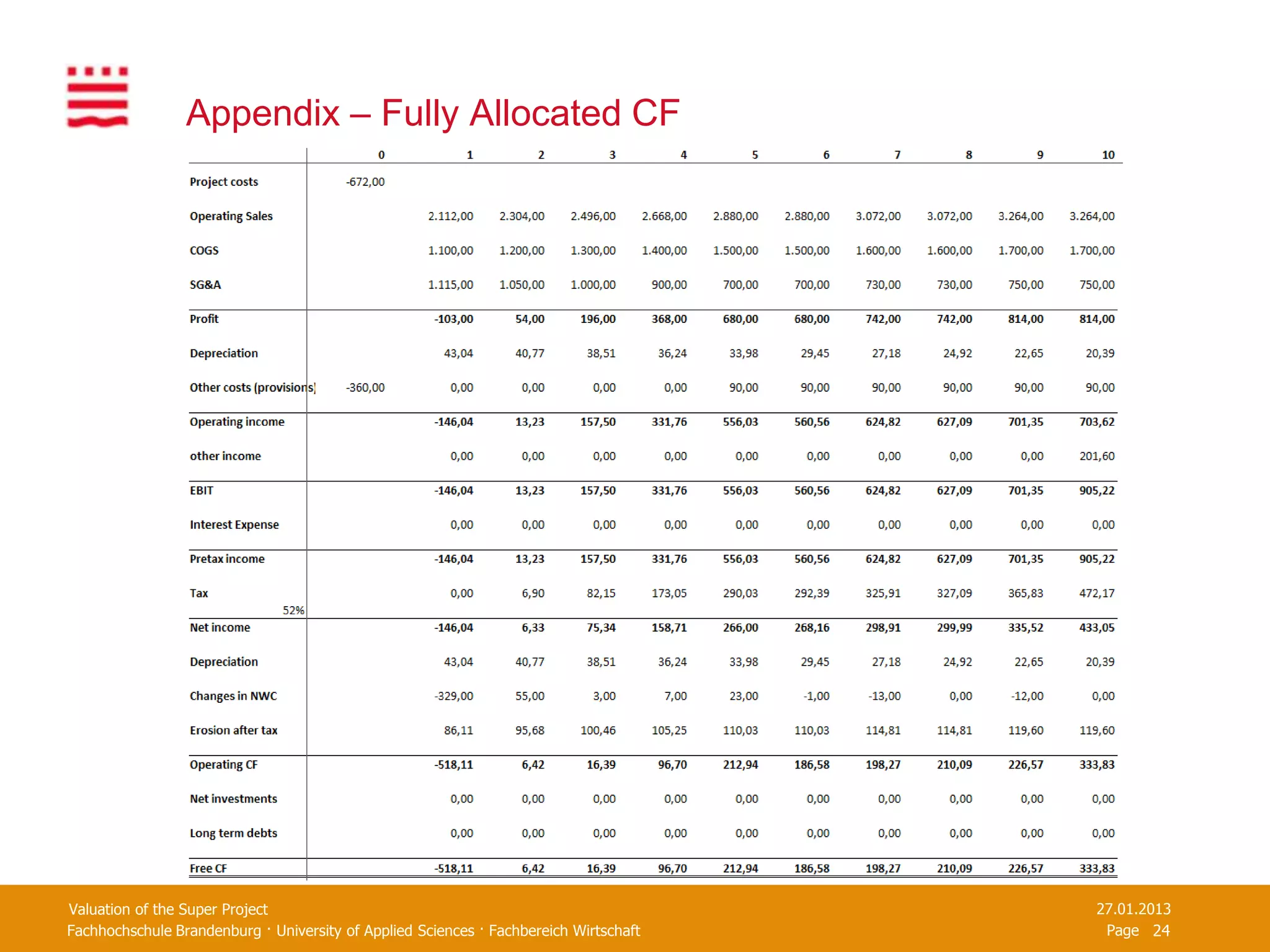
Appendix – Fully Allocated CF


Valuation of the Super Project                                                         27.01.2013
Fachhochschule Brandenburg · University of Applied Sciences · Fachbereich Wirtschaft    Page 24
Appendix – Excel File


                                                        Excel File


Valuation of the Super Project                                                         27.01.2013
Fachhochschule Brandenburg · University of Applied Sciences · Fachbereich Wirtschaft    Page 25
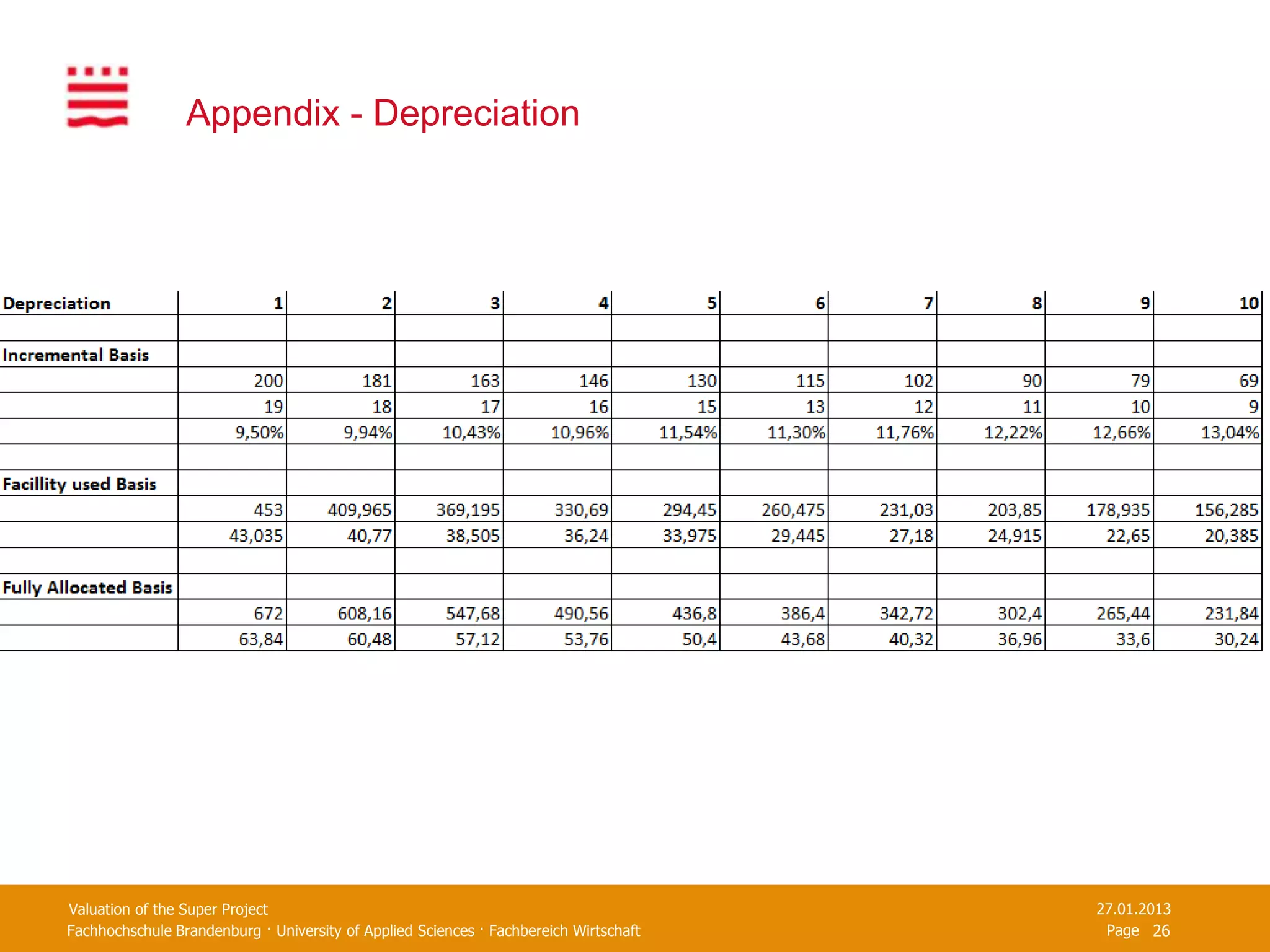
Appendix - Depreciation


Valuation of the Super Project                                                         27.01.2013
Fachhochschule Brandenburg · University of Applied Sciences · Fachbereich Wirtschaft    Page 26
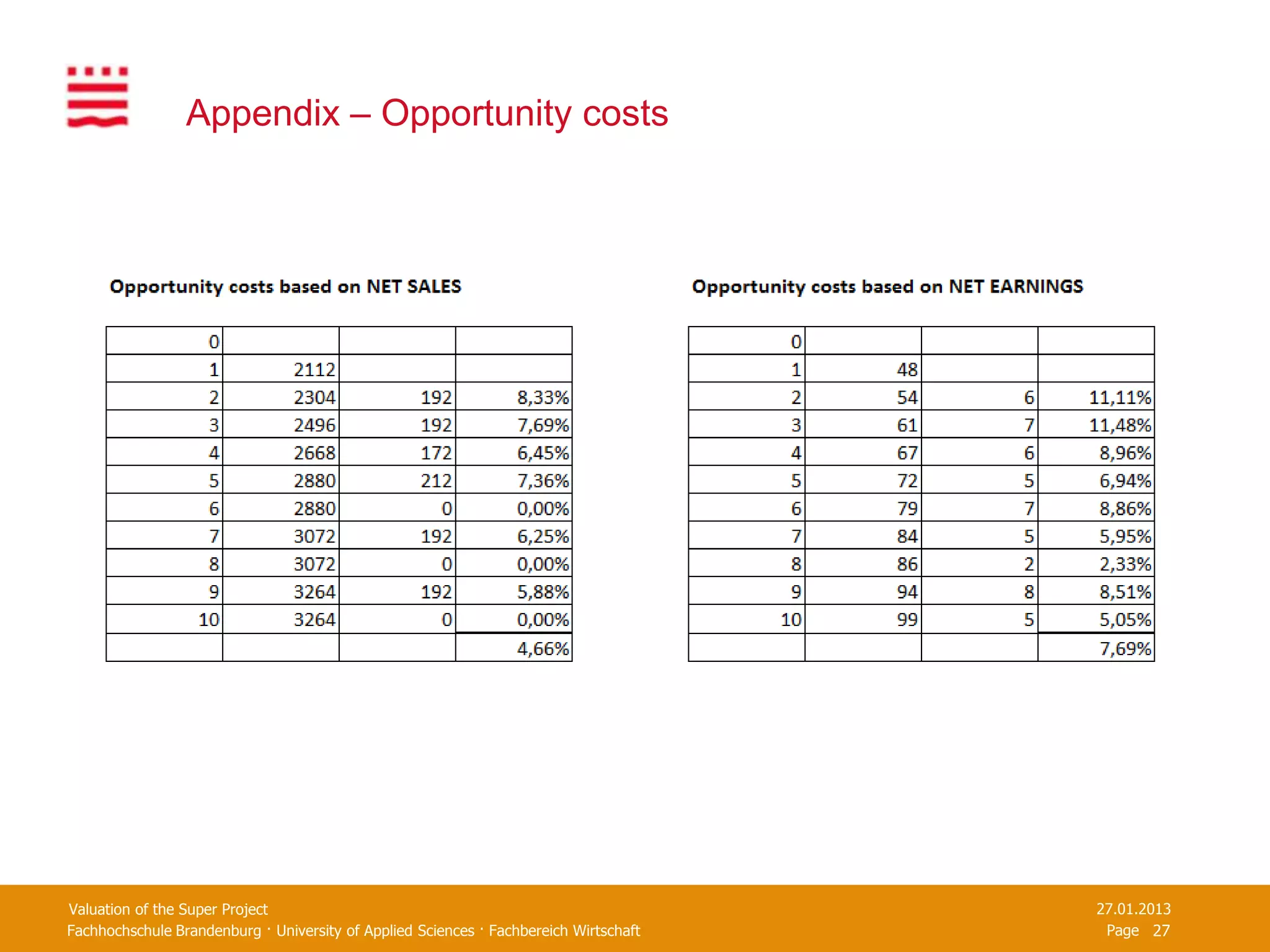
Appendix – Opportunity costs


Valuation of the Super Project                                                         27.01.2013
Fachhochschule Brandenburg · University of Applied Sciences · Fachbereich Wirtschaft    Page 27
Appendix – Erosion of Jell-O


Valuation of the Super Project                                                         27.01.2013
Fachhochschule Brandenburg · University of Applied Sciences · Fachbereich Wirtschaft    Page 28
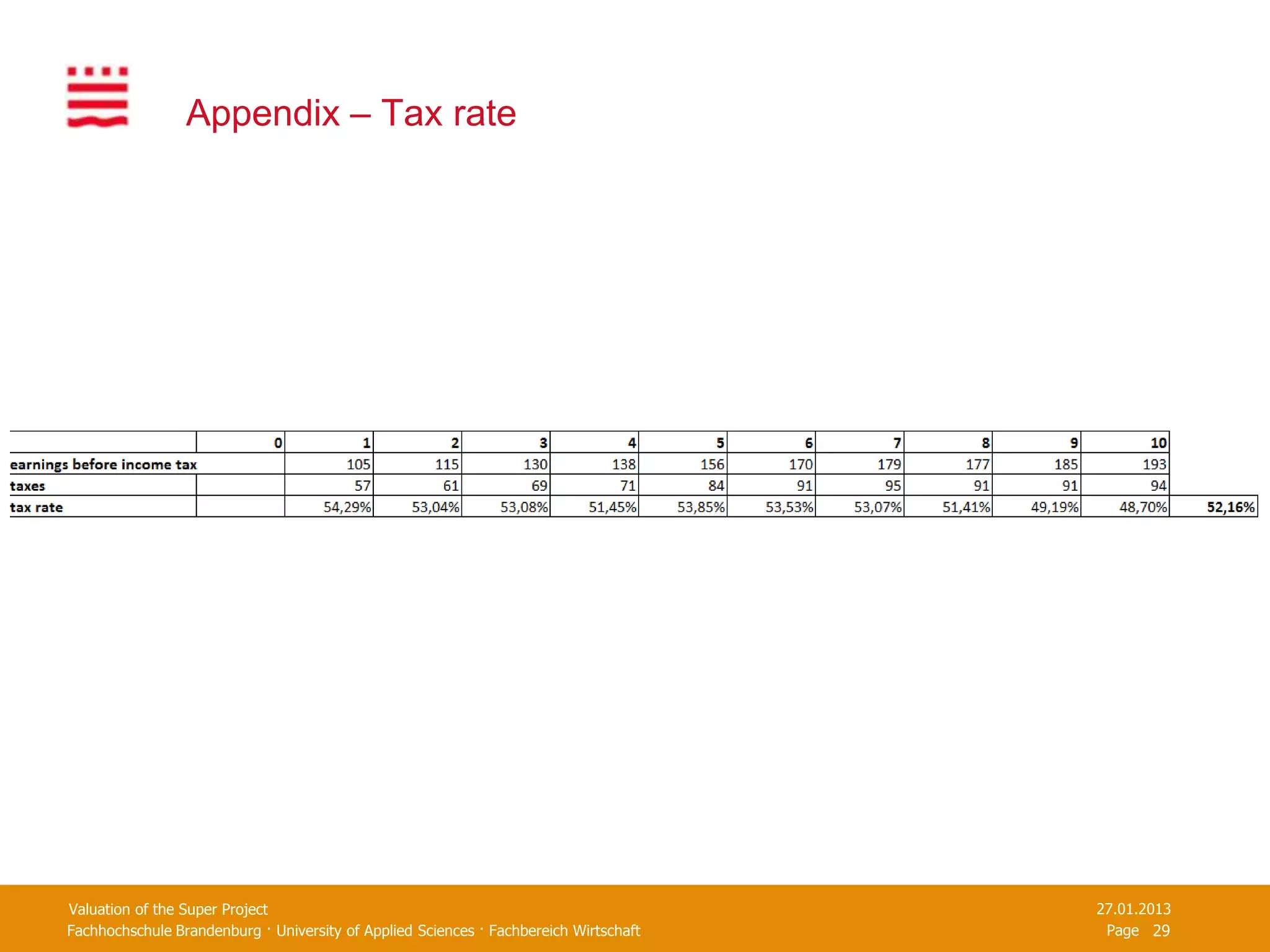
Appendix – Tax rate


Valuation of the Super Project                                                         27.01.2013
Fachhochschule Brandenburg · University of Applied Sciences · Fachbereich Wirtschaft    Page 29

Super Project

  • 1.
    Valuation of theSuper Project Group Members: XXX XXXXX XXX XXXXX Gordon Schwabe XXX XXXXX 27.01.2013
  • 2.
    AGENDA 1. Case summary 2. Problem statement 3. Clarifying problems & solutions 4. Comments on the 3 evaluation approaches 5. Recommendations on evaluation 6. Cash flow statement 7. Conclusion Valuation of the Super Project 27.01.2013 Fachhochschule Brandenburg · University of Applied Sciences · Fachbereich Wirtschaft Page 2
  • 3.
    Case Summary • General Foods is a large corporation organized by productl • Super is a proposed new instant desert, based on a “flavored, water- soluble, agglomerated powder.” • General Foods has numerous projects with a strict criteria to judge their value for the company • There are basically three types of capital investment proposals at General Foods: • Safety • Quality • Increased profit Valuation of the Super Project 27.01.2013 Fachhochschule Brandenburg · University of Applied Sciences · Fachbereich Wirtschaft Page 3
  • 4.
    Problem Statement •3 methods, each passes with advantages and disadvantages • Incremental / Facilities used / Fully allocated • Memos indicate that General Foods’ finance personnel are questioning the same criteria’s ability to accurately reflect the value of the Super project • No precise estimation of company value, because of the high variance in the evaluation methods Valuation of the Super Project 27.01.2013 Fachhochschule Brandenburg · University of Applied Sciences · Fachbereich Wirtschaft Page 4
  • 5.
    Problem Statement –What is ROFE? GF uses Return On Funds Employed (ROFE) to evaluate the viability of capital projects, and to weigh one project against another to determine prioritization. ROFE = EBIT / Capital Invested (book value)  Ratio of EARNINGS created from the book value of capital invested • Using EBIT, does not capture net operating cash flow • Uses book value (depreciated value) of capital investments • If capital assets are depreciated, they appear to create a cash flow • Depreciation is an accounting expense not a cash flow • Artificially biases long-term asset-intensive projects, as they have bigger apparent depreciation cash flows • Does not capture the time value of money; interest and inflation ROFE is not a tool to evaluate capital projects. Even used as a metric to compare capital earnings performance, it has flaws. Valuation of the Super Project 27.01.2013 Fachhochschule Brandenburg · University of Applied Sciences · Fachbereich Wirtschaft Page 5
  • 6.
    Problem Statement -How we should deal with… • Test-market expenses • Erosion of Jell-O contribution margin • Allocation of charges for the use of excess agglomerator capacity • Overhead expenses Valuation of the Super Project 27.01.2013 Fachhochschule Brandenburg · University of Applied Sciences · Fachbereich Wirtschaft Page 6
  • 7.
    Test-market expenses •Should only be taken into account if they can be attributed to the particular project • In the Super case these expenses had been made before the Super project had started  Will not be taken into account in the FCF Valuation of the Super Project 27.01.2013 Fachhochschule Brandenburg · University of Applied Sciences · Fachbereich Wirtschaft Page 7
  • 8.
    Erosion of Jell-Ocontribution margin • Super will displace part of Jell-O´s market share  Erosion of Jell-O contribution margin should be taken into account Valuation of the Super Project 27.01.2013 Fachhochschule Brandenburg · University of Applied Sciences · Fachbereich Wirtschaft Page 8
  • 9.
    Allocation of chargesfor the use of excess agglomerator capacity • Not counted in the FCF of the Super Project • Charges represent opportunity costs for the Jell-O devision or future projects  Take costs into account on a corporate level Valuation of the Super Project 27.01.2013 Fachhochschule Brandenburg · University of Applied Sciences · Fachbereich Wirtschaft Page 9
  • 10.
    Erosion of Jell-Ocontribution margin • Should be taken into account if they can be attributed to the particular project  General Foods Corp. already counted theses costs in the CF of Jell-O Valuation of the Super Project 27.01.2013 Fachhochschule Brandenburg · University of Applied Sciences · Fachbereich Wirtschaft Page 10
  • 11.
    Overhead Expenses •Should be taken into account if these expenses can be attributed to Super • Overhead expenses for the Super Project are not clearly defined  Overhead expenses will be taken into account in the FCF Valuation of the Super Project 27.01.2013 Fachhochschule Brandenburg · University of Applied Sciences · Fachbereich Wirtschaft Page 11
  • 12.
    Incremental Basis • Thisevaluation approach uses only directly identified cash flows  Only incremental approaches has been taken into account  Jell-O facilities and production capacity are not relevant for Super because they have already been counted in the CF. This execution of Incremental Basis is flawed because it: • Includes sunk costs (the marketing study) • Fails to account for relevant increasing overhead costs. • Fails to take into account income-tax-reducing depreciation. • Utilizes ROFE. Again, ROFE is no good for capital budgeting Valuation of the Super Project 27.01.2013 Fachhochschule Brandenburg · University of Applied Sciences · Fachbereich Wirtschaft Page 12
  • 13.
    Facilities-Used Basis • Superwill use 1/2 of Jell-O’s agglomerator • Super will use 2/3 of Jell-O’s building • Super “pro-rata” share is $453 K • Charges Super with the facility overhead ($28k p/y).  This approach • In the capital budgeting process only incremental cash flows are taken into account. • Only shifts costs ($453K in facilities) to Super, which is an accounting maneuver and does not effect the cashflow • It’s a “net zero” method, it just moves costs  Useful for accounting, not for capital budgeting Valuation of the Super Project 27.01.2013 Fachhochschule Brandenburg · University of Applied Sciences · Fachbereich Wirtschaft Page 13
  • 14.
    Fully Allocated Basis Facilities-Used Basis + overhead expenses • Overhead expenses: • Selling, general and administrative costs  This approach • Gives the most inclusive analysis of existing cash flow • Adds overhead costs correctly Valuation of the Super Project 27.01.2013 Fachhochschule Brandenburg · University of Applied Sciences · Fachbereich Wirtschaft Page 14
  • 15.
    Evaluation of theSuper Project GF can do this by: 1. Taking into account incremental cash flows 2. Modifying their income statement to deduct depreciation before calculating tax 3. Ignore sunk costs (marketing test, Jell-O facilities, etc.) 4. Remove depreciation from capital assets for purposes of evaluation 5. Accept overhead from growth/doubling powdered dessert line Valuation of the Super Project 27.01.2013 Fachhochschule Brandenburg · University of Applied Sciences · Fachbereich Wirtschaft Page 15
  • 16.
    Recommendations evaluation ofthe Super Project • $200k for high speed filling/packaging equipment, finish packing room • $360k market test – irrelevant • Opportunity cost for Jell-O’s facilities and equipment • Not relevant – same opportunity for any project using this building • From corporate POV, hard to sell to move in some business to utilize temporarily excess Jell-O facilities, low feasibility • Capital depreciation – non-cash expense – irrelevant • Capital depreciation expense tax deduction – relevant to operating cash flow • Shift $453k pro-rata share of Jell-O facilities and agglomerator – Incremental test – irrelevant Valuation of the Super Project 27.01.2013 Fachhochschule Brandenburg · University of Applied Sciences · Fachbereich Wirtschaft Page 16
  • 17.
    Recommendations Evaluation ofthe Super Project • $28k avg. yearly depreciation of Jell-O facilities – Incremental test – irrelevant • $19k business expansion capital for distribution system – Incremental test – relevant • Expansion capital depreciation expense tax deduction – relevant to operating cash flow • $90k additional yearly overhead expense for business expansion – Incremental test – relevant Valuation of the Super Project 27.01.2013 Fachhochschule Brandenburg · University of Applied Sciences · Fachbereich Wirtschaft Page 17
  • 18.
    Free Cash Flow 400.00 200.00 0.00 Amount -200.00 -400.00 -600.00 -800.00 1 2 3 4 5 6 7 8 9 10 11 FCF Incremental -200 -518 -5.4 5.17 86.1 246. 221. 233. 245. 263. 303. FCF Facility used -453 -518 6.42 16.3 96.7 256. 229. 241. 253. 269. 345. FCF Fully Allocated -672 -518 6.42 16.3 96.7 212. 186. 198. 210. 226. 333. Valuation of the Super Project 27.01.2013 Fachhochschule Brandenburg · University of Applied Sciences · Fachbereich Wirtschaft Page 18
  • 19.
    Free Cash Flow Net Sales Net Earnings Discount rate 4,66% 7,69% NPV 447,59 248,64 IRR 13% 13% Net Sales Net Earnings Discount rate 4,66% 7,69% NPV 280,38 67,31 IRR 9% 9% Net Sales Net Earnings Discount rate 4,66% 7,69% NPV -102,79 -286,13 IRR 3% 3% Valuation of the Super Project 27.01.2013 Fachhochschule Brandenburg · University of Applied Sciences · Fachbereich Wirtschaft Page 19
  • 20.
    Conclusion - An expansionor broadening of market capture by appealing to somewhat parallel consumer needs - Take advantage of short term availability of Jell-O facilities - in the long term it is not a better project just because it fits a facility that is temporarily unused Main Points: - NPV is in 2 approaches positive - IRR is in 2 approaches higher than discount rate (decision premise) - Payback after the 6th year (shorter than normal payback period)  Do the investment Valuation of the Super Project 27.01.2013 Fachhochschule Brandenburg · University of Applied Sciences · Fachbereich Wirtschaft Page 20
  • 21.
  • 22.
    Appendix – IncrementalCF Valuation of the Super Project 27.01.2013 Fachhochschule Brandenburg · University of Applied Sciences · Fachbereich Wirtschaft Page 22
  • 23.
    Appendix – FacilityUsed CF Valuation of the Super Project 27.01.2013 Fachhochschule Brandenburg · University of Applied Sciences · Fachbereich Wirtschaft Page 23
  • 24.
    Appendix – FullyAllocated CF Valuation of the Super Project 27.01.2013 Fachhochschule Brandenburg · University of Applied Sciences · Fachbereich Wirtschaft Page 24
  • 25.
    Appendix – ExcelFile Excel File Valuation of the Super Project 27.01.2013 Fachhochschule Brandenburg · University of Applied Sciences · Fachbereich Wirtschaft Page 25
  • 26.
    Appendix - Depreciation Valuationof the Super Project 27.01.2013 Fachhochschule Brandenburg · University of Applied Sciences · Fachbereich Wirtschaft Page 26
  • 27.
    Appendix – Opportunitycosts Valuation of the Super Project 27.01.2013 Fachhochschule Brandenburg · University of Applied Sciences · Fachbereich Wirtschaft Page 27
  • 28.
    Appendix – Erosionof Jell-O Valuation of the Super Project 27.01.2013 Fachhochschule Brandenburg · University of Applied Sciences · Fachbereich Wirtschaft Page 28
  • 29.
    Appendix – Taxrate Valuation of the Super Project 27.01.2013 Fachhochschule Brandenburg · University of Applied Sciences · Fachbereich Wirtschaft Page 29