Chapter 1:
Introduction to Tourism,
Planning and
Development
1.1: Definition of Terms
Learning Outcome
• At the end of the section, you will be able to:
1. Define the meaning of tourism.
2. Describe what is planning.
3. Discuss the term development.
What is Tourism?
• Definitions being made to serve different purposes.
• Many scholars and organizations described as follows:
What is Tourism?
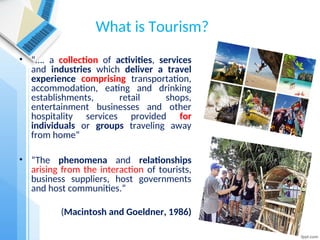
• “…. a collection of activities, services
and industries which deliver a travel
experience comprising transportation,
accommodation, eating and drinking
establishments, retail shops,
entertainment businesses and other
hospitality services provided for
individuals or groups traveling away
from home“
• “The phenomena and relationships
arising from the interaction of tourists,
business suppliers, host governments
and host communities.”
(Macintosh and Goeldner, 1986)
What is Tourism?
• Tourism is a social, cultural and
economic phenomenon which entails
the movement of people to countries or
places outside their usual environment
for personal or business/professional
purposes. These people are called
visitors (which may be either tourists or
excursionists; residents or non-residents)
and tourism has to do with their
activities, some of which imply tourism
expenditure.
( World Tourism Organization,
1991)
What is Tourism?
• Travel
Refers to the activity of travelers. A
traveler is someone who moves
between different geographic
locations, for any purpose at any
duration. The visitor is a particular type
of traveler and consequently tourism is
a subset of travel.
What is Tourism?
• Tourism as a concept of space and time.
• Space = travel away from home location
or region
• Time = time spent away from home
location
• Different terms exists:
Eg: International tourist, International
excursionist, domestic tourists
(Hall, 2008)
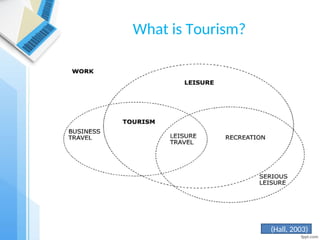
What is Tourism?
(Hall, 2003)
What is Tourism?
(Hall, 2004,
2005, p. 130)
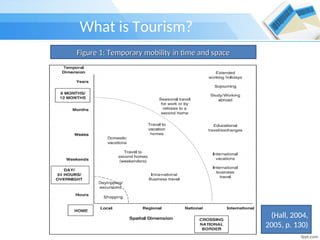
Figure 1: Temporary mobility in time and space
What is Tourism?
(Hall, 2003)
(Hall, 2004,
2005, p. 132)
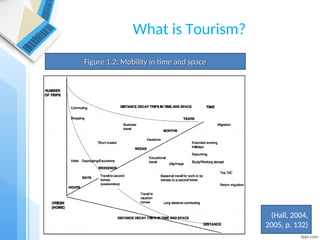
Figure 1.2: Mobility in time and space
What is Tourism?
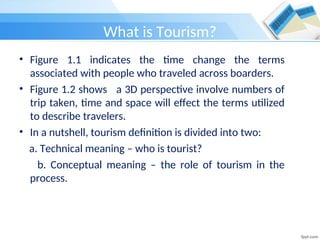
• Figure 1.1 indicates the time change the terms
associated with people who traveled across boarders.
• Figure 1.2 shows a 3D perspective involve numbers of
trip taken, time and space will effect the terms utilized
to describe travelers.
• In a nutshell, tourism definition is divided into two:
a. Technical meaning – who is tourist?
b. Conceptual meaning – the role of tourism in the
process.
What is Planning?
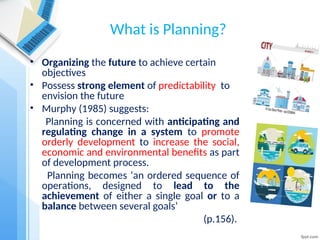
• Organizing the future to achieve certain
objectives
• Possess strong element of predictability to
envision the future
• Murphy (1985) suggests:
Planning is concerned with anticipating and
regulating change in a system to promote
orderly development to increase the social,
economic and environmental benefits as part
of development process.
Planning becomes ‘an ordered sequence of
operations, designed to lead to the
achievement of either a single goal or to a
balance between several goals’
(p.156).
What is Planning?
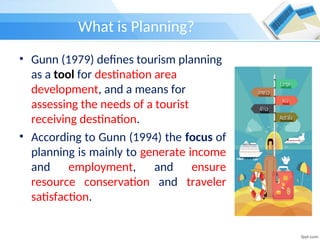
• Gunn (1979) defines tourism planning
as a tool for destination area
development, and a means for
assessing the needs of a tourist
receiving destination.
• According to Gunn (1994) the focus of
planning is mainly to generate income
and employment, and ensure
resource conservation and traveler
satisfaction.
What is Planning?
• Planning helps under or low
developed destinations to receive
guidelines for future tourism
development.
• For already developed countries,
planning can be used as a means
“to revitalize the tourism sector
and maintain its future viability”
(WTO, 1994, p.3).
What is Planning?
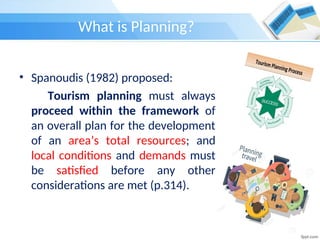
• Spanoudis (1982) proposed:
Tourism planning must always
proceed within the framework of
an overall plan for the development
of an area’s total resources; and
local conditions and demands must
be satisfied before any other
considerations are met (p.314).
What is Planning?
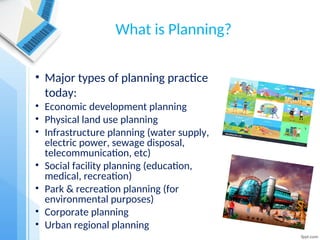
• Major types of planning practice
today:
• Economic development planning
• Physical land use planning
• Infrastructure planning (water supply,
electric power, sewage disposal,
telecommunication, etc)
• Social facility planning (education,
medical, recreation)
• Park & recreation planning (for
environmental purposes)
• Corporate planning
• Urban regional planning
What is Planning?
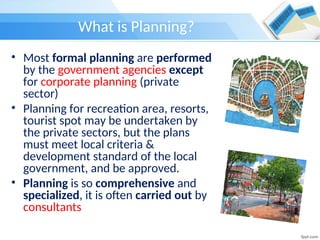
• Most formal planning are performed
by the government agencies except
for corporate planning (private
sector)
• Planning for recreation area, resorts,
tourist spot may be undertaken by
the private sectors, but the plans
must meet local criteria &
development standard of the local
government, and be approved.
• Planning is so comprehensive and
specialized, it is often carried out by
consultants
What is Development?
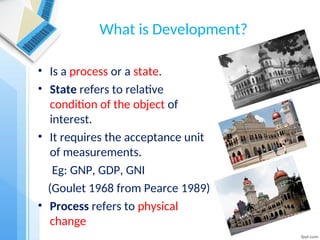
• Is a process or a state.
• State refers to relative
condition of the object of
interest.
• It requires the acceptance unit
of measurements.
Eg: GNP, GDP, GNI
(Goulet 1968 from Pearce 1989)
• Process refers to physical
change
What is Development?
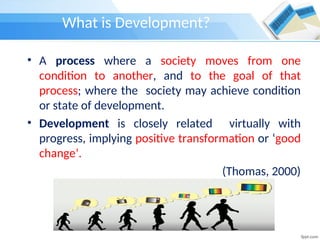
• A process where a society moves from one
condition to another, and to the goal of that
process; where the society may achieve condition
or state of development.
• Development is closely related virtually with
progress, implying positive transformation or ‘good
change’.
(Thomas, 2000)
What is Development?
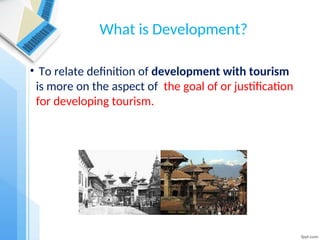
• To relate definition of development with tourism
is more on the aspect of the goal of or justification
for developing tourism.
Conclusion
• Today, tourism industry grow
tremendously.
• In order to ensure the industry can
benefit everyone in the earth,
planning and development of
products and services require careful
considerations.
• The choice falls on our
hand.

1.1_Definition_of_terms_HTT557_1 (1).ppt

  • 1.
    Chapter 1: Introduction toTourism, Planning and Development 1.1: Definition of Terms
  • 2.
    Learning Outcome • Atthe end of the section, you will be able to: 1. Define the meaning of tourism. 2. Describe what is planning. 3. Discuss the term development.
  • 3.
    What is Tourism? •Definitions being made to serve different purposes. • Many scholars and organizations described as follows:
  • 4.
    What is Tourism? •“…. a collection of activities, services and industries which deliver a travel experience comprising transportation, accommodation, eating and drinking establishments, retail shops, entertainment businesses and other hospitality services provided for individuals or groups traveling away from home“ • “The phenomena and relationships arising from the interaction of tourists, business suppliers, host governments and host communities.” (Macintosh and Goeldner, 1986)
  • 5.
    What is Tourism? •Tourism is a social, cultural and economic phenomenon which entails the movement of people to countries or places outside their usual environment for personal or business/professional purposes. These people are called visitors (which may be either tourists or excursionists; residents or non-residents) and tourism has to do with their activities, some of which imply tourism expenditure. ( World Tourism Organization, 1991)
  • 6.
    What is Tourism? •Travel Refers to the activity of travelers. A traveler is someone who moves between different geographic locations, for any purpose at any duration. The visitor is a particular type of traveler and consequently tourism is a subset of travel.
  • 7.
    What is Tourism? •Tourism as a concept of space and time. • Space = travel away from home location or region • Time = time spent away from home location • Different terms exists: Eg: International tourist, International excursionist, domestic tourists (Hall, 2008)
  • 8.
  • 9.
    What is Tourism? (Hall,2004, 2005, p. 130) Figure 1: Temporary mobility in time and space Figure 1: Temporary mobility in time and space
  • 10.
    What is Tourism? (Hall,2003) (Hall, 2004, 2005, p. 132) Figure 1.2: Mobility in time and space Figure 1.2: Mobility in time and space
  • 11.
    What is Tourism? •Figure 1.1 indicates the time change the terms associated with people who traveled across boarders. • Figure 1.2 shows a 3D perspective involve numbers of trip taken, time and space will effect the terms utilized to describe travelers. • In a nutshell, tourism definition is divided into two: a. Technical meaning – who is tourist? b. Conceptual meaning – the role of tourism in the process.
  • 12.
    What is Planning? •Organizing the future to achieve certain objectives • Possess strong element of predictability to envision the future • Murphy (1985) suggests: Planning is concerned with anticipating and regulating change in a system to promote orderly development to increase the social, economic and environmental benefits as part of development process. Planning becomes ‘an ordered sequence of operations, designed to lead to the achievement of either a single goal or to a balance between several goals’ (p.156).
  • 13.
    What is Planning? •Gunn (1979) defines tourism planning as a tool for destination area development, and a means for assessing the needs of a tourist receiving destination. • According to Gunn (1994) the focus of planning is mainly to generate income and employment, and ensure resource conservation and traveler satisfaction.
  • 14.
    What is Planning? •Planning helps under or low developed destinations to receive guidelines for future tourism development. • For already developed countries, planning can be used as a means “to revitalize the tourism sector and maintain its future viability” (WTO, 1994, p.3).
  • 15.
    What is Planning? •Spanoudis (1982) proposed: Tourism planning must always proceed within the framework of an overall plan for the development of an area’s total resources; and local conditions and demands must be satisfied before any other considerations are met (p.314).
  • 16.
    What is Planning? •Major types of planning practice today: • Economic development planning • Physical land use planning • Infrastructure planning (water supply, electric power, sewage disposal, telecommunication, etc) • Social facility planning (education, medical, recreation) • Park & recreation planning (for environmental purposes) • Corporate planning • Urban regional planning
  • 17.
    What is Planning? •Most formal planning are performed by the government agencies except for corporate planning (private sector) • Planning for recreation area, resorts, tourist spot may be undertaken by the private sectors, but the plans must meet local criteria & development standard of the local government, and be approved. • Planning is so comprehensive and specialized, it is often carried out by consultants
  • 18.
    What is Development? •Is a process or a state. • State refers to relative condition of the object of interest. • It requires the acceptance unit of measurements. Eg: GNP, GDP, GNI (Goulet 1968 from Pearce 1989) • Process refers to physical change
  • 19.
    What is Development? •A process where a society moves from one condition to another, and to the goal of that process; where the society may achieve condition or state of development. • Development is closely related virtually with progress, implying positive transformation or ‘good change’. (Thomas, 2000)
  • 20.
    What is Development? •To relate definition of development with tourism is more on the aspect of the goal of or justification for developing tourism.
  • 21.
    Conclusion • Today, tourismindustry grow tremendously. • In order to ensure the industry can benefit everyone in the earth, planning and development of products and services require careful considerations. • The choice falls on our hand.