Travel and Tourism
Definitions and Concepts
Definitions
Travel
Destination
orientation
Purposeful
Direct
Tourism
Leisure pursuit
Acquisition
activity
Meandering
Tourism Cycle
Leave home
Use transportation to travel away
Arrive or journey in a new place or space
Acquire mementos and souvenirs
Use transportation to travel back
Arrive back home
Use mementos to reconstruct trip
Advancements in Travel
1. A system of currency exchange
Roman coins
Greek games
Common language (Latin)
2. Rural to urban movement
Grand Tour (16th century)
Spa and seaside resort (19th century)
More travel advancements
Holidays (from holy days) for workers
(UK)
Railway opens US
Wealthy class emerges to tour
Vacations for middle classes
Mass tourism after WWII
Travel democratized
Hedonic travel prevails
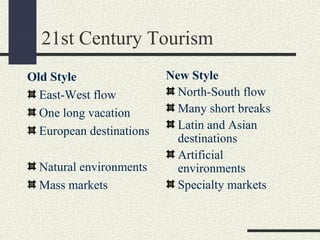
21st Century Tourism
Old Style
East-West flow
One long vacation
European destinations
Natural environments
Mass markets
New Style
North-South flow
Many short breaks
Latin and Asian
destinations
Artificial
environments
Specialty markets
Chapter 1
Attractions and Services for the
Traveler and Tourist
Attraction Destinations
PRIMARY
Extended time
Breadth of appeal
Market orientation
(Disney-amusement)
Site orientation
(Aspen-sport)
SECONDARY
Short time; stopover
Narrow focus
(MOMA - education)
Accessible to transport
Roadside attractions
Facilities
Lodging
Food and beverage
Support Industries (goods, services,
activities)
Proximity to transportation
Hospitality programs
Souvenirs
Integral part of economic structure of
destination
Serve as tangible symbols to commemorate
travel experiences
Act as ‘site markers’ of visitation
Embody memories and recollections of
travel
Function of souvenirs
Pictorial images (photos, postcards, books)
Pieces-of-the-rock (collected from nature)
Symbolic shorthand (miniatures)
Markers (inscribed with location; t-shirt)
Local products (food, crafts, art)
Souvenir meanings
Niave travelers assign public meanings to
souvenirs that are specific to the locale and
are representations of some geographic
space; conspicuous authenticity
Experienced travelers see souvenirs as
private representations of hedonics
(pleasures) that relate to friends, family or
other experiences; abstract authenticity
Chapter 2
Tourism impacts on the economy,
society, culture and environment
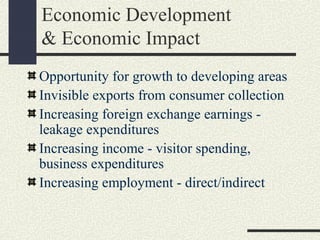
Economic Development
& Economic Impact
Opportunity for growth to developing areas
Invisible exports from consumer collection
Increasing foreign exchange earnings -
leakage expenditures
Increasing income - visitor spending,
business expenditures
Increasing employment - direct/indirect
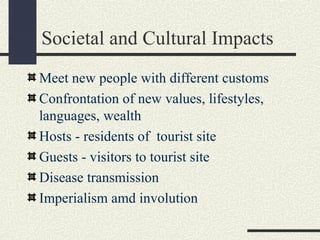
Societal and Cultural Impacts
Meet new people with different customs
Confrontation of new values, lifestyles,
languages, wealth
Hosts - residents of tourist site
Guests - visitors to tourist site
Disease transmission
Imperialism amd involution
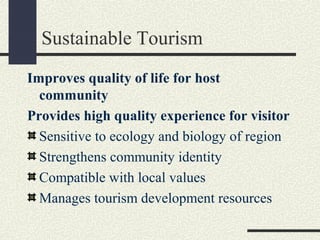
Sustainable Tourism
Improves quality of life for host
community
Provides high quality experience for visitor
Sensitive to ecology and biology of region
Strengthens community identity
Compatible with local values
Manages tourism development resources
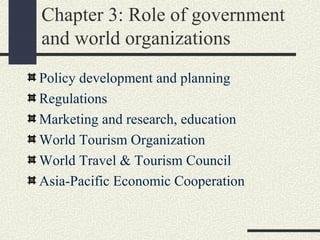
Chapter 3: Role of government
and world organizations
Policy development and planning
Regulations
Marketing and research, education
World Tourism Organization
World Travel & Tourism Council
Asia-Pacific Economic Cooperation
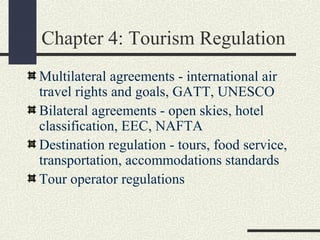
Chapter 4: Tourism Regulation
Multilateral agreements - international air
travel rights and goals, GATT, UNESCO
Bilateral agreements - open skies, hotel
classification, EEC, NAFTA
Destination regulation - tours, food service,
transportation, accommodations standards
Tour operator regulations
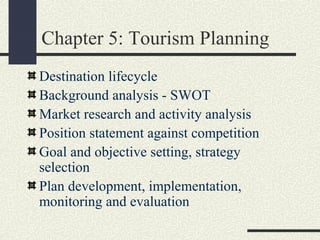
Chapter 5: Tourism Planning
Destination lifecycle
Background analysis - SWOT
Market research and activity analysis
Position statement against competition
Goal and objective setting, strategy
selection
Plan development, implementation,
monitoring and evaluation
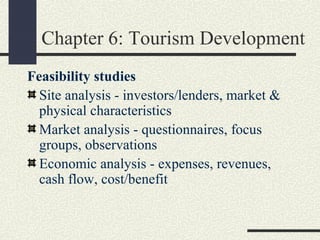
Chapter 6: Tourism Development
Feasibility studies
Site analysis - investors/lenders, market &
physical characteristics
Market analysis - questionnaires, focus
groups, observations
Economic analysis - expenses, revenues,
cash flow, cost/benefit
Chapter 7
Tourism Marketing
Marketing Segment Criteria
Measurable number of visitors
Accessible through media or promotion
Sufficient numbers to justify effort
Unique characteristics
Sustainability
Competitive advantage
Similar characteristics or motivations
Segmentation
Demographic and socioeconomic
Geographic
Purpose of trip
Behavioral
Psychographic
Product-related
Channel of distribution
Positioning
Determine how tourists perceive position
Evaluate whether to establish, change or
reinforce that position
Objective positioning - match site attributes
with tourist needs
Subjective positioning - correct
misperceptions; repositioning
Positioning approaches
Product features (Swiss Alps)
Benefits, problem solution, needs
(LaCosta’s full service spa)
Special usage occasion (Honeymoon at
Madonna Inn)
User category (Avis Number 2)
Against a competitor (Don’t take Amex)
Product class (Love Boat)
Marketing planning
Situation analysis - economy, consumers,
competition, trends, SWOT
Goals- segments, position, objectives and
strategies
Marketing mix - integrated brand
communication
Implementation - tracking and
modification
Evaluation - effectiveness, accountability
Marketing mix - 8Ps
Product - transport, lodging, souvenirs
Price - lifecycle, competition, TM
Promotion - advertising, PR, sales, publicity
Place - channel, intermediaries
Packaging - all inclusive trips
Programming - activities, events
People - human resources
Partnership - coop ads and packaging
Chapter 8
Tourism Promotional Communication
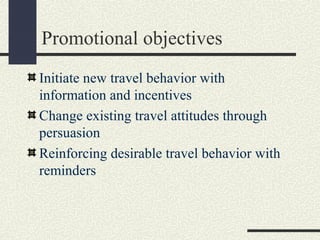
Promotional objectives
Initiate new travel behavior with
information and incentives
Change existing travel attitudes through
persuasion
Reinforcing desirable travel behavior with
reminders
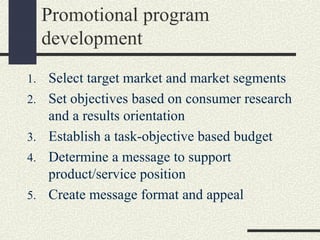
Promotional program
development
1. Select target market and market segments
2. Set objectives based on consumer research
and a results orientation
3. Establish a task-objective based budget
4. Determine a message to support
product/service position
5. Create message format and appeal
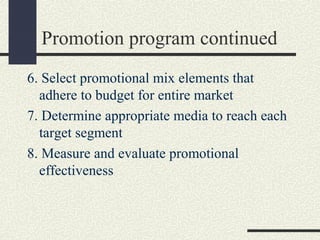
Promotion program continued
6. Select promotional mix elements that
adhere to budget for entire market
7. Determine appropriate media to reach each
target segment
8. Measure and evaluate promotional
effectiveness
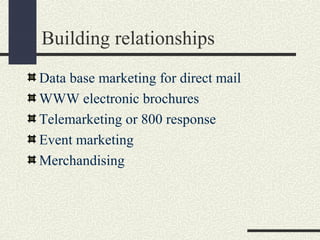
Building relationships
Data base marketing for direct mail
WWW electronic brochures
Telemarketing or 800 response
Event marketing
Merchandising
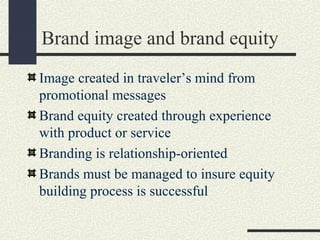
Brand image and brand equity
Image created in traveler’s mind from
promotional messages
Brand equity created through experience
with product or service
Branding is relationship-oriented
Brands must be managed to insure equity
building process is successful
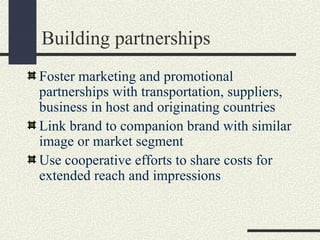
Building partnerships
Foster marketing and promotional
partnerships with transportation, suppliers,
business in host and originating countries
Link brand to companion brand with similar
image or market segment
Use cooperative efforts to share costs for
extended reach and impressions

Tourism

  • 1.
  • 2.
  • 3.
    Tourism Cycle Leave home Usetransportation to travel away Arrive or journey in a new place or space Acquire mementos and souvenirs Use transportation to travel back Arrive back home Use mementos to reconstruct trip
  • 4.
    Advancements in Travel 1.A system of currency exchange Roman coins Greek games Common language (Latin) 2. Rural to urban movement Grand Tour (16th century) Spa and seaside resort (19th century)
  • 5.
    More travel advancements Holidays(from holy days) for workers (UK) Railway opens US Wealthy class emerges to tour Vacations for middle classes Mass tourism after WWII Travel democratized Hedonic travel prevails
  • 6.
    21st Century Tourism OldStyle East-West flow One long vacation European destinations Natural environments Mass markets New Style North-South flow Many short breaks Latin and Asian destinations Artificial environments Specialty markets
  • 7.
    Chapter 1 Attractions andServices for the Traveler and Tourist
  • 8.
    Attraction Destinations PRIMARY Extended time Breadthof appeal Market orientation (Disney-amusement) Site orientation (Aspen-sport) SECONDARY Short time; stopover Narrow focus (MOMA - education) Accessible to transport Roadside attractions
  • 9.
    Facilities Lodging Food and beverage SupportIndustries (goods, services, activities) Proximity to transportation Hospitality programs
  • 10.
    Souvenirs Integral part ofeconomic structure of destination Serve as tangible symbols to commemorate travel experiences Act as ‘site markers’ of visitation Embody memories and recollections of travel
  • 11.
    Function of souvenirs Pictorialimages (photos, postcards, books) Pieces-of-the-rock (collected from nature) Symbolic shorthand (miniatures) Markers (inscribed with location; t-shirt) Local products (food, crafts, art)
  • 12.
    Souvenir meanings Niave travelersassign public meanings to souvenirs that are specific to the locale and are representations of some geographic space; conspicuous authenticity Experienced travelers see souvenirs as private representations of hedonics (pleasures) that relate to friends, family or other experiences; abstract authenticity
  • 13.
    Chapter 2 Tourism impactson the economy, society, culture and environment
  • 14.
    Economic Development & EconomicImpact Opportunity for growth to developing areas Invisible exports from consumer collection Increasing foreign exchange earnings - leakage expenditures Increasing income - visitor spending, business expenditures Increasing employment - direct/indirect
  • 15.
    Societal and CulturalImpacts Meet new people with different customs Confrontation of new values, lifestyles, languages, wealth Hosts - residents of tourist site Guests - visitors to tourist site Disease transmission Imperialism amd involution
  • 16.
    Sustainable Tourism Improves qualityof life for host community Provides high quality experience for visitor Sensitive to ecology and biology of region Strengthens community identity Compatible with local values Manages tourism development resources
  • 17.
    Chapter 3: Roleof government and world organizations Policy development and planning Regulations Marketing and research, education World Tourism Organization World Travel & Tourism Council Asia-Pacific Economic Cooperation
  • 18.
    Chapter 4: TourismRegulation Multilateral agreements - international air travel rights and goals, GATT, UNESCO Bilateral agreements - open skies, hotel classification, EEC, NAFTA Destination regulation - tours, food service, transportation, accommodations standards Tour operator regulations
  • 19.
    Chapter 5: TourismPlanning Destination lifecycle Background analysis - SWOT Market research and activity analysis Position statement against competition Goal and objective setting, strategy selection Plan development, implementation, monitoring and evaluation
  • 20.
    Chapter 6: TourismDevelopment Feasibility studies Site analysis - investors/lenders, market & physical characteristics Market analysis - questionnaires, focus groups, observations Economic analysis - expenses, revenues, cash flow, cost/benefit
  • 21.
  • 22.
    Marketing Segment Criteria Measurablenumber of visitors Accessible through media or promotion Sufficient numbers to justify effort Unique characteristics Sustainability Competitive advantage Similar characteristics or motivations
  • 23.
    Segmentation Demographic and socioeconomic Geographic Purposeof trip Behavioral Psychographic Product-related Channel of distribution
  • 24.
    Positioning Determine how touristsperceive position Evaluate whether to establish, change or reinforce that position Objective positioning - match site attributes with tourist needs Subjective positioning - correct misperceptions; repositioning
  • 25.
    Positioning approaches Product features(Swiss Alps) Benefits, problem solution, needs (LaCosta’s full service spa) Special usage occasion (Honeymoon at Madonna Inn) User category (Avis Number 2) Against a competitor (Don’t take Amex) Product class (Love Boat)
  • 26.
    Marketing planning Situation analysis- economy, consumers, competition, trends, SWOT Goals- segments, position, objectives and strategies Marketing mix - integrated brand communication Implementation - tracking and modification Evaluation - effectiveness, accountability
  • 27.
    Marketing mix -8Ps Product - transport, lodging, souvenirs Price - lifecycle, competition, TM Promotion - advertising, PR, sales, publicity Place - channel, intermediaries Packaging - all inclusive trips Programming - activities, events People - human resources Partnership - coop ads and packaging
  • 28.
  • 29.
    Promotional objectives Initiate newtravel behavior with information and incentives Change existing travel attitudes through persuasion Reinforcing desirable travel behavior with reminders
  • 30.
    Promotional program development 1. Selecttarget market and market segments 2. Set objectives based on consumer research and a results orientation 3. Establish a task-objective based budget 4. Determine a message to support product/service position 5. Create message format and appeal
  • 31.
    Promotion program continued 6.Select promotional mix elements that adhere to budget for entire market 7. Determine appropriate media to reach each target segment 8. Measure and evaluate promotional effectiveness
  • 32.
    Building relationships Data basemarketing for direct mail WWW electronic brochures Telemarketing or 800 response Event marketing Merchandising
  • 33.
    Brand image andbrand equity Image created in traveler’s mind from promotional messages Brand equity created through experience with product or service Branding is relationship-oriented Brands must be managed to insure equity building process is successful
  • 34.
    Building partnerships Foster marketingand promotional partnerships with transportation, suppliers, business in host and originating countries Link brand to companion brand with similar image or market segment Use cooperative efforts to share costs for extended reach and impressions