Travel & Tourism

                      BY
           Vinitha Emilia
          Sneha Thomas
TRAVEL & TOURISM
                           EVOLUTION
•   2000 years Before Christ, in India and Mesopotamia
   Travel for trade was an important feature since the beginning of civilisation.
•
    600 BC and thereafter
   The earliest form of leisure tourism can be traced as far back as the Babylonian and Egyptian
    empires.
   In India, as elsewhere, kings travelled for empire building.

•   500 BC, the Greek civilisation
   The Greek tourists travelled to sites of healing gods.
   Inns were established in large towns and seaports to provide for travellers' needs.
   This era also saw the birth of travel writing.


•   In the Middle Ages
   Travel became difficult and dangerous as people travelled for business or for a sense of obligation
    and duty.
• Role of the industrial revolution in promoting travel in the west
 The rapid urbanisation due to industrialisation led to mass immigration in cities.
  These people were lured into travel to escape their environment to places of
  natural beauty, often to the countryside they had come from change of routine
  from a physically and psychologically stressful jobs to a leisurely pace in
  countryside.

• The development of the spas
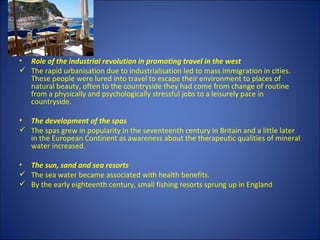
 The spas grew in popularity in the seventeenth century in Britain and a little later
  in the European Continent as awareness about the therapeutic qualities of mineral
  water increased.

• The sun, sand and sea resorts
 The sea water became associated with health benefits.
 By the early eighteenth century, small fishing resorts sprung up in England
• Highlights of travel in the nineteenth century
 Advent of railway initially catalysed business
  travel and later leisure travel. Gradually
  special trains were chartered to only take
  leisure travel to their destinations.
 Tourism in the Twentieth Century
  The birth of air travel and after
PRODUCT
• Travel and Tourism one of the world's largest foreign exchange
  earner among industries, provides employment directly to millions
  of people worldwide and indirectly through many associated
  service industries.
• A very wide industry, it includes:
 Government tourism departments,
 Immigration and customs services,
 travel agencies,
 airlines,
 tour operators,
 hotels
 and many associated service industries such as airline catering or
  laundry services, Guides, Interpreters, Tourism promotion and sales
  etc.
TYPES OF TOURISM
   Leisure travel
   Winter tourism
   Mass tourism
   Ecotourism
   Recession tourism
   Medical tourism
   Educational tourism
   Creative tourism
   Dark tourism
   Sports tourism
   Latest trends
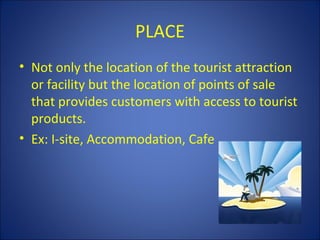
PLACE
• Not only the location of the tourist attraction
  or facility but the location of points of sale
  that provides customers with access to tourist
  products.
• Ex: I-site, Accommodation, Cafe
PRICE
• Used to achieve predetermined sales volume
  and revenue objectives
• It gives a preceived value in the eyes of the
  customer
PEOPLE
• Traveller
• Tourist
Meet their expectations
• Employees – Physical appearance, Knowledge, Grooming,
  Trained
• The people who sell and service your product are an
  extremely important part of tourism marketing. Friendly
  personal service and trained employees can make or break a
  tourism business.
• Because much of the tourism industry is based upon word of-
  mouth advertising particularly about the service received-
  what your customers say after they depart can thrust your
  business forward or send it into a downward spiral.
PROCESS
• There are different types of processes involved in
    running a tourism business
 administration,
 training,
 planning and strategizing,
 recruitment,
 distribution,
 purchasing and service delivery.
It is important to ensure that these processes are
    planned and carried out properly so that operations
    run smoothly and problems are rectified quickly
PROMOTION
• A range of activities can be used to convince
  customers to buy the product, including
  information kits, web sites, advertising,
  personal selling, sales promotion, travel
  shows, and public relations.
• Utilize tourist information centers, such as
  welcome centers.
• Participation with your state, regional and
  local tourism offices and associations.
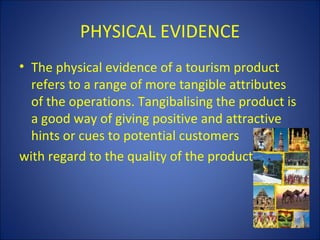
PHYSICAL EVIDENCE
• The physical evidence of a tourism product
  refers to a range of more tangible attributes
  of the operations. Tangibalising the product is
  a good way of giving positive and attractive
  hints or cues to potential customers
with regard to the quality of the product.
THANK YOU

7 ps

  • 1.
    Travel & Tourism BY Vinitha Emilia Sneha Thomas
  • 3.
    TRAVEL & TOURISM EVOLUTION • 2000 years Before Christ, in India and Mesopotamia  Travel for trade was an important feature since the beginning of civilisation. • 600 BC and thereafter  The earliest form of leisure tourism can be traced as far back as the Babylonian and Egyptian empires.  In India, as elsewhere, kings travelled for empire building. • 500 BC, the Greek civilisation  The Greek tourists travelled to sites of healing gods.  Inns were established in large towns and seaports to provide for travellers' needs.  This era also saw the birth of travel writing. • In the Middle Ages  Travel became difficult and dangerous as people travelled for business or for a sense of obligation and duty.
  • 4.
    • Role ofthe industrial revolution in promoting travel in the west  The rapid urbanisation due to industrialisation led to mass immigration in cities. These people were lured into travel to escape their environment to places of natural beauty, often to the countryside they had come from change of routine from a physically and psychologically stressful jobs to a leisurely pace in countryside. • The development of the spas  The spas grew in popularity in the seventeenth century in Britain and a little later in the European Continent as awareness about the therapeutic qualities of mineral water increased. • The sun, sand and sea resorts  The sea water became associated with health benefits.  By the early eighteenth century, small fishing resorts sprung up in England
  • 5.
    • Highlights oftravel in the nineteenth century  Advent of railway initially catalysed business travel and later leisure travel. Gradually special trains were chartered to only take leisure travel to their destinations.  Tourism in the Twentieth Century The birth of air travel and after
  • 6.
    PRODUCT • Travel andTourism one of the world's largest foreign exchange earner among industries, provides employment directly to millions of people worldwide and indirectly through many associated service industries. • A very wide industry, it includes:  Government tourism departments,  Immigration and customs services,  travel agencies,  airlines,  tour operators,  hotels  and many associated service industries such as airline catering or laundry services, Guides, Interpreters, Tourism promotion and sales etc.
  • 7.
    TYPES OF TOURISM  Leisure travel  Winter tourism  Mass tourism  Ecotourism  Recession tourism  Medical tourism  Educational tourism  Creative tourism  Dark tourism  Sports tourism  Latest trends
  • 8.
    PLACE • Not onlythe location of the tourist attraction or facility but the location of points of sale that provides customers with access to tourist products. • Ex: I-site, Accommodation, Cafe
  • 9.
    PRICE • Used toachieve predetermined sales volume and revenue objectives • It gives a preceived value in the eyes of the customer
  • 10.
    PEOPLE • Traveller • Tourist Meettheir expectations • Employees – Physical appearance, Knowledge, Grooming, Trained • The people who sell and service your product are an extremely important part of tourism marketing. Friendly personal service and trained employees can make or break a tourism business. • Because much of the tourism industry is based upon word of- mouth advertising particularly about the service received- what your customers say after they depart can thrust your business forward or send it into a downward spiral.
  • 11.
    PROCESS • There aredifferent types of processes involved in running a tourism business  administration,  training,  planning and strategizing,  recruitment,  distribution,  purchasing and service delivery. It is important to ensure that these processes are planned and carried out properly so that operations run smoothly and problems are rectified quickly
  • 12.
    PROMOTION • A rangeof activities can be used to convince customers to buy the product, including information kits, web sites, advertising, personal selling, sales promotion, travel shows, and public relations. • Utilize tourist information centers, such as welcome centers. • Participation with your state, regional and local tourism offices and associations.
  • 13.
    PHYSICAL EVIDENCE • Thephysical evidence of a tourism product refers to a range of more tangible attributes of the operations. Tangibalising the product is a good way of giving positive and attractive hints or cues to potential customers with regard to the quality of the product.
  • 14.