

Total Workforce Management 2013:
Rostering
In association with:
2 | Total Workforce Management 2013
Introduction
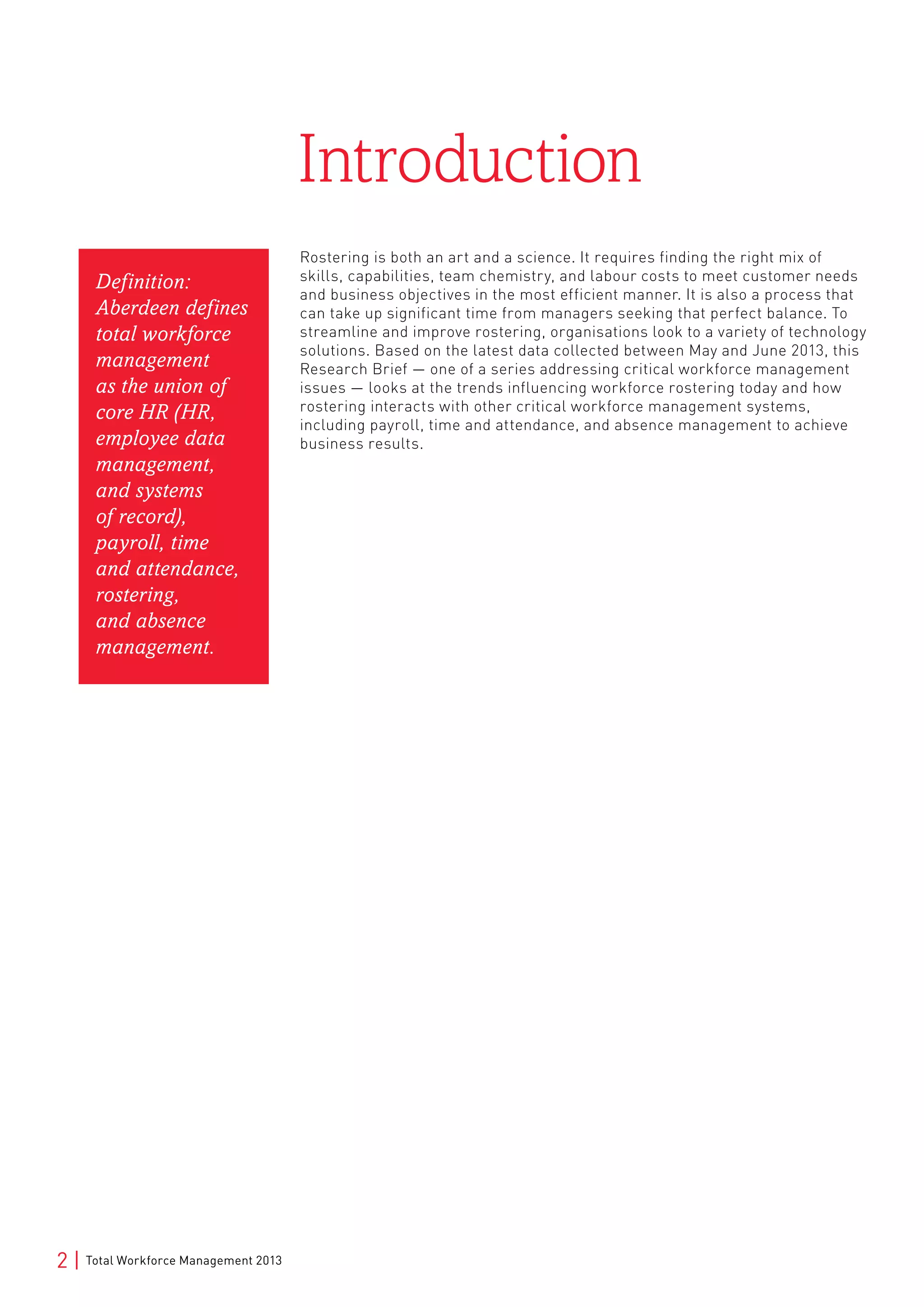
Definition:
Aberdeen defines
total workforce
management
as the union of
core HR (HR,
employee data
management,
and systems
of record),
payroll, time
and attendance,
rostering,
and absence
management.
Rostering is both an art and a science. It requires finding the right mix of
skills, capabilities, team chemistry, and labour costs to meet customer needs
and business objectives in the most efficient manner. It is also a process that
can take up significant time from managers seeking that perfect balance. To
streamline and improve rostering, organisations look to a variety of technology
solutions. Based on the latest data collected between May and June 2013, this
Research Brief — one of a series addressing critical workforce management
issues — looks at the trends influencing workforce rostering today and how
rostering interacts with other critical workforce management systems,
including payroll, time and attendance, and absence management to achieve
business results.
Total Workforce Management 2013 | 4
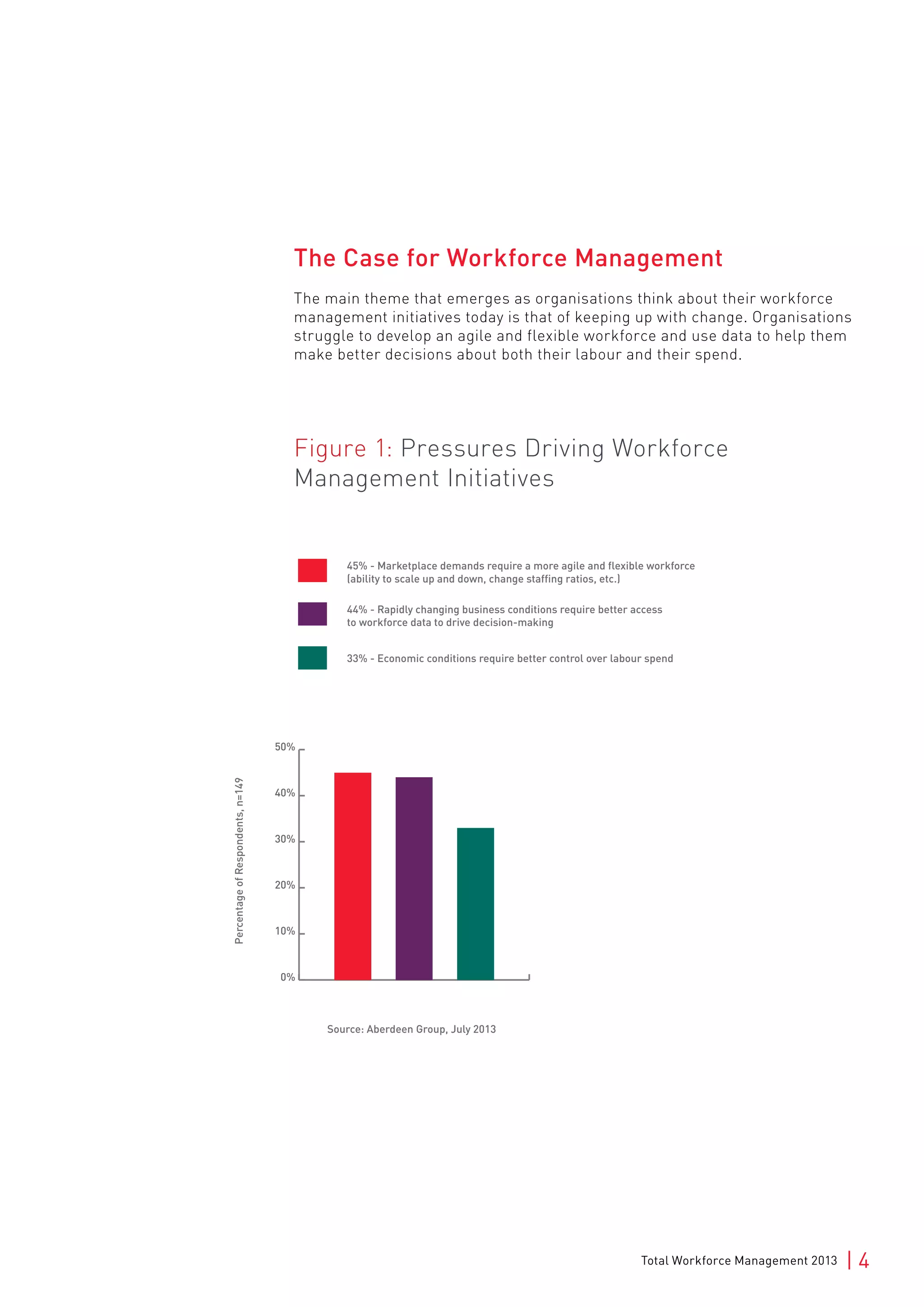
Figure 1: Pressures Driving Workforce
Management Initiatives
The Case for Workforce Management
The main theme that emerges as organisations think about their workforce
management initiatives today is that of keeping up with change. Organisations
struggle to develop an agile and flexible workforce and use data to help them
make better decisions about both their labour and their spend.
0%
10%
20%
30%
40%
50%
33% - Economic conditions require better control over labour spend
44% - Rapidly changing business conditions require better access
to workforce data to drive decision-making
45% - Marketplace demands require a more agile and flexible workforce
(ability to scale up and down, change staffing ratios, etc.)
Source: Aberdeen Group, July 2013
PercentageofRespondents,n=149
5 | Total Workforce Management 2013
To truly respond to these challenges, organisations must consider the full
scope of total workforce management. Aberdeen defines total workforce
management as core HR (HR, employee data management, and system of
record), payroll, time and attendance, rostering, and absence management,
and we’ll go into detail on many of these topics in this research series.
As any manager in an industry highly reliant on hourly labour knows, the
roster is the lifeblood of the organisation. Managers must be able to look at
demand and put together a plan to ensure that the right employees with the
right skills, capabilities, certifications, and availability are rostered at any
given time. And they must do so in a way that is compliant with government
rules and Enterprise Bargaining Agreements and company policy, which
takes into account the most efficient use of their labour budget. It’s not
surprising that organisations look to automated tools to help them manage
this process, as organisations that automate rostering not only reduce the
time required to build rosters, but also reduce their labour costs by helping
to eliminate unplanned overtime, improve revenue by ensuring that the right
staff are in place at the right time, and reduce organisational risk by improving
compliance.
Manual versus Automated
There are many potential benefits to overall workforce management
automation. When asked to cite the most important benefits of automation,
respondents listed the reduction of time spent on workforce management
activities by HR (39%), improved accuracy of workforce data (36%), reduction
in time spent on workforce management activities by managers (36%),
and reduced overall labour cost (31%) as the top four benefits. Clearly
automation helps drive both the efficiency and effectiveness of workforce
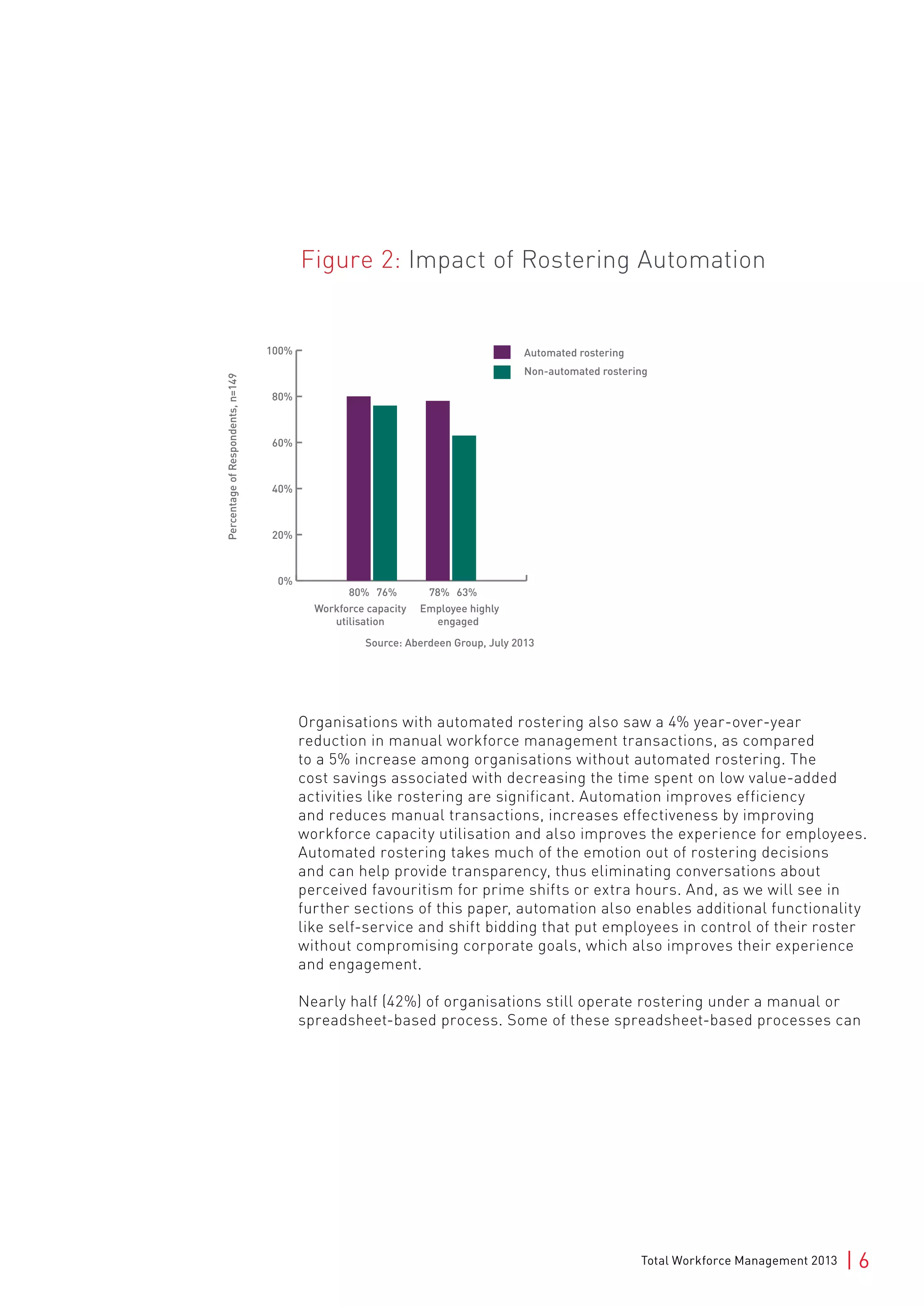
management activities. Automated rostering contributes to these goals. As
illustrated in Figure 2, organisations automating rostering saw 5% greater
workforce capacity utilisation — the percentage of actual work done versus
the theoretical capability available within the roster, a measure of roster and
workforce efficiency — and 24% higher engagement levels due to rostering
transparency than organisations without automated rostering.
Total Workforce Management 2013 | 6
Figure 2: Impact of Rostering Automation
Organisations with automated rostering also saw a 4% year-over-year
reduction in manual workforce management transactions, as compared
to a 5% increase among organisations without automated rostering. The
cost savings associated with decreasing the time spent on low value-added
activities like rostering are significant. Automation improves efficiency
and reduces manual transactions, increases effectiveness by improving
workforce capacity utilisation and also improves the experience for employees.
Automated rostering takes much of the emotion out of rostering decisions
and can help provide transparency, thus eliminating conversations about
perceived favouritism for prime shifts or extra hours. And, as we will see in
further sections of this paper, automation also enables additional functionality
like self-service and shift bidding that put employees in control of their roster
without compromising corporate goals, which also improves their experience
and engagement.
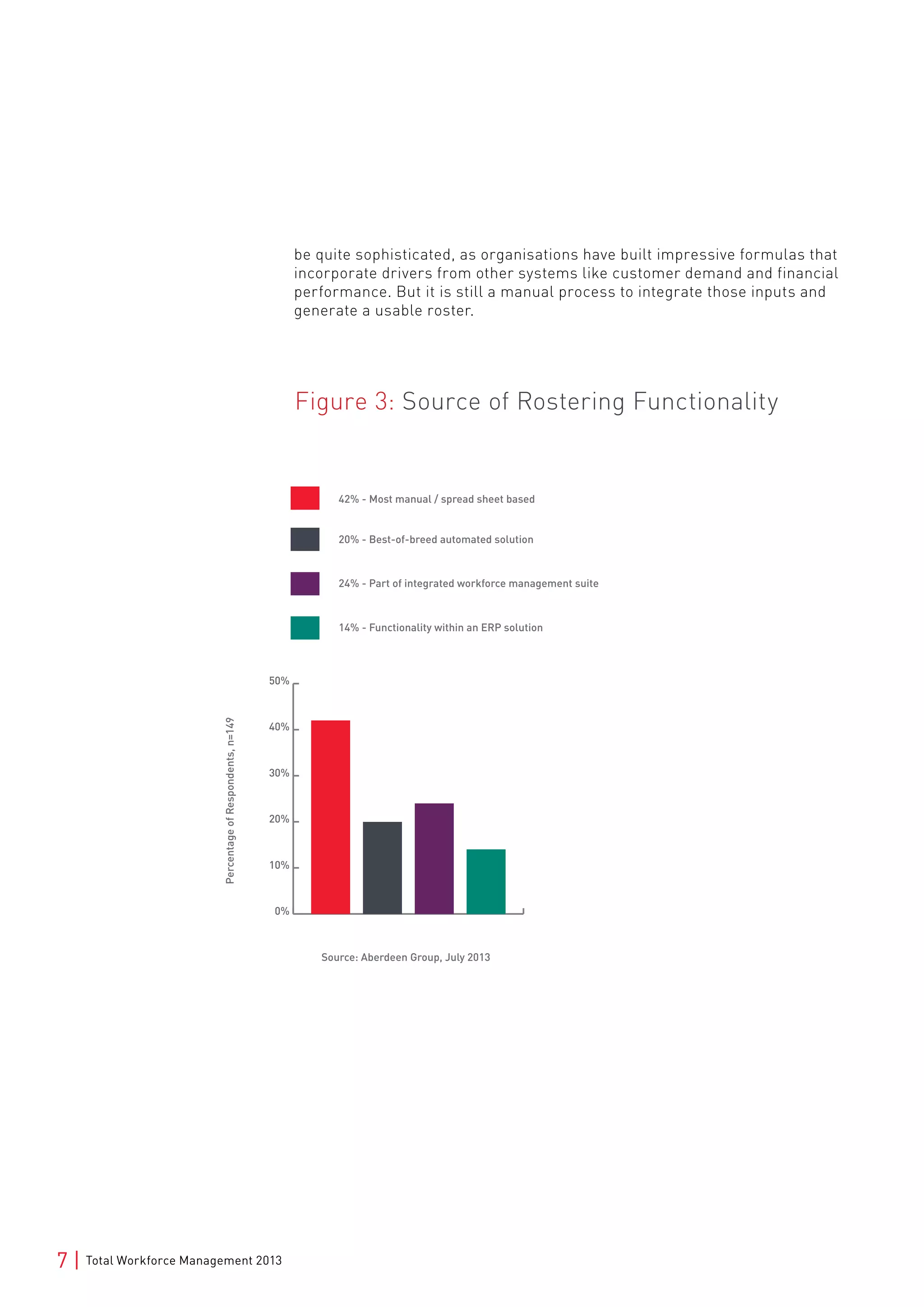
Nearly half (42%) of organisations still operate rostering under a manual or
spreadsheet-based process. Some of these spreadsheet-based processes can
0%
20%
40%
60%
80%
100%
63%78%
Source: Aberdeen Group, July 2013
PercentageofRespondents,n=149
76%80%
Workforce capacity
utilisation
Employee highly
engaged
Automated rostering
Non-automated rostering
7 | Total Workforce Management 2013
Figure 3: Source of Rostering Functionality
be quite sophisticated, as organisations have built impressive formulas that
incorporate drivers from other systems like customer demand and financial
performance. But it is still a manual process to integrate those inputs and
generate a usable roster.
0%
10%
20%
30%
40%
50%
14% - Functionality within an ERP solution
24% - Part of integrated workforce management suite
20% - Best-of-breed automated solution
42% - Most manual / spread sheet based
Source: Aberdeen Group, July 2013
PercentageofRespondents,n=149
Total Workforce Management 2013 | 8
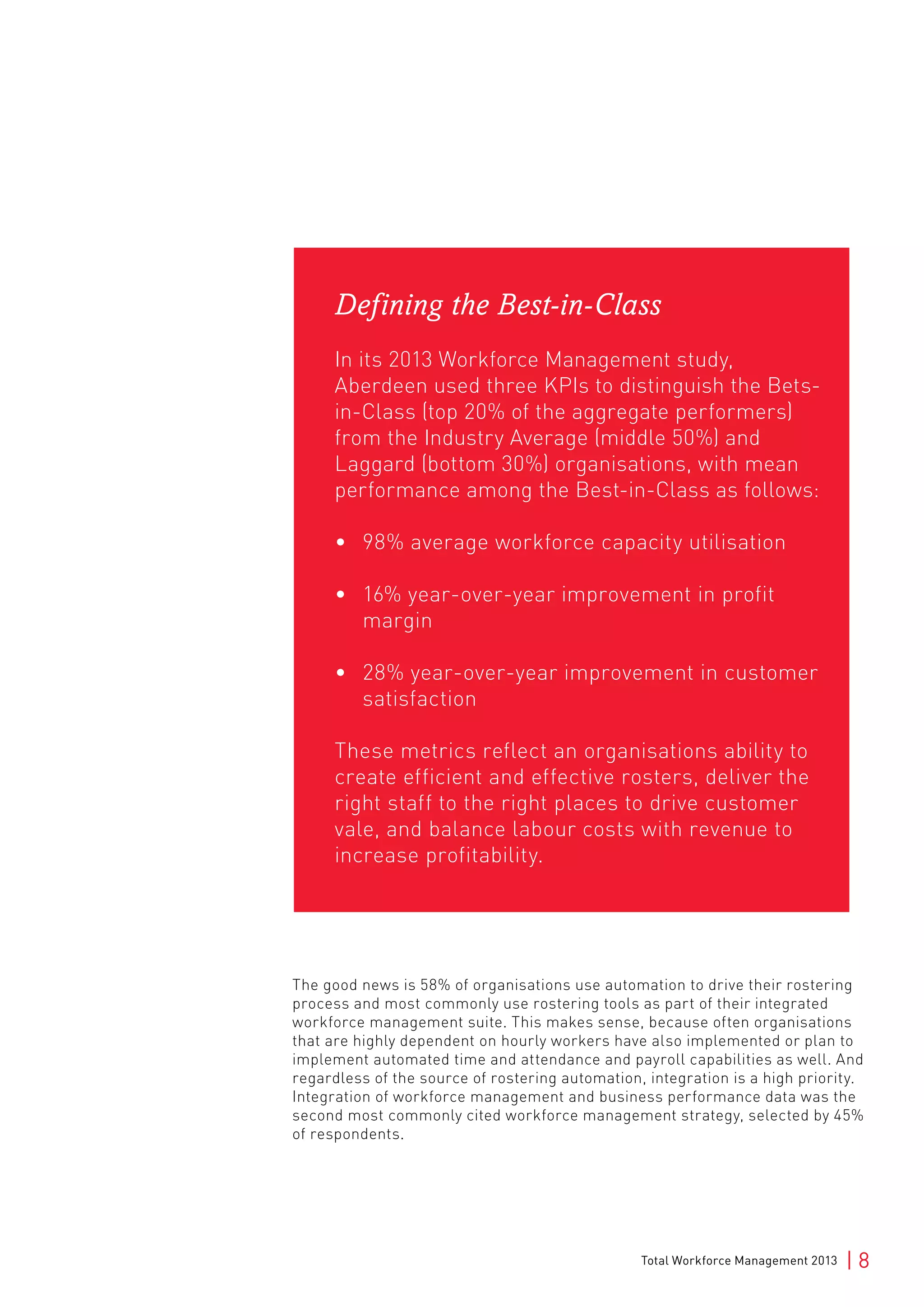
Defining the Best-in-Class
In its 2013 Workforce Management study,
Aberdeen used three KPIs to distinguish the Bets-
in-Class (top 20% of the aggregate performers)
from the Industry Average (middle 50%) and
Laggard (bottom 30%) organisations, with mean
performance among the Best-in-Class as follows:
•	 98% average workforce capacity utilisation
•	 16% year-over-year improvement in profit
margin
•	 28% year-over-year improvement in customer
satisfaction
These metrics reflect an organisations ability to
create efficient and effective rosters, deliver the
right staff to the right places to drive customer
vale, and balance labour costs with revenue to
increase profitability.
The good news is 58% of organisations use automation to drive their rostering
process and most commonly use rostering tools as part of their integrated
workforce management suite. This makes sense, because often organisations
that are highly dependent on hourly workers have also implemented or plan to
implement automated time and attendance and payroll capabilities as well. And
regardless of the source of rostering automation, integration is a high priority.
Integration of workforce management and business performance data was the
second most commonly cited workforce management strategy, selected by 45%
of respondents.
9 | Total Workforce Management 2013
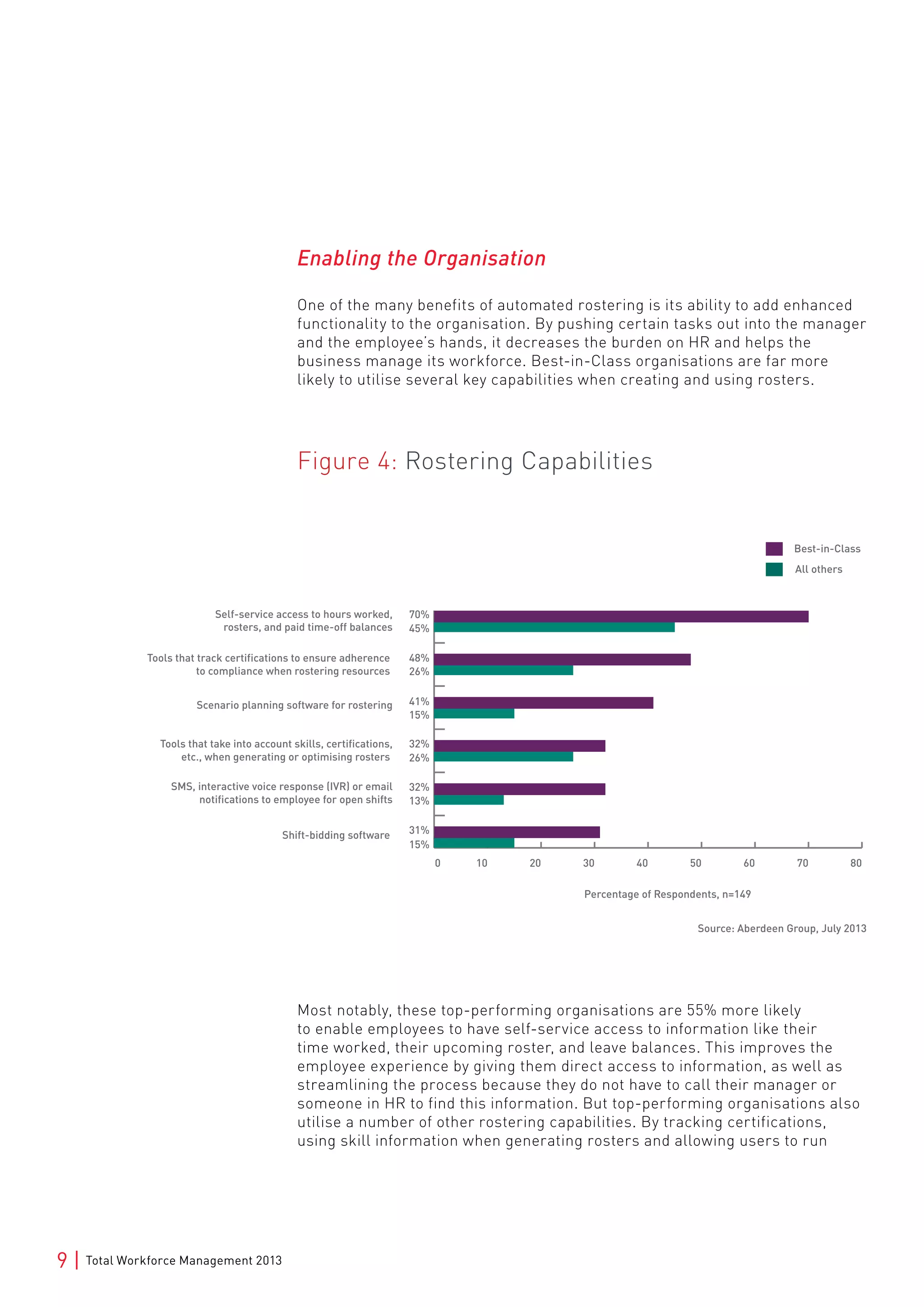
Figure 4: Rostering Capabilities
Enabling the Organisation
One of the many benefits of automated rostering is its ability to add enhanced
functionality to the organisation. By pushing certain tasks out into the manager
and the employee’s hands, it decreases the burden on HR and helps the
business manage its workforce. Best-in-Class organisations are far more
likely to utilise several key capabilities when creating and using rosters.
Most notably, these top-performing organisations are 55% more likely
to enable employees to have self-service access to information like their
time worked, their upcoming roster, and leave balances. This improves the
employee experience by giving them direct access to information, as well as
streamlining the process because they do not have to call their manager or
someone in HR to find this information. But top-performing organisations also
utilise a number of other rostering capabilities. By tracking certifications,
using skill information when generating rosters and allowing users to run
0 10 20 30 40 50 60 70 80
Source: Aberdeen Group, July 2013
Percentage of Respondents, n=149
Best-in-Class
All others
Self-service access to hours worked,
rosters, and paid time-off balances
Tools that track certifications to ensure adherence
to compliance when rostering resources
Scenario planning software for rostering
Tools that take into account skills, certifications,
etc., when generating or optimising rosters
SMS, interactive voice response (IVR) or email
notifications to employee for open shifts
Shift-bidding software
15%
31%
13%
32%
32%
26%
41%
15%
48%
26%
70%
45%
Total Workforce Management 2013 | 10
scenarios, Best-in-Class organisations use automation to not only ensure
they have that right combination of skills that is required to deliver for their
customers, they are also allowing managers and employees to communicate
and collaborate around rosters by enabling shift bidding, utilising automated
tools to reach out to employees to cover shifts, and improving roster visibility.
To achieve the best results, organisations need to not only automate, but also
take advantage of additional capabilities that allow them to use their rostering
data to improve overall performance.
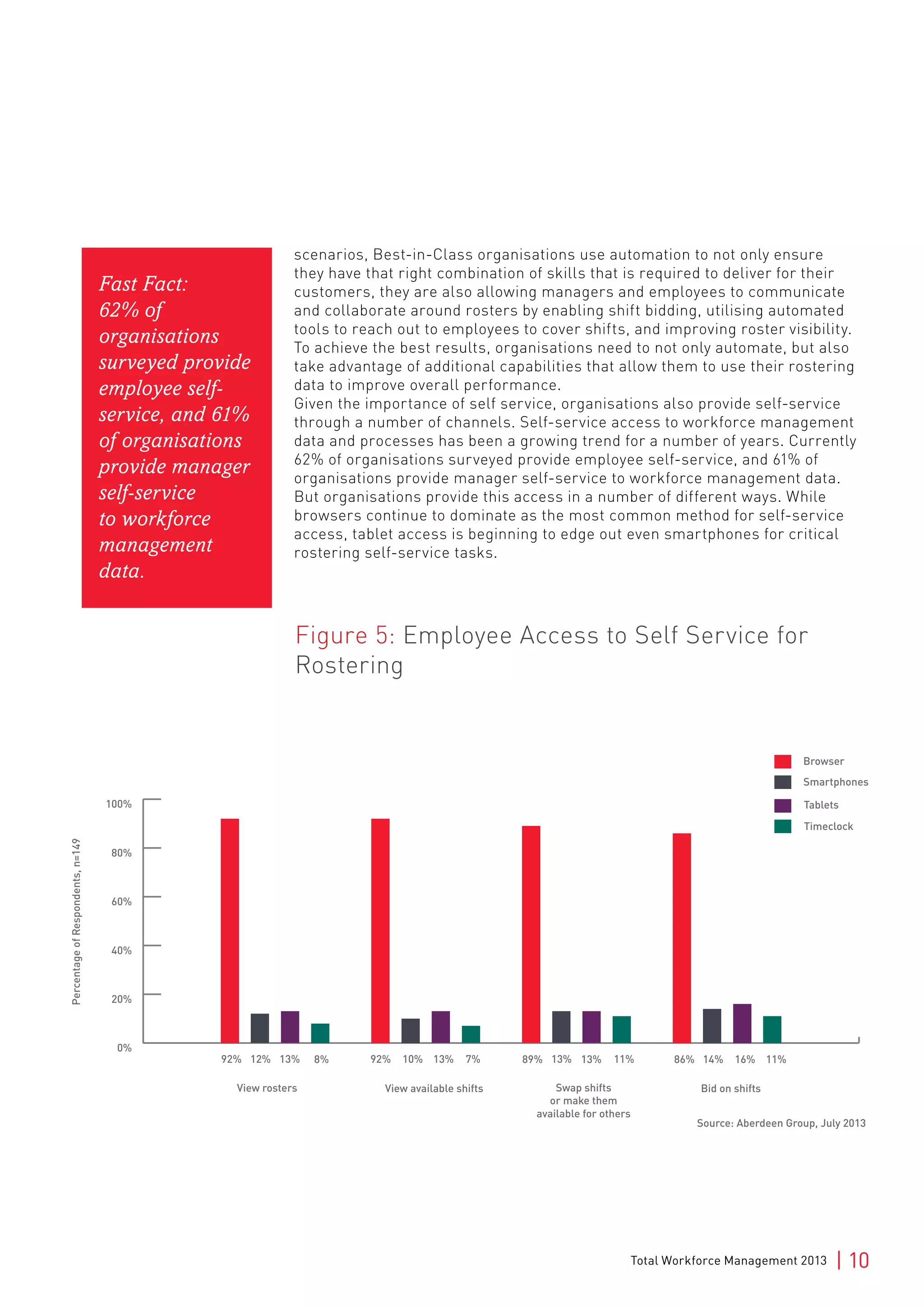
Given the importance of self service, organisations also provide self-service
through a number of channels. Self-service access to workforce management
data and processes has been a growing trend for a number of years. Currently
62% of organisations surveyed provide employee self-service, and 61% of
organisations provide manager self-service to workforce management data.
But organisations provide this access in a number of different ways. While
browsers continue to dominate as the most common method for self-service
access, tablet access is beginning to edge out even smartphones for critical
rostering self-service tasks.
Figure 5: Employee Access to Self Service for
Rostering
Fast Fact:
62% of
organisations
surveyed provide
employee self-
service, and 61%
of organisations
provide manager
self-service
to workforce
management
data.
0%
20%
40%
60%
80%
100%
92% 12% 13% 8% 92% 10% 13% 7% 89% 13% 13% 11% 86% 14% 16% 11%
Source: Aberdeen Group, July 2013
PercentageofRespondents,n=149
View rosters View available shifts Swap shifts
or make them
available for others
Bid on shifts
Browser
Smartphones
Tablets
Timeclock
11 | Total Workforce Management 2013
Integration
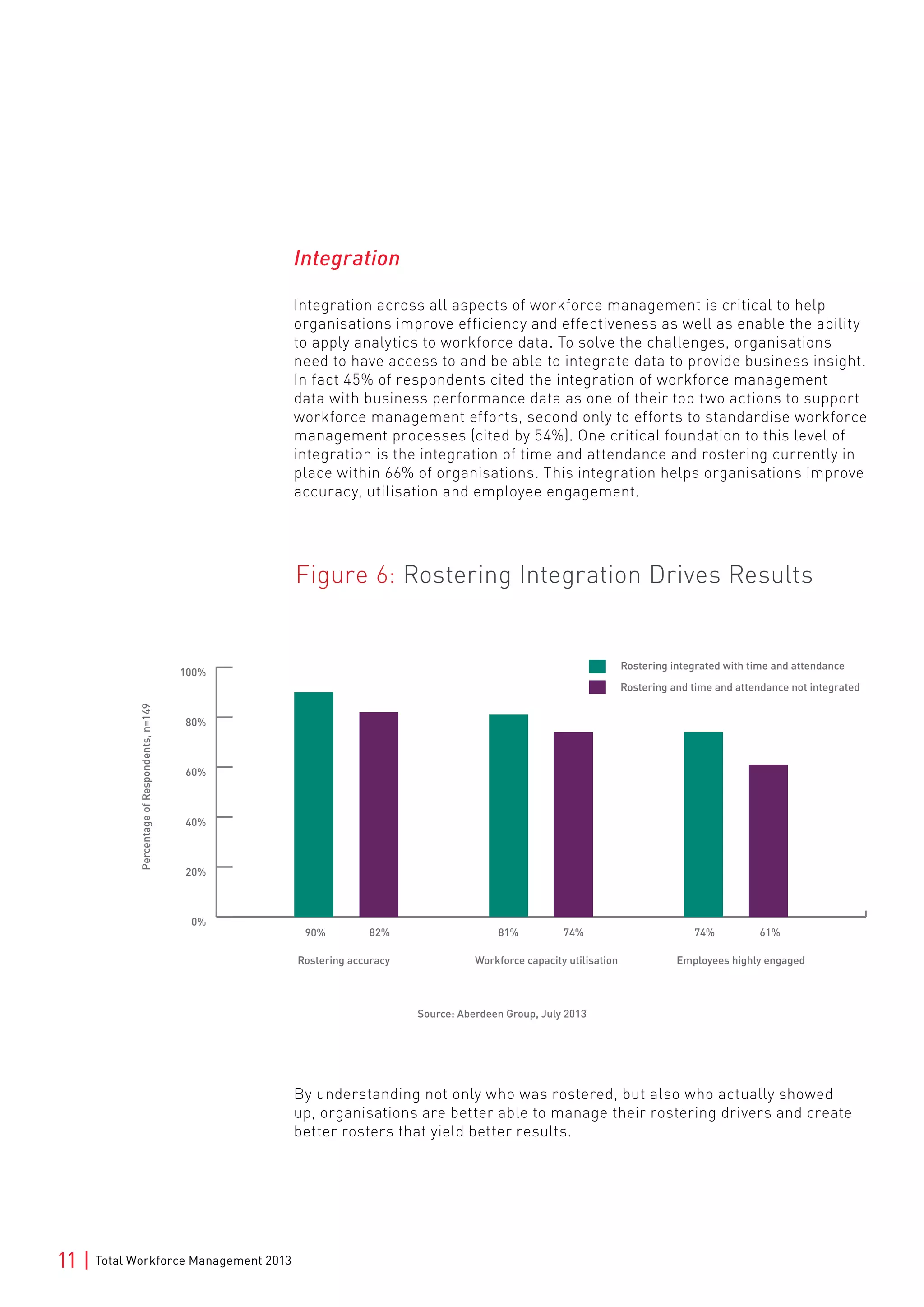
Integration across all aspects of workforce management is critical to help
organisations improve efficiency and effectiveness as well as enable the ability
to apply analytics to workforce data. To solve the challenges, organisations
need to have access to and be able to integrate data to provide business insight.
In fact 45% of respondents cited the integration of workforce management
data with business performance data as one of their top two actions to support
workforce management efforts, second only to efforts to standardise workforce
management processes (cited by 54%). One critical foundation to this level of
integration is the integration of time and attendance and rostering currently in
place within 66% of organisations. This integration helps organisations improve
accuracy, utilisation and employee engagement.
Figure 6: Rostering Integration Drives Results
By understanding not only who was rostered, but also who actually showed
up, organisations are better able to manage their rostering drivers and create
better rosters that yield better results.
0%
20%
40%
60%
80%
100%
PercentageofRespondents,n=149
Source: Aberdeen Group, July 2013
Rostering integrated with time and attendance
Rostering and time and attendance not integrated
90% 82% 81% 74% 74% 61%
Rostering accuracy Workforce capacity utilisation Employees highly engaged
Total Workforce Management 2013 | 12
Key Insights
Rostering is at the heart of operational efficiency for organisations that
depend on having the right people in the right place to execute business
strategy. Reducing the time it takes to create rosters as well as building
rosters that more accurately reflect demand and bring together the right
mix of skills and capabilities at the right cost, drive organisations to look to
rostering automation. Combining automation with the ability to share data with
employees and managers via self-service, and integrate rostering with other
workforce management as well as business performance data and processes,
is a critical foundation for organisational performance and for data driven
decision making.
Total Workforce Management 2013 | 13
Content produced with permission from
Aberdeen Group.
This document is the result of primary research performed by
Aberdeen Group. Aberdeen Group’s methodologies provide for
objective fact-based research and represent the best analysis
available at the time of publication. Unless otherwise noted, the
entire contents of this publication are copyrighted by Aberdeen
Group, Inc. and may not be reproduced, distributed, archived, or
transmitted in any form or by any means without prior written
consent by Aberdeen Group, Inc. (2013)
Office locations:
Melbourne
Level 1, 6 Nexus Court
Mulgrave VIC 3170
Sydney
Level 3, 15 Bourke Road
Mascot NSW 2020
Brisbane
Level 1, Building 2
Gateway Office Park
747 Lytton Road
Murarrie QLD 4172
Perth
The Gateway
G2/59 Albany Highway
Victoria Park WA 6100
Adelaide
Unit 5/217 Portrush Road
Maylands SA 5069
Contact Us:
Phone: 1800 000 729
Web: 	 adppayroll.com.au
Twitter: @ADP_ANZ
About ADP®
•	 Globally ADP is the market leader in payroll
and HR services with 60 years of experience
in the business	
•	 Payroll experts in the local market – working
with Australian businesses for more than 35
years	
•	 Approximately 7,000 clients in Australia and
New Zealand producing around 10 million
payslips per annum	
•	 ADP in Australia employs over 300 staff
based in Adelaide, Brisbane, Melbourne,
Perth and Sydney	
•	 ADP has a AA credit rating by Moody’s and
Standard  Poor’s, ADP globally is one of the
most financially stable organisations in the
world.
	 For enquiries visit
adppayroll.com.au/contact
or call 1800 000 729.
The ADP Logo and ADP are registered
trademarks of ADP, LLC. ©2011 ADP, LLC.

Total Workforce Management 2013: Rostering

  • 1.
    Total Workforce Management2013: Rostering In association with:
  • 2.
    2 | TotalWorkforce Management 2013 Introduction Definition: Aberdeen defines total workforce management as the union of core HR (HR, employee data management, and systems of record), payroll, time and attendance, rostering, and absence management. Rostering is both an art and a science. It requires finding the right mix of skills, capabilities, team chemistry, and labour costs to meet customer needs and business objectives in the most efficient manner. It is also a process that can take up significant time from managers seeking that perfect balance. To streamline and improve rostering, organisations look to a variety of technology solutions. Based on the latest data collected between May and June 2013, this Research Brief — one of a series addressing critical workforce management issues — looks at the trends influencing workforce rostering today and how rostering interacts with other critical workforce management systems, including payroll, time and attendance, and absence management to achieve business results.
  • 4.
    Total Workforce Management2013 | 4 Figure 1: Pressures Driving Workforce Management Initiatives The Case for Workforce Management The main theme that emerges as organisations think about their workforce management initiatives today is that of keeping up with change. Organisations struggle to develop an agile and flexible workforce and use data to help them make better decisions about both their labour and their spend. 0% 10% 20% 30% 40% 50% 33% - Economic conditions require better control over labour spend 44% - Rapidly changing business conditions require better access to workforce data to drive decision-making 45% - Marketplace demands require a more agile and flexible workforce (ability to scale up and down, change staffing ratios, etc.) Source: Aberdeen Group, July 2013 PercentageofRespondents,n=149
  • 5.
    5 | TotalWorkforce Management 2013 To truly respond to these challenges, organisations must consider the full scope of total workforce management. Aberdeen defines total workforce management as core HR (HR, employee data management, and system of record), payroll, time and attendance, rostering, and absence management, and we’ll go into detail on many of these topics in this research series. As any manager in an industry highly reliant on hourly labour knows, the roster is the lifeblood of the organisation. Managers must be able to look at demand and put together a plan to ensure that the right employees with the right skills, capabilities, certifications, and availability are rostered at any given time. And they must do so in a way that is compliant with government rules and Enterprise Bargaining Agreements and company policy, which takes into account the most efficient use of their labour budget. It’s not surprising that organisations look to automated tools to help them manage this process, as organisations that automate rostering not only reduce the time required to build rosters, but also reduce their labour costs by helping to eliminate unplanned overtime, improve revenue by ensuring that the right staff are in place at the right time, and reduce organisational risk by improving compliance. Manual versus Automated There are many potential benefits to overall workforce management automation. When asked to cite the most important benefits of automation, respondents listed the reduction of time spent on workforce management activities by HR (39%), improved accuracy of workforce data (36%), reduction in time spent on workforce management activities by managers (36%), and reduced overall labour cost (31%) as the top four benefits. Clearly automation helps drive both the efficiency and effectiveness of workforce management activities. Automated rostering contributes to these goals. As illustrated in Figure 2, organisations automating rostering saw 5% greater workforce capacity utilisation — the percentage of actual work done versus the theoretical capability available within the roster, a measure of roster and workforce efficiency — and 24% higher engagement levels due to rostering transparency than organisations without automated rostering.
  • 6.
    Total Workforce Management2013 | 6 Figure 2: Impact of Rostering Automation Organisations with automated rostering also saw a 4% year-over-year reduction in manual workforce management transactions, as compared to a 5% increase among organisations without automated rostering. The cost savings associated with decreasing the time spent on low value-added activities like rostering are significant. Automation improves efficiency and reduces manual transactions, increases effectiveness by improving workforce capacity utilisation and also improves the experience for employees. Automated rostering takes much of the emotion out of rostering decisions and can help provide transparency, thus eliminating conversations about perceived favouritism for prime shifts or extra hours. And, as we will see in further sections of this paper, automation also enables additional functionality like self-service and shift bidding that put employees in control of their roster without compromising corporate goals, which also improves their experience and engagement. Nearly half (42%) of organisations still operate rostering under a manual or spreadsheet-based process. Some of these spreadsheet-based processes can 0% 20% 40% 60% 80% 100% 63%78% Source: Aberdeen Group, July 2013 PercentageofRespondents,n=149 76%80% Workforce capacity utilisation Employee highly engaged Automated rostering Non-automated rostering
  • 7.
    7 | TotalWorkforce Management 2013 Figure 3: Source of Rostering Functionality be quite sophisticated, as organisations have built impressive formulas that incorporate drivers from other systems like customer demand and financial performance. But it is still a manual process to integrate those inputs and generate a usable roster. 0% 10% 20% 30% 40% 50% 14% - Functionality within an ERP solution 24% - Part of integrated workforce management suite 20% - Best-of-breed automated solution 42% - Most manual / spread sheet based Source: Aberdeen Group, July 2013 PercentageofRespondents,n=149
  • 8.
    Total Workforce Management2013 | 8 Defining the Best-in-Class In its 2013 Workforce Management study, Aberdeen used three KPIs to distinguish the Bets- in-Class (top 20% of the aggregate performers) from the Industry Average (middle 50%) and Laggard (bottom 30%) organisations, with mean performance among the Best-in-Class as follows: • 98% average workforce capacity utilisation • 16% year-over-year improvement in profit margin • 28% year-over-year improvement in customer satisfaction These metrics reflect an organisations ability to create efficient and effective rosters, deliver the right staff to the right places to drive customer vale, and balance labour costs with revenue to increase profitability. The good news is 58% of organisations use automation to drive their rostering process and most commonly use rostering tools as part of their integrated workforce management suite. This makes sense, because often organisations that are highly dependent on hourly workers have also implemented or plan to implement automated time and attendance and payroll capabilities as well. And regardless of the source of rostering automation, integration is a high priority. Integration of workforce management and business performance data was the second most commonly cited workforce management strategy, selected by 45% of respondents.
  • 9.
    9 | TotalWorkforce Management 2013 Figure 4: Rostering Capabilities Enabling the Organisation One of the many benefits of automated rostering is its ability to add enhanced functionality to the organisation. By pushing certain tasks out into the manager and the employee’s hands, it decreases the burden on HR and helps the business manage its workforce. Best-in-Class organisations are far more likely to utilise several key capabilities when creating and using rosters. Most notably, these top-performing organisations are 55% more likely to enable employees to have self-service access to information like their time worked, their upcoming roster, and leave balances. This improves the employee experience by giving them direct access to information, as well as streamlining the process because they do not have to call their manager or someone in HR to find this information. But top-performing organisations also utilise a number of other rostering capabilities. By tracking certifications, using skill information when generating rosters and allowing users to run 0 10 20 30 40 50 60 70 80 Source: Aberdeen Group, July 2013 Percentage of Respondents, n=149 Best-in-Class All others Self-service access to hours worked, rosters, and paid time-off balances Tools that track certifications to ensure adherence to compliance when rostering resources Scenario planning software for rostering Tools that take into account skills, certifications, etc., when generating or optimising rosters SMS, interactive voice response (IVR) or email notifications to employee for open shifts Shift-bidding software 15% 31% 13% 32% 32% 26% 41% 15% 48% 26% 70% 45%
  • 10.
    Total Workforce Management2013 | 10 scenarios, Best-in-Class organisations use automation to not only ensure they have that right combination of skills that is required to deliver for their customers, they are also allowing managers and employees to communicate and collaborate around rosters by enabling shift bidding, utilising automated tools to reach out to employees to cover shifts, and improving roster visibility. To achieve the best results, organisations need to not only automate, but also take advantage of additional capabilities that allow them to use their rostering data to improve overall performance. Given the importance of self service, organisations also provide self-service through a number of channels. Self-service access to workforce management data and processes has been a growing trend for a number of years. Currently 62% of organisations surveyed provide employee self-service, and 61% of organisations provide manager self-service to workforce management data. But organisations provide this access in a number of different ways. While browsers continue to dominate as the most common method for self-service access, tablet access is beginning to edge out even smartphones for critical rostering self-service tasks. Figure 5: Employee Access to Self Service for Rostering Fast Fact: 62% of organisations surveyed provide employee self- service, and 61% of organisations provide manager self-service to workforce management data. 0% 20% 40% 60% 80% 100% 92% 12% 13% 8% 92% 10% 13% 7% 89% 13% 13% 11% 86% 14% 16% 11% Source: Aberdeen Group, July 2013 PercentageofRespondents,n=149 View rosters View available shifts Swap shifts or make them available for others Bid on shifts Browser Smartphones Tablets Timeclock
  • 11.
    11 | TotalWorkforce Management 2013 Integration Integration across all aspects of workforce management is critical to help organisations improve efficiency and effectiveness as well as enable the ability to apply analytics to workforce data. To solve the challenges, organisations need to have access to and be able to integrate data to provide business insight. In fact 45% of respondents cited the integration of workforce management data with business performance data as one of their top two actions to support workforce management efforts, second only to efforts to standardise workforce management processes (cited by 54%). One critical foundation to this level of integration is the integration of time and attendance and rostering currently in place within 66% of organisations. This integration helps organisations improve accuracy, utilisation and employee engagement. Figure 6: Rostering Integration Drives Results By understanding not only who was rostered, but also who actually showed up, organisations are better able to manage their rostering drivers and create better rosters that yield better results. 0% 20% 40% 60% 80% 100% PercentageofRespondents,n=149 Source: Aberdeen Group, July 2013 Rostering integrated with time and attendance Rostering and time and attendance not integrated 90% 82% 81% 74% 74% 61% Rostering accuracy Workforce capacity utilisation Employees highly engaged
  • 12.
    Total Workforce Management2013 | 12 Key Insights Rostering is at the heart of operational efficiency for organisations that depend on having the right people in the right place to execute business strategy. Reducing the time it takes to create rosters as well as building rosters that more accurately reflect demand and bring together the right mix of skills and capabilities at the right cost, drive organisations to look to rostering automation. Combining automation with the ability to share data with employees and managers via self-service, and integrate rostering with other workforce management as well as business performance data and processes, is a critical foundation for organisational performance and for data driven decision making.
  • 13.
    Total Workforce Management2013 | 13 Content produced with permission from Aberdeen Group. This document is the result of primary research performed by Aberdeen Group. Aberdeen Group’s methodologies provide for objective fact-based research and represent the best analysis available at the time of publication. Unless otherwise noted, the entire contents of this publication are copyrighted by Aberdeen Group, Inc. and may not be reproduced, distributed, archived, or transmitted in any form or by any means without prior written consent by Aberdeen Group, Inc. (2013)
  • 14.
    Office locations: Melbourne Level 1,6 Nexus Court Mulgrave VIC 3170 Sydney Level 3, 15 Bourke Road Mascot NSW 2020 Brisbane Level 1, Building 2 Gateway Office Park 747 Lytton Road Murarrie QLD 4172 Perth The Gateway G2/59 Albany Highway Victoria Park WA 6100 Adelaide Unit 5/217 Portrush Road Maylands SA 5069 Contact Us: Phone: 1800 000 729 Web: adppayroll.com.au Twitter: @ADP_ANZ About ADP® • Globally ADP is the market leader in payroll and HR services with 60 years of experience in the business • Payroll experts in the local market – working with Australian businesses for more than 35 years • Approximately 7,000 clients in Australia and New Zealand producing around 10 million payslips per annum • ADP in Australia employs over 300 staff based in Adelaide, Brisbane, Melbourne, Perth and Sydney • ADP has a AA credit rating by Moody’s and Standard Poor’s, ADP globally is one of the most financially stable organisations in the world. For enquiries visit adppayroll.com.au/contact or call 1800 000 729. The ADP Logo and ADP are registered trademarks of ADP, LLC. ©2011 ADP, LLC.