Definition of Torque
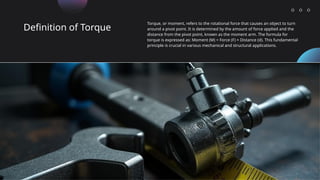
Torque,or moment, refers to the rotational force that causes an object to turn
around a pivot point. It is determined by the amount of force applied and the
distance from the pivot point, known as the moment arm. The formula for
torque is expressed as: Moment (M) = Force (F) × Distance (d). This fundamental
principle is crucial in various mechanical and structural applications.
5.
Factors Affecting Torque
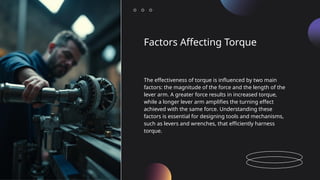
Theeffectiveness of torque is influenced by two main
factors: the magnitude of the force and the length of the
lever arm. A greater force results in increased torque,
while a longer lever arm amplifies the turning effect
achieved with the same force. Understanding these
factors is essential for designing tools and mechanisms,
such as levers and wrenches, that efficiently harness
torque.
6.
Examples of Torquein
Tools
Torque is commonly utilized in various tools, such as spanners and torque
wrenches. For instance, when applying a force to turn a bolt with a wrench,
the torque applied ensures that the bolt is secured tightly. The effectiveness
of these tools is greatly enhanced by the principle of leverage, allowing
users to generate sufficient turning force with minimal effort.
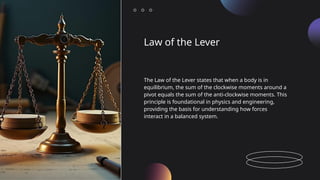
Law of theLever
The Law of the Lever states that when a body is in
equilibrium, the sum of the clockwise moments around a
pivot equals the sum of the anti-clockwise moments. This
principle is foundational in physics and engineering,
providing the basis for understanding how forces
interact in a balanced system.
9.
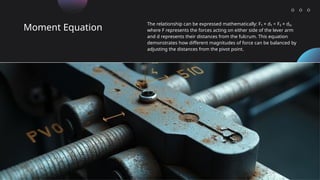
Moment Equation
The relationshipcan be expressed mathematically: F₁ × d₁ = F₂ × d₂,
where F represents the forces acting on either side of the lever arm
and d represents their distances from the fulcrum. This equation
demonstrates how different magnitudes of force can be balanced by
adjusting the distances from the pivot point.
10.
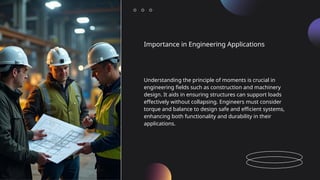
Importance in EngineeringApplications
Understanding the principle of moments is crucial in
engineering fields such as construction and machinery
design. It aids in ensuring structures can support loads
effectively without collapsing. Engineers must consider
torque and balance to design safe and efficient systems,
enhancing both functionality and durability in their
applications.
11.
Conclusions
Torque is essentialfor understanding turning forces and
their effects on various systems. By leveraging the
principle of moments, engineers and designers can
create stable and effective solutions in numerous
applications, from tools to large structures. Mastery of
these concepts is fundamental for successful
engineering practices.
12.
CREDITS: This presentationtemplate was created by Slidesgo,
and includes icons, infographics & images by Freepik
Thank you!
Do you have any questions?