Model of a Fluidic Toroidal Drive
Martin Jones
MARS44 CONSULTING, LLC
July 14, 2012
Abstract
We have determined parametric equations for the geometrical curve that defines
the wrapping of a toriodal core. Using the trajectory of the wrapping or fluid
flow, a Newtonian model has been developed for calculating the forces induced on
a specifically wrapped toriodal core (although other wrappings may be applied to
this methodology). It has not been necessary to use the equations of fluid motion to
calculate the Newtonian forces induced by fluid elements arranged symmetrically
around the axis of rotation of the core because it was not required to calculate the
dynamics of the fluid rather than the forces induced by imposed kinematics. A
few ‘special’ numbers of turns for the wrapping concerned were found to produce
an uncompensated thrust that can be used for propulsion.
1
1 Introduction
Some intro here on history of the development of uncompensated forces.
2 Model
To approximate a fluid in the model, the cumulative forces of a finite number of sym-
metrically aligned fluid elements being pumped through the coil at an arbitrary mass
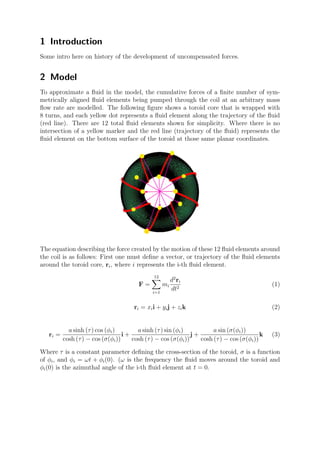
flow rate are modelled. The following figure shows a toroid core that is wrapped with
8 turns, and each yellow dot represents a fluid element along the trajectory of the fluid
(red line). There are 12 total fluid elements shown for simplicity. Where there is no
intersection of a yellow marker and the red line (trajectory of the fluid) represents the
fluid element on the bottom surface of the toroid at those same planar coordinates.
The equation describing the force created by the motion of these 12 fluid elements around
the coil is as follows: First one must define a vector, or trajectory of the fluid elements
around the toroid core, ri, where i represents the i-th fluid element.
F =
12
i=1
mi
d2
ri
dt2
(1)
ri = xii + yij + zik (2)
ri =
a sinh (τ) cos (φi)
cosh (τ) − cos (σ(φi))
i +
a sinh (τ) sin (φi)
cosh (τ) − cos (σ(φi))
j +
a sin (σ(φi))
cosh (τ) − cos (σ(φi))
k (3)
Where τ is a constant parameter defining the cross-section of the toroid, σ is a function
of φi, and φi = ωt + φi(0). (ω is the frequency the fluid moves around the toroid and
φi(0) is the azimuthal angle of the i-th fluid element at t = 0.
3 Results
The Figures (1-3) show a contour of the forces in the x, y, and z directions versus the
number of turns in the winding of the tube around the toroid that carries the fluid (water
in this case) and the time. For a pump that rates at about 4 kg/s mass flow rate, the
model predicts the following results. In time, 4 periods are shown (the water circulates
4 times around the toroid). Force is in Newtons.
4 Future Work
Future work begs the question of space-time structure around this toroid. The same
methodology employed previously can be applied to the Einstein field equations to derive
the dynamic space-time structure caused by the moving fluid. Furthermore, once the
kinematics of the fluid are imposed, any space-time structure should be able to be derived
and vice-versa.
5 Acknowledgment
Thank you to Dan Winter for funding to accomplish these results. Also thank you to
both William Donavan and Winter for discussions and guidance during the development
of this model.
3
Figure 1: Shows the contour of the x-Force for time and number of turns on the torus.
This simulation used 500 fluid elements.
4
Figure 2: Shows the contour of the y-Force for time and number of turns on the torus.
This simulation used 500 fluid elements.
5
Figure 3: Shows the contour of the z-Force for time and number of turns on the torus.
This simulation used 500 fluid elements.
6

toroidwork07-12-2012

  • 1.
    Model of aFluidic Toroidal Drive Martin Jones MARS44 CONSULTING, LLC July 14, 2012 Abstract We have determined parametric equations for the geometrical curve that defines the wrapping of a toriodal core. Using the trajectory of the wrapping or fluid flow, a Newtonian model has been developed for calculating the forces induced on a specifically wrapped toriodal core (although other wrappings may be applied to this methodology). It has not been necessary to use the equations of fluid motion to calculate the Newtonian forces induced by fluid elements arranged symmetrically around the axis of rotation of the core because it was not required to calculate the dynamics of the fluid rather than the forces induced by imposed kinematics. A few ‘special’ numbers of turns for the wrapping concerned were found to produce an uncompensated thrust that can be used for propulsion. 1
  • 2.
    1 Introduction Some introhere on history of the development of uncompensated forces. 2 Model To approximate a fluid in the model, the cumulative forces of a finite number of sym- metrically aligned fluid elements being pumped through the coil at an arbitrary mass flow rate are modelled. The following figure shows a toroid core that is wrapped with 8 turns, and each yellow dot represents a fluid element along the trajectory of the fluid (red line). There are 12 total fluid elements shown for simplicity. Where there is no intersection of a yellow marker and the red line (trajectory of the fluid) represents the fluid element on the bottom surface of the toroid at those same planar coordinates. The equation describing the force created by the motion of these 12 fluid elements around the coil is as follows: First one must define a vector, or trajectory of the fluid elements around the toroid core, ri, where i represents the i-th fluid element. F = 12 i=1 mi d2 ri dt2 (1) ri = xii + yij + zik (2) ri = a sinh (τ) cos (φi) cosh (τ) − cos (σ(φi)) i + a sinh (τ) sin (φi) cosh (τ) − cos (σ(φi)) j + a sin (σ(φi)) cosh (τ) − cos (σ(φi)) k (3) Where τ is a constant parameter defining the cross-section of the toroid, σ is a function of φi, and φi = ωt + φi(0). (ω is the frequency the fluid moves around the toroid and φi(0) is the azimuthal angle of the i-th fluid element at t = 0.
  • 3.
    3 Results The Figures(1-3) show a contour of the forces in the x, y, and z directions versus the number of turns in the winding of the tube around the toroid that carries the fluid (water in this case) and the time. For a pump that rates at about 4 kg/s mass flow rate, the model predicts the following results. In time, 4 periods are shown (the water circulates 4 times around the toroid). Force is in Newtons. 4 Future Work Future work begs the question of space-time structure around this toroid. The same methodology employed previously can be applied to the Einstein field equations to derive the dynamic space-time structure caused by the moving fluid. Furthermore, once the kinematics of the fluid are imposed, any space-time structure should be able to be derived and vice-versa. 5 Acknowledgment Thank you to Dan Winter for funding to accomplish these results. Also thank you to both William Donavan and Winter for discussions and guidance during the development of this model. 3
  • 4.
    Figure 1: Showsthe contour of the x-Force for time and number of turns on the torus. This simulation used 500 fluid elements. 4
  • 5.
    Figure 2: Showsthe contour of the y-Force for time and number of turns on the torus. This simulation used 500 fluid elements. 5
  • 6.
    Figure 3: Showsthe contour of the z-Force for time and number of turns on the torus. This simulation used 500 fluid elements. 6