Wind Effects in Tensile
Membrane Structures
Pedro Gil Marques de Queirós Ferreira
Elsa de Sá Caetano
2016
PhD 2016 | 2
2016 CONSTRUCT PhD Workshop
Wind Effects in Tensile Membrane Structures
• Motivation
– Growing use of tensile membranes in special
structures has brought increased demand in the
assessment of their structural behavior
– Membrane structures are characterized by: high
flexibility, leading to strong geometric nonlinear
behavior; complex shapes; slight prestress;
orthotropic materials; and construction methods
– Recent damages due to aerodynamic and
ponding effects of these lightweight structures
and lack of standards motivated this work
PhD 2016 | 3
2016 CONSTRUCT PhD Workshop
Wind Effects in Tensile Membrane Structures
• Objectives & Tasks
– The work focused two main aspects
• Form-finding
• Characterization of the wind effects in membranes
– Two types of examples
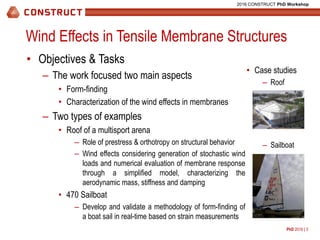
• Roof of a multisport arena
– Role of prestress & orthotropy on structural behavior
– Wind effects considering generation of stochastic wind
loads and numerical evaluation of membrane response
through a simplified model, characterizing the
aerodynamic mass, stiffness and damping
• 470 Sailboat
– Develop and validate a methodology of form-finding of
a boat sail in real-time based on strain measurements
• Case studies
– Roof
– Sailboat
PhD 2016 | 4
2016 CONSTRUCT PhD Workshop
Wind Effects in Tensile Membrane Structures
– Structural form-finding and optimization methods
• Force Density Method (FDM): 1lFDM and 2nlFDM
– Independent of the material properties and linearize the
Equilibrium equations using a force density coefficient q
= t/l for the truss elements
• Surface Stress Density Method
– Analogous to FDM setting a surface stress density
coefficient qs for the constant strain triangle elements
• Dynamic Relaxation Method: Viscous & Kinetic model
– Explicit direct time-integration of the dynamic
Equilibrium equations using central finite differences.
[Cs Xf q F]1,2 + Qz
2 X t l
Cs Xf Xini qs F Xend t l S σ = 4qsS
Cs Xf Xini F (E A ti )truss el. Xend t l
kN/m
0 2 4 6 8 10
0
1
2
3
4
5
6
7
8
9
10
1 2
3
4 5
6
7 8
9
Geometria Inicial - MDFl
x
y
0 2 4 6 8 10
0
1
2
3
4
5
6
7
8
9
10
1
2
3
4 5
6
7 8
9
Geometria Inicial - MDFl
x
y
0 2 4 6 8 10
0
1
2
3
4
5
6
7
8
9
10
1
2
3
4 5
6
7 8
9
Geometria Inicial - MDFl
x
y
0 2 4 6 8 10
0
1
2
3
4
5
6
7
8
9
10
1 2
3
4 5
6
7 8
9
Geometria Inicial - MDFl
x
y
PhD 2016 | 5
2016 CONSTRUCT PhD Workshop
Wind Effects in Tensile Membrane Structures
• Linear Force Density Method (lFDM)
– Example of a cooling tower
 Solution is obtained iteratively: rinf ≈ 9
m, rsup ≈ 7 m, Hc ≈ 21 m e Hm ≈ 25 m
Configuração a) b) c)
qs (N/m) 400 400 400
qcomp (N/m) -2800 -3000 -3000
qc,v (N/m) 100 100 1000
qc,h (N/m) 100 100 100
Configuração a) b) c)
qs (N/m) 400 400 400
qcomp (N/m) -2800 -3000 -3000
qc,v (N/m) 100 100 1000
qc,h (N/m) 100 100 100
Suspension cables
Upper compression ring
Lateral cable net (horizontal
or circumferential and vertical
cables)
Mast
Lower compression ring
PhD 2016 | 6
2016 CONSTRUCT PhD Workshop2016 CONSTRUCT PhD Workshop
Wind Effects in Tensile Membrane Structures
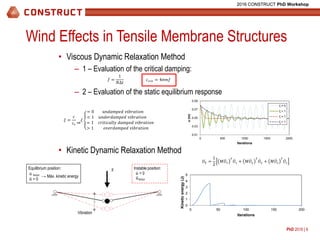
• Viscous Dynamic Relaxation Method
– 1 – Evaluation of the critical damping:
– 2 – Evaluation of the static equilibrium response
• Kinetic Dynamic Relaxation Method
𝑓 =
1
𝑁∆𝑡
𝑐 𝑐𝑟𝑖𝑡 = 4𝜋𝑚𝑓
𝑈𝑘 =
1
2
𝑀𝑈𝑥
𝑇
𝑈𝑥 + 𝑀𝑈𝑦
𝑇
𝑈𝑦 + 𝑀𝑈𝑧
𝑇
𝑈𝑧
0
1
2
3
4
5
0 50 100 150 200
Kineticenergy(J)
Iterations
0.01
0.03
0.05
0.07
0.09
0 500 1000 1500 2000
u(m)
Iterations
ξ = 0
ξ < 1
ξ = 1
ξ > 1
Equilibrium position:
→ Máx. kinetic energy
𝑢 𝑚á𝑥
𝑢 = 0
Instable position:
𝑢 = 0
𝑢 𝑚á𝑥
Vibration
F
𝜉 =
𝑐
𝑐 𝑐
𝜉
= 0 𝑢𝑛𝑑𝑎𝑚𝑝𝑒𝑑 𝑣𝑖𝑏𝑟𝑎𝑡𝑖𝑜𝑛
< 1 𝑢𝑛𝑑𝑒𝑟𝑑𝑎𝑚𝑝𝑒𝑑 𝑣𝑖𝑏𝑟𝑎𝑡𝑖𝑜𝑛
= 1 𝑐𝑟𝑖𝑡𝑖𝑐𝑎𝑙𝑙𝑦 𝑑𝑎𝑚𝑝𝑒𝑑 𝑣𝑖𝑏𝑟𝑎𝑡𝑖𝑜𝑛
> 1 𝑜𝑣𝑒𝑟𝑑𝑎𝑚𝑝𝑒𝑑 𝑣𝑖𝑏𝑟𝑎𝑡𝑖𝑜𝑛
PhD 2016 | 7
2016 CONSTRUCT PhD Workshop
Wind Effects in Tensile Membrane Structures
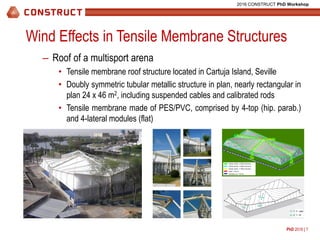
– Roof of a multisport arena
• Tensile membrane roof structure located in Cartuja Island, Seville
• Doubly symmetric tubular metallic structure in plan, nearly rectangular in
plan 24 x 46 m2, including suspended cables and calibrated rods
• Tensile membrane made of PES/PVC, comprised by 4-top (hip. parab.)
and 4-lateral modules (flat)
Tubular section F 323x8 (mmxmm)
Tubular section F 200x6 (mmxmm)
Tubular section F 150x5 (mmxmm)
Cable F 36 mm
Calibrated rod F 25 mm
U – warp
T – fill
PhD 2016 | 8
2016 CONSTRUCT PhD Workshop
Wind Effects in Tensile Membrane Structures
– Roof of a multisport arena
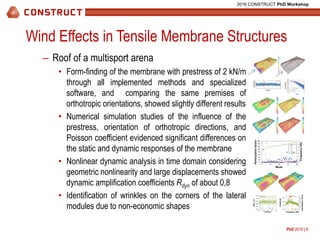
• Form-finding of the membrane with prestress of 2 kN/m
through all implemented methods and specialized
software, and comparing the same premises of
orthotropic orientations, showed slightly different results
• Numerical simulation studies of the influence of the
prestress, orientation of orthotropic directions, and
Poisson coefficient evidenced significant differences on
the static and dynamic responses of the membrane
• Nonlinear dynamic analysis in time domain considering
geometric nonlinearity and large displacements showed
dynamic amplification coefficients Rdyn of about 0,8
• Identification of wrinkles on the corners of the lateral
modules due to non-economic shapes
0
1
2
3
4
5
6
7
0
20
40
60
80
100
120
140
160
0 10 20 30 40
Frequência(Hz)
Fatordeparticipação
Modo
X
Y
Z
Freq.
3.79
5.97
0
0.1
0.2
0.3
0.4
0.5
0.6
0.7
0.8
0.9
1
1.E-12
1.E-08
1.E-04
1.E+00
0 5 10 15 20
Fatordehibridização(FH)
Amplitude
Frequência (Hz)
Dir. x
FH
Participationfactor
Mode
Frequency(Hz)
Disp.(m)
Amplitude
Hybridizationfactor
Frequency (Hz)Time (s)
-0.002
-0.001
0.000
0.001
0.002
0.003
100 150 200 250 300
Deslocamento(m)
Tempo (s)
Rdin = 1.08
Ux, quasi-estático
Ux, din
quasi-static
0
5
10
15
20
25
30
35
40
45
50
0 100 200 300 400 500 600 700 800
Velocidade(m/s)
Tempo (s)
1
534
Velocity(m/s)
Time (s)
PhD 2016 | 9
2016 CONSTRUCT PhD Workshop
Wind Effects in Tensile Membrane Structures
– Form-finding of a boat sail in real-time
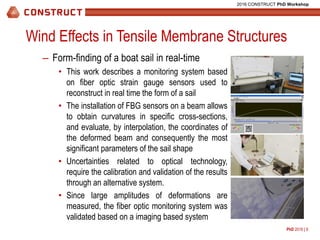
• This work describes a monitoring system based
on fiber optic strain gauge sensors used to
reconstruct in real time the form of a sail
• The installation of FBG sensors on a beam allows
to obtain curvatures in specific cross-sections,
and evaluate, by interpolation, the coordinates of
the deformed beam and consequently the most
significant parameters of the sail shape
• Uncertainties related to optical technology,
require the calibration and validation of the results
through an alternative system.
• Since large amplitudes of deformations are
measured, the fiber optic monitoring system was
validated based on a imaging based system
Draft position
Chord
Camber(cm)
(%)(cm)
Conclusions
• Implementation of form-finding routines
• Application to a tensile membrane roof
• Identification of more relevant aspects of
the behavior through parametric analysis
• Wind action and effects assessment
• Sail case: development, implementation
and validation of an algorithm already
patented for real-time assessment of sail
shape. This methodology can be used for
SHM of other engineering applications

Pedro Gil Ferreira

  • 1.
    Wind Effects inTensile Membrane Structures Pedro Gil Marques de Queirós Ferreira Elsa de Sá Caetano 2016
  • 2.
    PhD 2016 |2 2016 CONSTRUCT PhD Workshop Wind Effects in Tensile Membrane Structures • Motivation – Growing use of tensile membranes in special structures has brought increased demand in the assessment of their structural behavior – Membrane structures are characterized by: high flexibility, leading to strong geometric nonlinear behavior; complex shapes; slight prestress; orthotropic materials; and construction methods – Recent damages due to aerodynamic and ponding effects of these lightweight structures and lack of standards motivated this work
  • 3.
    PhD 2016 |3 2016 CONSTRUCT PhD Workshop Wind Effects in Tensile Membrane Structures • Objectives & Tasks – The work focused two main aspects • Form-finding • Characterization of the wind effects in membranes – Two types of examples • Roof of a multisport arena – Role of prestress & orthotropy on structural behavior – Wind effects considering generation of stochastic wind loads and numerical evaluation of membrane response through a simplified model, characterizing the aerodynamic mass, stiffness and damping • 470 Sailboat – Develop and validate a methodology of form-finding of a boat sail in real-time based on strain measurements • Case studies – Roof – Sailboat
  • 4.
    PhD 2016 |4 2016 CONSTRUCT PhD Workshop Wind Effects in Tensile Membrane Structures – Structural form-finding and optimization methods • Force Density Method (FDM): 1lFDM and 2nlFDM – Independent of the material properties and linearize the Equilibrium equations using a force density coefficient q = t/l for the truss elements • Surface Stress Density Method – Analogous to FDM setting a surface stress density coefficient qs for the constant strain triangle elements • Dynamic Relaxation Method: Viscous & Kinetic model – Explicit direct time-integration of the dynamic Equilibrium equations using central finite differences. [Cs Xf q F]1,2 + Qz 2 X t l Cs Xf Xini qs F Xend t l S σ = 4qsS Cs Xf Xini F (E A ti )truss el. Xend t l kN/m 0 2 4 6 8 10 0 1 2 3 4 5 6 7 8 9 10 1 2 3 4 5 6 7 8 9 Geometria Inicial - MDFl x y 0 2 4 6 8 10 0 1 2 3 4 5 6 7 8 9 10 1 2 3 4 5 6 7 8 9 Geometria Inicial - MDFl x y 0 2 4 6 8 10 0 1 2 3 4 5 6 7 8 9 10 1 2 3 4 5 6 7 8 9 Geometria Inicial - MDFl x y 0 2 4 6 8 10 0 1 2 3 4 5 6 7 8 9 10 1 2 3 4 5 6 7 8 9 Geometria Inicial - MDFl x y
  • 5.
    PhD 2016 |5 2016 CONSTRUCT PhD Workshop Wind Effects in Tensile Membrane Structures • Linear Force Density Method (lFDM) – Example of a cooling tower  Solution is obtained iteratively: rinf ≈ 9 m, rsup ≈ 7 m, Hc ≈ 21 m e Hm ≈ 25 m Configuração a) b) c) qs (N/m) 400 400 400 qcomp (N/m) -2800 -3000 -3000 qc,v (N/m) 100 100 1000 qc,h (N/m) 100 100 100 Configuração a) b) c) qs (N/m) 400 400 400 qcomp (N/m) -2800 -3000 -3000 qc,v (N/m) 100 100 1000 qc,h (N/m) 100 100 100 Suspension cables Upper compression ring Lateral cable net (horizontal or circumferential and vertical cables) Mast Lower compression ring
  • 6.
    PhD 2016 |6 2016 CONSTRUCT PhD Workshop2016 CONSTRUCT PhD Workshop Wind Effects in Tensile Membrane Structures • Viscous Dynamic Relaxation Method – 1 – Evaluation of the critical damping: – 2 – Evaluation of the static equilibrium response • Kinetic Dynamic Relaxation Method 𝑓 = 1 𝑁∆𝑡 𝑐 𝑐𝑟𝑖𝑡 = 4𝜋𝑚𝑓 𝑈𝑘 = 1 2 𝑀𝑈𝑥 𝑇 𝑈𝑥 + 𝑀𝑈𝑦 𝑇 𝑈𝑦 + 𝑀𝑈𝑧 𝑇 𝑈𝑧 0 1 2 3 4 5 0 50 100 150 200 Kineticenergy(J) Iterations 0.01 0.03 0.05 0.07 0.09 0 500 1000 1500 2000 u(m) Iterations ξ = 0 ξ < 1 ξ = 1 ξ > 1 Equilibrium position: → Máx. kinetic energy 𝑢 𝑚á𝑥 𝑢 = 0 Instable position: 𝑢 = 0 𝑢 𝑚á𝑥 Vibration F 𝜉 = 𝑐 𝑐 𝑐 𝜉 = 0 𝑢𝑛𝑑𝑎𝑚𝑝𝑒𝑑 𝑣𝑖𝑏𝑟𝑎𝑡𝑖𝑜𝑛 < 1 𝑢𝑛𝑑𝑒𝑟𝑑𝑎𝑚𝑝𝑒𝑑 𝑣𝑖𝑏𝑟𝑎𝑡𝑖𝑜𝑛 = 1 𝑐𝑟𝑖𝑡𝑖𝑐𝑎𝑙𝑙𝑦 𝑑𝑎𝑚𝑝𝑒𝑑 𝑣𝑖𝑏𝑟𝑎𝑡𝑖𝑜𝑛 > 1 𝑜𝑣𝑒𝑟𝑑𝑎𝑚𝑝𝑒𝑑 𝑣𝑖𝑏𝑟𝑎𝑡𝑖𝑜𝑛
  • 7.
    PhD 2016 |7 2016 CONSTRUCT PhD Workshop Wind Effects in Tensile Membrane Structures – Roof of a multisport arena • Tensile membrane roof structure located in Cartuja Island, Seville • Doubly symmetric tubular metallic structure in plan, nearly rectangular in plan 24 x 46 m2, including suspended cables and calibrated rods • Tensile membrane made of PES/PVC, comprised by 4-top (hip. parab.) and 4-lateral modules (flat) Tubular section F 323x8 (mmxmm) Tubular section F 200x6 (mmxmm) Tubular section F 150x5 (mmxmm) Cable F 36 mm Calibrated rod F 25 mm U – warp T – fill
  • 8.
    PhD 2016 |8 2016 CONSTRUCT PhD Workshop Wind Effects in Tensile Membrane Structures – Roof of a multisport arena • Form-finding of the membrane with prestress of 2 kN/m through all implemented methods and specialized software, and comparing the same premises of orthotropic orientations, showed slightly different results • Numerical simulation studies of the influence of the prestress, orientation of orthotropic directions, and Poisson coefficient evidenced significant differences on the static and dynamic responses of the membrane • Nonlinear dynamic analysis in time domain considering geometric nonlinearity and large displacements showed dynamic amplification coefficients Rdyn of about 0,8 • Identification of wrinkles on the corners of the lateral modules due to non-economic shapes 0 1 2 3 4 5 6 7 0 20 40 60 80 100 120 140 160 0 10 20 30 40 Frequência(Hz) Fatordeparticipação Modo X Y Z Freq. 3.79 5.97 0 0.1 0.2 0.3 0.4 0.5 0.6 0.7 0.8 0.9 1 1.E-12 1.E-08 1.E-04 1.E+00 0 5 10 15 20 Fatordehibridização(FH) Amplitude Frequência (Hz) Dir. x FH Participationfactor Mode Frequency(Hz) Disp.(m) Amplitude Hybridizationfactor Frequency (Hz)Time (s) -0.002 -0.001 0.000 0.001 0.002 0.003 100 150 200 250 300 Deslocamento(m) Tempo (s) Rdin = 1.08 Ux, quasi-estático Ux, din quasi-static 0 5 10 15 20 25 30 35 40 45 50 0 100 200 300 400 500 600 700 800 Velocidade(m/s) Tempo (s) 1 534 Velocity(m/s) Time (s)
  • 9.
    PhD 2016 |9 2016 CONSTRUCT PhD Workshop Wind Effects in Tensile Membrane Structures – Form-finding of a boat sail in real-time • This work describes a monitoring system based on fiber optic strain gauge sensors used to reconstruct in real time the form of a sail • The installation of FBG sensors on a beam allows to obtain curvatures in specific cross-sections, and evaluate, by interpolation, the coordinates of the deformed beam and consequently the most significant parameters of the sail shape • Uncertainties related to optical technology, require the calibration and validation of the results through an alternative system. • Since large amplitudes of deformations are measured, the fiber optic monitoring system was validated based on a imaging based system Draft position Chord Camber(cm) (%)(cm)
  • 10.
    Conclusions • Implementation ofform-finding routines • Application to a tensile membrane roof • Identification of more relevant aspects of the behavior through parametric analysis • Wind action and effects assessment • Sail case: development, implementation and validation of an algorithm already patented for real-time assessment of sail shape. This methodology can be used for SHM of other engineering applications