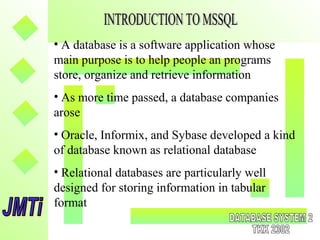
• A database is a software application whose
main purpose is to help people an programs
store, organize and retrieve information
• As more time passed, a database companies
arose
• Oracle, Informix, and Sybase developed a kind
of database known as relational database
• Relational databases are particularly well
designed for storing information in tabular
format
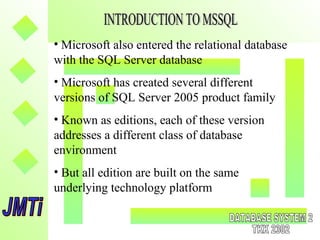
• Microsoft also entered the relational database
with the SQL Server database
• Microsoft has created several different
versions of SQL Server 2005 product family
• Known as editions, each of these version
addresses a different class of database
environment
• But all edition are built on the same
underlying technology platform
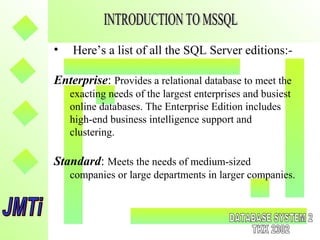
• Here’s a list of all the SQL Server editions:-
Enterprise: Provides a relational database to meet the
exacting needs of the largest enterprises and busiest
online databases. The Enterprise Edition includes
high-end business intelligence support and
clustering.
Standard: Meets the needs of medium-sized
companies or large departments in larger companies.
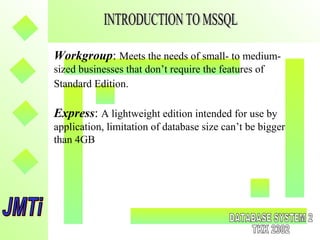
Workgroup: Meets the needs of small- to medium-
sized businesses that don’t require the features of
Standard Edition.
Express: A lightweight edition intended for use by
application, limitation of database size can’t be bigger
than 4GB
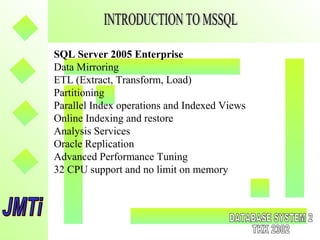
SQL Server 2005 Enterprise
Data Mirroring
ETL (Extract, Transform, Load)
Partitioning
Parallel Index operations and Indexed Views
Online Indexing and restore
Analysis Services
Oracle Replication
Advanced Performance Tuning
32 CPU support and no limit on memory
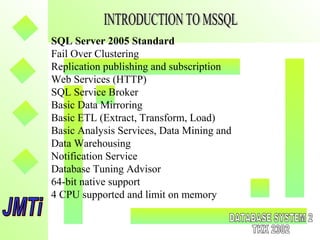
SQL Server 2005 Standard
Fail Over Clustering
Replication publishing and subscription
Web Services (HTTP)
SQL Service Broker
Basic Data Mirroring
Basic ETL (Extract, Transform, Load)
Basic Analysis Services, Data Mining and
Data Warehousing
Notification Service
Database Tuning Advisor
64-bit native support
4 CPU supported and limit on memory
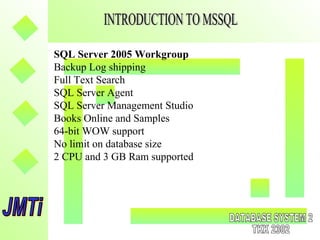
SQL Server 2005 Workgroup
Backup Log shipping
Full Text Search
SQL Server Agent
SQL Server Management Studio
Books Online and Samples
64-bit WOW support
No limit on database size
2 CPU and 3 GB Ram supported
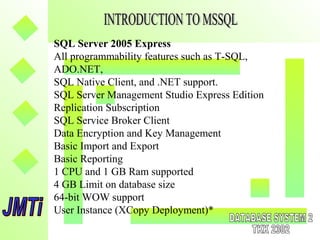
SQL Server 2005 Express
All programmability features such as T-SQL,
ADO.NET,
SQL Native Client, and .NET support.
SQL Server Management Studio Express Edition
Replication Subscription
SQL Service Broker Client
Data Encryption and Key Management
Basic Import and Export
Basic Reporting
1 CPU and 1 GB Ram supported
4 GB Limit on database size
64-bit WOW support
User Instance (XCopy Deployment)*
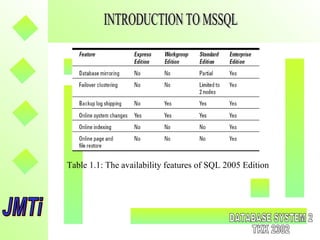
Table 1.1: The availability features of SQL 2005 Edition
A Client-Server Database
• SQL Server 2005 is a client-server database.
• SQL Server 2005 database engine is installed on a server machine to which
you connect anything from a few machines to many hundreds or thousands
of client machines.
• A client-server architecture can handle large amounts of data better than a
desktop database such as Microsoft Access.
• The SQL Server instance provides security, availability, and reliability
features that are absent from databases such as Access.
• A client-server architecture also can reduce network traffic.
• SQL Server installation is used for two broad categories of data
processing: Online Transaction Processing (OLTP) and Online Analytical
Processing (OLAP).
OLTP
• Online Transaction Processing is the kind of processing that the databases
of Amazon.com or any other large online retailer needs to do.
• A large number of orders come in every minute and the information from
each of those orders needs to be written to the database quickly and
reliably.
• With OLTP, you can group certain actions together.
• For example, the different aspects of a bank transfer between accounts
would be carried out together, if money is moved out of one account, it is
also moved into another account.
• The all or nothing characteristic of a transaction ensures that the data
remains in a consistent state.
OLAP
• An Online Analytical Processing database is intended to process large
• amounts of data that doesn’t change often.
• For example, an online retailer might want to store summary data about
sales by month, by region, by product category, and so on.
• In SQL Server 2005, the OLAP functionality is carried out in Analysis
Services. In Analysis Services, you create cubes that allow you to examine
dimensions of a cube.
• OLAP often takes place in a data warehouse.
Programmable database
• SQL Server 2005 is a great environment for programmers.
• SQL Server 2005 supports the Structured Query Language (SQL).
• SQL Server satisfies some standard SQL syntax and adds its own
extensions to SQL, allowing you to easily write code.
• Microsoft flavor of SQL is called Transact-SQL (T-SQL) which allows you
to add, modify, or query relational in SQL Server 2005.
• Transact-SQL programming is commonly done in the query pane of SQL
Server Management Studio.
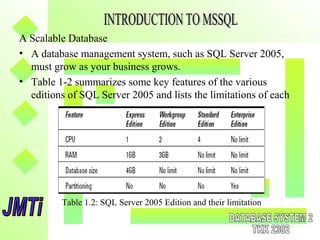
A Scalable Database
• A database management system, such as SQL Server 2005,
must grow as your business grows.
• Table 1-2 summarizes some key features of the various
editions of SQL Server 2005 and lists the limitations of each
Table 1.2: SQL Server 2005 Edition and their limitation
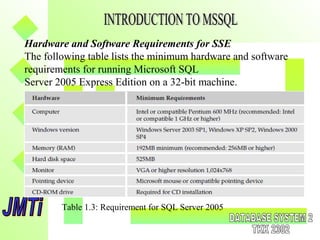
Hardware and Software Requirements for SSE
The following table lists the minimum hardware and software
requirements for running Microsoft SQL
Server 2005 Express Edition on a 32-bit machine.
Table 1.3: Requirement for SQL Server 2005
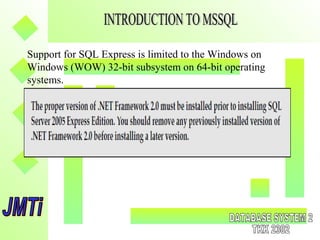
Support for SQL Express is limited to the Windows on
Windows (WOW) 32-bit subsystem on 64-bit operating
systems.

Topic1

  • 1.
    • A databaseis a software application whose main purpose is to help people an programs store, organize and retrieve information • As more time passed, a database companies arose • Oracle, Informix, and Sybase developed a kind of database known as relational database • Relational databases are particularly well designed for storing information in tabular format
  • 2.
    • Microsoft alsoentered the relational database with the SQL Server database • Microsoft has created several different versions of SQL Server 2005 product family • Known as editions, each of these version addresses a different class of database environment • But all edition are built on the same underlying technology platform
  • 3.
    • Here’s alist of all the SQL Server editions:- Enterprise: Provides a relational database to meet the exacting needs of the largest enterprises and busiest online databases. The Enterprise Edition includes high-end business intelligence support and clustering. Standard: Meets the needs of medium-sized companies or large departments in larger companies.
  • 4.
    Workgroup: Meets theneeds of small- to medium- sized businesses that don’t require the features of Standard Edition. Express: A lightweight edition intended for use by application, limitation of database size can’t be bigger than 4GB
  • 5.
    SQL Server 2005Enterprise Data Mirroring ETL (Extract, Transform, Load) Partitioning Parallel Index operations and Indexed Views Online Indexing and restore Analysis Services Oracle Replication Advanced Performance Tuning 32 CPU support and no limit on memory
  • 6.
    SQL Server 2005Standard Fail Over Clustering Replication publishing and subscription Web Services (HTTP) SQL Service Broker Basic Data Mirroring Basic ETL (Extract, Transform, Load) Basic Analysis Services, Data Mining and Data Warehousing Notification Service Database Tuning Advisor 64-bit native support 4 CPU supported and limit on memory
  • 7.
    SQL Server 2005Workgroup Backup Log shipping Full Text Search SQL Server Agent SQL Server Management Studio Books Online and Samples 64-bit WOW support No limit on database size 2 CPU and 3 GB Ram supported
  • 8.
    SQL Server 2005Express All programmability features such as T-SQL, ADO.NET, SQL Native Client, and .NET support. SQL Server Management Studio Express Edition Replication Subscription SQL Service Broker Client Data Encryption and Key Management Basic Import and Export Basic Reporting 1 CPU and 1 GB Ram supported 4 GB Limit on database size 64-bit WOW support User Instance (XCopy Deployment)*
  • 9.
    Table 1.1: Theavailability features of SQL 2005 Edition
  • 10.
    A Client-Server Database •SQL Server 2005 is a client-server database. • SQL Server 2005 database engine is installed on a server machine to which you connect anything from a few machines to many hundreds or thousands of client machines. • A client-server architecture can handle large amounts of data better than a desktop database such as Microsoft Access. • The SQL Server instance provides security, availability, and reliability features that are absent from databases such as Access. • A client-server architecture also can reduce network traffic. • SQL Server installation is used for two broad categories of data processing: Online Transaction Processing (OLTP) and Online Analytical Processing (OLAP).
  • 11.
    OLTP • Online TransactionProcessing is the kind of processing that the databases of Amazon.com or any other large online retailer needs to do. • A large number of orders come in every minute and the information from each of those orders needs to be written to the database quickly and reliably. • With OLTP, you can group certain actions together. • For example, the different aspects of a bank transfer between accounts would be carried out together, if money is moved out of one account, it is also moved into another account. • The all or nothing characteristic of a transaction ensures that the data remains in a consistent state.
  • 12.
    OLAP • An OnlineAnalytical Processing database is intended to process large • amounts of data that doesn’t change often. • For example, an online retailer might want to store summary data about sales by month, by region, by product category, and so on. • In SQL Server 2005, the OLAP functionality is carried out in Analysis Services. In Analysis Services, you create cubes that allow you to examine dimensions of a cube. • OLAP often takes place in a data warehouse.
  • 13.
    Programmable database • SQLServer 2005 is a great environment for programmers. • SQL Server 2005 supports the Structured Query Language (SQL). • SQL Server satisfies some standard SQL syntax and adds its own extensions to SQL, allowing you to easily write code. • Microsoft flavor of SQL is called Transact-SQL (T-SQL) which allows you to add, modify, or query relational in SQL Server 2005. • Transact-SQL programming is commonly done in the query pane of SQL Server Management Studio.
  • 14.
    A Scalable Database •A database management system, such as SQL Server 2005, must grow as your business grows. • Table 1-2 summarizes some key features of the various editions of SQL Server 2005 and lists the limitations of each Table 1.2: SQL Server 2005 Edition and their limitation
  • 15.
    Hardware and SoftwareRequirements for SSE The following table lists the minimum hardware and software requirements for running Microsoft SQL Server 2005 Express Edition on a 32-bit machine. Table 1.3: Requirement for SQL Server 2005
  • 16.
    Support for SQLExpress is limited to the Windows on Windows (WOW) 32-bit subsystem on 64-bit operating systems.