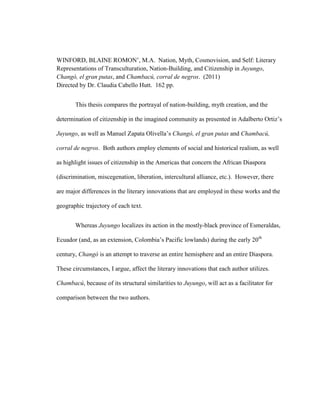
This thesis compares the literary representations of nation-building, myth creation, and citizenship in Adalberto Ortiz's novel Juyungo and Manuel Zapata Olivella's novels Changó, el gran putas and Chambacú, corral de negros. Both authors employ elements of social realism and highlight issues of citizenship concerning the African diaspora, such as discrimination and miscegenation. However, there are differences in the geographic scope and literary innovations used. Whereas Juyungo is set in Ecuador, Changó attempts to represent the experiences of the African diaspora across the Americas. Chambacú, due to its structural similarities to Juyungo, facilitates a comparison

![156
---. Changó, the Biggest Badass. [Translated by Jonathan Tittler]. Lubbock: Texas Tech
University Press, 2010. Print.
---. El árbol brujo de la libertad: África en Colombia. Buenaventura: Universidad del
Pacífico, 2002. Print.
---. “El sincretismo Afro-cristiano en las luchas liberadoras de América”. Cultura negra y
teología. San José: Editoriales Dei, 1986. 105-21. Print.
---. La rebelión de los genes: El mestizaje americano en la sociedad futura. Bogotá:
Altamir Ediciones, 1997.](https://image.slidesharecdn.com/550209e8-ac0c-486e-916a-02513a192e02-170117194440/85/Winford_uncg_0154M_10840-162-320.jpg)


