7TH TOPIC : PARK PLANNING & DEVELOPMENT
PROGRAM AND ACTIVITIES
 To identify Park Planning and Development process for program
and activities according to Monty L. Christiansen
 To determine the suitability of recreation facilities implementation
based on activities
 Give an overview on park planning development on activity and
program aspect in the park.
 There are four major phases to park planning:
1. Pre-design Phase
2. Design Phase
3. Development Phase
4. Actualization
 Pre-design Objective:
 Is to prepare a design program, which describe the objective of
the park plan in experiential and physical terms
 Steps of the pre-design phase
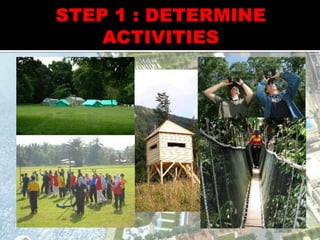
1. Step 1 : Determine activities to be offered
2. Step 2 : Consider activity experience orientation for each
activity
3. Step 3 : Prepare activity analysis for each activity
4. Step 4 : prepare synthesis of complete pre-design
package
5. Step 5 : Document into organized design program
 The basic approaches to determination of activities
is to select the activities prior to any resources
allocations including
a) Natural – refer to inventory and analysis in order to
suited with certain needed activity
b) Human – the opportunity to utilize special human
resource
c) Fiscal – capital development grants for outdoor
recreation have supported the provision of facilities
activities
 Two preliminary considerations must be examined when preparing
a design:
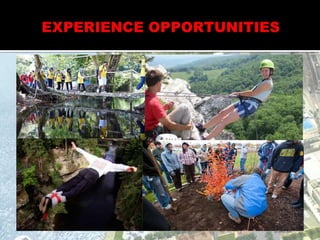
1. Experience opportunities
a. Entry Level Participation – basic skills of any activities
b. Skills-Improvement Participation – require special program
c. Programmed Participation – scheduled experience with or
without formal organization
d. Unstructured Participation – some activities are 'prone to
inclination & opportunity
e. Competitive Participation – compete and evaluate
f. Vicarious Participation – where are spectators enjoy the
excitement & fun of an activity while not actually being involved
2. Experience and development norms
▪ Should recognize that there is a range of recreational
experience needs
▪ Recreationist have different expectations and realize
different levels of satisfaction or gratification for
activities participations
▪ Development norms – the physical development or
environmental modification compatible with the
proposed experience levels
▪ Experience norms – the level expectations by
recreationist
STEP 2 : CONSIDER ACTIVITY
EXPERIENCE ORIENTATION FOR EACH
ACTIVITY
 Consist four factors of activity analysis such as:
a. Activity Factor – establish the groundwork for the
primary planning. To provide quality recreational
experience
b. Participant Factor – are essential descriptions of the
specific user populations for the community
c. Resource & Facility Factor – related to development
and to provide the park user with the quality experience.
d. Support Factor – consist 2 groups; services & facilities.
Provide amenities in addition to the basic activity needs
 Review the activity in order to identify area of
duplications, conflict, omission & multiple use &
synthesize these into summation for the complete
project
 The park design program has four basic
components:
a. Objectives
b. Activity conception
c. Design controls
d. Submission format
- Are desired outcomes or targets
- It will guide a decision and form the criteria
against which work result are measured
- Something need to achieve - achievement
- Something efforts or actions are intended to
attain or accomplish
 Design Objective:
 Is to document the recommended physical arrangement of
the park object in conformance with design program
 Steps of the Design Phase:
1. Steps 1 : Establish design objectives from design
program
- should be expressed as functional or performance
objectives
2. Steps 2 : Site analysis – the process of evaluate &
comparing several sites to determine the best program
& suitable
3. Steps 3 : Develop alternative concept plans - refer to
concept topic
4. Steps 4 : Evaluation of alternatives/recommendation of
primary concept plan
- identify the best alternative, the suitable
recommendation.
5. Step 5 : Refinement of concept
- refine the concept to suited with the best alternative that
has been chosen
6. Step 6 : Preparation of general development plan
- Development that related to the design phase
 Planning is the first step at any level of
management
 The purpose of park planning is to ensure the
necessary means, including human and
physical resources and support services, to
provide an established recreation experience
 In park planning, objective and concept need
to define as a guideline
 A general idea or an abstract that derived or
inferred from specific instance or occurrences
 An idea for something new to propose,
design.
 The idea will be expand and covered the
whole proposal or design
Please refer lecturer 6
 There are three distinct steps of the
development phase of park planning:
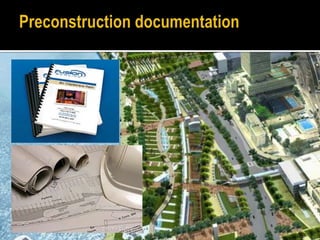
a) Preconstruction documentation
- construction drawing & specification
- the documentation in graphic & narrative form
- as a guideline and control for development
- requires very careful preparation of
construction drawings & specification
b. Construction Constructing – Competitive Bid
- selecting contractor by several process
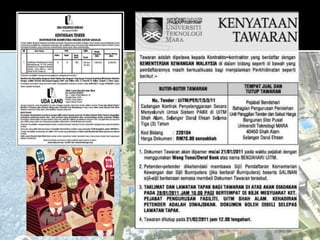
 The Competitive Bid-Process – The park agency
publicly requests interested contractor to submit
 The advertisement – should be placed where the
greatest number of potential bidders. The content &
publication requirement follow gov. statue & policy.
 The instructions to bidders – usually accompanied a bid
form & package of contract document. Guidelines &
directions for bid submission , Explanation of the contract-
awarding procedure, Information about the work
 The Proposal – Usually have three major part 1) The
agreement to the basic conditions, The detailed contract cost
prepared by bidder 3) The identification of the bidding firm
 Selecting the best bidder – Determining which bidders are
qualified, bid evaluation & comparison, notification of award
 The contract – legal covenant signed by both the contractor
and the authorized representative
c. Project Construction
 The actual project construction. The parties directly
involved in this step are the general contractor, his sub
contractors, the park agency & the authorized construction
inspector
 Consist of several process:
1. Construction insurance requirements – Park Agency &
Contractor
2. Construction progress & quality control
▪ Approval of material substitution & work order
changes
▪ Inspection, material testing & approval
▪ Determination of work completed & payment
▪ Final acceptance & payment
 A continuous process of assuring that all experience
determinants are appropriate for the proposed recreational
activity.
 Is to make sure that all experience determinants,
nonphysical as well as physical, are appropriate for the
proposed recreation activity
 Is incorporated throughout the entire park planning
process, before and concurrent with the physical planning
phases and continuing after the completion facility
development
 Actualization requires merging of the
complimentary park management processes of
planning, control and evaluation.
 Plan, control documents are the tools and
media of this process..
 Is a predetermined course of action over a
specified period of time representing a
projected response to an anticipated
environment
 Has three characteristic:
1. It must involve the future while simultaneously
considering past & present experience
2. It must involve actions.
3. It must involve decisions to take future actions
at the time the plan is authorized
 Control document may define or establish
standard for
1. the quality of performance, service or
development;
2. protect park asset from wastage, misuse, abuse,
or loss;
3. is a set limits of responsibility and authority;
direct planning concern;
4. facilitate evaluation of result.
 A good control document provides guidance
without demanding unquestioning
compliance and permits imaginative decision
making applied to recurring problems or
situations affecting the recreational
experiences to be provided
 Examples of park control document –
policies, procedures, rules and regulations,
performance standard, agency specifications
etc.
 Is based on control and affects plans.
 It provides the means for looping back
through the park planning process & insuring
that the process is dynamic & continuous
 To be effective, evaluation must:
1. Be based on a well prepared control
2. Identify & appraise significant measurable
qualities or characteristics of effort or situation
3. Provide foundation of instrument
 It is necessary to coordinate all the quality
determinants of a recreational experiences.
There are four primary factors to be
considered in the actualization process:
1. Activity factors
2. Participant factors
3. Physical resource factors
4. Human resource factors
(see page 87 (Park Planning Handbook (1977) by Monty L. Christiansen
 Program planning should be based on activity
analysis & should be well along prior to physical
planning because of the special program needs
that must be included in the design.
 Determination of the experience opportunities
offered (refer to Pre-design phase)
 Program plans are complemented by program
manuals, guides, schedules, performance
standard & other controls
 Various program effectiveness evaluation
techniques used to identify weaknesses &
implement improvements
 The participant is the benefiting recipient of the
recreational experience being planned, thus
there are several factors concerning these
individuals that are important to actualize the
quality desired for their experiences
 Pre experiences plans – PR, program information
(fee, charges, permit etc.)
 Concurrent - recreational occasion, have supervision,
rescue procedure, preparation for any circumstances
 Include the natural resources that comprise the park site,
the activity facility or area and the utilities and attendant
mechanical retinue to sustain the activity
1. Natural resources – directed actualization concerns are related
to either self-replenishing resources and site characteristics or
nonrenewable resources and site qualities.
2. Activity areas & facility – the development & maintenance of
activity area must be carefully coordinated to insure that all
efforts are complementary to the proposed experience.
3. Utilities & Mechanical Equipment –These utilities must be
designed and installed according to carefully prepared
specifications & operated and serviced according to detailed
manuals.
 Two factors relative to recreation service
personnel that are commonly recognized:
 Employee performance – preparation, control &
evaluation.The employee need to make sure all
the visitor get the experience as what
management have provided and plan.
 Employee remuneration and benefits – wage &
salary, schedules, promotion criteria, medical
insurance etc.
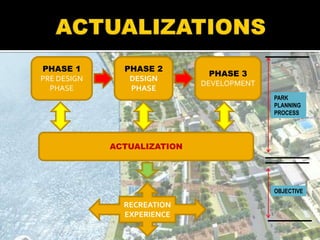
PHASE 1
PRE DESIGN
PHASE
PHASE 2
DESIGN
PHASE
PHASE 3
DEVELOPMENT
ACTUALIZATION
RECREATION
EXPERIENCE
PARK
PLANNING
PROCESS
OBJECTIVE
NOW YOU NEED TO PROPOSE NEW
CONCEPT & REDEVELOPMENT

Topic 7 park planning process & development program and activities

  • 1.
    7TH TOPIC :PARK PLANNING & DEVELOPMENT PROGRAM AND ACTIVITIES
  • 2.
     To identifyPark Planning and Development process for program and activities according to Monty L. Christiansen  To determine the suitability of recreation facilities implementation based on activities  Give an overview on park planning development on activity and program aspect in the park.
  • 3.
     There arefour major phases to park planning: 1. Pre-design Phase 2. Design Phase 3. Development Phase 4. Actualization
  • 4.
     Pre-design Objective: Is to prepare a design program, which describe the objective of the park plan in experiential and physical terms  Steps of the pre-design phase 1. Step 1 : Determine activities to be offered 2. Step 2 : Consider activity experience orientation for each activity 3. Step 3 : Prepare activity analysis for each activity 4. Step 4 : prepare synthesis of complete pre-design package 5. Step 5 : Document into organized design program
  • 5.
     The basicapproaches to determination of activities is to select the activities prior to any resources allocations including a) Natural – refer to inventory and analysis in order to suited with certain needed activity b) Human – the opportunity to utilize special human resource c) Fiscal – capital development grants for outdoor recreation have supported the provision of facilities activities
  • 7.
     Two preliminaryconsiderations must be examined when preparing a design: 1. Experience opportunities a. Entry Level Participation – basic skills of any activities b. Skills-Improvement Participation – require special program c. Programmed Participation – scheduled experience with or without formal organization d. Unstructured Participation – some activities are 'prone to inclination & opportunity e. Competitive Participation – compete and evaluate f. Vicarious Participation – where are spectators enjoy the excitement & fun of an activity while not actually being involved
  • 9.
    2. Experience anddevelopment norms ▪ Should recognize that there is a range of recreational experience needs ▪ Recreationist have different expectations and realize different levels of satisfaction or gratification for activities participations ▪ Development norms – the physical development or environmental modification compatible with the proposed experience levels ▪ Experience norms – the level expectations by recreationist STEP 2 : CONSIDER ACTIVITY EXPERIENCE ORIENTATION FOR EACH ACTIVITY
  • 10.
     Consist fourfactors of activity analysis such as: a. Activity Factor – establish the groundwork for the primary planning. To provide quality recreational experience b. Participant Factor – are essential descriptions of the specific user populations for the community c. Resource & Facility Factor – related to development and to provide the park user with the quality experience. d. Support Factor – consist 2 groups; services & facilities. Provide amenities in addition to the basic activity needs
  • 11.
     Review theactivity in order to identify area of duplications, conflict, omission & multiple use & synthesize these into summation for the complete project
  • 12.
     The parkdesign program has four basic components: a. Objectives b. Activity conception c. Design controls d. Submission format
  • 13.
    - Are desiredoutcomes or targets - It will guide a decision and form the criteria against which work result are measured - Something need to achieve - achievement - Something efforts or actions are intended to attain or accomplish
  • 14.
     Design Objective: Is to document the recommended physical arrangement of the park object in conformance with design program  Steps of the Design Phase: 1. Steps 1 : Establish design objectives from design program - should be expressed as functional or performance objectives 2. Steps 2 : Site analysis – the process of evaluate & comparing several sites to determine the best program & suitable
  • 15.
    3. Steps 3: Develop alternative concept plans - refer to concept topic 4. Steps 4 : Evaluation of alternatives/recommendation of primary concept plan - identify the best alternative, the suitable recommendation. 5. Step 5 : Refinement of concept - refine the concept to suited with the best alternative that has been chosen 6. Step 6 : Preparation of general development plan - Development that related to the design phase
  • 16.
     Planning isthe first step at any level of management  The purpose of park planning is to ensure the necessary means, including human and physical resources and support services, to provide an established recreation experience  In park planning, objective and concept need to define as a guideline
  • 17.
     A generalidea or an abstract that derived or inferred from specific instance or occurrences  An idea for something new to propose, design.  The idea will be expand and covered the whole proposal or design Please refer lecturer 6
  • 18.
     There arethree distinct steps of the development phase of park planning: a) Preconstruction documentation - construction drawing & specification - the documentation in graphic & narrative form - as a guideline and control for development - requires very careful preparation of construction drawings & specification
  • 20.
    b. Construction Constructing– Competitive Bid - selecting contractor by several process  The Competitive Bid-Process – The park agency publicly requests interested contractor to submit  The advertisement – should be placed where the greatest number of potential bidders. The content & publication requirement follow gov. statue & policy.  The instructions to bidders – usually accompanied a bid form & package of contract document. Guidelines & directions for bid submission , Explanation of the contract- awarding procedure, Information about the work
  • 22.
     The Proposal– Usually have three major part 1) The agreement to the basic conditions, The detailed contract cost prepared by bidder 3) The identification of the bidding firm  Selecting the best bidder – Determining which bidders are qualified, bid evaluation & comparison, notification of award  The contract – legal covenant signed by both the contractor and the authorized representative
  • 23.
    c. Project Construction The actual project construction. The parties directly involved in this step are the general contractor, his sub contractors, the park agency & the authorized construction inspector  Consist of several process: 1. Construction insurance requirements – Park Agency & Contractor
  • 24.
    2. Construction progress& quality control ▪ Approval of material substitution & work order changes ▪ Inspection, material testing & approval ▪ Determination of work completed & payment ▪ Final acceptance & payment
  • 25.
     A continuousprocess of assuring that all experience determinants are appropriate for the proposed recreational activity.  Is to make sure that all experience determinants, nonphysical as well as physical, are appropriate for the proposed recreation activity  Is incorporated throughout the entire park planning process, before and concurrent with the physical planning phases and continuing after the completion facility development
  • 26.
     Actualization requiresmerging of the complimentary park management processes of planning, control and evaluation.  Plan, control documents are the tools and media of this process..
  • 27.
     Is apredetermined course of action over a specified period of time representing a projected response to an anticipated environment  Has three characteristic: 1. It must involve the future while simultaneously considering past & present experience 2. It must involve actions. 3. It must involve decisions to take future actions at the time the plan is authorized
  • 28.
     Control documentmay define or establish standard for 1. the quality of performance, service or development; 2. protect park asset from wastage, misuse, abuse, or loss; 3. is a set limits of responsibility and authority; direct planning concern; 4. facilitate evaluation of result.
  • 29.
     A goodcontrol document provides guidance without demanding unquestioning compliance and permits imaginative decision making applied to recurring problems or situations affecting the recreational experiences to be provided  Examples of park control document – policies, procedures, rules and regulations, performance standard, agency specifications etc.
  • 30.
     Is basedon control and affects plans.  It provides the means for looping back through the park planning process & insuring that the process is dynamic & continuous  To be effective, evaluation must: 1. Be based on a well prepared control 2. Identify & appraise significant measurable qualities or characteristics of effort or situation 3. Provide foundation of instrument
  • 31.
     It isnecessary to coordinate all the quality determinants of a recreational experiences. There are four primary factors to be considered in the actualization process: 1. Activity factors 2. Participant factors 3. Physical resource factors 4. Human resource factors (see page 87 (Park Planning Handbook (1977) by Monty L. Christiansen
  • 32.
     Program planningshould be based on activity analysis & should be well along prior to physical planning because of the special program needs that must be included in the design.  Determination of the experience opportunities offered (refer to Pre-design phase)  Program plans are complemented by program manuals, guides, schedules, performance standard & other controls  Various program effectiveness evaluation techniques used to identify weaknesses & implement improvements
  • 33.
     The participantis the benefiting recipient of the recreational experience being planned, thus there are several factors concerning these individuals that are important to actualize the quality desired for their experiences  Pre experiences plans – PR, program information (fee, charges, permit etc.)  Concurrent - recreational occasion, have supervision, rescue procedure, preparation for any circumstances
  • 34.
     Include thenatural resources that comprise the park site, the activity facility or area and the utilities and attendant mechanical retinue to sustain the activity 1. Natural resources – directed actualization concerns are related to either self-replenishing resources and site characteristics or nonrenewable resources and site qualities. 2. Activity areas & facility – the development & maintenance of activity area must be carefully coordinated to insure that all efforts are complementary to the proposed experience. 3. Utilities & Mechanical Equipment –These utilities must be designed and installed according to carefully prepared specifications & operated and serviced according to detailed manuals.
  • 35.
     Two factorsrelative to recreation service personnel that are commonly recognized:  Employee performance – preparation, control & evaluation.The employee need to make sure all the visitor get the experience as what management have provided and plan.  Employee remuneration and benefits – wage & salary, schedules, promotion criteria, medical insurance etc.
  • 36.
    PHASE 1 PRE DESIGN PHASE PHASE2 DESIGN PHASE PHASE 3 DEVELOPMENT ACTUALIZATION RECREATION EXPERIENCE PARK PLANNING PROCESS OBJECTIVE
  • 37.
    NOW YOU NEEDTO PROPOSE NEW CONCEPT & REDEVELOPMENT