A/Prof Deb Cushing, Prof Evonne Miller & Tobias Volbert
QUT x Urban Play
Creating Great Places: The Design Series
Agenda for today…
• Introductions
• What is Theory Storming?
• 6 Critical Theories
• Salutogenic Design as a Global Priority
• Applying it to a Multi-use Trail Scenario
• Creating Great Places in Practice – Tobias Volbert
• Discussion Lounge
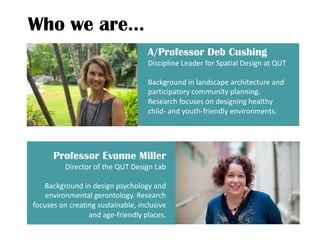
Who we are…
A/Professor Deb Cushing
Discipline Leader for Spatial Design at QUT
Background in landscape architecture and
participatory community planning.
Research focuses on designing healthy
child- and youth-friendly environments.
Professor Evonne Miller
Director of the QUT Design Lab
Background in design psychology and
environmental gerontology. Research
focuses on creating sustainable, inclusive
and age-friendly places.
Week 1.
Theory-Storming
Salutogenic Design
Week 2.
Theory-Storming
Innovative Child-friendly Design
Week 3.
Theory-Storming
Innovative Age-friendly & Inclusive Design
Week 4.
Theory-Storming
Innovative Sustainable Design
Great places don’t just happen.
They are created.
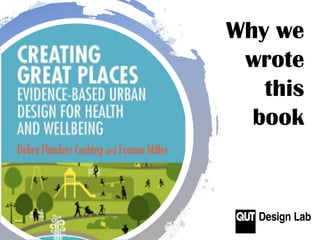
Why we
wrote
this
book
Evidence-based
Design is…
“a process for the conscientious,
explicit and judicious use of
current best evidence from
research and practice in making
critical decisions, together with
an informed client, about the
design of each individual and
unique project”
(Hamilton & Watkins, 2009, p.9).
Why is this important?
“Once finished, a new
urban area or park or
building will likely
outlast every person
who designed,
engineered and built
it. […]And it will remain in
use long after those who
commissioned and paid for it
are gone…. every element –
building, landscape, urban
area, infrastructure – ought,
accordingly, be designed to
help us thrive” p. 269-272, Goldhagen, 2017
Theory-Storming
Viewing a design problem through
multiple theoretical lenses. The goal
is to generate an evidence-based
design solution that is creative and
inspired, but also effective and
sustainable for multiple stakeholders.
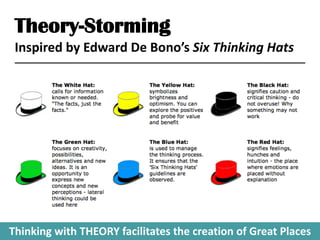
Theory-Storming
Inspired by Edward De Bono’s Six Thinking Hats
Thinking with THEORY facilitates the creation of Great Places
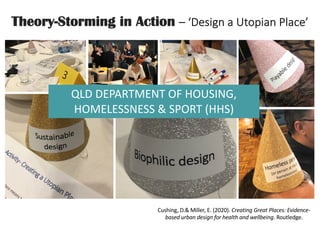
Theory-Storming in Action – ‘Design a Utopian Place’
Cushing, D.& Miller, E. (2020). Creating Great Places: Evidence-
based urban design for health and wellbeing. Routledge.
QLD DEPARTMENT OF HOUSING,
HOMELESSNESS & SPORT (HHS)
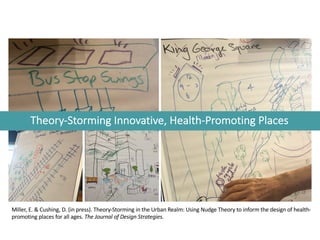
Theory-Storming Innovative, Health-Promoting Places
Miller, E. & Cushing, D. (in press). Theory-Storming in the Urban Realm: Using Nudge Theory to inform the design of health-
promoting places for all ages. The Journal of Design Strategies.
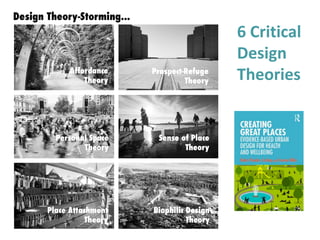
6 Critical
Design
Theories
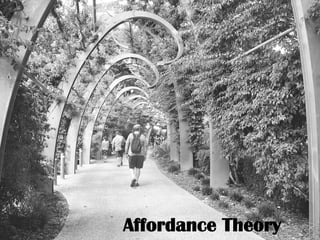
Affordance Theory
Affordances are opportunities for
actions supported by an environment,
and communicated through visual cues
perceived by users. These cues are often
determined by the surfaces, objects, and
layout of the space.
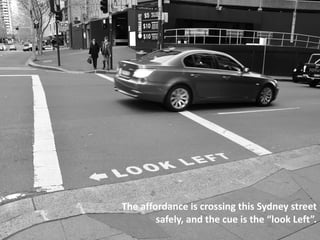
The affordance is crossing this Sydney street
safely, and the cue is the “look Left”.
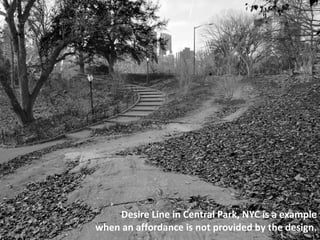
Desire Line in Central Park, NYC is a example
when an affordance is not provided by the design.
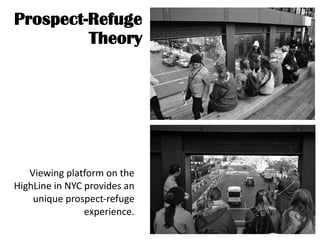
Prospect-Refuge
Theory
Viewing platform on the
HighLine in NYC provides an
unique prospect-refuge
experience.
Prospect refuge theory
describes the idea that people in
public places feel most comfortable
when they can observe what is
happening around them, while also
being slightly protected.
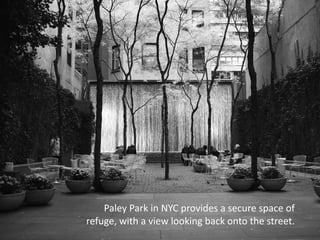
Paley Park in NYC provides a secure space of
refuge, with a view looking back onto the street.
The Salk Institute is known for the prospect it
provides when standing in a specific vantage point.
Photo by Natalie Wright.
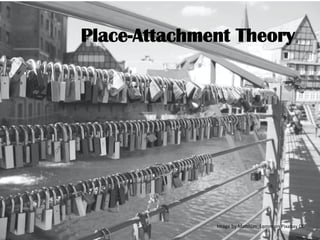
Place-Attachment Theory
Image by Matthias_Lemm on Pixabay CC
Place attachment theory
explains why people develop
emotional bonds with specific places,
often a treasured landscape from
their childhood. Using that
knowledge during the design
process, can aid in the creation of
better places that people will use
and enjoy, take ownership of, and
thrive in.
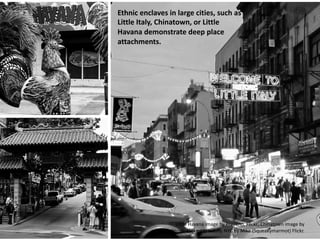
Ethnic enclaves in large cities, such as
Little Italy, Chinatown, or Little
Havana demonstrate deep place
attachments.
Little Havana image by Prayitno, Flickr; Chinatown image by
Osbornb, Flickr; Little Italy, NYC by Mike (Squeakymarmot) Flickr.
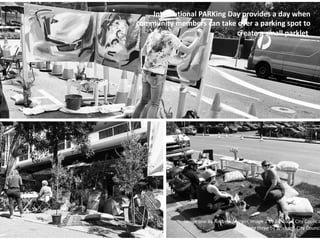
Image one by Andrew Merger, image 2 by Brisbane City Council
image three by Brisbane City Counci
International PARKing Day provides a day when
community members can take over a parking spot to
create a small parklet.
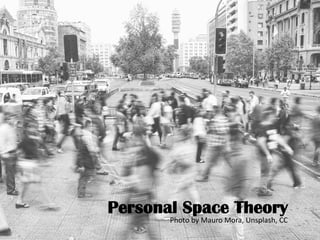
Personal Space Theory
Photo by Mauro Mora, Unsplash, CC
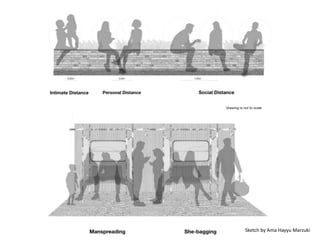
Proxemics describes the study of
personal space and how
different people conceptualize, use
and organize space. Proxemics
explains how intimate, personal,
social, and public distances may
differ depending on a person’s
cultural background, gender, age,
and relationship with others.
Sketch by Ama Hayyu Marzuki
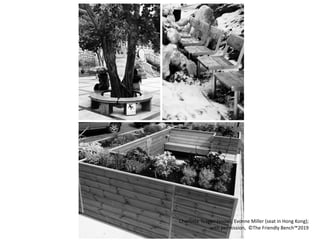
Charlotte Teagan (snow), Evonne Miller (seat in Hong Kong);
with permission, ©The Friendly Bench™2019
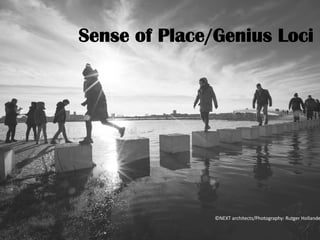
Sense of Place/Genius Loci
©NEXT architects/Photography: Rutger Hollande
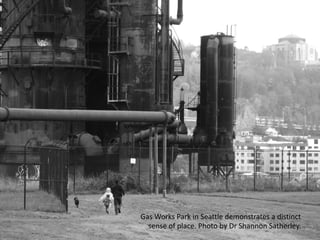
Sense of place theory is the
concept that every natural
environment has a unique character
with which people can identify and
be intrigued. This character can and
should be the starting point of a
designed environment, ensuring the
unique character is not lost or
hidden, but is celebrated and
reinforced.
Gas Works Park in Seattle demonstrates a distinct
sense of place. Photo by Dr Shannon Satherley.
Photos by: Ellen Marie Sæthre-McGuirk (Oslo);
Debra Cushing (Surfboard bench); ©NEXT
architects/Photography: Jeroen Bosch.
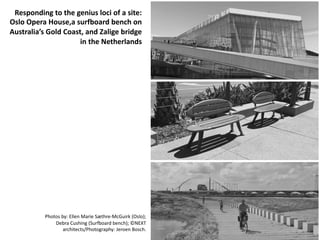
Responding to the genius loci of a site:
Oslo Opera House,a surfboard bench on
Australia’s Gold Coast, and Zalige bridge
in the Netherlands
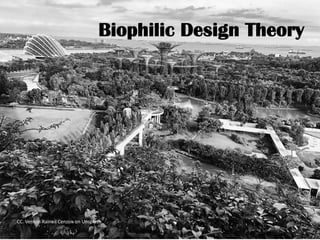
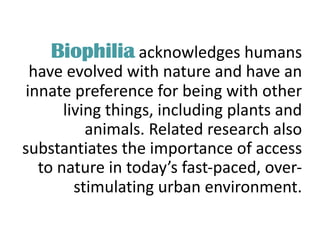
Biophilic Design Theory
CC. Vernon Raineil Cenzon on Unsplash
Biophilia acknowledges humans
have evolved with nature and have an
innate preference for being with other
living things, including plants and
animals. Related research also
substantiates the importance of access
to nature in today’s fast-paced, over-
stimulating urban environment.
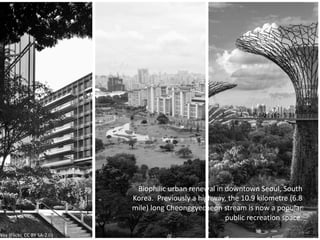
Biophilic urban renewal in downtown Seoul, South
Korea. Previously a highway, the 10.9 kilometre (6.8
mile) long Cheonggyecheon stream is now a popular
public recreation space.
Nux (Flickr, CC BY SA-2.0)
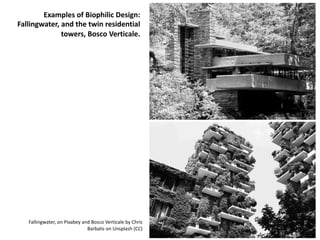
Examples of Biophilic Design:
Fallingwater, and the twin residential
towers, Bosco Verticale.
Fallingwater, on Pixabey and Bosco Verticale by Chris
Barbalis on Unsplash (CC)
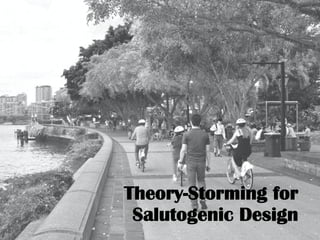
Theory-Storming for
Salutogenic Design
Salutogenic Design…
ACTIVELY promotes health and
wellbeing using a systems thinking
approach, addressing all factors that
can create, enhance and improve
physical, mental, and social well-
being.
What is health?
The World Health Organisation
defines health as, “a state of
complete physical, mental and
social well-being and not merely
the absence of disease or
infirmity”
(WHO, 2019)
Our Global Health Crisis…
• Obesity
• Heart-disease, Cancer, Diabetes, Lung Disease
• Mental Illness, Depression, Anxiety, Loneliness
• Fatigue, Stress
• Short and Long-term Injuries
…and now COVID-19
These affect all ages and are impacted by
our environment.
AN INDOOR CHILDHOOD?
AN INACTIVE ADULTHOOD?
Green time has been traded for screen time…
The need for Salutogenic Design
Three-quarters of UK children
spend less time outdoors than
prison inmates.
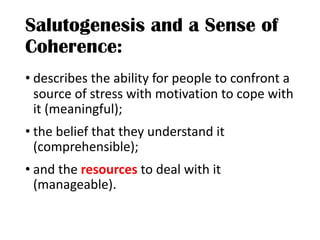
Salutogenesis and a Sense of
Coherence:
• describes the ability for people to confront a
source of stress with motivation to cope with
it (meaningful);
• the belief that they understand it
(comprehensible);
• and the resources to deal with it
(manageable).
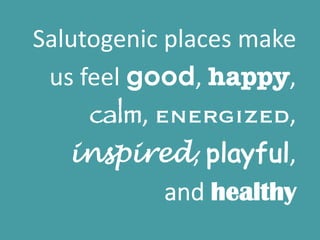
Salutogenic places make
us feel good, happy,
calm, energized,
inspired, playful,
and healthy
Theory-storming
a multi-use trail
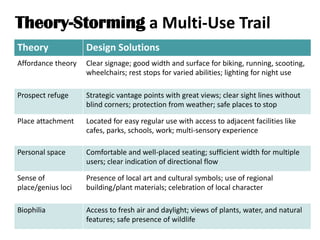
Theory-Storming a Multi-Use Trail
Theory Design Solutions
Affordance theory Clear signage; good width and surface for biking, running, scooting,
wheelchairs; rest stops for varied abilities; lighting for night use
Prospect refuge Strategic vantage points with great views; clear sight lines without
blind corners; protection from weather; safe places to stop
Place attachment Located for easy regular use with access to adjacent facilities like
cafes, parks, schools, work; multi-sensory experience
Personal space Comfortable and well-placed seating; sufficient width for multiple
users; clear indication of directional flow
Sense of
place/genius loci
Presence of local art and cultural symbols; use of regional
building/plant materials; celebration of local character
Biophilia Access to fresh air and daylight; views of plants, water, and natural
features; safe presence of wildlife
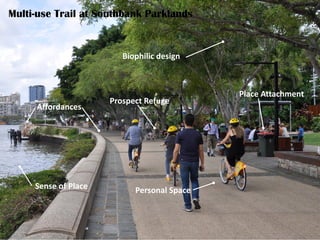
Prospect Refuge Theory
Prospect Refuge
Personal Space
Affordances
Sense of Place
Biophilic design
Place Attachment
Multi-use Trail at Southbank Parklands
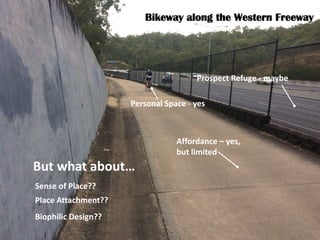
Bikeway along the Western Freeway
Affordance – yes,
but limited
Prospect Refuge - maybe
Sense of Place??
Place Attachment??
Personal Space - yes
Biophilic Design??
But what about…
Creating Great Places
in Practice
Creating great places
where people thrive
requires
boundary-pushing
innovative thinking
and courageous
leadership
Are we up for the
challenge?
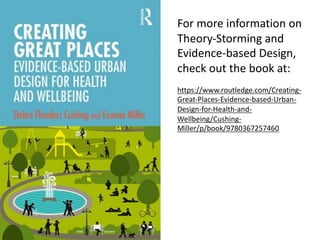
For more information on
Theory-Storming and
Evidence-based Design,
check out the book at:
https://www.routledge.com/Creating-
Great-Places-Evidence-based-Urban-
Design-for-Health-and-
Wellbeing/Cushing-
Miller/p/book/9780367257460
Coming up next week…
Week 2.
Theory-Storming
Innovative Child-friendly Design
Week 3.
Theory-Storming
Innovative Age-friendly & Inclusive Design
Week 4.
Theory-Storming
Innovative Sustainable Design
A/Prof Deb Cushing, Prof Evonne Miller & Tobias Volbert
QUT x Urban Play
Creating Great Places: The Design Series
Questions?

Creating Great Places - Webinar1_Salutogenic Design

  • 1.
    A/Prof Deb Cushing,Prof Evonne Miller & Tobias Volbert QUT x Urban Play Creating Great Places: The Design Series
  • 2.
    Agenda for today… •Introductions • What is Theory Storming? • 6 Critical Theories • Salutogenic Design as a Global Priority • Applying it to a Multi-use Trail Scenario • Creating Great Places in Practice – Tobias Volbert • Discussion Lounge
  • 3.
    Who we are… A/ProfessorDeb Cushing Discipline Leader for Spatial Design at QUT Background in landscape architecture and participatory community planning. Research focuses on designing healthy child- and youth-friendly environments. Professor Evonne Miller Director of the QUT Design Lab Background in design psychology and environmental gerontology. Research focuses on creating sustainable, inclusive and age-friendly places.
  • 4.
    Week 1. Theory-Storming Salutogenic Design Week2. Theory-Storming Innovative Child-friendly Design Week 3. Theory-Storming Innovative Age-friendly & Inclusive Design Week 4. Theory-Storming Innovative Sustainable Design
  • 5.
    Great places don’tjust happen. They are created.
  • 6.
  • 7.
    Evidence-based Design is… “a processfor the conscientious, explicit and judicious use of current best evidence from research and practice in making critical decisions, together with an informed client, about the design of each individual and unique project” (Hamilton & Watkins, 2009, p.9).
  • 8.
    Why is thisimportant?
  • 9.
    “Once finished, anew urban area or park or building will likely outlast every person who designed, engineered and built it. […]And it will remain in use long after those who commissioned and paid for it are gone…. every element – building, landscape, urban area, infrastructure – ought, accordingly, be designed to help us thrive” p. 269-272, Goldhagen, 2017
  • 10.
    Theory-Storming Viewing a designproblem through multiple theoretical lenses. The goal is to generate an evidence-based design solution that is creative and inspired, but also effective and sustainable for multiple stakeholders.
  • 11.
    Theory-Storming Inspired by EdwardDe Bono’s Six Thinking Hats Thinking with THEORY facilitates the creation of Great Places
  • 12.
    Theory-Storming in Action– ‘Design a Utopian Place’ Cushing, D.& Miller, E. (2020). Creating Great Places: Evidence- based urban design for health and wellbeing. Routledge. QLD DEPARTMENT OF HOUSING, HOMELESSNESS & SPORT (HHS)
  • 13.
    Theory-Storming Innovative, Health-PromotingPlaces Miller, E. & Cushing, D. (in press). Theory-Storming in the Urban Realm: Using Nudge Theory to inform the design of health- promoting places for all ages. The Journal of Design Strategies.
  • 14.
  • 15.
  • 16.
    Affordances are opportunitiesfor actions supported by an environment, and communicated through visual cues perceived by users. These cues are often determined by the surfaces, objects, and layout of the space.
  • 17.
    The affordance iscrossing this Sydney street safely, and the cue is the “look Left”.
  • 18.
    Desire Line inCentral Park, NYC is a example when an affordance is not provided by the design.
  • 19.
    Prospect-Refuge Theory Viewing platform onthe HighLine in NYC provides an unique prospect-refuge experience.
  • 20.
    Prospect refuge theory describesthe idea that people in public places feel most comfortable when they can observe what is happening around them, while also being slightly protected.
  • 21.
    Paley Park inNYC provides a secure space of refuge, with a view looking back onto the street.
  • 22.
    The Salk Instituteis known for the prospect it provides when standing in a specific vantage point. Photo by Natalie Wright.
  • 23.
    Place-Attachment Theory Image byMatthias_Lemm on Pixabay CC
  • 24.
    Place attachment theory explainswhy people develop emotional bonds with specific places, often a treasured landscape from their childhood. Using that knowledge during the design process, can aid in the creation of better places that people will use and enjoy, take ownership of, and thrive in.
  • 25.
    Ethnic enclaves inlarge cities, such as Little Italy, Chinatown, or Little Havana demonstrate deep place attachments. Little Havana image by Prayitno, Flickr; Chinatown image by Osbornb, Flickr; Little Italy, NYC by Mike (Squeakymarmot) Flickr.
  • 26.
    Image one byAndrew Merger, image 2 by Brisbane City Council image three by Brisbane City Counci International PARKing Day provides a day when community members can take over a parking spot to create a small parklet.
  • 27.
    Personal Space Theory Photoby Mauro Mora, Unsplash, CC
  • 28.
    Proxemics describes thestudy of personal space and how different people conceptualize, use and organize space. Proxemics explains how intimate, personal, social, and public distances may differ depending on a person’s cultural background, gender, age, and relationship with others.
  • 29.
    Sketch by AmaHayyu Marzuki
  • 30.
    Charlotte Teagan (snow),Evonne Miller (seat in Hong Kong); with permission, ©The Friendly Bench™2019
  • 31.
    Sense of Place/GeniusLoci ©NEXT architects/Photography: Rutger Hollande
  • 32.
    Sense of placetheory is the concept that every natural environment has a unique character with which people can identify and be intrigued. This character can and should be the starting point of a designed environment, ensuring the unique character is not lost or hidden, but is celebrated and reinforced.
  • 33.
    Gas Works Parkin Seattle demonstrates a distinct sense of place. Photo by Dr Shannon Satherley.
  • 34.
    Photos by: EllenMarie Sæthre-McGuirk (Oslo); Debra Cushing (Surfboard bench); ©NEXT architects/Photography: Jeroen Bosch. Responding to the genius loci of a site: Oslo Opera House,a surfboard bench on Australia’s Gold Coast, and Zalige bridge in the Netherlands
  • 35.
    Biophilic Design Theory CC.Vernon Raineil Cenzon on Unsplash
  • 36.
    Biophilia acknowledges humans haveevolved with nature and have an innate preference for being with other living things, including plants and animals. Related research also substantiates the importance of access to nature in today’s fast-paced, over- stimulating urban environment.
  • 37.
    Biophilic urban renewalin downtown Seoul, South Korea. Previously a highway, the 10.9 kilometre (6.8 mile) long Cheonggyecheon stream is now a popular public recreation space. Nux (Flickr, CC BY SA-2.0)
  • 38.
    Examples of BiophilicDesign: Fallingwater, and the twin residential towers, Bosco Verticale. Fallingwater, on Pixabey and Bosco Verticale by Chris Barbalis on Unsplash (CC)
  • 39.
  • 40.
    Salutogenic Design… ACTIVELY promoteshealth and wellbeing using a systems thinking approach, addressing all factors that can create, enhance and improve physical, mental, and social well- being.
  • 41.
    What is health? TheWorld Health Organisation defines health as, “a state of complete physical, mental and social well-being and not merely the absence of disease or infirmity” (WHO, 2019)
  • 42.
    Our Global HealthCrisis… • Obesity • Heart-disease, Cancer, Diabetes, Lung Disease • Mental Illness, Depression, Anxiety, Loneliness • Fatigue, Stress • Short and Long-term Injuries …and now COVID-19 These affect all ages and are impacted by our environment.
  • 43.
    AN INDOOR CHILDHOOD? ANINACTIVE ADULTHOOD? Green time has been traded for screen time… The need for Salutogenic Design Three-quarters of UK children spend less time outdoors than prison inmates.
  • 44.
    Salutogenesis and aSense of Coherence: • describes the ability for people to confront a source of stress with motivation to cope with it (meaningful); • the belief that they understand it (comprehensible); • and the resources to deal with it (manageable).
  • 45.
    Salutogenic places make usfeel good, happy, calm, energized, inspired, playful, and healthy
  • 46.
  • 47.
    Theory-Storming a Multi-UseTrail Theory Design Solutions Affordance theory Clear signage; good width and surface for biking, running, scooting, wheelchairs; rest stops for varied abilities; lighting for night use Prospect refuge Strategic vantage points with great views; clear sight lines without blind corners; protection from weather; safe places to stop Place attachment Located for easy regular use with access to adjacent facilities like cafes, parks, schools, work; multi-sensory experience Personal space Comfortable and well-placed seating; sufficient width for multiple users; clear indication of directional flow Sense of place/genius loci Presence of local art and cultural symbols; use of regional building/plant materials; celebration of local character Biophilia Access to fresh air and daylight; views of plants, water, and natural features; safe presence of wildlife
  • 48.
    Prospect Refuge Theory ProspectRefuge Personal Space Affordances Sense of Place Biophilic design Place Attachment Multi-use Trail at Southbank Parklands
  • 49.
    Bikeway along theWestern Freeway Affordance – yes, but limited Prospect Refuge - maybe Sense of Place?? Place Attachment?? Personal Space - yes Biophilic Design?? But what about…
  • 50.
  • 51.
    Creating great places wherepeople thrive requires boundary-pushing innovative thinking and courageous leadership
  • 52.
    Are we upfor the challenge?
  • 53.
    For more informationon Theory-Storming and Evidence-based Design, check out the book at: https://www.routledge.com/Creating- Great-Places-Evidence-based-Urban- Design-for-Health-and- Wellbeing/Cushing- Miller/p/book/9780367257460
  • 54.
    Coming up nextweek… Week 2. Theory-Storming Innovative Child-friendly Design Week 3. Theory-Storming Innovative Age-friendly & Inclusive Design Week 4. Theory-Storming Innovative Sustainable Design
  • 55.
    A/Prof Deb Cushing,Prof Evonne Miller & Tobias Volbert QUT x Urban Play Creating Great Places: The Design Series Questions?