1
Griffin, Management, 10e©2021 Cengage Learning. All Rights Reserved. May not be scanned, copied or duplicated, or posted to a publicly accessible website, in whole or in part.
Management
Chapter Fourteen: Basic Elements of
Individual Behavior in Organizations
2
Griffin, Management, 10e©2021 Cengage Learning. All Rights Reserved. May not be scanned, copied or duplicated, or posted to a publicly accessible website, in whole or in part.
Warm Up
‱ Review one of the personality assessments discussed in the text.
Based on your rating, do you agree with the accuracy of the
assessment?
‱ How can this information make you a better student? Employee?
‱ How can the understanding of personality help you as a manager?
3
Griffin, Management, 10e©2021 Cengage Learning. All Rights Reserved. May not be scanned, copied or duplicated, or posted to a publicly accessible website, in whole or in part.
Learning Objectives (1 of 2)
By the end of this chapter, you should be able to:
14-1 Explain the nature of the individual–organization relationship.
14-2 Describe how personality and personality attributes affect
behavior in organizations.
14-3 Discuss individual attitudes in organizations and how they
affect behavior.
14-4 Describe basic perceptual processes and the role of
attributions in organizations.
4
Griffin, Management, 10e©2021 Cengage Learning. All Rights Reserved. May not be scanned, copied or duplicated, or posted to a publicly accessible website, in whole or in part.
Learning Objectives (2 of 2)
By the end of this chapter, you should be able to:
14-5 Discuss the causes and consequences of stress and
how it can be managed.
14-6 Describe creativity and its role in organizations.
14-7 Explain how workplace behaviors can directly or
indirectly influence organizational effectiveness.
5
Griffin, Management, 10e©2021 Cengage Learning. All Rights Reserved. May not be scanned, copied or duplicated, or posted to a publicly accessible website, in whole or in part.
14-1a The Psychological Contract
‱ The Psychological Contract
− The overall set of expectations held by an individual with
respect to what he or she will contribute to the organization and
what the organization will provide in return
− Contributions
â–Ș What the individual provides to the organization
− Inducements
â–Ș What the organization provides to the individual
6
Griffin, Management, 10e©2021 Cengage Learning. All Rights Reserved. May not be scanned, copied or duplicated, or posted to a publicly accessible website, in whole or in part.
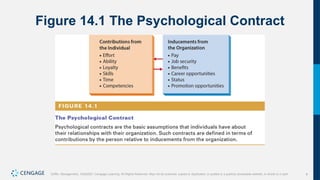
Figure 14.1 The Psychological Contract
7
Griffin, Management, 10e©2021 Cengage Learning. All Rights Reserved. May not be scanned, copied or duplicated, or posted to a publicly accessible website, in whole or in part.
14-1b The Person–Job Fit
‱ The person–job fit
− The extent to which the contributions made by the individual match
the inducements offered by the organization
â–Ș Each employee has a specific set of needs to be fulfilled and a
set of job-related behaviors to contribute.
â–Ș The degree to which the organization can take advantage of those
behaviors and, in turn, fulfill an employee’s needs will determine
the level of person-job fit.
8
Griffin, Management, 10e©2021 Cengage Learning. All Rights Reserved. May not be scanned, copied or duplicated, or posted to a publicly accessible website, in whole or in part.
14-1c The Nature of Individual Differences
‱ Individual differences
− Personal attributes that vary from one person to another
− May be physical, psychological, or emotional
− Must consider the situation in which behavior occurs
â–Ș Those who are productive in one area may not be
productive in ALL areas
9
Griffin, Management, 10e©2021 Cengage Learning. All Rights Reserved. May not be scanned, copied or duplicated, or posted to a publicly accessible website, in whole or in part.
Discussion #1
‱ How does a psychological contract really work? What is
really required to make the employment relationship work
for the employee and the employer? For example, does an
employer owe an employee any more than a good wage?
What do employees owe an employer? Does the
psychological contract really go both ways? Why or why
not?
10
Griffin, Management, 10e©2021 Cengage Learning. All Rights Reserved. May not be scanned, copied or duplicated, or posted to a publicly accessible website, in whole or in part.
14-2 Personality and Individual Behavior
‱ Personality:
‱ The relatively stable set of psychological and
behavioral attributes that distinguish one person
from another
‱ “Big Five” personality traits
‱ A popular personality framework based on five
key traits
11
Griffin, Management, 10e©2021 Cengage Learning. All Rights Reserved. May not be scanned, copied or duplicated, or posted to a publicly accessible website, in whole or in part.
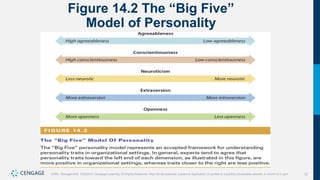
14-2a The “Big Five” Personality Traits
‱ Agreeableness: A person’s ability to get along with others
‱ Conscientiousness: A person’s ability to manage multiple tasks and
consistently meet deadlines
‱ Neuroticism: Extent to which a person experiences anxiety and is poised,
calm, resilient, and secure
‱ Extraversion: A person’s comfort level with relationships
‱ Openness: A person’s rigidity of beliefs and range of interests
12
Griffin, Management, 10e©2021 Cengage Learning. All Rights Reserved. May not be scanned, copied or duplicated, or posted to a publicly accessible website, in whole or in part.
Figure 14.2 The “Big Five”
Model of Personality
13
Griffin, Management, 10e©2021 Cengage Learning. All Rights Reserved. May not be scanned, copied or duplicated, or posted to a publicly accessible website, in whole or in part.
14-2b The Myers-Briggs Framework
‱ Myers-Briggs Type Indicator (MBTI)
− A questionnaire used to differentiate personalities on the
dimensions of the Myers-Briggs framework
− Useful to determine communication styles and interaction
preferences; has questionable reliability and validity
‱ Personality Types:
− Extraversion (E) versus Introversion (I)
− Sensing (S) versus Intuition (N)
− Thinking (T) versus Feeling (F)
− Judging (J) versus Perceiving (P)
14
Griffin, Management, 10e©2021 Cengage Learning. All Rights Reserved. May not be scanned, copied or duplicated, or posted to a publicly accessible website, in whole or in part.
14-2c Other Personality Traits at Work (1 of 3)
‱ Locus of control
− The degree to which an individual believes that his or her behavior
has a direct impact on the consequences of that behavior
− Internal locus of control—individuals believe they are in control of
their lives
− External locus of control—individuals believe that external forces
dictate what happens to them
15
Griffin, Management, 10e©2021 Cengage Learning. All Rights Reserved. May not be scanned, copied or duplicated, or posted to a publicly accessible website, in whole or in part.
14-2c Other Personality Traits at Work (2 of 3)
‱ Self-efficacy
− An individual’s beliefs about his or her capabilities to
perform a task
− High self-efficacy individuals believe they can perform
well, while low self-efficacy individuals doubt their ability
to perform
‱ Authoritarianism
− The extent to which an individual believes that power
and status differences are appropriate within hierarchical
social systems like organizations
16
Griffin, Management, 10e©2021 Cengage Learning. All Rights Reserved. May not be scanned, copied or duplicated, or posted to a publicly accessible website, in whole or in part.
14-2c Other Personality Traits at Work (3 of 3)
‱Machiavellianism
−Behavior directed at gaining power and controlling the
behavior of others
‱Self-esteem
−The extent to which a person believes he or she is a
worthwhile and deserving individual
‱Risk propensity
−The degree to which an individual is willing to take chances
and make risky decisions
17
Griffin, Management, 10e©2021 Cengage Learning. All Rights Reserved. May not be scanned, copied or duplicated, or posted to a publicly accessible website, in whole or in part.
14-2d Emotional Intelligence
‱ Emotional intelligence (EQ)
‱ The extent to which people are self-aware, manage their
emotions, motivate themselves, express empathy for others,
and possess social skills
‱ Dimensions of EQ
‱ Self-awareness
‱ Managing emotions
‱ Motivating oneself
‱ Empathy
‱ Social skills
18
Griffin, Management, 10e©2021 Cengage Learning. All Rights Reserved. May not be scanned, copied or duplicated, or posted to a publicly accessible website, in whole or in part.
Knowledge Check 1
Which of the following describes a person’s belief about his or her
ability to perform a task?
A. Locus of control
B. Self-efficacy
C. Machiavellianism
D. Emotional intelligence
19
Griffin, Management, 10e©2021 Cengage Learning. All Rights Reserved. May not be scanned, copied or duplicated, or posted to a publicly accessible website, in whole or in part.
Knowledge Check 1: Answer
‱ Which of the following describes a person’s belief about his or her ability to
perform a task?
B. Self-efficacy
Self-efficacy is a related but subtly different personality characteristic than locus of
control. Self-efficacy is a person’s beliefs about his or her capabilities to perform a
task. People with high self-efficacy believe that they can perform well on a specific
task, whereas people with low self-efficacy tend to doubt their ability to perform a
specific task.
20
Griffin, Management, 10e©2021 Cengage Learning. All Rights Reserved. May not be scanned, copied or duplicated, or posted to a publicly accessible website, in whole or in part.
14-3 Attitudes and Individual Behavior (1 of 2)
‱ Attitudes:
‱ Complexes of beliefs and feelings that people have about
specific ideas, situations, or other people
‱ Cognitive dissonance:
‱ Caused when an individual has conflicting attitudes
‱ I really wanted that promotion, but it went to someone
else. I know I should continue to work hard to get the
next promotion, but I really don’t want to work for that
person.
21
Griffin, Management, 10e©2021 Cengage Learning. All Rights Reserved. May not be scanned, copied or duplicated, or posted to a publicly accessible website, in whole or in part.
14-3 Attitudes and Individual Behavior (2 of 2)
‱ Affective component:
‱ Reflects feelings and emotions an individual has toward a
situation; how we feel
‱ Cognitive component:
‱ Derived from knowledge an individual has about a
situation; why we feel that way
‱ Intentional component:
‱ Reflects how an individual expects to behave toward or in
the situation; how we intend to behave
22
Griffin, Management, 10e©2021 Cengage Learning. All Rights Reserved. May not be scanned, copied or duplicated, or posted to a publicly accessible website, in whole or in part.
14-3a Work-Related Attitudes (1 of 2)
‱ Job satisfaction and work behaviors
‱ Job satisfaction is influenced by personal, group, and
organizational factors.
‱ Satisfied employees are absent from work less often,
make positive contributions, and stay with the
organization.
‱ Dissatisfied employees are absent from work more often,
may experience stress that disrupts coworkers, and are
continually looking for another job.
23
Griffin, Management, 10e©2021 Cengage Learning. All Rights Reserved. May not be scanned, copied or duplicated, or posted to a publicly accessible website, in whole or in part.
14-3a Work-Related Attitudes (2 of 2)
‱ Job satisfaction or dissatisfaction
‱ An attitude that reflects the extent to which an individual
is gratified by or fulfilled in his or her work
‱ Job satisfaction and work behaviors
‱ High levels of job satisfaction do not necessarily lead to
high job performance
24
Griffin, Management, 10e©2021 Cengage Learning. All Rights Reserved. May not be scanned, copied or duplicated, or posted to a publicly accessible website, in whole or in part.
14-3b Organizational Commitment
and Engagement
‱ Organizational commitment
‱ An attitude that reflects an individual’s identification with and attachment to
the organization itself
‱ Organizational commitment and work behaviors
‱ Employee commitment strengthens with an individual’s age, years with the
organization, sense of job security, and participation in decision making.
‱ Committed employees have highly reliable habits, plan a longer tenure with
the organization, and muster more effort in performance.
25
Griffin, Management, 10e©2021 Cengage Learning. All Rights Reserved. May not be scanned, copied or duplicated, or posted to a publicly accessible website, in whole or in part.
14-3c Affect and Mood in Organizations
‱ Positive affectivity:
− A tendency to be relatively upbeat and optimistic,
have an overall sense of well-being, see things in a
positive light, and seem to be in a good mood
‱ Negative affectivity:
− A tendency to be generally downbeat and pessimistic,
tend to see things in a negative way, and seem to be
in a bad mood
26
Griffin, Management, 10e©2021 Cengage Learning. All Rights Reserved. May not be scanned, copied or duplicated, or posted to a publicly accessible website, in whole or in part.
Knowledge Check 2
‱ What is the relationship between job satisfaction and performance?
A. More satisfied employees have higher performance.
B. More satisfied employees have lower performance.
C. Less satisfied employees work harder to improve performance.
D. There is no relationship between job satisfaction and performance.
27
Griffin, Management, 10e©2021 Cengage Learning. All Rights Reserved. May not be scanned, copied or duplicated, or posted to a publicly accessible website, in whole or in part.
Knowledge Check 2: Answer
‱ What is the relationship between job satisfaction and performance?
D. There is no relationship between job satisfaction and performance.
A satisfied employee tends to be absent less often, to make positive
contributions, and is inclined to stay with the organization. In contrast, a
dissatisfied employee may be absent more often, may experience stress that
disrupts coworkers, and may be continually looking for another job.
Contrary to what many managers believe, however, high levels of
job satisfaction do not necessarily lead to higher levels of performance.
28
Griffin, Management, 10e©2021 Cengage Learning. All Rights Reserved. May not be scanned, copied or duplicated, or posted to a publicly accessible website, in whole or in part.
14-4a Basic Perception Process (1 of 2)
‱ Perception:
− The set of processes by which an individual becomes
aware of and interprets information about the
environment
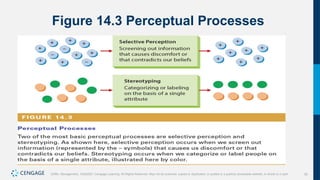
‱ Selective perception:
− The process of screening out information that we are
uncomfortable with or that contradicts our beliefs
− If selective perception causes someone to ignore
important information, it can become quite detrimental
29
Griffin, Management, 10e©2021 Cengage Learning. All Rights Reserved. May not be scanned, copied or duplicated, or posted to a publicly accessible website, in whole or in part.
14-4a Basic Perception Process (2 of 2)
‱ Stereotyping:
− The process of categorizing or labeling people on
the basis of a single attribute
− Stereotyping may cost the organization valuable
talent, violate federal anti-bias laws, and is
unethical
30
Griffin, Management, 10e©2021 Cengage Learning. All Rights Reserved. May not be scanned, copied or duplicated, or posted to a publicly accessible website, in whole or in part.
Figure 14.3 Perceptual Processes
31
Griffin, Management, 10e©2021 Cengage Learning. All Rights Reserved. May not be scanned, copied or duplicated, or posted to a publicly accessible website, in whole or in part.
14-4b Perception and Attribution
‱ Attribution
− The process of categorizing or labeling people on the basis of a single
attribute
‱ How behavioral attributions are formed:
− Consensus: Do other people in the same situation behave the same way?
− Consistency: Does this person behave the same way at different times?
− Distinctiveness: Does this person behave the same way in other
situations?
32
Griffin, Management, 10e©2021 Cengage Learning. All Rights Reserved. May not be scanned, copied or duplicated, or posted to a publicly accessible website, in whole or in part.
Discussion #2
‱ Can you identify types of stereotyping that might go on
in the workplace today? What is the result of
stereotyping in the workplace? Can stereotyping ever
be useful or efficient in the workplace? Why or why
not?
33
Griffin, Management, 10e©2021 Cengage Learning. All Rights Reserved. May not be scanned, copied or duplicated, or posted to a publicly accessible website, in whole or in part.
14-5 Stress and Individual Behavior (1 of 2)
‱ Stress: An individual’s response to a strong stimulus, which is called a stressor
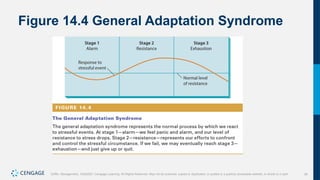
‱ General adaptation syndrome (GAS)
− General cycle of the stress process
− Stage 1 Alarm: Panic, wondering how to cope, and a feeling of
helplessness
− Stage 2 Resistance: Individual is actively resisting the effects of the
stressor
− Stage 3 Exhaustion: Prolonged exposure to stress causes an individual to
give up
34
Griffin, Management, 10e©2021 Cengage Learning. All Rights Reserved. May not be scanned, copied or duplicated, or posted to a publicly accessible website, in whole or in part.
Figure 14.4 General Adaptation Syndrome
35
Griffin, Management, 10e©2021 Cengage Learning. All Rights Reserved. May not be scanned, copied or duplicated, or posted to a publicly accessible website, in whole or in part.
14-5 Stress and Individual Behavior (2 of 2)
‱ Personality Types:
‱ Type A
− Extremely competitive, devoted to work, strong sense of time
urgency
− Have a lot of drive and want to accomplish as much as
possible as quickly as possible
‱ Type B
− Less competitive, less devoted to work, weaker sense of time
urgency
36
Griffin, Management, 10e©2021 Cengage Learning. All Rights Reserved. May not be scanned, copied or duplicated, or posted to a publicly accessible website, in whole or in part.
Poll 1
Are you a Type A personality or a Type B?
A. Type A: I am competitive and have a lot of drive. I am devoted
to my work, and I accomplish a lot!
B. Type B: I am less devoted to work and have less of a sense of
time urgency, and I am pretty relaxed about it!
C. Can I be both?
37
Griffin, Management, 10e©2021 Cengage Learning. All Rights Reserved. May not be scanned, copied or duplicated, or posted to a publicly accessible website, in whole or in part.
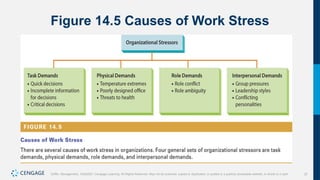
Figure 14.5 Causes of Work Stress
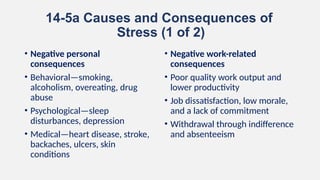
14-5a Causes and Consequences of
Stress (1 of 2)
‱ Negative personal
consequences
‱ Behavioral—smoking,
alcoholism, overeating, drug
abuse
‱ Psychological—sleep
disturbances, depression
‱ Medical—heart disease, stroke,
backaches, ulcers, skin
conditions
‱ Negative work-related
consequences
‱ Poor quality work output and
lower productivity
‱ Job dissatisfaction, low morale,
and a lack of commitment
‱ Withdrawal through indifference
and absenteeism
39
Griffin, Management, 10e©2021 Cengage Learning. All Rights Reserved. May not be scanned, copied or duplicated, or posted to a publicly accessible website, in whole or in part.
14-5a Causes and Consequences of
Stress (2 of 2)
‱ Burnout
− A feeling of exhaustion that may develop when
someone experiences too much stress for an extended
period of time
40
Griffin, Management, 10e©2021 Cengage Learning. All Rights Reserved. May not be scanned, copied or duplicated, or posted to a publicly accessible website, in whole or in part.
14-5b Managing Stress
‱ Regular exercise
− Reduces tension and stress, and improves self-confidence and feelings
of optimism
‱ Relaxation
− Allows individuals to adapt and deal with their stress
‱ Time management
− Reduces stress by prioritizing activities to accomplish them in their order
of importance
‱ Support groups
− Socializing away from work reduces stress
41
Griffin, Management, 10e©2021 Cengage Learning. All Rights Reserved. May not be scanned, copied or duplicated, or posted to a publicly accessible website, in whole or in part.
Discussion #3
‱ Whether it is exam time, a group project is due, or an attempt
is being made to manage work, family, and classes, students
are under stress. What are your techniques for managing
stress? Do they work? How do you know when you have
reached burnout?
42
Griffin, Management, 10e©2021 Cengage Learning. All Rights Reserved. May not be scanned, copied or duplicated, or posted to a publicly accessible website, in whole or in part.
14-6a The Creative Individual
‱ Creativity: The ability of an individual to generate new ideas or to
conceive of new perspectives on existing ideas
‱ The creative individual
− Background experiences and creativity
‱ Personal traits and creativity
− Personal traits of openness, an attraction to complexity, high
levels of energy, independence, autonomy, strong self-
confidence, and a strong belief in his or her own creativity
‱ Cognitive abilities and creativity
− Highly intelligent, both divergent and convergent thinkers
43
Griffin, Management, 10e©2021 Cengage Learning. All Rights Reserved. May not be scanned, copied or duplicated, or posted to a publicly accessible website, in whole or in part.
14-6b The Creative Process (1 of 2)
‱ Preparation
− Formal education and training are used to “get up to speed.”
− Experiences on the job provide additional knowledge and ideas.
‱ Incubation
− It is a period of conscious concentration during which knowledge
and ideas mature and develop.
− Incubation is helped by pauses in rational thought.
44
Griffin, Management, 10e©2021 Cengage Learning. All Rights Reserved. May not be scanned, copied or duplicated, or posted to a publicly accessible website, in whole or in part.
14-6b The Creative Process (2 of 2)
‱ Insight:
− A spontaneous breakthrough in which the creative person
achieves a new understanding of some problem or situation
â–Ș The “aha moment”
− Patterns of thought coalesce into a new understanding
‱ Verification:
− Determines the validity or truthfulness of the insight
− Tests are conducted and prototypes are built to see if the insight
leads to the expected results
45
Griffin, Management, 10e©2021 Cengage Learning. All Rights Reserved. May not be scanned, copied or duplicated, or posted to a publicly accessible website, in whole or in part.
14-6c Enhancing Creativity in Organizations
‱ Enhancing creativity in organizations
− Make creativity part of the organization’s culture.
− Set goals for revenues from creative products and services.
− Reward creative success; refrain from punishing creative failures
—some ideas work out as expected, while others don’t.
46
Griffin, Management, 10e©2021 Cengage Learning. All Rights Reserved. May not be scanned, copied or duplicated, or posted to a publicly accessible website, in whole or in part.
Discussion #4
‱ Do you consider yourself to be creative? What steps do you
use when trying to creatively resolve an issue? How can you
apply those same processes to other areas of your life?
47
Griffin, Management, 10e©2021 Cengage Learning. All Rights Reserved. May not be scanned, copied or duplicated, or posted to a publicly accessible website, in whole or in part.
14-7a Performance Behaviors
‱ Workplace behavior:
− A pattern of action by the members of an organization that
directly or indirectly influences organizational effectiveness
‱ Performance behaviors:
− The total set of work-related behaviors that an organization
expects an individual to display
48
Griffin, Management, 10e©2021 Cengage Learning. All Rights Reserved. May not be scanned, copied or duplicated, or posted to a publicly accessible website, in whole or in part.
14-7b Withdrawal Behaviors
‱ Withdrawal behaviors:
− Absenteeism
â–Ș When an individual does not show up for work
â–Ș Cause may be legitimate or feigned
â–Ș May be a symptom of other work-related problems
− Turnover
â–Ș When people quit their jobs
â–Ș May be due to work-related or personal reasons
49
Griffin, Management, 10e©2021 Cengage Learning. All Rights Reserved. May not be scanned, copied or duplicated, or posted to a publicly accessible website, in whole or in part.
14-7c Organizational Citizenship
‱ Organizational citizenship:
− The behavior of individuals that makes a positive overall
contribution to the organization
‱ Determinants of organizational citizenship:
− Individual’s personality, attitudes, and needs
− Social context of the workplace (work group)
− Organization’s capability to reward citizenship
50
Griffin, Management, 10e©2021 Cengage Learning. All Rights Reserved. May not be scanned, copied or duplicated, or posted to a publicly accessible website, in whole or in part.
14-7d Dysfunctional Behaviors
‱ Dysfunctional behaviors:
− Those that detract from, rather than contribute to, organizational
performance
â–Ș Absenteeism and turnover
â–Ș Theft and sabotage
â–Ș Sexual and racial harassment
â–Ș Politicized behavior
â–Ș Intentionally misleading others
â–Ș Spreading malicious rumors
â–Ș Workplace violence
51
Griffin, Management, 10e©2021 Cengage Learning. All Rights Reserved. May not be scanned, copied or duplicated, or posted to a publicly accessible website, in whole or in part.
Knowledge Check 3
In what way does an employee’s personality, attitudes, and needs affect his or her
workplace behaviors, and by extension, the effectiveness of the organization?
A. They help to shape organizational citizenship.
B. They reduce turnover.
C. They prevent dysfunctional behaviors.
D. They enhance creativity.
52
Griffin, Management, 10e©2021 Cengage Learning. All Rights Reserved. May not be scanned, copied or duplicated, or posted to a publicly accessible website, in whole or in part.
Knowledge Check 3: Answer
‱ In what way does an employee’s personality, attitudes, and needs affect his or
her workplace behaviors, and by extension, the effectiveness of the
organization?
A. They help to shape organizational citizenship.
The personality, attitudes, and needs of the individual will have to be consistent
with citizenship behaviors. Similarly, the social context in which the person works,
or the work group, will need to facilitate and promote such behaviors. And the
organization itself, especially its culture, must be capable of promoting,
recognizing, and rewarding these types of behaviors if they are to be
maintained. Research suggests that organizational citizenship may play
an important role in organizational effectiveness.
53
Griffin, Management, 10e©2021 Cengage Learning. All Rights Reserved. May not be scanned, copied or duplicated, or posted to a publicly accessible website, in whole or in part.
Summary (1 of 2)
Now that the lesson has ended, you will have learned how to:
‱ Explain the nature of the individual–organization relationship.
‱ Describe how personality and personality attributes affect behavior in
organizations.
‱ Discuss individual attitudes in organizations and how they affect behavior.
‱ Describe basic perceptual processes and the role of attributions in
organizations.
54
Griffin, Management, 10e©2021 Cengage Learning. All Rights Reserved. May not be scanned, copied or duplicated, or posted to a publicly accessible website, in whole or in part.
Summary (2 of 2)
Now that the lesson has ended, you will have learned how to:
‱ Discuss the causes and consequences of stress and how it
can be managed.
‱ Describe creativity and its role in organizations.
‱ Explain how workplace behaviors can directly or indirectly
influence organizational effectiveness.
55
Griffin, Management, 10e©2021 Cengage Learning. All Rights Reserved. May not be scanned, copied or duplicated, or posted to a publicly accessible website, in whole or in part.
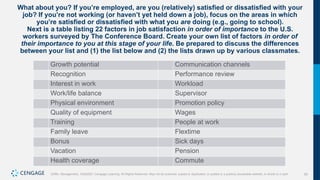
What about you? If you’re employed, are you (relatively) satisfied or dissatisfied with your
job? If you’re not working (or haven’t yet held down a job), focus on the areas in which
you’re satisfied or dissatisfied with what you are doing (e.g., going to school).
Next is a table listing 22 factors in job satisfaction in order of importance to the U.S.
workers surveyed by The Conference Board. Create your own list of factors in order of
their importance to you at this stage of your life. Be prepared to discuss the differences
between your list and (1) the list below and (2) the lists drawn up by various classmates.
Growth potential Communication channels
Recognition Performance review
Interest in work Workload
Work/life balance Supervisor
Physical environment Promotion policy
Quality of equipment Wages
Training People at work
Family leave Flextime
Bonus Sick days
Vacation Pension
Health coverage Commute
56
Griffin, Management, 10e©2021 Cengage Learning. All Rights Reserved. May not be scanned, copied or duplicated, or posted to a publicly accessible website, in whole or in part.
Employees First
‱ What is your impression of the “employees first” culture at HCL Technologies?
Explain whether this culture can be equally effective in other organizations.
‱ How did organizational behavior help Vineet Nayar lead his company? Did it
also help supervisors at HCL?
‱ What do you think of HCL’s approach during the global recession where it
retained all employees but did not provide any raises? Would you do anything
differently?
‱ Design an employee attitude survey for the HCL employees.
57
Griffin, Management, 10e©2021 Cengage Learning. All Rights Reserved. May not be scanned, copied or duplicated, or posted to a publicly accessible website, in whole or in part.
What about Megan? First, draw up a list of job-dissatisfaction
factors for Megan. Second, regard the following as applicable to
Megan’s situation:
‱ She likes the type of work she does and has good relationships with coworkers.
‱ More than a few of her coworkers are also frustrated by the company’s tight supervision and
demanding work schedule.
‱ She is a cheerful and positive person.
‱ She performs well and gets positive feedback because she looks for solutions to problems
rather than dwelling on the negative aspects of things.
‱ What do you think Megan should do? If you think that she should find another job, be
prepared to explain why you think it’s the best move. If you think that she should try to resolve
her frustrations before looking for another job, explain the points that she should try to get
across in conversations with her boss.
Students will vary on their advice for Megan. If they feel Megan should quit her job, it may center
around trust and micromanaging. If Megan cannot trust her manager to keep her word, then there
may not be a reason to stay. Her manager is a micromanager, and she is unlikely to change in
the future. If they urge Megan to stay and work it out with her manager, students may use the
points bulleted above for Megan to bring up with her manager.
58
Griffin, Management, 10e©2021 Cengage Learning. All Rights Reserved. May not be scanned, copied or duplicated, or posted to a publicly accessible website, in whole or in part.
Gad Levanon, an economist who coauthored The Conference Board report,
writes the following:
Based on macro trends—including a significantly tighter labor market, slowing
productivity growth, and more business investment—worker satisfaction should
be on the rise. But job dissatisfaction may remain entrenched until we see
improvements in worker compensation, which has grown abysmally in recent
years despite historically high corporate profits.
Levanon is expressing an opinion and making a related prediction. Explain his
opinion and his prediction in your own words. Do you agree or disagree with this
opinion and prediction? In particular, do you expect things to get better
economically? Whether you answer yes or no, how do you see your prospects for
getting a job that you’re satisfied with?

Principles and practises of management ppt

  • 1.
    1 Griffin, Management, 10e©2021Cengage Learning. All Rights Reserved. May not be scanned, copied or duplicated, or posted to a publicly accessible website, in whole or in part. Management Chapter Fourteen: Basic Elements of Individual Behavior in Organizations
  • 2.
    2 Griffin, Management, 10e©2021Cengage Learning. All Rights Reserved. May not be scanned, copied or duplicated, or posted to a publicly accessible website, in whole or in part. Warm Up ‱ Review one of the personality assessments discussed in the text. Based on your rating, do you agree with the accuracy of the assessment? ‱ How can this information make you a better student? Employee? ‱ How can the understanding of personality help you as a manager?
  • 3.
    3 Griffin, Management, 10e©2021Cengage Learning. All Rights Reserved. May not be scanned, copied or duplicated, or posted to a publicly accessible website, in whole or in part. Learning Objectives (1 of 2) By the end of this chapter, you should be able to: 14-1 Explain the nature of the individual–organization relationship. 14-2 Describe how personality and personality attributes affect behavior in organizations. 14-3 Discuss individual attitudes in organizations and how they affect behavior. 14-4 Describe basic perceptual processes and the role of attributions in organizations.
  • 4.
    4 Griffin, Management, 10e©2021Cengage Learning. All Rights Reserved. May not be scanned, copied or duplicated, or posted to a publicly accessible website, in whole or in part. Learning Objectives (2 of 2) By the end of this chapter, you should be able to: 14-5 Discuss the causes and consequences of stress and how it can be managed. 14-6 Describe creativity and its role in organizations. 14-7 Explain how workplace behaviors can directly or indirectly influence organizational effectiveness.
  • 5.
    5 Griffin, Management, 10e©2021Cengage Learning. All Rights Reserved. May not be scanned, copied or duplicated, or posted to a publicly accessible website, in whole or in part. 14-1a The Psychological Contract ‱ The Psychological Contract − The overall set of expectations held by an individual with respect to what he or she will contribute to the organization and what the organization will provide in return − Contributions â–Ș What the individual provides to the organization − Inducements â–Ș What the organization provides to the individual
  • 6.
    6 Griffin, Management, 10e©2021Cengage Learning. All Rights Reserved. May not be scanned, copied or duplicated, or posted to a publicly accessible website, in whole or in part. Figure 14.1 The Psychological Contract
  • 7.
    7 Griffin, Management, 10e©2021Cengage Learning. All Rights Reserved. May not be scanned, copied or duplicated, or posted to a publicly accessible website, in whole or in part. 14-1b The Person–Job Fit ‱ The person–job fit − The extent to which the contributions made by the individual match the inducements offered by the organization â–Ș Each employee has a specific set of needs to be fulfilled and a set of job-related behaviors to contribute. â–Ș The degree to which the organization can take advantage of those behaviors and, in turn, fulfill an employee’s needs will determine the level of person-job fit.
  • 8.
    8 Griffin, Management, 10e©2021Cengage Learning. All Rights Reserved. May not be scanned, copied or duplicated, or posted to a publicly accessible website, in whole or in part. 14-1c The Nature of Individual Differences ‱ Individual differences − Personal attributes that vary from one person to another − May be physical, psychological, or emotional − Must consider the situation in which behavior occurs â–Ș Those who are productive in one area may not be productive in ALL areas
  • 9.
    9 Griffin, Management, 10e©2021Cengage Learning. All Rights Reserved. May not be scanned, copied or duplicated, or posted to a publicly accessible website, in whole or in part. Discussion #1 ‱ How does a psychological contract really work? What is really required to make the employment relationship work for the employee and the employer? For example, does an employer owe an employee any more than a good wage? What do employees owe an employer? Does the psychological contract really go both ways? Why or why not?
  • 10.
    10 Griffin, Management, 10e©2021Cengage Learning. All Rights Reserved. May not be scanned, copied or duplicated, or posted to a publicly accessible website, in whole or in part. 14-2 Personality and Individual Behavior ‱ Personality: ‱ The relatively stable set of psychological and behavioral attributes that distinguish one person from another ‱ “Big Five” personality traits ‱ A popular personality framework based on five key traits
  • 11.
    11 Griffin, Management, 10e©2021Cengage Learning. All Rights Reserved. May not be scanned, copied or duplicated, or posted to a publicly accessible website, in whole or in part. 14-2a The “Big Five” Personality Traits ‱ Agreeableness: A person’s ability to get along with others ‱ Conscientiousness: A person’s ability to manage multiple tasks and consistently meet deadlines ‱ Neuroticism: Extent to which a person experiences anxiety and is poised, calm, resilient, and secure ‱ Extraversion: A person’s comfort level with relationships ‱ Openness: A person’s rigidity of beliefs and range of interests
  • 12.
    12 Griffin, Management, 10e©2021Cengage Learning. All Rights Reserved. May not be scanned, copied or duplicated, or posted to a publicly accessible website, in whole or in part. Figure 14.2 The “Big Five” Model of Personality
  • 13.
    13 Griffin, Management, 10e©2021Cengage Learning. All Rights Reserved. May not be scanned, copied or duplicated, or posted to a publicly accessible website, in whole or in part. 14-2b The Myers-Briggs Framework ‱ Myers-Briggs Type Indicator (MBTI) − A questionnaire used to differentiate personalities on the dimensions of the Myers-Briggs framework − Useful to determine communication styles and interaction preferences; has questionable reliability and validity ‱ Personality Types: − Extraversion (E) versus Introversion (I) − Sensing (S) versus Intuition (N) − Thinking (T) versus Feeling (F) − Judging (J) versus Perceiving (P)
  • 14.
    14 Griffin, Management, 10e©2021Cengage Learning. All Rights Reserved. May not be scanned, copied or duplicated, or posted to a publicly accessible website, in whole or in part. 14-2c Other Personality Traits at Work (1 of 3) ‱ Locus of control − The degree to which an individual believes that his or her behavior has a direct impact on the consequences of that behavior − Internal locus of control—individuals believe they are in control of their lives − External locus of control—individuals believe that external forces dictate what happens to them
  • 15.
    15 Griffin, Management, 10e©2021Cengage Learning. All Rights Reserved. May not be scanned, copied or duplicated, or posted to a publicly accessible website, in whole or in part. 14-2c Other Personality Traits at Work (2 of 3) ‱ Self-efficacy − An individual’s beliefs about his or her capabilities to perform a task − High self-efficacy individuals believe they can perform well, while low self-efficacy individuals doubt their ability to perform ‱ Authoritarianism − The extent to which an individual believes that power and status differences are appropriate within hierarchical social systems like organizations
  • 16.
    16 Griffin, Management, 10e©2021Cengage Learning. All Rights Reserved. May not be scanned, copied or duplicated, or posted to a publicly accessible website, in whole or in part. 14-2c Other Personality Traits at Work (3 of 3) ‱Machiavellianism −Behavior directed at gaining power and controlling the behavior of others ‱Self-esteem −The extent to which a person believes he or she is a worthwhile and deserving individual ‱Risk propensity −The degree to which an individual is willing to take chances and make risky decisions
  • 17.
    17 Griffin, Management, 10e©2021Cengage Learning. All Rights Reserved. May not be scanned, copied or duplicated, or posted to a publicly accessible website, in whole or in part. 14-2d Emotional Intelligence ‱ Emotional intelligence (EQ) ‱ The extent to which people are self-aware, manage their emotions, motivate themselves, express empathy for others, and possess social skills ‱ Dimensions of EQ ‱ Self-awareness ‱ Managing emotions ‱ Motivating oneself ‱ Empathy ‱ Social skills
  • 18.
    18 Griffin, Management, 10e©2021Cengage Learning. All Rights Reserved. May not be scanned, copied or duplicated, or posted to a publicly accessible website, in whole or in part. Knowledge Check 1 Which of the following describes a person’s belief about his or her ability to perform a task? A. Locus of control B. Self-efficacy C. Machiavellianism D. Emotional intelligence
  • 19.
    19 Griffin, Management, 10e©2021Cengage Learning. All Rights Reserved. May not be scanned, copied or duplicated, or posted to a publicly accessible website, in whole or in part. Knowledge Check 1: Answer ‱ Which of the following describes a person’s belief about his or her ability to perform a task? B. Self-efficacy Self-efficacy is a related but subtly different personality characteristic than locus of control. Self-efficacy is a person’s beliefs about his or her capabilities to perform a task. People with high self-efficacy believe that they can perform well on a specific task, whereas people with low self-efficacy tend to doubt their ability to perform a specific task.
  • 20.
    20 Griffin, Management, 10e©2021Cengage Learning. All Rights Reserved. May not be scanned, copied or duplicated, or posted to a publicly accessible website, in whole or in part. 14-3 Attitudes and Individual Behavior (1 of 2) ‱ Attitudes: ‱ Complexes of beliefs and feelings that people have about specific ideas, situations, or other people ‱ Cognitive dissonance: ‱ Caused when an individual has conflicting attitudes ‱ I really wanted that promotion, but it went to someone else. I know I should continue to work hard to get the next promotion, but I really don’t want to work for that person.
  • 21.
    21 Griffin, Management, 10e©2021Cengage Learning. All Rights Reserved. May not be scanned, copied or duplicated, or posted to a publicly accessible website, in whole or in part. 14-3 Attitudes and Individual Behavior (2 of 2) ‱ Affective component: ‱ Reflects feelings and emotions an individual has toward a situation; how we feel ‱ Cognitive component: ‱ Derived from knowledge an individual has about a situation; why we feel that way ‱ Intentional component: ‱ Reflects how an individual expects to behave toward or in the situation; how we intend to behave
  • 22.
    22 Griffin, Management, 10e©2021Cengage Learning. All Rights Reserved. May not be scanned, copied or duplicated, or posted to a publicly accessible website, in whole or in part. 14-3a Work-Related Attitudes (1 of 2) ‱ Job satisfaction and work behaviors ‱ Job satisfaction is influenced by personal, group, and organizational factors. ‱ Satisfied employees are absent from work less often, make positive contributions, and stay with the organization. ‱ Dissatisfied employees are absent from work more often, may experience stress that disrupts coworkers, and are continually looking for another job.
  • 23.
    23 Griffin, Management, 10e©2021Cengage Learning. All Rights Reserved. May not be scanned, copied or duplicated, or posted to a publicly accessible website, in whole or in part. 14-3a Work-Related Attitudes (2 of 2) ‱ Job satisfaction or dissatisfaction ‱ An attitude that reflects the extent to which an individual is gratified by or fulfilled in his or her work ‱ Job satisfaction and work behaviors ‱ High levels of job satisfaction do not necessarily lead to high job performance
  • 24.
    24 Griffin, Management, 10e©2021Cengage Learning. All Rights Reserved. May not be scanned, copied or duplicated, or posted to a publicly accessible website, in whole or in part. 14-3b Organizational Commitment and Engagement ‱ Organizational commitment ‱ An attitude that reflects an individual’s identification with and attachment to the organization itself ‱ Organizational commitment and work behaviors ‱ Employee commitment strengthens with an individual’s age, years with the organization, sense of job security, and participation in decision making. ‱ Committed employees have highly reliable habits, plan a longer tenure with the organization, and muster more effort in performance.
  • 25.
    25 Griffin, Management, 10e©2021Cengage Learning. All Rights Reserved. May not be scanned, copied or duplicated, or posted to a publicly accessible website, in whole or in part. 14-3c Affect and Mood in Organizations ‱ Positive affectivity: − A tendency to be relatively upbeat and optimistic, have an overall sense of well-being, see things in a positive light, and seem to be in a good mood ‱ Negative affectivity: − A tendency to be generally downbeat and pessimistic, tend to see things in a negative way, and seem to be in a bad mood
  • 26.
    26 Griffin, Management, 10e©2021Cengage Learning. All Rights Reserved. May not be scanned, copied or duplicated, or posted to a publicly accessible website, in whole or in part. Knowledge Check 2 ‱ What is the relationship between job satisfaction and performance? A. More satisfied employees have higher performance. B. More satisfied employees have lower performance. C. Less satisfied employees work harder to improve performance. D. There is no relationship between job satisfaction and performance.
  • 27.
    27 Griffin, Management, 10e©2021Cengage Learning. All Rights Reserved. May not be scanned, copied or duplicated, or posted to a publicly accessible website, in whole or in part. Knowledge Check 2: Answer ‱ What is the relationship between job satisfaction and performance? D. There is no relationship between job satisfaction and performance. A satisfied employee tends to be absent less often, to make positive contributions, and is inclined to stay with the organization. In contrast, a dissatisfied employee may be absent more often, may experience stress that disrupts coworkers, and may be continually looking for another job. Contrary to what many managers believe, however, high levels of job satisfaction do not necessarily lead to higher levels of performance.
  • 28.
    28 Griffin, Management, 10e©2021Cengage Learning. All Rights Reserved. May not be scanned, copied or duplicated, or posted to a publicly accessible website, in whole or in part. 14-4a Basic Perception Process (1 of 2) ‱ Perception: − The set of processes by which an individual becomes aware of and interprets information about the environment ‱ Selective perception: − The process of screening out information that we are uncomfortable with or that contradicts our beliefs − If selective perception causes someone to ignore important information, it can become quite detrimental
  • 29.
    29 Griffin, Management, 10e©2021Cengage Learning. All Rights Reserved. May not be scanned, copied or duplicated, or posted to a publicly accessible website, in whole or in part. 14-4a Basic Perception Process (2 of 2) ‱ Stereotyping: − The process of categorizing or labeling people on the basis of a single attribute − Stereotyping may cost the organization valuable talent, violate federal anti-bias laws, and is unethical
  • 30.
    30 Griffin, Management, 10e©2021Cengage Learning. All Rights Reserved. May not be scanned, copied or duplicated, or posted to a publicly accessible website, in whole or in part. Figure 14.3 Perceptual Processes
  • 31.
    31 Griffin, Management, 10e©2021Cengage Learning. All Rights Reserved. May not be scanned, copied or duplicated, or posted to a publicly accessible website, in whole or in part. 14-4b Perception and Attribution ‱ Attribution − The process of categorizing or labeling people on the basis of a single attribute ‱ How behavioral attributions are formed: − Consensus: Do other people in the same situation behave the same way? − Consistency: Does this person behave the same way at different times? − Distinctiveness: Does this person behave the same way in other situations?
  • 32.
    32 Griffin, Management, 10e©2021Cengage Learning. All Rights Reserved. May not be scanned, copied or duplicated, or posted to a publicly accessible website, in whole or in part. Discussion #2 ‱ Can you identify types of stereotyping that might go on in the workplace today? What is the result of stereotyping in the workplace? Can stereotyping ever be useful or efficient in the workplace? Why or why not?
  • 33.
    33 Griffin, Management, 10e©2021Cengage Learning. All Rights Reserved. May not be scanned, copied or duplicated, or posted to a publicly accessible website, in whole or in part. 14-5 Stress and Individual Behavior (1 of 2) ‱ Stress: An individual’s response to a strong stimulus, which is called a stressor ‱ General adaptation syndrome (GAS) − General cycle of the stress process − Stage 1 Alarm: Panic, wondering how to cope, and a feeling of helplessness − Stage 2 Resistance: Individual is actively resisting the effects of the stressor − Stage 3 Exhaustion: Prolonged exposure to stress causes an individual to give up
  • 34.
    34 Griffin, Management, 10e©2021Cengage Learning. All Rights Reserved. May not be scanned, copied or duplicated, or posted to a publicly accessible website, in whole or in part. Figure 14.4 General Adaptation Syndrome
  • 35.
    35 Griffin, Management, 10e©2021Cengage Learning. All Rights Reserved. May not be scanned, copied or duplicated, or posted to a publicly accessible website, in whole or in part. 14-5 Stress and Individual Behavior (2 of 2) ‱ Personality Types: ‱ Type A − Extremely competitive, devoted to work, strong sense of time urgency − Have a lot of drive and want to accomplish as much as possible as quickly as possible ‱ Type B − Less competitive, less devoted to work, weaker sense of time urgency
  • 36.
    36 Griffin, Management, 10e©2021Cengage Learning. All Rights Reserved. May not be scanned, copied or duplicated, or posted to a publicly accessible website, in whole or in part. Poll 1 Are you a Type A personality or a Type B? A. Type A: I am competitive and have a lot of drive. I am devoted to my work, and I accomplish a lot! B. Type B: I am less devoted to work and have less of a sense of time urgency, and I am pretty relaxed about it! C. Can I be both?
  • 37.
    37 Griffin, Management, 10e©2021Cengage Learning. All Rights Reserved. May not be scanned, copied or duplicated, or posted to a publicly accessible website, in whole or in part. Figure 14.5 Causes of Work Stress
  • 38.
    14-5a Causes andConsequences of Stress (1 of 2) ‱ Negative personal consequences ‱ Behavioral—smoking, alcoholism, overeating, drug abuse ‱ Psychological—sleep disturbances, depression ‱ Medical—heart disease, stroke, backaches, ulcers, skin conditions ‱ Negative work-related consequences ‱ Poor quality work output and lower productivity ‱ Job dissatisfaction, low morale, and a lack of commitment ‱ Withdrawal through indifference and absenteeism
  • 39.
    39 Griffin, Management, 10e©2021Cengage Learning. All Rights Reserved. May not be scanned, copied or duplicated, or posted to a publicly accessible website, in whole or in part. 14-5a Causes and Consequences of Stress (2 of 2) ‱ Burnout − A feeling of exhaustion that may develop when someone experiences too much stress for an extended period of time
  • 40.
    40 Griffin, Management, 10e©2021Cengage Learning. All Rights Reserved. May not be scanned, copied or duplicated, or posted to a publicly accessible website, in whole or in part. 14-5b Managing Stress ‱ Regular exercise − Reduces tension and stress, and improves self-confidence and feelings of optimism ‱ Relaxation − Allows individuals to adapt and deal with their stress ‱ Time management − Reduces stress by prioritizing activities to accomplish them in their order of importance ‱ Support groups − Socializing away from work reduces stress
  • 41.
    41 Griffin, Management, 10e©2021Cengage Learning. All Rights Reserved. May not be scanned, copied or duplicated, or posted to a publicly accessible website, in whole or in part. Discussion #3 ‱ Whether it is exam time, a group project is due, or an attempt is being made to manage work, family, and classes, students are under stress. What are your techniques for managing stress? Do they work? How do you know when you have reached burnout?
  • 42.
    42 Griffin, Management, 10e©2021Cengage Learning. All Rights Reserved. May not be scanned, copied or duplicated, or posted to a publicly accessible website, in whole or in part. 14-6a The Creative Individual ‱ Creativity: The ability of an individual to generate new ideas or to conceive of new perspectives on existing ideas ‱ The creative individual − Background experiences and creativity ‱ Personal traits and creativity − Personal traits of openness, an attraction to complexity, high levels of energy, independence, autonomy, strong self- confidence, and a strong belief in his or her own creativity ‱ Cognitive abilities and creativity − Highly intelligent, both divergent and convergent thinkers
  • 43.
    43 Griffin, Management, 10e©2021Cengage Learning. All Rights Reserved. May not be scanned, copied or duplicated, or posted to a publicly accessible website, in whole or in part. 14-6b The Creative Process (1 of 2) ‱ Preparation − Formal education and training are used to “get up to speed.” − Experiences on the job provide additional knowledge and ideas. ‱ Incubation − It is a period of conscious concentration during which knowledge and ideas mature and develop. − Incubation is helped by pauses in rational thought.
  • 44.
    44 Griffin, Management, 10e©2021Cengage Learning. All Rights Reserved. May not be scanned, copied or duplicated, or posted to a publicly accessible website, in whole or in part. 14-6b The Creative Process (2 of 2) ‱ Insight: − A spontaneous breakthrough in which the creative person achieves a new understanding of some problem or situation â–Ș The “aha moment” − Patterns of thought coalesce into a new understanding ‱ Verification: − Determines the validity or truthfulness of the insight − Tests are conducted and prototypes are built to see if the insight leads to the expected results
  • 45.
    45 Griffin, Management, 10e©2021Cengage Learning. All Rights Reserved. May not be scanned, copied or duplicated, or posted to a publicly accessible website, in whole or in part. 14-6c Enhancing Creativity in Organizations ‱ Enhancing creativity in organizations − Make creativity part of the organization’s culture. − Set goals for revenues from creative products and services. − Reward creative success; refrain from punishing creative failures —some ideas work out as expected, while others don’t.
  • 46.
    46 Griffin, Management, 10e©2021Cengage Learning. All Rights Reserved. May not be scanned, copied or duplicated, or posted to a publicly accessible website, in whole or in part. Discussion #4 ‱ Do you consider yourself to be creative? What steps do you use when trying to creatively resolve an issue? How can you apply those same processes to other areas of your life?
  • 47.
    47 Griffin, Management, 10e©2021Cengage Learning. All Rights Reserved. May not be scanned, copied or duplicated, or posted to a publicly accessible website, in whole or in part. 14-7a Performance Behaviors ‱ Workplace behavior: − A pattern of action by the members of an organization that directly or indirectly influences organizational effectiveness ‱ Performance behaviors: − The total set of work-related behaviors that an organization expects an individual to display
  • 48.
    48 Griffin, Management, 10e©2021Cengage Learning. All Rights Reserved. May not be scanned, copied or duplicated, or posted to a publicly accessible website, in whole or in part. 14-7b Withdrawal Behaviors ‱ Withdrawal behaviors: − Absenteeism â–Ș When an individual does not show up for work â–Ș Cause may be legitimate or feigned â–Ș May be a symptom of other work-related problems − Turnover â–Ș When people quit their jobs â–Ș May be due to work-related or personal reasons
  • 49.
    49 Griffin, Management, 10e©2021Cengage Learning. All Rights Reserved. May not be scanned, copied or duplicated, or posted to a publicly accessible website, in whole or in part. 14-7c Organizational Citizenship ‱ Organizational citizenship: − The behavior of individuals that makes a positive overall contribution to the organization ‱ Determinants of organizational citizenship: − Individual’s personality, attitudes, and needs − Social context of the workplace (work group) − Organization’s capability to reward citizenship
  • 50.
    50 Griffin, Management, 10e©2021Cengage Learning. All Rights Reserved. May not be scanned, copied or duplicated, or posted to a publicly accessible website, in whole or in part. 14-7d Dysfunctional Behaviors ‱ Dysfunctional behaviors: − Those that detract from, rather than contribute to, organizational performance â–Ș Absenteeism and turnover â–Ș Theft and sabotage â–Ș Sexual and racial harassment â–Ș Politicized behavior â–Ș Intentionally misleading others â–Ș Spreading malicious rumors â–Ș Workplace violence
  • 51.
    51 Griffin, Management, 10e©2021Cengage Learning. All Rights Reserved. May not be scanned, copied or duplicated, or posted to a publicly accessible website, in whole or in part. Knowledge Check 3 In what way does an employee’s personality, attitudes, and needs affect his or her workplace behaviors, and by extension, the effectiveness of the organization? A. They help to shape organizational citizenship. B. They reduce turnover. C. They prevent dysfunctional behaviors. D. They enhance creativity.
  • 52.
    52 Griffin, Management, 10e©2021Cengage Learning. All Rights Reserved. May not be scanned, copied or duplicated, or posted to a publicly accessible website, in whole or in part. Knowledge Check 3: Answer ‱ In what way does an employee’s personality, attitudes, and needs affect his or her workplace behaviors, and by extension, the effectiveness of the organization? A. They help to shape organizational citizenship. The personality, attitudes, and needs of the individual will have to be consistent with citizenship behaviors. Similarly, the social context in which the person works, or the work group, will need to facilitate and promote such behaviors. And the organization itself, especially its culture, must be capable of promoting, recognizing, and rewarding these types of behaviors if they are to be maintained. Research suggests that organizational citizenship may play an important role in organizational effectiveness.
  • 53.
    53 Griffin, Management, 10e©2021Cengage Learning. All Rights Reserved. May not be scanned, copied or duplicated, or posted to a publicly accessible website, in whole or in part. Summary (1 of 2) Now that the lesson has ended, you will have learned how to: ‱ Explain the nature of the individual–organization relationship. ‱ Describe how personality and personality attributes affect behavior in organizations. ‱ Discuss individual attitudes in organizations and how they affect behavior. ‱ Describe basic perceptual processes and the role of attributions in organizations.
  • 54.
    54 Griffin, Management, 10e©2021Cengage Learning. All Rights Reserved. May not be scanned, copied or duplicated, or posted to a publicly accessible website, in whole or in part. Summary (2 of 2) Now that the lesson has ended, you will have learned how to: ‱ Discuss the causes and consequences of stress and how it can be managed. ‱ Describe creativity and its role in organizations. ‱ Explain how workplace behaviors can directly or indirectly influence organizational effectiveness.
  • 55.
    55 Griffin, Management, 10e©2021Cengage Learning. All Rights Reserved. May not be scanned, copied or duplicated, or posted to a publicly accessible website, in whole or in part. What about you? If you’re employed, are you (relatively) satisfied or dissatisfied with your job? If you’re not working (or haven’t yet held down a job), focus on the areas in which you’re satisfied or dissatisfied with what you are doing (e.g., going to school). Next is a table listing 22 factors in job satisfaction in order of importance to the U.S. workers surveyed by The Conference Board. Create your own list of factors in order of their importance to you at this stage of your life. Be prepared to discuss the differences between your list and (1) the list below and (2) the lists drawn up by various classmates. Growth potential Communication channels Recognition Performance review Interest in work Workload Work/life balance Supervisor Physical environment Promotion policy Quality of equipment Wages Training People at work Family leave Flextime Bonus Sick days Vacation Pension Health coverage Commute
  • 56.
    56 Griffin, Management, 10e©2021Cengage Learning. All Rights Reserved. May not be scanned, copied or duplicated, or posted to a publicly accessible website, in whole or in part. Employees First ‱ What is your impression of the “employees first” culture at HCL Technologies? Explain whether this culture can be equally effective in other organizations. ‱ How did organizational behavior help Vineet Nayar lead his company? Did it also help supervisors at HCL? ‱ What do you think of HCL’s approach during the global recession where it retained all employees but did not provide any raises? Would you do anything differently? ‱ Design an employee attitude survey for the HCL employees.
  • 57.
    57 Griffin, Management, 10e©2021Cengage Learning. All Rights Reserved. May not be scanned, copied or duplicated, or posted to a publicly accessible website, in whole or in part. What about Megan? First, draw up a list of job-dissatisfaction factors for Megan. Second, regard the following as applicable to Megan’s situation: ‱ She likes the type of work she does and has good relationships with coworkers. ‱ More than a few of her coworkers are also frustrated by the company’s tight supervision and demanding work schedule. ‱ She is a cheerful and positive person. ‱ She performs well and gets positive feedback because she looks for solutions to problems rather than dwelling on the negative aspects of things. ‱ What do you think Megan should do? If you think that she should find another job, be prepared to explain why you think it’s the best move. If you think that she should try to resolve her frustrations before looking for another job, explain the points that she should try to get across in conversations with her boss. Students will vary on their advice for Megan. If they feel Megan should quit her job, it may center around trust and micromanaging. If Megan cannot trust her manager to keep her word, then there may not be a reason to stay. Her manager is a micromanager, and she is unlikely to change in the future. If they urge Megan to stay and work it out with her manager, students may use the points bulleted above for Megan to bring up with her manager.
  • 58.
    58 Griffin, Management, 10e©2021Cengage Learning. All Rights Reserved. May not be scanned, copied or duplicated, or posted to a publicly accessible website, in whole or in part. Gad Levanon, an economist who coauthored The Conference Board report, writes the following: Based on macro trends—including a significantly tighter labor market, slowing productivity growth, and more business investment—worker satisfaction should be on the rise. But job dissatisfaction may remain entrenched until we see improvements in worker compensation, which has grown abysmally in recent years despite historically high corporate profits. Levanon is expressing an opinion and making a related prediction. Explain his opinion and his prediction in your own words. Do you agree or disagree with this opinion and prediction? In particular, do you expect things to get better economically? Whether you answer yes or no, how do you see your prospects for getting a job that you’re satisfied with?

Editor's Notes

  • #1 Add slide notes here
  • #2 Instructor Note: An alternative to the pair/group icebreaker activity would be to edit the above prompt slightly and ask your students to individually think through a warm-up reflection. This may be a more feasible approach for large online courses. This can be assigned as a small group activity or a general discussion at the start of the class.
  • #3 Add slide notes here
  • #4 Add slide notes here
  • #9 The individual employee or manager makes a variety of contributions to the organization—effort, skills, ability, time, loyalty, and so forth. These contributions presumably satisfy various needs, expectations, and requirements of the organization. In return for these contributions, the organization provides inducements to the individual employee or manager. Some inducements, like pay and career opportunities, are tangible rewards. Others, like job security and status, are more intangible. If both the individual and the organization perceive that the psychological contract is fair and equitable, they will be satisfied with the relationship.
  • #32 Stereotyping is the process of categorizing or labeling people on the basis of a single attribute. Common attributes on which people often stereotype are race, gender, and age. Of course, stereotypes along these lines are inaccurate and can often be harmful. For example, suppose a manager forms the stereotype that women can perform only certain tasks and that men are best suited for other tasks. To the extent that this affects the manager’s hiring practices, the manager is (1) costing the organization valuable talent for both sets of jobs, (2) violating federal law, and (3) behaving unethically. On the other hand, certain forms of stereotyping can be useful and efficient. Suppose, for example, that a manager believes that communication skills are important for a particular job and that speech communication majors tend to have exceptionally good communication skills. To the extent that communication skills truly predict job performance and that majoring in speech communication does indeed provide those skills, this form of stereotyping can be beneficial.
  • #41 There are no right or wrong answers. Students should be able to identify sources of stress in their lives and discuss constructive ways to deal with that stress. They should also be able to identify signs of burnout and how they can manage that as well.
  • #46 Although creative people often report that ideas seem to come to them “in a flash,” individual creative activity actually tends to progress through a series of stages. Not all creative activity has to follow four stages, but much of it does. The four stages are preparation, incubation, insight, and verification. Managers who wish to enhance and promote creativity in their organizations can do so in a variety of ways. One important method for enhancing creativity is to make it a part of the organization’s culture, often through explicit goals. Managers who wish to enhance and promote creativity in their organizations can do so in a variety of ways. One important method for enhancing creativity is to make it a part of the organization’s culture, often through explicit goals.
  • #50 Add slide notes here