Lease Accounting Basics For Non-Accountants Caia Brookes, 2009
In This Presentation: Different types of leases Basic accounting entries for each lease type Much simplified!! Displayed with T-accounts From the LESSOR’S perspective
What is a Lease? A lessor owns an  ASSET The lessor gives a lessee  USE  of the asset In return, the lessee pays  RENT  to the lessor periodically How does the lessor represent the asset and the rent on their books?
What are T-accounts? Asset  1000 Debit on the left Credit on the right Debits must equal credits for any given activity Also can be written: DR  Asset  1000 CR  Cash  1000 Cash  1000 A way of visualizing an activity hitting your general ledger – each ‘T’ is a general ledger (GL) account
What are T-accounts? Accounts Payable 1000 Each entry is the result of an activity The BALANCE in the account = Sum of Debits (left column)  Sum of Credits (right column) This GL account, ‘Accounts Payable,’ has a CREDIT balance of 700 1000 700
Before the Lease – Purchasing the Asset The lessor used to have CASH, but now they have exchanged it for an ASSET (in this case,  a fleet of trucks). The value of that asset  will decrease over time, via depreciation. CASH Asset Cost Purchase Depreciation
Purchase – Example of GL Postings Cash  Asset (Trucks) 10000 10000 Cash paid = 10000  * Disclaimer: I made this and the other figures in these examples up! Not necessarily realistic! *
Depreciation – Example of GL Postings Depreciation  Asset (Trucks) 10000 50 Depreciation this period = 50 50 Cash  10000 Asset value is now 9950
Operating Lease Most basic type of lease Value at any time is basically the depreciated value of the asset Only additional postings are when rent is received
Rent Income – Example of GL Postings Depreciation  Asset (Trucks) 10000 50 Rent this period = 100 50 Cash  10000 Rent Income  100 100 (Advanced topic: rent may be ACCRUED to income over time rather than recognized as income upon payment)
Finance Lease (or ‘Capital’ Lease) How does a finance lease differ from a regular operating lease? As defined by FASB, if the asset is ‘ used up ’ by the end of the lease, or if it is  virtually   sold  to the lessee, it is considered closer to  financing a sale (a LOAN)  than simply renting an asset for the lessee’s temporary use.
Classification Criteria - FAS13 1. Ownership transfers at term? 2. There is a bargain purchase option? 3. Lease term is at least 75% of econ. life? 4. PV of min lease pymts is at least 90% of FMV at inception?  (calculated using interest rate implicit in lease) Is ANY of these true? Cost/value at inception = FMV? NO YES YES NO CAPITAL LEASE OPERATING LEASE DIRECT FINANCE LEASE SALES-TYPE LEASE
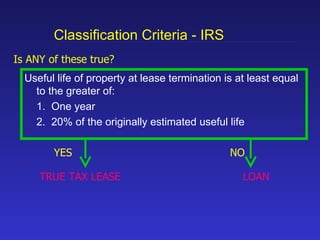
Tax Treatment of Finance Leases From an IRS perspective, there is no concept of ‘finance lease.’ If the lease looks more like a loan (will the asset be ‘used up’ at the end), it is treated as a loan. A finance lease can be  either  a lease or a loan for tax purposes. Therefore, finance leases usually need separate reports for tax calculations.
Classification Criteria - IRS Useful life of property at lease termination is at least equal to the greater of: 1.  One year 2.  20% of the originally estimated useful life Is ANY of these true? NO YES TRUE TAX LEASE LOAN
Finance Lease Concepts Initial investment  = cash paid to buy the asset going on lease, OR the value of that asset on the books before going on lease, OR the cash given to the lessee to buy the asset Asset RESIDUAL  = the estimated value of the asset at the end of the lease term, since the lessor technically still owns it Implicit interest rate  = a rate calculated by the lessor’s pricing tool, often not revealed to the lessee, and used to process accounting entries for the lease
Loans – Review for Comparison If a finance lease is treated more like a loan… what does a loan look like in the GL? Loans have: Initial principal (borrowed or financed amount) Periodic payments which are made up of  Principal repayments Interest There may be a balloon payment at the end Value at any given time = remaining principal to be paid back
Loans – Example of GL Postings Loan Principal 10000 Principal given to the borrower = 10000 Cash  10000 Notice that any collateral asset  doesn’t appear  on the GL
Loan Payment – Example of GL Postings Loan Principal 10000 Loan payment this period = 100 10 Cash  10000 Interest Income  90 100 (Advanced topic: income may be ACCRUED over time rather than recognized as income upon payment) Loan value is now 9990 Loan payment = principal repayment 10 and interest 90
Loan Math vs. Finance Lease Math LEASE : Total lease  payments  over term +  RESIDUAL  (estimated value of asset at end) - Initial  investment = Total lease  income  over term (at the lessor’s implicit interest rate) LOAN : Total loan  payments  over term +  Balloon  payment, if any - Loan  principal = Total  interest  income over term (at the stated loan interest rate)
Put Another Way… Loan principal =  Future payments  + balloon  –  Future (unearned) interest Lease book value =   Future payments  + Residual  – Future (unearned) income
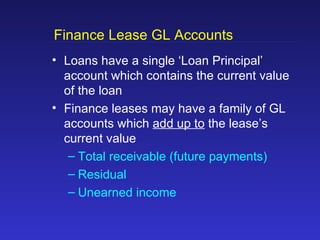
Finance Lease GL Accounts Loans have a single ‘Loan Principal’ account which contains the current value of the loan Finance leases may have a family of GL accounts which  add up to  the lease’s current value Total receivable (future payments) Residual Unearned income
Setting Up the Finance Lease -  Where’s the ‘Asset?’ The lessor used to have a hard ASSET (trucks) on the books, but now they have exchanged it for a LEASE (a financial asset, even if it isn’t a tangible asset). The value of this asset will decrease over time, via AMORTIZATION. Asset Cost Lease Out Amortization Total Rec U/e inc Residual Purchase CASH
Finance Lease GL Postings - Before Hard Asset  10000 + Total rents   30000 + Residual   9000 Investment  -10000 Unearned inc   29000 Total Receivable Unearned Income Residual  Cash  10000
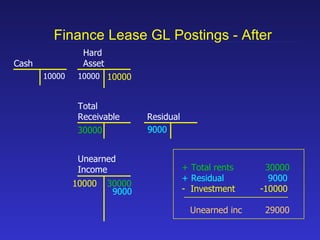
Finance Lease GL Postings - After Hard Asset  10000 + Total rents   30000 + Residual   9000 Investment  -10000 Unearned inc   29000 Total Receivable Unearned Income Residual  Cash  10000 10000 10000 30000 30000 9000 9000
Finance Lease GL Postings - After Hard Asset  10000 + Total rents   30000 + Residual   9000 Investment  -10000 Unearned inc   29000 Total Receivable Unearned Income Residual  Cash  10000 10000 10000 30000 30000 9000 9000 These accounts hold the lease value Notice the hard asset (trucks) have NO VALUE on the books while on a finance lease.
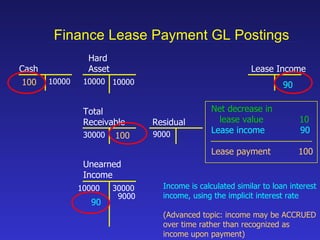
Finance Lease Payment GL Postings Net decrease in  lease value  10 Lease income   90 Lease payment  100 Hard Asset  10000 Total Receivable Unearned Income Residual  Cash  10000 10000 10000 30000 30000 9000 9000 100 90 90 100 Lease Income  Income is calculated similar to loan interest income, using the implicit interest rate (Advanced topic: income may be ACCRUED over time rather than recognized as income upon payment)
End of Lease  In a finance lease, the lessee often purchases the asset from the lessor at the end of the term (or it may be sold as scrap, depending on the value at the time). If the asset is returned to the lessor, and NOT immediately sold, it may need to start depreciating again.
Life of a Finance Lease –  Where’s the ‘Asset?’ CASH Asset Cost Purchase Lease Out End of Lease Sell Depreciation Amortization Total Rec U/e inc Residual

Lease Accounting Basics

  • 1.
    Lease Accounting BasicsFor Non-Accountants Caia Brookes, 2009
  • 2.
    In This Presentation:Different types of leases Basic accounting entries for each lease type Much simplified!! Displayed with T-accounts From the LESSOR’S perspective
  • 3.
    What is aLease? A lessor owns an ASSET The lessor gives a lessee USE of the asset In return, the lessee pays RENT to the lessor periodically How does the lessor represent the asset and the rent on their books?
  • 4.
    What are T-accounts?Asset 1000 Debit on the left Credit on the right Debits must equal credits for any given activity Also can be written: DR Asset 1000 CR Cash 1000 Cash 1000 A way of visualizing an activity hitting your general ledger – each ‘T’ is a general ledger (GL) account
  • 5.
    What are T-accounts?Accounts Payable 1000 Each entry is the result of an activity The BALANCE in the account = Sum of Debits (left column) Sum of Credits (right column) This GL account, ‘Accounts Payable,’ has a CREDIT balance of 700 1000 700
  • 6.
    Before the Lease– Purchasing the Asset The lessor used to have CASH, but now they have exchanged it for an ASSET (in this case, a fleet of trucks). The value of that asset will decrease over time, via depreciation. CASH Asset Cost Purchase Depreciation
  • 7.
    Purchase – Exampleof GL Postings Cash Asset (Trucks) 10000 10000 Cash paid = 10000 * Disclaimer: I made this and the other figures in these examples up! Not necessarily realistic! *
  • 8.
    Depreciation – Exampleof GL Postings Depreciation Asset (Trucks) 10000 50 Depreciation this period = 50 50 Cash 10000 Asset value is now 9950
  • 9.
    Operating Lease Mostbasic type of lease Value at any time is basically the depreciated value of the asset Only additional postings are when rent is received
  • 10.
    Rent Income –Example of GL Postings Depreciation Asset (Trucks) 10000 50 Rent this period = 100 50 Cash 10000 Rent Income 100 100 (Advanced topic: rent may be ACCRUED to income over time rather than recognized as income upon payment)
  • 11.
    Finance Lease (or‘Capital’ Lease) How does a finance lease differ from a regular operating lease? As defined by FASB, if the asset is ‘ used up ’ by the end of the lease, or if it is virtually sold to the lessee, it is considered closer to financing a sale (a LOAN) than simply renting an asset for the lessee’s temporary use.
  • 12.
    Classification Criteria -FAS13 1. Ownership transfers at term? 2. There is a bargain purchase option? 3. Lease term is at least 75% of econ. life? 4. PV of min lease pymts is at least 90% of FMV at inception? (calculated using interest rate implicit in lease) Is ANY of these true? Cost/value at inception = FMV? NO YES YES NO CAPITAL LEASE OPERATING LEASE DIRECT FINANCE LEASE SALES-TYPE LEASE
  • 13.
    Tax Treatment ofFinance Leases From an IRS perspective, there is no concept of ‘finance lease.’ If the lease looks more like a loan (will the asset be ‘used up’ at the end), it is treated as a loan. A finance lease can be either a lease or a loan for tax purposes. Therefore, finance leases usually need separate reports for tax calculations.
  • 14.
    Classification Criteria -IRS Useful life of property at lease termination is at least equal to the greater of: 1. One year 2. 20% of the originally estimated useful life Is ANY of these true? NO YES TRUE TAX LEASE LOAN
  • 15.
    Finance Lease ConceptsInitial investment = cash paid to buy the asset going on lease, OR the value of that asset on the books before going on lease, OR the cash given to the lessee to buy the asset Asset RESIDUAL = the estimated value of the asset at the end of the lease term, since the lessor technically still owns it Implicit interest rate = a rate calculated by the lessor’s pricing tool, often not revealed to the lessee, and used to process accounting entries for the lease
  • 16.
    Loans – Reviewfor Comparison If a finance lease is treated more like a loan… what does a loan look like in the GL? Loans have: Initial principal (borrowed or financed amount) Periodic payments which are made up of Principal repayments Interest There may be a balloon payment at the end Value at any given time = remaining principal to be paid back
  • 17.
    Loans – Exampleof GL Postings Loan Principal 10000 Principal given to the borrower = 10000 Cash 10000 Notice that any collateral asset doesn’t appear on the GL
  • 18.
    Loan Payment –Example of GL Postings Loan Principal 10000 Loan payment this period = 100 10 Cash 10000 Interest Income 90 100 (Advanced topic: income may be ACCRUED over time rather than recognized as income upon payment) Loan value is now 9990 Loan payment = principal repayment 10 and interest 90
  • 19.
    Loan Math vs.Finance Lease Math LEASE : Total lease payments over term + RESIDUAL (estimated value of asset at end) - Initial investment = Total lease income over term (at the lessor’s implicit interest rate) LOAN : Total loan payments over term + Balloon payment, if any - Loan principal = Total interest income over term (at the stated loan interest rate)
  • 20.
    Put Another Way…Loan principal = Future payments + balloon – Future (unearned) interest Lease book value = Future payments + Residual – Future (unearned) income
  • 21.
    Finance Lease GLAccounts Loans have a single ‘Loan Principal’ account which contains the current value of the loan Finance leases may have a family of GL accounts which add up to the lease’s current value Total receivable (future payments) Residual Unearned income
  • 22.
    Setting Up theFinance Lease - Where’s the ‘Asset?’ The lessor used to have a hard ASSET (trucks) on the books, but now they have exchanged it for a LEASE (a financial asset, even if it isn’t a tangible asset). The value of this asset will decrease over time, via AMORTIZATION. Asset Cost Lease Out Amortization Total Rec U/e inc Residual Purchase CASH
  • 23.
    Finance Lease GLPostings - Before Hard Asset 10000 + Total rents 30000 + Residual 9000 Investment -10000 Unearned inc 29000 Total Receivable Unearned Income Residual Cash 10000
  • 24.
    Finance Lease GLPostings - After Hard Asset 10000 + Total rents 30000 + Residual 9000 Investment -10000 Unearned inc 29000 Total Receivable Unearned Income Residual Cash 10000 10000 10000 30000 30000 9000 9000
  • 25.
    Finance Lease GLPostings - After Hard Asset 10000 + Total rents 30000 + Residual 9000 Investment -10000 Unearned inc 29000 Total Receivable Unearned Income Residual Cash 10000 10000 10000 30000 30000 9000 9000 These accounts hold the lease value Notice the hard asset (trucks) have NO VALUE on the books while on a finance lease.
  • 26.
    Finance Lease PaymentGL Postings Net decrease in lease value 10 Lease income 90 Lease payment 100 Hard Asset 10000 Total Receivable Unearned Income Residual Cash 10000 10000 10000 30000 30000 9000 9000 100 90 90 100 Lease Income Income is calculated similar to loan interest income, using the implicit interest rate (Advanced topic: income may be ACCRUED over time rather than recognized as income upon payment)
  • 27.
    End of Lease In a finance lease, the lessee often purchases the asset from the lessor at the end of the term (or it may be sold as scrap, depending on the value at the time). If the asset is returned to the lessor, and NOT immediately sold, it may need to start depreciating again.
  • 28.
    Life of aFinance Lease – Where’s the ‘Asset?’ CASH Asset Cost Purchase Lease Out End of Lease Sell Depreciation Amortization Total Rec U/e inc Residual