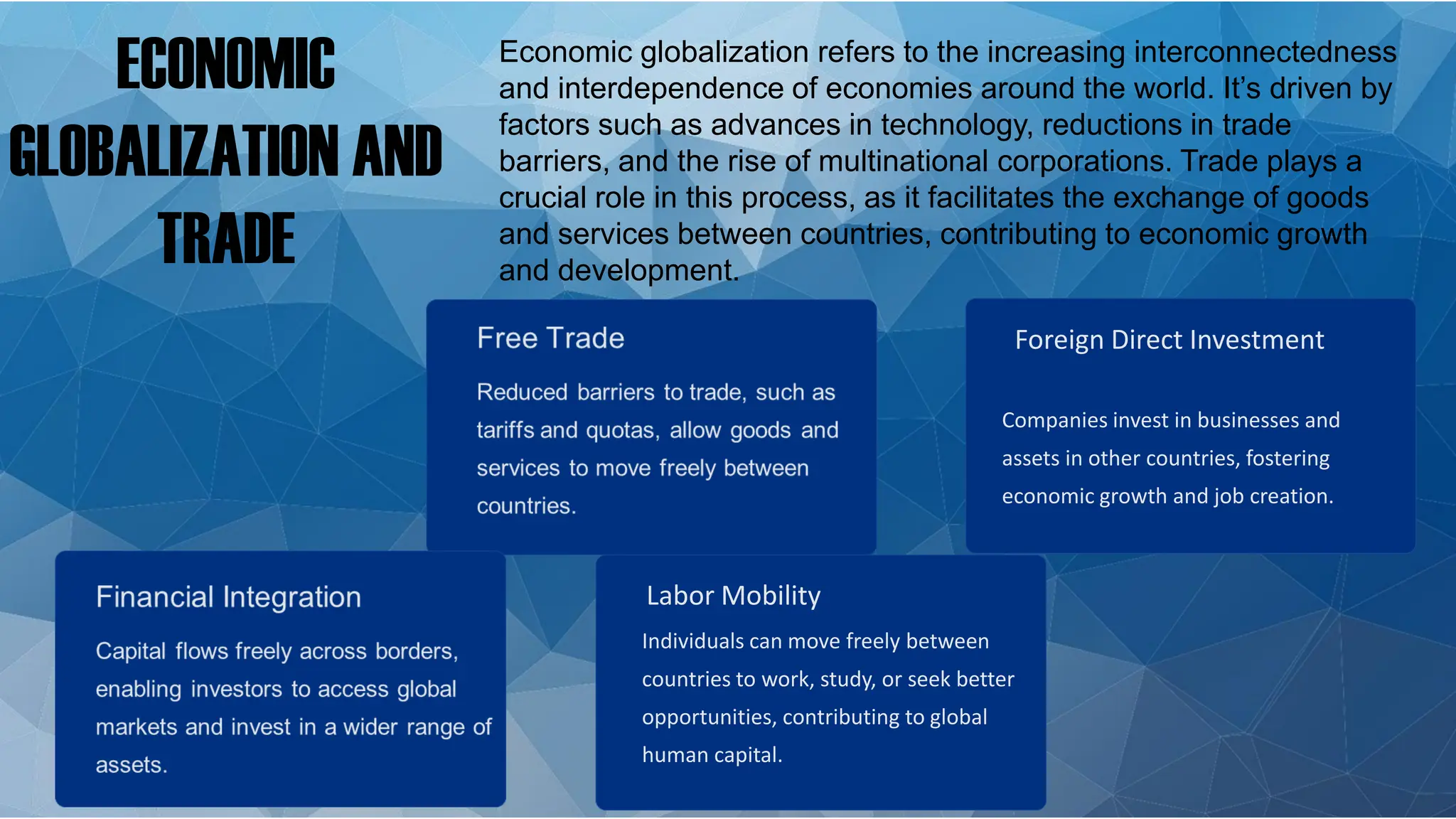
ECONOMIC
GLOBALIZATION AND
TRADE
Economic globalizationrefers to the increasing interconnectedness
and interdependence of economies around the world. It’s driven by
factors such as advances in technology, reductions in trade
barriers, and the rise of multinational corporations. Trade plays a
crucial role in this process, as it facilitates the exchange of goods
and services between countries, contributing to economic growth
and development.
Foreign Direct Investment
Companies invest in businesses and
assets in other countries, fostering
economic growth and job creation.
Labor Mobility
Individuals can move freely between
countries to work, study, or seek better
opportunities, contributing to global
human capital.
Role of ICTsin Globalization
Information and Communication Technologies (ICTs) play
vital roles in the context of globalization by serving as
foundational enablers for cross-border communication,
collaboration, and exchange of knowledge. These
technologies, encompassing a wide range of digital tools and
platforms, facilitate the seamless transmission of information
and data across global networks, supporting and enhancing
the interconnected nature of modern commerce and e-
commerce. Furthermore, ICTs form the backbone of global
connectivity, providing the infrastructure for cross-cultural
interactions, while also driving and shaping the ongoing
technological innovation that characterizes the contemporary
global landscape.
FORMS OF ECONOMY
ProtectionismVS Trade Liberation.
Protectionism: Protecting one’s economy from foreign
competition by creating a trade barrier;
▪ High custom duty,
▪ Limit import products,
▪ Ban import product.
Trade Liberation(Free Trade); reducing trade barriers for easy
global trade.
Institution of EconomicGlobalizational
The institution of economic globalization encompasses a diverse array of
international organizations, agreements, and frameworks that collectively
influence and regulate the global economy. These institutions, which include
entities like the World Trade Organization (WTO), International Monetary Fund
(IMF), and numerous regional trade blocs, play pivotal roles in shaping the
interconnected nature of international trade, investment, and financial systems.
Additionally, they contribute to the development of policies, regulations, and
standards that govern cross-border economic activities and facilitate cooperation
among participating nations.
Expansion of
International
Trade
International tradehas expanded significantly due to globalization. The reduction
of trade barriers and technological advancements have led to a surge in cross-
border commerce.
1 Growth in Trade Volume
The volume of goods and services traded internationally has increased
dramatically in recent decades.
2 Diversification of Trade Flows
Countries are increasingly trading with a wider range of partners, leading to a
more interconnected global economy.
3 Emergence of New Trading Blocs
Regional trade agreements, such as the European Union and NAFTA, have
have facilitated trade and investment among member countries.
Drivers of EconomicGlobalization
Several factors have contributed to the rapid growth of economic
globalization. These drivers include technological advancements,
liberalization of trade and investment policies, and the rise of multinational
multinational corporations.
1
3
Technological Advancements
Advances in transportation,
communication, and information
technology have facilitated global trade
and investment.
Liberalization of Trade Policies
Governments have reduced tariffs and
quotas, fostering a more open and
competitive global marketplace.
Rise of Multinational
Corporations
Large corporations with operations in
multiple countries have played a
significant role in globalizing production
and distribution.
Financial Market Integration
The development of global financial
financial markets has enabled easier
easier access to capital and increased
increased liquidity.
Multinational Corporations andGlobal Supply
Chains
Multinational corporations (MNCs) have been instrumental in driving globalization. They operate in multiple
countries, sourcing inputs, manufacturing goods, and distributing products globally.
Global Sourcing
MNCs often source inputs from
different countries to take advantage of
lower costs and specialized skills.
Global Production
MNCs produce goods in multiple
locations to optimize production
processes and minimize costs.
Global Distribution
MNCs distribute their products globa
through an extensive network of
warehouses and distribution channe
Liberalization of FinancialMarkets
Globalization has led to the liberalization of financial markets, allowing for greater capital flows across
borders. This has increased access to financing for businesses and investors worldwide.
Increased Capital Flows Capital flows freely between countries, providing
more investment opportunities.
Lower Borrowing Costs Access to global financial markets reduces borrowing
costs for businesses and governments.
Enhanced Liquidity Global financial markets provide greater liquidity,
making it easier to buy and sell assets.
Challenges and Criticismsof Economic Globalization
Globalization has faced criticism from various stakeholders, who argue that it has exacerbated
inequality, undermined labor rights, and contributed to environmental degradation.
1 Income Inequality
Globalization has led to increased
income inequality, as some workers
have lost jobs or seen their wages
decline.
2 Exploitation of Labor
Critics argue that globalization has led
to the exploitation of labor in
developing countries, as companies
seek to minimize costs.
3
Globalization has increased pollution
and resource depletion, as companies
move production to countries with
weaker environmental regulations.
4 Loss of Cultural Identity
Some critics argue that globalization
has led to the homogenization of
cultures, as Western products and
values become dominant.
Environmental Degradation
21.
Conclusion and FutureOutlook
Economic globalization is an ongoing process that has reshaped the global economy. While it has brought benefits in
terms of economic growth and increased trade, it has also presented challenges related to inequality, environmental
sustainability, and cultural homogenization.
The future of globalization will likely be shaped by technological advancements, changing geopolitical dynamics, and
evolving social values. It is essential to address the challenges of globalization while harnessing its potential to promote
economic prosperity and social well-being.