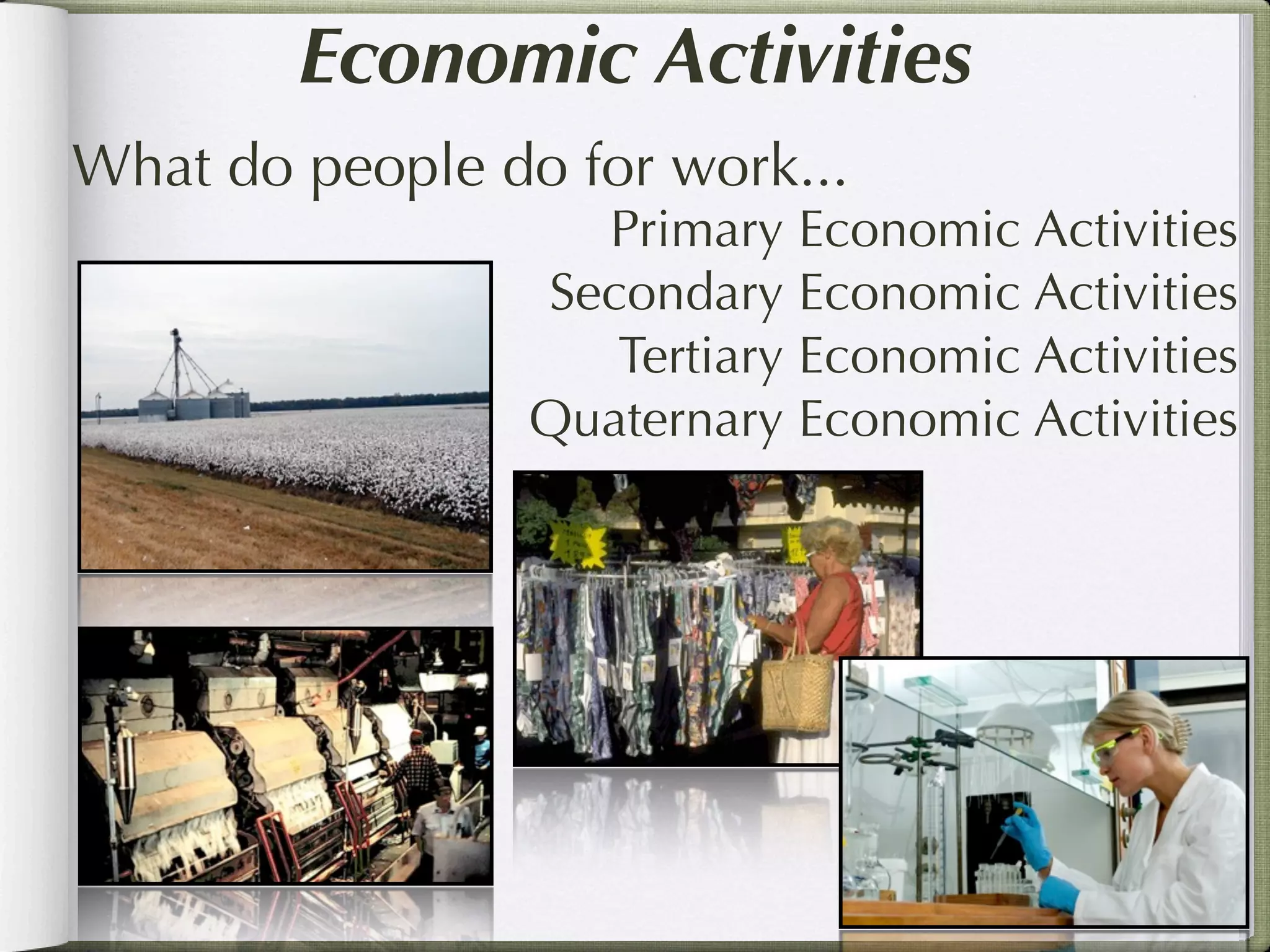
Economic Activities
What do people do for work...
                   Primary Economic Activities
                 Secondary Economic Activities
                    Tertiary Economic Activities
                 Quaternary Economic Activities
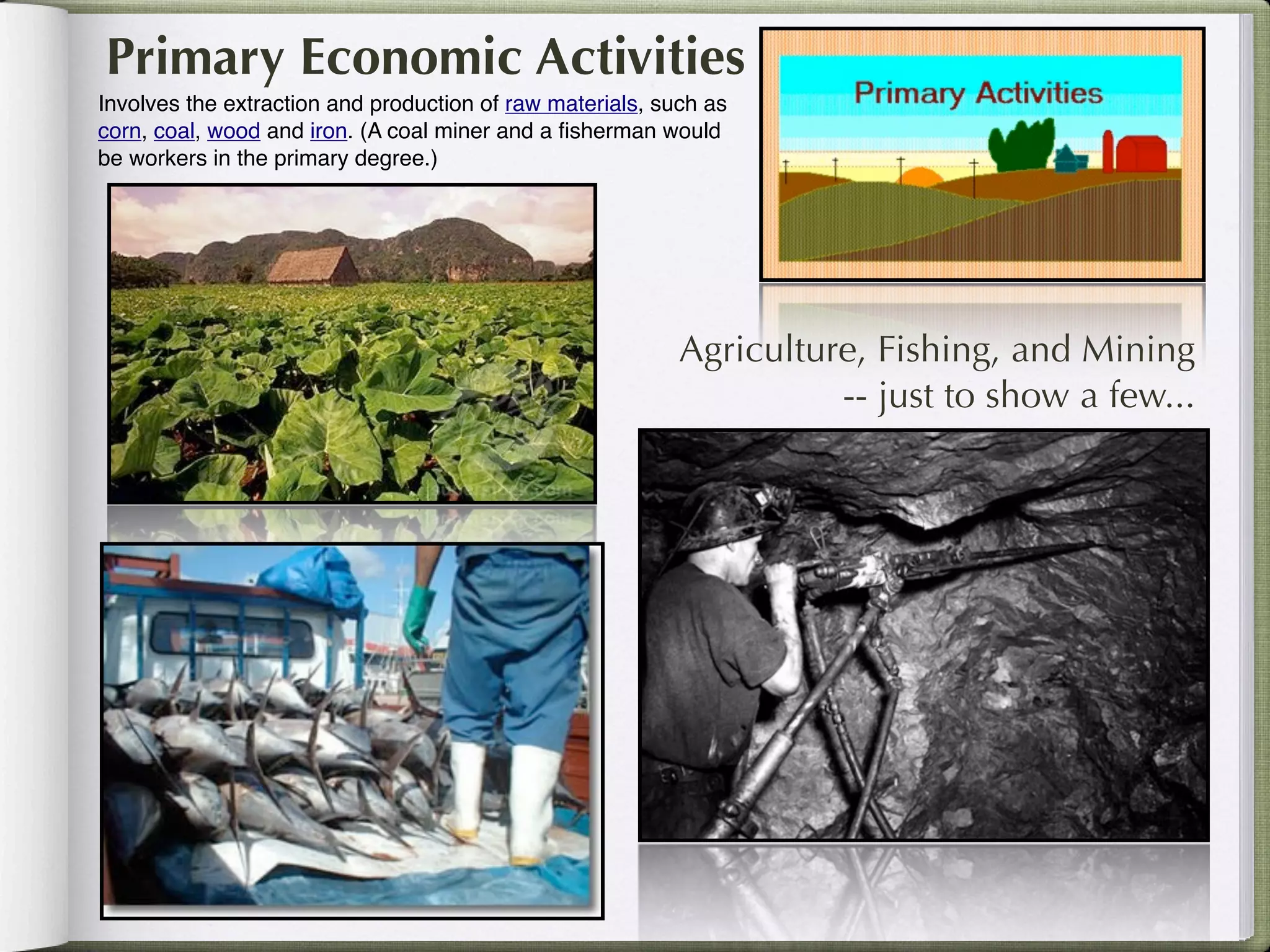
Primary Economic Activities
Involves the extraction and production of raw materials, such as
corn, coal, wood and iron. (A coal miner and a fisherman would
be workers in the primary degree.)


                                                           Agriculture, Fishing, and Mining
                                                                     -- just to show a few...
Secondary Economic Activities
Involves the transformation of raw or intermediate materials into goods
e.g. manufacturing steel into cars, or textiles into clothing. (A builder and
a dressmaker would be workers in the secondary degree.)
Tertiary Economic Activities
The tertiary sector of the economy is the service industry.
This sector provides services to the general population
and to businesses. Activities associated with this sector
include retail and wholesale sales, transportation and
distribution, entertainment (movies, television, radio,
music, theater, etc.), restaurants, clerical services, media,
tourism, insurance, banking, healthcare, and law.
Quaternary Economic Activities
The quaternary sector of the economy consists of intellectual
activities. Activities associated with this sector include government,
culture, libraries, scientific research, education, and information
technology.

Some consider there to be a branch of the quaternary sector called
the quinary sector, which includes the highest levels of decision
making in a society or economy. This sector would include the top
executives or officials in such fields as government, science,
universities, nonprofit, healthcare, culture, and the media.
Levels of Development
of Nations


Underdeveloped Countries...
              Developing Countries...
                             Developed Countries...
Underdeveloped and Developing
Countries
Economically underdeveloped countries of Asia, Africa, Oceania, and
Latin America, considered as an entity with common characteristics,
such as poverty, high birthrates, and economic dependence on the
advanced countries.

Developing countries show progress of political, social and
economical development.
Underdeveloped and Developing Countries
The development of a country is measured with statistical indexes such as per
capita (per person) income, GDP (gross domestic product), life expectancy, the rate
of literacy, et cetera. The UN has developed the Human Development Index (HDI),
a compound indicator of the above statistics, to gauge the level of human
development for countries where data is available.
Developing countries are in general countries which have not achieved a significant
degree of industrialization relative to their populations, and which have, in most
cases a medium to low standard of living. There is a strong correlation between
low income and high population growth.
Developed Countries
Commercial vs Cottage Industry


             Commercial Industry
              allows for mass production, & for
                products to be sold in markets.
Commercial vs Cottage Industry


                                     Cottage Industry
                    Using little advance technology, this industry
                   usually involves production of goods by hand
                              in shops in or near workers’ homes.
Commercial vs Cottage Industry
Subsistence Farming/Hunting
Residents grow or hunt only enough food to feed their
families or villages. This agricultural method is used
mostly in developing countries.
Commercial Farming

Cultural Geography - Economic Activities

  • 1.
    Economic Activities What dopeople do for work... Primary Economic Activities Secondary Economic Activities Tertiary Economic Activities Quaternary Economic Activities
  • 2.
    Primary Economic Activities Involvesthe extraction and production of raw materials, such as corn, coal, wood and iron. (A coal miner and a fisherman would be workers in the primary degree.) Agriculture, Fishing, and Mining -- just to show a few...
  • 3.
    Secondary Economic Activities Involvesthe transformation of raw or intermediate materials into goods e.g. manufacturing steel into cars, or textiles into clothing. (A builder and a dressmaker would be workers in the secondary degree.)
  • 4.
    Tertiary Economic Activities Thetertiary sector of the economy is the service industry. This sector provides services to the general population and to businesses. Activities associated with this sector include retail and wholesale sales, transportation and distribution, entertainment (movies, television, radio, music, theater, etc.), restaurants, clerical services, media, tourism, insurance, banking, healthcare, and law.
  • 5.
    Quaternary Economic Activities Thequaternary sector of the economy consists of intellectual activities. Activities associated with this sector include government, culture, libraries, scientific research, education, and information technology. Some consider there to be a branch of the quaternary sector called the quinary sector, which includes the highest levels of decision making in a society or economy. This sector would include the top executives or officials in such fields as government, science, universities, nonprofit, healthcare, culture, and the media.
  • 6.
    Levels of Development ofNations Underdeveloped Countries... Developing Countries... Developed Countries...
  • 7.
    Underdeveloped and Developing Countries Economicallyunderdeveloped countries of Asia, Africa, Oceania, and Latin America, considered as an entity with common characteristics, such as poverty, high birthrates, and economic dependence on the advanced countries. Developing countries show progress of political, social and economical development.
  • 8.
    Underdeveloped and DevelopingCountries The development of a country is measured with statistical indexes such as per capita (per person) income, GDP (gross domestic product), life expectancy, the rate of literacy, et cetera. The UN has developed the Human Development Index (HDI), a compound indicator of the above statistics, to gauge the level of human development for countries where data is available. Developing countries are in general countries which have not achieved a significant degree of industrialization relative to their populations, and which have, in most cases a medium to low standard of living. There is a strong correlation between low income and high population growth.
  • 9.
  • 10.
    Commercial vs CottageIndustry Commercial Industry allows for mass production, & for products to be sold in markets.
  • 11.
    Commercial vs CottageIndustry Cottage Industry Using little advance technology, this industry usually involves production of goods by hand in shops in or near workers’ homes.
  • 12.
  • 13.
    Subsistence Farming/Hunting Residents growor hunt only enough food to feed their families or villages. This agricultural method is used mostly in developing countries.
  • 14.

Editor's Notes