Types of Agriculture
LEARNING OBJECTIVES
1. TO DEFINE THE DIFFERENT TYPES OF AGRICULTURE
2. TO EXPLAIN THE DIFFERENT FACTORS AFFECTING
THESE TYPES OF AGRICULTURE
2.
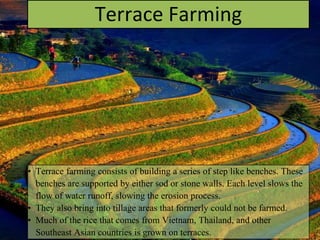
Terrace Farming
• Terrace farming consists of building a series of step like benches. These
benches are supported by either sod or stone walls. Each level slows the
flow of water runoff, slowing the erosion process.
• They also bring into tillage areas that formerly could not be farmed.
• Much of the rice that comes from Vietnam, Thailand, and other
Southeast Asian countries is grown on terraces.
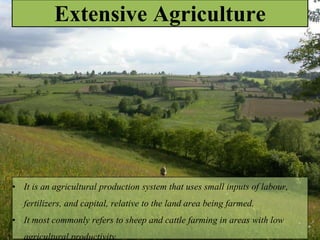
Extensive Agriculture
• It is an agricultural production system that uses small inputs of labour,
fertilizers, and capital, relative to the land area being farmed.
• It most commonly refers to sheep and cattle farming in areas with low
agricultural productivity
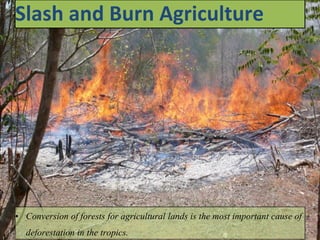
Slash and Burn Agriculture
• Conversion of forests for agricultural lands is the most important cause of
deforestation in the tropics.
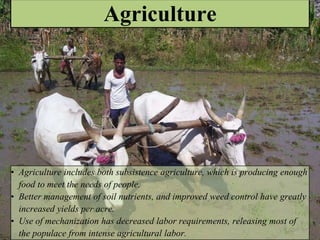
Agriculture
• Agriculture includes both subsistence agriculture, which is producing enough
food to meet the needs of people.
• Better management of soil nutrients, and improved weed control have greatly
increased yields per acre.
• Use of mechanization has decreased labor requirements, releasing most of
the populace from intense agricultural labor.
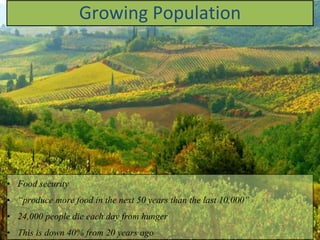
Growing Population
• Food security
• “produce more food in the next 50 years than the last 10,000”
• 24,000 people die each day from hunger
• This is down 40% from 20 years ago
• Pinpoint fertilizer applications based on yields
• Improved seed technologies decrease need for
pesticides/
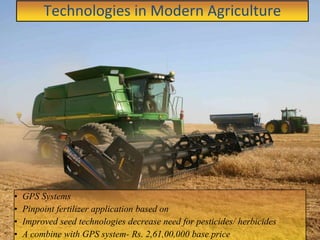
• GPS Systems
• Pinpoint fertilizer application based on
• Improved seed technologies decrease need for pesticides/ herbicides
• A combine with GPS system- Rs. 2,61,00,000 base price
Technologies in Modern Agriculture
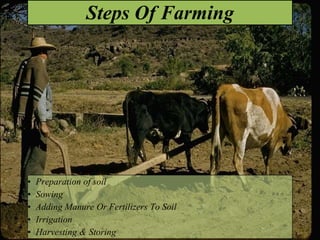
Steps Of Farming
• Preparation of soil
• Sowing
• Adding Manure Or Fertilizers To Soil
• Irrigation
• Harvesting & Storing
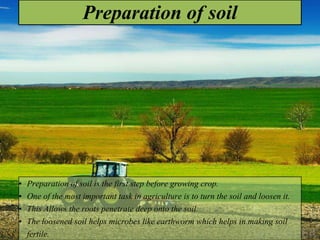
• Preparation of soil is the first step before growing crop.
• One of the most important task in agriculture is to turn the soil and loosen it.
• This Allows the roots penetrate deep onto the soil.
• The loosened soil helps microbes like earthworm which helps in making soil
fertile.
Preparation of soil
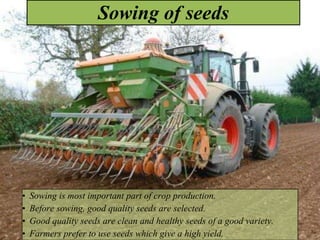
Sowing of seeds
• Sowing is most important part of crop production.
• Before sowing, good quality seeds are selected.
• Good quality seeds are clean and healthy seeds of a good variety.
• Farmers prefer to use seeds which give a high yield.
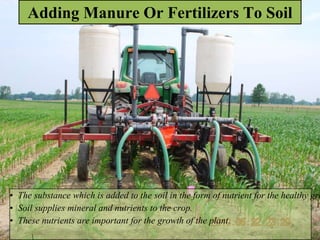
Adding Manure Or Fertilizers To Soil
• The substance which is added to the soil in the form of nutrient for the healthy gro
• Soil supplies mineral and nutrients to the crop.
• These nutrients are important for the growth of the plant.
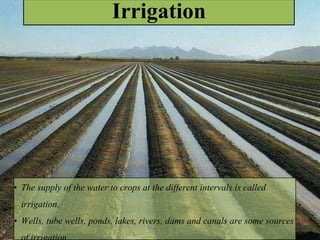
Irrigation
• The supply of the water to crops at the different intervals is called
irrigation.
• Wells, tube wells, ponds, lakes, rivers, dams and canals are some sources
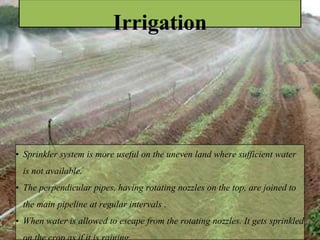
intervals . When water is allowed to escape from the rotating
Irrigation
• Sprinkler system is more useful on the uneven land where sufficient water
is not available.
• The perpendicular pipes, having rotating nozzles on the top, are joined to
the main pipeline at regular intervals .
• When water is allowed to escape from the rotating nozzles. It gets sprinkled
Irrigation
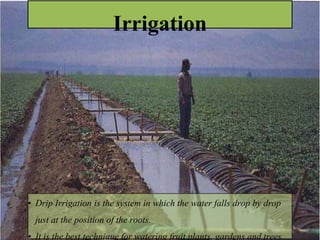
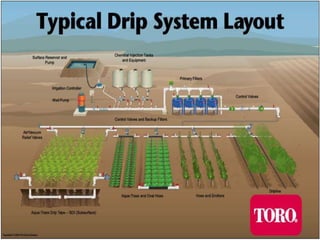
• Drip Irrigation is the system in which the water falls drop by drop
just at the position of the roots.
• It is the best technique for watering fruit plants, gardens and trees.
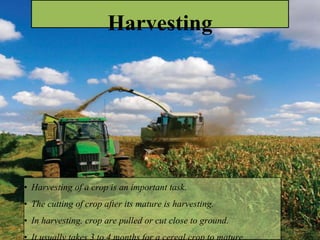
ground. It usually takes 3 to 4 months for a cereal crop to mature.
Harvesting
• Harvesting of a crop is an important task.
• The cutting of crop after its mature is harvesting.
• In harvesting, crop are pulled or cut close to ground.
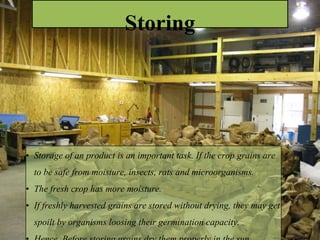
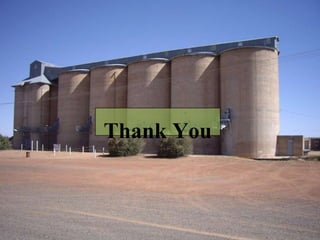
Storing
• Storage of an product is an important task. If the crop grains are
to be safe from moisture, insects, rats and microorganisms.
• The fresh crop has more moisture.
• If freshly harvested grains are stored without drying, they may get
spoilt by organisms loosing their germination capacity.
Thank You

Topic 21 Agriculture

  • 1.
    Types of Agriculture LEARNINGOBJECTIVES 1. TO DEFINE THE DIFFERENT TYPES OF AGRICULTURE 2. TO EXPLAIN THE DIFFERENT FACTORS AFFECTING THESE TYPES OF AGRICULTURE 2.
  • 2.
    Terrace Farming • Terracefarming consists of building a series of step like benches. These benches are supported by either sod or stone walls. Each level slows the flow of water runoff, slowing the erosion process. • They also bring into tillage areas that formerly could not be farmed. • Much of the rice that comes from Vietnam, Thailand, and other Southeast Asian countries is grown on terraces.
  • 3.
    Extensive Agriculture • Itis an agricultural production system that uses small inputs of labour, fertilizers, and capital, relative to the land area being farmed. • It most commonly refers to sheep and cattle farming in areas with low agricultural productivity
  • 4.
    Slash and BurnAgriculture • Conversion of forests for agricultural lands is the most important cause of deforestation in the tropics.
  • 5.
    Agriculture • Agriculture includesboth subsistence agriculture, which is producing enough food to meet the needs of people. • Better management of soil nutrients, and improved weed control have greatly increased yields per acre. • Use of mechanization has decreased labor requirements, releasing most of the populace from intense agricultural labor.
  • 6.
    Growing Population • Foodsecurity • “produce more food in the next 50 years than the last 10,000” • 24,000 people die each day from hunger • This is down 40% from 20 years ago
  • 7.
    • Pinpoint fertilizerapplications based on yields • Improved seed technologies decrease need for pesticides/ • GPS Systems • Pinpoint fertilizer application based on • Improved seed technologies decrease need for pesticides/ herbicides • A combine with GPS system- Rs. 2,61,00,000 base price Technologies in Modern Agriculture
  • 8.
    Steps Of Farming •Preparation of soil • Sowing • Adding Manure Or Fertilizers To Soil • Irrigation • Harvesting & Storing
  • 9.
    • Preparation ofsoil is the first step before growing crop. • One of the most important task in agriculture is to turn the soil and loosen it. • This Allows the roots penetrate deep onto the soil. • The loosened soil helps microbes like earthworm which helps in making soil fertile. Preparation of soil
  • 10.
    Sowing of seeds •Sowing is most important part of crop production. • Before sowing, good quality seeds are selected. • Good quality seeds are clean and healthy seeds of a good variety. • Farmers prefer to use seeds which give a high yield.
  • 11.
    Adding Manure OrFertilizers To Soil • The substance which is added to the soil in the form of nutrient for the healthy gro • Soil supplies mineral and nutrients to the crop. • These nutrients are important for the growth of the plant.
  • 12.
    Irrigation • The supplyof the water to crops at the different intervals is called irrigation. • Wells, tube wells, ponds, lakes, rivers, dams and canals are some sources
  • 13.
    intervals . Whenwater is allowed to escape from the rotating Irrigation • Sprinkler system is more useful on the uneven land where sufficient water is not available. • The perpendicular pipes, having rotating nozzles on the top, are joined to the main pipeline at regular intervals . • When water is allowed to escape from the rotating nozzles. It gets sprinkled
  • 14.
    Irrigation • Drip Irrigationis the system in which the water falls drop by drop just at the position of the roots. • It is the best technique for watering fruit plants, gardens and trees.
  • 16.
    ground. It usuallytakes 3 to 4 months for a cereal crop to mature. Harvesting • Harvesting of a crop is an important task. • The cutting of crop after its mature is harvesting. • In harvesting, crop are pulled or cut close to ground.
  • 17.
    Storing • Storage ofan product is an important task. If the crop grains are to be safe from moisture, insects, rats and microorganisms. • The fresh crop has more moisture. • If freshly harvested grains are stored without drying, they may get spoilt by organisms loosing their germination capacity.
  • 18.